
You’ve spent weeks researching the 4Cs. You know your cut grades from your clarity charts, you’ve agonised over carat weight versus face-up size, and you can explain the difference between eye-clean and flawless to anyone who’ll listen. All of that matters. The centre stone is the main event, of course. But here’s what most buying guides skip entirely: a poorly constructed setting can take an exceptional diamond and make it look ordinary. The setting is the part of the ring most buyers barely consider, and it accounts for at least half of the visual result.
The best ring makers approach settings with the same obsessive precision they bring to stone selection, building every element of a ring around a single goal: making the whole piece work together rather than relying on one stone to carry the load. These are the principles behind that approach, and almost none of them are common knowledge.
The Whole Ring Should Sparkle, Not Just The Centre Stone
When you picture a ring catching the light from across a room, you’re not imagining one bright stone surrounded by dull metal. You’re imagining something that radiates light as a complete piece. That means the stones in the setting need to match the centre diamond in colour and quality.
This gets overlooked more often than you’d think. A centre diamond with exceptional whiteness surrounded by slightly warmer or lower-quality side stones creates visible contrast, and not the good kind. The centre looks brilliant; everything around it looks like an afterthought. Rather than amplifying the main stone, the setting undermines it. What could have been an extraordinary ring ends up looking like a good diamond dropped into something off the shelf.
When the stones are properly matched, light moves across the entire piece without interruption. The ring reads as one unified object rather than a collection of mismatched parts.
Read: The new rules of proposing in 2026

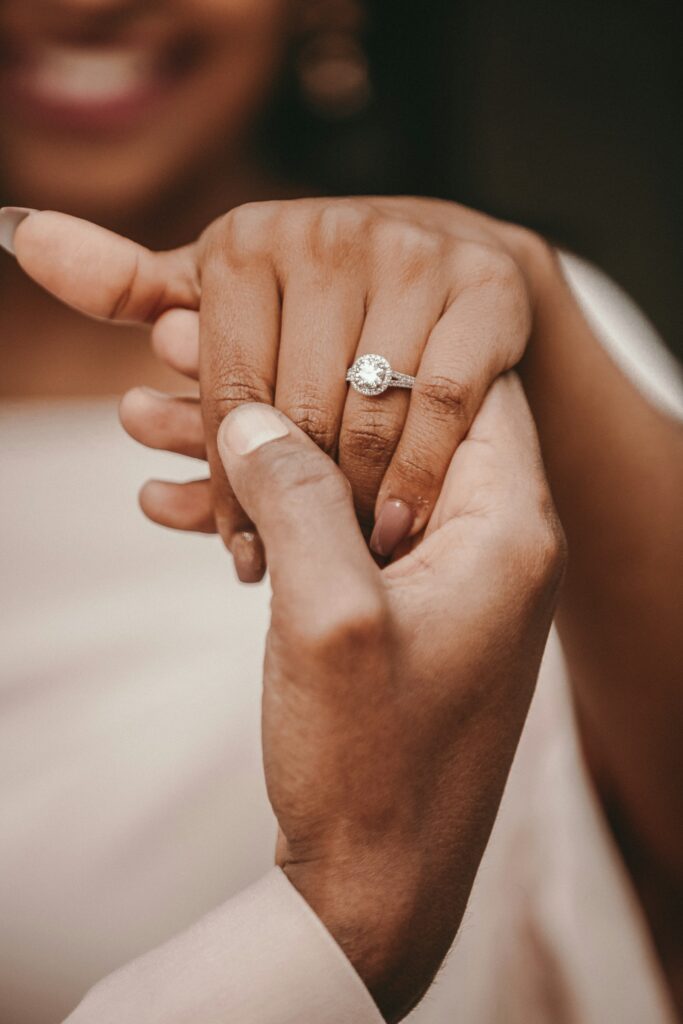
How Proportions Can Make Or Break A Setting
The relationship between the size of the side stones and the centre stone is something most buyers never consciously consider when buying an engagement ring, and it’s one of the most powerful variables in how the finished ring looks.
Side stones that are too large pull the eye outward and make the main diamond look smaller than it is. Too small, and they fail to add anything to the overall brilliance. When the proportions are right, the side stones do exactly what they should: draw the eye toward the centre while adding their own light. The centre stone looks larger and more prominent, not because it changed, but because everything around it is working in its favour.
This extends to the overall geometry of the setting: angles, depth, the relationship between the head and the band. Master diamond setter Vanessa Nicole considers this the most overlooked element of ring design, the idea that every proportion needs to be calibrated so the finished ring functions as a single coherent object rather than an assembly of individual components.

Stone Spacing Matters As Much As The Stones Themselves
Here’s a detail that separates an exceptional setting from an average one, and it’s almost invisible until you know to look for it. The central loose diamond and the other diamongs in a setting should sit so close together they’re practically touching. Not near each other. Almost touching.
When stones are spaced with visible gaps between them, those gaps read as darkness. Instead of a continuous sweep of brilliance across a halo or a pavé band, the eye picks up bright, dark, bright, dark. The sparkle fragments. The ring loses its sense of depth.
There’s a practical dimension too. Gaps between stones are exactly where soap residue, hand lotion and the general grime of daily life accumulate. A ring with widely spaced stones dulls faster and more noticeably than one where the stones sit tight. What looked bright in the jeweller’s case starts looking flat after a few months of real wear. Most people don’t think about maintenance when they’re choosing a ring, but the way a setting is built determines how much upkeep it needs. Tighter placement means less cleaning, less buildup, and a ring that holds its look for longer without professional intervention.
Tight stone placement takes genuine precision, more time, and more skill, which is exactly why it isn’t the default at most price points.

How Your Choice Of Metal Changes The Way A Diamond Looks
The metal you choose for the band and setting isn’t just an aesthetic preference. It directly affects how your diamond appears. A diamond with a slight warm tint can look noticeably more yellow when set in white gold or platinum, because the cool metal highlights the warmth by contrast. That same stone set in yellow gold looks cleaner, because the warm tones blend rather than clash. It works the other way too. A colourless diamond in a yellow gold setting can pick up warmth from the metal around it, particularly if the prongs are gold rather than white-tipped.
This is one of the reasons why the best setters think about metal and stone as a pairing rather than separate decisions. The choice of metal should follow the stone, not the other way around. A ring where metal and diamond are working together looks more expensive and more considered than one where they’ve been chosen independently, regardless of what was actually spent.
Read: 8 quirky and unique ways to personalise your engagement ring

Why Prong Shape Matters More Than You Think
The prongs holding your centre stone in place do more than secure the diamond. They either help it sparkle or work against it, and the difference comes down to shape and positioning.
A prong sculpted to follow the natural facets of the diamond, shaped into a sleek claw that flows with the stone’s geometry, essentially disappears. Your eye goes straight to the diamond. A prong that’s simply bent over into a rounded blob sits on top of the stone like a small cap, drawing attention to itself and blocking light in the process. The angle at which a prong meets the facet determines how much light passes through freely and how much gets interrupted.
Height matters too. Prongs that sit too high catch on fabric and hair, but they also lift away from the stone in a way that breaks the line between metal and diamond. A prong that hugs close creates a cleaner, more seamless look. The diamond appears more secure, more intentional, and better set.
Look at all of a ring’s prongs together. They should be even, symmetrical and consistent. Unevenness is one of the clearest signs that the setting work was rushed. If you’re buying in person, ask to see the ring under magnification before committing. Prong work that looks fine to the naked eye can reveal all sorts of inconsistencies under a loupe, and those inconsistencies only become more visible over time as the metal wears.
The Bottom Line
The 4Cs are the right starting point when buying the ideal engagement ring, and understanding them matters. But they describe the diamond in isolation. The ring that actually stops someone mid-sentence is the result of everything working together: stone, setting, proportion, placement. Looking beyond the centre stone and paying attention to how a ring is built, not just what’s in it, is the difference between something that sparkles and something worth staring at.