This second week of March, it’s Food Waste Action Week and National Butchers Week, and today, we’re considering food storage as a way of avoiding food waste.
Should you have got a little over excited over two such major celebrations occuring simultaneously and splashed out big at the butchers, you’re probably wondering how best to store it all correctly. Well, we’re here to help. We’ve teamed up with the masters of meat over at Ginger Pig to give you our 5 IDEAL tips for storing meat safely.
CIRCULATE
With the exception of bacon, meat needs circulating air in the fridge so as not to spoil, so it’s best to remove meat from its packaging once you get it home. Think about how butchers display meat in their counters; this is how it keeps best. Putting your joint of meat on a wire rack allows for best circulation; you could even try your hand at dry aging some beef for a few days in this way, bringing out a deep, complex flavour in the meat. Lovely stuff.
PRIME POSITION
If you’ve got plenty of space in the fridge, your meat will be fine on a plate or rack on the bottom shelf, not touching any other foods (store different meats separately, of course). Not only does this positioning reduce the risk of cross-contamination, but it’s the coldest part too. If you’re tight on space (which isn’t advisable – see below) place your meat on top of some kitchen paper in a clean, sealed, plastic container.
TEMPERATURE & TIMING
Make sure your fridge is running between 1-4°C. Allowing meat to be in the ‘danger zone’ of temperature (that’s between roughly 5 and 63°C, guys) is going to put your stomach in the danger zone, too.
In terms of how long you can store your meat before it’s not safe to eat, of course a little discretion is advised. In general, though…
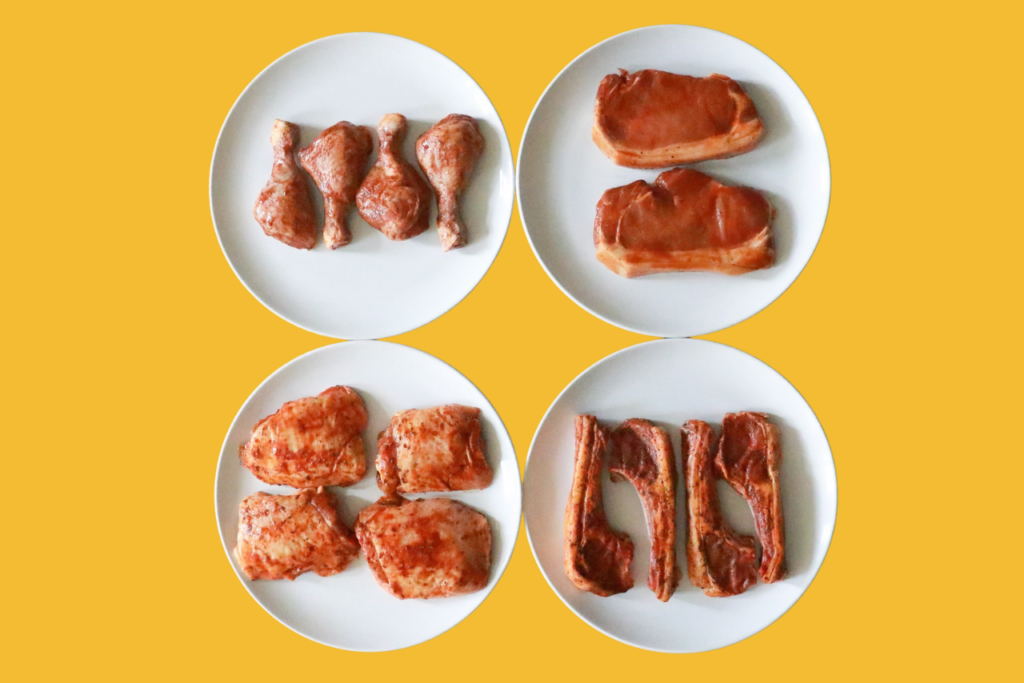
- Sausages, mince, diced meat, chicken pieces, beef and pork ribs keep for approximately 2 days.
- Whole chicken, steaks, roasts (boned and rolled) approximately for 2-3 days.
- Roasts (bone in) for 2-3 days.
- Roasts (bone out) for 3-4 days
- Cured meats (ready to eat) for up to a week.
- Bacon (raw) for 5 days
OVERFILL AT YOUR PERIL
Its advisable for a couple of reasons not to overfill your fridge. Firstly, a fridge which is full to bursting and blocking air vents won’t maintain the correct temperature; a fluctuating atmosphere (exacerbated by constantly opening and closing the door) will do your meat’s condition no favours at all. Secondly, the risk of cross-contamination is greatly enhanced if items are touching.
FREEZING
Instead of overfilling your fridge, consider freezing products you’ve just purchased; retaining their freshness if done properly. Freeze before the meat’s use-by date, make sure it’s properly wrapped (preferably with foil and plastic wrap) to avoid freezer burn, and make sure you thaw thoroughly in the fridge before eating. Never refreeze meat which you’ve previously frozen and defrosted. Happy eating!