Let’s be honest here; Warsaw itself could easily fill a week, between the painstakingly rebuilt Old Town, the sobering history of the Warsaw Uprising, and a food scene that’s finally getting the recognition it deserves. But venture beyond the city limits and you’ll discover a Poland that few visitors take the time to explore.
Already one of Europe’s most affordable city breaks, Warsaw’s central position in the Masovian plains makes it a natural launchpad for day trips in almost every direction. Warszawa Centralna, the main train station, connects efficiently with cities across the country, and within two hours’ travel you can walk through a primeval forest where elk roam freely, stand in the birthplace of one of classical music’s greatest composers, or lose yourself in the Gothic alleyways of a UNESCO World Heritage town.
Whether you’re drawn to nature, music, art, or the kind of history that demands quiet reflection, here are 5 of the most rewarding day trips from Warsaw.
Kampinos National Park
Distance: Immediately northwest of Warsaw (park boundary is within city limits)
Travel time: 30 to 40 minutes by car or city bus
IDEAL for: Nature, hiking, cycling, and wartime history
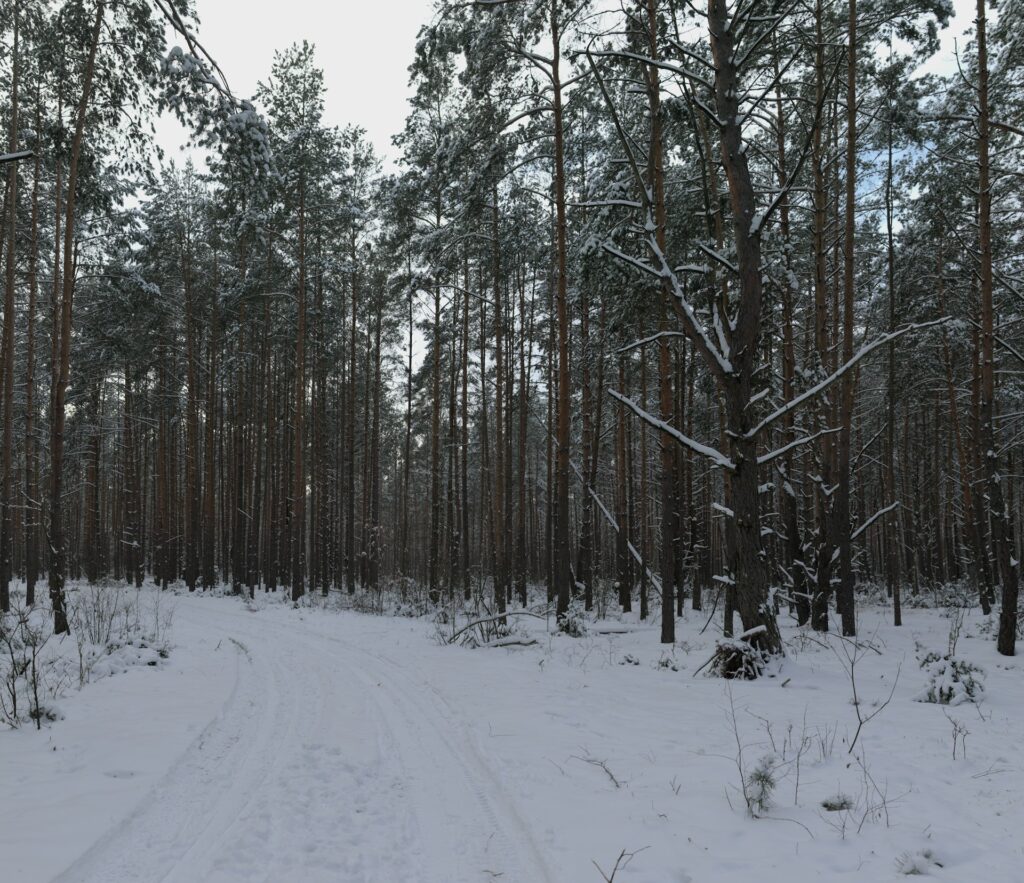
Most European capitals have a municipal park or two. Warsaw borders an actual primeval forest. Kampinos National Park, covering 385 square kilometres of ancient woodland, inland dunes and marshland, was designated a UNESCO Biosphere Reserve in 2000 and functions as the so-called “Green Lungs of Warsaw.”
The park’s landscape was sculpted during the last Ice Age, when glacial processes formed two parallel belts of inland sand dunes separated by boggy depressions and peat marshes. These dunes, reaching heights of 30 metres, are unique in Europe at this scale. The park’s emblem is the elk, reintroduced in the 1950s after disappearing in the 19th century. The population now numbers around 450, and European bison, lynx, beaver, and over 200 bird species also call the forest home.
Beyond the natural world, the Palmiry Cemetery and Museum marks the site where Nazi German forces secretly executed thousands of Warsaw’s inhabitants between 1939 and 1945, lending a contemplative weight to even the most casual walk among the trees.
Getting there: Several Warsaw city buses serve the park, most departing from the Metro Młociny stop. By car, trailheads are 30 to 40 minutes from central Warsaw, and having your own wheels opens up the more remote southern trails that buses don’t reach.
Kaizen RENT car rental in Poland offers pickup from central Warsaw, which is worth considering if you’re planning to combine Kampinos with Żelazowa Wola in the same day. The park offers 360 kilometres of hiking trails and 200 kilometres of cycling routes. For a gentle introduction, try the 3.5-kilometre educational trail from Izabelin, or the Karczmisko trail on wooden footbridges across a peat bog. Visit on weekdays for the best chances of spotting elk.
Żelazowa Wola & Chopin’s Birthplace
Distance: 50km west of Warsaw
Travel time: 1 hour by car; 1.5 hours by train and bus
IDEAL for: Classical music, Polish cultural heritage, and beautiful gardens
On the western edge of the Kampinos Forest, the village of Żelazowa Wola holds a disproportionately large place in Polish cultural life. It was here, in a modest manor house in 1810, that Fryderyk Chopin was born. The Birthplace of Fryderyk Chopin and Park is now a branch of Warsaw’s Fryderyk Chopin Museum, and visitors come as much for the surrounding gardens as for the house itself.
The manor is small and can be toured in under an hour, but the park, with over 60 species of trees, paths winding alongside the Utrata River, and Chopin’s music drifting through the canopy, rewards lingering. Between May and September, open-air Chopin Recitals take place every Saturday and Sunday at noon and 3 PM, with admission included in the standard park entry ticket. They are exactly as lovely as they sound.
Getting there: By car, about an hour from central Warsaw. By public transport, train to Sochaczew (30 minutes) then local bus or taxi for the final 15 minutes. Opening hours vary by season: 10 AM to 8 PM from May to August, 10 AM to 6 PM in March, April, September and October, and 9 AM to 5 PM from November to February. The visit pairs naturally with a morning walk in Kampinos National Park, given its proximity to the forest’s western edge.
Toruń
Distance: 210km northwest of Warsaw
Travel time: 2.5 to 3 hours by car or train
IDEAL for: Medieval architecture, Copernicus, and the world’s best gingerbread
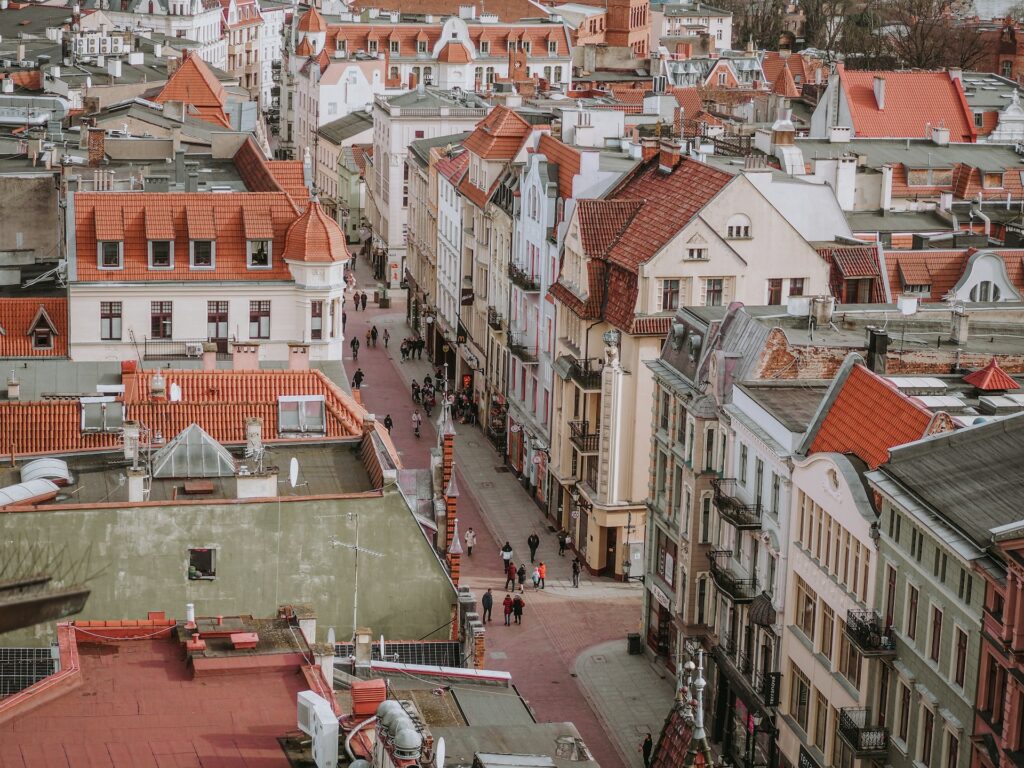
If Krakow’s Old Town is the poster child for Poland’s medieval heritage, Toruń is its quieter, less visited, and arguably better-preserved rival. Inscribed as a UNESCO World Heritage Site in 1997 and voted one of Poland’s Seven Wonders, this Gothic gem on the Vistula survived the Second World War almost entirely intact, a rarity in a country where so many historic centres were reduced to rubble.
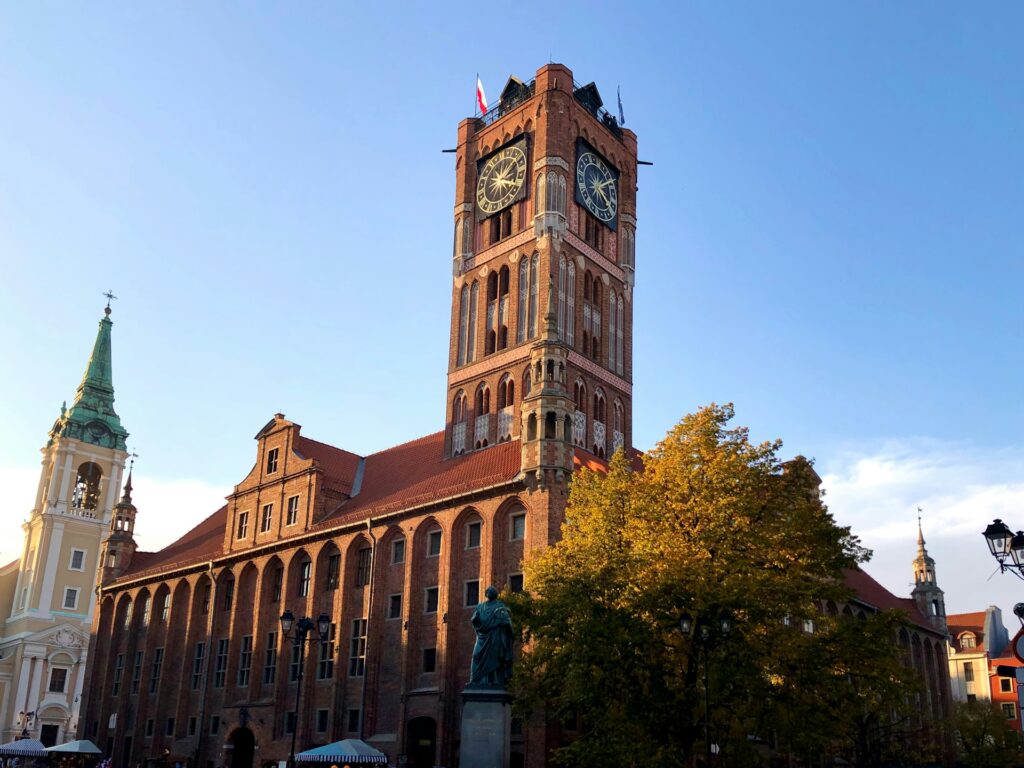
Founded by the Teutonic Knights in 1233 and rapidly grown into a key Hanseatic League trading centre, Toruń’s mercantile wealth is written into its architecture: monumental brick churches, an imposing Old Town Hall, and rows of Gothic townhouses, many still standing on their original medieval plots. The city’s most famous son, Nicolaus Copernicus, was born here in 1473 in a Gothic townhouse now operating as a museum, and the Cathedral where he was baptised houses the Tuba Dei, the largest medieval church bell in Poland at nearly 7,500 kilograms.
Toruń’s most endearing claim to fame, though, is its gingerbread. The city has been baking the stuff since the Middle Ages, and the Living Museum of Gingerbread lets visitors make their own using traditional methods. It’s surprisingly enjoyable, and the product is genuinely good.
Getting there: Direct trains from Warszawa Centralna take approximately 2.5 to 3 hours. The Old Town is walkable from Toruń Główny station. Start at the Market Square, work through the Copernicus House and Cathedral, and allow time for the Gingerbread Museum and the city’s own Leaning Tower. The Christmas market is particularly atmospheric.
Kazimierz Dolny
Distance: 150km southeast of Warsaw
Travel time: 2 hours by car; 2.5 hours by minibus
IDEAL for: Art, Renaissance architecture, and Vistula River scenery
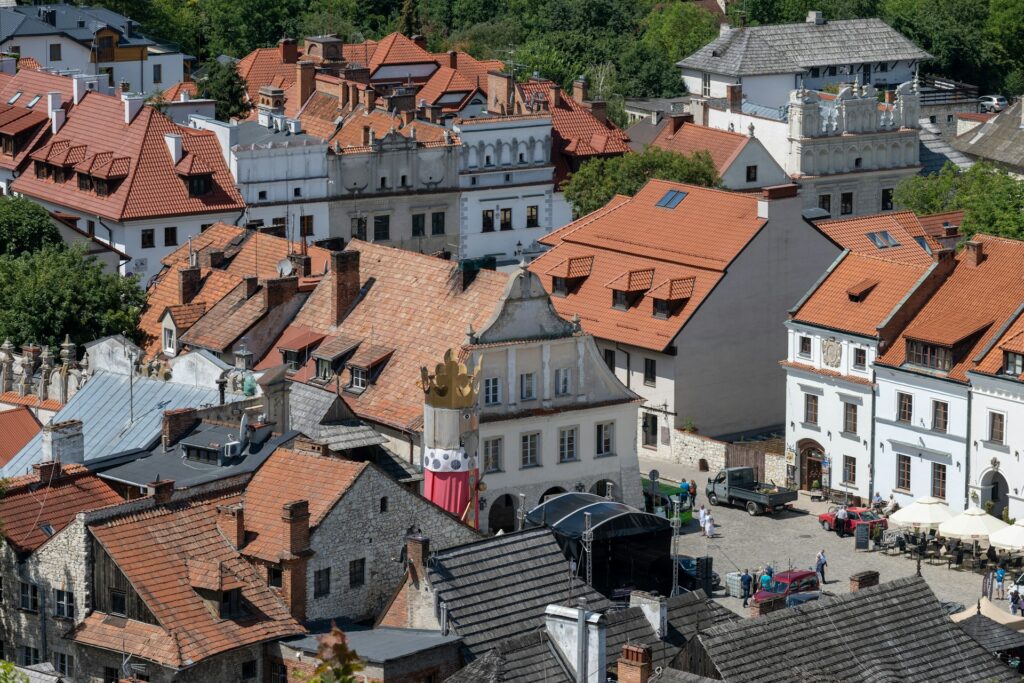
There’s a quality to the light in Kazimierz Dolny that painters have been chasing since the late 19th century. This tiny town of around 2,500 people, perched on the banks of the Vistula and encircled by wooded hills, has been Poland’s unofficial artists’ colony for over a hundred years, and it’s not difficult to understand why.
Founded in the 12th century and granted royal charter by King Casimir the Great, Kazimierz Dolny flourished as a grain trading port. That prosperity built the ornate merchant houses still visible around the Rynek, the main square, most notably the Przybyła tenement houses from the early 17th century. Castle ruins overlook the town from a wooded hill, and the Three Crosses Hill offers panoramic views across the Vistula valley. Today, around 60 galleries line the narrow streets, and stalls selling paintings and folk art cluster around the square each weekend.
Before the Second World War, nearly half of the population was Jewish. The old synagogue still stands on Lubelska Street, and the Jewish cemetery, about two kilometres from the centre, is a moving and largely overlooked site. Don’t leave without trying the kogut, a rooster-shaped semi-sweet bread that has become the town’s edible emblem, its origins tied to a local legend involving a devil, holy water, and the last surviving rooster.
Getting there: Most practical by car (two hours), or by minibus from Warsaw’s Dworzec Zachodni station. The Korzeniowy Dół gorge, a 700-metre loess ravine with exposed ancient tree roots, is exceptional walking. Visit on weekdays to avoid the Warsaw weekend crowd, and bring sturdy shoes for the castle hill.
Read: An alternative 48 hours in Krakow
Łódź
Distance: 130km southwest of Warsaw
Travel time: 1.5 hours by express train
IDEAL for: Street art, post-industrial reinvention, and Poland’s creative underbelly
Łódź (pronounced, approximately, “woodge”) is the day trip most people don’t expect to enjoy as much as they do. Poland’s third-largest city spent years carrying the nickname “the Detroit of Poland” after its textile industry collapsed in the 1990s. But like its American counterpart, Łódź has been reinventing itself with serious ambition, channelling its industrial bones into one of the most interesting creative scenes in Central Europe, recognised in 2017 with UNESCO City of Film status.
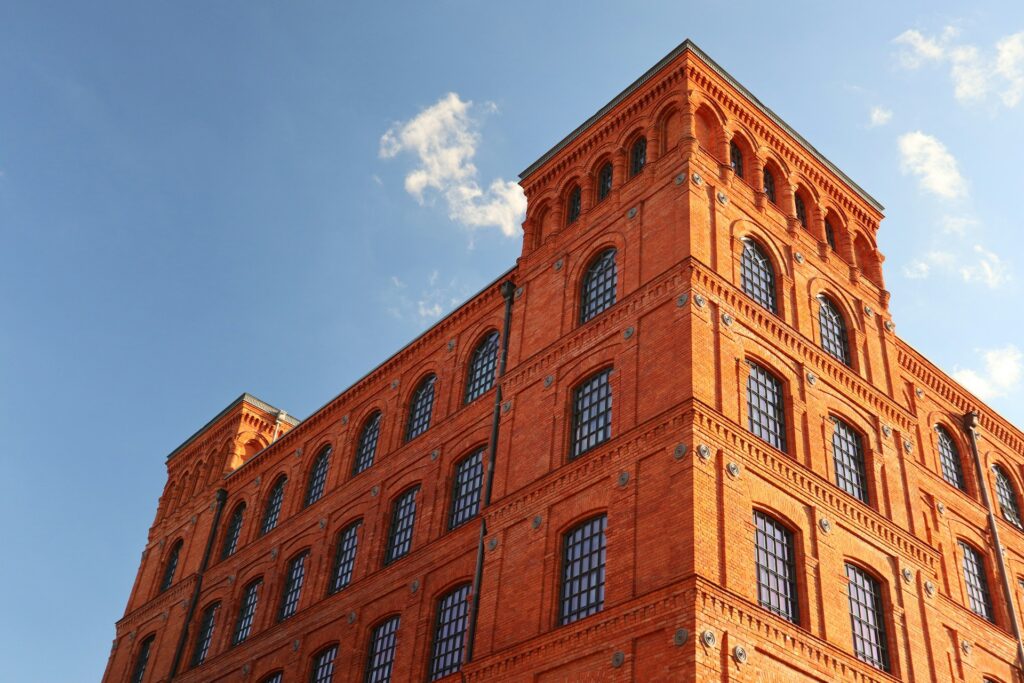
The centrepiece is Manufaktura, a vast complex of red-brick factory buildings now housing the MS2 contemporary art museum, restaurants, shops, and a cinema, the result of Poland’s largest renovation project since the reconstruction of Warsaw’s Old Town. Piotrkowska Street, stretching over four kilometres, is one of the longest commercial streets in Europe, lined with art nouveau buildings, bronze statues commemorating residents like pianist Arthur Rubinstein, and more than 150 murals that have become a defining feature of the city.
For all its creative reinvention, Łódź doesn’t try to hide its rougher edges. Scaffolding coexists with gleaming galleries, and the contrast between dereliction and regeneration is part of what makes the place compelling. It feels unfinished and energetic, a city in transition rather than one posing for photographs.
Getting there: Express trains from Warszawa Centralna reach Łódź Fabryczna, a strikingly modern station in the city centre, in around 1.5 hours. Start at Manufaktura, walk south along Piotrkowska to OFF Piotrkowska (a former cotton mill turned independent creative hub), and eat well for significantly less than you’d pay in Warsaw.
The Bottom Line
Warsaw increasingly functions not just as a destination but as a gateway to the broader character of Poland. These five day trips represent vastly different facets of the country: primeval nature at Kampinos, musical heritage at Żelazowa Wola, medieval grandeur at Toruń, artistic bohemia at Kazimierz Dolny, and creative reinvention at Łódź. Together, they reveal a Poland whose depth extends well beyond its capital.
Talking of which, if Krakow is also on your Polish itinerary, we’ve got you covered. Here’s our guide to the best day trips from Krakow. Just don’t try to do both cities in a week. You’ll need a little longer than that!