Gran Canaria’s capital city tends to get overlooked. Mention the island and most people picture the southern resorts: Maspalomas dunes, Playa del Inglés, poolside buffets.
But Las Palmas, perched on the northeastern tip, is something else entirely: a proper city with a 15th century heart, one of Europe’s finest urban beaches, and a food scene that owes more to Lisbon or Barcelona than to any hotel complex. Two days here offers a different side of Gran Canaria, and a compelling reason to base yourself somewhere with actual character.
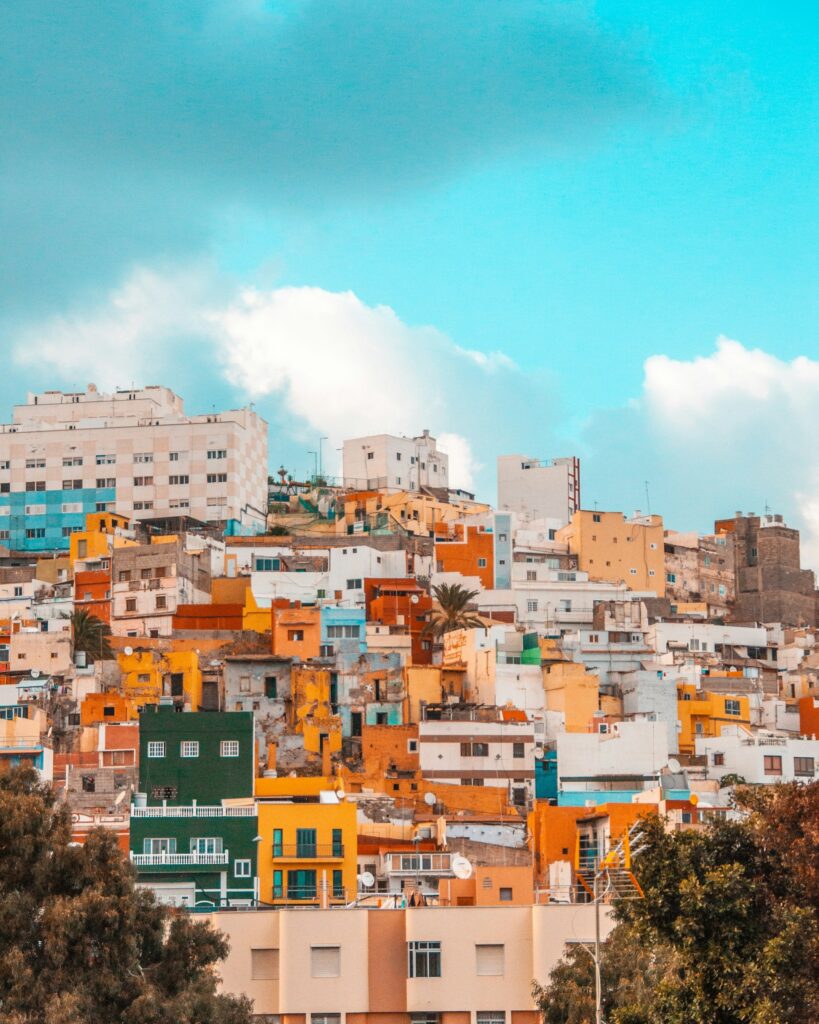
The city spreads across a narrow isthmus connecting the port area to the historic quarters in the south. Most of what you will want to see falls into two distinct zones. To the north, the three-kilometre stretch of Playa de Las Canteras anchors a neighbourhood of surf shops, beachfront cafés and apartment blocks with salt-crusted balconies. To the south, the cobbled lanes of Vegueta and Triana form the city’s colonial core, founded in 1478 and largely unchanged since Christopher Columbus stopped here to pray before sailing west.
Day 1: Columbus, Cobblestones & the Old Town
Morning: Vegueta
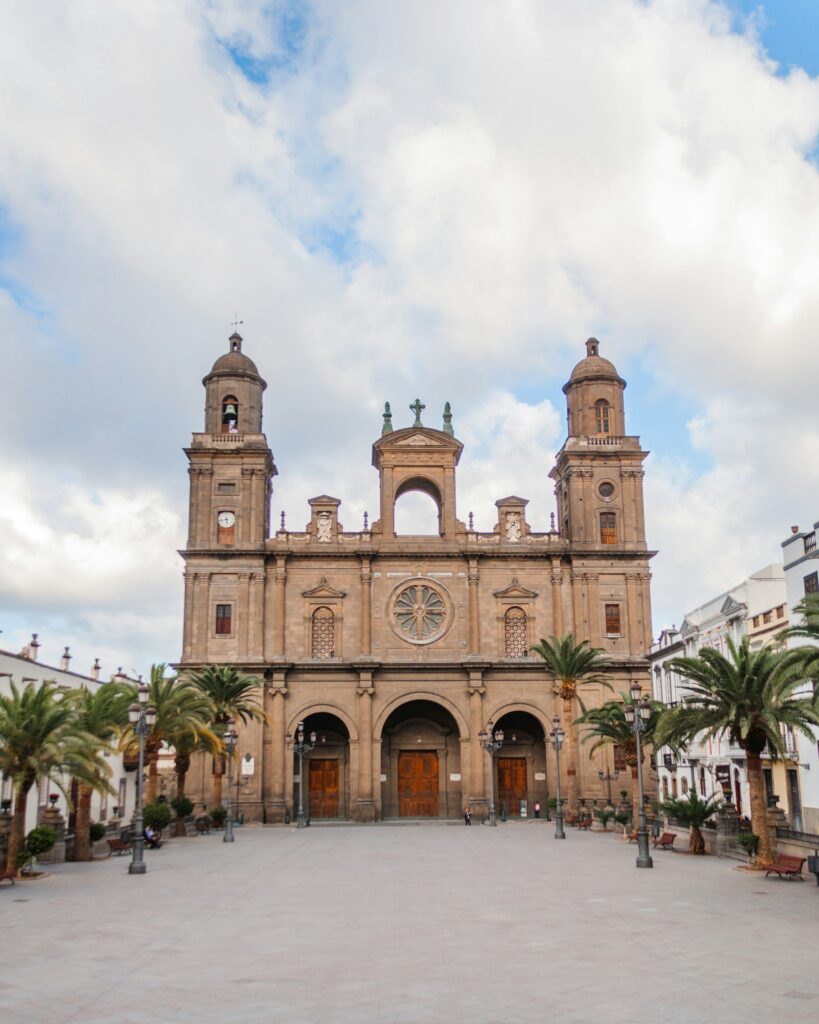
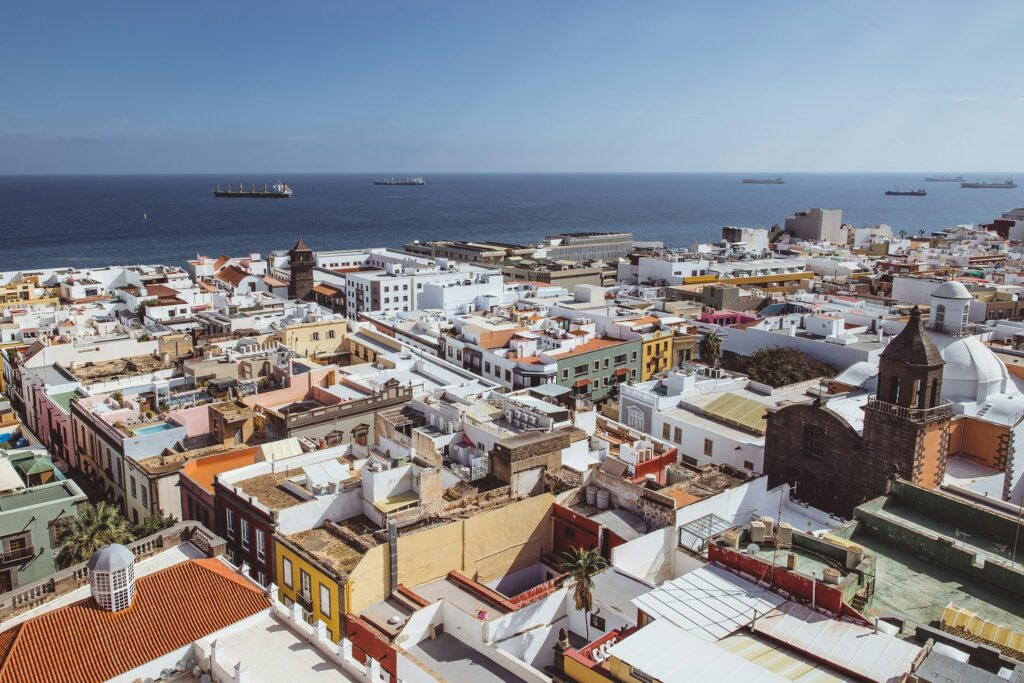
Start in Vegueta, where the city began. The founding site lies on Calle Montesdeoca, a narrow street named after the merchant families who built their houses here in the decades after the Spanish conquest. The hermitage of San Antonio Abad, where Columbus reportedly prayed before his Atlantic crossing, sits at one end of the street, while the grander Plaza de Santa Ana opens up at the other.
The cathedral here took five centuries to complete, which accounts for its architectural confusion: Gothic foundations, Renaissance details, neoclassical flourishes added when someone finally got around to finishing the facade in the 1800s. The interior is worth the modest entrance fee, less for any single feature than for the overall effect of vaulted ceilings and filtered light. The tower lift offers views across the rooftops to the port and, on clear days, the volcanic rim of the caldera at Bandama.
Plaza de Santa Ana itself is flanked by the old town hall, the bishop’s palace and a row of bronze dogs that have become a popular meeting point. From here, the Casa de Colón fills a 15th century governor’s mansion with exhibits on Columbus, Atlantic navigation and the islands’ role as a staging post between Europe and the Americas. The courtyard alone, with its carved wooden balconies and dripping greenery, justifies the entrance fee.
If you want to stay in Vegueta, the Boutique Hotel Cordial Plaza Mayor de Santa Ana occupies a restored building overlooking the cathedral square, with a rooftop terrace that catches morning light and evening breezes. Suites 1478, nearby, offers nine rooms in a converted townhouse with similar views.
Lunch: Mercado de Vegueta
Walk south to the Museo Canario, which houses one of the most significant collections of pre-Hispanic artefacts in the archipelago. The museum covers the indigenous Canarii people, who lived on Gran Canaria before the Spanish arrived, with sections devoted to their mummification practices, cave dwellings and pottery. Some of the skulls on display still bear evidence of trepanning, an early form of surgery that involved drilling holes in the skull to relieve pressure.
For lunch, the Mercado de Vegueta offers stalls selling tropical fruit, local cheeses and cured meats alongside a handful of tapas bars. The market building dates from the 1850s and remains a functioning local institution rather than a tourist attraction, which keeps prices reasonable and quality high. On Sundays, a craft market spills out into the surrounding streets with displays of local singing and dancing.
Afternoon: Triana
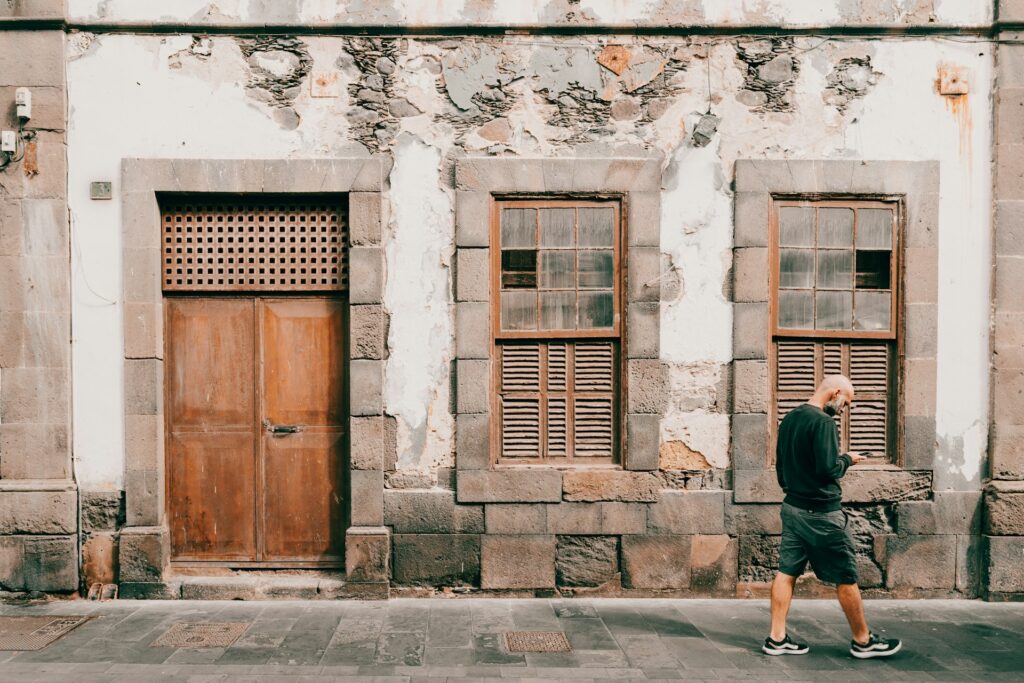
The afternoon might be spent wandering through Triana, the commercial district that developed alongside Vegueta as the city expanded beyond its original walls. Calle Mayor de Triana, now pedestrianised, runs through the centre with a mix of high street chains and older shops selling everything from espadrilles to religious paraphernalia. The art nouveau buildings along here, designed by local architects in the early 20th century, are worth noting: decorative ironwork, coloured tiles and carved stonework that wouldn’t look out of place in Valencia or Brussels.
The two areas are connected by a straightforward bus route to the beach neighbourhood, though the walk between them takes around 40 minutes and passes through everyday neighbourhoods that reveal Las Palmas as a working city rather than a tourist construct.
Evening: Dinner at Casa Montesdeoca
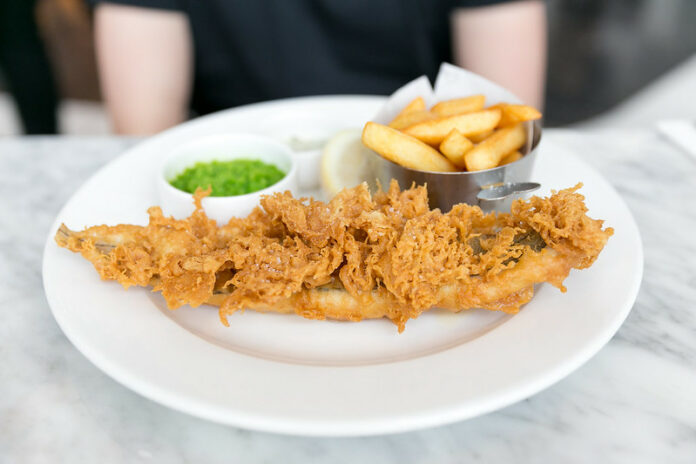
The evening should involve dinner in Vegueta. Casa Montesdeoca occupies a 16th century merchant’s house on the street of the same name, with a courtyard restaurant serving market-driven Canarian cooking. Chef Gustavo Carrasco works primarily with local ingredients (Atlantic fish, island cheeses, vegetables from the interior) in dishes that nod to tradition without being bound by it. The cod with potatoes and grilled octopus in broth has drawn particular praise. Expect to pay around €50 to €100 per person.
Alternatively, the tapas bars along Calle Mendizábal fill up on Thursday evenings for the informal weekly gathering that has become a local tradition. The atmosphere is more social than gastronomic, but the wine is decent and the company reliably convivial.
Day 2: Sand, Surf & the Port Market
Morning: Las Canteras Beach
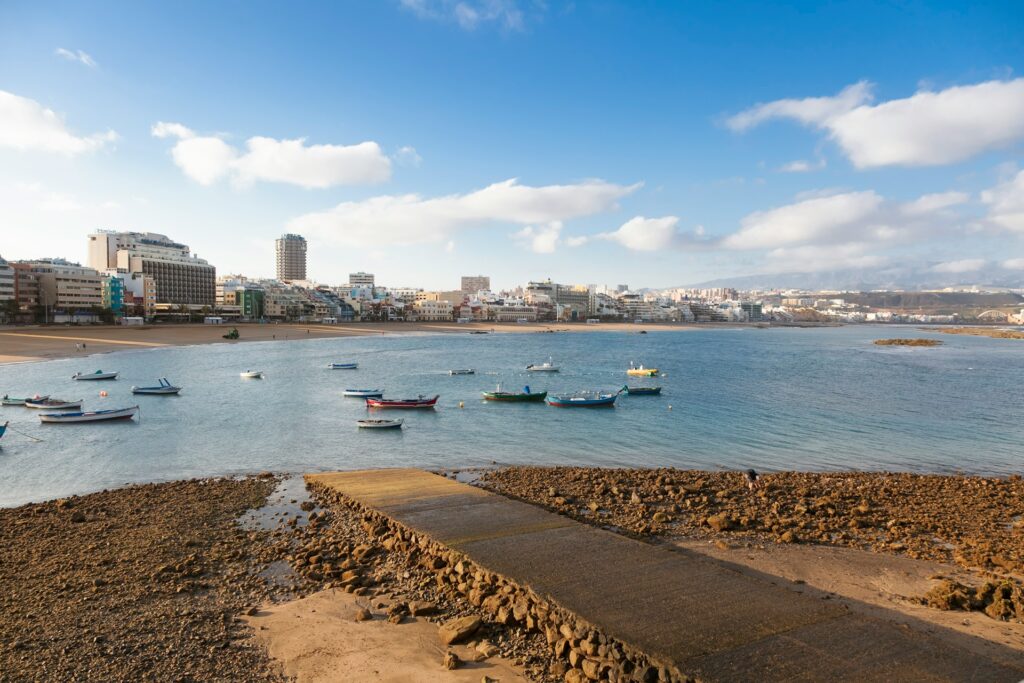
The second day belongs to Las Canteras, widely considered one of the best urban beaches in Europe. The comparison makes sense: three kilometres of golden sand, clear water protected by a volcanic reef, and a promenade lined with cafés and restaurants that cater primarily to locals rather than tourists. The beach operates as a kind of outdoor living room for the city, with runners in the morning, families in the afternoon and couples watching the sunset from the southern end.
La Barra, the natural rock formation that runs parallel to the shore, creates a sheltered lagoon ideal for swimming and snorkelling. At low tide, you can wade out to the reef and watch parrotfish pick at the rocks. The southern section, known as La Cícer, faces the open Atlantic and draws surfers to consistent if modest waves. Several schools along this stretch offer lessons for beginners.
The Paseo de las Canteras, the promenade backing the beach, sustains a long morning’s walk. Start at La Puntilla, the northern point, and work your way south past ice cream shops, seafood restaurants and the occasional sculpture. The buildings facing the beach range from 1960s apartment blocks to recent boutique hotels, giving the strip a pleasantly lived-in quality that newer resort developments rarely achieve.
Lunch: Mercado del Puerto
At the northern end, just back from the beach, the Mercado del Puerto occupies a cast iron market hall designed by engineers from the company of Gustave Eiffel. The building opened in 1891 and was restored in the 1990s as a combined food market and tapas destination. During the day, stalls sell fresh produce, fish and flowers; by evening, the bars around the perimeter fill with locals drinking vermouth and eating pintxos. The atmosphere on Friday and Saturday nights verges on festive.
For those booking Gran Canaria all inclusive holidays in the south, a day trip to Las Palmas and the Mercado del Puerto makes a rewarding addition to a week on the beach. The market feels genuinely local, the prices are fair, and the produce reflects what’s actually grown and caught on the island. It’s an easy way to experience the capital’s character without giving up the convenience of resort accommodation.
For something lighter after the market, the Peña La Vieja ice cream shop, near the central section of the beach, serves some of the best artisan gelato on the island alongside horchata made from tiger nuts.
Afternoon: La Isleta & Castillo de la Luz
The afternoon might include a visit to Poema del Mar, the aquarium near the port, or a walk through La Isleta, the working-class neighbourhood on the peninsula north of the beach. The Castillo de la Luz, a 15th century fortress that once guarded the harbour, now houses a foundation dedicated to the Canarian sculptor Martín Chirino, whose abstract iron works occupy the interior spaces. The castle itself is worth seeing for the views back across the bay to Las Canteras.
From here, the port area offers little of interest unless you’re catching a ferry to Tenerife, but the walk back along the beach as the light softens makes for a fitting end to the weekend.
The Bottom Line
Las Palmas rewards the visitor willing to treat it as a city rather than a gateway to the beach. The combination of colonial history, excellent food and genuine urban life distinguishes it from anywhere else in the Canaries. Two days gives you a proper taste; you may find yourself wishing you had booked three.