
You finished a brutal gym session, the endorphins are flowing, and you feel untouchable. But between the salt, the heat, the friction and the cortisol spike that comes with any high-intensity effort, your face has been through something closer to a stress test than a spa day. Most people towel off and carry on with their morning. And most people are getting the next five minutes completely wrong.
The post-workout window matters as much for your skin as it does for your muscles. Exercise can be one of the best things you do for your complexion – it boosts circulation, strengthens your immune response and supports the trillions of microorganisms that keep your skin balanced. But the way most of us handle the aftermath undoes a lot of that good work. Here are the mistakes worth correcting.
Rushing To Wash Your Face The Moment You Stop
The standard post-workout skincare advice is to wash your face as soon as you finish exercising. It sounds logical – you’re sweaty, so wash it off. But your skin is temporarily more permeable after exercise, thanks to increased blood flow and dilated pores, and reaching for a cleanser at this precise moment can strip an already-disrupted barrier even further.
A 2025 review in Microorganisms found that intensive exercise elevates sweat production, raises skin pH and increases mechanical friction, all of which shift the microbial composition of your skin. Hitting that freshly destabilised environment with a foaming cleanser is like pressure-washing a surface that’s already been sandblasted.
The better approach is to give your skin five to ten minutes to begin cooling naturally. Blot (don’t rub) with a clean towel if you need to. When you do cleanse, use lukewarm water and a gentle, low-pH skincare formula that lifts sweat and oil without taking your natural moisture with it. Dermatologist Tamia Harris-Tryon at UT Southwestern has put it simply: if the water is hot enough to clean your pots and pans of oil, it will strip the natural oils from your skin too.

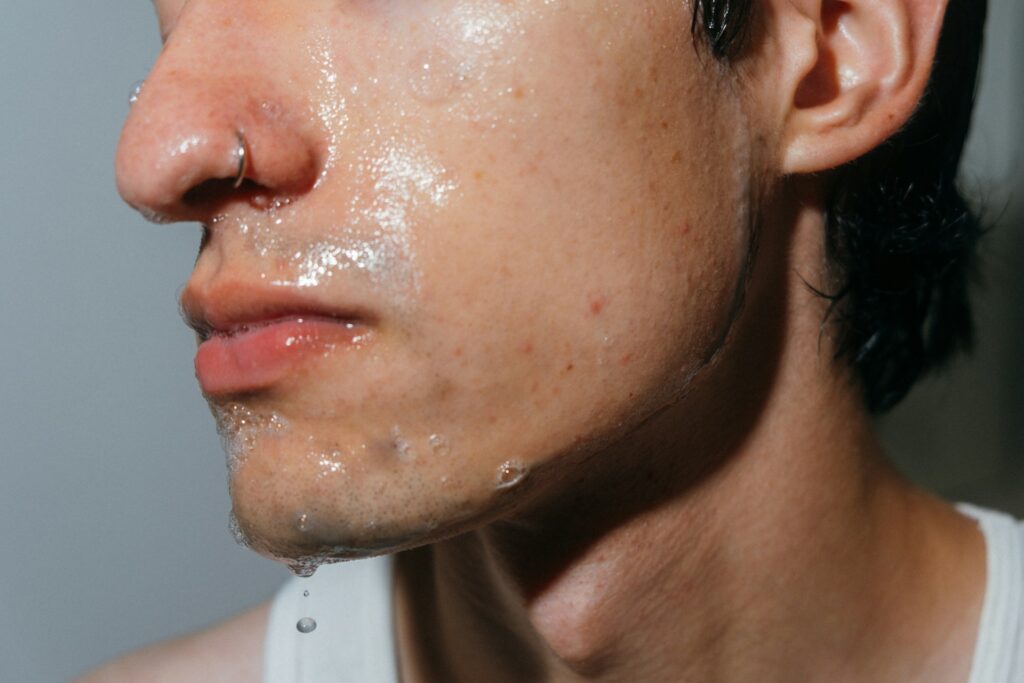
Blaming Sweat For Your Breakouts When It’s Actually Cortisol
If you break out more during heavy training blocks, the instinct is to blame sweat and dirty gym equipment. But the more likely culprit is hormonal. High-intensity exercise triggers a cortisol spike, and cortisol stimulates your sebaceous glands to produce more oil, weakens collagen and elastin, and impairs your skin’s barrier function.
A 2018 study in Scientific Reports found that elevated cortisol in the skin’s outer layer directly correlated with deteriorated barrier function. So while you’re scrubbing your face raw trying to get rid of the sweat, the real problem is happening beneath the surface.
You can’t eliminate the cortisol response, nor would you want to – it’s part of how your body adapts to training. But you can support your skin through it. Products containing niacinamide help regulate the oil production that cortisol triggers, whilst ceramide-rich moisturisers replenish the epidermal lipids it depletes. If your skincare routine doesn’t account for what’s happening hormonally during a hard training block, you’re treating the symptom and missing the cause.
Read: How to feel more energised in the morning in 8 IDEAL hacks


Having Nothing In Your Gym Bag For The Gap Between Finishing & Showering
There’s usually a lag between finishing your workout and actually being able to wash your face – you’re stretching, chatting, driving home, grabbing a coffee. During that window, the bacteria in your sweat are settling into your pores and the salt is drawing moisture out of your skin. Most people just leave their face to marinate until they get to a shower, which is one of the easiest mistakes to fix.
Hypochlorous acid (HOCl) spray is the answer, and it’s the most underrated product in post-workout skincare. Your white blood cells naturally produce this molecule to fight bacteria and reduce inflammation. In a spray, it does the same thing on the surface of your skin: antimicrobial, anti-inflammatory, and gentle enough that it won’t disrupt your microbiome.
Dermatologists are increasingly recommending it as a post-workout bridge – a spritz that neutralises bacteria, calms redness and supports your skin’s pH balance without requiring you to touch your face with gym hands. Keep a bottle next to your water bottle. It buys your skin valuable time.
Skipping Moisturiser Because Your Skin Already Feels Oily
This is one of the most common post-workout mistakes, especially among men, and it creates a vicious cycle. When you sweat, you lose minerals and electrolytes, and your skin’s moisture barrier takes a hit. Post-exercise, transepidermal water loss – the rate at which moisture escapes through your skin – increases measurably. Your face might feel oily, but what’s actually happening underneath is dehydration. And dehydrated skin compensates by producing even more oil, which leads to more congestion, which makes you even less inclined to moisturise. The cycle continues.
A lightweight, water-based moisturiser breaks that loop. It sinks in fast, doesn’t feel heavy, and gives your barrier the support it needs to stop overcompensating. If you’re training hard and frequently, look for products with hyaluronic acid to bind moisture and ceramides to rebuild the barrier. This isn’t an optional extra – it’s as fundamental to your skin’s recovery as protein is to your muscles.


Assuming You Don’t Need SPF After An Indoor Workout
Post-workout skin is temporarily more vulnerable to UV damage. You’ve just increased blood flow to the surface, cleared out your pores and thinned your barrier slightly through sweat and friction. Even the walk from the gym to your car counts. Up to 80% of UV rays penetrate cloud cover, and standard window glass blocks UVB but still lets through a significant amount of skin-ageing UVA. If you trained indoors and assume you’re covered, you’re not.
If the idea of applying thick sunscreen after getting clean fills you with dread, look for mineral or zinc-based formulas with a matte finish. Modern formulations are so light they feel like nothing. This is the single most effective anti-ageing step in any skincare routine, full stop, and skipping it after exercise – when your skin is at its most exposed – is the worst possible time to forget.
Stopping Your Skincare Routine At Your Chin
The neck and chest have thinner skin, fewer oil glands and are prime territory for sweat to pool during exercise. Yet most people stop everything at the jawline and then wonder why they’re dealing with irritation and breakouts on their neck and chest.
During a workout, sweat collects in the folds of the neck and across the décolletage, creating exactly the warm, damp conditions that bacteria thrive in. Tight workout clothes make it worse, trapping sweat against the skin for the duration of your session and well beyond it if you don’t change promptly.
If you’re cleansing, moisturising and applying SPF to your face but ignoring everything below it, you’re leaving the most vulnerable skin on your body completely unprotected. Take every product all the way down to the collarbone, and change out of damp gym kit as soon as you can.
The Bottom Line
None of these mistakes are catastrophic on their own, but stack them up over months and years of regular training and they add up to a complexion that’s working against you rather than with you.
The fixes are simple: wait a few minutes before cleansing, carry a hypochlorous acid spray for the in-between window, moisturise even when your skin feels oily, never skip SPF after a session, and take everything below the jawline. Five minutes of the right post-workout care is worth more than a twelve-step evening routine that ignores what your skin actually went through at 7am. How about that, then?