There’s a running gag among people who’ve road-tripped Ireland that the journey always takes twice as long as planned. Not because the roads are bad, though some of them genuinely are, but because you keep pulling over. A waterfall here. A ruin on a hillside there. A pub that looks too good to drive past, with smoke curling from its chimney at three in the afternoon and a hand-painted sign promising music later. Before you know it, you’ve added an hour to the day and you don’t mind in the slightest.
A campervan is, in many ways, the perfect vehicle for this kind of travel. You aren’t racing a check-in time. You aren’t paying for a hotel room you’ll barely use. You’re simply moving when the mood strikes and stopping when it doesn’t. In a country where the weather is famously contrary and the landscape changes character every twenty miles, having your bed and your kettle and a roof over both feels less like a luxury than a sensible bit of forward planning.
If you’ve never done a trip like this before, Ireland is one of the most forgiving places in Europe to start. Distances are short. The driving culture is patient. Here’s what to know before you go.
Getting The Van Across In The First Place
If you’re bringing your own van from the UK, the two main ferry routes into the Republic are Holyhead to Dublin (around 3h25 on the standard crossing, or 2h15 on Irish Ferries’ Dublin Swift) and Pembroke or Fishguard to Rosslare (3h30 to 4h, useful if you’re heading straight into the south or west). Or, if you’re planning to start out in Northern Ireland and work your way down, Cairnryan to Belfast or Larne is about 2h15 and ideal if you’re driving from Scotland. Book well ahead in July and August; campervan slots on the popular sailings go quickly and walk-on pricing for a vehicle is rarely kind.
That said, hiring locally is often the easier option for a first trip. Comparison platforms like Campstar let you filter by pickup location and trip length across multiple Irish suppliers in one go, which saves the tedium of opening fifteen browser tabs to work out whether the Galway pickup with the better price has a fixed bed or a convertible dinette.
Picking Your Route
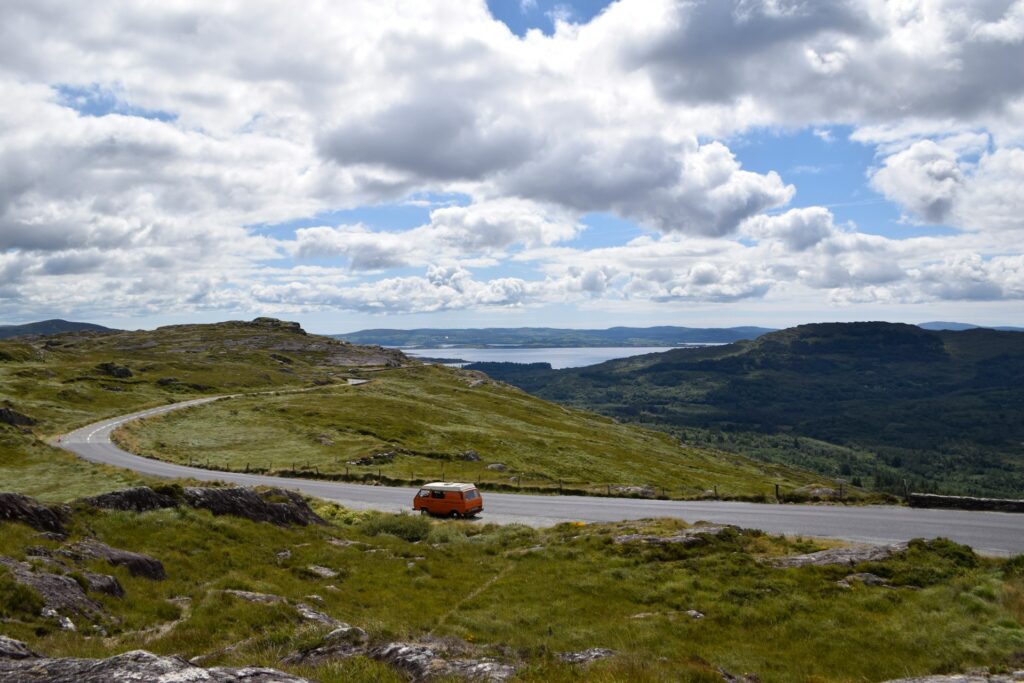
Ireland rewards slow travel, which in practice means resisting the urge to plan too much and then cramming it all in anyway. The classic starting point is the Wild Atlantic Way, a 2,500-kilometre coastal touring route running from the Inishowen Peninsula in Donegal down to Kinsale in County Cork. Officially the longest defined coastal route in the world, it would take a fortnight of solid driving to do the whole thing justice, and probably a month to do it properly.
So most first-timers sensibly pick a section. The stretch from Galway up through Connemara and into County Mayo packs in cliff-edge roads, near-empty beaches, peat-bog scenery, and village pubs where someone will almost certainly start playing a fiddle by half-nine. If you’d rather head south, Kerry and the Dingle Peninsula offer some of the most dramatic coastal driving in Europe, with the added bonus of slightly more reliable weather and a few more Michelin-recognised kitchens than you might expect for the population density.
The less obvious option is to skip the Atlantic coast entirely. The Beara Peninsula is quieter than its Kerry neighbour. The Mournes in Northern Ireland are routinely undersold. Inland, the lakes of the Midlands offer flatter, gentler driving for anyone still finding their feet behind the wheel of a larger vehicle.
Getting To Grips With Irish Roads
This is where first-timers benefit from an honest briefing rather than a cheerful one. Ireland drives on the left, which is welcome news for UK visitors and a manageable enough adjustment for everyone else. The motorways are perfectly fine. The rural lanes ask a bit more of you.
Country roads in the west can be narrow enough that you’ll meet oncoming traffic with no obvious plan for who reverses, hedgerows pressed close on both sides, and the occasional stretch where the tarmac more or less gives up and admits it’s actually a farm track. Signage outside the main towns is bilingual, and in parts of the Gaeltacht, meaning the Irish-speaking regions of Connemara, parts of Donegal, and the Dingle Peninsula, it appears in Irish only. This is rarely a serious problem but does require you to know that Galway is Gaillimh before you set off, rather than discovering it on a roundabout at speed.
Sheep have the right of way and seem to know it. So do cows on the morning walk between field and milking parlour. None of this is reason to avoid the countryside. It’s reason to take the first day or two gently while you adjust to the van’s width and the road’s modest ambitions.
One specific thing to flag: if your route takes you anywhere near Dublin, the M50 orbital motorway has a barrier-free toll between junctions 6 and 7. There are no booths and nothing to stop you, just an overhead camera that photographs your plate. You have until 8pm the day after your journey to pay online at eflow.ie. Miss the deadline and the penalties escalate quickly. It is the single most common thing UK visitors get wrong, and the easiest to get right.
A note on jurisdictions: the Republic and Northern Ireland are two different countries, and crossing between them you’ll switch from euros to pounds, kilometres per hour to miles per hour, and EU mobile roaming to whatever your UK provider charges post-Brexit. The border itself is invisible. The arithmetic isn’t.
Pitches, Aires & Wild Camping
Ireland has a solid network of campsites, particularly along the Wild Atlantic Way and around the seven national parks. Facilities range from basic field-with-tap to full-service operations with hook-ups, waste disposal, and hot showers. Booking ahead in July and August is advisable for the popular sites in Kerry, Connemara, and Donegal. Outside high season, you can largely turn up.
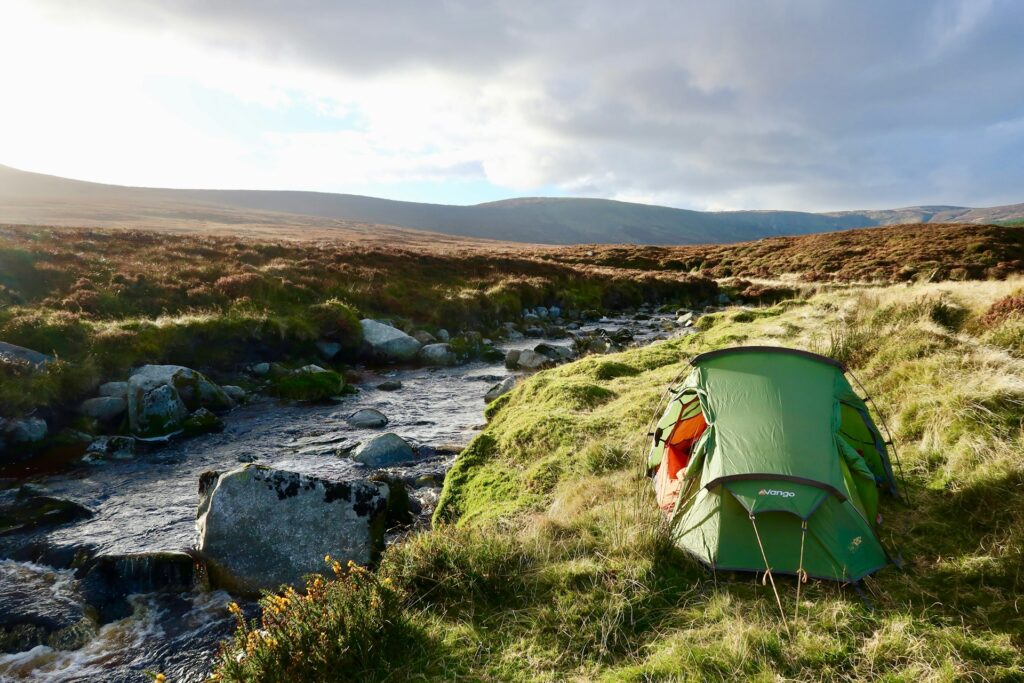
Wild camping is the trickier subject. There is no general right to camp on private land in Ireland without the landowner’s permission, and rules across the national parks vary from one to the next. In vehicle terms, overnight parking in park car parks is almost always prohibited. In practice, parking up discreetly on quiet coastal lay-bys or in pub car parks with the publican’s nod is widely tolerated. The unspoken rules apply: arrive late, leave early, leave no trace, ask if in doubt, and move on if asked. France-style aires also exist in modest numbers, and apps like Park4Night will surface them.
When To Go
May, June, and early September are the sweet spots. The weather is as cooperative as Irish weather ever consents to be, the roads are quieter than peak summer, and the evenings stretch out long and golden well past nine. July and August are busier, particularly in Kerry and Connemara, and you’ll want sites booked. If you can time your trip around the Galway International Arts Festival (13 to 26 July in 2026) or the Galway International Oyster Festival on the last weekend of September, even better.
Pack for all four seasons regardless of when you travel. Ireland will provide them, usually before lunchtime.
The Bottom Line
You can plan all of the above to the last detail. But you’ll come home talking about something else. The morning you wake up parked above Killary Harbour with nothing in the windscreen but water and hills and a low fog burning off the slopes. The afternoon you stumble into a music session in a Dingle pub and stay three hours longer than you meant to. The realisation, somewhere around day four, that you haven’t checked your phone in six hours and the world has not ended.
A first campervan trip anywhere tends to rearrange your sense of what a holiday can feel like. In Ireland, with its short distances, soft welcomes, and weather that forces you to live by the hour rather than the itinerary, that rearrangement happens faster than most.