Spring is here, the clocks are about to go forward and the warmer weather offers the perfect excuse to take a long, hard look at what’s lurking in your wardrobe. If you’re anything like us, the colder months have left behind a trail of impulse buys, barely worn layers and items that no longer fit your life or your style. Perhaps you’ve been meaning to sort it all out for a while now, but somehow a new season has crept up without you getting round to it.
The good news? A seasonal reset doesn’t have to mean a complete overhaul. Instead, it’s a chance to strip things back, focus on what you actually wear and build something more intentional. We’re talking fewer pieces, smarter choices, and saying no to fast fashion to build a wardrobe that works harder so you don’t have to. Here are our 7 essential tips on how to build the IDEAL minimalist wardrobe.
Define Your Style
A minimalist wardrobe isn’t necessarily about Scandi tones of white, beige and black (unless that’s your thing, of course). Nope, defining yourself as ‘minimalist’ and being all about crazy colours and pretty patterns certainly aren’t mutually exclusive positions. Rather, your minimalist wardrobe should simply include these items.
When creating a minimalist wardrobe, it’s first important to define your style. That said, it’s not obligatory to box yourself into conventional style typologies like ‘boho’ or ‘grungy’ – both women’s and men’s fashion trends come and go, and trying to move with the times will only see your wardrobe get larger and more complicated to pin down.
Take stock of your clothes, identify which colours you wear the most, and hone in on what fabrics you prefer. Also ask which cuts and silhouettes make you feel particularly confident? Let these decisions guide you and do away with anything which doesn’t tick these boxes.
Clear Out & Be Selective
After you’ve taken stock of everything you currently own, it’s time to clear out your closet. Don’t just throw things out – recent research suggests that more than 8 million Brits throw perfectly wearable clothes into the bin – but instead, start by dividing your clothes into three distinct piles; Charity, Sell Online and Keep. Give your other garments a new lease of life by selling them online or giving them to a charity store. If an item you love simply needs to be repaired, then get stitching.
Redefine what it means to declutter because it certainly isn’t about throwing everything into a black bin bag and sending it to landfill. Oh no.
Think About Your Lifestyle
Whilst curating your minimalist wardrobe, you also need to think about your lifestyle needs. Indeed, a minimalist wardrobe is nothing if not practical. Do you wear smart clothes to work but prefer joggers on the weekend? Are you lucky to work from home and therefore don’t need much in the way of office wear? Or, do you work outside in colder climes, and winter in particular calls for a bomber, puffer or shearling jacket?
It’s all very well having a small number of high-quality pieces that you can mix and match, but if you’re constantly in the laundry room, it’s not very practical or environmentally friendly to do so. Strike the right balance.
The Right Amount Of Items
While there is no ‘set number of items’ which define a wardrobe, let alone a minimalist one, common wisdom suggests that a minimalist wardrobe should include three pairs of shoes, a couple of jackets suitable for both formal and more dressed down occasions, three apiece of shorts/skirts, sweaters and trousers (again, with varying levels of formality), and a handful of t-shirts and dress shirts. If the colours are mixed and protocol appropriately varied, then you should be able to mix and match an outfit for every occasion from this short, simple list.
Embrace Timeless Fashion
Trends come and go, but some kinds of fashion endure. When curating your minimalist wardrobe, focus on classic pieces that never go out of style. Think of timeless men’s fashion pieces like a tailored blazer, a vintage polo shirt, or a pair of well-made leather shoes. These pieces not only provide a foundation for your wardrobe but also ensure that you always have something stylish to wear, regardless of current fashion trends. By embracing timeless fashion, you create a wardrobe that is both sustainable and enduring.
Invest in Versatile Pieces
When building a minimalist wardrobe, versatility is key. Look for pieces that can be dressed up or down depending on the occasion. For example, a classic white shirt can be paired with jeans for a casual look or with a blazer and trousers for a more formal setting.
Similarly, a well-fitted pair of black trousers can be worn with a t-shirt for a relaxed vibe or with a blouse for a professional appearance. By investing in versatile pieces, you ensure that each item in your wardrobe can serve multiple purposes, reducing the need for excess clothing.
Quality Not Quantity
It’s important to remember here that a minimalist wardrobe isn’t the same as a capsule wardrobe. While both translate to small, carefully curated wardrobes of items that you can mix and match to create a number of outfits, a capsule wardrobe is usually just for a single season, while a minimal wardrobe is more flexible and can serve a full year. Indeed, above all else, a minimalist wardrobe is about quality rather than quantity.
Building a minimalist wardrobe isn’t about deprivation or conforming to a particular aesthetic. It’s about making more considered choices, buying fewer but better items, and finding real confidence in a smaller selection of clothes that suit your body, your lifestyle and your taste.
The process takes time and a fair bit of honesty with yourself about what you actually reach for each morning, but the payoff is considerable: less clutter, less decision fatigue, less waste and a wardrobe that feels like it belongs to you rather than the other way around. You might be surprised, too, by how much calmer your mornings become when every option in front of you is one you genuinely like. Start small, be ruthless in your editing and trust that less really can be more.
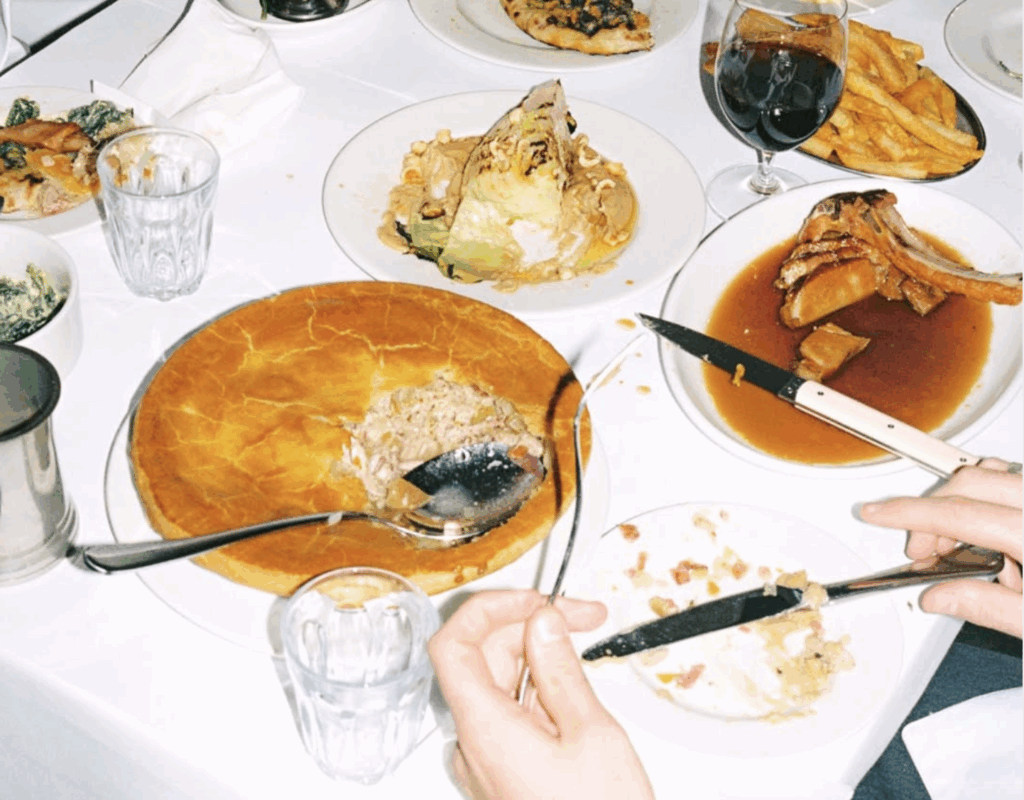
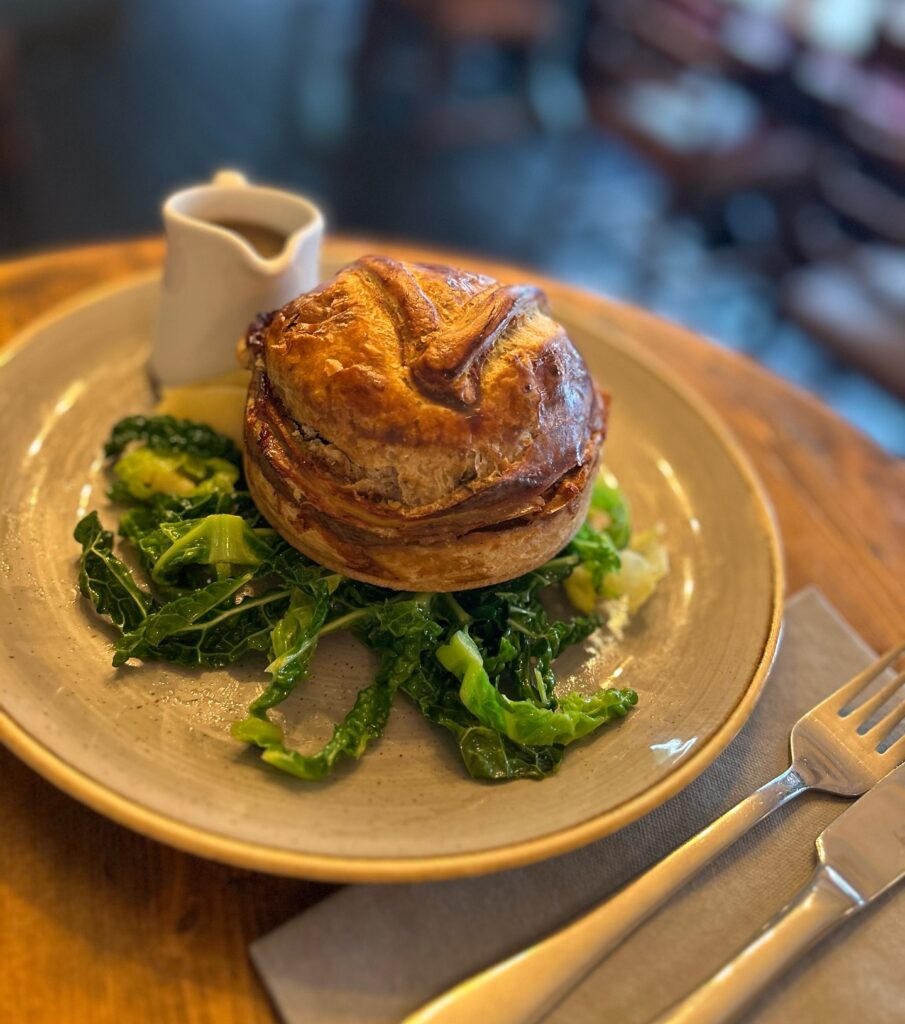
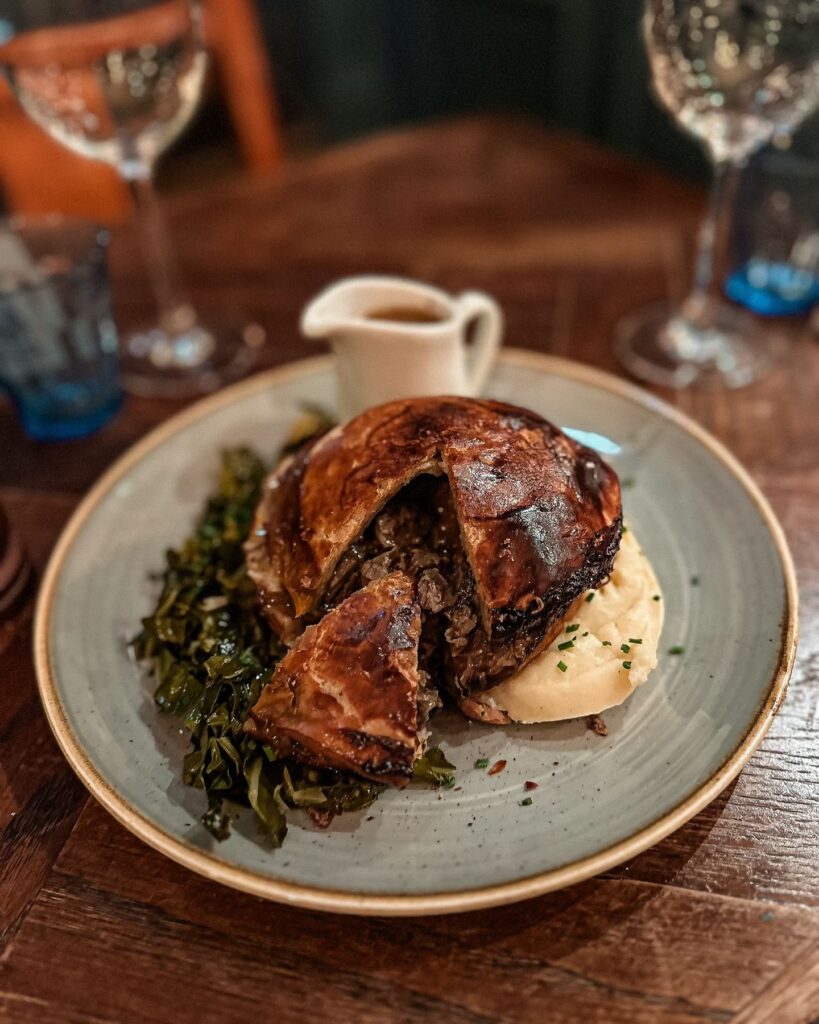
Here at IDEAL we love a pie – whether it comes underneath a lid of mash, puff or good old fashioned suet. Pies just have a seductive, inbuilt comfort that we all need right now. When it’s wash-out weather, there’s nothing better to do than hunker down in a cosy spot with a proper pie, a mountain of mash, and gravy that pools invitingly around the edges.
From East End pie and mash shops serving the same liquor-drenched classics since Victorian times, to Michelin-rated gastropubs doing seasonal numbers with game and bone marrow, London’s pie scene has serious range.
The capital’s got you sorted, and here’s where you should be eating pies in London right now.
M Manze, Tower Bridge
Ideal for classic East London pie and liquor…
We had to start here, at a bonafide London institution. Once, this famous pie and mash shop had 12 locations in London but as of 2025, are down another one. Sadly, the Deptford location closed in January of last year when owner George Mascall announced his retirement. However, two London branches of M. Manze remain open – Peckham and Tower Bridge Road – as well as an outpost in Sutton.
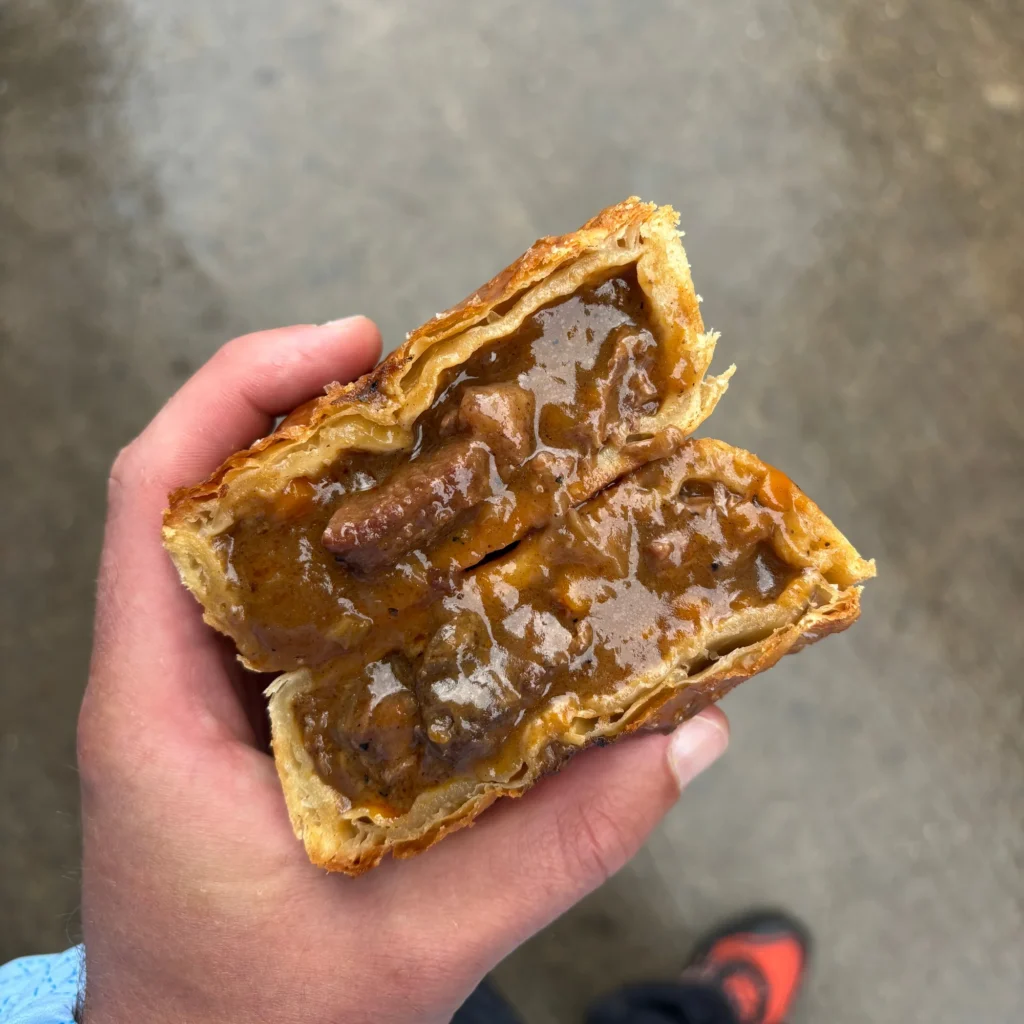
The Tower Bridge location was the first, and has been serving this dish up since 1891, securing its place as the nation’s oldest pie and mash shop. The pie itself is beautifully straightforward: minced beef filling, once made thrifty use of meat scraps and vegetables, now made with quality beef wrapped in shortcrust pastry.
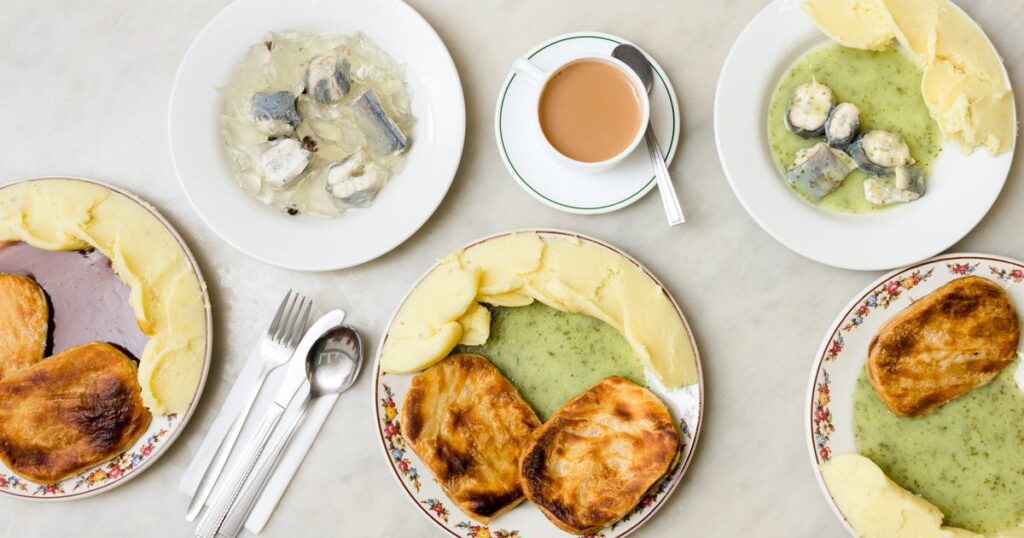
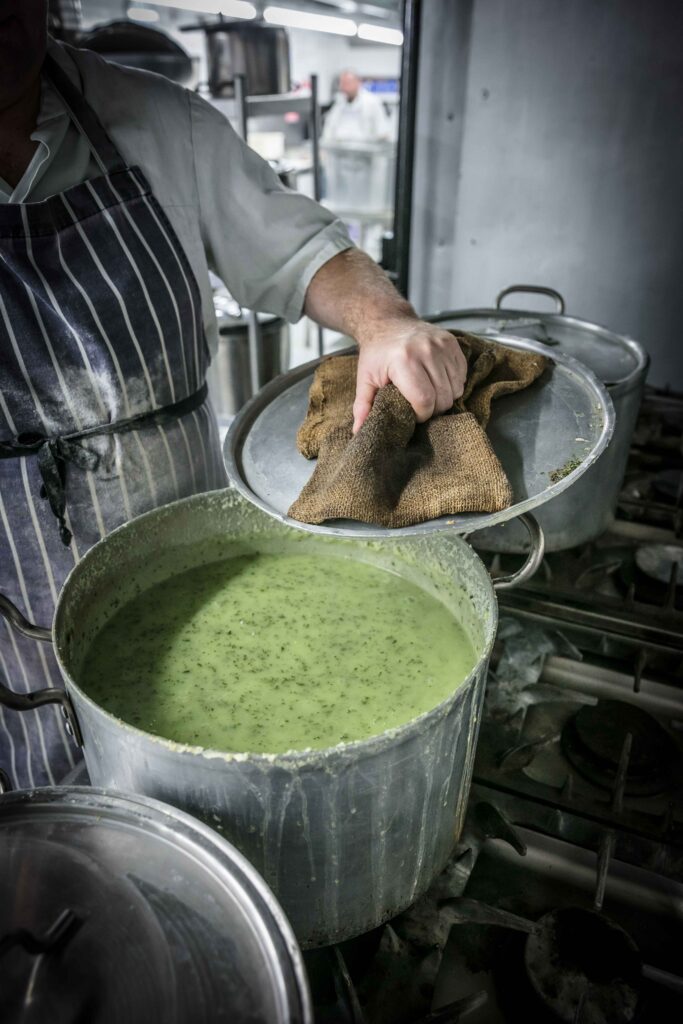
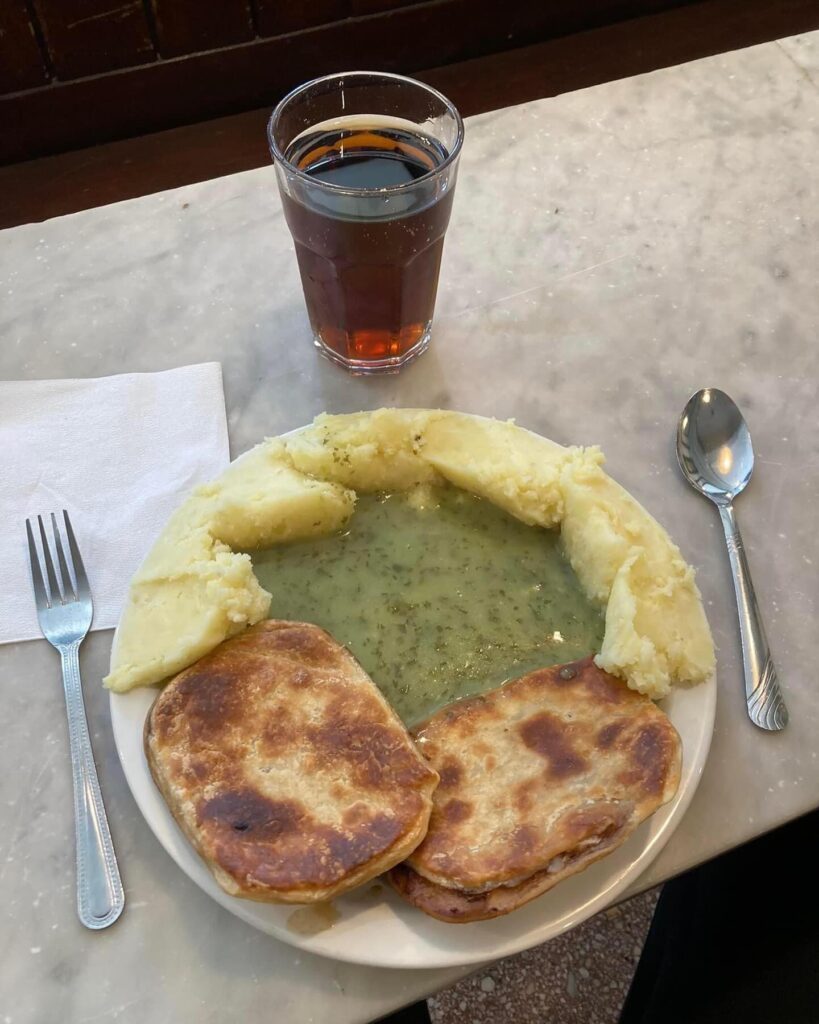
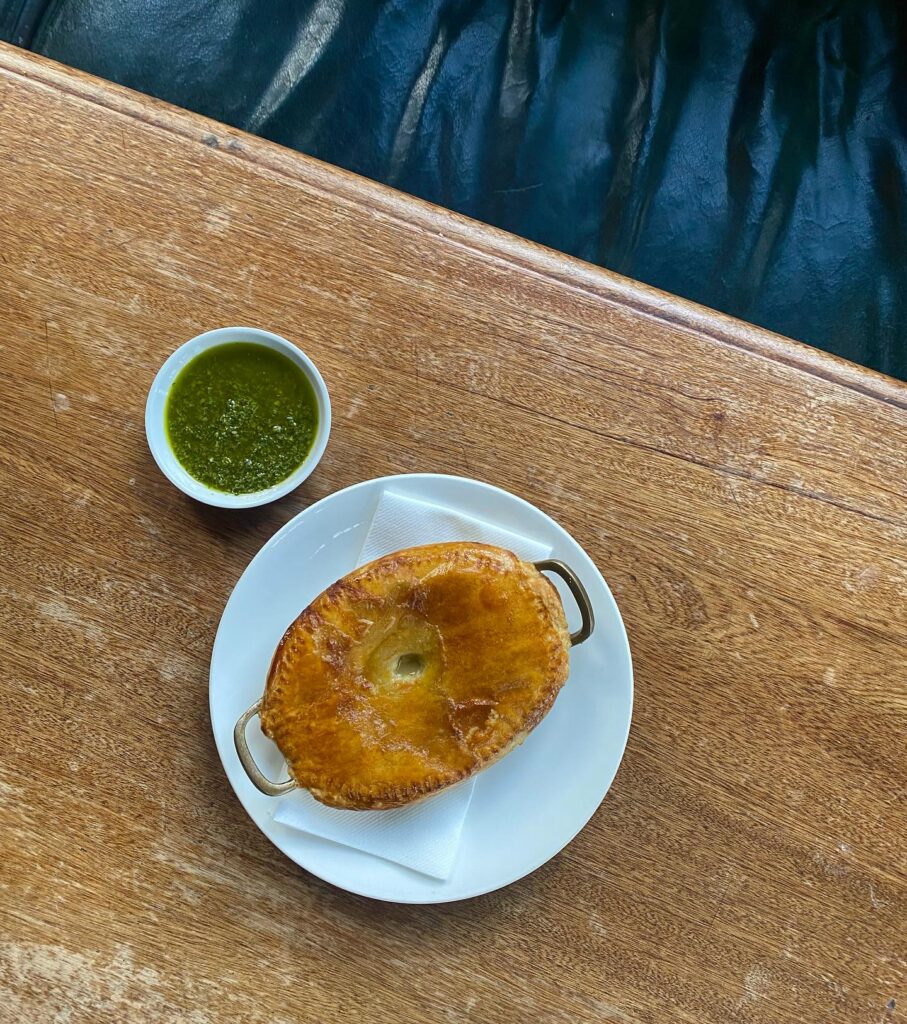
It lands on your table with a mound of mashed potato and that famous thin green parsley sauce they call ‘liquor’ – don’t worry/shame, there’s no booze involved. The presentation is an art form in itself: spread spoonfuls of mash and pie creating neat boundaries while the bright green sauce pools in the centre. Watch them work behind the counter and you’ll find yourself oddly hypnotised.
There’s lots of debate on how to eat your pie and mash. Our ritual involves dousing everything in malt vinegar, then finishing with a hit of chilli vinegar to wake everything up towards the end. Then there’s the great pie-flipping controversy. Purists insist on turning their pie upside down and making a slit in the pie, pouring a little vinegar into the crevice and seasoning with salt and white pepper, letting all those meaty juices soak into the pastry lid. Others guard that top crust like treasure as they love the crisp contrast. Settle the debate by ordering a ‘double double’ – two pies means you can try both ways and pick your side.
One final tip: eat like the locals do, with a spoon and fork. That spoon becomes essential for gathering up every last bit of sauce with your pie and mash. Whatever your technique, wash it all down with a glass of sarsaparilla and make sure you don’t skip the eels.
As the debate over London’s best traditional pie and mash rages on, with some claiming that Maureen’s takes the crown, but for us, M. Manze has the upper crust.
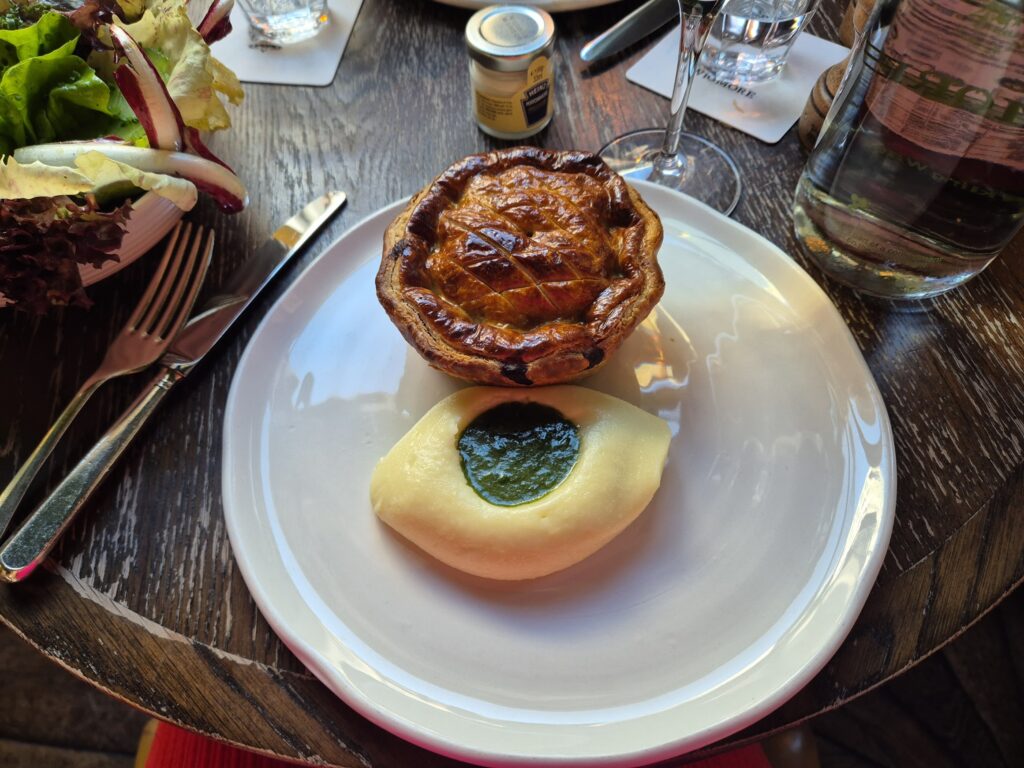
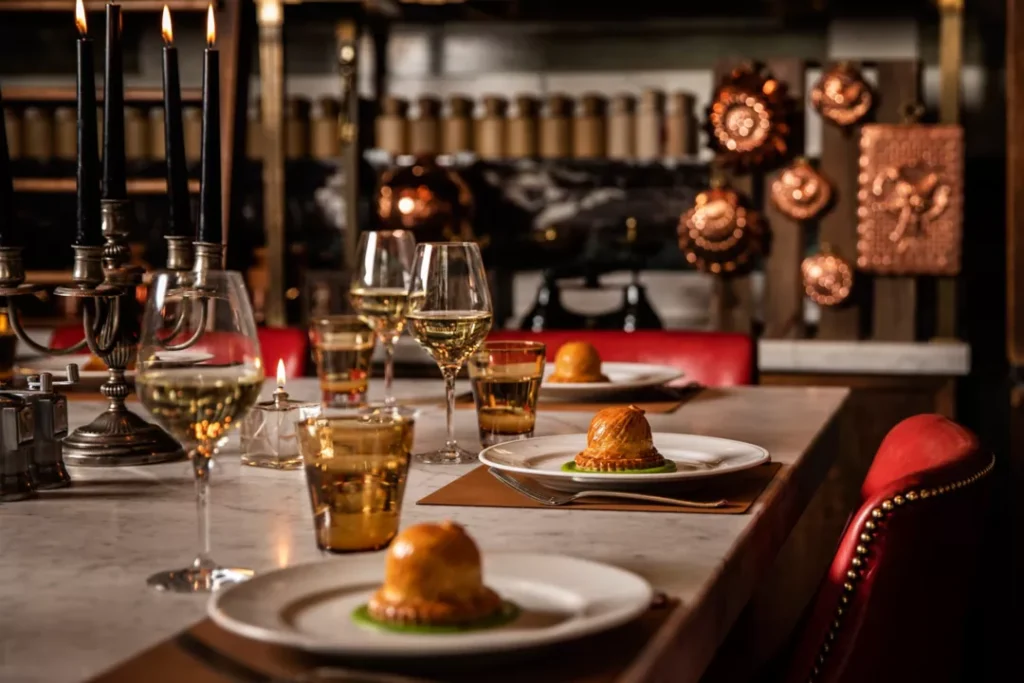
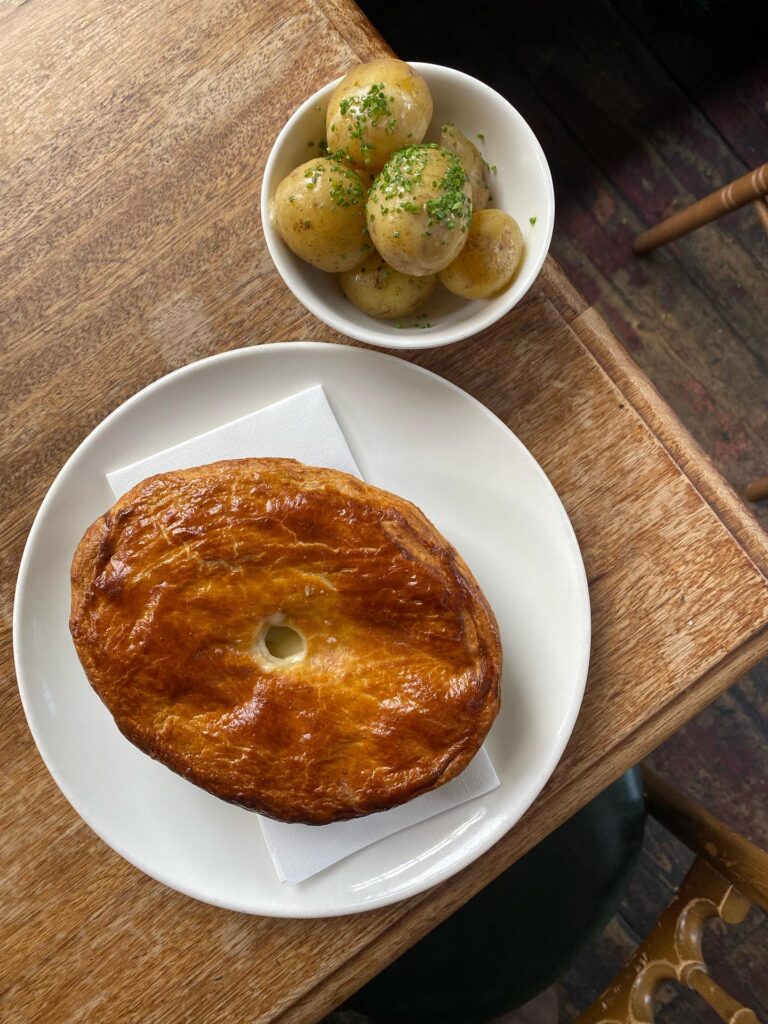
Beyond the requisite pints, a pub’s reputation hinges on its pies. While pies aren’t always on Wigmore’s menu, when they are, this is where you should head for a fix in Central – specifically for the smoked ham hock and cheese version, which is genuinely exceptional.
This isn’t your usual pub grub pie; this is Michel Roux Jr.’s take. We all know the chef has a fondness for pastry – he did start as a pastry chef, as he won’t stop telling the camera when given half the chance. He’s brought that experience here, just minutes from Oxford Circus, to reimagine this classic with his signature touch.
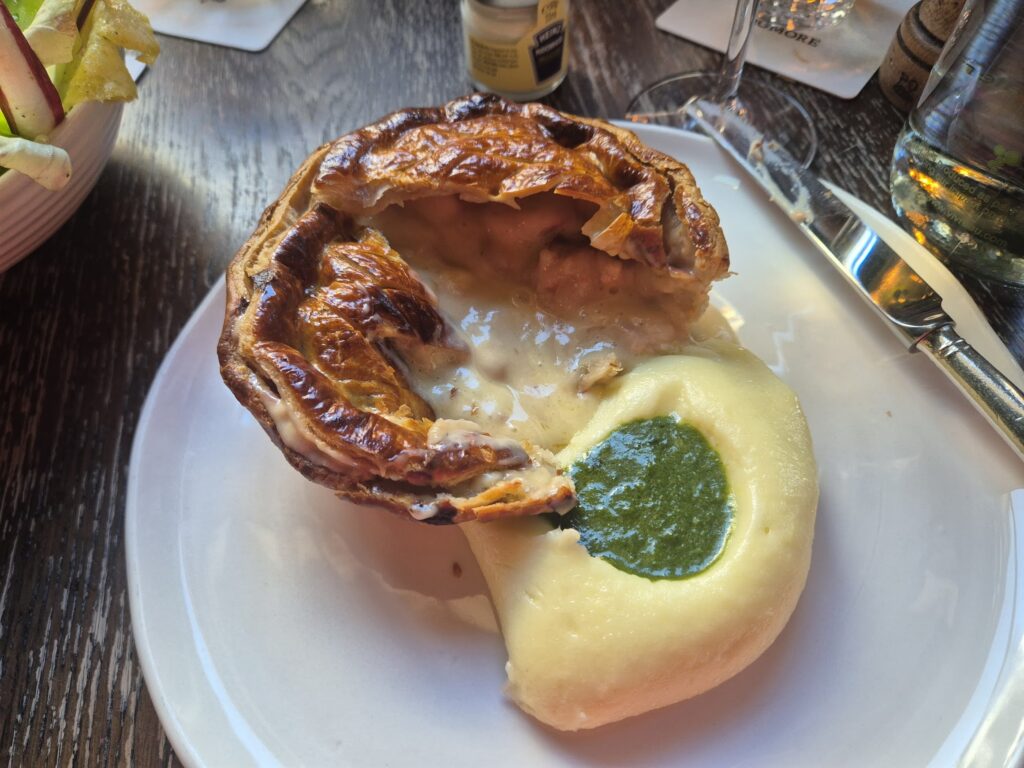
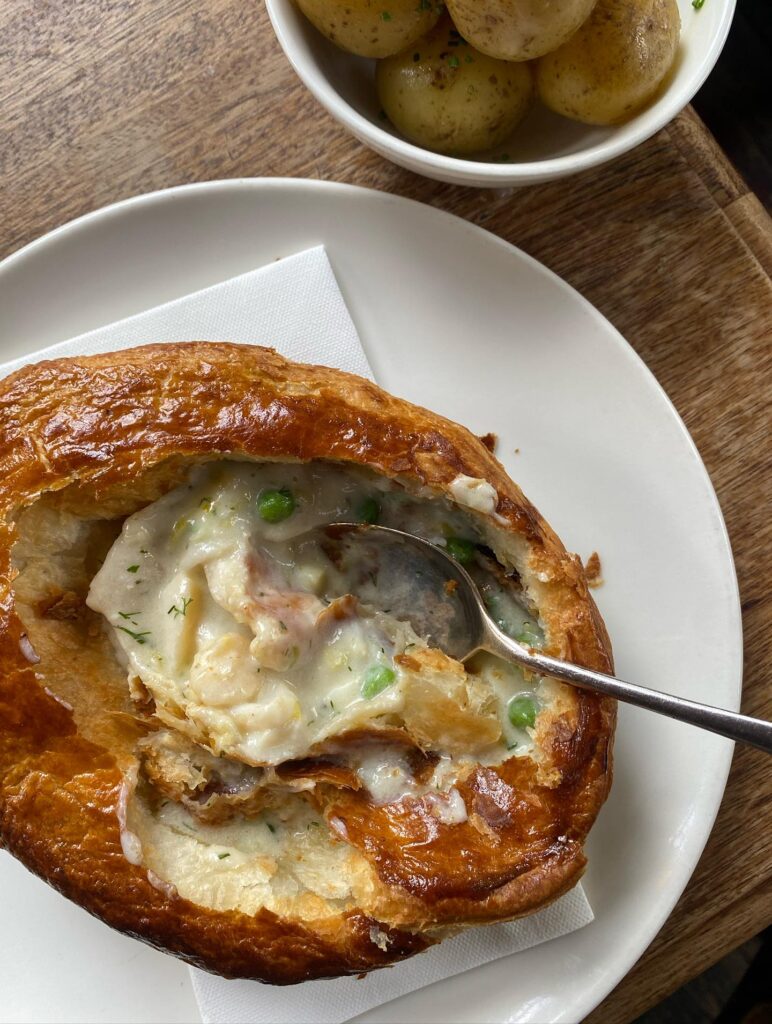
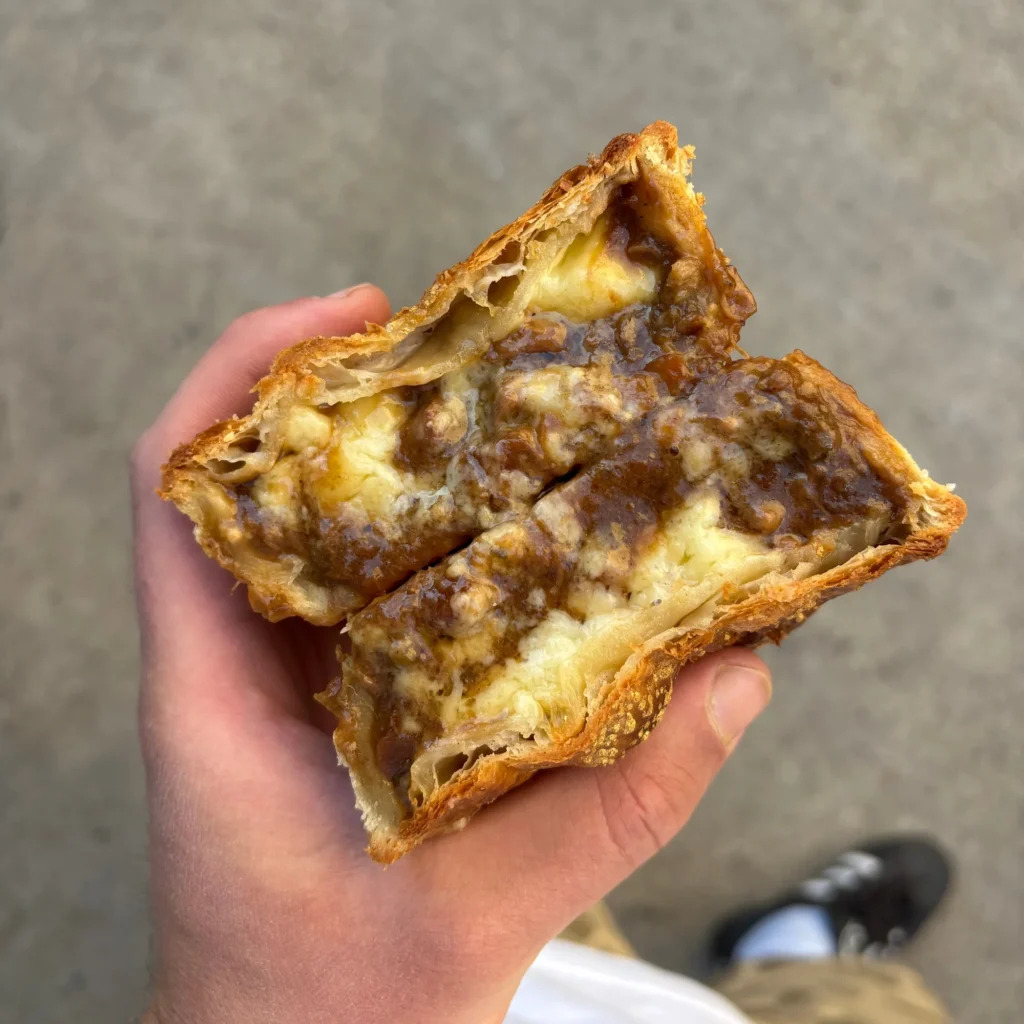
The pastry is of course perfect – you’d think he’d written a book on it. Inside, generous chunks of smoky ham meld with cheese in a creamy béchamel that’s indulgent without being overwhelming. It’s rich, molten, and utterly satisfying. Is that a hint of nutmeg, too? It brings something to the table.
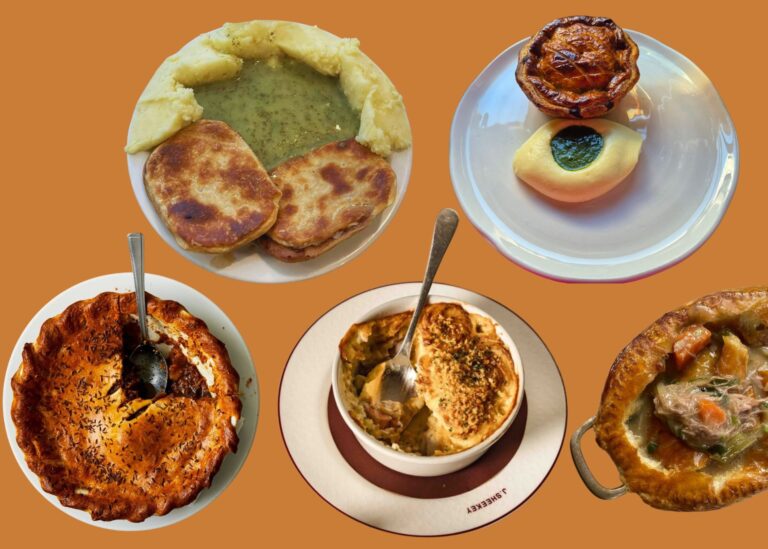
Let’s talk about that mash, you know, the one that looks like a weird eye above. It comes with as much butter as potato, using the ol’ Robuchon ratios applied – widely considered the best, most decadent method across the world. Paired with a pool of silky garlic butter (yes, butter on butter), this is a clever riff on classic pie and mash, swapping out the traditional parsley liquor for something far more luxurious. It’s glorious.
A picky restaurant review of The Wigmore a while back complained about putting a small pie on a large plate here, saying it emphasises how tiny the pie is. We’re not sure we agree with that. The pie’s size is perfectly judged. Given the richness of the filling, any larger would be overwhelming and we would have left reeling.
Be sure to check what this restaurant offers during British Pie Week, which is happening right now. Last time, they created an XL braised beef cheek, ale, bone marrow, and pearl onion sharing pie. This year, they’ve gone a step further with a full Pie Month throughout March 2026, centred around a minted lamb shank sharing pie with caramelised baby pearl onions and Chantenay carrots, served with mash, Bloody Mary salt triple-cooked chips and charred hispi cabbage for tables of four.
Some people measure inflation by the price of Freddo chocolate bars. We measure it by the cost of Quo Vadis’s pie. In 2022, the pie cost £19.50; by 2023, it had risen to £21.50; today, at the time of writing, it’s £32.50.
Before you choke on your pastry crumbs at that 67% increase, remember: restaurants aren’t printing money in their basements. They’re just trying to keep the lights on and the ovens hot. When energy bills soar, cooking oil doubles in price, and staff need living wages, even the humble pie isn’t immune. At least Quo Vadis has the decency to make it consistently delicious. Regardless of whether it’s filled with chicken, mutton, or guinea fowl – the price stays the same. Class. But we digress.
Come autumn, game season is our favourite time for a pie here. Think guinea fowl, chicken and bacon encased in a crunchy suet crust. They also offer a more formal ‘QV chicken pie’ as part of their set-menu feasts, to be taken in the private dining room if you’re feeling fancy. Past iterations have included Swaledale mutton, celeriac and turnip with salsa verde, cosily tucked beneath a suet lid, an indulgent guinea fowl and porcini creation, or a classic ham hock, chicken and leek combination. It’s pleasingly seasonal and reliably delicious.
2026 marks a huge milestone for Quo Vadis: the restaurant’s centenary. To celebrate, Jeremy Lee has launched a year-long programme of guest chef suppers in collaboration with some of the biggest names in British cooking. The line-up includes Margot and Fergus Henderson, Jackson Boxer, Angela Hartnett and Neil Borthwick, Ravinder Bhogal, Anna Tobias and more. Tickets are released monthly via the Quo Vadis newsletter, The Rocket, with club members given a 48-hour head start. Expect them to sell fast.
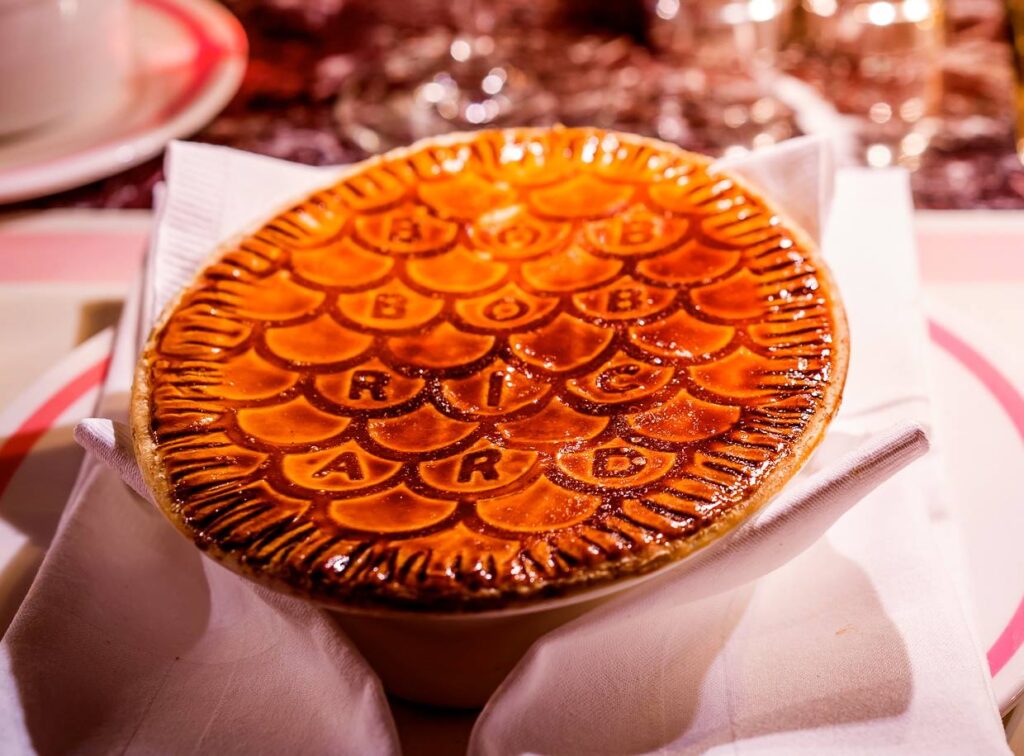
Many food sites cooler than us who offer London’s best pie roundups tend to overlook Bob Bob Ricard – perhaps because it feels a bit crass to include somewhere so openly luxurious. However, other older publications (perhaps with less swagger) hail this spot’s chicken and champagne number as the best pie in London. With such a discrepancy in ideas about what makes a good pie, you may wonder where we stand? Well, in the name of flavour, BBR’s certainly deserves to be here.
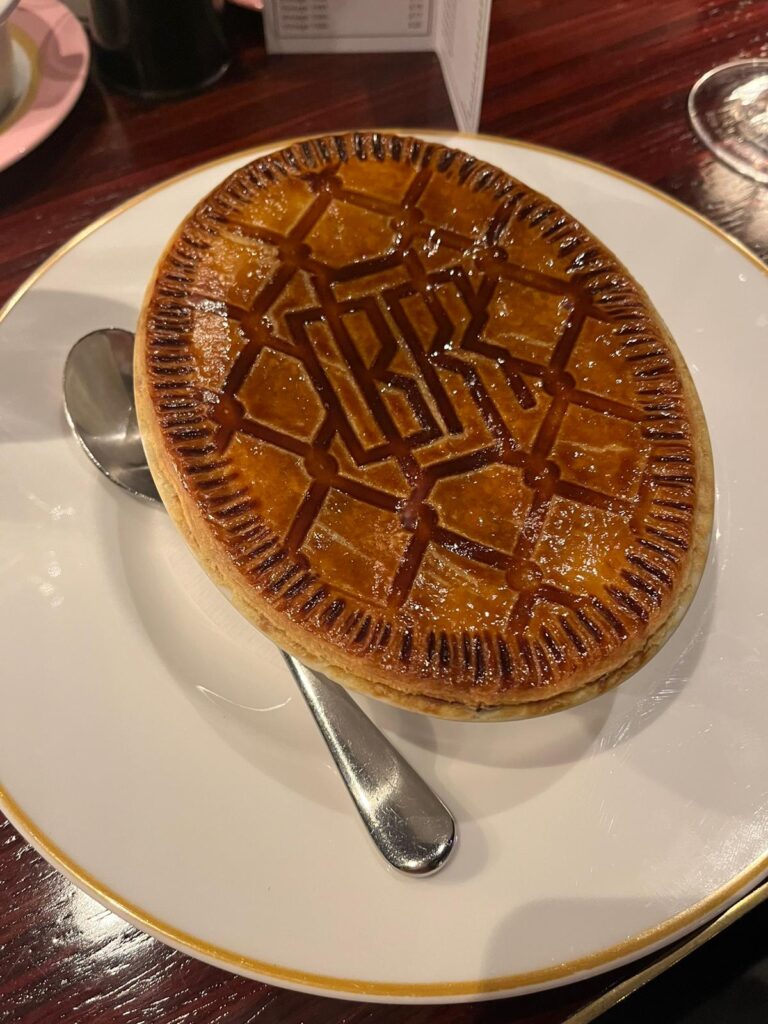
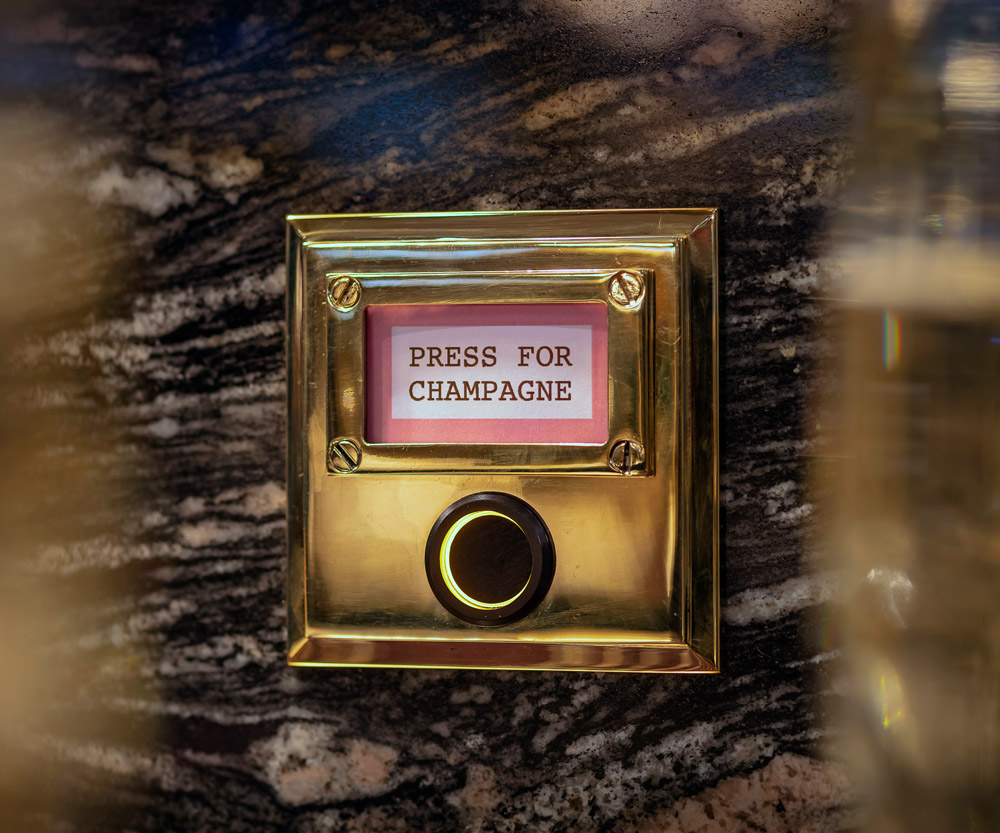
Indeed, this theatrical Soho establishment famous for its ‘press for champagne’ button stationed at each table serves its undeniably bougie signature pies with the BBR logo singed onto the crust. But they’re also undeniably delicious.
Bob Bob Ricard’s famous pies have achieved something close to celebrity status, attracting high-profile collaborations along the way. The last partnership with Idris Elba to celebrate his drinks brand saw an exclusive Glorious Twelfth dish: roasted Scottish grouse with a rich Porte Noire VSOP cognac sauce. Whilst we’re not sure Elba was actually at the stoves flambéeing his signature spirit, it brought a certain vivacity to an already fine pie nonetheless.
Ideal for a classically creamy yet carefully balanced celebration of seafood…
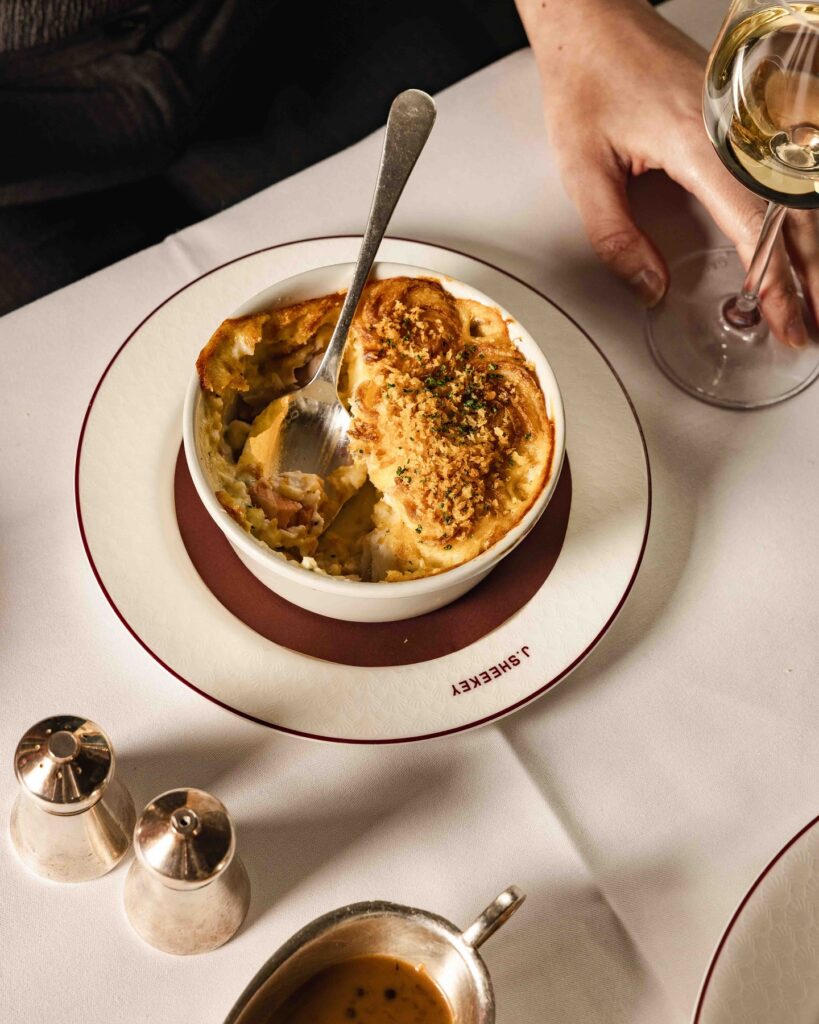
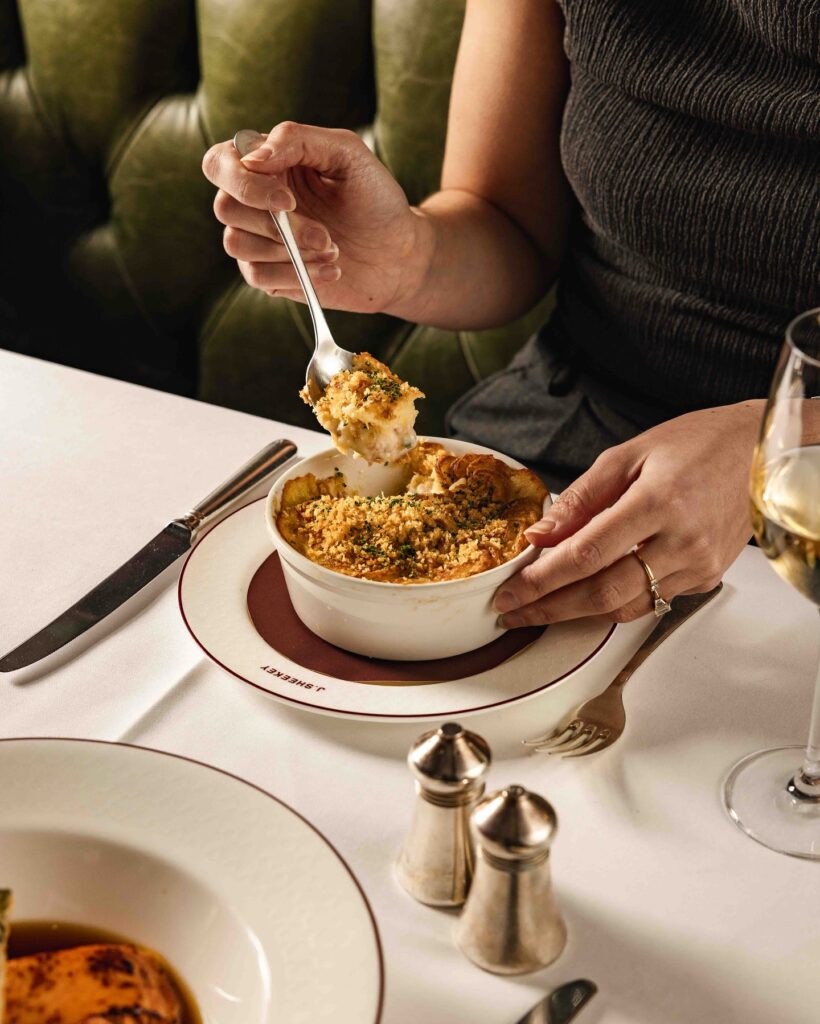
Back to an old stalwart. J Sheekey is one of our favourite places to eat oysters in London, and it’s also a favourite spot for a classic fish pie done right. Originally opened as an oyster bar in 1896, today the pie ranks amongst their most celebrated dishes.
For us, a proper fish pie needs savoury depth to balance the white sauce, and at J Sheekey, a generous dose of English mustard, Worcestershire sauce, anchovy essence and lemon juice achieves exactly that. Whilst some establishments load their pies with prawns and lobster, this version is refreshingly simple – and all the better for it.
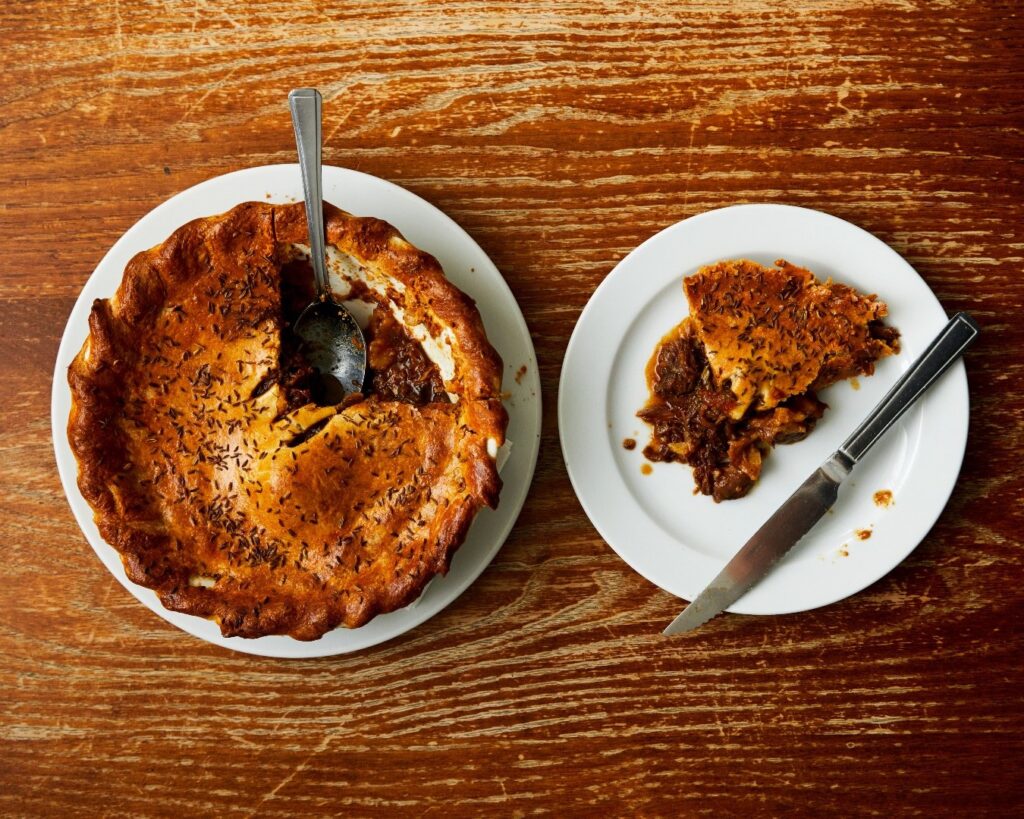
A sharing pie at St John come the colder months is a glorious thing. The restaurant is famous for its nose-to-tail philosophy and seasonal British cooking, ensuring their pie offerings celebrate whatever game, meat, fish or vegetable is at its peak. St John’s pies are a true celebration of seasonal British bounty, with magnificent fillings that change as the seasons turn.
Recently, they’ve been serving a spiced hare pie to share for £58, alongside options like guinea fowl, bacon and trotter. As pheasants and hares make their way to the ovens, this is the perfect time for a fine game pie – slow braised to melting tenderness, infused with marrow-bone richness, and encased in golden suet pastry.
A word of warning: St John updates their menus daily, with menus not going online until 11am for lunch and 5pm for supper. So if it’s a pie you’re after, be sure to check ahead as they won’t always be on the menu.
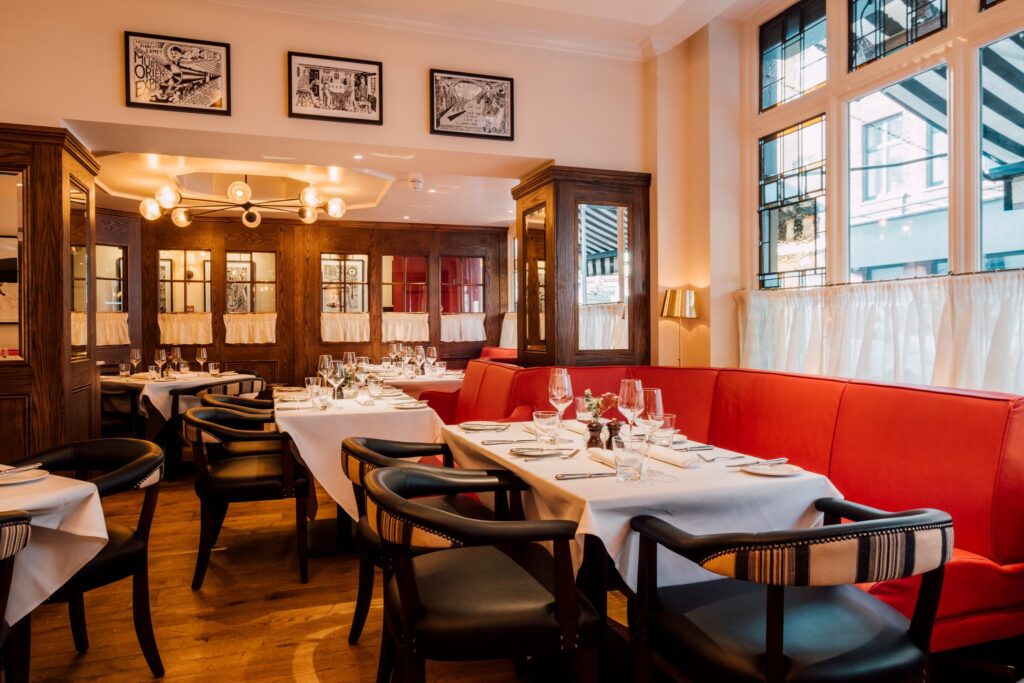
Bistro Freddie celebrates the best of British produce with a distinctive French flair. Step inside and you’re greeted by low lighting, flickering candles, and handwritten menus and a room that buzzes with infectious energy. You’re also greeted by the aroma of shallots sautéing and stock simmering in the kitchen beyond which triggers a visceral reaction – you instinctively know you’re about to eat very well indeed.
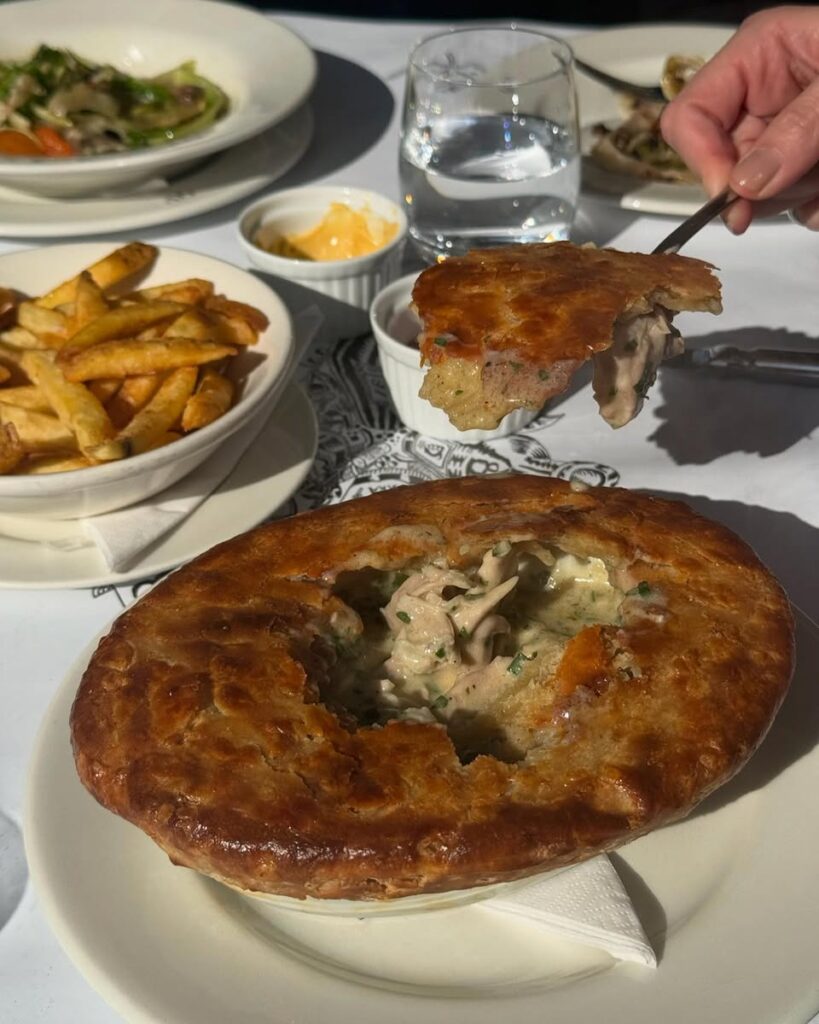
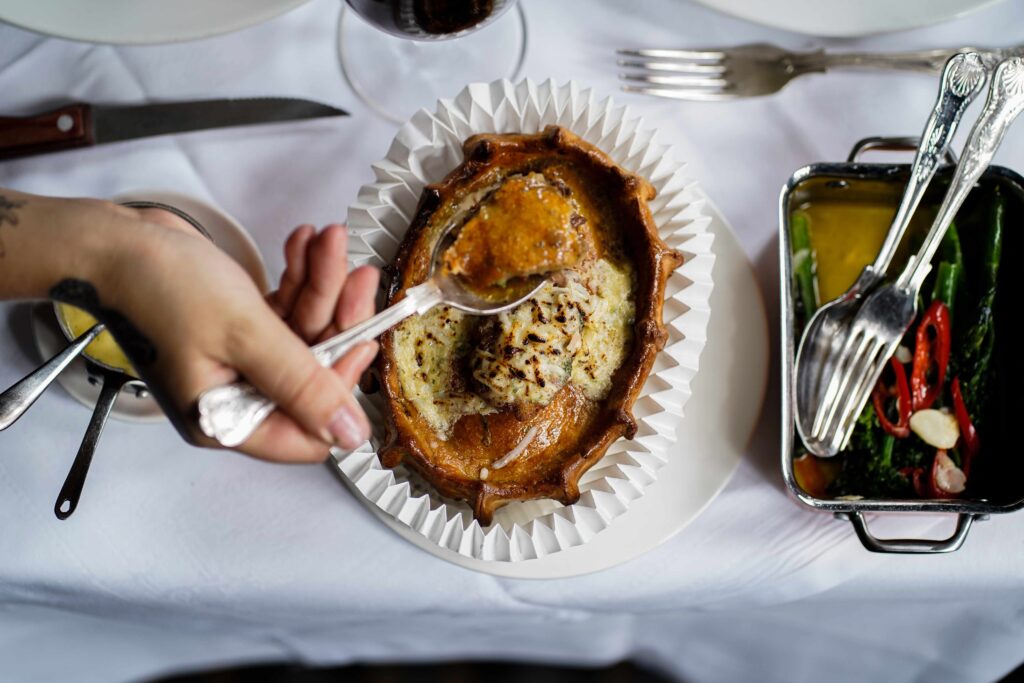
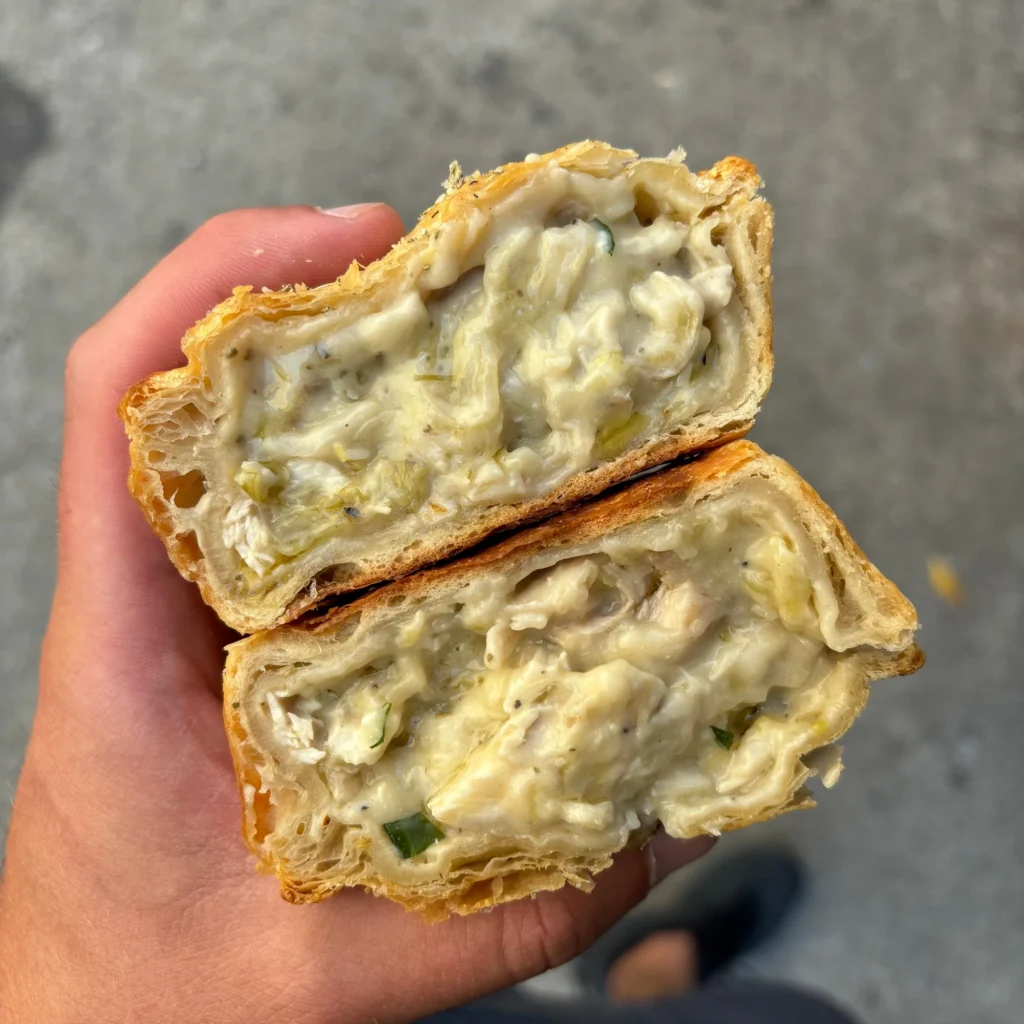
While Bistro Freddie excels across the board, their chicken pot pie stands as the undisputed star of the menu. We recently shared their confit chicken and tarragon, and it’s a stunner. The chicken legs get three hours in the confit bath, then a gentle cook-down with shallots, white wine, vinegar and stock until they’re falling-apart tender. A heap of tarragon goes in at the end, then the whole lot gets topped with pastry and baked until it’s golden.
We love the beautiful simplicity of this pie. It’s the kind of dish that wins you over with its restraint – a clear anti-cream mandate keeps everything light. No unnecessary flourishes ensures ultimate satisfaction. Pair it with a mountain of frites or their butter mash made with equal weights of potato and butter (the Robuchon method strikes again) and wash it all down with a glass of French fizz which cuts through all that fatty richness perfectly, and you’ll be one happy camper.
Do note, as with many on this list, the pies here evolve with the seasons. One month might bring chicken with earthy girolles and rich liver, while another offers rabbit and bacon elevated by a luxurious, viscous jus made from pig trotters and chicken wings. Classic combinations like beef and Guinness also make regular appearances, ensuring there’s always something new to discover.
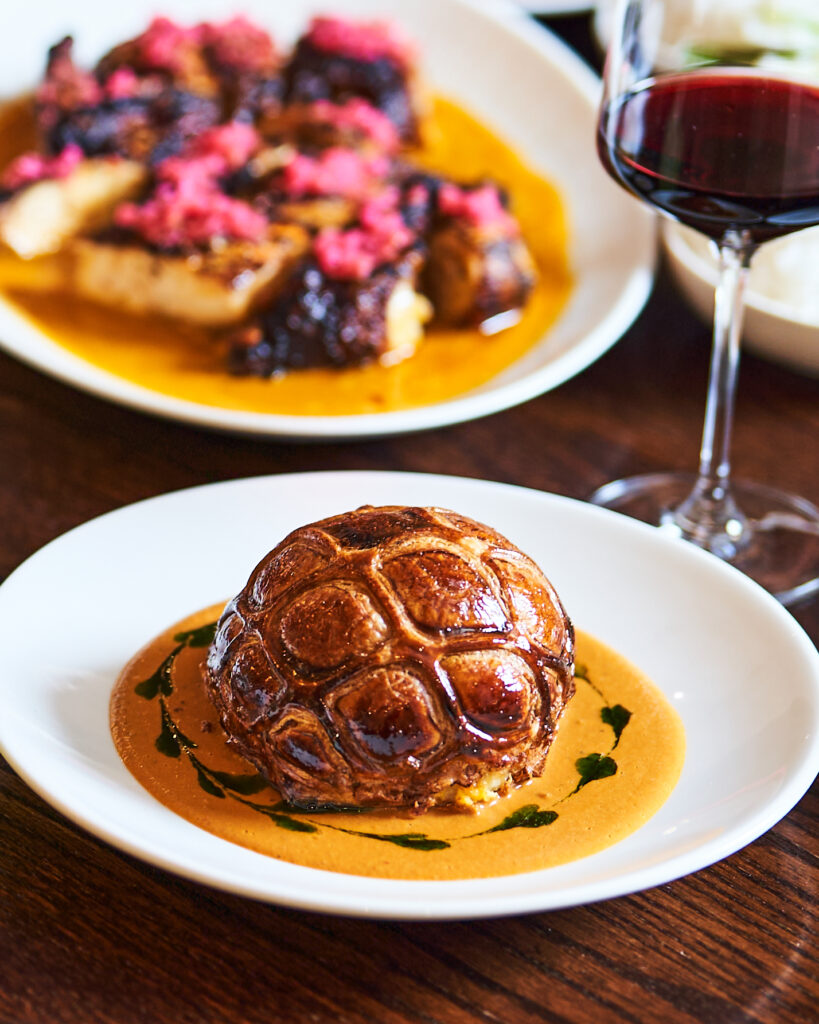
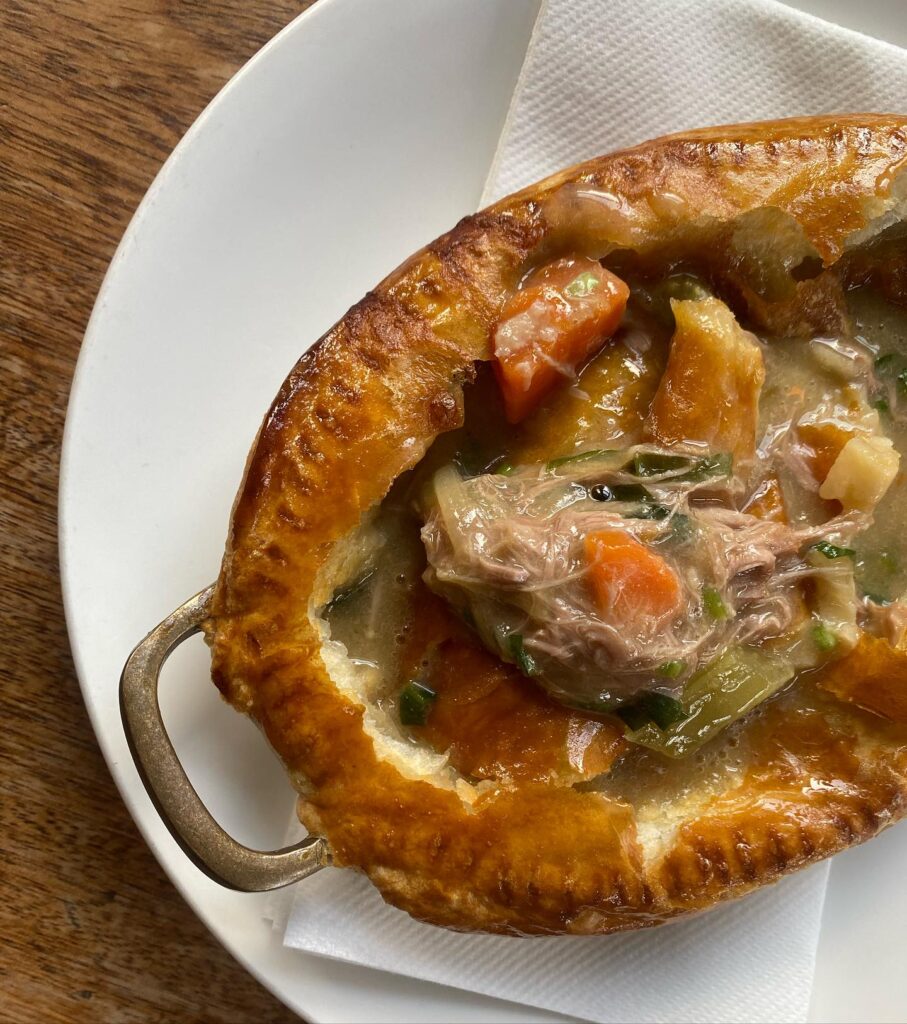
If there was an award for the prettiest pie in London, Donia’s would win. Why? Just look at it; the perfect, burnished dome. The attractive lattice work. The intricate artwork etched into the sauce that surrounds it… It’s gorgeous.
You’ve fallen in love before you’ve even had a bite. While London’s pie scene generally debates most heatedly over who owns the perfect pastry-to-filling ratio, Donia has revolutionised the entire conversation. Their lamb shoulder caldereta pie doesn’t just blur cultural boundaries, it erases them entirely, creating something that feels both familiar and unexpected – this is London-Filipino cooking and we’re here for it.
Indeed, their lamb shoulder caldereta pie is Filipino soul food 2.0, where a traditional cauldron stew is reimagined, finding new life encased in buttery puff pastry.
The lamb shoulder undergoes careful preparation that transforms it into something extraordinary, slowly developing the deep, complex flavours that make caldereta so beloved. The added chicken liver pâté brings a rich, earthy depth that most pie fillings simply can’t match, and the tomato base cuts through with just enough acidity to keep things bright and balanced. Inside it’s thickened with a potato pavé, just for extra lusciousness. And surprisingly rare in London restaurants, the puff pastry is made in house.
Beneath it, the caldereta sauce (gently spiced and thrumming with the richness and depth of offal) is punctuated with swirls of chive oil; when all that puff pastry soaks up the sauce, it’s heaven. The skill and technical process of this pie is up there with the very best in London. Despite its handsome size, it’s quite difficult not to order a second.
Ideal for dedicated pastry chefs making London’s top pies…
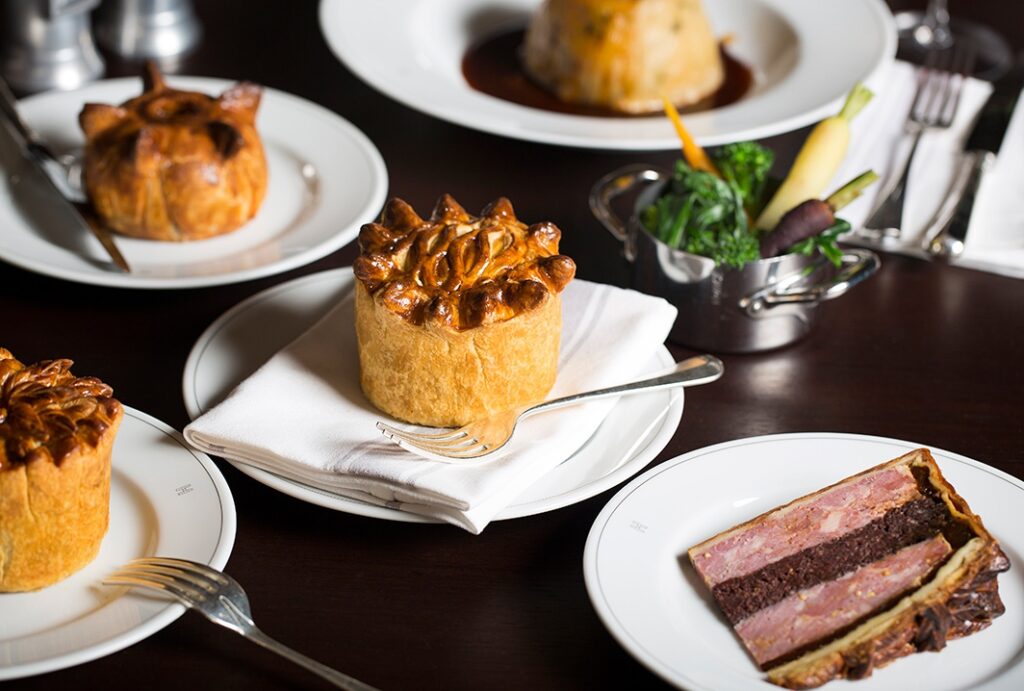
Pies are big business for London restaurants. They’re on the tick list for most tourists visiting the capital, and having one that takes off online is going to draw in the punters, no doubt about it. The Holborn Dining Room understands the gravitas of a perfectly formed pie, and has a whole job dedicated to it as a result. Here, the ‘Head Pie Maker’ is an illustrious role, first given to Callum Franklin (a man sometimes referred to as the ‘pie king’), and then to his protege Nokx Majozi, who has just hung up her hat after 11 years on the pies.
Huge Birkenstocks to fill, but Laszlo Kiss has stepped into them with confidence – his British Pie Week 2026 line-up includes beer-braised beef ribs, lamb and chargrilled aubergine, and a returning fan-favourite rhubarb pie from Executive Pastry Chef Mark Perkins.
Getting your hands on one of these pies is half the experience. There’s the Pie Hole which sells pies directly from a handy street-side kitchen hatch – Tuesday to Thursday between 11am and 3pm. That same kitchen then transforms into the Pie Room, a private dining space for up to 10 guests Wednesday to Saturday from 5pm onwards, where the marble pastry-rolling table becomes an intimate dining table. Don’t want to eat standing up or lack enough friends for a private booking? The main Holborn Dining Room serves pies too – just allow thirty minutes for cooking.
This is an excellent choice if you’re dining with vegetarians, as there’s usually more than one veggie option. Lincolnshire poacher cheese and potato pie or beluga lentil and wild mushroom cottage pie anyone? Their most photographed offering is the dauphinoise and comté cheese pie, which is layered with creamy potato and served with caramelised onion and parsley sauce. The salmon, octopus and saffron fish pie with stunning bisque sauce is also magnificent. Yep, the range here is truly impressive.
But the absolute star of the show is the Gloucester Old Spots pork pie – pork shoulder, smoked ham hock, fennel seed, and sage in hot water crust pastry. Now, traditionalists will tell you pork pies should be served cold with jelly. The Holborn Dining Room breaks both rules: theirs arrives hot from the oven with gravy, and there’s no jelly in sight. Initially we were skeptical, but like many pork pie purists before us, we’ve been completely won over.
Ideal for a timeless tribute to British steak and beef pies…
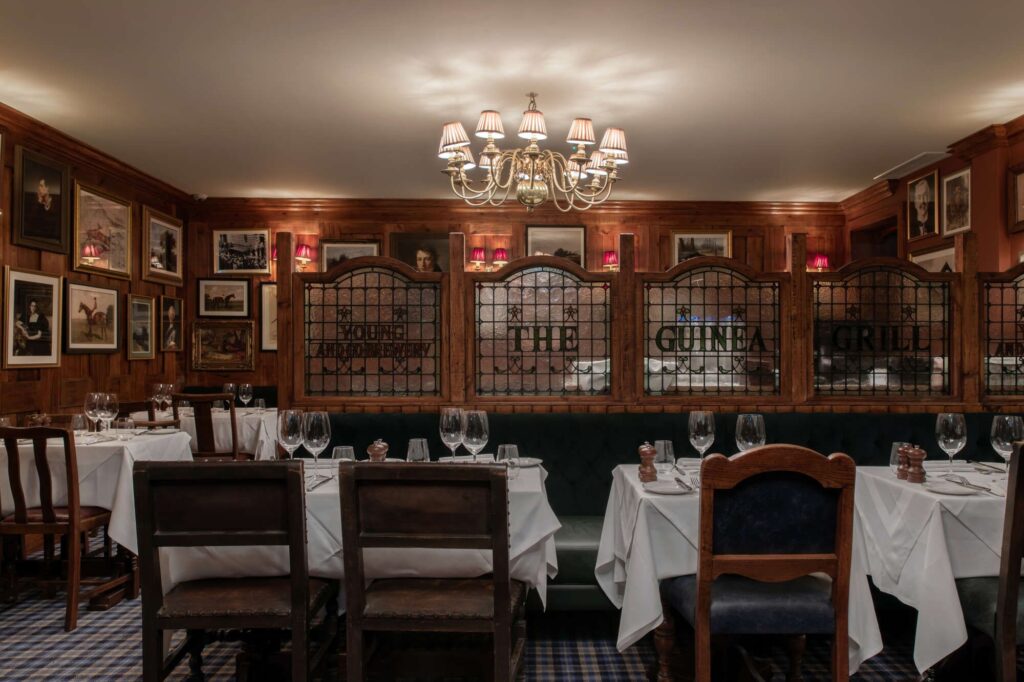
Open since 1952, The Guinea Grill is housed within one of London’s most storied pub sites – there’s been an inn here since 1423. The restaurant proper began in the post-war years when hungry American diplomats stationed nearby were desperate for decent steaks. A clever landlord saw an opportunity, and what started as covert back-room dining for homesick Yanks eventually became one of the capital’s most celebrated steakhouses.
The clientele is, shall we say, a particular sort – think salmon-trousered chaps who believe they run the city and tourists clutching guidebooks. But none of that actually matters once you’re settled in, because you’ll find yourself utterly absorbed in what’s on your plate rather than who’s at the next table. The wood-panelled walls, white linen, and claret paint create a cocoon of old-school comfort that somehow makes the whole experience work.
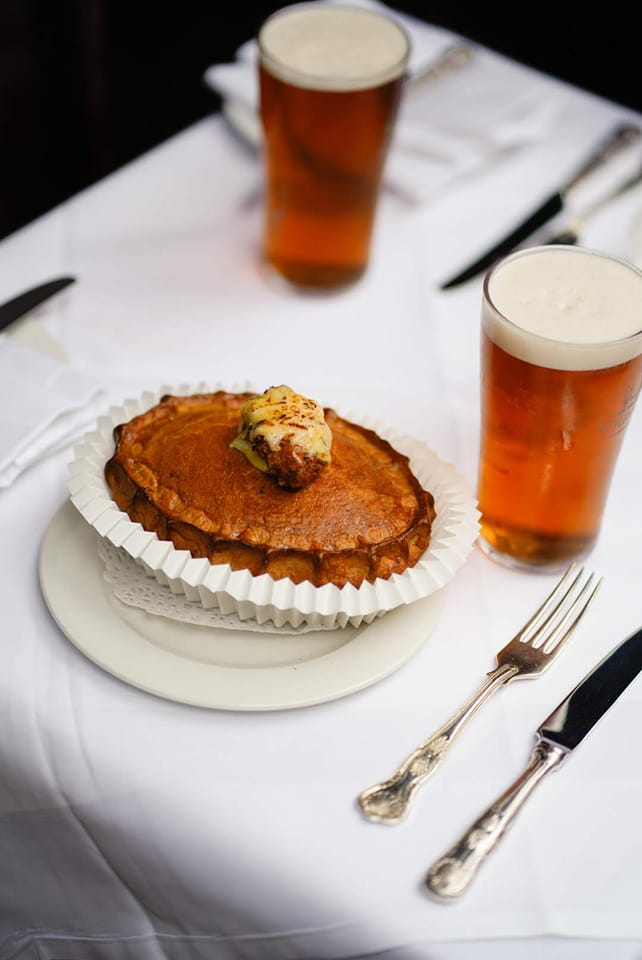
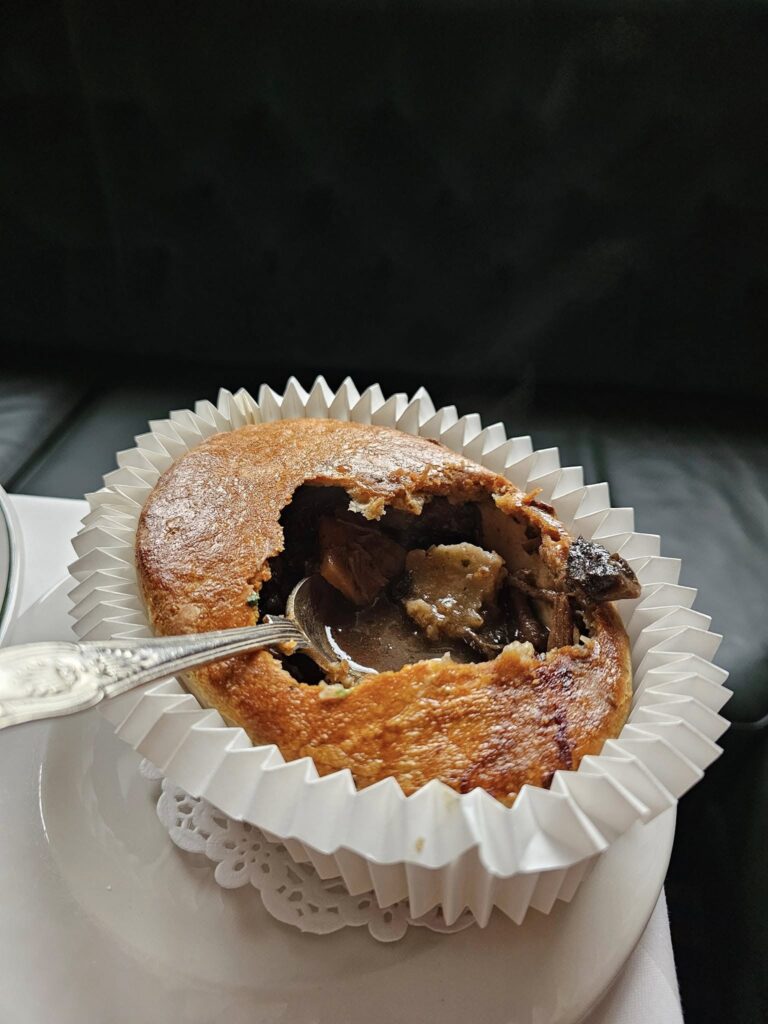
Pies have been on the menu since the 1940s, constructed with proper suet lids using cuts from their dry-aged beef. The star turn is the beef shin, Guinness and oyster pie. At £35, it’s a gloriously over-the-top creation that arrives crowned with a cheese-wrapped deep-fried oyster sitting proudly atop the golden pastry. Beneath lies slow-braised beef shin that collapses at the merest prod, swimming in rich, stout-darkened gravy with the briny sweetness of oysters throughout. It’s unashamedly luxurious.
For something more classic, there’s a steak and kidney pie with mushrooms, or the straightforward steak and mushroom version at the same price. Vegetarians get a look-in with a potato and Wensleydale pie that hits all the right notes. If you’re lucky, your pie might arrive adorned with a traditional paper frill or white doily – touches that somehow feel charming rather than affected in this particular setting.
Can’t get a table in the restaurant? It happens. But the bar area operates on a walk-in basis and has its own menu featuring slightly smaller, more affordable pies that are every bit as good. The atmosphere’s livelier too, with proper pub energy and some of London’s better pints of Guinness on tap.
Struggling to get into the Guinea Grill? Worry not. Just four minutes away down a stretch of Regent Street you’ll find its sister pub The Windmill, run by the same folk. You’ll find that pitch-perfect blueprint of a traditional London pub here, too, and the pies here are all about rich fillings and classic British flavours served all day, everyday, throughout the year.
These guys are a touch cheaper than those in the Guinea Grill’s main restaurant, but the same as the bar offering. What’s the difference? The truth is you’re paying for different experiences – the Guinea’s restaurant offers white tablecloth refinement and exceptional silver service, whilst the Windmill gives you a proper pub setting with pies that are a rounder, more rustic affair. But that’s not a criticism – they’re bloody good pub pies in a brilliant pub atmosphere.
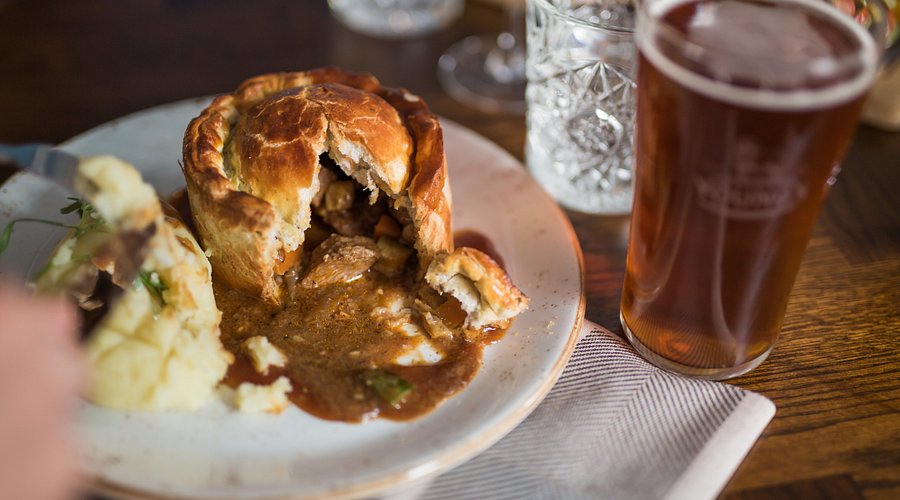
The Windmill’s been winning British Pie Awards for years – their Hampshire venison, smoked bacon and wild mushroom pie grabbed gold, whilst the steak and mushroom version snagged silver. Downstairs in the pub, there are at least three pies on at any time, whilst the upstairs dining room offers the same pies alongside a more refined British menu. You can even get the Guinea’s award-winning steak and kidney pie here.
Beyond pies, there’s a full British pub menu, an excellent pint of Guinness, and access to the full 300-bin wine list from the Guinea if you fancy going grand. One final treat: there’s a hidden rooftop terrace at the back – an absolute gem on a sunny afternoon when you can escape the Regent Street chaos with a pie and a pint.
Ideal for a British-Indian mash-up that totally makes sense…
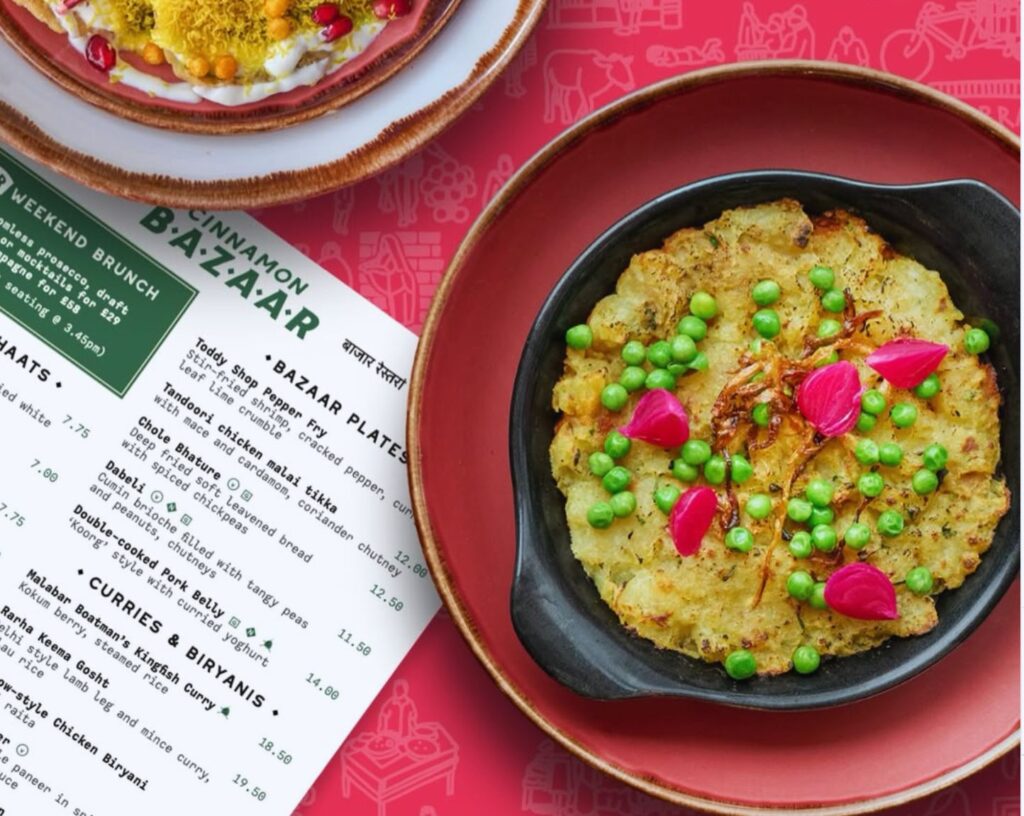
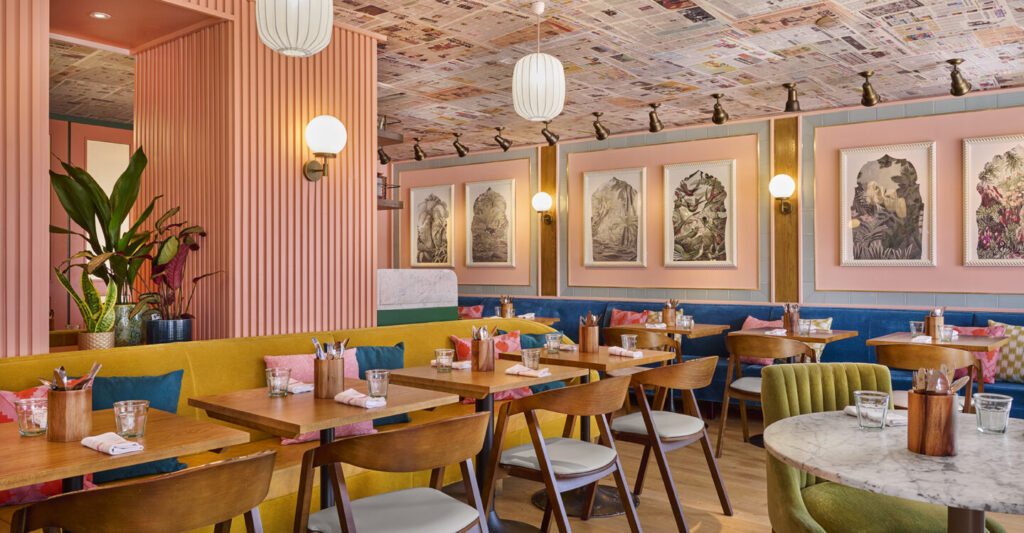
Sometimes the best innovations come from taking two beloved classics and letting them collide. Vivek Singh’s rogan josh shepherd’s pie at Cinnamon Bazaar does exactly that – merging the humble British shepherd’s pie with the aromatic complexity of a Kashmiri rogan josh to joyous effect.
This clever marriage of British and Indian flavours creates a genuinely stunning piece of cookery with subtle background notes from the spice mix of star anise, fennel seeds, cinnamon stick and green cardamom pods.
What makes this work so brilliantly is the restraint. The spices aren’t shouting for attention; they’re having a quiet, civilised conversation with the lamb. Topped with the traditional mash and a golden crust, it’s familiar enough to feel comforting yet exciting enough to keep you coming back.
And yes, we realise there’s no pastry here and the whole definition of a ‘pie’ thing might sidetrack the pedants, but we simply don’t care enough to discuss it further.
Ideal for a spectacular sharing pie and south London hospitality…
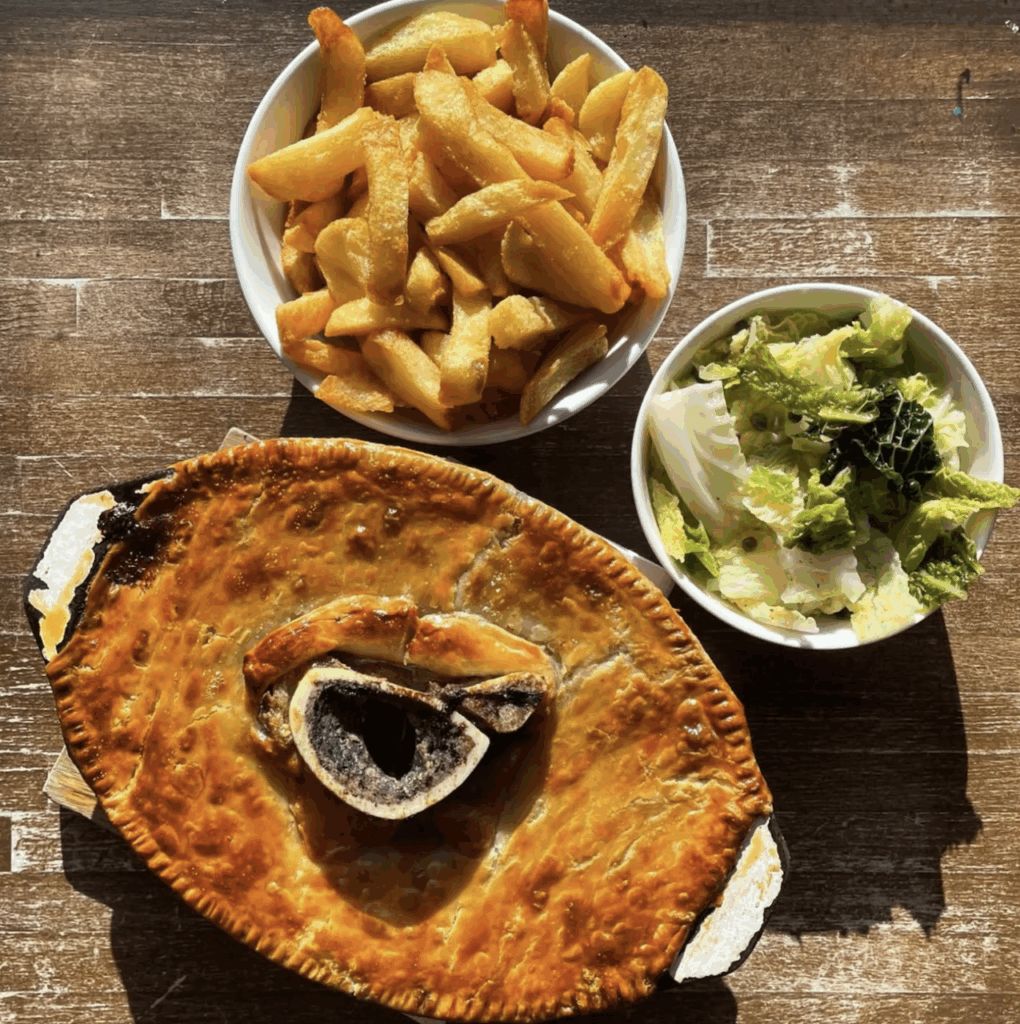
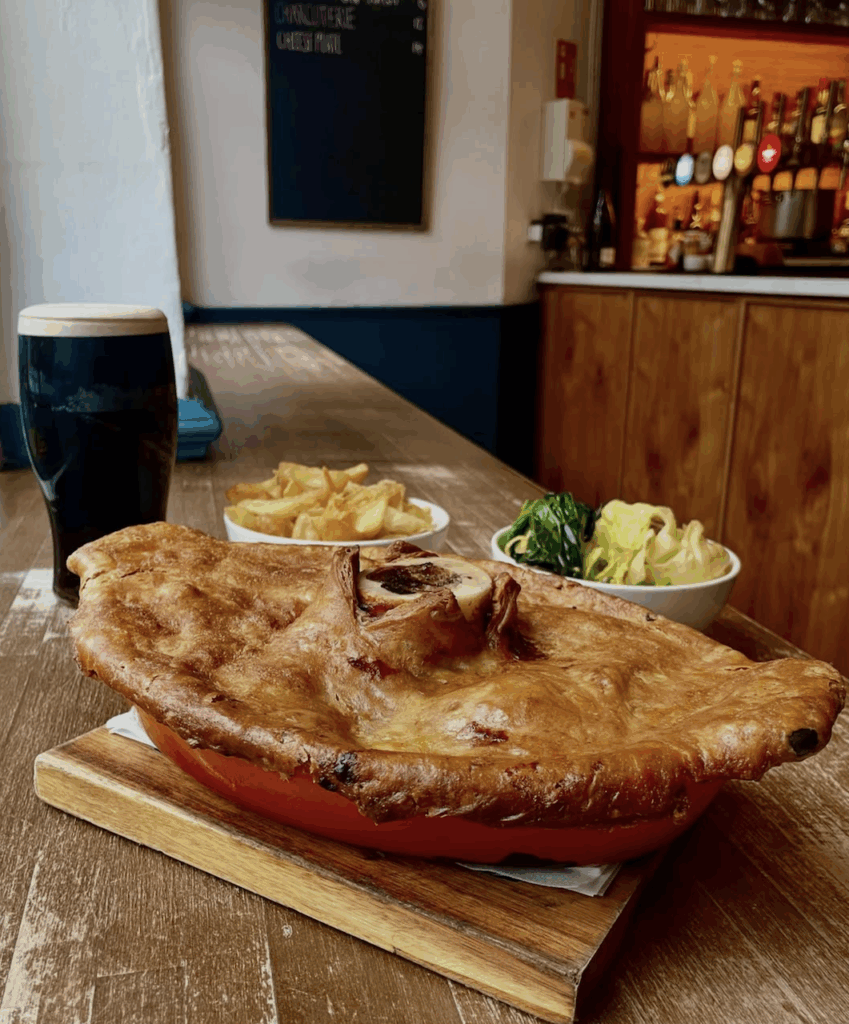
Beef, ale and bone marrow pie… Need we say more? This one is a pie built for sharing – a signature dish that’s become legendary among south London’s food lovers.
This Victorian pub got a gorgeous makeover back in 2014, transforming it into one of the capital’s most respected gastropubs. It’s part of the same stable as the Anchor and Hope in Waterloo – that original south London gastropub pioneer – along with the Canton Arms and Great Queen Street. You know you’re in safe hands, then, and the dining room oozes a certain familiar character with distressed wooden floorboards, mismatched vintage chandeliers, and an open kitchen where you can watch the chefs work.
The beef, ale and bone marrow pie is a magnificent beast, served in a pie dish with a dramatic end of marrow bone protruding from its golden suet crust. Inside, tender chunks of Hereford beef have been slowly braised in dark ale until they’re melt-in-the-mouth soft, whilst the bone marrow enriches the gravy with an incredible savoury depth. Those caramelised crusty bits that cling to the edges of the dish? Absolute gold.
It typically comes with seasonal accompaniments – think buttery cavolo nero or January King cabbage, plus chips. At around £45, it’s designed for two to share, though three wouldn’t go hungry. The richness demands a robust red wine and ideally a lazy afternoon with no pressing engagements afterwards. Oh, you twisted our arm…
Ideal for a workers’ lunch with serious credentials…
Fancy a pie from the first London pub to win Michelin Pub of the Year? Of course you do; that’s why you’re here. Well, the pies at The Marksman were exceptional even before that accolade dropped, and they’ve remained consistently brilliant since.
This handsome Hackney Road boozer is under the direction of two talented chefs who’d previously worked at St. John. They’ve struck that rare balance of keeping the downstairs pubby – handsome wood panelling, lush leather banquettes and the cheerful buzz of locals propping up the bar – whilst the upstairs dining room is light and bright with perhaps the best acoustics in London. While the decor is impressive, the genius is of course in the cooking.
Now back to pies. Pies, pies, pies. The pies evolve with the seasons, once again, a consistent marker or thoughtfulness and rigour. One visit might bring chicken studded with earthy girolles, another could feature duck enriched with prunes and bacon. They occasionally offer larger sharing pies too – we’ve seen a magnificent chicken and wild garlic number that looked (and smelt!) darn good on a neighbouring table.
Our top tip though is to look out for their workers’ lunch offering: substantial pies paired with a pint for around £15, available at the end of the week. Recent highlights include a fish pie with buttered greens, and a stunning lamb and wild garlic version that showcases British ingredients at their seasonal best. These aren’t dainty affairs – they’re generous, soul-warming plates that’ll fuel you through an afternoon’s graft. Or, indeed, one spent on the sofa groaning.
Not always on the menu, they often announce their pie specials on social media ahead of time, so it’s worth following along and booking as and when something takes you fancy.
Ideal for accessible, quality pies across London (and beyond)…
We’re ending our list with a pie that’s quietly taken over London, one hand-pressed pastry case at a time. Here’s the proposition: from just £5.50, you get a proper shortcrust pie, made with quality ingredients and expertise. While being miles apart from a sad service station Ginsters, it’s the kind of pie that works equally well as a quick lunch or the star turn at a dinner party.
It’s the brainchild of chefs and flatmates Will Lewis and Josh Hill, who launched Willie’s during Covid. Lewis cut his teeth at St John and Rochelle Canteen, so the pedigree is there – as is the backing from Arsenal and England legend Ian Wright, who invested early on.
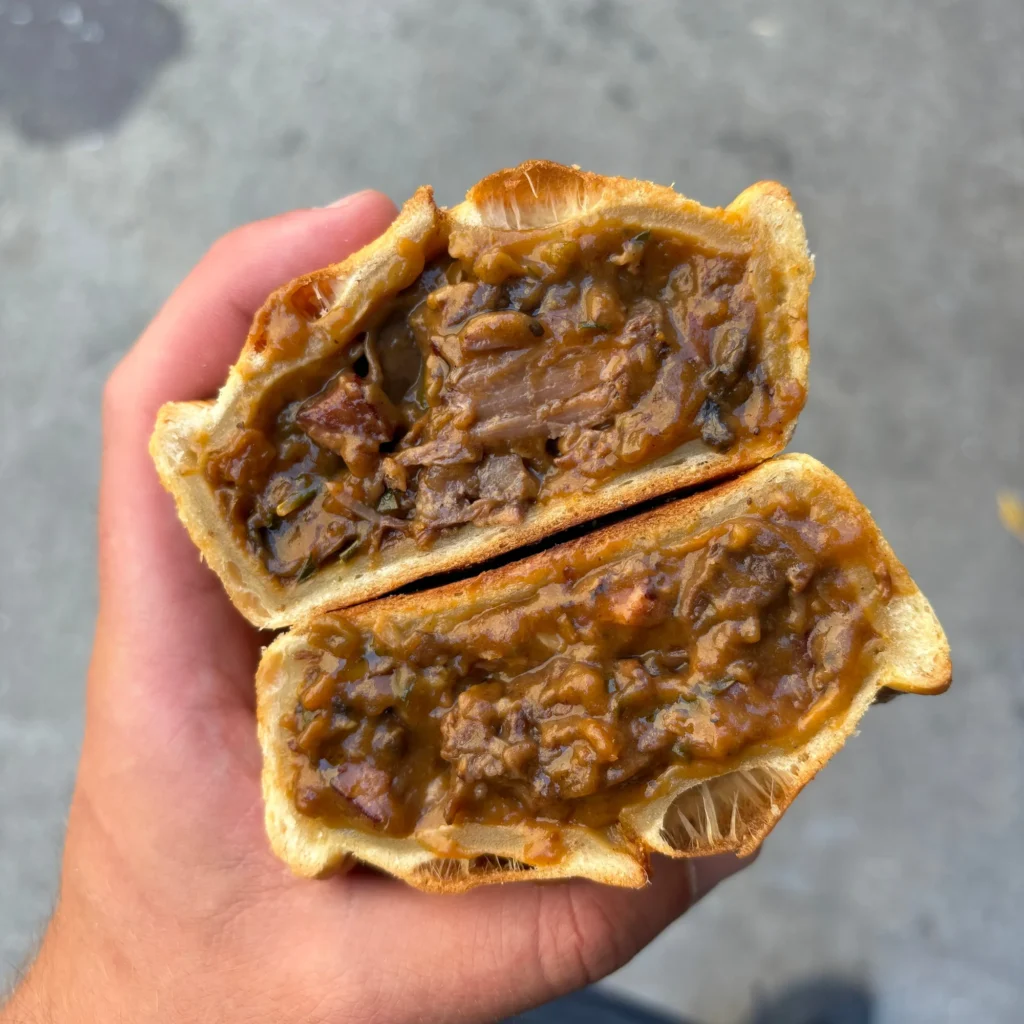
Our current top pick is the beef cheek and scotch bonnet, created in collaboration with Ben Lippett for his recently released cookbook. It’s a beauty; beef cheeks braised low and slow in Guinness and rich beef stock, spiked with punchy scotch bonnets, fragrant allspice and fresh thyme. The heat builds gradually rather than smacking you in the face, and that long braise means the meat practically melts into the pastry.
The range shifts with what’s good – you might find rabbit with Breton cider tarragon or roast chicken with celeriac. All handmade in Hackney, where there’s a permanent spot under the arches in London Fields with the scribe ‘since lockdown, 2020’ emboldened proudly on the front door.
Willie’s has spread across London – north to south, east to west, you’ll find them stocked somewhere nearby. Ocado carries them, there’s nationwide delivery, or you can pick them up in store. The pies also pop up every now and again in a pub with a residency, too; currently they are at The Wooden Cross in Crouch End and The Builders Arms in Chelsea.
Proper pies, properly accessible. What’s not to love?
All that said, the finest pie we’ve had all year wasn’t actually in London. It was just outside of Bruton, at Margot Henderson’s The Three Horseshoes. It’s part of our roundup of where to eat in Bruton, Somerset. Do check it out sometime!
Bangkok has always had great food in its shopping malls. It’s just that ‘great’ used to mean 30-baht bowls of boat noodles from the basement food court, bought using a convoluted token system, the logic of which has defeated visitors for decades. Now, shopping mall dining means something else entirely.
The recent era of mega-mall openings has lured internationally renowned chefs to the top floors of these developments, not tucked away on a lower ground floor but given prominent billing on high, their sweeping views of an ever-growing cityscape often standing in for a genuine sense of place or, indeed, actual walls.
ICONSIAM led the charge with Alain Ducasse’s Blue. Emsphere followed. Even the comparatively modest Gaysorn Amarin got in on the act with Gaggan at Louis Vuitton, an intimate 30-seat restaurant inside an LV flagship.
And now Dusit Central Park, which opened in September 2025 on the corner of Silom and Rama IV, has entered the conversation. Each new opening seems to make the last generation of malls feel instantly dated. MBK Centre, which felt like the cutting edge of Bangkok retail not so long ago, now has the air of a relic. The pace of reinvention here is relentless.
Dusit Central Park is a 130,000 square metre, eight-floor development, part of a 46 billion baht mixed-use project built on the site of the original Dusit Thani, one of the city’s most venerable hotels. The complex includes a seven rai rooftop sky garden that positions itself as an extension of Lumpini Park across the road, and it drew 70,000 visitors on its opening day alone. This is big-ticket Bangkok development at its most ambitious.
What’s notable about Dusit Central Park’s choice of headlining restaurant, Noi Samrub Bar and Eatery, is that they went local, handing the top floor not to an internationally imported name but to one of Bangkok’s most storied, freewheeling chefs, a decision that says something about how the country’s own culinary talent is now being valued.
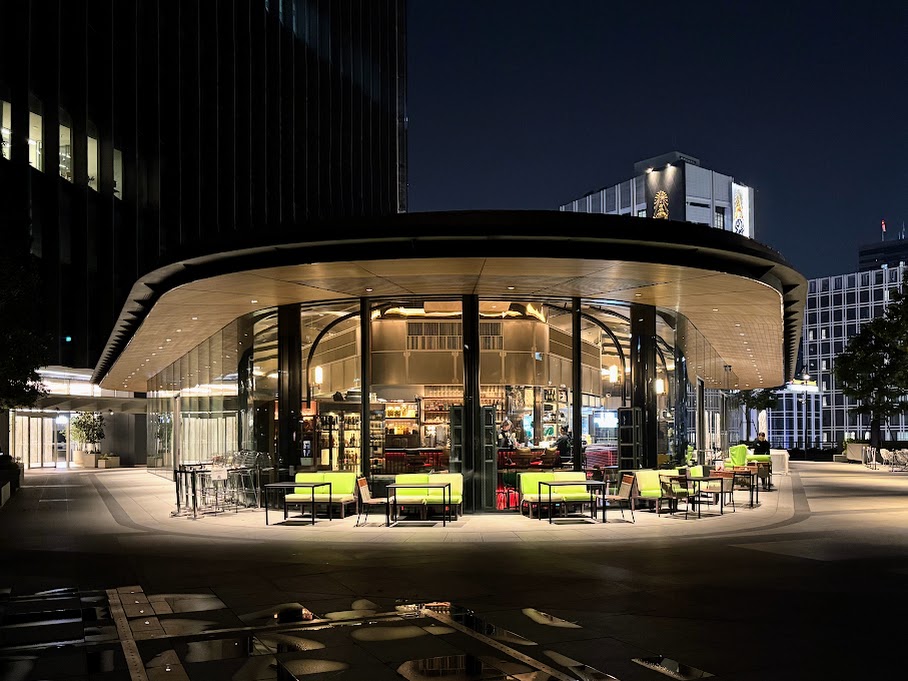
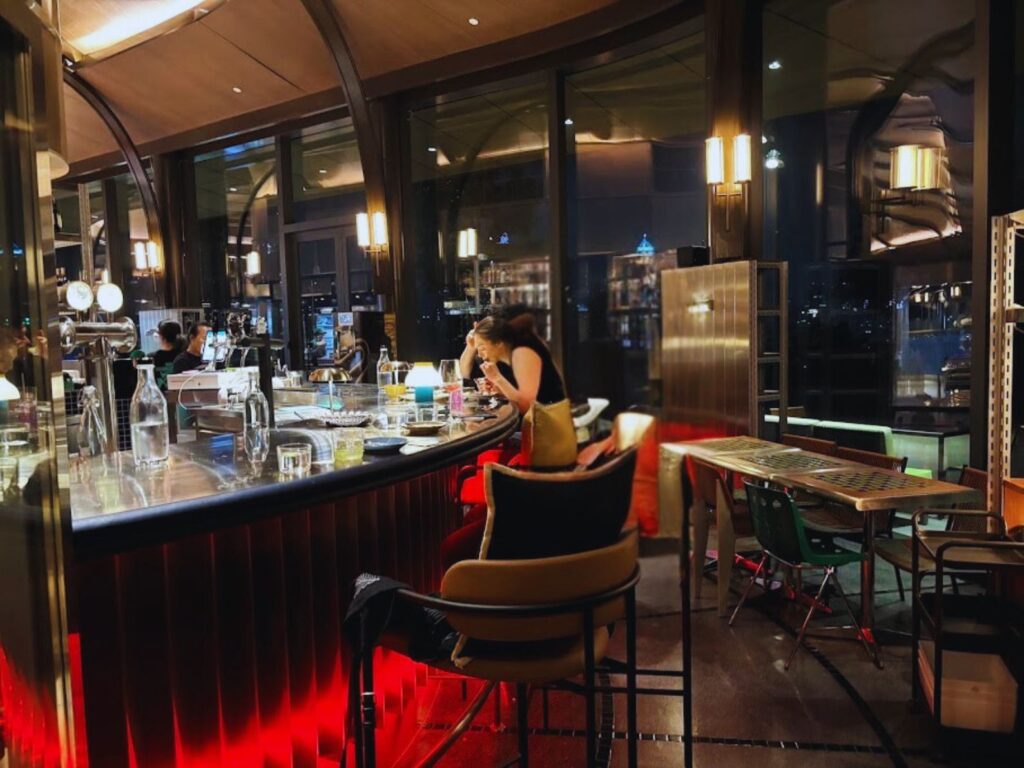
Noi Samrub is the latest venture from chef Prin Polsuk and his wife Thanyaporn ‘Mint’ Jarukittikun, the couple behind the Michelin-starred Samrub Samrub Thai. It sits at the top of the mall, wrapping around its upper floor with windows behind the diners and views over Lumpini Park’s green canopy and the city skyline beyond.
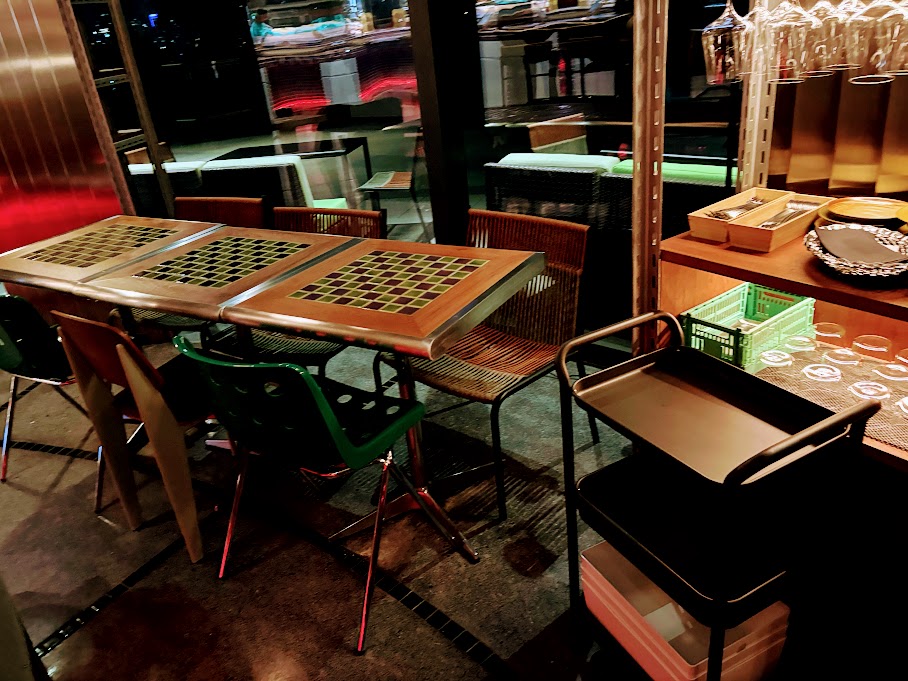
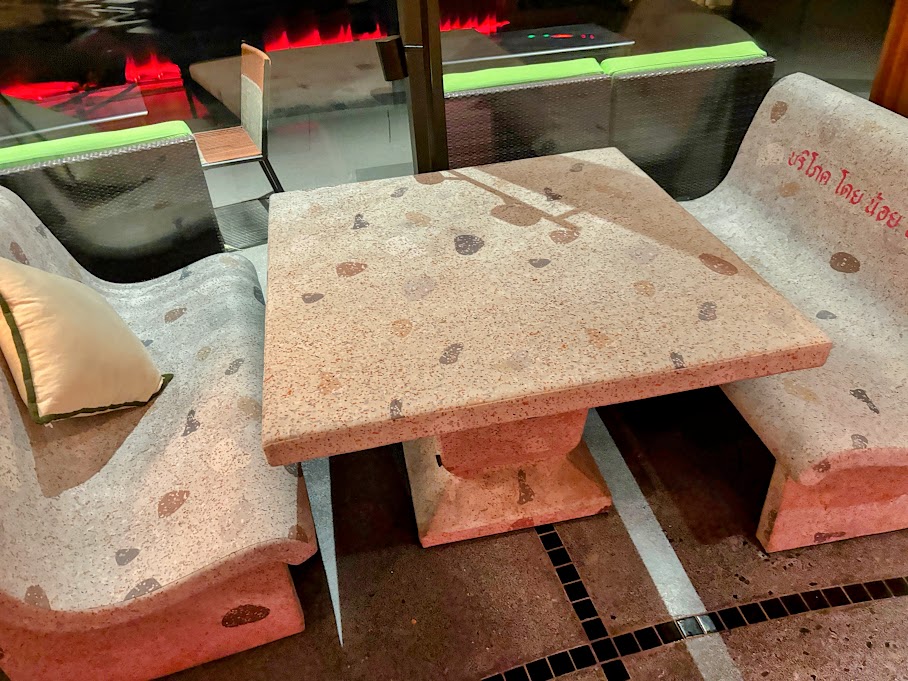
Despite its address, you don’t feel like you’re eating in a shopping centre at all. The interior has a wry, knowing quality: chequered tables frequently found in public spaces for playing Makruk (Thai chess), foam replicas of classic terrazzo-style concrete table and bench sets that you see dotted around every public space in Bangkok.
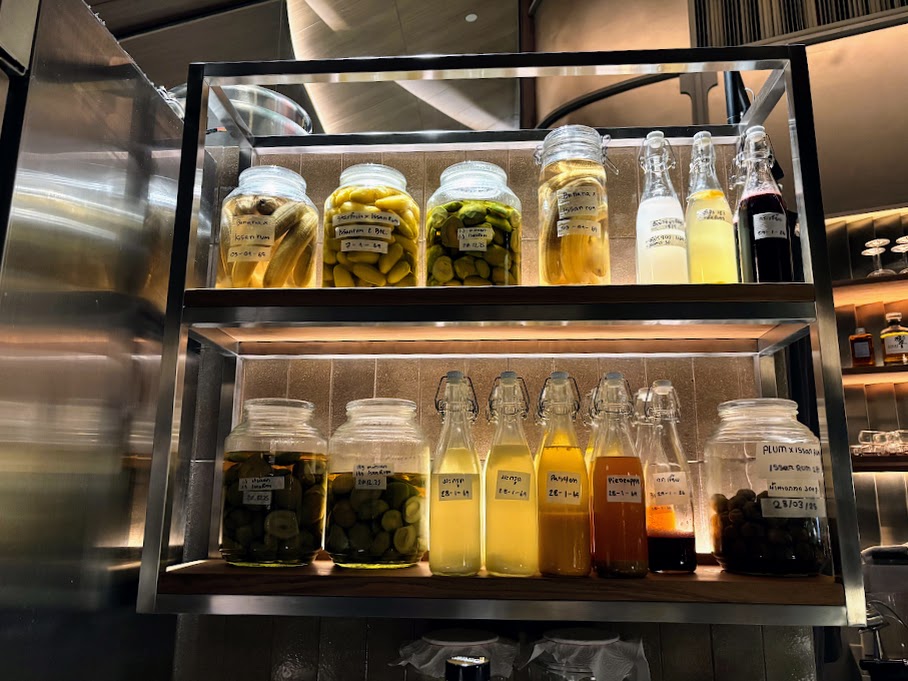
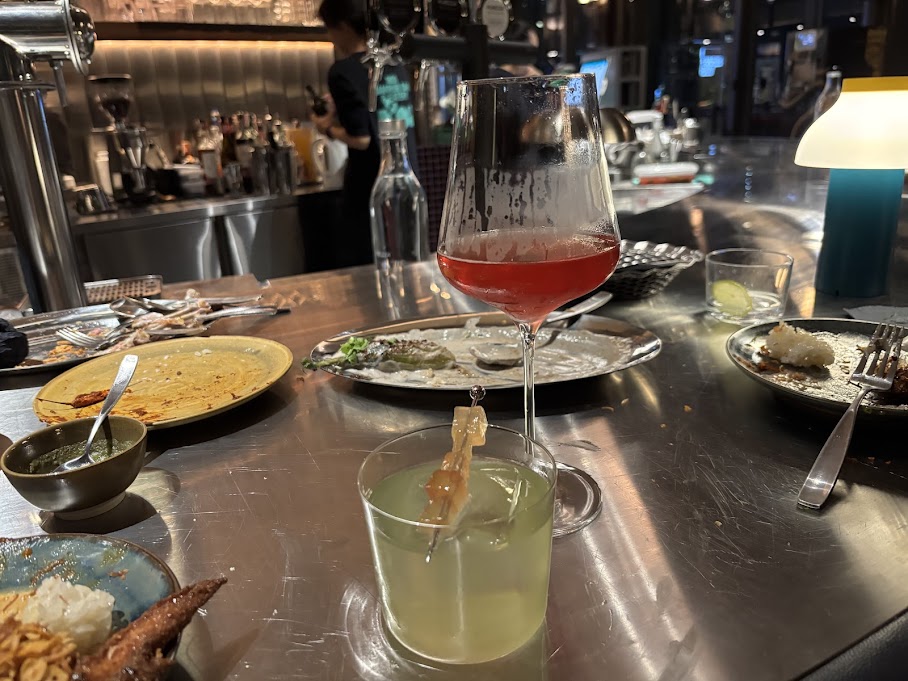
The sprawling, sleek curved counter offers the best seats in the house. It looks over a shelf of fizzing ferments and murky house-brewed spirits (plum Isaan rum, banana skin-infused rice wine, that kind of thing) that openly defy the sanitised logic of the floors below. There’s a youthful irreverence to the whole set-up; a Thai izakaya that feels like it belongs to a different postcode entirely, and it invites you to drink.
Chef Prin cut his teeth as a protégé of David Thompson at Nahm, both in London (where the restaurant became the first Thai establishment in the world to win a Michelin star) and later in Bangkok, before founding Samrub Samrub Thai with Mint in 2017. What began as a post-work gathering of chefs evolved into one of the most important Thai restaurants in the world, now holding a Michelin star of its own and ranked 47th on Asia’s 50 Best Restaurants. Prin’s thing is preservation: he digs through ancient recipe books, works with rural farming communities, and serves dishes that haven’t appeared on a Bangkok menu in decades, sometimes centuries, perhaps never.
At Noi Samrub, though, there’s no dogma to the cooking. Prin is famous for his forensic faithfulness to historical Thai recipes at Samrub – a restaurant that’s reverent but still a lot of fun – but the mood here is looser, more instinctive, more playful.
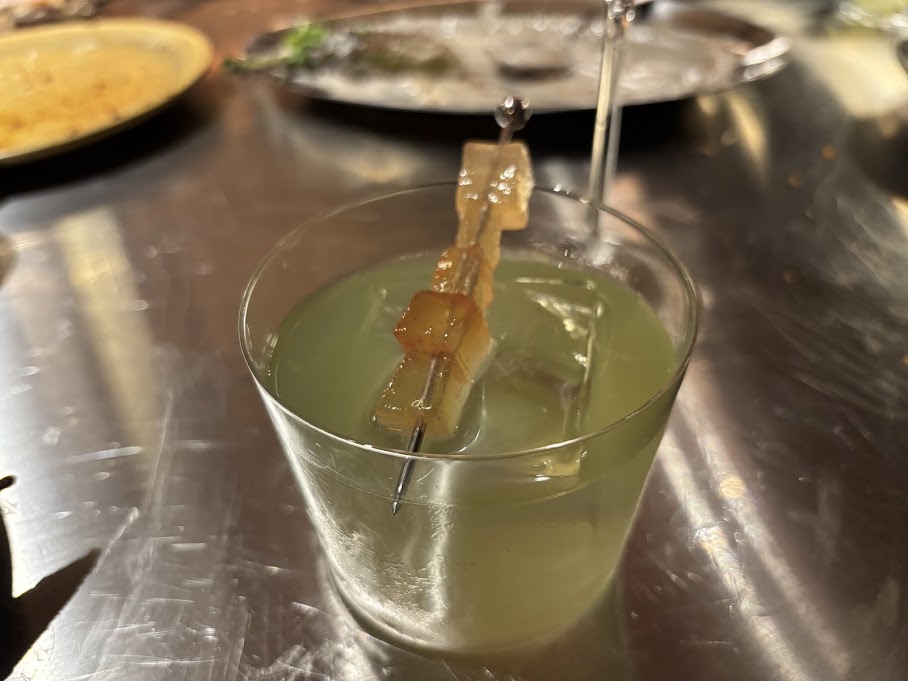
This is food designed to be eaten with a drink in hand, and the drinks are seriously good. The cocktail programme, built around those spirits visible from the bar, could hold its own on any best bar in Asia list, and it’s pretty much obligatory to work your way through a few before, during and after eating. The pandan campari is particularly special, and the on-tap Sato (the increasingly popular, sake-adjacent, Thai fermented sticky rice wine) goes with everything.
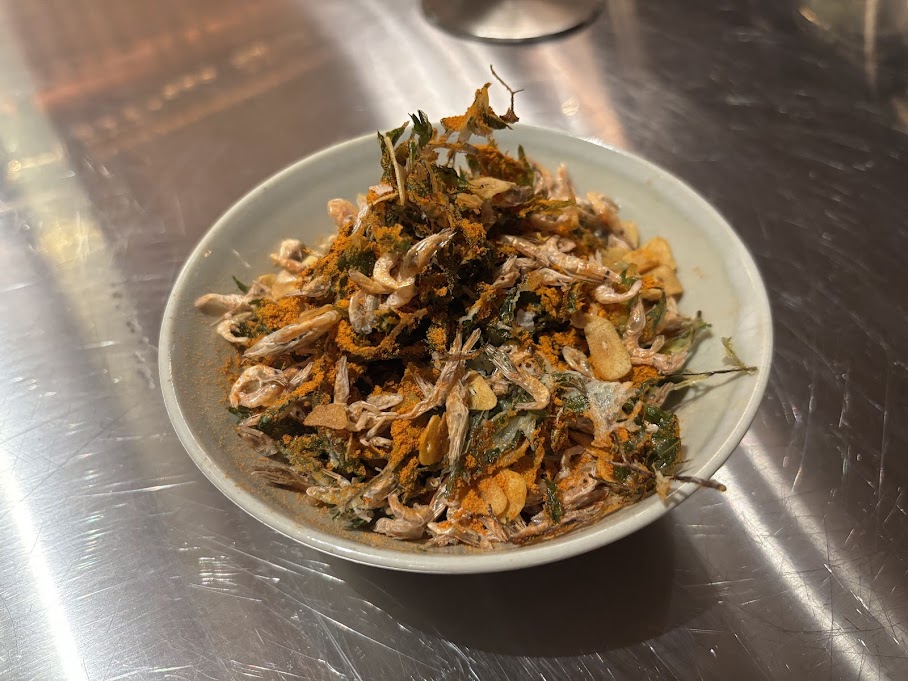
There’s a photobook-style menu to leaf through alongside the main one, great for pointing at when words start blurring and vibrating. The menu moves from snacks (pickled bilimbi with chilli salt, shrimp with garuda crumb and red curry powder) through grilled shellfish and skewers, and into more serious territory, topping out with a grilled phu phan beef rib for 2,700 baht.
What’s particularly lovely is that some dishes which previously appeared on Samrub Samrub Thai’s rotating tasting menus seem to have found a second life here on Noi’s à la carte. Given how transient each Samrub menu is, with a new regional focus every couple of months and dishes that may never return, there’s something generous about giving them a more permanent home at Noi, Prin’s meticulous research allowed to breathe beyond a single menu cycle.
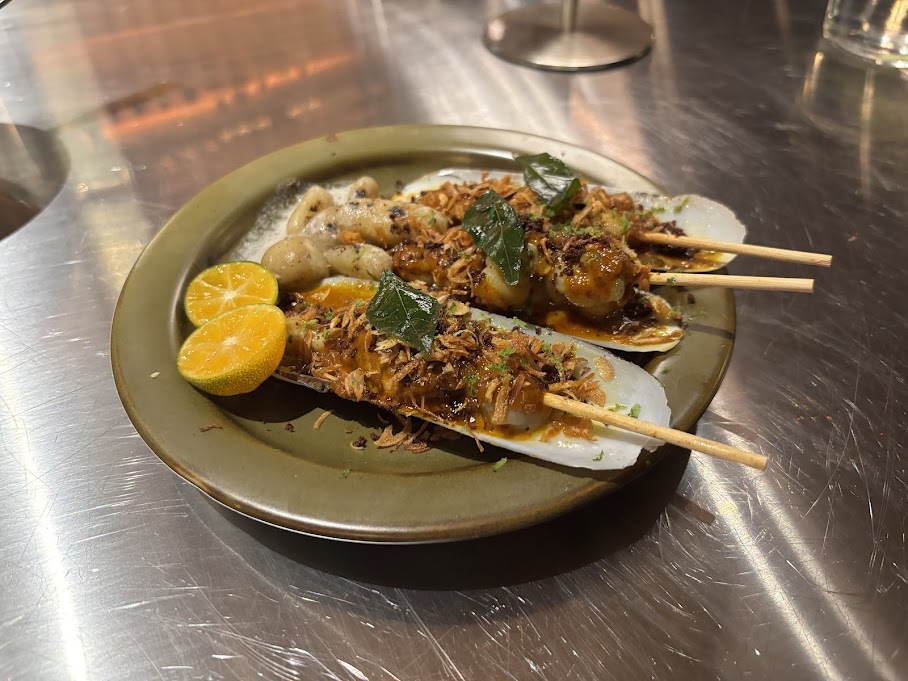
Grilled bamboo clams with Southern golae sauce
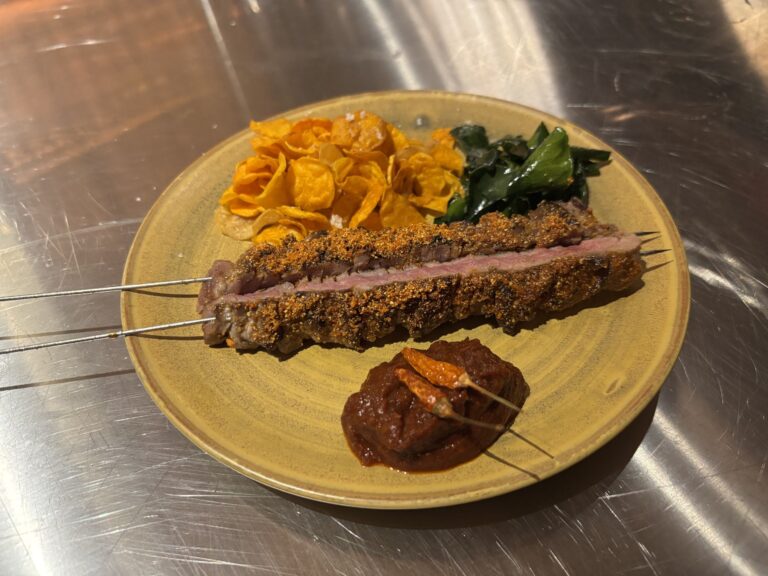
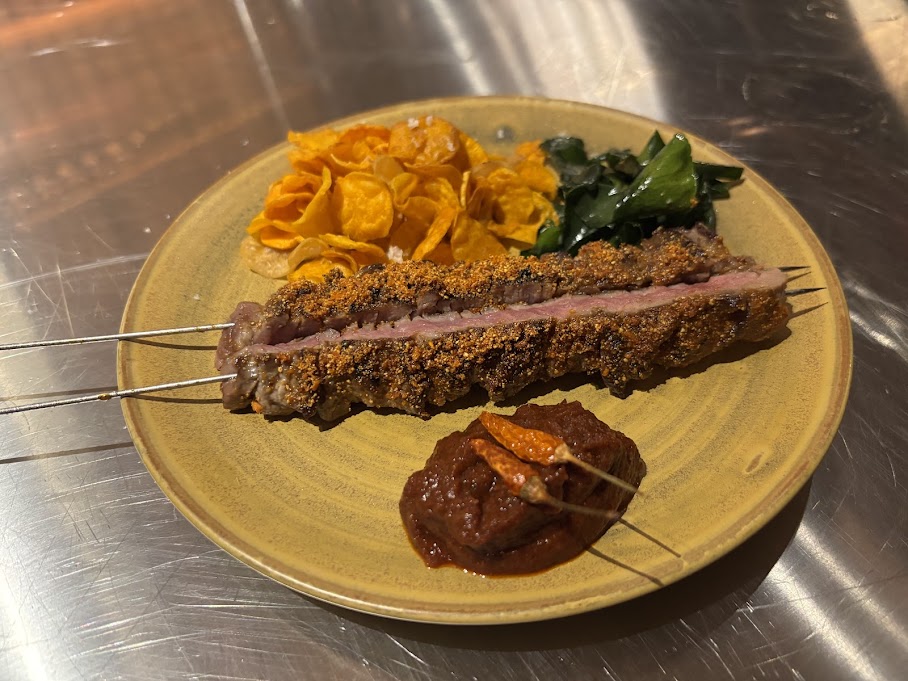
From our visit, the grilled bamboo clams with Southern golae sauce were a highlight: sweet, smoky and slicked with a tart coconut marinade that had caught on the grill and caramelised into something that tasted vaguely obscene. Trang venison skewers with toasted spices were terrific too, the dry spice rub assertively bitter, the meat blushing, its companion relish fruity, glossy, and really fucking spicy.
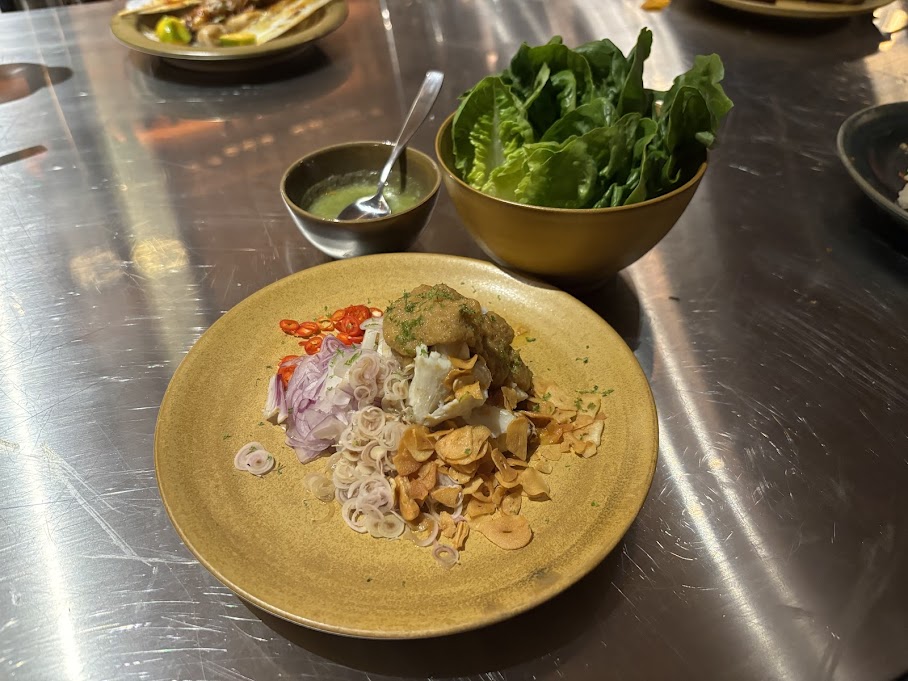
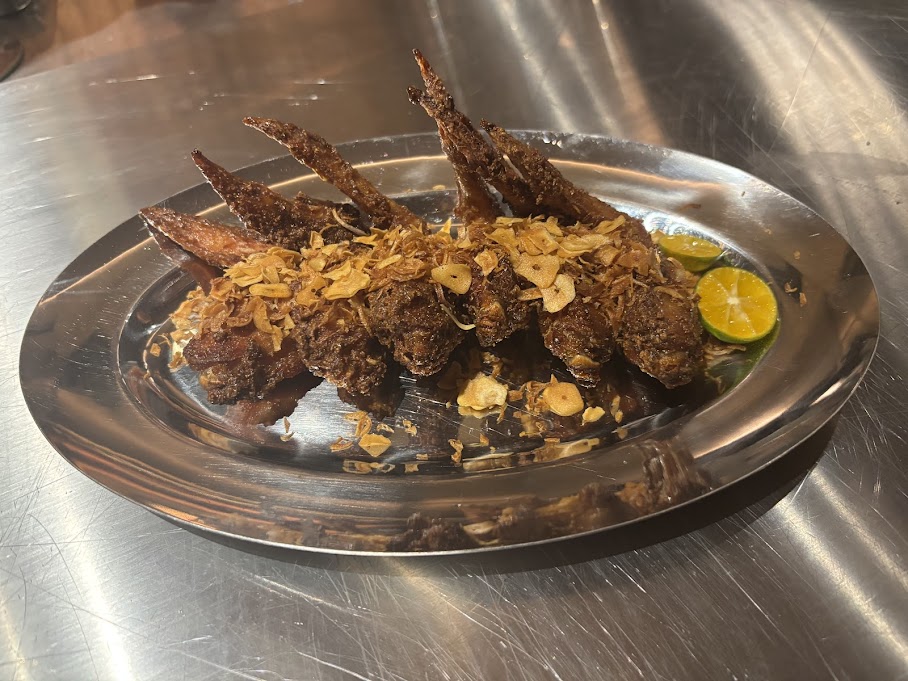
The crab miang, served with crisp folds of lettuce rather than the more traditional betel leaf, had a build-your-own quality that was in keeping with the get-stuck-in spirit of the place. Miang caramel was replaced with nahm jim seafood to bruising effect. The NFC were the funkiest, most fragrant chicken wings I’ve had in years, the intimidating half dozen dispatched even faster than the frosty Regency highball that had appeared on the counter without me even asking.
Trang venison skewersCrab miangNFC
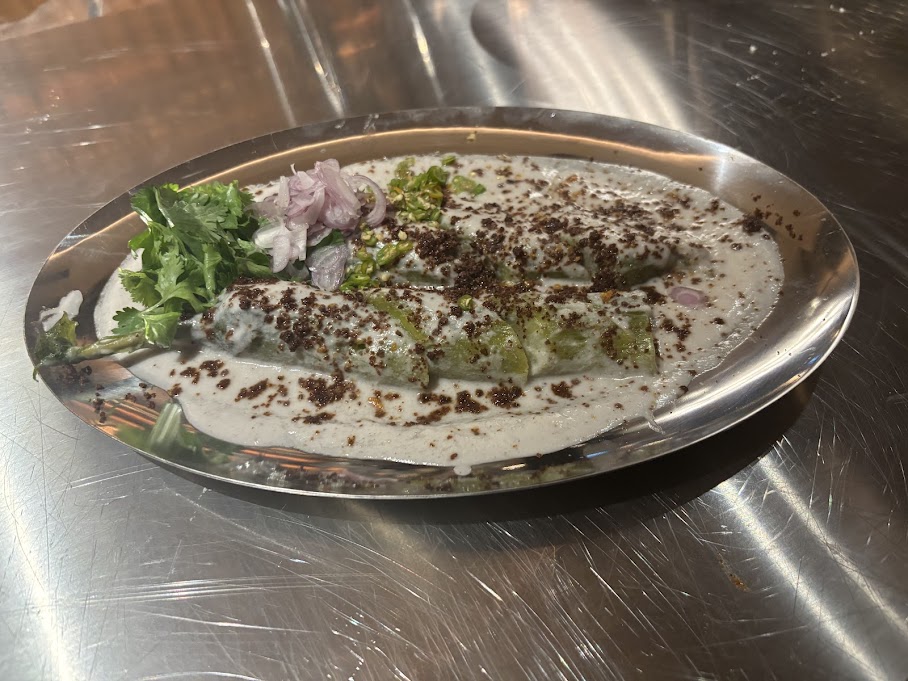
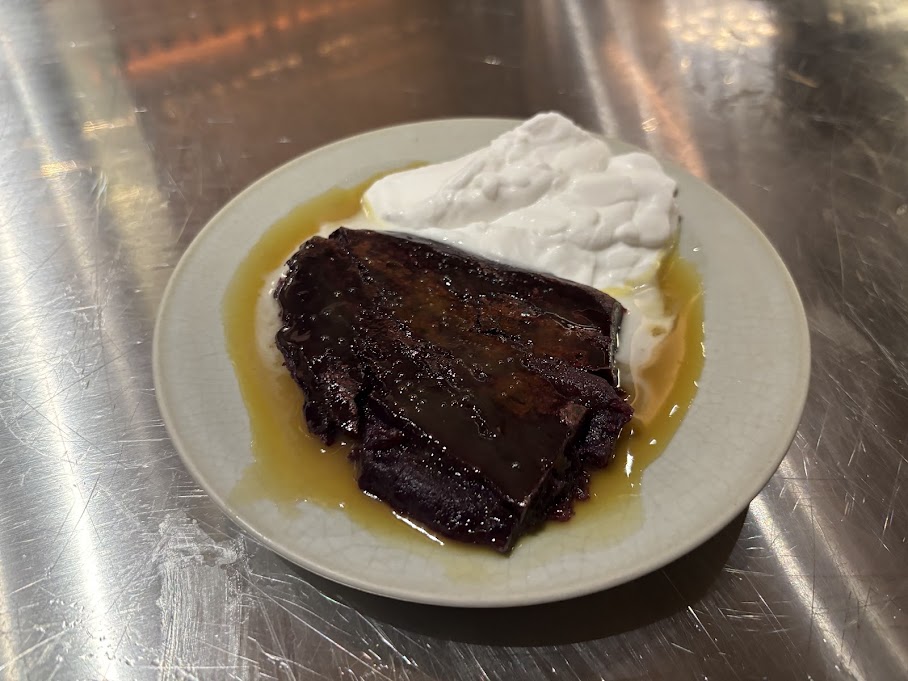
To close, grilled aubergine with coconut cream and shrimp paste blurred the line between savoury and sweet so convincingly that the actual dessert, a roasted Japanese sweet potato with coconut cream, felt almost restrained – and somehow earthier – by comparison. Mix them up – this isn’t a place to be fussing about within the confines of mains and puddings. It’s in the blurred liminal spaces where the real fun happens.
Grilled aubergine with coconut cream and shrimp paste Japanese sweet potato with coconut cream
A tip: dine late. After your meal, head up to explore Dusit Central Park’s rooftop sky garden. By that hour the crowds will have gone, the pathways roped off until tomorrow, and you’ll have the gardens and their panoramic views over the city to yourself. Then exit back down through the mall after hours, when the shops are closed and staff are changing the displays around you, shuffling and sweeping, and the whole building takes on a different surreal energy. It’s one of those evenings that could only happen in Bangkok.
The Millennium Stadium, known as the Principality Stadium since 2016 when the naming rights were sold to the Principality Building Society, is an iconic venue in Wales, hosting various concerts, shows, and sporting events.
No matter the reason you’re visiting the impressive, near 75’000 capacity stadium, you will, of course, need something to eat prior to or after the game or concert you’re attending. Because a show spent on a rumbling stomach isn’t very fun, now is it?
Although there are plenty of food trucks on site and bars withn the stadium terraces, these can be expensive and may not provide the best culinary experience, to put it rather mildly.
Thankfully, the Millennium Stadium is well positioned, with its main gate on Cardiff’s Westgate Street meaning it’s virtually in the city centre. As a result, there are plenty of lunch and dinner options to choose from, with many chain restaurants and well-liked independent options just a rugby ball’s throw away.
All that said, you’re not going to be the only person visiting the Principality Stadium looking for a place to eat. On match-day, many popular haunts will be tough to snag a table in, turning your hunt for a place to eat into a challenging task.
To help you with that, here are a few lesser-known places around the Millennium Stadium that you can try that offer fantastic food and experiences.
Bar 44
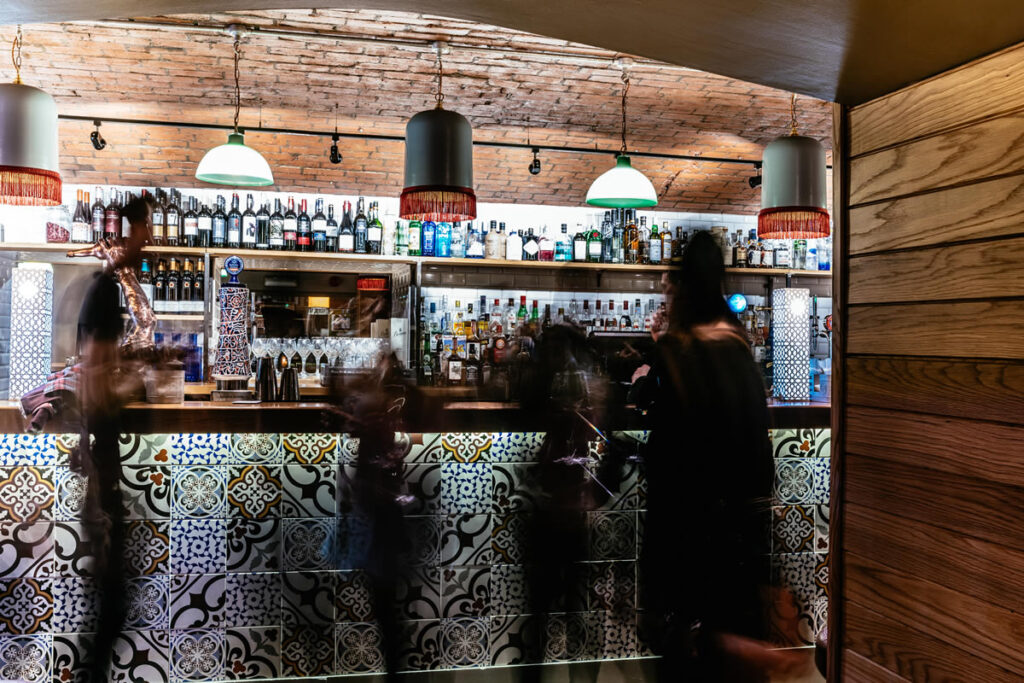
Bar 44 is so close to the Millenium Stadium that you can see it from their large bay windows overlooking Westgate street (where Cardiff’s worst car park stands, incidentally). As a former canal warehouse, the venue has a curved brick roof and dim lighting, creating an underground, bunker-like vibe, making it feel detached from all the hubbub at the stadium.
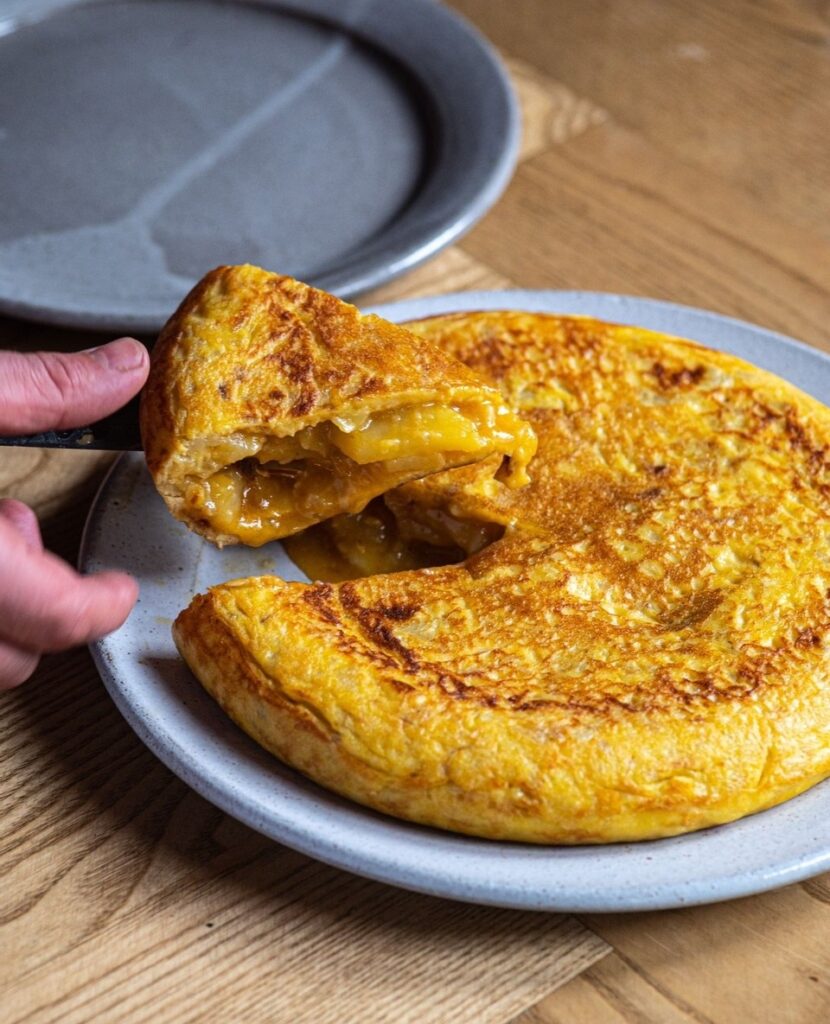
Bed in, then, for the restaurant’s wide range of authentic Spanish tapas, with a menu split into four; snacks and bread, cured bits, classic tapas and a regularly changing seasonal section, the latter of which is where much of the culinary intrigue lies. We’re still dreaming of the orange and maple glazed baby cuttlefish, quite frankly.
From the classics, and a staple of tapas bars everywhere, the patatas bravas here outclasses others in Cardiff, utilising a sherry aioli that takes the dish to the next level. There’s also a fruity chorizo option that has been poached in pear cider, or you can try gambas, a plate of grilled wild prawns with a hefty chilli kick.
Alongside their more traditional tapas offerings, on Sundays the restaurant serves up Sunday roast platters with a Spanish twist, designed for two to share. You can chose between slow-roasted Duroc pork belly or a 35-day dry aged picanha of Hereford beef served with horseradish aioli. Both come with a selection of mouth-wateringly good sides including chorizo Yorkshire pudding (which could, perhaps more accurately, be called toad in the hole), jamon fat roast potatoes and manchego cauliflower cheese.
Do make sure you save room for the restaurant’s famous olive oil ice cream. Trust us, it works!
While not quite in the stadium’s immediate orbit, Matsudai At The Bank is worth the short taxi ride (or 15 minute walk) to Grangetown if you’re after something rather different from your typical match-day fare. As Wales’ first dedicated ramen shop, this venture has evolved from remarkably humble beginnings – founder James Chant started Matsudai in September 2019 as a pop-up, having never worked in a professional kitchen during his previous career in the music industry.
The restaurant’s interior manages to channel the energy of a Tokyo ramen-ya while remaining distinctly Cardiff – think exposed brick walls adorned with specially commissioned anime artwork featuring Welsh dragons. But it’s the bowls that are, of course, the main draw here. Their Welsh lamb tantanmen, made with locally sourced meat and a rich, spicy sesame broth, has become something of a signature, while the classic tonkotsu – featuring 40-hour bone broth and hand-cut noodles – demonstrates why they’ve earned national acclaim and praise from Observer food critic Jay Rayner and culinary luminary Tim Anderson.
Don’t skip the sides either; the karaage chicken, crisp and juicy in all the right places, gives any stadium snack a run for its money. Actually, it knocks all the stadium snacks at the Principality well and truly out the park. Just remember to arrive early – once they’re out of broth, that’s it for the day.
Occupying a grand Victorian building on High Street, with its original features lovingly restored, Pasture has quickly established itself as one of Cardiff’s premier destinations for serious steak enthusiasts since opening in 2021 (there are now three branches across the city, as well as three more in Bristol and one in Birmingham). The restaurant’s proximity to the stadium makes it perfect for pre-match dining, though you might find yourself so contentedly full (or culinarily comatose) that the walk to your seat feels rather more challenging than usual.
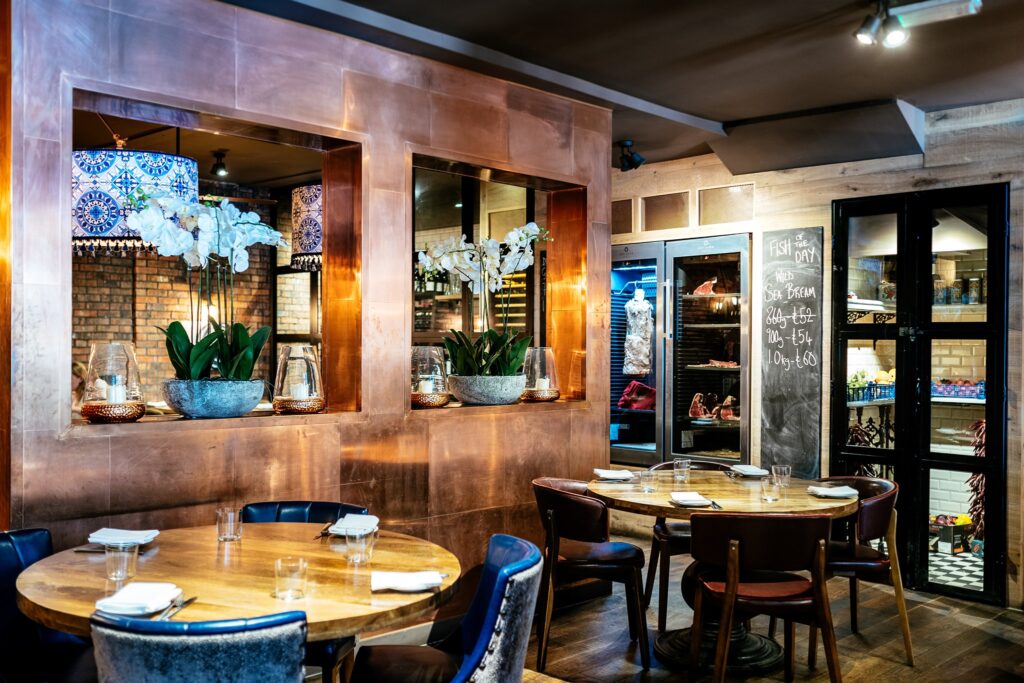
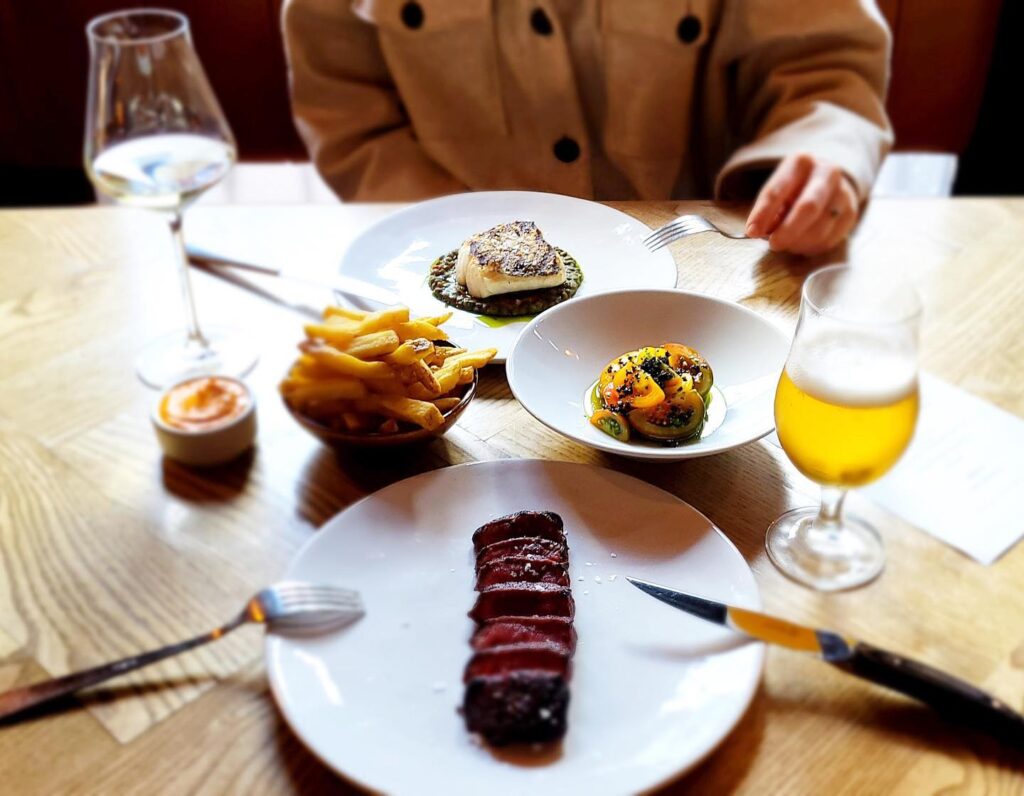
The kitchen’s piece de resistance is their dry-ageing cabinet, prominently displayed and housing cuts of Welsh beef aged anywhere from 35 to 50 days. While the steaks – from native breed cattle – are the obvious draw, don’t overlook their seafood offering; the coal-roasted shellfish platter, featuring whatever’s best from the morning’s catch from Cardiff Bay, makes for an impressive starter to share.
The restaurant’s Sunday roast has garnered particular acclaim, with their beef dripping Yorkshire puddings talked about in breathy tones by Cardiff’s dining cognoscenti (perhaps the batter has got stuck in their throats). The bar area, with its brass fittings and leather banquettes, makes an equally appealing spot for a pre-match drink and a few small plates – their Welsh rarebit croquettes being a particular favourite.
And if you need further proof that Pasture has become central to Cardiff’s food identity, they’ve just been named the exclusive food partner for the Blackweir summer concert series VIP area this year – fire-grilled steaks and burgers served to thousands across the city’s biggest outdoor gigs.
Part of the same family of restaurants as Bar 44, Asador 44 is another great option if you’re looking for tasty Spanish cuisine close to the Millennium Stadium. Focused more on the grill (which ‘asador’ translates as) side of things, this restaurant is ideal if you’re looking for Basque-reared steak or unique and exciting seafood grill options. Or both, of course…
Housed in a historic red brick building in the centre of Cardiff, the venue has a warm feel to it, elevated by the clay-coloured slate interior. It is a more upmarket option, sure, but it’s worth the higher price tag, with their dishes often looking too imposing to actually take down!
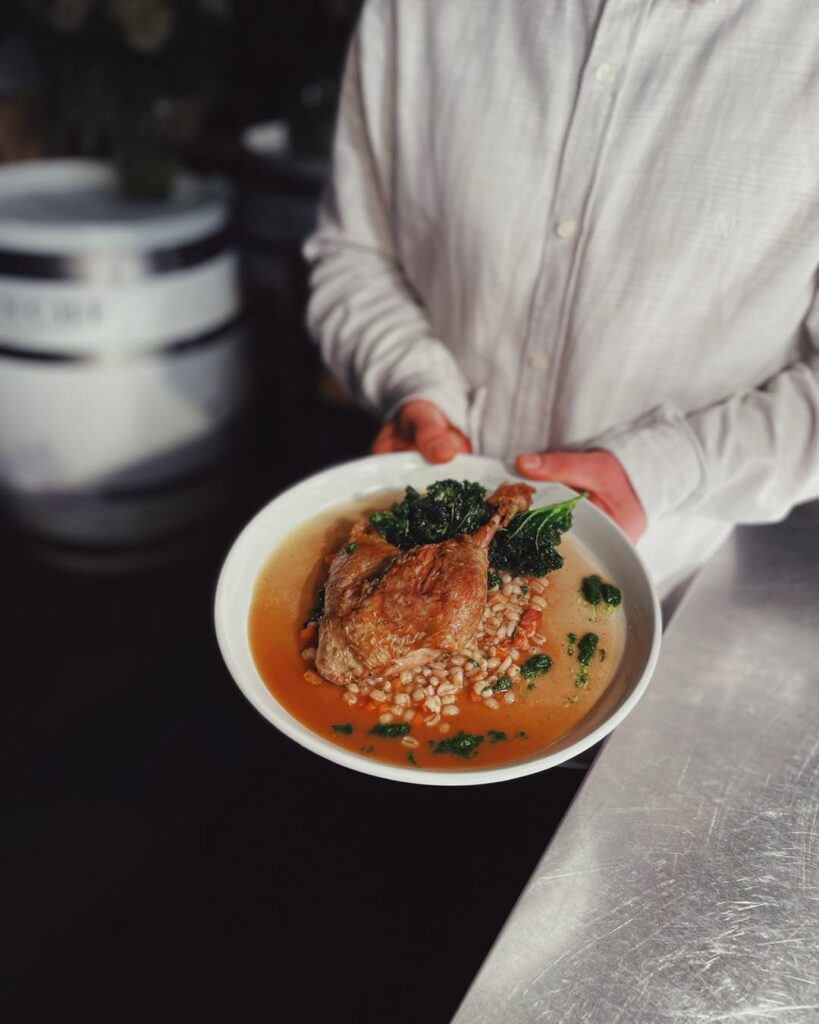
Their Fabada Asturiana, a confit duck leg dish served with chorizo, morcilla and white beans, is a rich dish brimming with complicated flavour combinations, and their 300g rump steak is another appealing option. Just make sure you don’t slip into a food coma just as the concert begins!
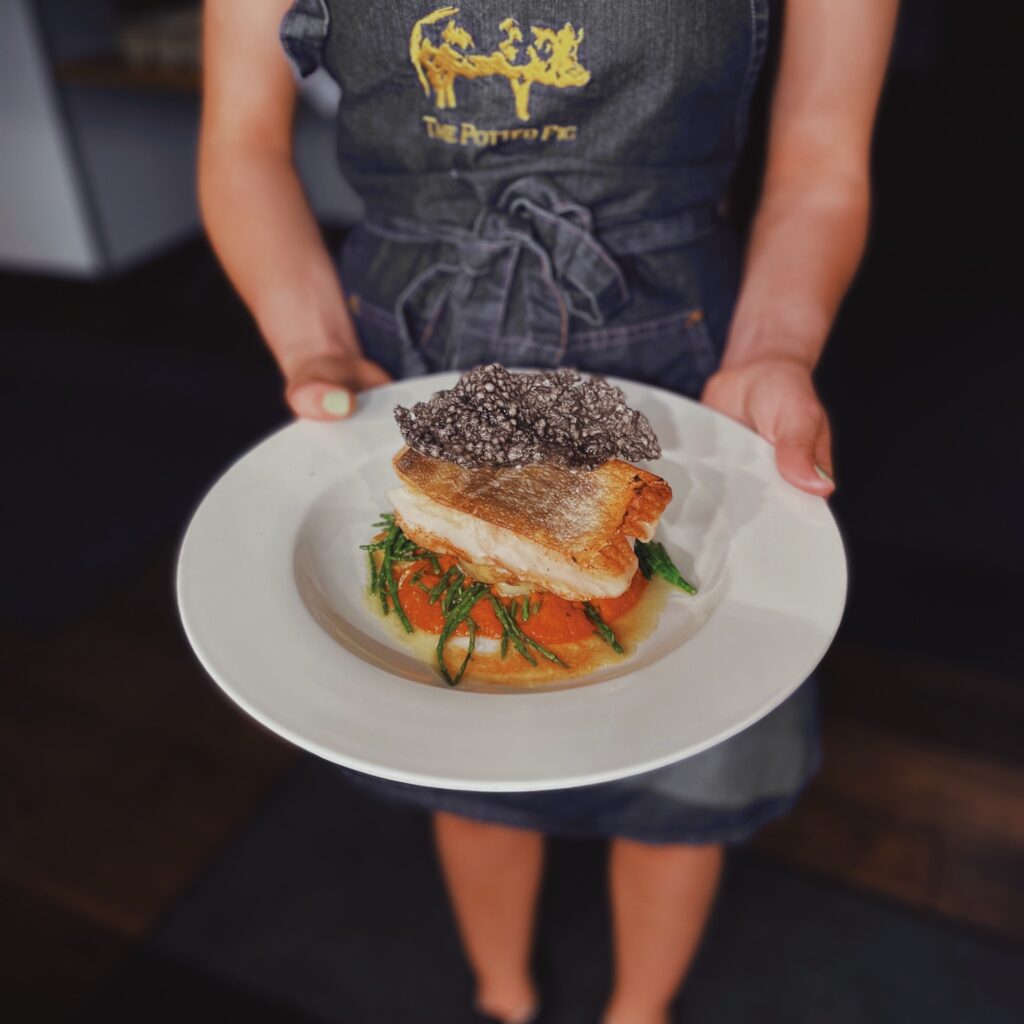
Located in a former bank vault just a short walk from the stadium, The Potted Pig is an elegant restaurant offering gutsy, generous dishes built around a love of British produce, and a passion for flavour above all else.
Although there’s always something new on the regularly changing menu at The Potted Pig, you can expect dishes like pork belly with properly crisp shards of crackling, served with a mustard mash which is all the right levels of piquant. Even heartier is beef brisket, fondant potatoes and a seriously rich bourguignon sauce that’s been seasoned keenly, to say the least.
The cheeseboard here is a thing of beauty, showing off a selection of Welsh cheeses from artisan dairy farms. The Snowdonia Black Bomber – a lively-tasting cheddar with crystals in all the right places – is particularly good. Yep, this is definitely one of the best places to eat near Cardiff’s Millennium Stadium.
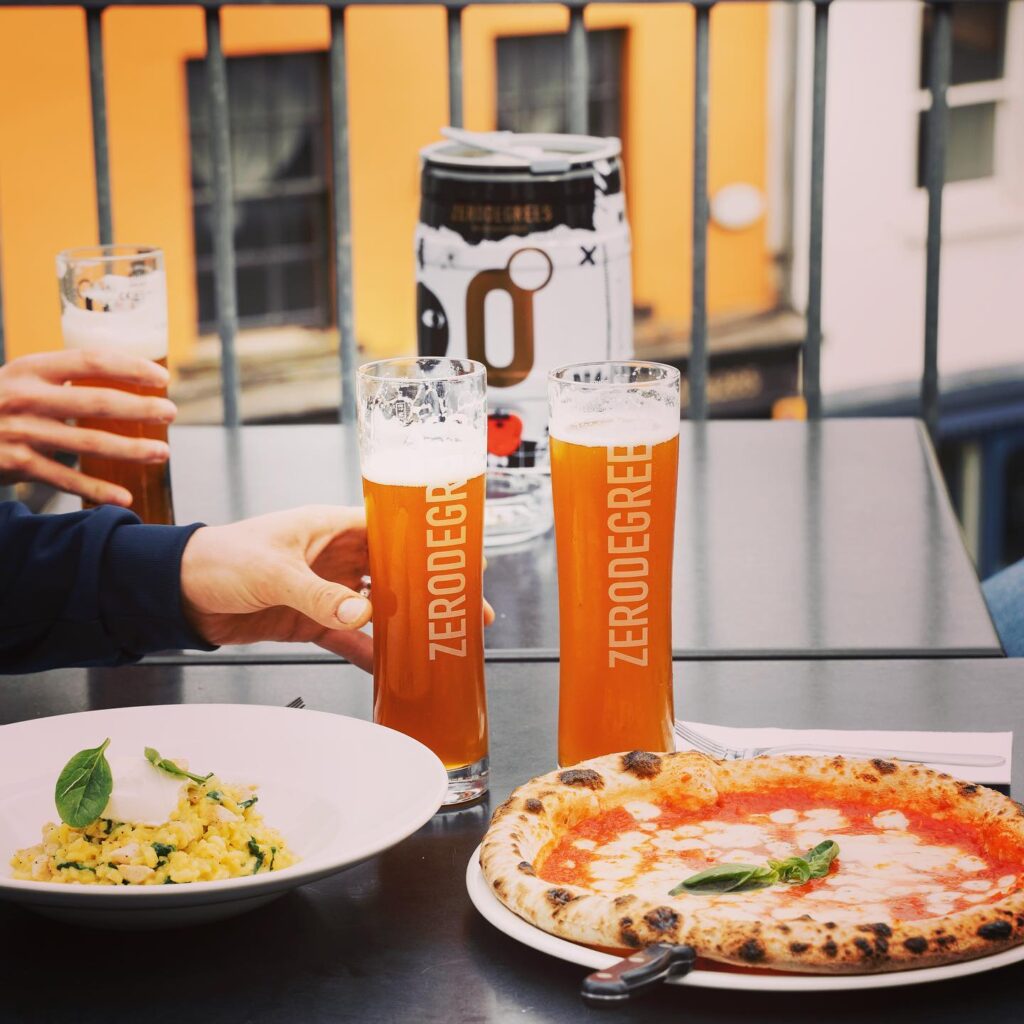
If you’re looking for a lively spot for a warm-up drink or a post-match de-brief, Zerodegrees Microbrewery, another on Westgate Street, could be just the ticket. Instantly identifiable by its bold, neon blue signage, this open-layout restaurant and bar use large skylights to create an open, breezy-feeling space.
Although focused on providing excellent craft beers and IPA, the food at Zerodegrees isn’t half bad, with an Italian menu focused on pizza, pasta, risotto and the like. For the former, the kitchen uses specialist flour imported directly from Naples to make their dough and spend more than 24 hours to prove it, creating a fluffy and light pizza that’s topped with a wide array of carefully curated toppings to elevate their pizzas to new heights.
For something different, try their caramelised pear & gorgonzola pizza that blends savoury and sweet perfectly. Using an open-plan kitchen at the centre of the venue, you can watch as the chefs work on your dish, adding to the exciting and welcoming atmosphere of the venue. Lunch and a show before another show? Sounds like an exciting day out to us.
While there, be sure to try some of their wonderful beers, with the house special Our Mango beer a clean, golden ale with a sweet aroma. Cheers!
If you want to get a tad further away from the stadium but still want to experience a lively town centre atmosphere, The Real Italian Pizza Co is a great option. Serving wood-fired pizza, this restaurant is family-run, offering a simple yet delectable menu that gives you the taste of Italy from the heart of Cardiff.
Originally from Bath, the independent restaurant came to Cardiff after winning the Bath Good Food Awards in 2014, and has built on that success with its hand-stretched, thin-crust pizza.
Get their classic Patatina for a hearty pizza topped with oven-baked potatoes infused with a delicate mix of rosemary and garlic oil, or go bold with their Viva Ce. This meaty affair combines parmesan shavings and cured beef with creamy mozzarella.
The interior is simple yet homely, with its most prominent feature being the large oven that commands attention and space, and provides wafts of wonder to entice hungry customers inside.
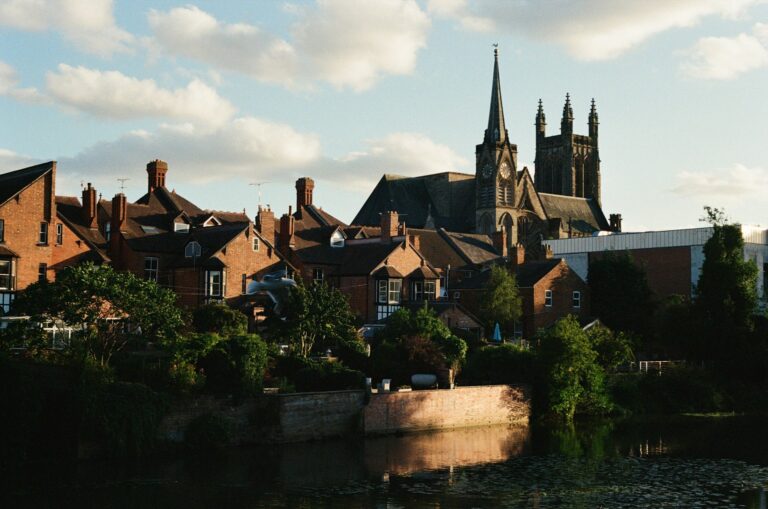
Sitting between Warwick and Kenilworth, Royal Leamington Spa has long held its own among Warwickshire’s destinations. With a population of around 55,000, it is comfortably the county’s largest town, and its reputation as an elegant place to visit predates the tourism boards by a couple of centuries.
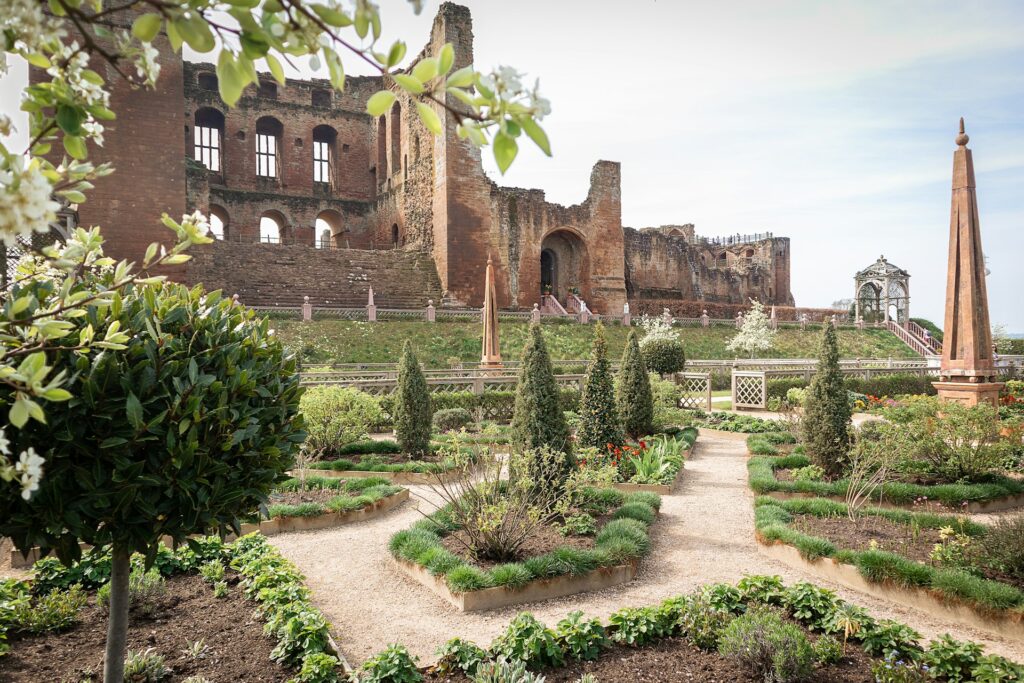
Warwickshire is not short of famous names. Stratford-upon-Avon and its Shakespeare connections sit twenty minutes to the south. Warwick Castle draws visitors from across the world. Kenilworth Castle, managed by English Heritage, is one of the finest medieval ruins in the country. Leamington sits right in the middle of all of them, with Regency architecture that ranks among the finest in England, a food and drink scene that continues to grow, and a compact centre that rewards aimless wandering.
Queen Victoria first visited in 1830 as an eleven-year-old princess. Eight years later, now on the throne, she granted the town its ‘Royal’ prefix. The spa industry has long since faded, but the elegance it left behind has not. Two days here, with castles, Shakespeare country, and rolling countryside all within a short drive, makes for a weekend that balances culture, good eating, and the kind of unhurried pace that a proper break demands.
Day One: The Parade, Jephson Gardens & The Old Town
Morning
Start your two day break on the Parade, the main thoroughfare that runs through the heart of town. Built in stages from 1808 onwards, it’s lined with creamy stucco frontages and columned facades that would look at home in Bath or Cheltenham, and gives an immediate sense of why Leamington attracted Regency-era wealth.
At the southern end, the Royal Pump Rooms occupy a handsome building dating from 1814, originally constructed to serve the booming spa trade. Saline water can still be sampled from a fountain inside, though the building now houses an art gallery, museum, and the town’s library. The collection covers local history from the spa’s Georgian heyday through to the present, and the entrance is free. Allow an hour.
From the Pump Rooms, cross into Jephson Gardens, named after Dr Henry Jephson, the physician who made Leamington’s waters famous in the 1820s by prescribing them to a parade of wealthy patients. The gardens are immaculate: formal flower beds, mature trees, and a glasshouse filled with tropical plants.
There is also a memorial to the Czechoslovak paratroopers who were based in the Leamington area before their mission to assassinate Reinhard Heydrich, the Nazi Reich Protector of Bohemia and Moravia, in 1942. It’s a striking piece of history in an otherwise serene setting. On a fine morning, the gardens reward a slow lap. Pick up a coffee from one of the cafes along the Parade and bring it in with you.
Afternoon
Lunch on the Parade or in the surrounding streets. Rustiq on Warwick Street is open daily from noon and serves Mediterranean-influenced tapas and sharing plates alongside larger dishes. It’s a reliable midweek option with an outdoor terrace that earns its keep in warmer months.
Or, if you’re visiting at the weekend, Grace & Vine on Guy Street does low-intervention wines with pintxos-style small plates that change regularly. It opens for lunch Friday to Sunday.
After lunch, walk south into the Old Town, the original settlement on the southern bank of the River Leam. The character shifts from Georgian grandeur to something older and more piecemeal; it’s a visually arresting spectacle.
This is where you’ll find the Warwickshire Gin Company, a small-batch distillery tucked under the railway arches, producing gins, rums, and vodkas inspired by local historical figures. Their tasting experience runs for 90 minutes and includes seven samples plus three full drinks, and it’s popular, so book ahead. If gin isn’t your thing, the Old Town is also home to independent shops and a handful of antique dealers worth browsing.
Evening
For dinner, Baserri on Park Street is the strongest table in town, doing Basque-influenced cooking using produce sourced directly from Spain alongside local ingredients. The cheesecake draws favourable comparisons with San Sebastián, and with only 30 covers, booking ahead is essential.
For something more relaxed, The Star & Garter on Warwick Street serves seasonal British cooking with locally sourced ingredients in a gastropub setting, with a private dining room opening onto a terrace for groups.
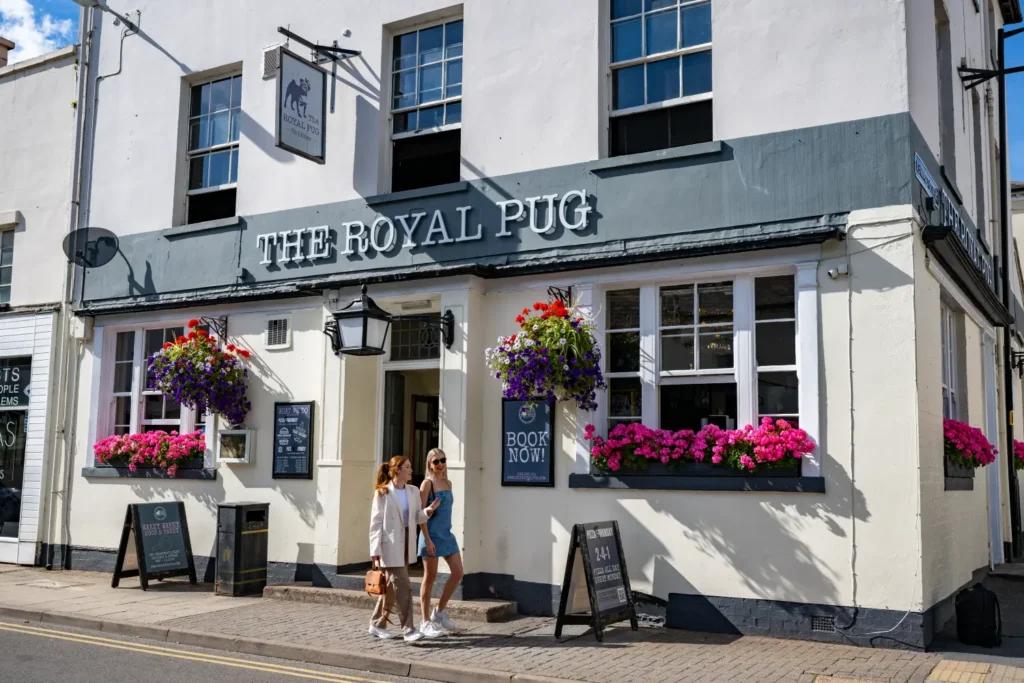
For a post-dinner drink, The Royal Pug on Regent Street has a beer garden that comes into its own on warmer evenings. It’s a solid local with a good range of ales.
Day Two: Warwick, Kenilworth & The Countryside
Morning
Warwick sits just two and a half miles west of Leamington, close enough that the two towns have effectively merged, though they retain distinct identities. The castle is the obvious draw, and with good reason: a thousand years of history stacked on a bend in the River Avon, with Norman foundations, medieval towers, and enough interactive exhibitions to fill a full morning. Arrive early to beat the school groups.
The town beyond the castle rewards a wander too. Lord Leycester Hospital, a cluster of medieval timber-framed buildings on the High Street, is one of the best-preserved examples of its kind in England. St Mary’s Church, with its Beauchamp Chapel, is worth the detour for its perpendicular gothic architecture alone.
Afternoon
Head north to Kenilworth, six miles from Leamington and reachable by a seven-minute train ride or a short drive. Kenilworth Castle, managed by English Heritage, spans nine centuries of construction, from a Norman keep dating to the 1120s through to the Elizabethan palace that Robert Dudley created in a sustained effort to woo Queen Elizabeth I.
The restored Elizabethan Garden, complete with a Renaissance aviary and a marble fountain carved with classical figures, is the highlight. The castle endured the longest siege in medieval English history in 1266, lasting six months, and the sense of scale and age is palpable even in ruin. Budget a couple of hours.
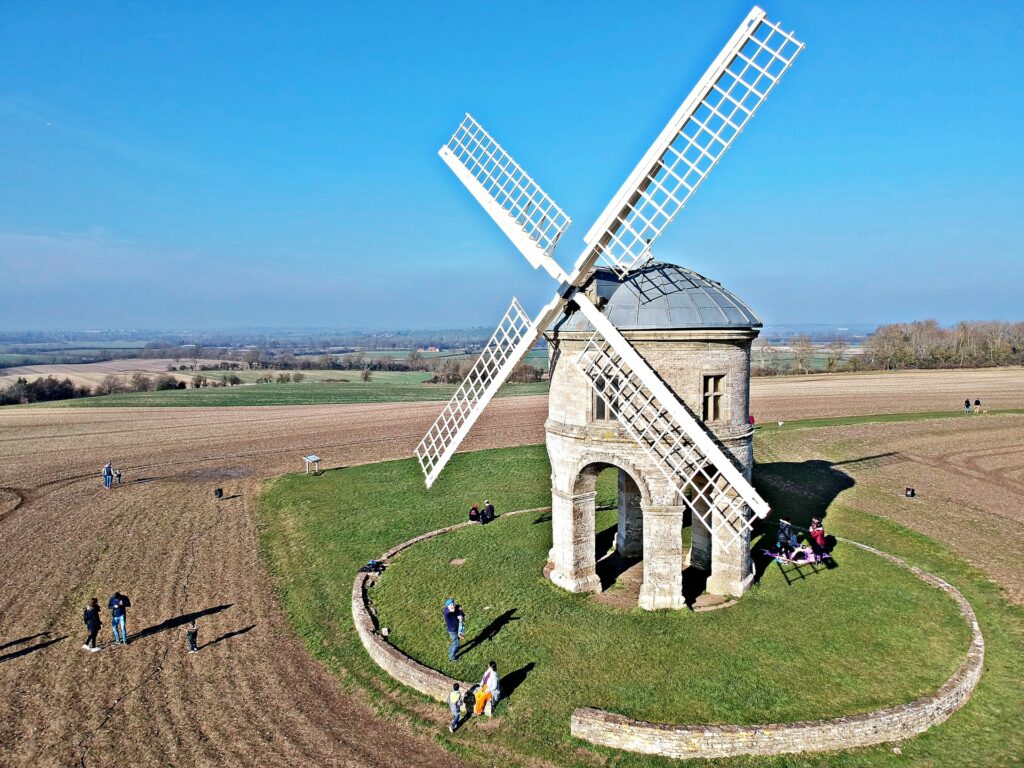
On the drive back toward Leamington, a short detour off the Fosse Way brings you to Chesterton Windmill, a Grade I listed tower mill built around 1632 for Sir Edward Peyto of Chesterton Manor. It stands on an open hilltop on six stone arches – a design so unusual that early observers assumed it must have been an observatory – and is now confirmed as the earliest tower mill in England to retain any of its working machinery. The interior opens only on Heritage Open Weekends, but the exterior is accessible year-round, reached by a short walk from roadside parking on Windmill Hill Lane. On a clear afternoon the views across south Warwickshire are considerable, and the structure itself is striking enough to justify the stop.
If the weather holds and you’d rather be outdoors, Draycote Water, a reservoir and country park a short drive east of town, offers a five-mile circular walk with birdwatching opportunities, sailing, and fishing. It’s a peaceful counterpoint to the morning’s castle-hopping.
Evening
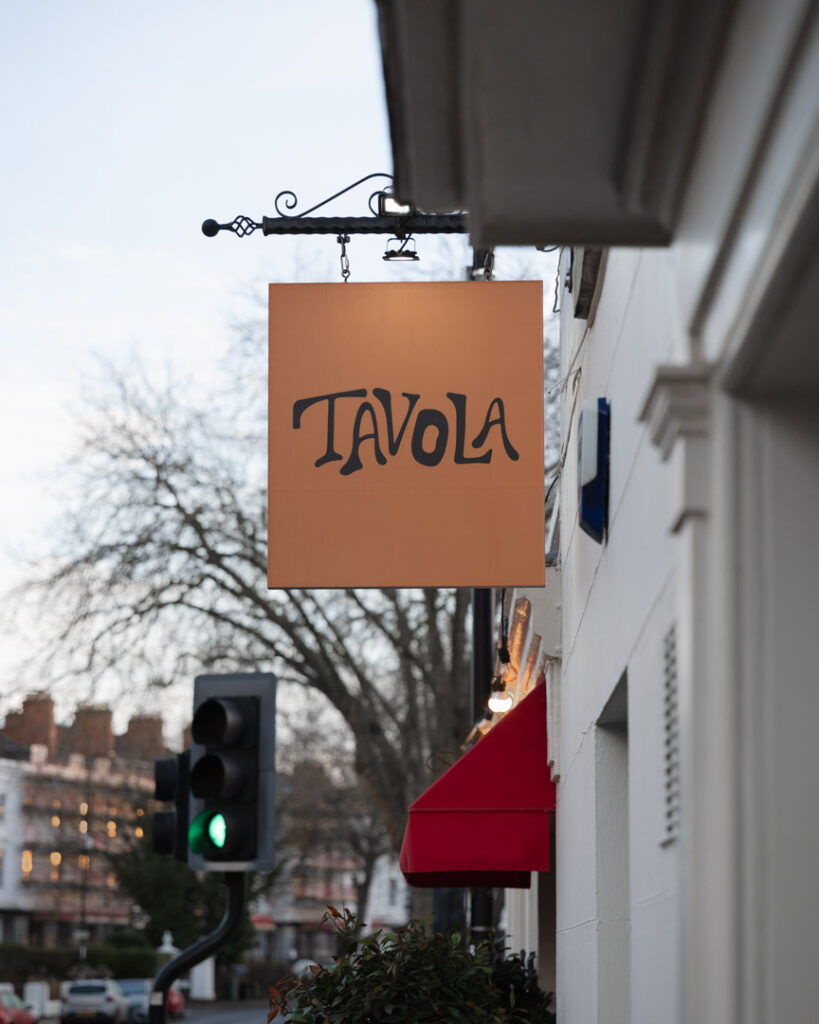
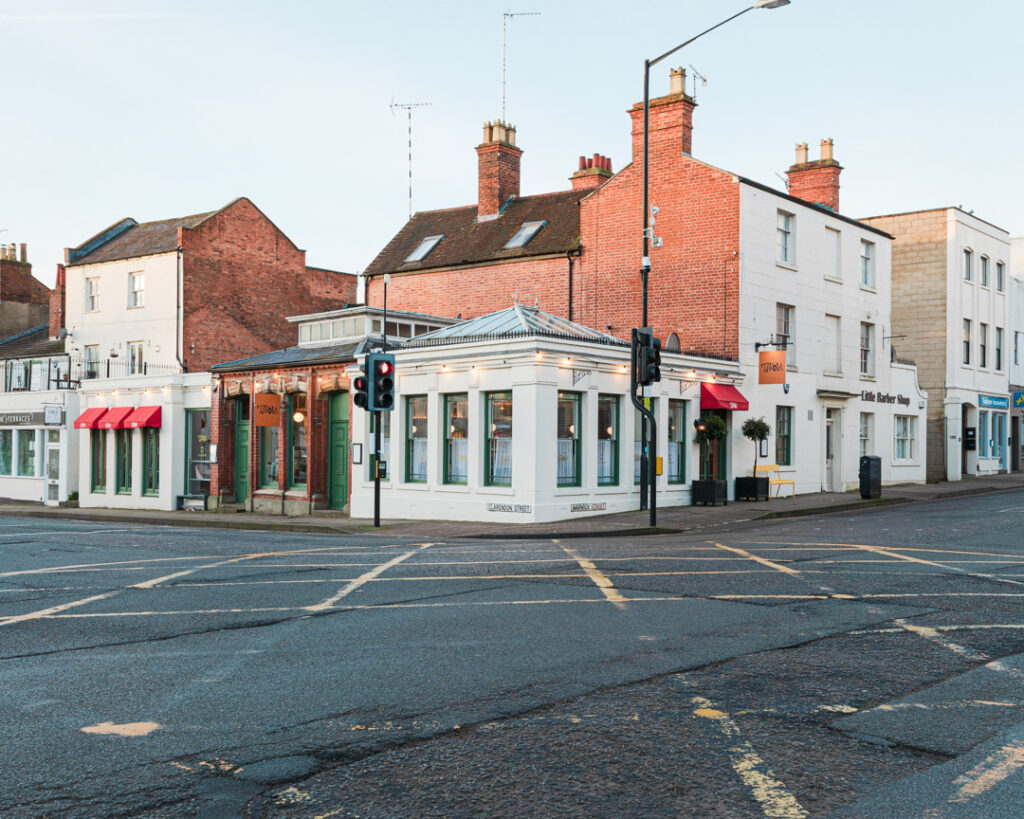
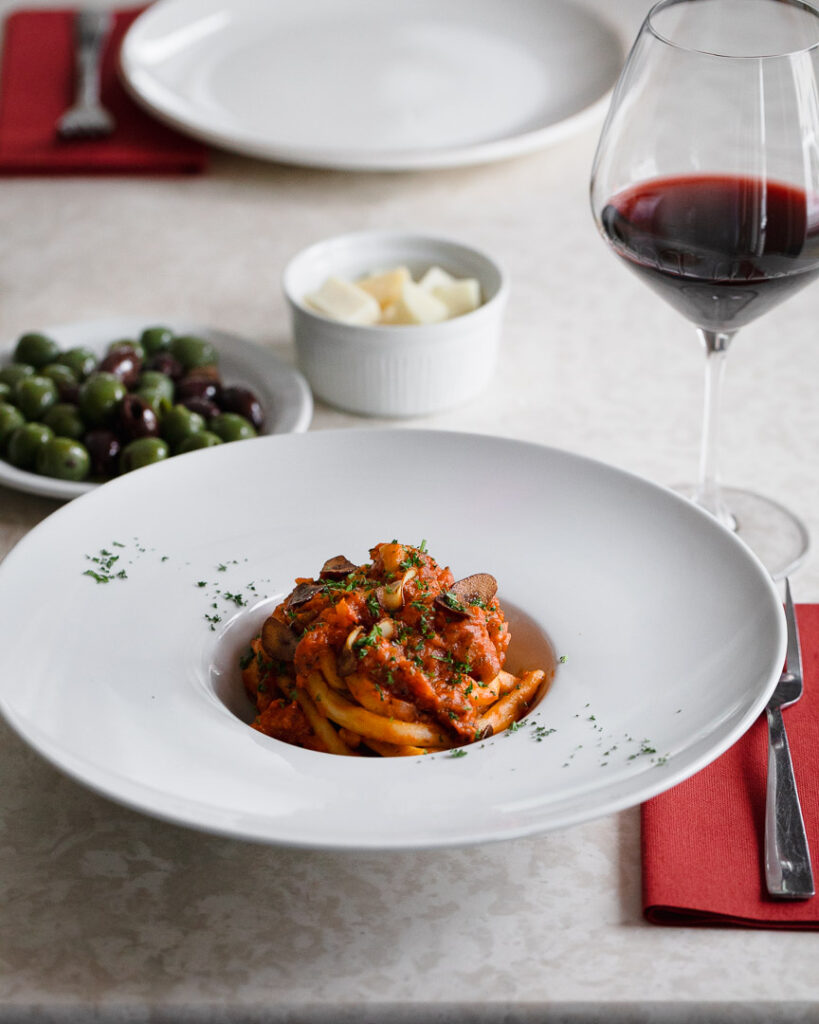
Return to Leamington for a final dinner. Tavola is a well-regarded Italian on Clarendon Street, where a Tuscan-born chef makes fresh pasta daily and the carbonara is done the Roman way with guanciale rather than bacon.
For something more adventurous, Leru on Regent Street pairs Mediterranean-influenced seafood (chargrilled prawn skewers, seared scallops, crispy whitebait) with cocktails in a setting that leans more bar than restaurant.
A nightcap at the Fizzy Moon Brewhouse & Grill on Regent Street rounds things off nicely. A large Victorian pub with its own house ale, over 120 gins, and the kind of convivial atmosphere that draws a mixed crowd without getting rowdy.
Where To Stay
For a weekend base that puts you within easy reach of Leamington, Warwick, and the surrounding countryside, Draycote Hotel is a strong option. Set within 150 acres of Warwickshire countryside near the village of Thurlaston, the hotel sits just off the A45 with straightforward access to Leamington, Warwick, and the motorway network beyond.
The 49 rooms are modern and spacious, and the on-site Three Cooks restaurant draws on the kitchen team’s English, European, and Asian heritage for menus that go well beyond the usual hotel dining formula.
Whitefields Golf Course, an 18-hole championship layout adjacent to the hotel, is a bonus for golfers. The natural drainage keeps it playable year-round, and a TopTracer driving range adds a modern touch. Draycote Water reservoir is practically on the doorstep, making the hotel a natural base for walkers and wildlife enthusiasts as well as culture seekers.
Getting There & Around
Leamington Spa station is well connected. Chiltern Railways runs frequent services from London Marylebone taking around 75 minutes for the fastest trains, continuing to Birmingham. CrossCountry links Leamington to Coventry, Manchester, and Bournemouth. West Midlands Trains provides local connections to Kenilworth (seven minutes), Coventry, and Nuneaton.
By car, the town is three miles from the M40, with the M1 and M45 accessible via the A45, the same road that passes Draycote Hotel. Leamington’s centre is compact and walkable, though a car opens up the wider county. Warwick is a five-minute drive or a quick bus ride; Stratford-upon-Avon is 20 minutes south by car or reachable by Stagecoach bus.
The Bottom Line
Royal Leamington Spa is substantial enough to fill a weekend in its own right, but positioned so centrally within Warwickshire that two of England’s great castles, Shakespeare country, and rolling countryside are all within a short drive.
The Regency architecture gives it a visual identity that most English market towns lack, and a dining scene anchored by independents rather than chains means you eat well without trying too hard. It’s an easy weekend from London or Birmingham, and a strong base from which to explore the wider county.
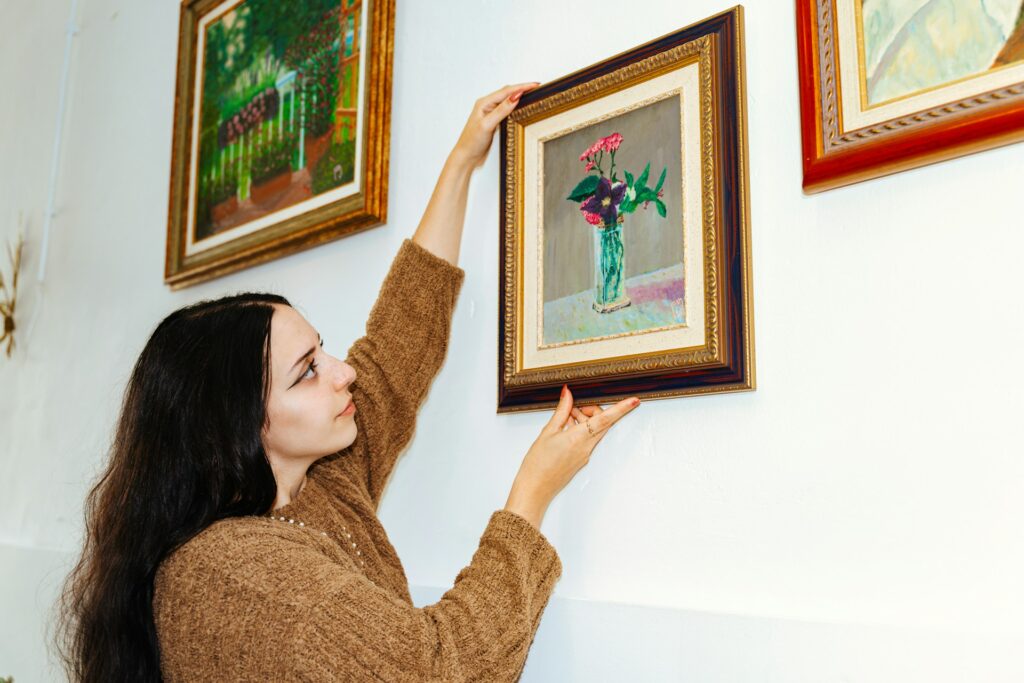
There’s a particular kind of disappointment that comes with getting a piece of art framed and realising, once it’s on the wall, that the high impact you were hoping for simply isn’t there. Maybe the colours look muted behind the glass, or the frame is fighting the image for attention. More often than not, the problem comes down to the framing itself.
A good frame should feel almost invisible, doing its job without pulling focus from the piece it protects. Yet framing remains one of the most commonly botched elements of home interiors, largely because most of us treat it as a functional afterthought rather than a decision that deserves real thought. From limited edition prints to original paintings you’ve saved up for, these are the mistakes worth avoiding.
Defaulting To Black Every Time
Black frames have become the safe option for good reason: they’re neutral and they complement most things. But that neutrality becomes a problem when it starts flattening the work inside it, which happens more often than you’d think. A warm-toned oil painting, for instance, can lose much of its richness behind a stark black surround, while a delicate pencil drawing risks being overwhelmed entirely.
Switching to natural oak, walnut, or ash immediately brings a warmth that responds to the art rather than sitting in opposition to it, particularly with landscapes, botanical prints, and anything with an earthy palette. Lighter, more contemporary work tends to benefit from white or off-white frames instead, which have the added advantage of opening up a smaller room. The point is that the frame should be a response to what’s inside it and what’s around it, rather than a reflex.
Skimping On The Mount
The mount is one of the most underrated elements of a correctly hung framed piece, and getting it wrong throws the whole thing off balance. Too narrow and the artwork feels cramped, as though it’s been squeezed into a space it doesn’t fit; too wide and the work shrinks into insignificance. As a general rule, the mount should be proportional to both the frame and the piece itself, with most works benefiting from a border of at least 5cm.
Colour is equally important here. A bright white mount can create harsh contrast against vintage prints or warmer-toned photography, so an off-white or cream option will often sit far more comfortably, softening the transition between image and frame. It’s a small detail, but one that makes a surprisingly large difference to how a piece reads on the wall.
Ignoring The Glass
Standard picture glass does the basics, but it comes with trade-offs that most people don’t consider until the damage is done. Glare is the most immediately obvious issue, making artwork hard to see depending on where it’s hung and how the light falls throughout the day.
The less visible problem is UV exposure: over time, direct or indirect sunlight will fade pigments, yellow paper, and degrade photographic prints, often so gradually that you don’t notice until the damage is irreversible. Museum-grade glass with UV filtering and anti-reflective coating costs more upfront, but for pieces hung opposite windows or in south-facing rooms it’s an investment that pays for itself in preservation alone.
Matching Every Frame In The Room
There’s a persistent idea that all frames in a room should match, and while the intention is understandable, the result is almost always a set of walls that feel flat and lifeless. Uniformity strips away the individuality of each piece, turning a collection into something closer to a hotel corridor.
A more considered approach is to find a loose thread that ties your frames together without making them identical, whether that’s a shared material like wood in varying tones, or a consistent width of frame across different finishes. The goal is cohesion rather than repetition, so that the eye moves between pieces with interest rather than glazing over.
Off-the-shelf frames have their place, and for casual prints and posters they do the job perfectly well. The problems start when you try to force more demanding work into standard sizes, which usually means cropping the mount awkwardly to fit, leaving uneven borders, or worse, trimming the artwork itself to suit the frame. All of these compromises show, and they undermine work that deserves better.
For pieces you genuinely care about, bespoke framing is worth the outlay. As the specialistts at Lorimer Art Gallery and Bespoke Framing in Rugby tell us, tailored solutions can account for the specific dimensions, weight, and character of each piece, using conservation-grade materials where longevity matters. It’s the kind of detail that separates a wall that looks thrown together from one that looks genuinely considered.
Hanging Art Too High
This isn’t strictly a framing mistake, but it’s so closely tied to how a framed piece lands in a room that it belongs here. The gallery standard is to position the centre of the artwork at roughly 145cm from the floor, which places it at average eye level, and yet most people hang significantly higher than this, particularly above furniture.
The result is a disconnect between the piece and the space beneath it: art that sits too high stops feeling like part of the room and starts feeling like it’s been pushed upward to fill a gap. Bringing it down to eye level is one of the simplest changes you can make, and it’s often the most transformative.
Neglecting The Back Of The Frame
What’s happening behind the glass matters more than most people think. Cheap backing boards can off-gas acids that gradually discolour mounts and damage the artwork itself, while a frame that isn’t properly sealed will allow dust and insects to work their way in over time. Neither of these problems is immediately visible, which is precisely why they’re so easy to ignore.
For anything with real value, whether financial or sentimental, acid-free backing boards and sealed dust covers are basic precautions that cost relatively little but make a significant difference over the years.
Overlooking The Relationship Between Art & Wall Colour
A frame that looked perfect in the shop can read completely differently once it’s up against your actual wall colour at home. Dark frames on dark walls tend to disappear, losing their definition, while light frames on white walls can wash out so completely that the piece feels like it’s floating without an edge. The mount colour plays into this dynamic too, acting as the intermediary between image and wall.
Before committing, it’s worth holding the framed piece against the wall in the room where it will actually hang, at different times of day if possible, because natural and artificial light will change the relationship between frame, mount, and wall considerably.
Going Too Ornate
Heavy, gilded frames have their place, particularly with classical portraiture and oil paintings of a certain vintage. But applying that same treatment to a modern photograph or a simple line drawing creates a mismatch that draws all the attention to the frame itself.
The framing should reflect the character of the art rather than impose a style onto it, and when in doubt, simpler tends to age better. A restrained frame also gives you more flexibility when a room eventually changes around it, which it will.
Treating Framing As A One-Off Decision
Art collections evolve, rooms get repainted, furniture changes, and light shifts with the seasons, so a frame that worked perfectly five years ago might not be serving the piece as well now. There’s nothing wrong with reframing work as your taste and your interiors develop.
In fact, it’s one of the more affordable ways to refresh a room without buying new art, and it gives you the chance to upgrade materials, swap out a mount that has started to yellow, or simply try a different look. Thinking of framing as a living part of your interior rather than a sealed-and-done job keeps your collection feeling current and intentional.
The Bottom Line
The art on your walls only works as hard as the framing around it. Getting the fundamentals right, from mount proportions and glass quality to the relationship between frame and wall colour, is what separates a collection that feels considered from one that looks like it was hung in a hurry. Most of these mistakes are easy enough to fix, and the ones that need professional help are rarely as expensive as people assume.
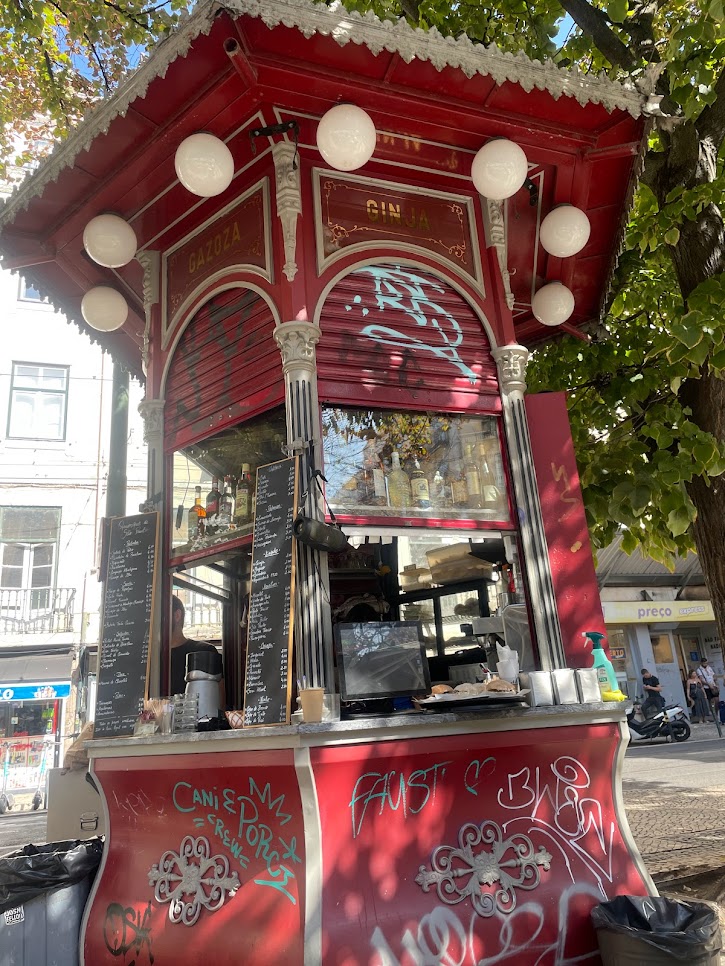
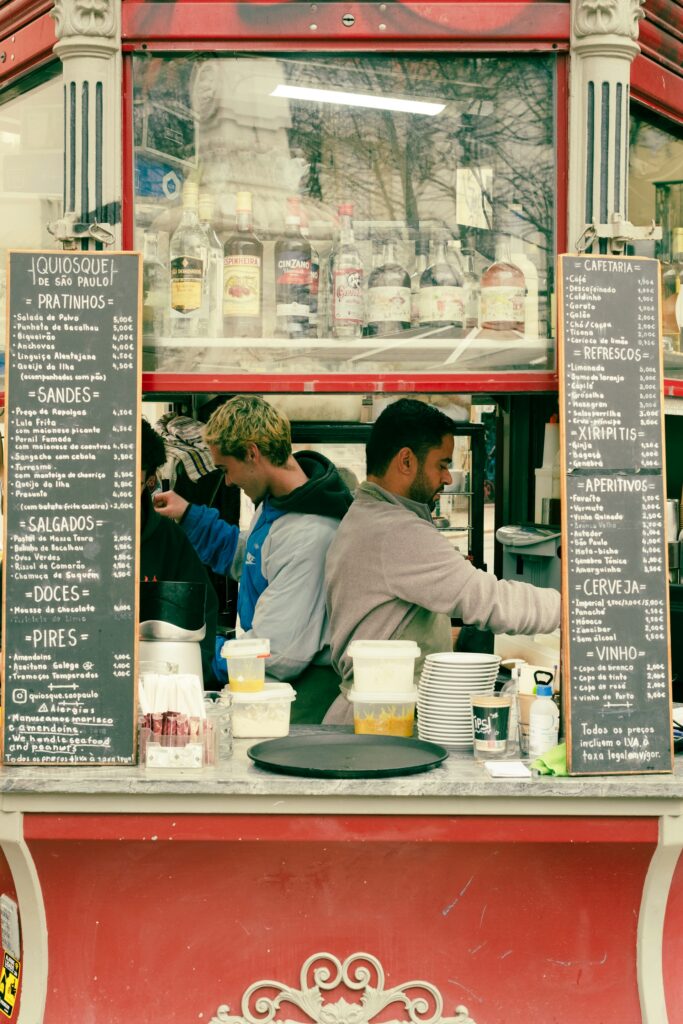
This just (relatively speaking, in the history of all time) in; Lisbon has recently (relatively speaking, in the…hmmm, we’ve already said that) been revealed as 2024’s ‘cheapest place in Europe to eat and drink’, with the study citing the city’s sandwiches, sweet treats and kiosk culture as just a few of the reasons that the Portuguese capital is so affordable for food lovers.
But it’s not just affordability that’s lead to Lisbon’s food scene being the toast of the culinary cognoscenti the world over; the quality of ingredients, particularly the seafood, is second to none almost anywhere on the planet, with the city’s affinity with the deep fat fryer also something to sing about from the top of São Roque.
The city also straddles tradition and innovation in a really pleasing way, with time-honoured classics and innovative contemporary takes on cherished Alfacinha dishes rubbing along harmoniously. Cervejarias share streets with trendy new wine bars, kiosks share squares with TikTok baiting bakeries, and everything seems to work in harmony. It’s a collision of the old and new, and it’s all better for it.
If you’re travelling to the city in search of the very best food it has to offer – whether you’re looking to splurge on Michelin-starred multicourse extravaganzas or a floury bun for a couple of Euros – we (and Lisbon) have got you covered. Here is our IDEAL 22; the best restaurants in Lisbon. Or, at least our favourite 22 of them…
Cervejaria Ramiro
Ideal for possibly, very nearly definitely, the best seafood on the planet…
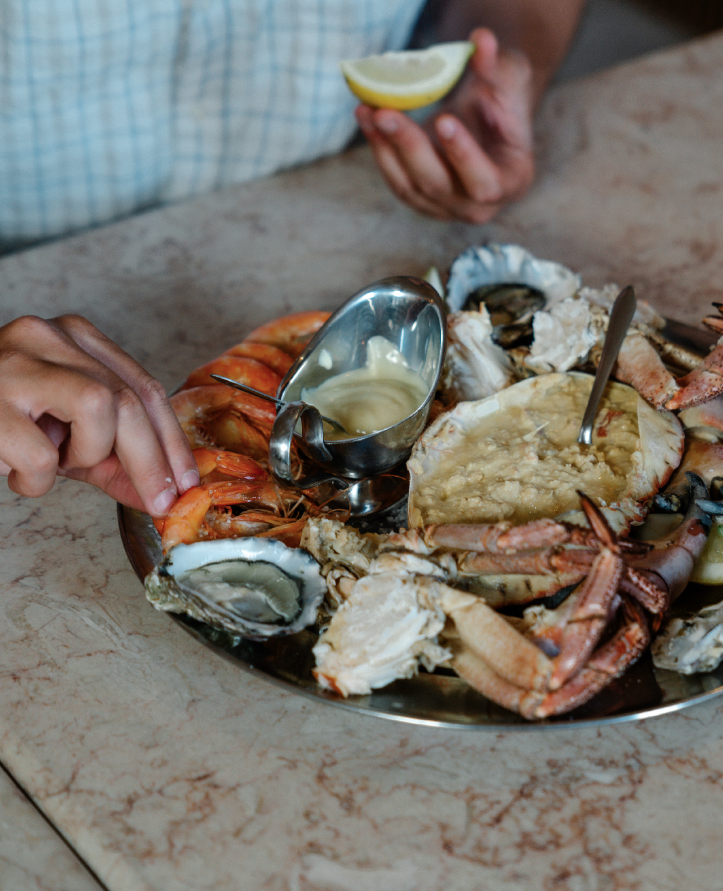
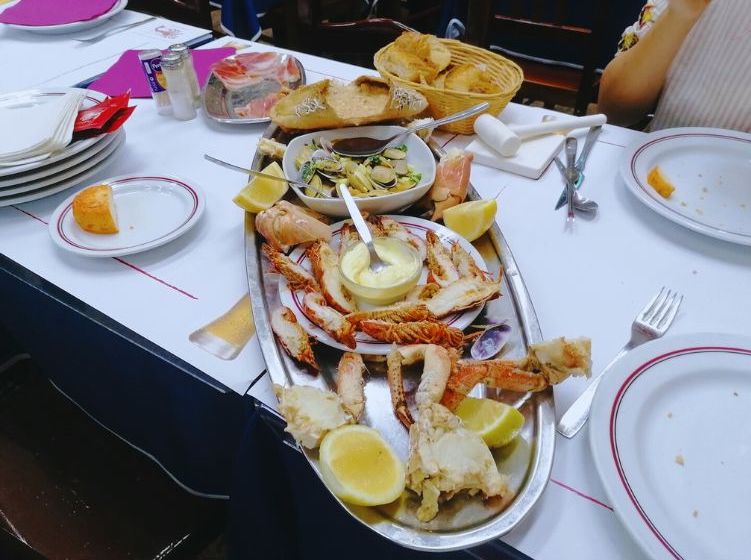
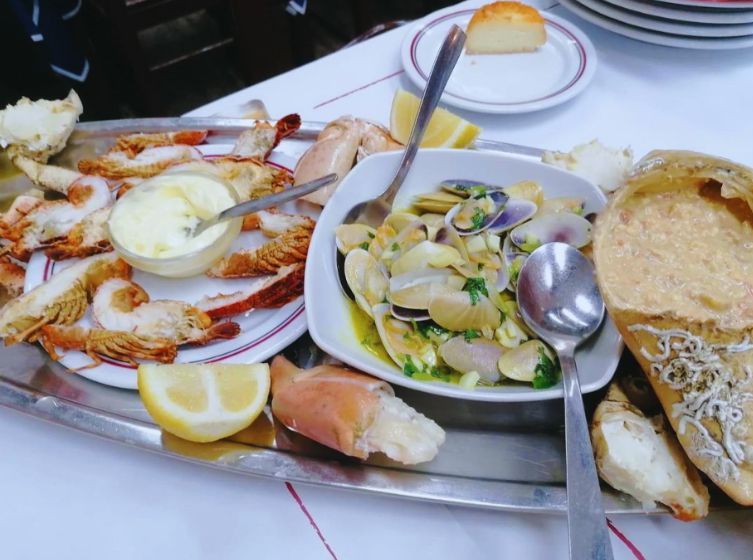
You’ve probably heard of this place by now, whether through Bourdain, Stein, or just about any other celebrity chef with a TV show. Rather than being overcome by the hype machine, Ramiro couldn’t care less who’s dining there; this legendary restaurant first opened its doors in 1956 and has set the standard for seafood restaurants in Lisbon ever since.
It is always full. This is where locals and tourists alike head in their droves to eat the finest seafood of the region in the organised chaos of the city’s most famous cervejaria.
Though it’s a seafood restaurant first and foremost, many people bookend their meal with meat, starting with a plate of pata negra ham and ending, for dessert, with a steak sandwich. The latter has been documented so thoroughly that we’re not going to explain it away any further – it just works.
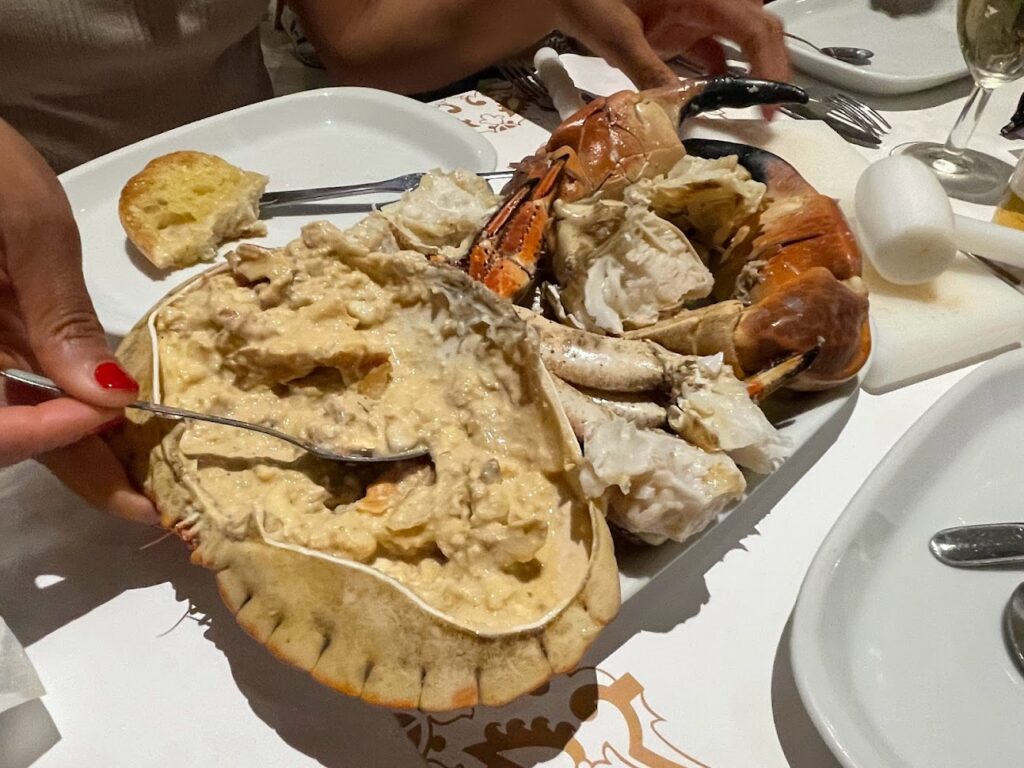
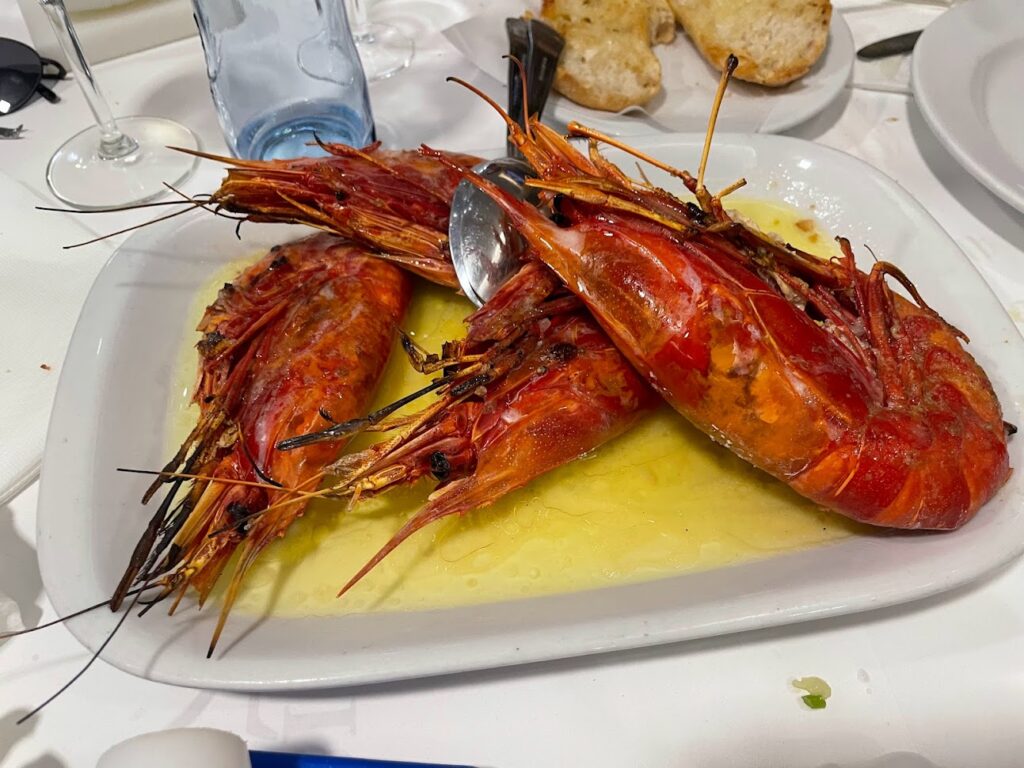
Back to the reason we’re all here; the shellfish. The enormous tiger prawns are 100% worth ordering, as well as the deservedly popular clams in garlic butter, but the absolute standout is the scarlet prawns, each with enough head juice to fill a coffee mug. Drink passionately, and then fill that mug with the house Vinho Verde, which pairs with everything on the menu brilliantly.
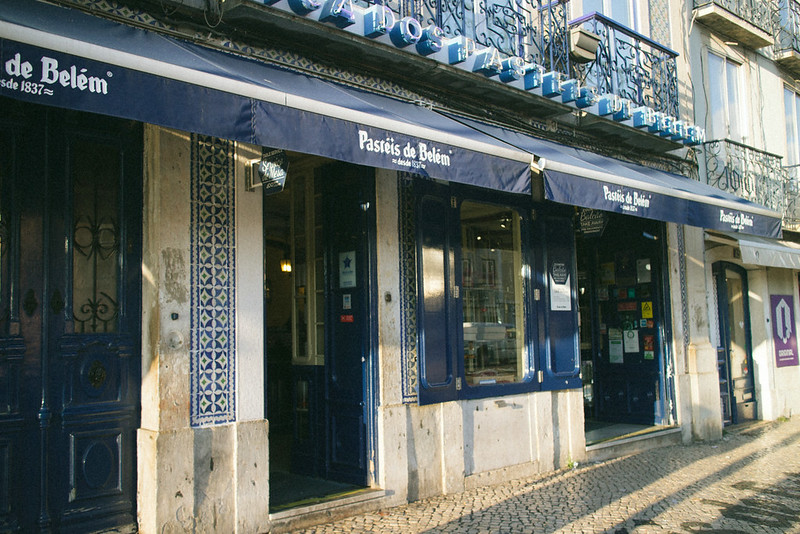
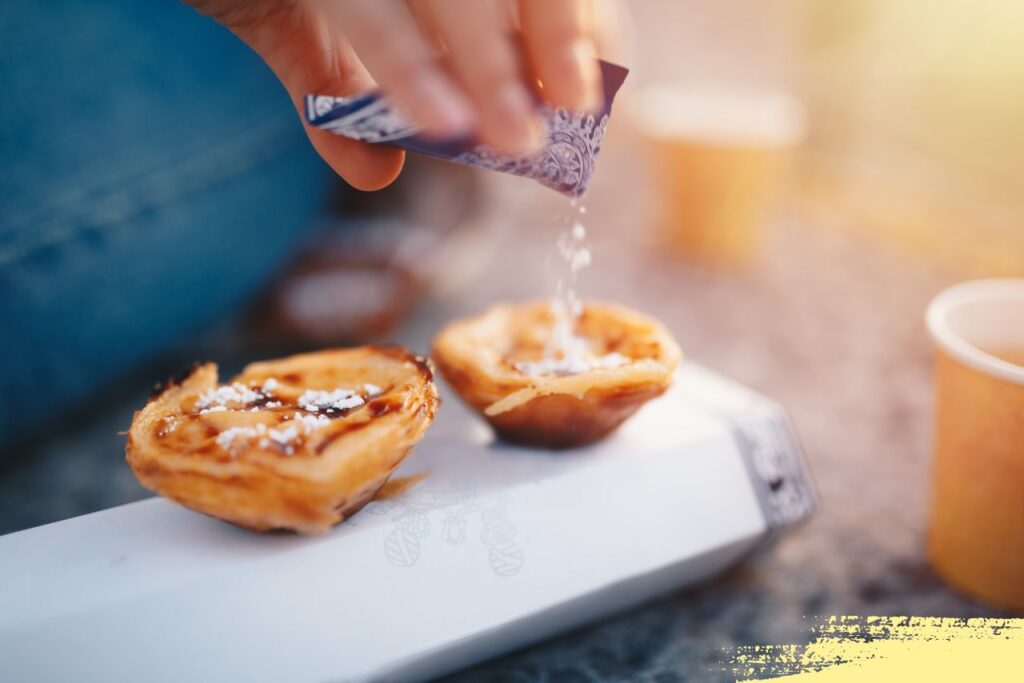
More a cafe than a restaurant, but no trip to Lisbon is complete without eating at Pasteis de Belem. This iconic bakery has been serving its world-famous custard tarts since 1837, and they’re just as good now as they were back then (hmmm; can’t actually vouch for that one). The flaky, buttery crust and creamy filling are the stuff of legends, and rightly so; they churn out around 20,000 of these a day and, during weekends, this number may double.
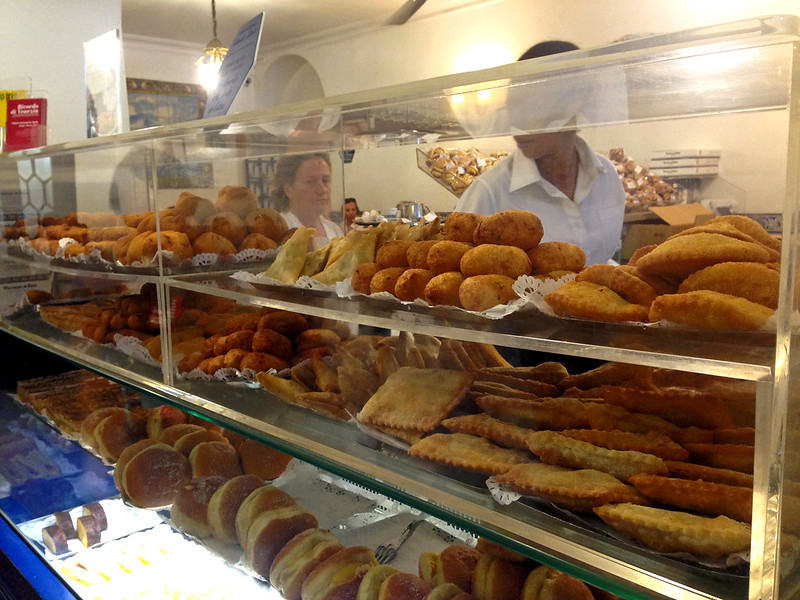
While they are of course most famous for their tarts, Pasteis de Belem have a whole savoury menu too, offering classic salgados – salty, savoury bites that make up the fried, fatty side of the Portuguese diet
In a country where cod is a cult, the pasteis de bacalhau (salt cod fritters) are not to be missed. The rissol de camarão (prawn turnover) is good, too, but we’re particularly fond of the coxas de galinha (minced chicken fritter) and the empada de pato e espinafres (duck and spinach pie). Far too many brackets and far too much fried food, but fuck it…
…Whichever way you play it, wash it all down with a glass of espinheira cherry liqueur and then a coffee to steady the ship – that’s a whole lot of pastry you’ve just eaten.
Ideal tip: If you’re craving the best custard tarts in the centre of Lisbon, then Manteigaria is your go-to spot. With two spots in the city – the mothership in Chiado and one in the ever popular Time Out Market – their pastéis de nata are legendary, often hailed as the finest in town, even giving the iconic Pasteis de Belem a run for their money. It’s a custard tart experience you won’t want to miss. Speaking of the Time Out Market….
Ideal for the best seafood in Lisbon’s Time Out Market…
It’s impossible to walk past Marisqueira Azul in Lisbon’s Time Out Market without stopping to marvel at the marvellous, mouthwatering selection of fresh seafood on ice and crustaceans in tanks. It’s also impossible to stop yourself from setting up shop at one of the twenty countertop stools, ordering a cold glass of beer, and settling in.
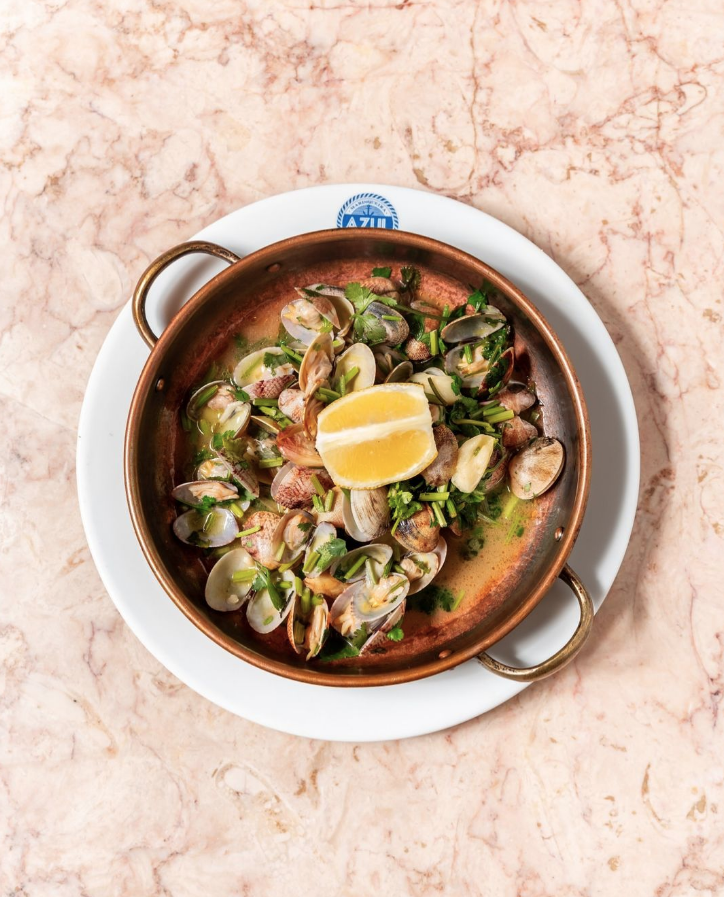
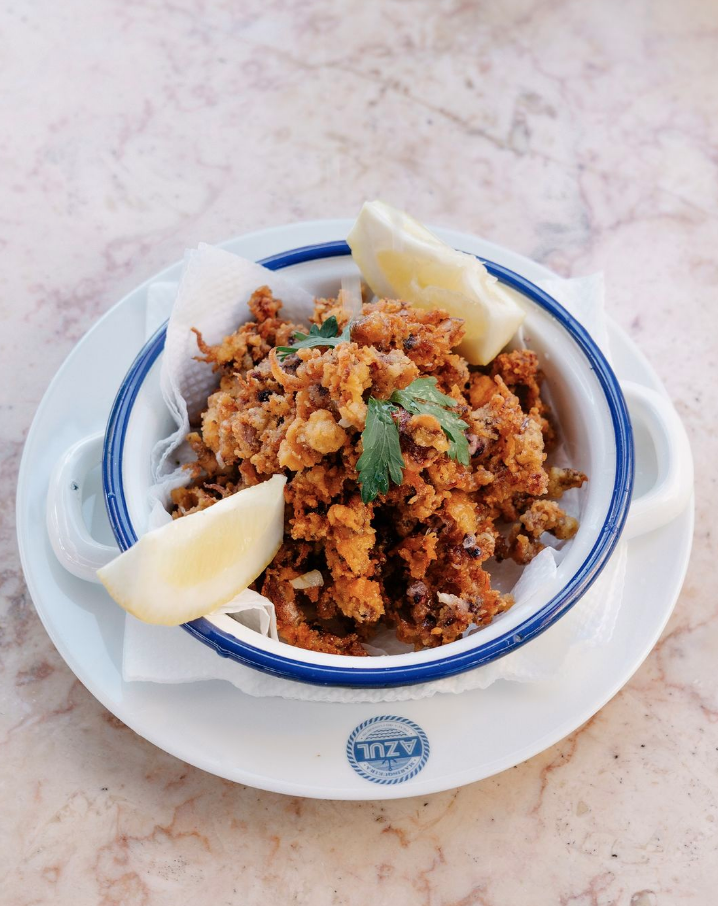
While the Time Out Market itself is, to be honest, a bit of a tourist trap, this place is anything but. Portuguese seafood takes centre stage on the peripheries of the market here, with oysters from Setubal, barnacles from Berlengas, and lingueirao from the Algarve particular highlights. You can’t come here and not order the latter – razor clams done simply with ubiquitous, irresistible garlic butter. Just smackingly delicious. We’re addicted to the puntillitas do manel too – crisp, salty little squid that’s one of the restaurant’s specialities.
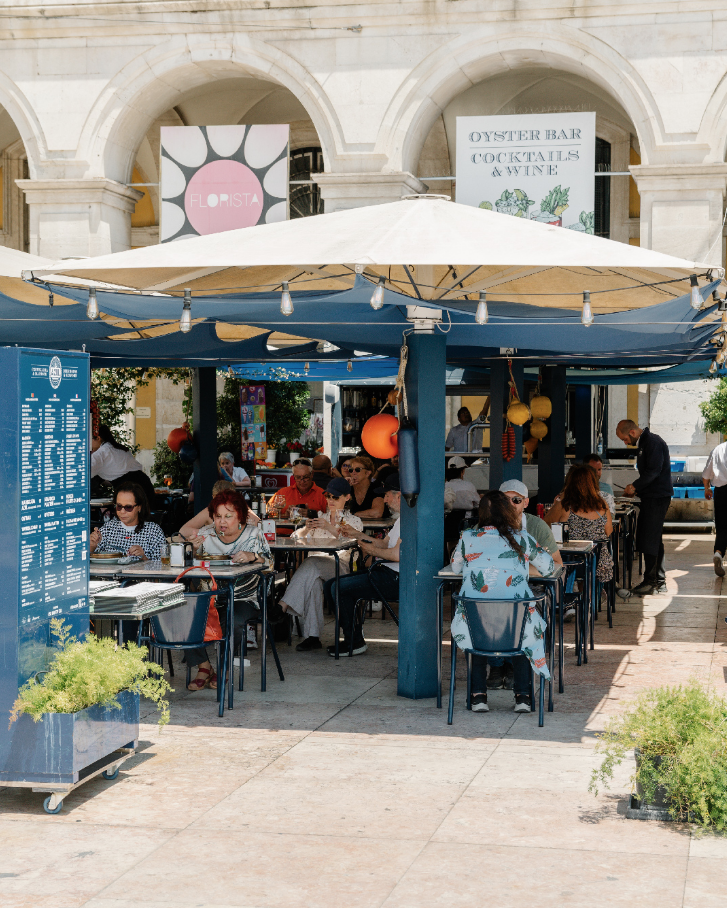
Sure, given its location, Marisqueria Azul is on the more expensive side (you might want to weigh your seafood before ordering) but with al fresco seating available in the warmer months, there’s no place we’d rather be on a fine Lisbon day.
Ideal for an old-school, no frills seafood experience…
Another gem for seafood enthusiasts, and less touristy than some of the more heaving joints on our list, Do Lis does the important stuff right and worries about little else in terms of frippery or fuss.
Shellfish is displayed enticingly just behind the front window. The space is cavernous, the room bare and the table cloths paper, but the seafood arrives whole, with all the dirty, delicious head juices and brains intact ready for sucking, and is as fresh as you’ll find. The spider crab and barnacles are particularly good here, both bathing in enough runoff for the best part; mopping up those juices with plenty of crusty, heavily buttered bread.
It’s also just a three minute walk north of Ramiro, so if you find the queues too much there, it’s an awesome reserve option to have up your sleeve. Once seated, roll them up, you’re going to be down, dirty and elbows deep in all the good bits.
Ideal for hearty dishes at affordable prices from Michelin-starred chef Jose Avillez…
Celebrity chef Jose Avillez has made this little corner of Chiado very much his own with the Bairro do Avillez concept; a clutch of excellent, dependable restaurants all under one roof and banner.
We say roof, but the pick of the bunch is Pateo, a large, open semi alfresco space and a fine purveyor of all things oceanic. Ordering off the grill is reliably excellent; a particularly fine tuna steak served with Algarve salad was fantastic. If it’s something of a celebration, don’t miss the blue lobster over coals from the specials; top notch and a real treat. Best of all, though, is the chargrilled squid with black rice, which is creamy and comforting, but also a moody little number; charcoal black and throbbing with umami.
The adjacent Taberna is also excellent, with an extensive selection of Portuguese charcuterie alongside inventive riffs on the country’s snack culture. The atmosphere here is more intimate and the small plates are ideal for sharing. Highlights include the crispy pork belly and the octopus salad, both of which showcase Avillez’s knack for approaching traditional Portuguese ingredients with a modern twist.
Ideal for a quirky, tinned fish eating experience on Lisbon’s Pink Street…
You could be forgiven for turning your nose up at a restaurant serving tinned fish. But to do so in Lisbon would be to miss out on a Portuguese staple, a countrywide tradition, and a worthwhile meal indeed. The contents of these cans aren’t bland supermarket versions, instead they’re artisan tins of sardines bathing in premium olive oil. Or, octopus just boiled and preserved at its most tender. You got the picture…
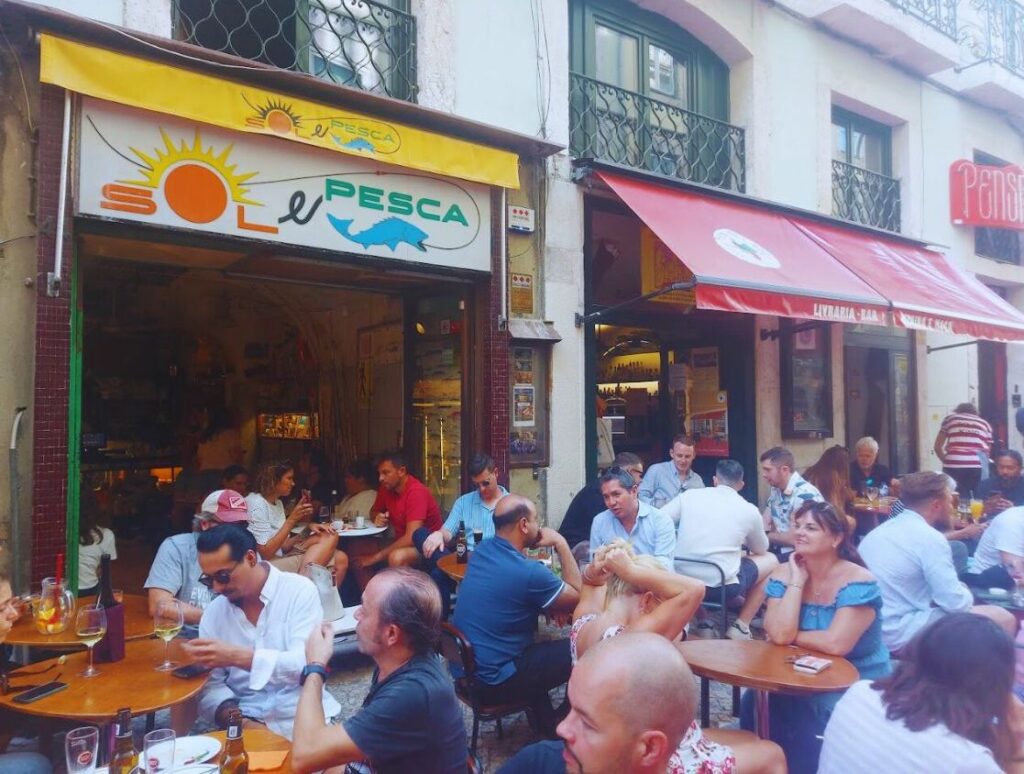
Sol E Pesca, on the lively, perennially popular Pink Street is our favourite place to head for a tinned fish eating experience in Lisbon. Here you can enjoy your meal while buskers perform and the world goes by – it’s got to be the best people watching spot in the city.
A must-order is, of course, tinned sardines in spicy tomato sauce – when in Lisbon, and all that. Slivers of smoked eel from the coastal village of Murtosa make a handsome plate, too, while monkfish liver (the ol’ foie gras of the sea) and sea urchin roe (the ol’ caviar of the sea) are totally redolent of the ocean, which is perhaps the ultimate compliment when coming out of a tin.
Ideal tip: They have a gorgeous cookbook, which makes a great souvenir alongside some of those tins.
Ideal for a more local take on the traditional cervejaria experience…
If you’re after yet more seafood (this time fresh rather than canned), O Palacio is another eminently viable alternative to the previous few on our list. True to the soul of any self respecting cervejaria, it stays open late and gets increasingly raucous as the evening wears on. Come dinner time, as soon as you step foot into the door, you’re greeted with a loud and convivial din – a good sign that this place is a favourite among locals.
O Palacio is a little out of Lisbon’s historic centre, in the pretty residential neighbourhood of Alcantara, and, accordingly, it’s cheaper than the more tourist-heavy places. This certainly doesn’t affect the quality, we’re pleased to report.
A must-order is the remarkable signature seafood platter, which is replete with all manner of shelled things and superb value, too. If whole fish is more your thing, then come here in June; on the grill they will have sardines aplenty to celebrate Lisbon’s Feast of St. Antony, which sees sardines eaten in their thousands across the city.
Ideal for perhaps Lisbon’s most legendary pork sandwich…
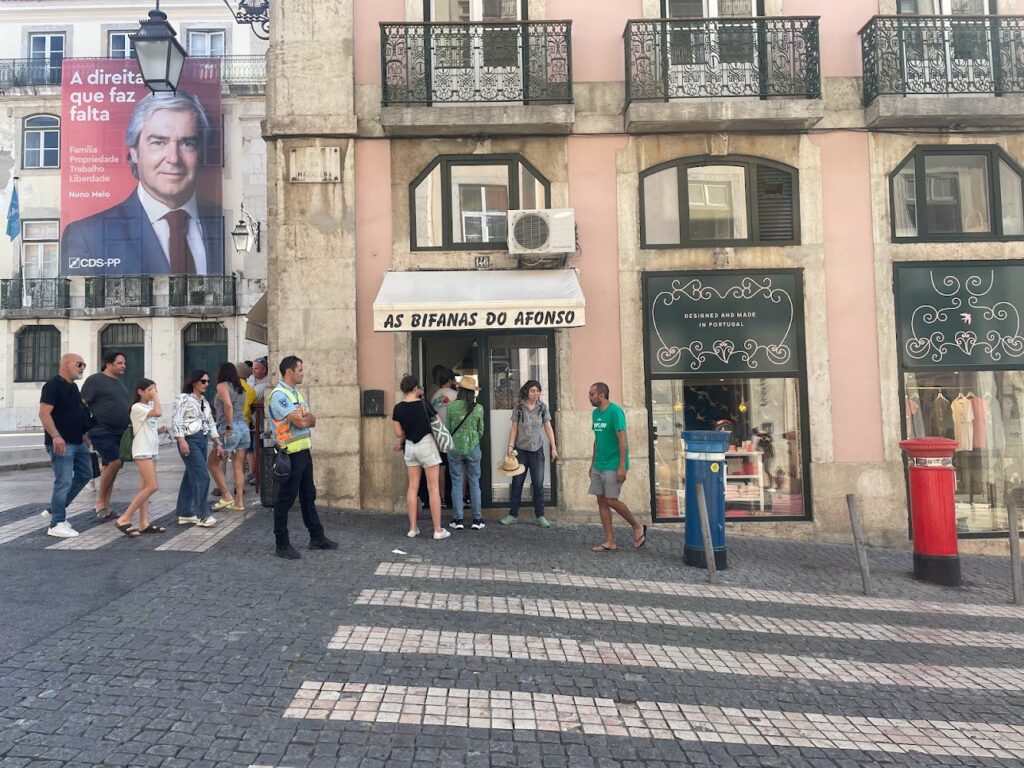
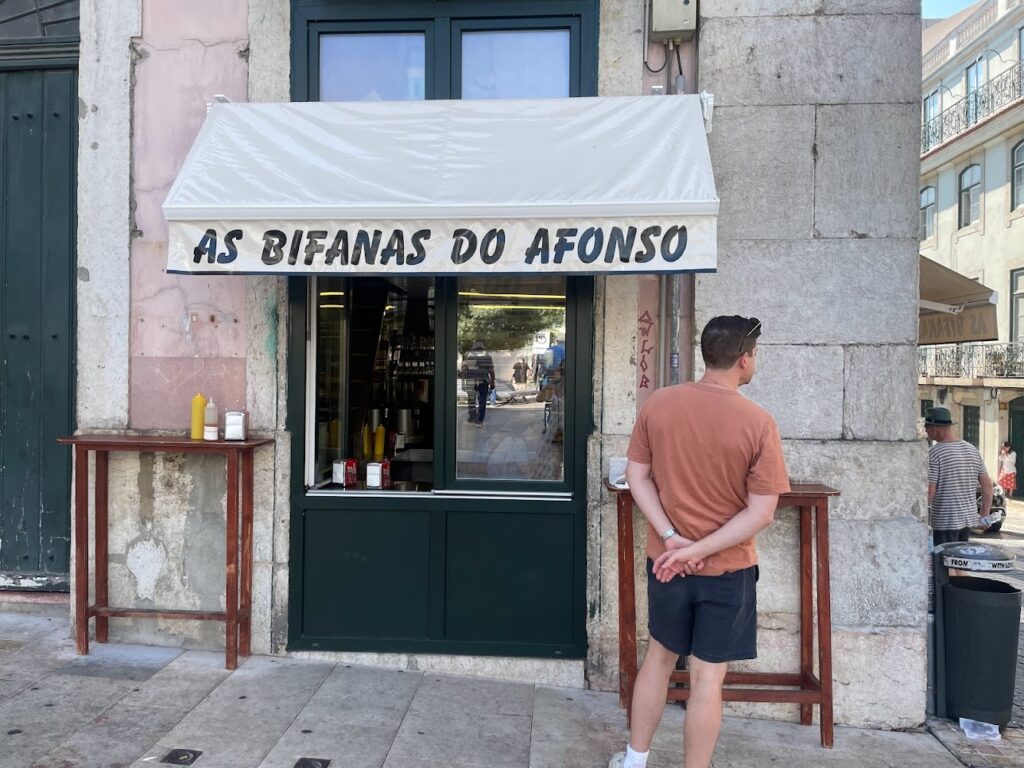
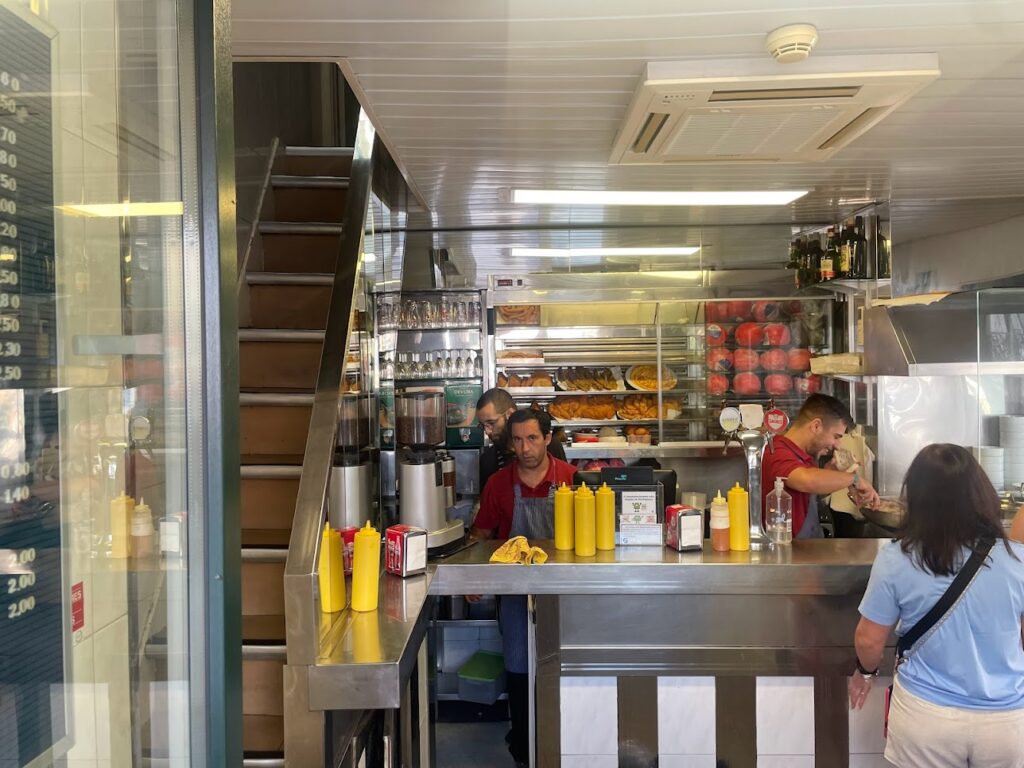
We’re using the word ‘restaurant’ a little loose and easy here, since you can’t even sit down in Bifanas do Afonso, let alone relax into a three course meal or whatever.
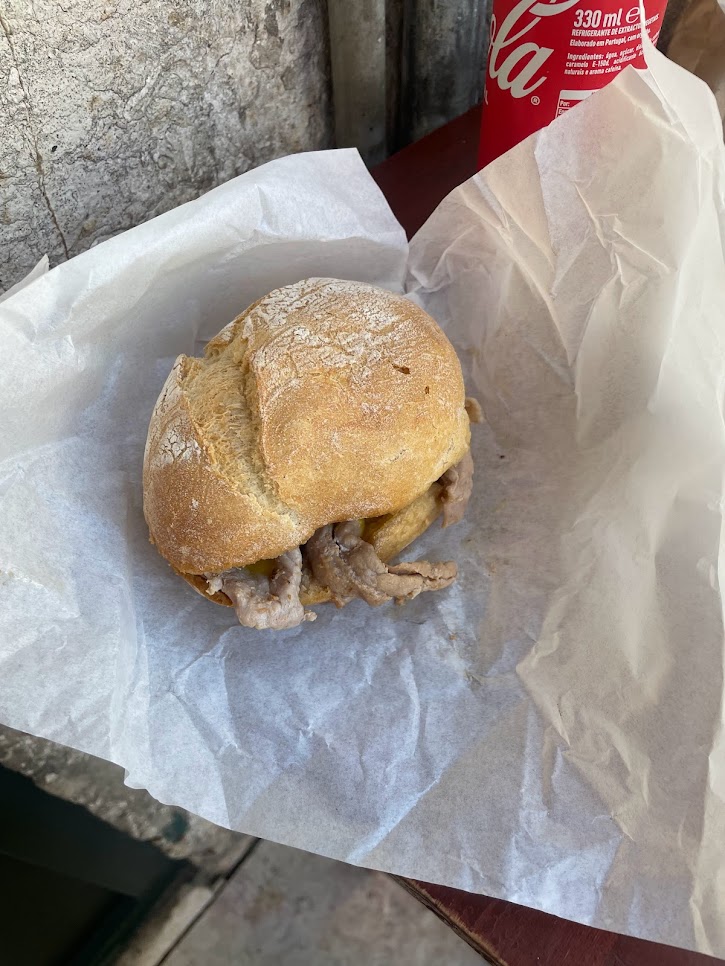
But that’s irrelevant, as this is one of the most popular places to eat in all of Lisbon, their immaculately conceived sandwiches a rare case of the hype being richly deserved.
The two juggernauts are the bifana and prego, both beautiful in their simplicity. The former sees pork loin sauteed in garlic and white wine, plonked in a crusty roll (did we mention how good the bread is in Lisbon?). And that’s it. Who can argue with that, hey? The prego is the beef version, usually pepped up with a bit of mustard.
Embrace the clarity and restraint of it all at As Bifanas do Afonso, where you order from a hatch, pay with a few coins, and perhaps even have a cheeky little plastic pint as you lean up against a wall in the adjacent square.
Thanks to a certain chain restaurant, most people think that they know piri piri chicken pretty intimately. But this enduringly popular dish, with roots in Africa – the name is derived from the Swahili word for pepper; ‘pili pili’ – is something of a different beast here in Portugal.
You’ll find chicken houses all over Lisbon, most of them neighbourhood take-out spots with someone working a grill, brushing piri piri onto spatchcocked birds who have seen a little exercise in their lives, with darker, more delicious flesh as a result.
A Valenciana, on Rue Marques de Fronteira in the city’s northwest, is one of the very best piri piri peddlers in Lisbon. It’s the place where Alfacinhas come to pick up dinner, the unfailingly juicy chicken to be picked over back at home by the family.
You don’t have to take away, of course. There’s plenty of terrace seating if the weather’s good, and a dining room too, with TVs blasting and plenty of lively atmosphere to soak up. Either way, tables are stocked with gorgeous piri piri oil with which to douse your bird. Red and translucent, this is what real piri piri should look like. Go easy; it’s blow-your-head-off spicy, and the chickens have already been lovingly brushed with the stuff.
This dish is about smoke, spice and succulent chicken, making it the ideal no fuss meal. Chips alongside make perfect sense, but many prefer crisps as an accompaniment. We certainly do.
While you’re here, you may as well order the bacalhau a bras; the version here is exceptionally good. If you have space, a slice of dia de bolacha is the perfect way to finish your meal.
While they are quick to accommodate walk-ins, it’s a good idea to book ahead. And if you can’t get a seat, take out.
Ideal for all day-dining at one of Lisbon’s most iconic restaurants…
When you’re on holiday, you don’t always want a meal at a ‘normal time’, with many preferring to simply go with the flow and eat when they’re hungry.
When that hunger hits, it’s often hard to find a place that will feed you if you decide you want your meal at 4pm in the afternoon or at 11pm in the evening, let’s be honest. Enter Pap’Acorda.
Open from 12am to midnight most days and until 2 am on Fridays and Saturdays, the restaurant’s kitchen works round the clock to produce confident renditions of classic Portuguese plates. Fancy some veal croquettes served with tomato rice at 4pm? No problem. Or, a restorative bowl of açorda (bread soup) after one too many cocktails, late in the evening? Sem problemas.
How about a quick snack of peixinhos da horta washed down with some beer, just because? Sure thing, because Pap’Acorda is all things to all people, and all the better for it. It also has lots of traditional vegetarian Portuguese dishes, which, in a city dominated by meat and seafood, can be hard to come by.
Founded in 1981 in the heart of Bairro Alto with a view to serve gently modern takes on Portuguese classics, in 2016 Pap’Acorda moved to a sprawling space on the first floor of the Time Out Market. It’s a move that’s certainly paid off, as the iconic restaurant is as busy as ever.
Synonymous with Lisbon nightlife since its inception, it’s the ideal place to come before a night out in the surrounding bars. There’s nearly always space for walk-ins, though you should come with the mindset that you may have to wait for your order to be taken, owing to the 150 seats and 25 more at the counter.
Let’s end on something sweet; Pap’Acorda’s chocolate mousse has something of a reputation as one of the best desserts in town. When you need a change from all those custard tarts, this is the one.
Ideal for inducing a food coma via an exemplary francesinha…
The ultimate Portuguese comfort food, sure, but it’s surprisingly hard to find a good francesinha in Lisbon. In Porto, the sandwich’s home, it lurks on nearly every restaurant menu, ready to take you down with its one-two-three punch of cured meat, melted cheese and a thick beer sauce. But in Lisbon, you have to go looking for it…
…Look no further, as the city’s best version is found at Restaurante Marco, close to Santos train station, where they specialise in this hulking sarnie.
If you’re not familiar with francesinha, let us enlighten you. Porto’s signature sandwich, the name translates to “little French” or “Frenchie”, its inception attributed to a French-Belgian chef who relocated to Portugal in the 1960s and decided to put a Portuguese spin on the classic croque monsieur sandwich.
Calling the francesinha a ‘sandwich’ does it an injustice, let’s be honest. Not for the faint hearted, it makes the croque monsieur looks meagre in comparison. Layers of different meats – ham, sausage, steak, mortadella – are sandwiched between bread and covered in melted cheese and grilled, all before being drowned in a murky tomato and beer sauce. For the insatiably hungry, a fried egg can be added.
At Restaurante Marco, an exemplary version is served alongside a mountain of French fries. The cheesecake has something of a cult following here, too. Order one if – implausibly – you have room. Wash it down with all the local beers; this one’s the ideal restaurant if you’re hungover after a night on the azulejos. Then, tackle several of Lisbon’s famously steep, slippery hills in recompense.
Ideal for going the whole hog – trotters, tails, testicles and all…
Pigmeu, a haven for bacon lovers, offers a variety of pork dishes that celebrate nose-to-tail eating, focusing on often underappreciated parts like offal, snouts, pig’s ears, trotters, and tails.
The restaurant’s mission, encapsulated by the hashtag #detudoumporco (meaning nose-to-tail eating), is to make these parts delicious. Miguel Azevedo Peres, the mastermind behind Pigmeu, hails from Lisbon but brings the suckling pig traditions of his family’s Bairrada region to the capital.
Start your meal with the pig heart empanadas and finish with the pudim abade de prisco – a tradition dessert made with port and caramel that gets its savoury notes from – you guessed it – pork. The chocolate mousse whether it comes with crispy bacon shards or pork crackling on top is a sexy ol’ thing, too. Vegetarians need not apply.
Gambrinus is an old-school fine dining institution in Lisbon, open for nearly a century, and known for its seafood, white tablecloths, and silver service. Named after King Gambrinus, the patron saint of beer, the restaurant’s decor remains unchanged since a 1964 remodel, featuring dark wooden paneling, red carpets, and immaculate linen tablecloths. Visual highlights include a tapestry of the four seasons in the main dining room and a stained glass of King Gambrinus in the smaller dining room. Yep, it’s that kind of place.
While many think of this place as a seafood restaurant, we don’t. We’re here for a perch at the restaurant’s iconic wooden counter to dine off the bar menu instead.
Gambrinus’ counter is, hands down, one of our favourite spots to dine solo in Lisbon. You’ll find us here, swigging a Gambrinus tulip beer (a blend of ‘white’ and dark beer) while snacking on toasted almonds and slices of butter-slathered rye bread, all in between courses of beef croquettes with Colman’s mustard.
As the name suggests, A Casa do Bacalhau specialises in the Portugal’s favourite ingredient, bacalhau.
Portuguese salt cod (though Bacalhau just means ‘cod’, in context it usually refers to the salted kind) is a joy, and many view it as the national dish. As such, you’ll find it everywhere in Lisbon, rarely messed with too much, and remaining refreshingly, resolutely unpretentious in its serving, the flavours allowed to speak for themself.
At A Casa do Bacalhau (the ‘House of Cod’), the fish appears in nearly 30 dishes. You’ll want to order the bacalhau a bras – shredded salt cod with eggs and olives – here, as it’s an gold-standard version of a much-loved classic, as well as the bacalhau com natas, an indulgent affair not miles away from a British fish pie.
The dining room at A Casa do Bacalhau is a treat, too; all gorgeous alcoves, hanging foliage and walls lined with wine bottles. It’s the perfect place to settle into for a feast of fish.
Ideal for regional Alentejo dishes and one of Lisbon’s best winelists…
There’s something about sitting at a counter that creates an intimate and personable experience with your dining companion (or even a stranger), and that’s what you get at O Frade. Indeed, one of the best seats in all of Lisbon is at their U-shaped counter, bringing a side order of spectacle to your dinnertime. Here it’s all about an ocean-to-table menu and traditional Alentejo recipes with just the right amount of contemporary flair.
This is a family-run affair, with the cousins coming from an Alentejo clan of cooks, a region known for its hearty cooking. The thing we like most about this place is that the chefs serve food they like to eat. Their enthusiasm translates to the plates here, with the generous, umami-rich seafood rice (the duck rice is also excellent) a must order. That bracketed boi, the the pato à frade, has something of a cult following in the city, and regularly sells out.
Should you not be able to score a seat at the counter on your visit, O Frade also have a place in the Time Out Market where you can eat duck rice until your heart’s content.
Back in the room and it’s one that’s decorated beautifully, with intricate tiling and several prints that pull focus on vinho da talha (an acclaimed wine produced in the Alentejo region). The winelist is suitably stacked with affordable bottles of the stuff. Well, it would be rude not to have a glass, then…
Ideal for meticulous, Michelin-starred riffs on classic Portuguese dishes…
A Michelin-starred restaurant by the chef José Avillez from earlier in this very list, Belcanto offers an unparalleled contemporary dining experience. The tasting menu – currently priced at a pretty breathtaking €265 – is a journey through contemporary Portuguese cuisine, with each dish designed to tell its own story whilst also contributing to a cohesive whole.
We wouldn’t want to spoil the surprise of this highly inventive experience, but let us just say this; the suckling pig pork trotters with coriander and orange peel puree is genuinely up there with the nicest things we’ve ever eaten.
Equally good, and as documented on a recent UK season of Masterchef The Professionals, ‘The garden of the goose that laid the golden eggs’ is the signature dish, a carefully balanced, texturally intoxicating thing, rich in truffle and with a wonderful mouthfeel from oozing goose egg yolk. It’s no surprise that Belcanto boasts two Michelin stars and a 42nd ranking of the World’s 50 Best Restaurants, and for a special occasion kind of place, it’s unsurpassed anywhere in Portugal.
Ideal for a traditional, typically convivial tasca experience…
A charming, compact little spot that offers traditional Portuguese dishes without refinement or deconstruction, O Velho Eurico is a convivial place; one where young folk spill out onto the randomly assigned outdoor tables just in front of the restaurant and Portuguese music blasts until late.
Housed in the historic centre of town on the way up to Sao Jorge Castle, chef Zé Paulo Rocha is at the stoves here, his cod with crisps a particularly good version of a popular Lisbon classic. Other standout dishes include the iscas de cebolada (pork liver) and the rancho a minhota, a thicky, murky stew comprising various meats, pasta and chickpeas. These dishes are unveiled each day on a main blackboard menu, echoing the tradition of Lisbon’s tascas and adding a touch of theatre to the place.
Due to the tight confines of the dining room, you’ll want to book this one. If not, expect to queue. O Velho Eurico comes highly recommended by Lisbon local and now London treasure, chef Nuno Mendes. We have to say, we agree with him!
Ideal for a farm-to-table celebration of Portuguese producers…
Uniquely situated in a repurposed fish factory near the iconic Sé Cathedral in the city’s old town, Prado is instantly recognisable by its lofty ceilings and vibrant greenery, offering a succinct backdrop for a dining experience that’s grounded in sustainability. Under the creative leadership of talented young chef António Galapito (who trained with aforementioned Nuno Mendes at London’s Lisboeta), Prado has garnered acclaim for its innovative approach to culinary artistry.
The name ‘Prado’, meaning ‘meadow’, reflects the restaurant’s philosophy of sourcing ingredients locally and seasonally, ensuring that the freshest produce features prominently in all its dishes. The culinary experience at Prado focuses on highlighting the natural flavours of its ingredients, in line with its commitment to sustainable practices and respecting the environment. Indeed, as the team themselves put it straightforwardly; “if it’s not in season, it’s not on the menu”.
A simple but assertive dish of smoked eel, almond, cucumber and melon was a recent, ultra-summery highlight. Enjoy with the house kombucha, which is excellent. They also have a shop up the street which is worth a visit. stocked with all sorts of artisan bits.
Ideal for forgotten Portuguese flavours rediscovered…
This charming restaurant is renowned for reviving traditional tasca fare with contemporary flair. Established in 2011, the menu, scrawled on a single blackboard, showcases a rotating selection of dishes that celebrate local producers in a narrow, vintage-style setting.
It’s an exclusive feeling kind of place, with only ten marble-topped tables, bringing an intimate interpretation of the tasca experience to the fore.
The head chef here is André Magalhães, who has dedicated himself to the art of preserving and modernising Lisbon’s forgotten flavours. Magalhães’s approach is meticulously researched; he has spent years exploring the old tascas of Lisbon, conversing with innkeepers, and collecting traditional recipes and techniques.
This ethnographic endeavour has culminated in the recreation of several near-forgotten dishes. Notable examples include iscas com elas — marinated slices of cow liver served with boiled potatoes and cow spleen sauce — and picadinho de carapau, a tartar of Atlantic horse mackerel marinated with an aromatic mix of ginger, celery, green apple, red onions, and lemon. It really is superb stuff.
The emphasis on local sourcing extends beyond the plate; the restaurant also sells artisanal products like olive oil made by Magalhães’s father in the northern region of Tras-os-Montes.
Ideal for a quick refuel while exploring the city…
You can enjoy it all in the restaurant, sure, but perhaps even more enjoyable is to eat the same dishes in the adjacent São Paulo square, located close to the waterfront in the Cais do Sodré neighbourhood.
Here, Taberna da Rua das Flores have taken over one of the kiosks (Quiosque São Paulo), and you can order some of the signature dishes direct from there, all to be enjoyed with several glasses of beer.
The punheta de bacalhau, a delicious salt cod salad, is an ode the country’s infatuation with the stuff. The miomba, a long lost sandwich that Magalhães recovered from the archives that’s something of a precursor to the bifana, is served here and is also excellent. So too are the issóis de camarão, a kind of prawn turnover. Delicious, and what a setting to enjoy it all in.
Ideal for a standing-room-only shot of Lisbon’s most iconic drink…
We’re using the word ‘restaurant’ even more loosely here than we did with Bifanas do Afonso, because A Ginjinha is essentially a hatch, a counter, and some sticky floors. But no list of the best places to eat and drink in Lisbon would be complete without it.
Open since 1840 on Largo de Sao Domingos, just off Rossio Square, A Ginjinha is the original home of ginjinha, the sour cherry liqueur that’s as much a part of Lisbon as the azulejos and the trams. A Galician immigrant named Francisco Espinheira, on the advice of a friar from the nearby church, started infusing morello cherries with aguardente, sugar and cinnamon, and the city has been drinking the stuff ever since.
The ritual is simple. You queue, you order (com elas for cherries in the glass, sem elas for without), you pay your couple of euros, and you step out into the square to sip with the assembled crowd of locals and visitors. It is not, despite what many tourists do, a shot to be knocked back; sip it, and savour the warming, sweet-tart hit of cherry and cinnamon. If you opted for com elas, suck the boozy cherry at the end and spit the pit, as tradition dictates.
Just across the road, Ginjinha Sem Rival has been doing its own version since 1890. Try both if you’re feeling competitive about it.
Ideal for Portuguese beer food in the most historic of settings…
We end, just as we started, in one of Lisbon’s best cervejarias. Housed within the walls of a former monastery, Trindade is not only one of Lisbon’s most venerable breweries; it’s also a brilliant restaurant to boot.
This cavernous space offers a unique blend of history and gastronomy and is recognised as a cultural heritage site. Housed in a 13th-century convent adorned with magnificent tile panels, Cervejaria Trindade is a landmark that truly needs no introduction. This historic brewery first opened its doors 184 years ago, and is a beautiful place to spend an evening, its intricate tiles, long central table, and enveloping acoustics a total pleasure to be amongst.
The rich history of Trindade is vividly depicted on its walls, with tiles featuring Masonic symbols that hint at its storied past. From its origins as a brewery to its evolution into a craft beer haven, Trindade is somewhere we keep returning to.
Though the temptation is always to order the size-of-your-forearm red prawns when in Lisbon, at Trindade the most exquisite, downright delicious plate we’ve had was actually the fairly lowkey-looking coast prawns – small, pink guys that are served cold with aioli. Nothing has ever tasted more like a fresh ocean breeze than these. They were quite simply superb. The tomato rice, starchy and unctuous, should also grace your table.
On that table, fresh, frothy beer will also sit – you are dining in a brewery, after all. You know what? We might just order another glass and usher you off; we fancy some alone time with these prawns…
…phew, we came over a little hot, sweaty and distracted there. Back in the room now, and weirdly in the midst of post-climatic clarity, we fancy going cycling. Fortunately, Portugal looks pretty damn good on two wheels. Care to join us? We’ll give you a backie!
If 2025 was the year everyone finally admitted that their grey accent wall wasn’t doing them any favours, then 2026 is shaping up to be the year we actually do something about it. The direction of travel in interiors has been clear for a while now; away from the sterile, the overly curated, the performatively minimal, and towards something warmer, more personal, more lived-in.
But what does that look like in practice, beyond the Pinterest boards and the Instagram saves you’ll never revisit? Here’s our guide to the home decor shifts gaining real momentum this year, and how to fold them into your space without ripping up the floorboards.
The Slow Living Room
The single biggest shift in how we think about our living spaces right now can be summed up in one word: patience. The era of the one-click room transformation, where an entire aesthetic arrives in flat-pack boxes on the same Tuesday afternoon, is losing its grip. In its place is something designers are calling slow decor, and it’s less a trend than an attitude.
Rather than assembling a room in a single burst of spending, you build it over time. The sofa might be new, but the coffee table came from an antique market in Frome. The art on the wall was picked up on a holiday three years ago. The blanket draped over the armchair was your grandmother’s, or at least looks like it could have been. Nothing matches perfectly, but everything feels considered. The result is a space that tells a story rather than stages one, and that distinction is starting to matter more than it has in years.
Caramel, Terracotta & The Death Of Grey
Pantone named Cloud Dancer, a shade of white, as its 2026 Colour of the Year. Which is interesting, because the actual rooms people are decorating tell a very different story. Caramel and toffee tones are appearing on walls that would have been Farrow & Ball Cornforth White two years ago.
Terracotta, which spent a long time confined to plant pots and Tuscan holiday rentals, is turning up on kitchen splashbacks and bedroom accent walls. Deep chocolate brown, a colour most people haven’t touched since the early 2000s, is back on upholstery and looking genuinely good.
Farrow & Ball’s newest additions tell the story well; shades like Naperon (a peachy terracotta) and Marmelo (a deep, muddy green) sit right in this territory. The trick is in the layering. A room might move from a pale oat wall through to deep walnut furniture and a rust-coloured throw without any single element dominating. Brass hardware ties it together. Linen softens it. It’s the interiors equivalent of cooking with umami; there’s no one dramatic ingredient, but the overall effect has real depth.
Texture Over Pattern
This follows naturally from the colour shift. When your palette is restrained, you need texture to create interest. Right now, that means bouclé on armchairs, raw plaster wall finishes, jute rugs layered over floorboards, hand-thrown ceramics on open shelving and furniture where you can actually see and feel the wood grain. Smooth, factory-perfect surfaces are losing appeal; people want to run their hand across something and feel it push back.
This is also a pointed rejection of fast furniture. Solid oak ages beautifully where veneer chips and peels. A hand-woven Welsh wool throw develops character over time while its polyester equivalent pills after six months. Choosing materials that wear well is becoming as much a practical calculation as an aesthetic one; spend more now, replace less later.
Objects That Earn Their Place
Perhaps the most interesting development in home decor right now is the move away from purely decorative objects and towards things that actually do something. Cottagecore got us partway there; all those sourdough starters and hand-thrown mugs at least gestured towards function. But the coffee table book that nobody opens, the ceramic vase that never holds flowers, the candle that must never be lit; these props of curated living are losing ground to items with a bit more substance.
Bedroom furniture is catching up with the same thinking. Double beds with pull-out drawers are a case in point; they look no different from any other well-designed bed frame, but they eliminate the need for a separate storage unit that eats into your floor space. In a country where the average new-build bedroom barely fits a wardrobe, that’s not a minor selling point.
Board games left out on display are a perfect example. A beautifully crafted backgammon board or a handsome chess set on a side table looks striking when untouched and gives people something to actually engage with when they’re in the room. If you’re in the market, some of the best chess sets available now combine serious craftsmanship with the kind of clean design that earns permanent shelf space.
The same principle applies to well-bound books you’ve actually read, musical instruments you genuinely play, and ceramics you eat from rather than just admire. The most stylish object in a room right now is one that shows signs of use.
Curves & Soft Geometry
Straight lines haven’t disappeared, but they’re sharing the stage with softer, more organic shapes. Bean-shaped coffee tables, arched mirrors, rounded-back armchairs and oval dining tables are appearing everywhere from high-end showrooms to John Lewis. And the effect on a room is immediately noticeable; curves make a space feel more inviting almost regardless of what else is going on.
This isn’t about going full 1970s. The best implementations keep the softness subtle; a gently rounded sofa edge here, an arched floor lamp there. The goal is to take the rigidity out of a room without losing its structure, and when done well, it makes even the most compact flat feel more relaxed and generous than its square footage suggests.
Layered Lighting
If you still rely on a single, stressful overhead light to illuminate your living room, now is the time to rethink that. Layered lighting has been a design-world talking point for years, but it’s finally crossing into mainstream adoption, and the difference it makes to how a room feels is hard to overstate.
The principle is straightforward: instead of one bright source, use several softer ones at different heights and intensities. A floor lamp in one corner, a table lamp on a sideboard, perhaps a pair of wall sconces flanking a mirror. Warm white bulbs throughout, and dimmers wherever possible.
The effect is a room that can shift from bright and functional during the day to something much more atmospheric in the evening, all without the overhead glare that makes every room look like a dentist’s waiting room.
Collected Art Over Catalogue Art
The mass-produced abstract print, framed in slim black aluminium and ordered from the same website as everyone else on your street, is on its way out. What’s replacing it is harder to pin down, precisely because the whole point is that it varies from home to home. A painting picked up from a degree show. A photograph from a trip that actually meant something to you. A print inherited from a parent. The common thread is provenance; where did this come from, and why is it on your wall?
Framing matters here too. Thicker, vintage-style frames are replacing the thin, gallery-style options that dominated the last half-decade. The effect is warmer and more substantial, and it makes a piece of art feel like something you’ve lived with for years rather than something you ordered on a Tuesday and hung on a Wednesday. If you need a starting point, the Royal Academy and regional galleries like the Ikon in Birmingham sell limited-edition prints that won’t turn up in every other living room on your road.
The Bottom Line
The thread connecting all of these shifts is a growing impatience with interiors that look good in a photograph but feel hollow to actually live in. The best rooms in 2026 won’t be the most expensive or the most on-trend. They’ll be the ones that look like somebody actually lives in them, uses them, and has built them up piece by piece rather than all at once.
Biophilic design seems to fit into this theme nicely, so let’s take a look at its practical applications next.
Islington, it’s safe to say, is a place you can expect to eat and drink well. The home of the champagne socialist and champagne football, of allotment enthusiasts, Little Italy and apparently more restaurants than days of the year; if you can’t find some good grub here, well, you’re just not looking hard enough.
But with such choice comes a paradox; sifting through the standard and sub par to find something truly exceptional can be time consuming. Don’t worry, we’re here to help; here’s our guide on where to eat in Highbury & Islington, and the best restaurants in this part of North London.
Xi’an Impression
Ideal for thick handpulled noodles seconds from the Emirates Stadium…
Pre-match sloppy frankfurter, this ain’t. Just seconds from the Arsenal ground, Xi’an Impression brings dishes from the Shan Xi province to the heart of Highbury with aplomb.
At the woks is chef Wei Guirong, who honed her skills in Soho’s Hunanese restaurant Ba Shan before setting up shop here, with a view of The Emirates stadium and a view to bringing the flavours of her birthplace to this little corner of North London.
Man, it’s good; the signature biang biang noodles, known for their belt-like shape, are the obvious highlight. Thick and slippery, these are masterful; starchy enough that they double back on themselves in the bowl appealingly, bringing even more tension. Top them with a tangle of stir-fried Xinjiang chicken that sings with Sichuan peppercorns, fermented soy beans and chilli, and slurp the rust-coloured juices that pool below the noodles. Ruin your shirt in the process.
By Irene Cheng
It’s not just the noodles that deliver here. The Rou Jia Mo, often referred to as a Chinese hamburger, here features succulent, savoury shredded pork and a fluffy bun. It’s excellent, as are the pig’s ears in chilli oil; gnarly and gelatinous in the best possible way.
With a BYOB policy and all of the above clocking in at under thirty quid, Xi’an Impression still represents great value, despite its ever rising popularity and, accordingly, prices. It’s walk-in only here and the dining room is compact,so be prepared to wait.
Ideal for a thoughtfully rendered desi pub experience in the heart of Islington…
A beautifully conceived riff on the Great British-Indian tradition of the desi pub, The Tamil Prince on Islington’s Hemingford Road presides over the former site of the Cuckoo, and much of the pub’s layout and features remain faithfully present.
The food and vibe, however, has very much changed, with Prince Durairaj, a chef with roots in Tamil cuisine and time spent at Gopal’s Corner and Roti King, presiding over the kitchen here, whilst Glen Leeson, former general manager at Bao, works the floor.
The two originally joined forces in 2021, working on a Tamila street food concept in Hackney Wick that quickly gained traction, and a bricks and mortar place followed swiftly, just a year later.
We’re so glad it did, as the Tamil Prince is one of the most enjoyable places to settle into for a meal just about anywhere in London, with a fine selection of craft beers from local breweries and innovative cocktails (like the off-menu The Prince – a heady, intoxicating blend of cardamom rum, lime, and rosewater marked with the Tamil Prince logo) really hitting the spot.
Yep, we’d come here for a pint regardless of the kitchen’s nimble, talented hands, but when you throw okra fries, a balloon-like channa bhatura, the signature sea bream, here coated in a thick spice rub and grilled whole until caramelised, and a side of flakey, buttery roti into the mix, there’s no stopping us here.
Such has been the success of the Hemingford Road original that the team have since expanded at pace, opening The Tamil Crown in a former pub near Angel in late 2023, then launching Tamila, a more casual curry house concept, on Northcote Road in Clapham in October 2024 and on Poland Street in Soho in February 2026. That the group is now four venues deep tells you everything about the quality of Durairaj’s cooking; get yourself to the source before a booking becomes even harder to come by.
London suddenly feels very much alive with the flavours of Malaysia, with the city increasingly conversant in the intricacies of nasi lemak and mee goreng, and well versed in their laksa preferences.
Sambal Shiok is one of a ever-growing number of excellent Malaysian options in the city that pays little lip service to diluting the essential flavours of the country’s cuisine, and we’re very much here for it.
Fronted by Mandy Yin, the food here is influenced by the chef’s Peranakan Chinese heritage, though she freely admits that the ‘authenticity’ of her food isn’t her number one priority. Instead, the dishes at Sambal Shiok bring to the foreground her own take on the cooking traditions and street food of both Kuala Lumpur and Penang, as well as drawing inspiration from her upbringing in the UK.
The restaurant is particularly famed for its laksas, with the country’s two most distinctive styles both available here. Our go-to is always the Penang assam laksa, a thick, sour number that’s anchored by mackerel and shrimp paste, its rich, puckering acidity the result of plenty of tamarind. It’s a bowl that pulls off the impressive balancing act of being both soothing and invigorating, fiery and funky, and is just incredible. Thick, sticky rice noodles cling on to the broth ‘till the last bite. Heaven.
Though we’ll remain faithful to the assam version forever more, Sambol Shiok also does an excellent bowl of coconut curry laksa, in the campur style – thin and soupy, and sweet from coconut milk, but also with the funkiness of the Penang style throbbing freely away in the background. Hey, you could order both!
Just a 5 minute walk around the corner from Highbury and Islington Overground, Sambal Shiok is a popular spot, and booking in advance is highly recommended.
Ideal for soul nourishing Afghan stews at reassuringly reasonable prices…
Something of a North London institution and in a pleasant spot overlooking Islington Green, Afghan Kitchen is reassuring in its simplicity, flawless in its execution. Just eight mains are available here, four meat and four vegetarian, all intricately spiced, soul-warming stews, plus a handful of sides – rice, pickles, bread and chutney. Nothing costs more than a tenner, the sides a couple of quid each at most.
These are profoundly flavourful dishes. Our go-to here is the ghormeh subzi gosht, a fragrant lamb and spinach stew that’s savoury and warming, but also a heady affair, redolent in fenugreek leaves and nutmeg, and with a pleasing astringency from dried limes. The whole affair is thickened with braised, murky-coloured spinach and given freshness with fresh herbs – coriander and parsley are added right at the close. Have it over rice, or with a side of excellent glazed flatbread (only served in the evenings), and a tea that’s only 80p, and luxuriate in one of the city’s best value spreads.
Ideal for one of London’s most reliable gastropubs and a celebration of British beef…
The Draper’s Arms is a gastropub beloved of Londoners, known for its charming ambiance and comforting, broadly British food. Owned by Nick Gibson, this pub emphasises a seasonal menu that showcases the best of local produce, with beef dishes a clear standout.
In fact, half of the mains focus on beef. We’re particularly enamoured with the restaurant’s sticky, gelatinous braised shortrib, which arrives glossy and spoonable on a feather light celeriac purée. Gorgeous.
Perhaps unsurprisingly, if you’re after one of the best roast dinners in Islington, it’s here you should come. The 54 day aged t-bone steak that comes with all the trimmings is a treat, the flamboyantly risen yorkies blessed with plenty of beef fat flavour.
The Draper’s Arms also boasts an impressive selection of local ales and a curated wine list that is more keenly priced than most in this neck of the woods. The building, dating back to the 1830s and has been a cornerstone of the Islington community for nearly two centuries, its Georgian architecture offering a cosy retreat with fireplaces and a picturesque garden for those warmer London days.
The pub is also something of a hub for hospitality gatherings, too, with charity events aimed at supporting the industry often held here (and £1 from every sale of the pub’s iconic suet crust beef bourguignon pie going to Action Against Hunger). On a more anecdotal note, it’s one of London’s most popular places for chefs to hang out on their days off. That should tell you all you need to know.
F.K.A.B.A.M *As of January 2026, now sadly closed*
Ideal for fire, flatbreads and throwing out some hand horns…
Would you like some glitter with your foie gras doughnut, sir? Actually, we doubt they’d call you ‘sir’ here, and Black Axe Mangal (now called F.K.A.B.A.N) is all the better for it. The food matches the provocative art and riff-heavy soundtrack, with big, bold flavours, vital visual appeal, and a fitting taste of the flame provided by their wood fired oven. Flatbreads are the order of the day; the squid ink rendition with smoked, whipped cod’s roe and egg yolk a particular favourite.
It’s a compact place, and only open for dinner during the week, so getting a table is tough, to say the least. The good news is, they do a Saturday and Sunday brunch which starts the ball rolling on a rollicking weekend or adeptly cures the previous night’s ills. Or both. It’s usually both.
Originally opened in 2015 by chef Lee Tiernan, who previously honed his skills for a decade at St John Bread and Wine, and his wife Kate, this establishment quickly became renowned for its rock’n’roll, tattoo’d, trailblazing vibes.
Despite a temporary closure due to the pandemic in March 2020, Black Axe Mangal has made a triumphant return as F.K.A.B.A.M, continuing to serve much of its beloved menu while introducing new elements. After flirting with a set menu format, priced at £58 for five courses shared between two people, the team at BAM recently announced they were returning to a la carte. Regardless of how the menu is structure, some items, like the lamb offal flatbread and charred hispi, are thankfully ever present.
These dishes are complemented by a selection of innovative drinks, including the quirky borscht back, which has earned itself something of a cult following in the city. Here, a combination of a vodka shot, a borscht shot, horseradish, and a frankfurter on a stick is available as a bolt on, for £6.66. Oh, go on then.
*Sadly, at the end of 2025, FKABAM closed its doors. Fortunately, there are rumours of a reinvention, rather than this being permanent. We’ll keep you posted!*
Ideal for perhaps the best Italian food in the city…
Now well into its second decade, Trullo feels like it goes from strength to strength, and is arguably Highbury and Islington’s most cherished neighourhood restaurant, a place where you can take your parents or go on a first date equally, and one where the welcome will always be warm-hearted and the food just downright darn delicious.
Sure, its younger sibling Padella may now be the favourite child, but Trullo is the ultra-knowledgeable, trend-setting older brother who, deep down, everyone knows is still the cooler kid. And it’s not just about the pasta here. This is nourishing, homely, expertly sourced, expertly cooked food that any borough would be proud to call their ‘neighbourhood’ joint.
They have a way with pulses and beans at Trullo, make no mistake. You’re guaranteed to get a gorgeously cooked piece of meat or fish sitting atop a bed of beans, usually with a piquant salsa to help things along. Think Black Hampshire pork chop with borlotti beans and salsa verde or Whole Brixham mackerel with roast yellow peppers, coco blanc and salsa rossa. Think both.
Indeed, any in-season, whole fish cooked on the grill is a guaranteed winner here, as is the legendary beef shin ragu with pappardelle. Right now, the former is a whole Brixham sea bass with charred leeks and a sauce of St Austell mussels and their cooking liquor. It’s a stunning piece of work, the fish arriving longer than its plate and with gently blistered skin, it lifts off the bone neatly, making it a glorious centrepiece for sharing. Pair it with a Gulfi Carjcanti 2020, its its crisp acidity and notes of citrus and white flowers standing up well to the the smokey flavours of the grill.
Originally a fishmongers, the operation at Prawn On The Lawn quickly expanded to fully fledged restaurant to satisfy the fish lovers of Islington, of which, it turns out, there are many. With a daily changing menu owing to what’s fresh scrawled on chalkboard (small plates, platters and whole fish) this is as close to the beach as you’re going to get in inner-city London.
It’s testament to the chef’s skills and freshness of the produce that the dishes produced within the tiny open kitchen are of such sterling quality; a mackerel and ‘nduja dish, in particular, induced rapture. Their taramasalata with seeded crackers has a well-deserved cult following, too.
While you’ll find dishes inspired from all over the world on the menu, it’s often the simple plates that are the best here. Recently, a prosaically titled, prosaically adorned red mullet, olive oil and lemon dish was spectacular in its simplicity.
Situated just a stone’s throw from the Highbury & Islington station, the interior is reminiscent of a seaside eatery, and features an open kitchen and a casual yet chic dining area, where diners can enjoy their meals accompanied by expertly mixed cocktails like classic negronis or cucumber-and-chilli margaritas.
Ideal for punchy, uplifting Thai food in a kinda chaotic dining room…
Thai food in the capital is now so popular that the usual explanatory diatribe seems unnecessary; you probably know farang means foreigner, dishes are designed to be shared, everything revolves around rice, the food of the country is hugely different from region to region……
But just because we’re all now so well versed in the vernacular, it shouldn’t overshadow just how splendid the cooking is at Farang. The larger, sharing curries, cooked low and slow, consistently pack a huge punch of depth and verve, and their gai prik – deep fried chicken wings with a sweet fish sauce glaze – are simply divine.
Sure, the dining room may be acoustically challenging and the service sometimes erratic, but it’s worth looking past these minor obstacles for Farang’s uplifting food.
Ideal for light, airy food in an even breezier space…
We finish up at Westerns Laundry in Drayton Park, in their beautiful, bright dining room (a repurposed 1950s industrial building that once served as North London’s largest commercial laundry), perched at the bar, sipping natural wine and watching the chefs work. ‘Modern European small plates’ are listed on a blackboard to the right of our stools, and the menu leans heavily on the sea’s bounty.
The brainchild of Jeremie Cometto-Lingenheim and David Gingell, who previously captivated the London food scene with their venture Primeur, Westerns Laundry opened its doors in late April 2017. The space now features a 60-cover dining room that opens onto a charming 20-cover cobbled courtyard adorned with olive trees, ideal for the warmer months ahead. During winter, the restaurant’s private dining room is a gorgeously intimate space for a Christmas meal with friends, by the way.
The vibe of the food, just like the room, is light and free from frippery; a thick fillet of blistered hake over lentils and mussels was a recent highlight.
Be warned; Western’s Laundry is a little bit of a walk from Highbury & Islington station, but those who traverse the ten minutes will be richly rewarded.
From salt-weathered warehouses turned tasting menu destinations to craft beer bars serving day-boat catches, Falmouth is cultivating Cornwall’s most intriguing food scene.
This maritime town has long charmed visitors with its deep-water harbour and Georgian townhouses, but it’s the wave of ambitious young chefs and restaurateurs who have transformed those historic spaces into something unexpected: a dining destination that feels both deeply Cornish and distinctly contemporary. Here, you’re as likely to find ancient grain sourdough and natural wines as you are traditional fish and chips, though you’ll find those too, seasoned by the sea breeze and a decent back story.
While Rick Stein’s Padstow and Nathan Outlaw’s Port Isaac (footnote: they don’t actually own these towns, just exert something of an influence) might grab the headlines, Falmouth is more than keeping pace. The town now holds a Michelin Green Star, two entries in the Michelin Guide, and a growing reputation that sees national critics making the journey west. The recent closure of Michelin-listed Hevva! in March 2026, with chef Finn Johnson heading to London, is a loss, but it speaks to the calibre of talent this small Cornish town is now producing.
From harbourside fine dining to hidden neighbourhood gems, here’s our pick of the best restaurants in Falmouth.
Culture, Custom House Quay
Ideal for nature-inspired tasting menus that tell Cornwall’s story through food…
In a transformed quayside warehouse, Culture is rewriting the rules of sustainable fine dining in Cornwall. Cape Town-born chef Hylton Espey and wife Petronella earned Falmouth’s first Michelin Green Star in 2023, and the restaurant has held on to it since, reinforcing its position as one of Cornwall’s most important dining rooms.
The evening’s Journey Menu is a seven-course story told through the landscapes, farms and waters around Falmouth. Each course is named after its inspiration, whether that’s a local farm, a stretch of coastline or a nearby woodland, and Espey’s zero-waste approach runs through every element. Current courses include Dexter beef from Chynoweth Farm, dry-aged in-house for over 70 days, and fish sourced through Giles at Pysk on Events Square, prioritising day boats and fishermen the team know by name. The bread course, milled from ancient grains grown by a local farmer called William, serves as a gentle provocation about modern farming and soil health. When this kind of cooking lands, the entire dining room fills with the scent of a thoughtful kitchen working at the top of its game.
The cooking style defies easy categorisation. Espey’s South African heritage occasionally surfaces, but it’s Cornwall’s seasonal rhythms that truly drive the menu. At £90 per person for the Journey Menu, it’s an investment in an evening of genuine culinary theatre. Those seeking a gentler introduction should try the five-course Discovery Menu at lunch, priced at £62, which represents something of a steal for cooking at this level.
The commitment to sustainability here goes beyond buzzwords. Vegetables arrive caked in soil without plastic packaging, the furthest farm is just 90 minutes away, and even the beautiful plates are crafted less than a block away by local potter Sam Marks. The kitchen runs solely on electric and induction, while local charcoal feeds the flames that kiss many of the dishes. That’s right, you deduced it, too; they don’t use gas.
The glass-walled wine cellar is worth a detour. Overseen by GM Bobby (how could he not oversee? It’s see through), the wine flights are both adventurous and enlightening, drawing from small, ethical producers across the globe. The dinner wine flight, at £62, feels like good value given the breadth and quality on show. A glass of Nyetimber Blanc de Blancs is available as a supplement if you’re feeling celebratory, because some moments deserve marking.
Dinner is served Wednesday to Saturday from 7pm, with lunch available Friday and Saturday from 1pm. Book well ahead: with only one sitting per service and a growing reputation, tables here are becoming Cornwall’s hottest reservation.
While the price point puts it firmly in special occasion territory, Culture manages to feel both important and intimate, a restaurant that’s pushing boundaries while keeping its feet firmly planted in Cornish soil.
Ideal for intimate, ingredient-led dining in characterful surroundings…
It takes a certain confidence to open a restaurant down a cobbled alleyway off Falmouth’s high street, but Mine has turned its tucked-away location into part of its charm. This cosy neighbourhood spot feels like a delicious secret you’ll want to keep to yourself, though its continued inclusion in the Michelin Guide (it features again in the 2026 edition) suggests the secret is well and truly out.
The dining room at Mine (not mine, although that’s true too) strikes that perfect balance between casual and considered, with midnight blue walls and industrial pendants casting shadows over intimate corners, nurturing a vibe that feels relaxed but also ready for a celebration. But it’s the small, open kitchen where the real action happens, with the chefs dancing an impressive choreography in a space barely bigger than a ship’s galley.
The weekly-changing menu is refreshingly straightforward: one meat, one fish, and one vegetarian option per course. The execution, though, shows chef Angus Bell’s impressive pedigree. Having cut his teeth at the Michelin-starred Star Inn at Harome before training under Michel Roux Jr at Le Gavroche, Bell brings serious technique to seemingly simple dishes. His crab fritters with bisque mayo remain one of Falmouth’s great snacks and are worth ordering by the half dozen.
Images via Mine
The menu rotates with the seasons and what’s landed that day, but expect the same level of care across the board: beautifully handled fish from Cornish boats, well-sourced meats from local farms, and vegetarian dishes that feel like a genuine course rather than an afterthought. Sides of buttery mash and spring greens are worth adding, and the desserts, particularly anything involving chocolate, tend to be exceptional.
For the best experience, grab a table in the cobbled courtyard on balmy summer evenings, or cosy up inside when the maritime weather does its thing. And if you’re feeling adventurous post-dinner, The Chintz Symposium next door offers excellent cocktails in surroundings that feel like falling down a particularly stylish rabbit hole.
Ideal for ultra-fresh seafood and craft beer in laid-back surroundings…
When one of Cornwall’s most exciting breweries turns its hand to seafood, expectations run high. Verdant’s cosy cellar bar on Quay Street delivers spectacularly, a place where the day’s catch meets some of the county’s finest craft beer, all served with the kind of effortless cool that makes you want to settle in for the afternoon.
The premise is beautifully simple: small plates of impeccably fresh seafood designed to pair with the eight rotating lines of Verdant beer on tap. Their signature crab loaded chips have near-mythical status, a generous heap of fries lavished with brown crab cheese sauce, pico de gallo, and deep-fried capers, crowned with fresh white crab meat and homemade aioli. It’s the kind of dish, often enjoyed in a one-two punch with the signature fish finger butty, that has people making special trips to Falmouth.
The rest of the menu changes with the tides, sometimes literally. Expect whatever’s been landed that morning to appear in creative combinations. You might find gurnard tostadas singing with chilli, lime and coriander, or buttermilk fried sardines from Mount’s Bay lounging on a bright tangle of parsley and shallots. The kitchen shows particular flair with the specials board, and there are always one or two vegan options for anyone being dragged to a seafood bar against their will.
The drinks selection deserves equal billing. Beyond Verdant’s own excellent brews, including their signature pale ales and IPAs, the chalkboard reveals an ever-changing selection that reads like a craft beer lover’s wishlist. With eight rotating lines and an extensive selection of sharing bottles from some of the world’s most exciting breweries, alongside a thoughtfully curated wine list and proper spirits, you’re as likely to find people debating hop profiles as discussing the day’s catch. For those steering clear of alcohol, the soft drinks go well beyond the usual suspects.
Don’t expect white tablecloths or reservations. This is a deliberately casual affair where the focus is squarely on what’s on your plate and in your glass. Open Tuesday to Saturday from noon until 11pm (kitchen closes at 9pm), with a no-bookings policy that keeps things spontaneous. Get there early, grab a table, and settle in for some of the best seafood and beer matching you’ll find anywhere in Cornwall.
Ideal for seafood feasts with spectacular coastal views…
Perched above Swanpool Beach, Beach House Falmouth occupies one of the most enviable dining positions in Cornwall. Formerly known as Hooked on the Rocks, the restaurant was taken over by the Beach House Group in early 2025 (the same team behind Harbour House in Flushing) and the rebrand has brought new energy without losing what made the location special. The focus remains firmly on Cornish seafood, and those sweeping coastal views haven’t changed one bit.
The kitchen works with a close-knit network of local suppliers, including Ned Bailey in Falmouth, Mylor Fish Shop, and Cornwall Fish Direct in Newlyn, and the menu shifts with what’s available each day. Starters lean into the sharing spirit: Porthilly Pacific oysters, shell-on wild prawns with ‘nduja butter, and scallops dressed simply with olive oil, lemon and parsley. For mains, whole hot crab with garlic butter is comfortably one of the best-value dishes on the menu, while whole plaice with parsley, caper and lemon butter is a satisfying exercise in letting good fish speak for itself. If you’re going big, the grilled lobster remains a triumph of simplicity, or go further still with the hot seafood platter to share.
The drinks list leans into local producers, with Loveday Gin, Knightor Winery’s Cornish Cuvée, and a wine list curated in partnership with Wanderlust Wine, focusing on small, family-run vineyards.
Beyond the main restaurant, Beach House has introduced a few nice touches since the rebrand. There’s a weekday set menu offering two courses for £20 or three for £25, making it a more accessible lunchtime option. Oyster Mondays bring half-price oysters all day. There’s even a Sunday Swim Club and a monthly Run Club if you want to earn your lunch the hard way. The Cool Box, an outdoor bar overlooking the bay, serves drinks, pastries and loaded fries from midday, no booking needed.
Images via Hooked On The Rocks
Dogs are welcome everywhere at Beach House Falmouth, and the South West Coast Path runs right past the door, making it a natural stop on any coastal walk. Open daily: weekdays from noon until late, weekends from 9am with breakfast served until 11.30am.
Ideal for all-day dining with unbeatable harbour views…
Taking pride of place on Falmouth’s Grade II listed harbour wall, Indidog masters that rare trick of being both a destination restaurant and a reliable local haunt. Floor-to-ceiling windows frame spectacular views across Carrick Roads towards Flushing, Mylor and St Mawes, while the kitchen serves accomplished plates from breakfast through to dinner.
Mornings here are particularly special. The breakfast menu dares to be different, with perfectly cooked steak and eggs paired with a Bloody Mary, or indulgent stacks of pancakes alongside their house Breakfast Mocktini. Best of all is the Cornish crab benedict, which is light, indulgent and simply the best breakfast dish in Falmouth, bar none.
Come evening, the menu shifts to showcase the finest Cornish produce, with day boat fish and local farm meats taking centre stage. A starter of crispy squid with sriracha mayo and lime sets the tone, while mains might include a beautifully simple day boat fish with seaweed butter and potato hay. There’s always one thoughtfully crafted vegan option per course, the kind of cooking that treats plant-based diners as a genuine priority rather than a box-ticking exercise.
Indidog’s cocktail game is strong, with a list that leans heavily on local distilleries. The Cornish Martini makes a perfect aperitif (or brunch pick-me-up, quite frankly). They run a 2-for-1 cocktail offer between 2pm and 6pm daily, which takes the sting out of the afternoon. The wine list balances familiar names with organic and vegan options, plus a selection of small-batch wines from Cornish and English vineyards for those in the know.
Hidden just off the high street (look for the steps under Specsavers), Indidog keeps solid hours, open daily with brunch served until around midday, lunch through the afternoon, and dinner from 6pm. Hours vary slightly by season and day of the week, so check their website before visiting. Those harbour views, however, come at no extra charge.
Ideal for laid-back Italian small plates in a true neighbourhood setting…
Hidden in Falmouth’s terraces high above the harbour, Provedore feels like stumbling upon a slice of rustic Italy. Since 2007, this charming wooden haven with its courtyard and olive tree has evolved from a neighbourhood deli into something quite special: Falmouth’s answer to a Venetian bacaro, where the food is as warm and colourful as the welcome.
Images via Provedore
The kitchen serves up ever-changing cicchetti (Italian small plates) that showcase whatever’s inspiring the chefs that day. Of course, there’s salami and cheeses, but you might also find plump ravioli stuffed with mozzarella, sun-dried tomatoes and basil, swimming in house-made confit tomato sauce, or a hearty Tuscan braise of fennel sausage and white beans lifted with lemon. The grilled dishes (Provedore have a dedicated barbecue out back) are particularly good. Half a blistered, tender poussin cooked with orange and Portuguese oregano has regulars planning their week around its appearance on the menu.
There’s also the occasional appearance of a dedicated pizza menu, courtesy of the guys at Lucky Rod. These are beautifully puffy, sloppy Neapolitan numbers pitched at Naples prices. An eclectic selection of wines and beers chosen to complement the rustic Italian fare seals the deal. This is the kind of place where you’ll want to linger over a glass of Chianti while debating whether to order another plate of those slow-braised chickpeas with pancetta and fresh thyme.
Open Thursday through Saturday evenings from 5pm until 8pm for drinks and cicchetti, Provedore operates a strictly walk-ins only policy. It’s the kind of place that makes you feel like a regular on your first visit, and has you planning your return before you’ve even finished paying the bill.
Get there early: tables in their charming courtyard are particularly sought after when the weather plays along.
Ideal for elevated fish and chips with harbour views…
When only proper fish and chips will do, Harbour Lights delivers in style. This award-winning chippy (a past top-10 finisher at the National Fish & Chip Awards, and holder of the NFFF Quality Award) isn’t trying to reinvent the humble fish supper; they’re just serving the freshest catch with the care and respect it deserves, while keeping prices reasonable for the quality on offer. What’s not to love?
The menu celebrates Cornish seafood with pride. Their line-caught haddock comes perfectly flaky, encased in their signature batter that shatters satisfyingly at first bite. The local hake is worth the slight premium: a Cornish treasure that shows why this stretch of coast is so renowned for its seafood. Or, for a bit of fun, their Fizz & Chips pairs line-caught haddock and chips with a glass of prosecco, a combination that somehow makes perfect sense.
Plant-based diners aren’t an afterthought here. Their vegan option (brine-marinated tofu wrapped in nori and deep-fried) has developed a following, with some claiming it tastes even fishier than fish. That would be a claim too far, but it is good. For something different, try the Hooked on the Harbour burger: crispy battered cod in a Baker Tom brioche bun with homemade tartare sauce. Magic.
Images via @harbourlightsfalmouth
The drinks list goes beyond what you’d expect from a chippy, with local beers like Rattler cider and Tribute ale sitting alongside a carefully chosen wine selection.
The restaurant serves Monday to Saturday from noon to 3pm and 5pm to 8pm, with Sundays noon to 3pm. The takeaway keeps slightly longer hours. A quid from every bill goes to support the Fishermen’s Mission, and though optional, it’s a thoughtful touch that connects your dinner to the folks who made it possible. Much like all of the best places to eat in Falmouth, come to think of it…
Falmouth’s dining scene punches well above its weight for a town of its size. With a Michelin Green Star at Culture, two Michelin Guide entries, and a depth of quality from neighbourhood cicchetti bars to award-winning chippies, it’s a place where eating well is simply what you do. The combination of fiercely local sourcing, genuine culinary ambition, and that ever-present salt air makes eating out here feel like something quite special.
To some, London’s West End is the pulsating heart of the UK’s theatre scene, a hub of kinetic energy that receives 200 million annual visitors. Indeed, 24% of all visitors to London will attend a show here. To the other 76%, it can sometimes be a part of London that feels curiously busy but also barren, a wasteland of subpar steakhouses and American candy stores…
Either way, when alighting hungry in this most bustling of Central London locations, you needn’t settle on a flabby fillet or contribute to money washing with a round of Milk Duds. There are plenty of great places to eat in the West End, both budget and blowout, that will satisfy just about every visitor.
We’ve already written extensively about the best places to eat in Soho, so we’ll most park those recommendations and instead focus on the more central parts of the West End, where the magic (sometimes) happens.
With that in mind, and in no particular order, here are the best restaurants in London’s West End.
J. Sheekey
Ideal for spanking fresh seafood in a prestigious setting with over a century of history…
Serving up spanking, squeaky fresh seafood for over a century, J. Sheekey is one of the most prestigious purveyors of the good stuff in the city. It’s also one of the best restaurants close in the West End.
Established in 1896, J. Sheekey owes its inception to a unique historical event. The then Prime Minister, Lord Salisbury, granted permission to a local stallholder named Josef Sheekey to serve oysters in St Martin’s Court. The only condition was that he catered for Salisbury’s post-theatre supper parties. Thus, the beloved Sheekey’s was born.
Today, J. Sheekey continues to uphold its reputation as one of the best restaurants near Leicester Square. Though there is a vegetarian and vegan menu and a couple of cursory meat dishes on the a la carte, Sheekey’s is still all about the seafood, offering the freshest fish, shellfish and oysters in London.
The restaurant’s central crustacean bar is a highlight, and the walls adorned with framed photographs of famous faces add to its timeless charm. And though those celebrity endorsements and general sense of prestige do certainly lend themselves to a hefty bill, the J. Sheekey set menu is great value for Central London – here, it’s three courses for £39, running Sunday to Friday, midday to 4pm.
Ideal for Eastern Mediterranean cuisine served with swagger in a stunning Grade II listed building…
There’s a certain swagger about Claro that only comes with serious capital, the Eastern Mediterranean restaurant standing proud in a handsome Grade II listed building on Waterloo Place in the kind of power stance that The Saj would be proud of.
You feel it as you first put your hands on the high, heavy doors. In fact, you hear it the moment you manage to pry those doors open; the low thud-thud-thud of an Ibiza Chill playlist pitched just a little louder than is necessary, and the reassuring click-clack of expensive stone beneath your heels.
Stride on in; you deserve to be here. Big smiles and handshakes greet you as the room opens up, revealing striking checkerboard flagstone floors below and soaring ceilings above. Thoughtfully preserved wrought iron details nod to the building’s heritage, whilst expensively appointed lighting casts a flattering glow over the marble-topped tables and plush velvet banquettes. Disarmed and dare we say a little dazed, you’re hoping those banquettes will take you in for the evening and cradle you, because suddenly it feels like you might be required to do some networking, for some reason. It’s quite the entrance.
This place once housed both a bank and was part of the legendary Athenaeum Club, where Victorian luminaries like Charles Darwin and Charles Dickens gathered, but the refit is thoroughly modern, banishing the ghosts of the past to the bins out back.
Bringing you back to the here and now, the large, airy open kitchen serves as the beating heart of Claro, the chefs going about their work all jovial and jolly, collaborative in their cooking and plating, which lightens the mood and banishes any fears that this meal might be hard work. The menu is all about seasonal British produce delivered with distinctive Eastern Mediterranean flair, and we’re pleased to report that it does indeed deliver.
Start with the Masterpiece Martini, which is nothing short of spectacular (as you’d hope, for £16). Here, rosemary infused Ketel One Vodka, Tio Pepe sherry and clarified tomato bring a savoury twist on a classic that’s genuinely lip-smacking and utterly moreish. It’s the perfect accompaniment to a round of snacks; the Frena bread, which sighs almost as satisfyingly as you do when pierced. Served with both matbucha and a labneh and harissa number, it’s a punchy introduction to proceedings.
The chilli tasting plate – four different expressions of the ingredient that showcase its versatility beyond mere heat – and the Claro market salad with feta cheese and za’atar spice that tastes like sunshine on a plate, follow, both singing with freshness and the former a heat that starts up warm and round and then builds to something where you can feel your hair follicles starting to perspire.
The cured sardine bruschetta with pickled chilli and sour cream is next, balancing acidity and richness with remarkable precision, and a lamb cigar is pastoral enough to linger just a little funkily until the mains hit the table.
A monkfish shawarma is perhaps the only dud of the evening, a little over-marinated and ungenerous, its dusty turmeric finish calling to mind a Vietnamese cha ca or Coronation Chicken more than a shawarma, strangely. The dish’s tangle of fresh herbs, picked, we’re told, from the restaurant’s rooftop garden, is absolutely remarkable though, invigorating and complex, peppery, astringent and assertive, it’s what all other ‘herb salads’ want to be when they grow up. The waiter tells us no one ever eats it, which is a real shame.
The grilled butterflied seabass with vegetable skewer and charred tomato salsa brings things right back on form, the fish cooked to that perfect point where it’s just firm but still yielding, the skin blistered and burnished from the grill. The skewer is populated by red peppers and fennel, the latter having caramelised beautifully and bringing a suave energy to the plate. A truly great dish.
Everything’s been so light and invigorating that we surrender to our sweet tooth, finding maximum pleasure in the Paris Brest with sour cream chantilly, raspberry coulis and berries – a featherlight concoction that manages to be indulgent without being too heavy. For something more substantial, the chocolate and sesame fondant with chocolate fudge, sesame anglaise and sesame ice cream delivers a sophisticated interplay of sweet and nutty notes, and finishes us off, quite frankly, in every sense of the word.
To go alongside those sweet treats, the Eiswein from Schloss Gobelsburg in Austria’s Burgenland region (£30 a glass) is sublime. Yes, it’s steep, but this 2022 vintage offers a honeyed nectar that forms the perfect full stop to a meal of commendable vision and clarity.
Ideal for an intimate Michelin-starred chef’s table experience hidden beneath a Soho pub…
Though the immediate surrounds of Leicester Square are visibly dominated by the stark white lights of a dozen chain restaurants, tightly nestled beneath street level is one of Soho’s most exciting independent dining destinations; Evelyn’s Table.
This Michelin-starred chef’s table experience is a genuine hidden gem. Tucked away in the basement of The Blue Posts pub on the edge of London’s Chinatown, Evelyn’s table has been through several iterations in its six year life. It was first opened in 2017 by the team behind popular hotspots The Palomar and The Barbary. After a brief closure, it reopened in 2020 with a brand new team, featuring Luke Selby as head chef, with his two brothers Nat and Theo also on the stoves, which, incidentally, are on full display to the 12-person counter seater restaurant.
The intimate, family affair vibes quickly earned plaudits, with the team picking up a Michelin star in 2022. Though the Selby brothers have now moved on, Evelyn’s Table continues to fire on all cylinders, with chef Seamus Sam (formerly of Muse by Tom Aitkens) now heading up the kitchen.
There’s a real elegance to the dishes on show on the 5-dishes plus, £135-a-head tasting menu here, with Sam’s precise, Scandinavian and Japanese inspired technique bringing out the best in hand-dived Orkney scallops, venison at the height of its season and winter’s finest black truffle. It’s a very special place, indeed, and one of the best fine dining experiences in all of the West End.
Ideal for exploring the world through bold, fermented flavours…
When Ramael Scully left his role as head chef at Ottolenghi’s NOPI to open his first solo restaurant in 2018, he brought with him an approach to cooking that reflects his Malaysian-Chinese-Indian-Irish-Balinese background to thrilling effect. Unlike the many restaurants that handle the word ‘fusion’ like a miso-glazed hot potato, Scully’s food actually tastes like it’s come from someone who’s lived between cultures.
The restaurant sits in St James’s Market, and as you walk in, you’re met with shelves heaving with jars of pickles, preserves, oils and ferments in every colour imaginable. This isn’t just decoration; it’s Scully’s working larder, the backbone of dishes that might pair arepa with his mother’s eggplant sambal and bergamot labneh, or Cornish halibut with buttermilk whey koji butter sauce and tempura chicken oyster.
Or, how about steamed sea bass draped in Ethiopian spiced butter alongside brined green tomatoes that had been lightly pickled in apple vinegar and finished with Vadouvan? It’s a mouthful, sure, and the combinations sound wild on paper, but they make total sense, both on the plate and palate. On a visit in the summer, a twice-cooked pork belly with traditional satay sauce read almost pedestrian in comparison, but tasted fucking fantastic.
You’ll pay West End prices for the privilege, but these are generous plates that leave you satisfied. There’s an à la carte option with two courses for £65 or three for £75, alongside snacks and sides, or, for the full experience, the evening tasting menu is £135, with a vegan version at £105. Either way, you’re getting cooking that takes sustainability seriously without making a song and dance about it.
The open kitchen means you can watch the team fermenting, preserving and generally making the most of every ingredient that comes through the door. It’s thoughtful food that tastes brilliant, which is ultimately what matters.
Ideal for Istanbul-inspired cuisine six floors above the West End…
Six floors above the West End’s braying streets, Yasmin offers a sophisticated escape complete with panoramic views of the city. Talk about dinner and a show, hey? This Istanbul-inspired restaurant and bar, housed in the elegant 1 Warwick building member’s club, shares its home with sister restaurant Nessa on the ground floor. but aims to take things up several notches (erm, floors?) in terms of delivery.
The two restaurants share an executive chef too, Tom Cenci, and we amused ourselves over our Grand Bazaar (Yasmin’s Turkish twist on an Old Fashioned), imagining the chef darting between venues, running up the stairs spilling salted pistachios all over the place, and generally cursing the chaos of it all.
Hmmm, maybe we should get out more.
In reality, Yasmin is a supremely soothing spot to sink into, all sage green walls and warm wooden accents, highlighted by a spectacular marble-topped bar lined orbited by velvet stools seating gently boisterous custom. Trailing plants cascade from the ceiling, while banquette seating and rattan chairs create distinct zones for dining and lounging, in true member’s club style. Confusingly, you don’t actually need to be a card-carrying member to dine here, though for the gym and lounges below, you do.
The terrace, furnished with plush seating and draped with cosy throws, provides a sheltered spot for alfresco dining among the rooftops, though you’d be mad to be out there now, with temperatures hovering not troubling ten degrees. One for summer, perhaps…
Anyway, back in the warm, and Cenci has crafted a menu that pays homage to Turkish traditions whilst adding just the right amount of venue-appropriate sheen to proceedings. The sharing plates showcase bold flavours via Instagram-ready presentation – standouts include the whipped sheep’s cheese with hot honey and Isot Biber, piped and pretty, and the Muhammara aubergine, which arrives splayed out into three, panko’d and golden, its centre that lovely side of fudgy that aubergine gets through slow cooking. Alongside, a walnut and red pepper dip boasts chives sliced so finely we’re surprised @ratemychives hasn’t come calling. The flatbreads, made daily and grilled to order, are gold-standard, and show that the kitchen cares about the basics, which is always a good sign.
…All of this feels ready for the warmer months, when the wrap-around terrace seats 64 and offers atmospheric dining under the stars. We can’t wait.
Shoryu is owned by noodz-entrepreneur (and CEO of the Japan Centre) Tak Tokumine, a native of Fukuoka city who is dedicated to promoting his hometown’s cherished local speciality, ramen, across the globe.
We’re so glad that he’s made it his noble mission, as the restaurant’s signature dish – shoryu ganso tonkotsu, a rich and meaty ramen that boasts a 12-hour simmered broth, homemade Cotswold flour hosomen noodles, succulent char siu barbecue pork, Burford Brown nitamago egg, and an army’s arsenal-worth of vegetable toppings, from pickles to freshly shredded stuff – is as good as it gets.
The kotteri hakata tonkotsu, a heavy, fatty, meaty noodle broth, is another popular choice among patrons and, to us, is one of London’s finest hangover cures. The fact that it pairs so beautifully with a super frothy Kirin Nama draft certainly does no harm in dusting off last night’s excesses.
Finally, you don’t have to be vegan or vegetarian to be enamoured with their plant-based spicy goma tan tan. It comes with an umami rich tonyu soy milk, sesame and miso broth, and is topped with soya mince marinated in garlic and chiu chow chilli oil, crunchy beansprouts, pak choi, and extra chilli oil for a decent kick. Woof.
Ideal for centuries-old British cooking, game from the restaurant’s own estate, and a dining room dripping with theatrical history…
Founded in 1798, Rules is London’s oldest restaurant, and it wears that title with considerable pride. Thomas Rule opened it as an oyster bar in Covent Garden, and more than two centuries later, it’s still serving traditional British food from the same Maiden Lane address.
The dining room is all dark wood panelling, red velvet banquettes and walls covered in hundreds of paintings and cartoons. Late Poet Laureate John Betjeman called the ground floor interior “unique and irreplaceable and part of literary and theatrical London,” which feels about right in this corner of the West End.
The restaurant has been owned by just three families across its entire history, and the current proprietor, John Mayhew, took over in 1984. Over the years, Rules has fed Charles Dickens, H.G. Wells, Charlie Chaplin and countless others from London’s literary and theatrical worlds. It’s even appeared in novels by Graham Greene, Evelyn Waugh and John le Carré. The proximity to the West End means it still pulls in the theatre crowd, though these days you’re as likely to find tourists ticking it off their London list, as well as critics keen to buck hype-train trends and bang on about it constantly.
The menu focuses heavily on game, much of it sourced from Rules’ own Lartington Estate in the High Pennines. During shooting season (August 12th to December 10th, roughly), whole roast grouse arrives served traditionally, whilst year-round classics like steak and kidney pie, roast rib of beef for two, and slow-cooked ox cheek keep things properly old-school. In such esteemed surroundings, this kind of food feels wholly appropriate, and it’s cooked with precision.
The upstairs cocktail bar is a civilised spot for a pre-dinner drink, with house cocktails like the Rules Bellini and prosaically named Rules Cocktail (Tanqueray gin, Dubonnet and Crémant Blanc de Blanc). Whether you arrive sharpened, loosened or stone cold sober, this is hearty, traditional British cooking (and drinking) done properly, if without much in the way of modern flourishes. You’re paying for more than just the food; you’re paying for two centuries of history and a dining room that genuinely hasn’t changed all that much since Dickens was a regular.
Ideal for traditional Vietnamese pho and bao burgers stamped with lotus flowers…
A Shaftesbury Avenue stalwart that sits equidistant between Chinatown and Soho, one of the best restaurants in the West End is Pho & Bun, which offers a taste of Vietnam in the heart of London, all via the mind of chef Andy Le.
The star of the show at Pho & Bun is undoubtedly their traditional Vietnamese pho, a dish that, at its best, can be both transformative and transportative – quite the blessing after negotiating Leicester Square in the pissing rain.
The pho is light and nourishing, boasting a clear, flavoursome broth that carries the pleasant richness of beef bones. It’s served following traditional Vietnamese etiquette, which dictates that it should be eaten using only chopsticks and a simple metal spoon (not that absurdly sized ladle from a certain highstreet pho slinger).
In addition to the glorious national dish, the restaurant also serves a range of bun dishes, the slimmer, gently fermented noodle that is almost as popular on the streets of Hanoi, Hue, Ho Chi Minh City and beyond as pho. Go for the spicy, funky bun bo Hue, umami rich from shrimp paste and given succour and savour by bone marrow. If that doesn’t lift you out of your sense of Central London-spawned malaised, then you probably can’t be saved.
Finally, a firm favourite on the menu at Pho & Bun is their signature steamed bao burgers stamped with a lotus flower, Vietnam’s national flower which symbolises purity. ‘Authentic’ these bao/burger hybrids ain’t; authentically delicious they most certainly are. Indeed, they are quite simply addictive and something you’ll come to crave long after trying.
Ideal for fresh pasta that stands apart in a city of uninspiring Italian joints…
Bancone Covent Garden, founded in 2018 by Will Ellner and his business partner David Ramsay (no relation to…), is one of the best fresh pasta joints in this part of town. In fact, in a city where that particular type of restaurant has become increasingly ubiquitous and uninspiring, Bancone stands out as being, well, actually good at pasta.
Here, it’s handmade every day, and that springy, sprightly essence is perhaps best realised in the least adorned pastas, like the insanely comforting silk handkerchiefs with walnut butter and a confit egg yolk, or the spaghetti alla chittara (a slightly squared off version of your usual strands hailing from the Abruzzo region) which is dressed in nothing more than a little chilli, garlic and parsley. It’s fucking fabulous. For something a little more fulsome and equally as comforting, Bancone’s tortellini in brodo never misses the mark.
The restaurant operates on a first-come, first-served basis, welcoming walk-ins with open arms. However, they do not guarantee specific tables or times, adding to the spontaneous/frustrating nature of the dining experience. If you do need to wait a while, then there’s plenty of streetside entertainment and shopping options in Covent Garden to keep you occupied.
Bancone Covent Garden has been recognised in the so-called Little Red Book for its light, fresh food, earning a Michelin Bib Gourmand award in 2023. There are now two more outposts, in Soho’s Golden Square and Borough Yards, just off Borough Market.
Ideal for grand Parisian dining at obscenely reasonable prices…
Sometimes, the question of where to eat in the West End that won’t break the bank is answered with a single word; Zedel.
Brasserie Zedel, located in the heart of Piccadilly, is a grand Parisian brasserie that brings with it authentic Art Deco interiors and obscenely reasonable, humble French fare.
Hidden beneath the laid back Parisian-style ZL Café, providing a sense of discovery and exclusivity to its patrons, the establishment has a rich history, originally serving as the basement of the Regent Palace Hotel, and in the 1980s and 90s, it was known as the Atlantic Bar and Grill. The art deco and beaux arts fittings have been meticulously refurbished, with details recreated according to archived original drawings, preserving the historical charm of the place.
The restaurant serves traditional French food at exceptional value, with an expansive, inclusive space to match, making it a hugely popular choice among locals and tourists alike.
The menu is almost as expansive as the space, but most are here for the prix-fixe option which, at £19.95 for three thoroughly generous courses, has got to be the best value meal in Central London. Currently on, a leek and potato vichyssoise soup, a brasserie-ever-present steak haché with fries and peppercorn sauce, and a chocolate and caramel tart, is a trio of satisfying dishes that simply shouldn’t be giving you change from a 20 pound note. Throw in a large glass of house red for £7 and you really are laughing here.
Ideal for innovative Indian small plates that marry British ingredients with subcontinental flavours…
Kricket was founded in 2015 by university friends Will Bowlby and Rik Campbell, with the duo starting their culinary journey in a basic 20-seater shipping container at Pop Brixton. Today, Kricket has expanded to three permanent locations in Brixton, Soho, and White City, with plans to grow further in London and internationally.
The Soho branch is particularly convenient for those visiting the West End, as it’s just a 200 metre walk away from Leicester Square.
Almost ten years ago, Kricket’s proposition felt kinda unique; a combination of British ingredients with the flavours, aromas and cooking tekkers of India. Now, it’s an idea that permeates the menu of just about every non-European restaurant that is – or could be – on the JKS roster, but back then it felt quite novel.
The restaurant features a theatre kitchen, counter seating, and long sharing tables, making it an ideal spot for group dining in Central London. Bowlby, who once cooked European food for the locals in Mumbai, returned to the UK to cook Indian food for Londoners, and his innovative approach to Indian cuisine, combined with Rik Campbell’s business acumen, has made Kricket a major hit.
We’re addicted to their crispy and salty samphire pakoras, which are topped with a sticky date and tamarind chutney and served with a heady chilli garlic mayonnaise for dunking. Perhaps even better is the cuttlefish and Goan sausage ragu, boasting serious depth and funk, with both dishes exemplifying the kind of East-meets-West stylings that have lent such success to Kricket.
Do not miss out, either, on the predictably dubbed but undeniably delicious KFC (Keralan fried chicken), whose curry leaf mayonnaise and deep fried curry leaf garnish really does take things up several notches. This is beer food, make no mistake, and the Harbour Brewing Co’s Session IPA is always on the taps. Well, it would be rude not to, don’t you think?
Ideal for authentic Taiwanese-style fried chicken with customisable powders in the heart of Chinatown…
Good Friend Chicken is not your typical fried chicken joint. This Chinatown chicken shop prides itself on serving Taiwanese-style fried chicken, with their commitment to authenticity evident in every aspect of its operation. In fact, Good Friend even shipped their oven all the way from Taiwan to ensure the food is prepared as it would be in the night markets of Taipei.
Their menu, though concise, is packed with golden, crispy delights. The chicken breast is skillfully sliced thin and marinated masterfully before being tossed in three different flours to create an unforgettable crispness. Their popcorn chicken, another must-try item on the menu, disappears so fast that it’s wise to order several bags.
But it’s the options for customisation that keeps the customers being reeled in. Once served, you have the option to douse your chicken with any one (or all) of seven different powders, adding the risk of flavour overload, admittedly, but also a real sense of jeopardy that makes every bite all the more exciting. The plum powder, in particular, comes highly recommended.
…Actually, we did think they could top those lofty standards, owing to the relentless boundary pushing of the restless duo, perfectionism seemingly already reached but also just another insanely complex emulsion away.
At the new 180 Strand-housed Ikoyi, the space is larger and more sumptuous, all clean curves and tasteful mustard tones, the vibe gently refined; a little slicker, perhaps. Prices have increased in tandem. The tasting menu now is one of the most enthusiastically priced in London, at £380.
But what a procession of plates it is, of around 14 on our visit, with premium ingredients gracing just about every bite. Yep, that spice-based cuisine built around British hyper-seasonality remains. The iconic jollof rice with crab or lobster custard is still here, but leading up to the big, smoky reveal, luxury and innovation abounds; an aged lobster with one of Chan’s famously vital sauces, this one an agrodolce of sorts, was particularly special. Another course of lobster claw, sweetbreads and pine nut was as opulent and awe-inspiring as it sounds.
Yep, this is a restaurant firing on all cylinders, but we wouldn’t be at all surprised if Ikoyi somehow managed to find another gear; the sense of focus on improvement here feels totally implacable. In the best possible way of course…
Ideal for convivial counter-dining with exceptional Spanish tapas and seafood specials…
Speaking of counter-dining, perhaps London’s most beloved bar seating set-up is found at the various outposts of acclaimed tapas group Barrafina.
Those in the West End and looking for the best dining options in Covent Garden will be pleased to hear that this famous corner of London boasts not one but two Barrafinas. We’re particularly enamoured with the Drury Lane iteration, which is compact, cosy and convivial, and leans a little more into the seafood side of the Spanish repertoire, often to glorious effect.
The specials are usually dictated by what’s fresh from the sea, so keep an keen eye for the miniature, roaming chalkboard for details of what’s good today; on our last visit, an enthusiastically brined piece of hake with punchy aioli and red peppers so caramelised they were collapsing was as good as it sounds.
Ideal for proper Sichuan Chinese cuisine that promises plenty of brow-mopping…
Though the Real Beijing Food House feels like a Chinatown institution, with dusty carpets, dimly lit booths and properly brilliant, spice-centric regional Chinese dishes, the broadly Sichuan (confusingly, when you consider the name) restaurant hasn’t actually been standing proudly on this Gerard Street spot for as long as you’d think. Previously found on Charing Cross Road, Food House moved more into the heart of Chinatown during the area’s recent redevelopment, and has quickly become the must-eat restaurant here and without doubt one of the best places to eat close in the West End. It recently further entered the wider public consciousness after being positively reviewed in the Observer back in 2022.
It was a review that was very much deserved, the restaurant’s chilli oil slicked noodle dishes and whole fish dishes – again, dappled with rust coloured droplets that promise plenty of brow mopping – delivering big on flavour and a sense of satisfaction felt deep in your stomach.
For a quick, efficient lunch, the chilli oil (there it is again) lamb noodles is the type of one-bowl-wonder that knocks your socks off and leaves you regretting every single Sainos meal deal that came before it.
Ideal for honest Italian food cooked with respect and just a touch of refinement…
The younger, more affordable sibling of Angela Hartnett’s brilliant fine dining restaurant Murano, Café Murano offers fresh pasta, seasonal vegetables prepared with precision, immaculate shellfish, and the odd hearty af ragu, just as you’d expect from a chef this devoted to the food of Italy.
True to the soul of the place, the pedigree of the produce is the main draw, with the restaurant’s plates arriving with little frippery or adornment. Instead, Cafe Murano strives for simple, honest food, cooked with respect and just a little refinement. It more than delivers, which is a surprisingly rare find in this part of the West End.
Ideal for rainy afternoons whiled away eating and drinking through a variety of street food stalls…
Brought to Covent Garden by KERB, a group known for nurturing London’s street food scene, Seven Dials is one of the most exciting eating destinations in London.
In the 19th Century, Seven Dials Market, then Thomas Neal’s Warehouse, was used to store cucumbers and bananas. Now transformed into a foodcourt, to honour the past of the structure the market has been divided into two areas: Banana Warehouse and Cucumber Alley.
Banana Warehouse is billed as ‘The Belly of the Beast’ and has plenty of seating and communal tables. Here, you’ll find a number of street food kitchens and counter-top cafes serving an impressive lineup of street food from around the world. There is also a downstairs bar creating creative cocktail concoctions made with spirits from the East London Liquor Co. Banana Warehouse is the ideal place to come and while away a rainy afternoon in central London, eating and drinking your way through to the night.
If you need a pitstop while shopping your way through Covent Garden and are feeling peckish, Cucumber Alley is the place to go. Inside are seven independent food traders, seven days a week selling some of the best snacks and desserts in the Big Smoke.
On our last visit, we had a slice or two from Bad Boy Pizza Society and a gorgeous batata hara from the Syrian street food joint Arnabeet. Lovely stuff.
Ideal for a enormous 20-inch pizzas and inventive toppings…
Not one for the pizza purists, this, but definitely a place for a sharin’, tearin’ good time, the pizzas here are huge 20-inch numbers, perfect for some group fun. Indeed, the name Homeslice in bro parlance means friend, and the buddying up concept lends itself to conviviality and good cheer.
Some of the topping combos are inventive, some downright weird; cauliflower cheese and harissa anyone? But, when they get things right, it’s brilliant.
East London’s London Fields is so clouded with clichés that even observing them is something of one. They put Monster Munch on their oysters here, the mad bastards. Their wine is turbid and full of sediment. Perhaps there’s something in the water here. There’s certainly something in the soil…
London Fields – the grassy stretch, not the neighbourhood – is a sprawling plot that dates back to the 16th century. The park’s rather prosaic, quite beautiful name comes from its historical role as a place where farmers would bring their cattle to graze before heading to the city markets. It has transformed over the centuries into South-Central Hackney’s most cherished public space, becoming a byword for the wider area in the process, as well as a certain sensibility, of stripped back swagger, experimentation, and a kind of studied, strained style.
The cows have gone now, replaced with grazing, bathing humans, the latter found at the iconic Lido, an outdoor swimming pool that has been a community staple since 1932, the former in an ever-growing array of cafes, bars, and restaurants that cater to the eclectic tastes of its residents and visitors (they bloody love salty fingers in this part of town).
At the south end of London Fields park, the historic Broadway Market has been a cornerstone of the local community since the 1890s. Originally a bustling marketplace for fresh produce and household goods, Broadway Market has undergone something of a makeover in recent years, with its main drag now dominated by a string of bricks and mortar, food-adjacent operations.
Formerly known simply as ‘The Broadway’, the strip has evolved from its role as the final stretch of a cattle route leading from Essex into the slaughterhouses of London to a fully fledged shopping street and venue of a weekly farmer’s market, with many ups and downs in between. According to Layers of London, “Broadway was a thriving daily market until it declined steeply in the 1970s and 80s. A graffito stated: ‘Broadway Market is not a sinking ship – It’s a submarine. ‘ Recovery began in the 1990s and in 2004 Broadway Market Residents and Traders Association (BMRTA) established a Saturday farmers’ market.”
Fast forward to 2026, and every Saturday, the market explodes into life, its vendors offering everything from ‘gourmet’ street food (with plenty of tasters being handed out on little cocktail sticks) and organic produce to handmade crafts and vintage clothing.
But you can’t make a meal out of these cocktail stick tasters, however useful they are for picking your teeth afterwards, so instead we’re widening our scope to the restaurants both on the Broadway Market strip and the wider London Fields area. There’s plenty of great stuff to eat in this neck of the woods, so let’s get into it; here are the best restaurants in London Fields and Broadway Market.
Miga
On Mare Street, modern Korean restaurant Miga has been making major waves since its 2024 opening. The proud holder of a Bib Gourmand, Miga has been the recipient of several glowing national reviews, and is talked about in Vittles using exalted terms more often reserved exclusively for suya. Even the restaurant themselves talk a big game, with ‘The History Of Miga’ etched on the whitewashed walls outside the restaurant.
It’s a story that began in 1970s Seoul, where the family matriarch sold her own recipe of ox-bone broth. The family’s first UK restaurant opened in New Malden some quarter of a century ago, and their current venture continues to honour their heritage while offering a contemporary take on traditional Korean cuisine. The father’s extensive training under Korean and Japanese master chefs in the 90s is evident in the quality and gentle creativity of the dishes. Come full circle, a version of that broth as a savoury closer is the highlight of a meal at Miga.
Already, the place exudes a familial warmth, with the father attending to the open kitchen and younger family members (chiefly, the two sons) attending to guests in a bright, airy dining room, all shades of simultaneously stark yet soothing whitewash and walnut.
It allows attention to fall on the food, and a tight menu that features soul-stirring dishes like soy-braised short ribs and sticky glass noodles with crispy beef jeon, sanchaeg bibimbab topped with vegetables selected for their crunch and freshness, and a soy vinaigrette, and cucumber and spinach rolls with a miso sauce.
The ox bone broth is, unsurprisingly, also ace; a real restorative number blessed with generations of seasoning. Perhaps our favourite dish, though, is the spiced beef tartare, lifted and lightened with slivers of pear, all pulled together with a soy cured egg yolk.
It’s thoughtful, it’s interesting, and it’s downright delicious, a world away from your YORIs and the rest. Also of note, though Miga was first trading without a liquor licence, they now do beer, wine and soju. Rejoice!
Another Broadway Market beauty, Chakana is the second act of the popular Birmingham restaurant of the same name. Serving up photogenic plates of precision engineered Peruvian food and drinks from Europe’s most extensive range of pisco, it shouldn’t come as a huge surprise that Chakana has already hit its stride in the capital. The kitchen is headed up by chef Robert Ortiz, who previously earned Lima London its Michelin star, the first Peruvian restaurant in Europe to be bestowed with the honour.
A ceviche of thick, pronounced dice of seabream bedded deep in a bowl of house tiger milk is one of many highlights. Singing with just-squeezed lime, coriander and chilli, it’s masterfully balanced. Equally good, slices of raw Orkney scallop in a comedically vivid dragon fruit tiradito was sweet, refreshing and just a little intriguing.
You can read our full review of Chakana London here.
We wish they’d let us know about the pronunciation sooner, as we’d been going around calling it ‘S-you-n’ until we heard…
Anyway, the proposition at Sune, however you want to say it, has all the hallmarks, superficially at least, of an increasingly ubiquitous kind of London restaurant; somewhere with pockets of pleasure that ultimately ends up being incoherent and unsatisfying. The whole ‘wine bar that happens to do food’ thing going on. A restless, globe trotting menu with the threat of too much umami (too-mami?) lingering across it. There’s no central character around which the other dishes should orbit. There’s a danger that things are going to get confusing, fast..
But make the journey south over the bridge from Broadway Market onto Regent’s Canal, and you’ll be richly rewarded with a meal that does end up making perfect sense. That Sune is coherent shouldn’t actually come as a surprise; there’s plenty of pedigree behind the restaurant, with esteemed sommelier and natural wine enthusiast Honey Spencer and ex-Noma manager Charlie Sims leading things from the front, and former-Pidgin chef Michael Robins at the stoves out back, putting his delicate touch to dishes like pork, fig and cashew nut terrine with apple mostarda and pickles, or fried quail with harissa yoghurt and smoked apricot.
Really, any disparate elements here are pulled together by the impeccable winelist. Sune is named after Honey Spencer’s mentor Sune Rosforth, a renowned sommelier, signalling the restaurant’s dedication to the good stuff, first and foremost. The wine list is predominantly natural, featuring around a dozen types by the glass, starting a just £7 for a very nice 2022 Artefact #2 Tempranillo from Toledo. Spencer has also curated a selection of low-intervention kombucha-style brews for those not on the sauce.
That pork terrine from a paragraph or two previous currently features on a remarkably good value set lunch menu, featuring two courses for £25 or three for £29. If you don’t mind a double porking, you can follow that terrine with a dish of pork loin, grilled greens and lobster sauce. They’re missing a trick not having pork in their set menu dessert, too, but the affogato is bracing and lovely.
Finally, and kicking off at 11:30am each Sunday, the Sune brunch is popular and really, really nothing like your usual eggs on toast and the rest. There’s half lobster tails with calamansi lime and redcurrant, scallop ceviche with plum and salted chilli, cucumber salad with lavender and holy basil, and a reuben sandwich with dairy beef tartare laying across its surface. Yes, it’s idiosyncratic and at times inexplicable. But somehow, in their capable hands, it works.
North of London Fields, in the railway arches that form a rusty labyrinth beyond Broadway Market, is Yuki Bar – a tight, moody Japanese wine bar that’s quickly become an after-hours institution with the hospitality crowd. Former Noma and P. Franco (two joints that are catnip to said crowd) sommelier Yukiyasu Kaneko opened this 20-seat spot in early 2024, creating a space where industry folk and curious locals converge around a horseshoe counter.
The low bar places guests eye-level with the kitchen team, while overhead trains occasionally rattle bottles and conversation. J-pop cuts through any silence, though there’s rarely much of that as Kaneko pours rare finds and shares stories of producers.
The chalkboard menu changes frequently but maintains a confident simplicity. Eggs with sesame mayo for a fiver. Beef rump tataki at £13. £6.50 for leek and girolle miso soup. Crown prince squash with sesame, £6.50. It reads like poetry – sparse and purposeful, and absurdly good value in this city, in this economy.
The kitchen’s touch is gentle but assured, allowing ingredients to speak clearly. For something more substantial, pork belly braised in Guinness or a chicken hot pot lifted and freshened with a little ponzu both keep the nourishing, restorative theme going. Always finish with grilled onigiri in dashi £9.50 – rice cakes with crisp edges and a soul-warming broth.
The Japanese comfort food might feel fairly easy to pin down, but it tastes fucking great, giving space to a wine selection that defies easy categorisation, except in its quality and Kaneko’s evident passion. His recommendations come with context rather than pretension, making even the most esoteric bottle feel accessible.
Yuki Bar punctures London’s homogeneous wine bar scene with Japanese inflection and genuine character. Sunday evenings have become particularly special – the counter filled with chefs and waiters on their night off, glass in hand, winding down before another week begins.
Broadway Market’s Koya Ko – here since 2021 – is positioned as the more casual, faster-paced “little sister” to Koya Soho and their City branch, with a whip-smart ordering system and focus on tachi-gui (or, ‘vertical dining’) that encourages punters to stand whilst slurping back a bowl of noodles rather than settle in for the long haul.
images via @KoyaKoHackney
Indeed, whilst Koya Ko is very much tailored to the needs of speed and efficiency, the same love and attention to both noodle and broth that the brand has become known for remains, and the breakfast – served from 10am at the weekends – is as good as ever.
The Triple Pickle remains one of London’s finest pick-me-ups that doesn’t arrive via a ZipLoc. Instead, a bowl of udon noodles, slippery and silky, soft and chewy, is dressed with pickled beetroot and wakame, as well as soy cured chillies, bringing bites that soothe and invigorate in equal quantities. Yours for £12, and only served (as with all the breakfast dishes) until 11:45am.
Not to worry if you pitch up a little later; from midday onwards the larger lunch and dinner menu is in operation, with great value udon and rice bowls taking centre stage. The tempura prawn udon is as good as ever, and remains one of our favourite prawn dishes in London. Pair it with a glass of warmed choya umeshu – that complex, delicious ume plum liquor – and enjoy a moment of well-deserved mono no aware, as the steam from both mists up your glasses and you gently contemplate what to do with the rest of your day.
Chef Max Rocha wears his influences proudly. His time at St John Bread and Wine is there in Cafe Cecilia’s austere plates that celebrate beige, brown and yellow in all their illustrious shades, and in the bare bones dining room, dark wood dining chairs, whitewashed walls, chalkboard and all.
Rocha’s stint at the River Cafe is also clear, with a recent dish of rabbit cavatelli as good as we’ve had out west on Rainville Road. His Dublin roots are represented too, with gusto, in the now iconic Guinness bread ice cream, sometimes scooped over another showstopping sweet treat, the Cafe Cecilia deep-fried bread and butter pudding. Both embody the cafe’s commitment to making just a few ingredients truly sing. Both are fucking delicious.
All this minimalism could come across as style over substance if the cooking wasn’t so precise and on point. We certainly wouldn’t blame you for making that assumption; as son of John Rocha and sister of Simone, both designers, Max Rocha has a deeply ingrained connection to the world of fashion and a keen sense of composition. Fortunately, he’s put those familial sensibilities to good use in contriving suave plates that never sacrifice on flavour.
And true to the inclusive nature of the name, Cafe Cecillia is open for breakfast on Fridays, Saturdays and Sundays, between 9am and 10:45am. We’re still dreaming about the marinated, blackened peaches and goats curd on toast we had there recently. Yours for just £9.50.
We fear that we’ve been venturing further and further south on our tour of the best places to eat in London Fields, and that we’re starting to take liberties with the title. So, we’re heading back up through the park, exiting at Martello Street, and making for e5 Bakehouse. Founded by Ben Mackinnon in the spring of 2010, and now well into its second decade, it’s never been more popular.
The bakery’s beginnings were humble. Mackinnon, once a sustainability consultant specialising in renewable energy systems, decided to shift gears and pursue his passion for baking. After a short course in sourdough bread-making at the School of Artisan Food, he set up a clay oven in the corner of a railway arch and started making bread. What began as a modest bakery soon flourished, thanks to the support of local chefs and the wider community who were drawn in by the smell of just baked loaves, a bit like Mickey Mouse following his nose to a freshly baked pumpkin pie sitting on a window sill.
The use of heritage grains is central to the baking here, and it’s well apparent in the deep, nourishing undertone of the bread at e5. The sustainability thing isn’t just marketing here; e5 Bakehouse is certified organic by the Soil Association, the bakery pays the London living wage, and all of the power used at the bakery is sourced from renewable energy sources, including at Fellows Farm, which is off-grid and uses an electric van to deliver produce to the Bakehouse. Nicely done.
All this needs to be backed up by an amazing product, of course, and e5 Bakehouse more than delivers on that front, whether it’s in the absurdly moreish E5 Cheese Toastie that deploys tangy Keen’s cheddar, melty mozzarella, Glastonbury salted butter and spicy housemade vegan kimchi, or the famous, indulgent scrambled eggs doused in more of that raw, cultured butter. Of course, it’s the excellent bread that anchors both of these creations, but the bakery does excellent sweet stuff too. A late summer black and red currant galette recently was a revelation.
Unsurprisingly, the morning pastries are gold-standard. Pick them up on weekdays from 7:30am and at the weekend from 8am. There’s plenty of seating inside this surprisingly cavernous space, and great coffee, too, if you prefer to dine in.
Check out the team’s Poplar Bakehouse in Tower Hamlets while you’re here. An extension of the Just Bread refugee training programme that they ran in collaboration with the Refugee Council until 2017, the aim of this cafe and coffee roastery, which is now also a shop and bakery, us to employ and train people from refugee communities whilst investing profits back into projects which support and welcome refugees arriving in the UK.
Next up, we’re crossing Lamb Lane for a quick pitstop at Green Papaya, whose Xi’anese (Chinese Xi’an province and Vietnamese) cuisine has been gaining a devoted following in this corner of Hackney in recent years.
Start your meal here with an order of cha la lot – minced beef and pork wrapped in betel leaves and grilled, served with rice vermicelli, lettuce and herbs. The subtle, peppery flavour of the leaves (actually wild piper not ‘betel’, but who’s getting pedantic?) once smokey from the grill is intoxicating.
Don’t stop there. Any of the spicy noodles from the ‘Xi’an Noodles’ section of the menu will make you happy. Our go-to order is the Mount Qi pork noodles – think chunks of pork belly sautéed in a spicy sauce, tossed with our house chilli oil and Sichuan peppercorns, served with soya tofu and mixed with noodles. This bowl’s beautiful mélange of flavours and textures is worth a visit alone.
They also serve up satisfying bowls of pho. We’ve written more about the restaurant in our guide to the best pho in London. Do check it out.
Tomos Parry is one of London’s most celebrated chefs, praised just about everywhere for his mastery of open-fired grilling, inspired by Northern Spain’s Basque country and his Welsh roots, at Brat.
Before that, Parry was earning plaudits for bringing fresh energy to legendary restaurant Kitty Fisher’s, and before that before that, he won the Young British Chef of the year at the YBF Awards in 2014 for his cooking at Climpson’s Arch in London Fields. Parry has come full circle then, with the second iteration of his Michelin-starred restaurant Brat. It’s a satisfying career trajectory, and also a satisfying way to finish this article, so there you go…
Now, when someone mentions ‘the second Brat’, they’re probably referring to the Charli XCX’s remix album, but it wasn’t always that way. Four years ago, it was a different story; Brat x Climpson’s Arch originally opened as a winter pop-up in 2020, but its overwhelming popularity swiftly secured its permanence.
The restaurant is named after the traditional Northumbrian word for turbot, reflecting its homage to simple yet profound culinary roots, and is further emphasised by the elemental (see: ‘wood-fired’) focus of the cooking here.
The menu at Brat x Climpson’s Arch epitomises British seasonal cooking with a focus on high-quality ingredients. Signature dishes include whole crab with hay butter, roasted chicken rice, and the star attraction, grilled turbot, which is a must-try. The big, beautiful fish kinda exemplifies Parry’s ethos: unadorned, high-quality food cooked under unpredictable conditions to a type of no-one-plate-is-the-same perfection.
The dining space continues this sensibility arguably even more succinctly than the original warehouse in Shoreditch vibe, with a large covered courtyard ideally suited for al fresco dining, and an indoor space featuring a long bar for walk-ins.
Sure, Brat has been so hyped – so imitated – that its initial impact has been somewhat lessened. But this second, more laid back version has arguably breathed new life into the concept. Think we might be talking about the album again, but…
Now, we wish someone would breathe similar new life into us – after such an extensive eating tour of London Fields’ best restaurants, we’re ready to die. Fortunately, Bunhill Fields is just down the road.
The birthplace of both air traffic control and Stormzy, and with Unibail-Rodamco-Westfield’s long-awaited North End Quarter redevelopment now moving through the planning stages, Croydon certainly has a lot going for it.
No wonder it’s begun welcoming – for better or for worse – venture capitalists, tech experts, software developers and a whole host of startups, earning it the title of ‘South London’s Silicon Valley’.
And with investment, opportunity and plenty of hungry creatives, the options for a good feed in the area are growing. If you’re looking for advice on where to eat here, then we’ve pulled together this list of the best restaurants in Croydon. Up for some dinner? Let’s go…
Good Life Jerk Centre
Ideal for well-seasoned Jamaican food that tastes like someone’s mum made it…
On South End, Good Life Jerk Centre is the kind of unassuming spot you could easily walk past – but doing so would be a mistake. This Jamaican kitchen has built a devoted following among Croydon’s Caribbean food fans, and once you’ve tasted the jerk chicken, you’ll understand why.
Yep, the jerk is the main event (hence the name), with chicken and pork both marinated until imbued with that distinctive smoky, spicy heat. The pork, in particular, draws consistent praise – tender, well-seasoned, and about as far from an afterthought as you can get. Curry goat is another winner, slow-cooked until falling apart, while the pepper steak offers something a little different – a little rasping – for those who fancy it.
The sides deserve attention too. The rice and peas is cooked just right, the mac and cheese is creamy and comforting in that specifically Caribbean way, and the festival dumplings strike that balance between sweet and savoury that makes them so moreish. There’s a small dine-in area if you want to eat on site, though most opt for takeaway – either way, portions are generous and prices fair.
It’s not fancy, it’s not trying to be anything other than what it is: honest Jamaican cooking done with care. For that reason alone, Good Life Jerk Centre deserves a spot on your ‘best Croydon restaurants’ radar.
This slick Indian restaurant is named after the ivy gourd – or tendil as it is known in India – a nutritious vegetable that is a staple in many Asian cuisines. The tendli plant is a tropical vine that can spread quickly over trees, shrubs, fences, and other supports. Its fruit, which is green when raw and turns bright red when ripe, is commonly used in Indian cooking, and this reverence for even the most humble ingredients is reflected in the intricate cooking of chef Manonj Karvanar.
At Tindli, chef Karnavar brings his three decades of experience in prestigious 5-star hotels like the Marriott, Renaissance, Fairmont, Savoy, Mandarin Oriental, and Claridges London to create a menu that reflects the rich diversity of Indian cuisine. The dishes are crafted using fresh, locally sourced ingredients, with the tendli even featuring in some of them.
The highlight here is the celebratory, delicately spiced chatti biryani, which arrives at the table in the claypot it’s been cooked in, the lifting of its lid revealing a heady waft of ground coriander seeds, cumin and cardamom. A side of the house raita is all you need for one of Croydon’s most satisfying meals.
There’s something about the buzz in Croydon tapas joint Galicia that feels at odds with the restaurant’s slightly uninspiring surroundings on the high street. Inside, you can depend on lively chatter and comforting small plates, the restaurant’s extended marble counter and azujelo mosaic tiling bringing a little vivacity to a rainy Tuesday night just south of London.
Now approaching its third decade of trading, Galicia is owned by Fernando Alexandre, who has been here since the start, first as a waiter and then as owner. Go for a round of traditional tapas such as the chicken croquettes, patatas bravas and marinated anchovies before ordering a couple of larger dishes; the restaurant excels at fish cookery, and the seafood paella is something of a speciality here. Ditto the grilled octopus done in the Galician style, which feels apropos even if we are in Croydon. And get this; the wine list features several Spanish bottles under £30, which is becoming increasingly unheard of in this part of the UK.
This opulently furnished restaurant is testament to the diverse food scene in Croydon, with a wide-ranging, country-spanning menu of Turkish (and beyond) classics.
Kick things off with a few tasters off the mezze menu, with Atesh’s babaganoush a particularly fine version, its aubergine cooked until collapsing and super smoky, and properly humming with tahini and garlic. That pairs beautifully with the kasap kofte – miniature lamb meatballs – and the exemplary borek filled with feta and spinach.
The falafel makes an excellent starter choice too – crispy golden oblongs, perfectly seasoned standing proudly upright in a bed of creamy hummus – delicious
You could stop there, of course, but to do so would be to miss out on Atesh’s signature grilled shish dishes, which are pulled off the charcoal only when blistered, burnished and bloody delicious. At this juncture it would be rude not to have a raki or two, here served in the Turkish style, mixed with water until cloudy. Hmm; we might order another you know…
One of Britain’s oldest street markets (dating back to 1276, no less) and perhaps Croydon’s most dynamic food destination, Surrey Street Market pulses with an energy that feels distinctly communal. A £1.1 million refurbishment levelled the pavements and upgraded the lighting, and this historic thoroughfare has evolved from its traditional greengrocer roots into something approaching a world food market, though you can still find plenty of fruit and veg traders calling out their daily deals.
The real draw here though is the food. A revolving cast of street food vendors pack the market Monday through Saturday (6am-6pm) and with reduced hours on Sundays, serving everything from aromatic Thai curries to Ethiopian wat, empanadas to properly delicious jerk chicken.
By Adrian Wallett
In terms of bricks and mortar operations along the street, don’t miss Real Flavour Caribbean Takeaway, which does some of the best curry goat this side of the Thames, or Cockneys on nearby Frith Road – one of London’s last authentic pie and mash shops, where the chilli vinegar flows freely and the double pie and mash (washed down with a sarsaparilla, naturally) offers a taste of old London that’s becoming increasingly hard to find. For lunch on the go, the banh mi at Viet 2 Go are worth seeking out.
The market comes alive on Sundays too (10:30am-5pm), when a new programme of events brings street theatre, live music and seasonal celebrations to this already vibrant stretch. For a true taste of Croydon’s culinary diversity – and perhaps the town’s beating heart – Surrey Street Market is hard to beat.
When Olushola and Eniola Medupin opened their first Nigerian restaurant in Lewisham back in 2013, few could have predicted it would spawn an empire stretching from London to Dubai. But that’s exactly what happened, and their Croydon outpost might just be our favourite of all (note: we haven’t actually tried them all. That would be mental).
The restaurant’s name – a portmanteau of sorts, of its founders’ names – has become synonymous with faithfully rendered Nigerian cuisine in London, and it’s easy to see why. The kitchen here deals in bold, confident flavours, with dishes that feel both true to their roots and accessible to the uninitiated.
The jollof rice here is a masterclass in West African cookery, each grain distinctly separate and humming with gentle spice, while the pepper soup arrives properly warming and aromatic, thanks to spices sourced directly from Nigeria. But it’s the suya that keeps us coming back; these skewers of grilled meat come alive with yaji (a complex spice mix), offering street food given restaurant status without losing any of its soul.
The space itself strikes a neat balance between casual and special occasion, with lively decor nodding to Nigeria’s rich cultural heritage. Come Friday nights, the resident DJ transforms the intimate space into something approaching a party, though the food remains the star of the show. Just.
And with private dining for up to 15 people available, Enish has quickly established itself as a go-to for celebrations in this corner of Croydon.
Ideal for fish and chips done by people who really care…
If you’re out on the suburban fringes of Croydon – and you should be – McDermott’s has been serving what many consider some of the finest fish and chips in London since 1987.
This family-run institution, helmed by father and son duo Tony and Sean McDermott, has earned its reputation through decades of quiet obsession with getting everything right. The formula here is simple but uncompromising: fish delivered fresh from Billingsgate each morning (or frozen at sea off the coast of Iceland), hand-cut chips from carefully selected seasonal potatoes, and a kitchen that fillets and skins everything in-house. They only ever cook to order, which means nothing sits around going soggy – a small detail that makes all the difference.
The restaurant itself seats over 80, making it a sit-down affair rather than your typical paper-wrapped-on-the-bus situation, and it’s fully licensed too (woohoo! beers!). Go for the cod or haddock – both are exceptional – and don’t skip the homemade mushy peas and tartare sauce. With prices that remain reasonable for the quality on offer, this is fish and chips elevated without ever losing sight of what makes the dish great in the first place.
Some of the staff have been here since the doors first opened, which tells you something about the kind of place this is. Worth the trek to Forestdale? Absolutely.
We end in South Croydon, and at Chennai Dosa, one of our favourite places to eat in Croydon, make no mistake. Though several more branches have opened up across the south in recent years, this is the inaugural slinger of the good stuff, with the restaurant now close to two decades on this part of Brighton Road that’s been affectionately dubbed ‘Curry Mile’.
We’re not here for curry though. Instead, it’s all about the dosa, which arrive crisp and perfumed, with sambal and chutney for dipping. For us, the ghee roast dosa is where it’s add, the fat adding a sense of indulgence that makes this order feel like a real treat. For further dosa exploration, the slightly thicker oothappam comes already topped with piquant and spicy condiments.
Blackpool may not enjoy the stunning sunsets of Santorini, the panoramic vistas of Turkey or the glimmering turquoise blue seas of the Caribbean, but it does offer a value-for-money holiday to suit almost every taste.
Over the years, Blackpool’s famous terraced guest houses and family-run hotels have earned a reputation for offering no-nonsense, no-frills experience, but things have changed in recent years and this seaside resort now has much more to offer the discerning traveller.
Perhaps this is most clearly exemplified in the town’s flourishing culinary scene, with Blackpool boasting a diverse range of restaurants aiming to cater to every palate and price point.
We’ve endured all the fish and chips one man can muster in a single weekend, picked over pickled cockles, gorged on goulash and crammed in pizza crusts, all in the name of an article. This article, in fact; here’s where to eat in Blackpool.
The Bank Bar & Grill
Ideal for classic pub grub in a nostalgic town centre setting…
Sitting in the beating, rambunctious heart of Blackpool’s town centre just a pebble’s skim from the North Pier, The Bank Bar & Grill embodies the essence of a classic pub and grill. Its a place you want to settle into, all dark wood furnishings and adorned with vintage photographs and sporting memorabilia, transporting diners back in time, to a Blackpool of yesteryear. The menu features hearty and comforting dishes, such as rich steak and ale pie and the generous Sunday roast, which sees the locals flocking.
Ideal for sophisticated Lancashire cooking and riverside views…
Just a short drive from Blackpool’s bright lights, this 17th-century inn offers a masterclass in sophisticated Lancashire cooking. Perched on the banks of the River Wyre with views stretching to the Lake District, the AA Inn of the Year 2024/25 serves hearty, gutsy fare with clear French influences – think French onion soup and lobster thermidor from their aptly named ‘Premeditated Gluttony’ menu. The riverside setting is matched by a thoughtfully designed interior that manages to feel both historic and contemporary.
The emphasis here is firmly on local produce, with meat from nearby farms and seafood fresh from Fleetwood docks. The on-site TOTI (Taste of the Inn) deli and farm shop lets diners take a piece of the experience home, selling their own-made artisan breads, cakes and house specialities. Booking is essential, particularly for their panoramic River Lounge restaurant where the food is elevated further by those spectacular Bowland fells views.
Ideal for authentic Cantonese classics from a long-standing Blackpool institution…
If you’re after proper Cantonese cuisine in Blackpool, Michael Wan’s Mandarin has been the go-to spot since 1961. This Clifton Street stalwart has earned its reputation through consistent dim sum and faithfully prepared Cantonese classics. The crispy aromatic duck is done well – served with wafer-thin pancakes and house-made hoisin sauce – while the salt and pepper squid arrives gossamer-light and perfectly seasoned. As in, nice and salty like the adjacent sea…
The restaurant’s interior boasts the usual Chinese elements of a British/Cantonese joint, with red lanterns hanging above crisp white paper tablecloths. There’s surely a beckoning cat (Japanese, we know) in here somewhere. Service is notably attentive without being intrusive. Book ahead for weekend evenings, as locals and tourists both flock here for their Chinese food fix.
Ideal for casual Lebanese dining and vegetarian-friendly fare…
Something of a hidden gem, tucked away just south of Blackpool in Lytham St. Annes, Elvin’s serves up tasty food, focusing on flavours from Lebanon.
An unassuming cafe with unpredictable opening hours, it’s so highly regarded, in fact, that Elvin’s has previously been Trip Advisor’s number one restaurant in Lancashire. A great option for vegans and veggies, too, with the butterbean stew and flatbread combo utterly delicious.
Ideal for refined British cooking beneath a historic windmill…
Situated beneath one of Europe’s tallest working windmills, this Michelin Bib Gourmand holder has been delighting diners for over two decades. The restaurant’s edgy décor – think exposed brickwork meets urban graffiti – provides an unexpected backdrop for refined British cooking. Head chef Graham Floyd’s menu showcases clever yet unfussy dishes, with standouts including their signature ‘Twelve’s Banana’ dessert, a nostalgic tribute to the owner’s childhood reimagined as a deep-fried bread and butter pudding with raspberry jam and toasted rice custard.
Now in its 25 year, Paul and Caroline’s hands-on approach at Twelve ensures consistently high standards, which have earned them not just the coveted Bib Gourmand but also two AA rosettes. The bustling cocktail bar makes this as much a destination for evening drinks as it is for dining, with an impressive selection of gins and house cocktails. Their three-course menu, featuring dishes like wild halibut with mild curry sauce and celeriac tart with date purée, offers remarkable value for cooking of this calibre.
Ideal for traditional fish and chips from one of Blackpool’s oldest chippies…
For a taste of authentic British fish and chips, Yorkshire Fisheries is the place to be. One of Blackpool’s longest standing restaurants, founded in 1959, this traditional chippie has been serving up the laciest batter and fresh local fish for generations. The queues are often long, but the wait is well worth it.
Though primarily a takeaway, there is a no-frills dining room for those wanting to linger a little over their tea. Either way, don’t miss out on the ultra-viscous gravy here; it wouldn’t be Blackpool if your chips weren’t drowning in the stuff!
Ideal for contemporary British-Indian fusion in a lively setting…
For an adventurous culinary experience, Twisted is a must-try. This British-Indian fusion restaurant offers a modern take on classic street food dishes. Forgive the neon lights and silver-specked sofas, and instead get stuck into a sub-continental menu that features everything from samosas and tandoori chicken to lamb Karahi and keema.
Here, nothing is cooked from frozen and everything is preservative-free, and you can taste that freshness in dishes that sing of vibrancy and don’t weigh too heavy. Booking in advance is recommended here; Twisted is particularly popular with stag and hen parties.
Ideal for wood-fired Neapolitan pizzas in the heart of town…
For a taste of Italian cuisine, Stefani’s Pizzeria is a local favourite. This family-run pizzeria, sitting pretty on Cedar Square, has been serving up delicious pizzas, pastas, and calzones for over 20 years.
The pizzas are cooked in a traditional wood-fired oven, giving them that distinctive blistered, Leopard-like crust that is like catnip to pizza purists. Keep things simple and elegant with the Milano. Topped with wisps of prosciutto ham, sauteed mushrooms and fresh rocket, it’s a steal at £14.90.
Ideal for elegant modern British dining with locally-sourced ingredients…
Dining in Blackpool isn’t all fish and chips, stags and hens; there’s the finer end of dining to be found too, and perhaps the best iteration of a slicker, sleaker restaurant experience in town is at Scott’s Bistro, an intimate eatery half and hour down the road in Preston. The interior is sleek and modern, with a focus on natural light, and the menu follows a certain breezy suit with fresh, locally-sourced dishes that let the ingredients do the talking.
A soused local herring salad with roasted beetroot and dill is particularly fresh and lively, and a calves liver main – served just the right side of blushing – arrives with the creamiest of potato purees. The whole thing is given lift and piquancy via some expertly cured sherry onions. Yep, Scott’s is the place to wine and dine near Blackpool.
Ideal for hearty Italian favourites from a family-run establishment…
For a taste of simple Italian cuisine that rivals Stefani’s up the road, Pizza Grazie is the place to be. This family-run pizzeria, located on Talbot Road, has been serving up humble, hearty food for the best part of three decades, and it shows in the resplendent, generously topped pizzas here.
Shepherd’s Bush… Does that sound obscene? Silly? Just a name? Who knows…
What we do know is that Shepherd’s Bush occupies a curious position in West London neighbourhood hierarchy. Not as polished as neighbouring Notting Hill, as musical as Maida Vale, nor as determinedly bohemian as Ladbroke Grove, it exists in a state of perpetual transition that somehow suits it perfectly. The area’s character comes from this very refusal to be pinned down – one street offers Lebanese bakeries that have served the same families for forty years, the next harbours a Michelin-starred sushi counter floating eight floors above the former BBC Television Centre.
This slow and steady transformation arguably began in earnest when Westfield opened in 2008, bringing international chains and food courts that threatened to homogenise the area’s dining scene. Instead, something more interesting happened. The influx of new money and footfall created space for ambitious restaurants to thrive alongside the kebab shops and corner cafés that give Shepherd’s Bush its soul. Wood Lane now hosts world-class omakase, whilst family-run Persian restaurants continue serving the stews their grandmothers taught them.
Indeed, the Shepherd’s Bush dining scene reflects the neighbourhood itself – unpretentious but not unambitious, international by default rather than design, shaped more by immigration patterns than Instagram trends.
We’ve spent months eating our way through W12 (it’s a hard life, etc., etc.), from the market stalls to the mall restaurants, the hidden Syrian gems to the headline-grabbing openings to bring you these; our eight favourite restaurants in Shepherd’s Bush, the ones that capture what makes the neighbourhood one of London’s most exciting places to eat right now.
Giulia, Askew Road
Ideal for neighbourhood Italian that punches well above its weight…
Albanian-Italian chef Endris Kerbizi met Roman partner Giulia Quaglia whilst both worked at the Bvlgari Hotel, and the residents of Shepherd’s Bush must be so grateful love was in the air in the hallowed halls of that prestigious establishment…
Fast forward a few years, and their 30-cover trattoria on Askew Road is accumulating serious accolades (The Good Food Guide’s Best 100 Local Restaurants earlier this year, two AA Rosettes awarded July 2025, a Michelin Guide listing) through focused menus where morning-baked focaccia and fresh pasta emerge from a compact kitchen with a verve and vivacity that speaks of the handmade.
The seasonal monthly menu showcases Italy’s rhythms – come colder months, the traditional Ossobuco alla Milanese arrives slow-cooked to perfection alongside saffron-infused risotto. Perhaps a pumpkin risotto with veal ragu might appear, too. The fried Veal Cotoletta alla Milanese, more than 300 grams of hefty, golden, crispy joy, has become something of a signature for good reason. Spring brings artichokes aplenty, when dishes like charred artichoke with mint and baked ricotta or Carciofi alla Romana with pecorino and saffron land on nearly every table. And don’t get us started on season, where mushrooms bring earthy grandeur to the restaurant. That season has just ended, much to our devastation.
The wine list favours Italian producers without defaulting to obvious choices, several interesting orange wines sitting alongside classics from, primarily, Tuscany. Don’t know how to play it, plonk wise? Giulia herself provides Roman warmth front-of-house, conversing in rapid Italian with regulars whilst ensuring newcomers feel equally welcomed, all the while dropping wine recommendations. Exposed brick and simple wooden tables keep focus on the food rather than décor.
Booking ahead is generally recommended, though we’ve had success rocking up and walking in before.
Ideal for dim sum and duck that rivals Chinatown’s finest…
Inside the Dorsett Hotel overlooking Shepherd’s Bush Green, Shikumen was once a Michelin Bib Gourmand holder, and for good reason; there’s quality, intricate dumpling preparation at work here, the loss of that recognition inexplicable, in our eyes at least.
Indeed, the kitchen’s ability with xiao long bao, where thin skins contain scalding soup that burns the impatient, or scallop siu mai topped with bright orange tobiko that pops against sweet shellfish, continues to impress diners, even if the inspectors have gone cold on the restaurant.
Perhaps they missed out on the two-stage Peking duck service the last time they dropped in. Here, it’s all about the traditional technique – air-dried for hours, lacquered with maltose, its crispy skin wrapped in paper-thin pancakes and its meat stir-fried alongside seasonal vegetables. God it’s good, and for £88 a duck, you’d hope so. You do get a beautiful duck bone soup thrown in for good measure, too. Not ‘thrown in’, come to think of it; that would scald and scar. Perhaps ‘placed down gently’ for good measure might be more appropriate…
On the more affordable side of the spectrum, dim sum service runs until 5pm daily, and averages around £10 for a four piece tǐ, making lunch surprisingly accessible for high-end hotel dining. Hand-pleated har gau and wok-fired ho fun with house-made XO sauce demonstrate the kitchen’s commitment to traditional preparation, and are certain highlights.
Mahogany accents and red lanterns create a familiar, opulent Cantonese atmosphere and service maintains a certain hotel polish without stuffiness. Perhaps most importantly, friends from Hong Kong regularly praise the accuracy of flavours and techniques, which perhaps speaks louder than any Michelin award does.
Ideal for Thai-American fusion that actually makes sense…
Legendary LA chef Kris Yenbamroong’s first venture into London occupies The Hoxton’s ground floor, its pink ceilings and caramel booths channeling retro California diner aesthetics. Open from 7am to midnight, it’s pitched as an all-day, all-things-to-all-people kind of place, as long as you’re the kind of person who likes their tuna melt stuffed with larb, or your fried chicken waffles dressed with tom yum sauce.
If that all sounds like overkill, fear not; the James Beard-nominated chef behind LA’s NIGHT + MARKET maintains a kind of skewed, chaotic rock’n’roll logic here, the whole thing tied together by flavour, whether it’s avocado toast and pert nahm jim seafood in the morning, or the signature Tingling Onion (a Thai-spiced blooming onion) just before close as you see off your final Lychee Martini.
The predominantly natural wine list and playful cocktails that don’t top £15 suit the dialled-up-to-eleven menu. Fittingly, Chet’s is massively popular with pre-gig crowds heading to Shepherd’s Bush Empire. This is spicy stuff, so mano cornutas at the ready, even if you’re not in town for a show!
Ideal for Persian home cooking at neighbourhood prices…
Since 2007, this family-run Persian restaurant’s clay tandoor has produced fresh seeded naan for every table, the embers always glowing, the smoke always rising. It’s there in traditional recipes like kashk-e bademjan (smoky aubergine with fermented yogurt and fried onions) too, and mixed grills where marinated meats char over open flames.
That said, it’s the stews at Sufi that are the headliners, to our mind at least. Give us a bowl of the khoresh gheimeh (lamb and split pea stew) any day of the week and we’ll be happy, as long as there’s a pile of that naan for dredging.
The intimate space resembles dining in someone’s home, which essentially you are. The BYOB policy helps keep costs down for regulars who return weekly (count us among them). Those devoted patrons know to order the house-churned saffron ice cream regardless of season – it’s such an indulgent yet impossibly light finish.
The visible tandoor and wafts of aromatic spices set the scene, flickers of candlelit and effortless service ensures that scene is carried through to its natural conclusion. As in, paying the bill and bidding Sufi a cheery goodbye and see you next time.
This bustling Syrian restaurant near the north end of Shepherd’s Bush Market has become a neighbourhood institution through sheer consistency, quality and value. Sometimes, that’s all you want from your local restaurant. And if you don’t want that, then what exactly are you looking for?
Back inside, and tiled interiors evoke Damascus souks whilst the kitchen delivers faithfully rendered Levantine cooking that attracts a diverse, enthusiastic crowd.
The mezze selection showcases dogmatic, devoted technique – baba ganoush with deeply charred aubergine creating genuine smoky depth, fresh-fried falafel that maintains its crunch whilst revealing vivid green herbs within, and muhammara where walnuts and red peppers balance perfectly. Mixed platters encourage exploration, though the lamb kofta with spicy tomato sauce and lamb kibbeh deserve individual attention – you won’t want to share either.
Famously massive mains don’t top £15, and the comically generous mixed grill for two is just £30 – this would be good value even if the food itself was several notches less delicious. The fact it’s so fresh, so vital, so clearly made with devotion, makes the prices even more astonishingly reasonable.
The strict no-alcohol policy (no BYOB allowed) puts the focus on fresh juices that deserve it: pomegranate, tamarind, and jallab (date and rose) that complement the food better than wine might. Sahha to that!
Since 1914, Shepherd’s Bush Market has sat between Uxbridge Road and Goldhawk Road, a covered stretch of stalls selling fabric, fresh produce, household goods and some genuinely excellent street food. The market runs Monday to Saturday, 9am to 6pm, accessible from both Shepherd’s Bush Market and Goldhawk Road tube stations. The market operates on cash, speed and value.
Sam Sandwiches (Shop 9) has become something of a cult favourite since setting up here. This Algerian street food kitchen serves six types of meat sandwiches – lamb’s liver, merguez, marinated chicken, fish fillet, minced meat, and a special two meat version – all fried to order and stuffed into thick grilled pita with chips, a fried egg, harissa, mayo, and salad. The merguez is the move here, though regulars swear by the minced meat version. Everything costs between £7 except the double-meat number which is £8, portions are hefty, and Sam (the owner) runs the whole operation himself with genuine warmth. Open 11:45am to 6:45pm Monday to Saturday. Cash only.
Falafel Hut (Shop 49) has been slinging aubergine-packed falafel wraps for years, building a loyal following among locals and even earning a recommendation from chef Avinash Shashidhara of Pahli Hill Bandra Bhai. The wraps (£4-6) come loaded with still-warm falafels, tahini, chilli sauce, garlic sauce, salad and crucially, gooey slices of aubergine that melt into everything else. The structural integrity is questionable – these pittas are messy affairs – but that’s part of the appeal. Their fried fish falafel wrap offers an unusual but successful twist on the standard formula. The chilli sauce packs proper heat, so approach with caution. Open 11:30am to 6pm Tuesday to Saturday.
For those building a proper market day, Brothers & Cousins (Shop 53B) supplies fresh wild fish to locals and chefs alike, whilst The Hawk’s Nest in one of the converted railway arches serves Birdhouse Brewery beers and what chef Shashidhara calls “phenomenal” pizzas under skylights that brighten the whole space.
Endo at the Rotunda, White City *currently closed*
Ideal for Michelin-starred sushi with views across West London…
*A fire in the building in September 2025 forced Endo to close its White City home. While the Rotunda prepares to reopen, chef Endo Kazutoshi has launched a five-month pop-up at Annabel’s in Mayfair, running from 20 February 2026. Officially called Endo, Upstairs at Annabel’s – though Endo himself has dubbed it simply “Untitled” – the residency seats just 10 per sitting, two sittings per evening, Tuesday to Friday. Bookings are via the Endo at the Rotunda website. Importantly, despite the Annabel’s address, this is open to non-members. That said, it’s already completely sold out, so we’re not sure why we’re telling you this.*
Eight floors above the former BBC Television Centre, third-generation Yokohama sushi master Endo Kazutoshi presides over just 16 counter seats where an 18-or-so-course omakase journey costs £290. The space earned its Michelin star within six months of opening and has maintained it through 2025, combining premium British ingredients with those that simply cannot be replicated without importing from Japan. So, that’s Cornish tuna, Orkney scallops and Irish oysters with rice from Yamagata and water flown in from Fukuoka.
The signature ‘business card’ consists of multiple varieties of tuna layered with seaweed, each piece pressed, seasoned and garnished at the 200-year-old Hinoki wood counter. West London spreads out through floor-to-ceiling windows, adding drama to what already feels like theatre. Though you’ll pay just shy of £300 for the privilege (and that’s before you consider your sake splurge), the sky high prices don’t put off the punters; securing any reservation means joining monthly online scrambles where tables disappear within 30 minutes.
Blonde wood and clean lines channel Tokyo’s high-end sushi-yas whilst maintaining those eighth-floor views. Service operates at the precision level you’d expect, each course timed for the necessary appreciation without feeling either rushed or stagnant. Fortunately, the much-feared hushed tones and reverence of the traditional high-end sushi experience are punctuated by chef Endo’s flamboyant, playful delivery, which provides a welcome juxtaposition to the intricacy on the plate.