Home Blog Page 19

Where To Eat In Falmouth: The Best Restaurants In Falmouth

Last updated March 2026

From salt-weathered warehouses turned tasting menu destinations to craft beer bars serving day-boat catches, Falmouth is cultivating Cornwall’s most intriguing food scene.

This maritime town has long charmed visitors with its deep-water harbour and Georgian townhouses, but it’s the wave of ambitious young chefs and restaurateurs who have transformed those historic spaces into something unexpected: a dining destination that feels both deeply Cornish and distinctly contemporary. Here, you’re as likely to find ancient grain sourdough and natural wines as you are traditional fish and chips, though you’ll find those too, seasoned by the sea breeze and a decent back story.

While Rick Stein’s Padstow and Nathan Outlaw’s Port Isaac (footnote: they don’t actually own these towns, just exert something of an influence) might grab the headlines, Falmouth is more than keeping pace. The town now holds a Michelin Green Star, two entries in the Michelin Guide, and a growing reputation that sees national critics making the journey west. The recent closure of Michelin-listed Hevva! in March 2026, with chef Finn Johnson heading to London, is a loss, but it speaks to the calibre of talent this small Cornish town is now producing.

From harbourside fine dining to hidden neighbourhood gems, here’s our pick of the best restaurants in Falmouth.

Culture, Custom House Quay

Ideal for nature-inspired tasting menus that tell Cornwall’s story through food…

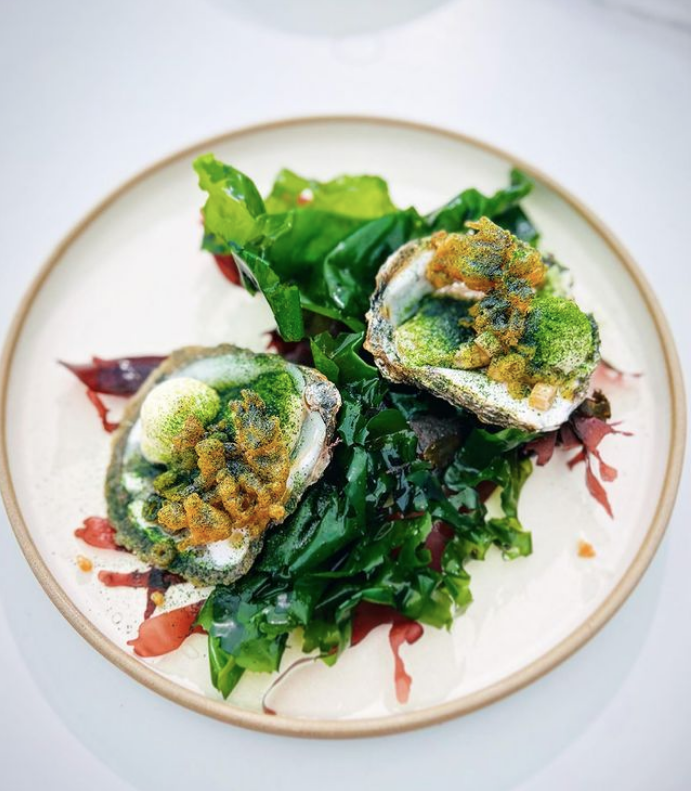
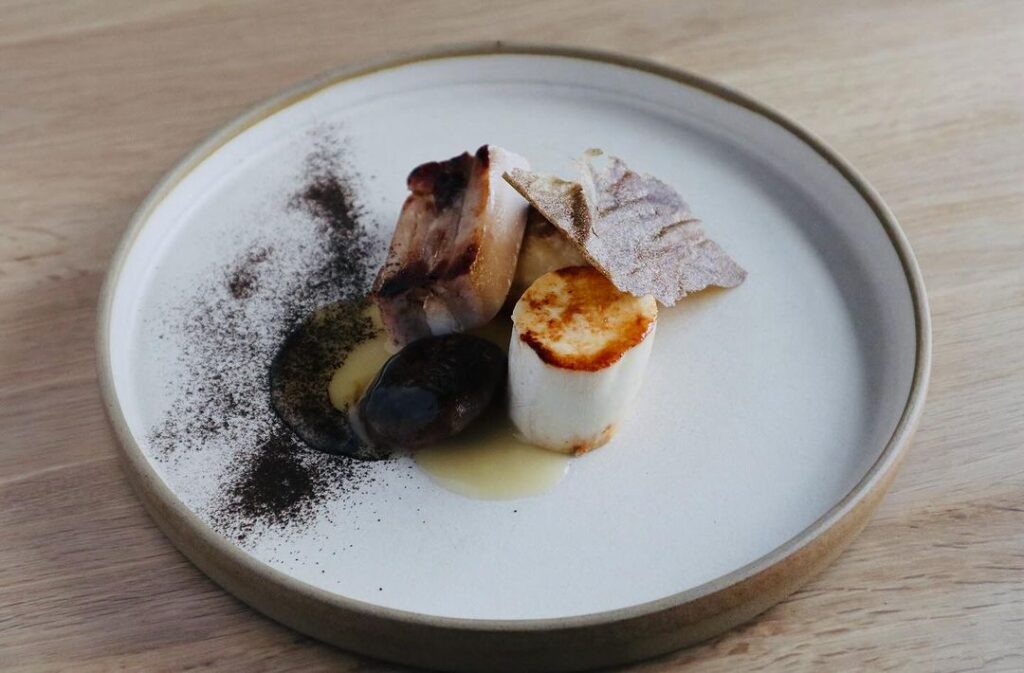
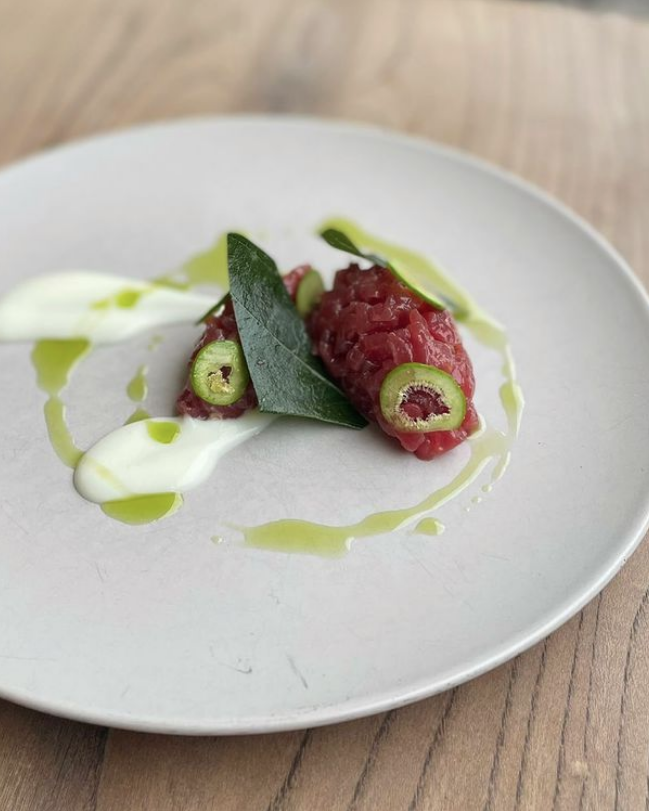
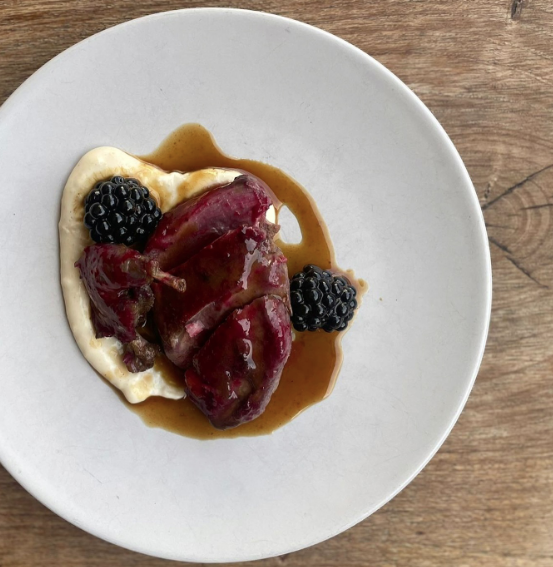
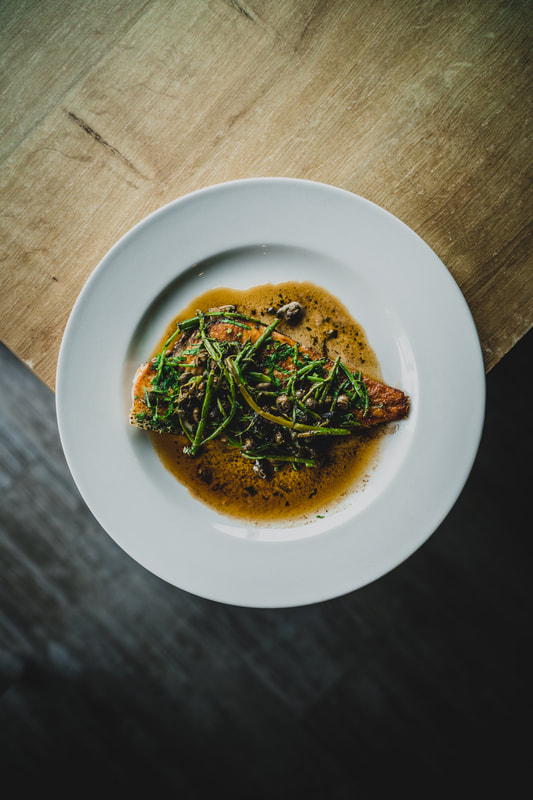
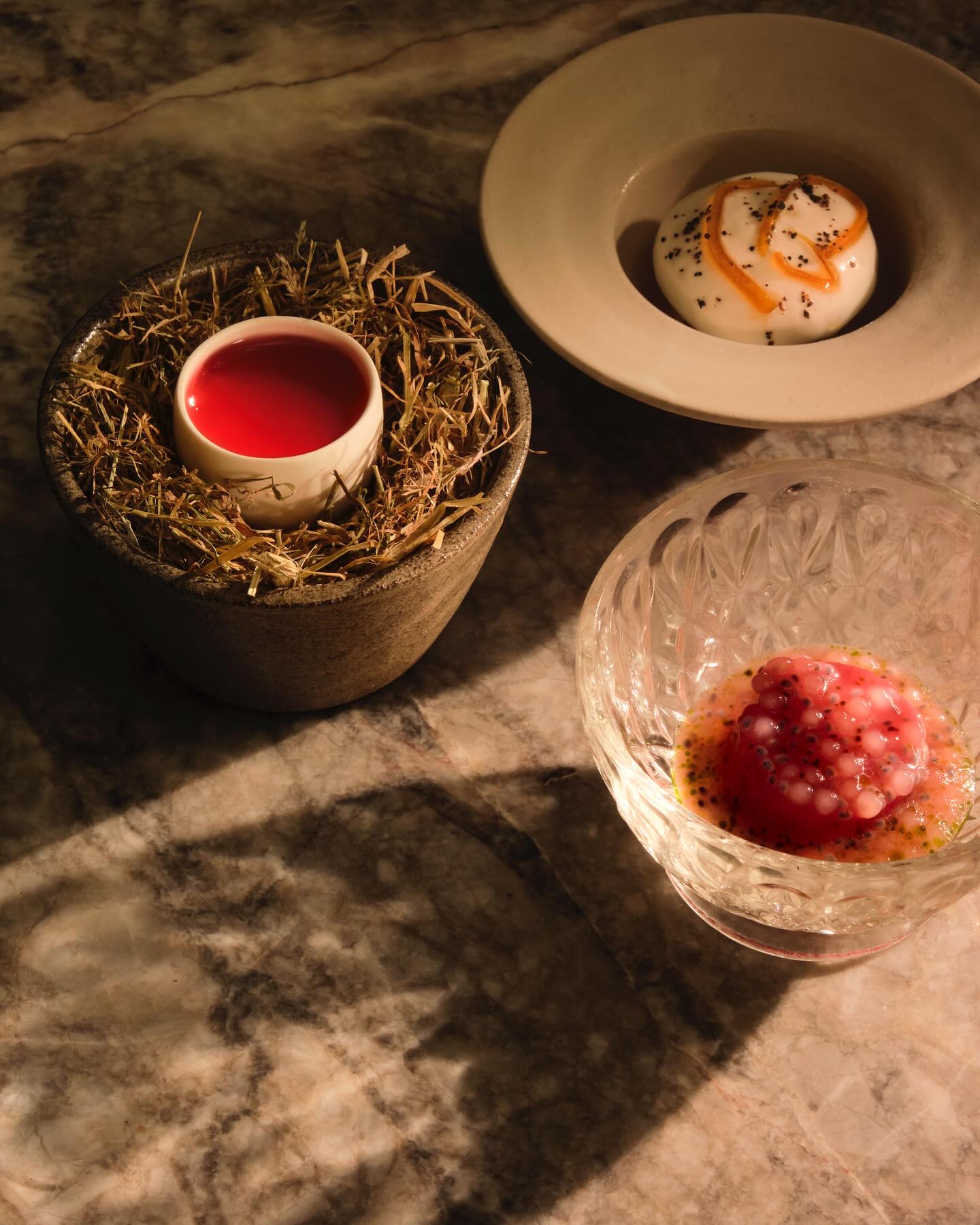
In a transformed quayside warehouse, Culture is rewriting the rules of sustainable fine dining in Cornwall. Cape Town-born chef Hylton Espey and wife Petronella earned Falmouth’s first Michelin Green Star in 2023, and the restaurant has held on to it since, reinforcing its position as one of Cornwall’s most important dining rooms.

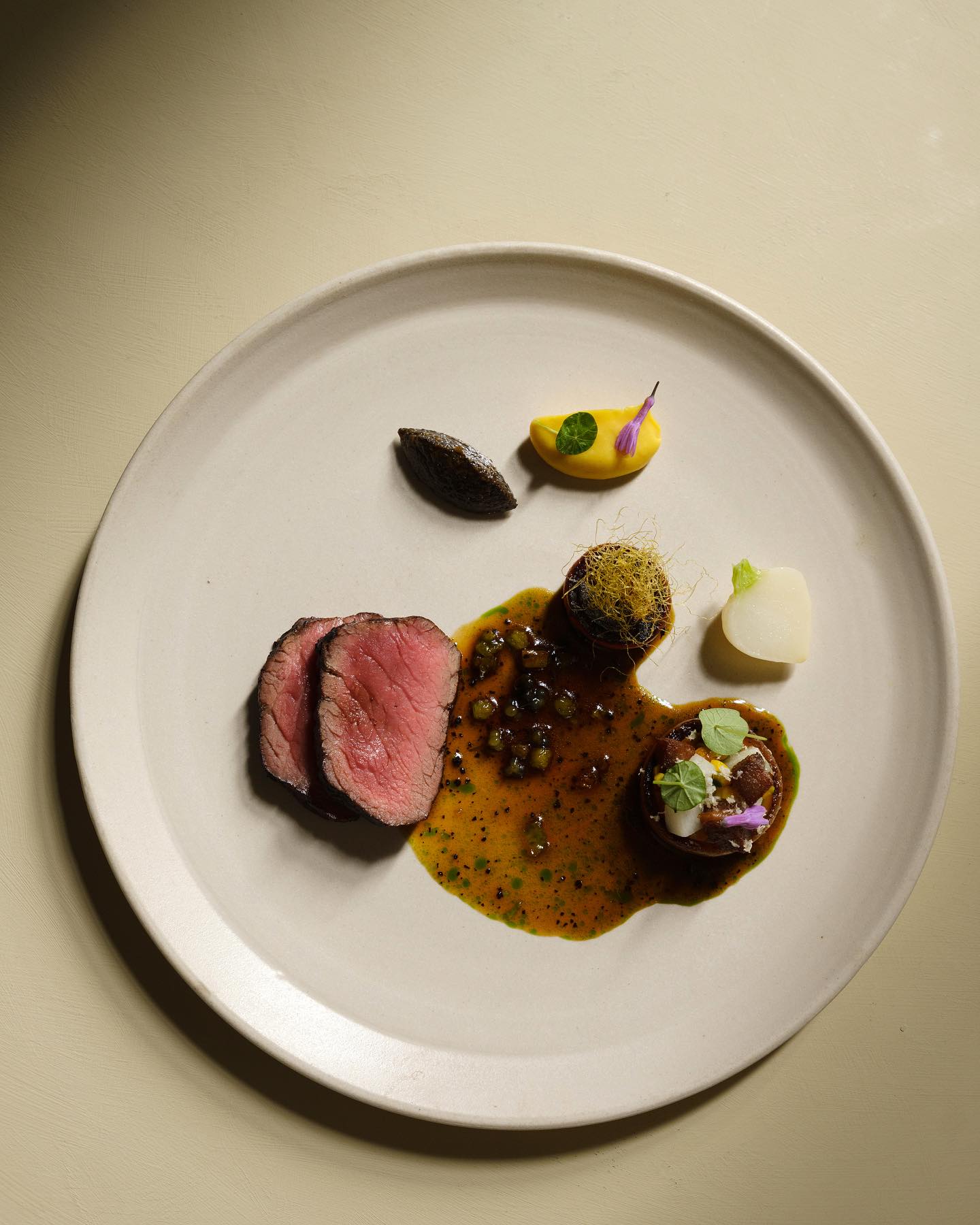
The evening’s Journey Menu is a seven-course story told through the landscapes, farms and waters around Falmouth. Each course is named after its inspiration, whether that’s a local farm, a stretch of coastline or a nearby woodland, and Espey’s zero-waste approach runs through every element. Current courses include Dexter beef from Chynoweth Farm, dry-aged in-house for over 70 days, and fish sourced through Giles at Pysk on Events Square, prioritising day boats and fishermen the team know by name. The bread course, milled from ancient grains grown by a local farmer called William, serves as a gentle provocation about modern farming and soil health. When this kind of cooking lands, the entire dining room fills with the scent of a thoughtful kitchen working at the top of its game.

The cooking style defies easy categorisation. Espey’s South African heritage occasionally surfaces, but it’s Cornwall’s seasonal rhythms that truly drive the menu. At £90 per person for the Journey Menu, it’s an investment in an evening of genuine culinary theatre. Those seeking a gentler introduction should try the five-course Discovery Menu at lunch, priced at £62, which represents something of a steal for cooking at this level.

The commitment to sustainability here goes beyond buzzwords. Vegetables arrive caked in soil without plastic packaging, the furthest farm is just 90 minutes away, and even the beautiful plates are crafted less than a block away by local potter Sam Marks. The kitchen runs solely on electric and induction, while local charcoal feeds the flames that kiss many of the dishes. That’s right, you deduced it, too; they don’t use gas.

The glass-walled wine cellar is worth a detour. Overseen by GM Bobby (how could he not oversee? It’s see through), the wine flights are both adventurous and enlightening, drawing from small, ethical producers across the globe. The dinner wine flight, at £62, feels like good value given the breadth and quality on show. A glass of Nyetimber Blanc de Blancs is available as a supplement if you’re feeling celebratory, because some moments deserve marking.
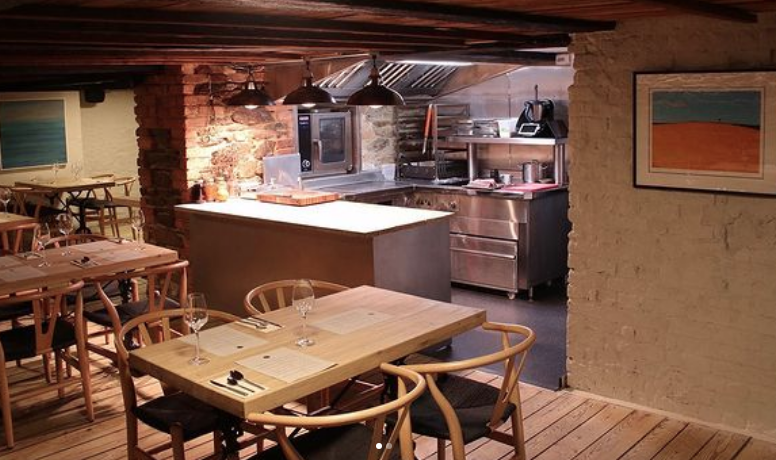
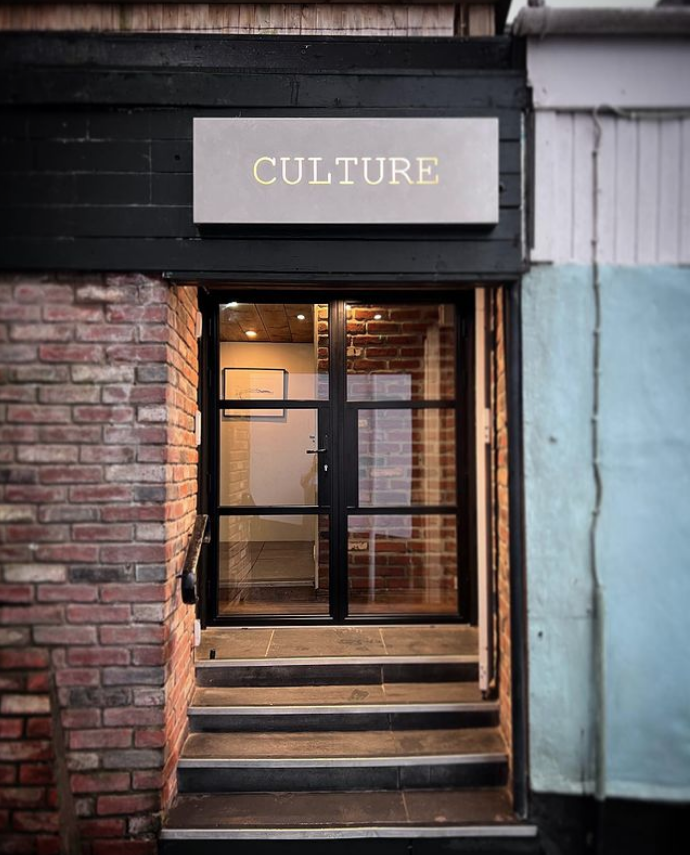
Image via @culture.restaurant

Dinner is served Wednesday to Saturday from 7pm, with lunch available Friday and Saturday from 1pm. Book well ahead: with only one sitting per service and a growing reputation, tables here are becoming Cornwall’s hottest reservation.

While the price point puts it firmly in special occasion territory, Culture manages to feel both important and intimate, a restaurant that’s pushing boundaries while keeping its feet firmly planted in Cornish soil.

Website: culturerestaurant.co.uk

Address: 38B Arwenack St, Falmouth TR11 3JF


Mine, The Old Brewery Yard

Ideal for intimate, ingredient-led dining in characterful surroundings…

It takes a certain confidence to open a restaurant down a cobbled alleyway off Falmouth’s high street, but Mine has turned its tucked-away location into part of its charm. This cosy neighbourhood spot feels like a delicious secret you’ll want to keep to yourself, though its continued inclusion in the Michelin Guide (it features again in the 2026 edition) suggests the secret is well and truly out.

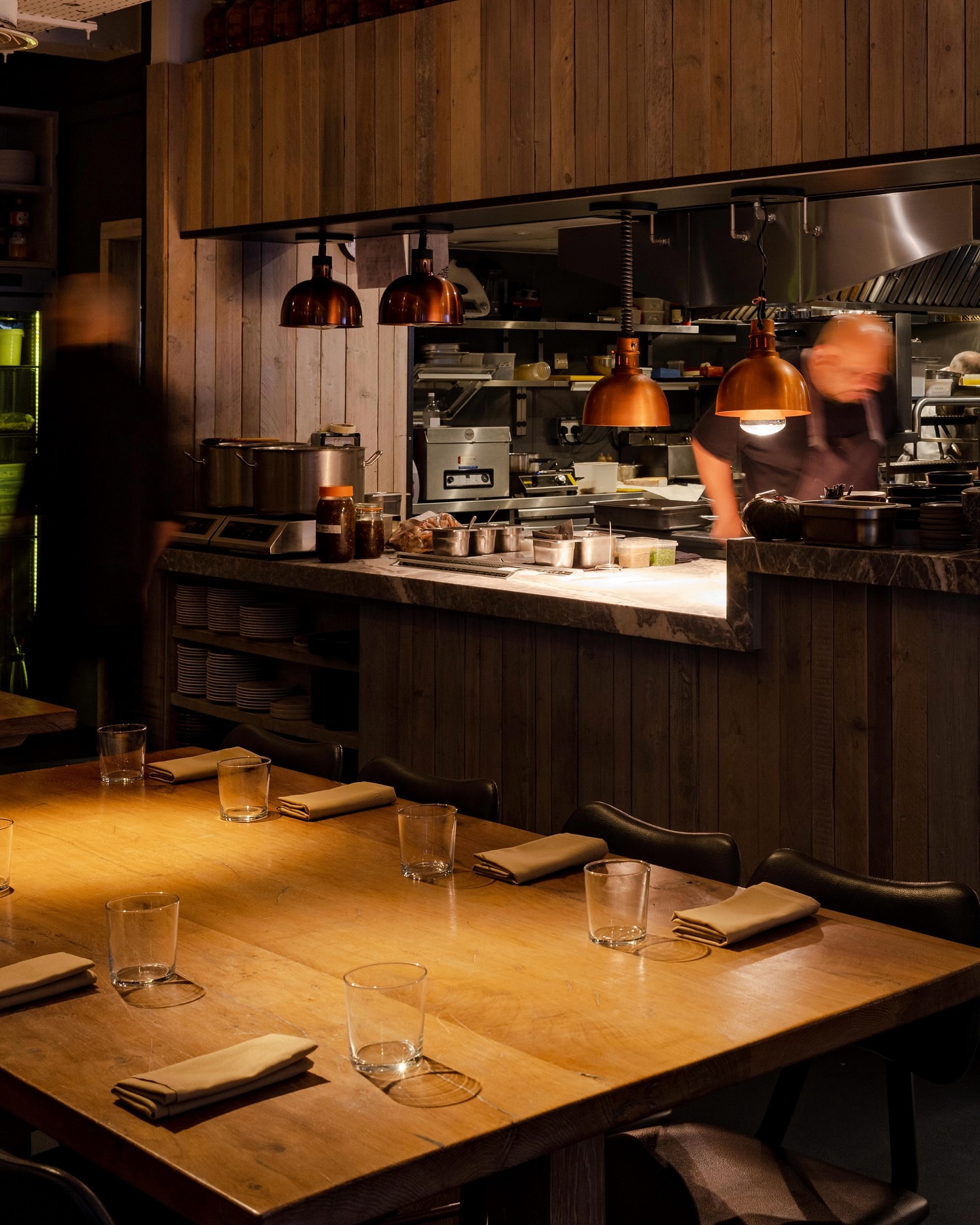
The dining room at Mine (not mine, although that’s true too) strikes that perfect balance between casual and considered, with midnight blue walls and industrial pendants casting shadows over intimate corners, nurturing a vibe that feels relaxed but also ready for a celebration. But it’s the small, open kitchen where the real action happens, with the chefs dancing an impressive choreography in a space barely bigger than a ship’s galley.

The weekly-changing menu is refreshingly straightforward: one meat, one fish, and one vegetarian option per course. The execution, though, shows chef Angus Bell’s impressive pedigree. Having cut his teeth at the Michelin-starred Star Inn at Harome before training under Michel Roux Jr at Le Gavroche, Bell brings serious technique to seemingly simple dishes. His crab fritters with bisque mayo remain one of Falmouth’s great snacks and are worth ordering by the half dozen.
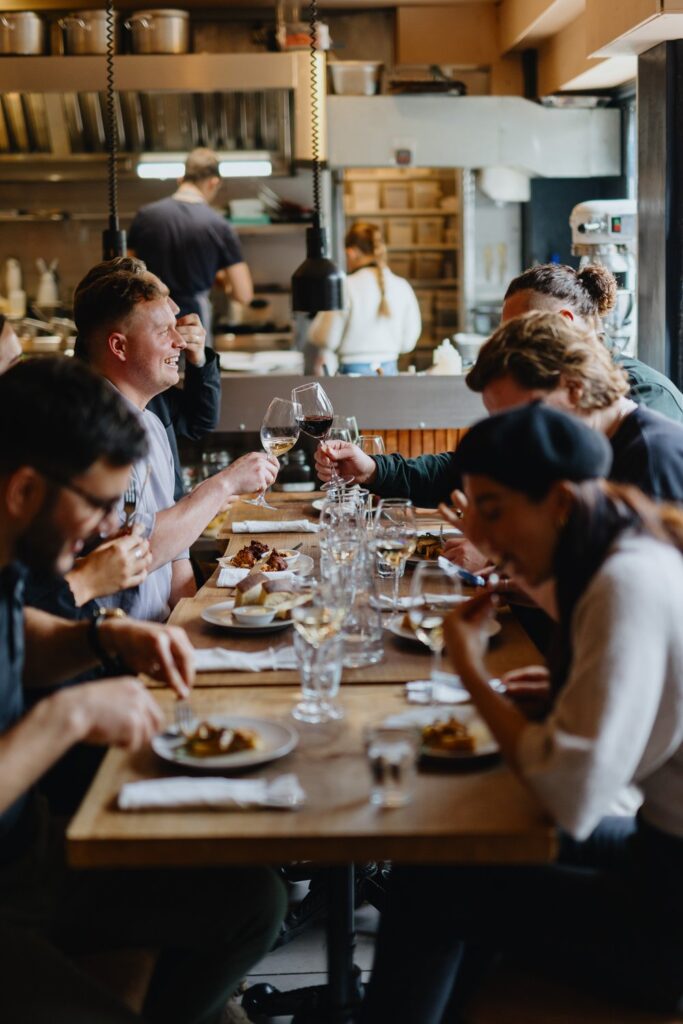
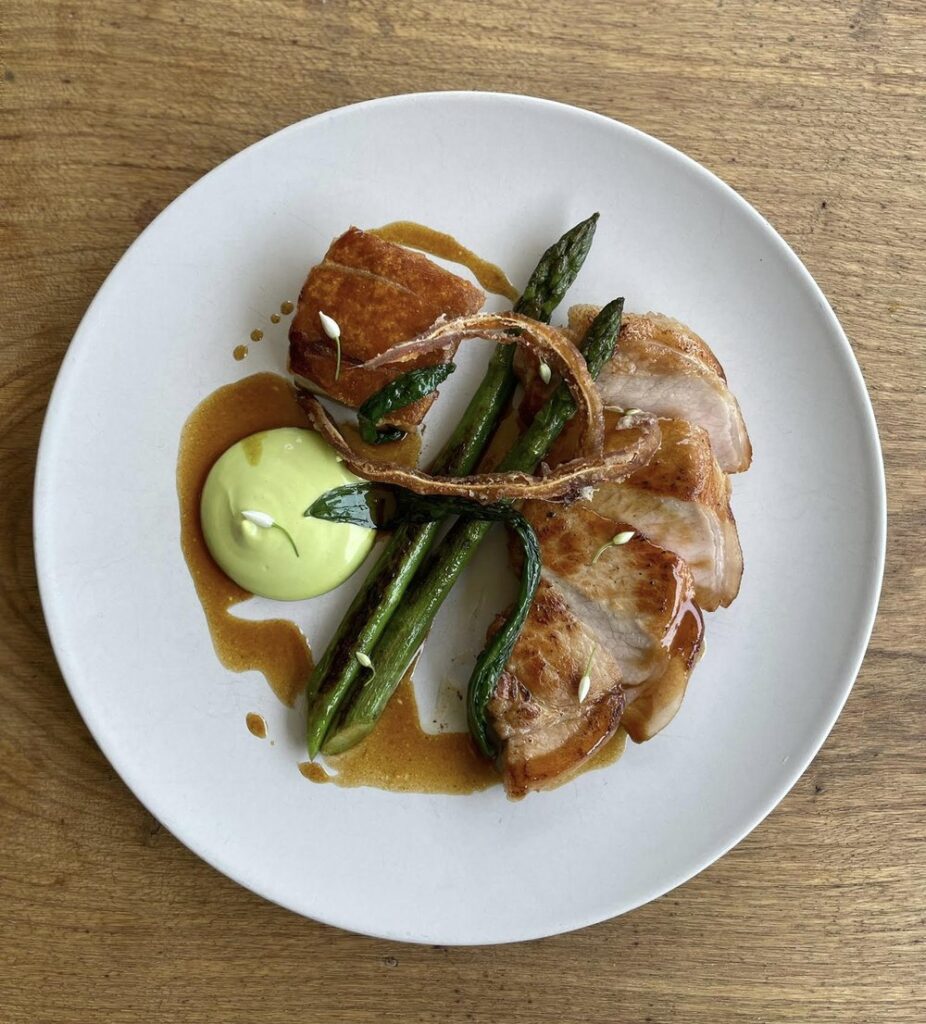
The menu rotates with the seasons and what’s landed that day, but expect the same level of care across the board: beautifully handled fish from Cornish boats, well-sourced meats from local farms, and vegetarian dishes that feel like a genuine course rather than an afterthought. Sides of buttery mash and spring greens are worth adding, and the desserts, particularly anything involving chocolate, tend to be exceptional.

For the best experience, grab a table in the cobbled courtyard on balmy summer evenings, or cosy up inside when the maritime weather does its thing. And if you’re feeling adventurous post-dinner, The Chintz Symposium next door offers excellent cocktails in surroundings that feel like falling down a particularly stylish rabbit hole.

Website: restaurantmine.co.uk

Address: 4 The Old Brewery Yard, High St, Falmouth TR11 2BY


Verdant Seafood Bar, Quay Street

Ideal for ultra-fresh seafood and craft beer in laid-back surroundings…

When one of Cornwall’s most exciting breweries turns its hand to seafood, expectations run high. Verdant’s cosy cellar bar on Quay Street delivers spectacularly, a place where the day’s catch meets some of the county’s finest craft beer, all served with the kind of effortless cool that makes you want to settle in for the afternoon.

The premise is beautifully simple: small plates of impeccably fresh seafood designed to pair with the eight rotating lines of Verdant beer on tap. Their signature crab loaded chips have near-mythical status, a generous heap of fries lavished with brown crab cheese sauce, pico de gallo, and deep-fried capers, crowned with fresh white crab meat and homemade aioli. It’s the kind of dish, often enjoyed in a one-two punch with the signature fish finger butty, that has people making special trips to Falmouth.

The rest of the menu changes with the tides, sometimes literally. Expect whatever’s been landed that morning to appear in creative combinations. You might find gurnard tostadas singing with chilli, lime and coriander, or buttermilk fried sardines from Mount’s Bay lounging on a bright tangle of parsley and shallots. The kitchen shows particular flair with the specials board, and there are always one or two vegan options for anyone being dragged to a seafood bar against their will.
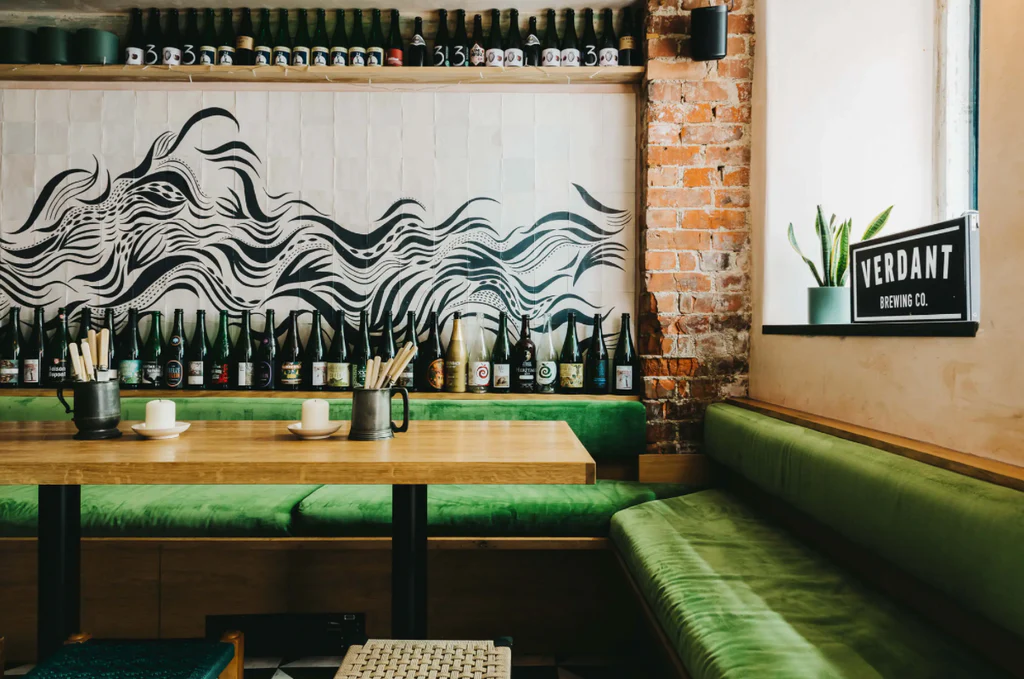
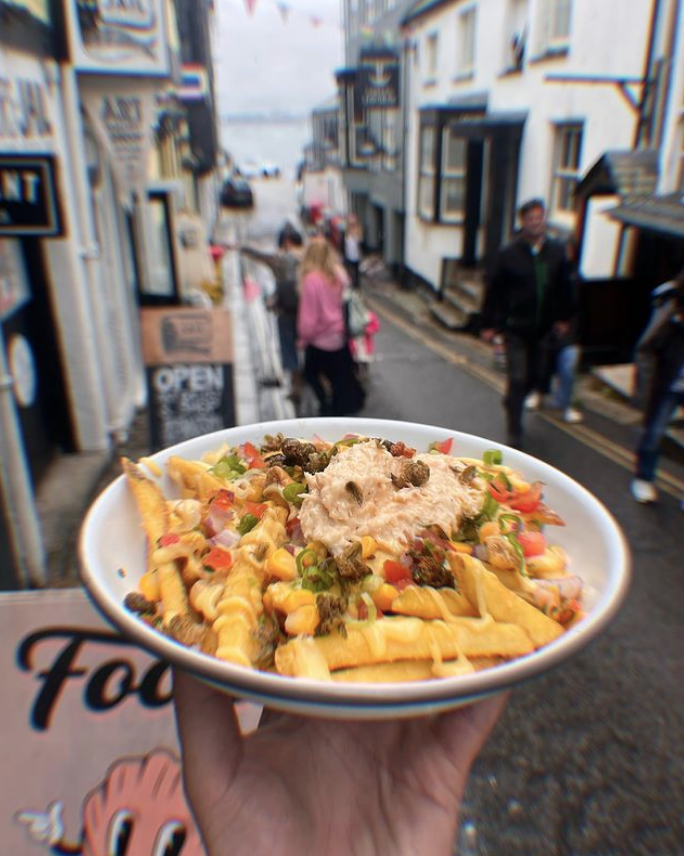
Images via @verdant_seafood_bar

The drinks selection deserves equal billing. Beyond Verdant’s own excellent brews, including their signature pale ales and IPAs, the chalkboard reveals an ever-changing selection that reads like a craft beer lover’s wishlist. With eight rotating lines and an extensive selection of sharing bottles from some of the world’s most exciting breweries, alongside a thoughtfully curated wine list and proper spirits, you’re as likely to find people debating hop profiles as discussing the day’s catch. For those steering clear of alcohol, the soft drinks go well beyond the usual suspects.

Don’t expect white tablecloths or reservations. This is a deliberately casual affair where the focus is squarely on what’s on your plate and in your glass. Open Tuesday to Saturday from noon until 11pm (kitchen closes at 9pm), with a no-bookings policy that keeps things spontaneous. Get there early, grab a table, and settle in for some of the best seafood and beer matching you’ll find anywhere in Cornwall.

Website: verdantbrewing.co

Address: Quay St, Falmouth TR11 3HH


Beach House Falmouth, Swanpool

Ideal for seafood feasts with spectacular coastal views…

Perched above Swanpool Beach, Beach House Falmouth occupies one of the most enviable dining positions in Cornwall. Formerly known as Hooked on the Rocks, the restaurant was taken over by the Beach House Group in early 2025 (the same team behind Harbour House in Flushing) and the rebrand has brought new energy without losing what made the location special. The focus remains firmly on Cornish seafood, and those sweeping coastal views haven’t changed one bit.

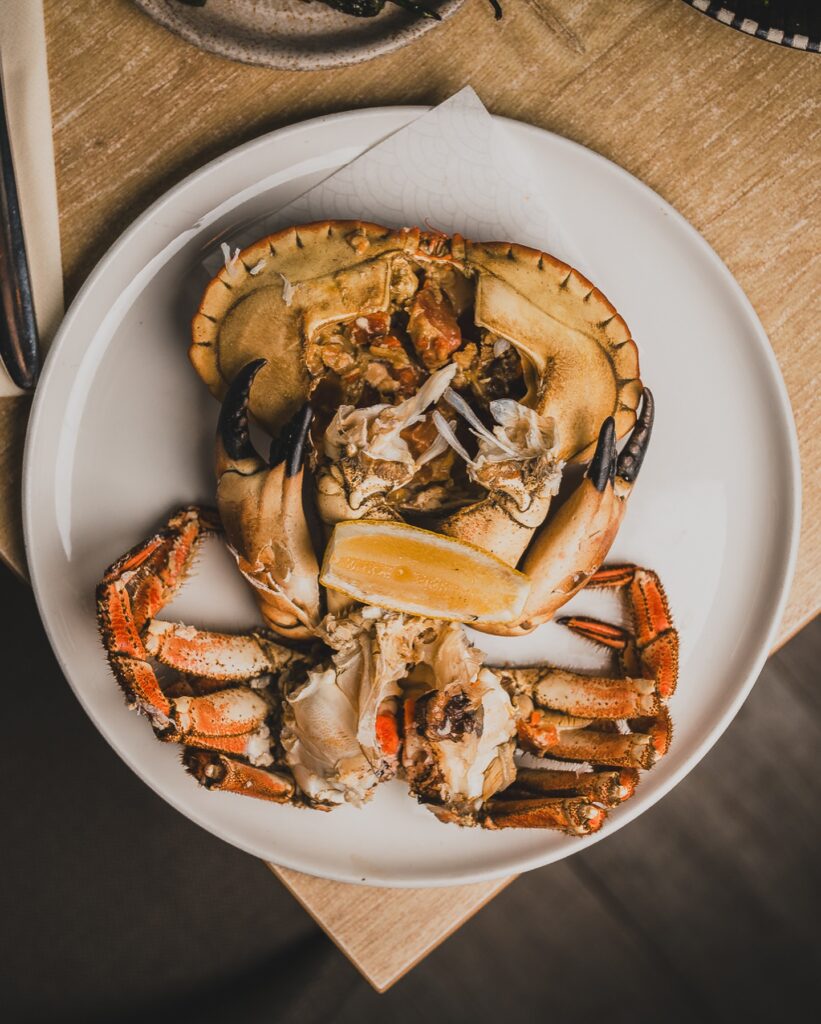
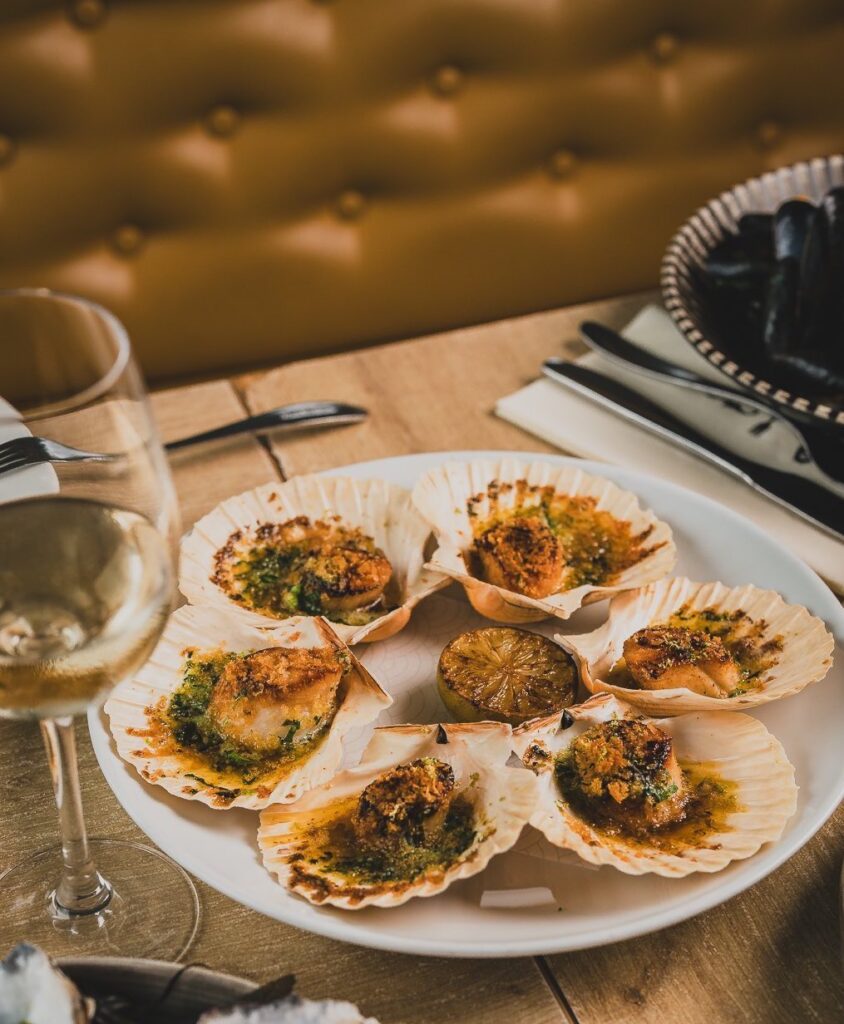
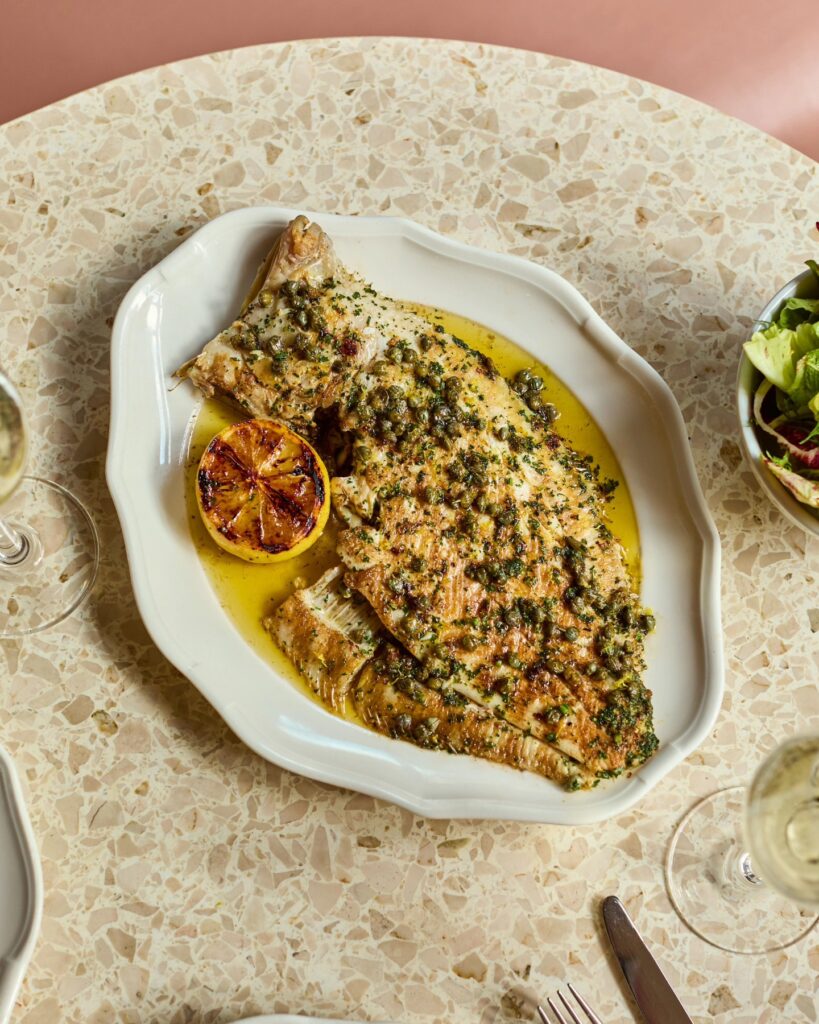
The kitchen works with a close-knit network of local suppliers, including Ned Bailey in Falmouth, Mylor Fish Shop, and Cornwall Fish Direct in Newlyn, and the menu shifts with what’s available each day. Starters lean into the sharing spirit: Porthilly Pacific oysters, shell-on wild prawns with ‘nduja butter, and scallops dressed simply with olive oil, lemon and parsley. For mains, whole hot crab with garlic butter is comfortably one of the best-value dishes on the menu, while whole plaice with parsley, caper and lemon butter is a satisfying exercise in letting good fish speak for itself. If you’re going big, the grilled lobster remains a triumph of simplicity, or go further still with the hot seafood platter to share.

The drinks list leans into local producers, with Loveday Gin, Knightor Winery’s Cornish Cuvée, and a wine list curated in partnership with Wanderlust Wine, focusing on small, family-run vineyards.
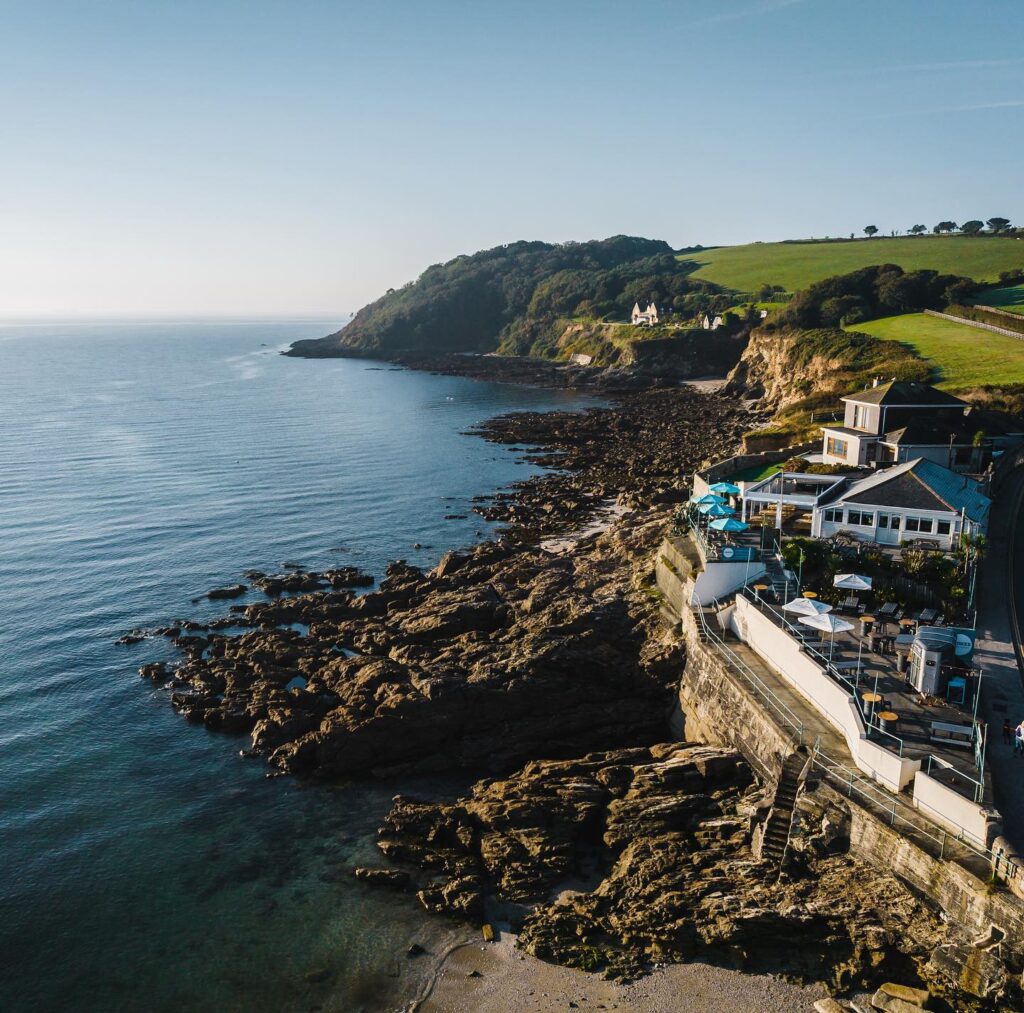
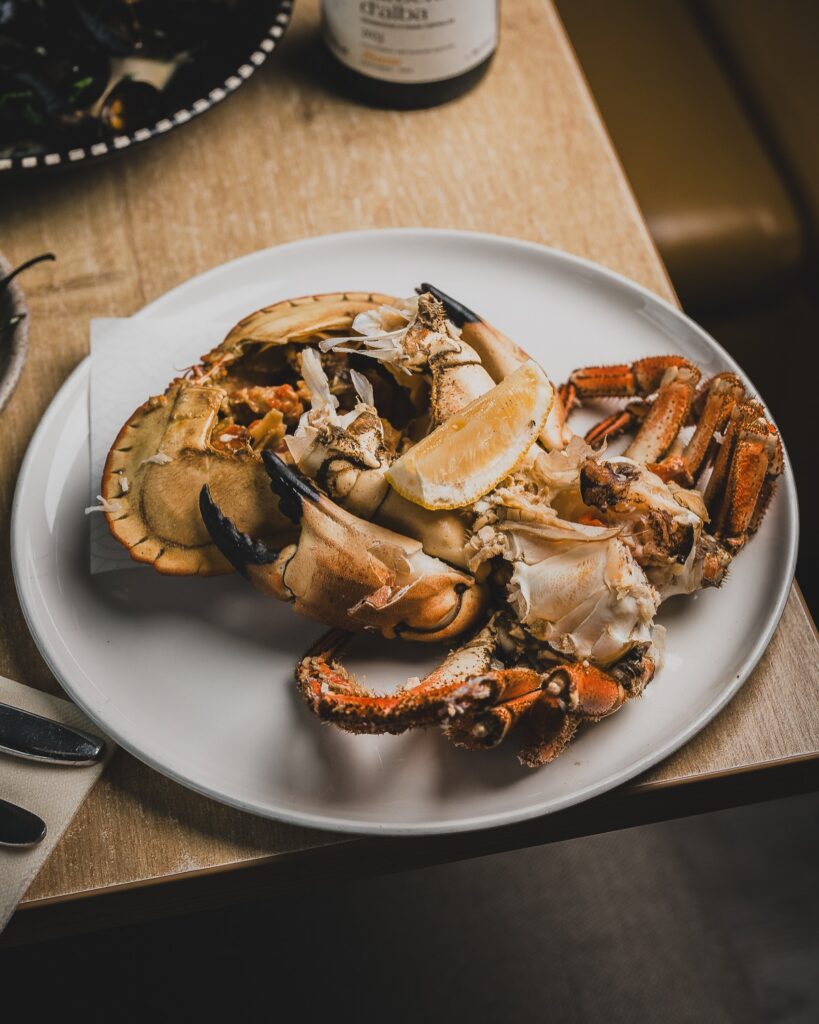
Beyond the main restaurant, Beach House has introduced a few nice touches since the rebrand. There’s a weekday set menu offering two courses for £20 or three for £25, making it a more accessible lunchtime option. Oyster Mondays bring half-price oysters all day. There’s even a Sunday Swim Club and a monthly Run Club if you want to earn your lunch the hard way. The Cool Box, an outdoor bar overlooking the bay, serves drinks, pastries and loaded fries from midday, no booking needed.
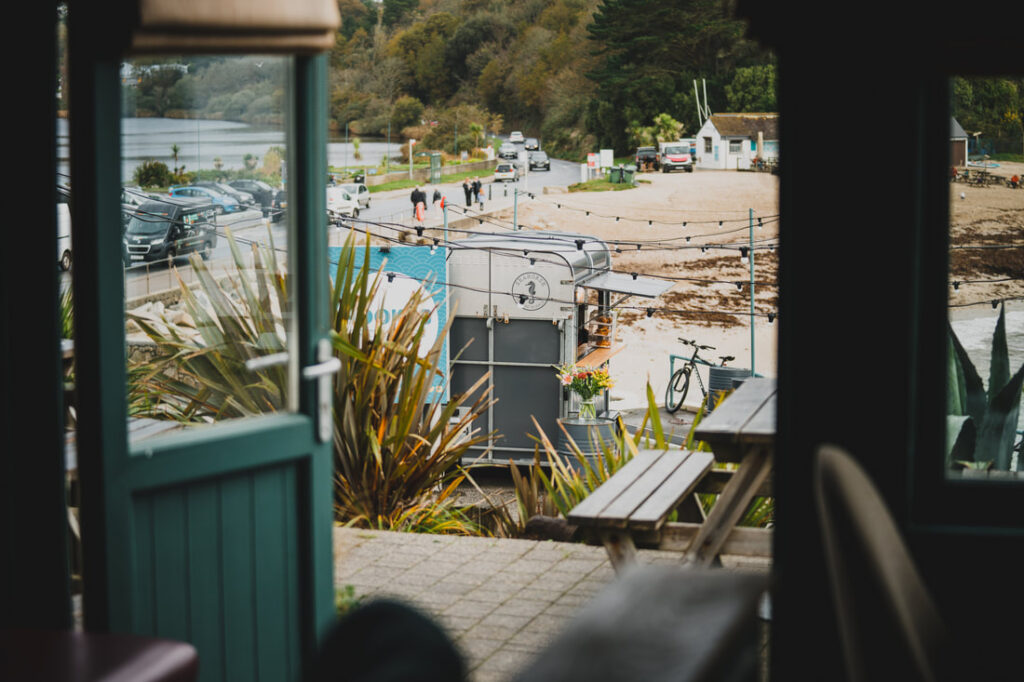
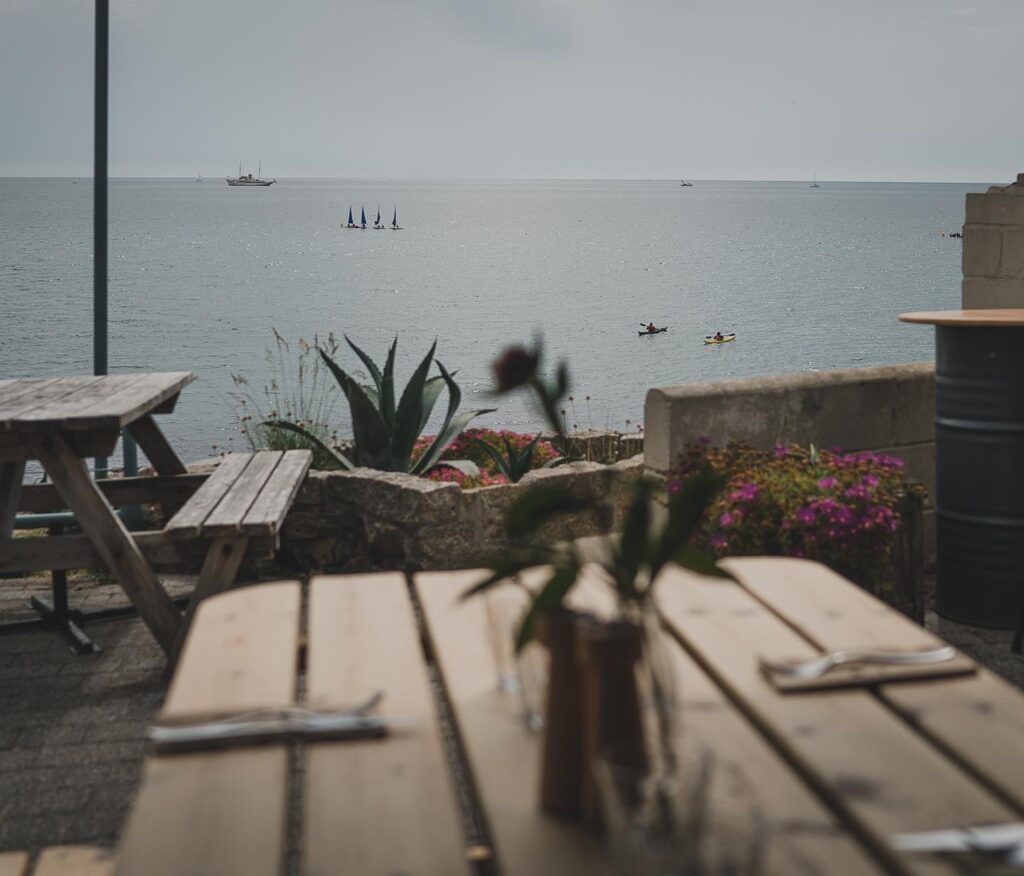
Images via Hooked On The Rocks

Dogs are welcome everywhere at Beach House Falmouth, and the South West Coast Path runs right past the door, making it a natural stop on any coastal walk. Open daily: weekdays from noon until late, weekends from 9am with breakfast served until 11.30am.

Website: beachhousefalmouth.com

Address: Swanpool Rd, Falmouth TR11 5BG


Indidog, Fish Strand Quay

Ideal for all-day dining with unbeatable harbour views…

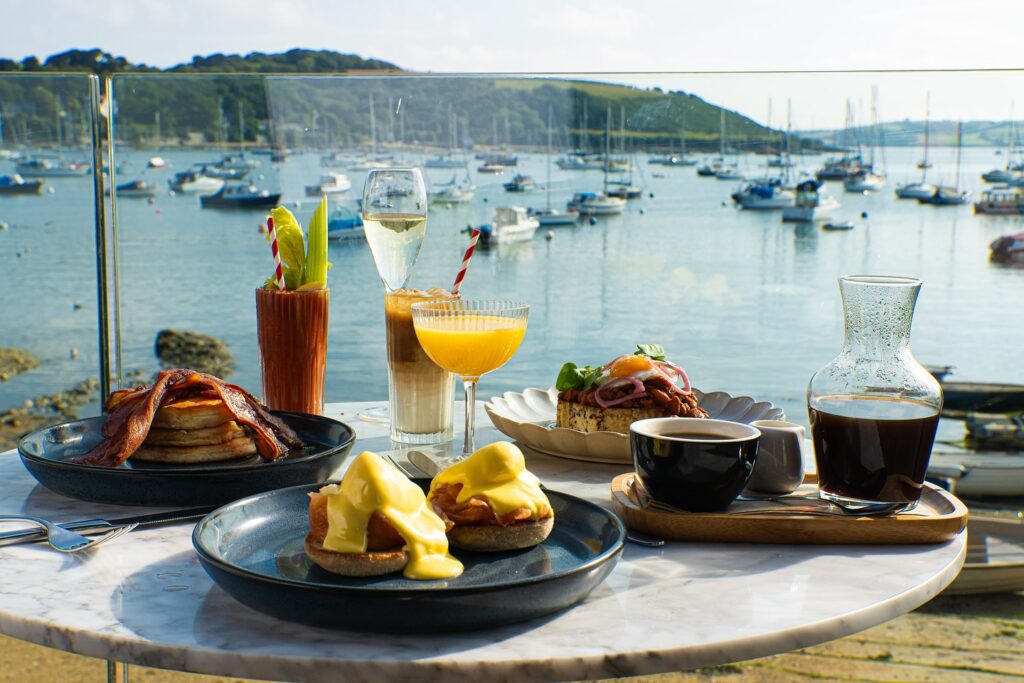
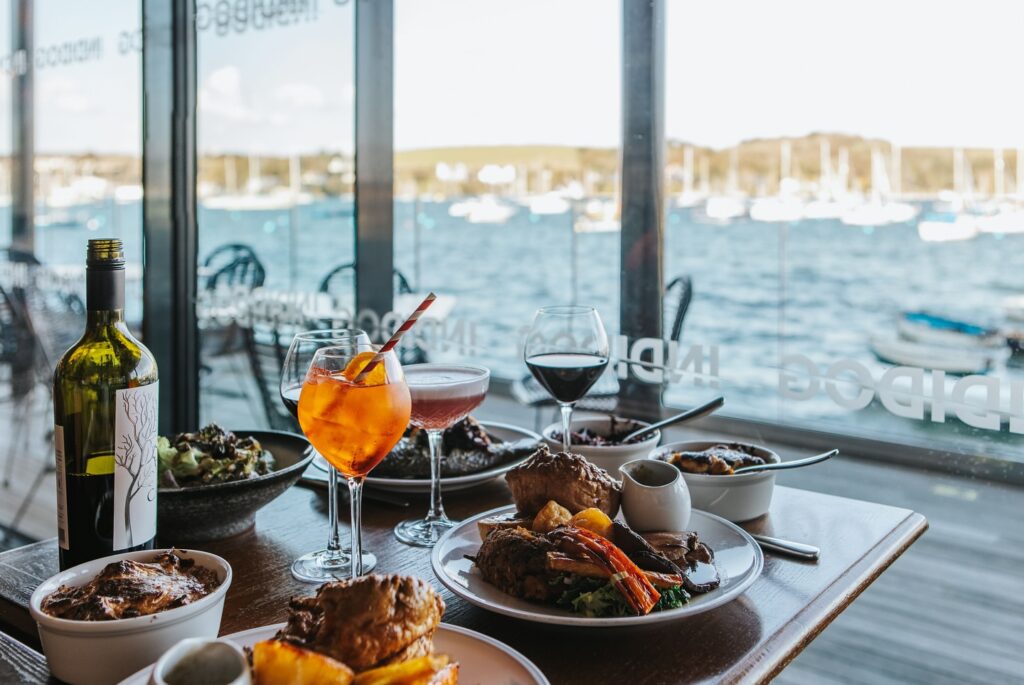
Taking pride of place on Falmouth’s Grade II listed harbour wall, Indidog masters that rare trick of being both a destination restaurant and a reliable local haunt. Floor-to-ceiling windows frame spectacular views across Carrick Roads towards Flushing, Mylor and St Mawes, while the kitchen serves accomplished plates from breakfast through to dinner.

Mornings here are particularly special. The breakfast menu dares to be different, with perfectly cooked steak and eggs paired with a Bloody Mary, or indulgent stacks of pancakes alongside their house Breakfast Mocktini. Best of all is the Cornish crab benedict, which is light, indulgent and simply the best breakfast dish in Falmouth, bar none.

Come evening, the menu shifts to showcase the finest Cornish produce, with day boat fish and local farm meats taking centre stage. A starter of crispy squid with sriracha mayo and lime sets the tone, while mains might include a beautifully simple day boat fish with seaweed butter and potato hay. There’s always one thoughtfully crafted vegan option per course, the kind of cooking that treats plant-based diners as a genuine priority rather than a box-ticking exercise.
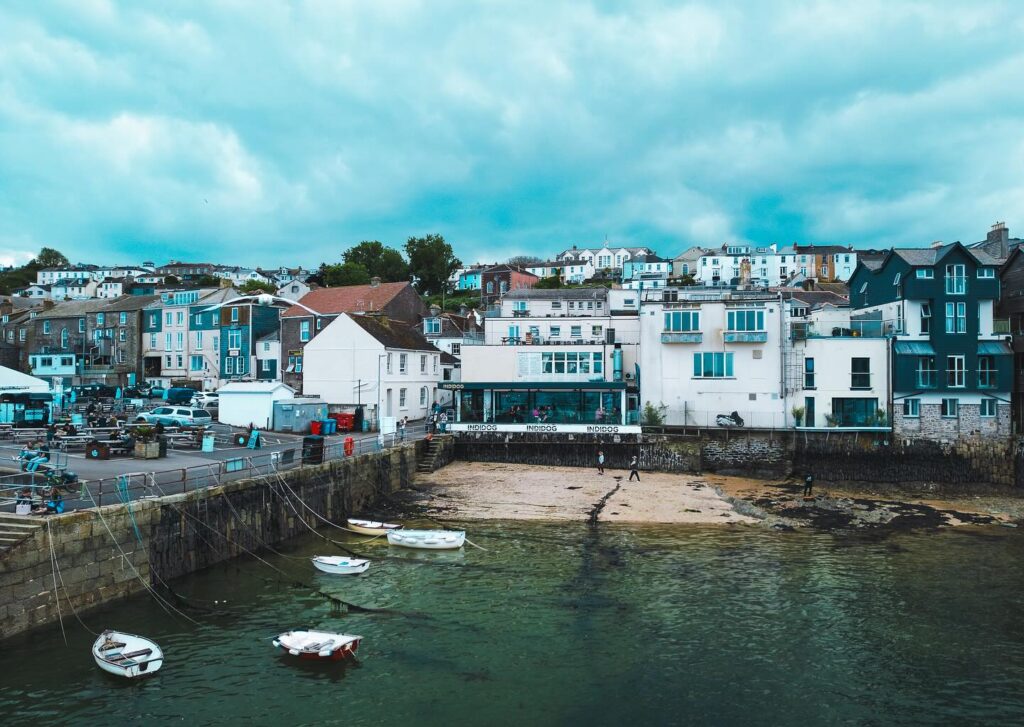
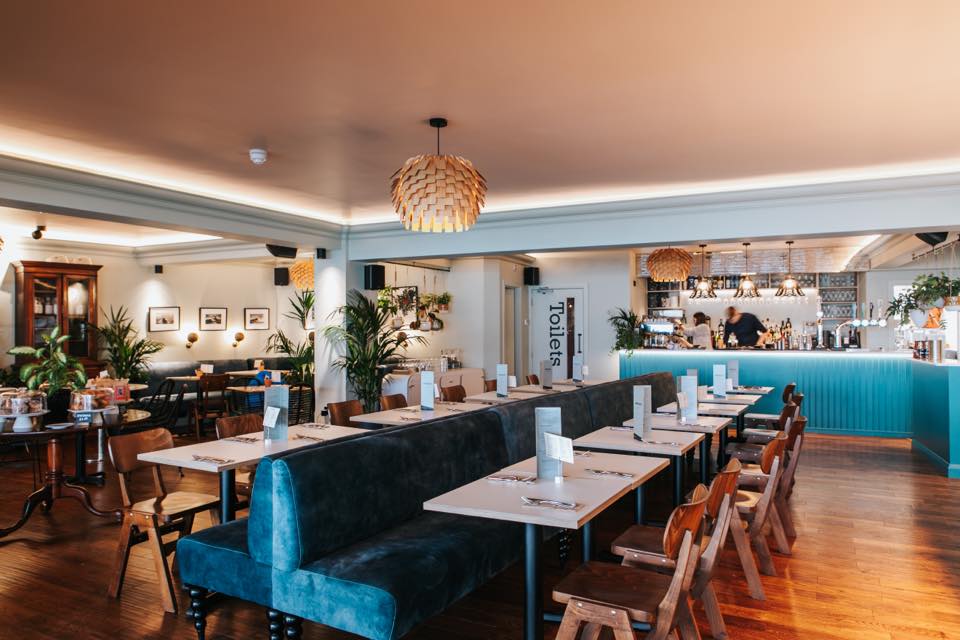
Images via @indidogeatery

Indidog’s cocktail game is strong, with a list that leans heavily on local distilleries. The Cornish Martini makes a perfect aperitif (or brunch pick-me-up, quite frankly). They run a 2-for-1 cocktail offer between 2pm and 6pm daily, which takes the sting out of the afternoon. The wine list balances familiar names with organic and vegan options, plus a selection of small-batch wines from Cornish and English vineyards for those in the know.

Hidden just off the high street (look for the steps under Specsavers), Indidog keeps solid hours, open daily with brunch served until around midday, lunch through the afternoon, and dinner from 6pm. Hours vary slightly by season and day of the week, so check their website before visiting. Those harbour views, however, come at no extra charge.

Website: indidogeatery.com

Address: 28a Market St, Falmouth TR11 3AT


Provedore, Trelawney Road

Ideal for laid-back Italian small plates in a true neighbourhood setting…

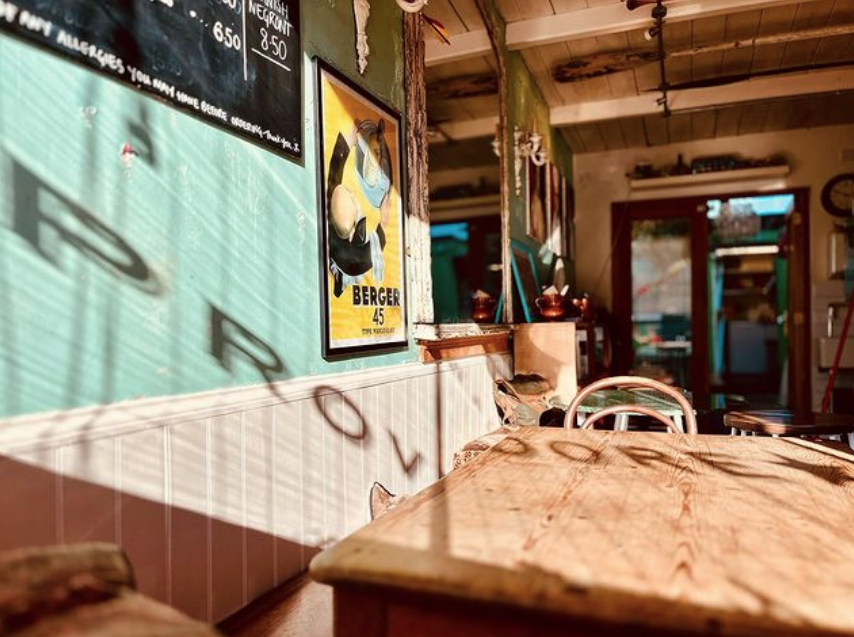
Hidden in Falmouth’s terraces high above the harbour, Provedore feels like stumbling upon a slice of rustic Italy. Since 2007, this charming wooden haven with its courtyard and olive tree has evolved from a neighbourhood deli into something quite special: Falmouth’s answer to a Venetian bacaro, where the food is as warm and colourful as the welcome.
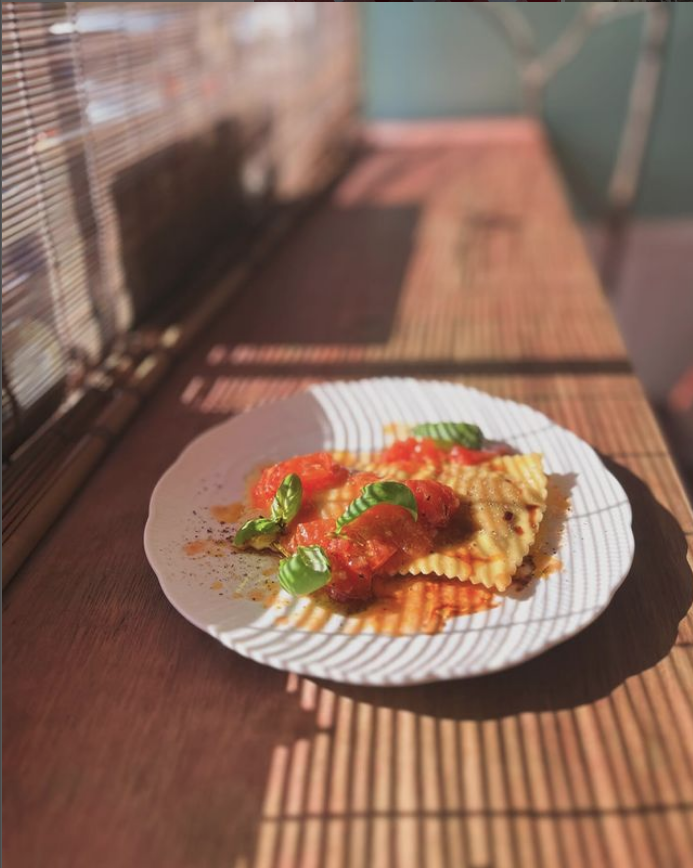
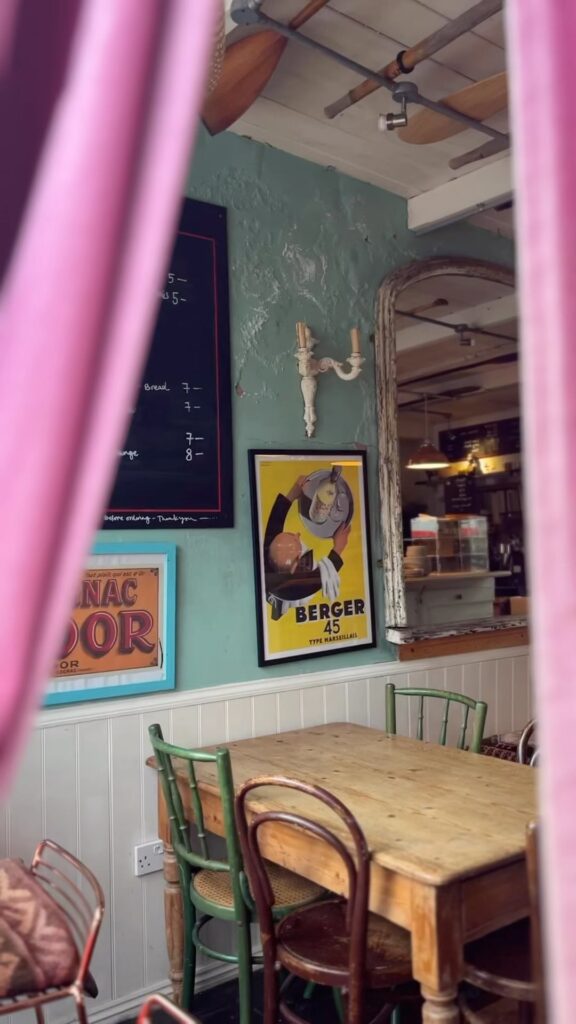
Images via Provedore

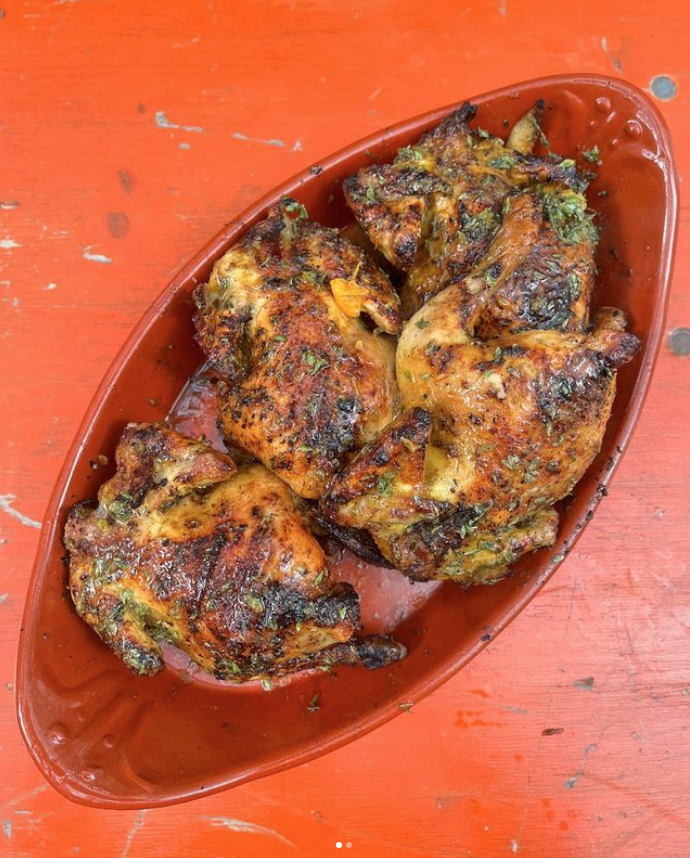
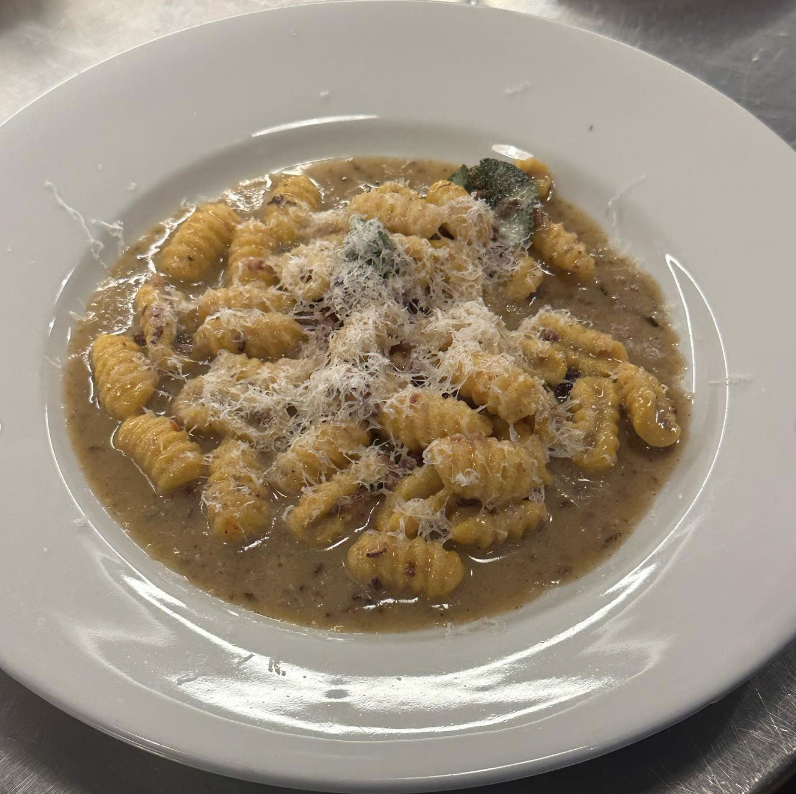
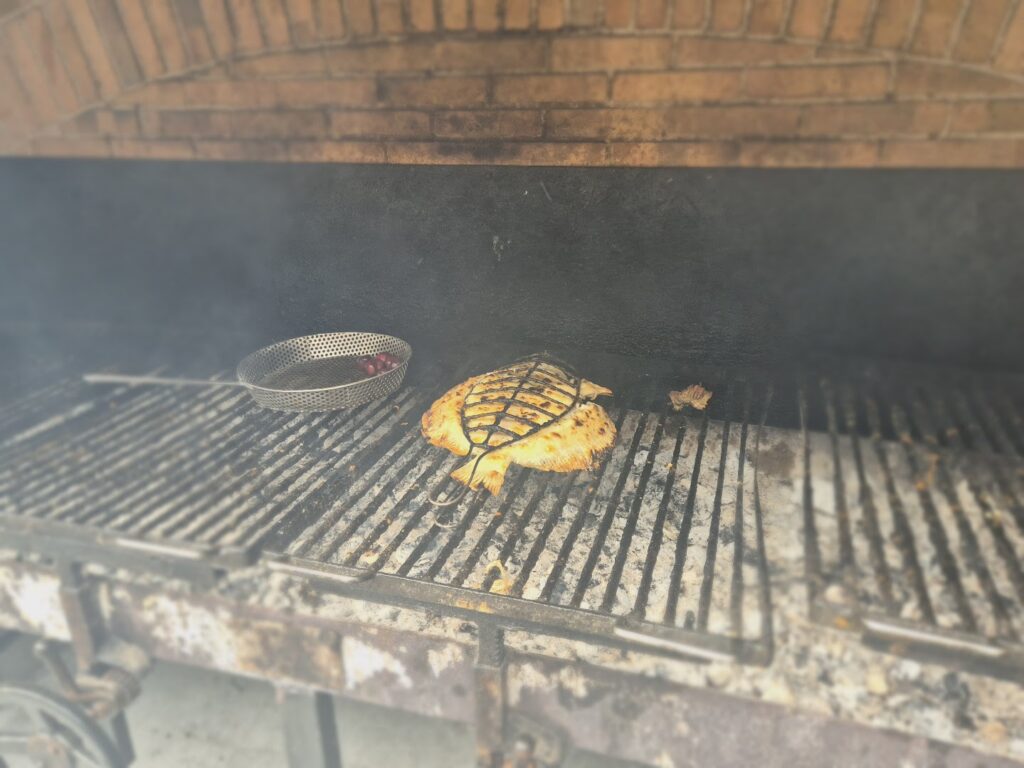
The kitchen serves up ever-changing cicchetti (Italian small plates) that showcase whatever’s inspiring the chefs that day. Of course, there’s salami and cheeses, but you might also find plump ravioli stuffed with mozzarella, sun-dried tomatoes and basil, swimming in house-made confit tomato sauce, or a hearty Tuscan braise of fennel sausage and white beans lifted with lemon. The grilled dishes (Provedore have a dedicated barbecue out back) are particularly good. Half a blistered, tender poussin cooked with orange and Portuguese oregano has regulars planning their week around its appearance on the menu.

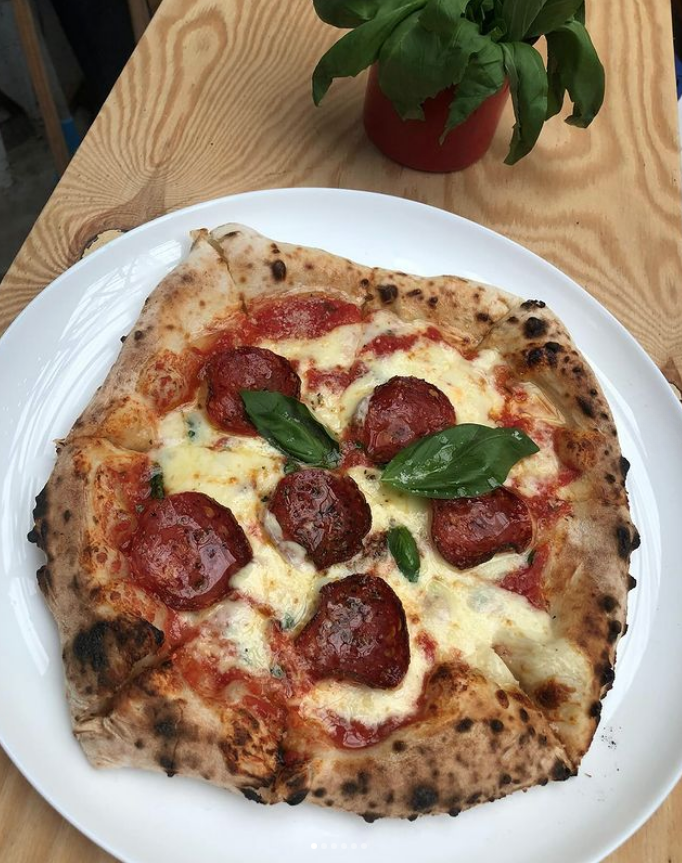
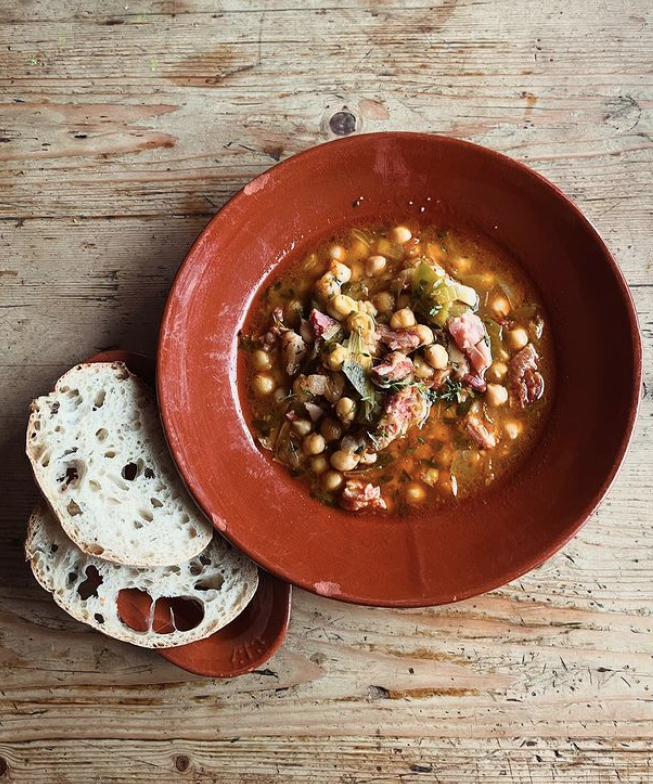
There’s also the occasional appearance of a dedicated pizza menu, courtesy of the guys at Lucky Rod. These are beautifully puffy, sloppy Neapolitan numbers pitched at Naples prices. An eclectic selection of wines and beers chosen to complement the rustic Italian fare seals the deal. This is the kind of place where you’ll want to linger over a glass of Chianti while debating whether to order another plate of those slow-braised chickpeas with pancetta and fresh thyme.

Open Thursday through Saturday evenings from 5pm until 8pm for drinks and cicchetti, Provedore operates a strictly walk-ins only policy. It’s the kind of place that makes you feel like a regular on your first visit, and has you planning your return before you’ve even finished paying the bill.

Get there early: tables in their charming courtyard are particularly sought after when the weather plays along.

Website: provedore.co.uk

Address: 43 Trelawney Rd, Falmouth TR11 4RE


Harbour Lights, The Old Boatyard

Ideal for elevated fish and chips with harbour views…

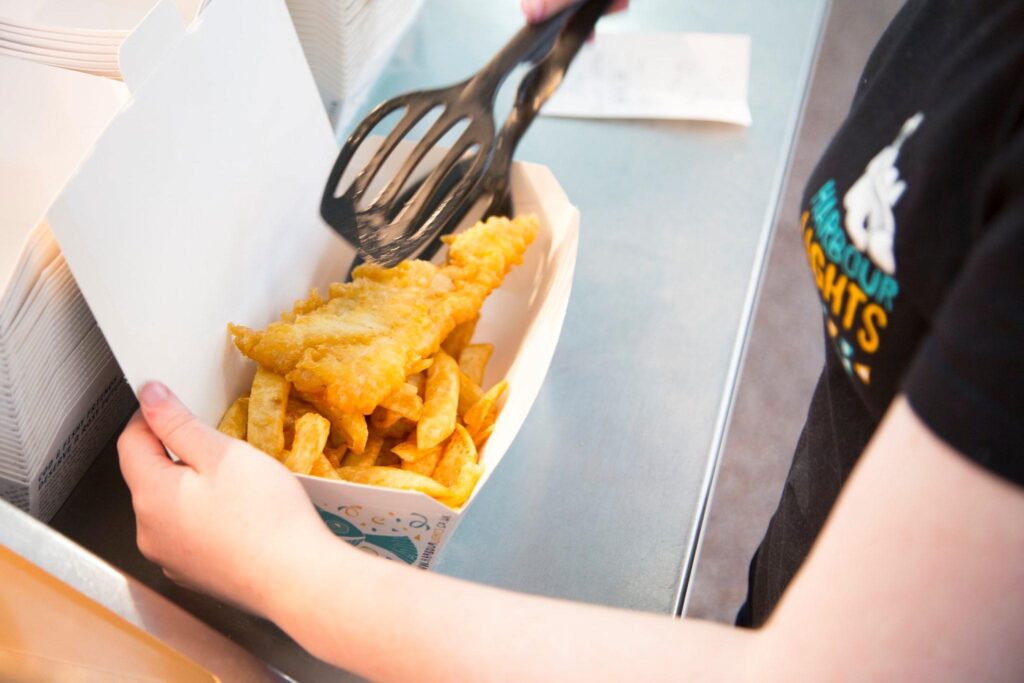
When only proper fish and chips will do, Harbour Lights delivers in style. This award-winning chippy (a past top-10 finisher at the National Fish & Chip Awards, and holder of the NFFF Quality Award) isn’t trying to reinvent the humble fish supper; they’re just serving the freshest catch with the care and respect it deserves, while keeping prices reasonable for the quality on offer. What’s not to love?

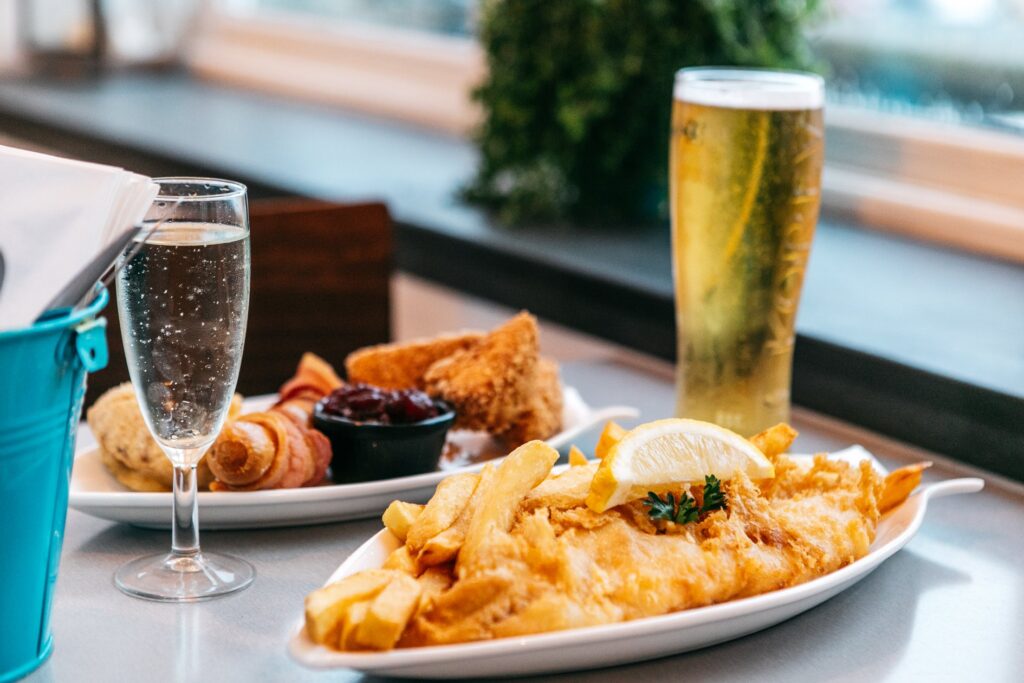
The menu celebrates Cornish seafood with pride. Their line-caught haddock comes perfectly flaky, encased in their signature batter that shatters satisfyingly at first bite. The local hake is worth the slight premium: a Cornish treasure that shows why this stretch of coast is so renowned for its seafood. Or, for a bit of fun, their Fizz & Chips pairs line-caught haddock and chips with a glass of prosecco, a combination that somehow makes perfect sense.

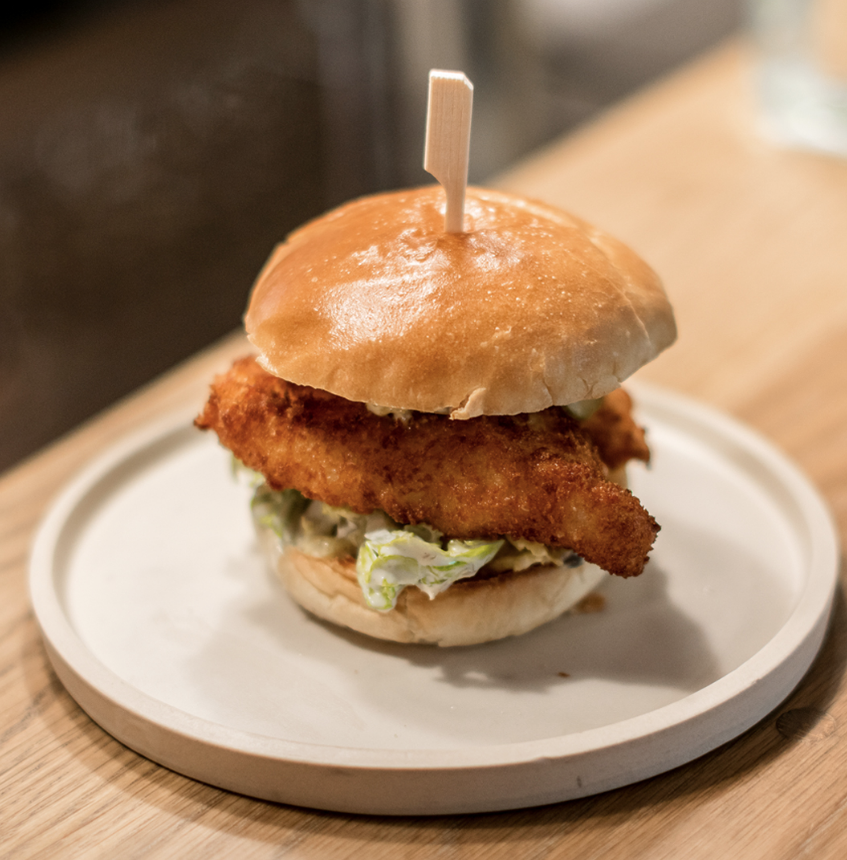
Plant-based diners aren’t an afterthought here. Their vegan option (brine-marinated tofu wrapped in nori and deep-fried) has developed a following, with some claiming it tastes even fishier than fish. That would be a claim too far, but it is good. For something different, try the Hooked on the Harbour burger: crispy battered cod in a Baker Tom brioche bun with homemade tartare sauce. Magic.
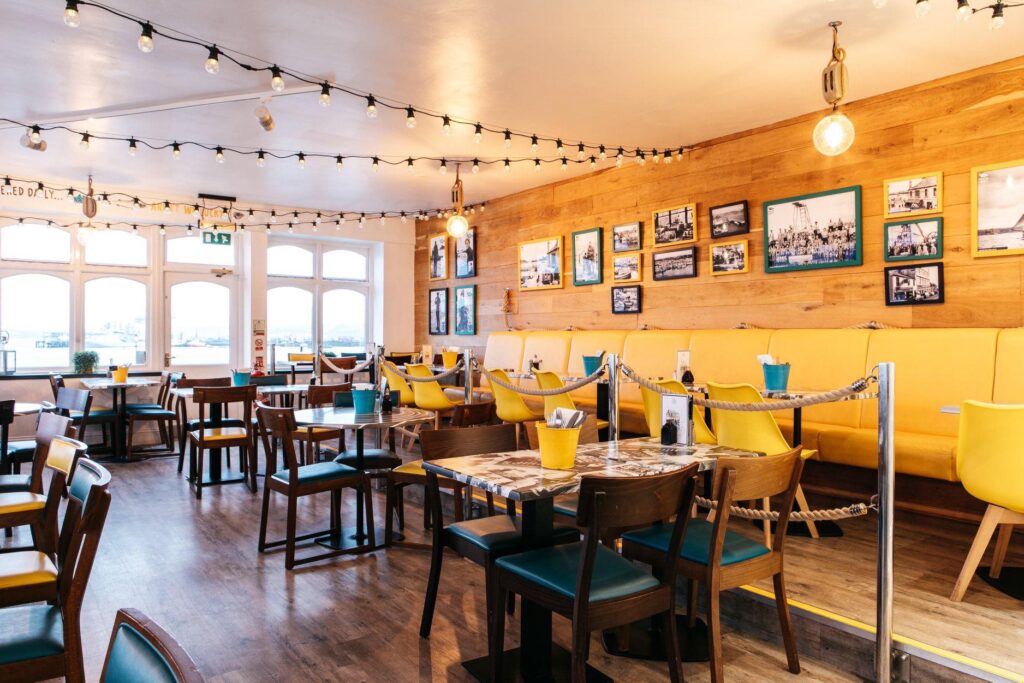
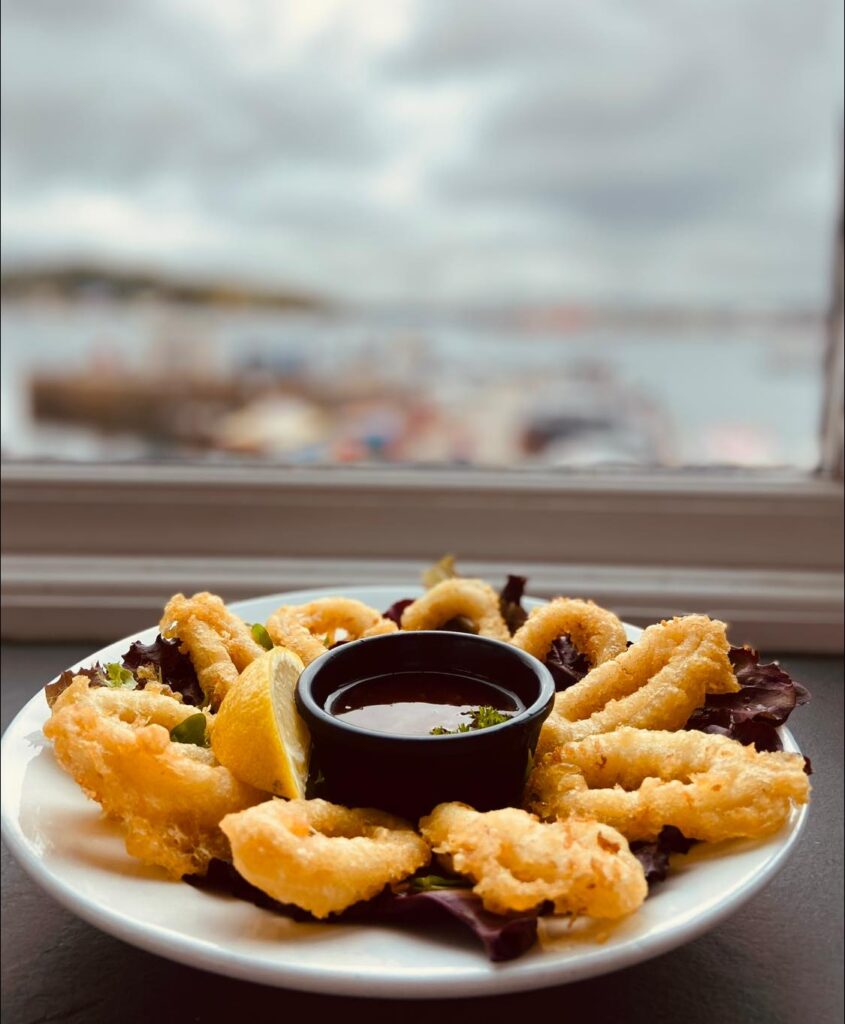
Images via @harbourlightsfalmouth

The drinks list goes beyond what you’d expect from a chippy, with local beers like Rattler cider and Tribute ale sitting alongside a carefully chosen wine selection.

The restaurant serves Monday to Saturday from noon to 3pm and 5pm to 8pm, with Sundays noon to 3pm. The takeaway keeps slightly longer hours. A quid from every bill goes to support the Fishermen’s Mission, and though optional, it’s a thoughtful touch that connects your dinner to the folks who made it possible. Much like all of the best places to eat in Falmouth, come to think of it…

Website: harbourlights.co.uk

Address: Arwenack St, Falmouth TR11 3LH

The Bottom Line

Falmouth’s dining scene punches well above its weight for a town of its size. With a Michelin Green Star at Culture, two Michelin Guide entries, and a depth of quality from neighbourhood cicchetti bars to award-winning chippies, it’s a place where eating well is simply what you do. The combination of fiercely local sourcing, genuine culinary ambition, and that ever-present salt air makes eating out here feel like something quite special.
The Best Restaurants In The West End

Last updated March 2026

To some, London’s West End is the pulsating heart of the UK’s theatre scene, a hub of kinetic energy that receives 200 million annual visitors. Indeed, 24% of all visitors to London will attend a show here. To the other 76%, it can sometimes be a part of London that feels curiously busy but also barren, a wasteland of subpar steakhouses and American candy stores…

Either way, when alighting hungry in this most bustling of Central London locations, you needn’t settle on a flabby fillet or contribute to money washing with a round of Milk Duds. There are plenty of great places to eat in the West End, both budget and blowout, that will satisfy just about every visitor.

We’ve already written extensively about the best places to eat in Soho, so we’ll most park those recommendations and instead focus on the more central parts of the West End, where the magic (sometimes) happens. 

With that in mind, and in no particular order, here are the best restaurants in London’s West End.

J. Sheekey

Ideal for spanking fresh seafood in a prestigious setting with over a century of history…

Serving up spanking, squeaky fresh seafood for over a century, J. Sheekey is one of the most prestigious purveyors of the good stuff in the city. It’s also one of the best restaurants close in the West End.

Established in 1896, J. Sheekey owes its inception to a unique historical event. The then Prime Minister, Lord Salisbury, granted permission to a local stallholder named Josef Sheekey to serve oysters in St Martin’s Court. The only condition was that he catered for Salisbury’s post-theatre supper parties. Thus, the beloved Sheekey’s was born. 

Today, J. Sheekey continues to uphold its reputation as one of the best restaurants near Leicester Square. Though there is a vegetarian and vegan menu and a couple of cursory meat dishes on the a la carte, Sheekey’s is still all about the seafood, offering the freshest fish, shellfish and oysters in London. 

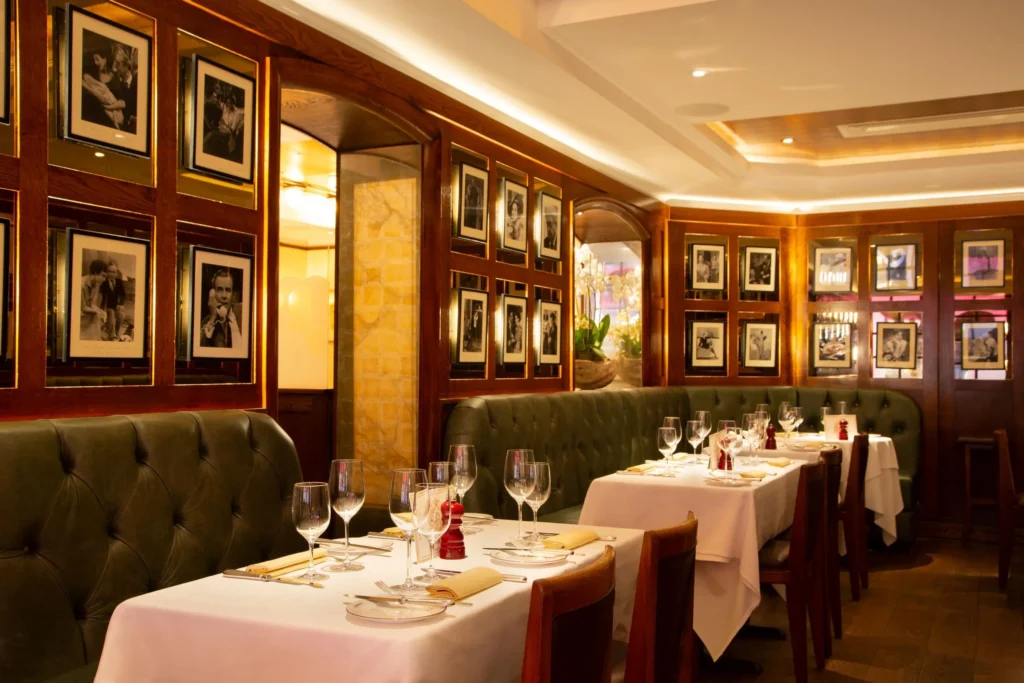
The restaurant’s central crustacean bar is a highlight, and the walls adorned with framed photographs of famous faces add to its timeless charm. And though those celebrity endorsements and general sense of prestige do certainly lend themselves to a hefty bill, the J. Sheekey set menu is great value for Central London – here, it’s three courses for £39, running Sunday to Friday, midday to 4pm.

Website: j-sheekey.co.uk

Address: 28-32 St Martin’s Ct, London WC2N 4AL


Claro 

Ideal for Eastern Mediterranean cuisine served with swagger in a stunning Grade II listed building…

There’s a certain swagger about Claro that only comes with serious capital, the Eastern Mediterranean restaurant standing proud in a handsome Grade II listed building on Waterloo Place in the kind of power stance that The Saj would be proud of. 

You feel it as you first put your hands on the high, heavy doors. In fact, you hear it the moment you manage to pry those doors open; the low thud-thud-thud of an Ibiza Chill playlist pitched just a little louder than is necessary, and the reassuring click-clack of expensive stone beneath your heels. 

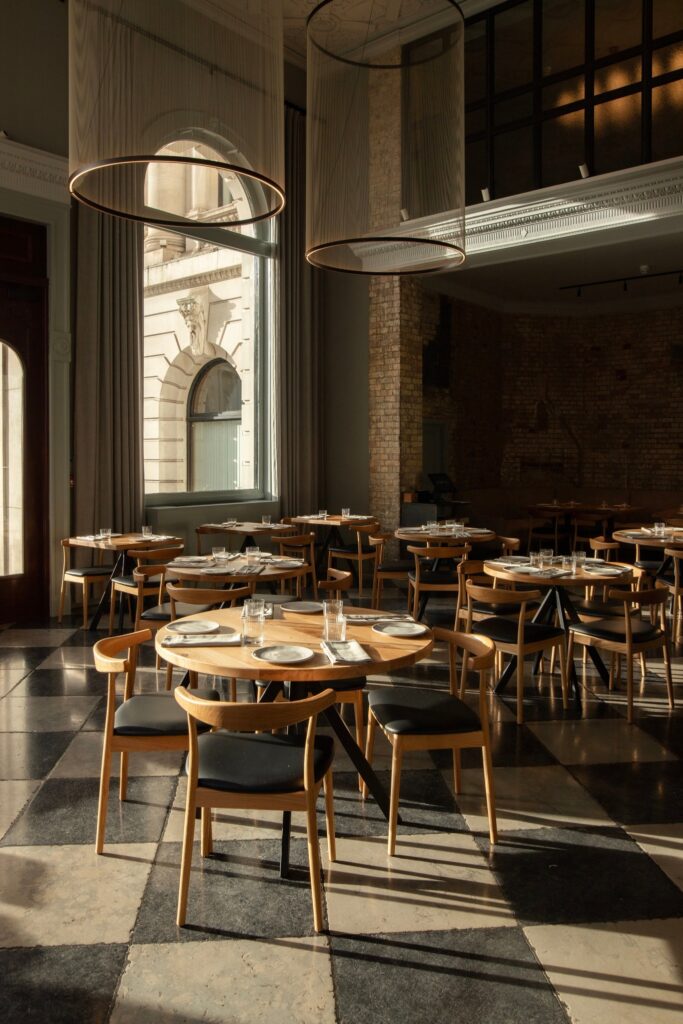
Stride on in; you deserve to be here. Big smiles and handshakes greet you as the room opens up, revealing striking checkerboard flagstone floors below and soaring ceilings above. Thoughtfully preserved wrought iron details nod to the building’s heritage, whilst expensively appointed lighting casts a flattering glow over the marble-topped tables and plush velvet banquettes. Disarmed and dare we say a little dazed, you’re hoping those banquettes will take you in for the evening and cradle you, because suddenly it feels like you might be required to do some networking, for some reason. It’s quite the entrance.

This place once housed both a bank and was part of the legendary Athenaeum Club, where Victorian luminaries like Charles Darwin and Charles Dickens gathered, but the refit is thoroughly modern, banishing the ghosts of the past to the bins out back. 

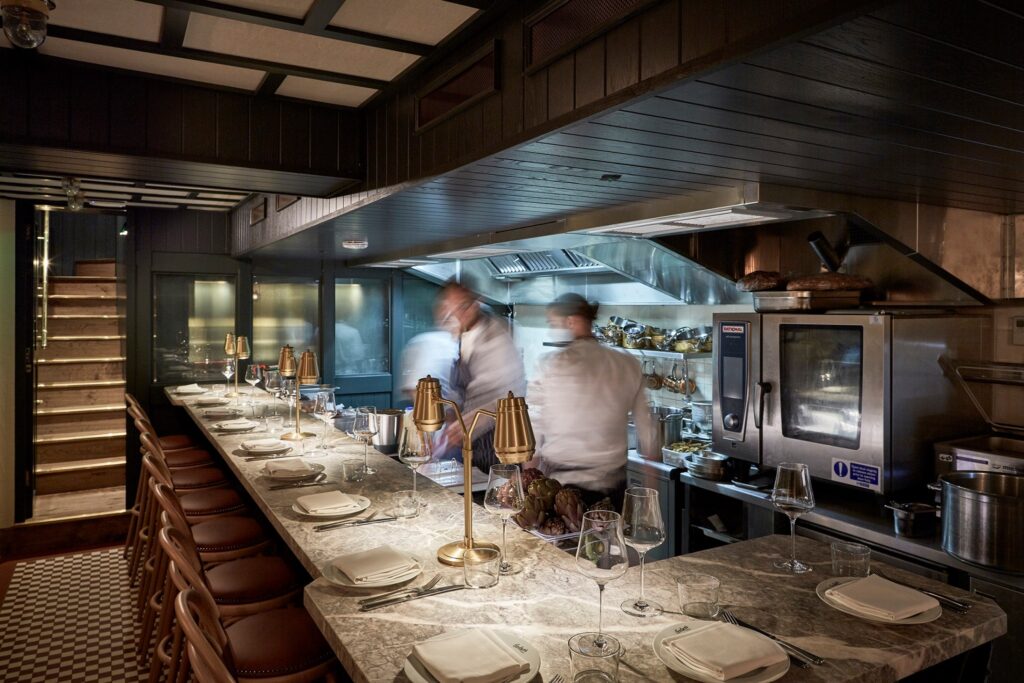
Bringing you back to the here and now, the large, airy open kitchen serves as the beating heart of Claro, the chefs going about their work all jovial and jolly, collaborative in their cooking and plating, which lightens the mood and banishes any fears that this meal might be hard work. The menu is all about seasonal British produce delivered with distinctive Eastern Mediterranean flair, and we’re pleased to report that it does indeed deliver.

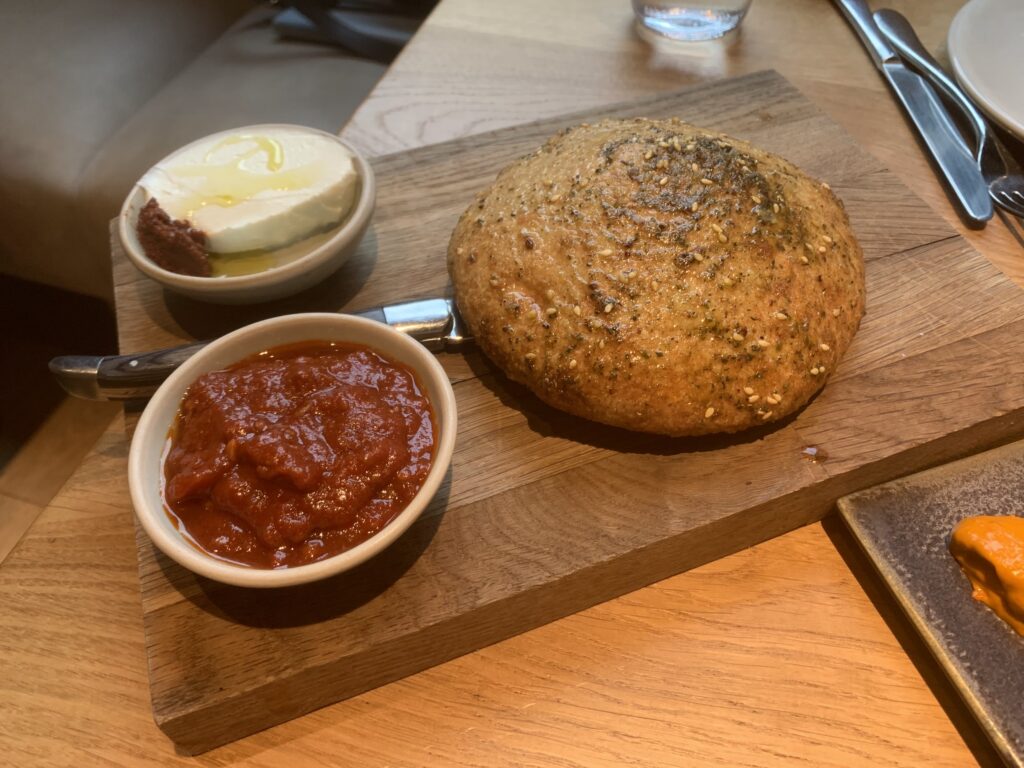
Start with the Masterpiece Martini, which is nothing short of spectacular (as you’d hope, for £16). Here, rosemary infused Ketel One Vodka, Tio Pepe sherry and clarified tomato bring a savoury twist on a classic that’s genuinely lip-smacking and utterly moreish. It’s the perfect accompaniment to a round of snacks; the Frena bread, which sighs almost as satisfyingly as you do when pierced. Served with both matbucha and a labneh and harissa number, it’s a punchy introduction to proceedings.

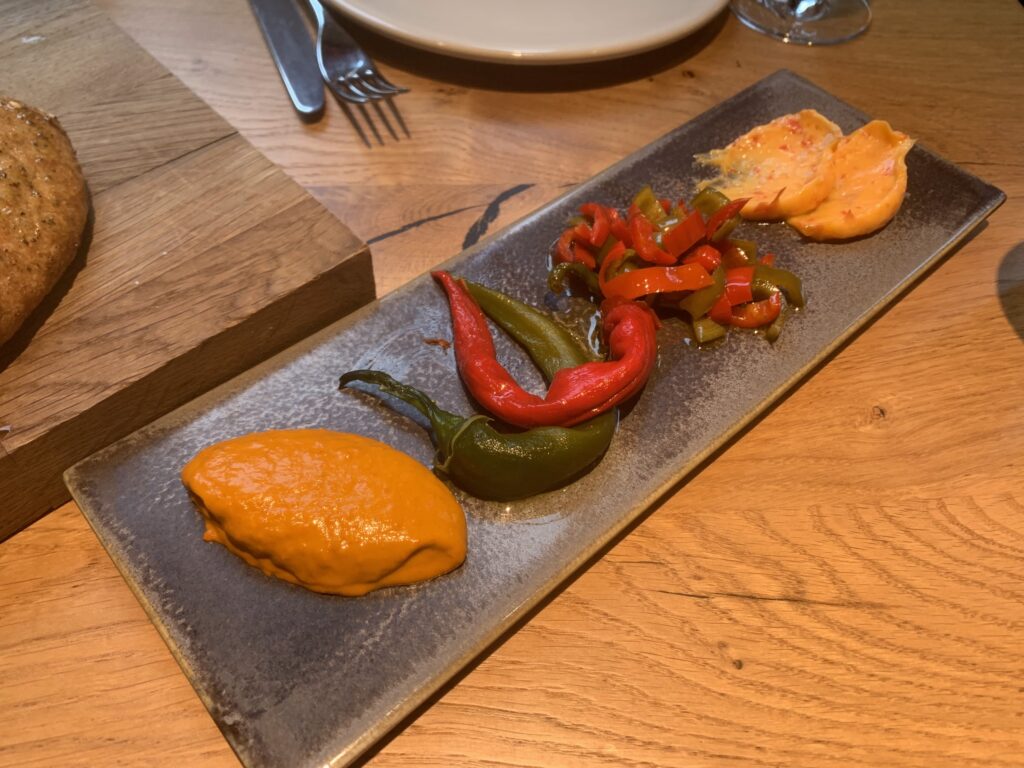
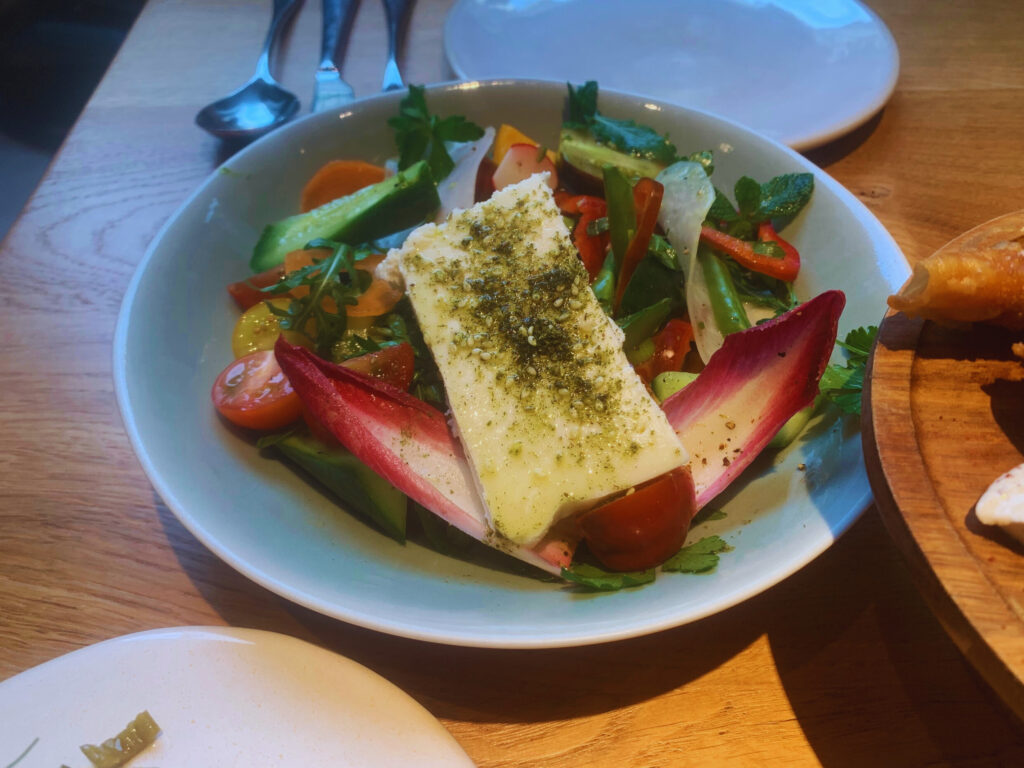
The chilli tasting plate – four different expressions of the ingredient that showcase its versatility beyond mere heat – and the Claro market salad with feta cheese and za’atar spice that tastes like sunshine on a plate, follow, both singing with freshness and the former a heat that starts up warm and round and then builds to something where you can feel your hair follicles starting to perspire. 

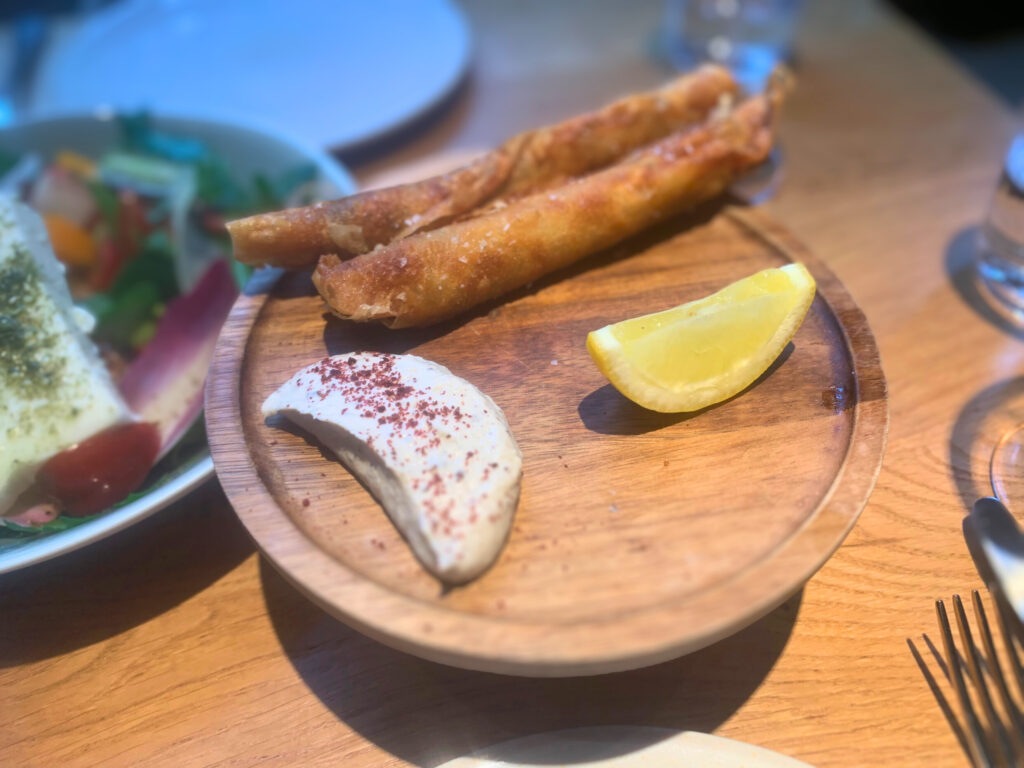
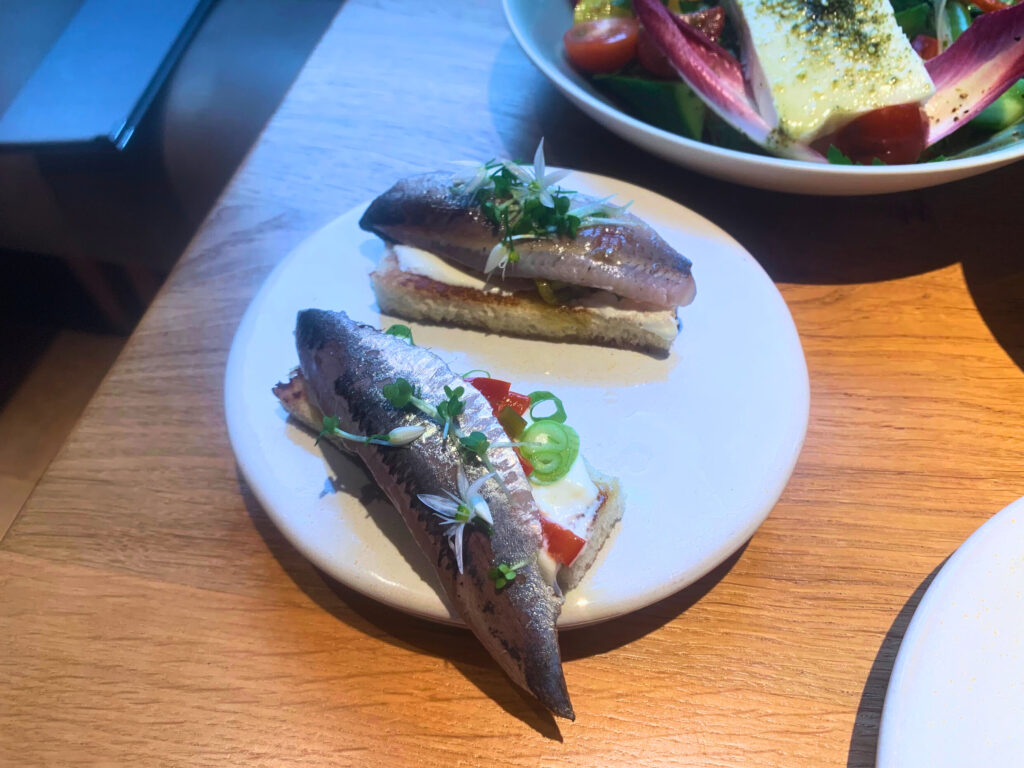
The cured sardine bruschetta with pickled chilli and sour cream is next, balancing acidity and richness with remarkable precision, and a lamb cigar is pastoral enough to linger just a little funkily until the mains hit the table.

A monkfish shawarma is perhaps the only dud of the evening, a little over-marinated and ungenerous, its dusty turmeric finish calling to mind a Vietnamese cha ca or Coronation Chicken more than a shawarma, strangely. The dish’s tangle of fresh herbs, picked, we’re told, from the restaurant’s rooftop garden, is absolutely remarkable though, invigorating and complex, peppery, astringent and assertive, it’s what all other ‘herb salads’ want to be when they grow up. The waiter tells us no one ever eats it, which is a real shame. 

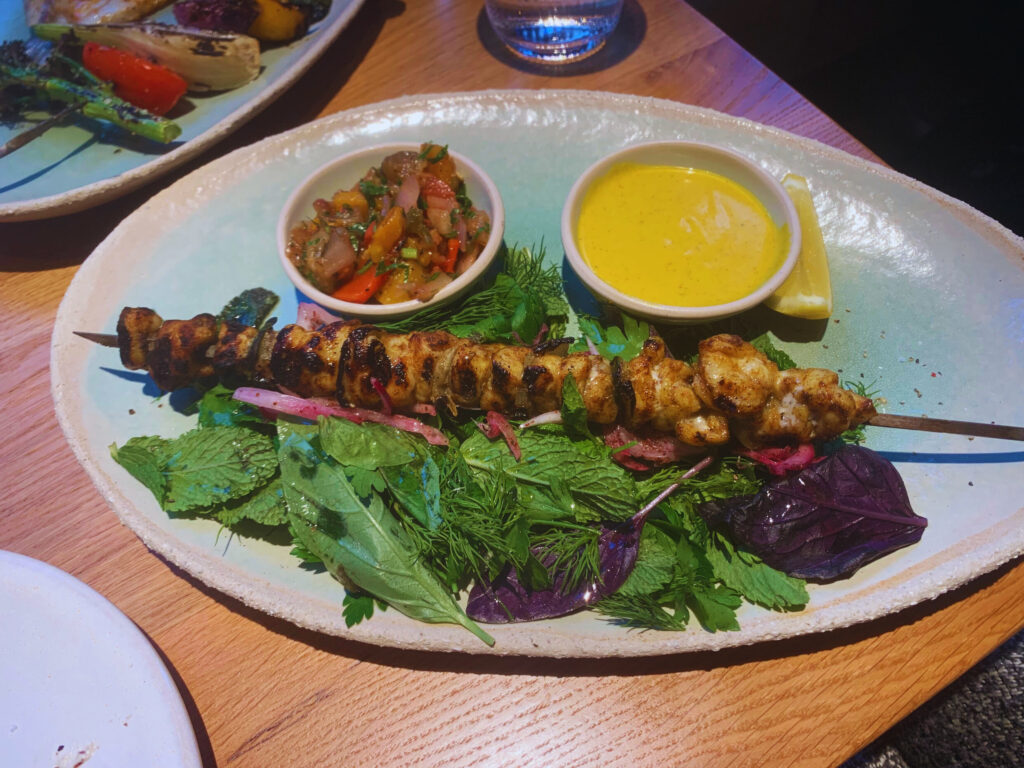
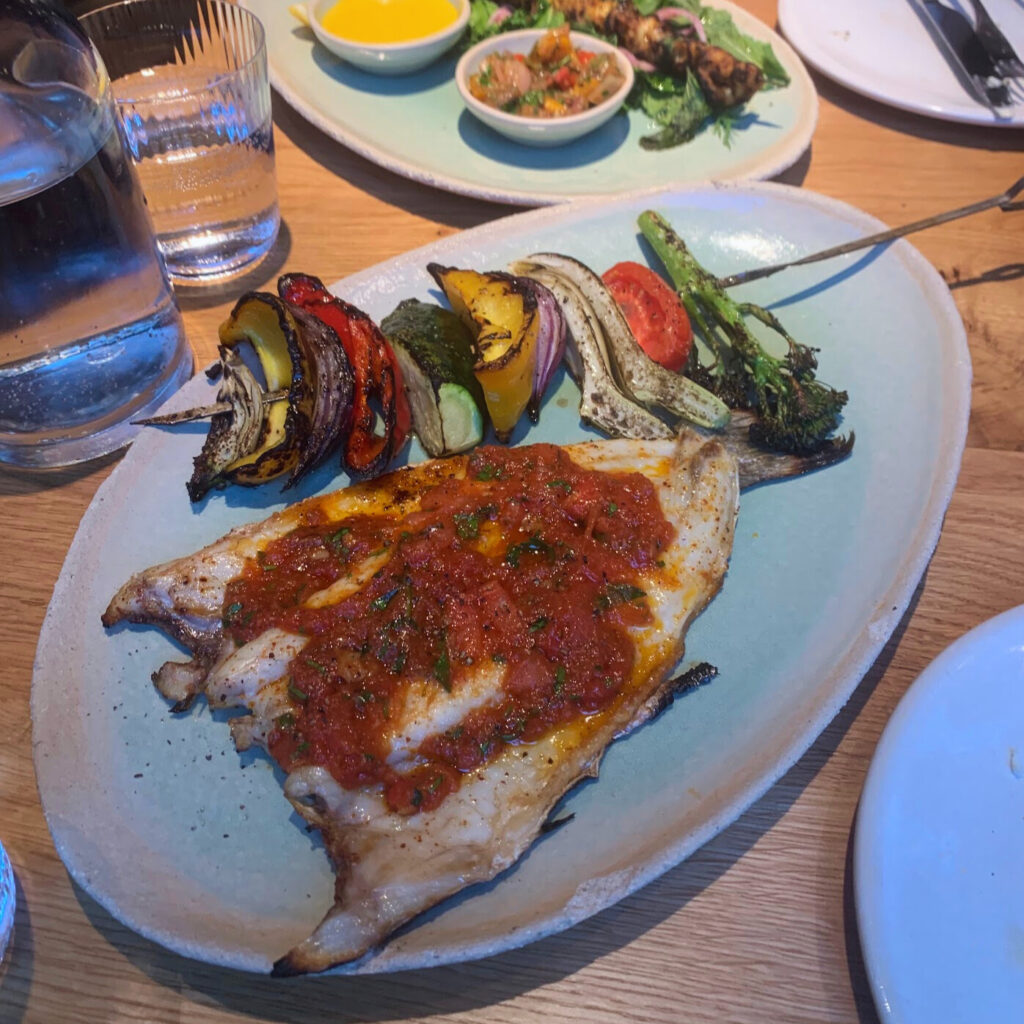
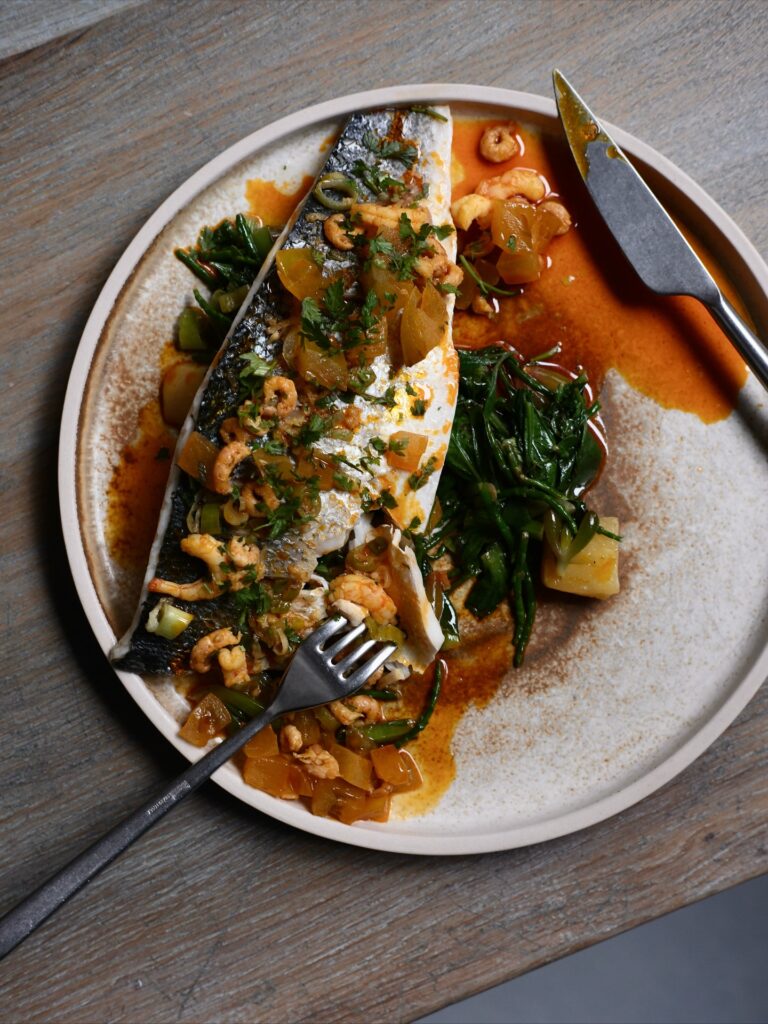
The grilled butterflied seabass with vegetable skewer and charred tomato salsa brings things right back on form, the fish cooked to that perfect point where it’s just firm but still yielding, the skin blistered and burnished from the grill. The skewer is populated by red peppers and fennel, the latter having caramelised beautifully and bringing a suave energy to the plate. A truly great dish.

Everything’s been so light and invigorating that we surrender to our sweet tooth, finding maximum pleasure in the Paris Brest with sour cream chantilly, raspberry coulis and berries – a featherlight concoction that manages to be indulgent without being too heavy. For something more substantial, the chocolate and sesame fondant with chocolate fudge, sesame anglaise and sesame ice cream delivers a sophisticated interplay of sweet and nutty notes, and finishes us off, quite frankly, in every sense of the word.

To go alongside those sweet treats, the Eiswein from Schloss Gobelsburg in Austria’s Burgenland region (£30 a glass) is sublime. Yes, it’s steep, but this 2022 vintage offers a honeyed nectar that forms the perfect full stop to a meal of commendable vision and clarity.

Website: clarolondon.com

Address: 12 Waterloo Place, London SW1Y 4AR


Evelyn’s Table

Ideal for an intimate Michelin-starred chef’s table experience hidden beneath a Soho pub…

Though the immediate surrounds of Leicester Square are visibly dominated by the stark white lights of a dozen chain restaurants, tightly nestled beneath street level is one of Soho’s most exciting independent dining destinations; Evelyn’s Table.

This Michelin-starred chef’s table experience is a genuine hidden gem. Tucked away in the basement of The Blue Posts pub on the edge of London’s Chinatown, Evelyn’s table has been through several iterations in its six year life. It was first opened in 2017 by the team behind popular hotspots The Palomar and The Barbary. After a brief closure, it reopened in 2020 with a brand new team, featuring Luke Selby as head chef, with his two brothers Nat and Theo also on the stoves, which, incidentally, are on full display to the 12-person counter seater restaurant.

The intimate, family affair vibes quickly earned plaudits, with the team picking up a Michelin star in 2022. Though the Selby brothers have now moved on, Evelyn’s Table continues to fire on all cylinders, with chef Seamus Sam (formerly of Muse by Tom Aitkens) now heading up the kitchen.

There’s a real elegance to the dishes on show on the 5-dishes plus, £135-a-head tasting menu here, with Sam’s precise, Scandinavian and Japanese inspired technique bringing out the best in hand-dived Orkney scallops, venison at the height of its season and winter’s finest black truffle. It’s a very special place, indeed, and one of the best fine dining experiences in all of the West End. 

Website: theblueposts.co.uk

Address: 28 Rupert St, London W1D 6DJ


Scully

Ideal for exploring the world through bold, fermented flavours…

When Ramael Scully left his role as head chef at Ottolenghi’s NOPI to open his first solo restaurant in 2018, he brought with him an approach to cooking that reflects his Malaysian-Chinese-Indian-Irish-Balinese background to thrilling effect. Unlike the many restaurants that handle the word ‘fusion’ like a miso-glazed hot potato, Scully’s food actually tastes like it’s come from someone who’s lived between cultures.

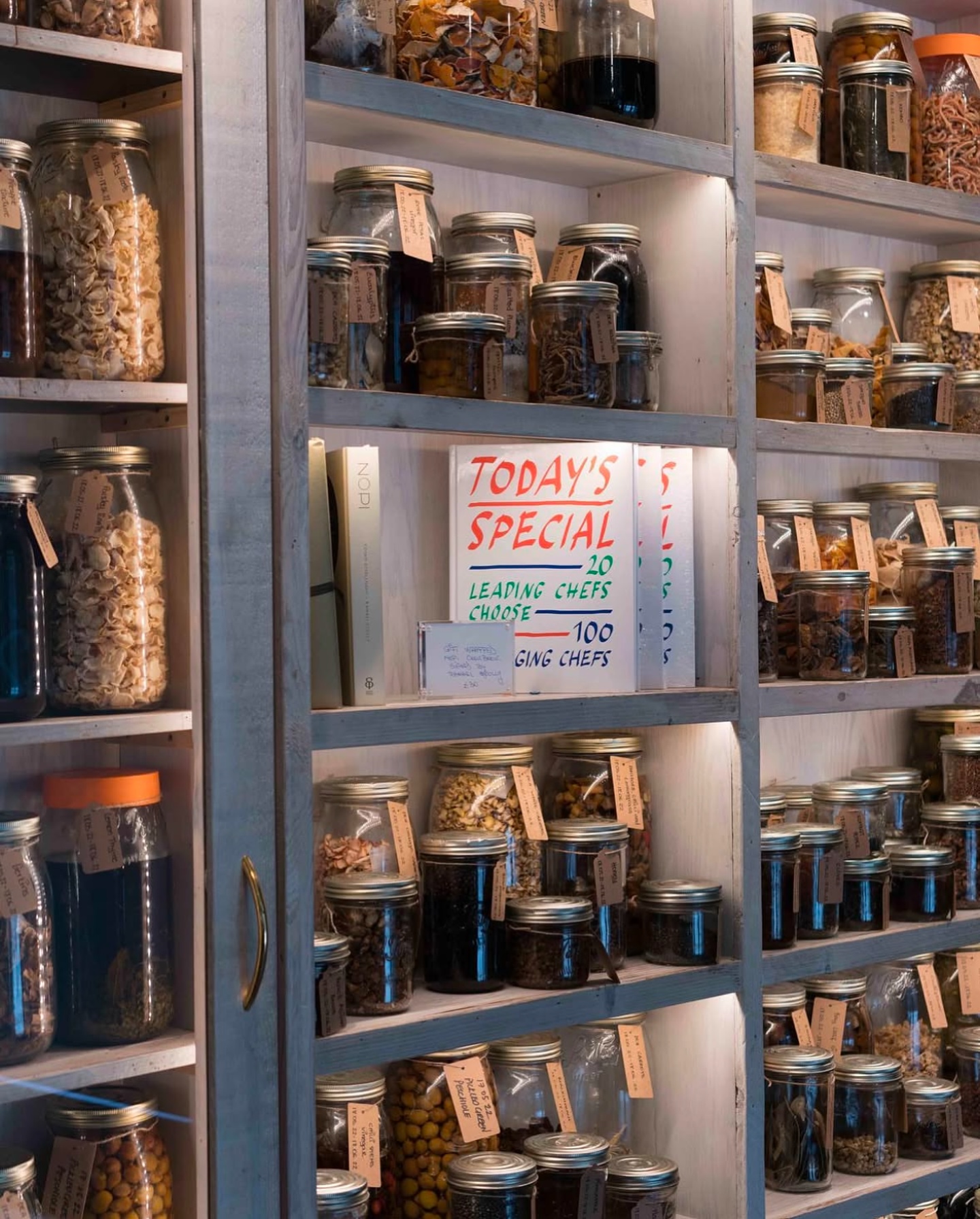
The restaurant sits in St James’s Market, and as you walk in, you’re met with shelves heaving with jars of pickles, preserves, oils and ferments in every colour imaginable. This isn’t just decoration; it’s Scully’s working larder, the backbone of dishes that might pair arepa with his mother’s eggplant sambal and bergamot labneh, or Cornish halibut with buttermilk whey koji butter sauce and tempura chicken oyster.

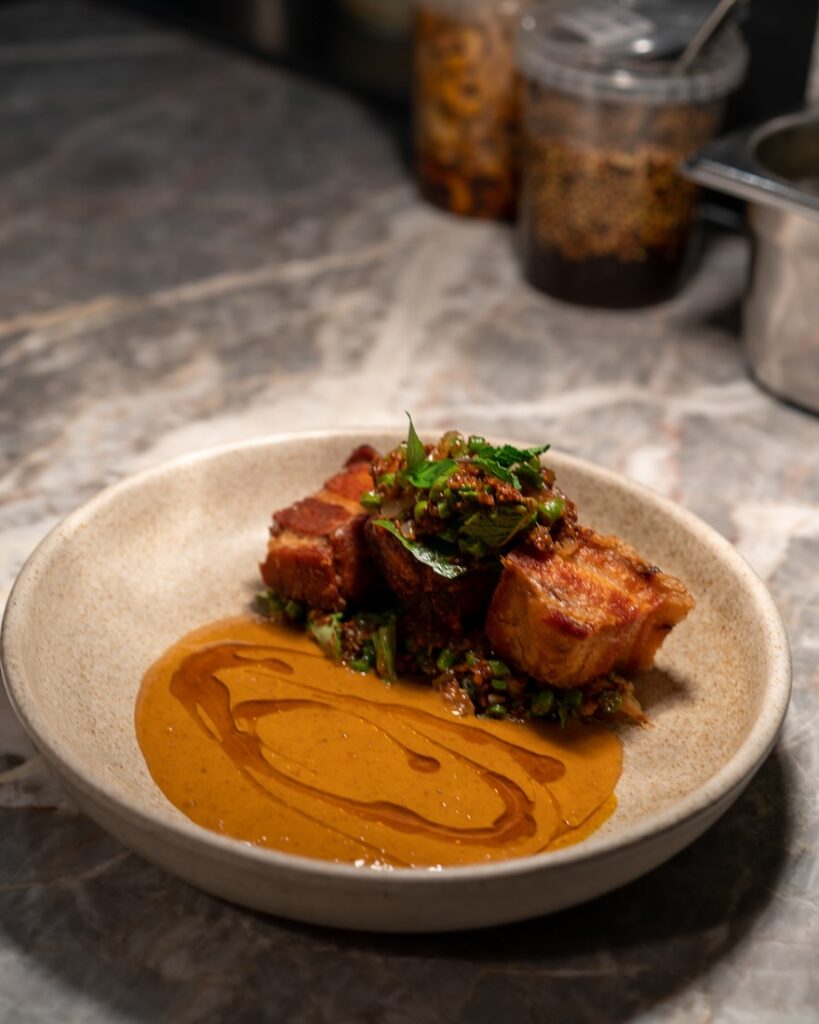
Or, how about steamed sea bass draped in Ethiopian spiced butter alongside brined green tomatoes that had been lightly pickled in apple vinegar and finished with Vadouvan? It’s a mouthful, sure, and the combinations sound wild on paper, but they make total sense, both on the plate and palate. On a visit in the summer, a twice-cooked pork belly with traditional satay sauce read almost pedestrian in comparison, but tasted fucking fantastic.

You’ll pay West End prices for the privilege, but these are generous plates that leave you satisfied. There’s an à la carte option with two courses for £65 or three for £75, alongside snacks and sides, or, for the full experience, the evening tasting menu is £135, with a vegan version at £105. Either way, you’re getting cooking that takes sustainability seriously without making a song and dance about it.

The open kitchen means you can watch the team fermenting, preserving and generally making the most of every ingredient that comes through the door. It’s thoughtful food that tastes brilliant, which is ultimately what matters.

Website: scullyrestaurant.com

Address: 4 St James’s Market, London SW1Y 4QU


Yasmin

Ideal for Istanbul-inspired cuisine six floors above the West End…

Six floors above the West End’s braying streets, Yasmin offers a sophisticated escape complete with panoramic views of the city. Talk about dinner and a show, hey? This Istanbul-inspired restaurant and bar, housed in the elegant 1 Warwick building member’s club, shares its home with sister restaurant Nessa on the ground floor. but aims to take things up several notches (erm, floors?) in terms of delivery.

The two restaurants share an executive chef too, Tom Cenci, and we amused ourselves over our Grand Bazaar (Yasmin’s Turkish twist on an Old Fashioned), imagining the chef darting between venues, running up the stairs spilling salted pistachios all over the place, and generally cursing the chaos of it all.

Hmmm, maybe we should get out more.

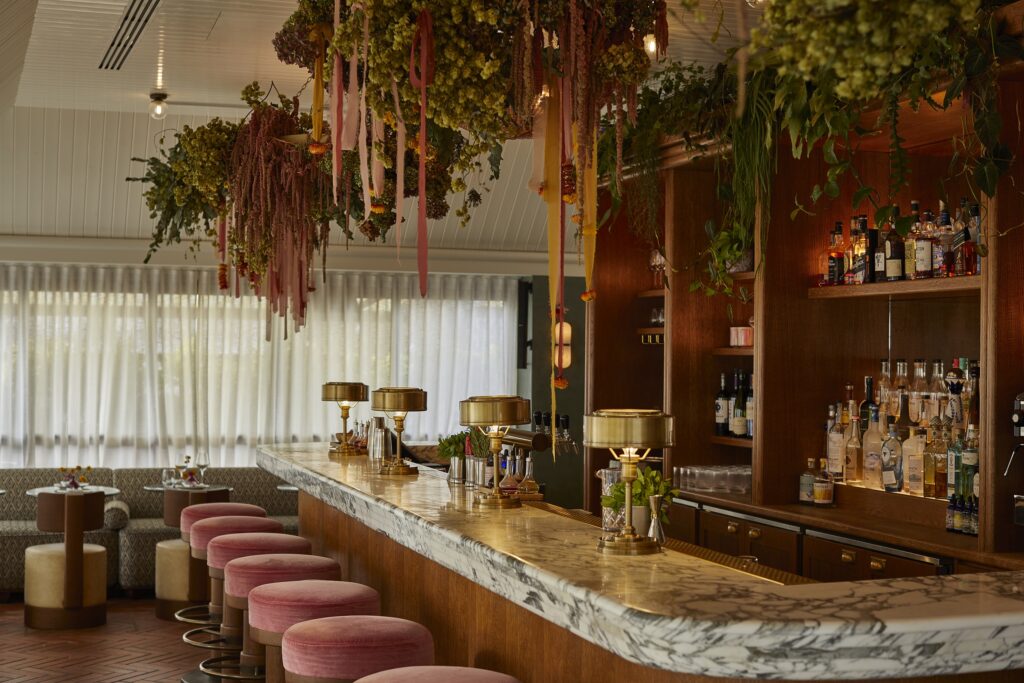
In reality, Yasmin is a supremely soothing spot to sink into, all sage green walls and warm wooden accents, highlighted by a spectacular marble-topped bar lined orbited by velvet stools seating gently boisterous custom. Trailing plants cascade from the ceiling, while banquette seating and rattan chairs create distinct zones for dining and lounging, in true member’s club style. Confusingly, you don’t actually need to be a card-carrying member to dine here, though for the gym and lounges below, you do.

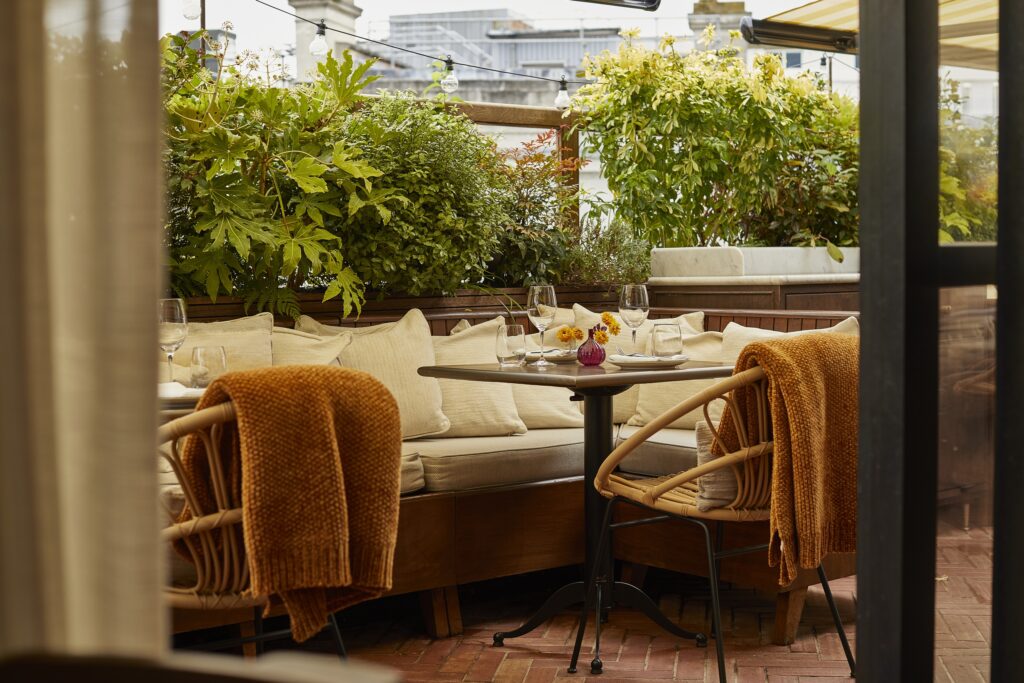
The terrace, furnished with plush seating and draped with cosy throws, provides a sheltered spot for alfresco dining among the rooftops, though you’d be mad to be out there now, with temperatures hovering not troubling ten degrees. One for summer, perhaps…

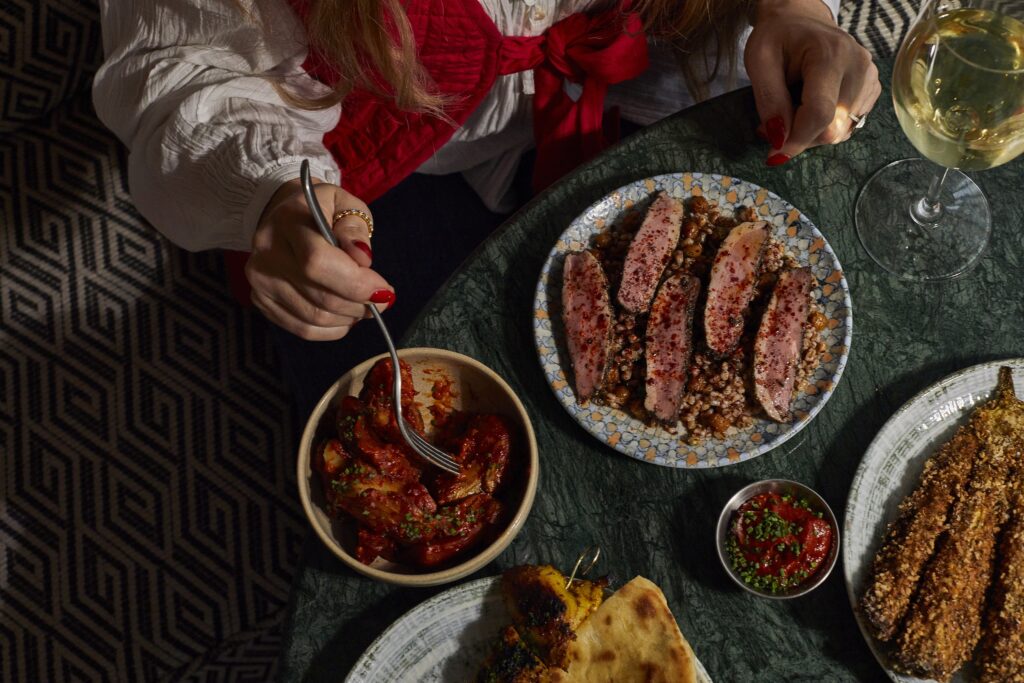
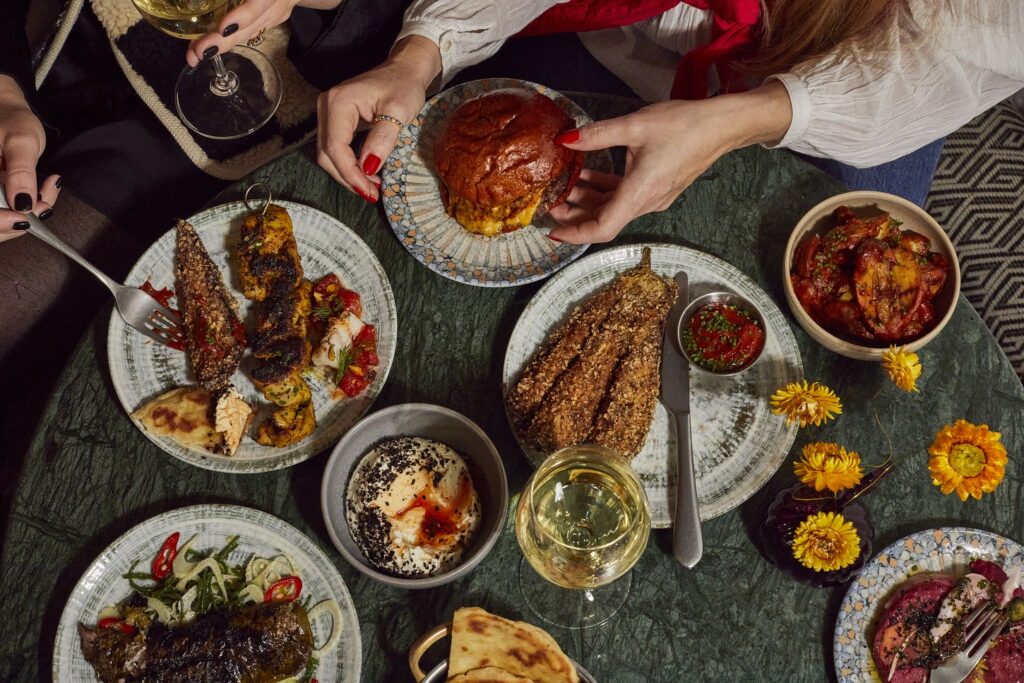
Anyway, back in the warm, and Cenci has crafted a menu that pays homage to Turkish traditions whilst adding just the right amount of venue-appropriate sheen to proceedings. The sharing plates showcase bold flavours via Instagram-ready presentation – standouts include the whipped sheep’s cheese with hot honey and Isot Biber, piped and pretty, and the Muhammara aubergine, which arrives splayed out into three, panko’d and golden, its centre that lovely side of fudgy that aubergine gets through slow cooking. Alongside, a walnut and red pepper dip boasts chives sliced so finely we’re surprised @ratemychives hasn’t come calling. The flatbreads, made daily and grilled to order, are gold-standard, and show that the kitchen cares about the basics, which is always a good sign.

…All of this feels ready for the warmer months, when the wrap-around terrace seats 64 and offers atmospheric dining under the stars. We can’t wait.

Address: 1 Warwick St, London W1B 5LR

Website: yasminsoho.com


Shoryu Soho

Ideal for authentic Fukuoka-style tonkotsu ramen…

Shoryu is owned by noodz-entrepreneur (and CEO of the Japan Centre) Tak Tokumine, a native of Fukuoka city who is dedicated to promoting his hometown’s cherished local speciality, ramen, across the globe. 

We’re so glad that he’s made it his noble mission, as the restaurant’s signature dish – shoryu ganso tonkotsu, a rich and meaty ramen that boasts a 12-hour simmered broth, homemade Cotswold flour hosomen noodles, succulent char siu barbecue pork, Burford Brown nitamago egg, and an army’s arsenal-worth of vegetable toppings, from pickles to freshly shredded stuff – is as good as it gets.

The kotteri hakata tonkotsu, a heavy, fatty, meaty noodle broth, is another popular choice among patrons and, to us, is one of London’s finest hangover cures. The fact that it pairs so beautifully with a super frothy Kirin Nama draft certainly does no harm in dusting off last night’s excesses.

Finally, you don’t have to be vegan or vegetarian to be enamoured with their plant-based spicy goma tan tan. It comes with an umami rich tonyu soy milk, sesame and miso broth, and is topped with soya mince marinated in garlic and chiu chow chilli oil, crunchy beansprouts, pak choi, and extra chilli oil for a decent kick. Woof.

Website: shoryuramen.com

Address: 3 Denman St, London W1D 7HA, United Kingdom


Read: The best ramen restaurants in Soho


Rules

Ideal for centuries-old British cooking, game from the restaurant’s own estate, and a dining room dripping with theatrical history…

Founded in 1798, Rules is London’s oldest restaurant, and it wears that title with considerable pride. Thomas Rule opened it as an oyster bar in Covent Garden, and more than two centuries later, it’s still serving traditional British food from the same Maiden Lane address.

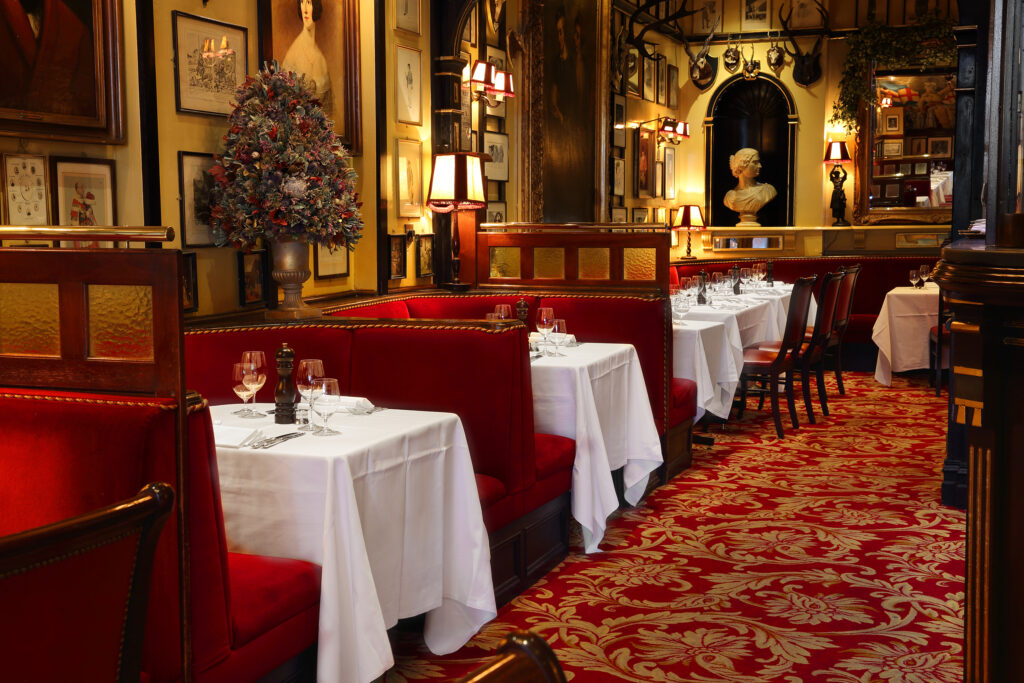
The dining room is all dark wood panelling, red velvet banquettes and walls covered in hundreds of paintings and cartoons. Late Poet Laureate John Betjeman called the ground floor interior “unique and irreplaceable and part of literary and theatrical London,” which feels about right in this corner of the West End.

The restaurant has been owned by just three families across its entire history, and the current proprietor, John Mayhew, took over in 1984. Over the years, Rules has fed Charles Dickens, H.G. Wells, Charlie Chaplin and countless others from London’s literary and theatrical worlds. It’s even appeared in novels by Graham Greene, Evelyn Waugh and John le Carré. The proximity to the West End means it still pulls in the theatre crowd, though these days you’re as likely to find tourists ticking it off their London list, as well as critics keen to buck hype-train trends and bang on about it constantly.

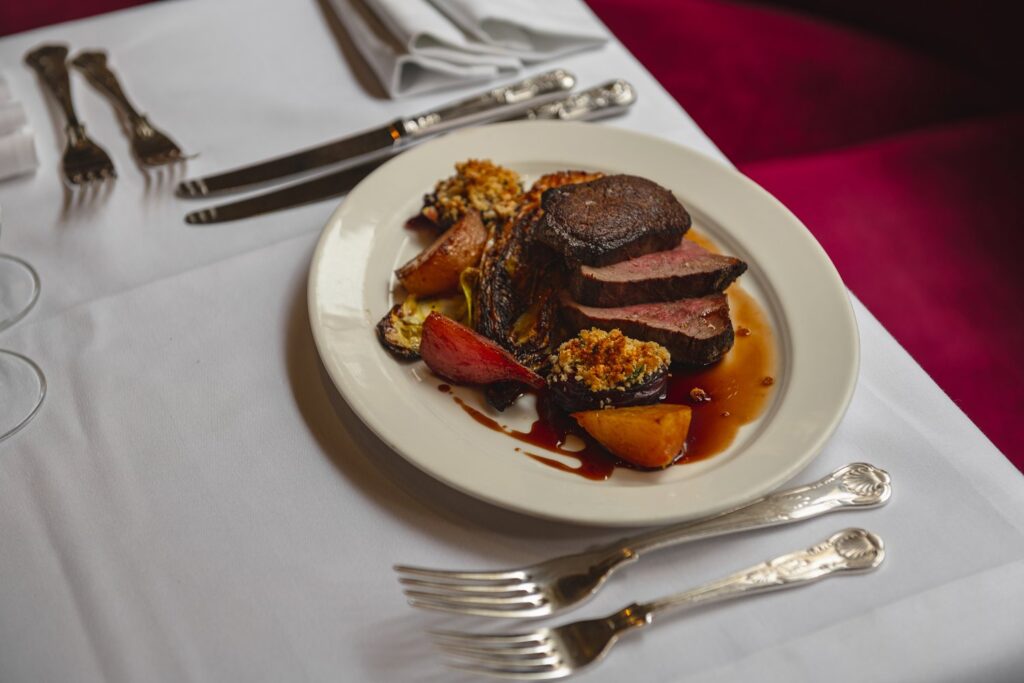
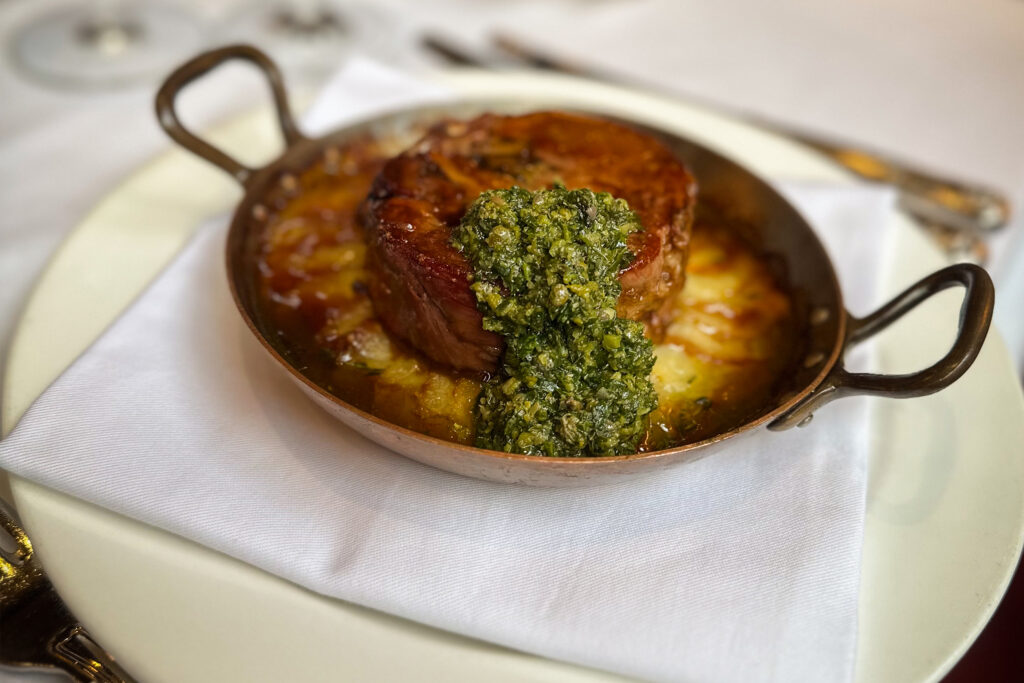
The menu focuses heavily on game, much of it sourced from Rules’ own Lartington Estate in the High Pennines. During shooting season (August 12th to December 10th, roughly), whole roast grouse arrives served traditionally, whilst year-round classics like steak and kidney pie, roast rib of beef for two, and slow-cooked ox cheek keep things properly old-school. In such esteemed surroundings, this kind of food feels wholly appropriate, and it’s cooked with precision.

The upstairs cocktail bar is a civilised spot for a pre-dinner drink, with house cocktails like the Rules Bellini and prosaically named Rules Cocktail (Tanqueray gin, Dubonnet and Crémant Blanc de Blanc). Whether you arrive sharpened, loosened or stone cold sober, this is hearty, traditional British cooking (and drinking) done properly, if without much in the way of modern flourishes. You’re paying for more than just the food; you’re paying for two centuries of history and a dining room that genuinely hasn’t changed all that much since Dickens was a regular.

Website: rules.co.uk

Address: 35 Maiden Lane, London WC2E 7LB


Pho & Bun

Ideal for traditional Vietnamese pho and bao burgers stamped with lotus flowers…

A Shaftesbury Avenue stalwart that sits equidistant between Chinatown and Soho, one of the best restaurants in the West End is Pho & Bun, which offers a taste of Vietnam in the heart of London, all via the mind of chef Andy Le.

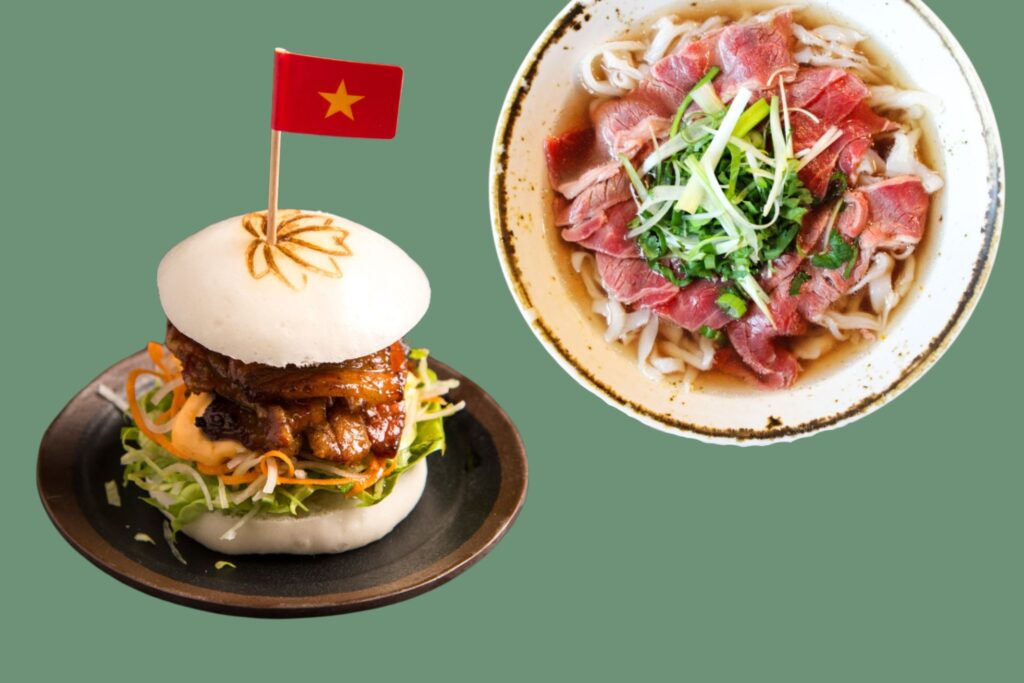
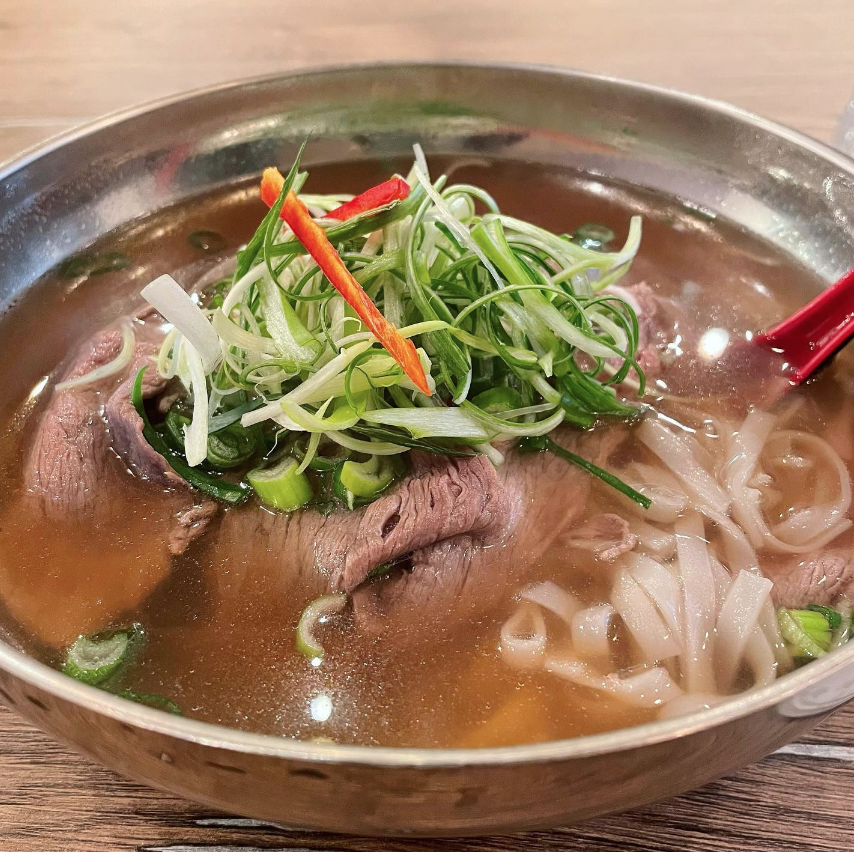
The star of the show at Pho & Bun is undoubtedly their traditional Vietnamese pho, a dish that, at its best, can be both transformative and transportative – quite the blessing after negotiating Leicester Square in the pissing rain.

The pho is light and nourishing, boasting a clear, flavoursome broth that carries the pleasant richness of beef bones. It’s served following traditional Vietnamese etiquette, which dictates that it should be eaten using only chopsticks and a simple metal spoon (not that absurdly sized ladle from a certain highstreet pho slinger).

In addition to the glorious national dish, the restaurant also serves a range of bun dishes, the slimmer, gently fermented noodle that is almost as popular on the streets of Hanoi, Hue, Ho Chi Minh City and beyond as pho. Go for the spicy, funky bun bo Hue, umami rich from shrimp paste and given succour and savour by bone marrow. If that doesn’t lift you out of your sense of Central London-spawned malaised, then you probably can’t be saved.

Finally, a firm favourite on the menu at Pho & Bun is their signature steamed bao burgers stamped with a lotus flower, Vietnam’s national flower which symbolises purity. ‘Authentic’ these bao/burger hybrids ain’t; authentically delicious they most certainly are. Indeed, they are quite simply addictive and something you’ll come to crave long after trying.

Website: phoandbun.com

Address: 76 Shaftesbury Ave, London W1D 6ND


Bancone Covent Garden

Ideal for fresh pasta that stands apart in a city of uninspiring Italian joints…

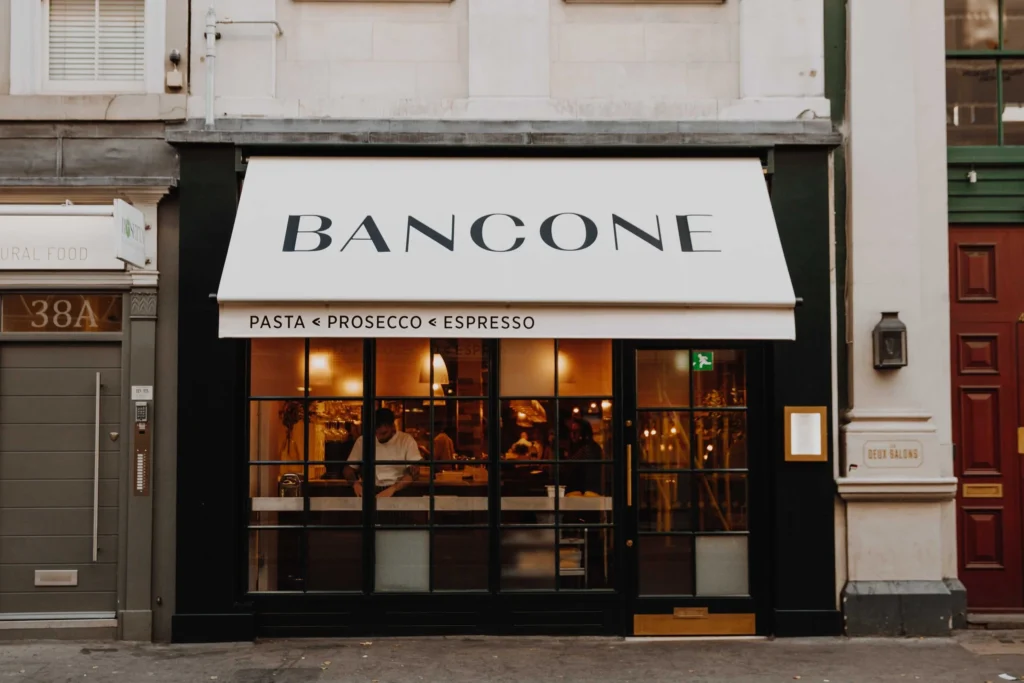
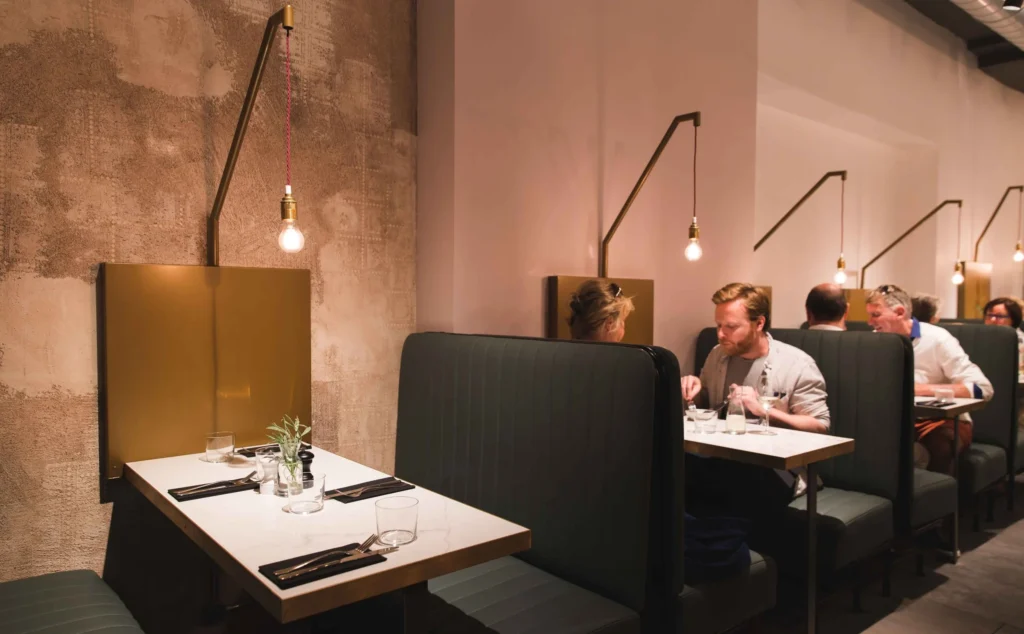
Bancone Covent Garden, founded in 2018 by Will Ellner and his business partner David Ramsay (no relation to…), is one of the best fresh pasta joints in this part of town. In fact, in a city where that particular type of restaurant has become increasingly ubiquitous and uninspiring, Bancone stands out as being, well, actually good at pasta. 

Here, it’s handmade every day, and that springy, sprightly essence is perhaps best realised in the least adorned pastas, like the insanely comforting silk handkerchiefs with walnut butter and a confit egg yolk, or the spaghetti alla chittara (a slightly squared off version of your usual strands hailing from the Abruzzo region) which is dressed in nothing more than a little chilli, garlic and parsley. It’s fucking fabulous. For something a little more fulsome and equally as comforting, Bancone’s tortellini in brodo never misses the mark.

The restaurant operates on a first-come, first-served basis, welcoming walk-ins with open arms. However, they do not guarantee specific tables or times, adding to the spontaneous/frustrating nature of the dining experience. If you do need to wait a while, then there’s plenty of streetside entertainment and shopping options in Covent Garden to keep you occupied. 

Bancone Covent Garden has been recognised in the so-called Little Red Book for its light, fresh food, earning a Michelin Bib Gourmand award in 2023. There are now two more outposts, in Soho’s Golden Square and Borough Yards, just off Borough Market.

Website: bancone.co.uk

Address: 39 William IV St, London WC2N 4DD


Brasserie Zedel

Ideal for grand Parisian dining at obscenely reasonable prices…

Sometimes, the question of where to eat in the West End that won’t break the bank is answered with a single word; Zedel.

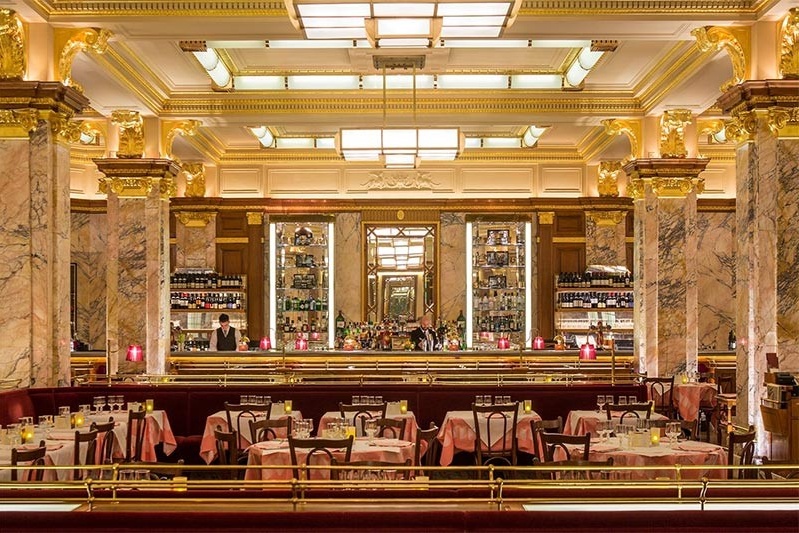
Brasserie Zedel, located in the heart of Piccadilly, is a grand Parisian brasserie that brings with it authentic Art Deco interiors and obscenely reasonable, humble French fare.

Hidden beneath the laid back Parisian-style ZL Café, providing a sense of discovery and exclusivity to its patrons, the establishment has a rich history, originally serving as the basement of the Regent Palace Hotel, and in the 1980s and 90s, it was known as the Atlantic Bar and Grill. The art deco and beaux arts fittings have been meticulously refurbished, with details recreated according to archived original drawings, preserving the historical charm of the place. 

The restaurant serves traditional French food at exceptional value, with an expansive, inclusive space to match, making it a hugely popular choice among locals and tourists alike.

The menu is almost as expansive as the space, but most are here for the prix-fixe option which, at £19.95 for three thoroughly generous courses, has got to be the best value meal in Central London. Currently on, a leek and potato vichyssoise soup, a brasserie-ever-present steak haché with fries and peppercorn sauce, and a chocolate and caramel tart, is a trio of satisfying dishes that simply shouldn’t be giving you change from a 20 pound note. Throw in a large glass of house red for £7 and you really are laughing here.

Website: brasseriezedel.com

Address: 20 Sherwood St, London W1F 7ED


Kricket Soho

Ideal for innovative Indian small plates that marry British ingredients with subcontinental flavours…

Kricket was founded in 2015 by university friends Will Bowlby and Rik Campbell, with the duo starting their culinary journey in a basic 20-seater shipping container at Pop Brixton. Today, Kricket has expanded to three permanent locations in Brixton, Soho, and White City, with plans to grow further in London and internationally. 

The Soho branch is particularly convenient for those visiting the West End, as it’s just a 200 metre walk away from Leicester Square.

Almost ten years ago, Kricket’s proposition felt kinda unique; a combination of British ingredients with the flavours, aromas and cooking tekkers of India. Now, it’s an idea that permeates the menu of just about every non-European restaurant that is – or could be – on the JKS roster, but back then it felt quite novel.

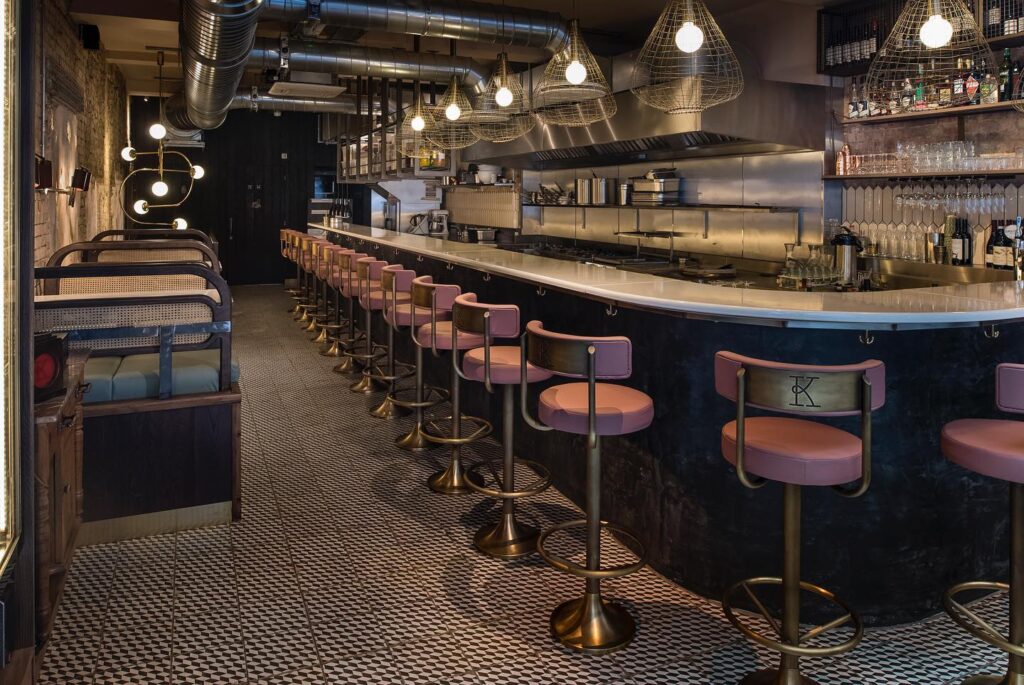
The restaurant features a theatre kitchen, counter seating, and long sharing tables, making it an ideal spot for group dining in Central London. Bowlby, who once cooked European food for the locals in Mumbai, returned to the UK to cook Indian food for Londoners, and his innovative approach to Indian cuisine, combined with Rik Campbell’s business acumen, has made Kricket a major hit.

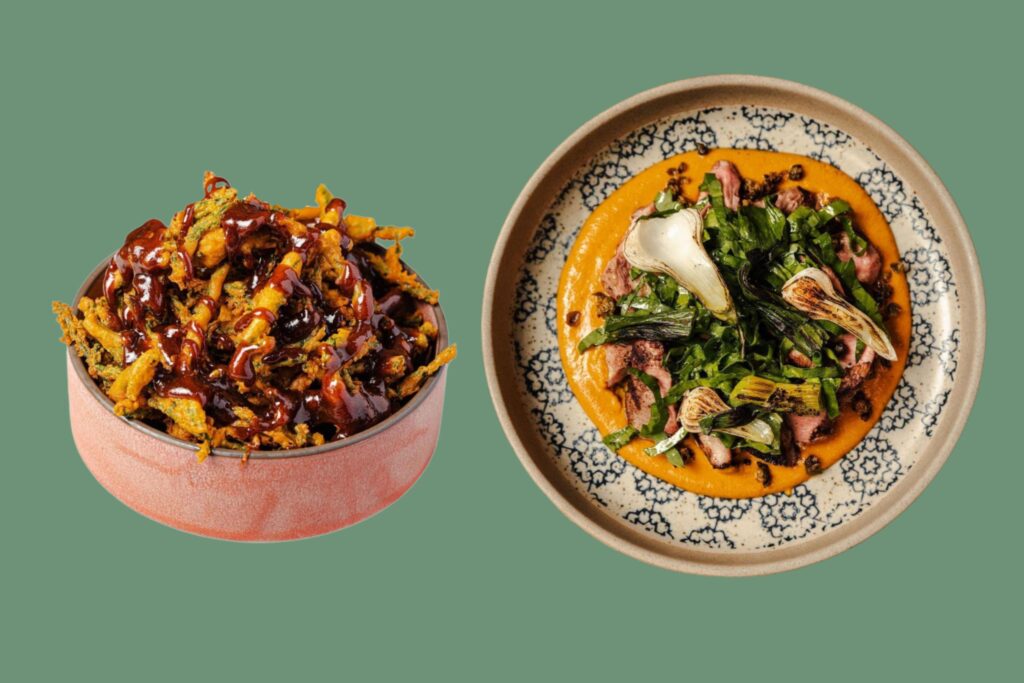
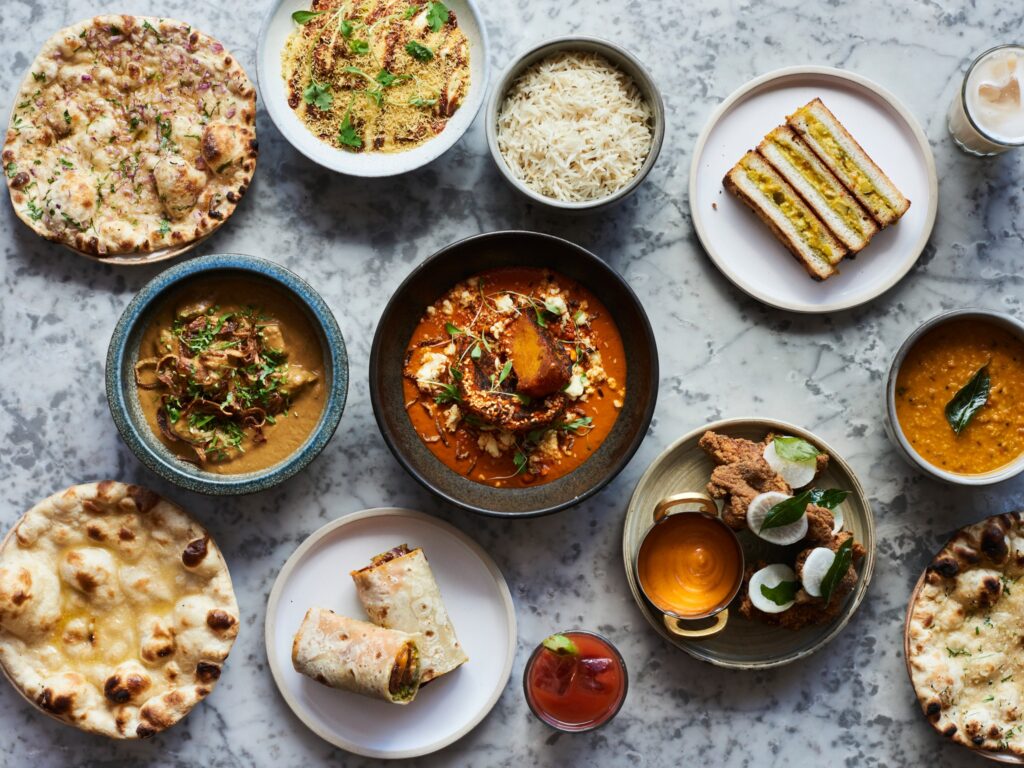
We’re addicted to their crispy and salty samphire pakoras, which are topped with a sticky date and tamarind chutney and served with a heady chilli garlic mayonnaise for dunking. Perhaps even better is the cuttlefish and Goan sausage ragu, boasting serious depth and funk, with both dishes exemplifying the kind of East-meets-West stylings that have lent such success to Kricket.

Do not miss out, either, on the predictably dubbed but undeniably delicious KFC (Keralan fried chicken), whose curry leaf mayonnaise and deep fried curry leaf garnish really does take things up several notches. This is beer food, make no mistake, and the Harbour Brewing Co’s Session IPA is always on the taps. Well, it would be rude not to, don’t you think?

Website: kricket.co.uk

Address: 12 Denman St, London W1D 7HJ


Good Friend Chicken

Ideal for authentic Taiwanese-style fried chicken with customisable powders in the heart of Chinatown…

Good Friend Chicken is not your typical fried chicken joint. This Chinatown chicken shop prides itself on serving Taiwanese-style fried chicken, with their commitment to authenticity evident in every aspect of its operation. In fact, Good Friend even shipped their oven all the way from Taiwan to ensure the food is prepared as it would be in the night markets of Taipei.

Their menu, though concise, is packed with golden, crispy delights. The chicken breast is skillfully sliced thin and marinated masterfully before being tossed in three different flours to create an unforgettable crispness. Their popcorn chicken, another must-try item on the menu, disappears so fast that it’s wise to order several bags.

But it’s the options for customisation that keeps the customers being reeled in. Once served, you have the option to douse your chicken with any one (or all) of seven different powders, adding the risk of flavour overload, admittedly, but also a real sense of jeopardy that makes every bite all the more exciting. The plum powder, in particular, comes highly recommended. 

And speaking of coming highly recommended, we’ve included Good Friend on our round-up of the best fried chicken in London. Do check out that guide when you get a minute.

Website: chinatown.co.uk

Address: 14 Little Newport St, London WC2H 7JJ


Ikoyi

Ideal for boundary-pushing fine dining that celebrates British hyper-seasonality through a spice-based lens…

We mentioned ‘blow out’ in the introduction. Well, here it is…

We didn’t think chef Jeremy Chan and co-owner Iré Hassan-Odukale could top the inaugural Ikoyi in St. James’s Market, which sat just a mile west of their new home at 180 Strand, but… 

…Actually, we did think they could top those lofty standards, owing to the relentless boundary pushing of the restless duo, perfectionism seemingly already reached but also just another insanely complex emulsion away.

At the new 180 Strand-housed Ikoyi, the space is larger and more sumptuous, all clean curves and tasteful mustard tones, the vibe gently refined; a little slicker, perhaps. Prices have increased in tandem. The tasting menu now is one of the most enthusiastically priced in London, at £380.

But what a procession of plates it is, of around 14 on our visit, with premium ingredients gracing just about every bite. Yep, that spice-based cuisine built around British hyper-seasonality remains. The iconic jollof rice with crab or lobster custard is still here, but leading up to the big, smoky reveal, luxury and innovation abounds; an aged lobster with one of Chan’s famously vital sauces, this one an agrodolce of sorts, was particularly special. Another course of lobster claw, sweetbreads and pine nut was as opulent and awe-inspiring as it sounds. 
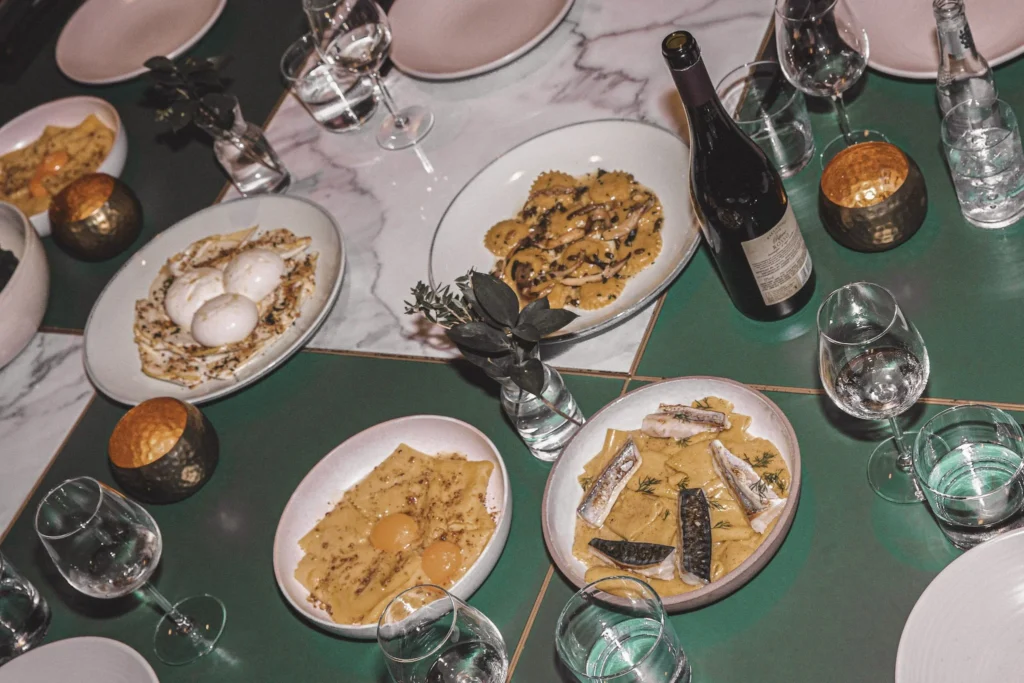
Yep, this is a restaurant firing on all cylinders, but we wouldn’t be at all surprised if Ikoyi somehow managed to find another gear; the sense of focus on improvement here feels totally implacable. In the best possible way of course…

Website: ikoyilondon.com

Address: 180 Strand, Temple, London WC2R 1EA


Read: Where to eat the spiciest food in London


Barrafina Drury Lane

Ideal for convivial counter-dining with exceptional Spanish tapas and seafood specials…

Speaking of counter-dining, perhaps London’s most beloved bar seating set-up is found at the various outposts of acclaimed tapas group Barrafina.

Those in the West End and looking for the best dining options in Covent Garden will be pleased to hear that this famous corner of London boasts not one but two Barrafinas. We’re particularly enamoured with the Drury Lane iteration, which is compact, cosy and convivial, and leans a little more into the seafood side of the Spanish repertoire, often to glorious effect.

The specials are usually dictated by what’s fresh from the sea, so keep an keen eye for the miniature, roaming chalkboard for details of what’s good today; on our last visit, an enthusiastically brined piece of hake with punchy aioli and red peppers so caramelised they were collapsing was as good as it sounds.

Website: barrafina.co.uk

Address: 43 Drury Ln, London WC2B 5AJ


Real Beijing Food House

Ideal for proper Sichuan Chinese cuisine that promises plenty of brow-mopping…

Though the Real Beijing Food House feels like a Chinatown institution, with dusty carpets, dimly lit booths and properly brilliant, spice-centric regional Chinese dishes, the broadly Sichuan (confusingly, when you consider the name) restaurant hasn’t actually been standing proudly on this Gerard Street spot for as long as you’d think. Previously found on Charing Cross Road, Food House moved more into the heart of Chinatown during the area’s recent redevelopment, and has quickly become the must-eat restaurant here and without doubt one of the best places to eat close in the West End. It recently further entered the wider public consciousness after being positively reviewed in the Observer back in 2022.

It was a review that was very much deserved, the restaurant’s chilli oil slicked noodle dishes and whole fish dishes – again, dappled with rust coloured droplets that promise plenty of brow mopping – delivering big on flavour and a sense of satisfaction felt deep in your stomach.

For a quick, efficient lunch, the chilli oil (there it is again) lamb noodles is the type of one-bowl-wonder that knocks your socks off and leaves you regretting every single Sainos meal deal that came before it.

Address: 46 Gerrard St, London W1D 5QH

Website: realbeijngfoodhouse.com


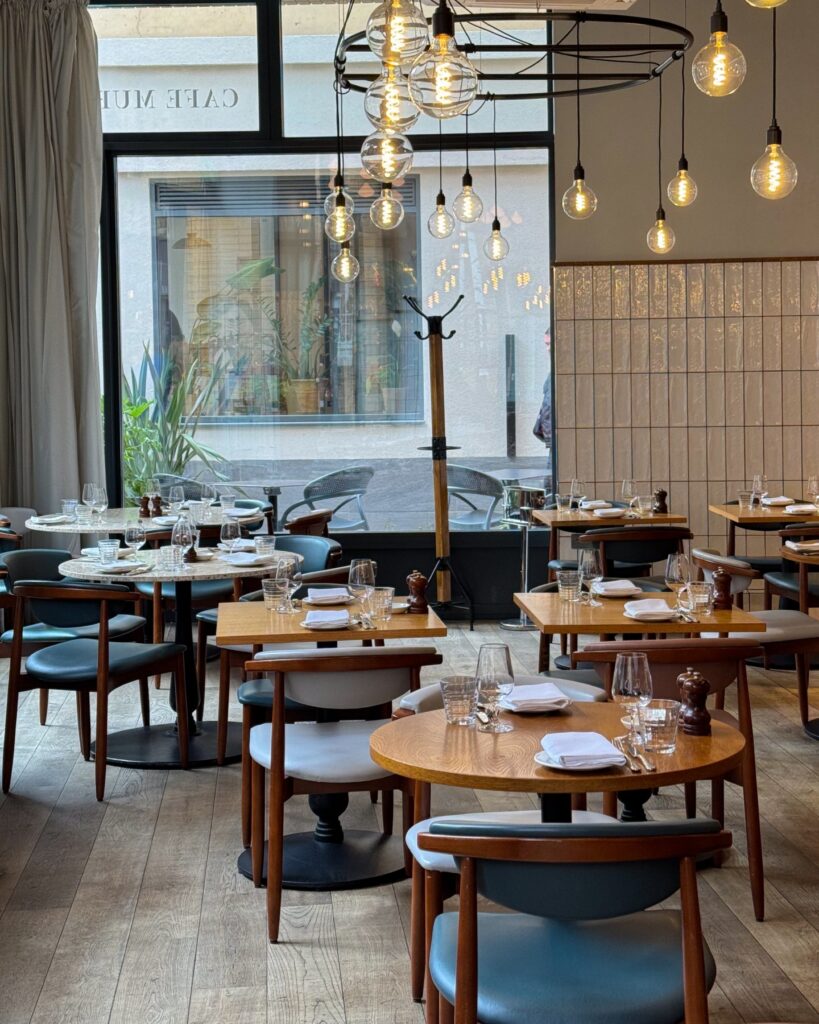
Cafe Murano

Ideal for honest Italian food cooked with respect and just a touch of refinement…

The younger, more affordable sibling of Angela Hartnett’s brilliant fine dining restaurant Murano, Café Murano offers fresh pasta, seasonal vegetables prepared with precision, immaculate shellfish, and the odd hearty af ragu, just as you’d expect from a chef this devoted to the food of Italy.

True to the soul of the place, the pedigree of the produce is the main draw, with the restaurant’s plates arriving with little frippery or adornment. Instead, Cafe Murano strives for simple, honest food, cooked with respect and just a little refinement. It more than delivers, which is a surprisingly rare find in this part of the West End.

Website: cafemurano.co.uk

Address: 36 Tavistock St, London WC2E 7PB


KERBS Seven Dials Market

Ideal for rainy afternoons whiled away eating and drinking through a variety of street food stalls…

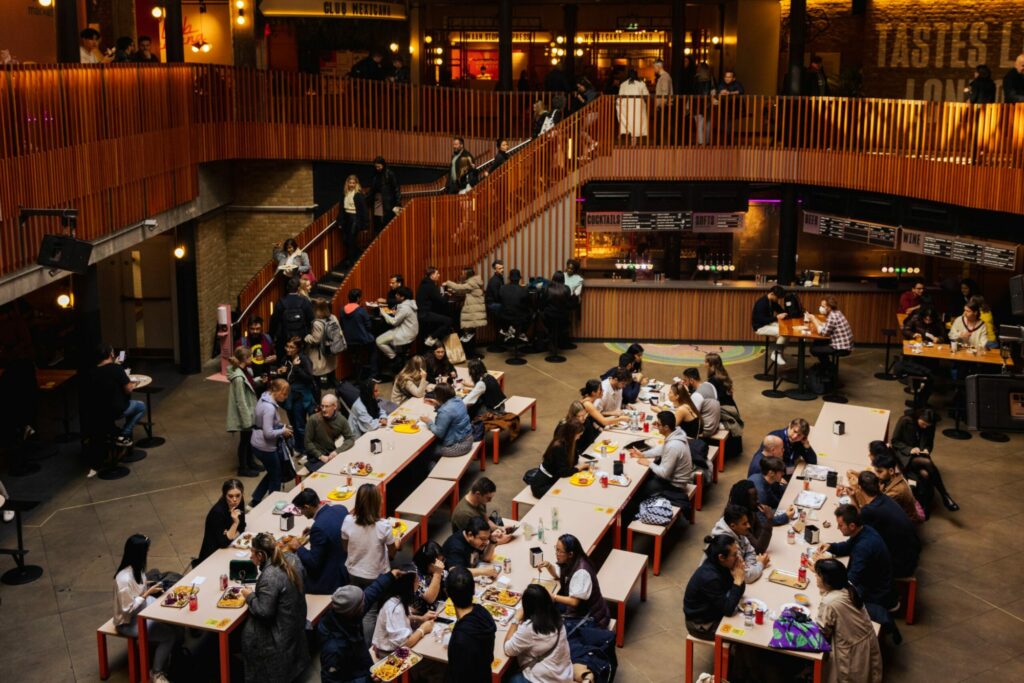
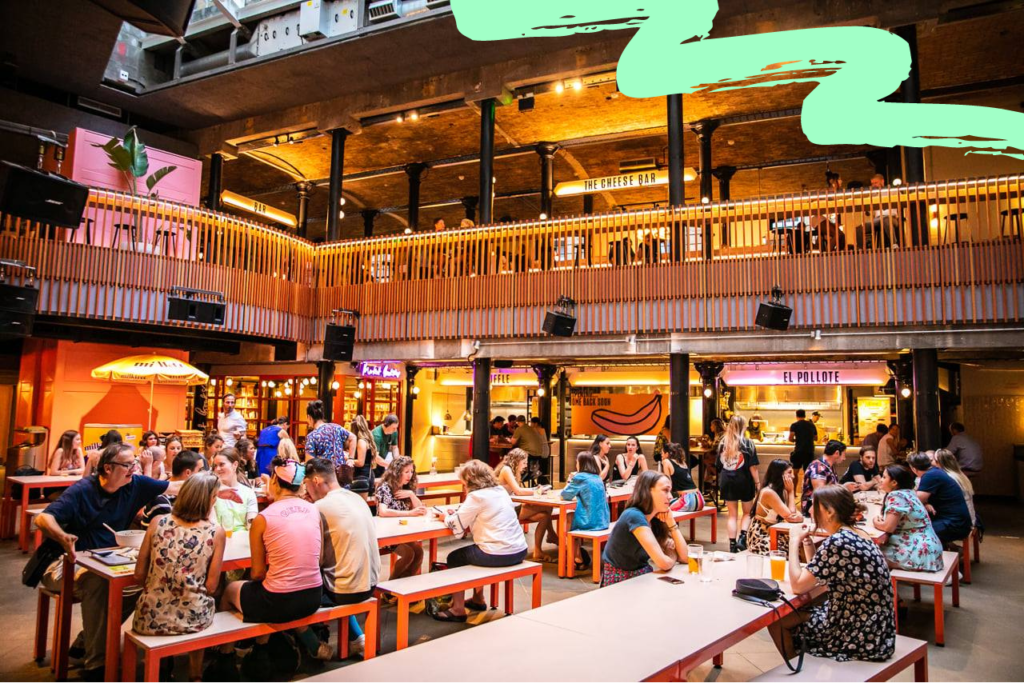
Brought to Covent Garden by KERB, a group known for nurturing London’s street food scene, Seven Dials is one of the most exciting eating destinations in London.

In the 19th Century, Seven Dials Market, then Thomas Neal’s Warehouse, was used to store cucumbers and bananas. Now transformed into a foodcourt, to honour the past of the structure the market has been divided into two areas: Banana Warehouse and Cucumber Alley.

Seven Dials Market - ideal for a rainy afternoon in London

Banana Warehouse is billed as ‘The Belly of the Beast’ and has plenty of seating and communal tables. Here, you’ll find a number of street food kitchens and counter-top cafes serving an impressive lineup of street food from around the world. There is also a downstairs bar creating creative cocktail concoctions made with spirits from the East London Liquor Co. Banana Warehouse is the ideal place to come and while away a rainy afternoon in central London, eating and drinking your way through to the night.

If you need a pitstop while shopping your way through Covent Garden and are feeling peckish, Cucumber Alley is the place to go. Inside are seven independent food traders, seven days a week selling some of the best snacks and desserts in the Big Smoke.

On our last visit, we had a slice or two from Bad Boy Pizza Society and a gorgeous batata hara from the Syrian street food joint Arnabeet. Lovely stuff.

Website: sevendialsmarket.com

Address: 35 Earlham St, London WC2H 9LD


Homeslice Pizza

Ideal for a enormous 20-inch pizzas and inventive toppings…

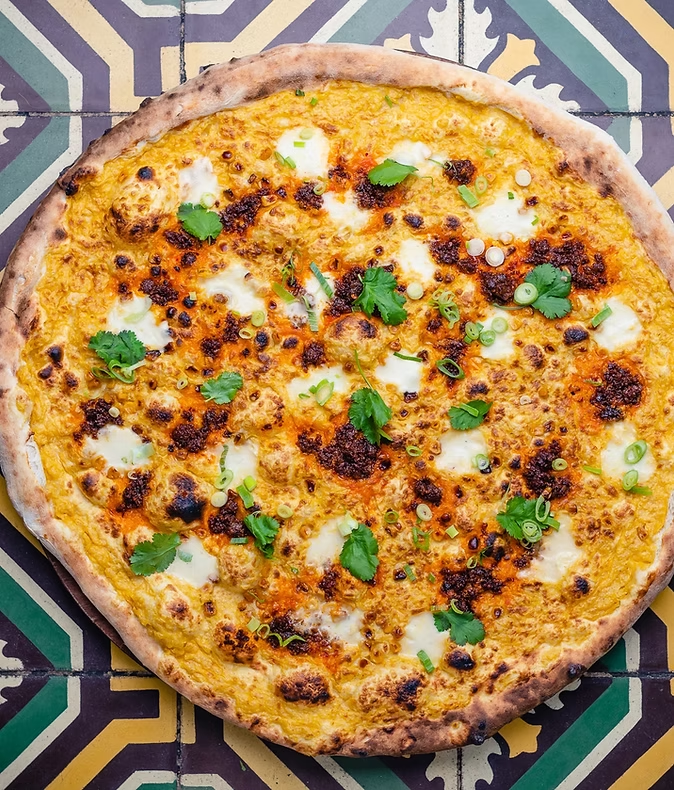
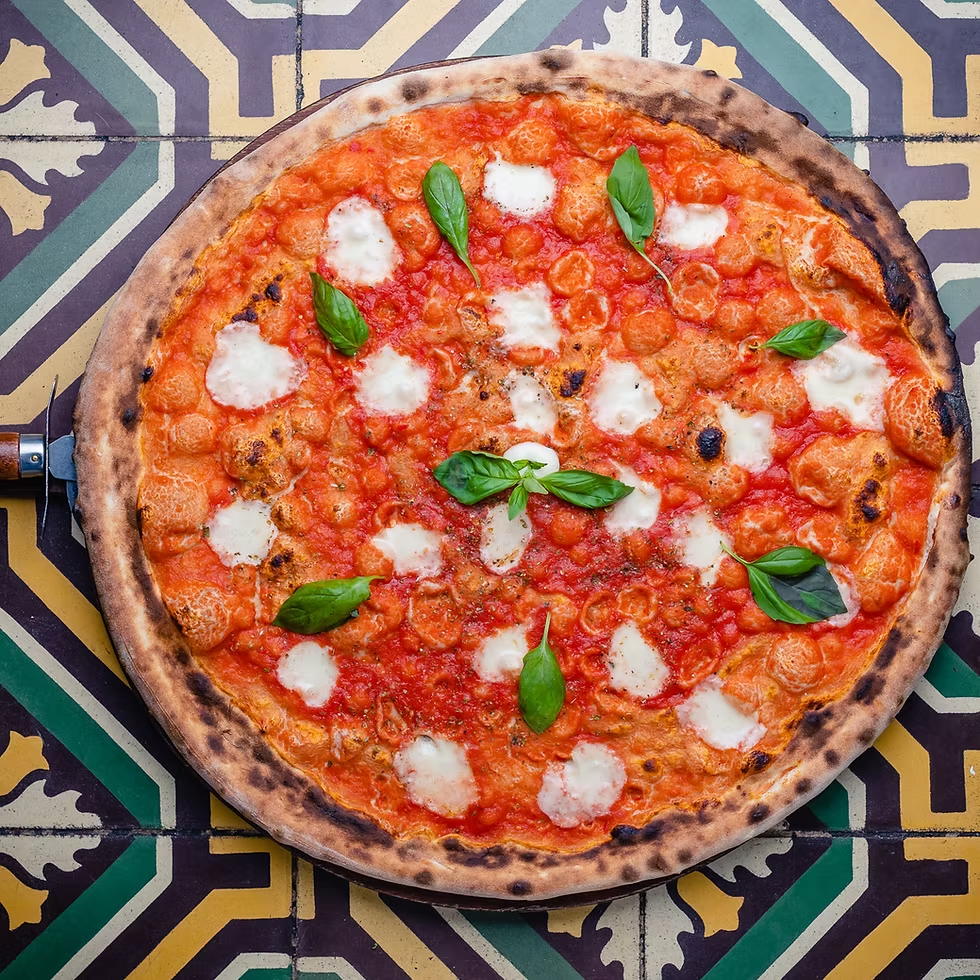
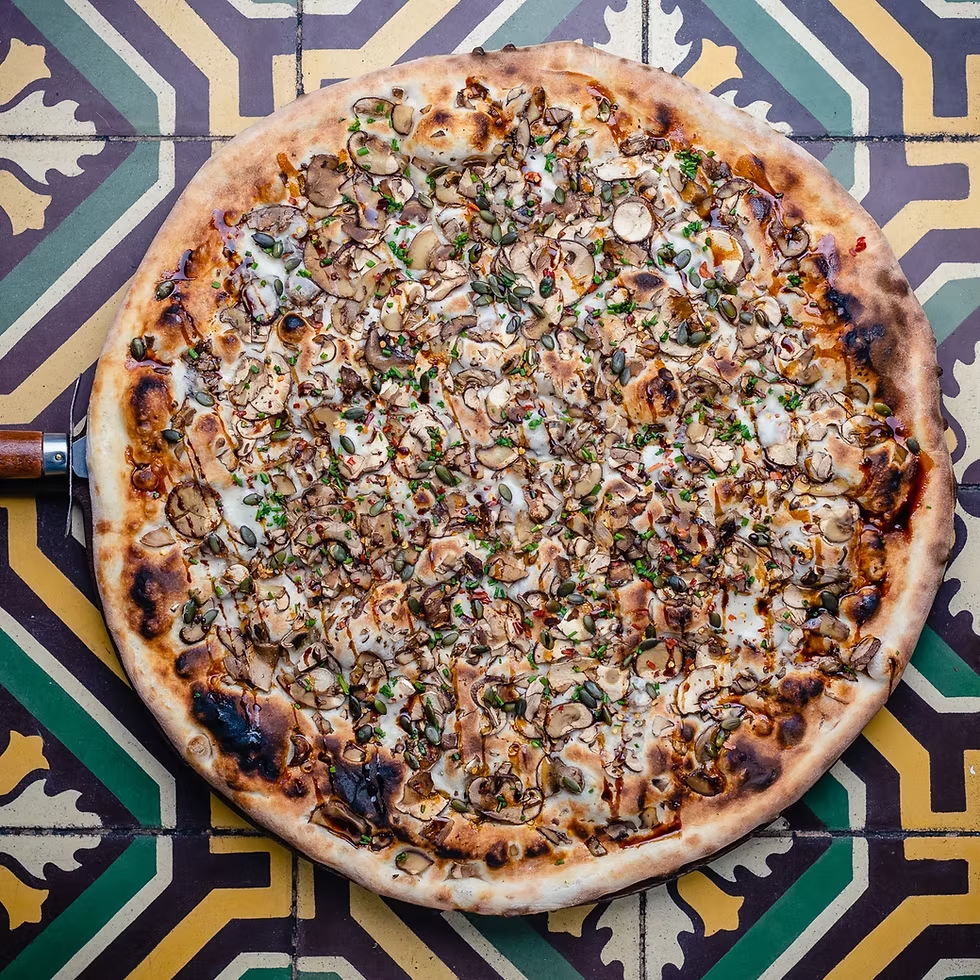
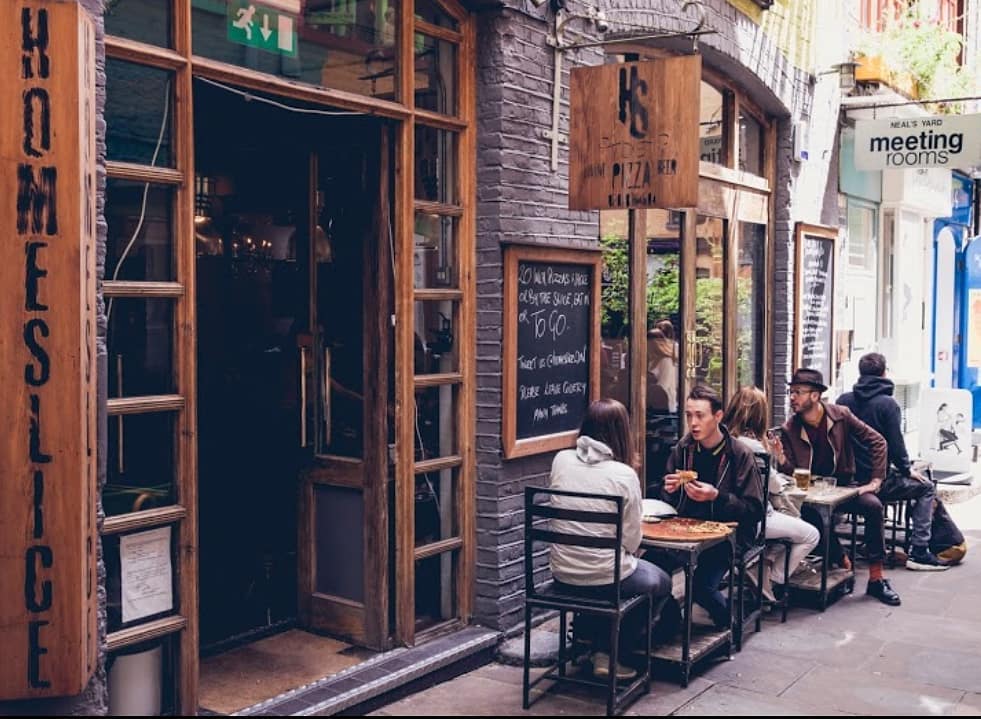
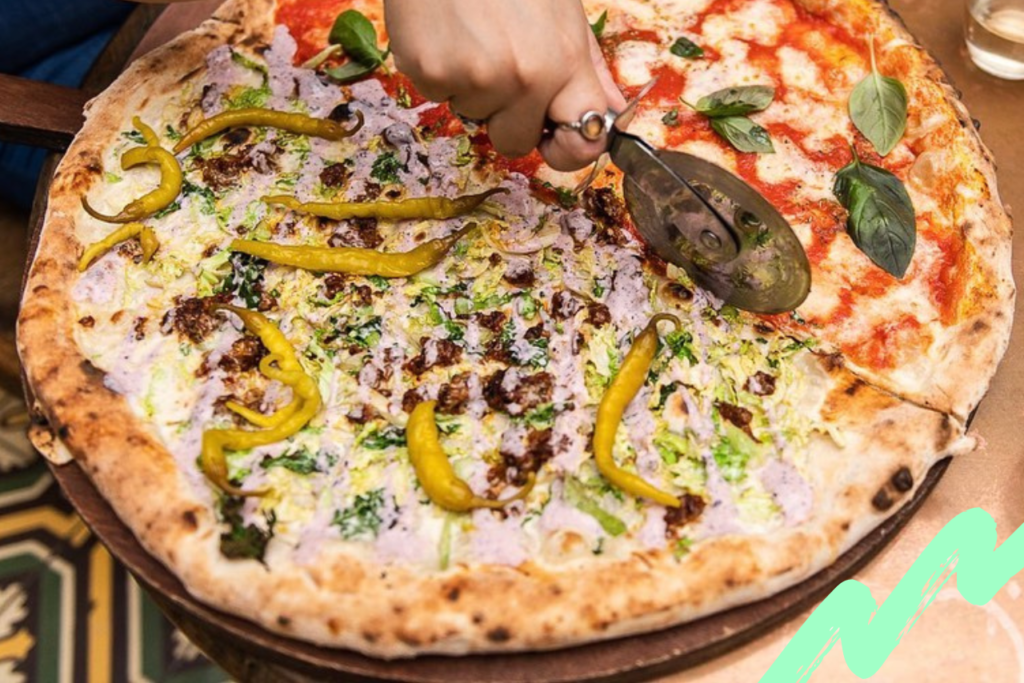
Not one for the pizza purists, this, but definitely a place for a sharin’, tearin’ good time, the pizzas here are huge 20-inch numbers, perfect for some group fun. Indeed, the name Homeslice in bro parlance means friend, and the buddying up concept lends itself to conviviality and good cheer.

Some of the topping combos are inventive, some downright weird; cauliflower cheese and harissa anyone? But, when they get things right, it’s brilliant.

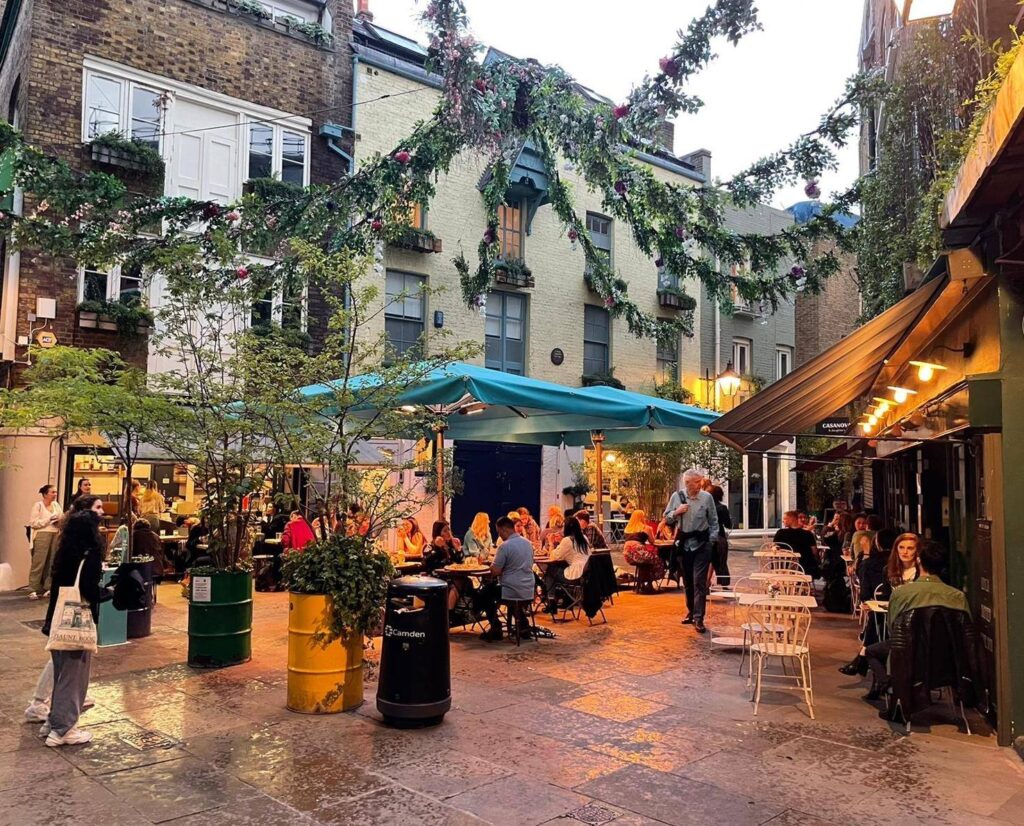
Home Slice Covent Garden

Website: homeslicepizza.co.uk

Address: 13 Neal’s Yard, London WC2H 9DP

Lovely stuff, indeed.

The Best Places To Eat In London Fields & Broadway Market

Last updated March 2026

East London’s London Fields is so clouded with clichés that even observing them is something of one. They put Monster Munch on their oysters here, the mad bastards. Their wine is turbid and full of sediment. Perhaps there’s something in the water here. There’s certainly something in the soil…

London Fields – the grassy stretch, not the neighbourhood – is a sprawling plot that dates back to the 16th century. The park’s rather prosaic, quite beautiful name comes from its historical role as a place where farmers would bring their cattle to graze before heading to the city markets. It has transformed over the centuries into South-Central Hackney’s most cherished public space, becoming a byword for the wider area in the process, as well as a certain sensibility, of stripped back swagger, experimentation, and a kind of studied, strained style. 

The cows have gone now, replaced with grazing, bathing humans, the latter found at the iconic Lido, an outdoor swimming pool that has been a community staple since 1932, the former in an ever-growing array of cafes, bars, and restaurants that cater to the eclectic tastes of its residents and visitors (they bloody love salty fingers in this part of town).

At the south end of London Fields park, the historic Broadway Market has been a cornerstone of the local community since the 1890s. Originally a bustling marketplace for fresh produce and household goods, Broadway Market has undergone something of a makeover in recent years, with its main drag now dominated by a string of bricks and mortar, food-adjacent operations.

Formerly known simply as ‘The Broadway’, the strip has evolved from its role as the final stretch of a cattle route leading from Essex into the slaughterhouses of London to a fully fledged shopping street and venue of a weekly farmer’s market, with many ups and downs in between. According to Layers of London, “Broadway was a thriving daily market until it declined steeply in the 1970s and 80s. A graffito stated: ‘Broadway Market is not a sinking ship – It’s a submarine. ‘ Recovery began in the 1990s and in 2004 Broadway Market Residents and Traders Association (BMRTA) established a Saturday farmers’ market.”

Fast forward to 2026, and every Saturday, the market explodes into life, its vendors offering everything from ‘gourmet’ street food (with plenty of tasters being handed out on little cocktail sticks) and organic produce to handmade crafts and vintage clothing. 

But you can’t make a meal out of these cocktail stick tasters, however useful they are for picking your teeth afterwards, so instead we’re widening our scope to the restaurants both on the Broadway Market strip and the wider London Fields area. There’s plenty of great stuff to eat in this neck of the woods, so let’s get into it; here are the best restaurants in London Fields and Broadway Market.

Miga

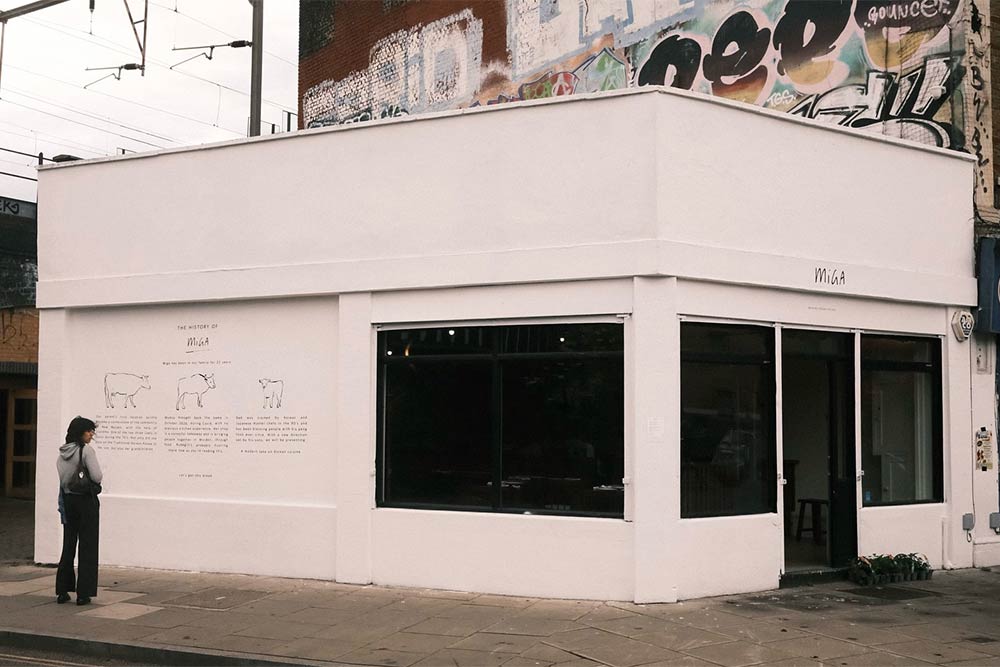
On Mare Street, modern Korean restaurant Miga has been making major waves since its 2024 opening. The proud holder of a Bib Gourmand, Miga has been the recipient of several glowing national reviews, and is talked about in Vittles using exalted terms more often reserved exclusively for suya. Even the restaurant themselves talk a big game, with ‘The History Of Miga’ etched on the whitewashed walls outside the restaurant.

It’s a story that began in 1970s Seoul, where the family matriarch sold her own recipe of ox-bone broth. The family’s first UK restaurant opened in New Malden some quarter of a century ago, and their current venture continues to honour their heritage while offering a contemporary take on traditional Korean cuisine. The father’s extensive training under Korean and Japanese master chefs in the 90s is evident in the quality and gentle creativity of the dishes. Come full circle, a version of that broth as a savoury closer is the highlight of a meal at Miga.

Already, the place exudes a familial warmth, with the father attending to the open kitchen and younger family members (chiefly, the two sons) attending to guests in a bright, airy dining room, all shades of simultaneously stark yet soothing whitewash and walnut.

It allows attention to fall on the food, and a tight menu that features soul-stirring dishes like soy-braised short ribs and sticky glass noodles with crispy beef jeon, sanchaeg bibimbab topped with vegetables selected for their crunch and freshness, and a soy vinaigrette, and cucumber and spinach rolls with a miso sauce.

The ox bone broth is, unsurprisingly, also ace; a real restorative number blessed with generations of seasoning. Perhaps our favourite dish, though, is the spiced beef tartare, lifted and lightened with slivers of pear, all pulled together with a soy cured egg yolk. 

It’s thoughtful, it’s interesting, and it’s downright delicious, a world away from your YORIs and the rest. Also of note, though Miga was first trading without a liquor licence, they now do beer, wine and soju. Rejoice!

Instagram: @miga

Address: 1 Mare St, London E8 4RP


Chakana

Another Broadway Market beauty, Chakana is the second act of the popular Birmingham restaurant of the same name. Serving up photogenic plates of precision engineered Peruvian food and drinks from Europe’s most extensive range of pisco, it shouldn’t come as a huge surprise that Chakana has already hit its stride in the capital. The kitchen is headed up by chef Robert Ortiz, who previously earned Lima London its Michelin star, the first Peruvian restaurant in Europe to be bestowed with the honour. 

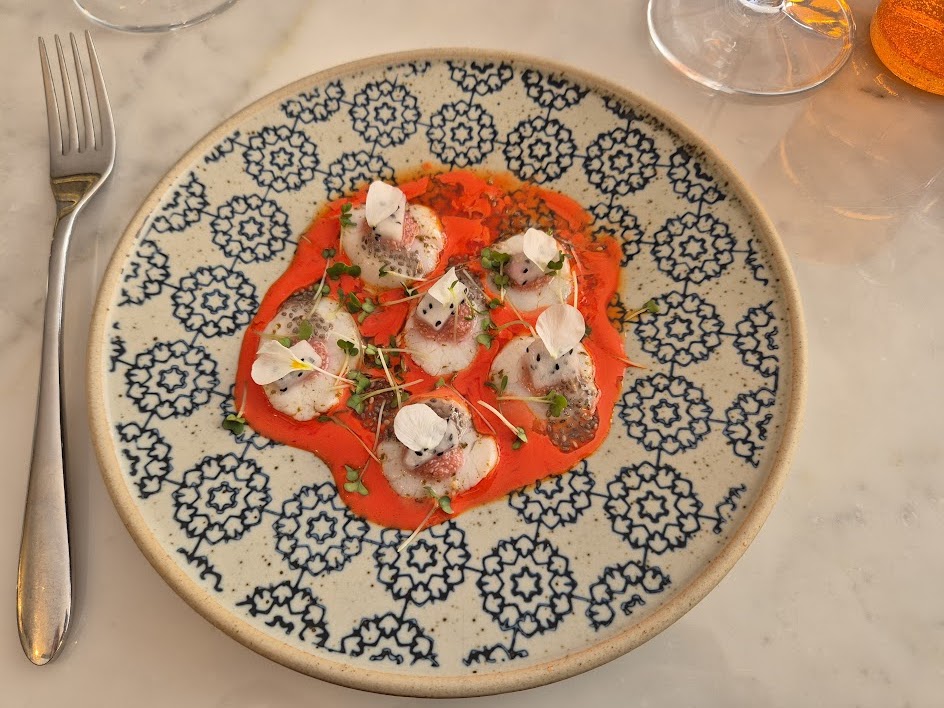
Orkney scallop and dragon fruit tiradito

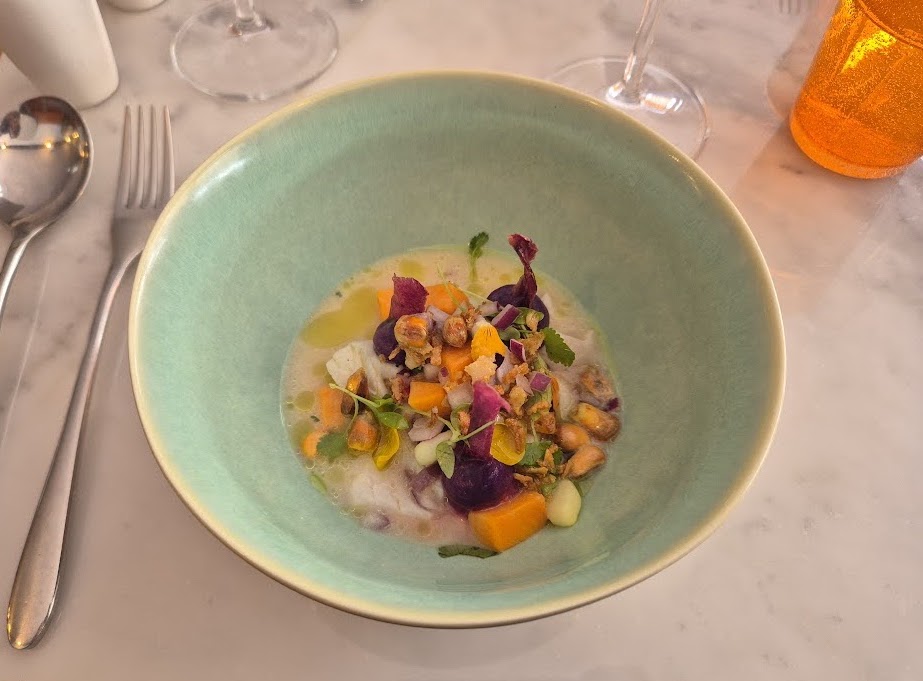
A ceviche of thick, pronounced dice of seabream bedded deep in a bowl of house tiger milk is one of many highlights. Singing with just-squeezed lime, coriander and chilli, it’s masterfully balanced. Equally good, slices of raw Orkney scallop in a comedically vivid dragon fruit tiradito was sweet, refreshing and just a little intriguing.

You can read our full review of Chakana London here.

Website:  chakana-restaurant.co.uk

Address: 41 Broadway Market, London E8 4PH


Sune

We wish they’d let us know about the pronunciation sooner, as we’d been going around calling it ‘S-you-n’ until we heard…

Anyway, the proposition at Sune, however you want to say it, has all the hallmarks, superficially at least, of an increasingly ubiquitous kind of London restaurant; somewhere with pockets of pleasure that ultimately ends up being incoherent and unsatisfying. The whole ‘wine bar that happens to do food’ thing going on. A restless, globe trotting menu with the threat of too much umami (too-mami?) lingering across it. There’s no central character around which the other dishes should orbit. There’s a danger that things are going to get confusing, fast..

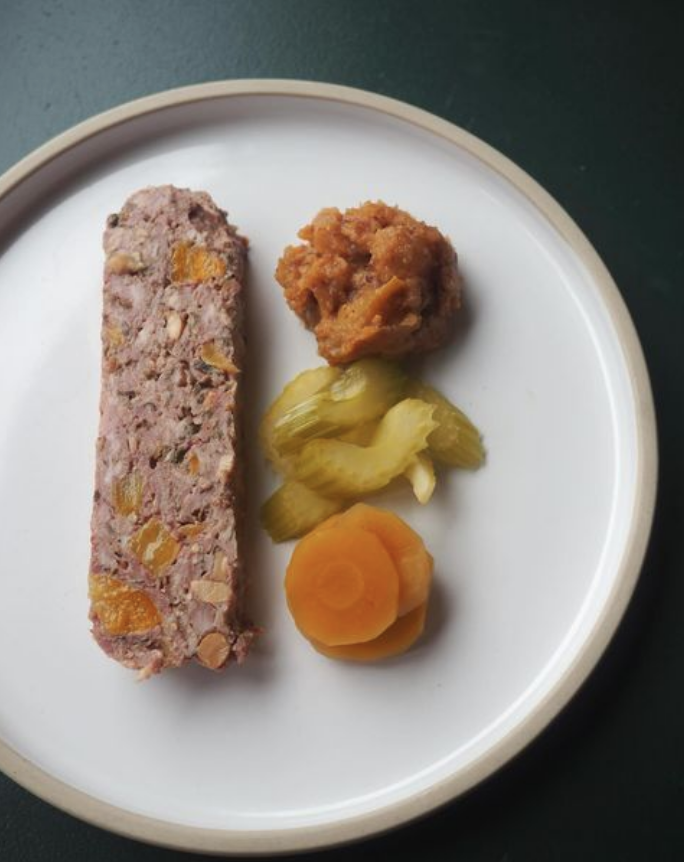
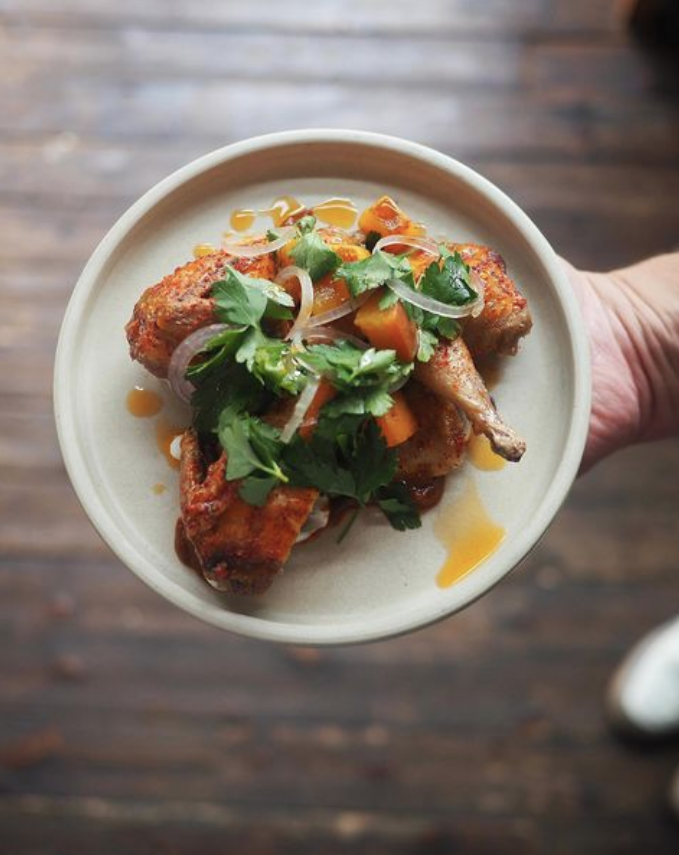
But make the journey south over the bridge from Broadway Market onto Regent’s Canal, and you’ll be richly rewarded with a meal that does end up making perfect sense. That Sune is coherent shouldn’t actually come as a surprise; there’s plenty of pedigree behind the restaurant, with esteemed sommelier and natural wine enthusiast Honey Spencer and ex-Noma manager Charlie Sims leading things from the front, and former-Pidgin chef Michael Robins at the stoves out back, putting his delicate touch to dishes like pork, fig and cashew nut terrine with apple mostarda and pickles, or fried quail with harissa yoghurt and smoked apricot.

Really, any disparate elements here are pulled together by the impeccable winelist. Sune is named after Honey Spencer’s mentor Sune Rosforth, a renowned sommelier, signalling the restaurant’s dedication to the good stuff, first and foremost. The wine list is predominantly natural, featuring around a dozen types by the glass, starting a just £7 for a very nice 2022 Artefact #2 Tempranillo from Toledo. Spencer has also curated a selection of low-intervention kombucha-style brews for those not on the sauce.

That pork terrine from a paragraph or two previous currently features on a remarkably good value set lunch menu, featuring two courses for £25 or three for £29. If you don’t mind a double porking, you can follow that terrine with a dish of pork loin, grilled greens and lobster sauce. They’re missing a trick not having pork in their set menu dessert, too, but the affogato is bracing and lovely.

Finally, and kicking off at 11:30am each Sunday, the Sune brunch is popular and really, really nothing like your usual eggs on toast and the rest. There’s half lobster tails with calamansi lime and redcurrant, scallop ceviche with plum and salted chilli, cucumber salad with lavender and holy basil, and a reuben sandwich with dairy beef tartare laying across its surface. Yes, it’s idiosyncratic and at times inexplicable. But somehow, in their capable hands, it works.

Website: sune.restaurant

Address: 129A Pritchard’s Rd, London E2 9AP


Yuki Bar

North of London Fields, in the railway arches that form a rusty labyrinth beyond Broadway Market, is Yuki Bar – a tight, moody Japanese wine bar that’s quickly become an after-hours institution with the hospitality crowd. Former Noma and P. Franco (two joints that are catnip to said crowd) sommelier Yukiyasu Kaneko opened this 20-seat spot in early 2024, creating a space where industry folk and curious locals converge around a horseshoe counter.

The low bar places guests eye-level with the kitchen team, while overhead trains occasionally rattle bottles and conversation. J-pop cuts through any silence, though there’s rarely much of that as Kaneko pours rare finds and shares stories of producers.

The chalkboard menu changes frequently but maintains a confident simplicity. Eggs with sesame mayo for a fiver. Beef rump tataki at £13. £6.50 for leek and girolle miso soup. Crown prince squash with sesame, £6.50. It reads like poetry – sparse and purposeful, and absurdly good value in this city, in this economy.

The kitchen’s touch is gentle but assured, allowing ingredients to speak clearly. For something more substantial, pork belly braised in Guinness or a chicken hot pot lifted and freshened with a little ponzu both keep the nourishing, restorative theme going. Always finish with grilled onigiri in dashi £9.50 – rice cakes with crisp edges and a soul-warming broth.

The Japanese comfort food might feel fairly easy to pin down, but it tastes fucking great, giving space to a wine selection that defies easy categorisation, except in its quality and Kaneko’s evident passion. His recommendations come with context rather than pretension, making even the most esoteric bottle feel accessible.

Yuki Bar punctures London’s homogeneous wine bar scene with Japanese inflection and genuine character. Sunday evenings have become particularly special – the counter filled with chefs and waiters on their night off, glass in hand, winding down before another week begins.

Instagram: @yukibar.london

Address: 426 Reading Ln, London E8 1DS


Koya Ko Hackney

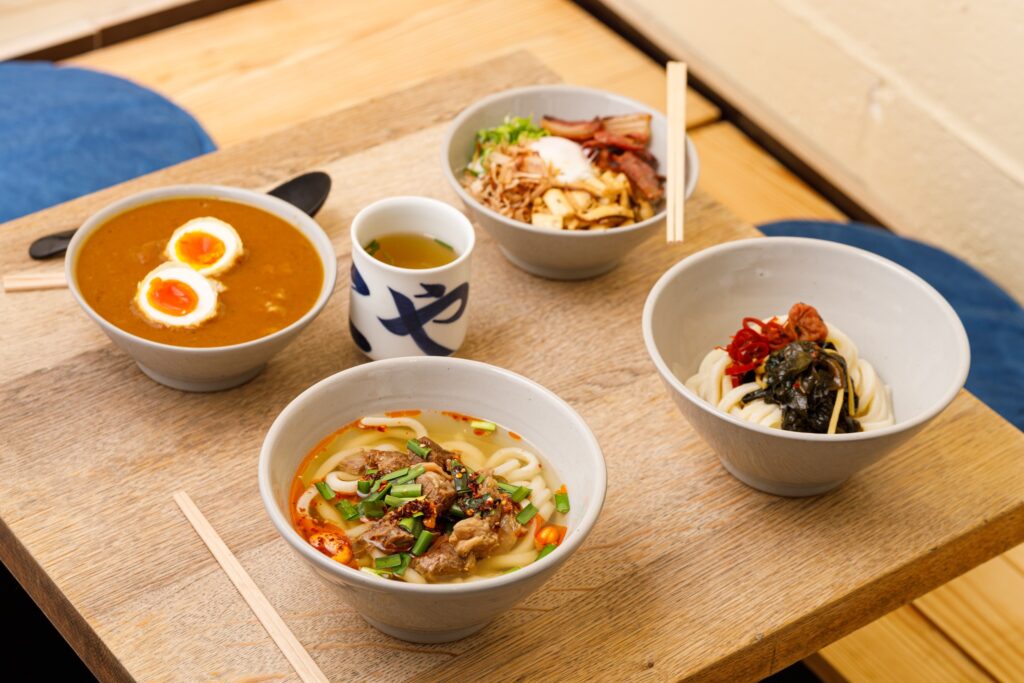
Broadway Market’s Koya Ko – here since 2021 – is positioned as the more casual, faster-paced “little sister” to Koya Soho and their City branch, with a whip-smart ordering system and focus on tachi-gui (or, ‘vertical dining’) that encourages punters to stand whilst slurping back a bowl of noodles rather than settle in for the long haul.

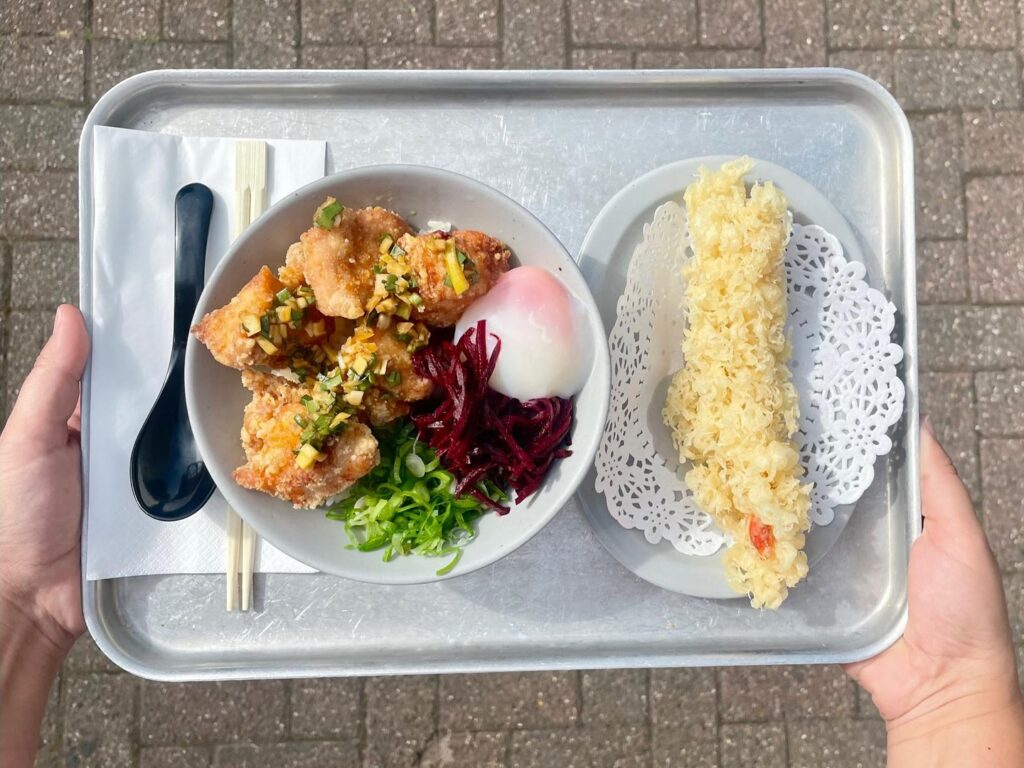
images via @KoyaKoHackney

Indeed, whilst Koya Ko is very much tailored to the needs of speed and efficiency, the same love and attention to both noodle and broth that the brand has become known for remains, and the breakfast – served from 10am at the weekends – is as good as ever.

The Triple Pickle remains one of London’s finest pick-me-ups that doesn’t arrive via a ZipLoc. Instead, a bowl of udon noodles, slippery and silky, soft and chewy, is dressed with pickled beetroot and wakame, as well as soy cured chillies, bringing bites that soothe and invigorate in equal quantities. Yours for £12, and only served (as with all the breakfast dishes) until 11:45am.

Not to worry if you pitch up a little later; from midday onwards the larger lunch and dinner menu is in operation, with great value udon and rice bowls taking centre stage. The tempura prawn udon is as good as ever, and remains one of our favourite prawn dishes in London. Pair it with a glass of warmed choya umeshu – that complex, delicious ume plum liquor – and enjoy a moment of well-deserved mono no aware, as the steam from both mists up your glasses and you gently contemplate what to do with the rest of your day.

Website: koya.co.uk

Address: 10 Broadway Market Mews, London E8 4TS


Cafe Cecilia

Chef Max Rocha wears his influences proudly. His time at St John Bread and Wine is there in Cafe Cecilia’s austere plates that celebrate beige, brown and yellow in all their illustrious shades, and in the bare bones dining room, dark wood dining chairs, whitewashed walls, chalkboard and all.

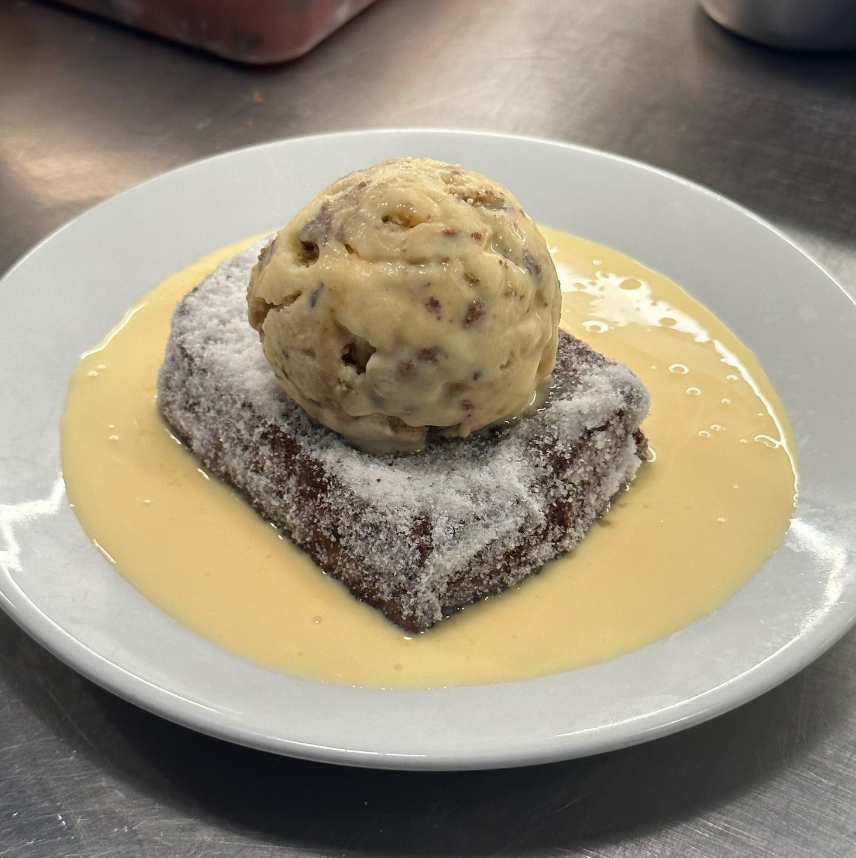
Rocha’s stint at the River Cafe is also clear, with a recent dish of rabbit cavatelli as good as we’ve had out west on Rainville Road. His Dublin roots are represented too, with gusto, in the now iconic Guinness bread ice cream, sometimes scooped over another showstopping sweet treat, the Cafe Cecilia deep-fried bread and butter pudding. Both embody the cafe’s commitment to making just a few ingredients truly sing. Both are fucking delicious.

All this minimalism could come across as style over substance if the cooking wasn’t so precise and on point. We certainly wouldn’t blame you for making that assumption; as son of John Rocha and sister of Simone, both designers, Max Rocha has a deeply ingrained connection to the world of fashion and a keen sense of composition. Fortunately, he’s put those familial sensibilities to good use in contriving suave plates that never sacrifice on flavour.

And true to the inclusive nature of the name, Cafe Cecillia is open for breakfast on Fridays, Saturdays and Sundays, between 9am and 10:45am. We’re still dreaming about the marinated, blackened peaches and goats curd on toast we had there recently. Yours for just £9.50. 

Website: cafececilia.com

Address: 32 Andrews Rd, London E8 4FX


E5 Bakehouse

We fear that we’ve been venturing further and further south on our tour of the best places to eat in London Fields, and that we’re starting to take liberties with the title. So, we’re heading back up through the park, exiting at Martello Street, and making for e5 Bakehouse. Founded by Ben Mackinnon in the spring of 2010, and now well into its second decade, it’s never been more popular.

The bakery’s beginnings were humble. Mackinnon, once a sustainability consultant specialising in renewable energy systems, decided to shift gears and pursue his passion for baking. After a short course in sourdough bread-making at the School of Artisan Food, he set up a clay oven in the corner of a railway arch and started making bread. What began as a modest bakery soon flourished, thanks to the support of local chefs and the wider community who were drawn in by the smell of just baked loaves, a bit like Mickey Mouse following his nose to a freshly baked pumpkin pie sitting on a window sill.

The use of heritage grains is central to the baking here, and it’s well apparent in the deep, nourishing undertone of the bread at e5. The sustainability thing isn’t just marketing here; e5 Bakehouse is certified organic by the Soil Association, the bakery pays the London living wage, and all of the power used at the bakery is sourced from renewable energy sources, including at Fellows Farm, which is off-grid and uses an electric van to deliver produce to the Bakehouse. Nicely done.

Image via e5bakehouse.com

All this needs to be backed up by an amazing product, of course, and e5 Bakehouse more than delivers on that front, whether it’s in the absurdly moreish E5 Cheese Toastie that deploys tangy Keen’s cheddar, melty mozzarella, Glastonbury salted butter and spicy housemade vegan kimchi, or the famous, indulgent scrambled eggs doused in more of that raw, cultured butter. Of course, it’s the excellent bread that anchors both of these creations, but the bakery does excellent sweet stuff too. A late summer black and red currant galette recently was a revelation.

Unsurprisingly, the morning pastries are gold-standard. Pick them up on weekdays from 7:30am and at the weekend from 8am. There’s plenty of seating inside this surprisingly cavernous space, and great coffee, too, if you prefer to dine in.

Check out the team’s Poplar Bakehouse in Tower Hamlets while you’re here. An extension of the Just Bread refugee training programme that they ran in collaboration with the Refugee Council until 2017, the aim of this cafe and coffee roastery, which is now also a shop and bakery, us to employ and train people from refugee communities whilst investing profits back into projects which support and welcome refugees arriving in the UK. 

Website: e5bakehouse.com

Address: 396 Mentmore Terrace, London E8 3PH


Green Papaya 

Next up, we’re crossing Lamb Lane for a quick pitstop at Green Papaya, whose Xi’anese (Chinese Xi’an province and Vietnamese) cuisine has been gaining a devoted following in this corner of Hackney in recent years.  

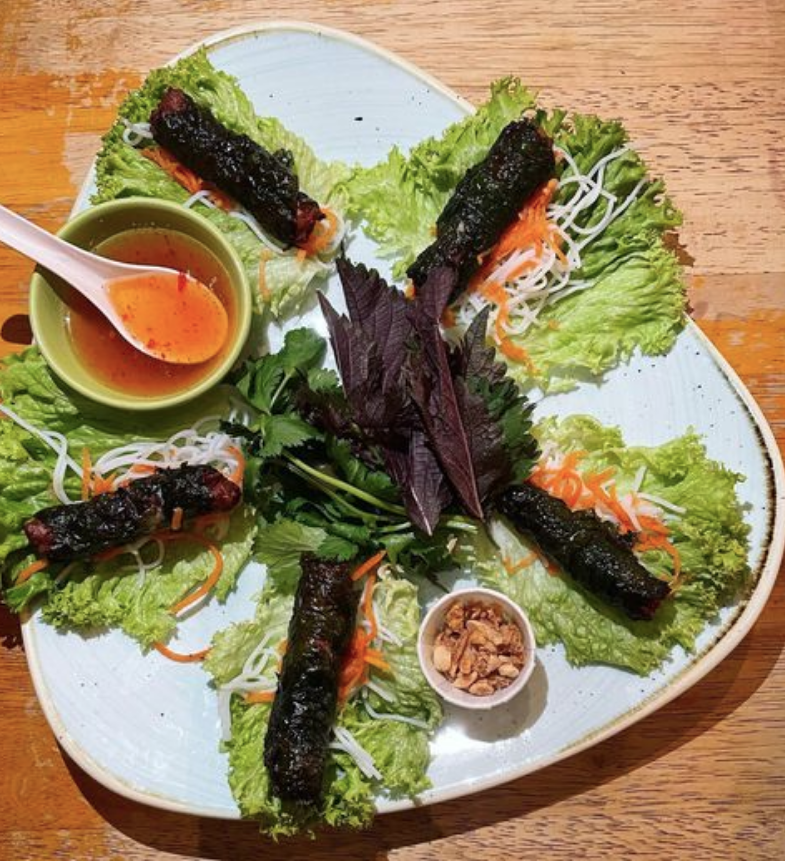
Start your meal here with an order of cha la lot – minced beef and pork wrapped in betel leaves and grilled, served with rice vermicelli, lettuce and herbs. The subtle, peppery flavour of the leaves (actually wild piper not ‘betel’, but who’s getting pedantic?) once smokey from the grill is intoxicating.

Don’t stop there. Any of the spicy noodles from the ‘Xi’an Noodles’ section of the menu will make you happy. Our go-to order is the Mount Qi pork noodles – think chunks of pork belly sautéed in a spicy sauce, tossed with our house chilli oil and Sichuan peppercorns, served with soya tofu and mixed with noodles. This bowl’s beautiful mélange of flavours and textures is worth a visit alone. 

They also serve up satisfying bowls of pho. We’ve written more about the restaurant in our guide to the best pho in London. Do check it out.

Website: green-papaya.com

Address: 191 Mare St, London E8 3QE 


Brat x Climpson’s Arch

Tomos Parry is one of London’s most celebrated chefs, praised just about everywhere for his mastery of open-fired grilling, inspired by Northern Spain’s Basque country and his Welsh roots, at Brat.

Before that, Parry was earning plaudits for bringing fresh energy to legendary restaurant Kitty Fisher’s, and before that before that, he won the Young British Chef of the year at the YBF Awards in 2014 for his cooking at Climpson’s Arch in London Fields. Parry has come full circle then, with the second iteration of his Michelin-starred restaurant Brat. It’s a satisfying career trajectory, and also a satisfying way to finish this article, so there you go…

Now, when someone mentions ‘the second Brat’, they’re probably referring to the Charli XCX’s remix album, but it wasn’t always that way. Four years ago, it was a different story; Brat x Climpson’s Arch originally opened as a winter pop-up in 2020, but its overwhelming popularity swiftly secured its permanence.

The restaurant is named after the traditional Northumbrian word for turbot, reflecting its homage to simple yet profound culinary roots, and is further emphasised by the elemental (see: ‘wood-fired’) focus of the cooking here.

Images via bratrestaurant.co.uk

The menu at Brat x Climpson’s Arch epitomises British seasonal cooking with a focus on high-quality ingredients. Signature dishes include whole crab with hay butter, roasted chicken rice, and the star attraction, grilled turbot, which is a must-try. The big, beautiful fish kinda exemplifies Parry’s ethos: unadorned, high-quality food cooked under unpredictable conditions to a type of no-one-plate-is-the-same perfection. 

The dining space continues this sensibility arguably even more succinctly than the original warehouse in Shoreditch vibe, with a large covered courtyard ideally suited for al fresco dining, and an indoor space featuring a long bar for walk-ins.

Sure, Brat has been so hyped – so imitated – that its initial impact has been somewhat lessened. But this second, more laid back version has arguably breathed new life into the concept. Think we might be talking about the album again, but…

Website: bratrestaurant.co.uk

Address: 374 Helmsley Pl, London E8 3SB

Now, we wish someone would breathe similar new life into us – after such an extensive eating tour of London Fields’ best restaurants, we’re ready to die. Fortunately, Bunhill Fields is just down the road.

The Best Restaurants In Croydon, London

Last updated March 2026

The birthplace of both air traffic control and Stormzy, and with Unibail-Rodamco-Westfield’s long-awaited North End Quarter redevelopment now moving through the planning stages, Croydon certainly has a lot going for it.

No wonder it’s begun welcoming – for better or for worse – venture capitalists, tech experts, software developers and a whole host of startups, earning it the title of ‘South London’s Silicon Valley’. 

And with investment, opportunity and plenty of hungry creatives, the options for a good feed in the area are growing. If you’re looking for advice on where to eat here, then we’ve pulled together this list of the best restaurants in Croydon. Up for some dinner? Let’s go…

Good Life Jerk Centre

Ideal for well-seasoned Jamaican food that tastes like someone’s mum made it…

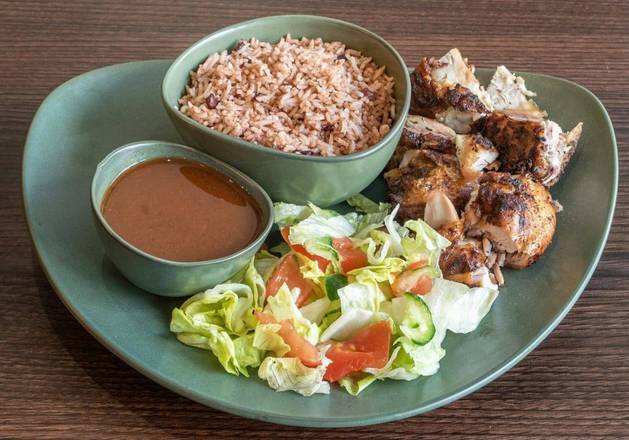
On South End, Good Life Jerk Centre is the kind of unassuming spot you could easily walk past – but doing so would be a mistake. This Jamaican kitchen has built a devoted following among Croydon’s Caribbean food fans, and once you’ve tasted the jerk chicken, you’ll understand why.

Yep, the jerk is the main event (hence the name), with chicken and pork both marinated until imbued with that distinctive smoky, spicy heat. The pork, in particular, draws consistent praise – tender, well-seasoned, and about as far from an afterthought as you can get. Curry goat is another winner, slow-cooked until falling apart, while the pepper steak offers something a little different – a little rasping – for those who fancy it.

The sides deserve attention too. The rice and peas is cooked just right, the mac and cheese is creamy and comforting in that specifically Caribbean way, and the festival dumplings strike that balance between sweet and savoury that makes them so moreish. There’s a small dine-in area if you want to eat on site, though most opt for takeaway – either way, portions are generous and prices fair.

It’s not fancy, it’s not trying to be anything other than what it is: honest Jamaican cooking done with care. For that reason alone, Good Life Jerk Centre deserves a spot on your ‘best Croydon restaurants’ radar.

Website: goodlifejerkcentre.com

Address: 95 South End, Croydon CR0 1BG


Tindli by Chef Karnavar

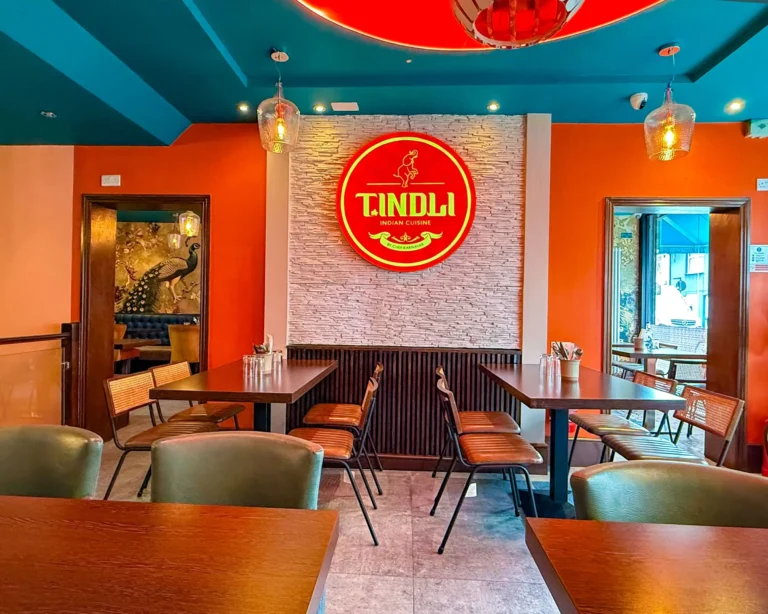
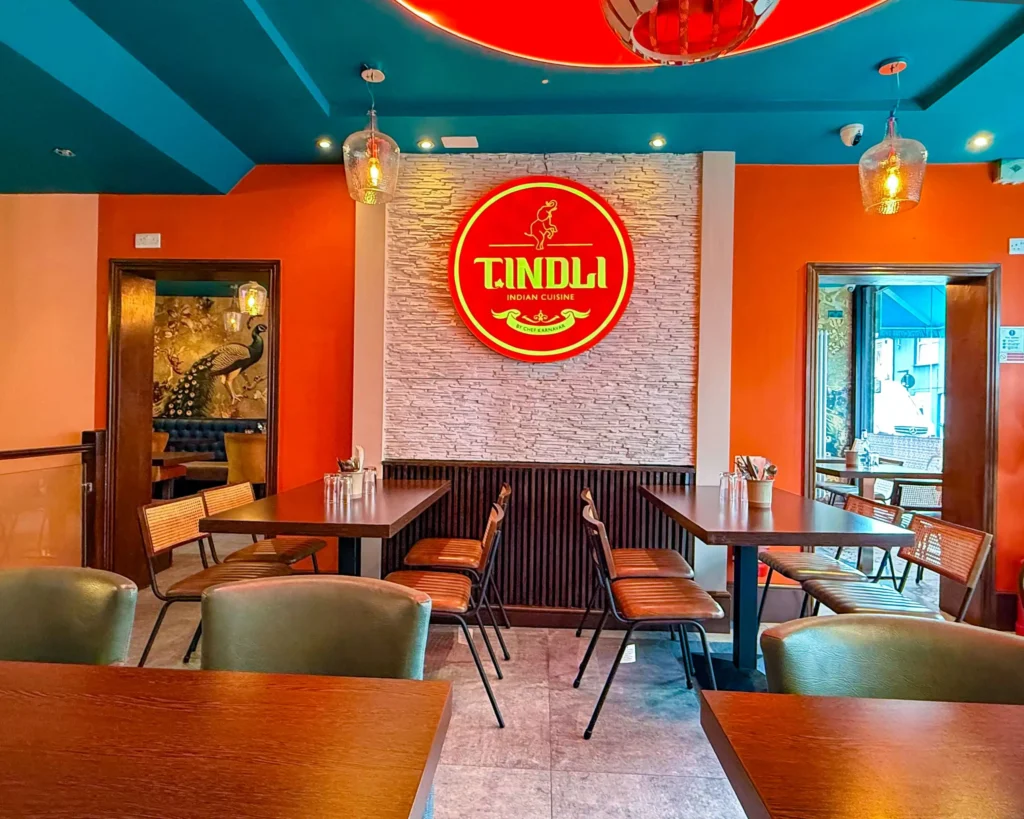
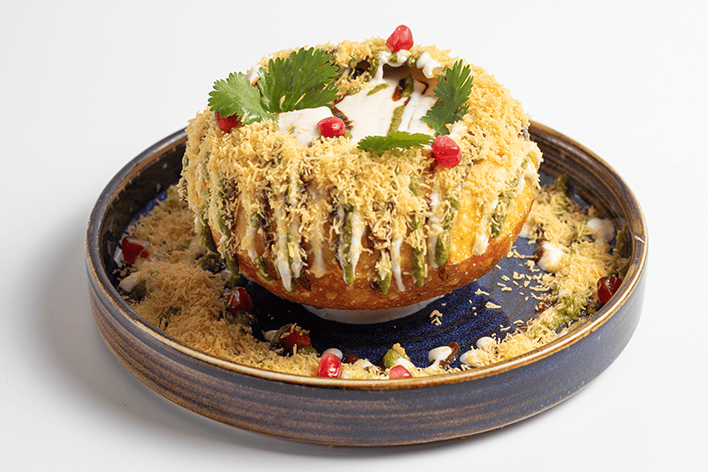
This slick Indian restaurant is named after the ivy gourd – or tendil as it is known in India – a nutritious vegetable that is a staple in many Asian cuisines. The tendli plant is a tropical vine that can spread quickly over trees, shrubs, fences, and other supports. Its fruit, which is green when raw and turns bright red when ripe, is commonly used in Indian cooking, and this reverence for even the most humble ingredients is reflected in the intricate cooking of chef Manonj Karvanar

At Tindli, chef Karnavar brings his three decades of experience in prestigious 5-star hotels like the Marriott, Renaissance, Fairmont, Savoy, Mandarin Oriental, and Claridges London to create a menu that reflects the rich diversity of Indian cuisine. The dishes are crafted using fresh, locally sourced ingredients, with the tendli even featuring in some of them.

The highlight here is the celebratory, delicately spiced chatti biryani, which arrives at the table in the claypot it’s been cooked in, the lifting of its lid revealing a heady waft of ground coriander seeds, cumin and cardamom. A side of the house raita is all you need for one of Croydon’s most satisfying meals.

Website: tindli.com

Address: 5-7 St James’s Rd, Croydon CR0 2SB


Galicia

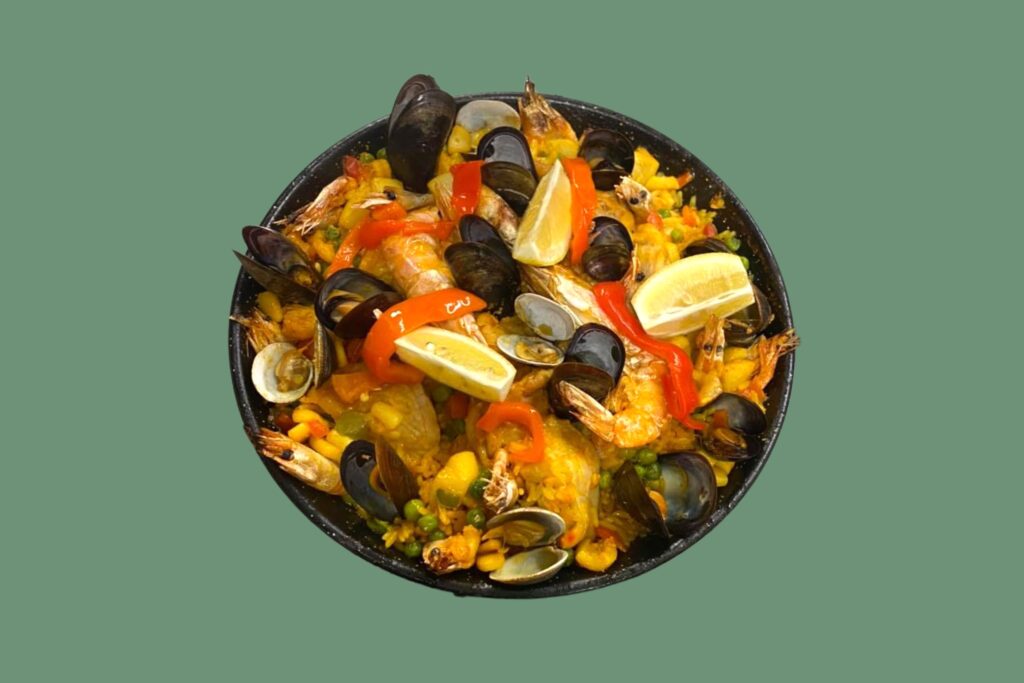
There’s something about the buzz in Croydon tapas joint Galicia that feels at odds with the restaurant’s slightly uninspiring surroundings on the high street. Inside, you can depend on lively chatter and comforting small plates, the restaurant’s extended marble counter and azujelo mosaic tiling bringing a little vivacity to a rainy Tuesday night just south of London.

Now approaching its third decade of trading, Galicia is owned by Fernando Alexandre, who has been here since the start, first as a waiter and then as owner. Go for a round of traditional tapas such as the chicken croquettes, patatas bravas and marinated anchovies before ordering a couple of larger dishes; the restaurant excels at fish cookery, and the seafood paella is something of a speciality here. Ditto the grilled octopus done in the Galician style, which feels apropos even if we are in Croydon. And get this; the wine list features several Spanish bottles under £30, which is becoming increasingly unheard of in this part of the UK.

Facebook: Galicia

Address: 269-275 High St, Croydon CR0 1QH


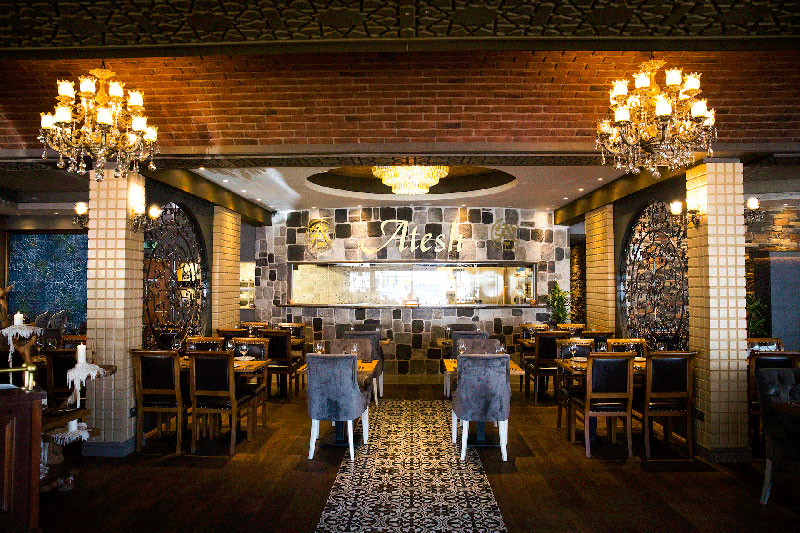
Atesh

This opulently furnished restaurant is testament to the diverse food scene in Croydon, with a wide-ranging, country-spanning menu of Turkish (and beyond) classics. 

Kick things off with a few tasters off the mezze menu, with Atesh’s babaganoush a particularly fine version, its aubergine cooked until collapsing and super smoky, and properly humming with tahini and garlic. That pairs beautifully with the kasap kofte – miniature lamb meatballs – and the exemplary borek filled with feta and spinach.

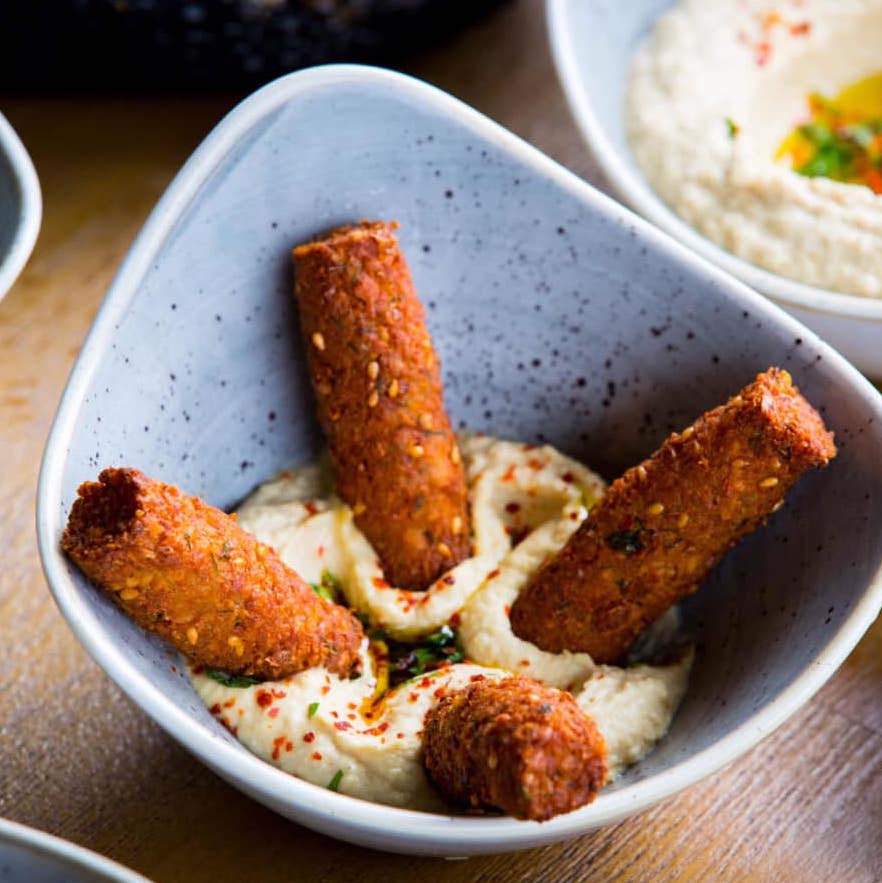
The falafel makes an excellent starter choice too – crispy golden oblongs, perfectly seasoned standing proudly upright in a bed of creamy hummus – delicious

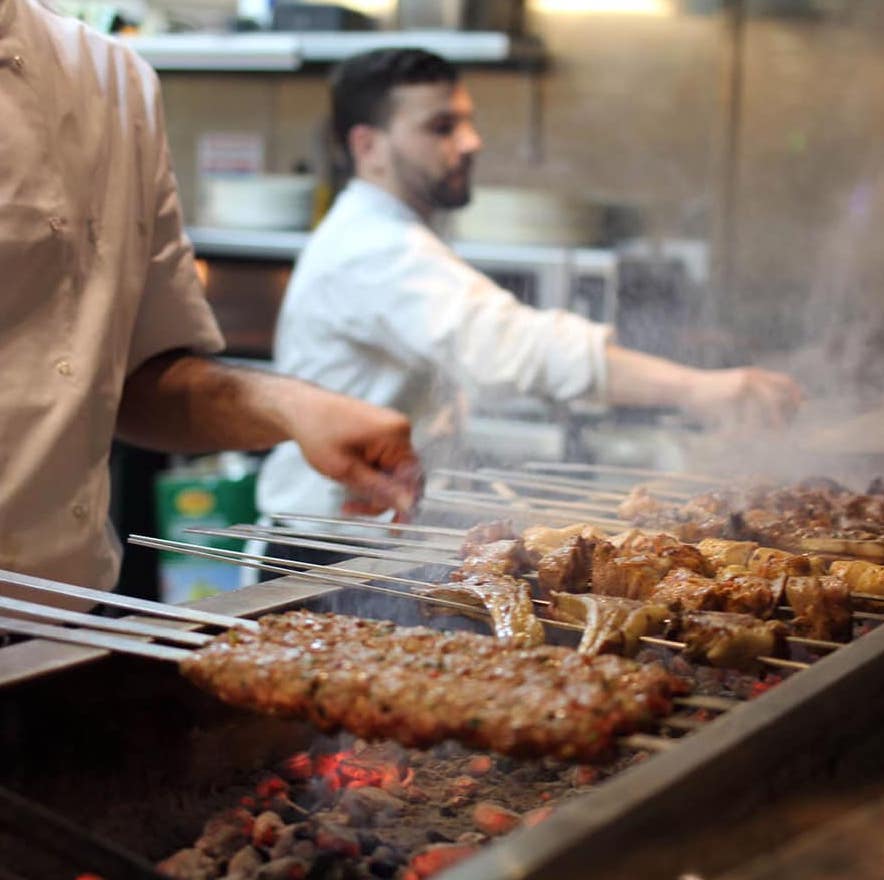
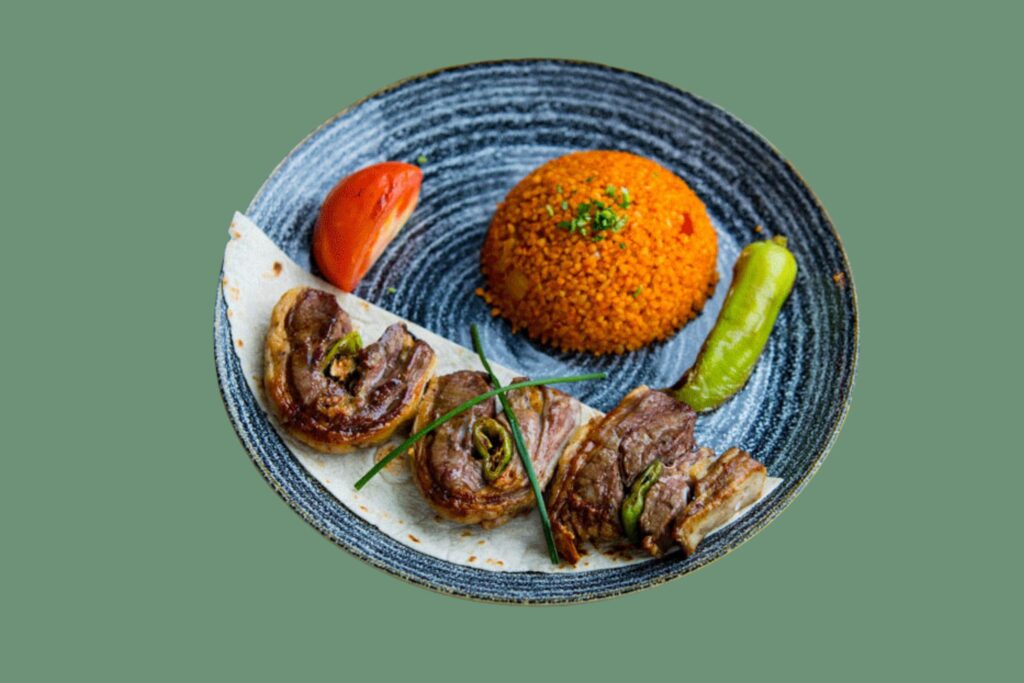
You could stop there, of course, but to do so would be to miss out on Atesh’s signature grilled shish dishes, which are pulled off the charcoal only when blistered, burnished and bloody delicious. At this juncture it would be rude not to have a raki or two, here served in the Turkish style, mixed with water until cloudy. Hmm; we might order another you know…

Website: ateshrestaurant.co.uk

Address: 235-241 High St, Croydon CR0 1QR


Surrey Street Market

One of Britain’s oldest street markets (dating back to 1276, no less) and perhaps Croydon’s most dynamic food destination, Surrey Street Market pulses with an energy that feels distinctly communal. A £1.1 million refurbishment levelled the pavements and upgraded the lighting, and this historic thoroughfare has evolved from its traditional greengrocer roots into something approaching a world food market, though you can still find plenty of fruit and veg traders calling out their daily deals.

The real draw here though is the food. A revolving cast of street food vendors pack the market Monday through Saturday (6am-6pm) and with reduced hours on Sundays, serving everything from aromatic Thai curries to Ethiopian wat, empanadas to properly delicious jerk chicken. 

By Adrian Wallett

In terms of bricks and mortar operations along the street, don’t miss Real Flavour Caribbean Takeaway, which does some of the best curry goat this side of the Thames, or Cockneys on nearby Frith Road – one of London’s last authentic pie and mash shops, where the chilli vinegar flows freely and the double pie and mash (washed down with a sarsaparilla, naturally) offers a taste of old London that’s becoming increasingly hard to find. For lunch on the go, the banh mi at Viet 2 Go are worth seeking out.

The market comes alive on Sundays too (10:30am-5pm), when a new programme of events brings street theatre, live music and seasonal celebrations to this already vibrant stretch. For a true taste of Croydon’s culinary diversity – and perhaps the town’s beating heart – Surrey Street Market is hard to beat.

Address: Surrey St, Croydon CR0 1RG

Website: croydon.gov.uk


Enish

When Olushola and Eniola Medupin opened their first Nigerian restaurant in Lewisham back in 2013, few could have predicted it would spawn an empire stretching from London to Dubai. But that’s exactly what happened, and their Croydon outpost might just be our favourite of all (note: we haven’t actually tried them all. That would be mental). 

The restaurant’s name – a portmanteau of sorts, of its founders’ names – has become synonymous with faithfully rendered Nigerian cuisine in London, and it’s easy to see why. The kitchen here deals in bold, confident flavours, with dishes that feel both true to their roots and accessible to the uninitiated.

The jollof rice here is a masterclass in West African cookery, each grain distinctly separate and humming with gentle spice, while the pepper soup arrives properly warming and aromatic, thanks to spices sourced directly from Nigeria. But it’s the suya that keeps us coming back; these skewers of grilled meat come alive with yaji (a complex spice mix), offering street food given restaurant status without losing any of its soul.

The space itself strikes a neat balance between casual and special occasion, with lively decor nodding to Nigeria’s rich cultural heritage. Come Friday nights, the resident DJ transforms the intimate space into something approaching a party, though the food remains the star of the show. Just.

And with private dining for up to 15 people available, Enish has quickly established itself as a go-to for celebrations in this corner of Croydon.

Website: enish.co.uk

Address: 62 S End, Croydon CR0 1DP


McDermott’s

Ideal for fish and chips done by people who really care…

If you’re out on the suburban fringes of Croydon – and you should be – McDermott’s has been serving what many consider some of the finest fish and chips in London since 1987.

This family-run institution, helmed by father and son duo Tony and Sean McDermott, has earned its reputation through decades of quiet obsession with getting everything right. The formula here is simple but uncompromising: fish delivered fresh from Billingsgate each morning (or frozen at sea off the coast of Iceland), hand-cut chips from carefully selected seasonal potatoes, and a kitchen that fillets and skins everything in-house. They only ever cook to order, which means nothing sits around going soggy – a small detail that makes all the difference.

The restaurant itself seats over 80, making it a sit-down affair rather than your typical paper-wrapped-on-the-bus situation, and it’s fully licensed too (woohoo! beers!). Go for the cod or haddock – both are exceptional – and don’t skip the homemade mushy peas and tartare sauce. With prices that remain reasonable for the quality on offer, this is fish and chips elevated without ever losing sight of what makes the dish great in the first place.

Some of the staff have been here since the doors first opened, which tells you something about the kind of place this is. Worth the trek to Forestdale? Absolutely.

Website: mcdermottsfishandchips.co.uk

Address: Unit 5-7, The Forestdale Shopping Centre, Featherbed Ln, Croydon CR0 9AS


Chennai Dosa

We end in South Croydon, and at Chennai Dosa, one of our favourite places to eat in Croydon, make no mistake. Though several more branches have opened up across the south in recent years, this is the inaugural slinger of the good stuff, with the restaurant now close to two decades on this part of Brighton Road that’s been affectionately dubbed ‘Curry Mile’.

We’re not here for curry though. Instead, it’s all about the dosa, which arrive crisp and perfumed, with sambal and chutney for dipping. For us, the ghee roast dosa is where it’s add, the fat adding a sense of indulgence that makes this order feel like a real treat. For further dosa exploration, the slightly thicker oothappam comes already topped with piquant and spicy condiments. 

Website: chennaidosacroydon.co.uk

Address: 3 Brighton Rd, South Croydon CR2 6EA

What a way to finish our tour of the best restaurants Croydon has to offer. We might stay here awhile with our dosa…

Speaking of places dubbed Curry Mile, why not check out our guide on where to eat on Brick Lane next? You know you want to…

Where To Eat In Blackpool: The Best Restaurants In Blackpool

Last updated March 2026

Blackpool may not enjoy the stunning sunsets of Santorini, the panoramic vistas of Turkey or the glimmering turquoise blue seas of the Caribbean, but it does offer a value-for-money holiday to suit almost every taste.

Over the years, Blackpool’s famous terraced guest houses and family-run hotels have earned a reputation for offering no-nonsense, no-frills experience, but things have changed in recent years and this seaside resort now has much more to offer the discerning traveller.

Perhaps this is most clearly exemplified in the town’s flourishing culinary scene, with Blackpool boasting a diverse range of restaurants aiming to cater to every palate and price point. 

We’ve endured all the fish and chips one man can muster in a single weekend, picked over pickled cockles, gorged on goulash and crammed in pizza crusts, all in the name of an article. This article, in fact; here’s where to eat in Blackpool.

The Bank Bar & Grill

Ideal for classic pub grub in a nostalgic town centre setting…

Sitting in the beating, rambunctious heart of Blackpool’s town centre just a pebble’s skim from the North Pier, The Bank Bar & Grill embodies the essence of a classic pub and grill. Its a place you want to settle into, all dark wood furnishings and adorned with vintage photographs and sporting memorabilia, transporting diners back in time, to a Blackpool of yesteryear. The menu features hearty and comforting dishes, such as rich steak and ale pie and the generous Sunday roast, which sees the locals flocking.

Address: 28 Corporation St, Blackpool FY1 1EJ

Website: thebankblackpool.com


The Cartford Inn, Little Eccleston

Ideal for sophisticated Lancashire cooking and riverside views…

Just a short drive from Blackpool’s bright lights, this 17th-century inn offers a masterclass in sophisticated Lancashire cooking. Perched on the banks of the River Wyre with views stretching to the Lake District, the AA Inn of the Year 2024/25 serves hearty, gutsy fare with clear French influences – think French onion soup and lobster thermidor from their aptly named ‘Premeditated Gluttony’ menu. The riverside setting is matched by a thoughtfully designed interior that manages to feel both historic and contemporary.

The emphasis here is firmly on local produce, with meat from nearby farms and seafood fresh from Fleetwood docks. The on-site TOTI (Taste of the Inn) deli and farm shop lets diners take a piece of the experience home, selling their own-made artisan breads, cakes and house specialities. Booking is essential, particularly for their panoramic River Lounge restaurant where the food is elevated further by those spectacular Bowland fells views.

Address: Cartford Ln, Preston PR3 0YP

Website: thecartfordinn.co.uk


Michael Wan’s Mandarin

Ideal for authentic Cantonese classics from a long-standing Blackpool institution…

If you’re after proper Cantonese cuisine in Blackpool, Michael Wan’s Mandarin has been the go-to spot since 1961. This Clifton Street stalwart has earned its reputation through consistent dim sum and faithfully prepared Cantonese classics. The crispy aromatic duck is done well – served with wafer-thin pancakes and house-made hoisin sauce – while the salt and pepper squid arrives gossamer-light and perfectly seasoned. As in, nice and salty like the adjacent sea…

The restaurant’s interior boasts the usual Chinese elements of a British/Cantonese joint, with red lanterns hanging above crisp white paper tablecloths. There’s surely a beckoning cat (Japanese, we know) in here somewhere. Service is notably attentive without being intrusive. Book ahead for weekend evenings, as locals and tourists both flock here for their Chinese food fix.

Address: 27 Clifton Street, Blackpool FY1 1JD

Website: michaelwansmandarin.co.uk


Elvin’s

Ideal for casual Lebanese dining and vegetarian-friendly fare…

Something of a hidden gem, tucked away just south of Blackpool in Lytham St. Annes, Elvin’s serves up tasty food, focusing on flavours from Lebanon.

An unassuming cafe with unpredictable opening hours, it’s so highly regarded, in fact, that Elvin’s has previously been Trip Advisor’s number one restaurant in Lancashire. A great option for vegans and veggies, too, with the butterbean stew and flatbread combo utterly delicious. 

Address: 73 Clifton Street, Unit 2 Clifton Walk, Lytham St Annes FY8 5ER

Website: elvinslytham.co.uk


Twelve Restaurant, Thornton

Ideal for refined British cooking beneath a historic windmill…

Situated beneath one of Europe’s tallest working windmills, this Michelin Bib Gourmand holder has been delighting diners for over two decades. The restaurant’s edgy décor – think exposed brickwork meets urban graffiti – provides an unexpected backdrop for refined British cooking. Head chef Graham Floyd’s menu showcases clever yet unfussy dishes, with standouts including their signature ‘Twelve’s Banana’ dessert, a nostalgic tribute to the owner’s childhood reimagined as a deep-fried bread and butter pudding with raspberry jam and toasted rice custard.

Now in its 25 year, Paul and Caroline’s hands-on approach at Twelve ensures consistently high standards, which have earned them not just the coveted Bib Gourmand but also two AA rosettes. The bustling cocktail bar makes this as much a destination for evening drinks as it is for dining, with an impressive selection of gins and house cocktails. Their three-course menu, featuring dishes like wild halibut with mild curry sauce and celeriac tart with date purée, offers remarkable value for cooking of this calibre.

Address: Fleetwood Rd N, Thornton-Cleveleys FY5 4JZ

Website: twelve-restaurant.co.uk


Yorkshire Fisheries

Ideal for traditional fish and chips from one of Blackpool’s oldest chippies…

For a taste of authentic British fish and chips, Yorkshire Fisheries is the place to be. One of Blackpool’s longest standing restaurants, founded in 1959, this traditional chippie has been serving up the laciest batter and fresh local fish for generations. The queues are often long, but the wait is well worth it. 

Though primarily a takeaway, there is a no-frills dining room for those wanting to linger a little over their tea. Either way, don’t miss out on the ultra-viscous gravy here; it wouldn’t be Blackpool if your chips weren’t drowning in the stuff!

Address:14-18 Topping St, Blackpool FY1 3AQ

Website: yorkshirefisheries.co.uk


ReadThe best restaurants on the Isle of Wight


Twisted Indian Street Food

Ideal for contemporary British-Indian fusion in a lively setting…

For an adventurous culinary experience, Twisted is a must-try. This British-Indian fusion restaurant offers a modern take on classic street food dishes. Forgive the neon lights and silver-specked sofas, and instead get stuck into a sub-continental menu that features everything from samosas and tandoori chicken to lamb Karahi and keema. 

Here, nothing is cooked from frozen and everything is preservative-free, and you can taste that freshness in dishes that sing of vibrancy and don’t weigh too heavy. Booking in advance is recommended here; Twisted is particularly popular with stag and hen parties.

Address: 15 Clifton St, Blackpool FY1 1JD

Website: twistedindianblackpool.co.uk


Stefani’s Pizzeria

Ideal for wood-fired Neapolitan pizzas in the heart of town…

For a taste of Italian cuisine, Stefani’s Pizzeria is a local favourite. This family-run pizzeria, sitting pretty on Cedar Square, has been serving up delicious pizzas, pastas, and calzones for over 20 years. 

The pizzas are cooked in a traditional wood-fired oven, giving them that distinctive blistered, Leopard-like crust that is like catnip to pizza purists. Keep things simple and elegant with the Milano. Topped with wisps of prosciutto ham, sauteed mushrooms and fresh rocket, it’s a steal at £14.90.

Address: 3 Cedar Square, Blackpool FY1 1BP

Website: stefanispizzeria.co.uk


Photo by Luke Ellis-Craven on Unsplash

Scott’s Bistro

Ideal for elegant modern British dining with locally-sourced ingredients…

Dining in Blackpool isn’t all fish and chips, stags and hens; there’s the finer end of dining to be found too, and perhaps the best iteration of a slicker, sleaker restaurant experience in town is at Scott’s Bistro, an intimate eatery half and hour down the road in Preston. The interior is sleek and modern, with a focus on natural light, and the menu follows a certain breezy suit with fresh, locally-sourced dishes that let the ingredients do the talking.

A soused local herring salad with roasted beetroot and dill is particularly fresh and lively, and a calves liver main – served just the right side of blushing – arrives with the creamiest of potato purees. The whole thing is given lift and piquancy via some expertly cured sherry onions. Yep, Scott’s is the place to wine and dine near Blackpool.

Address: 2 Glebe Ln, Kirkham, Preston PR4 2YN

Website: scottsbistro.co.uk


Pizza Grazie

Ideal for hearty Italian favourites from a family-run establishment…

For a taste of simple Italian cuisine that rivals Stefani’s up the road, Pizza Grazie is the place to be. This family-run pizzeria, located on Talbot Road, has been serving up humble, hearty food for the best part of three decades, and it shows in the resplendent, generously topped pizzas here.

Address: 44 Bolton St, Blackpool FY1 6AE

Website: pizzagrazieonline.co.uk

Speaking of seaside breaks, we’re heading to Brighton next. Care to join us?

The Best Restaurants In Shepherd’s Bush

Last updated March 2026

Shepherd’s Bush… Does that sound obscene? Silly? Just a name? Who knows…

What we do know is that Shepherd’s Bush occupies a curious position in West London neighbourhood hierarchy. Not as polished as neighbouring Notting Hill, as musical as Maida Vale, nor as determinedly bohemian as Ladbroke Grove, it exists in a state of perpetual transition that somehow suits it perfectly. The area’s character comes from this very refusal to be pinned down – one street offers Lebanese bakeries that have served the same families for forty years, the next harbours a Michelin-starred sushi counter floating eight floors above the former BBC Television Centre.

This slow and steady transformation arguably began in earnest when Westfield opened in 2008, bringing international chains and food courts that threatened to homogenise the area’s dining scene. Instead, something more interesting happened. The influx of new money and footfall created space for ambitious restaurants to thrive alongside the kebab shops and corner cafés that give Shepherd’s Bush its soul. Wood Lane now hosts world-class omakase, whilst family-run Persian restaurants continue serving the stews their grandmothers taught them.

Indeed, the Shepherd’s Bush dining scene reflects the neighbourhood itself – unpretentious but not unambitious, international by default rather than design, shaped more by immigration patterns than Instagram trends.

We’ve spent months eating our way through W12 (it’s a hard life, etc., etc.), from the market stalls to the mall restaurants, the hidden Syrian gems to the headline-grabbing openings to bring you these; our eight favourite restaurants in Shepherd’s Bush, the ones that capture what makes the neighbourhood one of London’s most exciting places to eat right now.

Giulia, Askew Road

Ideal for neighbourhood Italian that punches well above its weight…

Albanian-Italian chef Endris Kerbizi met Roman partner Giulia Quaglia whilst both worked at the Bvlgari Hotel, and the residents of Shepherd’s Bush must be so grateful love was in the air in the hallowed halls of that prestigious establishment… 

Fast forward a few years, and their 30-cover trattoria on Askew Road is accumulating serious accolades (The Good Food Guide’s Best 100 Local Restaurants earlier this year, two AA Rosettes awarded July 2025, a Michelin Guide listing) through focused menus where morning-baked focaccia and fresh pasta emerge from a compact kitchen with a verve and vivacity that speaks of the handmade.

The seasonal monthly menu showcases Italy’s rhythms – come colder months, the traditional Ossobuco alla Milanese arrives slow-cooked to perfection alongside saffron-infused risotto. Perhaps a pumpkin risotto with veal ragu might appear, too. The fried Veal Cotoletta alla Milanese, more than 300 grams of hefty, golden, crispy joy, has become something of a signature for good reason. Spring brings artichokes aplenty, when dishes like charred artichoke with mint and baked ricotta or Carciofi alla Romana with pecorino and saffron land on nearly every table. And don’t get us started on season, where mushrooms bring earthy grandeur to the restaurant. That season has just ended, much to our devastation.

The wine list favours Italian producers without defaulting to obvious choices, several interesting orange wines sitting alongside classics from, primarily, Tuscany. Don’t know how to play it, plonk wise? Giulia herself provides Roman warmth front-of-house, conversing in rapid Italian with regulars whilst ensuring newcomers feel equally welcomed, all the while dropping wine recommendations. Exposed brick and simple wooden tables keep focus on the food rather than décor. 

Booking ahead is generally recommended, though we’ve had success rocking up and walking in before.

Website: giuliarestaurant.co.uk

Address: 77 Askew Road, W12 9AH


Shikumen, Shepherd’s Bush Green

Ideal for dim sum and duck that rivals Chinatown’s finest…

Inside the Dorsett Hotel overlooking Shepherd’s Bush Green, Shikumen was once a Michelin Bib Gourmand holder, and for good reason; there’s quality, intricate dumpling preparation at work here, the loss of that recognition inexplicable, in our eyes at least.

Indeed, the kitchen’s ability with xiao long bao, where thin skins contain scalding soup that burns the impatient, or scallop siu mai topped with bright orange tobiko that pops against sweet shellfish, continues to impress diners, even if the inspectors have gone cold on the restaurant.

Perhaps they missed out on the two-stage Peking duck service the last time they dropped in. Here, it’s all about the traditional technique – air-dried for hours, lacquered with maltose, its crispy skin wrapped in paper-thin pancakes and its meat stir-fried alongside seasonal vegetables. God it’s good, and for £88 a duck, you’d hope so. You do get a beautiful duck bone soup thrown in for good measure, too. Not ‘thrown in’, come to think of it; that would scald and scar. Perhaps ‘placed down gently’ for good measure might be more appropriate…

On the more affordable side of the spectrum, dim sum service runs until 5pm daily, and averages around £10 for a four piece tǐ, making lunch surprisingly accessible for high-end hotel dining. Hand-pleated har gau and wok-fired ho fun with house-made XO sauce demonstrate the kitchen’s commitment to traditional preparation, and are certain highlights.

Mahogany accents and red lanterns create a familiar, opulent Cantonese atmosphere and service maintains a certain hotel polish without stuffiness. Perhaps most importantly, friends from Hong Kong regularly praise the accuracy of flavours and techniques, which perhaps speaks louder than any Michelin award does. 

Website: shikumen.co.uk

Address: 58 Shepherd’s Bush Green, W12 8QE


Chet’s, The Hoxton

Ideal for Thai-American fusion that actually makes sense…

Legendary LA chef Kris Yenbamroong’s first venture into London occupies The Hoxton’s ground floor, its pink ceilings and caramel booths channeling retro California diner aesthetics. Open from 7am to midnight, it’s pitched as an all-day, all-things-to-all-people kind of place, as long as you’re the kind of person who likes their tuna melt stuffed with larb, or your fried chicken waffles dressed with tom yum sauce.

If that all sounds like overkill, fear not; the James Beard-nominated chef behind LA’s NIGHT + MARKET maintains a kind of skewed, chaotic rock’n’roll logic here, the whole thing tied together by flavour, whether it’s avocado toast and pert nahm jim seafood in the morning, or the signature Tingling Onion (a Thai-spiced blooming onion) just before close as you see off your final Lychee Martini.

The predominantly natural wine list and playful cocktails that don’t top £15 suit the dialled-up-to-eleven menu. Fittingly, Chet’s is massively popular with pre-gig crowds heading to Shepherd’s Bush Empire. This is spicy stuff, so mano cornutas at the ready, even if you’re not in town for a show!

Website: chetsrestaurant.co.uk

Address: 65 Shepherds Bush Green, W12 8QE


Sufi, Askew Road

Ideal for Persian home cooking at neighbourhood prices…

Since 2007, this family-run Persian restaurant’s clay tandoor has produced fresh seeded naan for every table, the embers always glowing, the smoke always rising. It’s there in traditional recipes like kashk-e bademjan (smoky aubergine with fermented yogurt and fried onions) too, and mixed grills where marinated meats char over open flames. 

That said, it’s the stews at Sufi that are the headliners, to our mind at least. Give us a bowl of the khoresh gheimeh (lamb and split pea stew) any day of the week and we’ll be happy, as long as there’s a pile of that naan for dredging. 

The intimate space resembles dining in someone’s home, which essentially you are. The BYOB policy helps keep costs down for regulars who return weekly (count us among them). Those devoted patrons know to order the house-churned saffron ice cream regardless of season – it’s such an indulgent yet impossibly light finish.

The visible tandoor and wafts of aromatic spices set the scene, flickers of candlelit and effortless service ensures that scene is carried through to its natural conclusion. As in, paying the bill and bidding Sufi a cheery goodbye and see you next time.  

Website: sufirestaurant.com

Address: 70 Askew Road, W12 9BJ


Abu Zaad, Uxbridge Road

Ideal for Syrian mezze near the Market…

This bustling Syrian restaurant near the north end of Shepherd’s Bush Market has become a neighbourhood institution through sheer consistency, quality and value. Sometimes, that’s all you want from your local restaurant. And if you don’t want that, then what exactly are you looking for?

Back inside, and tiled interiors evoke Damascus souks whilst the kitchen delivers faithfully rendered Levantine cooking that attracts a diverse, enthusiastic crowd.

The mezze selection showcases dogmatic, devoted technique – baba ganoush with deeply charred aubergine creating genuine smoky depth, fresh-fried falafel that maintains its crunch whilst revealing vivid green herbs within, and muhammara where walnuts and red peppers balance perfectly. Mixed platters encourage exploration, though the lamb kofta with spicy tomato sauce and lamb kibbeh deserve individual attention – you won’t want to share either. 

Famously massive mains don’t top £15, and the comically generous mixed grill for two is just £30 – this would be good value even if the food itself was several notches less delicious. The fact it’s so fresh, so vital, so clearly made with devotion, makes the prices even more astonishingly reasonable. 

The strict no-alcohol policy (no BYOB allowed) puts the focus on fresh juices that deserve it: pomegranate, tamarind, and jallab (date and rose) that complement the food better than wine might. Sahha to that!

Website: abuzaad.co.uk

Address: 29 Uxbridge Road, W12 8LH


Shepherd’s Bush Market

Ideal for cheap, fast and delicious market food…

Since 1914, Shepherd’s Bush Market has sat between Uxbridge Road and Goldhawk Road, a covered stretch of stalls selling fabric, fresh produce, household goods and some genuinely excellent street food. The market runs Monday to Saturday, 9am to 6pm, accessible from both Shepherd’s Bush Market and Goldhawk Road tube stations. The market operates on cash, speed and value.

Sam Sandwiches (Shop 9) has become something of a cult favourite since setting up here. This Algerian street food kitchen serves six types of meat sandwiches – lamb’s liver, merguez, marinated chicken, fish fillet, minced meat, and a special two meat version – all fried to order and stuffed into thick grilled pita with chips, a fried egg, harissa, mayo, and salad. The merguez is the move here, though regulars swear by the minced meat version. Everything costs between £7 except the double-meat number which is £8, portions are hefty, and Sam (the owner) runs the whole operation himself with genuine warmth. Open 11:45am to 6:45pm Monday to Saturday. Cash only.

Falafel Hut (Shop 49) has been slinging aubergine-packed falafel wraps for years, building a loyal following among locals and even earning a recommendation from chef Avinash Shashidhara of Pahli Hill Bandra Bhai. The wraps (£4-6) come loaded with still-warm falafels, tahini, chilli sauce, garlic sauce, salad and crucially, gooey slices of aubergine that melt into everything else. The structural integrity is questionable – these pittas are messy affairs – but that’s part of the appeal. Their fried fish falafel wrap offers an unusual but successful twist on the standard formula. The chilli sauce packs proper heat, so approach with caution. Open 11:30am to 6pm Tuesday to Saturday.

For those building a proper market day, Brothers & Cousins (Shop 53B) supplies fresh wild fish to locals and chefs alike, whilst The Hawk’s Nest in one of the converted railway arches serves Birdhouse Brewery beers and what chef Shashidhara calls “phenomenal” pizzas under skylights that brighten the whole space.


Endo at the Rotunda, White City *currently closed*

Ideal for Michelin-starred sushi with views across West London…

*A fire in the building in September 2025 forced Endo to close its White City home. While the Rotunda prepares to reopen, chef Endo Kazutoshi has launched a five-month pop-up at Annabel’s in Mayfair, running from 20 February 2026. Officially called Endo, Upstairs at Annabel’s – though Endo himself has dubbed it simply “Untitled” – the residency seats just 10 per sitting, two sittings per evening, Tuesday to Friday. Bookings are via the Endo at the Rotunda website. Importantly, despite the Annabel’s address, this is open to non-members. That said, it’s already completely sold out, so we’re not sure why we’re telling you this.*

Eight floors above the former BBC Television Centre, third-generation Yokohama sushi master Endo Kazutoshi presides over just 16 counter seats where an 18-or-so-course omakase journey costs £290. The space earned its Michelin star within six months of opening and has maintained it through 2025, combining premium British ingredients with those that simply cannot be replicated without importing from Japan. So, that’s Cornish tuna, Orkney scallops and Irish oysters with rice from Yamagata and water flown in from Fukuoka.

The signature ‘business card’ consists of multiple varieties of tuna layered with seaweed, each piece pressed, seasoned and garnished at the 200-year-old Hinoki wood counter. West London spreads out through floor-to-ceiling windows, adding drama to what already feels like theatre. Though you’ll pay just shy of £300 for the privilege (and that’s before you consider your sake splurge), the sky high prices don’t put off the punters; securing any reservation means joining monthly online scrambles where tables disappear within 30 minutes.

Blonde wood and clean lines channel Tokyo’s high-end sushi-yas whilst maintaining those eighth-floor views. Service operates at the precision level you’d expect, each course timed for the necessary appreciation without feeling either rushed or stagnant. Fortunately, the much-feared hushed tones and reverence of the traditional high-end sushi experience are punctuated by chef Endo’s flamboyant, playful delivery, which provides a welcome juxtaposition to the intricacy on the plate.

Website: endoattherotunda.com

Address: 8th Floor, The Helios, Television Centre, 101 Wood Lane, W12 7FR

Got time? It’s a cool 48 hours in Notting Hill eating and drinking for us next. Care to join us?

Spring On The Danube: The Best Things To See & Do In Budapest, Bratislava & Vienna

There’s a particular quality to the Danube between March and June that the rest of the year can’t replicate. The light changes first, pale and watery in the mornings, stretching into long golden afternoons that play across the surface of the river like something borrowed from a Klimt painting. Then the banks follow: cherry blossoms appearing along the Budapest embankments, wildflower meadows filling in outside Bratislava, the Vienna Woods cycling through every available shade of green.

For anyone who has only experienced this stretch of the Danube in high summer, surrounded by tour groups and flattened by heat, the spring version feels like a different river entirely. Fed by Alpine snowmelt, the water runs higher and faster. The cities along its course are unhurried. Restaurant terraces reopen cautiously. And the cultural calendars, dormant since autumn, come back to life.

Budapest’s Slow Thaw

Budapest wears spring better than almost any European capital. The thermal baths take on a different character when the outside air still carries a bite but the water steams regardless. Széchenyi, the big one in City Park, is spectacular in the early morning when steam rises off the yellow neo-baroque pools and the place is still half empty. Rudas, the Ottoman-era bath at the foot of Gellért Hill, is smaller and darker, with a domed central pool that dates back to the sixteenth century and a rooftop terrace overlooking the Danube. Both are worth visiting, but in spring they feel less like tourist attractions and more like the neighbourhood amenity they were always intended to be.

The long green strip in the middle of the Danube, Margaret Island, fills with runners and picnickers weeks before the tourist season gets going. The ruin bars of the Jewish Quarter push further onto the pavements with each passing week, and the Great Market Hall begins stacking crates of new-season Hungarian strawberries, small and deeply fragrant, nothing like the pale imports that fill British supermarket shelves in January. The langós stalls on the upper floor do a roaring trade too, turning out fried dough loaded with sour cream and cheese that costs almost nothing and tastes unreasonably good.

Photo by Vitaliy Zamedyanskiy on Unsplash
New York Café Budapest

What makes the city particularly rewarding at this time of year is the space it gives you. There are no queues for the Fisherman’s Bastion at sunrise. You can walk into Café Gerbeaud or New York Café without forward planning. The whole place operates at a pace that encourages lingering, which suits the season.

The Budapest Spring Festival, held every April across roughly three weeks, is Hungary’s biggest cultural event – classical concerts, opera, jazz and contemporary dance spread across 40-odd venues, from the grand halls of Müpa and the Liszt Academy to open-air squares and ruin pub courtyards. It has been running since 1981, and a good portion of the programme is free.

Read: 48 hours in Budapest, where empire meets bohemia on the Danube 

Bratislava: The Danube’s Most Underrated Stop

Bratislava still catches people off guard, and that remains one of its strongest cards. The compact Old Town is gorgeous, all pastel baroque facades and cobbled lanes that open without warning onto the river, and in spring it looks its best. The castle grounds sit high above the Danube and become a favourite local walking spot once the weather turns, with views stretching to the Austrian border on clear days. Below the castle, the recently restored riverside promenade runs along the southern bank, lined with cafés that begin setting out chairs at the first sign of sustained warmth.

The food scene has sharpened considerably in recent years too. Slovak cooking has always had substance, hearty and Central European, built for cold weather, but a younger generation of chefs is doing interesting things with local ingredients. Spring is when the best of those ingredients arrive: wild garlic from the Small Carpathians, fresh trout, new potatoes. All of it pairs well with the crisp whites from the nearby Little Carpathian wine region, one of Central Europe’s most underappreciated. A handful of wine bars in the Old Town now pour flights from small local producers, and an afternoon spent working through them is an afternoon well spent.

In May, the Slovak Food Festival takes over the castle grounds – widely billed as the country’s biggest outdoor picnic, with producers and chefs from across Slovakia setting up among the ramparts. The views over the Danube make it worth the climb even if you arrive just for a glass of Veltlínske Zelené.

From Bratislava, the most natural next move is to cruise to Vienna, a journey of roughly ninety minutes downstream through some of the Danube’s prettiest stretches. The two capitals sit just sixty kilometres apart, closer than any other pair of national capitals in Europe, and seeing the landscape shift between them from the water adds something that trains and motorways simply can’t.

Vienna In Full Bloom

Vienna commits fully to spring. The Ringstrasse’s chestnut trees blossom in April, the Naschmarkt overflows with asparagus and wild garlic, and the parks, from the Prater to Schönbrunn’s gardens, are responsible for the kind of horticultural excess that makes the Habsburgs’ obsession with gardening feel entirely reasonable.

The asparagus in question is white asparagus – Spargel – grown in the Marchfeld plains east of the city, and its arrival between mid-April and mid-June is treated as a proper seasonal event. Restaurants put up dedicated menus; some hang banners in their windows. The classic preparation is deliberately simple: boiled and served with hollandaise and new potatoes. It is worth seeking out.

Photo by Sandro Gonzalez on Unsplash
white asparagus

From mid-May, the Wiener Festwochen – the Vienna Festival – runs for five or six weeks, filling venues across the city with theatre, opera and dance from international companies. It has been going since 1951 and opens each year with a free outdoor concert at Rathausplatz, the square in front of the Rathaus.

Indeed, musically, this is when the programme gets especially dense. The Musikverein and Konzerthaus run packed schedules too, and open-air performances begin appearing in courtyards across the city. There’s an energy to Vienna in April and May that sits at odds with its reputation for stuffiness: people stay longer in the coffeehouses, the Heurigen wine taverns in the outer districts throw open their gardens, and evenings increasingly migrate outdoors.

The coffeehouse culture is worth a particular mention in spring, not because it changes exactly, but because the contrast sharpens. You can spend a morning at Café Central or Café Sperl, reading the papers over a Melange and a piece of Topfenstrudel, then walk out into warm sunshine and blossom. That shift from the dark, wood-panelled interiors into the bright street is a small thing, but it captures something essential about Vienna at this time of year: a city that holds onto its traditions while the season pushes everything gently forward.

Read: 48 hours in Vienna, beyond schnitzel and sachertorte

Café Central

When To Go & How To Get There

Spring on the Danube runs broadly from late March through early June, with April and May the sweet spot. Temperatures tend to sit between 12°C and 22°C, warm enough for long days outside, cool enough to want a jacket for evening river walks. Flights into Budapest and Vienna are frequent and affordable from most UK airports. Wizz Air and Ryanair both serve Budapest from several regional airports, while Vienna has strong connections through BA, easyJet and Austrian Airlines. Bratislava is easily reached from either city by train, bus or boat, and its own airport receives a limited number of budget flights from the UK.

In terms of itinerary, a week gives you comfortable time to cover all three cities with breathing room. A long weekend works well if you pick one city and use the river to visit another as a day trip. Budapest and Vienna both function brilliantly as standalone spring breaks, but adding Bratislava between them, even for a single night, changes the texture of the trip considerably. It’s smaller, less polished and less predictable, and that is a large part of what makes it worth the stop.

The real case for spring is atmospheric rather than practical. The river feels different when the blossom is out and the snowmelt is still coming through. The cities feel different when the terraces have just reopened and the locals outnumber the visitors. There is a window, roughly six or eight weeks long, when this corridor of Central Europe is at its most rewarding, and it closes reliably every year around the middle of June.

The Bottom Line

The Danube between Budapest, Bratislava and Vienna is one of Europe’s great spring trips: culturally rich, logistically simple, and at a point in the calendar when the region looks and feels its best. Whether you spend a full week working downstream or grab a long weekend in one city with a day on the river, this is the time of year to do it.

All that said, autumn along the Danube comes pretty close. You know what they say about shoulder seasons, and all that…

The Best UK Cities To Own A Dog

The UK is home to around 13.5 million pet dogs, with 36% of all households owning at least one. That makes it one of the most dog-dense countries in Europe, yet the experience of owning one varies wildly depending on where you live. In one city you might have three parks within walking distance, a vet around the corner and a local pub that keeps biscuits behind the bar. In another, you could be driving 20 minutes to find somewhere your dog can run off-lead, paying well over the odds for a routine consultation and fielding dirty looks every time you try to bring them inside for a pint.

The gap has widened in recent years. The Competition and Markets Authority found that vet fees have risen at nearly twice the rate of inflation, with standard consultations now ranging from around £35 in Birmingham to upwards of £70 in parts of London. Rental markets in many cities remain hostile to dog owners. And while the culture around dogs in pubs and restaurants has shifted enormously over the past decade, some places have embraced it faster than others.

All of which means the city you choose, or already find yourself in, has a real impact on the quality of life you and your dog share. Here are five that get the balance right.

Edinburgh

Scotland’s capital has a structural advantage that most English cities cannot match. The Land Reform (Scotland) Act 2003 grants walkers and their dogs the right to roam across most of the countryside, provided the dog is kept under proper control. In practice, this means the city’s boundaries blur into open hills, coastline and woodland without the “Private, Keep Out” signs that dog owners south of the border encounter so often.

Within the city itself, 49% of Edinburgh is green space, the highest proportion of any major UK city according to a study by First Mile. The 650-acre Holyrood Park, with its climb up Arthur’s Seat, feels more like the Highlands than a capital city. Inverleith Park and The Meadows cover the everyday walks, and the 13-mile Water of Leith Walkway connects much of it together, running from the edge of the Pentland Hills all the way down to Leith. Portobello Beach adds a coastal dimension for dogs who prefer saltwater to grass.

A 2025 study by Accor rated Edinburgh 8.9 out of 10 for dog-friendly dining, the highest of any UK city in their analysis. Gastropubs like The Scran & Scallie and The Palmerston treat dogs as standard. For those moments when sentimentality strikes, there’s always Greyfriars Bobby’s statue to remind you that Edinburgh has been a dog city for well over a century.

Liverpool

Liverpool might not be the first city that springs to mind for dog owners, but the numbers tell a convincing story. In the same Accor study, Liverpool ranked as the overall most dog-friendly city in the UK with a combined score of 7.11, taking top marks for quality of veterinary care at 8.1 out of 10. That vet provision matters more than people tend to realise, and Liverpool’s consultation fees sit comfortably at the affordable end of the national spectrum.

The city’s green spaces do serious work. Sefton Park, a Grade I listed 235-acre Victorian park, has lakes, woodland and a palm house that makes you forget you are in a city at all. Croxteth Country Park adds 500 acres of countryside on the city’s edge, while the Otterspool Promenade offers a flat riverside path that suits older dogs or anyone after a walk without the gradient.

For a coastal fix, Crosby Beach is a 15-minute drive north; dogs are welcome year-round with no seasonal restrictions, and the three-kilometre stretch of sand around Antony Gormley’s iron figures is one of the more memorable walks on Merseyside.

Liverpool’s pub culture has embraced dogs without reservation. Lark Lane, the strip of independent bars and restaurants running alongside Sefton Park, functions as a dog-walking pitstop with a drinks licence. Venues like Mowgli on Bold Street, Duke Street Market and The Bookbinder all welcome four-legged visitors. The cost of living makes a tangible difference here too. 

According to estimates from Pets4Homes, a medium-sized dog in the UK now costs between £1,900 and £3,000 a year to keep, and being in a city where rent, food and vet bills sit below the national average provides genuine breathing room. Pet insurance premiums tend to be lower outside London and the South East as well, which is worth factoring into the monthly budget.

Brighton

If Edinburgh is the city where dogs have the freedom to roam, Brighton is the city where dogs have a social life. It has more dog meet-up groups per capita than anywhere else in the UK, with dedicated gatherings for pugs, terriers, sausage dogs and a catch-all group for everything in between. It would not be unusual for your cockapoo to have more weekend plans than you do.

The beach is the obvious draw. Miles of seafront let dogs run off-lead for most of the year, with the South Downs National Park rising directly behind the city for longer walks when pebbles lose their appeal. Preston Park, Stanmer Park and Queen’s Park cover the everyday routine, while Devil’s Dyke on the Downs offers one of the best viewpoints in southern England with a dog-friendly pub at the top.

Brighton’s food and drink scene treats dogs as default rather than exception. From the North Laines to Hove, you would struggle to find a pub without a water bowl by the door. The Farm Tavern in Hove has earned a reputation for serving complimentary roast dinners to visiting dogs, and Dishoom Permit Room on East Street welcomes them inside. The city’s progressive, community-minded character extends to its whole approach to animals, which is why Brighton consistently lands at or near the top of every dog-friendly city ranking published in the UK.

Bristol

Bristol combines the green credentials of a market town with the infrastructure of a proper city.

According to Visit Bristol, the city has over 400 parks and green spaces, an astonishing number for its size, anchored by the 850-acre Ashton Court Estate just across the Clifton Suspension Bridge. Leigh Woods, Brandon Hill, St George Park and the Blaise Castle Estate all offer varied terrain, from woodland scrambles to wide-open fields. The harbourside provides a flat, scenic loop that suits dogs of any age or energy level.

The independent pub and cafe scene has enthusiastically adopted a dogs-welcome policy. The Tobacco Factory in Southville, Mud Dock on the harbourside and The Grain Barge, a floating pub moored in the harbour, all treat dog owners as regulars rather than exceptions. Racks in Clifton keeps a selection of treats behind the bar for visiting hounds.

Vet provision is competitive, with prices sitting well below London and the South East. The city’s relatively compact layout helps on a daily basis; most Bristol dog owners can reach a significant green space within a ten-minute walk, which is the kind of everyday convenience that makes the biggest difference over the long run. The surrounding Somerset and Gloucestershire countryside is there for weekend adventures when the city parks start to feel too familiar.

Bath

Bath is a compact city, and for dog owners that works in its favour. You are never more than a few minutes from open countryside, and the hills surrounding the Georgian terraces provide some of the most scenic dog walks in the south of England.

The Skyline Walk, a six-mile National Trust route circling the city along the ridgeline, offers panoramic views over Bath and the Avon Valley without a stretch of pavement in sight. Alexandra Park, Bathwick Meadow and the towpath along the Kennet & Avon Canal cover the everyday walks, while Prior Park Landscape Garden welcomes dogs on leads past the Palladian Bridge and through its sweeping valley grounds.

The city’s pub scene has caught up with its dog-owning population. The Marlborough Tavern, The Hare & Hounds and The Hop Pole all welcome dogs, and several of Bath’s independent cafes keep water bowls and treats as standard. Victoria Park, which sweeps around the foot of the Royal Crescent, is an unlikely but excellent spot for an off-lead run with Georgian architecture as the backdrop.

Bath also benefits from proximity to wider walking country. The Cotswolds, Mendip Hills and the Somerset Levels are all within easy reach for day trips, and the Two Tunnels Greenway provides a traffic-free cycling and walking route that dogs love. On the practical side, the city has a decent spread of vet practices, and while it is not the cheapest place to live, it avoids the premiums of London, where vet consultations alone can run close to double what you would pay elsewhere.

The Bottom Line

Choosing where to live with a dog is not all about which city has the most Instagram-friendly park. The practical stuff, vet costs, rental policies on pets, access to off-lead space within walking distance of your front door, matters far more in the day-to-day reality of ownership than any ranking can fully capture.

12 Space Saving Solutions For Small Bedrooms

Ah, the small bedroom – a place where dreams are made and space is scarce. As homes get smaller, many of us are searching for small bedroom ideas that make the most out of our compact space. 

If you’re one of the many who struggle to find enough room in your pint-sized boudoir, fear not; there are plenty of ways to maximise space without compromising on style. Here are 12 ingenious space-saving solutions for small bedrooms.

Foot-of-the-Bed Storage: The Unsung Hero

Why let that valuable real estate at the foot of your bed go to waste? Utilise it by adding a stylish storage bench or trunk that doubles as seating. Not only does it provide extra space for blankets, shoes, or whatever else you can stuff in there, but it also gives your bedroom a polished, well-thought-out look. Plus, it’s the perfect spot to sit while contemplating what to wear!

Wall-Mounted Desks: A Study in Space Saving

In a small bedroom, every inch counts. That’s why wall-mounted desks are an excellent alternative to traditional desks that take up valuable floor space. Simply fold them up when not in use and voila! You’ve now got yourself a makeshift dance floor – or, you know, just more room to move around.

Floating Shelves: Defying Gravity

Who needs floor space when you’ve got walls? Floating shelves are a fantastic way to store books, knick-knacks, and other essentials without cluttering up your bedroom. Plus, they give the illusion of a larger room by, again, drawing the eye upwards (imagine these combined with tall cabinets – you’d never take your eyes off the ceiling!). Just be sure to secure them properly – nobody wants a midnight book avalanche.

Read: How to make your bedroom more aesthetically pleasing on a budget

A Storage Headboard: Head Bangingly Clever

A storage headboard is a clever way to add extra storage to your bedroom without sacrificing valuable floor space. Look for one with cubbies, shelves or drawers to keep all of your essentials within arm’s reach. We’re fans of bookcase headboards too; they not only look aesthetically pleasing, but you’re more likely to read before you go to sleep if a book is within arms reach. And if you didn’t know, reading a book before bed helps you sleep better. 

Under-Bed Storage: The Hidden Treasure Trove

Why let dust bunnies have all the fun under your bed? Make the most of this often-overlooked space by investing in under-bed storage containers or a bed frame with built-in drawers. It’s the perfect hideaway for seasonal clothing, extra bedding, or that collection of vintage Beanie Babies you just can’t part with.

Read: 8 ways to organise a small bedroom

Bespoke Corner Solutions: The Space Optimiser

Corner spaces in bedrooms are notoriously difficult to utilise effectively. This is where bespoke bedroom furniture comes in, as opting for fitted bedrooms can help tie everything together. Unlike off-the-shelf options, custom-made corner wardrobes can be tailored to fit snugly into those awkward angles, making use of every centimetre.

Consider clever internal fittings such as pull-out shoe racks and built-in jewellery drawers when planning your space. Though fitted wardrobes represent a larger initial investment, they offer unparalleled space efficiency—perfect for anyone looking to maximise a small bedroom.

Read: 8 corner wardrobe ideas to maximise bedroom storage

Tall & Long Cabinets: Embrace Vertical Space

We all know when it comes to maximising space in your bedroom, custom-made fitted wardrobes can be a gamechanger, especially if your bedroom has awkward nooks and crannies. 

However, if you can’t quite afford those much coveted custom fitted wardrobes for your home, there are plenty of other storage solutions available. Consider tall and thin cabinets that reach all the way to the ceiling and can fit neatly by the side of your window. Not only do they give you more storage space, but tall cabinets also draw the eye upward, making the room feel bigger.

Pendant & Sconce lighting: A Bright Idea

Wave goodbye to bulky bedside lamps and say hello to pendant lighting! By hanging chic pendant lights from the ceiling, you’ll free up precious nightstand space and create an airy, uncluttered vibe. Similarly mounting a sconce can free up space either side of the bed. 

Ottoman Stools: The Multi-Tasking Marvels

Ottoman stools are the superheroes of the furniture world. Not only do they provide additional seating, but they also come with hidden storage compartments for all those miscellaneous items that seem to multiply overnight. With their sleek design and practicality, ottoman stools are the perfect addition to any small bedroom. 

Mirror With Built-In Storage: Reflections Of Genius

A mirror is a must-have in any bedroom, but why settle for plain old looking glass when you can have one with built-in storage? These clever contraptions combine the best of both worlds, providing a spot to check your reflection and stash your belongings.

A wall mounted mirror with built in storage like this one from SONGMICS looks the part, too. It’s like having a Marie Kondo hiding behind your mirror, ready to store your stuff at a moment’s notice. Moreover, the mirror will reflect light and visually expand the space. What’s not to love?

Design by IDEAL image © Songmics via Amazon

Vertical Planters: Greenery Gone Wild

Bring the outdoors in with vertical planters that take up minimal space while adding a touch of nature to your bedroom. Not only do they look fabulous, but they also create a calming atmosphere and can help you sleep better.

Indeed, as reported by Heathline, plants can “reduce sleep latency (the time it takes you to fall asleep)” and “improve sleep integrity by reducing the number of micro-awakening events (the number of times you come out of deep sleep during the night)”.

Moreover, it can reduce cortisol concentrations. Combined, these all add up too a more restful night’s sleep.

Read: 4 IDEAL plants to place in your bedroom

The Catch-All-Basket: Chaos & Clutter Management

The bedroom is often the messiest room in the house. Yesterday’s clothes, multiple outfit changes in the morning, and getting ready in a rush means that mess often accumulates, especially when we find ourselves busy with other things. Consider a catch-all basket for your bedroom; a place where you can collect your clutter in a moment and make tidying easier later on.

The Bottom Line

So, there you have it – eleven space-saving solutions that will transform your small bedroom into a stylish, clutter-free sanctuary. With a little creativity and some clever furniture choices, you’ll be well on your way to becoming the Marie Kondo of compact living. Happy organising!

The Best Places In The World For Luxury Real Estate Investment

0

Making the step up from having vested interests in the UK housing market to being a global luxury real estate investor can be daunting. Suddenly those rungs on the premium property ladder are feeling pretty slippery underfoot, and more than just a little heavy on the wallet, too.

Whether planning for retirement or simply plotting an escape from these shores, you’ve got to speculate to accumulate, as the experts say, and if you’ve got the capital available to back your ambitions up, you might even find the world of luxury real estate investment is a very lucrative one indeed. 

This shouldn’t just be a case of spinning the globe and seeing where your finger lands. You might as well be spinning a roulette wheel with all your money on red. Instead, to make sure you’re in the black, here are some of the best places in the world for luxury real estate investment.

Toronto, Canada

Toronto is a city on a seemingly unstoppable upward trajectory. In Resonance’s annual ranking of the World’s Best Cities, ‘The Six’ (as one famous resident has nicknamed Toronto) ranked 17th, with experts praising its exponential growth, culturally, financially and in terms of size. It’s the fastest growing in all of North America, and is predicted to be the continent’s third largest in the not too distant future.

What’s more, Toronto has the ninth highest number of Global 500 head offices in the world, encouraged by fast growing real estate wealth. Luxury real estate auctions are particularly big business here, driving prices up by increasing that sense of exclusivity and scarcity in premium property listings in the city.  

All of this makes it an incredible place to invest in luxury property; there are young, aspirational folk living here with big money to spend. Will you join them?

Dubai, UAE

They don’t call it the City of Gold for nothing. In just a few years Dubai has grown spectacularly from a sleepy Gulf port to a global business hub and icon of ostentatious luxury and wealth the world over. 

Dubai’s rapid expansion is symbolised by its skyline, with the current record breaking collection of towers unrecognisable from the same view just twenty years ago. Incredibly, the tallest building in the world, the Burj Khalifa, has only been standing for just 15 years. 

This breakneck redevelopment is epitomsed by ambitious players in the space like Binghatti, who recently broke ground on Mercedes-Benz Places Binghatti City, a Dh30 billion “city within a city” comprising 12 skyscrapers and over 13,000 residences in the Meydan district.

This of course spells something of an opportunity for luxury real estate investors, as property in Dubai is ultra-modern and as technological advanced as it comes. What’s more, with a transient working population, the city offers much higher rental yields than many more mature, established real estate markets. Investment properties in the Middle East never looked so lucrative.

There are also new visa laws concerning residency and property ownership in the country that are more favourable to foreigners. Do check out these useful tips for expats moving to Dubai for more on that.

Manchester, UK

Whilst London is the obvious choice for a premium property investment on terra firma, it’s in Manchester that we think the luxury real estate market presents more lucrative opportunities.

Let us explain why.

Manchester is predicted to have huge property price growth across the next five years. On the whole, property prices will increase by an average of 6.2% across the UK over by 2027, with some high-performing regions such as the North West set to witness a growth of as much as 11.7%, where key cities like Manchester stand out as some of the best places to invest in UK property.

There are also high levels of employment and capital growth in the city, spurred on by regeneration projects like the development at St Johns, a new Manchester city-centre neighbourhood that will create a number of new homes, workplaces, and leisure and shopping attractions. All of this means a luxury property purchase here makes a whole lot of sense, and could well see a significant return on investment.

Alternatively, another predicted upcoming investment hotspot is Birmingham, with average yields set to grow by 8% in some areas of the city following the construction of HS2 and, consequently, some London commuters choosing to leave the Big Smoke for Brummagem.

Read: 5 IDEAL reasons to buy property in Manchester

Fortaleza, Brazil

For luxury beachfront property investment, Brazil’s Fortaleza ranks as one of the top five in the world, according to the Global Property Survey, as reported on by Forbes.

Brazil is one of the world’s largest economies, and growing fast. The capital of the country’s Ceará state in the northeast, Fortaleza is one of the largest urban centres in South America, in terms of both size and population. Considering it’s also a beach town, with long stretches of golden sands and surf, it’s no surprise that luxury properties here are in high demand, bolstered by that exquisite mix of a prime location on the coast and big-city amenities further inland.

With recent increases in the number of international flights into Fortaleza, tourism is booming here, with so much to see and do in the city. Combine this with the fact that Brazil’s middle class has been growing at a confident, consistent rate of 1% per year, and it seems like luxury property investment here makes perfect sense in terms of ROI. 

Singapore

Singapore is consistently named as the world’s most expensive city, and there is serious money in the Lion City.

In fact, low taxes, continued stability, capital preservation, and a universally-praised response to global challenges have made Singapore a more attractive place to invest than ever before. The luxury property market has shown remarkable resilience, with Q1 2025 data revealing a sharp 44.6% quarter-on-quarter rebound in transaction values for private homes priced above $5 million in the Core Central Region, reaching $1.37 billion.

The number of luxury transactions climbed significantly to 143 units in Q1 2025 – up 43% from the previous quarter and representing the highest quarterly sales volume since Q4 2023. The super luxury segment is particularly strong, with 17 condominium units selling for over $10 million in the first quarter alone. One standout transaction was a Park Nova unit that sold for $38.888 million at $6,593 per square foot – the second-highest price per square foot ever recorded in Singapore. We await 2026’s stats.

With Singapore ranking 11th in the world in terms of millionaire density, and the luxury market showing such robust performance even amid global economic uncertainties, the purchase of a luxury property here continues to be a wise investment indeed. The market’s strength in 2025 suggests this momentum will continue well into the future. Might 2026 be the year you move to Singapore?

Antalya, Turkey

We’re finishing up in Antalya, Turkey’s premier coastal destination and a luxury real estate hotspot that continues to attract significant international investment despite broader market challenges.

Recent market data from 2025 shows Antalya’s remarkable resilience and growth. The city saw home sales surge by 19.8% year-on-year to 77,512 units in 2024, capturing more than 5% of Turkey’s entire property market. What’s particularly compelling for international investors is that Antalya accounts for an impressive 34.6% of all foreign property purchases in Turkey – second only to Istanbul.

While Turkey’s property market faces the challenge of high inflation (with nominal price increases of around 30% masking real value declines), Antalya offers decent rental yields ranging from 3.46% to 8.17%, with a city average of 5.73%. This makes it an attractive option for investors seeking rental income from Turkey’s booming tourism sector.

The city benefits from its unique position as the gateway to Turkey’s stunning Turquoise Coast, combining year-round sunshine, pristine beaches, and a growing infrastructure that continues to attract both tourists and permanent residents. With Turkey’s revised investment thresholds for residency and citizenship still drawing international buyers despite recent increases, Antalya remains one of the most accessible entry points into the Turkish luxury property market.

If you’re keen to read more about that, then check out these 7 reasons investors are buying property in Antalya.

*Anything written by IDEAL Magazine is not intended to constitute financial advice. Always consult with an independent financial advisor or expert before making an investment or any personal finance decisions.*

48 Hours In Bilbao: A Weekend Guide To The Basque Country’s Cultural Capital

Until 1997, Bilbao was best known as an industrial port city; proud, Basque to its bones, but not somewhere that featured on many tourist itineraries. Then Frank Gehry built the Guggenheim on the banks of the Nervión River, and the city’s trajectory shifted overnight. 

The so-called ‘Guggenheim Effect’ became shorthand in urban planning for what a single building can do to a city’s fortunes, and nearly three decades on, Bilbao has made good on that early promise. The museum district hums with investment, but walk ten minutes into the Casco Viejo and you’ll find pintxo bars that haven’t changed their recipes in decades, medieval lanes where every other doorway leads to a tiny bar, and a food culture that rivals anywhere in Europe for quality and value.

This is a city that speaks its mind in Euskera, one of Europe’s most ancient languages, serves wine by pouring it from great heights, and considers a proper lunch incomplete without at least three courses. Barcelona and Madrid battle tourist hordes; Bilbao offers a more intimate urban experience where you’re more likely to rub shoulders with locals at the morning market than fellow visitors.

The compact city centre means everything is walkable or a short metro ride away, and the Bay of Biscay’s beaches and the verdant Basque mountains both lie within 30 minutes. Two days provides enough time to gorge on pintxos, gawp at world-class art, and understand why Bilbaóns are so fiercely proud of their transformed city.

Day 1

Morning: Gehry, Gooseneck Barnacles & The Casco Viejo

Begin your Bilbao weekender at Café Iruña, a Moorish-inspired institution on Jardines de Albia that’s been caffeinating locals since 1903. Their café con leche arrives in elegant china; elderly gents debate politics over copies of El Correo at the next table. The ornate tiled interior, complete with carved wooden ceiling and stained glass, provides the perfect backdrop for planning your day. Order a pintxo de tortilla; their Spanish omelette, served at room temperature as tradition demands, sets the bar high for everything that follows. Note that Café Iruña opens at 9am on weekdays but 11am on weekends.

A 15-minute riverside stroll brings you to the Guggenheim Museum Bilbao, Frank Gehry’s game-changing masterpiece that sparked the city’s renaissance. Arrive for the 10am opening to beat the crowds and catch morning light dancing off the titanium curves. The building itself is the star, but the collection holds its own with works by Koons, Kapoor, and Serra.

Don’t miss Richard Serra’s ‘The Matter of Time’; walking through these towering steel spirals feels like navigating a rust-coloured dreamscape, and the temptation to yell into the echoes and crevices is impossible to resist, even for adults. The museum is open Tuesday to Sunday (closed Mondays except in summer and on select holidays).

Afternoon: The Market & The Old Town

Exit the Guggenheim and walk 15-20 minutes along the river (or take the tram two stops) to reach the Mercado de la Ribera, Europe’s largest covered market by floor space. This art deco behemoth houses over 60 stalls where fishmongers hawk everything from percebes (gooseneck barnacles) to massive tuna heads. The upper floor has been converted into a gourmet food court where traditional meets contemporary; grab a txuleta (aged beef) sandwich from one stall and wash it down with txakoli (sparkling Basque wine) from another. Note that the market closes Monday and Saturday afternoons and all day Sunday.

Cross back over the river via the Campo Volantin footbridge (another Calatrava creation that locals love to hate) and plunge into the Casco Viejo, Bilbao’s atmospheric old town. These seven medieval streets, Las Siete Calles, have anchored the city since the 14th century. Start at Plaza Nueva, a neoclassical square ringed by pintxo bars, then lose yourself in the narrow lanes where every other doorway seems to lead to a tiny bar or ancient shop.

The Cathedral of Santiago deserves a quick visit for its Gothic cloister, but the real attraction is street life. Watch txikiteo in action: the Basque tradition of bar-hopping with small glasses of wine, never staying too long in one place.

Evening: Pintxo Crawl

As evening approaches, position yourself for Bilbao’s greatest ritual: the pintxo crawl. Most visitors stick to the Casco Viejo, but cross the river to the Diputación area in the Ensanche district and you’ll be richly rewarded. El Globo’s txangurro gratinado (spider crab gratin) is the essential Bilbao pintxo: brown crab meat and béchamel piled onto crusty bread and gratinéed until golden.

El txangurro gratinado (crab gratin pintxo)

Next door, La Viña del Ensanche has been run by the same family since 1927 and serves some of the city’s finest jamón ibérico, sliced on a vintage 1907 Berkel. For a full rundown of where to eat and how to navigate the ritual, our guide to the best pintxos in Bilbao covers the city’s four key neighbourhoods for txikiteo.

For a sit-down dinner (if you still have room), book ahead at Mina, chef Álvaro Garrido’s Michelin-starred restaurant which recently relocated from its original riverside spot to larger premises in the Indautxu neighbourhood. The tasting menu changes with the seasons but always showcases Basque ingredients with subtle Asian influences. The sake selection might seem incongruous until you taste how perfectly it pairs with local seafood.

End your night at Café Bar Bilbao back on Plaza Nueva, where the tiles haven’t changed since 1911 and the atmosphere gets increasingly animated as the night wears on.

Day 2

Morning: Art, Coffee & A View

Beat the crowds with a 9am visit to the Museo de Bellas Artes, Bilbao’s other world-class art museum that somehow flies under the tourist radar. The museum is currently partially open (with free admission) during the major Foster + Partners expansion project, Agravitas, with the full reopening scheduled for June 2026. What’s accessible is well worth the visit; the Basque art section proves particularly fascinating, revealing how isolated this culture remained from mainstream Spanish movements.

Exit through the lovely Doña Casilda Park and head to nearby Café Arrese in Abando district for a bit of Basque breakfast. This traditional pastelería has been perfecting its recipes since 1852; their butter croissants and Carolina pastries provide the perfect sugar rush for the day ahead. 

From here, it’s a short walk north through the museum district to the Funicular de Artxanda, which departs from behind the Guggenheim. This three-minute ride whisks you 770 feet above the city to a park where the panorama encompasses everything from the Guggenheim’s titanium curves to the Bay of Biscay. The contrast between green mountains and urban sprawl helps explain why Bilbaóns seem so content; they’ve got the best of both worlds.

Afternoon: Beach, Bridge & Football

Descend and take the metro (the stations themselves are architectural gems designed by Norman Foster) to Getxo, a seaside suburb about 30 minutes north. The Puente Bizkaia transporter bridge, a UNESCO World Heritage site, still ferries cars and pedestrians across the river mouth in a hanging gondola. Take the lift to the top walkway for vertigo-inducing views, then stroll along the waterfront promenade to Ereaga beach. For lunch, Las Arenas beach offers several chiringuitos (beach bars) serving fresh seafood with sand between your toes.

Return to central Bilbao for a pilgrimage to San Mamés Stadium, home of Athletic Bilbao. Even non-football fans should appreciate this club’s unique philosophy: they only field players born or raised in the Basque Country, yet have never been relegated from Spain’s top division in over a century of competition, holding their own against the likes of Real Madrid and Barcelona with a fraction of the budget.

If football doesn’t appeal, the nearby Azkuna Zentroa offers an alternative cultural fix. Philippe Starck transformed this former wine warehouse into a civic centre that defies categorisation. The 43 unique columns supporting the building each tell a different story, and inside you’ll find everything from a cinema to a rooftop swimming pool with a glass bottom.

Evening: Modern Basque Finale

For your farewell dinner, end your 48 hours where locals do, at a traditional asador (grill house) in the old town. Try Kasko for excellent grilled meats; order the chuletón (ribeye) for two, cooked over vine cuttings, and toast your weekend away in Bilbao with a glass (or two) of Rioja.

Beyond Bilbao: Extending Your Stay

If two days isn’t enough (and it won’t be), the Basque Country rewards a longer stay. San Sebastián is less than 90 minutes east by bus, with its own legendary pintxo scene concentrated along the old town’s narrow streets. Break the journey at the fishing village of Getaria, birthplace of Balenciaga and home to Elkano, one of the world’s great seafood restaurants, where whole turbot is grilled over charcoal just metres from the harbour. 

Head south and you’re in the Rioja wine region within an hour, tasting Tempranillo among centuries-old bodegas. North, the French Basque coast from Biarritz to Saint-Jean-de-Luz offers a different character entirely: softer light, Art Deco seafronts and Basque culture with a Gallic accent. All of it is easily combined into a longer trip, whether self-driven or through small group tours of Spain that connect the region’s highlights without the logistical headaches.

Where To Stay In Bilbao

We stayed at the Meliá, which overlooks Doña Casilda Park. Designed by Mexican architect Ricardo Legorreta as a tribute to Basque sculptor Eduardo Chillida, the building is a bold slab of Bilbao red that fits right in among the Gehrys and Calatravas. Its location, a short walk from both the Guggenheim and the Casco Viejo, made it an ideal base for covering the city on foot. Rooms on the upper floors face the park and the mountains beyond, and the breakfast buffet leans heavily on local produce: Idiazábal cheese, Basque cider, cured meats from the region.

Melia Bilbao

For a front-row seat to the Guggenheim, The Artist Grand Hotel of Art (formerly Gran Hotel Domine) sits directly opposite the museum in a building designed by Javier Mariscal, with Philippe Starck bathtubs and a rooftop terrace looking straight across at Gehry’s titanium curves. In the Casco Viejo, Hotel Tayko occupies a 1924 building with exposed brick and industrial-chic interiors; its restaurant is overseen by Michelin-starred chef Martín Berasategui, which alone justifies the booking.

Budget-conscious visitors should look at the Ensanche district, where mid-range options sit within easy walking distance of both the old town and the museum quarter.

The Bottom Line

Forty-eight hours in Bilbao reveals a city that’s mastered reinvention without forgetting its roots. From the Guggenheim’s titanium waves to the Casco Viejo’s medieval lanes, from cutting-edge cuisine to traditional txikiteo, the city offers a masterclass in how industrial heritage and contemporary culture can coexist and thrive. Don’t be surprised if you’re already planning your return before you’ve even reached the airport, which, in true Bilbao style, is conveniently located just twenty minutes from the city centre.

We’re off to the Spanish capital next, for a taste of Madrid’s most iconic local dishes. Care to join us?

5 Things Nobody Tells You About Buying An Engagement Ring

0

You’ve spent weeks researching the 4Cs. You know your cut grades from your clarity charts, you’ve agonised over carat weight versus face-up size, and you can explain the difference between eye-clean and flawless to anyone who’ll listen. All of that matters. The centre stone is the main event, of course. But here’s what most buying guides skip entirely: a poorly constructed setting can take an exceptional diamond and make it look ordinary. The setting is the part of the ring most buyers barely consider, and it accounts for at least half of the visual result.

The best ring makers approach settings with the same obsessive precision they bring to stone selection, building every element of a ring around a single goal: making the whole piece work together rather than relying on one stone to carry the load. These are the principles behind that approach, and almost none of them are common knowledge.

The Whole Ring Should Sparkle, Not Just The Centre Stone

When you picture a ring catching the light from across a room, you’re not imagining one bright stone surrounded by dull metal. You’re imagining something that radiates light as a complete piece. That means the stones in the setting need to match the centre diamond in colour and quality.

This gets overlooked more often than you’d think. A centre diamond with exceptional whiteness surrounded by slightly warmer or lower-quality side stones creates visible contrast, and not the good kind. The centre looks brilliant; everything around it looks like an afterthought. Rather than amplifying the main stone, the setting undermines it. What could have been an extraordinary ring ends up looking like a good diamond dropped into something off the shelf.

When the stones are properly matched, light moves across the entire piece without interruption. The ring reads as one unified object rather than a collection of mismatched parts.

Read: The new rules of proposing in 2026

How Proportions Can Make Or Break A Setting

The relationship between the size of the side stones and the centre stone is something most buyers never consciously consider when buying an engagement ring, and it’s one of the most powerful variables in how the finished ring looks.

Side stones that are too large pull the eye outward and make the main diamond look smaller than it is. Too small, and they fail to add anything to the overall brilliance. When the proportions are right, the side stones do exactly what they should: draw the eye toward the centre while adding their own light. The centre stone looks larger and more prominent, not because it changed, but because everything around it is working in its favour.

This extends to the overall geometry of the setting: angles, depth, the relationship between the head and the band. Master diamond setter Vanessa Nicole considers this the most overlooked element of ring design, the idea that every proportion needs to be calibrated so the finished ring functions as a single coherent object rather than an assembly of individual components.

Stone Spacing Matters As Much As The Stones Themselves

Here’s a detail that separates an exceptional setting from an average one, and it’s almost invisible until you know to look for it. The central loose diamond and the other diamongs in a setting should sit so close together they’re practically touching. Not near each other. Almost touching.

When stones are spaced with visible gaps between them, those gaps read as darkness. Instead of a continuous sweep of brilliance across a halo or a pavé band, the eye picks up bright, dark, bright, dark. The sparkle fragments. The ring loses its sense of depth.

There’s a practical dimension too. Gaps between stones are exactly where soap residue, hand lotion and the general grime of daily life accumulate. A ring with widely spaced stones dulls faster and more noticeably than one where the stones sit tight. What looked bright in the jeweller’s case starts looking flat after a few months of real wear. Most people don’t think about maintenance when they’re choosing a ring, but the way a setting is built determines how much upkeep it needs. Tighter placement means less cleaning, less buildup, and a ring that holds its look for longer without professional intervention.

Tight stone placement takes genuine precision, more time, and more skill, which is exactly why it isn’t the default at most price points.

How Your Choice Of Metal Changes The Way A Diamond Looks

The metal you choose for the band and setting isn’t just an aesthetic preference. It directly affects how your diamond appears. A diamond with a slight warm tint can look noticeably more yellow when set in white gold or platinum, because the cool metal highlights the warmth by contrast. That same stone set in yellow gold looks cleaner, because the warm tones blend rather than clash. It works the other way too. A colourless diamond in a yellow gold setting can pick up warmth from the metal around it, particularly if the prongs are gold rather than white-tipped.

This is one of the reasons why the best setters think about metal and stone as a pairing rather than separate decisions. The choice of metal should follow the stone, not the other way around. A ring where metal and diamond are working together looks more expensive and more considered than one where they’ve been chosen independently, regardless of what was actually spent.

Read: 8 quirky and unique ways to personalise your engagement ring

Why Prong Shape Matters More Than You Think

The prongs holding your centre stone in place do more than secure the diamond. They either help it sparkle or work against it, and the difference comes down to shape and positioning.

A prong sculpted to follow the natural facets of the diamond, shaped into a sleek claw that flows with the stone’s geometry, essentially disappears. Your eye goes straight to the diamond. A prong that’s simply bent over into a rounded blob sits on top of the stone like a small cap, drawing attention to itself and blocking light in the process. The angle at which a prong meets the facet determines how much light passes through freely and how much gets interrupted.

Height matters too. Prongs that sit too high catch on fabric and hair, but they also lift away from the stone in a way that breaks the line between metal and diamond. A prong that hugs close creates a cleaner, more seamless look. The diamond appears more secure, more intentional, and better set.

Look at all of a ring’s prongs together. They should be even, symmetrical and consistent. Unevenness is one of the clearest signs that the setting work was rushed. If you’re buying in person, ask to see the ring under magnification before committing. Prong work that looks fine to the naked eye can reveal all sorts of inconsistencies under a loupe, and those inconsistencies only become more visible over time as the metal wears.

The Bottom Line

The 4Cs are the right starting point when buying the ideal engagement ring, and understanding them matters. But they describe the diamond in isolation. The ring that actually stops someone mid-sentence is the result of everything working together: stone, setting, proportion, placement. Looking beyond the centre stone and paying attention to how a ring is built, not just what’s in it, is the difference between something that sparkles and something worth staring at.

How To Create A Japanese Onsen-Style Bath At Home

In Japan, the onsen is more than a bath. It is a ritual of stillness, built around mineral-rich thermal water, natural materials, and the deliberate removal of everything unnecessary. Whether found carved into a mountainside in Kyushu or tucked behind a wooden screen in a Kyoto ryokan, the onsen tradition centres on one idea: that bathing, done well, is a form of healing. Soaking in heated water improves blood circulation, eases muscle tension, and lowers cortisol levels. The effects on sleep and mental clarity are well documented.

A recent survey found that 67 percent of tourists visiting Japan are interested in experiencing an onsen, which speaks to how powerfully the concept resonates even for those encountering it for the first time.

The good news is that you do not need to book a flight to access those benefits. With thoughtful design choices and the right materials, it is entirely possible to bring the essence of an onsen into your home, whether you have a garden, a spare room, or simply a bathroom due an upgrade.

Start With The Principles, Not The Products

The temptation with any bathroom renovation is to lead with fixtures and fittings. But the onsen tradition works the other way around. It begins with philosophy.

The Japanese concept of ma refers to negative space, the emptiness between objects that gives a room its sense of calm. In an onsen-style bathroom, every element earns its place. There are no decorative towel racks, no cluttered shelves of half-used products, no visual noise. The room breathes.

Before choosing a single tile, think about what you want to feel when you enter the space. Warmth. Enclosure. Quiet. These sensations should guide every decision that follows, from layout to lighting to the temperature of the water itself.

Choose Your Space

An onsen-style bathing area works in more settings than you might expect. If you have a garden, a sheltered corner with good drainage and access to plumbing is ideal, particularly if it can be naturally screened from neighbours with bamboo fencing or a living wall of evergreen planting. For those in a flat or terraced house, converting an existing bathroom is the most practical route, and even a modest-sized room can feel genuinely transformative with the right approach.

Whichever route you take, consult a professional to optimise your heating systems early in the process. An onsen-style tub uses significantly more water than a standard bath, and you will need a boiler and pipework capable of delivering a steady supply of hot water at the right temperature.

Getting this infrastructure right from the outset saves time and money further down the line, and it is the kind of detail that separates a genuinely restorative bathing space from one that simply looks the part.

The Tub Is Everything

In a traditional onsen, bathers sit with water up to their shoulders. This deep immersion is central to the experience, and it is the single most important element to get right at home. Standard Western bathtubs are too shallow and too long for the purpose. What you want is a deep soaking tub, ideally one that allows you to sit upright with the water reaching your collarbone.

The gold standard is Hinoki wood, the Japanese cypress prized for its gentle, forest-like fragrance and natural resistance to moisture. Hinoki tubs are expensive and require careful maintenance, but the sensory experience they deliver is extraordinary. If budget or practicality is a concern, stone composite tubs and high-quality acrylic soaking tubs can achieve a similar depth and silhouette at a lower price point. A freestanding oval or circular shape works best, both for comfort and for the visual simplicity that defines the onsen aesthetic.

Natural Materials & Muted Tones

An onsen draws its beauty from the landscape around it. Indoors, you can echo this by choosing materials that feel connected to the natural world. Stone tiles in slate grey or warm sand tones create a grounding base. Pebble-style shower trays or accent strips of river stone add texture underfoot without cluttering the visual field. Wood, whether used for a bath surround, a low stool, or simple shelving, brings warmth and a faintly medicinal scent when it meets steam.

Avoid anything glossy, bright, or synthetic. The palette should be drawn from earth and water: grey, cream, moss green, charcoal, and the soft amber of untreated timber. If you are tiling walls, consider large-format tiles with minimal grouting to keep lines clean and surfaces calm.

Lighting & Atmosphere

Harsh overhead lighting will undo all your good work. In an onsen, light tends to be low, warm, and indirect. Recessed downlights on a dimmer switch are the simplest solution. Wall-mounted fixtures that cast light upward or downward, rather than into the eyes, help create a sense of enclosure and softness. If you have the budget, consider LED strips concealed beneath a floating vanity or behind a bath surround for a gentle glow that pools at floor level.

Candlelight is an obvious addition, and a good one. A few unscented candles on a stone tray beside the tub bring a flicker of movement to an otherwise still room. For outdoor onsens, low-level garden lighting and string lanterns can create a similar warmth without competing with the night sky.

The Washing Ritual

One detail that often gets overlooked in Western interpretations of the onsen is the washing station. In Japan, bathers wash thoroughly before entering the tub, as the bath itself is for soaking, not for cleaning. Recreating this at home means installing a hand-held shower head at a low height, ideally with a wooden stool and a small drainage area beside the tub.

This separation of washing and soaking is not just tradition for its own sake. It keeps your bathwater cleaner for longer, allows you to use the same water for a deeper, more meditative soak, and reinforces the idea that entering the tub is a distinct, intentional act.

Sensory Details That Matter

The difference between a nice bathroom and a space that genuinely changes how you feel often comes down to a handful of small, considered touches. A single living plant, such as a fern or a small bamboo, introduces organic life without demanding attention. A recirculating water feature, even a modest tabletop version, fills the room with the sound of flowing water, which has a measurable calming effect on the nervous system.

Scent matters too; Hinoki essential oil, yuzu, or cedarwood can be diffused gently or added to bathwater. Keep products to a minimum and store them out of sight. The visual absence of clutter is itself a form of relaxation.

Building An Outdoor Onsen

If you have the space and the budget, an outdoor onsen is the ultimate version of this project. Start by choosing a sheltered, private area with good drainage. Lay a timber deck or natural stone platform as the base, and position your soaking tub as the focal point. Surround it with planting that evokes a Japanese garden: ornamental grasses, ferns, moss-covered stones, and a Japanese maple if your climate allows it. Gravel or raked white sand between planted areas reinforces the Zen aesthetic.

Privacy is essential. Bamboo screens, slatted timber fencing, or a combination of both will shield the space from neighbouring views while allowing air and dappled light through. The goal is to feel enclosed by nature, not by walls.
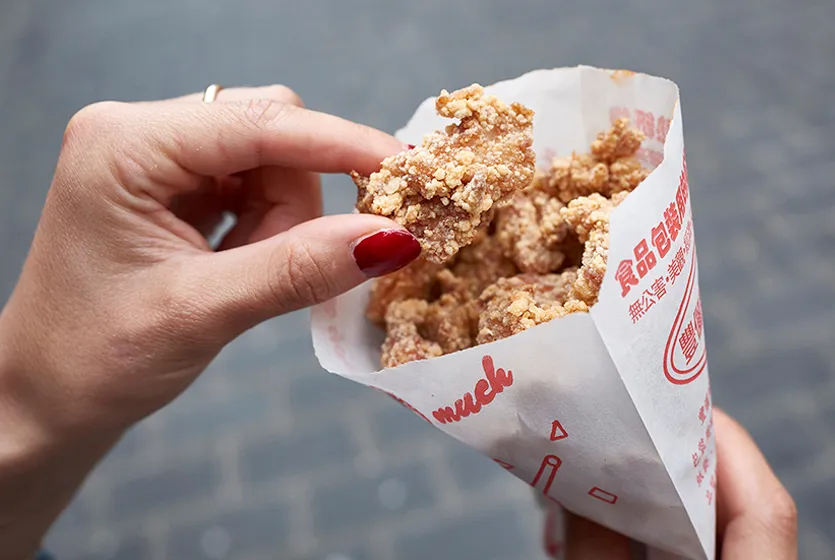
The Bottom Line

Creating a Japanese onsen-style bath at home is less about expensive products and more about a shift in thinking. Strip the space back. Choose natural materials. Prioritise depth, warmth, and quiet.

Secure stillness. When you sit in a tub of hot water in a room with nothing to distract you, the effect on body and mind is immediate and cumulative. The onsen teaches us that the most restorative spaces are often the simplest, and that healing begins with the decision to slow down.

The Way To A More Meaningful Life: Are You Living Your Eulogy?

With the Night Manager’s second season concluded and our old DVD of The Wire scratched and stuttering, we’ve recently been binge watching the affable and slightly unrealistic Netflix drama Sweet Magnolias.

In the episode If Thou Wilt, Remember, which brings the idea of funerals, death, and the celebration of life to the fore, one line that particularly stuck with us was; “You know, my, uh, papa used to say, “Live your eulogy“”.

Sure, we may do things to proactively prepare for our death. We contemplate life insurance, we write our will, and generally, euphemistically, we get our affairs in order. Some of us even plan our own funerals. But one thing that many of us don’t do is write our own eulogy, let alone live it.

Writing your own eulogy may sound a little morbid, but we shouldn’t shrink away from thinking about our legacy. According to The New York Times best seller Hero on a Mission – as reported by Inc – if you want to live a more meaningful life, then you should start by writing your own personal paean.

Many philosophers argue that by living a life of purpose and meaning, we can bring about feelings of happiness and satisfaction. Doing so helps us navigate our experiences with intention, connects us with others, offers a sense of fulfilment, and ultimately enriches our existence. However, in the grand theatre of life, we’re often more busy chasing promotions, not pondering posthumous praise and wondering about the impact we had on the planet.

Yet, imagine if we lived for our eulogies instead? Picture your best friend standing up at your memorial, recounting tales of your legendary kindness, your infectious laughter, or your uncanny ability to find the best parking spots when you invited your friends out for a day trip. Now that’s a legacy worth striving for!

Living your eulogy means prioritising the things that truly matter – love, relationships, the planet – whatever matters to you.

What Would Your Eulogy Say Right Now?

Ask yourself what your eulogy might read like. We can tell you one thing; no one wants theirs to read “broke the office record for most emails sent in a day” or “once binge-watched an entire HBO series in single sitting” (yep, it was The Wire).

A not-so-flattering legacy as the overzealous email sender or a champion couch potato really makes you think. Better to live the eulogy that you want to be remembered by… 

An Epiphany Moment

People who have written their own obituaries often describe it as an epiphany moment. One woman who attended an obituary workshop in America – an incarnation of the “death positivity” movement which believes having open, honest conversations about death & dying is the cornerstone of a healthy society – told the Guardian that despite being only thirty, writing her own obituary had been an epiphany.

This is because, it made her feel that she hadn’t achieved enough in her life. “It was like, wow, I really need to get my shit together,” she says.

Indeed, for many, writing their own obituary or eulogy can be a wake up call – you could get run over by a bus tomorrow, after all.

Reasons To Live Your Eulogy

The concept of living your eulogy is tied closely to the idea of defining and pursuing a meaningful life. Some other reasons on why you should consider living your eulogy include…

Clarity of Purpose: Writing a eulogy is inherently introspective. It helps one identify and articulate what they value most in life, leading to a better understanding of one’s purpose and life goals. By determining the kind of person you want to be remembered as, you gain a clear understanding of your purpose and the values that align with that purpose.

Guided Decision Making & Evaluation of Actions: When faced with choices or challenges, thinking about how you want to be remembered can guide your decisions and actions. A self-written eulogy sets a benchmark for evaluating one’s actions. If an action does not contribute to the vision articulated in the eulogy, it might be reconsidered.

Focusing on the Big Picture & What Matters: Living your eulogy can help you disregard distractions and less important matters, and instead focus your energy on what truly matters to you. This exercise allows people to step back from the day-to-day tasks and focus on what truly matters in the long term, helping them make decisions that are aligned with these long-term goals and values.

Motivation and Determination: Remembering your end goals can serve as a source of motivation during difficult times.

Living Your Legacy: A self-written eulogy is an opportunity to consider the kind of legacy one wants to leave behind. This can be a powerful motivator for pursuing meaningful work and relationships. Living in way that aligns with your desired eulogy ensures that you leave behind a legacy that you are proud of.

Living Authentically: Writing one’s eulogy can create a roadmap for living a life that is true to one’s values and beliefs, leading to an authentic existence. Following your values and goals can bring a deep sense of fulfillment, as you would be living a life that is true to you.

Living Your Eulogy & The Gravestone Exercise 

Living your eulogy is closely associated with Stephen R. Covey’s gravestone exercise. The gravestone exercise asks individuals to envision what they’d like their epitaph to convey after they’ve passed, rather than what they’d like their life insurance policy to contain. 

The idea is to reflect on your own mortality by imagining what you would like your tombstone or gravestone to say about you after you’ve passed away. And it’s not just a thought exercise, either; a growing number of people are taking practical steps in this direction, working with forward-thinking firms like Exit Here London funeral directors to plan services that actually reflect who they were and how they lived. This helps to clarify what is most important to you in your lifespan and what kind of person you want to be remembered as.

People often find that this exercise brings clarity to their personal and professional goals, as it often highlights the discrepancy between their current path and the path that leads towards the legacy they want to leave behind. Doing the gravestone exercise can help you avoid being ‘dead serious’ about the wrong things in life.

Now, both these exercises are not to put you in an early existential crisis, but rather to give you much-needed perspective. Indeed, this introspective exercise is a reminder of life’s brevity, prompting one to live in accordance with their ultimate goals and values

Like the gravestone exercise, living your eulogy essentially means aligning your daily actions, decisions and relationships with the legacy you wish to leave behind, serving as a reminder to continuously strive towards becoming the version of ourselves we’d like to be remembered as.

It’s important to note that the idea isn’t to obsess over death, but rather to use the inevitability of death as a catalyst to live a meaningful and fulfilling life now, whether you’re embarking on an academic journey at university or settling down into a peaceful retirement.

As the saying goes, “The trouble is, you think you have time.” Understanding that our time is limited can inspire us to make the most of the present.

The Bottom Line

Writing your eulogy can provide you with a kind of ‘how to live’ guide, a personal constitution you can refer back to in times of doubt or crisis. It’s a way of checking in with yourself and making sure you are living the life they truly want to live. 

So, go ahead and fast forward to your own funeral. It’s a bit macabre, yes, but it’s also a sober reminder to prioritise the living part your life.
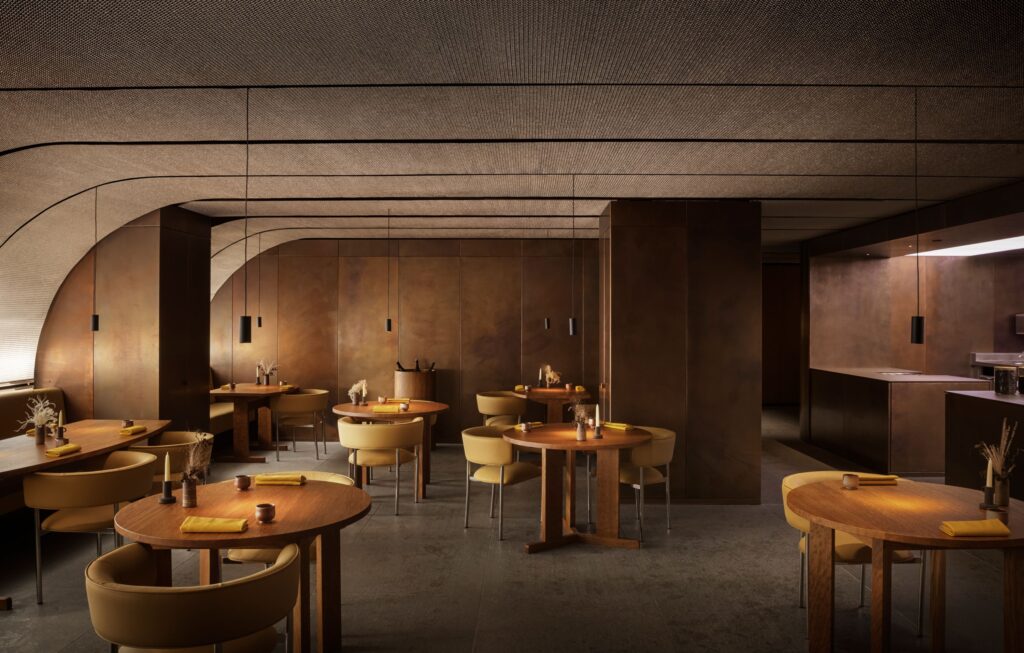
If you still find the idea of writing your own eulogy a little morbid, consider framing your eulogy as creating a goal (or goals) and working backwards from it; reverse engineering your life, so to speak.

Once you’ve laid out how you want to be remembered, it’s a lot easier to be intentional about what you do with your life!

9 Useful Tips For Expats Moving To Dubai

Ideal for those looking to settle in seamlessly…

So, you’re moving to the City of Gold, also known as the Sand Paradise and sometimes called the Gulf Tiger? When you reel off those glamorous, intoxicating nicknames, upping sticks to Dubai sounds swell. Care to sneak us along in your suitcase?
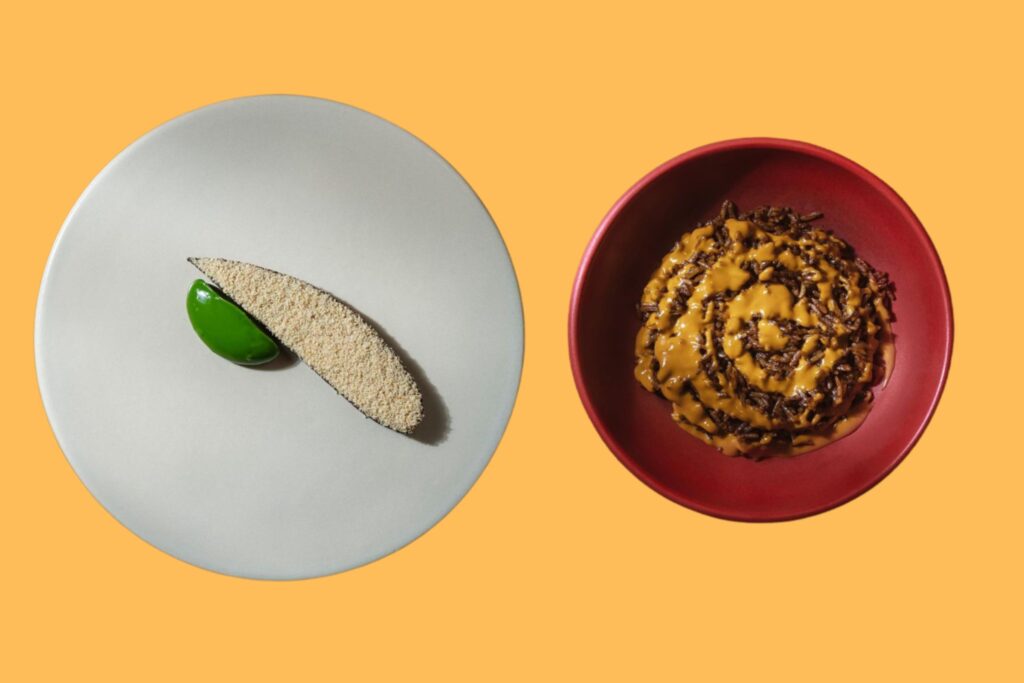
But it’s not all massive buildings, swanky restaurants and several zeros added to your bank balance with each connection you make. Instead, you’ll find Dubai a city of dichotomy. Though there’s convenience and comfort to be found in spades here, it’s also a place capable of delivering a pretty massive culture shock to first-timers, with extreme weather and a new set of customs to get acclimatised to.
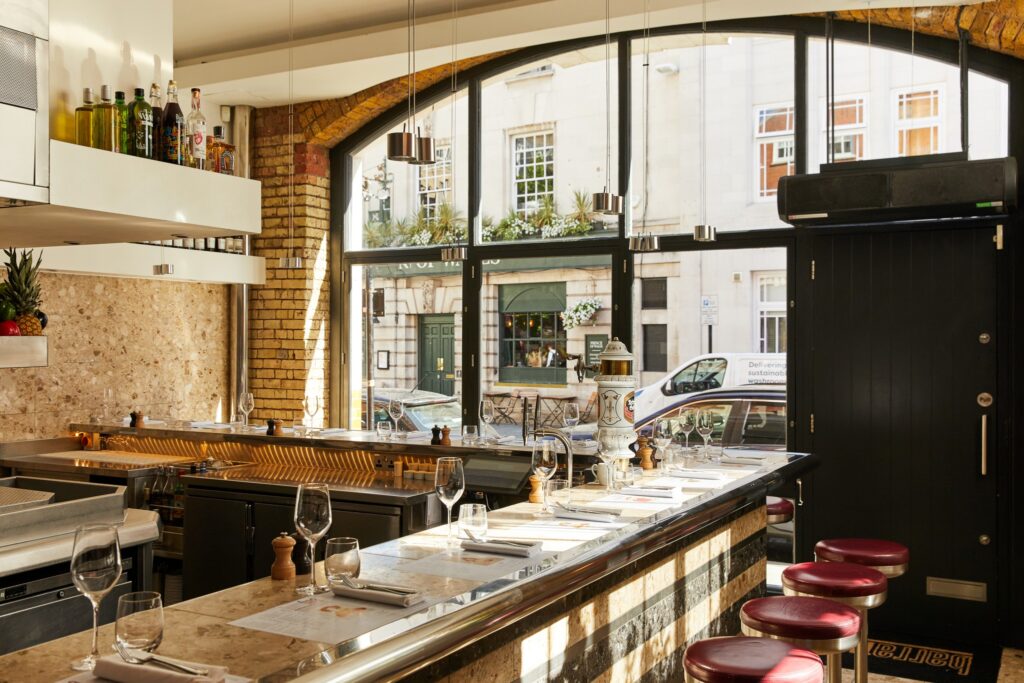
We’re here to help you settle in. Covering everything from how to rent a car in Dubai to the finest food in the city-state, here are 9 useful tips for expats moving to Dubai, IDEAL for those looking to settle in seamlessly.

Respect The Local Culture & Customs

Before you dive into the logistics of your move to Dubai, it’s crucial to understand and respect the emirate’s cultural and religious customs. As a Muslim country, the UAE observes Islamic traditions, and while Dubai is known for being one of the most progressive cities in the Middle East, certain social norms should be followed.

Dress codes are generally conservative, particularly in public spaces like malls, markets, and government buildings. While beachwear is perfectly acceptable at the beach or pool, it’s important to dress modestly elsewhere. For women, this means covering shoulders and knees, while men should avoid going shirtless outside of beach areas.

During Ramadan in Dubai, eating, drinking, or smoking in public during daylight hours is prohibited, even for non-Muslims. Many restaurants will be closed during the day, though some will offer discrete dining areas for non-fasting individuals. The holy month brings a unique atmosphere to the city, with shorter working hours and lively evening festivities that are worth experiencing.

Public displays of affection should be kept to a minimum. While UAE law was reformed in 2020 to decriminalise cohabitation for unmarried couples, discretion remains important, and shared cultural norms around modesty in public still very much apply. Additionally, be mindful that taking photographs of people without their permission is illegal, as is using offensive gestures or language in public.

Understanding these cultural nuances will not only help you avoid any inadvertent faux pas but will also enrich your experience of living in this fascinating city where tradition meets modernity.

Deciding On An Area To Live

Should you be heading to Dubai without a place secured, eager to see which neighbourhood feels right for you, then firstly, may we compliment you on your forward-thinking? We agree, it’s best to get a lay of the land first, before settling on somewhere to live, as each area offers something different, whether you’re a family seeking somewhere peaceful, or a young professional out on your own and wanting a more stimulating experience.

Whilst we wouldn’t want to state the obvious, Downtown Dubai has loads going on, with some seriously high-end shopping and dining options. It’s busy, bustling and full of energy, and where the most famous landmarks, such as the towering Burj Khalifa, are located.

As such, it’s perfectly suited to those young professionals we mentioned earlier. That said, it’s going to cost you, with a one bedroom apartment in Downtown Dubai coming in at around AED 10,000 to 15,000 per month (roughly £2,100 to £3,100). For families, you should also be aware that there are no schools downtown, though there are great transport links to several provided.

The most expensive areas in Dubai to own a property (and that’s saying something) are Palm Jumeirah, Emirates Hills and Dubai Marina. Speaking of which, should you be moving to Dubai as a young couple, and still want to be amongst the action but with a little more elbow room, Dubai Marina is where it’s at.

For something more affordable, Mirdif is still pretty centrally located, with several schools, a park, tennis courts and a shopping mall, and is popular with expats. Be warned that rush hour traffic in and out of Mirdif can be pretty frustrating, though connectivity should improve when the new Blue Line metro extension reaches the area (expected 2029). For expat families who are looking to spread out a little more, Arabian Ranches is the perfect choice.

Transport Smarts

Navigating your way around the City of Gold can be a thrilling experience, but it’s also essential to understand the various modes of transport available to you. Dubai boasts a well-structured and efficient transport system, making it easy for expats to get around.

Dubai Metro

The Dubai Metro is a state-of-the-art, driverless, fully automated rail system that is clean, fast, and efficient. It serves major tourist attractions, business hubs, and residential areas across two operational lines: the Red Line, which runs along Sheikh Zayed Road through the heart of the city (all the way out to Expo City Dubai), and the Green Line, which circles the Creek in Deira and Bur Dubai. 

A third line, the Blue Line, is currently under construction and expected to open in 2029. The metro operates from 5am to midnight Monday to Thursday and Saturday, from 5am to 1am on Fridays, and from 8am to midnight on Sundays. Do note that operating hours are sometimes extended during public holidays and major celebrations.

Taxis

Taxis are abundant, metered, and reasonably priced in Dubai. They can be hailed down on the street, booked online, or through various taxi booking apps. Dubai taxis are regulated by the government, and all drivers are professional and courteous. Be aware that during peak hours, finding a taxi might be a bit challenging.

Buses

Dubai’s bus network is extensive, serving over 140 routes across the city. The buses are modern, air-conditioned, and equipped with facilities for people with disabilities. They’re a cost-effective way to travel, especially if you’re on a tight budget.

Trams

The Dubai Tram operates in the Marina and JBR area, providing connectivity to the Dubai Metro and the Palm Monorail. Trams run at intervals of roughly 8 to 10 minutes during peak hours, and it’s a convenient way to travel around these areas.
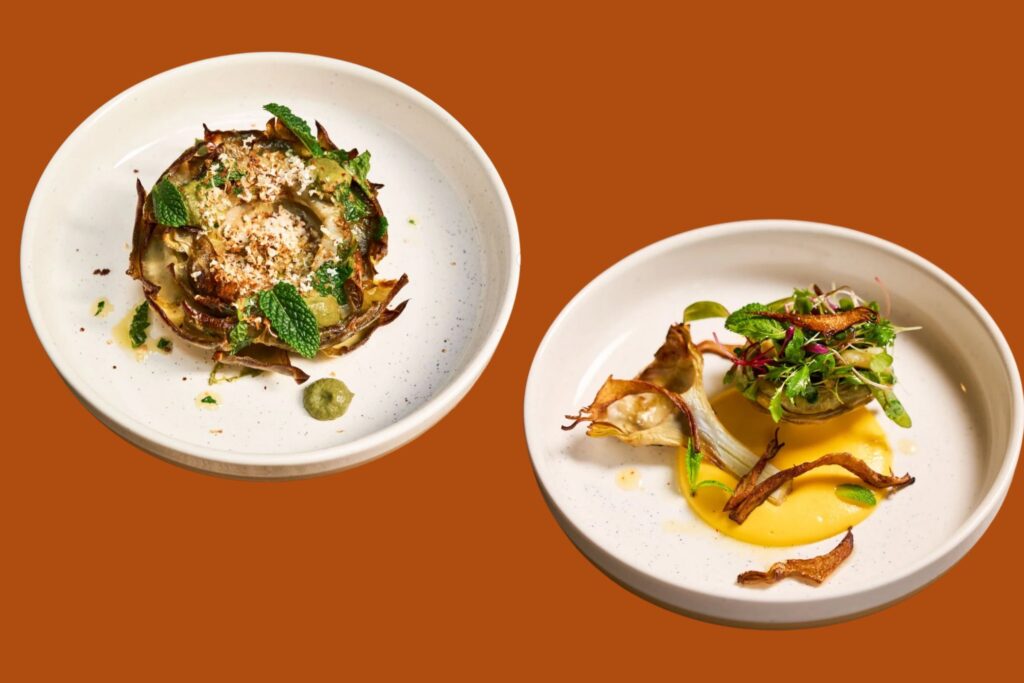
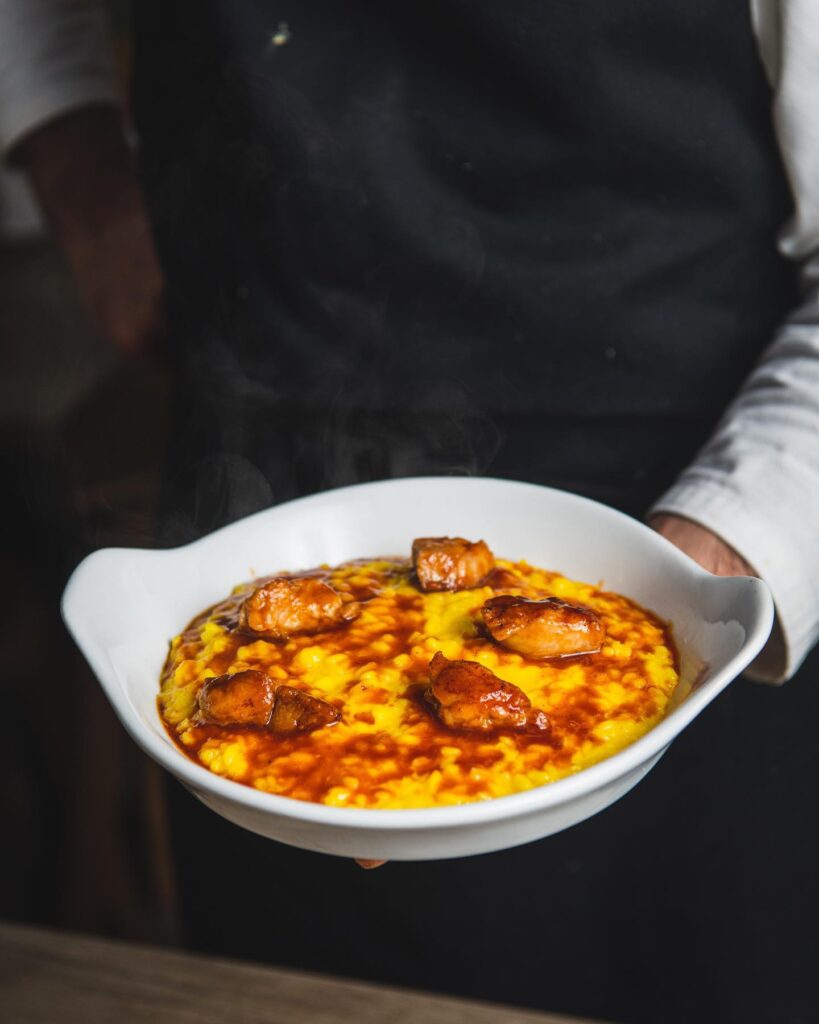
Car Rentals

If you prefer the freedom of driving, car rentals are widely available. However, keep in mind that traffic in Dubai can be heavy, especially during rush hours, and parking can be a challenge in busy areas. Also, remember that in the UAE, driving is on the right-hand side of the road. Should you choose to rent here, remember that the steering wheel will be on the left side of the car!

Bicycles

For short distances, consider renting a bicycle. Dubai has been increasingly promoting cycling, with dedicated cycling paths in specific areas of the city.

Abra (Water Taxi)

For a more traditional mode of transport, try the Abra, a type of water taxi found in Dubai. It’s a fun, inexpensive way to cross the Dubai Creek and offers a fantastic view of the city’s skyline.

Climate Cautious

The famous Dubai heat is certainly not to be underestimated. Temperatures routinely break the 40°C barrier in the sprawling summer months (from May to September) and don’t dip much below the mid twenties for the rest of the year. Indeed, don’t be surprised if the heat is pushing 50°C at times.

Although there’s some serious air-con going on indoors in Dubai, do be aware that this can lull you into a false sense of security. When you step outside or enter a vehicle, even for a second, you’ll feel that heat. If you’re heading out to enjoy the beach or one of Dubai’s famous water parks, do so early, before the midday sun bears down, stay hydrated and apply strong sunscreen, particularly between 10am and 4pm when the UV strength is considerably higher.

Work Smarts

Should you be travelling to Dubai with the intention of finding a job once you arrive, then be aware that any foreign national will need to secure an employment visa and Emirates ID, typically arranged through your sponsoring employer, in order to work legally.

Nearly all of those intending to work in Dubai will have already secured a job, and their company will have arranged the necessary work permit and residency visa on their behalf. That said, you can enter on a tourist visa and then look for work. The standard visa-on-arrival for UK passport holders grants a 30-day stay, though 60-day and 90-day visit visas are also available depending on your nationality and application route.

To assist your company with your work permit application, you’ll need a valid passport with at least six months until expiry, copies of your work contract, a medical fitness certificate, proof of qualifications and education, and the trade licence of the company you’re working for.

Starting A Business

Should you be arriving with the intention of setting up shop, Dubai has become considerably more welcoming for foreign entrepreneurs in recent years. Following major reforms to the UAE Commercial Companies Law in 2021, 100% foreign ownership is now permitted across the vast majority of mainland business sectors, meaning you no longer need a local sponsor holding a 51% stake as was previously required. 

As Rosemont Partners expert corporate services recommend, a handful of strategic industries (banking, telecom, and a few others) still require local partnership, but for most expats, this is no longer a hurdle. Free zones remain another popular option, offering tax incentives and streamlined setup processes.

Read: Your complete guide to Dubai’s best desert adventures

Cleaning & Laundry

Dubai has a fully appointed housekeeping industry, with the majority of expat households hiring the services of a housekeeper, cleaner, cook, security guard and more for the duration of their time in the city. If you’re not familiar with this level of help, it may feel strange at first, but if you’re paying fair wages and treating your housekeeper with the maximum levels of respect, then the arrangement works well for all parties.

Where once your landlord would pass on a recommendation for housekeepers or provide one with the property, now expats tend to use apps to find home help around the home. The justmop.com app is the preferred platform for many.

Feed Me

Like all things in Dubai, restaurant prices here are sky-high. If you’ve money to burn on foie gras topped with gold leaf and caviar, then be our guest. Actually, don’t; you sound expensive to host.

If you’re up for something more authentic, head out of the malls and onto the road. Around Old Dubai you can find cheaper restaurants with loads of traditional, family style food on offer. While Dubai doesn’t have a street scene as such, if you head to Al Rigga Street, you’ll find amazing Arabic shawarma, manakeesh and sweet treats like luqaimat to titillate your taste buds.

For groceries, some of the most ubiquitous, reliable stores include Spinneys, Al Maya Supermarket and, believe it or not, Waitrose. However, for ease, many online supermarkets operate in Dubai, delivering groceries, toiletries and everything you need right to your front door. Many expats avail themselves of such a service to avoid the blistering heat endured walking between shops.

Read: Where to eat on the Palm Jumeirah, Dubai

Learn Some Arabic

Though English is widely spoken in Dubai, and is the preferred tongue for doing business as well as being ever present in the tourism sector, if you’re to get under the skin of the city, it’s best to learn some Arabic.

In Dubai, the Emirati dialect of Arabic is spoken, but a more standard Arabic will be understood everywhere. To learn most efficiently, there are several language centres in Dubai, with the Headway Institute, The Arabic Language Centre, and the Iqraa Arabic Learning Centre being the three most highly regarded.

Exciting times await in the City Of Gold! We hope you settle in smoothly and without a hitch.