Though we realise that we’re in the depths of winter, the shortest day of the year isn’t far away and sunglasses aren’t exactly required, you know what they say about fixing the roof whilst the, erm, sun is shining? Think we might abandon this clumsy introduction, you know…
…Let’s start again. Aviator sunglasses have been a timeless accessory since their inception in the 1930s. Originally designed for pilots, these iconic shades have transcended their utilitarian roots to become a staple in fashion.
However, despite their classic appeal, aviators can sometimes veer into corny territory if not styled correctly. We’re here to help you stay on track, navigate the dos and don’ts of wearing aviator sunglasses, and ensure you look effortlessly chic rather than tragically outdated.
Understanding The Aviator Aesthetic
It’s essential to understand what makes aviators unique. Their teardrop shape, thin metal frame, and double bridge design are distinctive features that set them apart. Aviators exude a cool, laid-back vibe, often associated with a sense of adventure and rebellion.
The design was initially crafted to provide maximum coverage and protection for pilots’ eyes, which is why the lenses are large and cover a significant portion of the face. This utilitarian origin gives aviators a rugged, functional appeal that has been embraced by fashion icons and celebrities over the decades.
The aviator aesthetic is also deeply rooted in pop culture. From Tom Cruise’s iconic look in Top Gun to the effortlessly cool style of musicians like Freddie Mercury, aviators have been a symbol of nonchalant confidence and timeless style. Understanding this heritage can help you appreciate the versatility and enduring appeal of aviators, making it easier to incorporate them into your wardrobe with authenticity and flair.
Face Shape & Aviators
Firstly, let’s think about whether aviators are right for you at all. Choosing the right pair of aviators – or, choosing them at all – involves considering your face shape first.
Aviators are generally flattering on most face shapes due to their balanced proportions and versatile design. However, certain styles can frame your features more effectively:
Oval Faces: Almost any style of aviators will suit an oval face, as this shape is well-balanced and versatile. Feel free to experiment with different sizes and lens colours.
Round Faces: To add definition and length to a round face, opt for aviators with a more angular design. The teardrop shape can help elongate the face and add structure.
Square Faces: Aviators with rounded edges can soften the strong jawline and angular features of a square face. Look for frames that are slightly wider than your face to balance proportions.
Heart-Shaped Faces: For heart-shaped faces, which are wider at the forehead and narrower at the chin, aviators with a wider top and narrower bottom can help balance the face. Avoid overly large frames that can overwhelm your features.
Oblong Faces: If you have an oblong face, choose aviators with larger lenses to add width and balance to your face. Frames with a double bridge can also add a touch of sophistication and break up the length of your face.
Choosing The Right Pair
Frame Material
Aviators come in various materials, from classic metal to modern plastic. Metal frames, particularly in gold or silver, are timeless and versatile. They can be dressed up or down, making them a safe bet for most occasions. Plastic frames, on the other hand, offer a more contemporary look but can sometimes appear cheap if not chosen carefully. For a sense of understated cool, opt for high-quality plastic frames in neutral colours to avoid looking naff.
Lens Colour
The lens colour can significantly impact the overall look of your aviators. Traditional reflective green or grey lenses are versatile and understated, while mirrored or coloured lenses can add a bold statement. If you’re aiming for a classic look, stick to neutral lens colours. For a more modern twist, experiment with subtle tints like blue or brown, but avoid overly flashy colours that can detract from the sophistication of the aviators.
Fit & Size
Aviators are known for their oversized lenses, but it’s still worth considering the size. Too large, and they can overwhelm your features; too small, and they lose their iconic appeal. Ensure the bridge sits comfortably on your nose, and the arms fit snugly without pinching. The bottom of the lenses should ideally rest just above your cheekbones.
Aviator Glasses
Aviator glasses, as opposed to sunglasses, offer a unique way to incorporate the iconic aviator shape into your everyday look. Opt for metal frames in classic colours like gold, silver, or black, and pair them with clear or blue light blocking lenses for a modern twist.
These glasses can add intellectual charm and retro flair to both smart-casual and relaxed outfits, ensuring the rest of your ensemble is polished and cohesive.
Aviator Styling Tips
Casual Cool
Aviators naturally lend themselves to casual outfits. Pair them with a simple white t-shirt, well-fitted jeans, and a leather jacket for an effortlessly cool look. This combination harks back to the rebellious spirit of aviators, reminiscent of icons like James Dean and Tom Cruise in Top Gun. Finish the look with a pair of classic trainers or boots.
Or, go even more casual, and pair your aviators with a band T-shirt and a pair of Lakai skate shoes, or something more relaxed like a hoodie and joggers. This laid-back style is perfect for weekend outings or casual meet-ups with friends.
Smart Casual
For a smart-casual ensemble, aviators can add a touch of relaxed sophistication. Combine them with a crisp button-down shirt, chinos, and loafers. A lightweight blazer can elevate the outfit further, making it suitable for brunches or casual meetings. Stick to neutral colours and avoid overly busy patterns to keep the focus on the aviators.
Beach Ready
Aviators are perfect for beach outings, providing both style and sun protection. Pair them with swim shorts, a linen shirt, and espadrilles for a laid-back yet stylish beach look. A straw hat can add an extra layer of chic while protecting you from the sun. Opt for mirrored lenses to reflect the bright beach environment, but ensure the rest of your outfit remains understated.
Formal Flair
While aviators are inherently casual, they can be incorporated into formal attire with the right approach. Choose a pair with a sleek metal frame and neutral lenses. Pair them with a tailored suit in a classic colour like navy or grey, or even a saree or qipao. Ensure the rest of your accessories, such as your watch and shoes, are equally refined. This look works best for outdoor events or summer weddings where a touch of nonchalance is appreciated.
Common Pitfalls To Avoid
Overly Flashy Lenses
While mirrored and coloured lenses can be fun, they can also quickly look tacky if not styled correctly. Stick to subtle tints and avoid overly reflective or neon lenses unless you’re at a festival or similar event.
Mismatched Styles
Aviators have a distinct style that doesn’t always pair well with certain fashion trends. Avoid wearing them with overly formal or avant-garde outfits that clash with their laid-back vibe. Instead, aim for a cohesive look that complements the aviators’ aesthetic.
Poor Fit
Ill-fitting aviators can ruin your entire look. Ensure they sit comfortably on your face without slipping down your nose or pinching your temples. If necessary, visit an optician to adjust the fit.
The Bottom Line
Aviator sunglasses and glasses are versatile and timeless accessories that can elevate a variety of outfits when styled correctly. By choosing the right pair and following these styling tips, you can ensure your aviators look effortlessly chic rather than naff. Remember, the key is to embrace their laid-back, adventurous spirit while keeping your overall look cohesive and well-balanced. So, go ahead and rock those aviators with confidence!
Here’s the thing; electric cars might be grabbing all the headlines, but for millions of drivers, they’re still not a practical option. Whether it’s the rumoured eye-watering prices, tricky charging logistics, or simply that the timing isn’t right, many of us will be driving petrol and diesel cars for years to come. The good news? There are countless ways to slash your carbon footprint without going electric.
Maintain Your Car’s Vital Systems
The environmental impact of your vehicle isn’t just about what comes out of the exhaust pipe—it’s about how efficiently your car converts fuel into motion. A well-maintained car can emit significantly less CO2 than a neglected one, even if they’re the same model, helping avoid breakdowns in the process, too. Think of it as keeping your home energy-efficient: just as you wouldn’t leave windows open with the heating on, you shouldn’t expect your car to run efficiently without regular maintenance.
Keep Your Catalytic Converter Happy
The catalytic converter is perhaps the unsung hero of emissions control, quietly transforming harmful pollutants into less damaging substances. Yet many drivers unknowingly damage these expensive devices through poor driving habits. A healthy ‘cat’ can reduce your car’s toxic emissions by up to 90%, but it needs the right conditions to work effectively.
The key to catalytic converter health lies in how you use your car. Short journeys are particularly problematic — the system needs time to reach its optimal operating temperature. Regular motorway runs aren’t just enjoyable; they help clear out the system and maintain its efficiency. Think of it like exercising — your car sometimes needs a good run to stay healthy.
Essential maintenance includes:
Addressing engine warning lights promptly
Using the correct fuel grade
Scheduling regular motorway runs
Having it checked during services
Regular Oil Changes Matter
Engine oil is the lifeblood of your car’s efficiency. Modern engines operate with incredibly fine tolerances, and the right oil can make the difference between efficient combustion and wasteful burning of fuel. As oil ages, it becomes less effective at reducing friction and cleaning the engine, leading to increased fuel consumption and emissions.
Contemporary synthetic oils are remarkable at reducing internal friction, which directly translates to lower emissions and better fuel economy. However, they can only do their job if changed regularly and maintained at the correct level. Regular oil changes might seem expensive, but they’re far cheaper than the potential repairs—and environmental impact—of running with degraded oil.
Key practices include:
Following manufacturer service intervals strictly
Using the correct grade and specification
Checking levels monthly
Changing the oil filter with every oil change
Tyre Pressure: The Unsung Hero
Tyre pressure might seem like a minor detail, but it has a surprising impact on your car’s efficiency. When tyres are underinflated, they create more rolling resistance, forcing your engine to work harder and use more fuel. Think of it like trying to push a heavily loaded wheelbarrow — it’s much harder work than pushing one that’s rolling freely.
Modern tyres are engineered to maintain their pressure for longer, but they still need regular checks. The right pressure isn’t just about efficiency—it affects handling, braking, and tyre life too. A properly inflated tyre will roll more easily, requiring less energy and therefore producing fewer emissions.
Monthly maintenance should include:
Checking pressures when tyres are cold
Adjusting for heavy loads
Inspecting for damage
Checking tread depth
Master Eco-Driving Techniques
The way you drive has an enormous impact on your car’s emissions. Efficient driving isn’t just about going slower—it’s about being smarter with how you use the car’s energy. Think of it as being similar to managing your household budget: small, consistent savings add up to significant results over time.
The Gentle Art Of Acceleration
Smooth, progressive driving isn’t just more comfortable – it’s significantly more efficient. Modern engines are designed to operate most efficiently under gentle acceleration, and harsh driving can use significantly more fuel. Imagine you’re carrying a hot drink on your dashboard; this mindset naturally encourages smoother inputs and better anticipation.
The key to efficient acceleration is planning ahead. By looking further down the road, you can anticipate changes in traffic flow and adjust your speed gradually rather than rushing up to traffic lights only to brake heavily. This not only saves fuel but reduces wear on your vehicle’s components.
Effective techniques include:
Accelerating smoothly and progressively
Maintaining consistent speeds
Looking well ahead for hazards
Using cruise control on motorways when safe
Gear Selection Strategy
Modern cars are designed to operate efficiently when in the right gear, but many drivers either change up too late or rely too heavily on lower gears. Understanding your engine’s optimal operating range can significantly reduce fuel consumption and emissions.
Petrol and diesel engines have different characteristics, but both benefit from being in the highest appropriate gear for the conditions. Listen to your engine—if it’s spinning faster than necessary, you’re likely using more fuel than you need to.
Best practices include:
Changing up before 2,500rpm in petrol cars
Shifting before 2,000rpm in diesel engines
Using higher gears whenever possible
Avoiding labouring the engine in too high a gear
Journey Planning
One of the most effective ways to reduce your carbon footprint is to plan your journeys more efficiently. This isn’t just about taking the shortest route—it’s about considering when and how you travel to minimise your environmental impact.
Modern technology makes this easier than ever. Navigation apps can show real-time traffic conditions and suggest more efficient routes. Combining multiple short trips into one longer journey allows your engine to reach its optimal operating temperature and your catalytic converter to work effectively.
Smart planning includes:
Combining multiple errands into single trips
Avoiding peak traffic times when possible
Using real-time traffic information
Considering park-and-ride options for city centres
Weight Management
Every extra kilogram your car carries requires more energy to move, increasing fuel consumption and emissions. While you can’t change your car’s basic weight, you can ensure you’re not carrying unnecessary items. It’s surprisingly easy to accumulate ‘just in case’ items that rarely, if ever, get used.
Regular audits should address:
Removing unnecessary items from the boot
Clearing out door pockets and storage areas
Carrying only essential tools and equipment
Removing seasonal items when not needed
Stop-Start Technology
If your car has stop-start technology, use it. Modern systems are designed to reduce emissions and save fuel without harming the engine. The fuel saved might seem minimal per stop, but it adds up significantly over time, particularly in urban driving.
Making The Decision To Upgrade
If your current car is more than a decade old, upgrading to a newer conventional model might significantly reduce your carbon footprint. Even the method of your car delivery can make a difference — opting for collection or choosing a delivery service that consolidates routes reduces the environmental cost of getting your new vehicle home. Modern petrol and diesel engines are remarkably efficient, with sophisticated emissions control systems and better fuel management.
Consider these factors:
Real-world fuel economy figures
Emissions ratings
Maintenance costs
Overall environmental impact of manufacturing
The Bottom Line
Making your existing car greener isn’t about dramatic changes—it’s about understanding how your vehicle works and making informed decisions about how you use and maintain it. The cumulative effect of these adjustments can reduce your carbon footprint substantially while often improving your car’s reliability and your driving experience.
Start with the basics: regular maintenance, thoughtful driving, and journey planning. As you become more comfortable with these changes, you can explore more advanced modifications and techniques. Remember, every reduction in fuel consumption directly translates to a reduction in carbon emissions—and that’s a win for both the environment and your finances.
Think of your car as an ecosystem: each component and driving decision affects overall efficiency. By taking a holistic approach to reducing your car’s environmental impact, you can make a significant difference without making the switch to electric just yet.
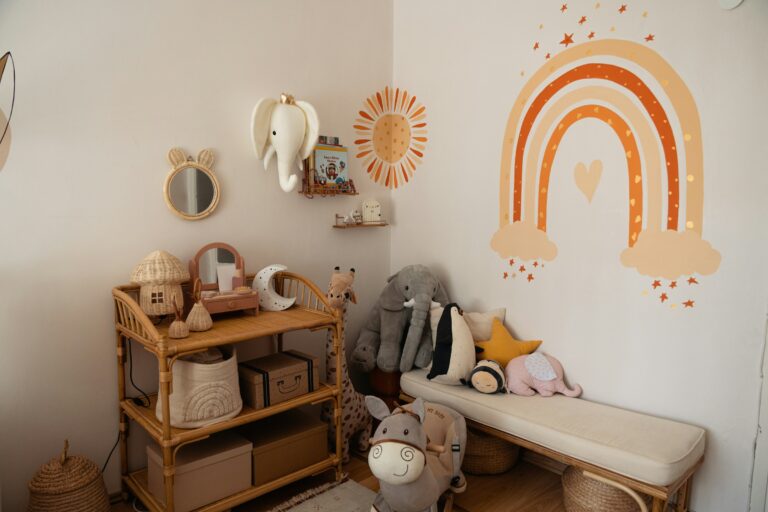
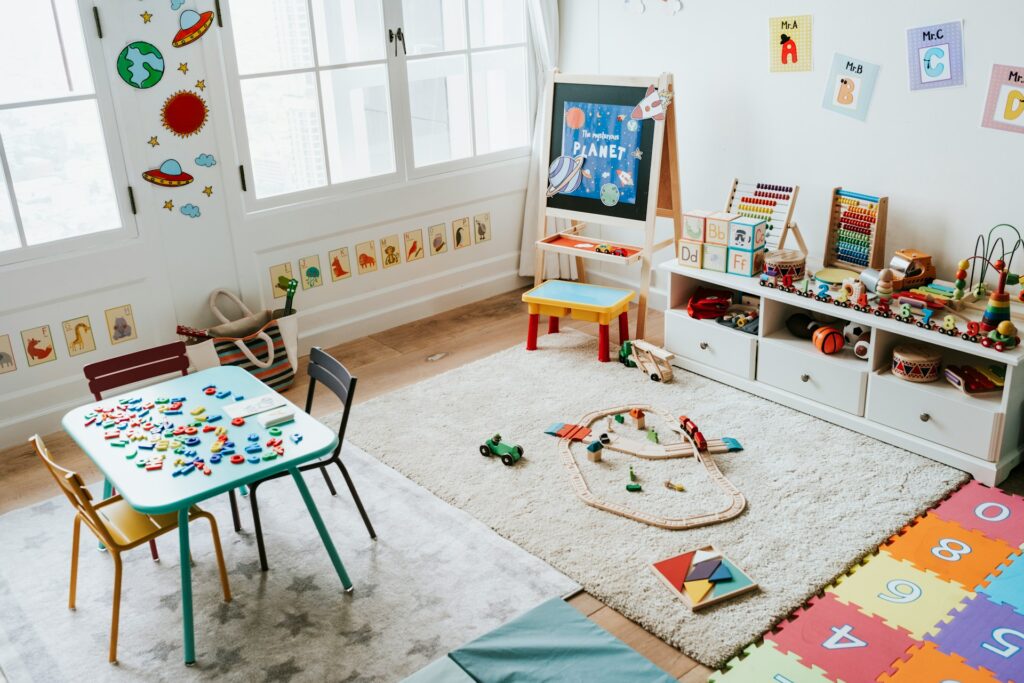
Designing your toddler’s bedroom isn’t just about choosing pretty colours or matching furniture – it’s about crafting an environment that nurtures their blossoming creativity and supports their developmental journey. With that in mind, here’s how to transform your little one’s room into a haven of imagination, guided by well-established principles of child development.
The Power Of Colour & Light
Toddlers are naturally drawn to bright, contrasting colours, but this doesn’t mean we should paint every wall in primary hues. Instead, consider creating a neutral, calming base with strategic pops of colour to stimulate curiosity without overwhelming their developing sensory system.
Natural light plays a fundamental role in regulating your toddler’s sleep-wake cycle and overall wellbeing. Position their play area near a window, but ensure you have effective blackout solutions for naptime and bedtime. The presence of natural light throughout the day helps establish healthy sleep patterns and provides an ever-changing canvas of shadows and light that naturally stimulates curiosity.
Educational Murals & Wall Art
Educational wall murals such as those from Photowall can transform a bedroom into an immersive learning environment. Consider designs that grow with your child: a world map that initially offers colour and visual interest can later become a tool for learning about different countries and cultures. Nature-themed murals featuring woodland creatures, sea life, or the solar system provide natural conversation starters about the world around us.
However, choose designs thoughtfully—avoid overwhelming patterns and opt for murals that can be changed or removed as your child’s interests evolve.
Creating Zones For Different Types Of Play
Different types of play—particularly pretend play and constructive play—support various aspects of your toddler’s development. Create distinct areas in your toddler’s room that encourage these different play styles:
A cosy reading nook with soft cushions and easily accessible books encourages early literacy and provides a quiet space for settling down. When books are displayed at your child’s height and in an inviting setting, they’re more likely to develop a natural interest in stories and reading.
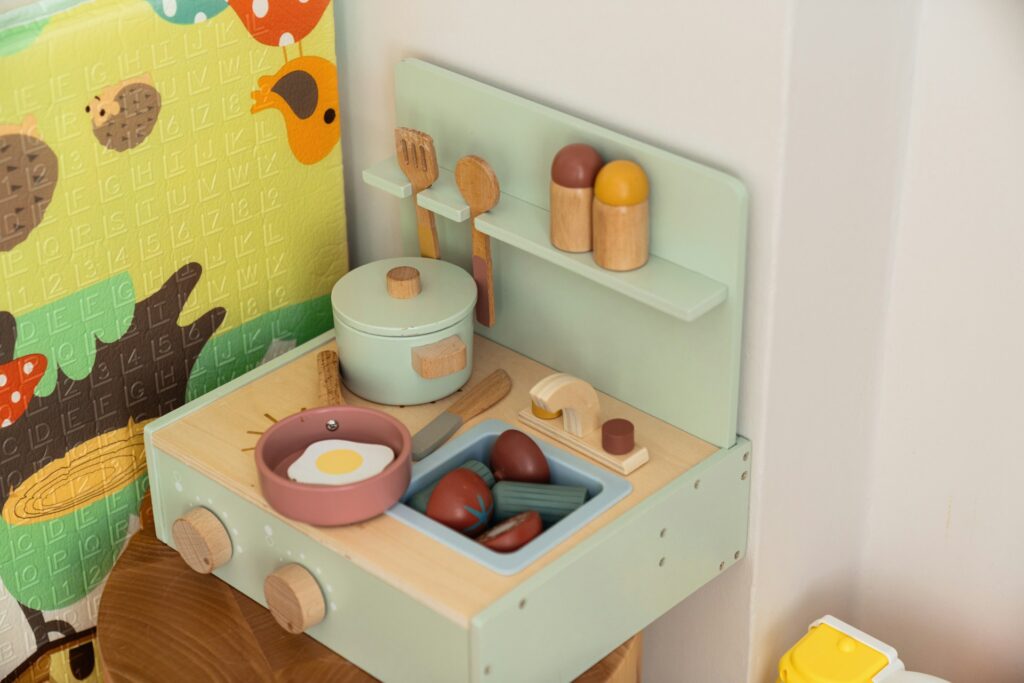
A simple play kitchen or shop corner supports imaginative play, which helps develop social skills and emotional understanding. Keep it simple—a few wooden crates and basic props often inspire more creativity than elaborate setups, as they leave more room for imagination.
Freedom To Move And Explore
Movement is essential for toddlers’ physical development and learning. Incorporate elements that encourage safe physical activity: cushions for climbing, stepping stones, or a hanging pod chair can help develop spatial awareness and motor skills whilst making the room more engaging.
Storage That Empowers Independence
A child’s sense of autonomy grows through their ability to make choices and access their belongings independently. Install low shelves and use clear containers so your toddler can see and choose their toys. This setup helps them learn to make decisions and take responsibility for their belongings.
Sound & Music
Creating opportunities for musical exploration and auditory development can enrich your toddler’s space. A dedicated music corner with simple instruments like xylophones, drums, or shakers allows for spontaneous musical expression. Consider a small speaker for playing gentle background music or audiobooks during quiet play. Being mindful of sound also means incorporating soft furnishings that help absorb noise and create a more peaceful environment.
Bringing Nature Indoors
Including natural elements in living spaces has long been recognised as beneficial for wellbeing. Consider adding child-safe plants, nature-themed wall art, or a small indoor sand table. These elements can help create a calming atmosphere while providing sensory experiences that support development and an interest in the environment, too.
The Art Of Balance
Remember that whilst it’s important to create an engaging environment, avoiding overstimulation is equally crucial. Leave some empty space on walls and shelves—this ‘breathing room’ helps prevent sensory overload and gives children space to focus on their chosen activities.
Interactive Wall Features
Beyond traditional decorative elements, consider adding interactive wall features at toddler height. A magnetic board for shape sorting, a felt board for storytelling, or a wipeable surface for early mark-making can transform empty wall space into engaging activity zones. These features encourage fine motor skills and creative expression while making use of vertical space—particularly valuable in smaller rooms.
Flexibility For Growing Minds
Perhaps most importantly, leave room for change. Young children learn through exploration and experimentation, so create a space that can evolve with your child’s interests. Consider magnetic walls for displaying artwork, easily rearranged furniture, and storage solutions that can adapt to changing needs.
The Bottom Line
When implementing these ideas, start small. Observe how your toddler uses different spaces and elements in their room, and adjust accordingly. Sometimes the simplest changes—like lowering a bookshelf or adding a cosy corner—can have the biggest impact on their engagement and independence.
Remember, the goal isn’t to create an Instagram-perfect room, but rather a space where your toddler feels safe, inspired, and empowered to explore. By thoughtfully considering these elements, you’re creating an environment that supports your child’s natural development and nurtures their innate creativity.
The key is creating a space that balances stimulation with serenity, educational opportunities with pure play, and current needs with room to grow. When thoughtfully designed, your toddler’s bedroom becomes more than just a place to sleep—it becomes a launching pad for learning, creativity, and adventure.
Christmas can go two ways. If you’ve had a brilliant year, it’s the perfect time to cosy up and bask in the festive glow. However, if you’ve separated from your children’s other parent, the sight of twinkling lights might fill you with uncertainty.
We understand how challenging this time can be. Whether you’re navigating the complexities of family law arrangements or simply trying to make sense of it all, here are some thoughtful ways to help you create meaningful moments during the festive season with your children after separation.
Reinvent Christmas (In Your Own Time)
That first Christmas without the kids around might feel particularly difficult. But consider this: you have the opportunity to create new traditions and celebrations. Think about choosing another special day to exchange presents, share a meal, and enjoy time together. It’s not about replacing Christmas Day, but rather about creating additional moments of joy.
Many children appreciate having two celebrations, as long as you’re mindful of the timing. The key is to avoid asking them to split December 25th between houses. Nobody needs the pressure of two Christmas dinners in one day, regardless of how tempting it might sound.
When it’s not your turn with the children, try to plan activities that keep you connected with others. Staying home alone can intensify difficult emotions. Consider alternating years – one year you’re creating Christmas memories with the children, the next you’re exploring new traditions for yourself.
Open Conversations With Your Children
Discussing Christmas arrangements with your children requires sensitivity and care. For younger ones, clear plans provide security, much like any other routine. For older children, including them in some of the planning discussions can help them feel heard and respected by both parents.
Finding Balance During Challenging Times
Managing emotions during separation is complex, and divorce can bring forth a range of feelings that need acknowledging. While it’s important to process these emotions, try to share them with your adult support network rather than your children. Young ones are remarkably perceptive to the emotional climate around them, even when they seem absorbed in their own activities.
Focus on creating gentle, positive moments when you’re together. These will become the memories that matter.
Building a Supportive Network
The statistics tell us something important: 42% of marriages end in divorce, with nearly half involving children under 16. This means many parents are navigating similar challenges. Connecting with others who understand your situation can provide both practical advice and emotional support.
If you know others in similar circumstances, consider creating new shared traditions. A pre-Christmas gathering or a quiet Boxing Day meal can offer comfort and companionship.
Finding Comfort in Giving Back
While managing practical holiday arrangements, remember to tend to your own wellbeing. The Mental Health Foundation notes that helping others can provide a sense of purpose and connection, particularly during challenging times.
Consider volunteering at your local food bank or participating in community events. These activities can provide meaningful structure to days when you’re not with your children.
Managing Gift-Giving Thoughtfully
Consider coordinating with your former partner about presents for the children. This can help avoid duplicate gifts and ensure neither parent feels pressured to overcompensate. You might decide to give joint presents for bigger items, or agree on spending limits that work for both households. Remember that children value your presence and attention more than expensive gifts.
Creating New Traditions with Extended Family
Extended family members often feel uncertain about how to navigate the holiday season after a separation. Have open conversations with grandparents, aunts, uncles, and other family members about how they can best support you and your children during this transition. Consider establishing new routines that allow children to maintain meaningful connections with both sides of the family, perhaps celebrating with different relatives on different days.
The Bottom Line
Surviving Christmas after separation requires patience and understanding. While compromise is essential, remember to be gentle with yourself as you adjust. Different doesn’t necessarily mean diminished – it can mean the beginning of new traditions that hold their own special meaning.
This Christmas might look different from those past, but with time and care, you can create warm and meaningful celebrations that work for everyone involved.
Whether you’re a pasta-phile, a lover of fine wine, an olive oil enthusiast, a renaissance art and architecture aficionado, or simply love to gaze over rolling hills ad infinitum, Tuscany has got you covered.
Whilst we luxuriate in the Italian region’s famously warm embrace, you might be considering moving here, awed by the fresh produce, laid back pace to life, clean air and a little bit of the ol’ dolce vita.
If so, then you’ve come to the right place for guidance on narrowing down your search into a shortlist of the 7 best cities and towns for British expats to live in Tuscany, IDEAL for living la dolce vita, for life.
Pisa: Ideal For Accessibility & Transport Links
There’s so much more to Pisa than that learning tower. Boasting its own international airport and easy accessibility to Tuscany’s other key cities and sites, as well as its position close to the coast, Pisa is the ideal city for expats in terms of location. With the centre of the city close, compact and pedestrianised, it’s also an incredibly accessible place once you’re there.
Because it’s a popular tourist destination, English is spoken here extensively, but if you’re keen to learn the local language, Pisa boasts several Italian language schools, too. Buying and renting property in Pisa is also, on average, cheaper than both Lucca and Florence. In short, Pisa represents a smart compromise between price and ROI.
For those considering the practicalities, the rental market here averages 20-30% lower than Florence, with two-bedroom flats ranging from €700-900 monthly in residential areas. The international airport serves year-round flights to major UK cities. Local estate agents often prioritise long-term rentals to permanent residents over holiday lets, giving you better negotiating power.
Lucca: Ideal For Evening Strolls & Serenity
Close to the Ligurian sea and just twenty minutes drive from the gorgeous beach of La Lecciona, Lucca is one of Italy’s most visually arresting cities. Surrounded by well preserved medieval city walls and cut in two by the Serchio River, Lucca is known as the City of 100 Churches, defined by its historic architecture.
Those historic city walls are now pedestrianised, and are a hugely popular spot for passeggiata, the beloved Italian pastime that mixes strolling, socialising and being seen. Because Lucca is less touristy than Florence and Pisa, the cost of living in terms of eating out, shopping and other amenities tends to be lower than those two tourist juggernauts. Accordingly, the centre is also significantly less crowded, and it’s these factors that mean Lucca has become increasingly popular with British expats in recent years.
The city boasts a strong expat community network, with regular language exchange meetups, and the local chamber of commerce offers free business setup consultations for new residents. Healthcare is particularly accessible, with several English-speaking GPs and specialists. The local market scene thrives year-round, with the Via Fillungo market offering significantly better value than tourist-oriented venues.
If you’re keen to base yourself a little further out of the city centre, then Lucca’s surrounding countryside is gorgeous, too. The Piana di Lucca, (Plain of Lucca) plays host to some of Tuscany’s most luxurious rental villas, helping give you a flavour of this unique part of the region before you commit to living here full-time. Trust us; you will commit…
Florence: Ideal For Foodies
Sure, Florence can get crowded. And yes, the cost of living in the city is the highest in Tuscany. But Florence is popular and keenly priced for a reason.
Well, several reasons, actually; it’s an eminently walkable city, served by some fantastic restaurants, and is one of the most historically interesting, culturally invigorating places on earth. The Uffizi and Palazzo Pitti museums, in particular, are revered across the world for their collections.
The city is supremely well connected to both the north and the south of Italy by train, with Florence’s Santa Maria Novella one of the busiest stations in Italy. Rome is just an hour and a half away via direct, high speed train, while you can get to Naples in under three hours without having to change. To the north, Turin’s Porta Nuova station also takes around three hours, and is direct, too. Bologna, to the east, takes only 40 minutes.
For those expats who love to stay put, Florence is full of gorgeous piazzas where you can sit, sip coffee and admire both the renaissance architecture and the suave people of the city.
For the pragmatists among us: expect to pay 40% more for housing than in surrounding towns. However, the trade-off includes exceptional public transport (€35 monthly pass), numerous co-working spaces for remote workers, and surprisingly good value if you know where to look. The Sant’Ambrogio area offers better-priced accommodation while maintaining easy access to the centre. The healthcare system here is particularly foreigner-friendly, with dedicated international patient services at major hospitals.
Finally, Florence is also one of the foodie capitals of Italy. Do check out our tips on where to live in Tuscany here if you love good food.
In the province of Siena, perched up high atop a hill in the gorgeous Val d’Elsa, you’ll find the medieval town of San Gimignano, which boasts World Cultural and Natural Heritage of UNESCO city status. It’s easy to see why.
Famed for its medieval architecture and collection of 14 towers that seemingly rise straight out of the hill (San Gimignano is known as the City of Beautiful Towers), expats love the palpable sense of history and stunning views from the town.
It’s a small town, with a population of under 10’000, but this brings with it a wonderful, tight knit community. If you’re hoping to make friends and bond with neighbours, a keen grasp of Italian is essential here. Considering San Gimignano’s size and rural, hilltop location, it’s also recommended expats get a car should they be planning to live here.
Critical practical considerations: winter heating costs run high in these medieval buildings, and you’ll absolutely need a car. However, property prices average 30% lower than coastal regions, and recent fibre optic installation means reliable remote working is entirely feasible. The local council offers incentives for renovation projects, potentially offsetting initial property costs. Be aware that most services close during winter months, so factor in regular trips to larger towns for supplies.
Viareggio: Ideal For Old School Italian Glamour
Sitting on the coast of the Tyrrhenian Sea, Viareggio is known as one of the more glamorous (if not a little faded) spots in Tuscany, with its funky, iconic Art Nouveau architecture a world away from the regal, renaissance vibes of Florence.
The city is famed for its 150 year old carnival, which occurs annually. The event sees satirical, sardonic floats that critique societal issues all doing their own passeggiata along Viareggio’s central promenade. Once a favourite holiday destination of the rich and famous, Viareggio is now more likely to attract expats looking for that dolce vita they associate with the Italy of old movies. Whilst some of the buildings here could do with a lick of paint, there’s still glamour to be found; Viareggio boasts several Michelin starred restaurants, and owing to the city’s long held association with the fishing industry, the seafood here is fantastic.
The practical reality: excellent year-round public transport, lower property prices than inland tourist hotspots (about 25% less than Florence), and a genuinely functional infrastructure for permanent residents. The local international school offers IB programmes, and the healthcare system includes specialist facilities for elderly care. The winter population drops significantly, meaning better deals on long-term rentals but reduced social activities.
Chianti: Ideal For Wine Lovers
Moving to Tuscany is a dream come true for wine lovers. Indeed, you could spend the rest of your days whiling away your time at different wine tastings and visiting vineyards with little chance of getting bored.
Tuscany is the birthplace of some of the world’s most iconic wines such as Chianti, Vino Nobile and Brunello, to name but a few. Chianti is one of Italy’s most iconic, noble vintages, with ancient origins dating back to the Middle Ages; if you are an oenophile, it’s here you should move.
If you’re seeking a more laid-back approach to life, you’ll find it on Chianti’s gently rolling hills, olive groves, in its rustic villages and countless vineyards. Also, it’s a hop, skip (or a stagger depending on how much wine you’ve had) away from Florence which means you can experience the hustle and bustle of city life when you fancy a change of pace and scenery.
Beyond the vineyards, consider the practicalities: properties here often come with agricultural land, which means potential tax benefits but also maintenance responsibilities. Internet connectivity varies significantly between villages – essential research for remote workers. The area has seen a recent surge in co-housing projects among international residents, offering a more sustainable approach to rural living. Transport links are limited; factor in private transport costs. Finally, owing to those rolling hills, Chianti is known for playing host to some of the finest cycling routes in Italy, if not the world.
Volterra: Ideal For History Buffs
Located in a prime position just a short drive from Florence, Pisa and Siena, Volterra is a charming walled, mountaintop town with heaps of history to discover. For those keen to take a deep dive into the past, Volterra’s Guarnacci Etrurian Museum is fascinating, with archaeological artefacts dating back more than 2000 years. If you’re hungry for more history, you should visit the Vallebuona archaeological area, with its Roman Theatre and third century baths.
In terms of standard of living for ex-pats, Volterra is a laid back place to live, with the surrounding countryside replete with olive groves and vineyards typical of the Tuscany so many dream of retiring in. Because it’s relatively untroubled by tourism, the cost of living is lower here than many of the other cities on our list.
The key advantage here is value for money – property prices are roughly 40% lower than Florence. Recent infrastructure improvements include new medical facilities and improved road connections. The town council actively supports foreign residents with dedicated cultural integration programmes. However, be prepared for limited English services and fewer modern amenities than larger cities.
Wherever you choose to settle, you’ll be blessed with some of the best food in the world, though you’ll need to consider the practical aspects of the move alongside the romantic notion of Italian living. Energy costs can be surprisingly high in historic properties, many areas require permits for renovation work (even for minor changes), and Italian inheritance law can override UK wills regarding Italian property – all factors worth considering before making your move to Tuscany.
Are you looking to turn your taco night up a notch? To dial down the flavour of the Old El Paso fajita mix, drown out the discontent surfacing from those new born baby sized burritos, and most importantly, to once and for all dispense with those novelty sombreros?
Yep, Taco night at home can be elegant, delicious and different with just a few simple tweaks to the sometimes tired UK formula. With that in mind, here are 5 ways to make your next taco night the best you’ve ever had.
Make Your Own Tortillas
First things first; a mistake so many of us Brits make on taco night is to disregard the actual tortilla – the base of the taco – itself. We’re all guilty of placing too much emphasis on the filling, particularly the protein, and neglecting the heart and soul of the dish. And the cuisine. And the country, come to think of it.
Yep, the best tacos are built on a solid foundation of homemade, proper tortilla. It should be warm, pliable, and tasting like corn. For the full Mexican experience, make your own; the only ingredient you need is Masa Harina (fine corn flour treated with a little calcium hydroxide lime water) which you can buy online from specialist suppliers and Latin American grocery shops. We use the reliable mexgrocer.co.uk or esoteric ingredients specialist Sous Chef.
All you need to do is incrementally add warm water to the Masa Harina (you’ll need roughly a 3:2 ratio), let it sit for a few minutes then knead until you have a pliable small dough. After that, form small balls from that dough, place them between cling film or in a sandwich bag, and flatten thinly, either using a dedicated tortilla press or a rolling pin. Bear in mind that the perfect taco should be gone in two or three bites, so aim for the size of a small American pancake, roughly.
Then, you just grill them on a hot grill pan for 30 seconds or so each side. Keep your homemade tortillas warm in the oven so they don’t turn dry and crisp. That, my friends, is a tostada, and not what we’re going for here. Should that occur, or you’re preparing your tortilla in advance, warm them through on a griddle pan once again before serving, to ensure your tortilla is pliable.
Salsa Diversity
As many a chef will tell you, the soul of Mexican cooking is found in its sauces. God, those sauces; we love them and we’re getting a bit hot under the collar just thinking about salsa. Or, maybe that’s the chilli sweats coming on.
Anyway, the importance of salsa, and the attention you give them in the preparation, can’t be overstated. In a quality taqueria, they’re the first item brought to the table, the first thing you taste, and the first sign to discerning palates of whether the restaurant knows what’s what they’re doing.
The ideal Taco night will have, at the very least, a salsa verde and a salsa roja (green and red) at the table, with spice levels, colour and aromatic qualities defined by the type of chilli you go for, whether you’re using green or red tomatillos, and the amounts of onion, garlic and fresh herbs added.
Experiment with a wide range of Mexican chillis; serrano is ubiquitous but shouldn’t be used indiscriminately, and make sure you stock up your larder with plenty of dried variants, too. Lots of salsas have smoky notes, garnered by charring your ingredients, so experiment with this too.
Most importantly, do endeavour to pair your salsas thoughtfully with the other components of your taco. If you’re doing crispy fish tacos, for instance, an assertive, smokey salsa roja will likely overpower the subtly of the fish. Instead, a fresh and light pico de gallo is just perfect here.
For inspiration, we absolutely love the nuanced, thoughtful salsa recipes from acclaimed London restaurant Breddos Tacos, available on the Great British Chefs website. Check them out!
Guacamole
When enjoying a feast ‘family style’, part of the fun is the hands on approach; dipping, swapping, personalising, experimenting, and washing it all down with a cold cerveza, of course.
As any visitor to Mexico will tell you, this adds real character and joy to eating in the country.
A side of guacamole, then, with fresh tortilla chips (deep fry some hand-cut triangles from your earlier batch of Masa Harina) just completes taco night for us. It’s essential you use ripe, room temperature avocados – some chefs swear by peeling off the stem and checking that it’s dark green beneath, but we think giving the fruit a good squeeze is more reliable – and practice a less is more approach with the seasoning.
After breaking down the avocado in a pestle and mortar, we think a squeeze of lime and a pinch of salt is all you need, but many also add serrano chilli and coriander, and that’s lovely, too!
Should you not be able to get your hands on any ripe avocados, be discerning about the shop bought stuff; many supermarket varieties are incredibly smooth, like baby food, and tend to be way too sour. While you can’t beat freshly homemade guacamole, the next best thing for us has got to be Holy Moly’s Original Guacamole, which we find delicious. The company work with Mexican farmers to ethically source handpicked Hass avocados, and the final product uses no preservatives, sulfites or any other nasty additives.
As a result, the dip tastes like it’s been freshly made – you really wouldn’t believe this stuff comes out of a packet. Moreover, the smashed avocado texture is spot on – the way good guacamole should be. Lovely stuff.
Bean There, Done That
Beans are a way of life in Mexico, an ever-present in the kitchen of every family in the nation, and part of the holy trinity of the country’s cuisine; chilli, corn and beans.
Indeed, top chef Enrique Olvera says that Mexicans are ‘in touch with the lifecycle that beans have. We always make a big batch….and know that they will evolve day-by-day. The first day, they are brothy and firm. The next day, the broth gets cloudier and the beans softer and so on until you have a homogenous paste later in the week. Then you start again with a fresh pot’.
We just love that idea that the progression of the bean pot charts the week’s succession. Therefore, on taco night, it’s essential you have a bowl of beans on your table. Refried beans are the absolute classic here, and marry beautifully in between bites of zesty, spicy salsas and reassuring guacamole.
To make refried beans (frijoles) you only need a couple of ingredients; pinto beans (available in some UK supermarkets), garlic, onion and salt, as well as cooking fat of your using; lard is the most traditional and, might we add, the most delicious. Check out the recipe for perfect refried beans from Serious Eats over here; faithful to the finest versions we’ve tried in Mexico.
Assemble With A Lightness Of Touch
Tacos the size of a pizza with the multi-meat filling landing in your lap when you lift it to your mouth…this ain’t it. The ideal taco should take a couple of bites only, and be lightly appointed, rather than collapsing under the weight of expectation. That way, the focus can fall more firmly on your delightful homemade tortillas, which are, after all, the heart of the meal.
A tortilla measuring around 15 centimetres across is traditional for tacos (roughly the length from the wrist to the tip of your middle finger) though making them slightly smaller works well for keeping the ingredients you add focused and compact. When assembling your taco, make sure there’s a decent border around the filling before you fold or roll, to avoid all the good stuff spilling out. And as we already mentioned, think carefully and thoughtfully about what flavours and textures work together as you assemble.
We hope you’ve enjoyed our deep dive into our IDEAL tacos. So, see you next Tuesday for Taco night?
There’s something gloriously self-indulgent about abandoning yourself to a proper Sunday roast, out and about, with nothing on the agenda but piercing an extra hole in your belt and collapsing into a James Bond rerun when you get home.
Oxford, with its centuries of tradition, taste for the finer things, and collection of students running low on where to take their visiting parents at the weekend, has perfected the art. From medieval dining rooms that the Bullingdon Club probably trashed, all the way to hidden neighbourhood gems, the city’s best roasts aren’t just about the food – though the food generally is magnificent – they’re about those languid Sunday afternoons that stretch into evening, when another glass of wine seems like the only sensible decision.
Whether you’re seeking crispy potatoes that shatter just so, Yorkshire puddings that defy gravity, or gravy rich enough to swim in (and thick enough to drag you under), these are the places that do Sunday lunch properly. You know, the kind where locals guard their favourite tables jealously. Sorry locals; here are the best places for a Sunday roast in Oxford.
White Hart, Fyfield
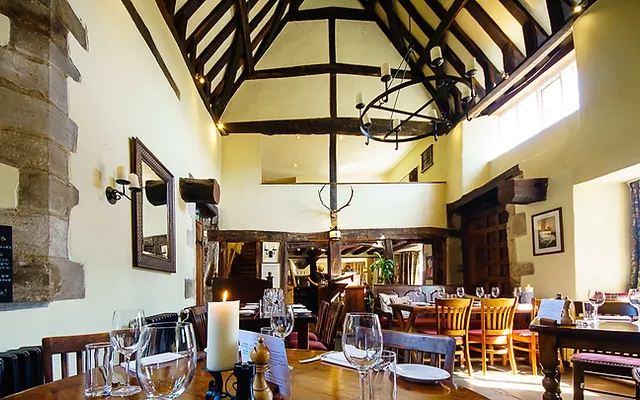
Just seven miles south of Oxford, in the quaint village of Fyfield, sits a 15th-century chantry house that serves what might just be the finest Sunday roast in Oxfordshire. The White Hart is the kind of place that makes you glad the English invented Sunday lunch (we did invent it, didn’t we Google?) – a magnificent medieval dining room with soaring vaulted ceilings, exposed beams, and flagstone floors that somehow manages to feel both impressively grand and genuinely cosy at the same time.
Since taking over in 2005, owners Mark and Kay Chandler have restored this historic hostelry to its former glory, creating the sort of place that even US presidents have dined in (Jimmy Carter, up in the minstrel’s gallery, if you’re asking). But don’t let such lofty credentials put you off – at its heart, The White Hart remains a proper village pub, just one that happens to serve exceptionally good food.
The Sunday roast here is a masterclass in doing the classics right while adding enough creative flourishes to keep things interesting. The dry-aged sirloin of beef is perhaps the must-order here, coming in hot, pink and tender, while the slow-cooked pork belly from nearby Kelmscott Farm arrives with crackling that shatters just so. Both are propped up by all the traditional trimmings, including Yorkshire puddings that rise like architectural features and roast potatoes that have clearly been shown the right amount of duck fat and attention.
But it’s the little touches that elevate things here. The cauliflower cheese is supremely well-judged – puckeringly sauced and with a burnished top that speaks of careful grilling. Seasonal vegetables, many plucked from their own kitchen garden just hours before service, retain both flavour and bite. The gravy (or ‘red wine jus’ if we’re being fancy) is good stuff, made from bones and reduced to a viscous – though not cloying – consistency.
For those looking to venture beyond the traditional roasts, the kitchen shows equal skill with fish (a recent pan-roasted lemon sole with crispy mussels, samphire and Pernod sauce caught our eye), while vegetarians are well-served by thoughtful dishes like their spiced butternut squash tagine with chickpeas and apricots.
Whatever you choose, make sure to leave room for pudding – the White Hart’s signature egg custard tart with marinated blackberries is a thing of beauty, while the sticky toffee pudding with praline tuile might just be worth the journey alone. You could even walk it off on the 8 miles back to Oxford, if that’s your thing.
The wine list deserves a nod, offering something for every budget and palate. By-the-glass options start at a reasonable £5 for both red (Le Havre De Paix) and white (Côtes De Gascogne Blanc), with plenty of interesting choices as you move up the scale. The Primitivo from Puglia makes for a particularly good match with the roast beef. For the designated drivers, there’s a thoughtful selection of ‘de-alcoholised’ wines from South Africa’s Darling Cellars at £23 a bottle.
In summer, the substantial terrace and gardens make for lovely pre-lunch drinks, while in winter, the massive inglenook fireplace in the bar area practically begs you to settle in for the afternoon. Which, given the portion sizes and the quality of the cooking, is probably exactly what you’ll end up doing.
The Sunday roast at The White Hart runs from 12-4pm, with two courses at £40 or three courses at £45.
A short stroll from the spires of Oxford city centre, across Magdalen Bridge and down the Iffley Road, sits what might be the city’s most consistently excellent gastropub. The Magdalen Arms comes with serious pedigree – it’s part of the same family as London’s legendary Anchor and Hope – and has been doing things properly for over 13 years now. While it may have been reviewed by every broadsheet going in its early days, these days it just quietly gets on with being brilliant.
The dining room perfectly threads the needle between pub and restaurant – all scarlet walls, wooden floors and mismatched furniture, with a continental feel that somehow works perfectly in this corner of East Oxford. In summer, the terrace catches the last of the evening sun, while in winter the spacious interior provides the ideal setting for tackling their generous Sunday offerings.
And generous they are. While the à la carte menu changes twice daily based on what’s good and available, Sundays are all about the sharing roasts that would defeat most rugby teams. The rare roast Hereford rump of beef (£75 for 2-3 to share) is cooked to a perfect blushing pink, with all the Sunday trimmings done exactly as they should be. But the real showstoppers are their slow-cooked options – a six-hour venison shank for two or three (£66) falls off the bone and comes with silky mash, seasonal greens and poached quince, while their slow-cooked lamb shoulder (£130) easily feeds four to five hungry souls and arrives with a decadent gratin dauphinoise and pickled red cabbage.
For solo diners or those with more modest appetites, the roast Gloucester Old Spot porchetta (£22) with sage and onion stuffing, roasties and chard strikes an excellent balance between a decent portion size and saving room for pudding. And you will want pudding – their lemon meringue pie, designed to share, is spoken about in hushed tones ‘round these parts.
The wine list shows the same careful consideration as the food. By-the-glass options start at £4.85 for both red (Primitivo Salento) and white (house Colombard/Ugni blanc). Their house cocktails deserve special mention – kick things off with their Sunday Bloody Mary made with house-infused horseradish vodka, or try the Wild Old Cuban with local Wild Oxen spiced rum, mint, lime, bitters and a champagne top.
Booking is essential for Sunday lunch (they’ll take tables up to 15), and while the dining room can get properly busy, service remains unflappable. If you can’t get a table, the bar operates on a first-come-first-served basis, and there’s usually space on the terrace in clement weather.
The Sunday roast at The Magdalen Arms runs from 12-3:30pm, with sharing roasts ranging from £50-£130.
Hidden away in the maze of terraced streets between Iffley Road and the river, The Chester Arms is the kind of local that makes you question whether you should tell anyone else about it. This powder-blue painted Victorian beauty, saved from closure by the dynamic duo of Beccy Webb and chef Hamzah Taynaz (who has now moved on), has become something of a Sunday roast institution – so much so that queues start forming well before opening time, with no reservations taken and no exceptions made – yes, that includes you.
While the pub’s legendary steak platters might be its weekday calling card (the onglet with Béarnaise sauce, fat chips and savoy cabbage is the stuff of local legend), Sundays are dedicated to traditional roasts served in a dining room that strikes the perfect balance between neighbourhood pub and destination dining spot. Original Halls Brewery stained glass windows and a handsome copper-fronted bar provide the backdrop, while the large patio garden (complete with an impressive tree) offers alfresco dining when the weather permits. But what kind of sick fuck eats their roast in a garden, honestly?
The Sunday menu is wonderfully focused – this is a kitchen that knows exactly what it’s doing. Individual roasts come in at £18, whether you’re opting for the roast beef (properly pink), the overnight slow-roasted pork belly (complete with crackling that could wake the neighbours), or their excellent Nut Roast Wellington, which can be made vegan on request. For bigger parties, the whole roast chicken at £43 is perfect for two to three to share. It’s a tearing, sharing good time.
Every roast comes loaded with the full array of trimmings: crisp roast potatoes, cauliflower cheese that’s worth the visit alone, savoy cabbage, carrots, and Yorkshire puddings that provide their own postcode. The gravy is the real deal – rich, homemade, and ladled with abandon. They’ll even do half-size portions of most roasts at half price if you’re not feeling quite up to the full portion (though this doesn’t apply to the sharing chicken).
For those avoiding roasts altogether (how have you gotten this far down the article, by the way?), their beer-battered fish and chips (£17) comes with either mushy peas or a mixed leaf salad, though on Sundays you’d be in a tiny minority not ordering the main event.
A word to the wise – if you’re planning on joining the Sunday queue, our advice is to get there at least half an hour before opening. Yes, it might seem excessive, but once you’re tucking into your roast in that convivial dining room, surrounded by happy locals and their dogs (who get their own photo wall, by the way), you’ll understand why people make the effort. Just remember – too many people knowing about a place like this can be dangerous, so maybe keep it to yourself. We understand the irony of saying that, by the way…
The Chester Arms serves Sunday roast from 12pm until they run out (which they invariably do).
Just off the always bustling, often bonkers Cowley Road, in an area that’s otherwise something of a real ale desert, The Marsh Harrier stands out as an unexpected oasis for both beer enthusiasts and Sunday roast seekers alike. This small, welcoming terraced pub might be modest in size, but it punches well above its weight when it comes to both food and drink.
While the pub’s Master Cellarman status (awarded for their exceptional ale conditioning) might be what initially draws you in, it’s their ‘Best British Sunday Roast’ (their words, not ours) menu that will keep you coming back. The kitchen offers an impressive range of options, with their Three Types of Meat (£20) presenting the indecisive with a perfect solution – a combination of beef, pork and chicken all on one plate. For the purists, the roast topside of British beef (£17) is cooked sympathetically and precisely, while the free-range roast loin of pork (£15) and British leg of lamb (£19) offer equally tempting, wholly affordable alternatives.
Vegetarians aren’t merely an afterthought – the vegetarian nut roast and stuffed aubergine (both £17) come with all the same trimmings as their meaty counterparts. There’s even a kids’ Sunday roast (£11) that doesn’t skimp on quality, just portion size.
Every roast comes complete with the full array of trimmings: homemade Yorkshire pudding that’s clearly been given proper attention, crisp roast potatoes, mixed seasonal vegetables, and rich pan gravy.
And you’ll want to save room for pudding – their warm sticky toffee pudding with toffee sauce and vanilla ice cream is the perfect way to round things off, though the homemade crème brulée makes a strong case for itself too. Hey, you could have both. Those after something lighter might opt for their selection of ice creams and sorbets, with vanilla, honeycomb, lemon and mango all vying for your attention. Hey, you could have all four, if you like… Hmmm; already said that.
The pub really comes into its own in summer, when the extensive rear garden – something of a rarity in this part of Oxford – provides a leafy setting for your Sunday lunch. With its decking area, BBQ spot, and blooming flowers, it’s a sun trap that feels miles away from the urban bustle of Cowley Road. This might be off the tourist trail, but locals know a good thing when they taste it – booking in advance is recommended.
Billed as ‘Oxford’s busiest city centre restaurant’ (is that a good thing?), you’d be forgiven for entering Quod, seeing tables of proud parents and reluctant scholarly offspring, and making assumptions. Assumptions that the food will be the identikit bistro kind found in establishments of this nature in every student town in the country. Assumptions that prices will match. You’d be wrong though. Quod is an unassumingly classy affair, unmissable on the High Street, but quite private and intimate within.
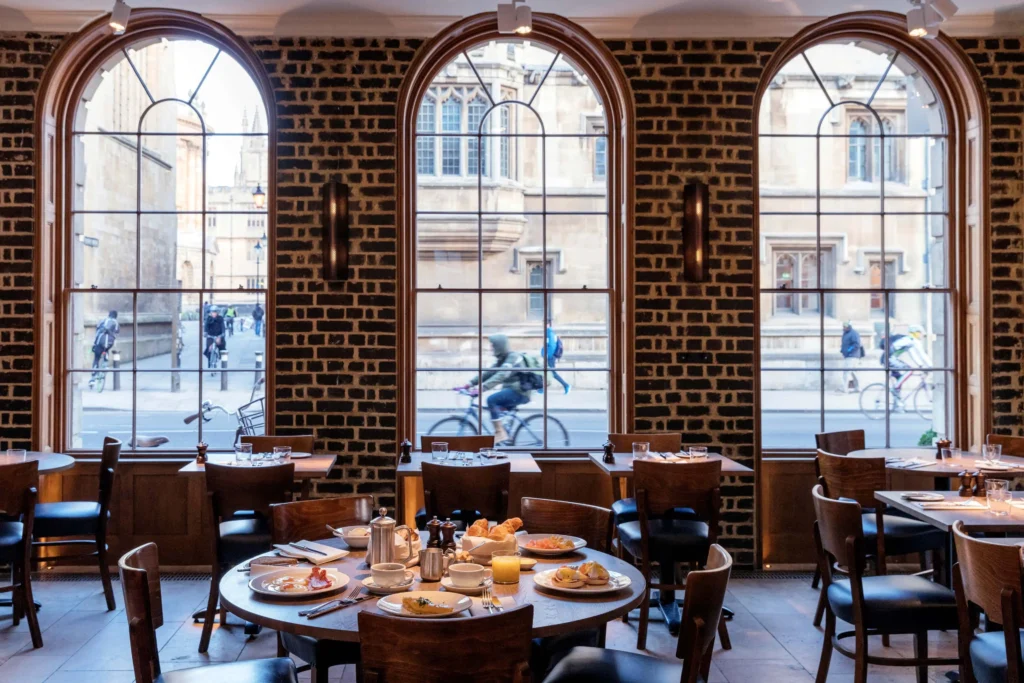
With views across to St Mary’s Church and the iconic Radcliffe Camera, Quod represents something of a departure from the traditional pub roast. Housed in what was once a banking hall within the Old Bank Hotel, this striking restaurant combines contemporary design with young British art on the walls (look out for works by Sandra Blow, Craigie Aitchinson and Gary Hume) to create one of Oxford’s most sophisticated Sunday lunch venues.
‘Wood Pigeon Breast, shallot purée & cavolo nero’
The kitchen, under head chef Rohan Kashid, takes Sunday lunch seriously – their roasts are cooked overnight, slow and low, to ensure perfect tenderness. The menu typically features lamb and pork (served with redcurrant and apple sauce respectively), while their roast beef arrives with a rich bone marrow gravy seasoned with thyme and garlic. All come with the traditional trimmings: roast potatoes that deliver that essential fluffy interior, seasonal vegetables treated with respect, and Yorkshire puddings that puff up proudly.
The gleaming white onyx-topped bar forms the heart of the space, and the drinks list shows why Quod has become Oxford’s perennial spot for everything from aperitifs to digestifs. The wine selection is particularly impressive – start perhaps with a glass of Exton Park RB 32 Brut a fresh and elegant English sparkling from Hampshire which pairs particularly well with white meats. For reds to match your roast, the Côtes du Rhône from Domaine de Verquière or the Chianti Classico Riserva both make excellent companions.
The real secret weapon here is the Italian garden terrace, providing a uniquely Mediterranean setting that feels miles away from the tourist bustle of the High Street. On warmer Sundays, this hidden courtyard makes the perfect spot for a long, leisurely lunch that could easily stretch into the evening.
Sunday lunch is served from 12 noon until 3pm, and booking is essential – this is prime real estate for both locals and visitors alike.
A Grade II listed 17th-century pub on the banks of the Thames in Lower Wolvercote, The Trout Inn is the kind of place that feels purpose-built for Sunday lunch. Made famous by appearances in Inspector Morse, Brideshead Revisited, and even a visit from Bill Clinton (what is it with Oxford and former US presidents), this riverside institution offers the kind of setting that makes you want to settle in for the afternoon – whether you’re by the cosy fire in winter or watching peacocks strut across the terrace in summer.
The Sunday menu here shows proper ambition, with individual roasts starting at £18.75 for their vegetarian option – a thoughtfully conceived butternut squash and celeriac Wellington with wild garlic and Tenderstem broccoli. Meat-eaters are well served by a 21-day aged roast sirloin of beef (£20.50), British half roast chicken with bread sauce and bacon-wrapped stuffing (£18.95), or slow-roasted pork belly complete with crackling that won’t leave you feeling disappointed – or, erm, shattered (£19.95).
But it’s their sharing options that really shine. The Roast Experience for Two, priced at just shy of £50, is a feast featuring 21-day aged sirloin, half a rotisserie chicken, and roast pork belly, complete with all the trimmings including cauliflower cheese. For beef enthusiasts, the Roast Duo of Beef (£22.95) combines slow-cooked blade with 21-day aged sirloin, while the Trio of Roasts brings together beef, pork and chicken for the truly undecided. It’s an absolute orgy of meat, let’s be honest, and not a trout in sight, weirdly.
Every roast comes loaded with roasties, sautéed greens, roasted root vegetables, Yorkshire pudding and – crucially – bottomless gravy. The kitchen takes pride in getting the details right, and it shows.
The wine list is equally well considered. Start perhaps with a glass of Laurent-Perrier Cuvée Rosé or keep it English with Chapel Down Brut. For reds to match your roast, the Barolo from Cascina Adelaide makes a fine choice, while the Old Coach Road Pinot Noir offers excellent value.
Save room for pudding if you can – their Callebaut white chocolate crème brulée with raspberries (just under a tenner_ is worth the indulgence, while the chocolate bomb with toffee sponge, caramelised banana and warm dulce de leche sauce offers a spot of theatre. The cheese board, featuring Taw Valley Cheddar, British Stilton, and Jacquin Buchette goats cheese makes a solid alternative for those seeking a salty, savoury finish.
An hour’s walk across Port Meadow from central Oxford (or 10 minutes by car), The Trout provides the perfect excuse for working up an appetite. Once you’re installed by the river with a roast in front of you, you’ll understand why this place has been drawing people in since the 17th century.
The Sunday roast is served from lunch until late, but booking ahead is essential – this is a destination pub for good reason.
As John F. Kennedy once said, ”the time to fix the roof is when the sun is shining”. But as the clocks go back, the temperatures drop and the nights draw in, you could argue that now really is the time to get your home winter-ready if you haven’t already done so.
In 2025, this has never been more pertinent, with energy bills still rising, a climate catastrophe actualising, and the need to conserve heat at home an ever more pressing concern. Whilst much of this is down to events outside of our control, there are some proactive steps you can take to wrestle back a little control by winterproofing your home.
If you’re looking to prevent any unwanted cold weather surprises this year (and keep yourself busy, too), then read on; here are 12 maintenance tasks you should tackle this winter.
Seal In The Heat
The seals around your doors and windows are a major source of heat loss. If you’re keen to lock heat in, then it’s imperative that you check the seals around your doors and windows. Simply run your finger around the seals or use a screwdriver to check for hidden gaps. Filling them with caulk is a simple DIY job – here’s how to do it.
Gutters, Drains & The Roof
Clearing out your gutter and drains of debris and buildup isn’t a fun job, but it’s a necessary one. Well maintained gutters reduce the need to replace them in the long run, moreover, having gutters free of debris minimises the chance of roof damage and water build up. You’ll want to invest in a suitable, safe ladder for this.
Speaking of roofs, roof damage is one of the most common issues to affect homes in Winter. As such, it’s important you check yours. As the Bromley roofing services providers at PSE tell us, a simple inspection is all that’s required here, making sure that there are no loose or cracked tiles, or slates on your roof, as breakages or gaps could let water in.
A frozen pipe is simply not something you want to mess with; it can burst, flood your home and cause a myriad of problems in the process. Before we enter the deepest recesses of Winter, it’s sensible to check yours are clear of obstruction and damage.
Prevention is clearly preferable to cure here, and the best way to pre-empt and protect from frozen or burst pipes is to keep your house at a consistent temperature, preferably via your thermostat.
Even if you’re away on a winter holiday, it’s a good idea to have your heating on a timer, at least coming on for a couple of hours each day, to keep your pipes in good nick. Insulating your pipes is also a smart move.
Protect Ya Deck
The winter garden can be a bleak and barren place, where only the hardiest of plants survive and only the most inquisitive of wildlife enter. That said, this isn’t just a case of hunkering down and ignoring your garden until the yellow daffodils bloom; there are more permanent elements of your outdoor space that require attention during winter, most chiefly your decking.
Get a head start. During autumn, make sure you’re regularly sweeping away those seasonally-fallen leaves, which can make your decking slippery at best and rotten at worst.
As a bare minimum, you should cover your decking in a water-resistant tarp to protect against the worst of winter’s excesses. Though your decking will most likely be industry-standard treated 8×2 timber, you’ll also want to apply an anti-slip coating to it to protect not only against slipping (obvs!) but also from defrosting ice and water penetrating your boards.
If you’ve got a log cabin in your garden, winter preparation is essential to prevent damage from the harsh British weather. Check for gaps between logs that may have developed during the warmer months—wood naturally expands and contracts with temperature changes. Use appropriate wood filler or chinking material to seal any spaces, paying special attention to areas around windows and doors.
Give the exterior a thorough inspection for signs of rot or pest infestation, and ensure the protective coating or stain is still effective. If water no longer beads on the surface, it’s time for a fresh application.
Call In The Chimney Sweep
Ok, we know that we said these were tasks to tackle yourself. However, some winter maintenance tasks really do require a professional’s hand, and, if you have an active fireplace, then chimney sweeping is definitely one of them. Not cleaning a chimney can lead up to a build up of soot, which in turn can cause a chimney fire.
Give Your A Boiler A Dry Run
Speaking of checks to get done before Winter fully sets in, it’s also a smart move to give your boiler a dry run to check everything is working prior to December and the beginning of the colder months. If you leave it until the temperatures reach those dreaded minuses, only to discover things are amiss, then you’ll be at the back of the queue when it comes to getting it fixed. Indeed, every plumber and heating engineer will attest that demand for their services shoots up as the colder months arrive.
As such, test things yourself and even if everything is working, get it serviced to ensure that this is going to remain the case. The boiler experts at *checks notes* IDEAL Magazine have written a really useful guide about when to know when your boiler needs servicing. Do check it out.
Inspect & Update Insulation
Speaking of insulation, and as the cold weather sets in, one of the most effective ways to keep your home warm and reduce energy bills is to ensure that your insulation is up to par. Over time, insulation can settle or become less effective, so it’s important to inspect it regularly. Check your attic, walls, and basement to see if the insulation is still adequate. Look for any areas where it may have been compromised or where there might be gaps.
If you find areas where the insulation is lacking, consider adding more. There are various types of insulation available, such as fiberglass, cellulose, or foam, and each has its own advantages. Remember, proper insulation can make a significant difference in your home’s ability to retain heat and can lead to substantial savings on heating costs.
Carport Care
Don’t overlook your carport just because it’s a simple structure – it needs winter preparation too. Start with the roof, clearing away any accumulated leaves and debris that could trap moisture and cause damage. For polycarbonate roofs, check for cracks or loose panels that might worsen under snow or during strong winds.
The supporting posts deserve special attention, particularly where they meet the ground. Look for signs of rust on metal supports or rot in wooden posts, and apply protective coatings as needed. If you have guttering, give it the same attention as your house gutters to ensure proper drainage throughout winter.
Bleed Radiators & Insulate
Other ways you can ensure your heating system is in good working order is to bleed your radiators, lag your pipes and insulate your hot water tank – this could save you quite a bit on your energy bills, too. In particular, radiators need to be bled each Winter to ensure they are running at full capacity and efficiency. Fear not; it’s an easy task to complete.
Prepare An Emergency Kit
Winter storms can come unexpectedly and may lead to power outages or being snowed in. It’s essential to prepare for such scenarios by assembling an emergency kit. Your kit should include items such as flashlights, batteries, a first-aid kit, non-perishable food items, bottled water, blankets, and warm clothing. Additionally, make sure to have a supply of any necessary medications and a portable charger for your mobile devices.
It’s also wise to include a battery-powered or hand-crank radio to stay informed about weather updates and emergency information. Preparing an emergency kit ensures that you and your family remain safe and comfortable during unforeseen winter emergencies.
Learn The Signs
It’s important to be aware of the warning signs of problems in your home so that you can address these issues quickly. A few things to look out for include signs of damp in your property such as a musty smell, mould, peeling paint or wallpaper, or sometimes the wall might be wet to the touch.
Flickering lights and sparking outlets are indicators of electrical faults or appliances short-circuiting when plugged into certain sockets, and an unwelcome draught is a sign of potential damage to doors and windows. Good luck!
Thailand’s appeal to expatriates goes far beyond the usual travel brochure promises. Yes, there are the powdery beaches, Michelin-recommended street food stalls and stunning temples – but what’s drawing a new generation of long-term residents is something more practical: the chance to build a comfortable life without depleting their savings.
From bustling university towns to quiet coastal provinces, certain spots in Thailand offer that rare combination of quality infrastructure, cultural depth, and genuine value for money. Here’s our pick of the just 8…
Chiang Mai: Northern Capital, Modern Workspace
The evolution of Chiang Mai from backpacker stopover to international creative hub has been remarkable. The city’s old quarter, with its crumbling brick walls and quiet temple courtyards, now shares space with minimalist co-working spaces and third-wave coffee roasters.
A modern one-bedroom flat in the fashionable Nimman area will typically cost £600-800 monthly, and things get even more affordable if you zoom out just a little to the adjacent Santitham neighbourhood.
The city balances innovation with tradition: you might start your morning with a bowl of khao soi from a decades-old street cart (still around £1), spend your afternoon coding in an air-conditioned workspace, and end the day at a contemporary art gallery opening. Living costs run about 40% below Bangkok’s, yet the city maintains a sophisticated infrastructure of international grocers, medical facilities, and restaurants.
Ubon Ratchathani remains one of Thailand’s most culturally authentic cities, largely untouched by mass tourism and all the better for it. The northeastern provincial capital runs on local rhythms – morning markets that wind down by sunrise, impromptu street football matches at sunset, and night markets where Thai remains the primary language. A modern apartment here costs £400-500 monthly, and that sum buys more space than you’d imagine.
The city’s location, near the confluence of the Mun and Mekong Rivers, shapes both its culture and commerce. Local markets reflect centuries of cultural exchange with Laos and Cambodia, while a growing number of international schools and hospitals signal the city’s gradual internationalisation.
Yet Ubon remains remarkably affordable, especially for those willing to adapt to its unhurried pace and embrace its distinctive Isaan character. For anyone seeking authentic Thai life without the typical expat bubble, Ubon presents a compelling alternative to more well-trodden paths. The fact that the duck laab here is the best in the world is an added bonus, of course.
Hua Hin: Seaside Living With Sophistication
Hua Hin presents an interesting case study in Thai urban development. Once a quiet fishing village turned royal retreat, it’s now finding its footing as a cosmopolitan coastal city. Long-term rentals in modern condominiums with sea views typically range from £700-1,000 monthly. The further inland you go, the more prices reflect local rather than tourist economies.
The city’s infrastructure has grown to match its population: international hospitals now rival Bangkok’s, shopping centres stock imported goods, and golf courses dot the outskirts. But unlike Phuket or Pattaya, Hua Hin maintains a distinctly Thai character. The morning market still serves primarily local customers, and street food vendors outnumber international restaurants. This balance makes Hua Hin particularly attractive for retirees and families seeking a coastal lifestyle without sacrificing urban conveniences or cultural authenticity.
For those considering Thailand real estate for investment, Hua Hin’s steady appreciation and reliable rental market make it worth serious consideration.
Nakhon Ratchasima (Korat): The Up & Coming Urban Hub
Korat functions as the northeast’s unofficial capital, a role reflected in its rapid evolution from sleepy provincial center to dynamic metropolis. A two-bedroom house in a good neighborhood runs £500-700 monthly, while the city’s expanding light rail system is making outlying areas increasingly accessible.
The city’s size supports a full range of urban amenities – shopping centers, international schools, specialized medical care – without the premium pricing found in more tourist-oriented locations. Its position at the edge of the Isaan plateau means weekends can alternate between exploring ancient Khmer temples and hiking in national parks.
For families especially, Korat offers an increasingly compelling package: urban convenience, cultural authenticity, and costs that allow for a genuinely comfortable lifestyle.
somm tam korat
Trat: The Coastal Province With Hidden Potential
The province of Trat offers an intriguing proposition for those seeking coastal life without tourist-driven inflation. The provincial capital serves as a springboard to islands like Koh Chang and Koh Kood, while maintaining mainland practicality. A modern two-bedroom house here typically rents for £500-600 monthly, basic apartments from £350.
The province’s location near Cambodia has attracted development interest, particularly in logistics and trade. For residents, this means improving infrastructure without the rapid price increases seen in other coastal areas. The combination of accessible islands and growing cross-border commerce suggests Trat might offer both lifestyle benefits and investment potential.
Those willing to be early adopters in this emerging area might find themselves well-positioned as the region develops, while enjoying the benefits of a laid-back coastal lifestyle at mainland prices.
Phitsanulok: Central Thailand’s Educational Hub
Phitsanulok embodies central Thailand’s particular mix of agriculture and academia. Home to two major universities, the city strikes a balance between educational hub and provincial capital. Modern condominiums in central areas range from £450-700 monthly, with similar prices for houses in residential districts.
The city’s role as a transport nucleus puts Bangkok within easy reach while keeping local prices stable. International schools and hospitals cater to a growing professional class, while the surrounding countryside offers everything from rice fields to mountain trails. For academics, teachers, and families prioritising education, Phitsanulok provides an intellectually stimulating environment without the financial pressures of larger university cities.
The growing international student population has brought with it a flourishing café culture and arts scene, adding contemporary flair to this historic city.
Chonburi: Industrial Powerhouse With Coastal Charm
Just 90 minutes from Bangkok, Chonburi province presents a compelling case for professionals seeking proximity to Thailand’s industrial heartland without capital city prices. The area encompasses everything from the manufacturing hub of Amata City to quiet fishing villages, with rental prices varying accordingly. A modern two-bedroom apartment in central Chonburi city typically costs £500-700 monthly, while similar properties in the more developed areas near industrial estates might reach £700-900.
The province’s role in Thailand’s Eastern Economic Corridor has brought substantial infrastructure investment, including expanded highways and plans for high-speed rail links. International schools, Japanese supermarkets, and specialized medical facilities cater to the growing expatriate professional community.
Meanwhile, local beaches like Bang Saen offer weekend escapes without tourist-inflated prices, and the seafood markets remain some of the most authentic in the eastern seaboard. For those whose work brings them to Thailand’s industrial sector, Chonburi offers the rare combination of career opportunities and affordable coastal living.
Property Investment: Understanding The Landscape
Thailand’s property market comes with distinct challenges for foreign buyers. The legal framework restricts foreign ownership of land, though several options exist:
Condominium purchase within the 49% foreign – soon to rise to 75% – ownership quota per building
Company formation (with specific requirements and restrictions)
Current condominium prices in these locations range from £50,000-150,000 for modern units, with Chiang Mai and Hua Hin commanding premium rates. Legal counsel isn’t optional here – it’s essential for navigating the complex regulations that vary by location and property type. While property can be an excellent investment in Thailand’s growing economy, success requires careful due diligence and a thorough understanding of both local markets and legal frameworks.
The Bottom Line
While these locations offer compelling value, choosing purely on cost can prove short-sighted. Consider the full economic picture: visa requirements, healthcare access, transport links, and professional opportunities. Many expatriates find that paying more for a well-connected area ultimately proves more economical than dealing with the limitations of cheaper, isolated locations.
The key lies in finding equilibrium – a place where cost, comfort, and opportunity intersect. While living costs in these locations run significantly below Western averages, maintaining a financial buffer remains crucial. Thailand rewards those who take time to understand its complexities, both cultural and economic. Success here often means balancing immediate savings against long-term livability, and being prepared for the occasional challenge that comes with life in a developing economy.
The good news is that Thailand still offers genuine opportunities for those seeking to build a comfortable life on a modest budget. The key is choosing your location wisely, understanding the true costs beyond just housing, and approaching the move with both enthusiasm and pragmatism. And in the end, there’s always the mighty Bangkok if none of these places will do…
The London dream has begun to tarnish for many city dwellers. As the capital’s cost of living crisis deepens and the average monthly rent surpasses £2,200, a great migration is quietly taking place. Young professionals, families, and seasoned urbanites are looking beyond the M25 for a life that offers more than just survival between paycheques. Scotland, with its magnificent landscapes, thriving cultural scene, and remarkably welcoming communities, has emerged as an increasingly attractive alternative to the relentless London grind.
This isn’t merely about escaping sky-high prices – though paying £800 for a spacious two-bedroom flat certainly beats cramming into a Zone 4 studio. It’s about rediscovering what city living should be: vibrant, communal, and actually enjoyable.
As remote work becomes the norm and London’s allure fades beneath the weight of its expenses, Scotland beckons with promises of shorter commutes, stronger communities, and the kind of work-life balance that feels like a fairy tale in the capital.
For those contemplating this northward journey, here are 7 Scottish destinations that offer not just refuge from London’s chaos, but genuine opportunities to thrive.
Glasgow: The Cultural Powerhouse
Ideal for: Creative professionals and music lovers who fancy a proper night out without the London price tag
Despite its gritty reputation from decades past, Glasgow has blossomed into a vibrant cultural hub that rivals any European city. The West End offers a perfect blend of Victorian architecture, trendy cafés, and green spaces like the Botanic Gardens. Housing costs here are roughly 60% lower than London, with a three-bedroom flat in desirable areas like Finnieston or Hillhead costing what you’d pay for a studio in Zone 3. The city’s music scene, art galleries, and renowned restaurants make it an ideal spot for culture vultures seeking more bang for their buck.
Unlike London’s often segregated cultural quarters, Glasgow’s creative spirit permeates every corner of the city. From the hidden speakeasies of Finnieston to the architectural gems of Alexander ‘Greek’ Thomson, the city pulses with an energy that feels genuine rather than manufactured for tourists.
The recent surge of new properties across Glasgow, particularly in up-and-coming areas like Merchant City and the riverside, means you’re not limited to traditional tenements – though these beloved buildings offer far more space and character than their London counterparts. The locals’ famous banter and the city’s self-deprecating humour make a refreshing change from London’s sometimes stuffy self-importance.
St Andrews: Coastal Living With Academic Flair
Ideal for: Academics, golf enthusiasts, and anyone who fancies bumping into a royal at the local pub
Known for more than just golf and royalty, St Andrews offers a sophisticated small-town lifestyle that many London escapees dream about. The seaside location provides stunning beaches for morning walks, while the university brings a constant stream of cultural events and youthful energy. The town centre’s medieval streets house independent shops and restaurants that would feel at home in Marylebone – but without the crushing overhead costs.
What sets St Andrews apart is its perfect balance of tradition and modernity. While London struggles with its identity, St Andrews knows exactly what it is. The academic year brings a buzz that rivals freshers’ week at any London university, but without the urban sprawl. Weekend walks along West Sands beach, immortalised in Chariots of Fire, remind you that this is a place where quality of life isn’t measured in overtime hours or tube stops.
Dundee: The Renaissance City
Ideal for: Digital nomads and creative entrepreneurs who want to be part of a city’s transformation
Once overlooked, Dundee has undergone a remarkable transformation. The V&A Dundee symbolises the city’s revival, while the waterfront regeneration project continues to attract creative businesses and professionals. Property prices remain surprisingly reasonable, and the surrounding countryside offers easy access to both Highland adventures and lowland charm. The tech sector’s growth means jobs aren’t limited to London anymore.
The city’s reinvention goes far beyond its striking waterfront. While London tech startups cluster in overpriced Shoreditch offices, Dundee’s digital quarter offers genuine opportunities for innovation and growth. The creative community here isn’t just about following trends – it’s about setting them, with numerous gaming companies and design studios choosing Dundee over traditional tech hubs. The city’s compact size means you can actually finish work and have time for a life.
Inverness: Gateway To The Highlands
Ideal for: Outdoor enthusiasts who still need decent WiFi and a good flat white
For those seeking a true escape from urban chaos, Inverness provides city amenities while being surrounded by some of Britain’s most spectacular landscapes. The Highland capital offers a quality of life that would be unimaginable in London, with a commute that might include views of dolphins in the Moray Firth. The property market remains stable and affordable, while the expanding airport connects residents to major European cities.
The notion of ‘having it all’ takes on new meaning here. While Londoners might consider themselves lucky to glimpse a fox in a back garden, Inverness residents casually spot red kites on their lunch breaks and wild dolphins on weekend walks. The surrounding Highlands offer adventure possibilities that make Richmond Park look like a garden square, yet you’re never more than five minutes from a proper coffee shop or coworking space.
Ideal for: History buffs and commuters who want to live in a postcard-worthy setting
Often overlooked by London emigrants, Stirling offers the perfect blend of historical grandeur and modern convenience. With its imposing castle and old town rivalling any European destination, this compact city provides easy access to both Glasgow and the Highlands. Property prices remain remarkably reasonable, and the surrounding countryside offers everything from hiking to wild swimming.
Where London’s history often feels commandeered by tourism, Stirling’s past remains authentically woven into daily life. Living here means your morning coffee might come with a castle view that would cost millions in Edinburgh. The city’s central location makes it perfect for hybrid workers who occasionally need to visit other Scottish cities, while the proximity to Loch Lomond means weekends can be spent wild camping rather than queueing for brunch in Balham.
Aberdeen: The Granite City
Ideal for: Professionals seeking international career opportunities without London’s corporate intensity
Don’t let the granite façades fool you – Aberdeen’s stern exterior houses a warm community and thriving cultural scene. The oil industry means international connections and amenities, while the stunning coastline and countryside provide weekend adventure opportunities. The recent downturn in oil prices means property is more affordable than ever, while the quality of life remains high.
Unlike London’s relentless focus on finance, Aberdeen’s business community maintains a refreshing sense of perspective. The city’s international outlook means you’ll find authentic Korean restaurants and Norwegian bars alongside traditional Scottish pubs. When summer arrives, the endless northern daylight transforms the city’s granite buildings from austere to ethereal – a light show that makes Canary Wharf’s illuminations look positively amateur.
Perth: The Fair City
Ideal for: Families and remote workers who want a proper garden without sacrificing city conveniences
Perth might be Scotland’s newest city, but it’s one of its most liveable. Situated on the River Tay, it offers the perfect balance between urban amenities and rural charm. The surrounding Perthshire countryside is amongst Scotland’s most beautiful, while the city centre maintains a proper high street with independent shops that London’s suburbs lost years ago.
The real joy of Perth lies in its rhythms – so different from London’s relentless pace. Here, you might spend your lunch break watching salmon leap up the river, or pop home to check on your vegetable garden (yes, you can actually afford one here). The schools consistently rank among Scotland’s best, and the sense of community means your neighbours will know your name rather than avoiding eye contact in the lift. House prices mean you can afford a family home with a garden for the price of a London flat, and you’ll actually have time to enjoy it.
The Bottom Line
When comparing any of these locations to London, the differences extend beyond mere finances. The pace of life shifts noticeably – strangers actually chat at bus stops, and getting a restaurant reservation doesn’t require booking three months in advance. While each city has its own character, they all share that renowned Scottish warmth that can make even the chilliest winter evening feel cosy.
The move north might seem daunting, but with remote work becoming increasingly normalised, there’s never been a better time to trade the Thames for the Tay, Clyde, or Ness. Plus, the money saved on housing alone could fund quite a few trips to explore the rest of Scotland’s mythology, landscapes and cities.
Just remember to pack a good raincoat – though truthfully, the weather isn’t that different from London. It’s just that Scots are more honest about it.
While we’d all love a bathtub we could take a swim in, or a toilet seat which does all the dirty work for us, the reality is that for many, the bathroom is a functional room at best.
But did you know the average person spends more than two years in the bathroom? That’s a whole lot of time spent on the toilet, in the bath, under the shower and all the rest, regardless of the size of the space. Which, for the most of us, is generally on the smaller side, let’s be honest…
That doesn’t mean you can’t make the most of this limited space, to make the room into somewhere you want to spend time. It all starts with generating more real estate. Or at least, giving the illusion of space. Here’s how to do both, and make your small bathroom look bigger in 7 IDEAL steps.
Use Frameless Shower Units
That shower curtain over bath scenario just isn’t a good look. Nor is it particularly convenient, let’s be honest. Use less space and make more of it, with a modern, sleek glass shower unit with frameless shower doors.
These serve to make bathrooms look a lot bigger because they’re not cutting off space visually. By removing any visual obstruction, you’re left with an open and airy space to bathe or shower in. Be conscious that if you choose to use textured glass the same effect is unlikely, as it’ll act like a wall. It may also look pretty dated. Just sayin’.
Bigger Mirrors
There’s a reason why so many interior designers place emphasis on using mirrors to create more space across their designs. If you want to make your small bathroom appear larger without having to invest in costly solutions, a few simple mirrors – or one large one, for that matter – can work wonders.
In fact, go for the largest mirror that the bathroom can take. Mirrors are great for reflecting light and open up spaces effectively. A full length, or full wall mirror, can create the impression of having double the space. And that’s what you’re here for right?
Shower Enclosures
Everybody knows just how relaxing it can be to take a soak in the tub after a long day. However, when it comes to utilising the space in a smaller bathroom you’ll probably want to reconsider your bath versus shower cubicle options.
Though you may think that adding a bath with shower enclosures overhead is going to give you the best of both worlds, the truth is that baths aren’t exactly petite.
Instead, we’d highly recommend opting for shower units or cubicles in replacement of a bath, if space saving is your main concern. Shower enclosures are inexpensive and easy to fit, and there are lots of spa-like shower designs out there to take advantage of if you value the relaxing quality of a good soak, including modern hydro shower cabin options from companies like Vidalux.
Tile Right To The Ceiling
As we mentioned earlier, eliminating obstructions in a small bathroom space should be your priority if an improved impression of spaciousness is your end goal. You can do this by ensuring that your tiles go all the way up to the ceiling. If you leave a small space of a painted wall or wall trim above your tiling, you’ll make the space appear cramped – unfinished, even.
For a more seamless look, extend those tiles all the way. Avoid using patterned tiles as this can create a busy space that can end up looking cluttered.
Blend Your Colours
While contrasting, block colours can bring about a unique finish to a bathroom, you should avoid channelling this energy in smaller spaces; the effect can often be on the dingy side. Instead, harness the power of tiles, contrasting with the colour of the rest of the space, to act as a visual divider. Or, if you’re keeping with paint and wallpaper, lighter colours as a general rule of thumb are best for making any room look as big as possible.
Recesses & Clever Storage Solutions
Recessed medicine cabinets, toilet roll holders, and soap dishes pry out more space. Compared to cabinets built out, recessed ones offer more room to bend over and use the sink. You’ll gain more space without foregoing sleekness.
Using recessed light also makes a tiny bathroom appear spacious. Consider recesses since they don’t cost much in the grand scheme of your remodelling.
By building shelving units into the existing wall structure rather than building outwards, space is saved on a foundational as well as visual level. If you’re lucky enough to have any alcoves in your bathroom that you can make use of this way, then do so! Recessed shelving can be fairly easy to install and the extra graft will certainly pay off in the long-run.
Also, we don’t need to tell you that hidden bathroom storage is better than having stuff exposed; but we’ll reiterate that point nonetheless.
Keeping things clean is equally as important as keeping them uncluttered, we think. It might sound obvious, but when you let your bathroom become dirty, you might find that it’s a great deal more difficult to unwind in. Make a regular schedule for cleaning and stick to it. If you have a houseful of people regularly using the bathroom, then set up a rota for cleaning.
Let Natural Light Flow
One of the most effective ways to create an illusion of space is to maximise natural light in your bathroom. If you’re lucky enough to have a window, make sure you’re not blocking it with heavy blinds or frosted treatments that diminish light flow. Instead, opt for lightweight, sheer window coverings or frosted film that maintains privacy while letting sunlight stream through.
For ground floor bathrooms where privacy is paramount, consider installing a top-hung window or a skylight if possible. These additions not only flood the space with natural light but also create a vertical dimension that draws the eye upward, making the ceiling appear higher. If structural changes aren’t an option, using light-reflective materials for your bathroom fixtures and fittings will help bounce whatever natural light you do have around the room, amplifying its space-enhancing effects.
Lights Up
Drab and dreary lighting isn’t going to do much aesthetically for any interior space and this is especially illuminative for bathrooms. While shoddy lighting can result in making a bathroom feel tighter on space than it actually is, properly considered brightness can have the opposite effect. By introducing both general and task lighting you’re going to instantly open up the area.
Make sure the lighting you choose doesn’t cast shadows of any kind; in a compact space shadows only serve to enhance that sense of dinginess.
Ah, the Christmas jumper. Once the sartorial equivalent of a festive faux pas, now a beloved icon of Yuletide cheer. But let’s face it, while we all adore the comfort and the camaraderie of donning a knit emblazoned with Rudolph’s slightly intoxicated-looking visage, there’s a fine line between looking seasonally spirited and resembling a walking, talking Christmas grotto.
Fear not, my fashion-forward friends! With a few clever accessorising tricks, you can transform your Christmas jumper from ‘novelty nightmare’ to ‘festive fashionista’. So, grab a mince pie and a mulled wine, and let’s dive into the art of making that jumper look (kinda) stylish.
The Subtle Art Of Layering
First things first, layering is your ally. A crisp white shirt under your jumper can add a touch of sophistication. Pop the collar (not, we should implore, in a Harry Hill-esque way) and let the cuffs peek out; it’s like saying, “Yes, I’m here for the eggnog, but I’ve also got a grasp on the basics of chic.”
Statement Necklaces: The Bolder, The Better
Now, let’s talk bling. A chunky statement necklace can work wonders. It draws the eye, creating a focal point that says, “I meant to wear this jumper, and I’m owning it.” Opt for something with a bit of sparkle or a geometric design that complements the festive patterns without competing with them.
The Magic Of A Gold Bracelet
Ah, the gold bracelet – a true classic. It’s like the Christmas fairy atop the tree, but for your wrist. A sleek gold cuff or a collection of delicate bangles can add a touch of elegance to your ensemble. It’s the sartorial equivalent of wrapping tinsel around your arm, but, you know, tasteful.
Whether you’re accessorising with a gold bracelet for women, men, or however your bracelet identifies, consider the jumper’s design. If your jumper is on the busier side, with Santa and his reindeer playing a game of Twister across your torso, opt for a simple gold bangle. It’ll add a touch of class without adding to the chaos.
On the other hand, if your jumper is a more subdued affair (perhaps a tasteful tartan or a minimalist tree), feel free to go a bit more ornate. A gold charm bracelet jingling away with every flick of the wrist can be quite the conversation starter. Just be prepared for the inevitable “Oh, how charming!” puns.
Belts: Cinch It In Style
If your Christmas jumper is a bit on the boxy side, a belt can be your best friend. Cinch it at the waist to give yourself a silhouette as flattering as a fitted midi dress. A sleek leather belt or a metallic chain belt can add structure and style in equal measure. This simple trick transforms even the most oversized jumper into something that hints at your natural shape.
Footwear: From Drab To Fab
Moving on to the lower regions (hmmm, that sounds weird), your choice of footwear can make or break the outfit. A pair of heeled ankle boots can elevate the look (quite literally) and add an edge to the softness of the Christmas jumper. If heels aren’t your thing, a pair of polished brogues or even some snazzy trainers can keep things stylish yet comfortable.
The Enchantment Of Earrings
Let’s not forget the power of a good pair of earrings. They’re like the fairy lights of your outfit; they add sparkle and draw attention to your face. If your jumper is already a kaleidoscope of colour, opt for simple studs. However, if your knitwear is more “silent night” than “jingle bell rock,” feel free to go for something a bit more daring. Think dangling, shimmering, and perhaps even a nod to the festive season with a tasteful snowflake or star design.
The Charm Of A Chic Hat
Now, for the pièce de résistance: a chic hat. Whether it’s a classic fedora with a festive band or a cosy beanie topped with a faux-fur pom-pom, a hat can add a whole new dimension to your look. It’s practical for those chilly winter days and adds a touch of mystery. After all, who is that stylish individual beneath the brim? Why, it’s you, of course!
The Finishing Touch: A Dash Of Humour
Lastly, never underestimate the power of a good sense of humour. Christmas is the time for joy and laughter, after all. So, if your jumper has a 3D Santa whose belly button lights up, own it. Pair it with confidence and a cheeky grin, and you’ll be the life of the Christmas do.
The Conscious Choice: Sustainability
In the midst of our accessorising adventure, let’s not forget the jumper itself. In an age where fast fashion is a naughty list no-no, ensuring your Christmas jumper is sustainably sourced is as important as the eggnog being boozy.
When selecting your festive knit, look for materials that are kind to the planet. Organic cotton, recycled wool, or even Tencel (a fabric made from sustainably sourced wood) can make your Christmas cheer a little greener. Brands that offer transparency about their manufacturing processes and support ethical labour practices deserve a spot on your “nice” list.
Moreover, consider the longevity of your jumper. Is it well-made? Will it last you for several seasons? The most sustainable garment is one that doesn’t need to be replaced every year. And if you’re feeling particularly crafty, why not upcycle an old jumper? A few well-placed embellishments can breathe new life into a forgotten garment.
Remember, a stylish Christmas jumper doesn’t have to cost the Earth—literally. By choosing sustainably sourced knits and timeless accessories, you’re not just making a fashion statement; you’re spreading goodwill to the planet, and that’s a trend that will never go out of style.
When it comes to keeping a clean home, most of us will diligently scrub our bathrooms, polish our kitchen surfaces, and hoover our living spaces with the utmost care. However, despite our best efforts, there are certain areas within our abodes that harbour more bacteria and grime than we could ever imagine. These hidden germ hotspots can often be the most surprising, lurking in plain sight, yet frequently overlooked in our cleaning routines.
With that in mind, today we’re (somewhat reluctantly) uncovering the most unexpectedly dirty places in your home and providing you with practical advice on how to keep them spotless. Only then will we take you up on that invite over for dinner…
The Overlooked Offenders
1. Household Handles and Switches
Doorknobs, cupboard handles, and light switches are touched multiple times a day by various hands, making them prime real estate for germs. Yet, they are often neglected during regular cleaning.
Sanitising Tip: Wipe these surfaces down at least once a week with a disinfectant wipe or a cloth dampened with a mixture of hot water and antibacterial soap.
2. Remote Controls and Electronic Devices
Our electronic companions, from remote controls to smartphones, are handled constantly and rarely cleaned. They can become a breeding ground for bacteria.
Sanitising Tip: Use an alcohol-based wipe to gently clean your devices, being careful not to damage any sensitive areas with excess liquid.
3. Kitchen Sponges and Cloths
Ironically, the very tools we use to clean can become the dirtiest items in our homes. Kitchen sponges and cloths can contain a higher number of bacteria than any other household item, leaving quite the smell behind if you’re not careful.
Sanitising Tip: Replace sponges regularly, and microwave damp sponges for two minutes daily to kill bacteria. Wash cloths at a high temperature and let them dry thoroughly before reuse.
4. Toothbrush Holders
Toothbrush holders are often found near sinks and toilets where they can be exposed to a host of germs, including E.coli.
Sanitising Tip: Regularly run your toothbrush holder through the dishwasher if it’s dishwasher-safe, or wash it in hot, soapy water.
5. Pet Bowls and Toys
Our furry friends’ accessories are often forgotten in the cleaning process. Pet bowls and toys can harbour bacteria that can affect both pets and humans, not to mention the musty aroma they often leave in their wake.
Sanitising Tip: Clean pet bowls daily and toys weekly, either in the dishwasher or with hot, soapy water, depending on the material they are made from.
These personal items come into contact with various surfaces throughout the day but are rarely cleaned.
Sanitising Tip: Wipe leather goods with a suitable cleaner and use disinfectant wipes on other materials, paying special attention to handles and corners.
7. Washing Machines
A device that’s supposed to clean your clothes can become surprisingly dirty itself, especially if you often wash at low temperatures.
Sanitising Tip:Run a hot wash cycle with a washing machine cleaner or white vinegar once a month to keep the machine and your clothes fresh.
8. Bedding and Mattresses
While sheets and pillowcases may be washed regularly, the mattress and duvet often go unnoticed. Dead skin cells, dust mites, and other allergens can accumulate, making your bed a hotbed for germs.
Sanitising Tip: Vacuum your mattress every month, use a mattress protector, and air out your duvet and pillows on a sunny day to reduce allergens. Wash bed linen weekly at a high temperature to kill dust mites. Many brands, such as Tineco, offer cordless vacuums equipped with strong suction power that can handle everything from dust and pet hair to larger debris.
9. Keyboards and Mice
Whether it’s for work or leisure, our computer keyboards and mice are in constant use. Crumbs, spills, and germy fingers can make these devices surprisingly dirty.
Sanitising Tip: Turn off your computer, unplug the keyboard and mouse, and gently shake out any debris. Use compressed air to blow out particles from between the keys, and clean the surfaces with a cloth dampened with isopropyl alcohol, ensuring it’s not too wet to prevent any damage.
10. Showerheads
The warm, moist environment of a showerhead is ideal for bacteria and mould to thrive, especially if you have hard water which can cause mineral build-up.
Sanitising Tip: Detach the showerhead and soak it in a mixture of white vinegar and water for a few hours to dissolve mineral deposits and kill bacteria. If it cannot be removed, fill a plastic bag with the vinegar solution and secure it around the showerhead with a rubber band, allowing it to soak.
11. Houseplant Leaves & Pots
While our leafy companions bring life and freshness to our homes, their leaves and pots can accumulate surprising amounts of dust, mold, and bacteria. The moist soil in plant pots can harbor fungal growth, while dusty leaves not only look unsightly but can also impair the plant’s ability to photosynthesize effectively.
Sanitising Tip: Gently wipe plant leaves monthly with a soft, damp cloth to remove dust buildup. For smaller plants, you can give them a shower in the sink or bathtub using lukewarm water. Check pot saucers regularly for stagnant water, and clean decorative pots with warm, soapy water when you repot plants. Consider adding a layer of pebbles or activated charcoal on top of the soil to prevent mold growth and fungus gnats.
Keeping Your Home Hygienically Clean
Maintaining a hygienic home is not just about the visible cleanliness but also about being mindful of the unseen germs that can accumulate in the nooks and crannies of our living spaces. Here are some general sanitisation tips to keep your home clean:
Regularly Disinfect: Incorporate the cleaning of these surprising areas into your regular routine.
Stay Dry: Moisture is a breeding ground for bacteria, so keep your home as dry as possible.
Ventilate: Good airflow can help prevent the growth of mould and mildew.
Declutter: Less stuff means fewer places for dust and germs to hide.
Use the Right Tools: Microfibre cloths and the correct cleaners can make a big difference in the effectiveness of your cleaning.
The Bottom Line
By shining a light on these surprising dirt magnets and adopting a thorough cleaning regimen, you can ensure that your home remains not just sparkling on the surface, but deeply sanitised for the health and well-being of everyone under your roof.
Remember, a clean home is a happy home, and sometimes the smallest efforts can make the biggest difference in our quest for cleanliness.
The UK may not boast the same temperatures as sunny Spain or possess the gastronomic heritage of foodie France. But whether it’s out of necessity, curiosity or national pride, people are increasingly realising that there’s still so much to enjoy about good old Grande-Bretagne.
Particularly in the often idyllic Devon to Cornwall, we boast some brilliant coastal towns and villages that can easily compete with holidays spent on the continent. With that in mind, here’s our top picks of coastal destinations in Devon and Cornwall.
Padstow: Ideal For A Foodie Summer Holiday
Padstow is a charming working fishing port, making it the ideal foodie destination in Cornwall for lovers of all things seafood.
From quirky cafes to award-winning bakeries and Michelin-rated restaurants, this harbour town has views that are as delightful as its culinary scene.
For a fine dining experience, it has to be Paul Ainsworth at Number 6, which offers a modern, playful tasting menu celebrating Cornwall’s frankly world class produce. Celebrity chef Rick Stein’s Seafood Restaurant and Rick Stein’s Cafe are also both within the town, earning it the nickname Padstein.
It’s also the start of the Camel trail cycle path. A hugely popular route with all ages, the gentle and scenic bike ride between Padstow and Wadebridge is a succinct way to get some fresh air in your lungs, wind in your sails and, of course, an opportunity to take in some views. Take a walk by the estuary at low tide and you’ll find the saltlands teeming with birds, if nature is your thing.
Ideal Tip: A short 37-minute drive from Padstow (or a 11.7 mile walk) you’ll find Port Issac. If you’re after some top-draw fish cookery, then one of the finest fish chefs in the world, Nathan Outlaw, owns two fantastic restaurants in Port Isaac, making the very most of the area’s finest produce. Which of course equates to some bloody nice seafood.
Mousehole is a small fishing village and one of the most picturesque spots in Cornwall – and one of the oldest, too.
The guys at Luxury Coastal say, “Arriving in this sleepy fishing village is a little bit like stepping into a fairytale. Found just three miles from Penzance, Mousehole is one of those destinations where time seems to stand still. Boats bob in the harbour, waves lap the beach and cafes serve the catch of the day. If you want to experience the Cornwall of days gone by, this is the perfect place to do it”.
One of the most popular times to visit Mousehole is in the lead up to Christmas when people come to see the famous Mousehole Lights. However, summer is an equally brilliant time to visit, and just perfect for strolling around its narrow streets, taking in some art galleries and enjoying the views across the harbour.
Ideal Tip: If you’re travelling with children, be sure to bring along the children’s classic ‘The Mousehole Cat’, a beautifully illustrated book that tells the tale of a cat and Cornish fisherman braving stormy seas to save their village.
Nestled in the South Hams district of Devon, Dartmouth stands as a testament to Britain’s rich maritime history. This picturesque harbour town, with its colourful mediaeval and Elizabethan buildings lining the waterfront, offers visitors a perfect blend of historical charm and modern coastal living.
The town’s crowning glory is the Royal Naval College, which has trained British naval officers since 1905. Take a stroll along the Embankment and you’ll find yourself surrounded by bobbing boats, from tiny fishing vessels to luxury yachts. For history buffs, Dartmouth Castle, perched at the mouth of the River Dart, offers stunning views of the estuary and a fascinating glimpse into the town’s military past.
Ideal Tip: Don’t miss the chance to hop aboard the Dartmouth Steam Railway for a journey along one of Britain’s most spectacular coastal routes. The round trip to Paignton offers breathtaking views of the English Riviera, and if you’re lucky, you might spot seals basking on the rocks below.
Falmouth: Ideal For Culture Vultures
Boasting the world’s third-deepest natural harbour, Falmouth combines maritime heritage with a thriving arts scene and vibrant university culture. This Cornish gem has reinvented itself as a creative hub whilst maintaining its seafaring roots.
The town is home to the excellent National Maritime Museum Cornwall, where visitors can explore Britain’s seafaring heritage through interactive exhibits and stunning vessels. Art enthusiasts will find themselves spoilt for choice with numerous galleries, including the renowned Falmouth Art Gallery, showcasing both local talent and international artists.
The bustling Events Square hosts year-round festivals, from the Falmouth Oyster Festival in autumn to the Sea Shanty Festival in summer. For those seeking a quiet moment, the subtropical Trebah and Glendurgan Gardens offer peaceful retreats with stunning coastal views.
Ideal Tip: Take the short ferry ride across to St Mawes for lunch at the Idle Rocks Hotel. The journey offers spectacular views of Falmouth’s harbour, and the hotel’s terrace restaurant serves up some of Cornwall’s finest seafood with a view to match.
Brixham: Ideal For Beach Lovers
According to Beachlets, who offer bespoke beachside cottages across the UK, one of the nicest things about the beaches in Devon’s Brixham is that the area’s coastline is peppered with little stretches of sand.
The hard part is where to go. However, they tell us that, “For popularity and convenience, it’s got to be Breakwater Beach…with a Seaside Award and a nod in the Good Beach Guide, it’s easy to see why this is one of the best-loved Brixham beaches! And then there’s Churston Cove. The kind of sleepy cove that the Famous Five would have gone crazy for”. We couldn’t have put it better ourselves.
Clovelly Beach: Ideal For An Instagrammable Holiday
Finally, Clovelly is a picture-perfect fishing village in North Devon, brimming with quaint cottages centred around its cobbled main street. This place is picture perfect in the truest sense of the word – in 2020 it was named the most Instagrammable village in the UK, with distinctive cobbled streets, flower-strewn cottages and resident donkeys all playing their part in its unique aesthetic.
As Great British Life explains “Clovelly is privately owned so you have to pay an entry fee, making it one of the most unique places in the country…And then there are some of the most breath-taking views over Bideford Bay and across the coastline, towards the North Atlantic Ocean. It’s easy to see why Clovelly makes it into so many social media feeds”.
Because you can’t spell Clovelly without ‘lovely’, after all!
The Bottom Line
With so much gorgeous coast to explore, defined by both golden sands and quaint fishing villages and towns, why would you ever want to leave Old Blighty?
Sometimes, when the colder climes kick in, those looking to warm up their homes simply turn up the heat to full. A quick fix solution, sure, but doing so doesn’t take the time to consider what might not be seasonal factors, but rather structural issues which need addressing.
Don’t be that guy; doing so could waste money, energy, and worst of all, do a damage to the environment which could easily be avoided. Fortunately, there are several different tricks and techniques that you can put into practice, ranging from the simple and affordable to the more expensive and time-consuming, which can stop your home losing heat and keep your energy bill low in the coming months. With that in mind, here are 6 methods to prevent heat loss at home this Winter.
Insulate Your Home Properly
The clearest cut, most foolproof way to reduce your home’s energy bills is to insulate your house properly. Sadly, identifying exactly where the heat is being lost isn’t quite so clear cut.
There are several places where your abode can lose its heat, including the floor, windows, doors and roof. If you don’t insulate your home properly, a lot of this energy can end up going to waste, which is detrimental to your bank balance and more importantly, the health of the planet. If your reluctance to strengthen your property’s insulation is due to the cost, then you may even be able to get a grant from the government to cover some of the fees involved.
Windows can account for up to 25-30% of your home’s heat loss, making them a crucial area to address for energy efficiency. Double and triple glazing are excellent long-term solutions, significantly reducing heat loss through the windows while also providing added benefits like noise reduction and increased home security. If you’re considering this upgrade, look for windows with a low U-value rating, as this indicates better insulation performance.
However, if double glazing isn’t currently within your budget, there are several cost-effective alternatives you can implement immediately. Start by installing heavy-duty window films – these transparent sheets create an additional barrier against heat loss and can be applied using just a hairdryer and some patience. For older windows, draught-proofing strips are particularly effective at sealing gaps in window frames. Choose self-adhesive foam strips for windows that open, and silicone sealant for windows that don’t.
Don’t overlook the window frames themselves. Check for any visible gaps or cracks and seal them using appropriate weather-stripping materials or caulk. Pay special attention to where the frame meets the wall, as these joints often develop gaps over time. For wooden frames, regular maintenance including painting and sealing can prevent warping that leads to draughts.
As the team at GT Glazing recommend for during particularly cold spells, consider using temporary secondary glazing kits, which involve attaching a layer of clear plastic film to your window frame using double-sided tape and shrinking it tight with a hairdryer. While not as elegant as permanent solutions, these kits can reduce heat loss significantly and are very cost-effective.
Use Draft Excluders For Your Doors
One of the most overlooked yet significant sources of heat loss in homes comes from the gaps under doors, particularly external doors and those leading to unheated spaces like garages or utility rooms. Installing draft excluders – whether store-bought or homemade – can make a noticeable difference in keeping your home warm and reducing your energy bills.
For external doors, consider fitting a brush strip or rubber seal to the bottom of the door. These are relatively inexpensive and can be easily installed with basic DIY skills. For internal doors, you could opt for fabric draft excluders, which can be simply placed against the bottom of the door when closed. These come in various designs to match your home décor, or you could even make your own using old pillowcases filled with rice or dried beans.
Additionally, don’t forget about letterboxes and keyholes – small brushed covers for these openings can prevent surprising amounts of cold air from entering your home. This simple and cost-effective draught-proofing solution can complement your other heat-saving measures and contribute to a warmer, more energy-efficient home.
Check Out Your Radiators
The first step that you can take to get your radiators working more effectively is to bleed them. Doing so will mean you’re using the heat generated effectively and efficiently.
Essentially, this means getting rid of any trapped air that is preventing them from giving off the maximum amount of heat. When you are spending so much money on heat, it makes sense that your radiators are working to their full potential.
It’s fairly easy to do this; with the heating turned off, simply take a radiator key and open your radiator’s valves (this should be obvious as the item which can be turned with the key usually positioned on the side of the radiator). Then, be prepared to catch the drips that follow, which will slowly turn into a steady stream. Once that stronger stream is present, you’ve released all the air. Tighten back up and move on to the next one.
Install A Radiator Shelf
Another option is to install a radiator shelf, which will direct the heat forwards in the room, rather than allowing it all to simply rise to the ceiling. You can get this item from most of hardware and DIY shops. Another simple step that you can take is to move anything away from your radiators that is causing a blockage, such as larger items of furniture.
Invest In Some Good Quality Curtains
We have already covered how much heat can end up being lost through your windows. Rather than letting this become too much of an issue, investing in some good-quality curtains can make such a big difference in your fight against heat loss.
Make sure that you also keep them open at the right time – allowing the sun to stream in when the weather allows for it. Avoid letting your curtains hang over the radiators as this can prevent the heat from warming the whole room.