Embarking on the journey of driving can be an exhilarating experience for new drivers, and choosing the right first car is a crucial step in that adventure. In 2025, the market offers a variety of vehicles that blend safety, reliability, and affordability, making them ideal candidates for those who have recently earned their driving stripes. With that in mind, here are 10 of the best first cars for new drivers this year.
The Best Buys For New UK Drivers This Year
Vauxhall Corsa
The Vauxhall Corsa stands as an iconic British favourite, particularly for those freshly donning their driver’s gloves. Priding itself on its compact size and nimbleness, the Corsa offers ease of navigation through the tight lanes and urban sprawls of Blighty’s towns.
Its infotainment system comes loaded with modern-day essentials, ensuring connectivity for the socially savvy generation. Coupled with a reputation for solid build quality, new drivers will find both confidence and comfort behind the wheel of this reliable motorcar.
Prices start from around £19’500.
Toyota Corolla
A name synonymous with dependability, the Toyota Corolla continues to uphold its long-standing reputation for reliability and durability. With a starting price of approximately £25’000 for the 2024 model, it remains an affordable option for many. Known for its excellent fuel economy and low-cost maintenance, the Corolla is a wise investment for any new driver looking to balance initial costs with long-term value.
The Corolla also offers a range of headlight options, including the latest LED technology, which provides clear, long-lasting illumination for safer driving from dusk till dawn.
The Honda Civic is another stalwart in the realm of first cars for new drivers. It’s included in the IIHS-HLDI’s 2023 Top Safety Picks for small cars, which is a testament to its commitment to keeping drivers safe on the road. The Civic’s blend of safety features, reliability, and fuel efficiency make it a smart choice for those prioritizing a secure and economical driving experience.
The Civic also caters to those new drivers who value safety during nighttime driving, offering headlight options such as LEDs, which are not only energy-efficient but also provide excellent road illumination, ensuring a safer driving experience in low-light conditions.
Prices start from around £25’000.
Hyundai Ioniq Hybrid
For the environmentally conscious new driver, the Hyundai Ioniq Hybrid is a standout. It offers the benefits of hybrid technology, such as reduced emissions and improved fuel economy, without sacrificing style or driving pleasure. The Ioniq Hybrid is a testament to Hyundai’s efforts to combine eco-friendliness with the practical needs of everyday driving.
Prices start from around £22’000.
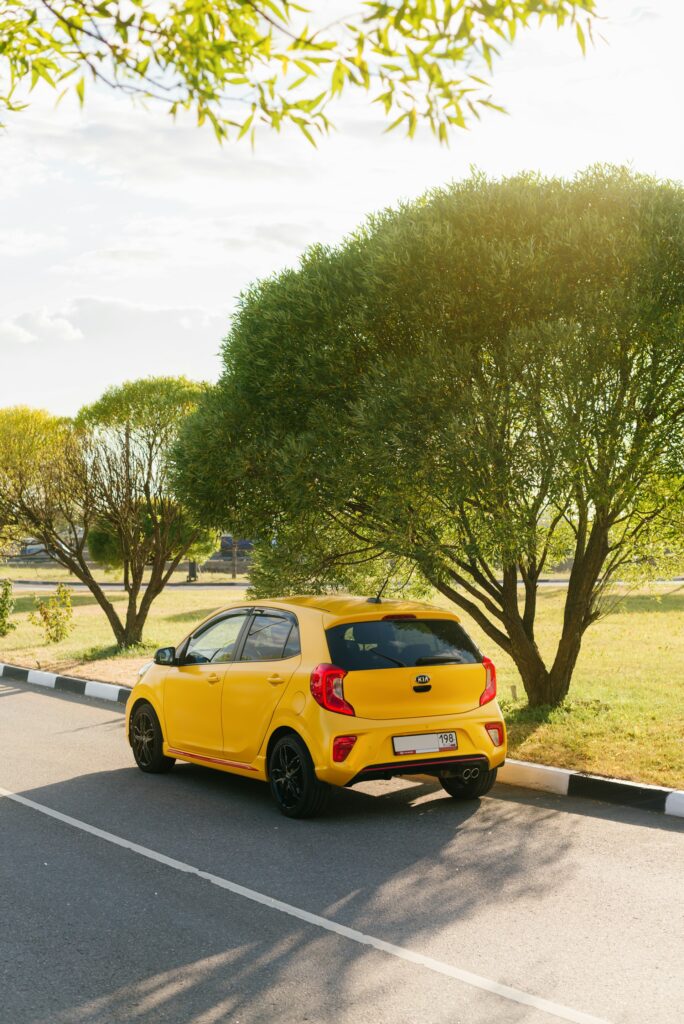
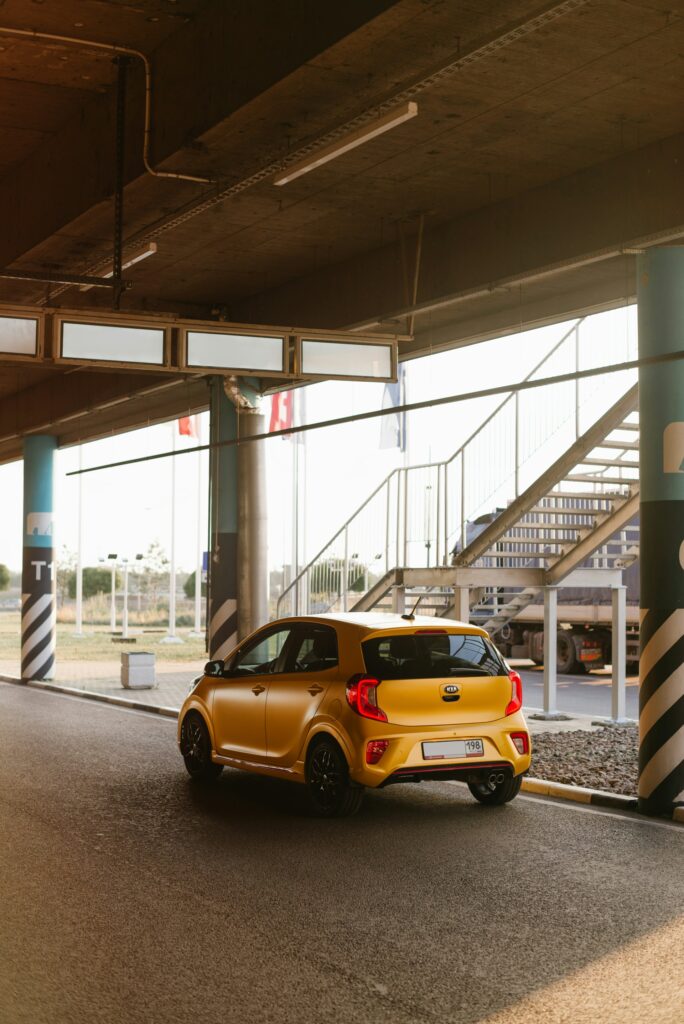
Kia Picanto
For the budget-conscious beginner, the Kia Picanto asserts itself as a paragon of value. With its low running costs and generous 7-year warranty – a clear testament to Kia’s trust in its craftsmanship – the Picanto eases financial worries for the fledgeling driver.
The affordability extends beyond the initial purchase, as Kia parts are readily available and reasonably priced, ensuring that maintenance won’t break the bank. And whilst it may be modest in size, it packs a punch with an unexpectedly spacious interior and brisk performance for city jaunts and countryside romps alike.
Prices start from around £13’500.
Mazda MX-5 Miata
For those who dream of a sportier ride, the 2023 Mazda MX-5 Miata is an exciting option. While it may not be the conventional choice for a first car, it offers an engaging driving experience with its nimble handling and responsive controls. It’s a car that makes every journey feel like a driving adventure, perfect for the spirited new driver.
Prices start from around £19’000.
Ford Focus
The Ford Focus has long been celebrated for its easy steering, control, and ultimate comfort, making it a popular choice among new drivers. Its reputation for reliability is well-founded, and with excellent fuel economy, it’s not only kind to your wallet at purchase but also at the petrol station. The Focus provides a smooth ride, which is perfect for those still getting accustomed to the nuances of handling a car on busy roads.
For first-time drivers who prioritise visibility during their night drives, the Ford Focus offers a choice between xenon and LED headlights. While xenon headlights are known for their bright, white light, LED headlights are durable and energy-efficient, making them a practical option for those who plan to log many hours on the road after dark.
Prices start from around £23’000.
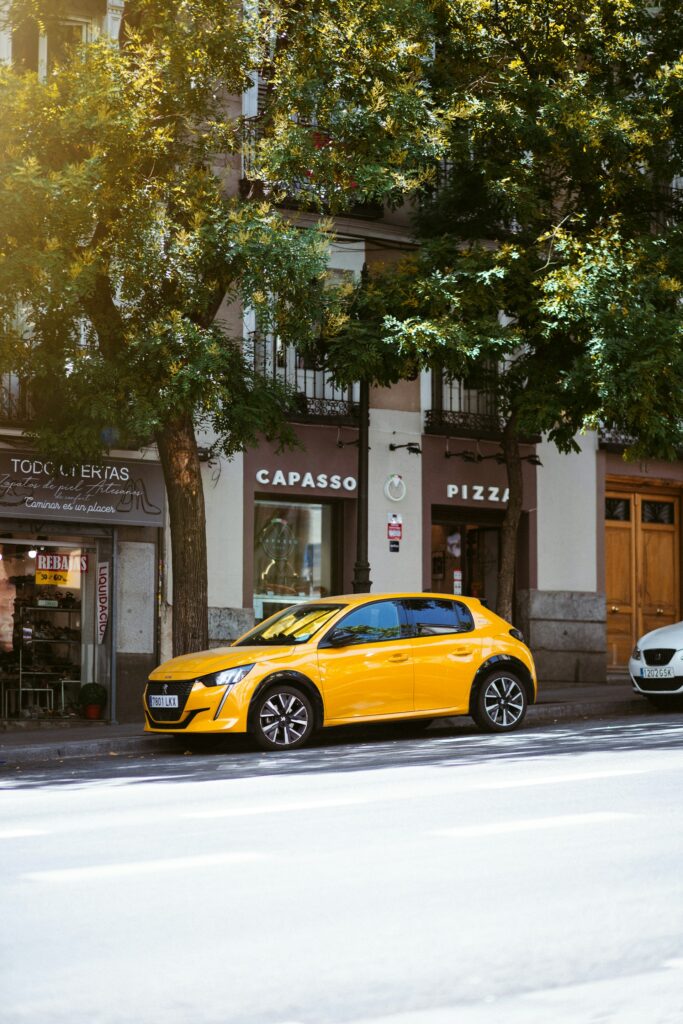
Peugeot 208
With a dash of Gallic flair, the Peugeot 208 captures the essence of stylish motoring without compromising the substance. The chic interior exudes a ‘beyond-its-class’ feel, while the exterior design conveys a modern aesthetic. Not merely a pretty face, the 208 is laden with advanced driver assistance systems that new drivers will appreciate, offering a blend of sophistication and safety in one appealing package.
Prices start from around £20’000.
Skoda Fabia
Another strong contender in the compact category, the Skoda Fabia, presents unmatched practicality and a mature drive experience. It boasts a capacious boot for the class, making it fitting for university students requiring ample space for their gear. With an array of nifty safety features, it’s designed to protect and reassure, paving the way for a secure driving initiation.
Prices start from around £15’700.
Seat Ibiza
Lastly, the Seat Ibiza strides forth as a sumptuous blend of sporty spirit and everyday usability. This Spanish marque provides a dynamic driving experience, which is seldom found at such an accessible price point. Despite its zeal, it doesn’t skip on practicality nor efficiency, presenting a balanced choice for those seeking a bit more verve from their inaugural motor.
This assortment crosses borders and tastes, all the while prioritising what matters most to the novice driver: safety, dependability, and financial prudence. Whether you’re in favour of traditional functionality or have a penchant for pizzazz, these ten cars provide a splendid starting line for your automobile adventures.
When considering these cars, it’s important to focus on the aspects that matter most to new drivers: safety features, reliability, and cost-effectiveness. Cars with collision avoidance, backup cameras, and automatic braking should be highlighted, as they can significantly enhance the safety of inexperienced drivers. Additionally, good gas mileage and a reasonable sale price are key factors that make these vehicles appealing choices for those just starting out on the road.
*All prices are for 2024 or 2025 models, new, as estimated by Auto Trader.*
Ideal for creating your very own domestic den of zen…
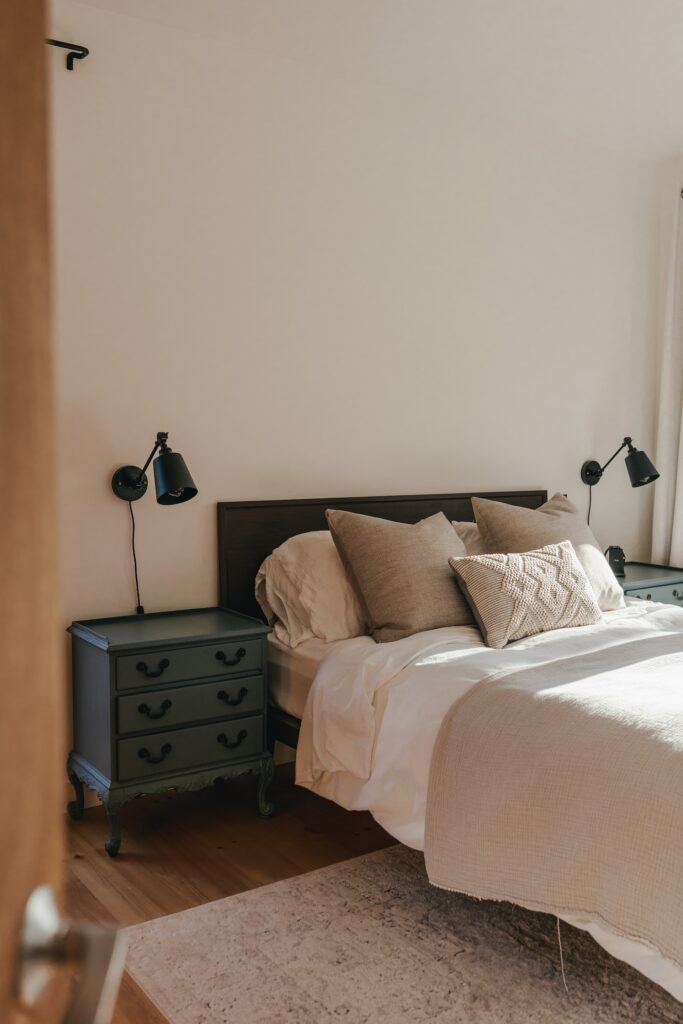
While you spend the majority of your bedroom hours dreaming with your eyes closed, it doesn’t change the fact that those familiar four walls are the last thing you see before drifting off to sleep. Consequently, they are also the first things you see when you wake up.
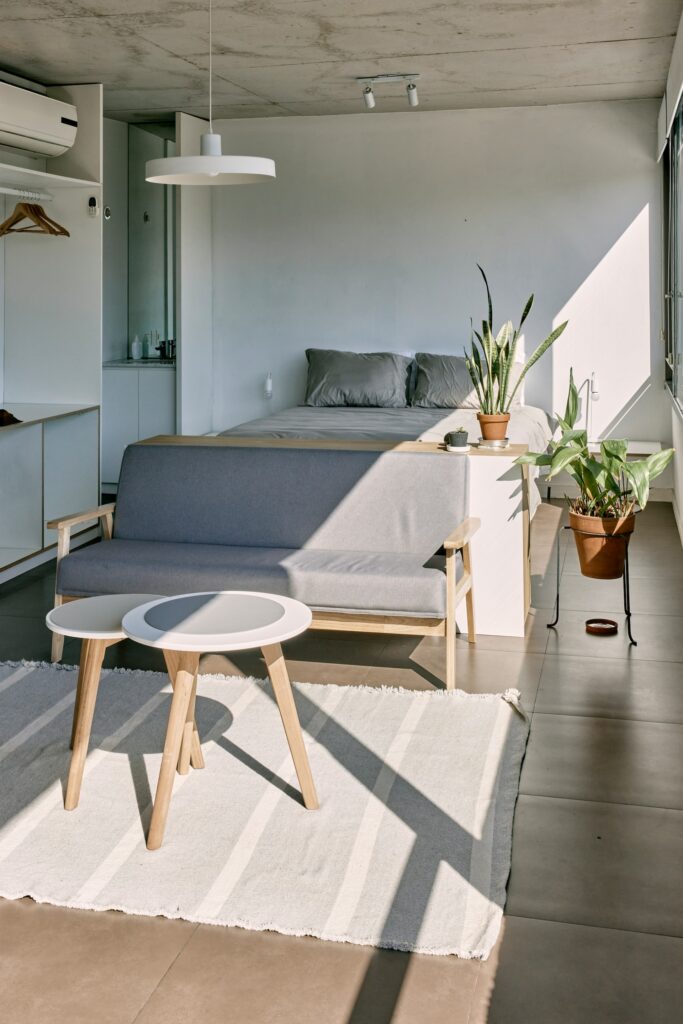
As such, the aesthetic and ambience of your bedroom can play a major role in both the quality of your rest and of your mood during the day. What’s more, in these topsy turvy, turbulent times, it’s vital you have somewhere personal to find peace, solace and comfort. With that in mind, here are some smart and simple ways to transform your bedroom into a tranquil space, IDEAL for creating your very own domestic den of zen.
The Ideal Sleep Environment
A zen and meditative space full of dream catchers, the soundtrack of wind chimes and the aroma of incense is all well and good. But if you’re not using your bedroom for its primary purpose (sleep, we mean sleep) and to its full potential, well, that tranquillity just ain’t gonna come.
A well thought through bedroom design is directly linked to the quality of your sleep, and creating a good sleep environment should be one of your main focal points when aiming for that ‘den of zen’ feel.
Ensuring a quality night’s rest boils down to four key aspects – noise, lighting, temperature, and bedding. Get those four elements right and good sleep will come.
It’s your bedroom. Your private, personal space where you’re allowed to dance like no one’s watching, where you laugh and cry, where you snore and drool on your pillow…
As such, don’t be afraid to personalise your bedroom to suit your favoured aesthetic and ambience, and ditch the identikit, IKEA styles in the process.
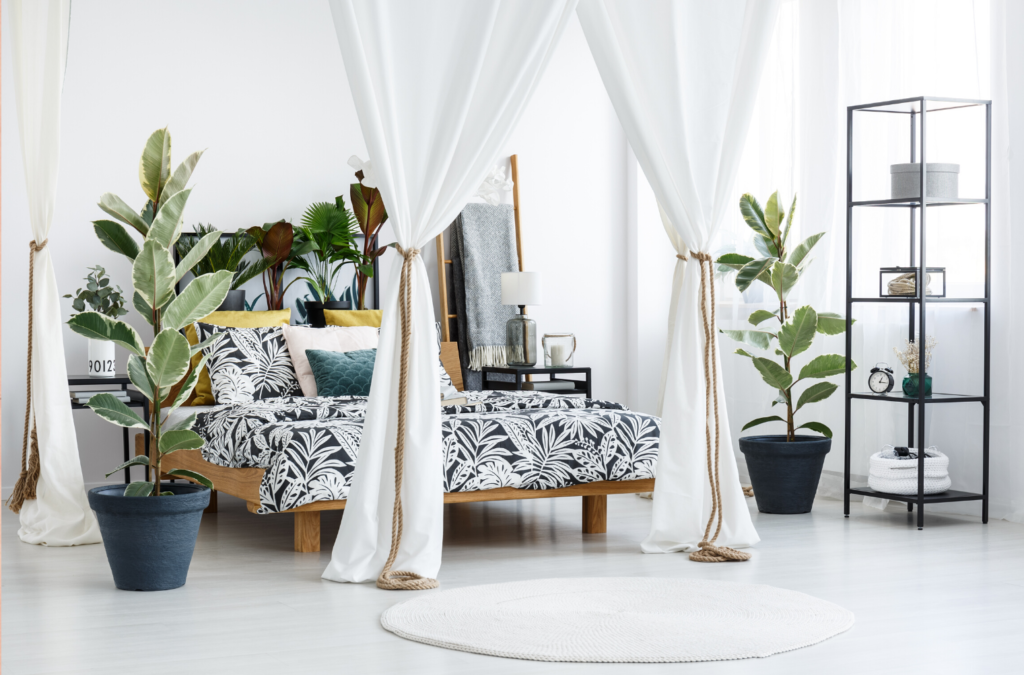
Use your bedroom to celebrate your interests and personality. Are you a plant person? Add some greenery. Perhaps you’re a minimalist and would like a no-nonsense décor? Strip it all back and simply sleep in a stark white room with no furnishings whatsoever! If you’re musical, invest in an immersive sound system or perhaps a retro record player set up…
Your bedroom is your vehicle for self-expression; put both hands on the wheel and steer confidently.
Colour Curious
Colour psychologists believe that the hues in which we paint our walls are both reflective of, and dictatorial of, our mood. In fact, there is a whole discipline within colour psychology termed ‘room colour psychology’ which posits that shades which come under the ‘cool colour’ umbrella are ideally suited to the bedroom.
These include restful greens, adept at calming a stressed mind and boosting fertility (ahem), soothing blues and restful lavender, in particular. Conversely, since you’re seeking a tranquil space, avoid bold colours, particularly red which can invoke passion (good for the bedroom, perhaps) but also anger (hmmm, not so much).
Avoid Extremities Of Artificial Light
On top of the colour scheme you choose, let the lighting fixtures further illuminate the beauty of your room, gently and softly rather than in a dramatic, overbearing way. Let the natural light flow to its maximum potential by avoiding placing furniture, stacks of books or any other items in front of your windows. Mirrors placed tactically allow natural light to bounce around the room, too.
In the evening, task lighting, layered and dim, is ideal for bringing that sense of calm to your private space. Should you need task lighting when getting ready for a day in the office or a night out on the town, for instance, then a make-up mirror with lights is perfect, and won’t throw off the overall balance of the room when not in use.
Maximise Storage
Tidy bedroom, tidy mind, as the saying goes, and it’s one so apt that we might as well move on to the next point, don’t you think?
That would be remiss of us. Especially handy for those struggling to make their small bedroom space work, maximising storage space is essential in order to prevent clutter becoming a mental distraction as well as a physical one.
There are plenty of ways you can keep your surplus of clothes, extra linen, and other trinkets organised and safely kept. Aside from your standard closet, use your headboard as storage by adding drawers and carving out blank shelves. For the ultimate space-saving solution, many Brits have been looking at ComfoRest single ottoman beds in recent years, which cleverly conceal generous storage compartments beneath the mattress – perfect for stashing away seasonal clothing or spare bedding without sacrificing floor space.
If ottoman beds aren’t your style, get some storage boxes made-to-measure and able to fit under your bed, or better yet, install pull-out drawers underneath your bed. Pick a bedside table with storage allocation to place things you want to be in reach like glasses or books. And finally, look into wardrobes specifically designed to possess extra storage space.
Natural Elements and Textures
Nothing says ‘zen’ quite like bringing the outdoors in, and incorporating natural materials into your bedroom design can work wonders for creating that sought-after sense of serenity. Think beyond just aesthetics here – natural textures engage our senses in a way that synthetic materials simply can’t match.
Start with your bedding choices. Opt for organic cotton sheets, linen duvet covers, or bamboo pillowcases that breathe with you through the night. These materials don’t just feel luxurious against your skin; they regulate temperature naturally and age beautifully over time. Layer in a chunky knit throw made from wool or alpaca for those cooler evenings when you need an extra cocoon of comfort.
For your floors, if you’re blessed with hardwood, let it shine! Add warmth underfoot with a jute or sisal rug- these natural fibres ground the space (literally) and add that earthy texture that screams tranquillity. If carpet is your reality, no worries; a strategically placed natural fibre rug can still work its magic.
Don’t overlook your window treatments either. Swap out those synthetic curtains for linen or cotton panels that filter light beautifully while maintaining privacy. On sunny mornings, watch how natural fabrics create a soft, diffused glow that no blackout curtain could ever replicate.
Finally, incorporate some raw wood elements – perhaps a live-edge bedside table or a piece of driftwood as wall art. These organic shapes and textures remind us of nature’s imperfect perfection and help create that connection to the natural world that’s essential for true tranquillity.
Power Corner
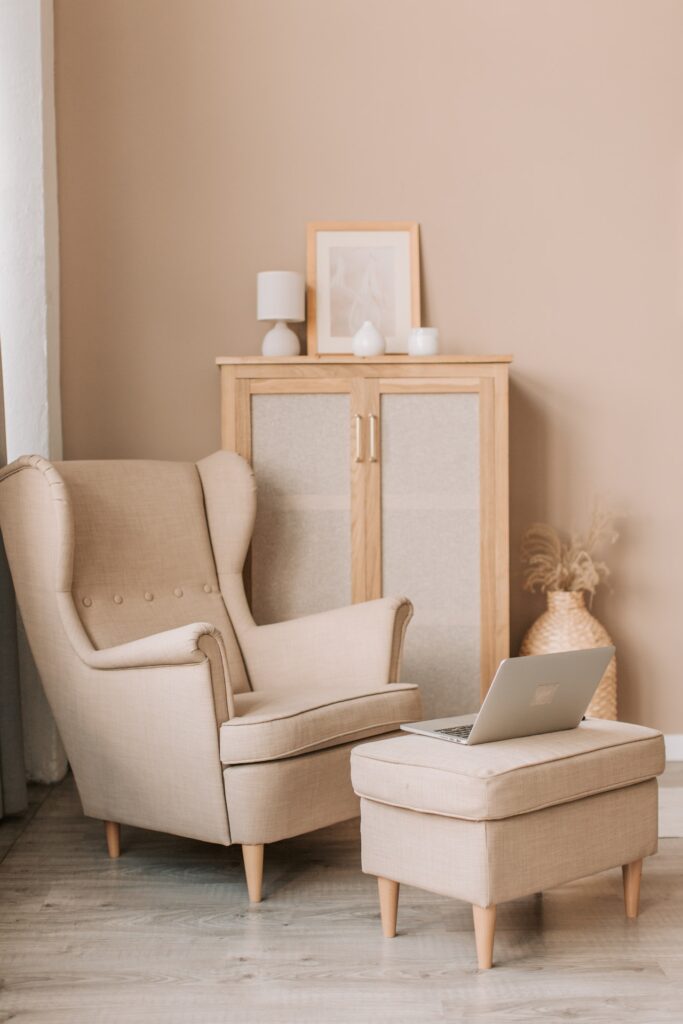
Giving corners of the home the attention they deserve has been one of 2025’s key home and interior trends, and we’ve been all over the concept of the ‘power corner’ for some time; an area of a room dedicated to decision making, contemplating, planning, or perhaps kicking back, device-and-distraction free. Place a comfortable chair or cushion in a position close to your bedroom window or better yet, install a window seat, to ensure you’re basking in natural light. Add a footstool and perhaps even place a blanket and some pillows within reach.
Use your power corner for when you most need your alone time. Look out world; big decisions will be made here!
Don’t Forget The Ceiling
Ceilings are the last thing most people take notice of when they are inside a room. That reason alone makes it all the more important when it comes to designing your bedroom. Though others may not cast their eyes upwards when they enter your bedroom, you certainly do. After all, and at the end of the day, we’ve all spent a few hours staring into our ceiling looking for answers when we can’t sleep.
Though they never come, it doesn’t hurt to make sure your ceiling is looking the part. Give it a lick of paint to avoid blemishes or cracks which are ripe for fixating on when you can’t sleep. Ideally, the colour will complement a shade pulled from the walls; perhaps it’s time to deploy that lavender we mentioned earlier?
Make It Your Healing Space
Last but not the least, it is important to keep in mind that your bedroom is your own personal retreat. As much as is possible, keep your room free from any distractions like television, gadgets, or anything that would remind you of your workload and stress.
Make your bedroom a place for healing. Do you share it with someone? Then consider what each would like to do in the room as you seek it for moments of comfort and rest. And if you need further advice on making your bedroom a true den of zen, then check out these tips on how to create a home meditation space. And breathe…
Summer is well and truly upon us, the birds are singing, plants are peeping their heads above the parapet and suddenly everything is looking rather rosy. Or rather, everything is looking rather dry, with 2025 looking to break all manner of records for heatwaves and drought.
That shouldn’t put you off your gardening, however. In fact, it should serve as even greater encouragement to get out there and nurture your plants.
With gardening now recognised as a therapeutic pastime, we’ll take any excuse we can to get out there and frolic amongst the long (and admittedly yellow) grass and flowers. But save a thought for the city dwellers, with not a square metre of garden to share between a street. Or perhaps not….
In fact, a trend in recent years is for those without garden space to erect greenhouses on apartment rooftops and experience the soothing effects of tending to plants, herbs and crops first hand. So, whether you’re living in Birmingham or Bledlow, there really is no excuse not to get your fingers green and your knees muddy/dusty. With that in mind, here are 7 greenhouse growing tips for summer.
Know Your Planting Seasons
Successful greenhouse growing isn’t simply a case of chucking some seeds into a pot, turning your back and hoping for the best. Nope, it actually requires careful planning and preparation, and most importantly, a very particular attention to the seasons.
In early summer, it’s time for fast-growing tender plants like courgettes, french beans and squashes, and in unheated greenhouses ready grown pepper and tomato plants. It’s also the ideal time to sow your basil seeds. In later summer, you can sow lettuce and any salad leaves that fall under the ‘peppery’ umbrella (rocket and watercress, we’re looking at you), as well as baby carrots and new potatoes.
Also fair game for planting (if you can find any space!) in your greenhouse are herbs like coriander, chervil, dill and parsley. It’s a good time for fennel, spring onions and Chinese cabbage, too.
Basically, timing is everything; the RHS have published this useful chart which gives extensive information on month-by-month best practice for planting.
Summer Lovin’
The weather has suddenly heated up considerably, and unseasonably warm looks set to become the new normal. The way you approach your greenhouse and its watering regime should be starkly different from winter to summer, adaptable and ever evolving, too.
If you’re going to take your growing regime seriously, then you might want to consider a smart automatic watering system, which are able to water automatically with minimal supervision. Solar powered, they also represent an environmentally friendly purchase, avoiding excessive energy use and overwatering.
During these hot summer months, when it gets stuffy and humid within, you’ll need to check water levels and carry out watering daily. Uneven watering – and that can mean overdoing it as much as neglecting it – can cause problems like blossom and rot.
To mitigate these issues, make sure you ventilate your greenhouse on particularly warm days and be aware that the manufacture of some shading will be necessary. Summer sees a rise in pests which, when unchecked, will ravage your crops; hang sticky traps to catch them.
Though the dream is to be at one with nature, listening to the subliminal messages your plants are sending and massaging their leaves until they flourish, the reality is somewhat different. As such, there’s no shame in relying on a little technology to make things run more smoothly.
By implementing features like remote control windows, widespread sprinklers or those smart watering systems we mentioned earlier, greenhouse owners can optimise the conditions of their goods within. Be wary of heated greenhouses, however. Although they allow for maximum year round yield, they are rarely cost effective. And at a time of climate chaosandrising energy bills, we should be trying to minimise our impact, not increase it.
Keep It Clean
If we’ve learnt anything from Breaking Bad, it’s that only with a meticulous attention to tidiness will production realise its full potential. Maintaining a clean and tidy greenhouse, then, is vital for the health and success of your plants. Tools and pots should always be disinfected to prevent diseases and harmful pests from invading, and excess condensation should be cleared from the glass to minimise the risk of mould growth.
You should keep a kit handy that includes natural and organic insecticidal soaps (an increasingly popular method of controlling certain insects in an eco-friendly manner), a bleach solution and disinfectant spray along with clean microfibre cloths so that you don’t have to waste time or effort collecting supplies when you need them. Those extra few seconds saved could be the difference between flourish or fail. Be sure the bleach solution is properly diluted; in most cases, one part bleach to nine parts water is a good ratio for safely disinfecting.
Scale Up Your Thinking
While most hobby greenhouse enthusiasts work with smaller structures, there’s much to learn from commercial-scale operations. Companies like the MSB Group, who specialise in larger steel agricultural buildings, have shown how proper structural design can dramatically improve growing conditions. Take inspiration from these larger projects by incorporating professional features into your home setup – consider installing proper guttering for rainwater collection, ensuring adequate floor drainage, and creating designated workspace areas. Even in a small greenhouse, thinking big about organisation and efficiency can transform your growing experience.
Master the Art of Succession Planting
To maximise your greenhouse’s productivity throughout summer, embrace succession planting. Rather than sowing all your seeds at once, stagger plantings every 2-3 weeks. This ensures a continuous harvest rather than a glut followed by nothing. Start with quick-maturing crops like salad leaves and radishes, planting new rows as you harvest mature ones. Keep a simple planting calendar on your greenhouse wall to track what was planted when, and you’ll enjoy fresh produce from early summer right through to autumn.
Create Microclimates Within Your Greenhouse
Your greenhouse doesn’t have to be a one-temperature-fits-all environment. By using shelving at different heights, creating shaded areas with cloth or netting, and positioning water barrels to absorb and release heat, you can create distinct growing zones. Place heat-loving plants like tomatoes and peppers on upper shelves where temperatures are warmer, while keeping cooler-climate crops like lettuce lower down. This microclimate approach allows you to grow a wider variety of plants successfully in the same space.
And with that, we wish you all the best success with your greenhouse grow-your-own endeavours!
While the British love affair with Italian property typically begins and ends with a restored farmhouse in Tuscany or a pied-à-terre in Rome, savvy buyers are discovering Italy’s best-kept secrets. From the heel of the boot to the Alpine foothills, these underrated destinations offer everything the famous regions do – spectacular food, vibrant culture, and that indefinable Italian magic – but with price tags that won’t require remortgaging your Surrey semi.
Abruzzo: The Wild Side Of Italy
Average property price: €124,000-€248,000 Nearest airports: Pescara (in the region), Rome Fiumicino (2.5 hours) IDEAL for: Nature lovers who like their wine robust and their mountains dramatic
Imagine Tuscany after a few shots of grappa – wilder, more rugged, and refreshingly unpretentious. That’s Abruzzo. Dubbed ‘Europe’s greenest region’, this is where Romans escape when they want proper mountains, proper beaches, and properly enormous portions of pasta.
The medieval town of Santo Stefano di Sessanio looks like a film set but without the tour buses. Here, if you looking at homes for sale in Italy, you can still buy a stone house needing love for around €50,000, or splash out €300,000 on something with valley views that’ll make your Instagram followers weep with envy.
The nightlife? Think less flashy clubs, more cosy osterie where the owner’s nonna still makes the pasta by hand. The local Montepulciano d’Abruzzo flows freely, and if you’re lucky, you’ll stumble into a sagra (food festival) where entire villages gather to celebrate everything from lentils to lamb. Speaking of lamb, the arrosticini – skewers of perfectly seasoned meat grilled over charcoal – are so good they should be illegal.
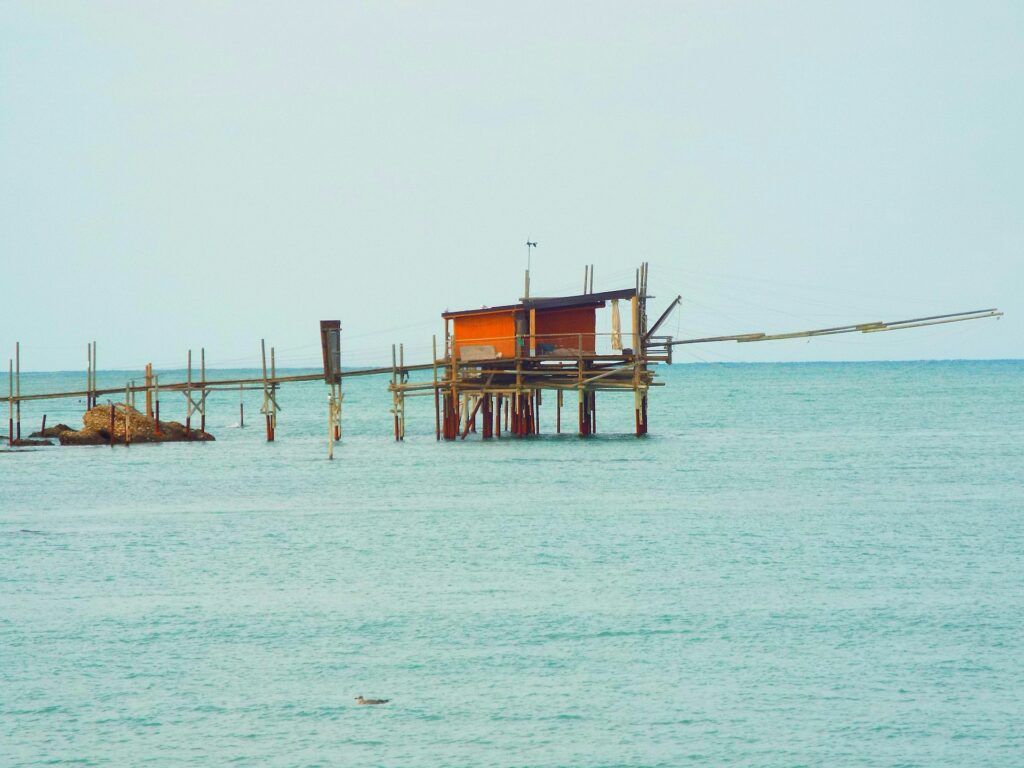
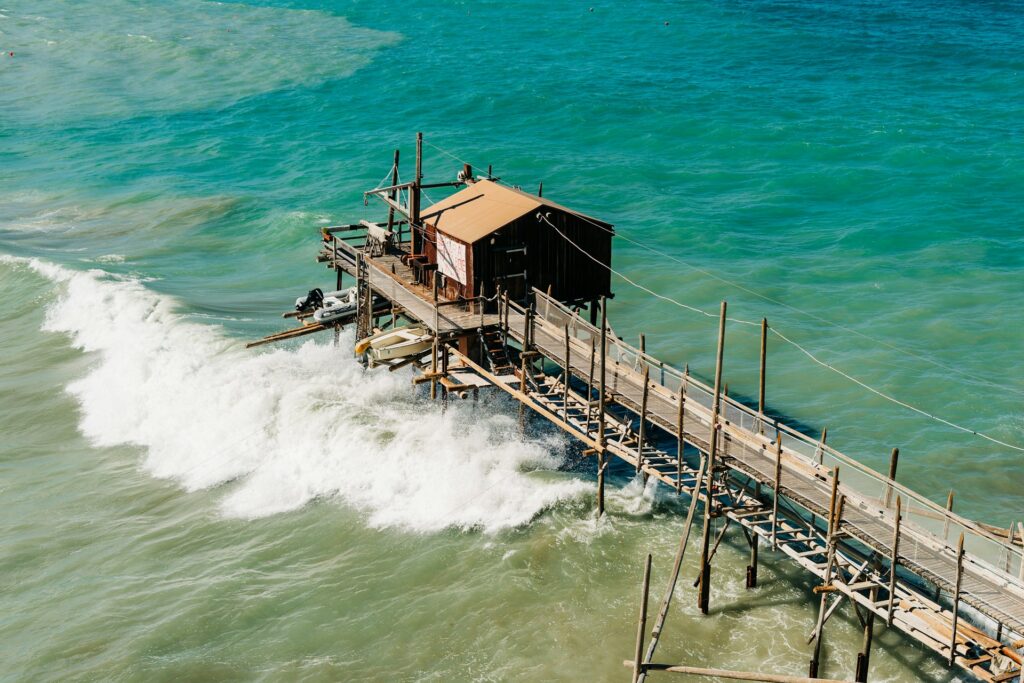
Beach bums aren’t forgotten either. The Costa dei Trabocchi features those extraordinary wooden fishing platforms jutting into the Adriatic, many now converted into atmospheric restaurants where you eat whatever was caught that morning.
Friuli-Venezia Giulia: Where Austria Meets The Adriatic
Average property price: €153,000 for a family home Nearest airports: Trieste (regional airport), Venice Marco Polo (1.5 hours) IDEAL for: Wine snobs and coffee addicts
Sandwiched between Austria, Slovenia, and the sea, Friuli is Italy’s most intriguing cultural mash-up. This is serious wine country – the whites here are so good, Veneto should be jealous – yet property prices remain surprisingly sensible.
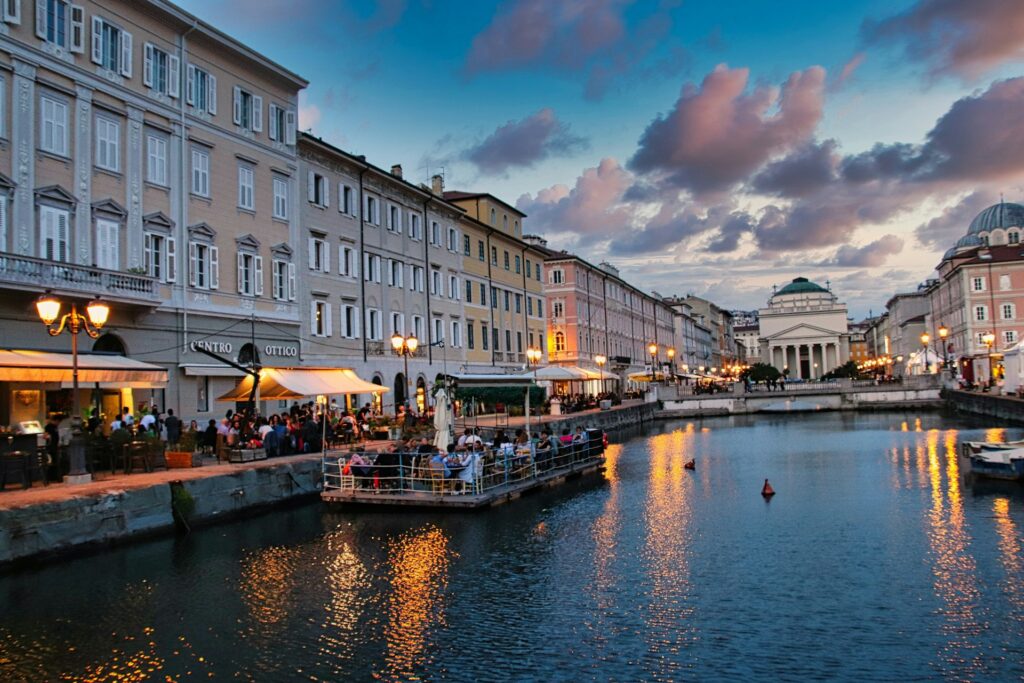
Trieste, the capital, is a coffee lover’s paradise with a café culture that rivals Vienna’s. The nightlife is more jazz club than techno temple, perfect for those who prefer their evenings sophisticated. Want something livelier? The university ensures a healthy population of dive bars and late-night pizzerias.
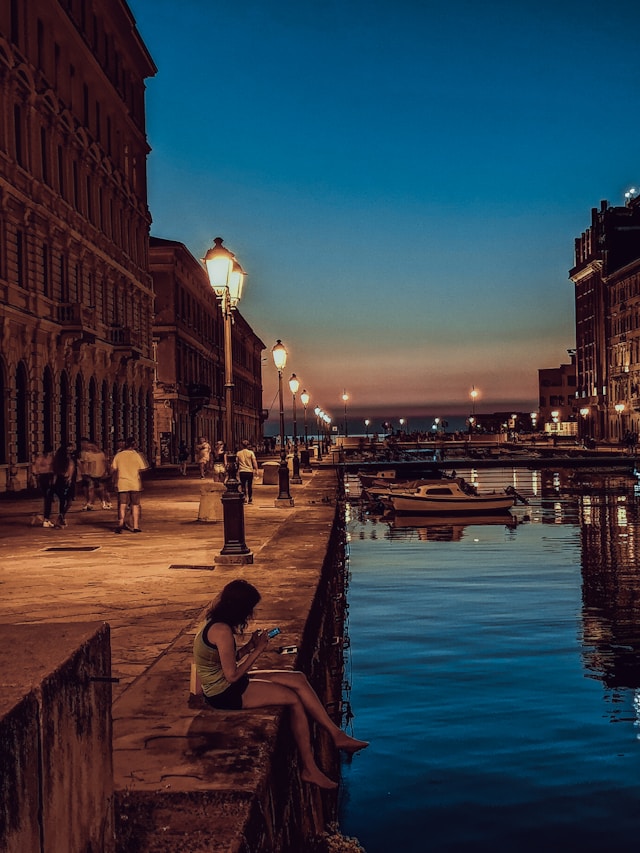
The food scene is bonkers good: think Austrian-influenced goulash alongside perfect prosciutto di San Daniele, all washed down with exceptional Friulano wines. In this area you’ll find towns like Cividale del Friuli offer medieval charm without the tourist coaches, while the Carnic Alps provide skiing just an hour from the beach. Properties range from €100,000 apartments in town to €300,000 country houses with mountain views.
Le Marche: Tuscany Without The Tourists
Average property price: €160,000 for a family home Nearest airports: Ancona (1.5 hours from region), Rimini (2 hours), Pescara (1 hour 45 mins) IDEAL for: Sunseekers who want culture and history alongside their tan
Le Marche is what happens when Tuscany and the Adriatic have a love child – all the Renaissance art and rolling hills you could want, plus 180 kilometres of beaches. Yet somehow, it’s remained deliciously under the radar.
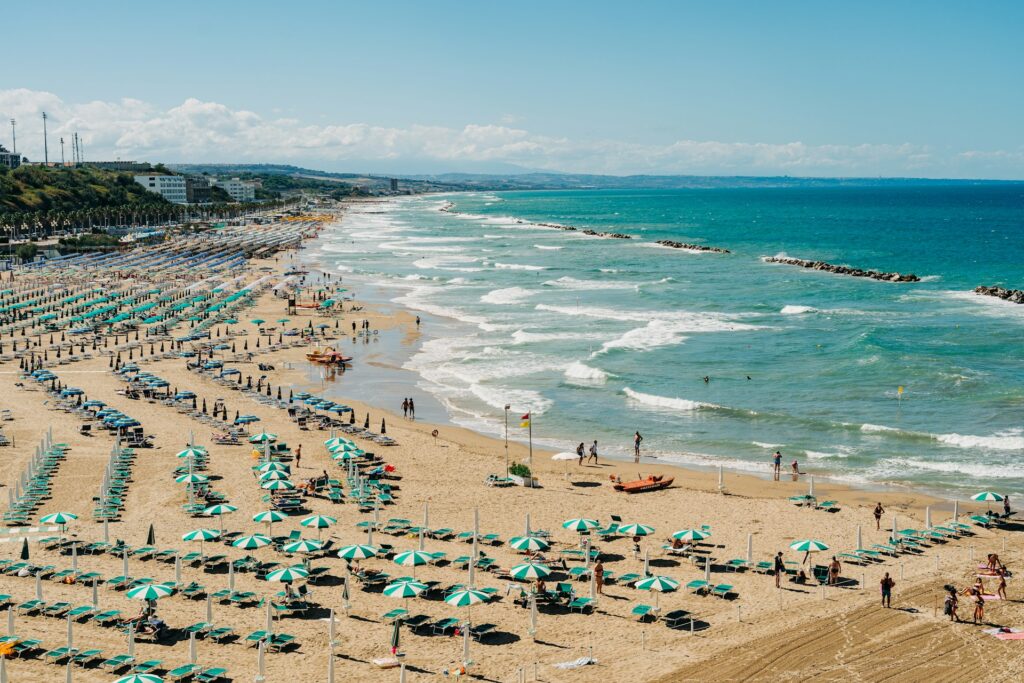
The university town of Urbino keeps things lively with students ensuring a decent bar scene year-round. Come summer, the coastal town of Senigallia transforms into party central, with beach clubs that go from lazy aperitivo spots by day to thumping discos by night. Not your scene? Head inland to the wine country, where Verdicchio flows like water and every hilltop town seems to have its own food speciality and cultural signature.
The region’s signature snack, olive all’ascolana (meat-stuffed olives, deep-fried to golden perfection), is the ultimate beer food – though locals prefer them with a crisp Rosso Piceno. Property-wise, you can snag a townhouse in a medieval borgo for under €100,000, or go full countryside with a farmhouse and vineyard for around €300,000.
Basilicata: Italy’s Best-Kept Secret
Average property price: €119,000-€238,000 Nearest airports: Bari (2 hours), Naples (2 hours) IDEAL for: Adventure seekers who like their Italy raw and real
Yes, Matera’s cave hotels are all over Instagram, but venture beyond and you’ll find an Italy that time forgot – in the best possible way. This is where village houses go for London parking space prices, and where the food is so good it doesn’t need to try.
Potenza, the regional capital, might be gritty but its bar scene is surprisingly hip, with craft beer spots and natural wine bars popping up between the brutalist architecture. Down on the coast, Maratea – dubbed the ‘Pearl of the Tyrrhenian’ – offers Caribbean-blue waters without the Caribbean price tags.
The cuisine here is properly hardcore: peperoni cruschi (sweet peppers dried until crispy) are eaten like crisps with drinks, lucanica sausages pack a proper punch, and the pasta is still made the way nonna did it. Some villages are part of the famous €1 house scheme, though factor in renovation costs before you get too excited.
Average property price: €95,000 for a family home Nearest airports: Naples (2 hours), Pescara (2 hours) IDEAL for: True escapists who want to disappear into real Italy
There’s a running joke in Italy that Molise doesn’t exist. With only 300,000 inhabitants in the entire region, it’s Italy’s second-best-kept secret (after the recipe for proper carbonara). This is where you come to properly escape.
Campobasso, the tiny capital, punches above its weight with a lively student scene keeping the bars buzzing and ensuring decent pizza at 2am. The coastal town of Termoli offers proper Italian beach life – think families playing cards under umbrellas and seafood so fresh it was swimming an hour ago.
The food is outrageously good and outrageously cheap: wild boar ragù, truffle everything, and caciocavallo cheese that’ll ruin you for supermarket cheddar. Some villages here are literally giving houses away to attract new blood – perfect if you fancy a project and have a thing for authentic Italy minus the crowds.
Piedmont’s Hidden Valleys: Gourmet Paradise On A Budget
Average property price: €133,000 in lesser-known areas Nearest airports: Turin (1 hour), Milan Malpensa (1.5-2 hours) IDEAL for: Serious food lovers with champagne tastes on prosecco budgets
Everyone knows about the Langhe and its eye-watering prices, but venture into Piedmont’s other valleys and you’ll find the same rolling vineyards, medieval towers, and truffle-scented air for half the cost.
Towns like Asti (yes, of spumante fame) and the spa town of Acqui Terme offer proper Italian life with a sophisticated edge. The thermal baths in Acqui have been soothing Romans since, well, Roman times, and today’s aperitivo scene would make Milan jealous.
This is Italy’s gastronomic heartland: white truffles, Barolo wines, gianduja chocolate, and beef so good it has its own denomination. The nightlife revolves around enotecas where sommeliers treat wine like religion, and dinner is a four-hour affair. Properties range from €100,000 fixer-uppers to €500,000 Liberty-style villas, with plenty of vineyard-adjacent options for aspiring winemakers.
Northern Puglia’s Gargano Peninsula: The Spur Of The Boot
Average property price: €130,000-€260,000 Nearest airports: Bari (2.5 hours to Vieste), Foggia (1 hour) IDEAL for: Beach lovers who prefer their coastline dramatic
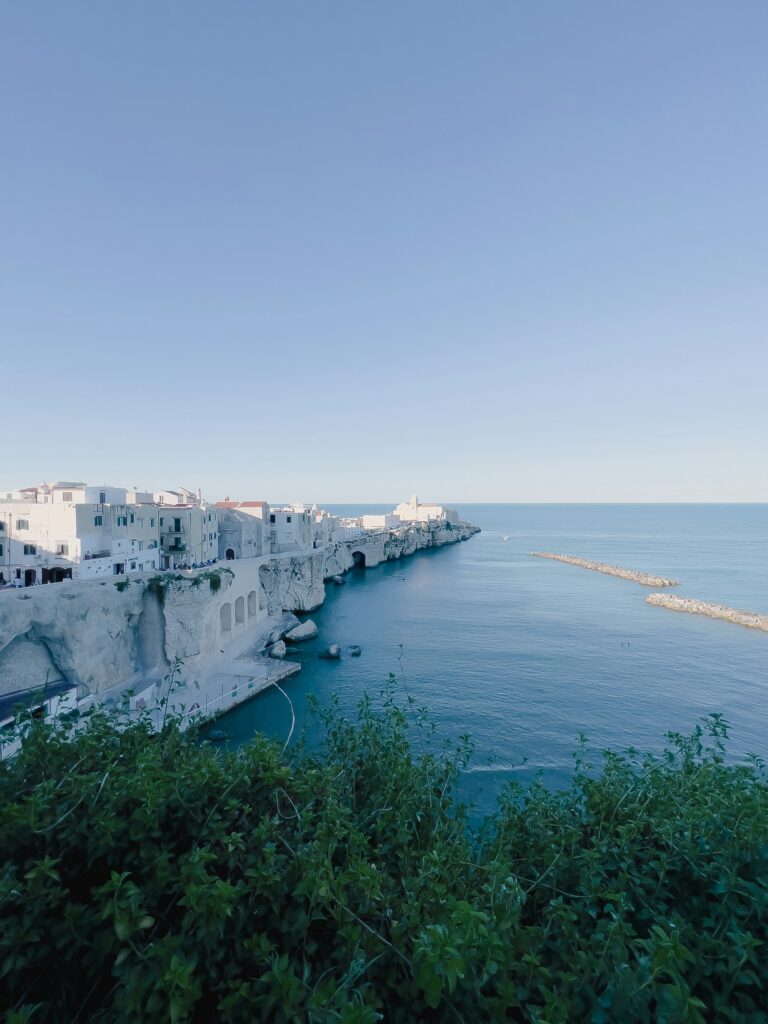
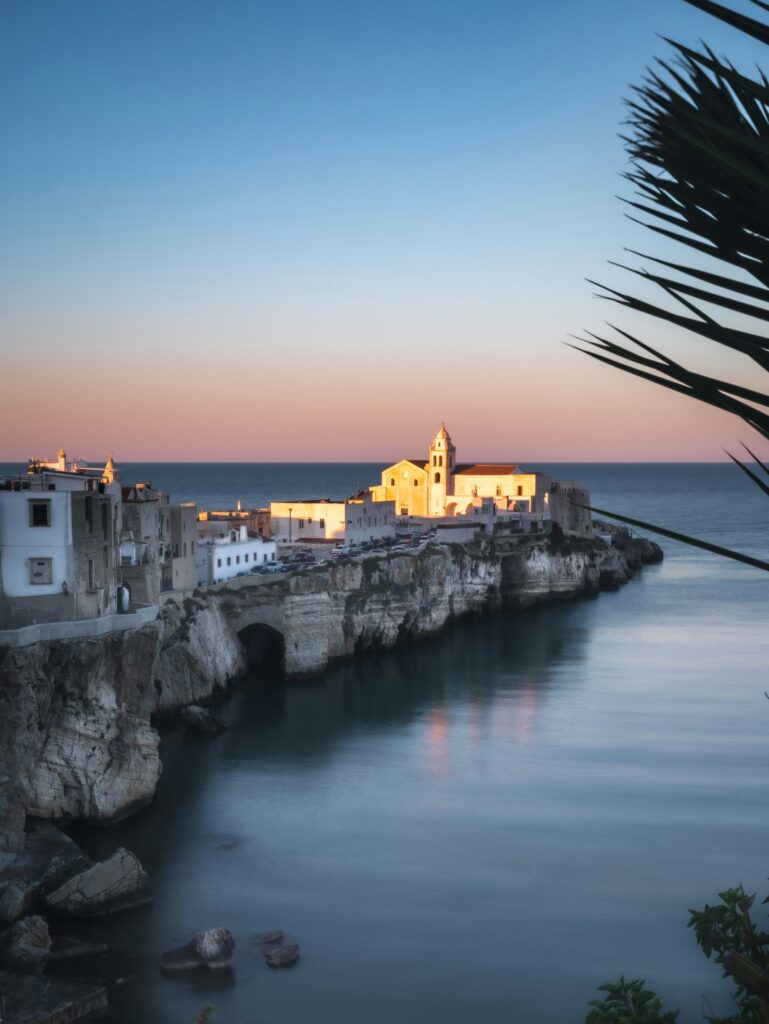
While everyone fights for a spot on Salento’s beaches, the Gargano Peninsula offers something altogether more wild. Think dramatic white cliffs, hidden coves accessible only by boat, and fishing villages that haven’t changed since your grandparents’ time.
Vieste perches on a white limestone peninsula with beaches on both sides – perfect for following the sun throughout the day. The old town is a maze of steep steps and washing lines, where the evening passeggiata still matters and the gelato is made by someone’s actual nonna.
Summer brings beach clubs that transform from lazy day spots to sunset party venues, with DJs spinning until dawn. The food is Puglia at its finest: burrata so fresh it’s still warm, orecchiette with turnip tops, and seafood pulled from the boat to your plate. The Foresta Umbra offers hiking through ancient beech forests when you need a break from the beach, and the whole area remains refreshingly Italian in character.
Most regions have decent flight connections from the UK, though you’ll want a car for exploring. The good news? Petrol is cheaper than the UK, the autostrade are gloriously empty compared to the M25, and Italian drivers aren’t nearly as terrifying as everyone says (okay, that last bit might be a lie).
The Bottom Line
These regions offer what we all want from Italy – incredible food, affordable wine, actual Italian neighbours (not just other expats), and property prices that won’t require selling a kidney. You’ll need some basic Italian (Duolingo won’t cut it for negotiating with the local builder), and yes, the bureaucracy can be maddening, but that’s a small price for la dolce vita.
Honestly, when you’re sitting on your terrace, glass of local wine in hand, watching the sun set over your own piece of authentic Italy, you’ll wonder why you didn’t do it sooner.
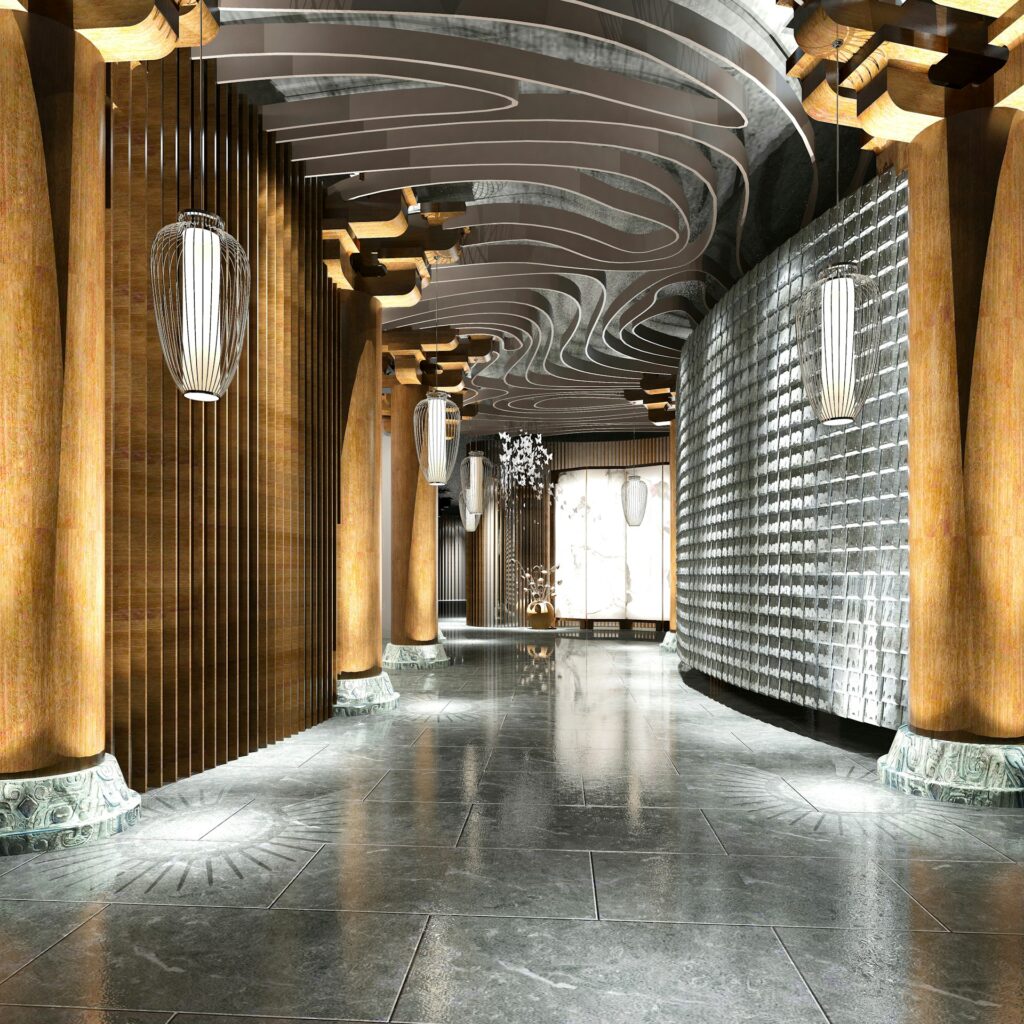
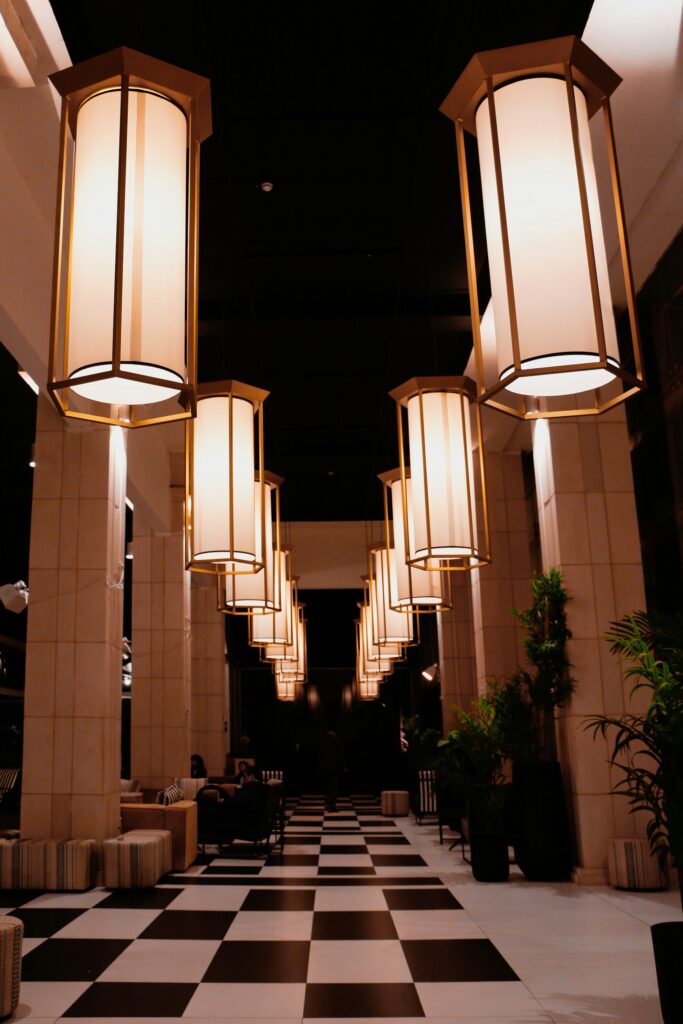
Step into any of 2025’s most anticipated hotel openings and you’ll quickly realise that something fundamental has shifted in high-end hospitality design. From Rome’s ancient ruins glimpsed through glass-bottom pools to Crete’s revolutionary earth-sheltered suites, this year’s properties are rewriting the rulebook on what a hotel can be.
Three defining movements are shaping 2025’s hotel landscape: the embrace of ‘quiet luxury’ over ostentatious display, the rise of bioclimatic architecture that works with nature rather than against it, and the seamless integration of technology that enhances rather than dominates the guest experience.
Quiet Luxury Replaces Grand Gestures
The era of gilt and glitter has given way to something altogether more refined. This year’s most talked-about openings demonstrate that true luxury lies in craftsmanship, heritage, and thoughtful restoration rather than superficial opulence.
The Waldorf Astoria New York’s reopening after a $2 billion renovation perfectly encapsulates this shift. Designer Pierre-Yves Rochon has transformed the legendary property from 1,400 rooms into just 375 suites, with the smallest measuring 475 square feet.
The painstaking restoration preserved 60,000 square feet of landmarked interiors, including the iconic 1893 World’s Fair clock, whilst creating Manhattan’s largest luxury accommodations. As Hospitality Design reports, it’s a masterclass in respecting history whilst meeting contemporary expectations.
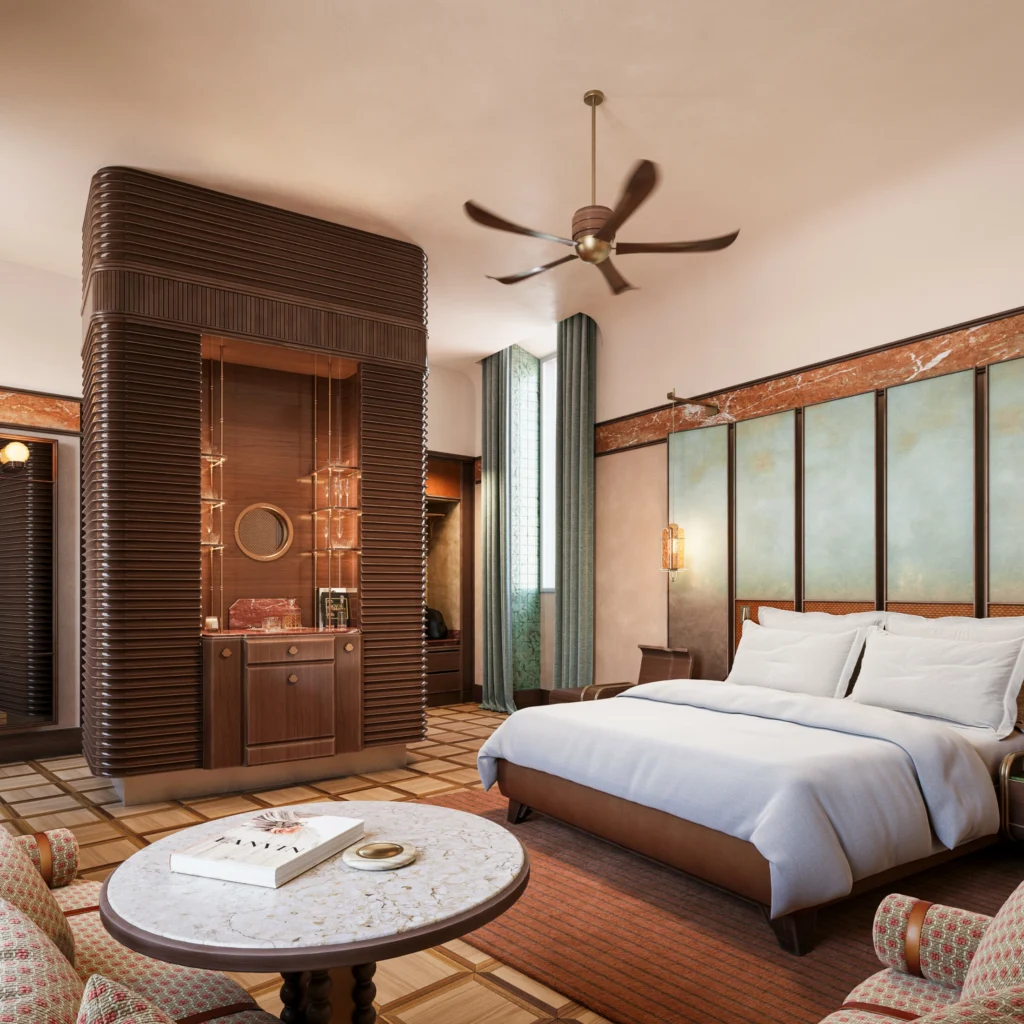
In Rome, the Orient Express La Minerva takes a different approach to historical preservation. Franco-Mexican designer Hugo Toro has transformed the 17th-century Palazzo Fonseca into 93 rooms that blend Art Deco glamour with Roman heritage.
The property’s showpiece – a glass-bottom pool suspended over ancient ruins discovered during construction – exemplifies how modern hotels are celebrating rather than concealing their archaeological treasures, according to Elite Traveler.
A New Colour Palette For A New Era
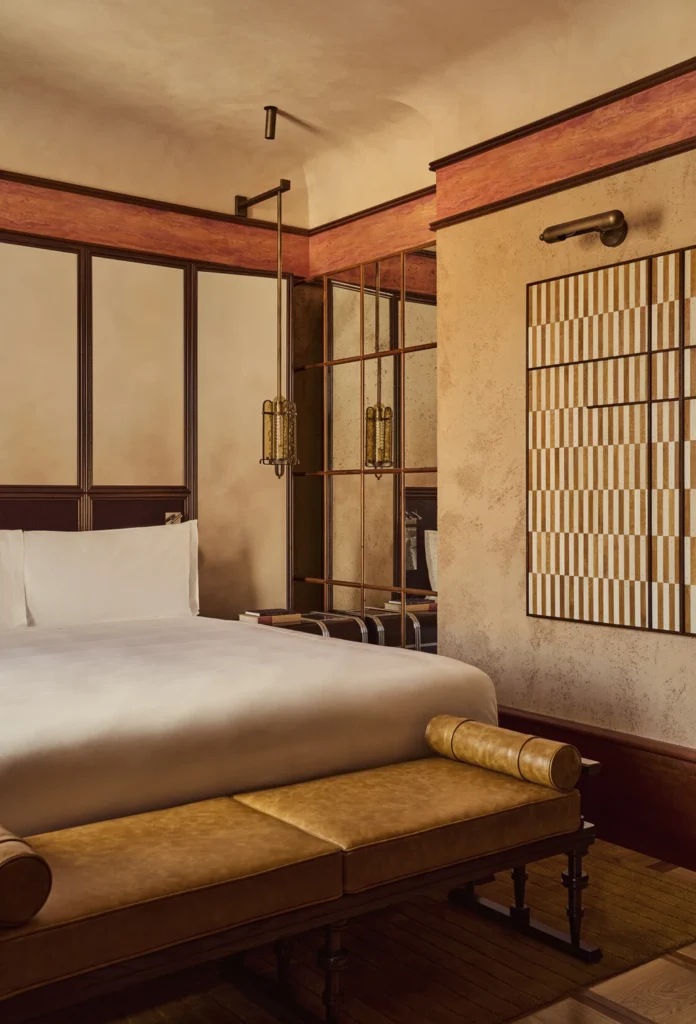
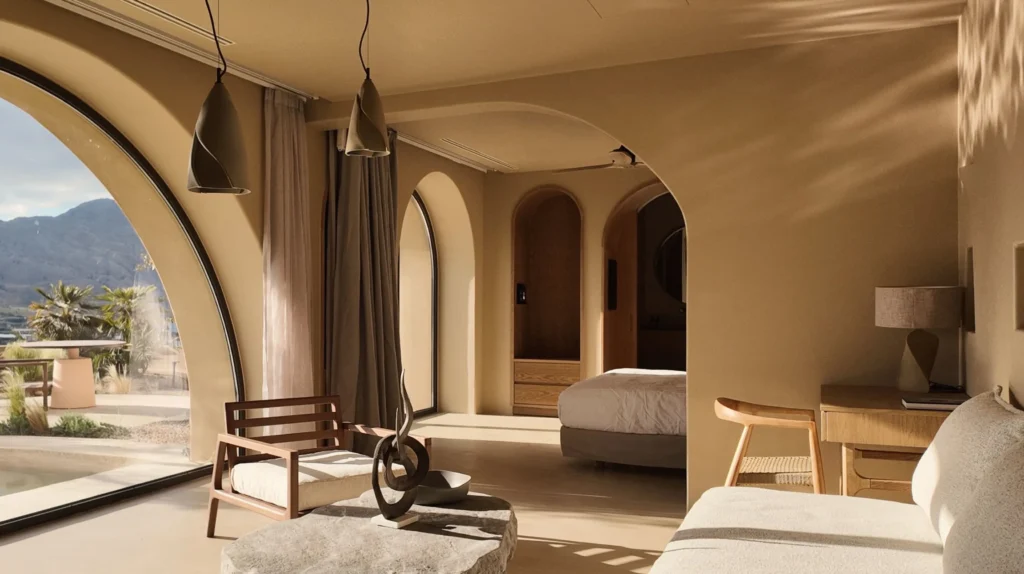
Pantone’s choice of Mocha Mousse as 2025’s Colour of the Year reflects a broader shift towards warmth and authenticity in hotel design. This sophisticated brown – reminiscent of perfectly frothed coffee – appears throughout the year’s most significant openings, from Orient Express La Minerva’s terracotta accents to the earth tones dominating Tella Thera’s interiors.
The move away from stark whites and cool greys towards warmer, more enveloping colours creates spaces that feel residential rather than institutional. Supporting palettes incorporate sage greens, dusty pinks, and deep blues that reference nature whilst maintaining sophistication.
Materials tell a similar story of authenticity and responsibility. FSC-certified woods, recycled metals, and fabrics created from ocean plastics are becoming industry standards. Properties are discovering that guests increasingly value knowing their luxury experience doesn’t come at the environment’s expense. Consultancies like IH Group are instrumental in helping hotels navigate these material choices whilst maintaining the premium feel guests expect.
Perhaps nowhere is hotel design’s evolution more evident than in the boutique properties embracing bioclimatic architecture. These hotels don’t just minimise their environmental impact; they demonstrate that sustainability can enhance rather than compromise the luxury experience.
Tella Thera in Crete represents the vanguard of this movement. Designed by Stella Pieri of Pieris.Architects, the property introduces what they term ‘Future Primitivism’ – subterranean suites nestled into the hillside with rooftop gardens planted with olive trees. This €10 million project, the first approved under Greece’s 2024 Development Law, achieves near-zero carbon emissions through its innovative earth-integrated design. The natural insulation keeps rooms cool in summer and warm in winter, proving that ancient building wisdom still has much to teach us.
Copenhagen’s Park Lane offers a Nordic interpretation of sustainable luxury. The property, transformed from a 1920s cinema by Camilla van den Tempel of &TEMPEL, showcases how existing buildings can be reimagined for contemporary hospitality. The material palette – solid wood, genuine leather, marble, bronze glass, and mohair, all sourced from Danish artisans – creates what Wallpaper describes as a ‘serene minimalism’ that feels both timeless and thoroughly modern.
The design revolution isn’t limited to luxury properties. Major hospitality brands are introducing prototypes that prove good design and operational efficiency aren’t mutually exclusive.
Hampton by Hilton’s new North American prototype, launching in early 2025, demonstrates how thoughtful planning can benefit both guests and operators. The redesign achieves 6% cost savings on furniture and fixtures whilst creating more inviting spaces. Repositioned front desks allow for flexible community areas, enlarged windows flood rooms with natural light, and outdoor patios encourage social interaction. As Hotel Dive reports, it’s a blueprint for how mid-scale hotels can elevate their offering without breaking the bank.
IHG’s Holiday Inn Express Generation 5 goes further still. The brand worked with a disability task force to ensure truly inclusive design, creating spaces that anticipate diverse guest needs through 2030. The new prototype features experiential zones including the EXPRESS Café & Bar and Focus Studios for quiet work, recognising that modern travellers need spaces that adapt throughout the day.
Technology That Enhances Rather Than Intrudes
The smartest hotels in 2025 are those where technology feels invisible yet indispensable. Rather than showcasing gadgets for their own sake, properties are implementing systems that genuinely improve the guest experience whilst reducing environmental impact.
Circadian lighting systems that mimic natural daylight patterns are becoming standard in forward-thinking properties. These systems not only help guests adjust to new time zones but also achieve dramatic reductions in energy consumption. Properties report substantial savings that benefit both their bottom line and the planet.
Living walls powered by AI represent another revolution here. These vertical gardens do more than look impressive; they actively purify the air, with some systems reducing pollutants by around half. Integration with weather data allows these installations to optimise their performance automatically, creating healthier environments without any effort from guests or staff.
Voice control has evolved from novelty to necessity, with thousands of rooms now featuring integrated systems. The technology has matured to the point where controlling room temperature, lighting, or ordering room service feels as natural as using a light switch.
Hotels As Community Anchors
The most successful hotels in 2025 recognise that they must offer more than accommodation. Properties are reimagining themselves as community hubs, with lobbies transforming into dynamic spaces that welcome locals alongside guests.
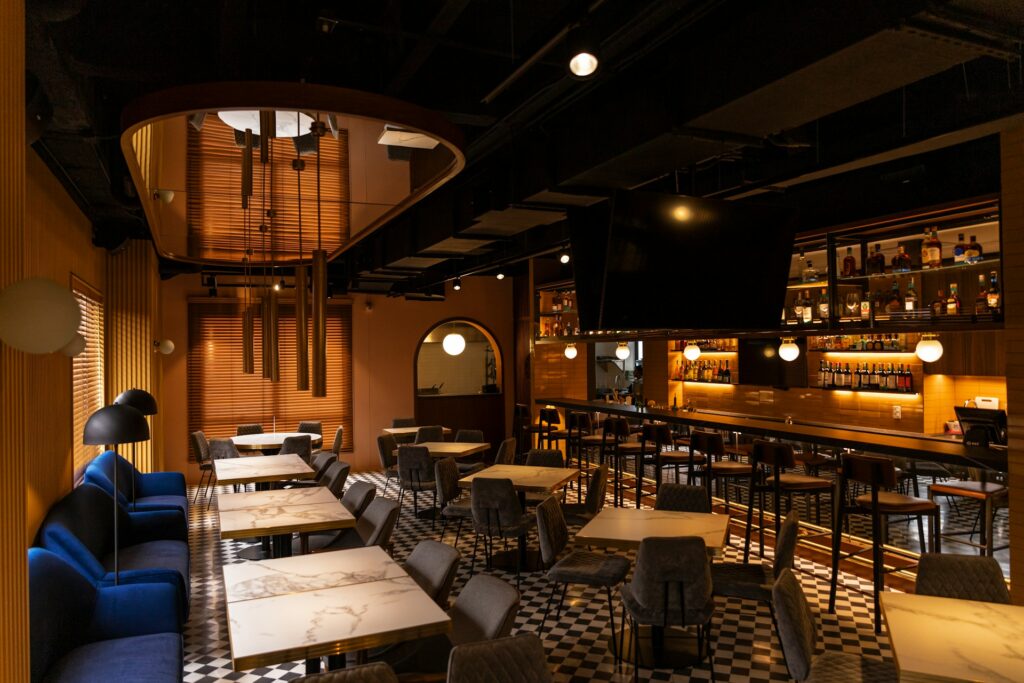
This shift manifests in various ways: restaurants and bars designed to attract neighbourhood diners, co-working spaces that rival dedicated offices, and cultural programming that celebrates local artists and makers. Hotels are becoming integral parts of their communities rather than isolated luxury bubbles.
Wellness offerings have evolved dramatically too. Today’s hotels feature comprehensive facilities that might include saunas, steam rooms, cold plunge pools, and meditation spaces. The focus has shifted from basic fitness to holistic wellbeing, recognising that modern travellers prioritise health as much as comfort.
As 2025 unfolds, it’s clear that hotel design has entered a new chapter. Whether it’s the Waldorf Astoria’s meticulous restoration, Tella Thera’s groundbreaking sustainable architecture, or Hampton by Hilton’s thoughtful prototype, each property contributes to a broader reimagining of what hotels can be.
The year’s designs prove that environmental responsibility, technological innovation, and authentic luxury aren’t competing priorities but complementary forces. Hotels are becoming more than places to sleep; they’re destinations that celebrate their locations, serve their communities, and create memorable experiences whilst treading lightly on the earth.
For travellers, this evolution means more choices than ever – from subterranean suites that connect us with ancient building traditions to urban hotels that pulse with their neighbourhoods’ energy. As the industry continues to innovate, one thing is certain: the hotels of 2025 are setting standards that will influence hospitality design for years to come.
Picture this: it’s 7am on a drizzly Tuesday morning, and you’re staring blearily at your trusty cafetière, wondering if there’s more to life than plunging, pouring and pondering if it’s okay to dump spent coffee down the sink.
There absolutely is, and no it isn’t. While the French press has served us faithfully through countless mornings (and let’s be honest, afternoons too), the world of home coffee brewing is vast, varied, and surprisingly accessible.
From the meditative ritual of pour-over to the theatrical flair of a stovetop espresso, mastering different brewing methods isn’t just about impressing your mates – it’s about discovering which style brings out the best in your beans and, crucially, fits into your morning routine. So put the kettle on, and let’s explore seven coffee brewing methods that’ll transform your kitchen into your favourite café.
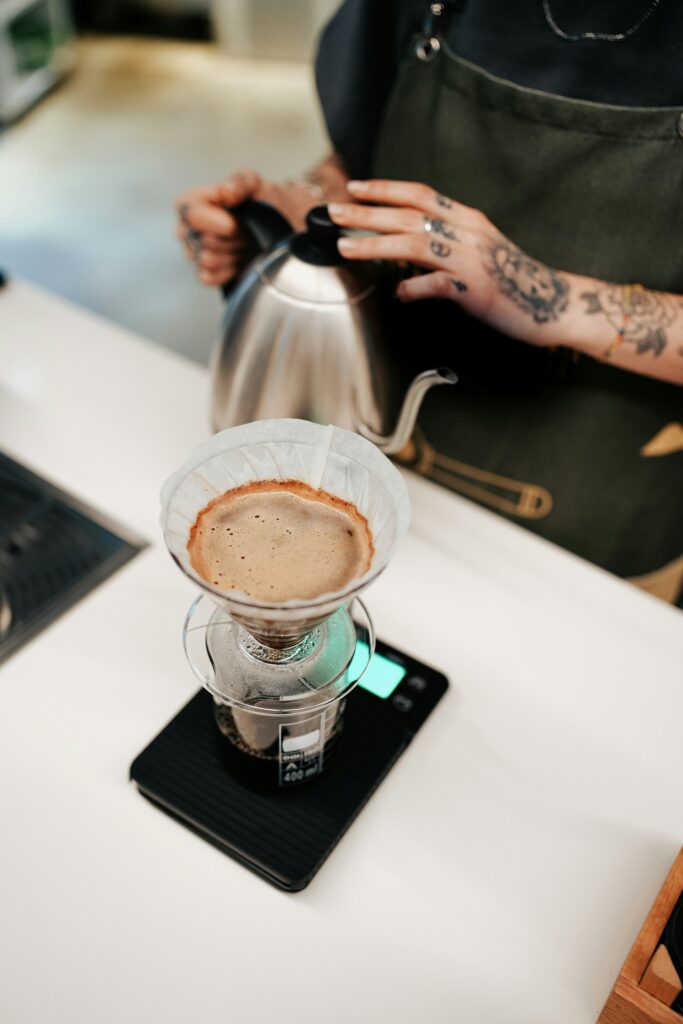
The Pour-Over: Precision & Patience
The pour-over method – think V60, Chemex, or good old filter cone – has become the darling of third-wave coffee shops, and for good reason. This method gives you complete control over every variable: water temperature, pour speed, and brewing time.
Start with medium-ground coffee (think coarse sand texture) and water heated to about 93°C. The key is the slow, circular pour, which should take about 3-4 minutes total. Yes, it requires a bit more attention than pressing a button, but the clean, nuanced cup you’ll get is worth those extra morning minutes. Plus, there’s something rather zen about the whole process – consider it mindfulness with caffeine benefits.
For best results, use a 1:15 coffee-to-water ratio (so 20g coffee to 300ml water). Pre-wet your filter to remove any papery taste and warm your brewing vessel. Start with a 30-second bloom – pour just enough water to saturate the grounds (about twice the coffee weight), then wait as CO2 escapes. This crucial step ensures even extraction. Continue pouring in steady circles, keeping the water level consistent, and aim to finish your final pour by the 2:30 mark.
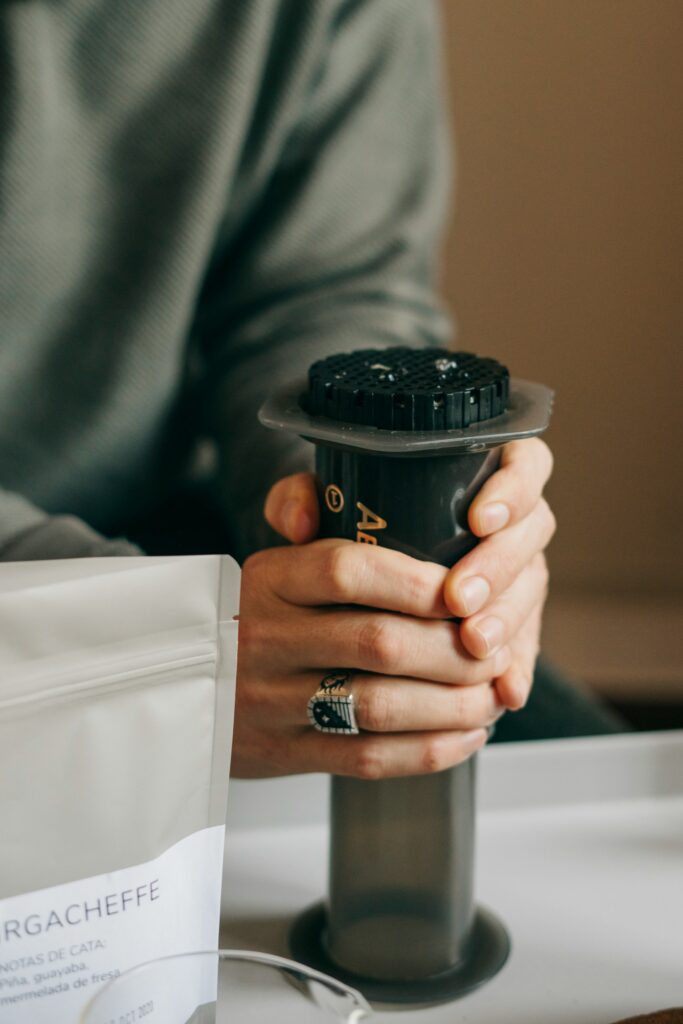
The AeroPress: A Traveller’s Best Friend
Invented in 2005 by a frisbee manufacturer, the AeroPress has become a favourite among coffee enthusiasts worldwide. This ingenious plastic contraption uses air pressure to push water through coffee grounds, creating a concentrated brew in under two minutes.
What makes it brilliant is its versatility – you can brew anything from espresso-style shots to longer, filter-style coffees. It’s virtually indestructible, making it perfect for camping trips or that dodgy office kitchen. The cleanup is satisfyingly simple too: just pop out the used coffee puck and give it a rinse.
The standard recipe calls for 17g of medium-fine coffee (slightly finer than pour-over) and 220ml of 80°C water. Insert a paper filter, add coffee, pour water to the top, stir for 10 seconds, then press slowly for 20-30 seconds. For a stronger brew, try the inverted method: flip the AeroPress upside down, brew for 1-2 minutes, then carefully flip and press. Water temperature is crucial here – anything above 85°C tends to over-extract and create bitterness, while 75-80°C brings out chocolate and caramel notes.
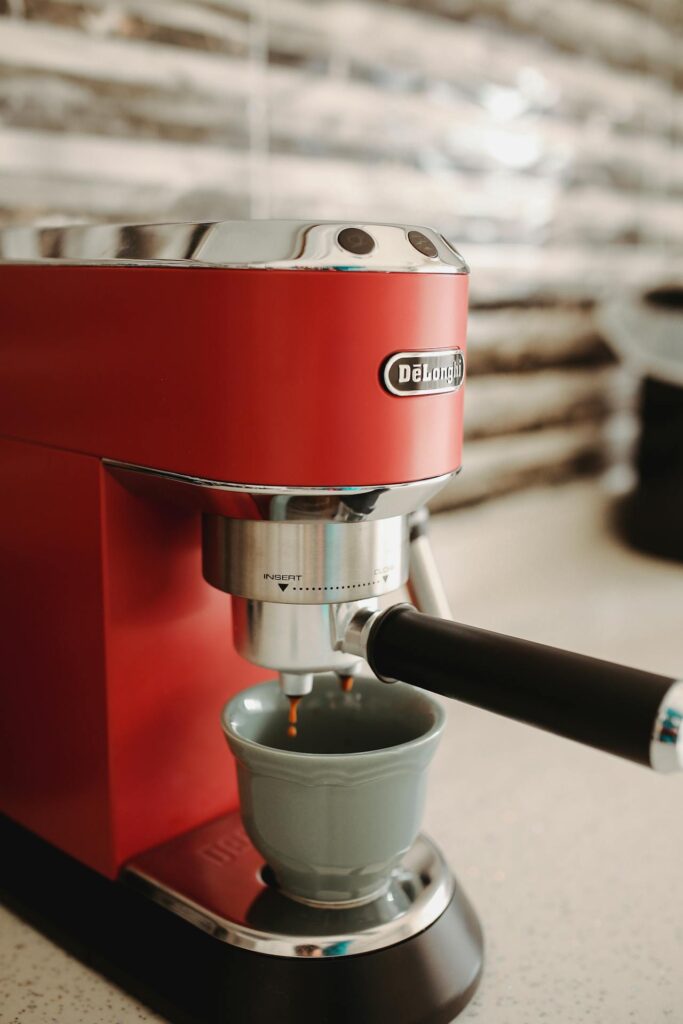
Espresso Machine: A Home Barista’s Dream
While a proper espresso machine requires investment (both financial and educational), mastering home espresso opens up a world of coffee possibilities. From cortados to cappuccinos, you’ll have café-quality drinks without the café prices.
The learning curve is steep – getting your grind size, dose, and tamp pressure just right takes practice. But once you’ve pulled that first perfect shot, complete with golden crema, you’ll understand why people become obsessed. For those starting out, consider a coffee subscription with ESE pods – they take the guesswork out of dosing while you perfect your milk-steaming technique.
The golden rules: aim for 18-20g of coffee yielding 36-40g of espresso in 25-30 seconds. Your grind should feel like fine table salt, and your tamp pressure should be firm and level – about 15kg of pressure. Temperature surfing (flushing water through the group head before pulling a shot) ensures consistent heat. For milk steaming, keep the steam wand tip just below the surface until the milk reaches 35°C (creating microfoam), then plunge deeper and create a whirlpool until it hits 60-65°C. Any hotter and you’ll scald the milk, destroying its natural sweetness.
Moka Pot: A Little Slice Of Stovetop Theatre
The Moka pot – Italy’s answer to home espresso since 1933. This octagonal aluminium beauty uses steam pressure to force water through coffee grounds, creating a strong, concentrated brew that’s not quite espresso but certainly packs a punch.
Fill the bottom chamber with hot water (using cold water makes the coffee taste metallic), add medium-fine grounds to the basket, and place it on medium heat. Listen for the gurgling sound – that’s your cue that coffee magic is happening. The result? A bold, slightly bitter brew that’s perfect for homemade flat whites or, if you’re feeling continental, served straight up with a sugar cube on the side.
Important details: fill water to just below the safety valve, and don’t tamp the grounds – just level them off with your finger. Keep the lid open while brewing so you can watch for the honey-coloured stream that signals perfect extraction. When it turns blonde and starts sputtering, remove from heat immediately to avoid burning.
Never put your Moka pot in the dishwasher – the harsh detergents strip away the coffee oil coating that prevents metallic tastes. A simple rinse and air dry keeps it in perfect condition.
Cold Brew: Summer In A Cup (Or, Indeed, A Jar)
Cold brew isn’t just hot coffee gone cold – it’s an entirely different beast. By steeping coarse grounds in cold water for 12-24 hours, you extract different compounds than with hot brewing, resulting in a smooth, naturally sweet concentrate with about two-thirds less acidity.
Mix one part coarse ground coffee with four parts cold water in a jar, let it steep overnight in the fridge, then strain through a fine mesh or coffee filter. The concentrate keeps for up to two weeks, ready to be diluted with water, milk, or ice. It’s meal prep for coffee lovers.
For optimal extraction, stir the grounds and water thoroughly at the beginning, then again after an hour. Room temperature brewing (12-15 hours) extracts more quickly than fridge brewing (18-24 hours) and produces a slightly different flavour profile – fruitier and more acidic. When straining, do it twice: first through a fine mesh sieve to remove the bulk of grounds, then through a coffee filter or cheesecloth for clarity. The final concentrate should be diluted 1:1 with water or milk, though adjust to taste.
Pro tip: freeze some concentrate in ice cube trays for iced coffees that don’t get watered down.
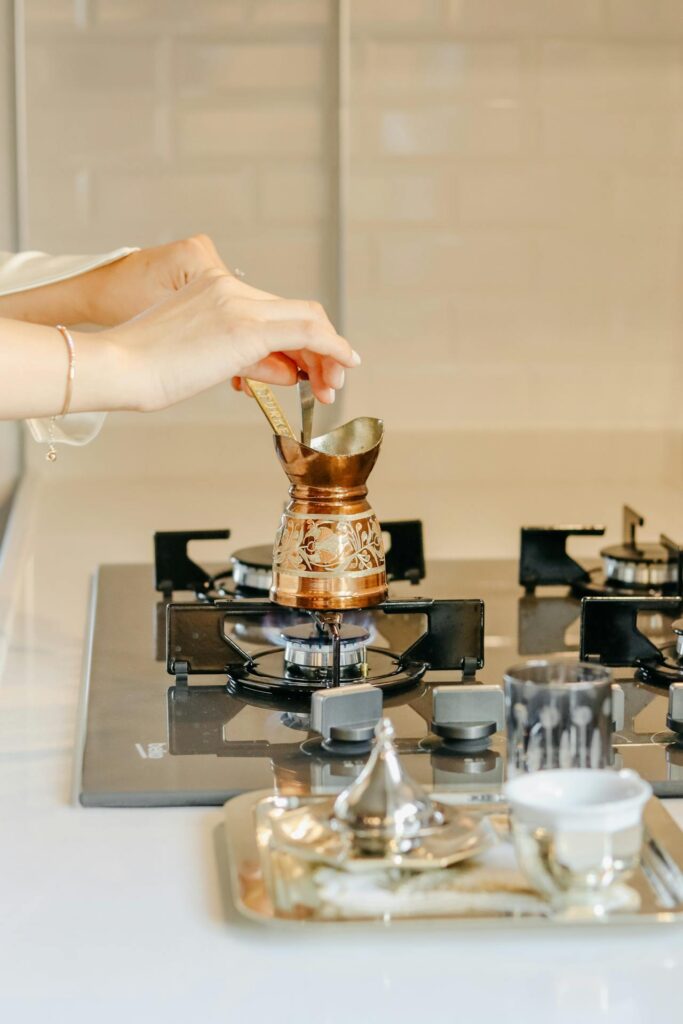
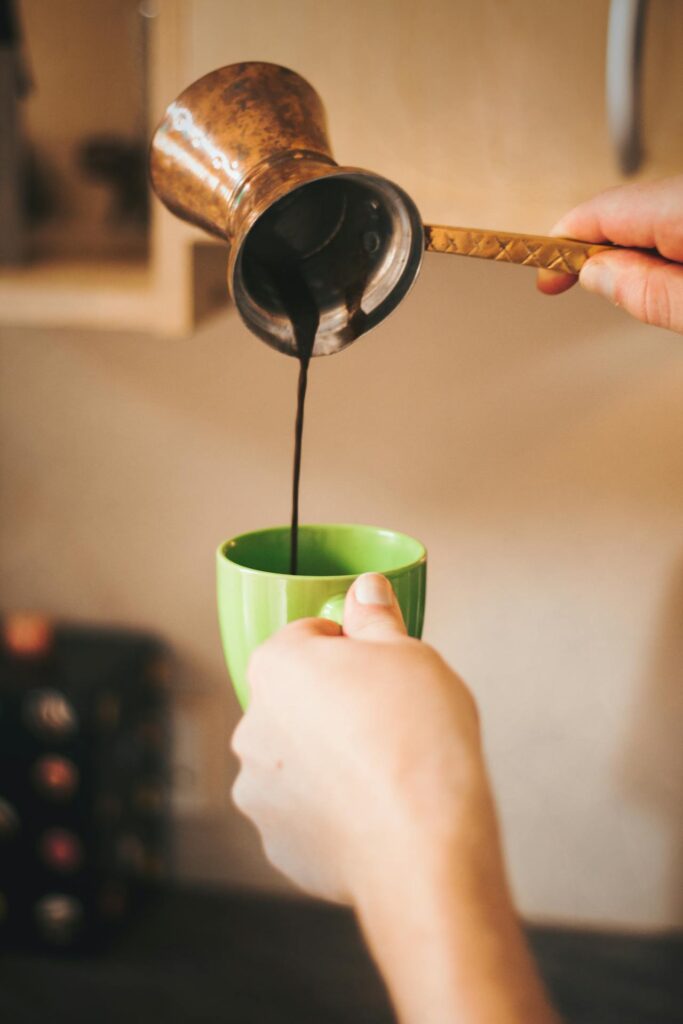
Turkish coffee isn’t just a brewing method; it’s a UNESCO-recognised cultural tradition. Using an ibrik (also called a cezve), you’ll need the finest ground coffee possible – powder-fine, like flour.
Combine cold water, sugar (if desired), and coffee in the ibrik, then heat slowly on the hob. The key is to let it foam up without boiling – remove it from heat just as it begins to rise, let it settle, then repeat twice more. Serve in small cups with the grounds still in – they’ll settle to the bottom, and reading the patterns they leave is a fortune-telling tradition in itself.
Use a 1:10 coffee-to-water ratio – about 7g of coffee per 70ml water (one traditional serving). Sugar goes in at the beginning: none (sade), a little (az şekerli), medium-sweet (orta), or very sweet (şekerli). Stir only at the beginning when cold – never once heating begins. The grind is crucial: it should be even finer than espresso, almost like cocoa powder.
Most coffee shops can’t grind this fine, so consider investing in a hand grinder with Turkish settings. The ideal brewing temperature is around 70°C – use the lowest heat setting and be patient. The entire process should take 3-4 minutes.
Siphon Brewing: Science Class Meets Coffee Shop
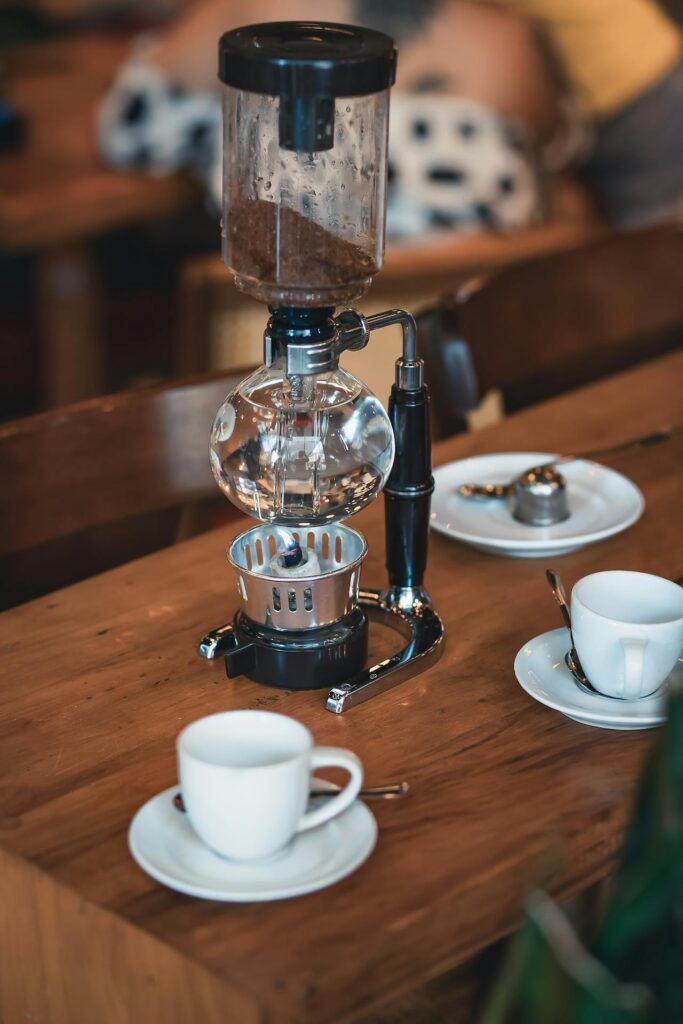
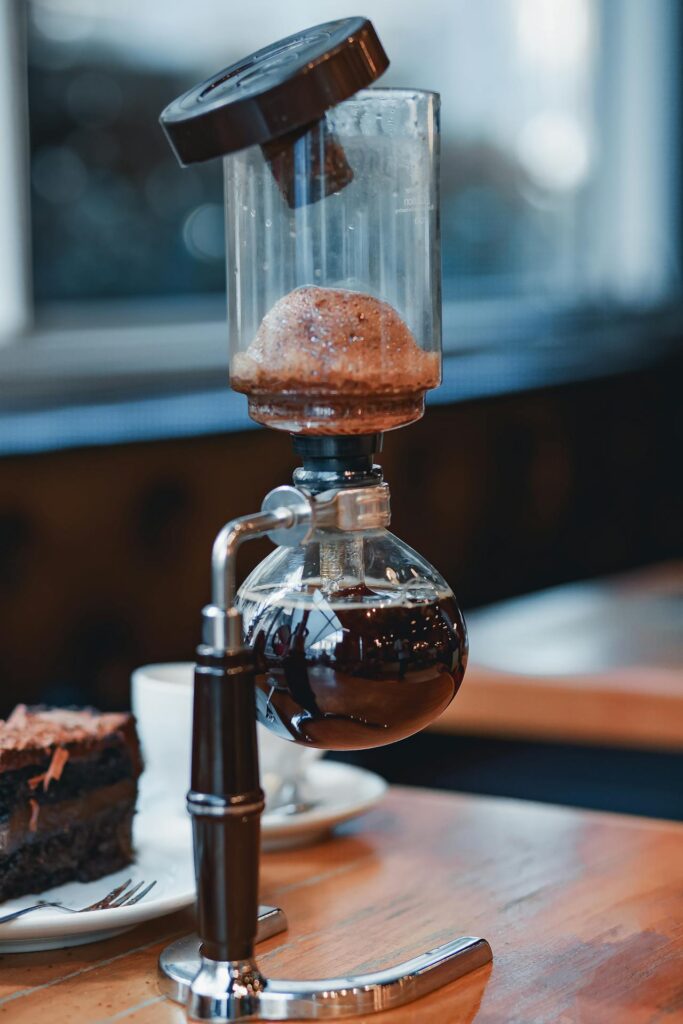
If you want to feel like a Victorian scientist while making your morning brew, siphon coffee is for you. This theatrical method uses vapour pressure and vacuum to brew coffee, and watching it in action is genuinely mesmerising.
Water in the bottom chamber heats up, creating vapour pressure that pushes it into the upper chamber where it mixes with coffee grounds. Remove the heat source, and physics takes over – the cooling air creates a vacuum that pulls the brewed coffee back down through a filter. The result is an incredibly clean, tea-like coffee that highlights subtle flavours. Yes, it’s a bit of a production, but sometimes your Sunday morning deserves a show.
Use medium-coarse grounds (similar to pour-over) at a 1:15 ratio. Once water rises to the upper chamber, reduce heat to maintain temperature without violent bubbling. Add coffee, stir gently, and brew for 90 seconds. Give one final stir, then remove from heat – the drawdown should take about 45-60 seconds. If it’s taking longer, your grind is too fine; if faster, too coarse.
Clean immediately after use while still warm – dried coffee oils make cleaning difficult. Most siphons use either cloth or paper filters; cloth provides fuller body but requires careful maintenance (rinse thoroughly and store in water in the fridge between uses).
The Bottom Line
Mastering these globally diverse brewing methods isn’t about becoming a coffee snob (though a little knowledge never hurt anyone at a dinner party). It’s about discovering what you enjoy and having the skills to make it happen. Start with one new method that intrigues you, give yourself permission to make a few terrible cups while you learn, and remember – even coffee professionals had to start somewhere.
Whether you become a pour-over perfectionist or stick with your trusty cafetière but with newfound appreciation, the goal is the same: a brilliant cup of coffee that makes your morning that little bit better. After all, life’s too short for bad coffee, especially when good coffee is just a new brewing method away.
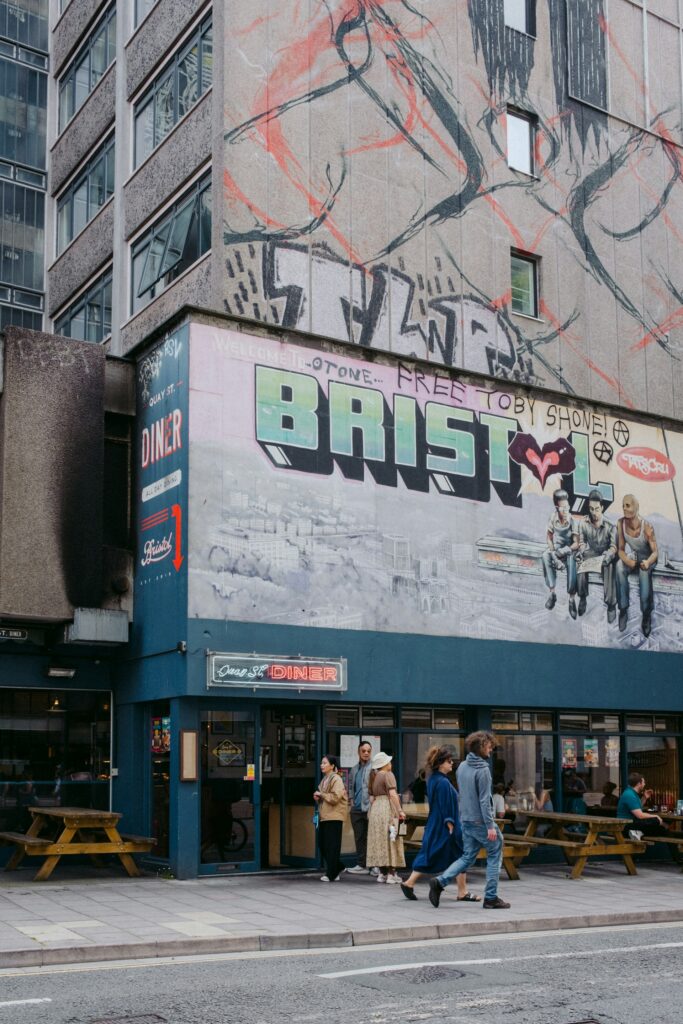
Sitting where the River Avon meets the Severn Estuary, Bristol pulses with a creative energy that sets it apart from Britain’s more buttoned-up cities. This is a place where Banksy first wielded his spray cans, where Massive Attack and Portishead pioneered trip-hop, and where Victorian warehouses now house everything from immersive art spaces to craft cider taprooms.
Bristol wears its contradictions proudly – it’s simultaneously gritty and genteel, radical and refined, with street art adorning Georgian terraces and Michelin-starred restaurants neighbouring proper pubs.
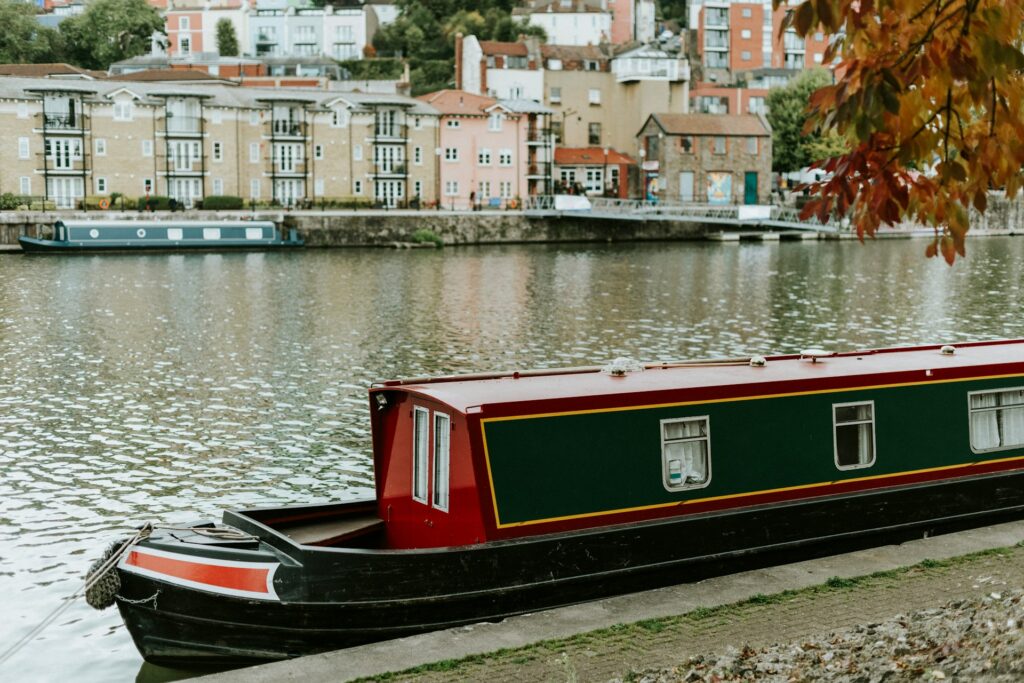
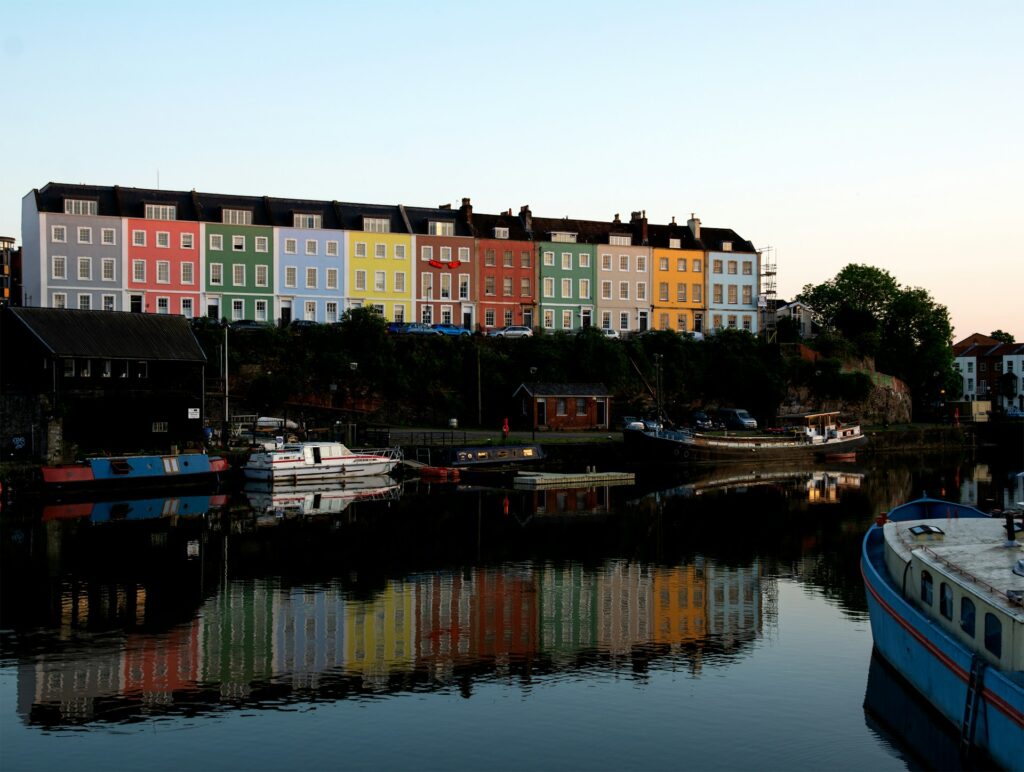
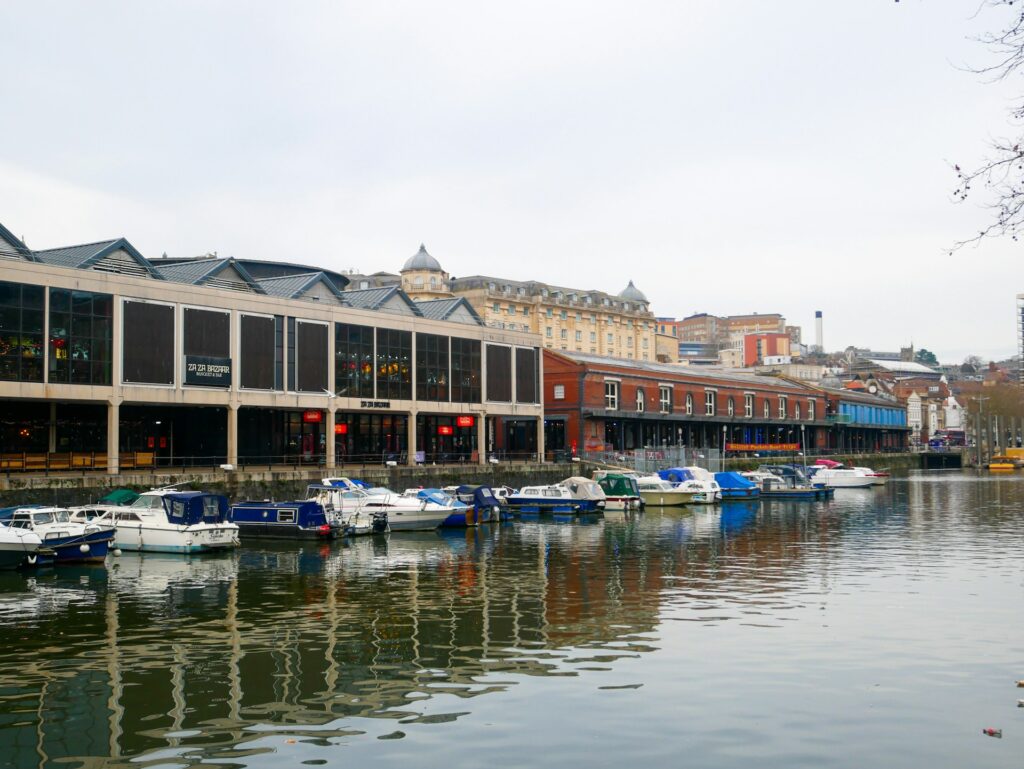
The city’s maritime past remains visible at every turn, from the restored SS Great Britain to the colourful houses of Clifton climbing the hillside like something from a sailor’s fever dream. But Bristol refuses to be a museum piece. In neighbourhoods like Stokes Croft and Gloucester Road, independent shops, venues, and cafés create what locals proudly claim is Britain’s most alternative mile. Meanwhile, the transformed harbourside buzzes with floating restaurants, cultural centres, and enough craft beer to sink a ship. Or, indeed, those floating restaurants…
While Bath, just 15 minutes by train, attracts the coach parties, hens and stags, Bristol rewards visitors with authentic experiences and a refreshing lack of tourist tat. Here, you’re more likely to stumble upon a guerrilla gardening project than a gift shop, more likely to find yourself in a converted shipping container listening to an underground DnB set, than queuing for overpriced attractions. Two days provides enough time to grasp why Bristolians are so fiercely proud of their city – and why an increasing number of Londoners are making it their permanent home.
Day 1: Harbourside Heritage & Street Art Safari
Morning: Breakfast & Brunel
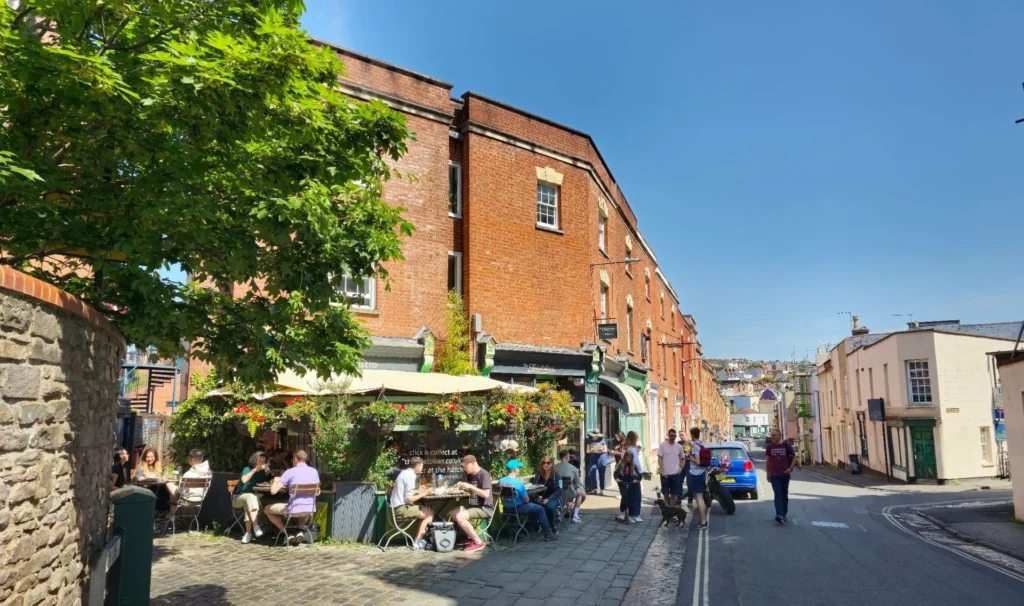
Start your Bristol adventure at the aptly named The Bristolian, an independent café just around the corner from lively Stokes Croft, where they try to source everything locally. There are plenty of gluten-free, vegetarian and vegan options, however you can’t go wrong with one of their full ‘Bristolian’ breakfasts.
Breakfast is big business in this city and The Bristolian is walk-in only, so if you can’t get a seat, pop into Café Kino which is just around the corner. This spot is very typical of a certain Bristol vibe, offering a community-focused cooperative with a vegetarian and vegan menu. Do a good deed for the day and partake in their ‘suspended coffee’ pay-it-forward scheme where you can buy a coffee or a soup that can be claimed by anyone who can’t afford it. Lovely stuff.
A 25-minute walk (or 10-minute bus ride on the number 8) brings you to the Harbourside and Brunel’s SS Great Britain. Arrive by 10am to beat the school groups and experience this marvel of Victorian engineering in relative peace (though, be warned, it’s closed Mondays in winter). The ship, once the largest in the world, has been brilliantly preserved in a glass-roofed dry dock that creates the illusion of floating on a glass sea. The audio guide, narrated by various fictional passengers, brings the vessel’s transatlantic crossings and Australian emigrant runs to vivid life. Tickets (£19.80 online) include unlimited return visits for a year.
If you haven’t had the chance to eat breakfast before you get to Brunel’s, pop to The Crêpe & Coffee Cabin, Bristol’s smallest coffee shop, complete with views across the harbour. This is a no-nonsense breakfast at a great price, and is a glorious spot on a sunny day to break your fast.
Midday: M Shed, Markets & Maritime Quarter
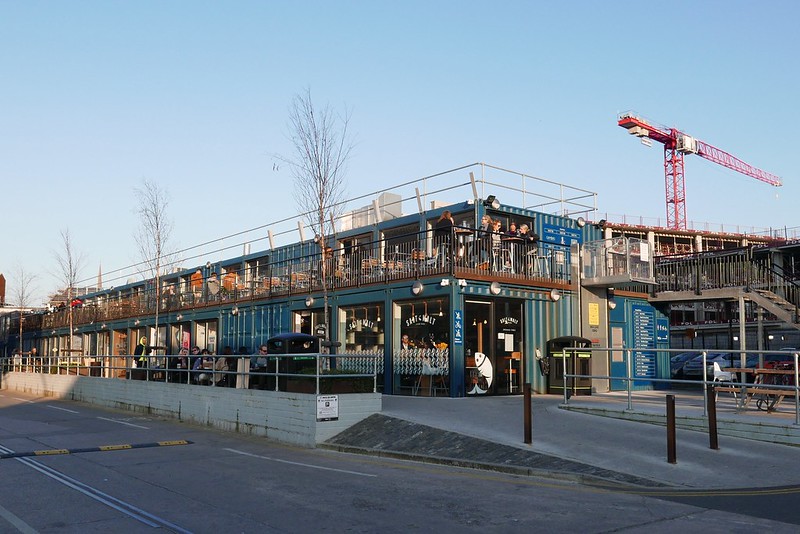
Stroll along the harbourside and pop into M Shed on Prince’s Wharf. It’s a museum all about Bristol and is free to enter. Then it’s onto Wapping Wharf, Bristol’s answer to Copenhagen’s Meatpacking District. This development of converted shipping containers houses some of the city’s most exciting food ventures.
Here you’re spoilt for lunch choices. For something light, head to Root, where chef Rob Howell creates vegetable-forward small plates that change with the seasons. Their charred hispi cabbage (whose garnishes change with the seasons) is the best version of this ubiquitous dish we’ve ever had, and the natural wine list champions small European producers. The restaurant holds a Michelin Bib Gourmand, a real coup for a place not in thrall to protein. Alternatively, Gambas is a tapas bar that places a heavy focus on all things prawn. Inspired by Valencia’s Mercado Central, there are few better ways to spend an afternoon than by taking a seat at the counter here and sucking prawn heads.
Before or after lunch, explore the independent shops of Wapping Wharf – Bert’s Homestore for Scandi-inspired homewares, The Bristol Cheesemonger for West Country artisan varieties, and Mokoko for bean-to-bar chocolate. Then walk to Spike Island, an international centre for contemporary art housed in a former tea-packing factory. Their exhibitions showcase cutting-edge work, often with a political edge that reflects Bristol’s radical heritage.
Afternoon: Street Art Pilgrimage
No visit to Bristol is complete without a street art tour. While organised tours exist, the DIY approach proves more rewarding. Since you’re in the area, start with Banksy’s Girl With The Pierced Eardrum in Hanover Place. Then, take the Bristol ferry up past Millennium Square to the city centre ferry landing.
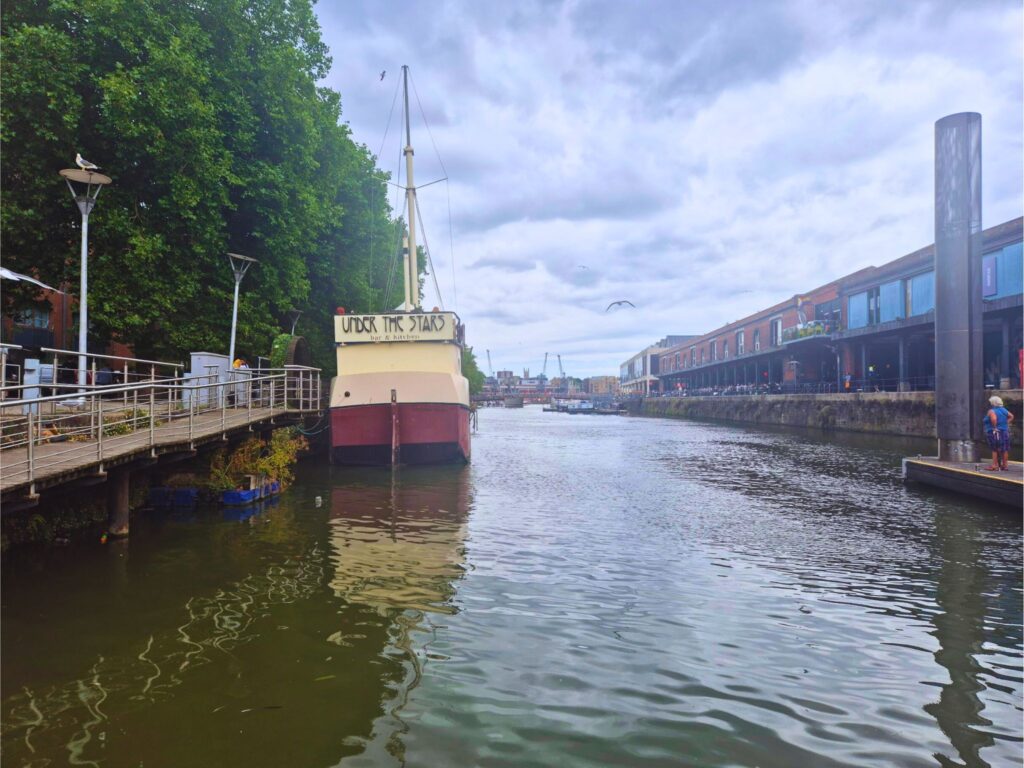
Before your street art quest continues, stop off at Under the Stars, one of our favourite boat bars. It’s moored on Bristol’s historic harbourside, and is ideal for a quick refreshment before heading to Nelson Street. On the way, if you’re in need of a snack, stop for some award winning Birria tacos or Nepalese dumplings at The Harbourside Market which is open every Wednesday, Thursday, Saturday and Sunday.
When you get to Nelson street, Banksy’s Well Hung Lover still clings to the side of a building at the Park Street junction, despite vandalism attempts (and a rumoured sale of the building) over the years. From here, wind through the backstreets towards Stokes Croft, Bristol’s cultural quarter and street art mecca.
The ever-changing murals here range from massive commissioned pieces to guerrilla tags. Don’t miss Banksy’s Mild Mild West opposite The Canteen – this 1999 piece featuring a teddy bear throwing a Molotov cocktail at riot police remains one of Bristol’s most iconic artworks.
While you’re here, pop into The Canteen for a swift coffee or something a little stronger. Here talented bar staff and baristas serve flat whites to some of the most colourful characters in Bristol. This place has become an institution and embodies Bristol’s independent spirit – the walls feature rotating exhibitions by local artists, and the communal tables encourage conversation with everyone from activists to accountants.
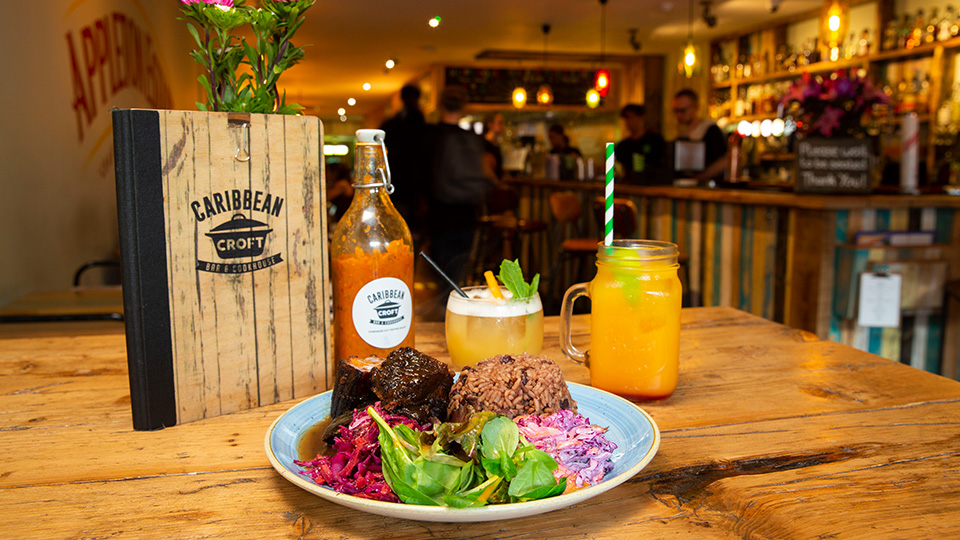
Sampling Caribbean food is another Bristol must and we can’t recommend Caribbean Croft on Stokes Croft enough. The recipes come from the chef’s mother-in-law, Ms Cat, and the menu is influenced by the restaurant’s staff who come from across the different islands. For something light, order the starter sharing platter (red mullet salad, Jerk wings…the works) and wash it down with their signature cocktail, the Caribbean Croft, which blends three different rums with vodka and a refreshing mix of grapefruit, orange, cranberry, fresh lime, and grenadine for a tropical flavour explosion. They also do a mocktail version if all that rum sounds a little too much of an afternoon pick-me-up.
Alternatively, if it’s raining cats and dogs on your visit (this is the South-West, one of the rainiest regions of the UK) and a street art tour is out of the question, consider going to Wake The Tiger, the UK’s largest immersive art experience, set in an old abandoned paint factory. It’s a labyrinth of mind-bending visuals and multi-sensory fun, and well worth your time, come rain or shine.
Evening: Cider & Sounds
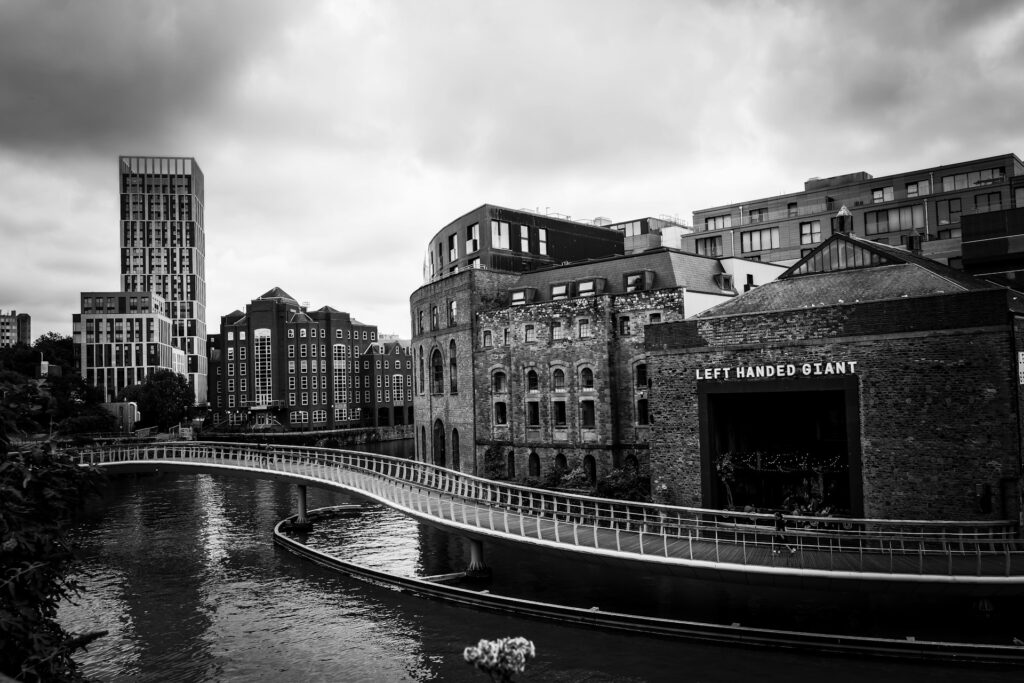
Bristol is often referred to as the cider capital of the UK and has a thriving cider scene. As darkness falls, make your way to The Apple, Bristol’s most beautiful cider boat moored in the Old City. This converted Dutch barge stocks over 40 ciders, from bone-dry farmhouse scrumpy to modern flavoured varieties. Order a tasting board to navigate the options – the staff genuinely know their stuff and can guide nervous newcomers away from the head-spinning 8% varieties which will have you singing “I Am A Cider Drinker” by the Wurzels on repeat. If you’re up for another jar, pop over to the Left Handed Giant, a renowned craft brewery which has great views across the Floating Harbour and Castle Park.
You’ll of course need a good meal after that cider and Bristol doesn’t disappoint. Ask most chefs and they’ll tell you that Bristol is undeniably a strong contender for the title of the best foodie city in England. With a diverse and thriving food scene, this Southwest food destination is home to an impressive array of Michelin-recognised restaurants and countless other award-winning establishments.
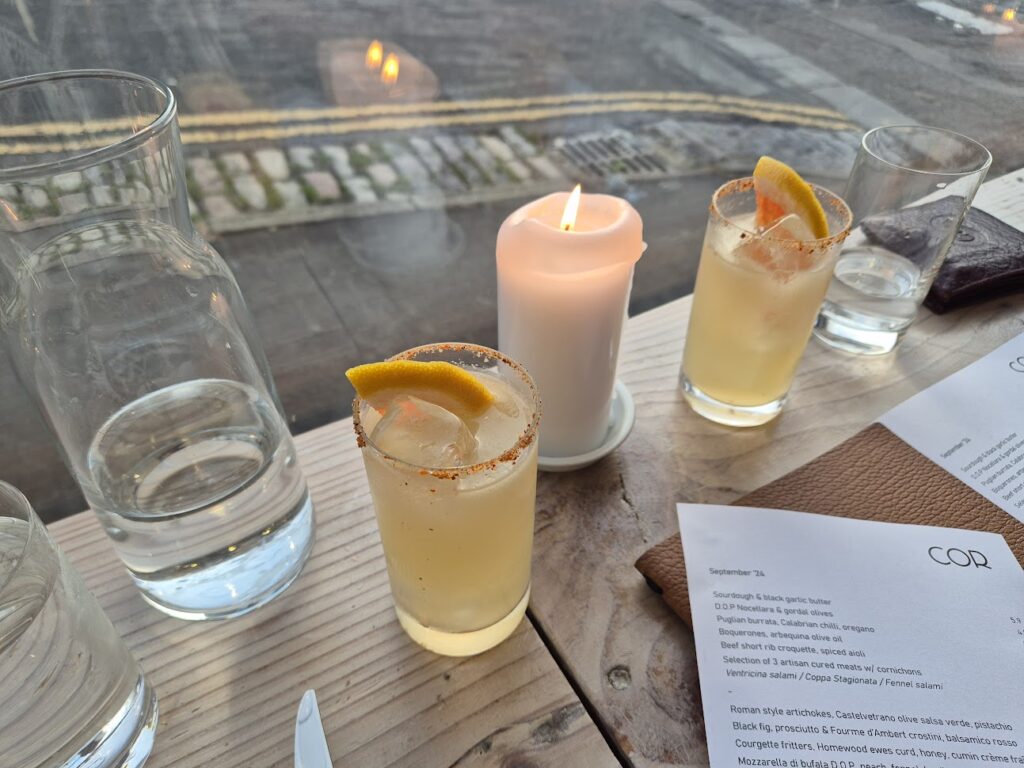
For dinner, choose from our roundup of the best restaurants in Bristol. While we can be fickle, currently our favourite in all of Bristol is COR in Bedminster. With a leaning towards Mediterranean plates told through a British lens, the food here is bright, bold and brilliant.
Wherever you go, end your night at Thekla, the legendary live music and club boat moored in the Mud Dock. This former German cargo ship has hosted everyone from Portishead to Idles over its 40-year history. Following a £1 million refurbishment in 2019, the sound system and intimate atmosphere guarantee a proper Bristol night out. Check their live listings – you might catch anything from drum and bass to post-punk.
Day 2: Clifton Heights & Independent Delights
Morning: Suspension & Splendour
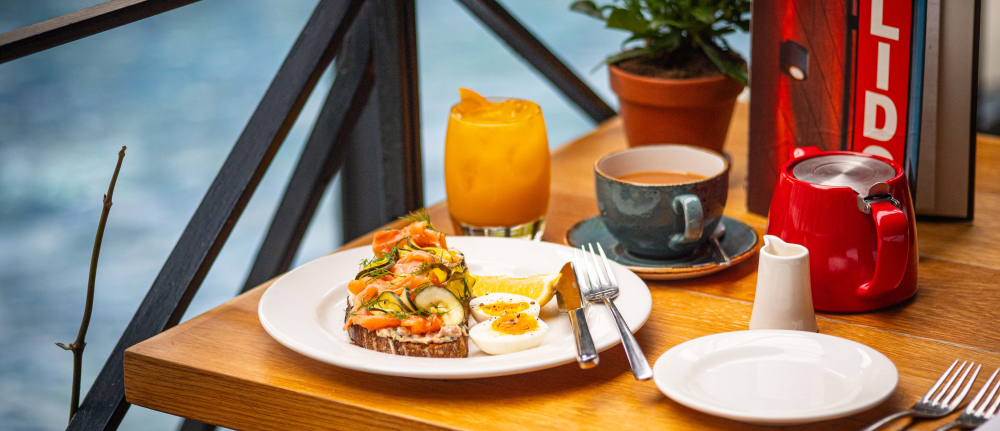
Begin day two exploring Clifto, Village. Start with breakfast at Primrose Café, which is arguably Bristol’s most beloved café. It’s been under the same ownership for over 30 years and everything is sourced locally, as you’d expect. Alongside your usual suspects, they have some fantastic breakfast options including kedgeree, huevos rancheros and our favourite, The Scandi, where toasted raisin and caraway rye is topped with all sorts of good things like cured salmon, pickled cucumber and celeriac rémoulade. This is a walk-in only café, but wait times are usually low.
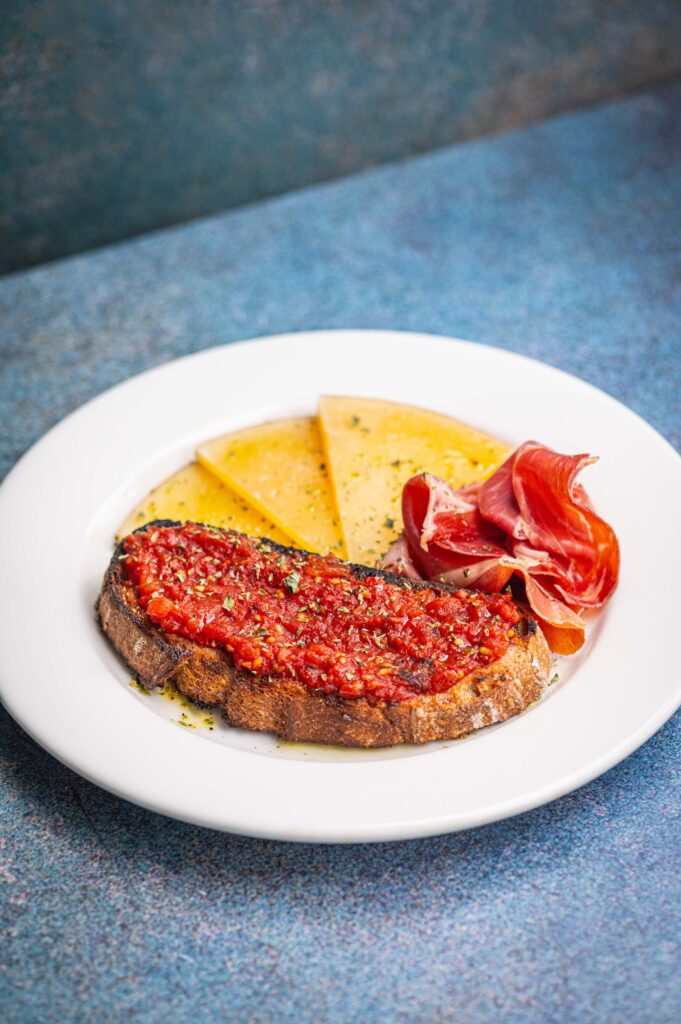
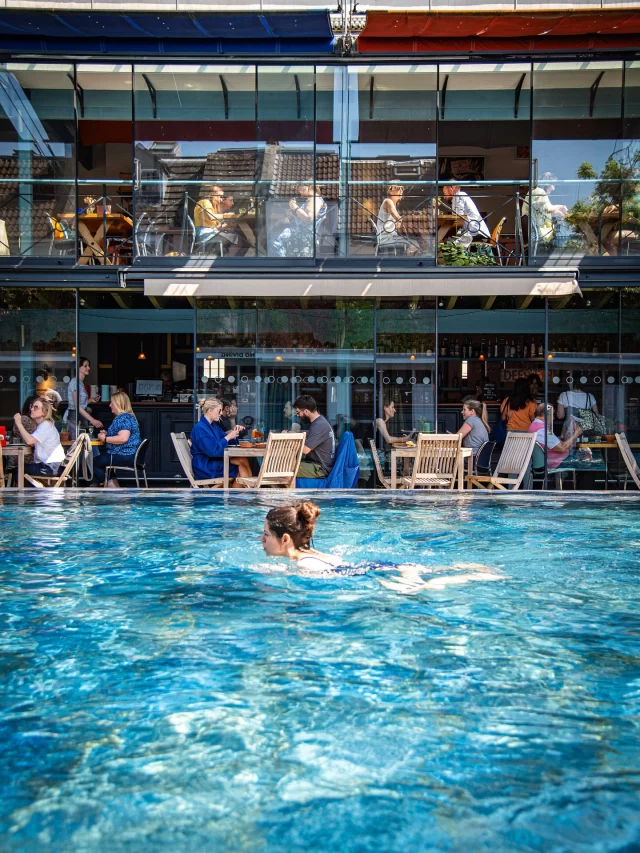
The Lido Restaurant is another one of our favourite spots for breakfast in Clifton. Serving Mediterranean inspired breakfasts from 9.00am to 10.45am, you can’t go wrong with their pan con tomate served with jamon and manchego, or our favourite charcoal grilled Iberico bacon chop, topped with a fried duck egg and accompanied by Morcilla de Burgos and baked beans. Booking is advised and if you fancy a swim, you can pre-book breakfast and a swim for £40.
From Clifton, it’s just a 2-minute stroll to the Clifton Suspension Bridge, Brunel’s masterpiece spanning the Avon Gorge. Cross on foot (free for pedestrians) for spectacular views – on clear days, you can see the Welsh hills. The visitor centre on the Leigh Woods side provides fascinating context about the bridge’s troubled construction and various safety measures.
For the energetic, descend the zigzag path to the Avon Gorge for a different perspective. Otherwise, return to Clifton Village and explore its independent shops. Then, wander down Whiteladies Road, which is home to a host of independent shops.
From Whiteladies Road, head to Park Street for the Bristol Museum & Art Gallery. This free museum punches well above its weight, with collections ranging from Banksy’s Paint Pot Angel to Alfred the Great’s coins. The Eastern art collection proves particularly strong, while the geology section explains why Bristol became such an important port.
For lunch, walk down Park Street to St Nicholas Market, Bristol’s oldest market dating from 1743. Known as ‘St Nick’s’ to locals, this covered market has been named as one of the best in the UK and is a must-visit.
The gorgeous glass arcade is home to the best street food in Bristol, and, arguably, the South West. Favourites include Chilli Daddy, who serve Szechuan street food, Caribbean Wrap, where you can get some of the best jerk chicken in Bristol, and Momo Bar, which is a Tibetan family-run stall steaming up momos. Also, don’t miss Angelababy Kitchen and their Hong Kong-style cooking – we love their char siu pork and generously sized bao buns. To top it all off, Taco Barra does excellent tacos, but be warned, they do sell out.
Whatever you choose to eat, or even if you decide to go hungry, grab a seat anywhere you can and watch the eclectic crowd drift past – this is Bristol at its most diverse and democratic.
If you’re in the mood for a mooch around after all that food, catch any bus heading north from the centre to Gloucester Road, reputedly Europe’s longest stretch of independent shops. Start at the Cheltenham Road end and work your way north, popping into whatever catches your eye. If you’re after a coffee, head to Scandi-style cafe Mød, or stop off for a pint at The Cider Press.
Evening: Dinner, Laughs & Live Music
For your farewell dinner, book ahead at Wilsons. This tiny restaurant on Chandos Road serves a daily-changing tasting menu that regularly earns national acclaim. Chef Jan Ostle works with hyper-local suppliers to create dishes that feel both innovative and deeply rooted in place – the Wye Valley asparagus with brown butter or Cornish crab with cucumber and dill exemplify the light touch. The wine list leans heavily on natural producers, with plenty available by the glass.
Cap off your Bristol weekend at The Wardrobe Theatre, an intimate venue at the Old Market Assembly that hosts comedy, theatre, and spoken word. Their weekend comedy nights attract both touring acts and local talent – Bristol has produced a disproportionate number of local comedians, after all. The BYOB policy and 100-seat capacity create an atmosphere where anything might happen.
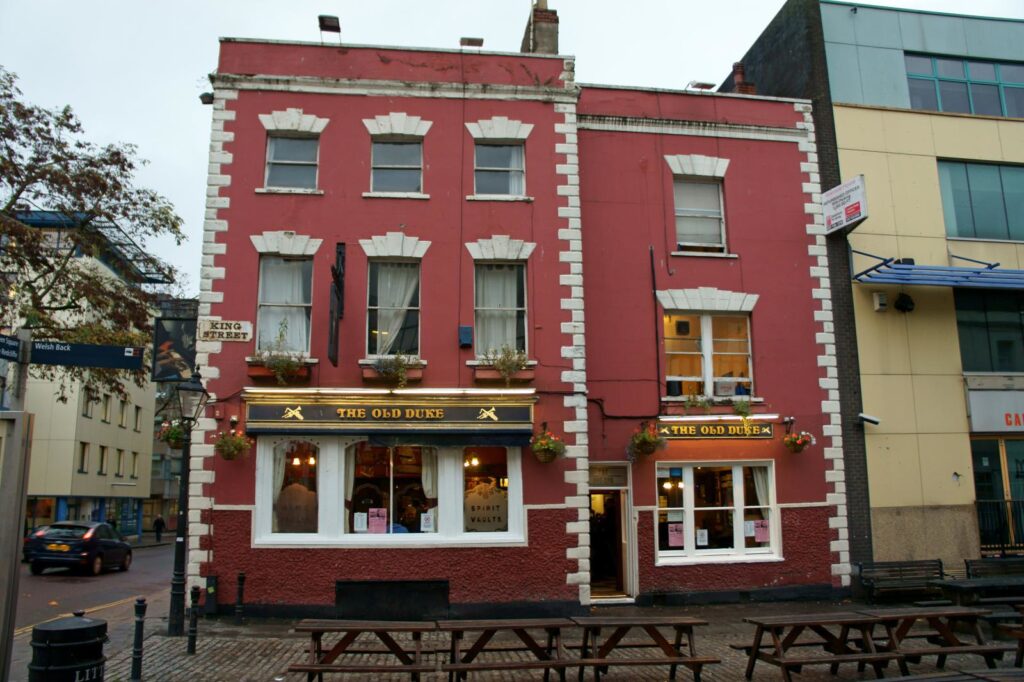
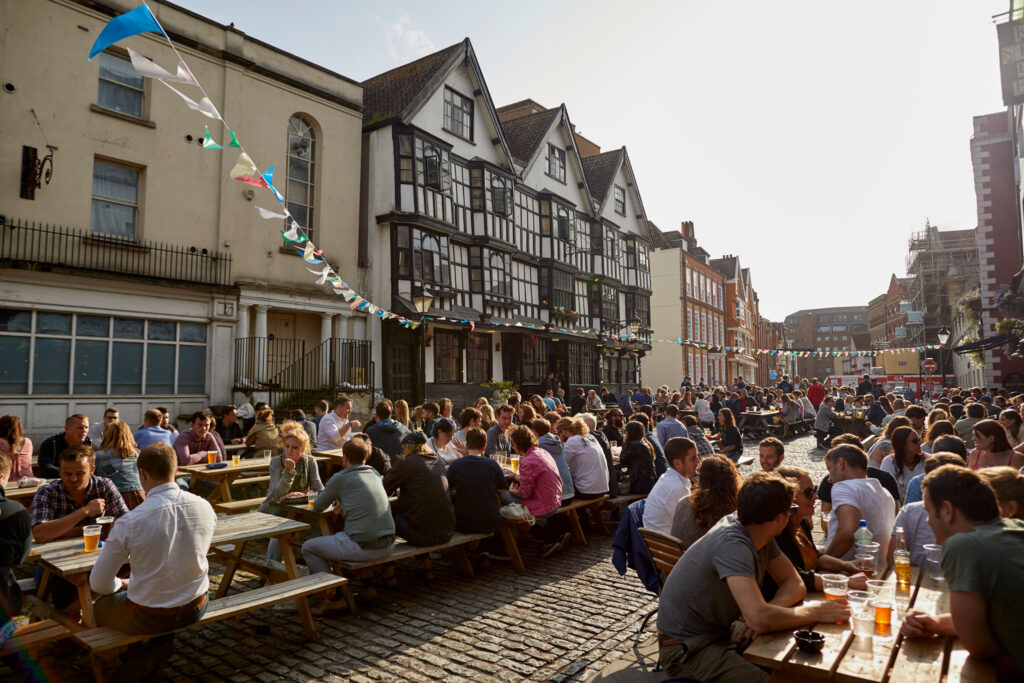
Finally, if you’re looking to continue your night, Bristol was recently named as one of the best places in the UK for its pub music scene. For live jazz, The Old Duke on King Street by Bristol’s harbourside has live music every night. You’ll recognise this area as it’s right next to The Cider Press. Kings Street itself has got to be one of our favourite streets in Bristol. Dating back to the medieval times, today it’s home to around 10 pubs and houses several of Bristol’s most renowned historic buildings, such as the Bristol Old Vic and the Llandoger Trow, the latter of which often has live music on too.
Elsewhere in Bristol, the Golden Lion on Gloucester Road serves live music every night of the week except Sundays while The Louisiana, where the likes of Amy Winehouse and Dua Lipa have played, always has something on.
Neighbourhood Know-How: Where To Stay In Bristol
Choosing the right Bristol base depends on whether you prioritise nightlife, culture, or tranquillity. Each neighbourhood offers a distinct flavour of Bristol life.
Harbourside appeals to first-time visitors wanting everything within walking distance. The Bristol Hotel, despite its chain appearance, occupies a prime position with rooms overlooking the water. More characterful is Number 38 Clifton, a boutique townhouse where each room is individually designed by local artists. Their breakfast includes homemade granola and eggs from urban chickens.
Clifton suits those seeking village vibes with city access. The Avon Gorge by Hotel du Vin, a Victorian pile by the suspension bridge, offers old-school grandeur and spectacular views following a complete renovation. For self-catering, the Clifton Lofts provide architect-designed apartments in converted warehouses, perfect for longer stays or those who want to shop at the farmers’ market.
Stokes Croft/Montpelier attracts visitors wanting to dive deep into Bristol’s alternative scene. The Artist Residence Bristol, occupying a former boot factory, features rooms designed by local artists and a ground-floor restaurant showcasing neighbourhood suppliers. Be aware this area gets lively at weekends – embrace the energy or pack earplugs.
For budget options, the YHA Bristol sits between the harbourside and city centre in a modern building with some en-suite rooms. In Stokes Croft, the Full Moon Backpackers occupies a Victorian house with both dorms and privates, plus a legendary Sunday roast that attracts locals.
Business travellers often default to the Aztec West business park, but staying there means missing Bristol’s essence. The city centre or harbourside provide better bases for experiencing what makes Bristol special while remaining convenient for meetings.
Forty-eight hours in Bristol reveals a city confidently charting its own course. From the street art-splattered walls of Stokes Croft to the genteel terraces of Clifton, from harbourside heritage to cutting-edge culture, Bristol offers experiences you won’t find in any other British city. The locals’ fierce pride in their independence, creativity, and slight contrarianism proves entirely justified.
Those with more time should explore further – the Mendip Hills for caving and hiking, Bath for Georgian splendour and a wealth of incredible day trips, or the Cotswolds for picture-perfect villages. The city also works brilliantly as a base for exploring the wider West Country, with excellent train connections to Devon and Cornwall.
But Bristol’s real appeal lies in simply wandering, following your nose from vintage shop to craft brewery, from harbourside path to hilltop view. Just don’t blame us when you find yourself browsing Rightmove for Totterdown terraces before you’ve even left.
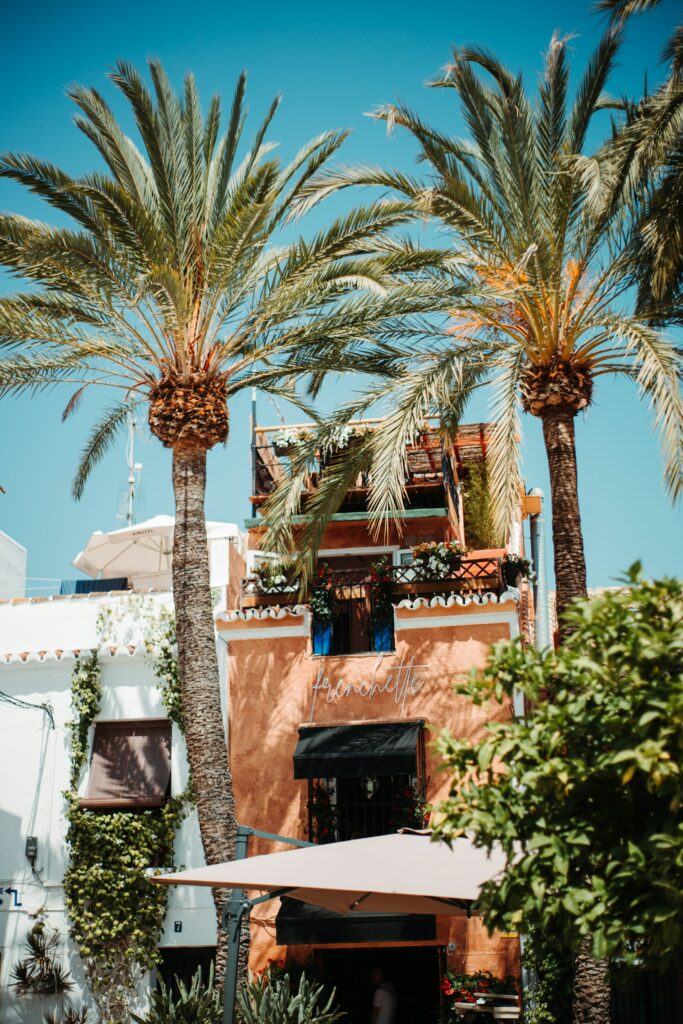
Marbella has long held a special place in the hearts of royalty and the world’s most rich figures. What began as a humble fishing village was transformed into the world’s premier jet-set destination through the vision of Prince Alfonso von Hohenlohe, who fell in love with the Costa del Sol’s untamed beauty in the 1950s.
His creation of the legendary Marbella Club Hotel attracted not only European aristocracy but also Hollywood’s golden age elite – Brigitte Bardot, Audrey Hepburn, and Sean Connery were amongst the luminaries who graced its terraces in the swinging sixties.
The hotel’s guest register reads like a who’s who of 20th-century glamour: opera legend Maria Callas, shipping magnate Aristotle Onassis, and members of the British royal family all found refuge in its exclusive embrace. This tradition of attracting both royal blood and entertainment royalty continues today, Antonio Banderas has long had connections with the area, while contemporary stars like George Clooney and tennis champion Novak Djokovic have discovered Marbella’s enduring allure.
The town’s regal connections run deep. The Saudi royal family has maintained a presence here for over four decades, with King Fahd’s spectacular White House replica palace – complete with hospital, helipad, and mosque – becoming an iconic summer residence. Today, King Salman Ibn Abdulaziz’s Al-Riya (the current King of Saudi Arabia) palace on the Golden Mile serves as a retreat for the crown prince and close family members, while Kuwaiti royals and British nobility have all found their own slice of Mediterranean paradise along this glamorous coastline.
But beyond the permanent palaces lies a more discreet world of luxury villa rentals, where royal families seek the ultimate in privacy and bespoke service. We’ve asked the team from Vacation Marbella, who have some of the area’s most luxurious properties on their books, to reveal three extraordinary properties that have secretly hosted some of the world’s most prestigious guests.
Villa Nicklaus: The Golf Valley’s Most Coveted Address
There are vacation rentals, and then there’s Villa Nicklaus – a four-bedroom sanctuary in Marbella’s prestigious Golf Valley that redefines what it means to live well. This isn’t just another luxury property; it’s a love letter to Italian craftsmanship, Andalusian living, and the art of entertaining in style.
The moment you step inside, you’re struck by the sheer sophistication of the design. Every inch of this meticulously renovated villa whispers bespoke luxury, from the museum-worthy Italian marble that flows throughout the interiors to the central island bar that anchors the open-concept kitchen – a space so beautifully conceived, it practically begs for impromptu dinner parties with your most stylish friends.
But it’s the thoughtful details that truly distinguish Villa Nicklaus. The private hammam feels like a secret borrowed from Istanbul’s finest spas, while the sculptural freestanding bathtub in the master suite could easily grace the pages of Architectural Digest. The walk-in dressing room? Pure fantasy fulfillment for anyone who’s ever dreamed of a Carrie Bradshaw-level closet.
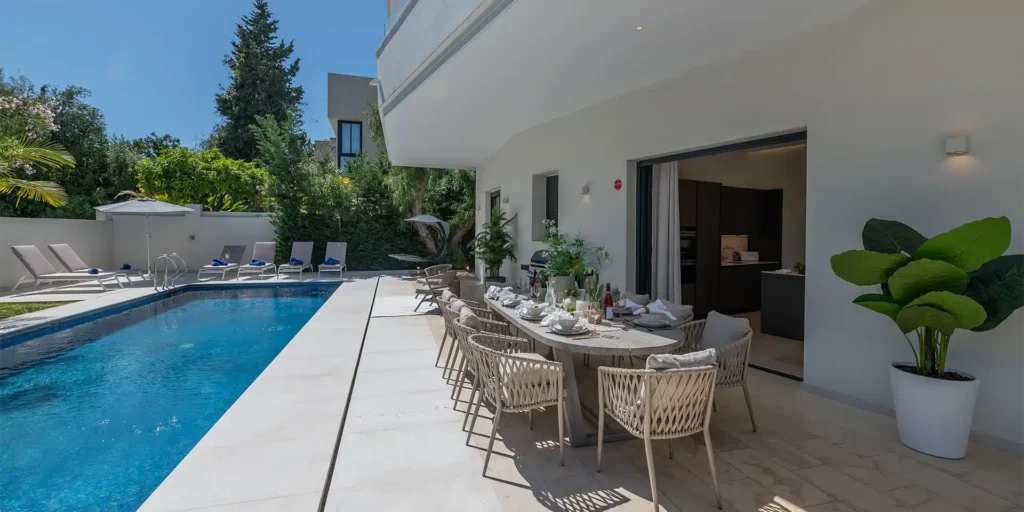
Outside, the magic continues. The heated swimming pool seamlessly blends with the manicured gardens, creating an oasis that feels both intimate and grand. The alfresco kitchen, complete with built-in BBQ, transforms al fresco dining from simple meal to theatrical experience—imagine serving perfectly grilled branzino as the sun sets over the Golf Valley’s rolling greens.
The villa’s location couldn’t be more perfect: seven minutes to Puerto Banús for world-class shopping and dining, yet blissfully removed from the crowds. Plus, with championship golf courses practically at your doorstep, mornings can begin with a few rounds before retreating to your private terrace for afternoon siestas overlooking the verdant landscape.
Villa Velazquez: Intimate Luxury On The Golden Mile
The Golden Mile has always been synonymous with exclusivity, making it the natural choice if you’re planning an intimate getaway with your closest friends. Villa Velazquez, with its prime location just 150 meters from the beach, offers the perfect blend of accessibility and privacy for this select group of five.
Enjoy spontaneous shopping expeditions to Marbella’s designer boutiques and evening adventures in Puerto Banús, whilst the villa’s peaceful setting provides the sanctuary needed for genuine relaxation and precious moments with friends away from busy schedules.
This brand-new sanctuary, completed in 2020, showcases striking modern architecture through its harmonious blend of concrete and glass, set amongst lush Mediterranean surroundings. The impressive living space features soaring 8-metre-high ceilings that create an immediate sense of grandeur, whilst maintaining an intimate atmosphere for close friendships.
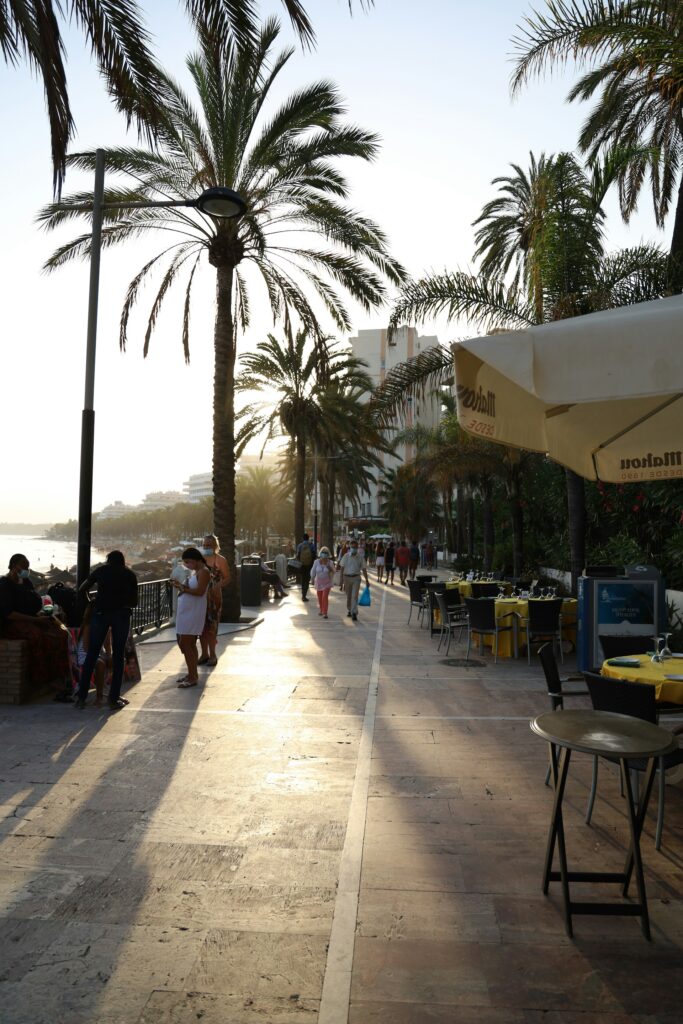
The villa’s crown jewel – a breathtaking top-floor terrace offering 360-degree panoramic views – becomes the perfect gathering spot for those famous Marbella sunrise and sunset moments. The private heated swimming pool, spanning over 80 square metres of pristine waters, provides a refreshing retreat between adventures, whilst Puerto Banús marina just five minutes away and the vibrant Paseo Marítimo promenade at your doorstep position you perfectly to explore both old town Marbella’s authentic charm and the marina’s glamorous atmosphere.
To elevate the experience further, the villa’s concierge team can arrange private chef services for exclusive barbecue evenings, followed by authentic flamenco performances under the stars – creating memorable experiences that embody the spirit of Andalusian hospitality.
Read: Where To Stay, Dine & Play In Puerto Banús: The Ideal Guide
Villa Martinica: Where Modern Glamour Meets Mediterranean Magic
Picture this: you’re sipping champagne in your private rooftop hot tub, watching the sun dissolve into the Mediterranean while Puerto Banús glitters in the distance. This isn’t just a fantasy—it’s Wednesday evening at Villa Martinica, the Costa del Sol’s most exciting new arrival that’s already rewriting the rules of luxury coastal living.
Built in March 2025, Villa Martinica feels like it was designed by someone who truly understands how modern jet-setters want to live. This isn’t your grandmother’s Mediterranean villa (though she’d certainly approve of the impeccable taste). Instead, it’s a five-bedroom sanctuary that seamlessly blends cutting-edge contemporary design with that irresistible Andalusian warmth that makes you never want to leave.
The villa’s crown jewel? That breathtaking rooftop terrace with panoramic sea views that’ll have you scrambling for your phone to capture the perfect golden hour shot. But trust us—no Instagram filter can do justice to watching the sunset from your private hot tub, glass of Cava in hand, with the Spanish coastline stretching endlessly before you.
Down below, the heated infinity pool practically floats among the lush landscaped gardens, creating those dreamy reflection shots your feed has been missing. The high-end outdoor kitchen transforms every meal into an event—imagine grilling fresh seafood while your friends lounge poolside, the scent of jasmine mixing with sea breeze.
Inside, Villa Martinica is pure architectural poetry. The open-plan living area floods with natural light through expansive glass doors that make you feel like you’re living in a beautifully curated gallery. It’s sophisticated enough for the most stylish dinner party, yet cozy enough for those rare quiet mornings when you just want to read Vogue with your coffee.
But here’s where Villa Martinica gets playfully brilliant: the private cinema room complete with arcade-style video games. It’s giving luxury entertainment complex vibes, perfect for those evenings when you want to channel your inner teenager (in the most chic way possible, naturally). Plus, there’s a pool table in the living room because why shouldn’t relaxation include a bit of friendly competition?.
Villa Martinica even welcomes your chicest four-legged companions (small dogs up to 10kg), because the best getaways include the whole family—paws and all. After all, luxury without your beloved pet isn’t really luxury at all.
The Royal Standard Of Service
What makes these properties truly fit for royalty extends far beyond marble floors and infinity pools. Marbella’s luxury villa sector has evolved to provide the kind of seamless, anticipatory service that royal guests expect as standard.
From 24-hour security teams to private chefs, butlers, and housekeeping staff, every detail is orchestrated to ensure complete comfort and privacy. Concierge services can arrange everything from Michelin-starred restaurant bookings to private shopping experiences, with entire establishments occasionally closing their doors to accommodate royal visits.
The infrastructure supporting these stays rivals that of any five-star resort: fleets of supercars with professional chauffeurs, private jet and helicopter transfers, and access to a network of luxury service providers who understand the unique requirements of royal hospitality.
As one luxury villa specialist from Vacation Marbella notes: “Marbella isn’t just another holiday destination for royalty – it’s become their home away from home. The combination of world-class properties, impeccable service, and that special Andalusian warmth creates something truly magical.”
In a world where true privacy has become the ultimate luxury, these three villas represent more than just accommodation – they offer royal families the chance to experience life beyond the palace walls, creating memories in one of the world’s most beautiful settings.
What do you get the petrol-head who has it all? Well, however much we’d love to get our car-loving loved one a new set of wheels, we just can’t justify that level of extravagance. That’s a convoluted way of putting “we can’t afford it”, by the way.
Not to worry. There are plenty of affordable, appropriate gifts for lovers of all things engine, wheels and petrol. All it takes is a little initiative, and getting to the end of this article. With that in mind, here are 11 car gadgets and accessories that will transform your next road trip.
HUDWAY Cast Heads-Up Display
Safeguard your journey with the HUDWAY Cast Heads-Up Display. This device will project your smartphone screen onto your windshield, allowing you to access your navigation, calls, or music without taking your eyes off the road. Because safety should always come first, regardless of how freewheelin’ a road trip is.
Handpresso Auto Hybrid Coffee Maker
We’ve all been there on a long distance drive, wrestling with yawns and longing for a hard hit of the good stuff to keep us awake, alert and accident free. Yep, sometimes you need a good cup of Joe to keep you on the road and safe. And there’s no shame in admitting that, right?
Why wait for pit stops when you can brew your espresso on the go? The Handpresso Auto Hybrid Coffee Maker plugs into your car’s cigarette lighter and brews a barista-quality espresso in just 2 minutes.
And most importantly, don’t forget to pack the cups!
There’s nothing worse than your iPhone dying just as the GPS announces that crucial turn in unfamiliar territory. ESRTECH’s Qi2 & MagSafe car chargers solve this modern motoring nightmare with magnetic precision. These clever devices snap your iPhone 12 or later into the perfect charging position, delivering up to 15W of wireless power while keeping your phone secure even on bumpy roads. Whether you prefer vent-mounted, dashboard, or windscreen options, the strong magnetic hold means no more fumbling with cables at traffic lights.
Some models even feature cooling systems to prevent overheating during those scorching summer drives. Simply put, it’s the difference between arriving with a dead phone and arriving ready for whatever comes next.
RoadPro Slow Cooker
Curb your hunger pangs with the RoadPro slow cooker, an ideal gadget for traveler foodies. Simply plug it into your car’s power outlet and enjoy home-cooked meals even on the open road.
Cooluli Mini Fridge Electric Cooler
Storing beverages and small food items can be a challenge during a road trip. But with Cooluli Mini Fridge Electric Cooler, you can easily maintain the freshness and temperature of your snacks and drinks.
Garim Speak Plus Dashboard
Music can affect your body’s chemistry. Indeed, loud music can increase your adrenaline levels, which will help you keep awake during a long, boring drive. However, the last thing you want to do when driving is fiddle with the music, scrolling through your Spotify library in search of that song. This leads to distraction and a compromise on safety.
Enter the Garmin Speak Plus which has all of the advantages of a regular dashcam, but also full access to Alexa and music. Keep your hands on the wheel and you can use your voice play music, check the weather, traffic or where the nearest petrol station is or even get her to tell you entertaining jokes. Moreover, you can simply ask Alexa to get Garmin to give you turn-by-turn directions and it features that all-important dashcam for added safety. Is there anything she/it/they can’t do?
Fobo Tire Plus
Maintaining the correct tire pressure is crucial for a safe and smooth road trip. With Fobo Tire Plus, you can monitor your car’s tire pressure in real-time, receiving updates on your smartphone.
Misplacing keys or wallets on a road trip can be a real stressor. Tile Mate Tracker comes to rescue in such scenarios. Attach this compact device to your essentials, and you can easily track them using the Tile app on your smartphone.
Autel MaxiCom MK808 OBD2 Scanner
This gadget is a must-have for those who like to be prepared for everything. The Autel MaxiCom MK808 OBD2 Scanner makes diagnosing and troubleshooting car problems a breeze, ensuring that small issues don’t escalate into bigger problems halfway through your trip.
Semi-Autonomous Driving Systems
Semi-autonomous driving systems are the zeitgeist of auto technology, working as an extra set of eyes and hands on the road. Companies like Tesla with their ‘Autopilot’ and GM’s ‘Super Cruise’ offer semi-autonomous driving features that can control steering, acceleration, and braking in certain circumstances, making long-haul travel less tiring.
These systems also come with safety features like lane keeping assist, adaptive cruise control and collision avoidance systems, adding an extra layer of security and peace of mind. Perhaps the leader in its field is Nissan’s ProPILOT Assist, which represents superb value for money, and is easily serviceable too.
Inflatable Car Bed
Let’s go all out here. The convenience of dinner and hot drinks is covered. But is that enough? Now, let’s turn this damn thing into a bedroom, too. An inflatable car mattress allows you to turn the back seat of your car into a bed when you need a kip in no time. Whilst this is a matter of personal preference, some of the best car air mattresses on the market include the Umbrauto SUV Air Mattress, the QDH SUV Air Mattress, and the Rightline Gear Universal-Fit SUV Air Mattress.
Whichever kind of mattress you choose, you’ll find the addition to your armoury super useful for quick naps to get your energy back up, but also handy if you’re looking for a budget way to sleep while you’re on your road trip.
And with all of this sorted, we’ll see you on the open road!
Buying a mattress; as long as it’s soft and comfy, it’s good enough to sleep on, right?
If only things were that easy. For one, we wouldn’t need to write another word. But perhaps more importantly, it’s essential to remember that not all mattresses are made equal and the quality of your sleep depends on factors far beyond simple comfort.
Whilst this is a decision certainly best slept on, here’s a few things to bear in mind; our top tips for choosing the right mattress for you.
Go Into A Store And Lie Down
When it comes to comparing mattresses, there’s nothing quite like trying out a mattress in person. And fortunately, any reputable mattress supplier will be more than happy for you to come to their store and let you try out their mattresses for size. Sure, you won’t be able to take a well-earned nap right there in public, but you can certainly get a sense of how the mattress feels first-hand. The store’s salespeople will also be able to guide you through some of the more impenetrable jargon that comes with mattress shopping.
Once you know what kind of mattress feels right for you and what you need from a mattress, find some reviews online to cross-reference your instincts.
Then, it’s back to a physical store that sells the mattresses you have shortlisted so you can try them out thoroughly before you buy them. We recommend trying out the mattress in the position you tend to sleep in, to identify any immediate issues lurking beneath the surface.
We don’t know about you, but all this comparing and travelling to mattress stores to test them out has made us knackered, we need our new mattress now.
Ideal Tip: It should be noted here that because there isn’t much regulation in the mattress industry, many retailers sell the same mattress under different model names, preventing customers from comparison shopping. The best way to get around this nefarious tactic is to obtain detailed product specifications, and then compare their materials and construction.
Find Brands That Offer A Sleep Trial
A mattress is a big investment. Luckily, many big brands allow you to try the mattress out at home first, with no financial commitment necessary should the mattress not suit your specific sleep needs. Yep, if you don’t love your new mattress, you can send it back and exchange it for a new one!
It’s not all positive news, though; you should be aware that there are strict conditions with these types of sleep trials. Most will allow you to remove the original packaging, sure, but insist you use a mattress protector for the duration of the trial period. Some insist that the original packaging is kept on, which pretty much defeats the whole point of trying to find out if you’re happy with the mattress. Unless, of course, you enjoy sleeping on a squeaky plastic sheet.
Because of this, do make sure you read the terms and conditions of your trial and be sure to keep proof of purchase.
Buy Within Your Budget
The last thing you want is a sleepless night on your new mattress, worrying about money; that would rather defeat the point of investing in your sleep, after all!
Of course, when you buy a mattress, you need to work within your budget, and a top quality one can be surprisingly expensive. In fact, according to finance and budget experts Nimble Fins, a premium mattress will cost you in the region of £3000, on average. Considering we’re advised to replace our mattresses once every ten years or so, that represents an enormous outlay over the course of your (admittedly well rested) lifetime.
That said, the consumer experts at Which have identified their ‘best buys’, with several clocking in at under a grand and some not much more than £150, showing that quality needn’t cost a fortune. Rather than fretting about price, work out your budget precisely, and adapt your needs accordingly.
You’ll also be pleased to hear that the guys over at CHOICE Australia found that “many cheaper mattresses are just as effective as pricey models”. However, they also found that the same mattresses are sold at totally different prices in different stores, so do shop around.
Now that you’ve sorted your budget, let’s talk about what your money is actually buying. The material of your mattress isn’t just industry jargon – it fundamentally affects how you’ll sleep for the next decade.
The mattress market has evolved far beyond the traditional spring models your grandparents swore by. Today’s shoppers are typically choosing between foam mattresses or hybrid mattresses, each offering distinct advantages depending on your sleep style.
Memory foam mattresses have gained popularity for their body-contouring properties and motion isolation – perfect if your partner tosses and turns like they’re auditioning for Cirque du Soleil. However, some sleepers find them too warm or feel like they’re sinking into quicksand.
Hybrid mattresses attempt to offer the best of both worlds, combining supportive springs with comfort layers of foam or latex. They tend to sleep cooler and provide more bounce (make of that what you will), whilst still offering decent pressure relief.
Then there’s latex, which offers natural breathability and durability, though it comes with a heftier price tag. And yes, traditional innerspring mattresses are still around, often at the budget-friendly end of the spectrum.
The key is matching the material to your needs: side sleepers often prefer softer foam for pressure relief, stomach sleepers typically need firmer support, and back sleepers usually fall somewhere in between. Hot sleepers should prioritize breathable materials, whilst those with allergies might lean towards hypoallergenic options like natural latex.
Making A List, Checking it Twice
If we haven’t driven you to bed already, we should reiterate that there are just so many considerations when choosing a mattress. If we wrote them all, this article would send you to sleep. So, we’re going to keep this one brief and to the point; here’s a useful summary of things you need to take into account when choosing a mattress:
Firmness
Material
Whether you sleep on your own or with a partner
Airflow
Warranty/ Guarantee
Mattress size
The position you sleep in
How warm your bedroom gets.
The lifespan of a mattress
It’s also important to consider here if you really need a new mattress. As the Guardian reports, “As the sleep economy grows, online companies vie to sell us new mattresses, offering 100-day returns. This has helped create an impossible waste mountain”. They go on to highlight that “The UK threw away more than 7m mattresses in 2017, the vast majority of which went straight to landfill”.
We’ve all seen a poorly disposed of mattress at the side of the road once in a while; well, imagine that multiplied by 7 million, every single year.
There are a surprising amount of mattress scammers out there, who sell second-hand mattresses dressed up as new ones, so make sure you buy from a reputable seller or directly from the manufacturer. Avoid unknown eBay sellers and if the price seems too good to be true, it likely is too good to be true.
The Bottom Line
Considering how sleep is essential in maintaining our overall health, the mattress you sleep on should be treated with respect and deep consideration. If you do make the wrong choice and can’t return your mattress, it’s not the end of the world – there are always mattress toppers.
When it comes to holidaying closer to home – or, controversially ‘staycationing’ – more and more people are turning to camping, glamping, and motorhome pitches. Spending time in the Great British outdoors, amongst nature and away from it all, has never felt so appealing, especially when the alternative is waiting for hours in a chaotic airport for a cancelled flight.
Luckily, the UK plays host to scenic beaches, idyllic countryside views, and rugged mountain ranges that can be accessed without having to brave any wild scenes at the UK’s departure gates.
With stunning, natural beauty right on your doorstep, there really is no need to travel all those miles to experience something amazing. Here are 9 of the best camping destinations in England, Wales, Scotland, and Northern Ireland. Or, as some people like to call it, the UK.
The Devon Coast, England
The Devon Coast offers up some truly breathtaking, scenic sights, and is a fantastic place to spend your camping holiday. Home to two National Parks, five Areas of Outstanding Natural Beauty and countless mesmerising beaches, you are spoilt for choice in Devon.
However, one of the top choices for pitching a tent in a remote spot is the Jurassic Coast. This iconic part of England is a World Heritage Spot with hiking trails, stunning vistas, and unique geological features. You can even spend part of your camping holiday hunting for fossils in this area.
Some of the best campsites are in and around the picturesque seaside town of Sidmouth, and its 85 mile hike to Studland in neighbouring Dorset. Along this hike, which is part of the South West Coast Path, you’ll find some truly remote spots to pitch up.
The Llyn Peninsula, also known as ‘Snowdon’s Arm’, is found in North Wales. As an Area of Outstanding Natural Beauty, the Llyn Peninsula is renowned for its intriguing wildlife, pretty beaches and thrilling water sports. With Snowdonia forming the background of your adventures, a holiday on the Llyn Peninsula is going to be one to remember.
For something a little more laid back, the Llyn Peninsula in Northern Wales has one of our favourite pubs in the world, Ty Coch Inn. But fear not, this one is for the kids too. The pub ‘garden’ is actually a small stretch of beach, letting you sup your pint while you watch the children build sandcastles – could there be anything better?
The Yorkshire Dales, England
The Yorkshire Dales National Park is a haven for those seeking limestone landscapes, rolling meadows, and charming market towns. With over 700 square miles of stunning countryside, you’ll find everything from gentle riverside pitches to more adventurous hillside spots. The area is famous for its dramatic waterfalls, including Aysgarth Falls and the impressive Hardraw Force.
Malham Cove, a magnificent curved limestone cliff, provides a spectacular backdrop for camping adventures. The nearby village of Malham offers several excellent campsites, whilst the more intrepid might prefer the remote beauty of upper Wharfedale. Don’t miss the chance to explore the fascinating cave systems at White Scar Cave or take a scenic ride on the Settle-Carlisle Railway – arguably Britain’s most beautiful train journey.
The Cairngorms, Scotland
Scotland’s Cairngorms National Park is Britain’s largest national park and home to some of the UK’s most dramatic mountain scenery. This wilderness playground offers everything from family-friendly camping parks to wild camping opportunities amongst ancient Caledonian pine forests. The area boasts five of Scotland’s six highest mountains and is perfect for those seeking a true Highland experience.
Glenmore Forest Park, near Aviemore, provides excellent camping facilities with direct access to Loch Morlich’s sandy beach – yes, a proper beach in the Scottish Highlands! Wildlife enthusiasts might spot red deer, golden eagles, or even the elusive Scottish wildcat. For a unique experience, visit in autumn when the forests burst into spectacular colours and the red deer rutting season begins.
Isles Of Scilly, England
When it comes to the most remote camping spots in the UK, the Isles of Scilly is a fair contender. The Scilly archipelago, just off the Cornish coast, is made up of over 140 islets and islands, with just five of those inhabited.
Four of these tiny islands offer campsites with a difference. Whether you choose to enjoy the popular St Mary’s island, the boating opportunities of Bryher, the dog-friendly campsite at St Martin’s, or the panoramic views of St Agnes, there is something for everyone on the Isles of Scilly.
The Castle Ward estate has gained international recognition in recent years due to part of the estate being used as a filming location for Game of Thrones. GoT fans can take a tour of these sites while nature lovers can enjoy the historic woods, the sweeping grounds, and majestic views over Strangford Lough.
It should be noted that the main campsite here, Castle Ward Caravan Park, has limited space for pitching tents, but this exclusivity makes it a peaceful, somewhat remote space to bed down for a night in blissful serenity.
Endless rolling hills, the peaceful sounds of surrounding nature and a wealth of natural beauty – what’s not to love? If you’re looking for the perfect countryside escape, then the Lake District could be just the place for you in 2022.
With spectacular scenery and places to explore, along with quaint towns and villages to amble through, it offers a slower pace of life to the cut’n thrust of urban Britain.
If you’re a lover of wildlife, The Lake District contains some of the UK’s best wild camping spots (providing you’ve first received permission from the landowner, that is). It should also be noted that land belonging to the Lake District National Park Authority is not suitable for wild camping. With those disclaimers dispensed with, you can find an insightful list of some of the best spots for wild camping in the Lake District here.
Alternatively, for something equally spontaneous but a little more legal certainty, why not try Baysbrown Farm?Situated in the beautiful Great Langdale Valley, what sets this campsite apart is the spontaneity it encourages; you don’t book a pitch here, you just arrive and find a space. Acres of flat ground belong to the farm, which sits at the base of the Lake District’s mountain range; the most picturesque of backdrops for happy campers.
For those preferring the comfort of a motorhome, there are numerous well-equipped sites throughout the region – just ensure your motorhome insurance covers you for navigating those famously narrow Lakeland lanes!
The Pembrokeshire Coast, Wales
Pembrokeshire’s rugged coastline offers some of Wales’ most spectacular camping spots, with the 186-mile Pembrokeshire Coast Path providing endless opportunities for coastal adventures. From secluded coves to expansive sandy beaches, this area combines natural beauty with fascinating wildlife – keep an eye out for seals, dolphins, and puffins on Skomer Island.
The area around St Davids, Britain’s smallest city, offers numerous camping options with easy access to stunning beaches like Whitesands Bay. For something truly special, try camping near the Blue Lagoon at Abereiddy or explore the colourful harbour village of Tenby. The region’s dark skies also make it perfect for stargazing, with several campsites offering astronomy evenings.
Gleann Na Muice, Scotland
If you are all about rugged mountains and dramatic landscapes, Scotland’s Gleann na Muice could be the ideal choice for you. Based within the Fisherfield Five, five of the most remote Munros in the Scottish Highlands, this spot is fantastic for wild camping. This one isn’t for the faint-hearted, but campers with a penchant for the wild will truly love an outward bounds excursion in this part of the UK.
A sponsored collaboration with Ouh La La, who bring over 20 years of expertise in supplying luxury lingerie.
When it comes to our wardrobes, the best pieces are often the most expensive ones. Yet when it comes to the garments that sit closest to our skin, this approach fails us spectacularly. We’ll happily invest hundreds in a handbag we carry a few times a week, but baulk at spending the same amount on a bra we wear every single day. It’s a curious contradiction that leaves many of us trapped in a cycle of ill-fitting, uncomfortable undergarments that neither flatter nor support us properly.
It shouldn’t be this way.
There’s an undeniable confidence that comes when you elevate your lingerie game. It’s about doing something for yourself that sparks self-confidence, that makes you feel good – a little bit of luxury you can incorporate into your everyday wardrobe. If you buy nice underwear, you’ll naturally look after it better, meaning you’ll feel better too – no more mismatched sets and wearing that same bra that you haven’t washed for a month.
There’s something magical about having truly nice things close to your skin. It’s not about showing off to anyone else – it’s about that secret smile you get when you know you’re wearing something beautiful,” says luxury lingerie experts Ouh La La. We couldn’t agree more.
With that in mind and the help of Ouh La La, here’s how to choose luxury lingerie that will transform your underwear drawer and last a lifetime…
Fit: Your Most Important Investment
Here’s the truth that might surprise you: the most expensive bra in the world is worthless if it doesn’t fit properly and is uncomfortable to wear. For us, an ill-fitting bra won’t last the night, let alone a lifetime.
Professional fitting services, offered by luxury lingerie boutiques, are worth their weight in gold. A skilled fitter can identify your true size and shape, which often differs significantly from what you think you know.
“It’s estimated that roughly 80% of women wear the wrong bra size, when in reality, taking time to find the perfect fit can make all the difference in giving you the right support, as well as streamlining your shape and ensuring that your clothes hang just right,” says Ouh La La.
If you don’t get the right fit, you’re less likely to wear the bra and more likely to give it to the charity shop, no matter how expensive it was.
Top Tip: Remember that luxury lingerie sizing can vary dramatically between brands. European brands run differently than American sizing, and some brands cater to specific body types or breast shapes. Don’t be surprised if you’re a different size in each brand you try – this is perfectly normal and why professional fitting is so valuable.
Pick Out a Bra Style You Love to Wear
There’s no point buying luxury lingerie if you’re not going to wear it. In our experience, most of us won’t wear a bra because the style wasn’t quite right. So pick out a bra style that you love to wear.
If you’re looking for something supportive and sexy, consider a balcony bra. Also known as balconettes or half cups, these are designed to give you a natural lift and are created to show off some cleavage. “This style tends to cut straight across the bust line, giving you more of a shelf effect. This can be incredibly flattering on your physique, especially when worn with a low-cut top or dress,” says Ouh La La. “We would recommend a flirty balconette style for nights out or paired with a gorgeous dress or evening gown,” they go on to say.
However, if you’re looking for luxury pieces to wear every day, consider a full cup bra designed to focus on full coverage, support, and comfort. When it comes to this design, “the Prima Donna Deauville bra, a bestseller across the world, provides unparalleled support and comfort,” suggests Ouh La La.
Push-up bras do exactly what the name suggests. “The push-up bra is designed to lift and enhance cleavage, incorporating padding or moulding to push your breasts inwards and upwards, creating the appearance of fuller, larger breasts. This style can be a little less comfortable if worn on a daily basis, but it’s an excellent choice for nights out,” says Ouh La La.
Investment-Worthy Brands
Luxury lingerie is designed to make you look and feel your best, and there’s a whole host of heritage brands that have earned their reputation through decades of craftsmanship and innovation. It’s these brands that you should spend your money on if you want your luxury lingerie to last.
“At Ouh La La, we’ve chosen brands like Empreinte, Aubade, Lise Charmel, Chantelle and Wacoal,” they explain. “These brands command premium prices because they’ve mastered the delicate balance between beauty, comfort, and longevity. When you invest in pieces from established luxury houses, you’re not just buying lingerie – you’re buying decades of expertise and innovation, plus the assurance that comes with proven quality,” they add.
There are, of course, other well-known brands. La Perla’s Italian artisanship creates pieces that feel like wearable art. Aubade combines French sophistication with technical precision. Agent Provocateur brings theatrical glamour with surprising comfort.
However, don’t overlook newer luxury players making waves in the industry. Brands like Fleur du Mal and Lonely Lingerie offer fresh perspectives on luxury intimates, often with more inclusive sizing and modern sensibilities whilst maintaining impeccable quality standards. These contemporary brands understand that luxury should be accessible to all body types and lifestyles.
Choosing The Right Luxury Lingerie Fabrics
When choosing luxury lingerie, it’s all about how you feel in the pieces you purchase. Do you want something you’ll feel feminine in? Then consider lace, which is elegant and romantic, adding a touch of femininity to any ensemble. Alternatively, silk offers luxurious smoothness and feels gentle against the skin, making it perfect for those who prioritise comfort alongside beauty.
Consider other materials that luxury brands employ: Italian mesh provides breathability with sophistication, French tulle adds delicate texture, intricate embroidery creates visual interest, and even faux fur can add unique textures and looks for special occasions. Each fabric choice should align with both your comfort preferences and the occasions you’ll be wearing the pieces.
Consider Seasonal Pieces For Year-Round Luxury
Your lingerie should change with the seasons, just like your wardrobe. Luxury brands know this isn’t just about staying comfortable – it’s about feeling indulgent all year round. There’s also a practical benefit: rotating your collection seasonally means each piece gets a proper rest, helping your luxury investment last much longer.
Summer calls for something special beyond basic cotton. The t-shirt bra is the perfect addition to refresh your wardrobe and prepare for the warmer months. But we’re talking about t-shirt bras crafted from Egyptian cotton or Swiss blends that feel like silk whilst keeping you cool. “Empreinte’s summer pieces prove that practical doesn’t mean boring – even their seamless bras feature hand-finished details and delicate lace,” suggests says Ouh La La.
The best summer lingerie works harder than you’d expect. Premium fibres absorb moisture brilliantly without showing it. “Due to their unique molecular structure, these fabrics can soak up to 20% of their weight in moisture before any signs of dampness become visible,” says Ouh La La. It’s the difference between surviving a hot day and gliding through it.
Winter luxury lingerie is where things get really indulgent. Think cashmere blends, silk-lined cups, and fabrics that wrap you in warmth without adding bulk.
“We love Empreinte and Marie Jo for their seasonal expertise. Their summer cottons breathe beautifully, whilst their winter silk-cashmere blends provide gentle warmth without sacrificing elegance,” Ouh La La offers. The real luxury? These pieces maintain their shape and beauty through every season and wash, especially when you’re not wearing the same bras year-round.
Colour Choice Matters
“What is the colour of your favourite lingerie piece, and how does it make you feel when wearing it?,” asks Ouh La La.
“Colour choice has been proven to hold unique power over our psyche. Blues and greens evoke feelings of tranquillity and peace, whilst fiery reds and sunny yellows infuse energy into our activities. The psychology of colour extends to our intimate wear, affecting not just how others perceive us, but more importantly, how we feel about ourselves,” they explain.
Consider starting your luxury lingerie collection with versatile neutrals – nude, black, and white – that work seamlessly under any outfit. These foundational pieces will serve you well in countless situations. Then add colours that make you feel confident and beautiful.
Whether that’s a soft blush pink that makes you feel feminine, a bold emerald that makes you feel powerful, or a deep navy that exudes sophistication, choose colours that enhance your mood and complement your personality. Soon you’ll have a lingerie drawer full of sumptuous sets – now that’s luxury.
The Bottom Line
Luxury lingerie means different things to different people. For some it’s comfort, for others it’s about quality. And for us? Investing in luxury lingerie isn’t about extravagance – it’s about recognising that the garments closest to your skin deserve the same consideration as the rest of your wardrobe. When you choose quality pieces that fit properly, feel beautiful, and suit your lifestyle, you’re investing in your daily comfort and confidence.
Remember that luxury lingerie is meant to last for years, not months. With proper care, a well-made bra from a reputable brand will maintain its shape, support, and beauty far longer than cheaper alternatives. This longevity makes the initial investment worthwhile, both financially and emotionally.
Gateway to the sun-soaked beaches of southern Portugal, Faro often gets overlooked by holidaymakers racing towards the Algarve’s more famous resort towns. Yet those who pause to explore this charming capital discover a city where Moorish walls embrace cobbled streets, where storks nest atop baroque churches, and where the rhythms of authentic Portuguese life continue undisturbed by mass tourism.
Behind its medieval ramparts, the Cidade Velha (Old Town) reveals a treasure trove of azulejo-clad buildings, intimate squares, and hidden courtyards where orange trees perfume the air and elderly locals debate the day’s news over tiny cups of bica.
Unlike its flashier coastal neighbours, Faro maintains a working-city authenticity that’s increasingly rare along the Algarve. Here, university students mingle with fishermen in waterfront cafés, traditional tascas serve petiscos to locals rather than tourists, and the morning market buzzes with genuine commerce rather than souvenir-hunting.
The city’s unique position between the Ria Formosa lagoon and the Atlantic creates a natural paradise on its doorstep – a protected wetland where flamingos wade through shallow waters and pristine barrier islands offer some of Portugal’s most unspoilt beaches. While you could easily spend a week exploring every winding alley and sampling each neighbourhood’s specialities, 48 hours provides enough time to experience Faro’s dual personality: historic city and gateway to one of the world’s most beautiful coastlines.
Day 1: Medieval Charm & Maritime Heritage
Morning: Through The Arco da Vila
Begin your Faro adventure at Pastelaria Coelho on Rua de Santo António, where the aroma of freshly baked pastries has been drawing locals since dawn for over four decades. Their bolas de Berlim (Portuguese doughnuts filled with egg custard) and galão (milky coffee served in a tall glass) provide the perfect fuel for exploration. The unpretentious interior, with its worn marble counter and constant stream of regulars, offers an authentic glimpse of Faro’s morning rhythms as workers grab their breakfast before heading to shops and offices.
A five-minute stroll brings you to the Arco da Vila, the neoclassical gateway that marks the entrance to Faro’s walled old town. Time your arrival for 9:30am to beat both the tour groups and the Algarve heat. The arch itself, built atop Moorish foundations, houses a colony of white storks whose distinctive clattering provides the soundtrack to old Faro. Look up to spot their enormous nests balanced precariously on the stonework.
Within the old town walls, the Sé Cathedral dominates the Largo da Sé. This architectural hodgepodge – Gothic bones dressed in Renaissance finery with baroque flourishes – tells the story of Faro’s turbulent past. The modest entrance fee includes access to the bell tower; climb the narrow spiral staircase for panoramic views across the terracotta rooftops to the Ria Formosa beyond. The Cathedral’s bone chapel, though smaller than Évora’s famous example, offers a sobering reminder of mortality crafted from the remains of 1,200 Carmelite monks.
Descend back through the old town and exit via the medieval walls for the 10-minute walk to the Mercado Municipal. This art deco market building comes alive between 11am and 1pm, when locals haggle over the morning’s catch. The fish section dazzles with displays of dourada (sea bream), robalo (sea bass), and the region’s famous percebes (gooseneck barnacles). The upper floor houses produce stalls where vendors will enthusiastically offer samples of whatever’s in season – perhaps sweet Algarve oranges or aromatic medronho berries.
For lunch, navigate the narrow streets behind the market to find Tasca do Ricky, a tiny family-run tasca that’s easy to miss but impossible to forget. Here, Ricky himself mans the grill, turning out perfectly charred chocos grelhados (grilled cuttlefish) and bifanas (pork sandwiches) that have achieved legendary status among local workers. The entire menu is scrawled on a chalkboard, prices haven’t changed in years, and there’s not a tourist menu in sight.
After lunch, take advantage of Faro’s unique geography with a trip to Ilha Deserta, part of the Ria Formosa Natural Park. Ferries depart hourly from the dock below the old town (€10 return), and the 30-minute journey through the lagoon’s maze of channels offers sightings of everything from spoonbills to seahorses. The island – also known as Ilha da Barreta – lives up to its deserted name, especially if you walk beyond the small beach bar near the jetty.
This barrier island stretches for 11 kilometres of virtually untouched sand, backed by dunes and salt marsh. Time your visit to include a late afternoon swim in the Atlantic, where the water temperature hovers around a pleasant 20°C even in spring and autumn.
The western tip of the island, reached by a 45-minute walk along the beach, offers the best sunset views – though check ferry times to ensure you don’t miss the last boat back.
Alternatively, if you’re in the need for afternoon refreshment, head to Restaurante Estaminé – a stunning wooden restaurant serving local cuisine and with seafood straight from the estuary.
Evening: Sunset & Seafood
Back on the mainland, climb to the Miradouro de Santo António for sunset views across the old town and lagoon. This small viewpoint beside the Santo António Church provides the perfect perch to watch the sky turn shades of pink and orange reflected in the still waters of the Ria Formosa.
For dinner, make your way to Tertúlia Algarvia, housed in a converted 17th-century stable just steps from the cathedral. This atmospheric restaurant specialises in cataplanas (traditional copper-pot stews) and fresh seafood prepared with a contemporary twist. Their caldeirada de peixe (fish stew) layers the day’s catch with potatoes, tomatoes, and peppers in a fragrant saffron broth. The stone walls and vaulted ceilings create an intimate atmosphere, while the small courtyard offers al fresco dining on warm evenings. Book ahead, especially at weekends when locals fill the tables for celebratory dinners.
End your evening at Columbus Bar, hidden down a side street in the old town. This intimate space, carved into the ancient city walls, serves creative cocktails using local ingredients like fig liqueur and Algarve honey. Their signature ‘Ria Formosa’ combines gin with elderflower and fresh herbs picked from the owner’s garden.
Start day two at Pastelaria Gardy on Rua de Santo António, where locals have been starting their mornings since 1964. Their speciality, folhados de Faro (puff pastries filled with egg custard and almonds), provide the perfect sugar rush before cultural exploration. The retro interior, complete with formica tables and net curtains, hasn’t changed in decades.
A five-minute walk brings you to the Igreja do Carmo, Faro’s most impressive baroque church. While the gilded interior dazzles with its excess of cherubs and carved altarpieces, the real draw is the Capela dos Ossos (Bone Chapel) accessed through the sacristy. Built in 1816, this macabre masterpiece uses the bones of over 1,200 monks to create intricate patterns across walls and ceiling, all overseen by the sobering inscription: “Stop here and consider, that you will reach this state too.”
Continue your morning with a visit to the Museu Municipal de Faro, housed in a 16th-century convent. The museum’s collection spans from Roman mosaics to contemporary art, but the highlight is the spectacular 3rd-century Roman mosaic of Ocean, discovered in the ruins of Milreu. The peaceful Renaissance cloister, with its orange trees and azulejo panels, offers a tranquil escape from the growing heat.
No visit to Faro is complete without experiencing Praia de Faro, the city’s own beach. Take bus 14 or 16 from the centre (20-minute journey) to reach this long stretch of sand that locals simply call ‘the island’. The beach extends for miles in both directions, backed by low dunes and beach bars that range from ramshackle to sophisticated.
For lunch with your toes in the sand, Wax Restobar offers a more refined take on beach dining without the premium prices of the Algarve’s posher resorts. Their grilled fish of the day, served simply with roasted vegetables and sea salt, showcases the quality of local seafood. The restaurant’s deck provides shade during the midday sun, and their selection of Portuguese wines includes excellent Alentejo whites perfect for a lazy beach afternoon.
Afternoon: Lagoon Life
Rather than rushing back to the city, spend your afternoon exploring more of the. The Centro de Educação Ambiental de Marim, located just east of Faro, offers walking trails through diverse habitats including salt pans, pine woods, and tidal mudflats. The 3km circular trail takes about 90 minutes at a leisurely pace, with bird hides positioned at strategic points for wildlife watching.
Time your visit for the afternoon when the harsh midday light softens and wildlife becomes more active. The salt pans attract flamingos year-round, while spring and autumn bring thousands of migrating birds. The restored tide mill and traditional salt workers’ houses provide insight into how locals have worked these waters for centuries.
Evening: Farewell Feast
For your final evening, Vila Adentro in the old town offers innovative takes on traditional Algarvian cuisine. Chef Pedro Vieira sources ingredients from small local producers, transforming humble dishes into something special. The cataplana de tamboril e gambas (monkfish and prawn stew) arrives in the traditional copper pot, but elevated with saffron and fresh herbs. The tasting menu, if you’re feeling indulgent, provides a journey through the region’s flavours paired with carefully chosen Portuguese wines.
Cap off your 48 hours at O Castelo, a rooftop bar perched atop the old town walls. As you sip a glass of white port or medronho (strawberry tree firewater), the illuminated cathedral and twinkling lights of the marina create a magical backdrop for your final night in Faro.
Choosing your base in Faro requires balancing historic charm with practical considerations. The compact size means nowhere is too far from the action, but each area offers a distinct experience.
The Cidade Velha (Old Town) provides maximum atmosphere in minimum space. Several boutique properties occupy lovingly restored 19th-century townhouses within the medieval walls. Look for intimate accommodations with four to six rooms that offer experiences where breakfast is served in courtyards fragrant with jasmine. Many feature rooftop terraces providing 360-degree views over terracotta tiles to the lagoon beyond. Request rooms with original azulejo tiles and wooden shutters opening onto the cathedral square for the most authentic experience.
For those seeking more space and modern amenities, the area around the marina offers excellent options. Several contemporary hotels surprise with their boutique sensibilities and rooftop pools overlooking the yacht harbour. Properties in this area are ideally positioned for early morning market visits or late-night waterfront strolls. Many feature popular rooftop terraces that have become local institutions, attracting stylish crowds of visitors and Farenses alike.
The neighbourhood around Rua de São Luis presents the best value options whilst maintaining easy access to both old town and waterfront. Here you’ll find a mix of guesthouses and small hotels occupying renovated merchant houses. Some modern hostels offer private rooms with boutique hotel standards at budget prices. The communal kitchen and lounge areas attract an interesting mix of travellers, creating opportunities to explore the Algarve with rental apartments as a base for longer stays – many guests end up extending their visit to explore the region more thoroughly.
For something different, consider the converted windmill apartments on the outskirts of the old town. These unique circular spaces, once used for grinding grain, now offer romantic retreats with modern comforts. Several properties provide such conversions, complete with mezzanine bedrooms and terraces offering panoramic views across the city to the ocean.
Budget-conscious travellers should look to the streets between the train station and the old town, where family-run pensões offer simple, clean rooms at reasonable prices. Many of these traditional guesthouses have been welcoming guests since the 1960s, and while the décor might be frozen in time, the welcome is warm and the location unbeatable.
The Bottom Line
Forty-eight hours in Faro reveals a city too often dismissed as merely the Algarve’s transport hub. From its medieval heart to its natural lagoon paradise, Faro offers an authentic slice of Portuguese life enhanced by coastal beauty and genuine hospitality. While the beach resorts to east and west provide their own pleasures, Faro’s combination of culture, nature, top Algarve accommodation and cuisine creates memories that linger long after the airport shuttle has whisked you away.
Those inspired to explore further should consider venturing to the mountain town of Monchique, an hour’s drive north, where thermal springs and forest walks provide a complete contrast to the coastal experience. Or perhaps explore more of the Ria Formosa’s islands – Culatra and Armona offer their own distinct charms and even quieter beaches.
For the ultimate Algarve experience, check out our guide to Portugal’s best coastal walks next. The Via Algarviana, starting just outside Faro, offers spectacular hiking through an Algarve most visitors never discover.
Whilst certainly not without their charms, you only have to cast your eyes across the sand to acknowledge that most travellers to Vietnam end up on the same crowded beaches: Nha Trang with its high-rise hotels, or Phu Quoc with its ever-expanding resort developments. But Vietnam’s 3,000-kilometre coastline holds a fair few secrets for those willing to cast the net a little wider.
These five beaches offer something increasingly rare: genuine discovery. Here you’ll find fishing villages where tourism hasn’t yet changed the rhythm of daily life, coral reefs that marine biologists use as healthy ecosystem benchmarks, and stretches of sand where your biggest decision is choosing between a hammock or a deck chair under the trees.
The window for experiencing these coastal treasures in their unspoiled state is rapidly closing. Already, the distant rumble of construction equipment signals change, and locals speak of international hotel chains scouting locations. But for now, these beaches remain gloriously uncommercialised.
Bai Xep Beach, Quy Nhon: The Backpacker Haven That Kept Its Soul
The Discovery
Sitting pretty 13 kilometres south of Quy Nhon city lies Bai Xep Beach, a pristine stretch of golden sand embraced by a traditional fishing village of just 100 or so souls. Once known only to local fishermen, this secluded car-free village offers a rare chance to experience a Vietnamese beach full of industry but without the crowds.
What Makes It Special
The beach is an incredible golden bay bordered by dramatic jagged rocks at either end, with clear blue water and traditional Vietnamese basket boats scattered across the crescent-shaped bay. The atmosphere blends beautiful beaches with an authentic fishing village vibe.
The Experience
Mornings bring fishermen preparing their gear for the day’s catch, whilst evenings offer beach barbecues. You can rent bamboo fishing rods to try your hand at local-style fishing, or take short hikes through the surrounding hills for spectacular coastal views. A 20-minute boat trip (80,000 VND return) takes you to Hon Ngang Island, where natural swimming pools form between rocks and a small beach awaits virtually undiscovered – perfect for snorkelling among coral and tropical fish.
The village boasts several small seafood restaurants run by local families, serving incredibly fresh, whole grilled fish, shellfish, and specialities like banh beo and seafood-laden fried rice. In the evening, tables and chairs appear on the beach for sunset dining, where the area’s residents gather for a couple of cold ones after their working day.
Getting There
Follow National Highway 1D south from Quy Nhon for 17 kilometres, then look for the ‘Bai Xep’ sign. The journey itself is scenic, with mountains and sea flanking both sides of the road. No ATMs exist in Bai Xep, so bring sufficient cash. Staff can arrange motorbike lifts to town if needed.
Best Time to Visit: May to August for optimal weather and calm seas.
Vinh Hy Bay, Ninh Thuan: The Untouched Marine Sanctuary
The Discovery
Located 42 kilometres northeast of Phan Rang-Thap Cham, Vinh Hy Bay is one of Vietnam’s four most beautiful bays, recognised as a national scenic site. This stunning bay features sandy beaches meeting towering mountains, with streams weaving through forests and vibrant coral reefs.
What Makes It Special
The bay’s beauty lies in its blend of sea and Nui Chua National Park – Vietnam’s only dry forest ecosystem and UNESCO Biosphere Reserve. Almost entirely surrounded by mountains, it creates a protected natural amphitheatre.
The Experience
Take glass-bottom boat tours (from 80,000 VND) to explore Ca Ong Cape, Yen Cave, and Hon Rua Islet, where you can admire coral reefs, sea urchins, and starfish. Visit secluded Ba Dien Beach with white sand and clear water, or discover Hang Rai reef – ancient coral formations creating breathtaking rock sculptures.
Visit Vinh Hy fishing village at dawn when boats return with their catch, or explore the area’s unusual grape farms where you can taste local grape liquor underneath the vines.
Getting There
Fly to Cam Ranh Airport (2 hours by road), or drive from Ho Chi Minh City following National Highway 1A for 50 kilometres, then take Provincial Road 702 at Vinh Hy Pass.
Best Time to Visit: May to August for sunshine and calm, clear waters.
Hon Gom Sandbar, Khanh Hoa: Nature’s Geographical Masterpiece
The Discovery
Hon Gom Sandbar is one of Vietnam’s most unique beach destinations – a long, narrow stretch of land that separates the deep blue sea from a calm lagoon, creating a stunning contrast between two bodies of water.
What Makes It Special
Along one side lie rocks resembling animals – a flamingo, a giant crocodile lurking underwater. The east side features a windswept, almost uninhabited beach. The peninsula is known locally as the ‘Garden of Rocks’ where unusual formations have spawned legends about rejuvenating energy.
The Experience
At Son Dung hamlet, Vuon Xoai restaurant occupies a sandy patch shaded by a 70-year-old mango tree, with steps leading into a gorgeous bay surrounded by smooth boulders and fishing boats. In early evening, the sun sets in the middle of the bay, sculpting mountain contours in purple light.
Getting There
The sandbar is accessible via a steep concrete path to Son Dung hamlet.
Best Time to Visit: Year-round, but avoid monsoon months (September-November).
Dam Trau Beach, Con Dao: The World-Ranked Paradise
The beach offers shallow, gentle waters during low tide, tree swings for photos, and tiny sand crabs that create intricate patterns across the beach. Its proximity to Con Son airport adds excitement as propeller planes land overhead just three or four times daily, earning it the nickname “Airport Beach”.
The Experience
Choose between lying on sand, wooden sun loungers, or hammocks in the shade. Two beach cafés provide food and drinks all day, whilst fresh guava juice from the snack shed offers perfect tropical refreshment. Behind cliffs on the left lies a hidden lagoon that becomes a natural jacuzzi during rainy season.
Con Dao National Park hosts Vietnam’s largest turtle community, particularly hawksbill sea turtles, and is the only area where dugongs live.
Getting There
Fly directly to Con Son Airport from Ho Chi Minh City or Can Tho (1 hour flight). The beach is 14 kilometres from Con Dao town centre.
Best Time to Visit: March to September for warm weather ideal for swimming.
Bai Mon Beach, Phu Yen: Vietnam’s Sunrise Gateway
The Discovery
Phu Yen Province’s Bai Mon Beach is a secluded paradise with soft white sand and crystal-clear waters. Located near Mui Dien Cape – Vietnam’s easternmost point – this hidden gem offers the extraordinary experience of witnessing the country’s very first sunrise each day.
What Makes It Special
This superb parcel of sand is wedged between two boulder-strewn hills, creating a secret beach that feels tucked away from the world. The beach entrance (20,000 VND) includes access to Mui Dien Lighthouse, where stupendous views stretch out to sea and down over the beach.
The Experience
Arrive at dawn to climb the lighthouse stairs and watch the sunrise over the ocean from Vietnam’s easternmost point. A separate staircase leads down to the beach for swimming in clear, calm waters. The beach remains uncrowded, particularly on weekdays.
Nearby floating restaurants in Vung Ro Bay serve fresh seafood in wooden structures on calm waters. Quán Chú Mười near the entrance can arrange overnight camping on the sand for the ultimate sunrise experience.
Getting There
The beach lies 35 kilometres southeast of Tuy Hoa City in Phu Yen Province, accessed via one of Highway QL1A’s most scenic sections.
Best Time to Visit: February to May for ideal weather and clearest sunrise views.
Planning Your Trip
Transportation Rent a motorbike for flexibility exploring coastal roads, as many hidden beaches require navigating village paths that taxis cannot access. Book domestic flights to reach remote islands like Con Dao efficiently. Consider hiring local fishermen for authentic and affordable boat trips between islands.
What to Pack Reef-safe sunscreen, waterproof camera, sufficient cash (many beaches lack ATMs), basic snorkelling gear, light rain jacket, and insect repellent for jungle-backed beaches.
Sustainable Travel These beaches remain pristine because visitor numbers stay low. Responsible Vietnam travel prioritises local guesthouses over international chains, eating at village restaurants, leaving no trace, avoiding single-use plastics, and visiting during weekdays when possible to reduce pressure on local infrastructure.
The Bottom Line
Vietnam’s quieter beaches offer some of the most rewarding coastal experiences in Southeast Asia. Whether you’re seeking peaceful retreats, authentic cultural encounters, or pristine natural environments, these five destinations deliver what mainstream beach resorts often promise but rarely provide: genuine connection with place and people.
The beauty of these destinations lies not just in their pristine sands and clear waters, but in their ability to offer experiences that feel both timeless and immediate. Here, Vietnam’s coastal spirit remains wonderfully intact.
Picture this: a customer has spent time browsing your online shop, carefully selecting items and adding them to their basket. They’re one click away from completing their purchase when suddenly… they vanish. No sale, no explanation – just another abandoned cart joining the digital graveyard of almost-purchases. If you’re running an online business, this scenario is frustratingly familiar.
Cart abandonment is the bane of ecommerce retailers everywhere. With average abandonment rates hovering around 70%, it’s a problem that costs businesses billions in lost revenue annually. But here’s the good news: many of these lost sales are recoverable with the right strategies.
Understanding Why Shoppers Abandon Their Carts
Nearly three quarters of online shopping carts are abandoned before purchase. In the UK specifically, this problem cost retailers £38 billion in lost sales in 2024 alone, according to Retail Economics and GFS via the Retail Gazette.
Whilst some abandonment is natural – window shoppers and comparison shoppers will always exist – a significant portion stems from preventable friction points in the purchasing journey. By identifying and addressing these issues, retailers can reclaim a substantial slice of this lost revenue.
Before diving into solutions, it’s crucial to understand why customers leave without buying. The most common culprits include:
Unexpected costs at checkout – Nothing sends shoppers running faster than surprise shipping fees, taxes, or handling charges appearing at the last minute. Transparency is key; if your free shipping threshold is £50, make that crystal clear from the start.
Complicated checkout process – Every additional step, form field, or page load increases the likelihood of abandonment. If customers need a PhD to navigate your checkout, you’ve already lost them.
Mandatory account creation – Forcing shoppers to create an account before purchasing is like asking someone to fill out a mortgage application before buying a coffee. Offer guest checkout options to reduce friction.
Security concerns – In an age of data breaches, customers are rightfully cautious about sharing payment information. Without visible security badges and HTTPS protocols, shoppers may think twice about entering their card details.
Poor mobile experience – With over half of online shopping happening on mobile devices, a clunky mobile checkout is commercial suicide. If customers are pinching, zooming, and squinting, they’re not buying.
Now that we’ve identified the problems, let’s explore practical solutions to transform those abandoned carts into completed sales.
The beauty of tackling cart abandonment is that even small improvements can yield impressive results. To reduce cart abandonment rates by even 1% can translate to thousands in additional revenue for mid-sized retailers. The following strategies aren’t just theoretical – they’re proven tactics used by successful online retailers from ASOS to Zara. The key is selecting the right combination for your specific audience and implementing them thoughtfully.
Simplify Your Checkout Process
Streamline your checkout to the bare essentials. Implement a single-page checkout where possible, or clearly indicate progress with a visual checkout steps indicator. Auto-fill forms using saved information, and only ask for essential details. Remember: every unnecessary field is a potential exit point.
Be Transparent About Costs
Display all costs upfront, including shipping, taxes, and any additional fees. Consider offering a shipping calculator on product pages so customers can estimate total costs before reaching checkout. Better yet, build shipping costs into your product prices and offer ‘free’ shipping – psychology matters in ecommerce.
Offer Multiple Payment Options
Different customers prefer different payment methods. Beyond traditional credit and debit cards, consider integrating digital payment apps like PayPal, Apple Pay, Google Pay, and buy-now-pay-later services like Klarna or Clearpay. The more options you provide, the more likely customers will find their preferred method.
Optimise for Mobile
Ensure your mobile checkout is as smooth as silk. Use large, thumb-friendly buttons, implement autofill for addresses, and ensure forms are easy to complete on smaller screens. Test your checkout process regularly on various devices – what works on your iPhone might be a nightmare on Android.
Build Trust Throughout the Journey
Display security badges prominently, use HTTPS across your entire site, and include customer reviews and testimonials near checkout buttons. Consider adding a money-back guarantee or highlighting your returns policy. Trust signals reassure nervous shoppers that their purchase is safe.
Implement Strategic Remarketing
Not all abandoned carts are lost causes. Set up automated email campaigns to remind customers about their abandoned items. Send the first email within 2-3 hours of abandonment, perhaps with a gentle reminder. Follow up after 24 hours, possibly with a small discount or free shipping offer. A final email after 48-72 hours can capture stragglers.
Deploy Intelligent Offers and Personalised Promotions
Generic discounts are so last season. Today’s shoppers expect personalised experiences that reflect their browsing behaviour and purchase history. Implement smart algorithms that analyse customer data to deliver targeted offers at the right moment.
For instance, a first-time visitor might receive a welcome discount, whilst a returning customer who’s abandoned luxury items might be offered exclusive VIP perks or payment plan options. Use behavioural triggers – if someone’s been hovering on a product page for several minutes, a subtle pop-up with a time-limited discount could provide the nudge they need.
The key is relevance and timing. A personalised 10% discount for items in their abandoned cart often outperforms a generic 20% site-wide sale. Just ensure your personalisation feels helpful rather than creepy – nobody likes feeling stalked by overzealous algorithms.
Create Urgency (Honestly)
Limited stock notifications, time-sensitive discounts, or highlighting when items are selling quickly can motivate fence-sitters. However, use these tactics honestly – fake urgency erodes trust and can backfire spectacularly.
Provide Excellent Customer Support
Make it easy for customers to get help when they need it. Live chat support during checkout can address concerns in real-time, preventing abandonment. Even a clearly visible customer service phone number can make the difference between a sale and an abandoned cart.
The Bottom Line
Reducing cart abandonment isn’t about implementing every possible strategy at once. Start by analysing your own data to identify where customers are dropping off, then systematically address those pain points. Small improvements can yield significant results – even reducing abandonment by 10% can dramatically impact your bottom line.
Remember, some cart abandonment is inevitable. Customers comparison shop, save items for later, or simply change their minds. Your goal isn’t perfection but continuous improvement. By focusing on user experience, building trust, and removing friction from the buying process, you’ll convert more browsers into buyers and transform those abandoned carts into completed sales.
The key is to think like your customers. Make their journey from product discovery to purchase as smooth, transparent, and reassuring as possible. Do that consistently, and you’ll see those abandonment rates drop whilst your revenue rises.