Home Blog Page 77

Where To Stay In Bath: The Best Hotels

When considering luxury hotel stays in the UK, Somerset has been enjoying a moment in the spotlight for a while now. Frome’s Babington House has been attracting guests since 1998. The Newt near Bruton regularly tops lists of the UK’s best hotels and was recently awarded the World’s Best Boutique Hotel at the World’s 50 Best Hotels. More recently, also in Bruton, the Number One Guest House, which until recently housed critically adored, Michelin-starred Osip, has been making waves. However, nowhere in Somerset (or the world) does a luxury Regency-style retreat quite like Bath.

With its elegant Georgian townhouses and mansions, Bath’s buildings are undoubtedly some of the most beautiful in Britain. It’s home to some 5000 Grade I, II*, and II listed buildings, one of the highest concentrations in the country.

There is, of course, no shortage of hotels housed within its historic buildings, all ready to receive and pamper you. From honey-hued hideaways to grand Georgian manors with sprawling gardens, these hotels blend comfort and luxury with the city’s unmistakable ambience, proving that Bath’s historical charm extends well beyond the Roman Baths and Royal Crescent.

Whether you’re on the hunt for a Jane Austen or Bridgerton-inspired break and keen for a hotel with historical charm, or you’re looking for something more contemporary and in keeping with Bath’s more cutting edge tendencies, this corner of Somerset is the place for you. 

So, without further ado, welcome to our curated selection of Bath’s finest hotels. Prepare to be pampered, charmed, and possibly never want to leave; here are some of the best places to rest your weary head after a day of sightseeing, shopping, and bathing in Bath.


The Yard In Bath

Ideal for a bespoke, boutique hotel experience in Bath city centre…

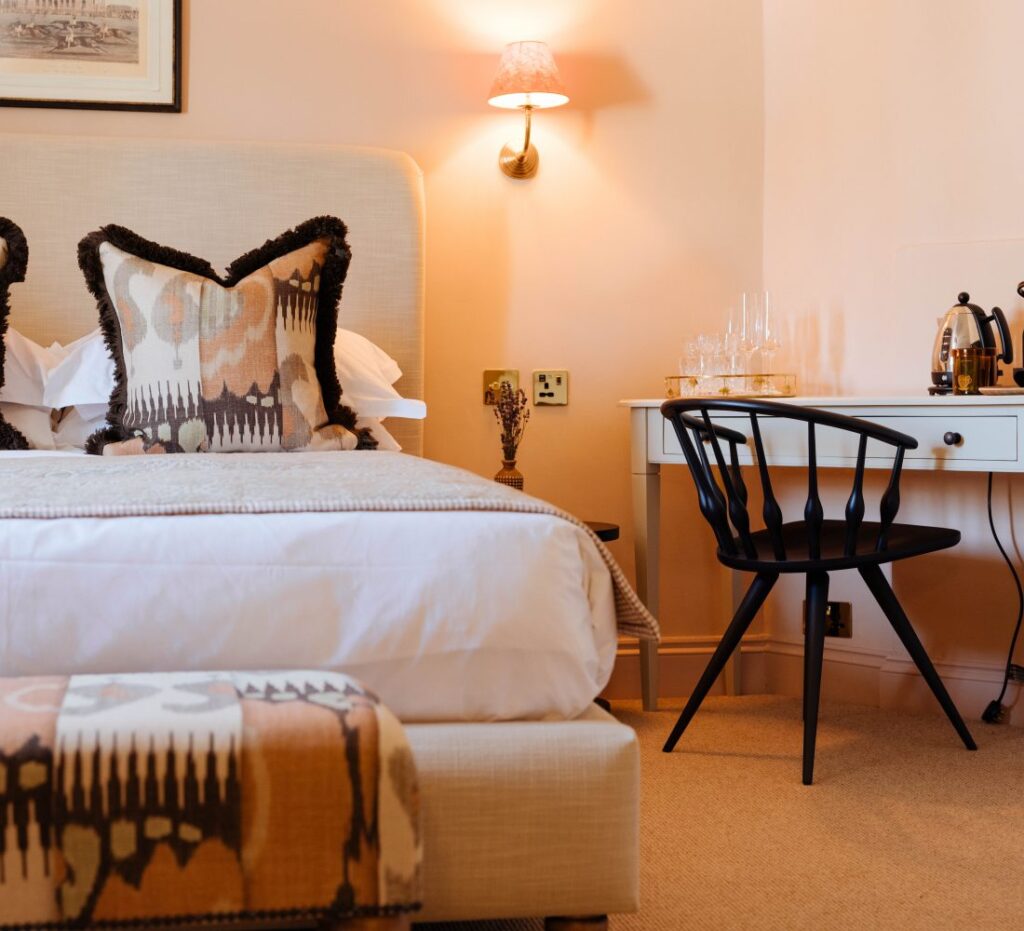
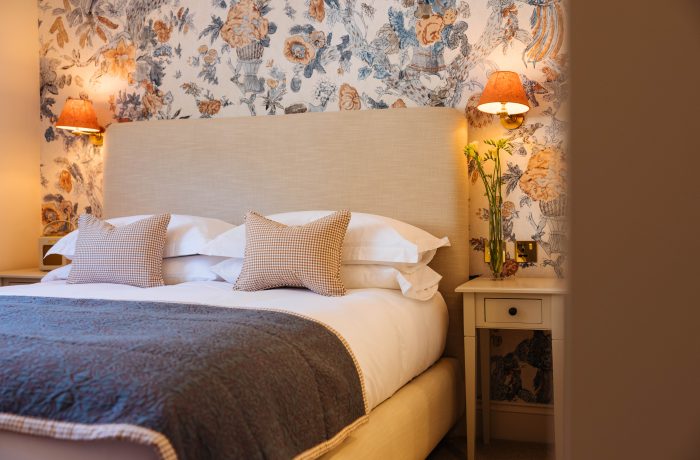
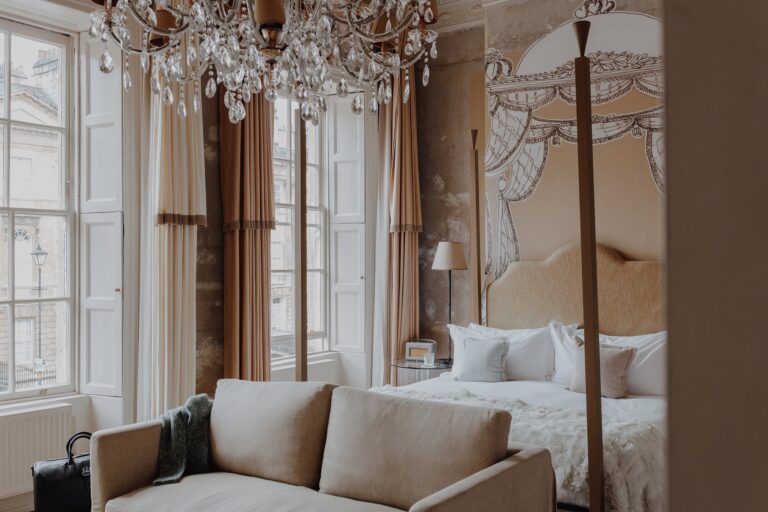
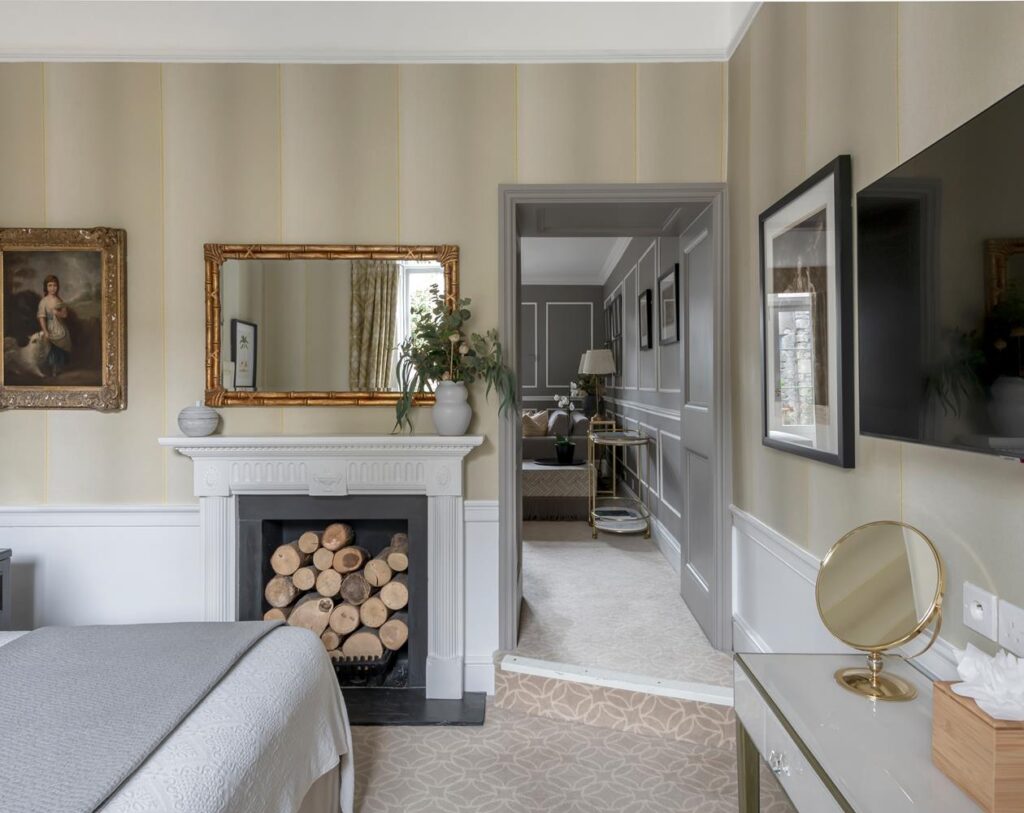
If you’re looking for a beautiful boutique hotel with a fascinating history, The Yard is a good bet to satisfy those wants. Formerly the Kings Arms (an 18th-century coaching inn on the main route between Bristol and Bath) today it is an intimate boutique hotel. Set within a gorgeous listed building, there’s a chicness about this hotel that belies its historic roots. That said, the owners have ensured that it’s filled with plenty of character creating a boutique hotel that’s both charming and functional.

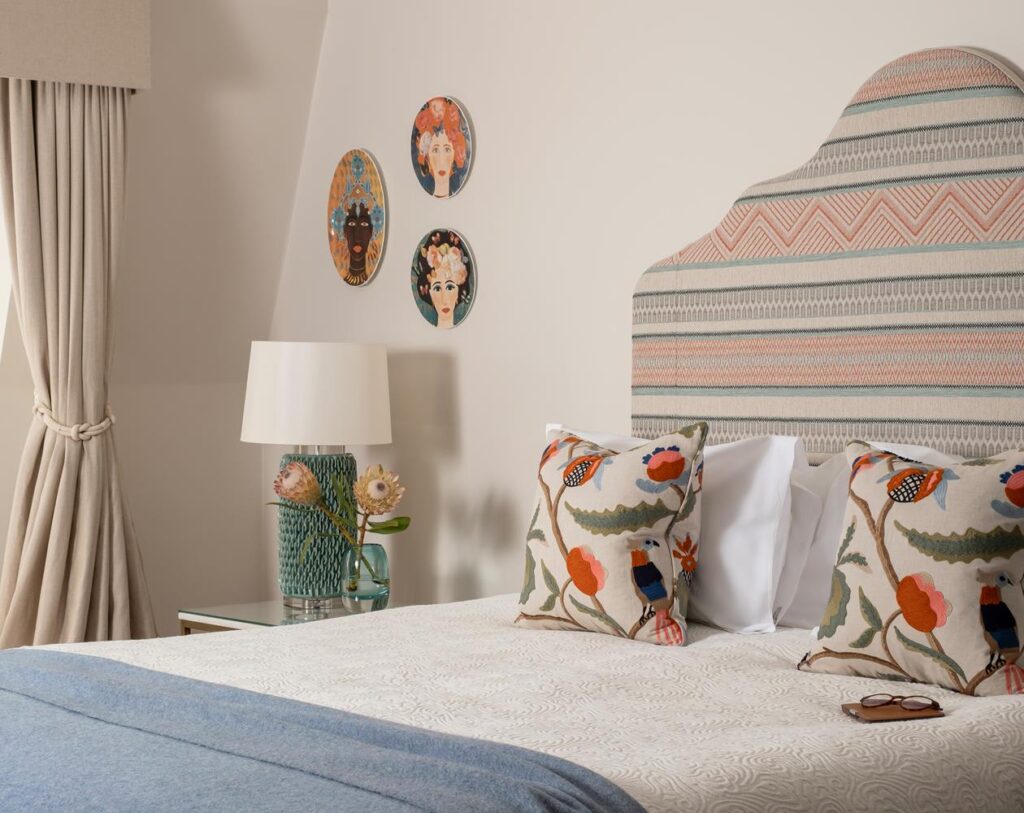
Each of its fourteen bedrooms is housed around a central courtyard, the focal point of the hotel, with every room boasting its own unique charm – think gorgeous floral-forward fabrics from local designers and a mix of antique and modern pieces. Sophie Conran crockery is used extensively, setting the tone for something genteel but contemporary. 
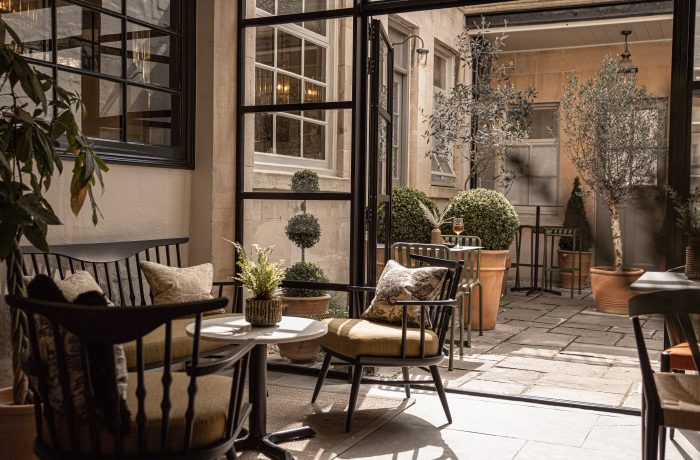
Rooms have all the modern hotel must-haves, including gorgeous waterfall showers, Netflix, a fully stocked mini-bar with drinks and snacks, and even complimentary fresh milk delivered in glass bottles from a local farm.   

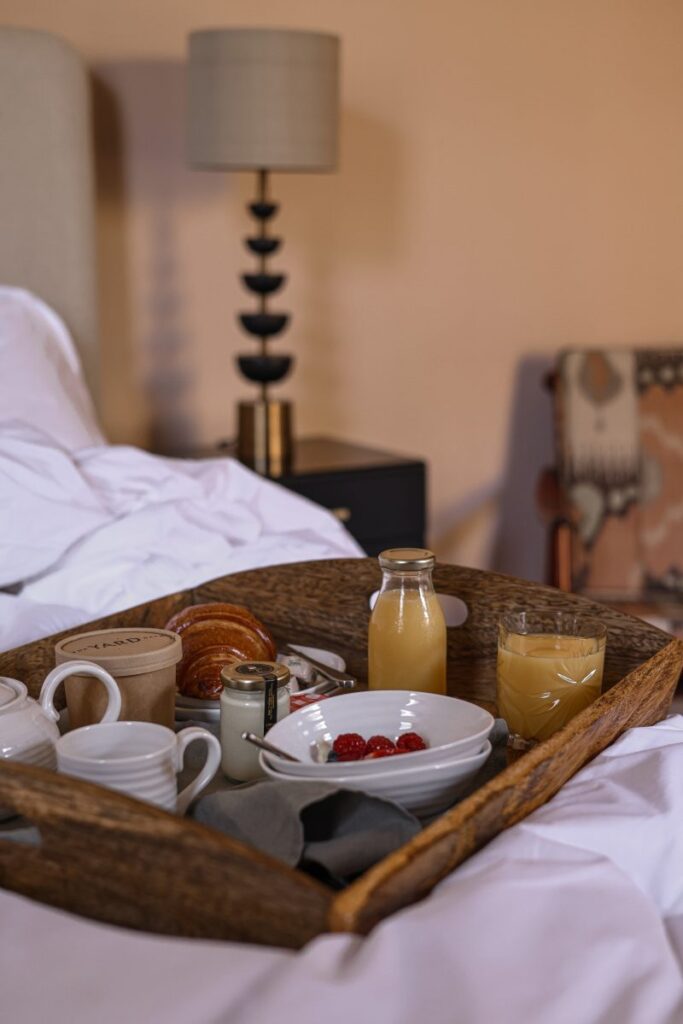
With a dedicated bar and no restaurant, the hotel is geared more towards drinking than eating, sure, but you won’t want for breakfast. Every morning a breakfast hamper is delivered to each room at 8am, sharp. This lovely box of goodies includes just baked croissants from local Hobbs House Bakery and freshly squeezed orange juice. Enjoying a slow start to the morning is an essential part of a relaxing weekend break after all.

If you can pull yourself away from your beautiful room, you can upgrade to a continental grazing breakfast served in the cafe which extends onto the beautiful courtyard. If it’s a cooked breakfast you’re after, then you might have to venture further afield, but that’s no issue; Bath is home to many excellent cafes.

This writer’s personal tip is to go for a hearty and historic breakfast at Sally Lunn’s. The French toast, which sees a Sally Lunn bun dipped in cinnamon eggs and topped and with dry cured smoked bacon, will set you up for a day of sightseeing. There’s also a Full English on offer if you’re feeling particularly hungry.
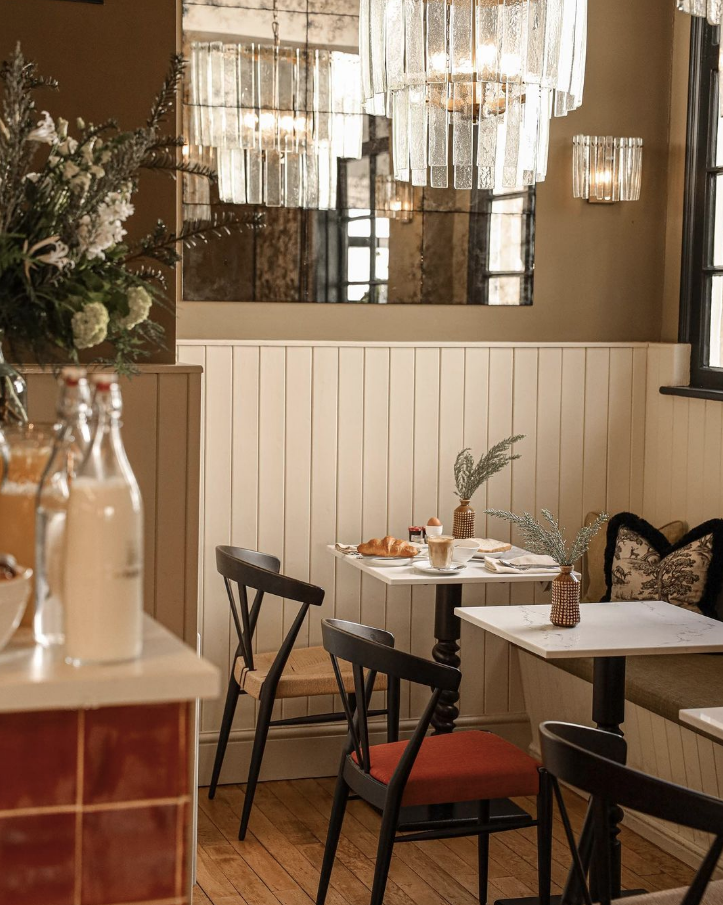
Anyway, back to the hotel. In the summer months, The Yard’s courtyard transforms into a lively corner of the city serving a selection of wines and seasonal cocktails. Plates of local cheeses like Bath Soft and Wyfe of Bath are served to compliment the short but well-curated wine list.

On Fridays, The Yard has a ‘Fizz and Fromage’ night where you can get an English cheeseboard and two glasses of English sparkling wine for just £25. In such an esteemed setting, it feels like a bargain.

If you’re after a nightcap, may we suggest having a hot chocolate here, which comes from Clifton Coffee in Bristol. Come winter, why not spike it with a shot of bourbon and enjoy it in front of the hotel’s roaring fire?

There’s something incredibly relaxing about this hotel. It’s cosy and elegant, small but perfectly formed. Do be warned; like many hotels in Bath, parking is limited but bookable, with Charlotte Street Parking only a short walk away.

One quick aside; we think the hotel has missed a trick not putting a fancy freestanding bath in the courtyard here. Having a bath in the yard, in the Yard in Bath? It just makes sense!

Rooms start at around £120 a night for the most basic room. Read our full review of The Yard here...

Website: theyardinbath.co.uk

Address: 1 Monmouth Pl, Bath BA1 2AT

Read: The best restaurants in Bath


No. 15 by GuestHouse

Ideal for some serious Bridgeton cosplay…

Bath’s No. 15 by GuestHouse Hotel sits pretty in one of the loveliest spots in the city. Next to Henrietta Park (home to some of the best trees in the city) and just along the road from Pulteney Bridge (one of only four in the world to have shops on both sides), No. 15 by GuestHouse is in a plum central location, ideally suited for soaking up the city.

With its Georgian aesthetics, every aspect of this hotel has been designed to reflect Bath’s graceful, rarefied air. The elegant, honey-hued hotel is made up of three interconnected townhouses with 36 uniquely designed bedrooms, all in keeping with the hotel’s Georgian roots. 

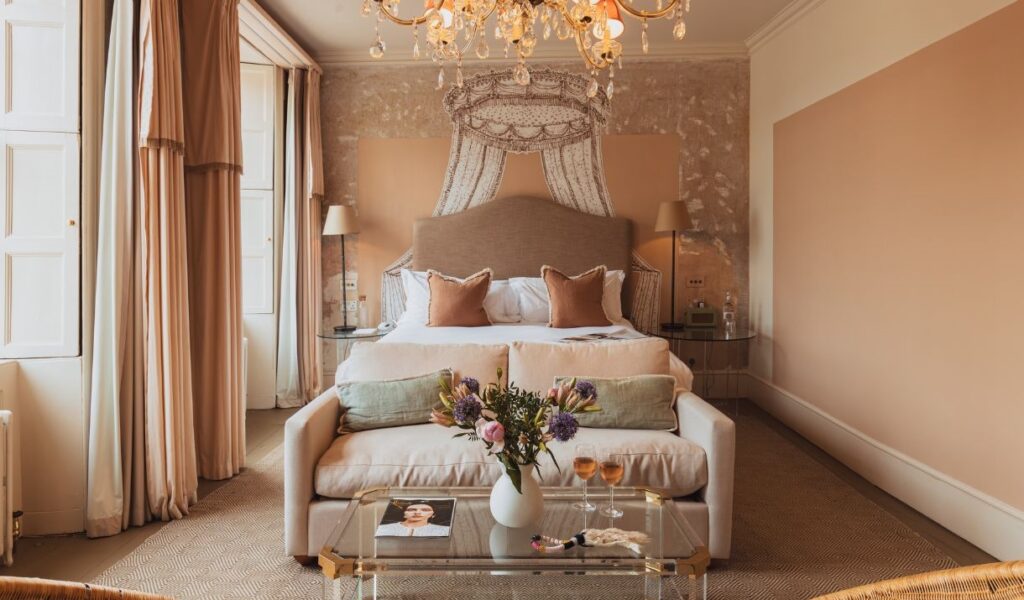
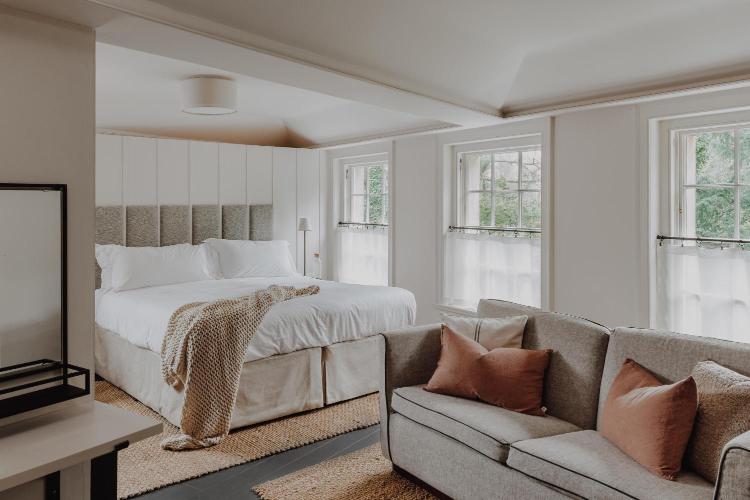
Those townhouses include snug attic spaces, as well as both light-bright and minimalist rooms and more grand affairs with four poster beds, regency-style fireplaces and chandeliers, all with views of the park. Pretty perfect for pretending you’re part of Bridgeton, we think – the hit Netflix show was filmed on this strip!

Anyway, you don’t have to get dressed up in some Regency-era threads to luxuriate in the experience here. Instead, the 200-thread count Egyptian cotton bed linen will see you right, which sits stop Hypnos Lansdowne cashmere mattresses. Even writing those words has made us feel all luxurious.

Rooms are equipped with Nespresso machines, Dyson hairdryers, and even record players. Yes, you read that right — record players, with a selection of vinyl appropriate to the occasion.  
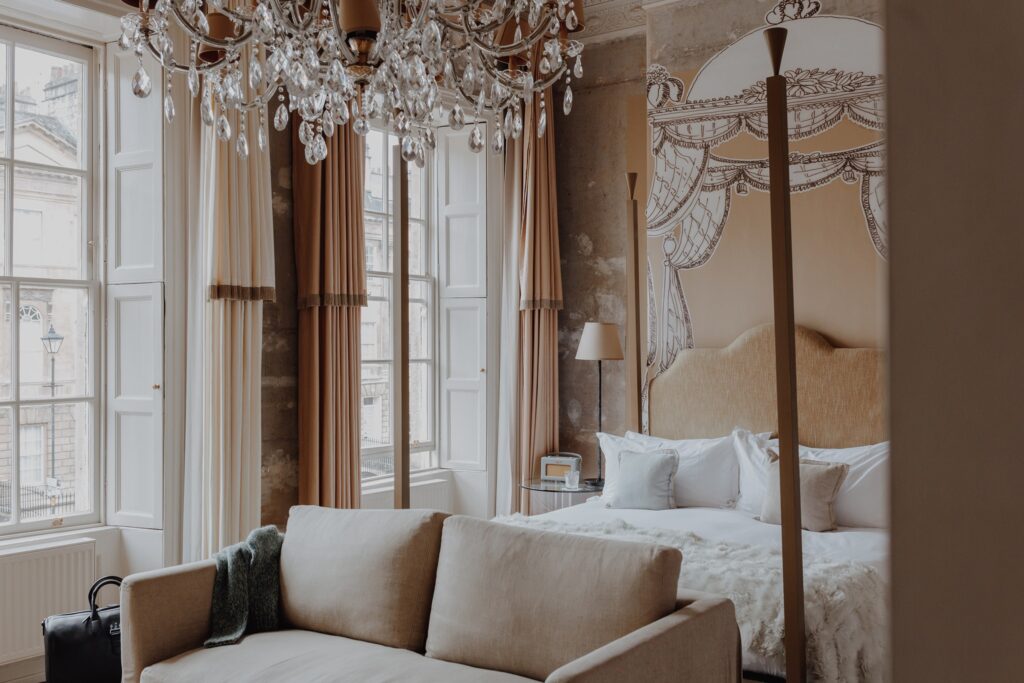
Beyond the elegant rooms, guests have access to a pantry full of treats stocked with homemade sweet and savoury snacks. Fancy an ice cream at midnight? It’s yours. A scone with the jam and cream setup whichever way you darn want it? That can be yours, too.

Unlike most cities, Bath doesn’t have many late night convenience stores. Best One Bath, just down the road and open until 1am, is about your only bet. Otherwise, if you’re hungry and it’s late you’ll find food trucks selling kebabs – perhaps not in keeping with the esteemed surrounds of No. 15 and their lovely bed linen, but it could work…

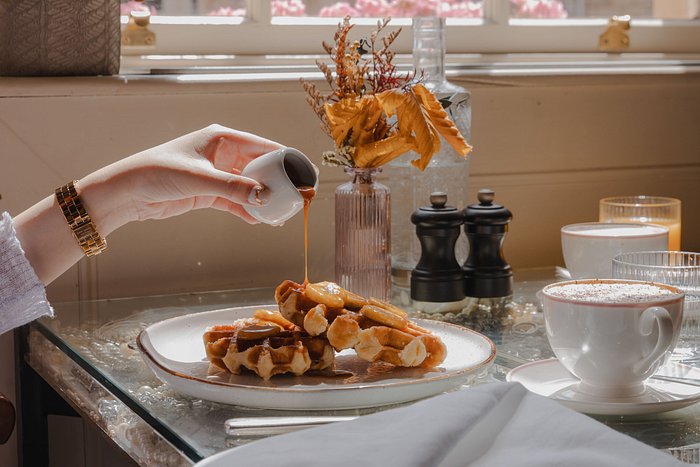
… You won’t go hungry at No. 15 though. There’s both a breakfast and a brunch menu, the latter of which has addictive salted caramel and banana waffles. Other cooked items, wide-ranging and well executed, are available, the highlight for us a moreish breakfast muffin with sausage patty, maple bacon, fried egg, dijonnaise and emmental. We’d go as far as saying it’s one of the best hotel breakfasts in Somerset, all to be enjoyed in a room that thrums with that golden glow that so many great places in Bath seem be blessed with.
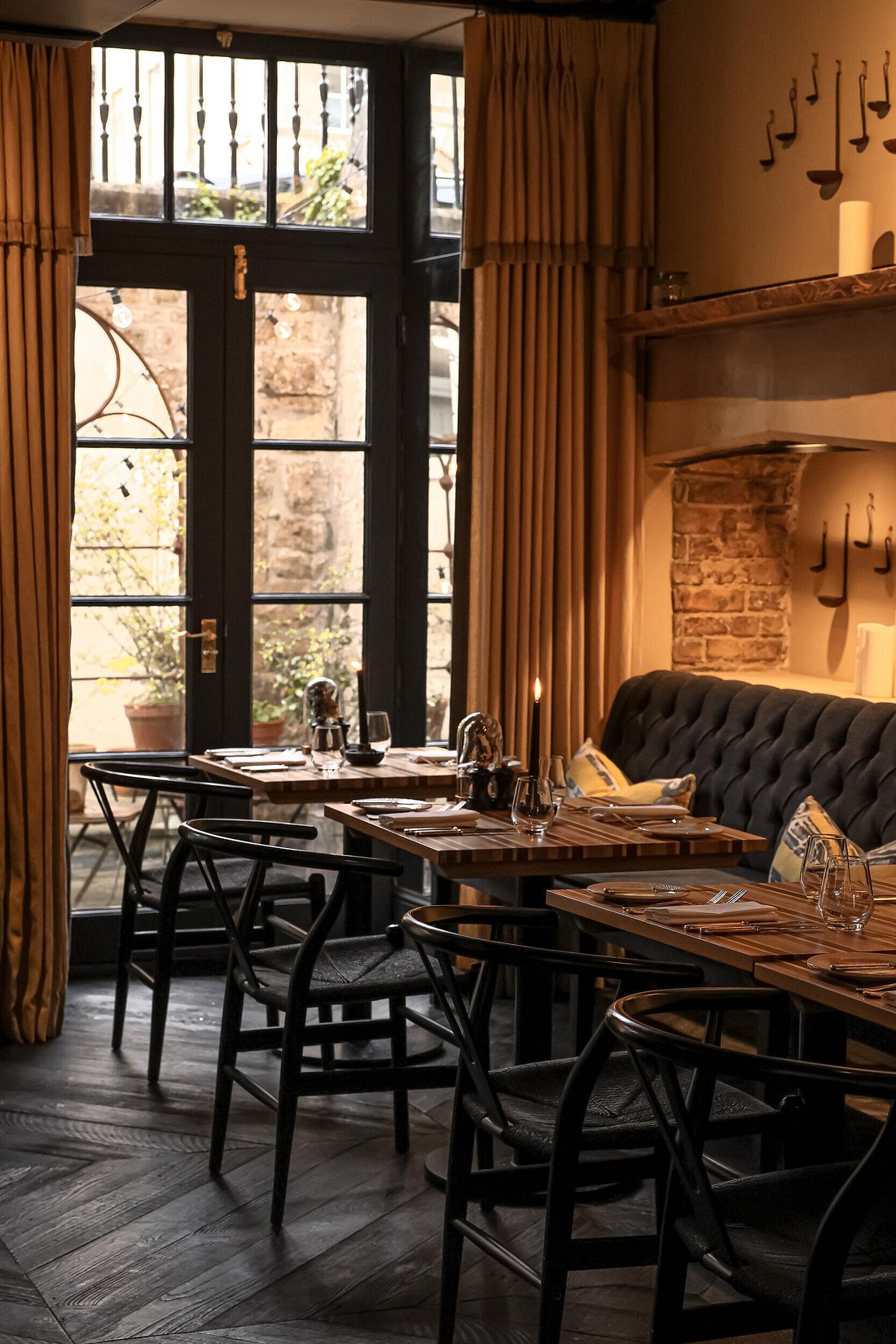
From just after midday to late evening, The Bar here (prosaically named but poetically delivered) serves seasonal cocktails like a Somerset Old-Fashioned, featuring cider brandy and demerara-sugar syrup made in neighbouring Bristol. There’s snacks and small plates like the local favourite Bath chaps, here with chorizo jam atop a fried brioche with crackling. There’s also larger heartier dishes like a stacked charcuterie plate from nearby Dorset and a sirloin steak sourced from Stokes Marsh farm. There’s even a burger oozing with Somerset brie, if you hadn’t figured out where you were resting your head yet.

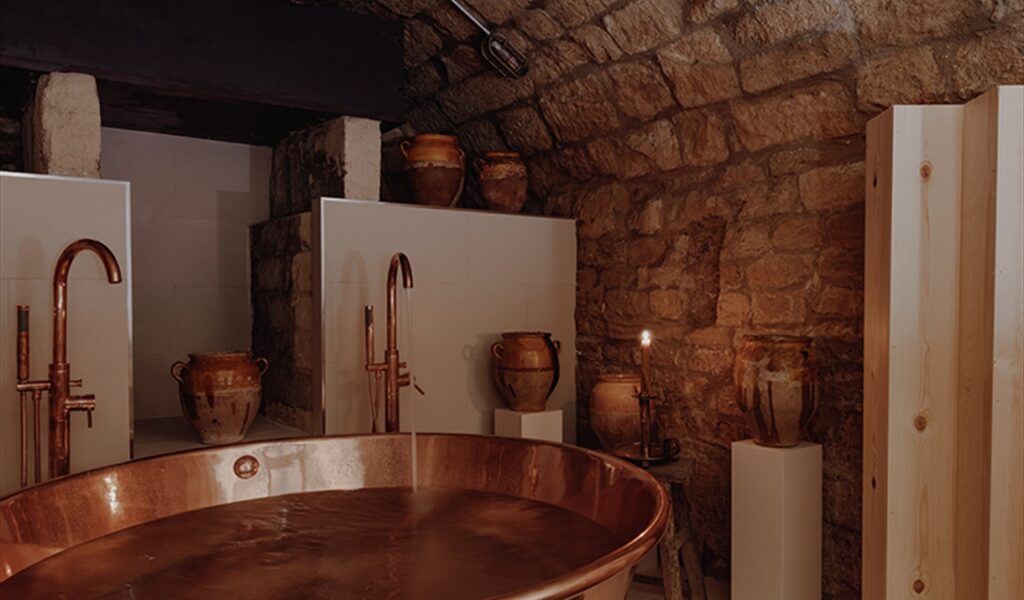
Since this is Bath, the hotel of course has spa facilities, and while not as extensive as other hotels in the city, it’s great for couple’s treatments. We love their Copper Room – an intimate and sensual space which you can book exclusively and relax in their oversized freestanding copper bathtub.
Soothing and spoiling, No. 15 by GuestHouse is one of the most beautiful boutique hotels in Bath city centre, without doubt. The small guest room here starts at £180 a night.

Website: guesthousehotels.co.uk

Address: 15 Great Pulteney St, Bathwick, Bath BA2 4BS


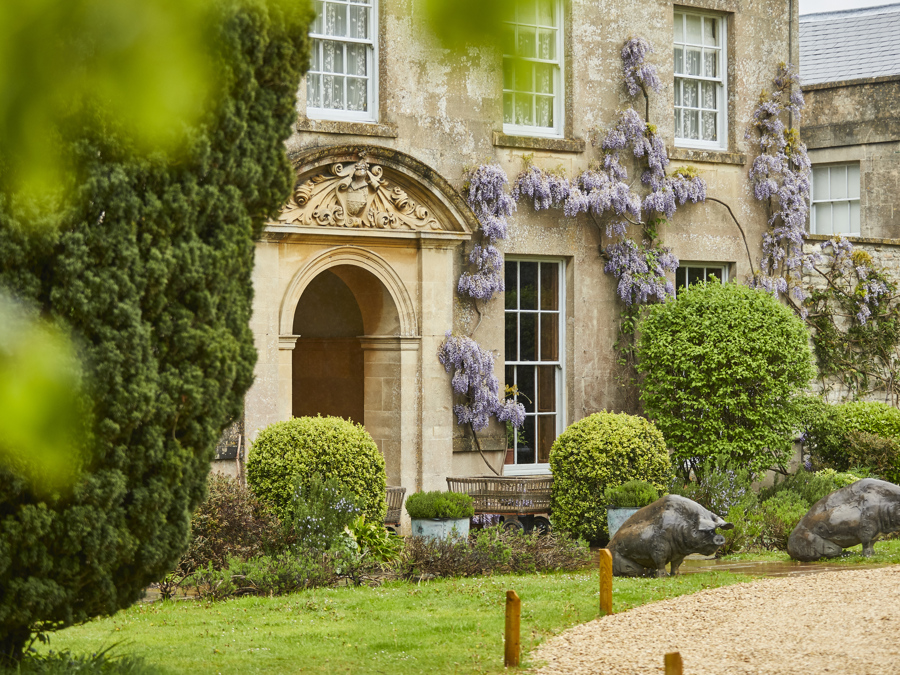
The Pig, Pensford

Ideal for those who want to explore Bath without staying in the busy city centre…

Bath teems with tourists come summer. Come to think of it, it’s no different in spring, autumn or winter, the latter particularly packed with Christmas Market revellers.

Indeed, the city attracts a staggering six million visitors every year. Don’t let this put you off. Despite the influx of visitors and congestion, especially on weekends, Bath manages to maintain a tranquil air. Although it’s not one of those cities where the urge to escape the chaos can feel overwhelming, it does get busy.

All of this to say, if you’d prefer to stay outside this city, then The Pig, a twenty-minute taxi ride away from the centre, is an excellent place to retreat. Set within a charming, honey-coloured (we’re sensing a theme here) Georgian mansion nestled in the Mendip Hills of Somerset, this countryside retreat boasts 29 uniquely decorated rooms. Guests can revel in the rural surroundings, which feature a deer park home to a fallow deer herd.

Come winter, you can enjoy cosy lounges with open fires. In summer, the sunlight streaming through those lounges more than makes up for the lack of a crackling fire. For those wanting to unwind even further, the hotel offers bespoke spa treatments in its Potting Shed and Sheep Hut treatment rooms. 
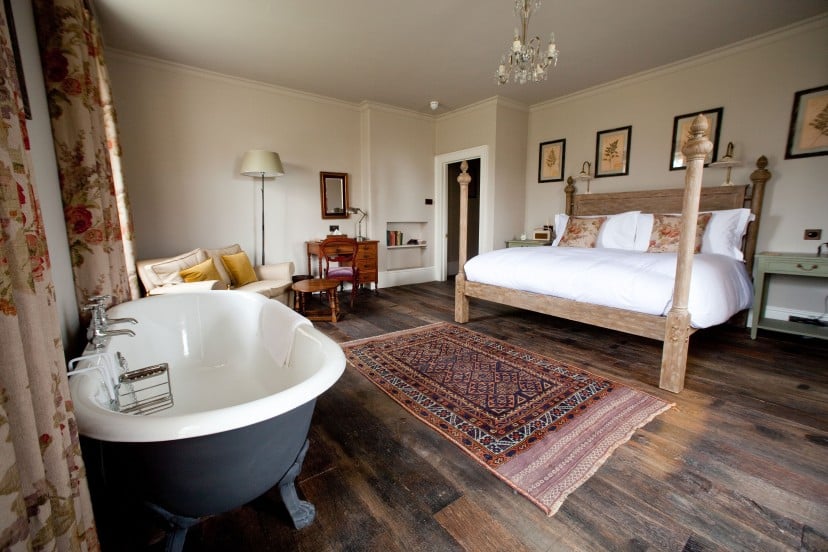
All great stuff so far, but it’s the sprawling kitchen garden and its lucky restaurant that’s the real draw here, a genuinely sustainable, organic, hyper-seasonal and hyper-local affair that’s like catnip to the culinary cognoscenti.

Whatever they can grow or rear themselves, they do. That means there are miles of polytunnels, and chickens, sheep and pigs reared on-site to ensure quality and provenance. Whatever is pulled from the vegetable patch that day appears on the menu. All other ingredients that aren’t grown or reared on-site are sourced within a 25-mile radius. The hotel even has its own beehives, producing 2000kg of honey a year.

It all feeds into a menu stacked with ‘zero mile’ ingredients, shoutouts to farmers and suppliers, and plenty of excellent technique that brings out the best from those ingredients – think Crystal Sea hake fillet, with leeks, spinach and Windfall apple verjus, or Newton Farm pork loin chop with sweetcorn and mustard sauce. There’s also a dedicated wood oven menu with some delicious flatbreads, for those after a more casual affair.
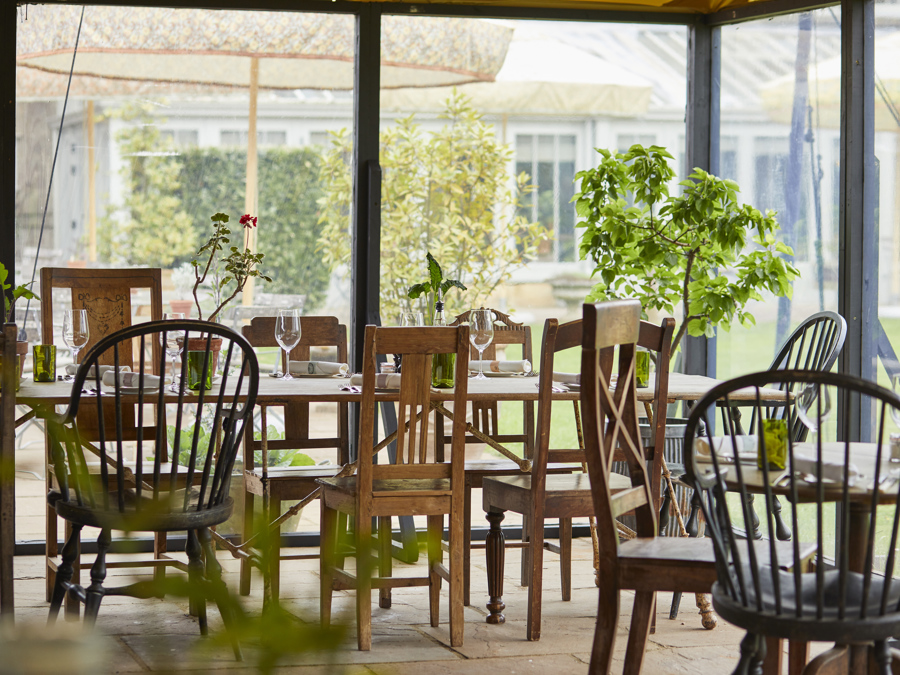
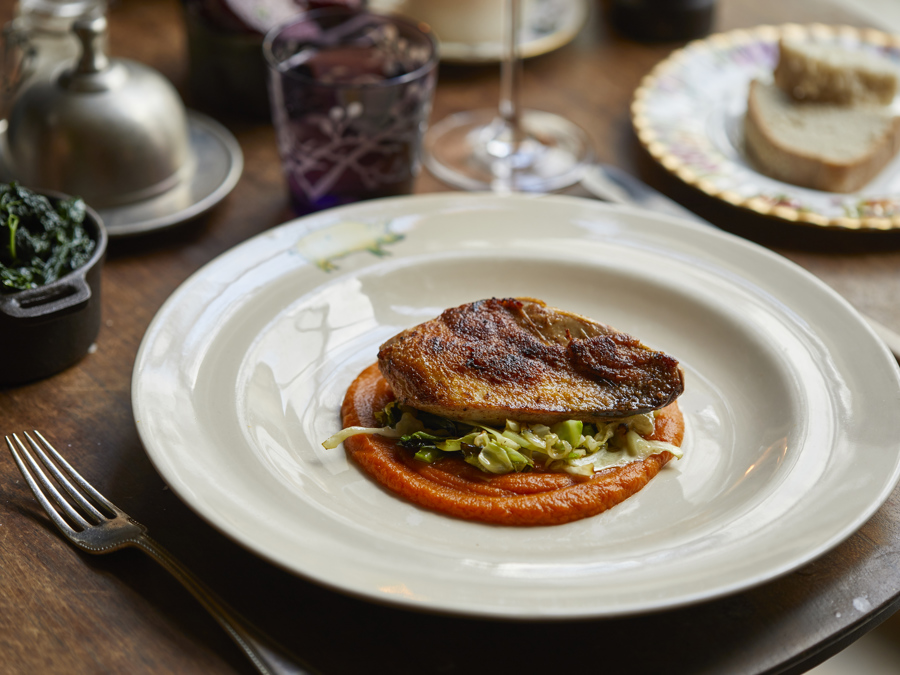
The Pig’s 25-mile radius menu has become synonymous with the hotel – raising the bar for food-forward hotels. The cocktails are of note, too – a carefully curated menu of local botanicals that drink wonderfully. Ours is a Pisco’s Not Dead (featuring pear and sage infused Barsol Pisco), if you’re getting a round in.

Snug rooms start at £235 a night on quieter days.

Website: thepighotel.com

Address: Hunstrete House, Hunstrete, Pensford, Bath BS39 4NS

Read: The best cocktail bars in Bath  


The Bath Priory

Ideal for a sophisticated stay that seamlessly blends city and countryside…

Bath is a place where city meets countryside in the most seamless, subtle fashion, and the Bath Priory is a perfect example of a country house hotel on the city’s edge, giving guests the ideal mixture of both worlds. The hotel sits a short stroll from Royal Victoria Park, and the gorgeous walk into the city centres takes you past must-see landmarks including the Royal Crescent and the Circus. 

Built-in 1835, originally as a private residence and formerly owned by the Priory of Bath Abbey, this honey-coloured Georgian mansion has gone through various incarnations, including being dormitory for The Park School in the sixties – the lucky folk. Today, the Bath Priory is part of the Andrew Brownsword Hotels group, owned by Christina and Andrew Brownsword CBE DL, and has been bestowed with more awards than you can count on two hands. 
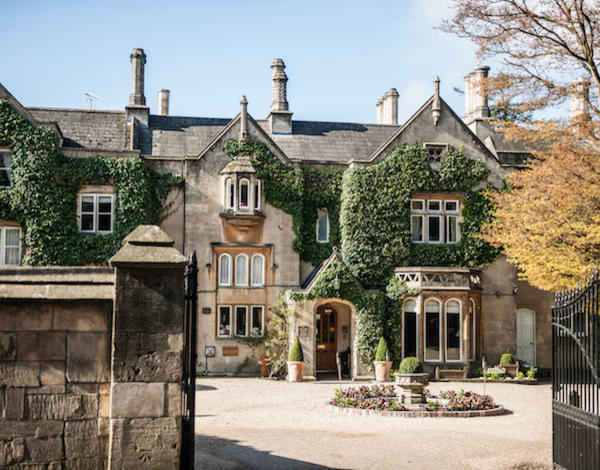
The hotel itself is set within four acres of gorgeous gardens which are looked after by a former Chelsea Flower Show silver medalist – if you’re looking for a tonic to urban life, this is it. The stoic, beautiful ancient Cedar of Lebanon dominates the garden – a stately tree in stately hotel grounds.

Be sure to plan to spend some time relaxing in the heated outdoor pool during the summer months.  The hotel also offers a prepared picnic or afternoon tea hamper – pick a spot on the lawn and enjoy the grounds. There’s also a gorgeous terrace bar for when you get parched. Basically, this is kind of what heaven looks like.

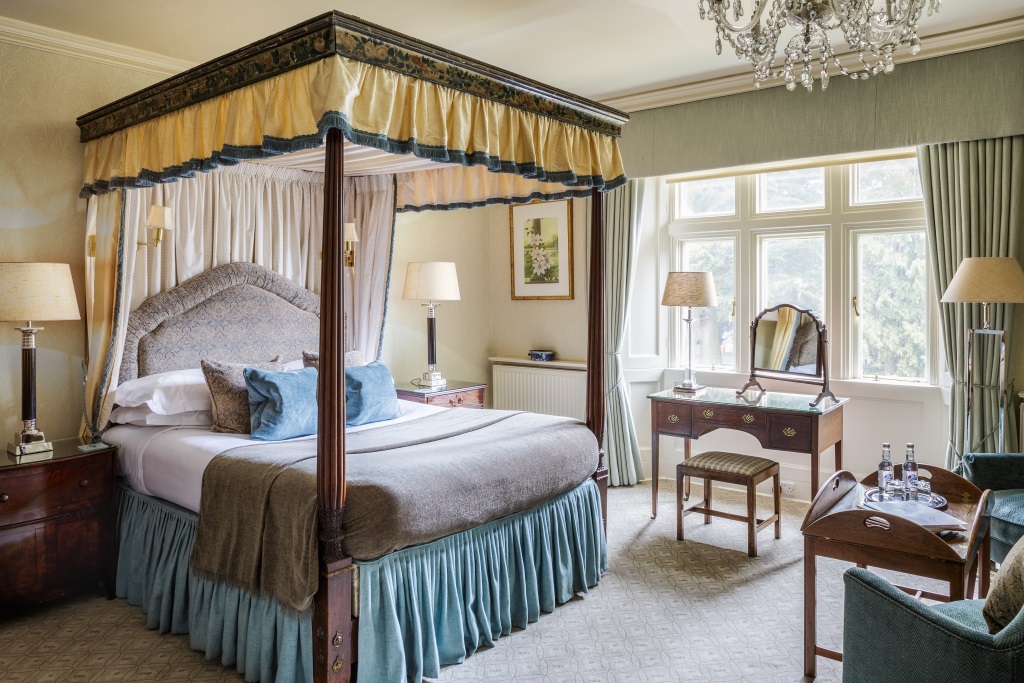
Back indoors, and you’ll find elegant drawing rooms full of antiques and walls adorned with fine art. the Library Room has a working fireplace for that nostalgic crackle and glow. Move up into the guest rooms and suites, which are admirably classic in style, with decoration leading towards the timeless, verging on the dated. Not that we’re complaining; they are pretty and comfortable and all you want from a hotel stay in such aristocratic surrounds. Some suites have large motifs depicting Bath of yesteryear on the walls. Others, timeless wooden panelling. Choose your poison, and once you’ve taken it, sink into your four poster bed for a long lie down.

Or, for the ultimate relaxation, guests seeking a soothing spa will not be disappointed. The Bath Priory is home to the first and only L’Occitane spa in the UK. At The Garden Spa by L’Occitane, guests can choose from treatments that highlight L’Occitane’s best products, including anti-aging facials and relaxing massages. There’s also an indoor pool and sauna, natch. 

A reservation at the celebrated onsite 3 AA Rosette restaurant of the same name completes the picture. A menu of contemporary British and European dishes with seasonal and carefully sourced ingredients hits all the right notes – so, that’s lamb from Wiltshire, wild Cornish turbot, Brixham crab and Orkney scallops, to name but a few. You know how the story goes, and usually, it’s a delicious story to read (hmmm, the ol’ synaesthesia’s kicking in a little here). 

Perhaps the best part about the Bath Priory, though, even as one of the city’s more exclusive stays, is that there’s nothing pretentious or stuffy about the place, with service graceful and light, and the whole vibe thoroughly demure.

Classic rooms start at £234 a night on quieter days.

Website: thebathpriory.co.uk

Address: Weston Rd, Bath BA1 2XT

Read: Where to eat the best vegetarian and vegan food in Bath


The Royal Crescent Hotel & Spa

Ideal for a luxurious stay in Bath’s most iconic location…

A Bath totem, this historic hotel occupies numbers 15 and 16 of the Royal Crescent. Sitting in a coveted spot and commanding impressive views of the park, the Royal Cresent Hotel is a bona fide landmark offering a splash of historic splendour to any stay in Bath. It’s also one of the few landmark buildings in the UK where you can actually spend the night.

The Royal Crescent itself was designed by architect John Wood the Younger and completed in 1775.  As you’d expect, those running the hotel now are keen to preserve as much if its heritage as possible. Interiors are, as you’d expect, period-inspired with velvet fabrics, portraiture and antiques setting the tone. To lighten the mood, they sit prettily alongside bold and bright modern furnishings, blended harmoniously together which is no easy feat. The contrast infuses drama in an opposites-attract sort of way, making for a unique space that feels both stimulating and serene.

Each of the 45 uniquely designed guest rooms are finely appointed and, again, a perfectly balanced mix of contemporary bright furnishings and period features. Historic detailing like ceiling roses, intricate cornices and other original elements are paid tribute to, while modern flourishes have brought this period property into 2024 in some style.

The best rooms are those that command floor-to-ceiling windows of the Crescent. Suites, of which there are 17, come with a private living room and are yours from £665 per night. This is a hotel for deep pockets – a fairly simple room will set you back £405. 
Fine dining abounds here in the hotel’s restaurant Montagu’s Mews. Named after the 18th Century writer and women’s education advocate Elizabeth Montagu, this Michelin-recommended restaurant serves intricate, precise plates that burst with clarity of flavour. You’ll pay for the privilege – the tasting menu here is £105 a person. We’ve already established you’ve got deep pockets, though…

In the summer months, picnics are available for guests to take onto the Royal Crescent lawn that stretches over the expanse in front of the hotel – it’s a quintessential Bath experience. Hampers are full of local goodie like homemade Bath Buns and Cheddar Valley strawberries with clotted cream. As part of the full Royal Crescent Hotel experience, it’s undeniably one of the most luxurious and historically significant things to do in the city.

Website: royalcrescent.co.uk

Address: 16 Royal Cres, Bath BA1 2LS


The Gainsborough Bath Spa

Ideal for the UK’s only private hot-spring-fed spa…

There’s nothing quite like a relaxing spa day in a luxury hotel. Fluffy white robes, a glass of fizz, a peaceful atmosphere and relaxing treatments. Maybe even a little bit of Enya… This is what you get – and more – at The Gainsborough. 

Named in homage to the artist Thomas Gainsborough and housed in two 18th-century Grade II Listed buildings, The Gainsborough is a stylishly opulent five-star, located in the epicentre of Bath.

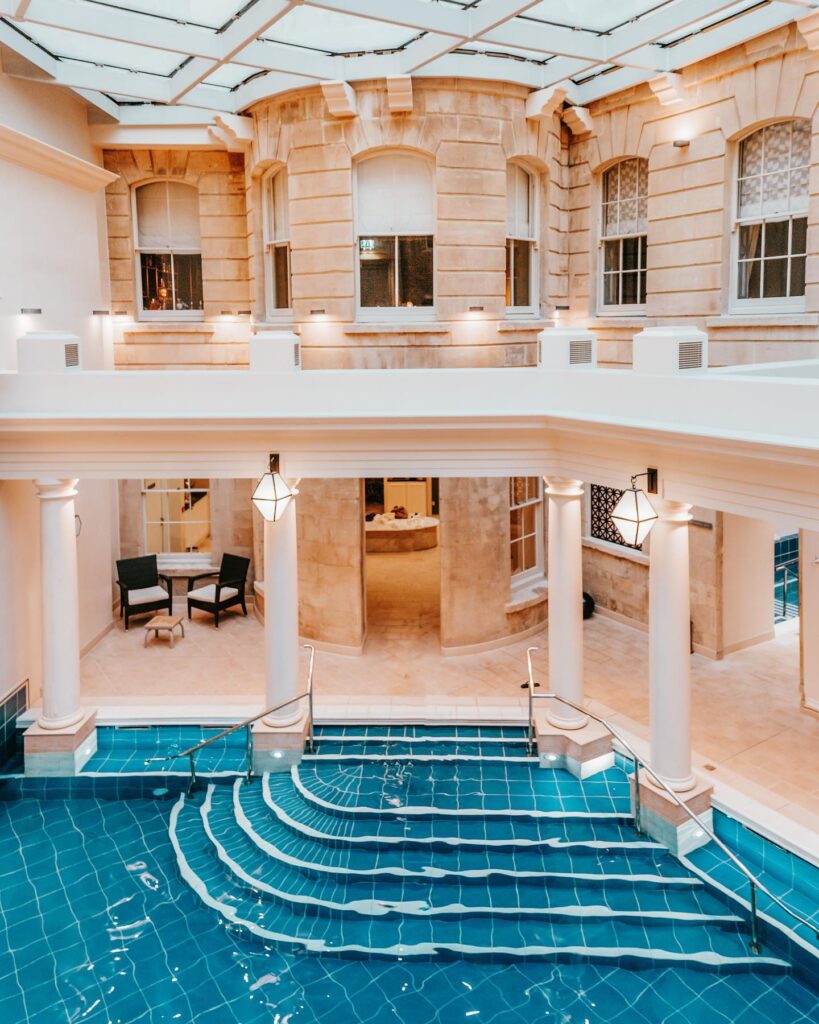
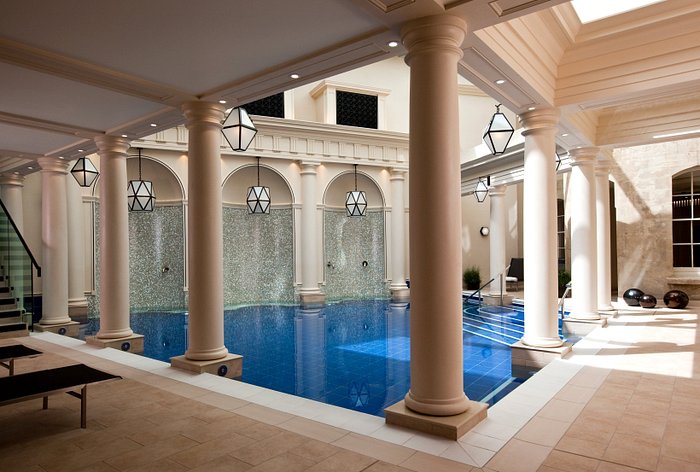
It’s a hotel that’s managed to capture the essence of the city perfectly and, accordingly, the hotel’s stand-out facility is its spa. Its Romanesque-style spa is notable for its unique access to the natural thermal, mineral-rich waters. This distinction sets it apart as the only hotel in the UK with such privileges. There are three pools, heated at slightly different temperatures, all filled with thermal water. A full roster of treatments is available in its Spa Village including a ‘Roman renewal’ body treatment and a warm mineral mud scrub. Aaaah – doesn’t that feel good?
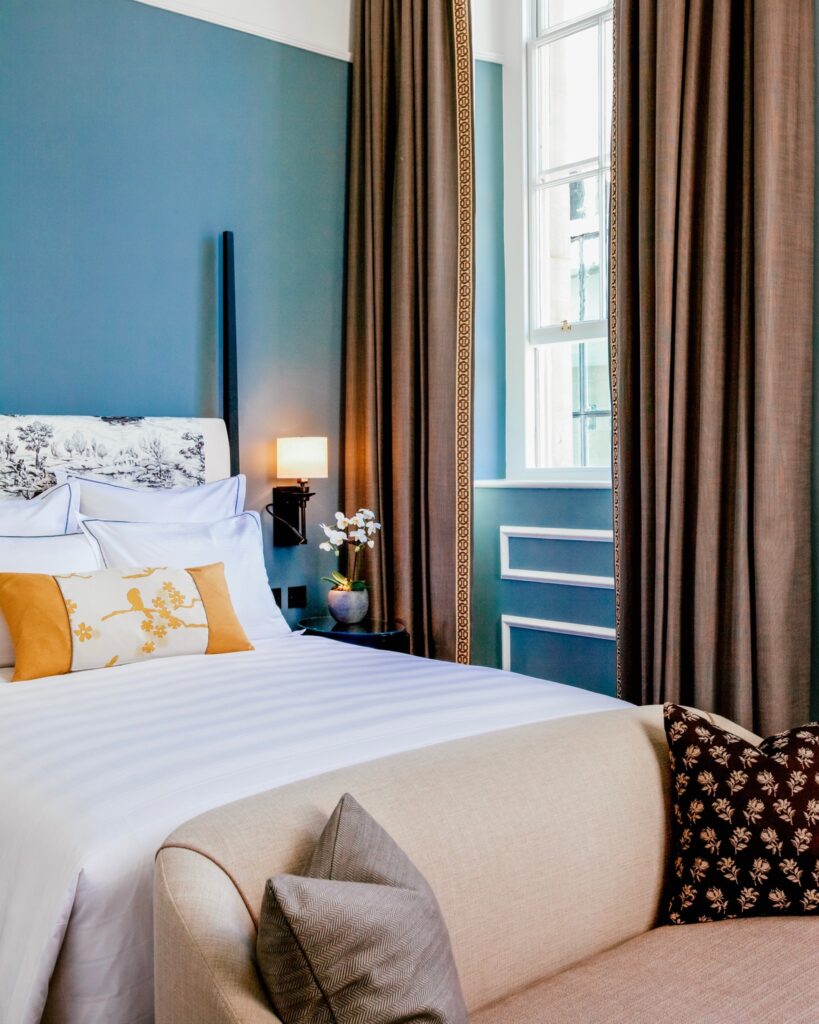
The rest of the hotel is plush and luxurious without being flashy. Once checked-in, it’s one of those hotels that you’ll have no desire to leave. The Gainsborough Bath Spa offers just about everything else you need for a spot of R&R. Nothing says ‘holiday’ like soaking in thermal waters and pretending you’re a Roman emperor, don’t you think? Now, where can I find Bath’s best bacchanalia?

Rooms start at around £235 a night on quieter days.

Website: thegainsboroughbathspa.co.uk

Address: Beau St, Bath BA1 1QY

The Bottom Line

Bath’s blend of historical grandeur and modern luxury makes it one of Britain’s most captivating destinations for discerning travelers. From intimate boutique hotels tucked away in Georgian townhouses to grand country house retreats just outside the city, each property offers its own distinctive take on luxury hospitality. 

Whether you’re drawn to thermal spa waters, Michelin-recommended dining, or simply the chance to wake up to views of honey-colored stone architecture, Bath’s diverse array of accommodations caters to every preference and occasion. While traditional booking platforms like Booking.com and Expedia offer extensive options, specialised sites like Vio.com can help streamline your search through Bath’s premium properties. 

Whichever you choose, this UNESCO World Heritage city promises an unforgettable stay that beautifully bridges its Roman roots with contemporary comforts.


When Is The Best Time Of Year To Visit Zimbabwe For A Safari?

Zimbabwe’s diverse landscapes and rich heritage sites are well-known among travellers, especially those interested in African wildlife safaris.

From national parks with exceptional game viewing opportunities to the legendary Victoria Falls, Zimbabwe is a treasure trove of natural wonders. To make the most of your visit to this African destination, it’s crucial to know the best time to travel.

Zimbabwe experiences two distinct seasons: wet and dry. Most tourists prefer the dry season due to its pleasant weather. Here’s a detailed monthly guide to help you plan your trip.

A Monthly Seasonal Guide To Visiting Zimbabwe

January to March

These months are the rainiest in Zimbabwe, which might deter some travellers. However, if you’re keen on exploring Victoria Falls, February and March are ideal as the water levels are high. In February, the mist from the falls can obscure the view, but by March, the visibility improves, offering a perfect experience. Budget travellers will find this period appealing due to lower demand and reduced prices.

  • Main Animals to See: Hippos, crocodiles, and bird species.
  • Average Temperatures: 20-25°C (68-77°F).
  • Packing Tip: Bring waterproof clothing and sturdy, non-slip shoes for wet conditions.

April and May

Rain showers decrease significantly in April, and the weather cools down. The game parks are lush and green, attracting tourists, although the weather can still be unpredictable. May is one of the peak months to visit Zimbabwe, offering spectacular views of Victoria Falls and excellent safari adventures. Be prepared for higher prices due to increased demand.

  • Main Animals to See: Elephants, buffalo, and various antelope species.
  • Average Temperatures: 15-25°C (59-77°F).
  • Packing Tip: Pack layers to adjust to changing temperatures and a light rain jacket.

June and July

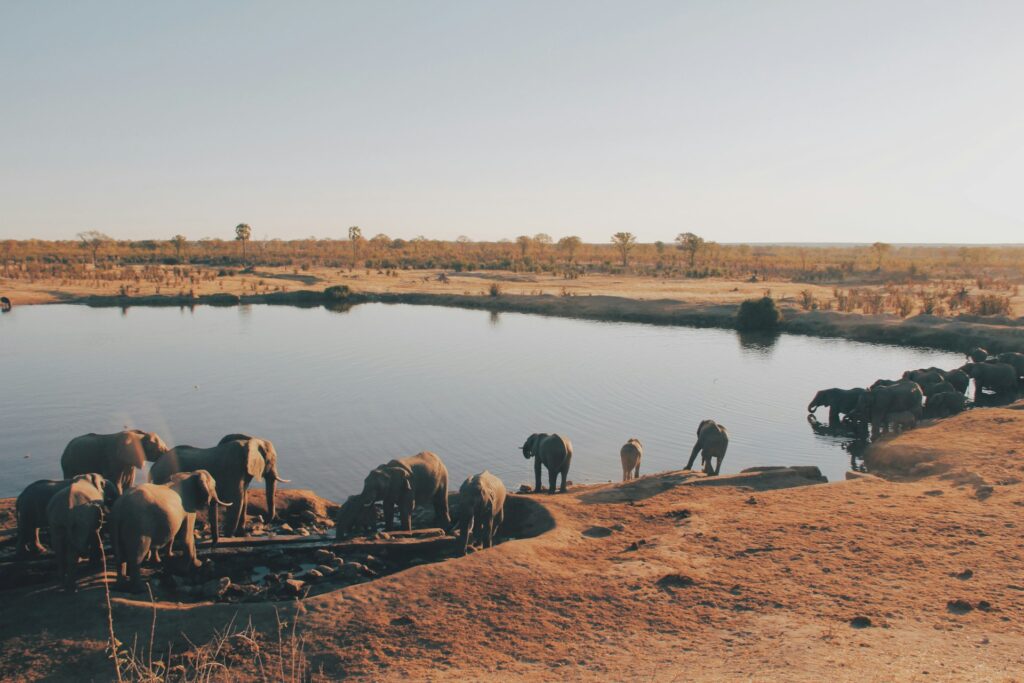
June and July are the best months for wildlife safaris in Zimbabwe. June is particularly good for elephant viewing in Hwange National Park and rhino tracking at Matobo Hills. In July, you can enjoy canoe safaris and game viewing. Pack extra layers as temperatures can drop significantly during these months.

  • Main Animals to See: Elephants, rhinos, lions, and leopards.
  • Average Temperatures: 10-20°C (50-68°F).
  • Packing Tip: Bring warm clothing for early mornings and evenings, and a hat for sun protection during the day.

August and September

August is another prime month for wildlife spotting, thanks to clear skies. It’s also a popular time for white-water rafting at Victoria Falls. As it is peak season, accommodations and camps in national reserves fill up quickly, and prices rise accordingly. September is notable for the annual game count at Hwange National Park, attracting many tourists.

  • Main Animals to See: Lions, leopards, elephants, and buffalo.
  • Average Temperatures: 15-25°C (59-77°F).
  • Packing Tip: Pack lightweight, breathable clothing and sunscreen for the daytime, and a light jacket for cooler evenings.

October to December

October is the hottest month in Zimbabwe, but game viewing remains excellent. The heat extends into November, but early rains can bring relief. This period is less popular among tourists, but it’s a fantastic time for birdwatching as migratory birds flock to various spots in the country. December is the wettest month, characterised by frequent summer rains. The lush green landscapes are at their peak, making it a great time for birdwatching. National parks are quieter, and budget travellers might find this period appealing, provided they can tolerate the rain.

  • Main Animals to See: Migratory birds, zebras, elephants, and hippos.
  • Average Temperatures: 20-30°C (68-86°F).
  • Packing Tip: Bring lightweight, breathable clothing, a hat, and waterproof gear for sudden rain showers.

Getting There From The UK

Travelling to Zimbabwe from the UK is relatively straightforward. Direct flights to Zimbabwe from London, arriving in Harare, the capital of Zimbabwe, are available with airlines such as British Airways and Ethiopian Airlines. A flight to Zimbabwe is approximately 11 hours. Alternatively, you can opt for connecting flights via Johannesburg, South Africa, which offers more flexibility in terms of flight schedules and airlines.

Once in Zimbabwe, domestic flights are available to major tourist destinations like Victoria Falls, Hwange National Park, and Bulawayo. Car rentals and guided tours are also popular options for exploring the country.

The Bottom Line

To have an unforgettable experience in Zimbabwe, it’s essential to choose the right time to visit based on your interests. Wildlife enthusiasts should aim for the dry season, particularly June, July, and August, while birdwatchers might prefer the wetter months. Always consider what you want to experience and plan accordingly to make the most of your trip to this incredible destination.

8 Things You Need To Help You Settle Into The UK Legally & Smoothly

0

Troubled times often call for a change of tack, scenery and perspective. A recent report published by Employer News revealed that a whopping 52% of Brits have considered leaving the UK for a better life abroad.

On the flip side, there are many looking to move to the UK, perhaps in search of a career change, promotion or newfound opportunities for socialising, language learning and even love. 

In fact, last year net migration stood at 685000, showing that whilst the UK’s position in the world and on those arriving is forever shapeshifting, some things will, of course, remain the same. They always do, right? For now, these are the need-to-know basics; our 8 things you need to help you settle into the UK legally and smoothly.

To Temper Expectations

Many people considering a move to the UK will believe they have a good knowledge of what life is like in the nation before they visit, thanks to its depiction in popular culture. However, everyday life in the United Kingdom is quite different from what you see or read on the Internet; it’s certainly not all donning tweed and inviting the Queen round for afternoon tea.

It’s wise to temper expectations considerably regarding what life is like in the UK or you’re only going to set yourself up for disappointment. With further seismic change afoot in 2025, and most of not exactly good, it might be worthwhile having a shortlist of other countries to consider.

To Embrace The Much Misunderstood Food Culture

‘British’ food, much-maligned globally, is as diverse and delicious as anywhere in the world, with the country boasting fine-dining temples of gastronomy, greasy spoon cafes, and everything in between.

Alongside famous British dishes such as fish and chips, shepherd’s pie, bangers and mash, and a good ol’ Sunday roast, cuisines from all around the world are popular here, especially in the capital.

Indeed, one of the greatest joys of living in London is that you can find food here from anywhere in the world. Eating out in this city is one of the biggest perks of living in major urban centres in the UK, and the diversity of deliciousness on offer makes the rat race seem almost worth it sometimes.

From Michelin Star restaurants to some of the best markets in the world, when it comes to food, the world is here. Want a traditional Turkish breakfast? No problem. Fancy some West African cuisine? Sure. Keen to sample the food of Bhutan? It’s here. 

While you can find a hugely diverse range of cuisines in the capital, if you’re looking to sample some proper ‘British’ gastronomy, some of the best British restaurants to do so in London include Battersea Pie Station, St. John, The Harwood Arms and Poppies Fish’n’Chips. Do give the national cuisine a try, and don’t believe the scurrilous stereotypes about stodge! 

Read: 9 of the best gastropubs in London

Visas

Should you still be keen to move to the UK, it’s essential you get to grips with your potential visa status at the earliest given opportunity.

It’s vital to get the right working visa to work lawfully in the UK; otherwise, you may face punishment or deportation. Usually, this is the Skilled Worker Visa (formally known as the Tier 2 general visa), however other options like the Health and Care Worker visa, Innovator Founder visa, Start-up visa, Global Talent visa and more also exist. Each comes with a separate set of conditions and fees.

Check out the Government’s breakdown of the different visas and entry requirements available to you here.

Bringing Family To The UK

Relocating to the UK often means bringing family along, and understanding the requirements is crucial. If you’re moving on a work visa, you can typically bring dependents, including your spouse or partner and children under 18. Each family member needs a dependent visa linked to your primary visa. Ensure your visa category, like the Tier 2 (General) or Skilled Worker visa, allows for dependents, as some, like the Tier 5, have restrictions.

Financial requirements are key; you must prove you have enough funds to support your dependents without public assistance. The amount varies by visa type and number of dependents, so check the latest guidelines on the UK government’s website. Suitable accommodation is also necessary, meeting UK housing standards with adequate space and facilities.

For those engaged but not yet married, a fiancé visa allows your partner to join you in the UK, provided you plan to marry within six months. This visa also requires proof of financial stability and suitable accommodation.

Children will need to be enrolled in local schools, and your dependents must pay the Immigration Health Surcharge for NHS access. Preparing for cultural adjustments is vital; support your family by helping them integrate into the community through local groups and events.

National Insurance Number (NI)

Everyone who works (or intends to work) in the UK is required to have a National Insurance (NI) number. This unique number is an identifier to the government to track the taxes and earnings of the country’s residents. Sometimes this number is enclosed with your biometric visa (found on the back). If not, you have to apply for it. As long as you are qualified to work in the UK, there will be no difficulties getting your NI. Moreover, you can even begin working whilst expecting your NI card to arrive.

A UK Bank Account

You will require a UK bank account to be paid a wage and to pay your bills. To get one, you’ll need a valid passport and proof of a UK address authorised by an official source, such as a utility bill or driving licence.

The common ‘high street’ banks are quite approachable when it comes to opening a new bank account; of course, they would be. Some provide basic accounts without much investigation into your finances, which is usually all you need, while others offer accounts with additional perks with a fairly modest monthly fee.

Healthcare & Insurance

The UK boasts a National Health Service (the NHS) which is available at the point of use. However, to gain access to the NHS, those on a visa will be required to pay an NHS surcharge as part of their visa charges. This fee varies according to the duration of your visa. 

After that fee is settled, you will enjoy the same healthcare access as UK citizens. Just take proof of residence to a nearby registration office. 

A Plan For Pet Management (Should You Own One)

Do you have a furry friend who you simply couldn’t bear to leave behind? Before you relocate to the UK, it is imperative you know the requirements for importing pets. The United Kingdom has certain limitations on importing pets and animals, and you may find these rules eccentric and obstructive, particularly when discussing quarantine laws. 

Your pet (if it’s a dog, cat or ferret – other animals have different, generally less strict requirements) needs to have been microchipped, have a pet passport and have been vaccinated against rabies. A blood test is also likely. Should you and your pet not meet these criteria, expect a four-month quarantine for your animal companion, with the owner (you) footing the bill.

Therefore, you must plan for this well ahead of time. Research the laws associated with pet relocation in the UK thoroughly or consult an agent to get a clearer idea. This will make sure you do not encounter any last-minute issues with your pets during relocation. 

The Bottom Line

If not planned properly, relocating to the UK can become overwhelming, with pitfalls common and an often hostile government lurking, ready to catch you out. Thorough research is required if you’re to make the move a success.

*The above is for informational purposes only and should not be taken as legal advice. Details are subject to change, and accuracy cannot be guaranteed. We advise readers to seek professional counsel or consult official government resources for current guidelines.*

How To Record Better Recruitment Videos

Any business that has an eye on future success needs a team of excellent employees. But in this day and age, finding and hiring the best of the best is increasingly difficult. In order to attract candidates, businesses must find ways to get their name in front of the calibre of employees they’re hoping to attract.

Creating a recruitment video is a highly effective way to do this. In an age when people are watching more videos than ever before, a well-made recruitment video can be the difference between hiring a talented employee who will take the business forward and letting them slip through the net. 

The key detail is that the video must be good because a poorly-made video will do more harm than good. If you’re looking for ways to record better recruitment videos, follow these top tips. 

Present Your Team In The Right Way 

A recruitment video isn’t just about finding employees. It’s a showcase for your brand. In your video, you may highlight your working environment and your key employees. You may have your hiring manager speak directly to potential candidates. Remember that not everyone is natural in front of the camera.

Find ways to present your on-camera employees in an engaging way, such as using video overlays (rather than having them speak directly to the camera) or using a teleprompter to produce smooth and nerve-free speech. 

Know Your Audience

You’ll be looking for candidates who are in line with your company culture. Before making your video, it’s best to understand who you’re trying to ultimately reach with your content. What is the ideal profile of your candidate? Which social media platforms do they use? Having this information will help to guide your script, the aesthetics, and the general tone of the video.

The goal is to have potential employees look at your branded video and think, “that’s the type of company that I want to work for.” The challenge is finding the words and shots that’ll appeal to them. 

Include A Call To Action 

A flashy video is well and good, but if there’s a call to action, then it probably won’t yield the kind of results that you’re looking for. A call to action is an instruction for the viewer to take action. Depending on what you’re hoping to achieve, this may be asking candidates to apply now or to sign up for your newsletter to hear about employment opportunities at your business. 

Work With A Professional Video Production Team

Whilst it might be tempting to create a recruitment video in-house, partnering with a professional video production team can significantly elevate the quality of your final product. Professional videographers bring expertise in lighting, sound, editing, and storytelling that can transform your message into a compelling narrative. They understand how to capture authentic moments whilst maintaining a polished, professional appearance that reflects well on your brand. The investment in professional production often pays for itself through the quality of candidates it attracts and the longevity of the video’s usefulness.

Leverage AI-Powered Video Creation Tools

Modern technology offers powerful solutions for businesses working with limited budgets or tight timelines. The best AI video generator platforms can help you create professional-looking recruitment videos by automating various aspects of production, from script writing to scene transitions. These tools can generate voiceovers, add captions, create animations, and even suggest optimal video structures based on recruitment best practices. Whilst they shouldn’t completely replace human creativity and authenticity, AI video generators can be excellent for creating supplementary content or initial drafts that can be refined later.

Showcase Real Employee Stories & Testimonials

Nothing speaks more powerfully to potential candidates than hearing directly from current employees about their positive experiences. Include brief testimonials from team members at various levels and departments, letting them share what they genuinely enjoy about working at your company. Focus on specific examples rather than generic praise – perhaps an employee discussing a project they’re proud of, growth opportunities they’ve experienced, or how the company supported them through a challenge. These authentic voices create trust and help candidates envision themselves as part of your team.

Keep It Concise & Platform-Optimised

Attention spans are shorter than ever, so aim to keep your recruitment video between 60-120 seconds for social media platforms, with a longer 2-3 minute version for your website. Consider creating multiple versions optimised for different platforms – a square format for Instagram, horizontal for YouTube, and vertical for TikTok or Instagram Stories. Each platform has its own best practices for engagement, so tailor your content accordingly whilst maintaining your core message across all versions.

Fancy A Fry-Up? The Best Full English Breakfast In London

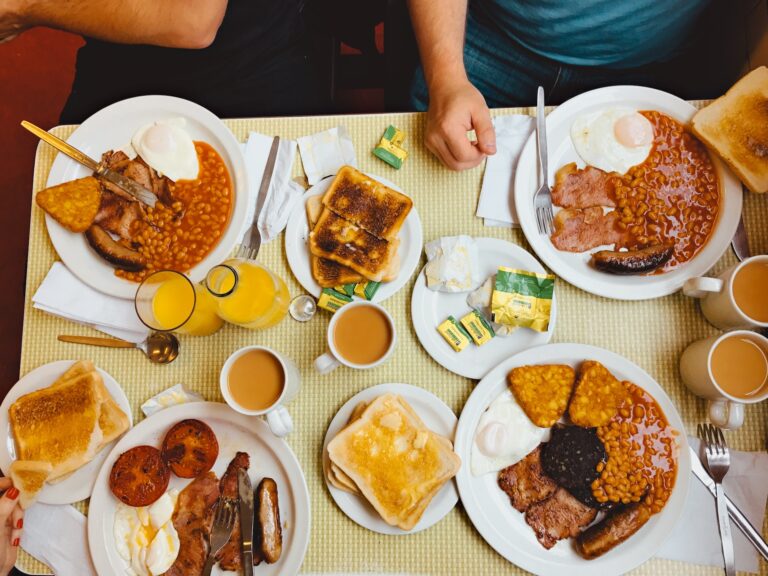
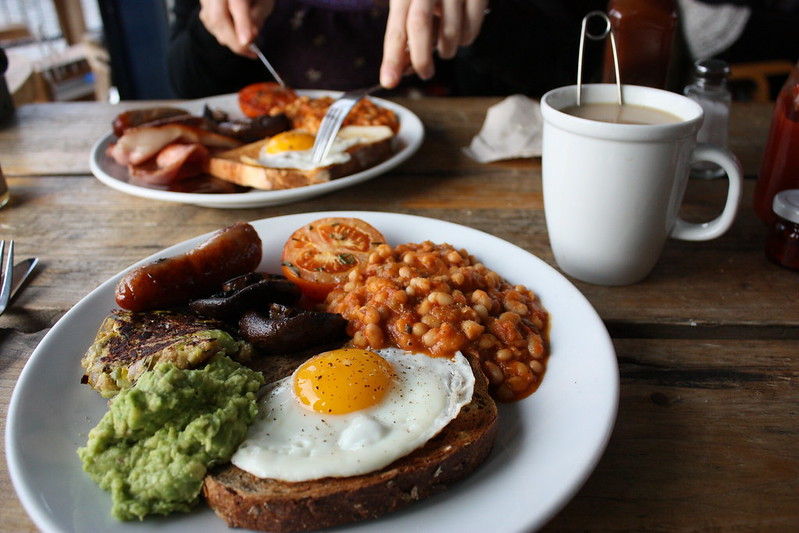
Fancy a fry-up? We wonder how many times those three little words are uttered across Britain each day, especially on weekends when a hangover is at its strongest and a full English breakfast most coveted. 

The author W. Somerset Maugham once opined that to dine well in Britain, you should eat breakfast thrice daily, and while we would never encourage you to tuck into a fry-up quite that often, there is no denying a Full English is a very good thing, indeed. 

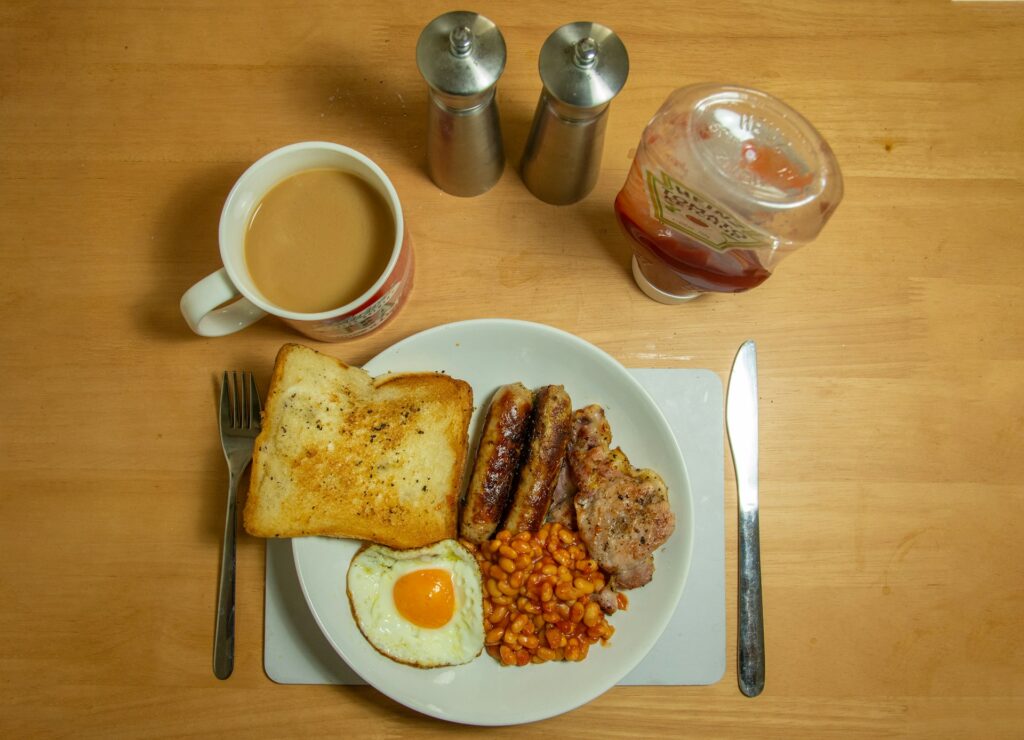
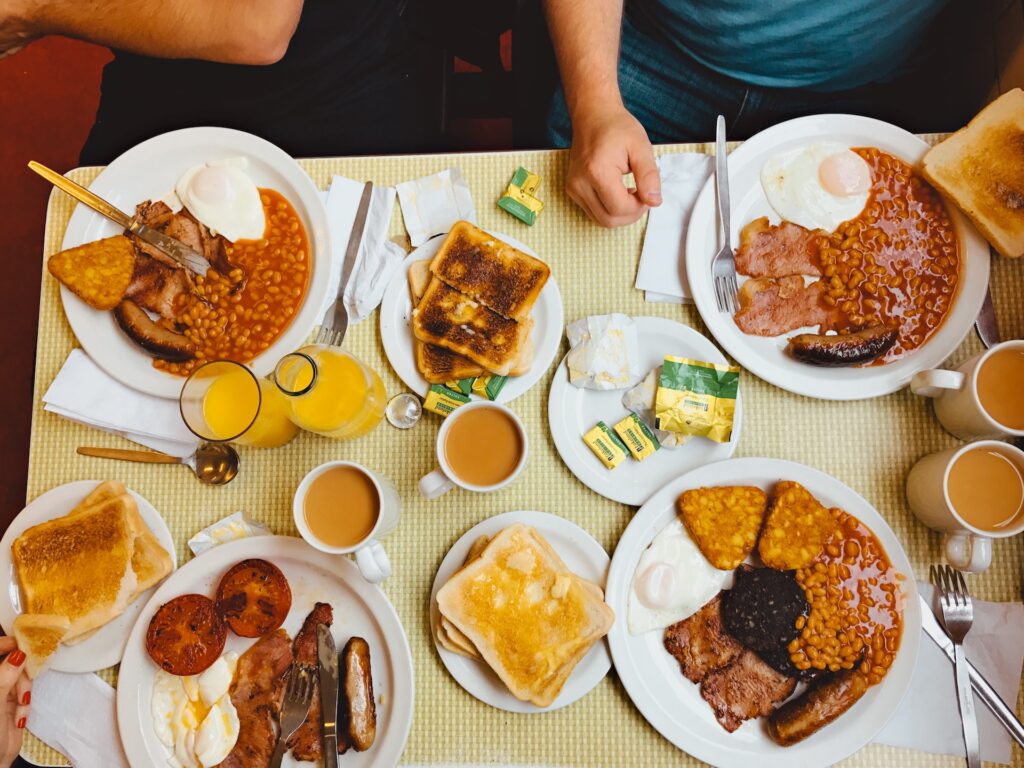
This humble meal is England’s answer to soul food, and our insatiable, indefatigable appetite for a serving of bacon, sausages, eggs and the rest only seems to be getting bigger.

London is of course famous for its greasy spoons and is home to hundreds of cafes, bars and restaurants serving Full English breakfasts, some traditional and some done with the kind of creative flair usually reserved for fine dining. 

Whilst food trends come and go, there’s still huge comfort to be found in the classics, after all. To help you narrow down your search into something cohesive and close-to-hand, we’ve eaten our way through the city and clogged up our arteries doing so to bring you these; the best fry ups in London. 

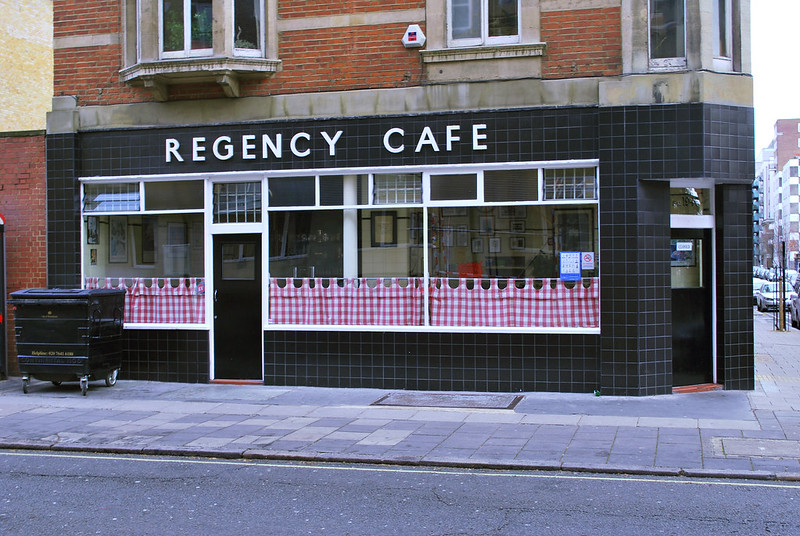
Regency Cafe, Westminster

Regency Cafe first opened its doors way back in 1946 and has become something of an institution in the 77 odd years since. Designed in an art deco style with pictures of Tottenham Hotspur players hanging on the wall, this cafe is as quintessentially London as they come (if you’re not a Gunner, of course), and has served as the backdrop to some seriously iconic English films, including Layer Cake, Brighton Rock, and Pride. 

Whilst we’re usually more than happy to put our breakfast plate in the capable hands of the chef, perhaps our favourite thing at Regency Cafe is that you have the flexibility to build your own breakfasts, with classic items all present and correct alongside some more (relatively speaking) esoteric fried breakfast offerings… Omelette in lieu of a fried egg, anyone?

Be warned; this place gets busy, with tourists after traditional English grub often making a beeline for the cafe right at the time hungry workers are finishing up for the day. That said, anywhere with a queue is worth the wait, as they say, and this place most certainly is.

Also worth mentioning, The Regency Cafe does a great fish & chips, but on Fridays only. Speaking of which, here’s our favourite places for fish and chips in London, if you’re so inclined to seek them out.

Address: 17-19 Regency St, London SW1P 4BY

Website: regencycafe.has.restaurant

fry up in London
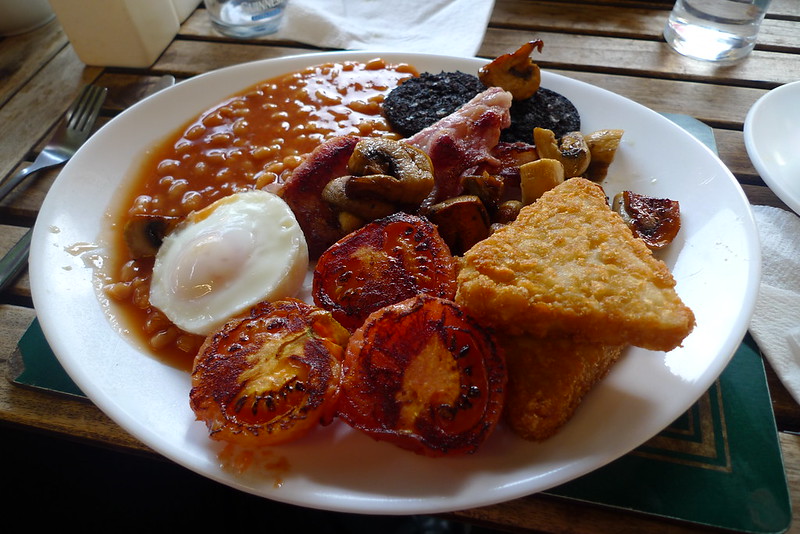
Photo by Joel Goodman on Unsplash
Image by distillated

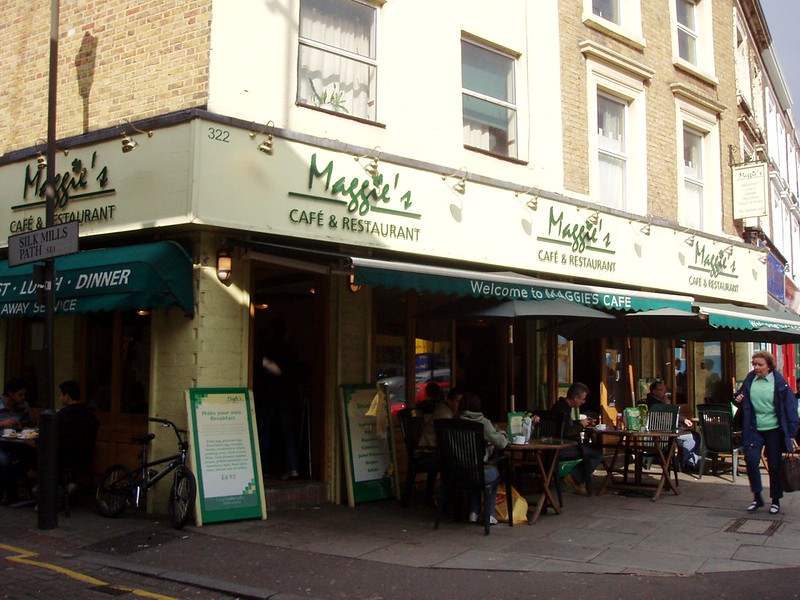
Maggie’s, Lewisham

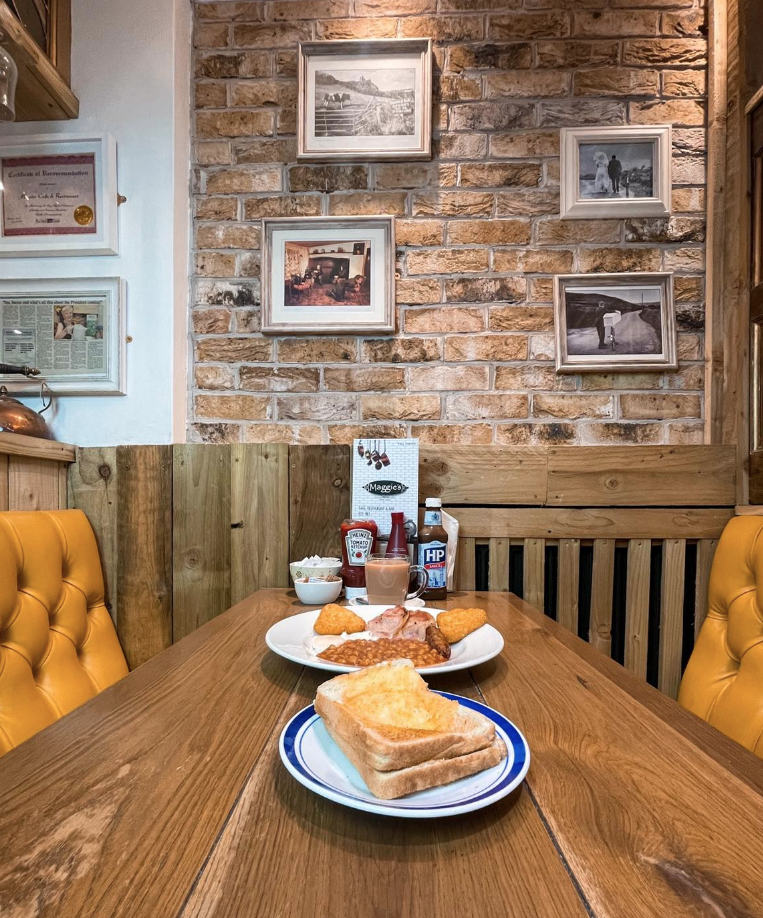
Serving up an all day breakfast close to Lewisham station, Maggie’s is famous for their ‘create your own breakfast’ menu, with people coming from the ‘burbs, Brum and even abroad (reportedly) just to try it.  

The restaurant is named after Lewisham legend Maggie, who sadly passed away in 2020. She opened up the restaurant with her husband in 1983 and it’s now run by her sons Oliver and Anthony. Fry-up finesse clearly runs on the family.

That fabled freestylin’ menu offers a choice of more than 15 items, including liver (ideal if yours is feeling like it needs a replacement after last night), bubble and squeak, tinned tomatoes and ham. Which begs the question… At what point does a fry-up become a different meal altogether? Is it still the same broom if you replace the handle and brush? Is liver, ham and tinned tomatoes a fry-up? Has anything even seen a frying pan? Anyway…

Just remember that the cornerstones of a fry-up are sausage, bacon and egg (don’t @us, fry up police), and from that foundation, you can play around as much as you like.

Image by Ewan Munro
By Ewan Munro

Address: 320-322 Lewisham Rd, London SE13 7PA

Website: maggiesrestaurant.co.uk 


Andrew’s Cafe, Holborn

A family run business, Andrew’s Cafe has been serving good food to Londoners for more than 50 years. 

This a proper, no frills cafe where, in their own words, “Local cabbies and electricians rub shoulders with familiar faces from the nearby ITN building”, which is just perfect if you need a socket fixed or a lift to the station following your fry-up. 

Image via @Andrew’sCafe

That fry-up, it should be noted, is exceptional value. For just £7.80 (yes, you read that right) you can get the all-day full breakfast, which is so full that its rashers genuinely hang off the side of the plate, having been muscled off-centre by Andrew’s generosity.

It’s well known that the legendary news presenter Jon Snow loves the fried egg here (the thought of bumping into him here is reason enough to visit, even if the food was terrible, which of course it isn’t). Snow even once fronted a petition to stop developers closing down the cafe; thank the good lord – and Jon – that it worked!

Address: 59 Grays Inn Rd, London WC1X 8TL

Website: Andrew’s Cafe | London | Facebook


Piggy’s Cafe, Billingsgate Market

While this cafe is more famous for its fish, the fry-ups here are darn good too. With a boisterous atmosphere to boot, Piggy’s is one of our favourite cafes in London, full stop.

Housed in Billingsgate Market, it’s particularly famous for its scallop and bacon butty, which has been fuelling the market traders at Billingsgate every morning since forever (well, 1982). We just love it. This saline, succulent sandwich starts being slung at 3am, and is certainly worth getting up for, even if you leave the market fishless and fancy free. 

If you do decide to visit in the early hours of the morning, you’ll see the fish traders devouring bacon butties, all with a luxurious shellfish twist; we urge you to do the same and order one alongside your fry up. Because you’ve made all this effort, it would be rude not to right? 

Address: Billingsgate Market, Trafalgar Way, London E14 5ST

Facebook: @billingsgatecafe


Polo Bar, Liverpool Street

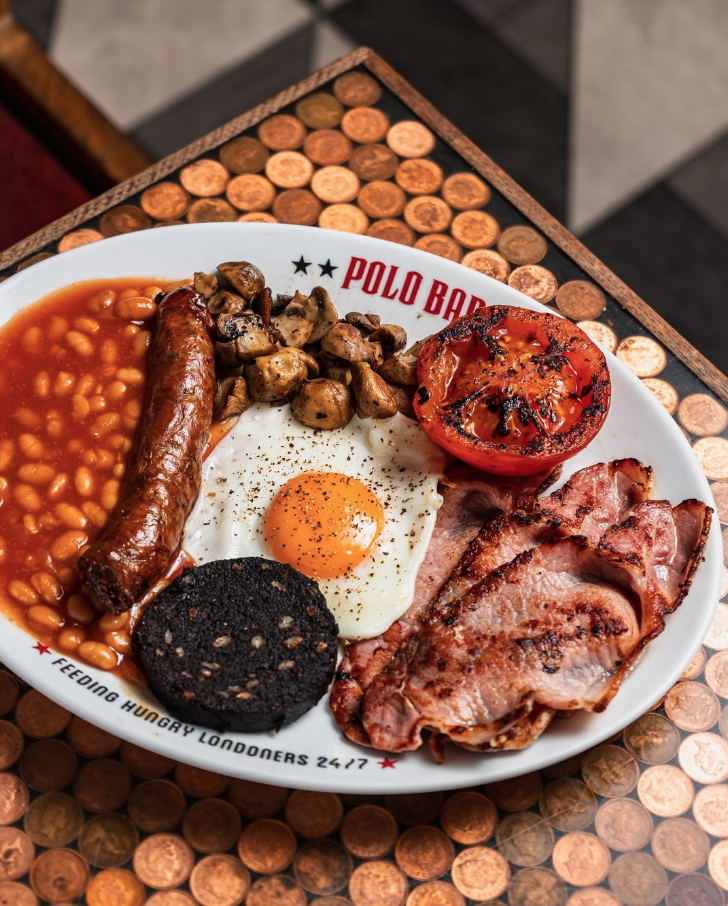
To be completely honest, we can’t quite remember the finer details of the fry up here, having dropped in after a long night on the tiles and Tequilas. What we do remember thinking, however, is that it was the best thing since sliced (or should that be fried?) bread.

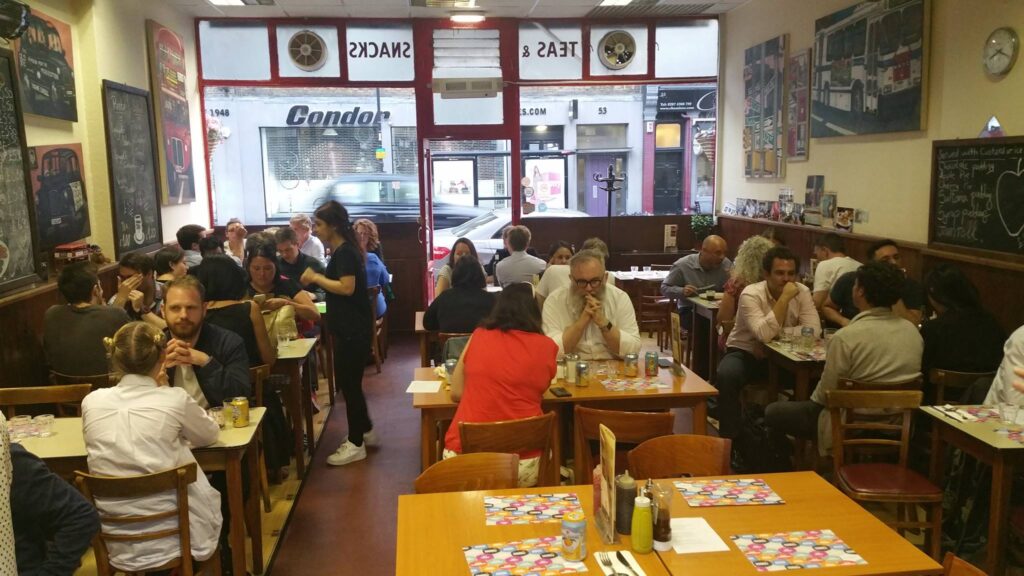
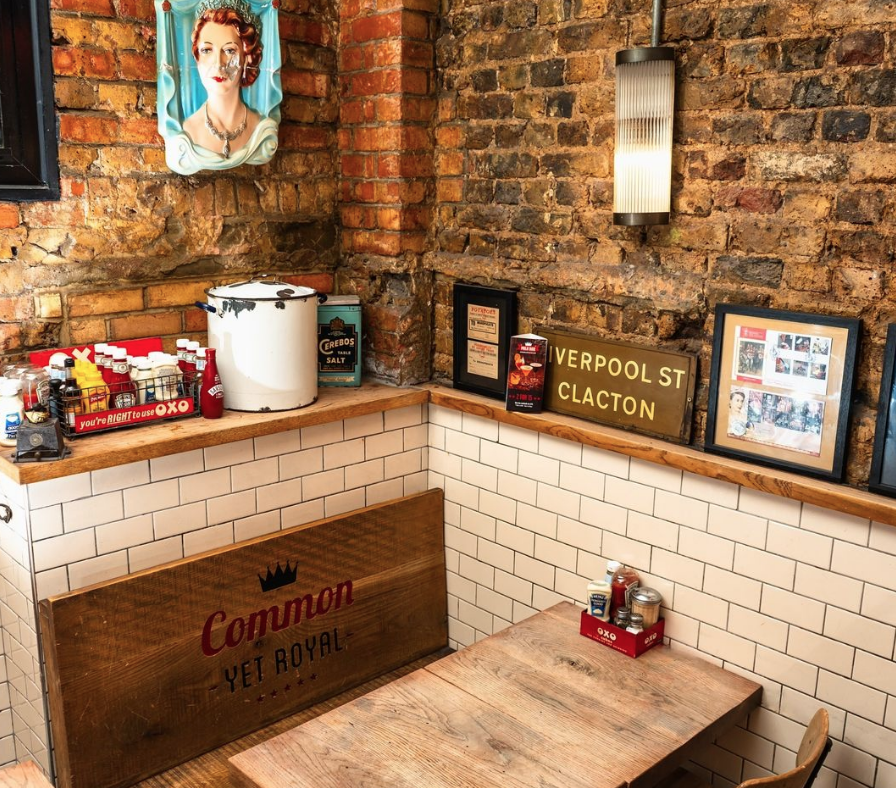
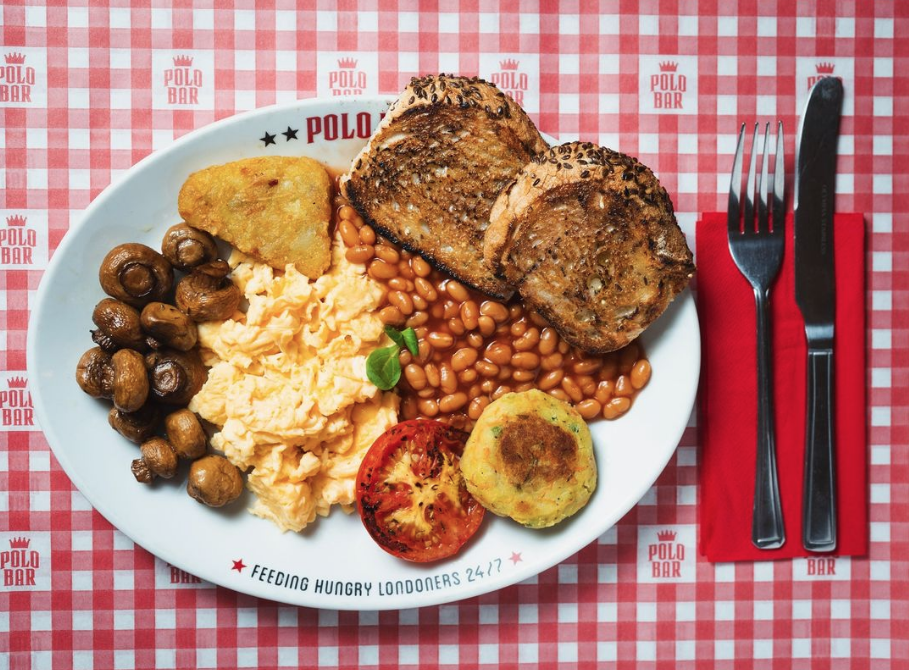
Minutes away from Liverpool Street Station, Polo bar serves up all-day and all night fry-ups, 24 hours a day, 7 days a week, with the staff surprisingly chipper in the wee hours of the morning.

The portions here are generous and if you’re craving eggs, bacon and something greasy to sop up that bevvy as the sun comes up, then this is one of the best places to stumble into in all of London. 

Address: 176 Bishopsgate, London EC2M 4NQ

Website: polobar.co.uk

Read: Where to eat near Liverpool Street Station


River Cafe, Putney

No, we don’t mean Ruth Rogers and Rose Gray’s tribute to seasonal Italian cooking just up the road (though we’d love to try their version of fry-up, we have to admit). Instead, we’re talking about an unassuming train station cafe in Putney that’s dishing out some of the best greasy grub south of the Thames.

This River Cafe, which Putney residents are proud to call their own, is busy, affable and as cheap as the chips; the latter, by the way, are lovely stumpy things that really hit the spot. 

With its real-deal retro Formica tabletops and art nouveau wall tiles, River Cafe is a relic of a time gone by, and as you step out of the station into the caff, it’s like you’ve travelled back in time. The generously proportioned fry-up and a straightforward cup of milky tea will bring you right back to the here and now, though.

Address: 1A Station Approach, London SW6 3UH


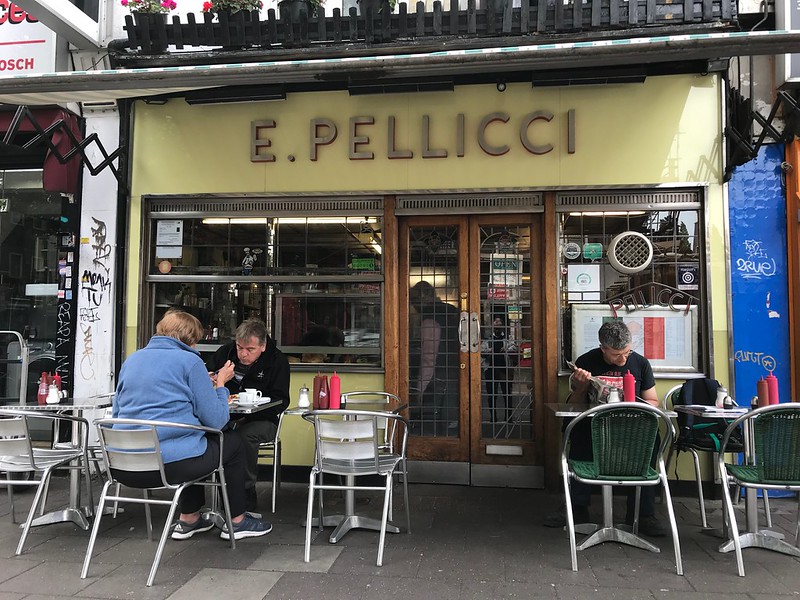
E. Pellicci, Bethnal Green

While the fry up is a uniquely British thing, many of the best in London are actually served in Italian caffs. And perhaps the very best of all is found in Bethnal Green institution, E. Pellicci.

This vintage Art Deco workers’ cafe has been serving the local community for over a century and if you’re looking for a historic, independently run cafe in London to enjoy a cooked breakfast, you can’t do better than E. Pellicci. 

The late Anthony Bourdain once said that if you are in London and fancy a Full English, then this is the place to come. It was here he pointed out the startling, heart attack inducing qualities of a full eight-piece breakfast, as if he was the first to experience such a realisation (Tony, we’ve been living this shit for decades). 

By Matt Brown via Flickr

“This, terrifyingly enough, is what most Brits expect from a proper fry up,” he said. Yes, yes we do.

There are four fry up options on the menu – essentially classic meat, classic vegan, and larger versions of both – but it’s the ‘Have The Lot (Meat)’ that we come for; a gigantic fry up which may just be the biggest Full English in London. Because where fry-ups are concerned, it really is a case of ‘go big or go home’, we think.

The golden, giving hash browns are particularly delicious, and we’d always recommend going for the fried bread instead or toast here. Or both; why not have both?

Address: 332 Bethnal Grn Rd, London E2 0AG

Website: epellicci.co.uk


The Wolseley, Mayfair 

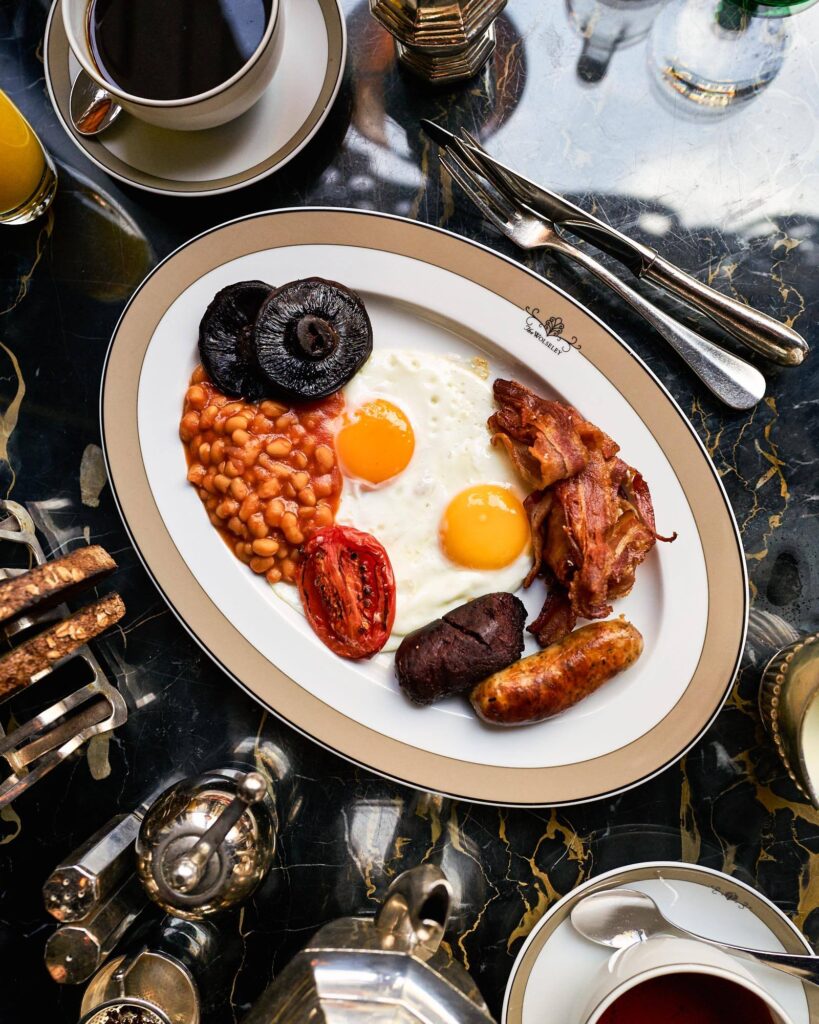
If you’re looking for a rather different, arguably more refined fry-up experience, then to the Wolseley you must head.  

This iconic all-day cafe-restaurant in London’s most expensive part of town offers an upmarket take on the Full English that still manages to tick all the usual boxes and fill all the usual holes, but with a little flourish and flair thrown in for good measure.  

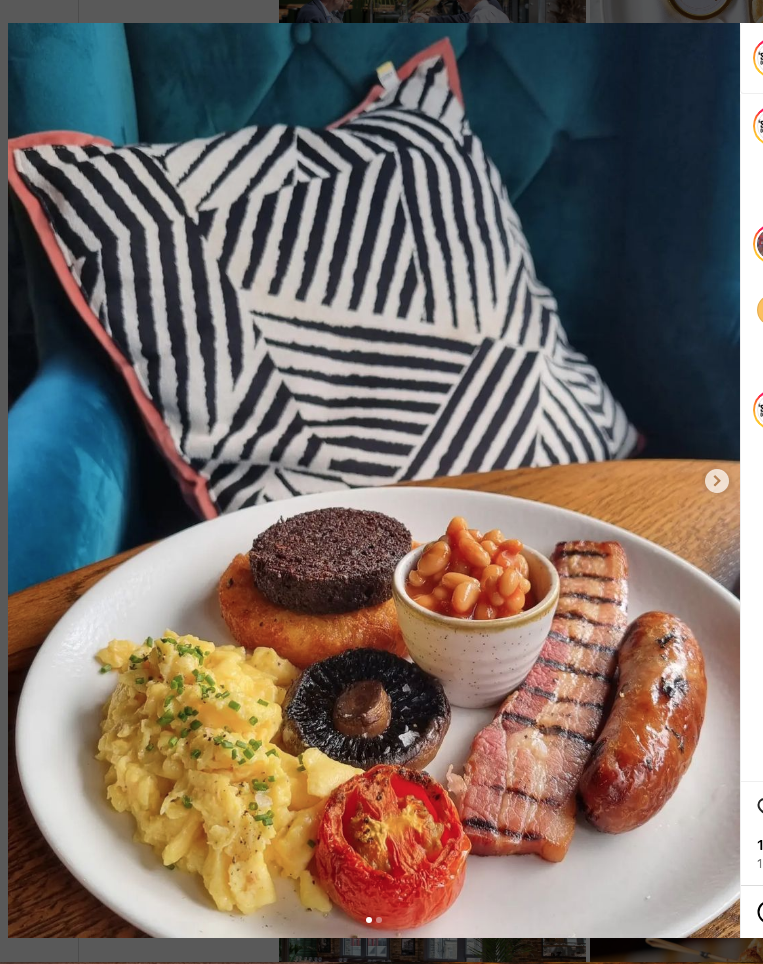
Economically named ‘The English’, and clocking in at £23, you can enjoy all the delights that a traditional fry-up offers here, with carefully sourced sausages plump, the Lancashire black pudding pronounced in all the right places, and the scrambled eggs a level of indulgent not seen on the other entries on our list.

That’s not why the breakfast here commands a premium price, of course; it’s the experience you’re paying for, and that experience is one of classic food and seamless service, both served in a glorious setting, renowned for its jaw droppingly spectacular, grand interior – its monochrome geometric marble flooring and vaulted ceiling with chandeliers galore are things of beauty.

Having breakfast here is an experience you won’t forget and a wonderful way to start a day. 

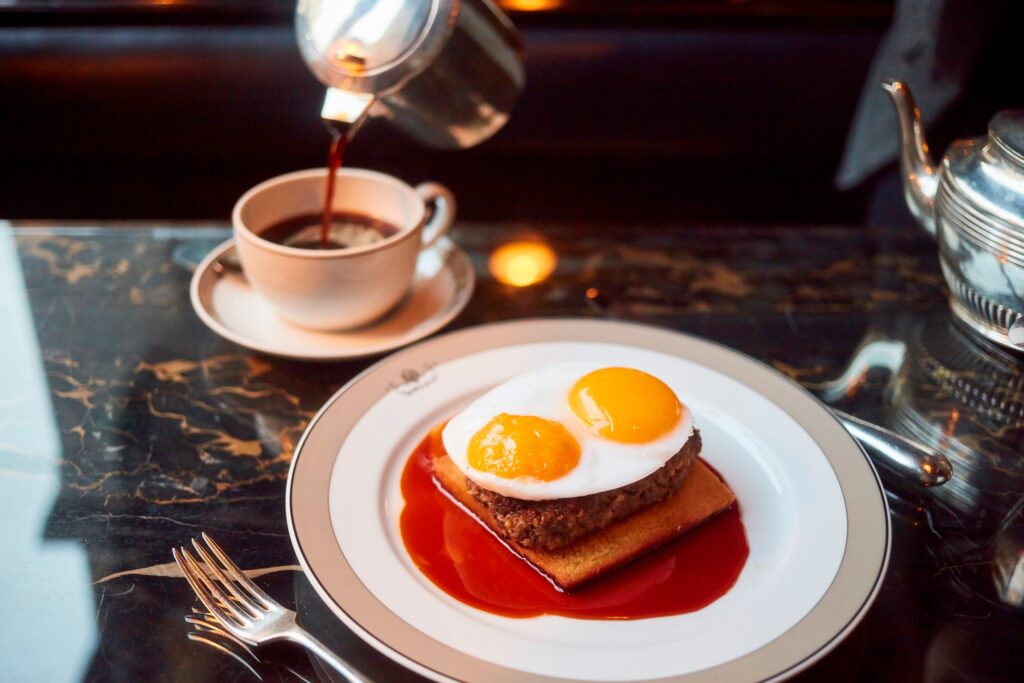
IDEAL Tip: If you’re feeling greedy, order the fried haggis topped with duck eggs and whiskey sauce. It’s unbelievably good.

Address: 160 Piccadilly, St. James’s, London W1J 9EB

Website: thewolseley.com


Smiths Of Smithfield

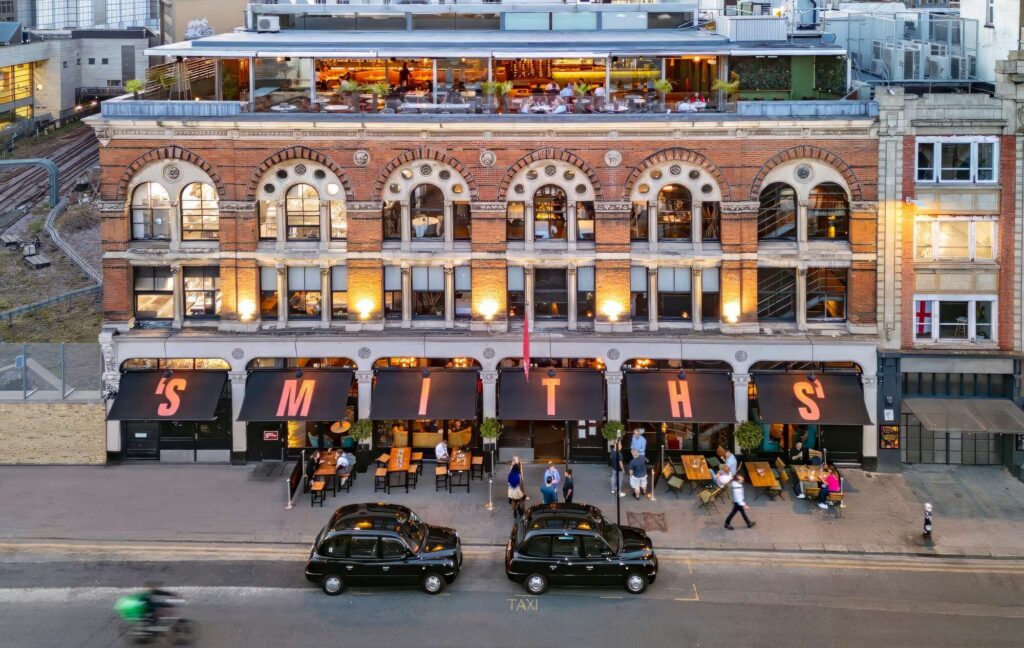
Next up on our list is another London institution, Smiths of Smithfied. One of Farringdon’s most iconic sites, this grade II listed, four-floor restaurant was once a market house in London’s meatpacking district. 

Today, it’s arguably one of the best places to come for a proper fry-up in this part of town. The Full English comprises thick cut bacon, Cumberland sausage, flat mushroom, Stornoway black pudding, confit tomato, hash brown, eggs, beans and of course toast. Proud of their provenance, everything here is unapologetically British, and since you’re here for a fry-up, that’s no bad thing.

If you want to try something different from the traditional breakfast, their steak and eggs with duck fat hash browns is a beautiful plate. which sees rump steak, green tomatoes, duck fat hash browns, fried eggs.

Address: 67-77 Charterhouse St, London EC1M 6HJ

Website: smithsofsmithfield.co.uk


Mario’s, Kentish Town

This narrow (you’ll have to visit to see what we mean) Italian cafe situated in Kentish Town’s pretty pastel Kelly Street has been a firm favourite in the neighbourhood for over half a century.

Billing itself as ‘The real-deal, original friendly cafe’ and ‘not a hipster hangout, more of a “everybody welcome” kind of place’, (try saying that with a mouthful of Cumberlands), it was opened by Mario Snr. back in 1958.

Images via @marioscafe.com

Today, it remains a community hub, with local art exhibited on the walls and residents of Kelly Street and beyond congregating here to fuel themselves on the famous fry-up and have a good ol’ gossip. We’d move here just to be part of the gang!  

Address: 6 Kelly St, London NW1 8PH

Website: marioscafe.com


Maria’s Market Cafe, Borough 

Named after its now retired founder Maria Moruzzi, Maria’s Market is another London institution that’s been serving the good stuff to Borough and beyond for decades.

A must here order is ‘The Market Special’ which comes with the caffs famous bubble and squeak; it’s a delicious medley of potatoes and greens and has the mandatory burnt bits that every good bubble should. 

If you need breakfast on-the-go, then go for the ‘Breakfast in a Bap’, which comprises egg, bacon, sausage, bubble, beans, cheese and black pudding, all inside a soft, very large white roll.

While you’re in the neighbourhood, do check out nearby Terry’s Cafe, which was founded in the early 1980’s by a former Smithfield meat trader, and delivers the greasy goods with the same aplomb as Maria. 

Address: The Market Porter, 9 Stoney St, London SE1 9AA

Website: boroughmarket.org.uk


The Pavilion Cafe, Victoria Park

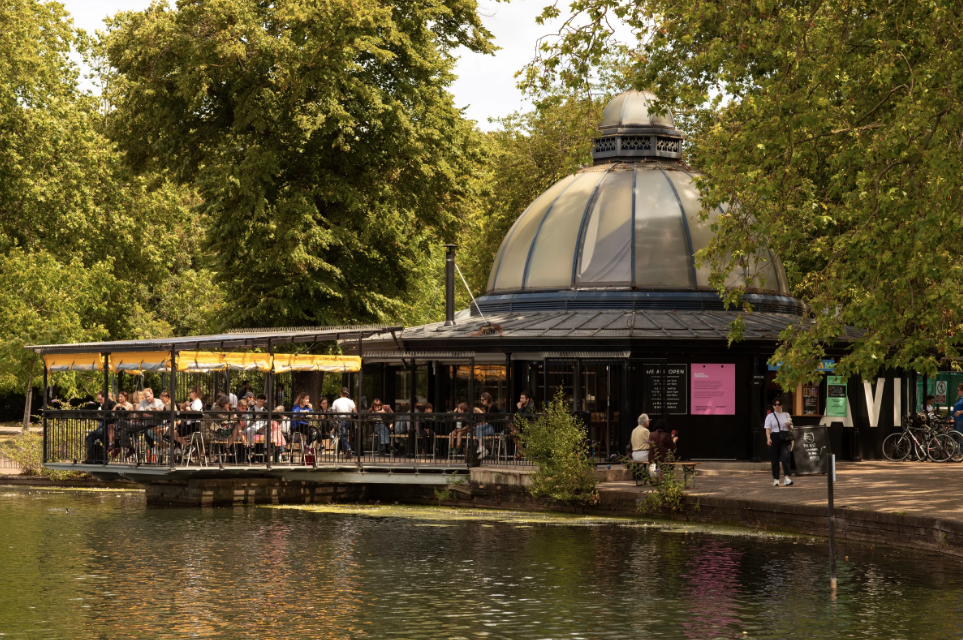
A fry up, in the middle of a park? Trust us; it works. 

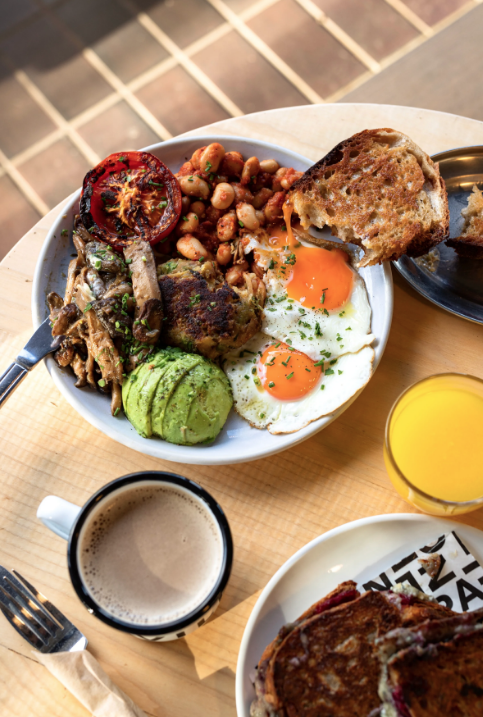
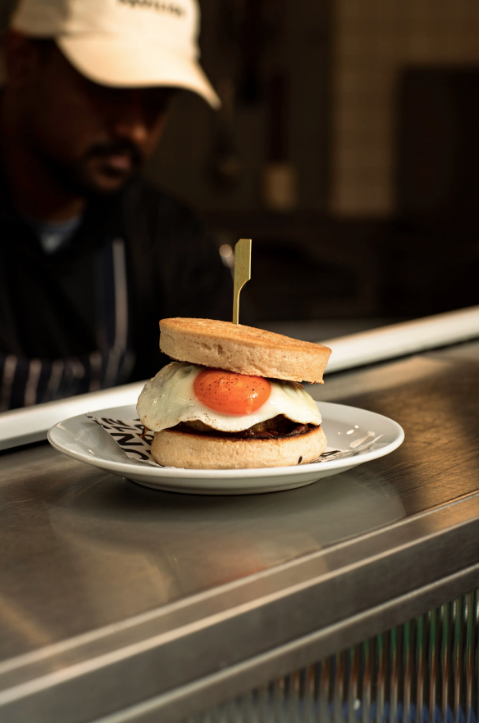
Greasy spoon, this ain’t. The Pavilion Cafe is arguably one of the most beautiful places in the world to get stuck into a fry up, particularly one which uses organic produce to such nourishing effect. The sausages, supplied by acclaimed London butchers The Ginger Pig, are testament to the power of well-sourced produce, even in the most humble of meals. The homemade beans are a refreshing change from our old friend H. J. Heinz’s, too. They also do a mega egg muffin sandwich with the pleasing addition of bubble and squeak and goey grilled cheese.

Images via @pavilionbread.com
Image by Avid Hills

Alongside the traditional fry-up fare, you’ll also find some poised, precisely spiced Sri Lankan brunch options, which after this many Full English breakfasts in such quick succession, is a blessed relief, quite frankly!

Website: pavilionbread.com

Address: Victoria Park, Old Ford Rd., London E9 7DE, UK

And on that note, before resentment builds towards this most beloved of English institutions, we’re off for a well earned lie down!

Hotel Review: Jules Et Jim – The Ideal Place For A Love Story In Paris’s Trendiest Neighbourhood

For those in thrall to the seductive pull of Paris, a warning; not every love story has a happy ending. For every snatched kiss at the top of the Tower, another is interrupted with an uninvited selfie stick. For each waft of your partner’s Chanel, as you walk hand-in-hand along the Seine, an accompanying punctuation of the river’s own scent. Hell, even the Pont des Arts, Paris’ famous ‘love lock’ bridge, has started to collapse under the expectation of all those happily-ever-afters.

There is one area of Paris though, which seems to retain the city’s romantic magic and mystique. Marais, with its cobbled streets, medieval lanes and cooler than coxa bars and galleries, still sets the scene for many a love undisturbed and unrequited. After a day of exploration and imbibing, you need a place to give you that fairy tale finish. And unlike the film from which the hotel takes its name, Jules & Jim does just that.

IDEA

A hotel in the city’s hippest area, one which invokes the spirit of care-free, impulsive Paris with its name, sure has a lot to live up to. The bar is set high. You come expecting romance yet privacy, class yet understatement and just the right amount of boutique luxury. You leave with your needs met.

LOCATION

Jules & Jim is in the heart the Marais district, on a street full of leather goods shops. That intoxicating smell permeates the promenade, bringing elegance and gravitas to its surrounds. The streets of Marais have been left to their pre-revolution devices more than any other area of Paris. This, combined with the area’s bohemian vibe and LGBT heavy population leads to an untouched yet welcoming and very trendy feel throughout – just great in a city slowly bending to the will of its millions of visitors.

STYLE & CHARACTER

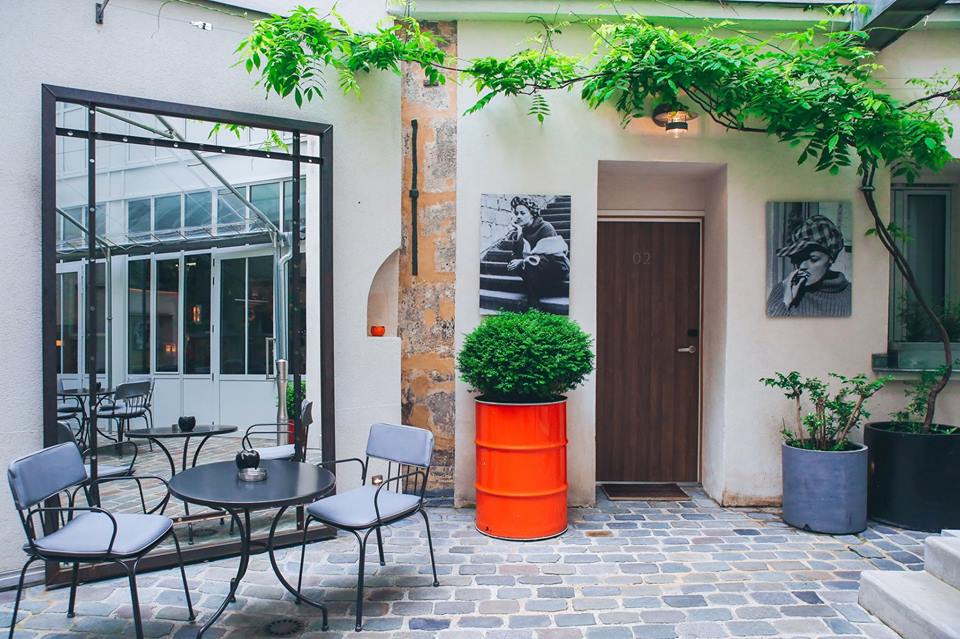
So, on to Jules & Jim itself. The entrance is funky in more ways than one; with a groovy appearance and strong smell of incense, it’s an arrival which assuages any fears of a hotel in homage to Hollywood. The theme is apparent immediately; stone, brick and wood is all unadorned and standing proudly very much in its naked state. The hotel knows it’s cool and needs no frippery, no displays of ostentation, to accentuate that fact. As their website states, their primary goal is one of ‘care, relaxation, kindness, politeness and simplicity’, and we couldn’t really describe our experience any more aptly than that.

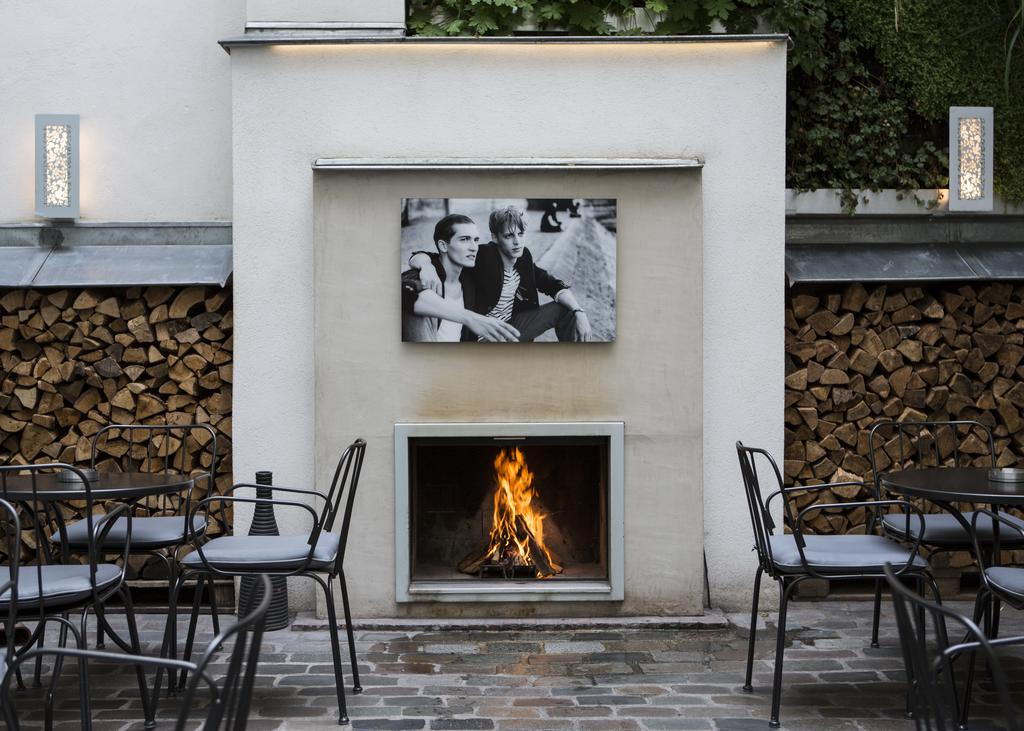
As you move on through the hotel post check-in, you pass a lovely courtyard decorated with log piles; full of residents and visiting young drinkers in the evening. The cheer and chatter is very much in keeping with the bonhomie of the area.

HOTEL REVIEW: JULES ET JIM – THE IDEAL PLACE FOR A WEEKEND AWAY IN PARIS’ TRENDIEST NEIGHBOURHOOD

ROOMS

The rooms are compact and well-appointed, which is exactly what one wants from a city-break joint from which to spring from each morning. The ceiling to floor window in the bathroom is a deal-breaker, bringing natural light we feared was lacking in the main room when first flinging open the door. The Molton Brown toiletries are indicative of the team’s thoughtful elegance, an attention to detail which sometimes goes unnoticed in larger, more standardised hotels. This lightness of touch is consistent, symbolic in the presence of two chairs. Yes, two! The solo seat in most hotel rooms is a point we always find slightly strange on our travels. The second is simply a marker of the understanding of comfort.

Speaking of comfort, nothing speaks louder volumes about the quality of the bed than almost missing breakfast. Job done, then.

HOTEL REVIEW: JULES ET JIM – THE IDEAL PLACE FOR A WEEKEND AWAY IN PARIS’ TRENDIEST NEIGHBOURHOOD

FACILITIES

Paris is a city where you feel compelled to do a lot of walking and as such, a gym isn’t a necessity by any means. Jules & Jim has identified their niche, and which facilities are important to a hotel in the middle of Marais. The bar and shared art space, then, are consistent with the clientele. A hotel bar and gallery aren’t the first destination in mind for a drink with added fashion, but the influx of visitors to soak it all up is testament to Jules & Jim’s quality.

FOOD & DRINK

Breakfast is a spread of fresh fruit, pastries and a good range of juices; a Parisian breakfast, make no mistake. Coffee is pert and assertive (a nod to the sedative effects of that bed, perhaps). There’s also cheese and jam, oats, the rest. When you’ve got strolling planned and need to be light on your feet, it’s ideal. When you’ve got a lunch appointment with stuffing your face at Chartier, it’s a necessity.

HOTEL REVIEW: JULES ET JIM – THE IDEAL PLACE FOR A WEEKEND AWAY IN PARIS’ TRENDIEST NEIGHBOURHOOD

WHY GO

Jules & Jim may have ended in death, but with the romance of the area, the sleek sophistication of the hotel, the bar seemingly made with courting in its one-track mind and rooms carefully composed for couples, the only demise you’re in danger of is the petite one.

Website: www.hoteljulesetjim.com

Address: 11 Rue des Gravilliers, 75003 Paris, France

Disclosure: IDEAL stayed as a guest of the hotel. However, all views are our own.

Restaurant SEO 101: Practical Tips To Improve Your Visibility On Google

0

In today’s competitive food industry, search engine optimization (SEO) is essential for restaurants looking to attract local customers. Whether you’re after increased foot traffic or online orders, your visibility on Google is essential in increasing custom. Here’s how to improve yours.

Focus On Local SEO

82% of smartphone users use search engines to find local businesses, according to Uberall.

For UK restaurants, local SEO is crucial because 46% of all Google searches are looking for local information, and 88% of consumers who search for a local business on a mobile device visit or call within 24 hours, according to HubSpot.

Practical Tip: Claim & Optimise Your Google My Business (GMB) Listing 

Ensure your GMB profile is complete, with up-to-date information, business hours, and photos of your restaurant. Use relevant keywords in your GMB description such as “best fry up in London” or “authentic Bangladeshi restaurant in Manchester.”

Mobile Optimisation

A one-second delay in page load time can reduce mobile conversions by 20%, according to Think With Google.

With over 89% of all restaurant searches now happening on mobile, ensuring your website is mobile-friendly is essential. If your site doesn’t load fast or isn’t easy to navigate on smartphones, potential customers will quickly leave.

Practical Tip: Use Google’s Lighthouse Tool To Test Your Page

This tool can check if your site is optimised for mobile use. Make sure your menu, booking options, and contact details are easy to find and accessible from any device.

Optimise For Voice Search

According to BrainZ Digital, “By 2024, 75% of UK households are expected to own smart speakers like Amazon’s Alexa or Google Home. Optimizing for voice search is a forward-looking strategy for UK food shops.”

Voice search is rapidly growing, especially for local queries. 55% of teenagers and 41% of adults use voice search daily, and a large portion of these searches are for local businesses like restaurants, as Synup reports.

Practical Tip: Use Conversational Keywords

Voice searches often involve more natural language, so incorporate phrases that sound conversational. For example, instead of just “pizza restaurant Bristol,” use “Where can I find the best pizza restaurant in Bristol?

Read: 7 steps to perform voice search optimisation for your content

Leverage Online Reviews

50% trust reviews as much as personal recommendations, as BrightLocal reports.

Online reviews are a powerful ranking factor for local SEO. Restaurants with high ratings and consistent reviews tend to appear higher in search results. According to BrightLocal, 87% of consumers read online reviews for local businesses.

Practical Tip: Encourage Customers To Leave Reviews

Offer a small incentive, such as a discount on their next meal, for leaving a review on Google or TripAdvisor. Also, always respond to reviews, both positive and negative, to show you care about customer feedback.

Create High-Quality Content

Content marketing generates 3x more leads than traditional marketing methods, and restaurants that blog regularly see an increase in traffic and bookings, according to Review 42.

Content marketing helps you target specific keywords and provide value to potential customers. However, this doesn’t just mean writing blogs; it can include videos, recipes, or even guides to local food events.

Practical Tip: Create ‘Ultimate Guides’

Ultimate guides can generate prestige, authority and traffic. For example, “The Ultimate Guide to Vegetarian Food in Bath” could attract local vegans searching for restaurant recommendations. Use local keywords and optimise your posts with helpful headings, lists, and images.

Read: Where to eat the best vegetarian food in Bath

Optimise For “Near Me” Searches

Google searches for “near me” have grown by 500% in the last few years.

Many users search for restaurants using phrases like “near me,” especially from mobile devices. In fact, 76% of people who conduct a local mobile search visit a related business within 24 hours, with 28% of those visits resulting in a purchase.

Practical Tip: Include “Near Me” Keywords in Your Content 

Sprinkle location-specific keywords across your website. Phrases like “best fish and chips near me” or “coffee shop near me in Leeds” should be naturally integrated into your content, headings, and meta descriptions. That word ‘naturally’ is absolutely essential here, mind.

Utilise Social Media For SEO

Instagram has over 2 billion users, and food-related posts make up a large chunk of its content, according to Omnicore.

Social media can indirectly improve SEO by driving traffic to your site and boosting engagement. More than 75% of consumers have intended to make a purchase based on a social media post.

Practical Tip: Post Regularly on Instagram and Facebook

Share high-quality images of your dishes, promote special offers, and use geo-tags and hashtags like #LondonEats or #ManchesterFoodie to increase visibility.

Optimise Your Menu For SEO

Websites using structured data see a 30% increase in click-through rates (CTR), according to Search Engine Land.

Menu optimisation is often overlooked, but search engines can’t read images of your menu. Ensure your menu is text-based, and use relevant keywords for the dishes you serve.

Practical Tip: Use Structured Data for Menus

Implement schema markup (structured data) on your menu to help search engines understand your offerings better. This can result in rich snippets in search results, showcasing your menu items, prices, and reviews.

Build Local Citations

Research by Bright Local suggests that 93% of consumers are frustrated by incorrect information on online directories, and 80% say they will lose trust due to inconsistent contact details. 

Local citations are mentions of your restaurant’s name, address, and phone number (NAP) on other websites, such as local directories or review sites. Consistent citations boost your local SEO rankings.

Practical Tip: List Your Restaurant in Online Directories

Ensure your NAP is consistent across platforms like Yelp, TripAdvisor, OpenTable, and local UK food blogs.

And with that, let’s instead read about the interesting part of restaurants – the food! Check out our guide to the best value set lunches in Mayfair for some light relief from the above.

Hotel Review: Anantara Riverside, Bangkok

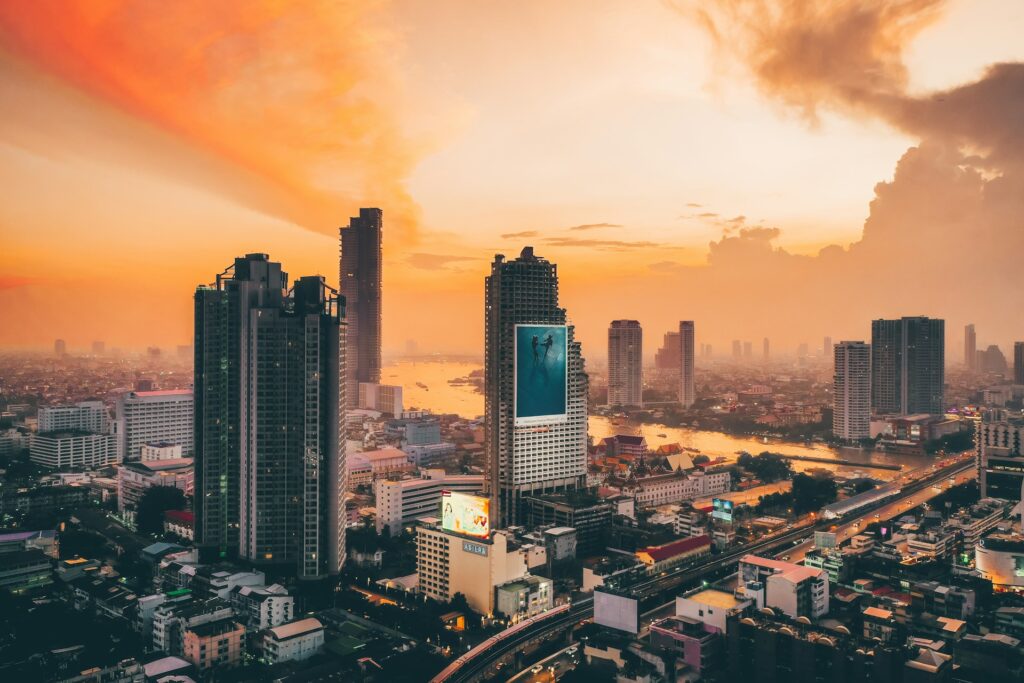
Looking for luxury in Bangkok? It’s not hard to find; all you need to do is look up. The capital is full of city-defining skyscrapers, many of which are home to luxury hotels. These perfectly cosmopolitan lodgings offer guests a world of indulgence, complete with panoramic views where patrons can soak up the city below, all with the rarified air of feeling like you’re floating dozens of floors above street level.

Sky-high hotels know how to make their guests feel on top of the world and use their dizzy heights to add that extra wow factor. Unless you suffer from vertigo, elevator-inspired claustrophobia or are simply don’t enjoy being high, there’s little reason not to stay in a skyscraper hotel in Thailand’s capital.

There is one reason not to – to feel pure, actual escapism from – whilst in – the city. Although we love staying in the heart of Bangkok, which is where these skyscraper hotels can usually be found, sometimes it’s nice to lay your hat somewhere that isn’t in the midst of traffic and towering buildings. A peaceful place that’s elegant and warm. Somewhere open and airy, that’s equally as impressive as a gravity-defying skyscraper, yet quieter and perhaps a little more unique. 

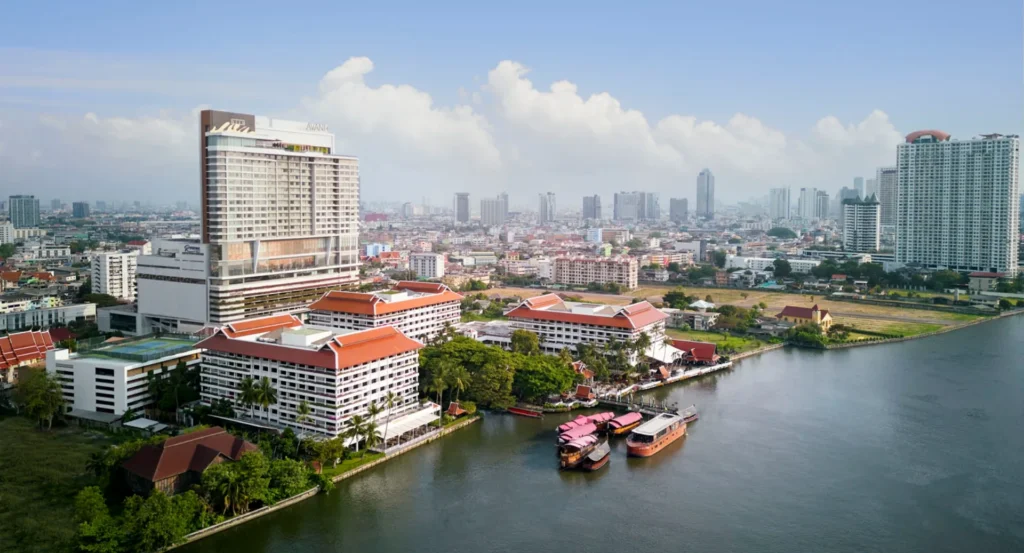
Enter Anantara Riverside Resort. Bangkok’s only low-rise 5-star hotel in a sea of skyscrapers, the resort stands out. If you’re looking for a beautiful hotel in an idyllic location that’s low slung, laid back but luxury nonetheless, then the Anantara is a good bet. Sitting pretty on the Thonburi side of Bangkok’s Chao Phraya river, Anantara’s location feels accessible yet lovingly isolated from the rest of the city.  

Don’t be put off by the hotel’s location “across the other side of the river”. In fact, this position is very much a plus point in the Anatara’s favour, perfectly poised for guests to experience the city by boat – which is the ideal way to get around Bangkok and see the sights in quintessential fashion. What’s not to love?

Read on for our full hotel review of the Anatara Riverside in Bangkok….

Location

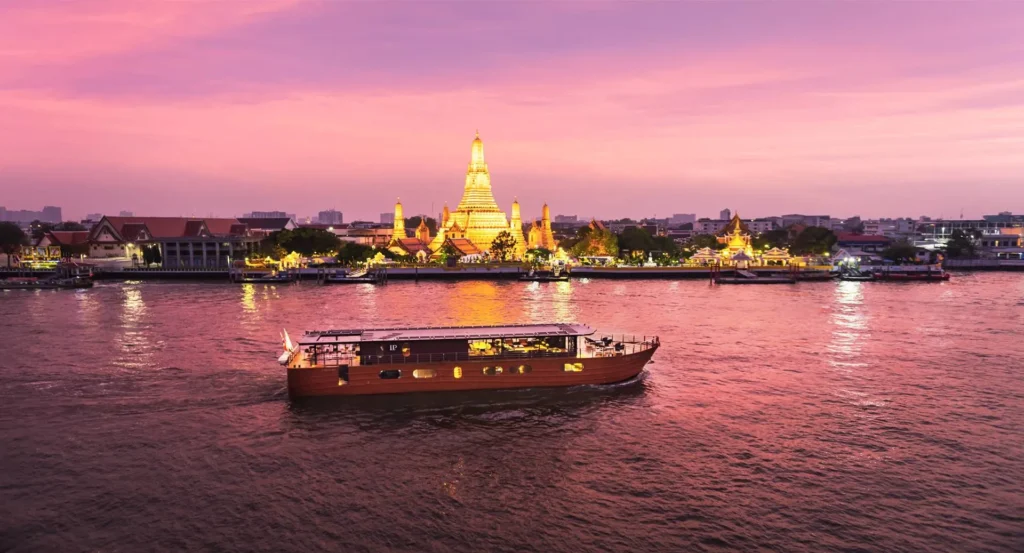
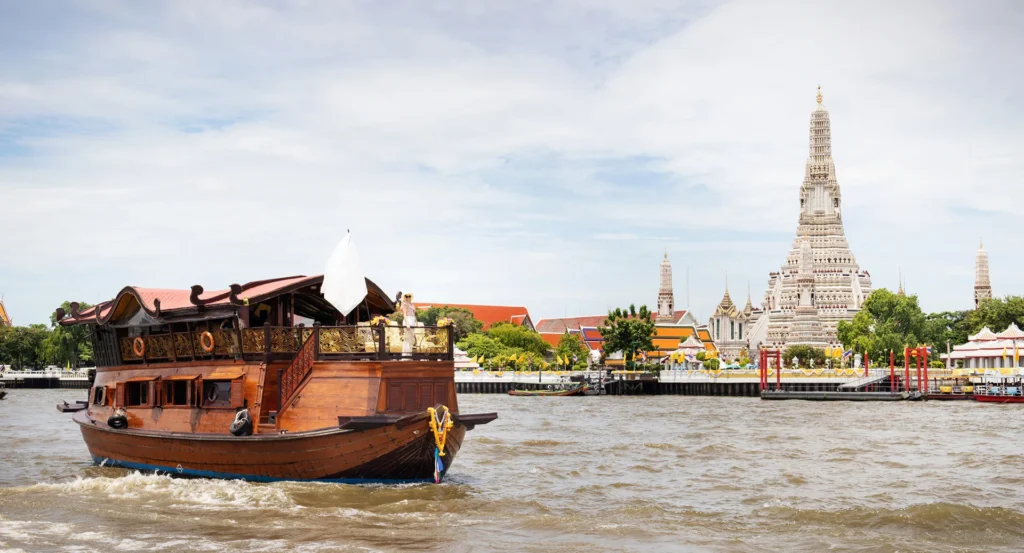
Situated on the west shore of Bangkok’s Chao Phraya River, on the edge of Bangkok’s business district, the Anatara’s position differentiates the hotel from others in the Sathorn area, and it’s all the better for it. The quiet location is a welcome escape from the madness of the city, but close enough to the bustle and excitement of attractions (like Asiatique opposite and the monumental Wat Arun a little further up the river) that you still feel part of it.

Although there is no skytrain stop within easy walking distance of the hotel, getting to and from the Anantara is easy. For public transport, the nearest BTS Skytrain station is Charoennakorn Station (ICONSIAM) which can be reached by taxi within 7 minutes. There’s also a free shuttle boat which runs from the hotel to the central hub BTS stop of Saphan Taksin, from 8am to 11.15pm. From here you can hop on a Chao Phraya tourist boat and glide on up the river to a whole host of Bangkok’s main attractions. Honestly, a ride up the river is a tourist attraction in itself, taking in all of those sites at a cerebral, almost celestial pace. 

Alternatively, you can catch the skytain at Saphan Taksin to take yourself further into the heart of modern Bangkok, Sukhumvit, putting a firm end to any perceived obstacle of being on the “the other side”. 

Indeed, the Anantara doesn’t take its riverside location for granted, and it’s good to know that the hotel sends a small boat out everyday to clean rubbish from the river.

In terms of immediate amenities, there’s a little Riverside Plaza adjacent to the hotel. Home to a 7/11 (stock up on a bottle of Pocari Sweat if you’re exploring all day – it’s the ultimate rehydrater and rejunivator) and a pharmacy, it’s a good place to have near. Several restaurants occupy this little plaza too, though most are a little uninspiring, especially when you consider the Anantara’s proximity to a different shopping mall, the absolute juggernaut ICONSIAM, which real Bangkok-heads know serves up some of the best food in the city. Here you’ll find gorgeous bowls of khao soi from famed Chiang Mai institution Khao Soi Lamduan and som tam from Jae Dang Sam Yan. For a sit-down meal, much talked about Bann Ice is one of the finest purveyors of Southern Thai food in the city.

Charoen Nakhon Road itself is lined with small shophouses. Before you get to ICONSIAM, you’ll find Khao Soi Ni Kala serving up excellent food from Northern Thailand, and Je Ju Noodle which serves up some of the best yen ta fo noodles (the much-loved, pink-hued noodle soup) in the city. Lovely stuff.

The Welcome 

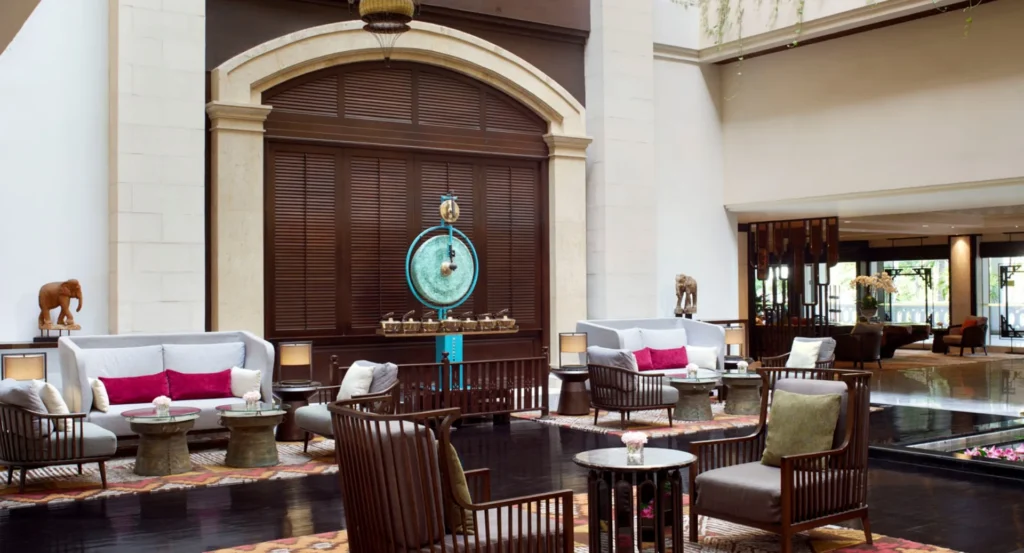
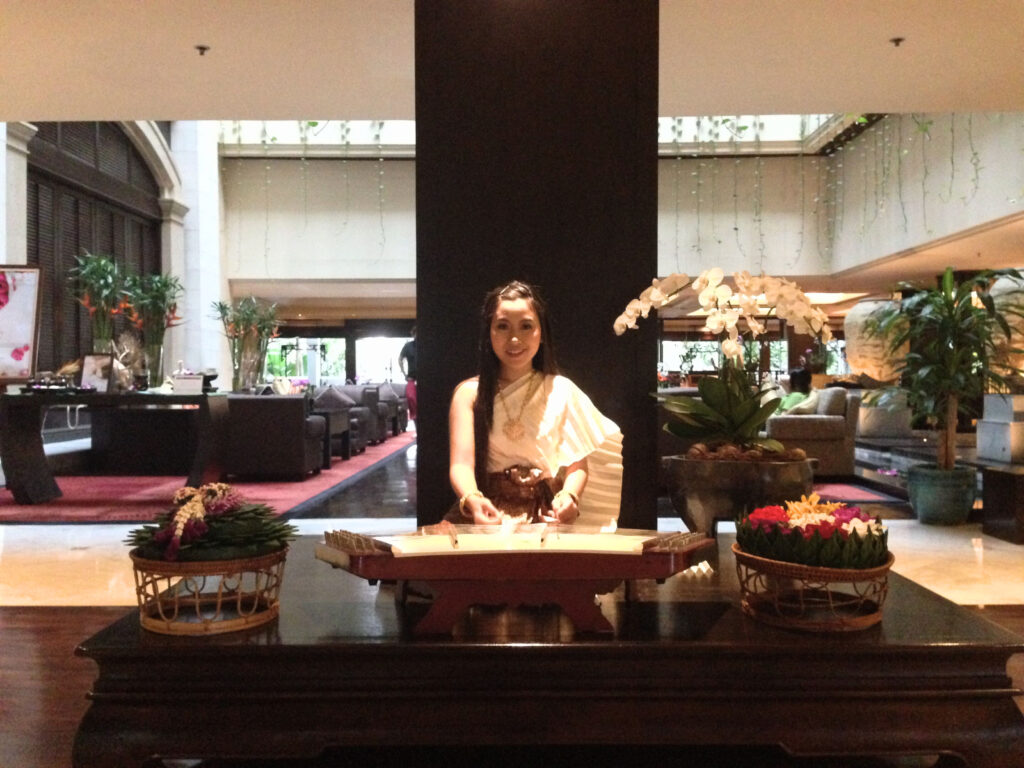
On first impressions, the sprawling lobby has a slight shopping mall feel to it. But look past this and you’ll begin to notice that the hotel has an elegant, old-world charm. Breathe in and there’s the wonderful aroma of exotic flowers. A beautiful water feature creates a peaceful atmosphere both visually and aurally, and, in a nod to Thai sunak, sculptures of Thai elephants frolic in a central water feature that’s made to look like a lily pond. We can almost imagine Moo Deng in here, having a wonderfully frivolous time. 

Intricate teakwood carvings abound and marble floors gleam. The warm, jasmine-scented welcome and the sight of the tropical garden just beyond the lobby’s expansive windows all set the tone for a stay that promises both relaxation and luxury.

Character & Style 

The hotel peacefully sits amidst 11 acres of lush tropical gardens, offering a refreshing escape from the frenetic pace of Thailand’s capital. The whole resort is imbued with classic Thai aesthetics, from the giant mural of traditional Thai life close to the entrance and huge antique urns that stand tall and proud in the lobby, all the way to the charming elephant sculptures scattered throughout the property. These touches of Thai culture give the resort a distinctly local feel. 

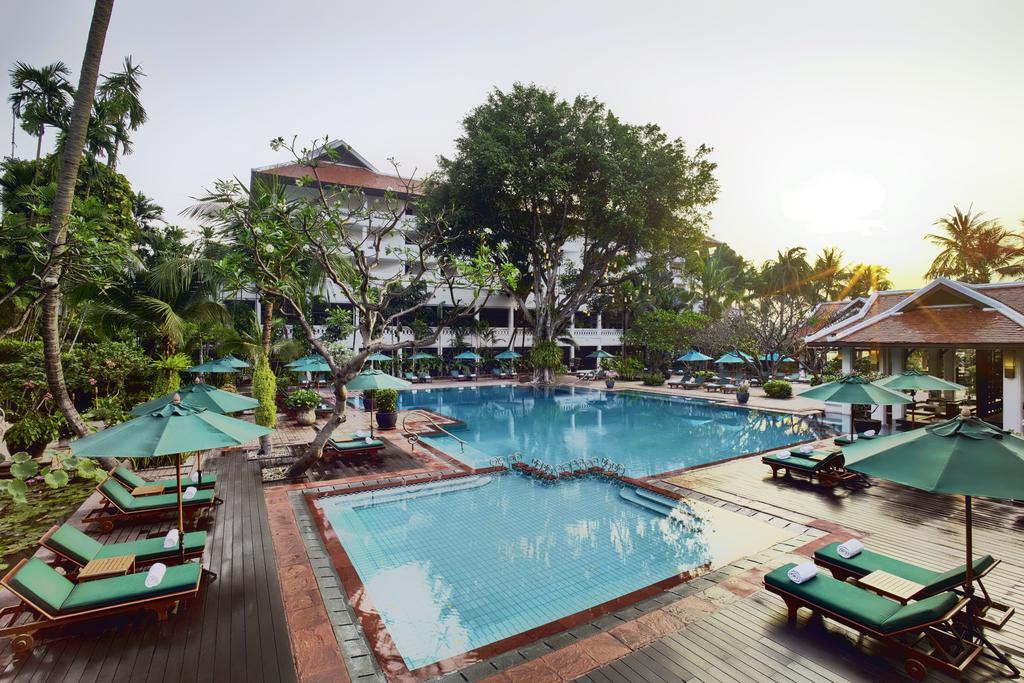
The guest rooms are spread across three low-rise buildings with traditional sloped Thai roofs. The grounds themselves are stunning with an abundance of tropical plants and gorgeous palm trees. The sprawling lagoon-style pool, surrounded by this verdant foliage and swaying palms, is a focal point for relaxation. At night the paths are illuminated and when coupled with the twinkling city lights across the river, it makes for one breathtaking view. 

Those sweeping views of the river give discerning travellers good reason to choose the Anantara – breathtaking and so easy to get lost, watching all the boats go by. You just can’t beat the sunset here. Witnessing day become night from the edge of the Anantara’s pier is something that will stay with you forever, with an almost irresistible pull from the wider city beckoning you into a balmy night in Bangkok.

Rooms

The resort boasts 281 guestrooms and 95 suites, each meticulously designed to reflect a harmonious blend of contemporary comfort and Thai heritage. 

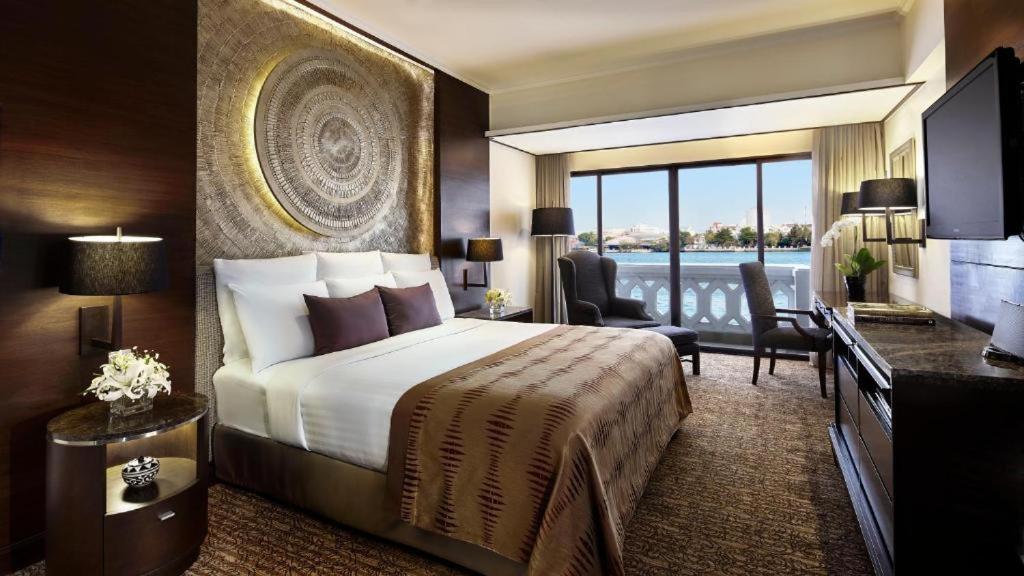
Our deluxe river view room was dreamy. Full of deep colours, rich textures and dark wooden furnishings, distinctively Thai elements reminded you exactly where you were, from the pictures of Thai temples behind the bed and the rare, reddish makha wooden flooring, all the way to the etched inscriptions around the window. 

The bed, fitted out with sumptuously soft Thai silk linen, was supremely comfortable, and the room’s private balcony offered a sweeping vista of the Chao Phraya, where the gentle hum of riverboats added a rhythmic charm to the serene setting – it was enough to rock you to sleep, quite frankly. Waking up to the already active Chao Phraya and starting the day with a freshly brewed cup of coffee is – was, will be – a moment to cherish.  

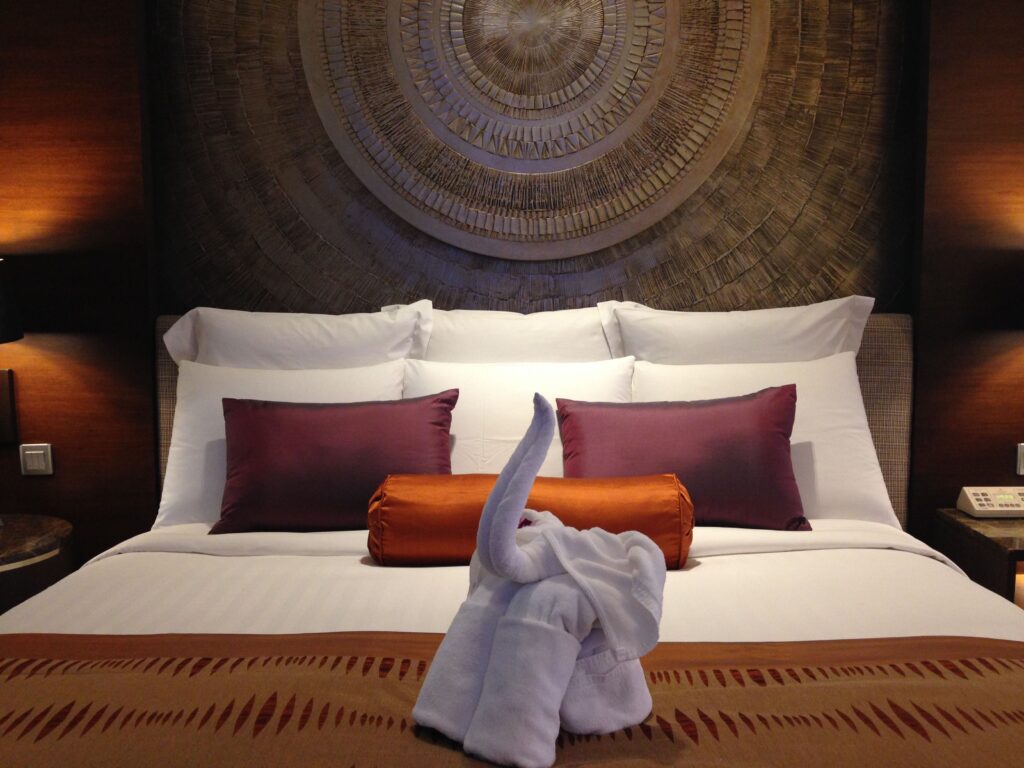
Each room comes with a ‘Handy’; a free smartphone device that allows guests to make unlimited local and international calls – a nice touch. However, dare we say, the most impressive thing about the room may be the elephant towel art, courtesy of the talented cleaning team. Just how do they get those trunks so erect?

Facilities

Let’s talk about the little things that really sing ‘luxury’ here. You won’t want for refreshments; the pool has a swim-up bar and the sunbeds are blessed with a call-for-service button where you can order drinks and snacks right to your lounger. Need we say more?  

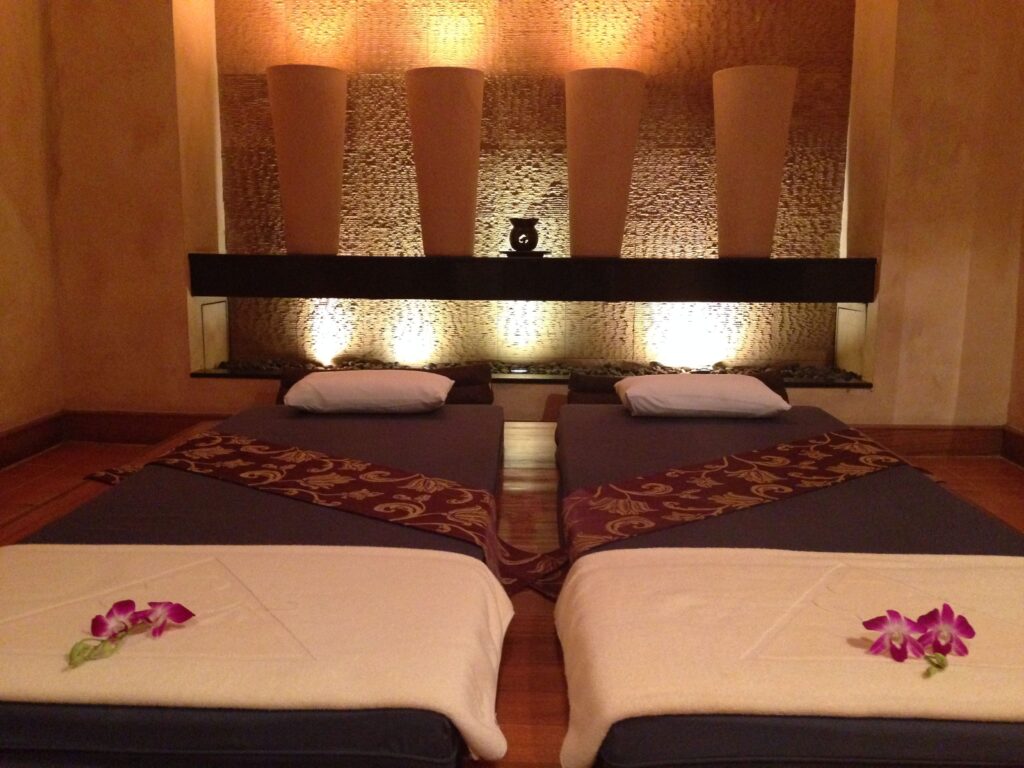
For those seeking rejuvenation, the Anantara Spa offers a range of treatments that blend ancient Thai techniques with modern wellness practices. Fitness enthusiasts will appreciate the well-equipped gym and the array of on-site activities, from Muay Thai boxing classes to yoga sessions by the river. 

You can even join the imitable Khun Waiyawit (better known as the Klong Guru) on a leisurely tour of the city’s canals via longtail boat, directly from outside the Anatara. Khun Waiyawit grew up around the city’s waterways and knows the intricate maze of canals like the back of his hand. Exploring this side of the city and seeing the traditional stilt house communities is to experience an older, more traditional side of Bangkok. The hotel also has a string of so-called Streetwise Gurus that are ready to take you to some of the best street food joints in the capital

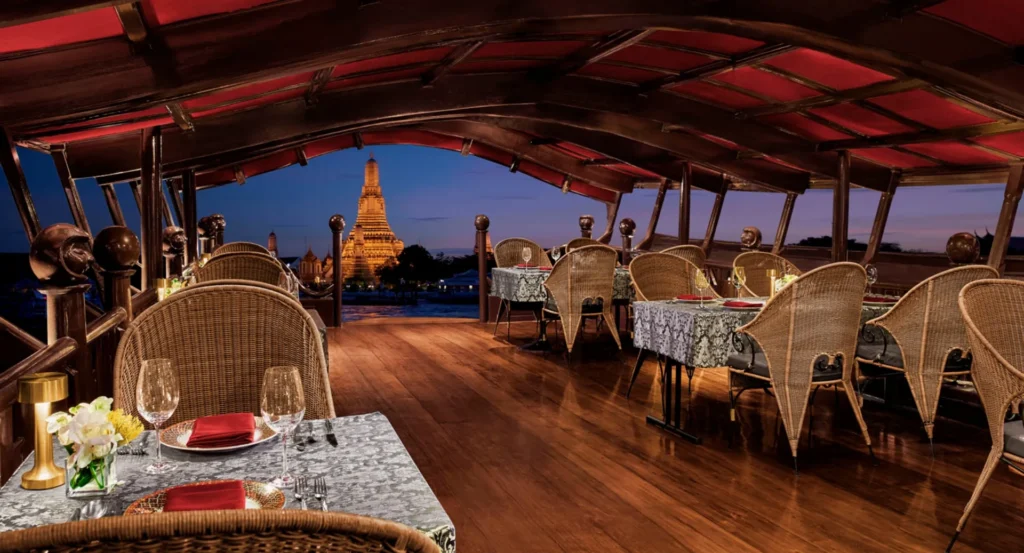
One of the best things we did at the Anantara was join the organised dinner cruise along the historic river. Whilst the sun set and night fell on the city, we dined on a five course-menu curated by executive chef Phongthorn, all to be enjoyed as you pass famous landmarks such as the Grand Palace and Wat Arun. If you’re a morning person, there’s also the Dawn Voyage available every weekend. Starting at 8am, it sheds yet another different light on this most captivating of cities. 

Food & Drink 

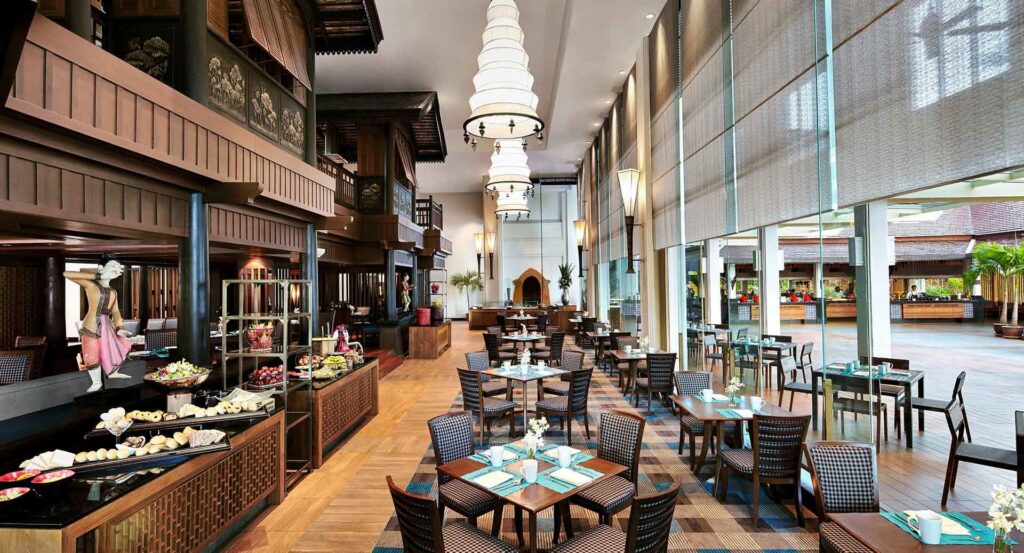
The buffet breakfast at Anantara’s ‘Market’ is wonderful. Here you can begin your day overlooking the river, enjoying the gorgeous view. The breakfast mango smoothies are particularly addictive during mango season (from late March to July). Filter coffee is available, of course, but if you want a really good coffee, often lacking at buffet breakfasts, then head to Mocha and Muffins inside the resort complex. 

Bangkok is home to some of the best restaurants and street-food stalls in the world, so there’s every reason to venture beyond the hotel for your meals. However, if you’re too exhausted to go out after a day of sightseeing, the hotel offers a diverse range of dining options (about as many you can count on two hands) to cater for all tastes. 

If the craving for Western food hits, Italian Brio serves a great menu of pizza and pasta – though it should be said, as an aside, that Bangkok is home to some of the best pizzerias in Asia. There’s Trader Vics here too, offering ‘Pacific Rim Cuisine’ and home to Bangkok’s only Chinese wood fired oven. We must say that the signature Trader Vic’s Mai Tai cocktail isn’t half bad. Also on site, the Japanese Teppanyaki house Benihana is every bit as theatrical as it is culinarily impressive.

There’s also the Riverside Terrace, where guests can indulge in a torch-lit seafood barbecue buffet while enjoying traditional Thai dance performances, all against the backdrop of the river.

The standout place for us, though, is the Longtail cocktail bar – it’s a great alfresco spot serving up Thai craft beer and cocktails that use local ingredients to great effect. Our favourite thing to drink here was the ‘Chao Phraya’ (no, we were not taking sips out of the river), where rum is mixed with fermented rice puree and cha-pu syrup made of herbs that grow along the river. It’s all served in a bamboo vessel – a traditional way of transporting liquids in Thai culture. They also serve up some great Thai drinking snacks like the sticky, fermented pork sausage, sai grok, and the beloved Thai minced meat salad, laab.

Why Stay? 

Known as the ‘River of Kings’, the Chao Phraya is a vital artery of Bangkok, and staying at the Anantara Riverside places guests right at the heart of it. When it’s time to replenish and relax in the midst of this juggernaut of a city, you can rely on the Anantara Riverside to help. Everything about the hotel seems to have been designed with relaxation in mind. As cliched as it sounds, the phrase ‘urban oasis’ springs to mind. 

Website: anantara.com

Address: 257/1-3 Charoennakorn Road Samrae Thon Buri, Bangkok 10600, Thailand

IDEAL Magazine stayed as a guest of the hotel

How To Complain Effectively About Just About Anything

0

We’ve all been there: the restaurant order that arrives stone cold, the delivery that never materialises, or the service that falls spectacularly short of expectations. Yet many of us suffer in silence, accepting poor treatment with a polite smile and a muttered “never mind.” But here’s the thing – complaining, when done properly, isn’t just about venting your frustrations. It’s a powerful tool for getting results, improving services, and standing up for yourself with grace and effectiveness.

Start With The Right Mindset

Before you launch into battle mode, take a step back and reframe your approach. You’re not attacking a person; you’re addressing a problem that needs solving. The person on the other end of your complaint likely didn’t personally sabotage your experience – they’re there to help, even if they don’t immediately seem like it.

Think of yourself as a collaborative problem-solver rather than an adversary. This mental shift will transform your tone, your language, and ultimately, your results. People respond far better to someone seeking a solution than someone looking for a fight.

Do Your Homework First

Never complain empty-handed. Before making contact, gather all relevant information: receipts, order numbers, correspondence, photographs, and timelines. The more organised and factual your approach, the more seriously you’ll be taken.

Research the company’s policies, guarantees, and standard procedures. Check their website for complaint procedures, escalation routes, and contact details for different departments. This preparation shows you’re serious and makes it harder for staff to fob you off with excuses.

Choose Your Channel Wisely

Not all complaints are created equal, and neither are the channels for making them. For simple issues – a wrong coffee order or a delayed train – speaking directly to staff on the spot often yields immediate results. For more complex problems, written communication provides a paper trail and forces you to articulate your concerns clearly.

Social media has revolutionised complaining, with many companies now maintaining dedicated customer service teams on Twitter and Facebook. A well-crafted public tweet can work wonders, but use this power responsibly. Public shaming should be a last resort, not your opening gambit.

Read: Your guide to avoiding travel disruption before it happens

Master The Art Of Tone

Your tone sets the entire trajectory of the interaction. Start polite but firm, and always address people by name when possible. “Hello Sarah, I hope you’re having a good day” goes much further than “Right, I’ve got a problem.”

Avoid accusatory language like “you people always” or “this is ridiculous.” Instead, focus on the specific issue and its impact on you. “I’m disappointed because…” or “I was surprised to find…” convey your feelings without putting the recipient on the defensive.

Be Specific & Solution-Focused

Vague complaints get vague responses. Instead of “your service is rubbish,” explain exactly what went wrong, when it happened, and how it affected you. Then – and this is crucial – suggest realistic solutions.

“I ordered a medium steak but received one that was well-done. Could we please get this corrected?” is infinitely more effective than “This steak is completely wrong and ruins my entire evening.”

Know When To Escalate

Sometimes your first point of contact simply cannot or will not help. Don’t waste time flogging a dead horse. Politely ask to speak to a supervisor, request the complaint be escalated, or find alternative contact methods.

For persistent issues with significant impact – particularly those involving professional services where standards have clearly been breached – you might need to consider more formal routes. In extreme cases involving professional misconduct, seeking advice from professional negligence solicitors can provide clarity on your options and the strength of your position.

Use The Power Of Documentation

Keep meticulous records of every interaction. Note the date, time, person you spoke to, and outcome of each conversation. This documentation serves multiple purposes: it helps you track progress, provides evidence if you need to escalate, and demonstrates to companies that you’re serious and organised.

Follow up written complaints if you don’t receive a response within a reasonable timeframe – usually seven to fourteen days. A simple “I’m following up on my complaint from [date]” email often prompts action from companies that thought you might simply give up.

Know Your Rights & Use Them

Familiarise yourself with consumer protection laws, industry standards, and company policies. In the UK, consumer rights are robust, and knowing phrases like “not fit for purpose” or “reasonable expectation” can add weight to your complaint.

Many industries have ombudsman services – independent bodies that can investigate complaints when companies fail to resolve them satisfactorily. The Financial Ombudsman, Property Ombudsman, and numerous others offer free dispute resolution services.

Time It Right

When you complain matters as much as how you complain. Avoid calling customer service lines during peak hours when staff are rushed and stressed. Mid-morning on weekdays often yields better results than Friday evenings or Monday mornings.

Similarly, don’t complain in the heat of the moment when you’re angry and likely to say something unhelpful. Take time to cool down and formulate your approach strategically.

Make It Easy For Them To Help You

The person handling your complaint wants to resolve it quickly and move on to the next issue. Make their job easier by being clear about what you want, providing all necessary information upfront, and being reasonable in your expectations.

If you’re seeking compensation, be realistic. Asking for a full refund because your soup was slightly cold is unreasonable, but requesting a replacement meal or discount on your bill is perfectly fair.

Follow Through Gracefully

When a company resolves your complaint satisfactorily, acknowledge their efforts. A simple “thank you for sorting this out” or positive review mentioning how well they handled your issue builds goodwill and encourages good service for future customers.
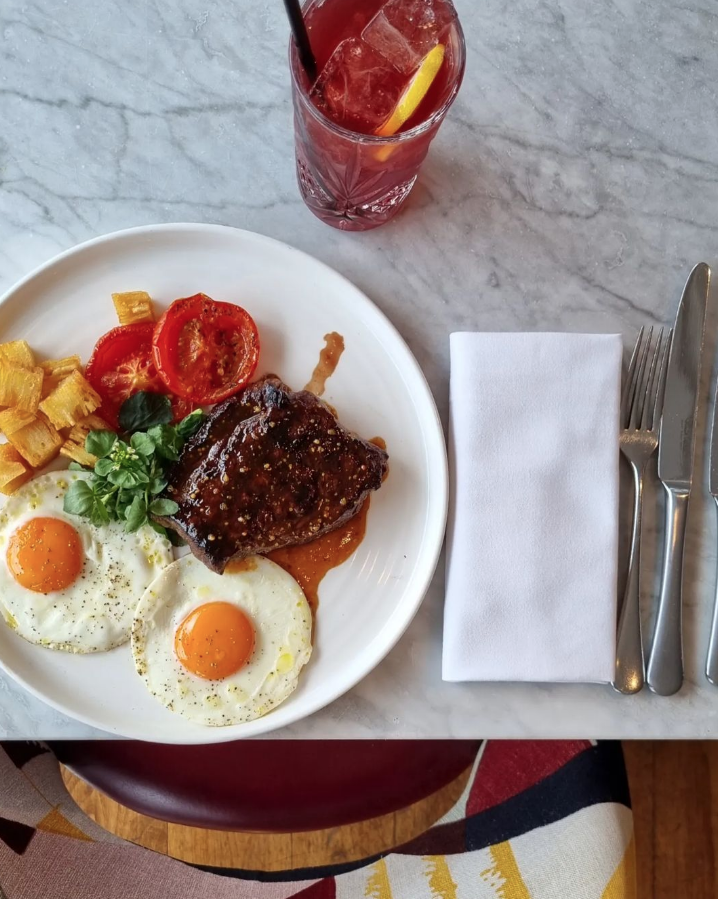
If they exceed your expectations in putting things right, consider sharing your positive experience as publicly as you shared your initial complaint.

Read: How to handle a dispute with your neighbour calmly

When To Walk Away

Sometimes, despite your best efforts, a complaint simply won’t be resolved to your satisfaction. Know when to cut your losses and take your custom elsewhere. Life’s too short to spend it battling companies that clearly don’t value your business.

However, before walking away completely, consider whether the issue warrants reporting to relevant authorities, industry bodies, or review platforms to warn other consumers.

The Long Game

Effective complaining isn’t just about getting immediate satisfaction – it’s about contributing to better standards across the board. When you complain thoughtfully and constructively, you’re not just solving your own problem; you’re potentially improving the experience for countless future customers.

Companies genuinely want feedback, even when it’s critical, because it helps them improve. Your complaint might highlight a training need, reveal a flawed process, or identify a recurring problem that needs addressing at a systemic level.

Remember, complaining effectively is a skill like any other – it improves with practice. Start with smaller issues to build your confidence before tackling larger problems. Soon, you’ll find that standing up for yourself comes naturally, and you’ll rarely accept substandard service again.

The next time something goes wrong, don’t suffer in silence or explode in anger. Take a deep breath, gather your facts, and complain like the articulate, reasonable person you are. You might be surprised by just how effective a well-crafted complaint can be.

Covering The Country: Must-Visit Places In Saudi Arabia

Ideal for first-time visitors discovering KSA… 

Until 2019, Saudi Arabia issued visas solely for pilgrims, business people and expatriate workers. The country enforced strict conservative laws and dress codes, with the mutawa (religious police) making arrests for activities such as playing music, wearing excessive makeup, or being seen in public with someone of the opposite sex. 

However, significant changes began in 2016 when it announced its plans to diversify the economy. Spearheaded by the Saudi crown prince Mohammed bin Salman, he initiated Vision 2030, a campaign to make KSA a ‘tolerant country’ with Islam as its constitution and moderation as its method.

In doing so the vision also aims to move the Saudi economy away from dependence on oil to tourism, potentially modernising its society in the process. The mutawa’s authority was curtailed, and Saudi women were granted the right to drive and travel without the need for prior consent. The country has even seen the establishment of cinemas and international music festivals, too.

We can safely say that the country has poured billions into making the KSA appear more progressive to outsiders. Accordingly, tourist visas were introduced, allowing visitors from 49 countries to explore Saudi Arabia. Last year, its tourism council revealed a record-breaking record-breaking year for Travel & Tourism in Saudi Arabia and welcomed 100 million tourists, well surpassing Vision 2030’s original target to attract 55 million tourists by 2030. 

Tourism is big news for the kingdom. Big hotel brands like the Four Seasons have moved in, and Accor has recently announced that it’s to open 45 new hotels in the Kingdom by 2023. Shiny new shopping malls are now home to Western Brands like Dunkin (we still have no idea why they changed it from Dunkin’ Donuts), which has become a new favourite of the Kingdom

While tourism is booming, many curious travellers are still unfamiliar with the Kingdom, which is why we’re bringing you this rather broad article on some of the top places to visit in Saudi Arabia. 

The Mosques Of Jeddha 

Can I visit Mecca and Medina as a non-muslim? It’s one of the questions many people ask when visiting Saudi Arabia. Since whole opening-up-to-tourists is new, there is still much confusion and outdated information, so let us clarify. If you are a non-Muslim tourist visiting Saudi Arabia, you’re not allowed to enter Mecca which is home to the Grand Mosque.  

Mecca is the holiest city in all of Islam. It is believed to be the birthplace of God’s revelation to man, and the city is centered around kabba, believed to be the site where God first revealed his message to the Prophet Abraham. Visiting Mecca is one of the pillars of Islam, and every Muslim seeks to carry out a pilgrimage to Mecca at least once in their life. Muslims can get of course get Umrah deals from the UK, to make the pilgrimage easier, but for non-Muslims, it’s out of bounds.

While non-Muslims are welcome in the holy city of Medina, they cannot visit the Prophets Mosque. Do be aware too that if you plan to visit during the Hajj season, you must apply for a Hajj visa.

Saudi Arabia is a deeply religious country. Tourists can gain a greater understanding and appreciation for the religion and the country by visiting its mosques that allow non-muslims inside. For visitors interested in visiting religious sites within the country, Jeddah is a better option than Medina, as it’s home to severak mosques that allow non-Muslim visitors to enter.

Perhaps the highlights here are the King Fahad Mosque, built by Abdel Wahed Al Wakil, who was one of the most influential architects in Islamic architecture, Al Taqwa Mosque, and the Al Rahma Mosque on The Red Sea, otherwise known as the Floating mosque, which is best seen at high tide.


Half Moon Bay

To the outside world, Saudi Arabia usually brings to mind miles and miles of dessert and sand dunes. However, it’s home to a diverse landscape cityscapes, grasslands, mountain ranges, and many glorious beaches.

Half Moon Bay is one of them and has been drawing Saudi families for decades. Located along the eastern coast of the Arabian Peninsula, this crescent-shaped bay is renowned for its serene waters, soft sandy shores, and stunning sunsets, and its calm, shallow waters make it an ideal spot for families with children.

In addition to its natural allure, Half Moon Bay Bay is steeped in local culture and history. Visitors can explore nearby attractions such as the Al Khobar Corniche and the King Fahd Causeway, which offer insights into the region’s heritage and modern development. The beach is also a gateway to the vibrant city of Al Khobar, known for its bustling markets. 

When visiting public beaches in Saudi Arabia, it is important to adhere to local customs and dress codes. Tourists should dress modestly, with men typically wearing shorts and t-shirts, while women are advised to wear long, loose-fitting clothing that covers their arms and legs. Swimwear is generally acceptable at private beaches and resorts, but it is recommended to bring a cover-up for walking to and from the beach area. Respecting these guidelines ensures a comfortable and enjoyable experience for all visitors.


The Red Sea 

Speaking of beaches, and announced as part of Saudi Arabia’s 2030 vision, The Red Sea Project is already making waves in the luxury travel world, emerging as one of the world’s premier beach destinations

This pioneering regenerative tourism destination on the west coast of Saudi Arabia (500km north of Jeddah, between the Saudi towns of AlWajh and Umluj) is expected to have 50 luxury resorts across 90-plus pristine natural islands by 2030. 

Home to the world’s fourth-largest barrier reef system, pristine beaches and beautiful blue waters, there really is something for everyone here. Here tourists can enjoy water-based activities such as snorkelling around its thriving coral reefs and kayaking through the Red Sea’s crystal clear tributaries, where mangroves preserve the region’s ecosystem.

The Red Sea’s inland region is also home to endless dunes where you can for dessert biking and appreciate the vastness of the desert landscape. It’s also home to red, rocky mountains which are popular for stargazing and full moon hikes. 

Thanks to an average daily temperature of 32C and arid desert weather, The Red Sea region is a year-round destination. Some of the top Red Sea resorts already in action include the Six Senses Southern Dunes, The St. Regis Red Sea Resort, and Nujuma, a Ritz-Carlton Reserve.


Al Ula Old Town

Located in the northwestern region of Saudi Arabia, Al Ula Old Town has huge historical significance to the region. The town was a vital crossroads on the incense trade route, connecting the Arabian Peninsula with the Mediterranean. 

Today, this ancient town, with its labyrinthine streets and mudbrick houses, provides a fascinating glimpse into the past, showcasing over 2,000 years of human settlement. Visitors can explore the remnants of ancient civilisations, including the Nabateans, who also built the famous Petra in Jordan. The well-preserved ruins, ancient inscriptions, and rock art offer a tangible connection to these bygone eras.

Additionally, Al Ula Old Town is surrounded by stunning natural landscapes. The dramatic sandstone mountains and lush oasis create a picturesque backdrop  The nearby Hegra (more on that in a moment), a UNESCO World Heritage site, features monumental tombs carved into rock formations, further enriching the historical experience.


Asir National Park

Spanning over 1,600 square kilometres, Asir National Park is renowned for its stunning landscapes, which include rugged mountains, lush valleys, and dense forests, providing a stark contrast to the typical desert scenery of the Arabian Peninsula.

One of the main attractions of Asir National Park is its diverse flora and fauna. The park is home to over 300 species of birds, including the rare and endangered Arabian leopard. Nature enthusiasts can enjoy birdwatching, hiking, and exploring the rich biodiversity that thrives in this unique ecosystem. The cool, misty climate of the Asir Mountains, particularly around the city of Abha, offers a refreshing escape from the heat, making it an ideal destination for outdoor activities.

Visitors can explore traditional Asiri villages, characterized by their distinctive architecture and vibrant wall paintings. The local markets and festivals provide a glimpse into the region’s rich cultural heritage and traditions.


Read: 4 fantastic things to do in Saudi Arabia this September


Taif 

Known poetically as the City of Roses, Taif is home to expansive rose fields and many perfume factories. The roses bloom from March to April and their petals are harvested for prized rosewater and oils used in perfumes by many high end brands like Chanel and Hèrmes

The Taif Rose Festival, held annually, celebrates the city’s famous rose farms, where tourists can witness the production of rose water and perfumes. It’s a wonderful time to visit as the air becomes heady with the fragrance of roses.  

Nestled in the Sarawat Mountains, many Saudis come here in  the summer to enjoy the cool climate. Nature enthusiasts can visit the Al Hada Mountain, accessible via a scenic cable car ride, offering breathtaking views and opportunities for hiking. For a cultural experience, the Souq Okaz, an ancient market, offers traditional crafts, performances, and a taste of local cuisine. 


Read: Do I really need travel insurance?


Hegra

Hegra, also known as Al-Hijr or Madain Salih, is an ancient archaeological site located in the Al-Ula region of northwestern Saudi Arabia. As the southern capital of the Nabataean Kingdom, Hegra is renowned for its well-preserved rock-cut tombs and monumental facades, which date back to the 1st century CE. This UNESCO World Heritage site offers a fascinating glimpse into the Nabataean civilisation and its architectural prowess.

Visitors to Hegra can explore over 100 intricately carved tombs, each adorned with detailed inscriptions and symbolic motifs. Guided tours provide historical context and insights into the Nabataean way of life. Additionally, the site features remnants of ancient wells, residential areas, and a railway station from the Ottoman era, adding layers of historical intrigue.

And since you’re in the Middle East, here’s how to spend an alternative weekend in Dubai, immersing yourself in the city’s lesser-known cultural gems…

7 Steps To Helping Elders Live A More Meaningful Retirement

To alter a well-worn phrase ever so slightly; nothing in this world can be said to be certain, except death, taxes and ageing. Indeed, getting older – in terms of accumulated years and their effect on your body – is inevitable and takes no prisoners, irrespective of wealth and status.  

But these golden years needn’t be spent in a hopeless, defeatist march towards the end. Despite the fact that isolation and loneliness are increasing amongst the elderly, and sometimes giving up employment can leave retirees feeling bereft of motivation, there are steps you can take to make those final years full of purpose and, whisper it, even fun. With that in mind, here are 7 steps to helping elders live a more meaningful retirement.

An Engaged Social Life

It’s been called the UK’s ‘silent epidemic’ and is an issue which doesn’t only afflict this country. Indeed, with so much interaction now occurring online, and with the world developing at a pace which leaves many behind, the elderly can sometimes be prone to loneliness and depression in the modern age.

The key to counteracting this is to encourage and facilitate as active a social life as possible in this ‘at risk’ age group. There really is no replacement for regular, face-to-face visits if an elderly loved one lives alone. 

That said, that can sometimes be tough, but regular (ideally, daily) phone calls for lively or loving discussion is the next best thing. Should making phone calls is tough – due to dexterity or mobility reasons – you might want to think about buying smart home hub device, such as Apple’s Siri or Amazon’s Alexa for your elderly loved one; the hands free nature, as well as simplicity of use, can be really useful for those elderly people who struggle with mobility or cognitive function.

Easy & Comfortable Living

For many retirees, their galavanting days are mostly behind them—all the power to those that are still trotting the globe. But the likelihood is that very few will decide to do much moving around after retirement, either moving out to their dream home, staying put, or moving into a retirement home. All the options are a perfectly valid form of living.

However, since this will be their forever home, it is important to ensure they are completely happy and satisfied in their home with access to all of their needs and all of life’s luxuries. 

If you’re in your golden years, make sure you are within comfortable walking distance to all of your amenities, easy access around your own home with as many accessibility options and support.

Also, as previously mentioned, engaged social life is a big priority. This means being near and around loved ones and friends in order to socialise. For those that are thinking of assisted living, moving to a retirement home, you want somewhere where all these needs are taken care of with ease. 

One increasingly popular option worth considering is park bungalow communities, which offer purpose-built, single-storey homes designed specifically for those over 45. These developments, such as those created by Regency Living, provide homes that are energy-efficient and low-maintenance, while fostering a strong sense of community through shared spaces and organised activities. Located in appealing areas near coastlines, countryside, or historic towns, park bungalows strike an ideal balance between independent living and neighbourly support, making them an attractive alternative for those who want to downsize without sacrificing comfort or companionship.

Pursuing Hobbies & Lifelong Learning

Retirement presents the perfect opportunity to explore interests that working life may have pushed aside. Whether it’s finally learning to play the piano, taking up watercolour painting, joining a book club, or enrolling in free online courses through platforms like the Open University, engaging the mind in new pursuits provides immense satisfaction and cognitive benefits.

Many community colleges offer discounted or free courses specifically for seniors, covering everything from local history to digital skills. Learning new technologies can be particularly empowering, helping older adults stay connected and engaged with the modern world. Creative pursuits like writing memoirs, genealogy research, or photography not only provide personal fulfillment but can also leave meaningful legacies for future generations.

The key is to start small and choose activities that genuinely spark interest rather than obligation. Whether it’s joining a local gardening club, volunteering for a cause close to the heart, or simply dedicating time to reading all those books that have been waiting on the shelf, having projects and goals gives structure and purpose to retirement days. These activities also provide natural opportunities for social connection, as many hobbies lead to meeting like-minded individuals who share similar passions.

Daily Assistance

Our seniors will likely need a helping hand in carrying out their day-to-day activities, and acknowledging this certainly isn’t an affront to their independence. In fact, any offers of assistance will be greatly appreciated. 

This is particularly pertinent in terms of medical need. As people age, medication and doctor’s appointments become part of daily life in a much more pronounced way. And counterintuitively, it’s also a time when remembering all these appointments gets tougher. Things can get misplaced, misconstrued or forgotten about, as a collective result of worsening memory, eyesight and increased distraction. 

Do your best, then, to get involved; initiate an active role in booking GP’s appointments, and be on hand to interpret instructions from their doctor, to reassure and clarify confusing information wherever possible. Invest in a pillbox so the medication doesn’t get mixed up, and label each one carefully should there be a risk of items getting mixed up.

If you are not readily available to help first hand with the regularity you’d like, you can hire help. A carer will be experienced in helping elders with a lightness of touch and respect so needed during these latter years. Though hiring represents quite the expense to many, it plays an essential role in ensuring that seniors remain safe and sane after retirement.

Financial Help

The image of a retiree settling back into beach-based retirement with pina colada in hand and nothing to worry about doesn’t really ring true anymore. Indeed, financial concerns can commonly plague the golden years.

It’s advisable to have an open dialogue about financial matters to ensure there’s no burden weighing heavy on your elderly loved ones during this time. If you’re able to, lending financial help will make adjusting to retirement a more stress free experience.

Regular Physical Activity

Just because mobility in old age is often reduced doesn’t mean that exercise should be neglected. Indeed, seniors benefit hugely from regular exercise, serving to keep not only the body fit but also the mind active. Some of the myriad benefits of exercise for the elderly include an improved immune system, stronger bones and balance, and reduced risk of age related health issues.

We’re not suggesting a regular marathon or joining the local five-a-side footy team, but a routine raising of the heart rate can do the world of good here. A brisk walk, a regular swim, stationary cycling (on an exercise bike) or gentle martial art participation – such as Tai Chi – can work wonders. It also grants a sense of purpose often lacking in retirement, particularly if there’s a participatory or involves a goal-orientated element. 

A Balanced Diet

A recent report by the World Health Organisation has suggested that many seniors are at increased risk of disease because they do not observe a healthy, balanced diet. Indeed, with decreased dexterity and mental faculties, whipping up a dinner from scratch, containing the requisite carbohydrates, proteins, fruits, and vegetables, can be tough. 

Here’s where you can play your part; cook a round of nourishing delicious meals to be kept in the freezer; snag an exclusive home delivery slot from a local supermarket and order lots of fresh produce; or, stock up your elderly loved one’s fridge with top quality, homecooked ready meals, of which there are now brands who cater specifically to ‘mature tastes’. All of this will provide an incentive for a cleaner, healthier eating and also hopefully bring more meaning to the daily routines by making mealtimes more enjoyable.

The Bottom Line

Everyone deserves to live a happy and healthy existence after retirement. If you have a retired relative, there are many things you can do to ensure that they are enjoying a rich and meaningful life. 

7 Ideal Scuba Diving Accessory Must Haves

Come on in, the water’s fine! Though 2025 seems to have seen a slew of shark attack stories in the news, scuba diving has never been more popular.

Indeed, since 1966 PADI (the leading scuba certification organisation), have issued over 30 million diver certificates globally. But so much of the success of a dive depends on luck; the weather, the visibility, the whim and want of those pesky sharks, the rays, coral and the rest. 

There are some areas, though, where you can take matters into your own hands and exert a little control, most specifically your gear and accessories. With that in mind, here are 7 IDEAL scuba diving accessory must haves.

A Gear Bag

There are more incredible diving spots around the world than you could ever shake a snorkel at. And there’s a good chance that your bucket list is even more burgeoning. But when ticking off these places, you’ll quickly realise that packing and keeping track of all your gear can be a huge hassle. In the rush to get underwater, stuff can get misplaced, mixed up with the terra firma stuff, or heaven forbid, thrown overboard.

A scuba gear bag is a wise investment, then, allowing you to keep all of your accessories in one, convenient spot, and offering protection when the seas get choppy. Scuba diving gear bags are specifically built to stand up against salt water, the sun, and aggressive bag handlers, and when you’re committing this much time and money to your passion, it’s definitely worth giving it that extra protection.

You’ll also want to bring a dry bag with you. When you head out for a day of diving, you likely aren’t just bringing your diving accessories with you. Oh no, your life is coming along for the ride too and as such, your possessions are at risk of damage or worse. At the least, you’ll have your phone, towel, a change of clothes, a water bottle, and a snack or meal in tow and keeping all of this dry can be a challenge. A dry bag is a sensible investment to mitigate this risk.

Scuba Tanks & Cylinders

Sure, you’re probably thinking that cylinders should be in the ‘essentials’ camp, rather than being considered an accessory. After all, cylinders are essential in that, you know, they keep you alive down there, helping you breathe underwater for longer and ensuring you’re able to get deep, down and personal with the seabed.

The average aluminum 80-cubic-foot tank on a 12-metre dive will be able to provide air for about 45 to 60 minutes, with a safe amount in excess for the return to the surface. In recent years, however, the popularity of scuba cylinders has grown. Whilst not able to last as long as a tank (up to 12 minutes), these cylinders are worn under the chin, and are compact, lightweight and portable. What’s more, they can be filled up between turns using a hand pressure pump, and are well suited to diving beginners.

For those diving in fairly shallow waters, these compact cylinders are a great choice, and close to weightless underwater, leading to a liberating, flexible diving experience.

A Dive Light

If you think regular diving is an exciting experience, just wait until you try night diving. But, you can’t have a successful night diving experience without the right dive light. Because staring into the abyss with visibility low can be a frightening, rather than enlightening, experience. When shopping for a dive light, you’ll want to look for one that has multiple beams and light modes. And if yours comes with an emergency signal, even better!

A Dive Watch

A dive watch is to a scuba diver what a smartwatch is to a runner. For divers who like to keep meticulous track of their diving environment (something we should all be doing in the name of both safety and curiosity), such a device is an absolute necessity.

When shopping for a divers watch, look out for the following features:

  • A watch that can withstand significant pressure due to the depth of the water
  • A rotating bezel, which acts as a backup to digital timers. This is an extremely important function for divers. Divers have a limited amount of oxygen, and a rotating bezel will help them know when they are close to running out
  • Luminescent dial features, which allow you to tell the time when diving in low light conditions
  • A crown that screws down is also essential, preventing water from entering the watch
  • A watch that’s made from rust and corrosion-resistant materials
  • Magnetic and shock resistance

While this may seem like a lot, these features will allow you to have the best diving experience possible.

An Underwater Camera

There are moments under the water that simply have to be seen to be believed. The colours, the shapes, the reflections, the moving, grooving life….it can be such an overwhelming experience that when you come back up for air, describing all you’ve seen can be tough.

Such sights deserve to be captured, framed and logged, for posterity’s sake at the very least. Cameras specifically designed for diving are best for those keen on some serious snaps, with the GoPro Hero and Canon G7X range both producing professional shots of the deep blue. But for beginners, the iPhone camera, when combined with protective dive housing equipment, does the job brilliantly.

A scuba camera isn’t just about capturing memories – it’s about sharing the magic of the underwater world with those who’ve never experienced it. Modern dive cameras offer red filters to restore natural colours at depth and burst modes perfect for fast-moving fish. Having a camera underwater also changes how you observe your surroundings, making you notice smaller details and develop a keener eye for marine life.

A Dive Compass

Getting disoriented underwater is easier than you might think. Currents can shift your position, limited visibility can make landmarks disappear, and the underwater world can look surprisingly similar in all directions. Without a reliable way to navigate, what started as an exciting exploration can quickly turn into a stressful search for your exit point or dive boat.

A good dive compass is your underwater GPS, helping you maintain your bearings and navigate safely back to your starting point. Modern diving compasses are designed to work accurately even when tilted, and many feature luminous markings that remain visible in low-light conditions. Some advanced models even include digital displays with multiple waypoints and depth readings.

When choosing a dive compass, look for one with a rotating bezel that allows you to set and follow a specific bearing, a liquid-filled chamber that dampens needle movement for steady readings, and a design that can be easily read while wearing diving gloves. Many divers prefer wrist-mounted compasses for convenience, though handheld models often provide more precise readings.

Whether you’re exploring a new reef system, navigating back to an anchor line, or simply wanting to swim in straight lines during your safety stop, a reliable compass transforms navigation from guesswork into confidence. It’s the difference between ending your dive exactly where you planned versus spending precious air and time searching for familiar landmarks.

A Dive Knife

It’s a fact of scuba diving; it can, at times, be dangerous. Down deep, hazards can present themselves. If you get caught in a net or some other object underwater, how are you going to get out? With a trusty dive knife, of course.

Even though it is rare to get caught underwater, it’s always best to be prepared. A dive knife is better than a regular knife because it resists corrosion, can cut through nearly any material and comes in the perfect size to carry with you underwater.

If this has sparked your interest in all things scuba, then check out these reasons to go diving and explore the world’s oceans!

Culinary Travel Experiences In Latin America, Ideal For The Epicurean Adventurer 

Let’s put things broadly and bluntly to kick things off; Latin America is a remarkable destination for a culinary adventure, with a rich and complex gastronomic heritage pretty much unrivalled anywhere on the planet. 

Of course, the region’s topographical range is as large as its cultures are diverse, making it ideal for the epicurean adventurer seeking new tastes and experiences. Indeed, Latin America – the region in the Americas encompassing countries in Central and South America, as well as parts of the Caribbean, where Romance languages, chiefly Spanish and Portuguese, are predominantly spoken – boasts a unique blend of indigenous ingredients and cooking techniques, influenced in part by centuries of African, Asian and European immigration. This fusion has given rise to a vibrant and varied food culture that is both deeply rooted in tradition and constantly evolving.

Unsurprisingly, then, the region is home to a number of UNESCO’s Cities of Gastronomy; Arequipa in Peru, Belo Horizonte in Brazil, Buenaventura in  Colombia and Panama City in Panama, to name but a few.

Of course, one of the standout features of Latin American cuisine is its use of fresh, local produce. The continent’s varied climates and landscapes, from the Amazon rainforest to the Andes mountains, provide an abundance of unique ingredients. It’s also home to some of the world’s most celebrated culinary traditions. 

Peruvian cuisine, for example, has gained international acclaim in recent decades for its bold flavours and inventive use of native ingredients. Dishes like ceviche, made from fresh fish marinated in citrus juices, and lomo saltado, a stir-fry that combines beef with vegetables and soy sauce, showcase the country’s culinary creativity and assimilation of influences. Similarly, Argentina is famous for its steak and asado, which highlight the country’s expertise in both animal husbandry and meat cookery.

On top of all that heritage, it could be argued that in 2024, Latin America is the number one influence on contemporary culinary trends, with three of the top 10 restaurants in the world (according to the World’s 50 Best Restaurants list, at least) based in the region. These culinary pioneers are not only preserving traditional techniques but also experimenting with new methods and ingredients. The results are thrilling.

A holiday to the region, then, is going to be one rooted in both innovation and tradition. But where to start in an area that spans 19.2 million km², 33 countries, and countless culinary cultures? Here’s a start; our pick of some of the best, most focused culinary experiences in Latin America, ideal for the epicurean adventurer.

The Mistura Food Festival in Lima, Peru

Ideal for the largest food festival in the continent…

We had to start here. Peru has arguably established itself as South America’s premier culinary destination. Whilst the country’s residents have of course known it since, well, forever, Peruvian food has been enjoying its time in the global spotlight lately, most recently winning ‘World’s Leading Culinary Destination’ at the World Travel Awards last year.

Without wishing to state the obvious here, the best place to try Peruvian food is in Peru, and there is no better time to experience it than in September, at the Mistura Food Festival. Held every September for 10 days, Mistura is South America’s largest food festival, drawing thousands of food enthusiasts from around the globe showcasing Peru’s biodiversity and culinary richness. 

Roasted Alpaca is Peruvian delicacy at Mistura Food Festival By Kaszojad via Canva
Anticuchos cooking on the grill by tirc83 via Canva
Anticuchos Peruvian beef hearts by tirc83 via Canva

The festival features over 300 farmers from various regions, and visitors can indulge in a variety of regional dishes prepared by more than 50 restaurants and 70 food carts. Here, traditional Peruvian favourites like ceviche, anticuchos (grilled meat skewers), and cuy (roast guinea pig) take centre stage alongside the innovative fusion dishes that the country is so well known for.
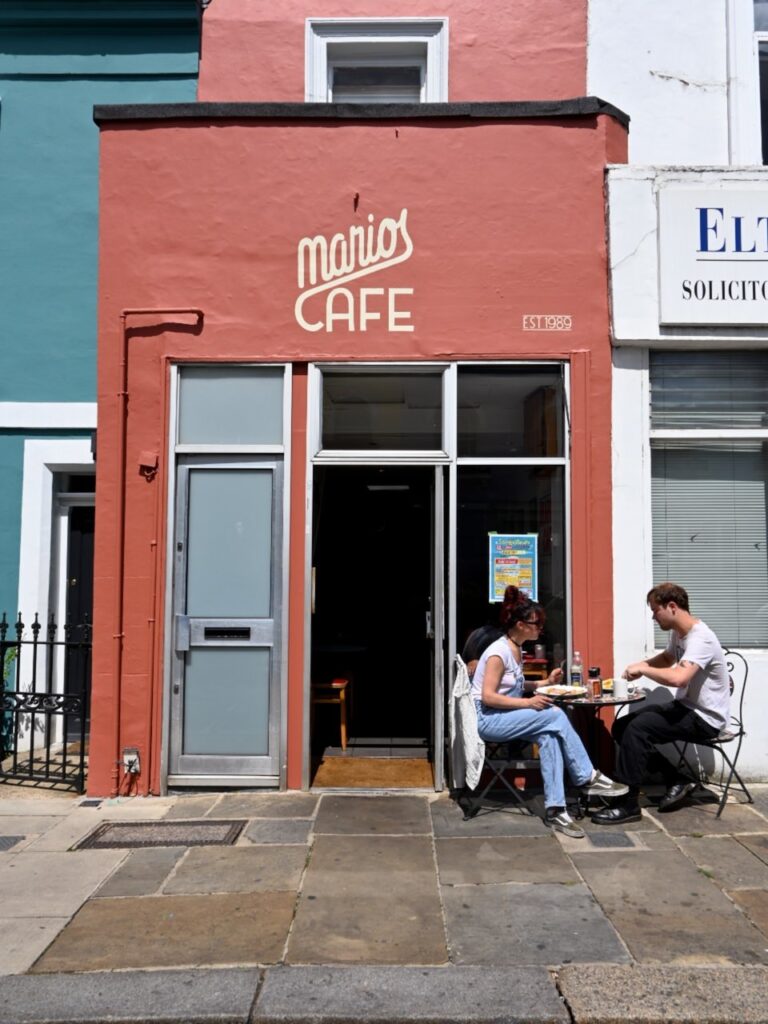
The festival’s highlight is the Gran Mercado, where attendees can taste and purchase premium produce from thousands of Peruvian producers. The highlight for many is the extensive range of cacao, with Peru boasting 12 exclusive growing regions of this exclusive, alluring ingredient. Many are here to shop for the rare, esteemed Criollo variety, which is sourced from Peru’s northern Piura region and used by some of the world’s best chocolatiers. 

It’s not only about chocolate here, of course, or ingredient shopping for that matter. Peru’s celebrity chefs and humble (and equally as skilled) street food vendors converge on the festival to demonstrate their skills and offer tasting samples. On top of all that, the event hosts numerous workshops and live cooking demonstrations, providing an immersive insight into the world of Peruvian gastronomy.

Where To Eat 

While you’re in Lima, securing a table at Chef Virgilio Martinez’s Central (the 2023 winner of the World’s Best Restaurant) is a must. Other restaurants regularly featured in the upper echelons of such lists include Maido, led by the award-winning Japanese-Peruvian chef Mitsuharu and Mayta, arguably Lima’s current hottest ticket in town in a city full of them.

Where To Stay

For the epicurean adventurer, nothing but sustainable luxury will do. Lima is home to a wealth of luxury hotels by big name brands striving to do things in a more eco-friendly way. The Country Club Lima Hotel, Palacio del Inka (a Luxury Collection hotel) and Miraflores Park (a Belmond hotel) all featured in Condé Nast’s Best Hotels in South America list for 2023. 

Read: 12 traditional Peruvian foods that you must try 


Vendimia Festival in Mendoza, Argentina 

Ideal for sipping Malbec in Argentina’s most renowned wine region…

From the staggering range of landscapes to the Maradona House Museum in Buenos Aires, there are countless good reasons to visit Argentina. Mendonza’s Vendimia Festival is most certainly one of them.  

The country’s ‘second city’ to many, Mendoza is the wine-growing heart – the beating grape – of Argentina. This region is about the same distance from the equator as the grape-growing regions of California, France, and Italy, and produces wine of similar quality and acclaim as a result. 

Mendonza’s wines range from award-winning Malbecs to vino patero, a proud Argentinian tradition that sees families and friends gather to crush grapes by foot, creating a rustic, young and sweet wine that embodies the spirit of community and heritage.

Familiar to steakhouse lovers the world over, Malbec is the signature wine of Mendoza and many vintages from the region are considered the world’s best. Known for its rich, fruit-forward flavours and juicy texture, common tasting notes of Mendoza Malbec include dark fruits such as blackberry, plum, and black cherry, and plenty of robust tannins. 

Every February, Mendoza gears up for the harvest festivities known as Fiesta Nacional de la Vendimia (National Grape Harvest Festival), all of which culminates on the first Saturday of March. It’s celebrated all over Argentina, but Mendoza’s celebration is the largest. Everyone from garagistas (garage winemakers) to large wine estates join in on the fun. 

A vibrant tribute to the region’s wine-making heritage, the people of Mendoza honour the humble grape harvest with parades, concerts and fireworks. They even choose a harvest queen. 

On top of that, many wineries host special events to commemorate the occasion, including complimentary wine tastings on the city streets, allowing visitors to sample a variety of local products. Wine enthusiasts can also indulge in complimentary tastings at renowned vineyards like Catena Zapata. Don’t miss the red wine fountain, which simply has to be seen (and tasted) to be believed. You might not remember doing so, of course!
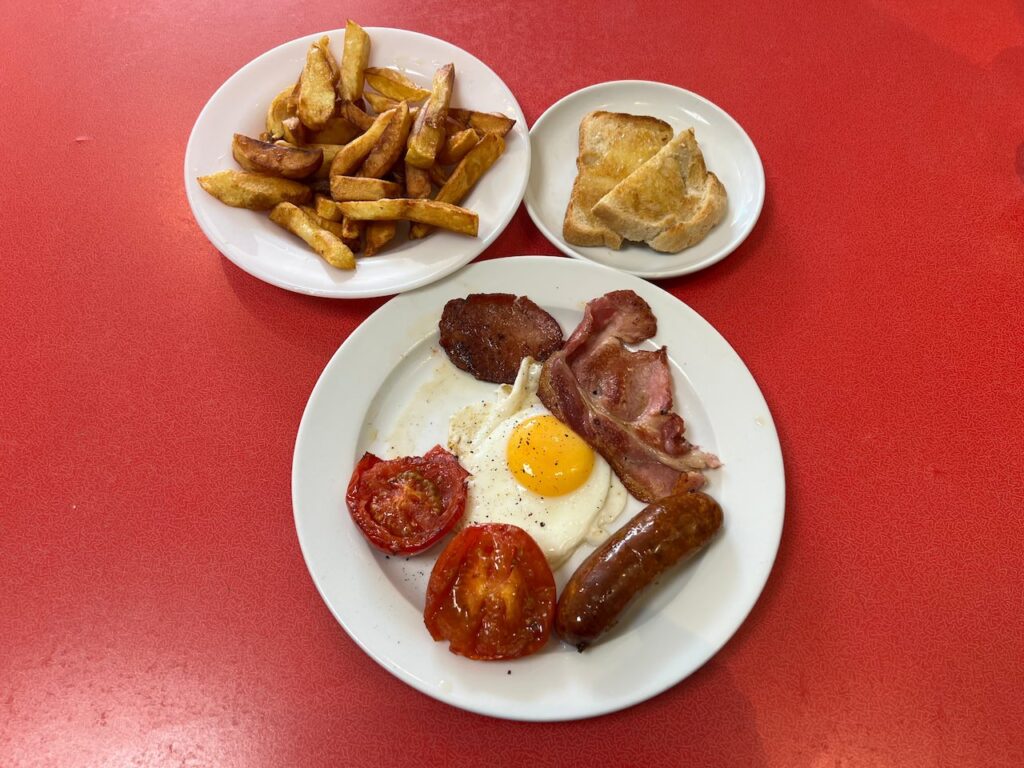
By EAQ Via Canva

Where To Eat 

While you’re in Mendoza, a must-visit is 1884 Restaurante. Housed inside a former winery and helmed by renowned chef Francis Mallmann (more on him in a moment), the restaurant offers a sophisticated menu of fire-based cooking highlighting local ingredients. This lavish place regularly makes those pesky lists we keep mentioning, and was featured in Argentina’s inaugural Michelin Guide, out at the tail end last year. With a 500-strong wine list, it’s our favourite place to dine and drink in Mendoza. 
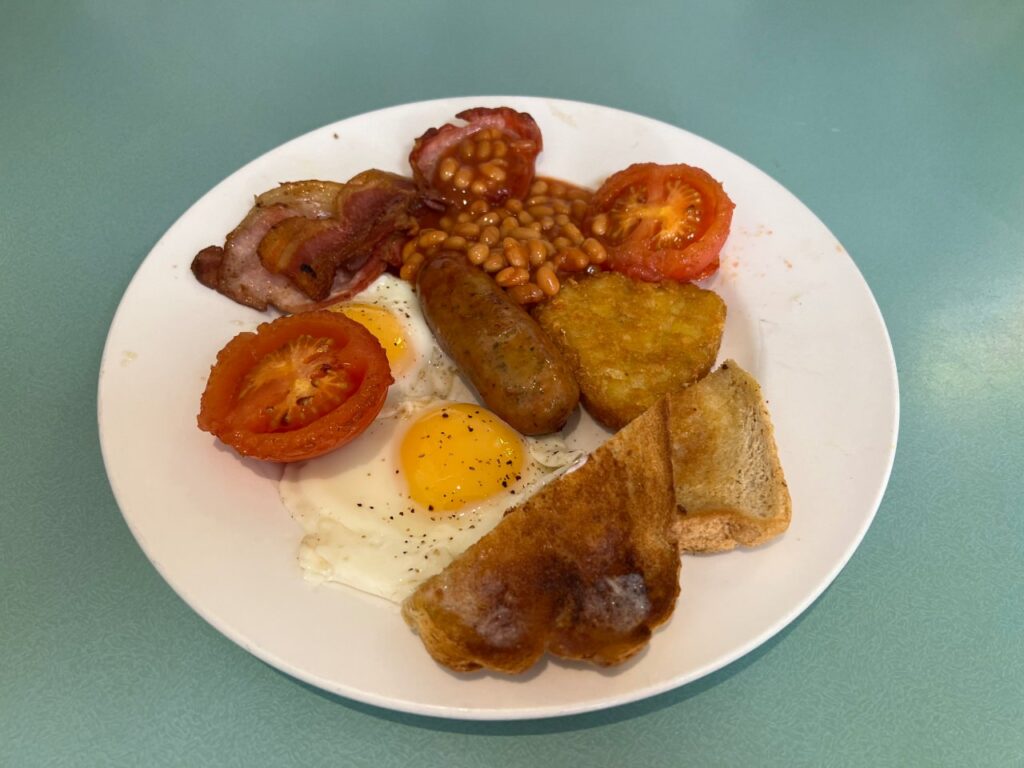
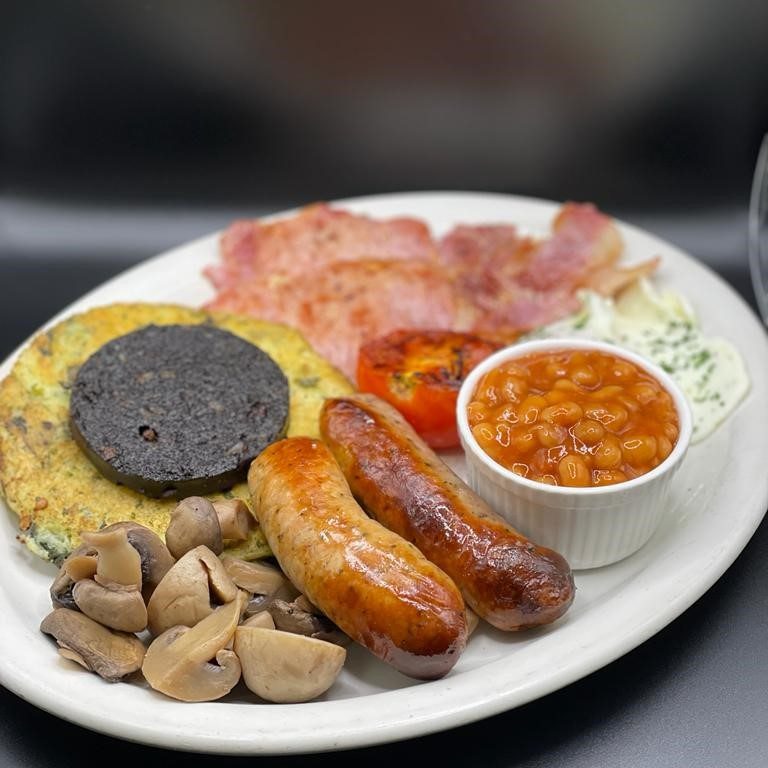
Azafrán, which means saffron in English, is another acclaimed Mendoza restaurant worth a visit. Chef Sebastián Weigandt is the main man here, bringing contemporary flair to classic Mendozan dishes. Since you’re in the area for the wine, you won’t be surprised that the wine list at Michelin-starred Azafrán is one of the best in the country. Salud!

Where To Stay 

With its private vineyard setting and private villas, The Cavas Wine Lodge provides an excellent base to experience the festival. Each villa has a private terrace with an open fire, making it the ideal place to curl up with a bottle of Malbec and enjoy the stunning Andean scenery. 

The Vines Resort & Spa is another good choice, billing itself as the ultimate retreat for food and wine lovers and outdoor adventurers. Oh, and the hotel’s restaurant, Siete Fuegos (Seven Fires), is helmed by none other than the mann, Francis Mallmann.  


Festival Del Habano in Havana, Cuba 

Ideal for those who believe all good meals end with a premium cigar…

In a recent article in the Guardian, a cigar shop owner in Mayfair told a reporter that 30% of his customers are under the age of 30. Indeed, it seems like the notion of a cigar-chomping old man in his dressing gown might be just a little bit outdated. 

Like drinking, smoking is without doubt bad for you, but that doesn’t stop hundreds of cigar enthusiasts from around the globe heading to Cuba for its premier tobacco festival, the Festival Del Habano, which offers a deep dive into the world of premium cigars.  

While technically not a culinary adventure, many cigar connoisseurs like to pair their smoke with food. For example, full-bodied cigars, such as Cubans and Hondurans, are thought to pair with smokey, barbecued foods, whereas mini cigars like Romeo y Julieta have a mellow smoke, so pair well with lighter dishes like pasta. This is the kind of stuff you can learn at Festival Del Habano in Havana.

Connoisseurs can attend factory tours and seminars, and take part in a contest for the longest unbroken ash, making their way through the festival trying not to drop their stack. The event culminates in a much-anticipated and gloriously lavish gala dinner which ends with a rare cigar auction. Once upon a time, Fidel Castro himself was a guest of honour at the gala dinner. He gave speeches every year and then signed humidors and cigars for the auction. What we would have given to share a stogie with El Comandante.

Where To Eat 

La Guarida (The Den) has been a Havanese fixture for over 84 years. It’s famed for both its culinary offerings and cinematic history. It doesn’t look like much from the outside and as you ascend the grand old crumbling staircase, you may not be filled with confidence. But this typically run-down Cuban charm is all part of the experience. As soon as you step into the grand restaurant, those feelings of doubt fall by the wayside – it’s a chic affair crowned by an incredible serving of suckling pig, a Cuban speciality. 

Where To Stay 

If it’s a five-star hotel you’re after, the Gran Hotel Manzana Kempinski offers a first-class, luxury experience in the heart of Old Havana. Iberostar Grand Packard is another luxurious hotel with stunning views of the Havana skyline and the sea. 

However, if you’re looking for a uniquely Cuban experience, stay at a casa particular (private guesthouses) some of which are equal to the best boutique hotels in the world in vibes. Paseo 206, La Reservais and Portería are all firm favourites of ours. 


Fire Cooking with Chef Francis Mallmann in Patagonia, Argentina 

Ideal for a culinary adventurer of open-fire cooking with a celebrity chef…

To call Chef Francis Mallmann a celebrity chef does him a disservice. He is Argentina’s most famous cook and undeniably one of the most prominent chefs in the whole of Latin America. Celebrated for his live-fire cooking techniques, which he’s termed ‘the 7 fires’, Mallmann’s approach utilises open flames, embers, and sometimes even hot ashes to prepare dishes that manage to be both rustic and refined.

Today he lives on a remote island in Patagonia, and you can join him to have an elemental encounter with food and nature on his private island, La Isla. Here guests can become properly immersed in his culinary journey, featuring daily open-fire cooking lessons over custom-made fire pits, all led personally by Mallmann. To get a taste of what’s in store, watch the Chef’s Table episode on Netflix devoted to the man, the myth, the legend himself. Yours for £25’000 a person.

Image via PSA

Where To Eat

You’ll likely arrive in Buenos Aires for this trip. A must-visit is Don Julio, arguably the world’s most revered steakhouse. Booking in advance is essential.

Where To Stay 

Guests can cosy up in Mallman’s treasured cabin while on the island. Luxury travel companies like Plan South America, which offer tailor-made journeys to Latin America, can assist you with securing a spot on this exclusive retreat.


Belize Lobster Festival, Belize

Ideal for seafood lovers and festival-goers…

Come summer, seafood season in Belize, the country’s long coastline and adjacent cerulean waters teem with crustaceans. Spiny lobsters, also known as rock lobsters, are particularly abundant in this part of the world, and str prized for their sweet and succulent meat. 

Lobster season in Belize opens on June 15th and closes on February 15th, and during this time there are many, many lobster festivals in the country, including Belize City’s Lobsterfest, the Caye Caulker Lobsterfest, Placencia Lobsterfest and our favourite, the San Pedro Lobsterfest. The latter, out of all the lobster festivals in Belize, is the biggest and most lively.  

San Pedro Lobstefest is held in July (usually in the second week) in the charming coastal town of San Pedro on the island of Ambergris Caye. This very Belizean festival is a hedonistic celebration of the crustacean – some even call it a festival of gastronomic debauchery. 

At the festival, lobster is served in many different ways – creole style, lobster thermidor, lobster ceviche, barbecued, frittered and on kebabs, in burritos and even as a pizza topping. Whichever way you take it, don’t miss the popular lobster crawl, where restaurants serve up lobster creations as a part of their menus. There are also fun and frivolous beauty pageants where some contestants dress as lobsters to a soundtrack of blasting reggae, all of which folds into night beach parties where local Belikin beers over ice go around until dawn. Heaven.

All that said, these lobster festivals aren’t just about fun and frivolity. They also highlight the sustainable lobster-catching techniques used – and encouraged – in Belize. While the lobster festivals have grown in demand, there are strict rules in place about the size of the catch. They also have a very strict, closed lobster season. Restaurants play their part in refusing soft-shelled and undersized lobsters. A delicious feast with a side of sustainability? Count us in!

Where To Eat

Elvi’s Kitchen, where Belize’s celebrity chef Jennie Staines pays homage to her mother Elvia’s Maya and Mestizo family recipes, is a must-visit. We know you’re here for lobster but her famous crab claws are a must-order too. 

If you’re still hungry, the Palmilla Restaurant, located within the Victoria House Resort, offers gourmet dining with a focus on local seafood, while the Hidden Treasure restaurant is known for its romantic ambiance and seafood dishes. 

Where To Stay 

5 miles north of San Pedro and reachable only by motorboat, Matachica Resort & Spa is the place to stay. If you haven’t had your fill of lobster, then Matachica’s restaurant, Mambo, is overseen by a trio of French Laundry alumni. The handmade lobster ravioli is particularly good.


Fiesta Del Yamor in Otavalo, Ecuador

Ideal for celebrating amazing maize in all its glory…

Corn has always held deep spiritual and cultural significance for the people of Latin America; both the Incas and the Mayans hailed it as a gift from the gods, symbolising fertility, abundance, and sustenance.

Today it is still widely celebrated across the world. Every year, the Fiesta Del Yamor in Otavalo, Ecuador, (an Indigenous harvest festival), honours the maize harvest. This 10-day celebration, starting at the business end of August and running into September, gives thanks at the second solstice, the season of the harvest. The celebrations date back to Incan rites of yamor, occurring the two weeks before the solstice.

The festival features a traditional drink called chicha del yamor, made from seven varieties of maize. As part of the offering to the sun god, the very best corn is chosen to be ground and mixed with water until it fermented to create a potent liquor called chicha. This drink lubricates proceedings, which include naked lake swimming, music, dancing and more.

Ecuador Otavalo City Street Market vy DanFLCreativo via Canva
Roasted Pig Head Otavalo Ecuador by DanFLCreativo via Canva

Where To Eat 

If you’ve had too much of that chicha del yamor to drink the night before, then tackle your chuchaqui (hangover) with an encebollado, a savoury fish soup with a murky yet oh-so delicious broth. 

Believed to help hangovers, this dish is served in the morning. Eat it at La Cosecha Coffee & Bakery. This restaurant is well-regarded for its hearty breakfasts and comforting dishes. Another great option is Mi Otavalito, which serves traditional Ecuadorian cuisine. 

Where To Stay 

Otavalo is home to the largest market in South America. During the Fiesta del Yamor, the Otavalo market, which is famous for its vibrant textiles and crafts, remains open.  

The market is often more lively and bustling during the festival, as it attracts many visitors and tourists, a time when vendors take advantage of the increased foot traffic to showcase their goods. Stay near the action (but removed enough for a little peace, too) at Hacienda Cusin, a beautifully restored 17th-century estate offering luxurious accommodations, gardens, and a unique historical experience.

Further away, the nearest big city is Quito. The capital of Ecuador and a UNESCO World Heritage site, it’s around a two hour drive from Otavalo, and also has plenty more accommodation options.


Flower & Coffee Festival in Boquete, Panama

Ideal for coffee lovers and nature enthusiasts…

Panama has long had a reputation as one of the world’s best coffee producers. Geisha, the rarest, most sought-after and most expensive coffee bean even comes from here. 

Coffee connoisseurs will know that its intensely floral Esmeralda Special from Hacienda La Esmeralda, located in the Boquete region of Panama, has time and time again been voted billed as “the world’s best coffee”, and has set auction records.

Boquete town, in the vibrantly colourful wooded valley of the same name, is surrounded by the mountains of Chiriquí. The nutrient-rich volcanic soil, cool climate and salty sea breeze in this northwestern part of Panamá make it ideal for growing coffee. 

Every year in January, Boquete holds its annual Flower & Coffee Festival. Visitors can tour coffee plantations, participate in tastings, and revel in the colourful displays of flora that the valley is famous for. Be sure to tour Finca La Valentina, the Don Pachi Estate, and the Hacienda La Esmeralda. You can even tour the region’s so-called coffee circuit, made up of 15 farms in Boquete, Volcan, and the greater Chiriqui region. 

Aerial views of Boquete town in Chiriqui Province of Panama by MediaProduction via Canva
© Dan Lundberg via Flickr

Where To Eat 

Visit Restaurante T’ach at the Panamonte Inn and Spa to experience the exquisite culinary creations of Panama’s leading culinary anthropologist, Charlie Collins. 

Previous winner of The Best in the World Culinary Heritage award at the 2018 Gourmand World Cookbook Awards, he masterfully blends traditional Panamanian flavours with innovative techniques. This unique dining experience not only offers delicious food but also provides a deep cultural insight into Panama’s rich gastronomic heritage.

Where To Stay

Boquete is only 40 minutes from David, Panama’s third largest city. It’s also an hour’s drive from The Gulf of Chiriquí. You can easily stay at either place and get a driver to take you to the Flower & Coffee Festival. 

If you want to stay in Boquete, then for a luxurious stay, the Panamonte Inn and Spa offers beautiful antique-style guest rooms. It’s a great base for exploring the highlands and coffee estates. You can even get cooking lessons with aforementioned, award winning Chef Charlie Collins.

The Bottom Line 

For those seeking to combine a love of travel with a passion for food, Latin America stands out as a destination that is both deeply rooted in tradition and at the forefront of culinary innovation. What more could you want than that?

8 Secrets To Getting A Good Night’s Sleep In A Hotel, According To The Experts

Let’s put it simply; staying in a hotel room is, more often than not, one of life’s most simple but greatest pleasures.

But just why is a straightforward sleep in an unfamiliar bed so enjoyable? Well, the design of a hotel room is part science and part interior design, which marry together for the ideal night’s sleep.

However, regardless of how plush the pillows or how high the thread count, research shows that people struggle to sleep on the first night of adapting to a new environment. Not only does it take them longer to fall asleep, but they have less REM sleep (the stage in which dreams occur) and have less sleep overall.

So, to help stop this from happening and to ensure you get the very most from your next night away, we’ve spoken to the experts and insiders, the guys who know hospitality inside from out, upside and down, to bring you these secrets on how to get a good night’s sleep in a hotel.

Ask For A Room On A Higher Level & Away From Any Lifts

When booking your hotel, consider requesting a room that’s on a higher level as that way you’re less likely to be disturbed by street-level noise, or noises coming from the hotel’s lobby or bar. You should also make sure to request a room that’s away from the lift, as this is also prone to making noise that can keep you awake.

If Something Is Keeping You Awake In Your Room, Request A New One

Whilst being overly polite is a very British habit, you should never feel like you can’t complain about your room to the hotel lobby. Perhaps the heating system in your room is broken or there’s a noise coming from the ventilation system that’s keeping you awake. If this or a similar scenario is the case, speak to the lobby and ask if you can be moved. In any reputable hotel, they’ll appreciate the feedback and be keen to put matters right.

Read: 8 insider tips for scoring a hotel room upgrade

Cover Up Blue & Red Light

Blue and red lights from electronic devices can significantly disrupt your sleep by interfering with your body’s natural circadian rhythm. To ensure a restful night, cover any light sources in your hotel room. This includes the standby light on the television, the indicator lights on smoke alarms, vape detectors for hotels that might be blinking, and any other electronic devices that emit light. You can use a small piece of masking tape or a sticky note to cover these lights. By eliminating these distractions, you’ll create a darker, more conducive environment for sleep.

Turn Your Air Conditioning To This Temperature Two Hours Before Bed

Being too hot or too cold can disrupt your sleep so try and pick a room that has an air conditioning system, so you are in control of the temperature. At least two hours before bed, set it to 15.6 to 19.4 degrees celsius as this creates the perfect sleep environment.  

Read: How to create the IDEAL environment for sleep in 5 simple steps

Ask The Hotel For Special Requests

A little personalisation can go a long way in creating the perfect sleeping environment away from home. For example, did you know that some hotels have different pillows that are available via request? Perhaps you prefer an extra-firm pillow, or a hypoallergenic pillow if you suffer from dust allergies – so just ask.

Similarly, if you find that your mattress is too hard, you could ask if they have anything to soften the sheets, such as a thick blanket. Or you could ask if there’s a recently renovated floor you could sleep on instead, as they’re more likely to have a newer mattress. 

Read: 6 tips for achieving that 5 star hotel bed at home this summer

Try This Deep Breathing Technique 

If you have trouble falling asleep when away from home, you should try a breathing technique to help your mind relax. Known as the 4-7-8 technique, you should exhale completely, inhale quietly for four seconds, hold your breath for seven seconds then breathe out for eight. If you repeat this process four times, your lungs will take in a large amount of air, therefore, allowing more oxygen into your body and creating a deeper sense of calm.

Don’t Let There Be Light

Did you know that light is the most important external factor that can impact your sleep? This is because light plays a central role in regulating your body’s internal clock (known as your circadian rhythm) and signals to your brain when you should be awake and when you should be resting. With this in mind, you should start dimming your lights or using more ambient lighting at nighttime so that by the time you get to bed, your room is virtually black. 

If blinking lights on televisions or alarm clocks disturb you, you should also pack a small roll of masking tape to cover these light sources. Alternatively, a bulldog clip can be used to pinch hotel curtains that let in bright shafts of light in the morning. 

Stick To Your Usual Sleep Schedule

One of the best ways to ensure a good night’s sleep at a hotel is to maintain your regular bedtime routine. If you wash your face before bed or like to journal, bring these items with you and carry out your bedtime routine as normal. Also, going to bed and waking up at your normal time also helps regulate your circadian rhythm – just as blocking out light does.

And with that, we can’t wait for our next stay in a hotel…. As long as we remember to request a wake-up call!

8 Travel Destinations Ideal For British Remote Workers

0

In an era where the traditional office walls have dissolved into the digital ether, those who have the privilege of working remotely are among the fortunate few. The ability to transform any corner of the world into a personal workspace is not just a perk; it’s a profound shift in how we define the work-life balance

From the bustling streets of Bangkok to the serene beaches of Bali, each destination beckons with its unique blend of culture, connectivity, and the promise of an office view that’s never mundane. For those who are lucky enough to be able to work remotely, here are 8 travel destinations that may fit the bill.

Thailand

A long-time favourite among remote workers, Thailand has just about everything you could want in a place to work and enjoy life. Fast internet, warm weather, great food and an affordable lifestyle are the main attractions here, together with friendly, welcoming people.

Thailand’s appeal for remote workers extends beyond its cultural attractions and landscapes. The country has a relatively low cost of living, allowing for a comfortable lifestyle on a modest budget. Cities like Chiang Mai have become hotspots for digital nomads due to their laid-back atmosphere, affordable accommodation, and a plethora of coworking spaces like Punspace. The Thai government’s SMART Visa program is designed to attract talent and experts in various fields, including digital nomads, providing a legal way to live and work in the country.

If you want to join a thriving community of remote workers from all over the planet, then Bangkok and Phuket are great options, while there are also more relaxing places such as Ao Nang and Surat Thani also worth checking out.


Medellín, Colombia

Medellín, once infamous for its turbulent past, has transformed into a vibrant and innovative city, making it an attractive destination for remote workers. Known as the “City of Eternal Spring” due to its pleasant climate year-round, Medellín offers a unique blend of modern amenities, rich culture, and affordable living.

The city’s infrastructure has significantly improved, with reliable high-speed internet that works well in tandem with IoT SIM cards, and numerous coworking spaces such as Selina and Atom House, which cater specifically to digital nomads. These spaces not only provide a productive work environment but also foster a sense of community through regular events and networking opportunities.

Medellín’s cost of living is relatively low compared to other major cities, allowing remote workers to enjoy a high quality of life without breaking the bank. The city is also known for its excellent public transportation system, including the innovative Metro and Metrocable, which make getting around easy and efficient.

The Colombian government has recognized the growing trend of remote work and is in the process of introducing a digital nomad visa, which will make it easier for remote workers to live and work in the country legally. This initiative is part of a broader effort to attract international talent and boost the local economy.

Medellín’s vibrant culture, friendly locals, and stunning landscapes make it an ideal destination for remote workers seeking a balance between work and leisure. From exploring the colourful streets of Comuna 13 to hiking in the nearby Andes mountains, there’s no shortage of activities to enjoy during your downtime.


Ecuador

Latin America has become an interesting option for digital nomads who want an affordable place to live that has easy access to modern amenities as well as historical attractions. While the likes of Peru and Argentina are better known for their tourist infrastructure and Costa Rica has a thriving ex-pat community, there are some convincing reasons to give Ecuador a try.

It’s small by South American standards, but Ecuador is one of the world’s most biodiverse and geographically varied countries. This means that from a base in the capital city of Quito or Cuenca, you can easily reach the beach, the rainforest, or the snow-capped mountains with just a few hours of travel. Quito and Cuenca both have reliable internet and a growing number of coworking spaces, such as Impaqto and Coworking StartUp. Ecuador also offers a two-year temporary residency visa that can be a good fit for remote workers.

Ecuador uses the US dollar, eliminating currency exchange hassles for American remote workers. The country offers a low cost of living and a diverse climate, from the cool highlands to the warm coastal regions.


Japan

As one of the most technologically advanced countries out, you won’t be surprised to find all the modern conveniences you could ask for here, with some of the fastest internet speeds around. Japan is rated as one of the safest countries for visitors, which will give you peace of mind if you’re working abroad for the first time.

The high cost of living here is one of the few potential drawbacks. However, you’ll find great hotels designed specifically for digital nomads, such as The Millennials Shibuya in Tokyo or The Lively Fukuoka Hakata in the relatively inexpensive destination of Fukuoka. 

Japan’s reputation for efficiency and technology makes it an attractive destination for remote workers. The country’s strong work ethic is balanced by its rich cultural experiences and public safety. Cities like Tokyo and Osaka have numerous coworking spaces, such as Impact Hub and The Snack, which provide not just a workspace but also opportunities for networking. Japan’s new remote work visa, expected to launch soon, will make it easier for digital nomads to live and work in the country legally.


Lisbon, Portugal

For British workers, there are some outstanding destinations to visit without leaving Europe. Portugal has everything you could ask for, from a place to live and work with friendly people, great food, and sandy beaches.

James Bond fans can even visit the famous Casino Estoril, which is said to have influenced the 007 Casino Royale novel. The impressive-looking building, which has been open since 1931, stands at one end of the Jardim do Estoril and hosts concerts, art exhibitions and movie screenings in its cinema. The surrounding gardens will be instantly recognisable too, and those who’ve watched the film will be able to stand in the exact spot where Bond parked his car. 

Lisbon has been rated as one of the continent’s finest cities but is still relatively low-key despite the wonderful setting and the eye-catching architecture. The capital regularly features in the top three of the world’s best cities for expats to live in, and there is a specific visa for digital nomads that shouldn’t be too difficult to obtain.

Portugal, on a wider level, stands out for its Digital Nomad Village in Madeira, a government-backed initiative that provides free workspace with high-speed internet for remote workers. The country’s Non-Habitual Resident (NHR) tax regime is also beneficial for freelancers and entrepreneurs, potentially offering tax exemptions for up to ten years. Lisbon and Porto are known for their affordable living costs, a variety of coworking spaces like Cowork Central and Porto i/o, and a warm, welcoming culture.


Bali, Indonesia

Bali is a tropical paradise that has become a hub for remote workers due to its serene landscapes, vibrant culture, and affordable cost of living. The island offers a unique blend of modern amenities and traditional Balinese culture, making it an ideal place for those looking to balance work and leisure. With its numerous coworking spaces, such as Hubud in Ubud and Dojo in Canggu, remote workers can find a community and network easily. The Balinese government is also considering a special five-year visa aimed at digital nomads to make it easier for remote workers to stay longer.

Bali is not just a haven for surfers and yogis; it’s also a premier destination for remote workers. The island’s infrastructure for digital nomads is well-developed, with high-speed internet widely available, especially in coworking spaces and cafes. Bali’s time zone (Central Indonesia Time, UTC+8) is favorable for those working with clients or teams in Asia and Australia. 

The cost of living is relatively low, allowing remote workers to enjoy a high quality of life, including access to healthy food options, wellness retreats, and a variety of leisure activities. The Balinese community is known for its hospitality, and there’s a strong sense of camaraderie among the expat and remote worker community, with regular meetups and networking events. For this reason, it’s a welcoming place to travel solo.


Prague, Czech Republic

Prague in the Czech Republic is another excellent destination for remote workers. The city boasts a rich history, stunning architecture, and a robust public transportation system. It’s also known for its relatively low cost of living compared to other European capitals. Prague has a growing number of coworking spaces, like Locus Workspace and K10 Coworking, which offer a comfortable environment for productivity. Additionally, the Czech Republic offers a ‘zivno’ visa, which is a type of long-term business visa that can be used by freelancers and digital nomads.

The city also has a thriving tech scene and a supportive community for entrepreneurs and freelancers, its central location in Europe is ideal for remote workers who want to travel, with many major cities just a train ride away. The cost of living is reasonable, and the city offers a range of accommodation options suitable for different budgets. 


Canada

Canada offers diverse cities like Toronto, Vancouver, and Montreal that are perfect for remote workers. These cities provide high-quality life, excellent healthcare, and a variety of coworking spaces. For instance, Toronto’s Workhaus and Vancouver’s Hive are popular among the digital nomad community. WeWork, Spaces, and Breather also provide flexible work environments for digital nomads. 

Canada’s friendly immigration policies, including the International Experience Canada (IEC) program, allow young professionals from many countries to work and travel in Canada for up to two years.

Canada’s immigration policies, including various work permit and visa options, support the country’s position as a top destination for skilled workers and entrepreneurs. The IEC program is particularly beneficial for young professionals looking to gain international work experience while enjoying the Canadian lifestyle.

The Bottom Line

From the beaches of Thailand to the coworking spaces of urban Canada, if you’re lucky enough to be able to work remotely, there’s a destination out there to suit your unique needs. Now, could you repeat that WiFi password just one more time?