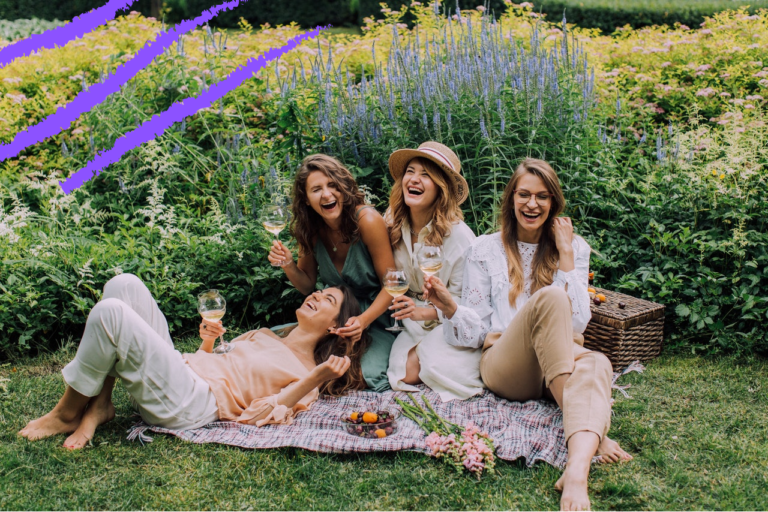
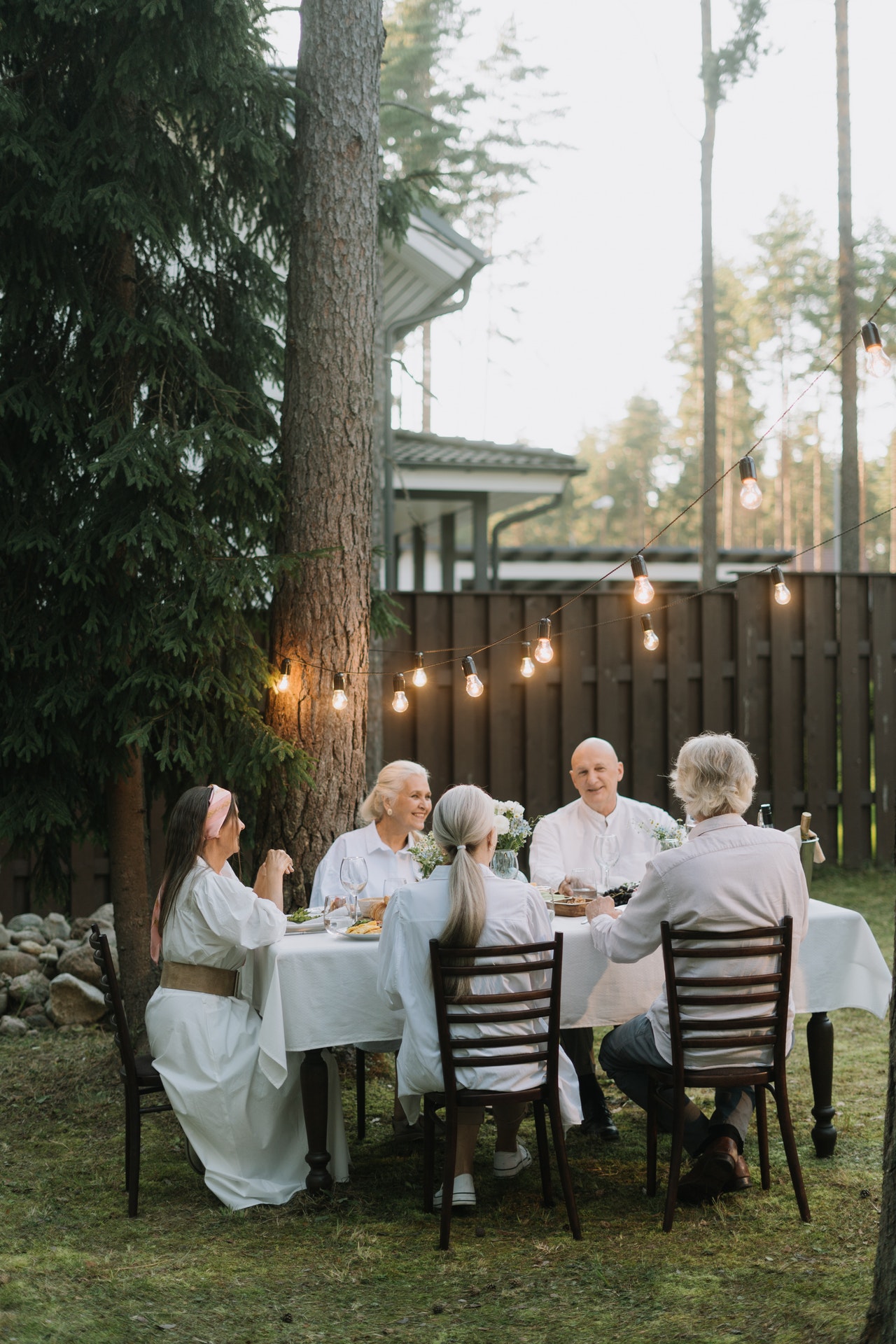
After several April days that have felt decidedly, profoundly summery and we’ve got our eyes firmly fixed forward on all of that al fresco frivolity that seems to define the season.
Summer is when hospitality, warm welcomes, good food and even better wine all come into their own, and for those who love to play host, this is your time to shine!
Should you be gearing up to hose some summer garden parties, then you’ve come to the right place to revel in the anticipation. Today, we’re celebrating those parties that go hard on the refreshments, with glorious gastronomic pleasure the focus of the fun. With that in mind, here’s how to host the IDEAL gourmand’s garden party this summer.
It’s All Berries & Cream
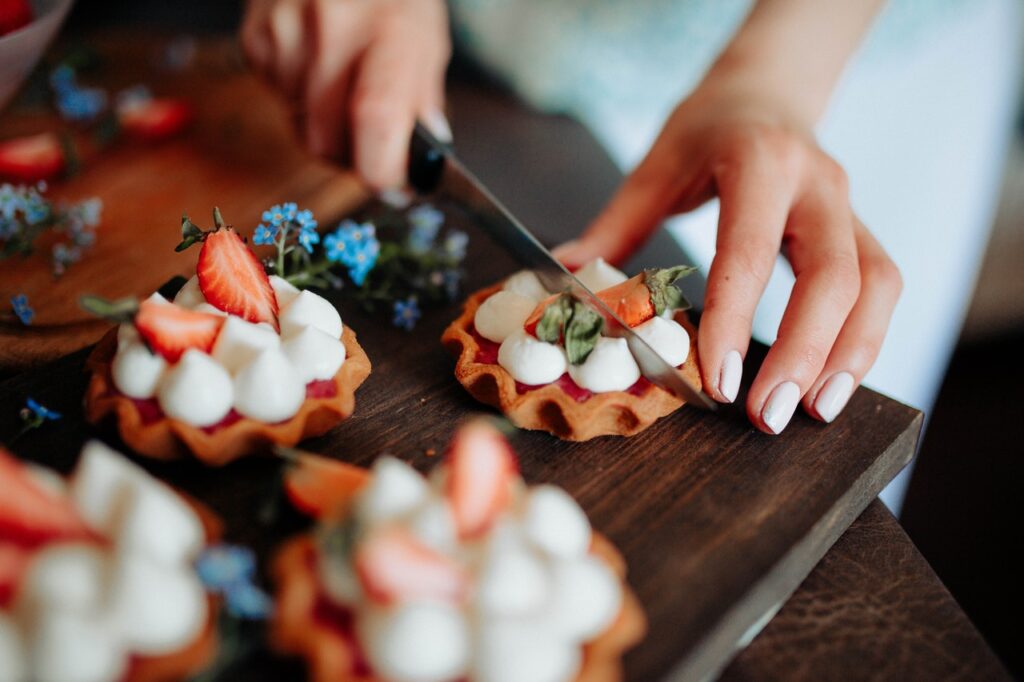
For dessert, British fruit is arguably at its peak in early summer, with strawberries, gooseberries, raspberries and even elderflower all on song.
Ask yourself; is it really a garden party without berries and cream in some format? Think scones with strawberry jam (the proper stuff with chunks), or even an Eton Mess or slushy which celebrates British fruits in season.
Both of these dishes rely heavily on whipped cream (unless you’re using clotted cream, of course), and making the perfect whipped cream is no easy feat.
A few seconds could mean the difference between perfectly whipped cream and something that’s well and truly over-worked. Indeed, whipping cream isn’t as easy as you might think. Over-whipped cream turns grainy and greasy, and this is something you want to avoid at all costs.
The secret is to whip your cream until just before it starts becoming stiff. You want a light, smooth and creamy texture that’s softly whipped and dollops nicely.
Anyway, enough of that wistful, whipped thinking. We need a drink. Fortunately, even your drinks can be inspired by the seasons…
Delicious, Uncomplicated Things
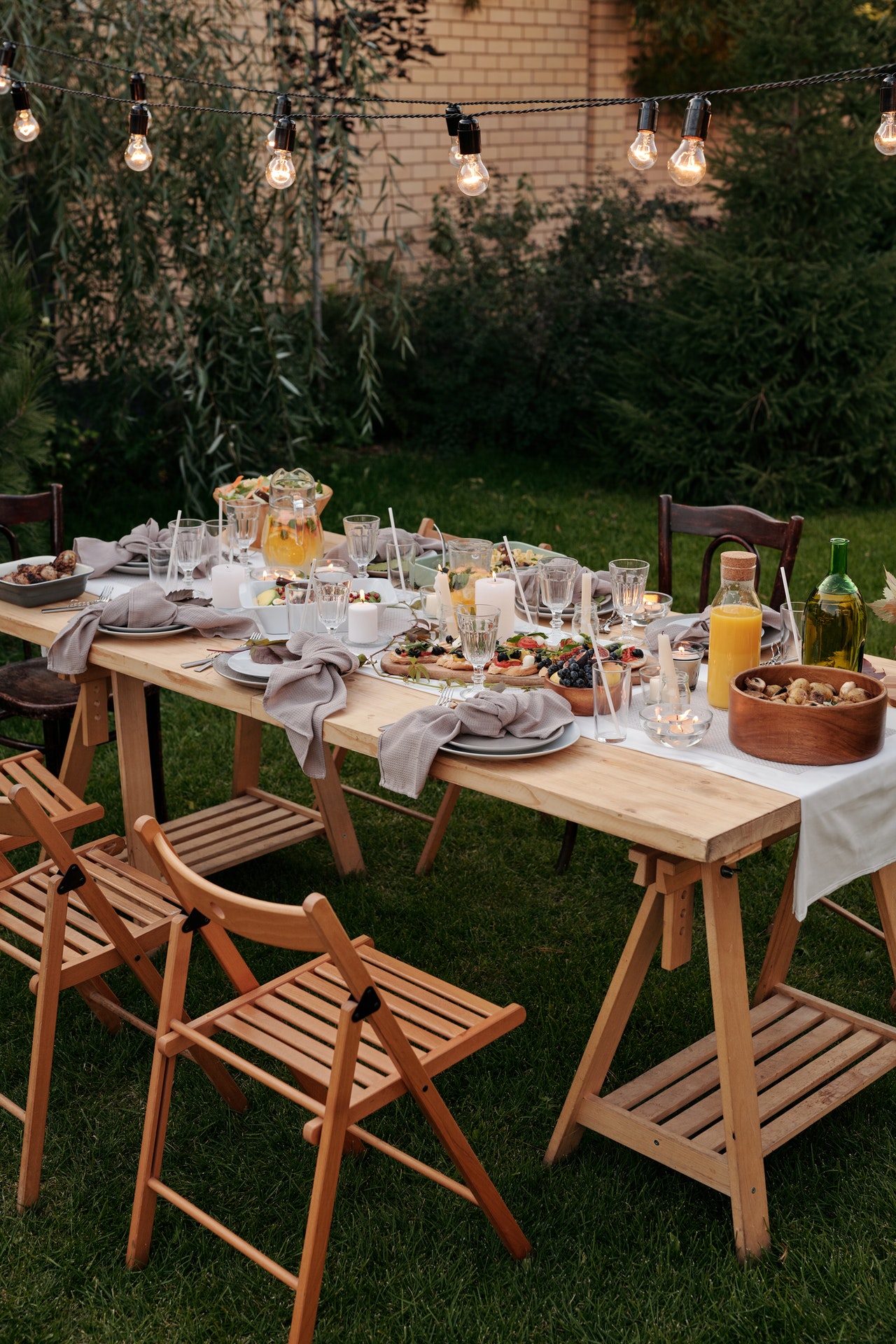
Marinating, dry-rubbing, slicing, dicing, par-boiling, searing, half-steaming, picking and chopping…so much of the work, food wise, can happen well in advance of your party if you design your menu right.
In fact, the only elements of your meal that genuinely need to be left to the last minute are the dressing of salads (premature dressing leads to limp leaves) and a final sprinkle of seasoning.
Prioritise delicious, uncomplicated elements and ingredients that are at their peak in summer. Doing so really sets the scene for the party, and means you have to do far less to get maximum flavour from them!
Creating a menu around the UK’s freshest Summer produce, then, seems to write itself; artichokes, asparagus, broad beans, peas, fennel, Jersey Royals, runner beans…how good does that all sound? Throw in some locally caught whole fish, grilled to perfection, or a whole joint of meat for the carnivores in the group, and your dinner party menu feels almost poetic. It certainly sings of better times ahead, don’t you think?
Ideal tip: Being stuck in the kitchen, flapping over the sides instead of charming and taking care of your guests, is never a good look. Make your life easy by preparing what you can in advance. Or make your life even easier, and ask all your guests to bring a dish with them.
Consider The Weather
When planning what you’re going to serve, it’s essential to take that incalculable British weather into consideration, as much as is possible and predictable. Those carb-heavy foods that we’re loving right now might be a bit much for a warm summer’s day, but if it’s a bit overcast and there’s a chill in the air, then they might be just the ticket.
During summer, fresh, vibrant and light ingredients are best when it comes to garden parties. A barbecue is, of course, appropriate whatever the weather – but does having one turn it into a BBQ party rather than a garden party? Whilst it’s only semantics after all, do think about how you bill your party. There are some serious pedants out there.
Of course, the food is only half the battle when it comes to weatherproofing your gathering. According to dynamicmarquees.co.uk, even a modest covered structure transforms how guests use a garden across the course of an afternoon, giving people somewhere to retreat from the midday sun and a dry spot to nurse a drink should the inevitable shower roll in. It’s worth thinking about layout too; positioning your covered area near the food rather than at the far end of the lawn keeps guests circulating naturally between sun and shade.
Who can resist some carefully crafted cocktails and mocktails using that seasonal British fruit we just mentioned?
Indeed, a drink muddled with seasonal fruit shows real class and care, and it’s something your guests will just love. The BBC has a great roundup of summer cocktail recipes here, but if you’re looking for a single showstopper, then consider a Watermelon Margaritas, served in a hollowed out baby watermelon. These guys take the refreshing levels way up. What a centrepiece!
We’re also fans of super refreshing Grapefruit Palomas, a popular cocktail in Mexico that’s similar to a Margarita. While grapefruit can be an acquired taste, in a cocktail it’s refreshing, light, and with just a little fizz – perfect for sunny garden parties. Mixing this drink also creates a beautiful light pink hue that looks brilliant in the sun.
\We also love to serve homemade strawberry lemonade for those not drinking; it’s important to make as much effort with the non-alcoholic drinks, we think.
Have A ‘Dine Anywhere’ Approach
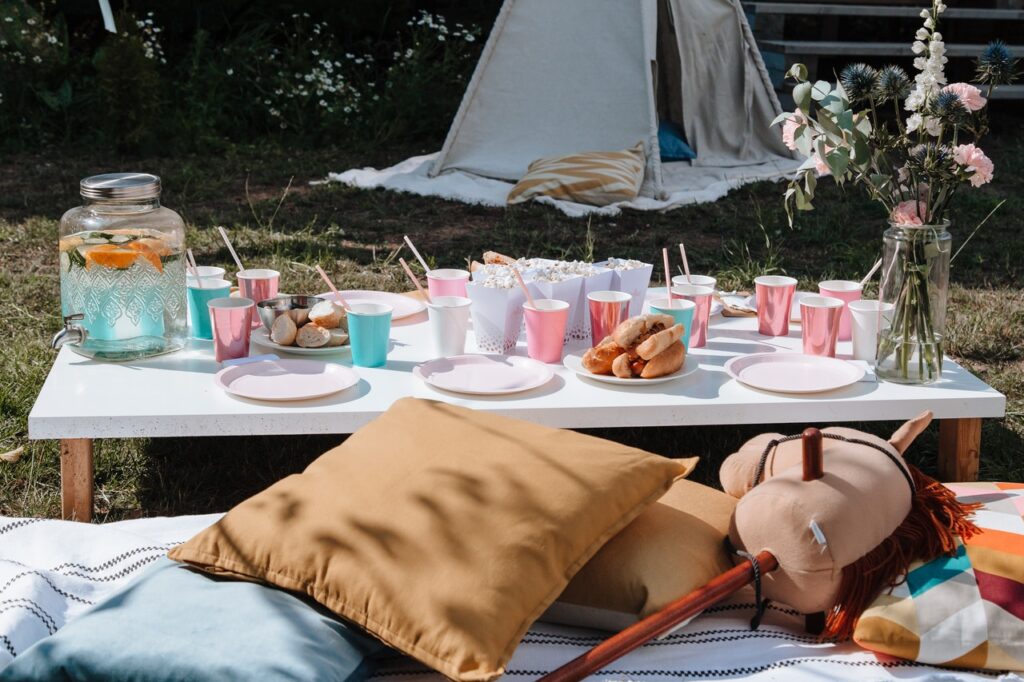
An easy way to feed guests, especially in the garden, is to put together (or order in) a selection of food platters rather than having a sit-down meal.
Grazing platters are so on-trend right now and come in a whole host of different shapes and sizes, from antipasti to tapas, meze, cheese and even dessert platters. However, be sure to keep things with wings away from your platters. A simple covering will do or consider an outdoor electric battery-powered fan to keep bugs at bay.
One bowl wonders – a large central dish such as risotto, curry or chilli – are another great ‘dine anywhere’ option, and can either be served by wait staff if you are having caterers in or are great if you’re keen for guests to simply help themselves.
The ‘dine anywhere’ approach means guests can perch wherever they like as they eat, giving everyone a much-needed chance to catch up with friends and family. Because, regardless of the quality of your food, that’s what it’s all about, right?
What Makes a Great Host?
But what makes a great host? Well, the ideal host is one who facilitates conversation when required, introduces people, pours drinks, cracks jokes and generally makes people smile.
Obviously, at a foodie garden party, a fair amount of the hosting credibility is earned from the dishes served, but none of that warm welcome we just described is possible when you’re chained to the stoves inside whilst the party goes on outdoors and without them.
Accordingly, what perhaps makes the best host on such occasions is fuss-free but delicious food. So, make a menu that’s seasonal, big on the flavours and colours of summer, but most importantly of all, has elements that you can prepare in advance.
The Bottom Line
We can’t wait for summer and all that sunkissed socialising. If you’re just as excited about hosting as you are attending all those garden parties, then we’re sure you’re going to smash it!
Go on, say it; we’re thinking it too. But perhaps the best thing you could say about Patong is that it knows what it is. It’s brash. Bawdy. Coated in ganja smoke and talc. And unsurprisingly, owing to the haze, and blinded by the lights of a cluster of golden arches, it can be tough to find anywhere really good to eat. At least, on Bangla and its web of sois, it can be.
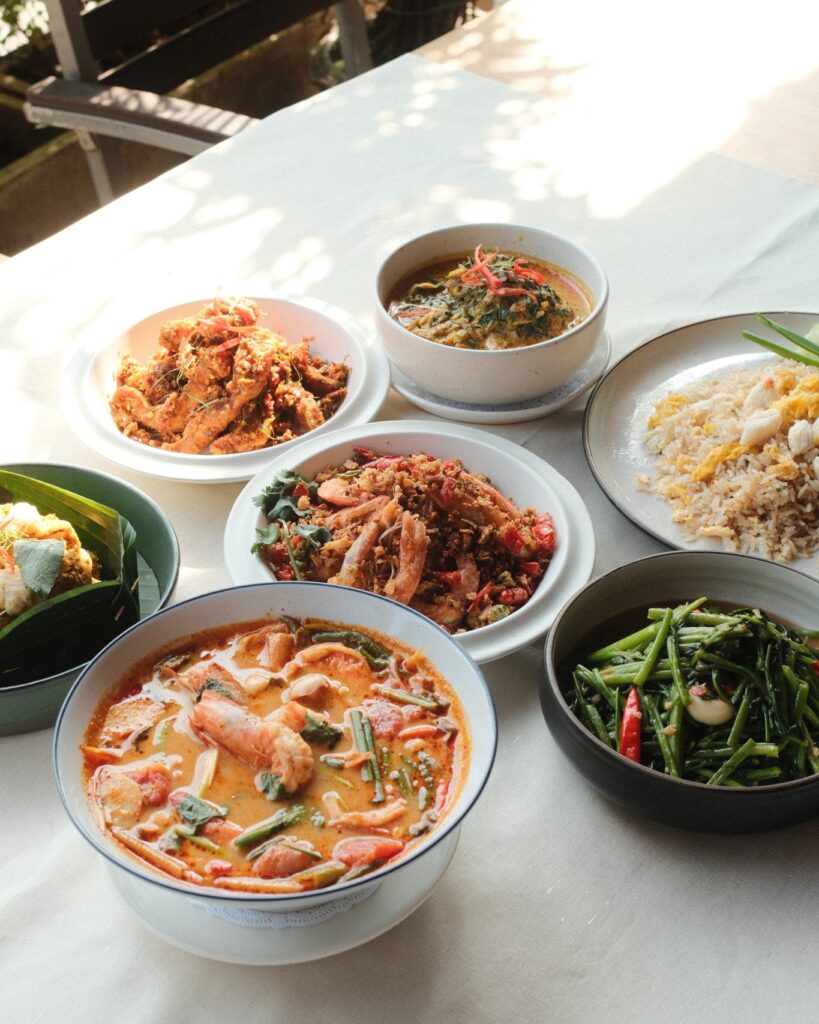
But Patong is bigger than its central nightlife premise. Head north towards Kalim and the clifftop dining scene rivals anywhere on the island: fine French tasting menus, award-winning Italian, Royal Thai cuisine with panoramic Andaman views. Duck inland, past the 7-Elevens and the tailors, and you’ll find Isaan shacks and southern Thai curry rice joints feeding the construction workers and hotel staff who keep the whole machine turning. And increasingly, Patong’s resort restaurants aren’t phoning it in either. Quite the opposite, in fact.
The hungry have to work a little harder here than in the Old Town or Bang Tao, sure, but the rewards are there. With that in mind, here are the best restaurants in Patong, Phuket.
Kaab Gluay
Ideal for southern Thai food done right, away from the tourist strip…
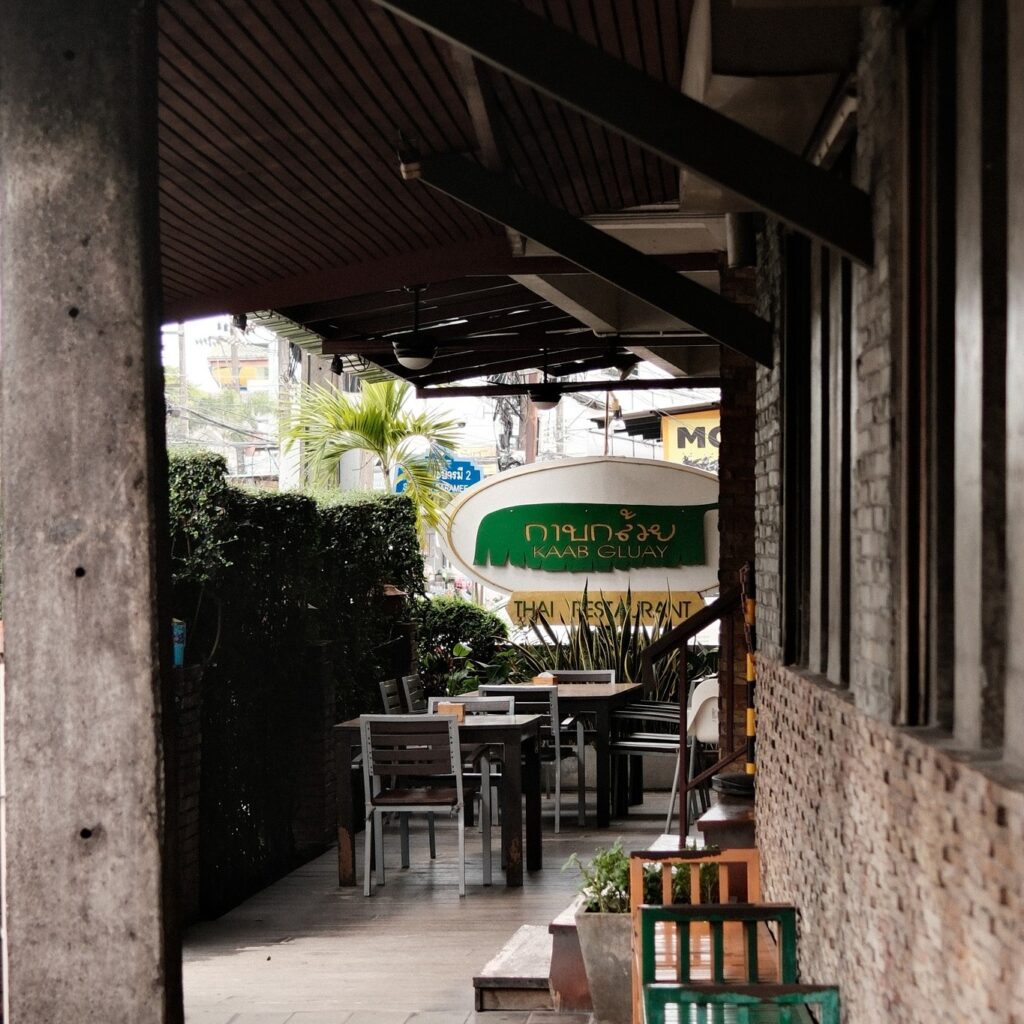
Phrabaramee is the road where tourist Patong gives way to something more residential, and negotiating it to eat at Kaab Gluay feels like a small act of commitment. A member of staff stands outside to help you do so, ushering you across like you’re an old lady who needs help with her shopping. But crossing the threshold rewards the curious.
Kaab Gluay has been a family operation on Phrabaramee Road for over 25 years, and it remains one of the very few restaurants in Patong where the food is uncompromisingly Thai and regionally focused. So, that’s southern Thai dishes with genuine, nuanced power, and a commitment to freshness that means the freezer and microwave aren’t in constant rotation like back there on the strip.
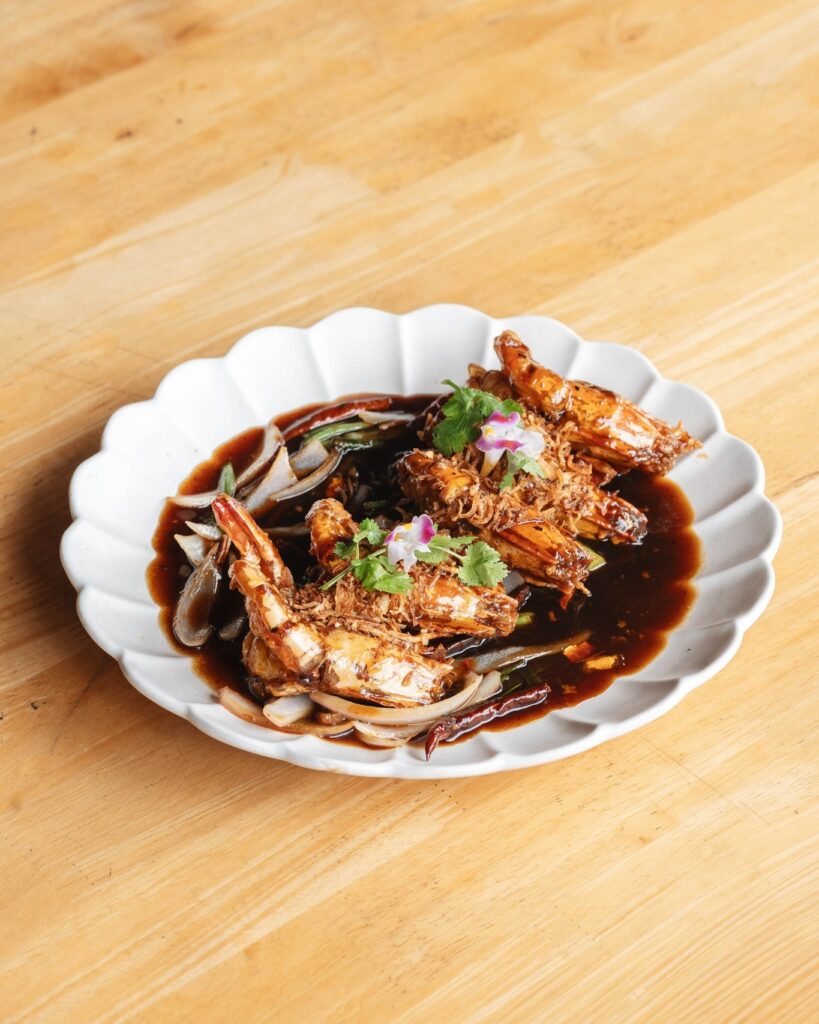
The family’s son, chef Suwijak ‘Mond’ Kunghae, grew up in this restaurant before going on to open the Michelin-listed Royd in Phuket Old Town, one of the island’s most hyped modern Thai restaurants. The roots of that cooking are in this kitchen. There’s an exacting standard and obligation to freshness that you can taste in the signature prawns in tamarind sauce and the snail coconut curry, both of which are rippers from a seriously sprawling menu.
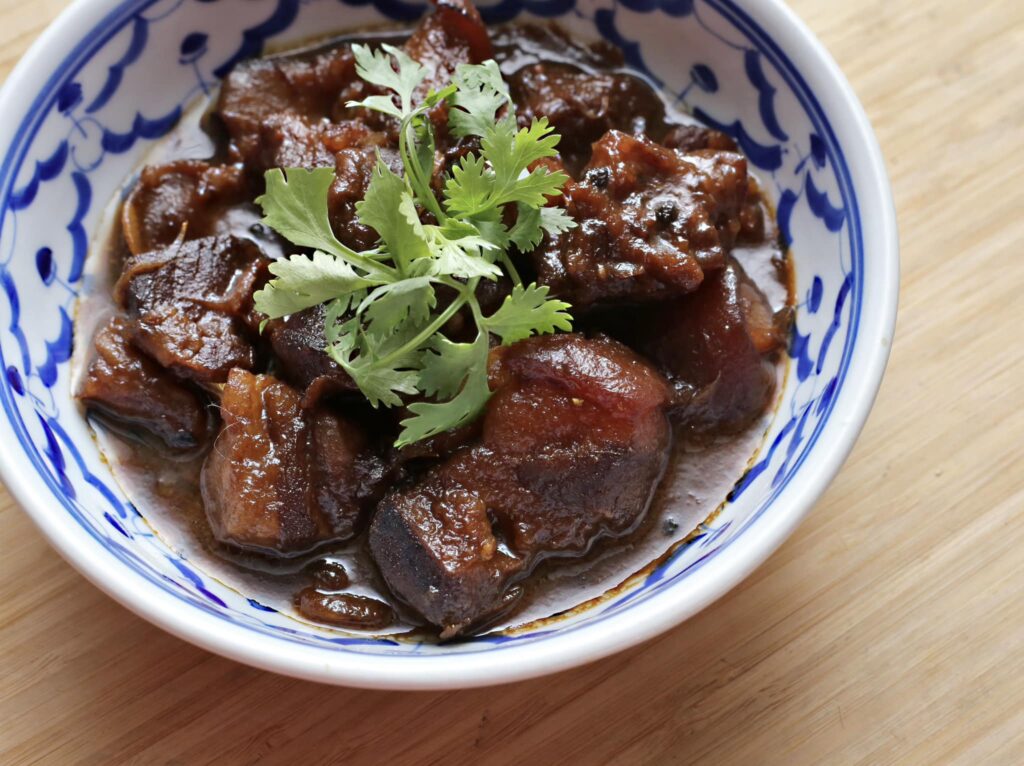
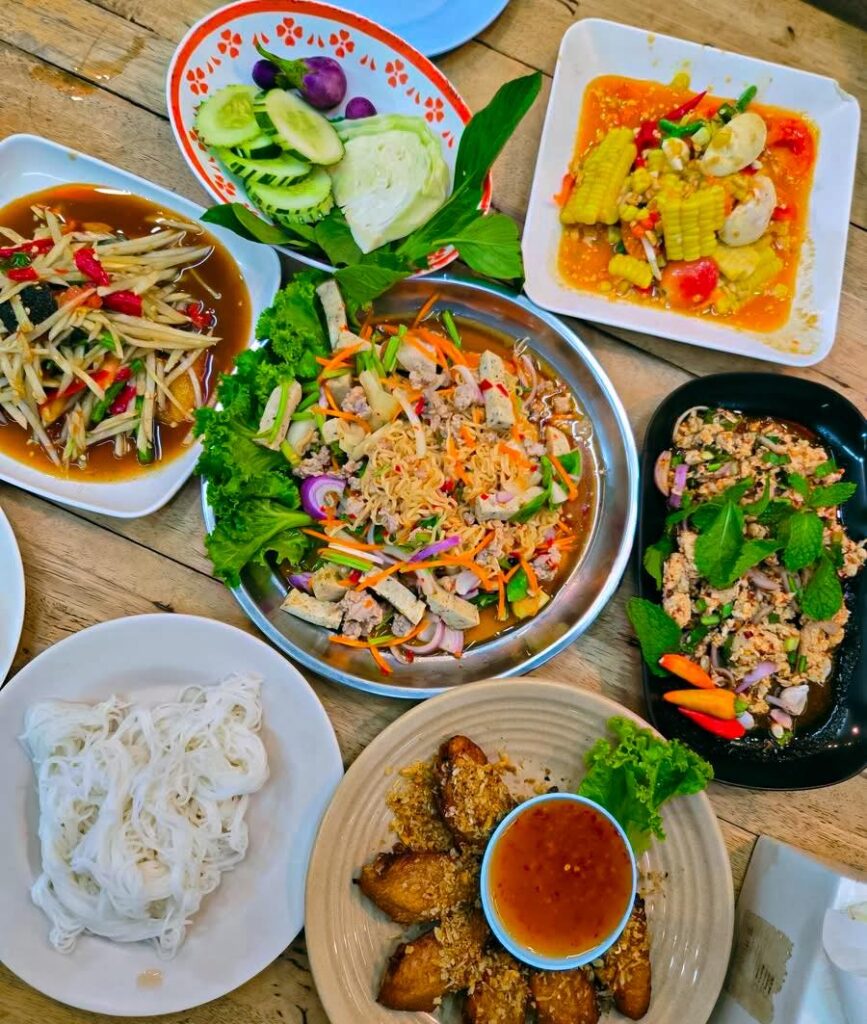
The kitchen is tiny, but that menu covers enormous ground, with over 30 salads and a full roster of southern Thai curries. The moo hong is textbook, one of the best we’ve had on an island full of the stuff, and the Peranakan snack game is strong; the signature lor bak is a highlight. Most other dishes fall between 150 and 250 baht, which is great value for the quality.
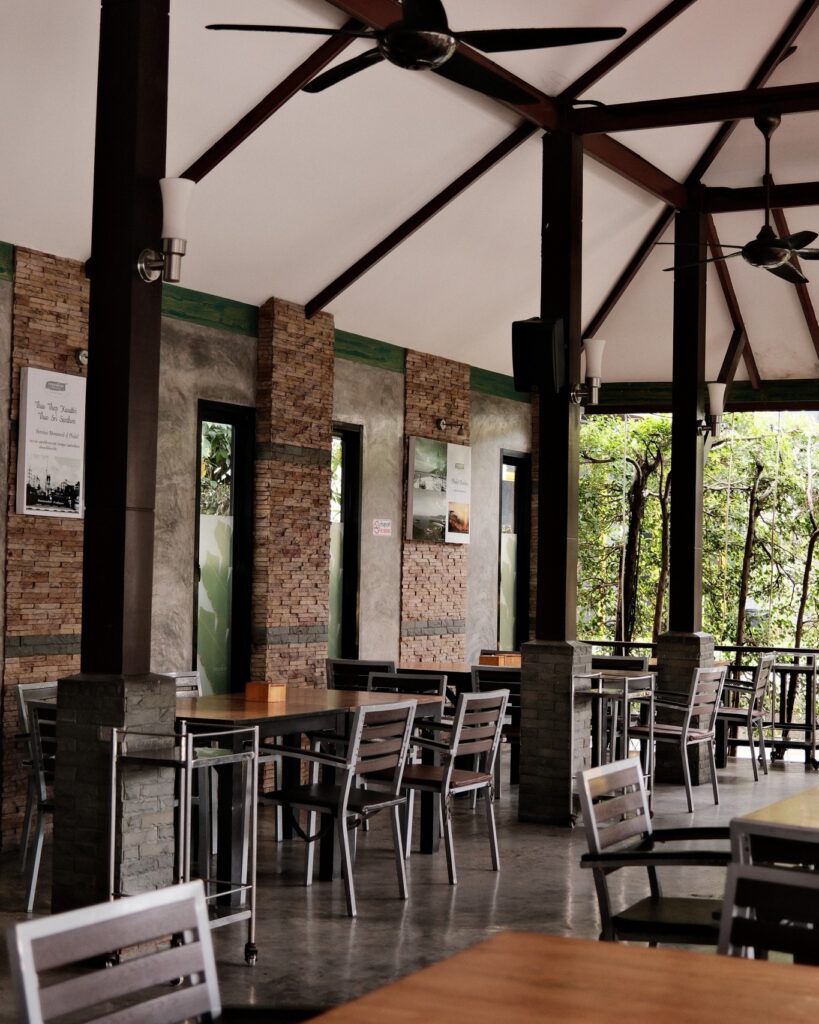
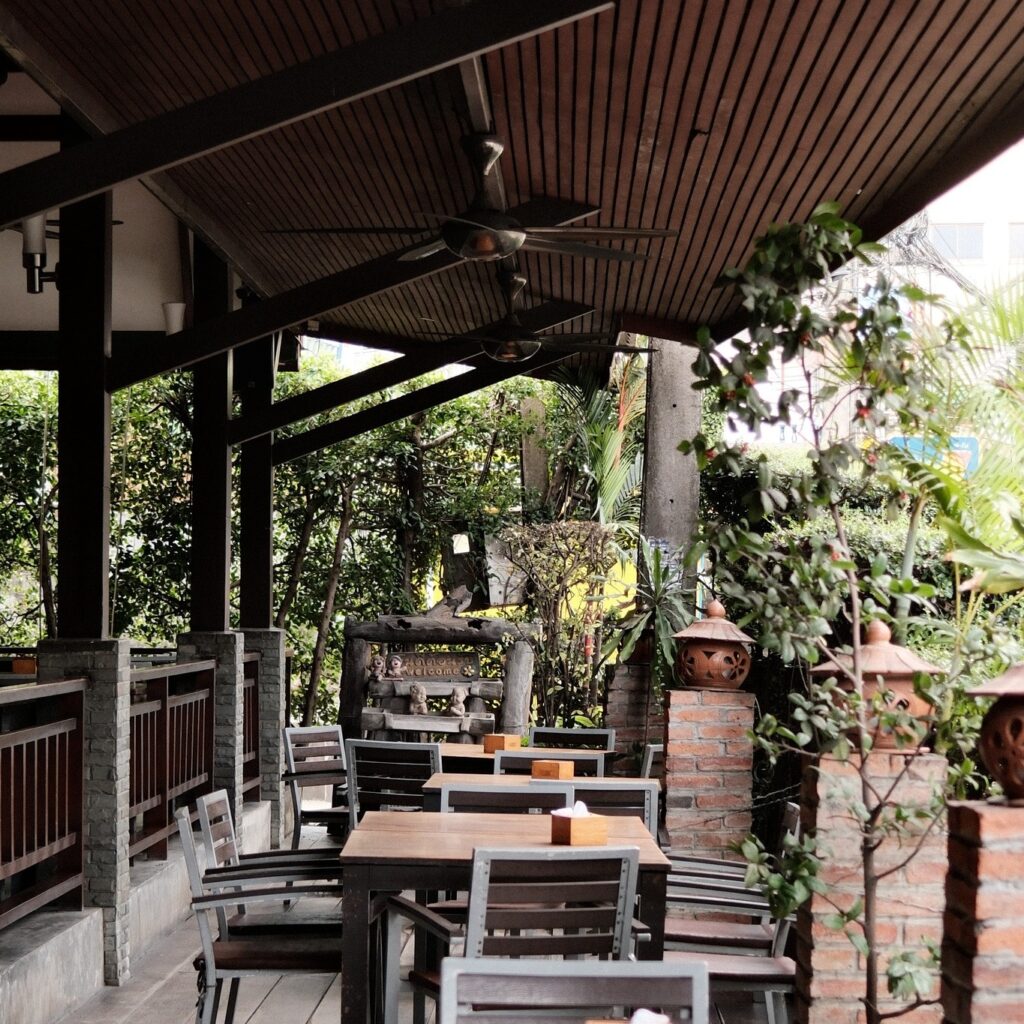
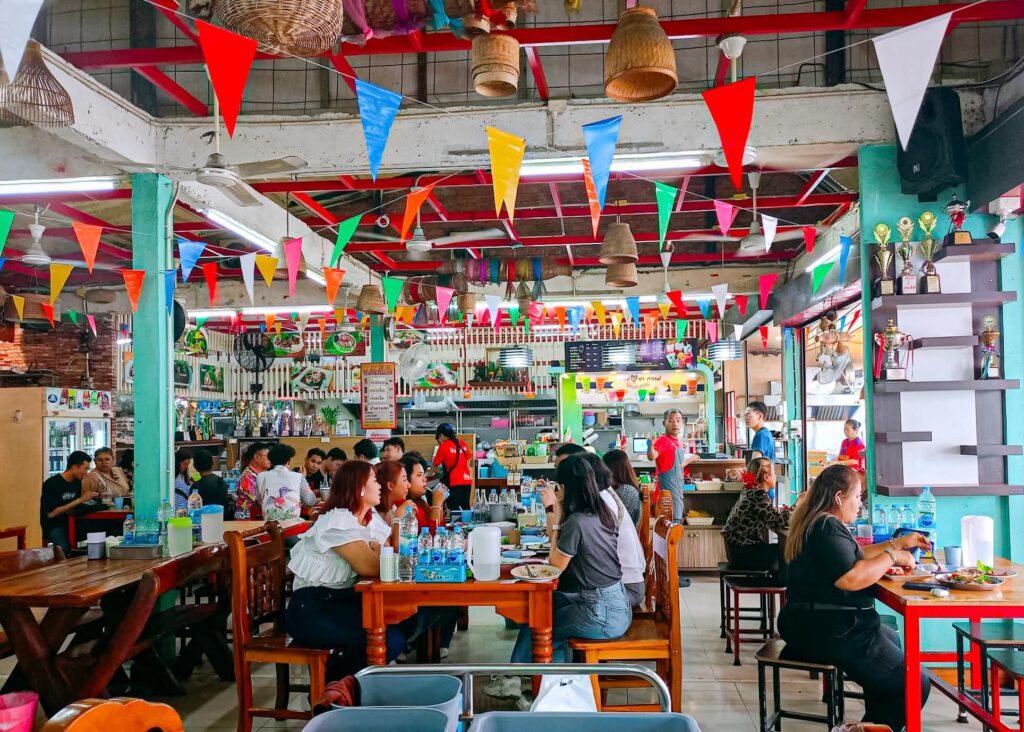
‘Southern Taste in Comfy Place’ is their tagline, and the space reflects it: a high, pitched timber-beamed roof, stone and brick walls, polished concrete floors, open-sided to the evening air (and that busy road!). Still, it’s not exactly suffering for a fine feed, and Kaab Gluay emphatically delivers on the latter. The dining room is primarily Thai, usually in large, convivial groups. In Patong, this is rare enough to denote something; this is ‘proper’ southern Thai in the best possible way.
Kaab Gluay is open daily from 11am until midnight.
Ideal for Michelin-recognised Indian fine dining in a Mughal rooftop tent…
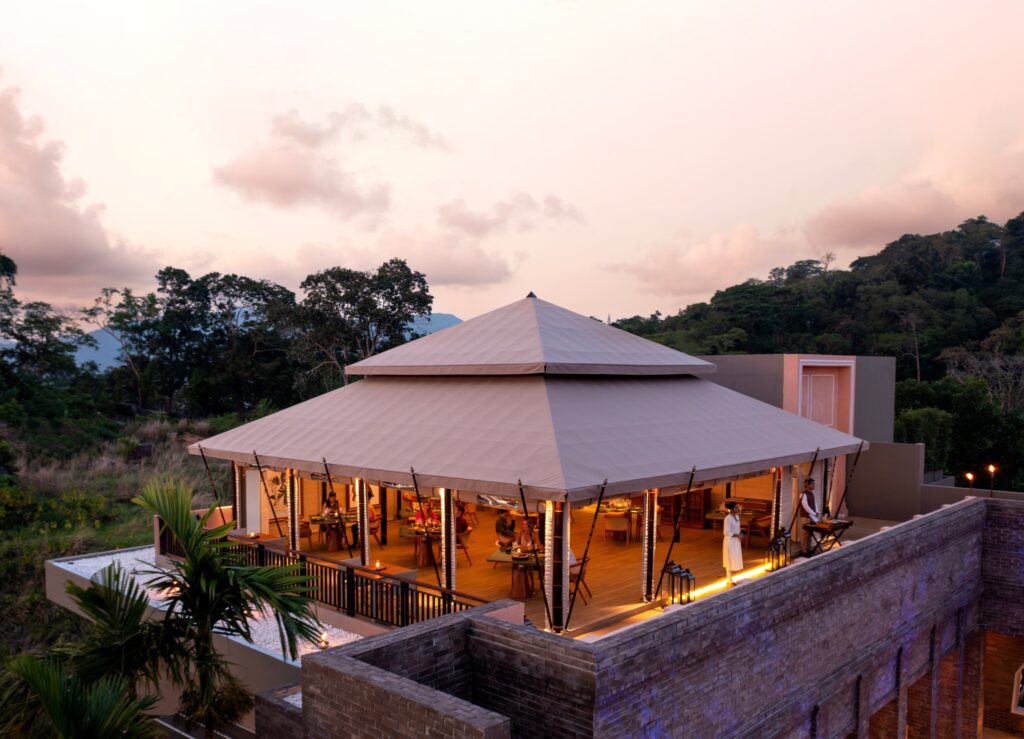
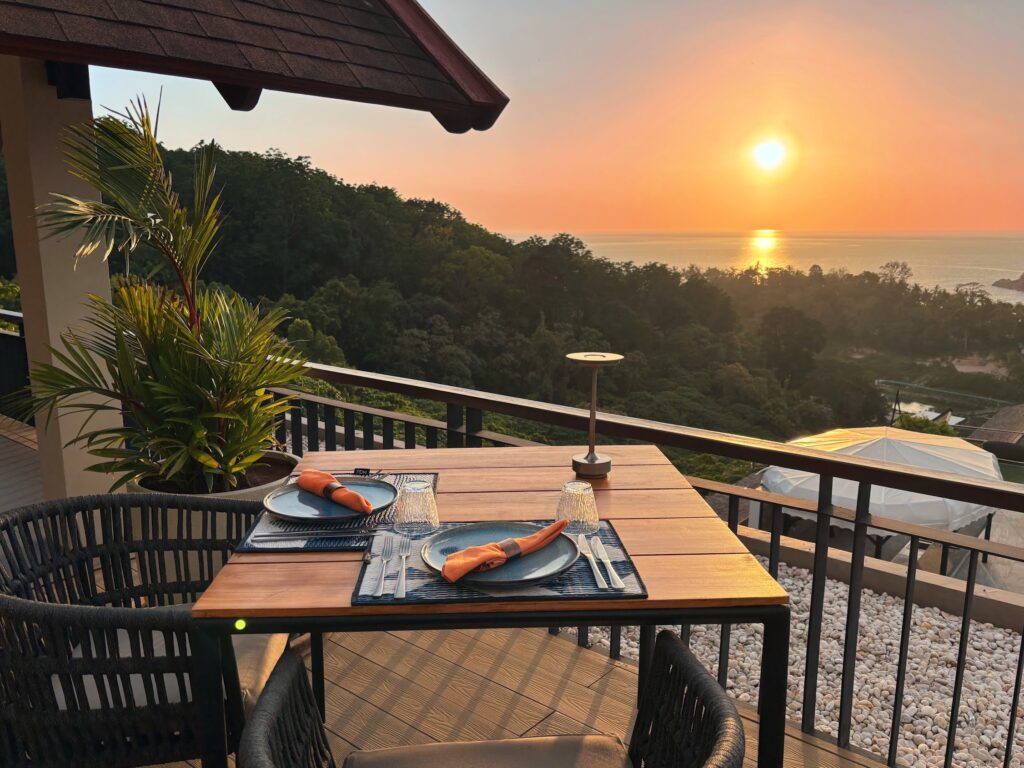
Tambu sits on the rooftop of Avista Hideaway, an MGallery property in the forested hills south of central Patong, about ten minutes’ drive from Bangla Road. Featured in the Michelin Guide Thailand for 2026 and named Asia’s Best New Restaurant at the World Culinary Awards 2024, it serves ‘progressive Indian charcoal cuisine’. Their words, though it’s a fair description; everything’s cooked entirely over tandoor (specially made in India and shipped over), sigdi and tawa. You won’t see a sly induction hob or combi oven here, just plenty of smoke and plenty of flavour.
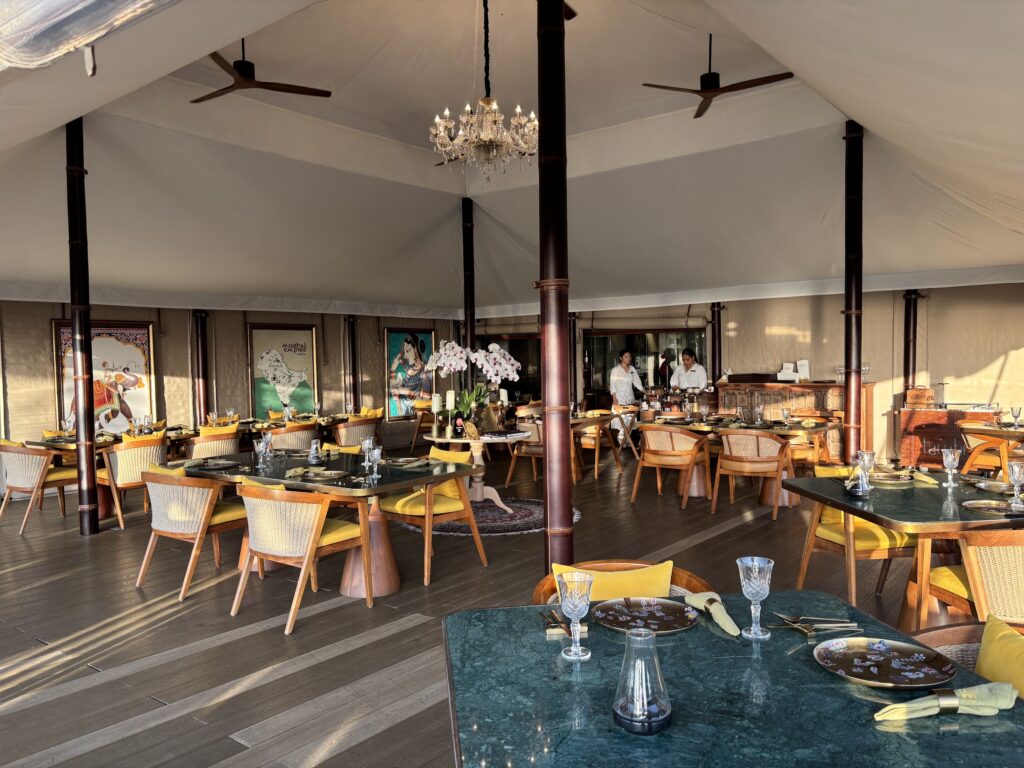
The setting is modelled on the tented palaces the Mughal royal family used when they travelled, with sweeping views across forested hills to the Andaman Sea. A grand chandelier hangs from the white canopy, Mughal-era paintings line the tent walls, and the tableware throughout is in the Meenakari style, the ornate Rajasthani enamel craft that has its origins in the Mughal courts. It all adds up to a place that feels cohesive and carefully put together.
It’s almost too much, but a breeze floats by, the setting sun dapples across the tent, and everything falls into place. On any given evening, big tables of Indian families who’ve driven across from other parts of the island sit alongside solo diners, and the range of people this place draws is as expansive as those views.
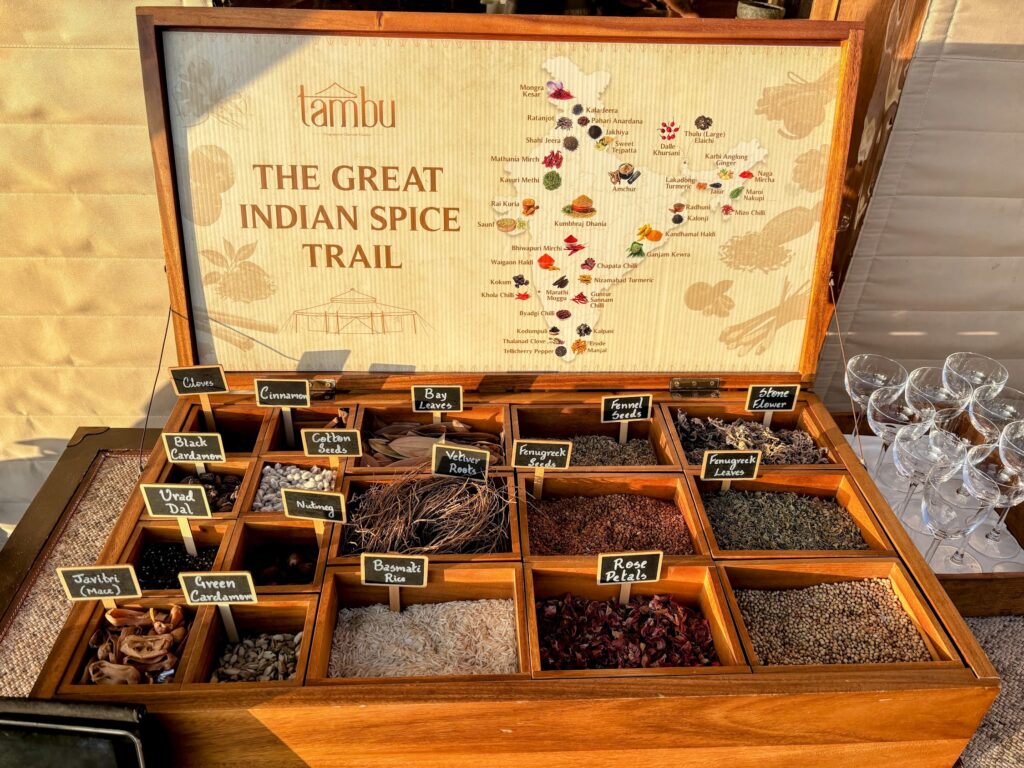
Staff in lovely flowing white welcome you gracefully. The evening begins at a wooden spice box near the entrance, labelled ‘The Great Indian Spice Trail’, where each of the spices you’ll be eating that night is laid out in compartments, from stone flower and vetiver root to green cardamom and rose petals, with a map showing where in India each originates. A wonderful masala-based welcome drink follows, balanced and savoury, and the scene setting is done.
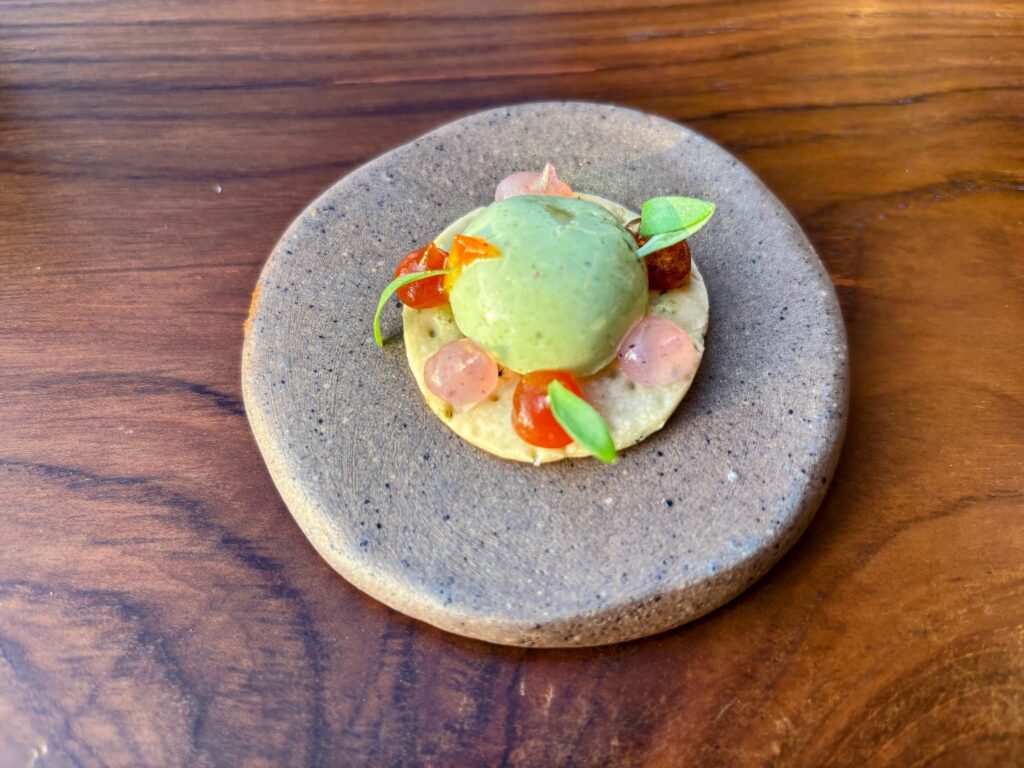
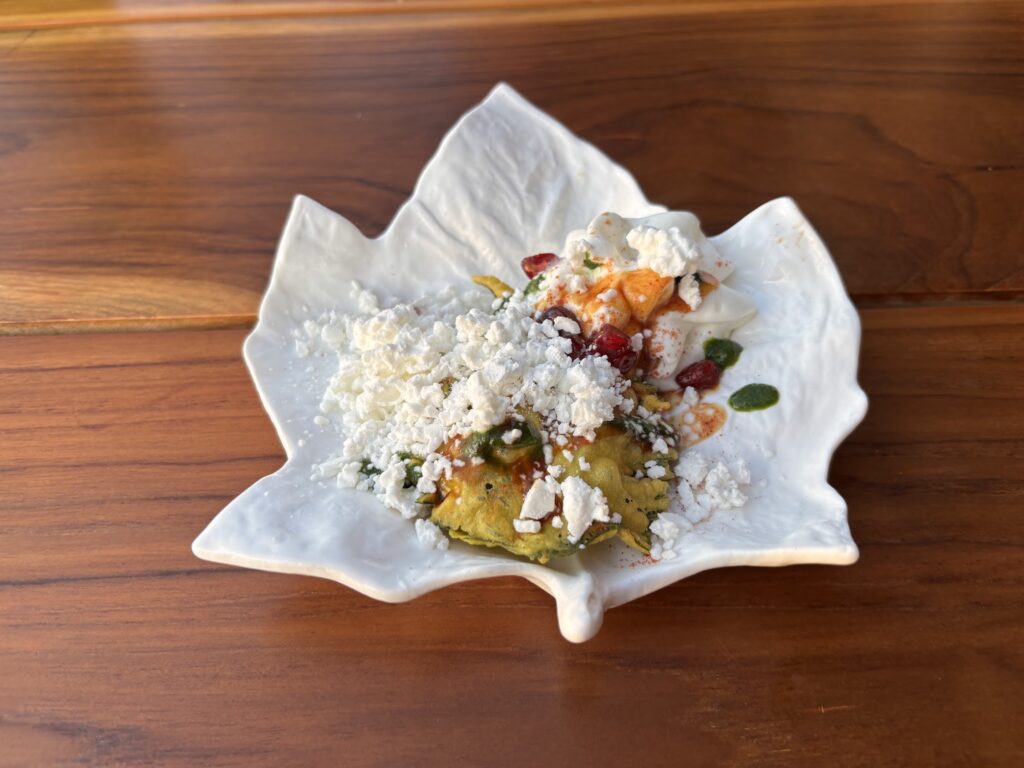
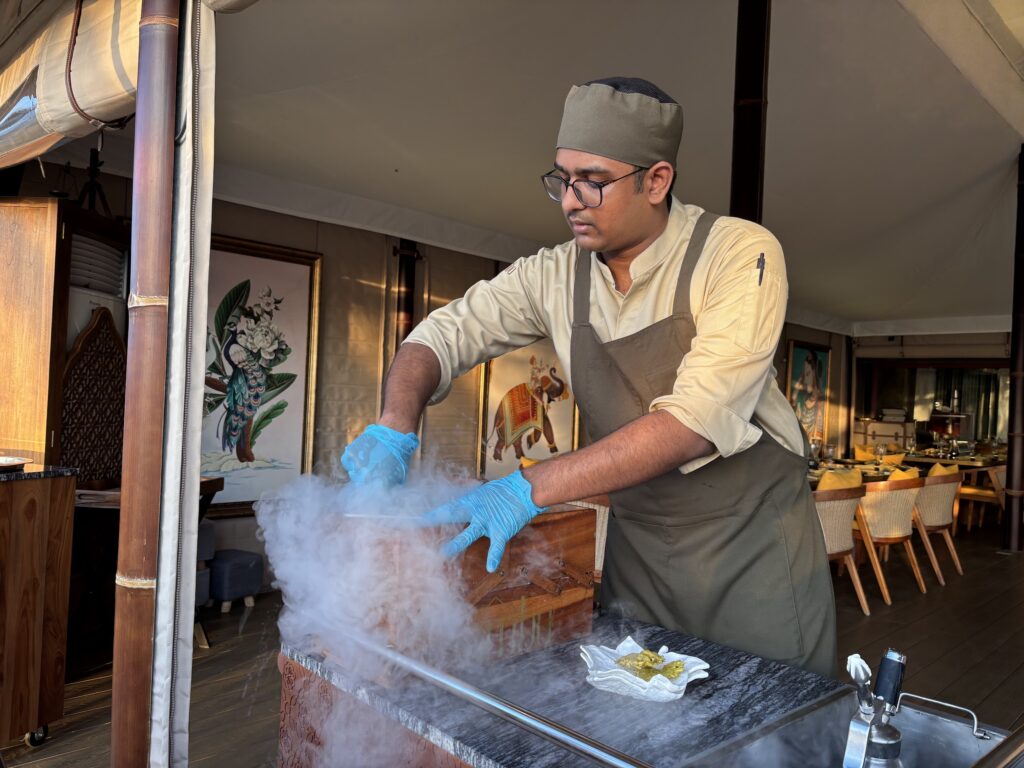
Seated and ready now, and Iron Chef Thailand winner Saurabh Sachdeva offers a ‘Roots’ seven-course tasting menu at THB 3,190 (around £70) alongside a shorter four-course set and a full à la carte. We had the four-course, which opened with a yoghurt sphere over khakra – energetic, eye-opening – then a shiso leaf chaat made tableside with dry ice, theatre and frivolity.
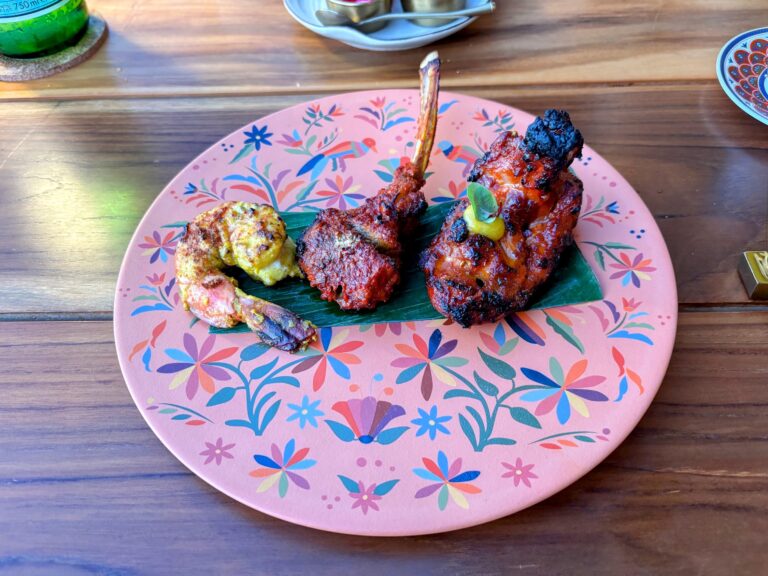
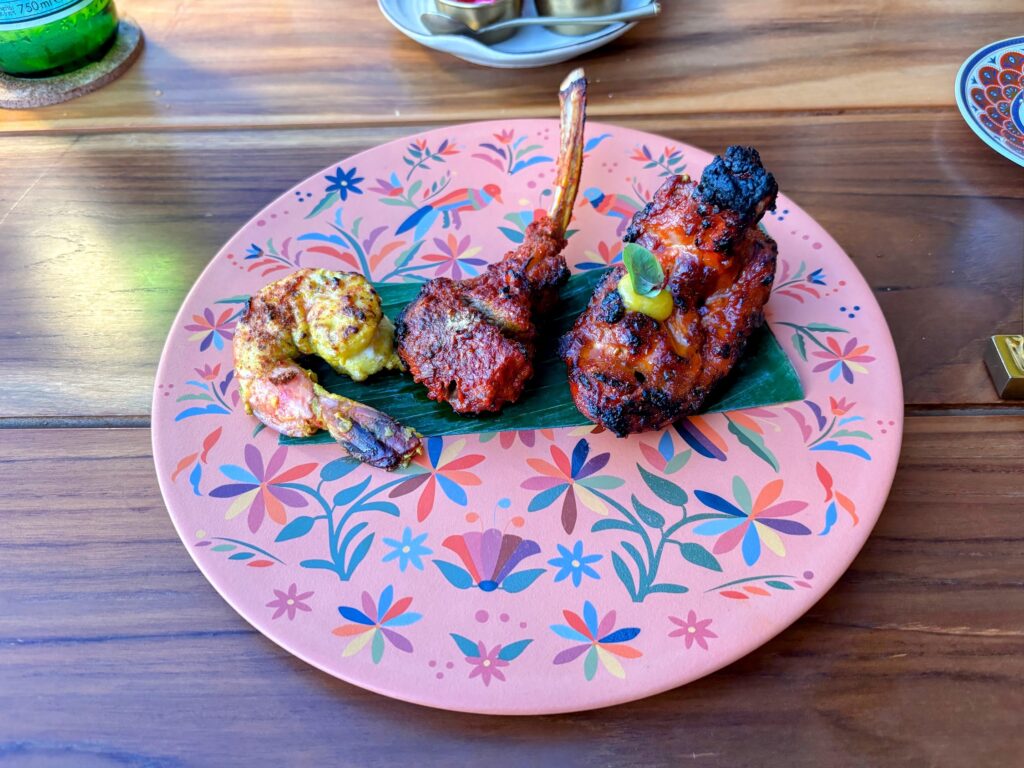
The tandoor course arrives on perhaps the most beautiful plate I’ve ever seen. Its contents weren’t half bad either; lamb chop barrah, Tambu barbecue chicken and butter garlic Andaman prawns, with chutneys and pickles alongside. It’s the small touches – a tiny smear of mango puree on the chicken, a gold dot on the lamb, an exacting char that is pronounced but keeps things juicy on the prawns – that signal the finesse at work here.
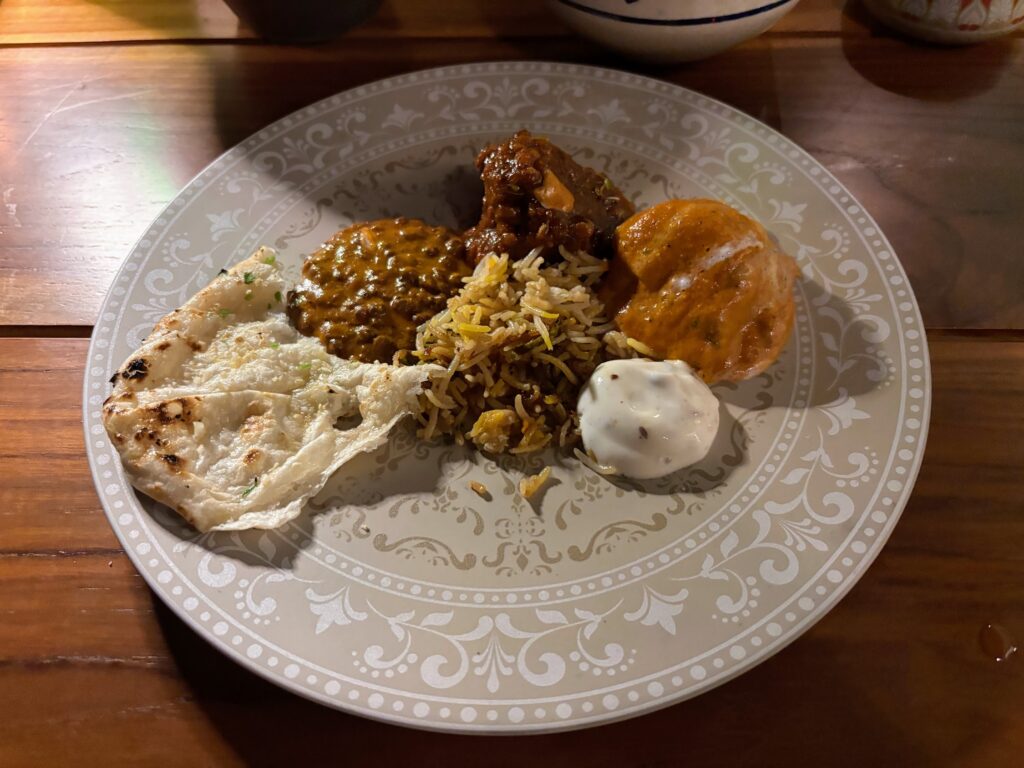
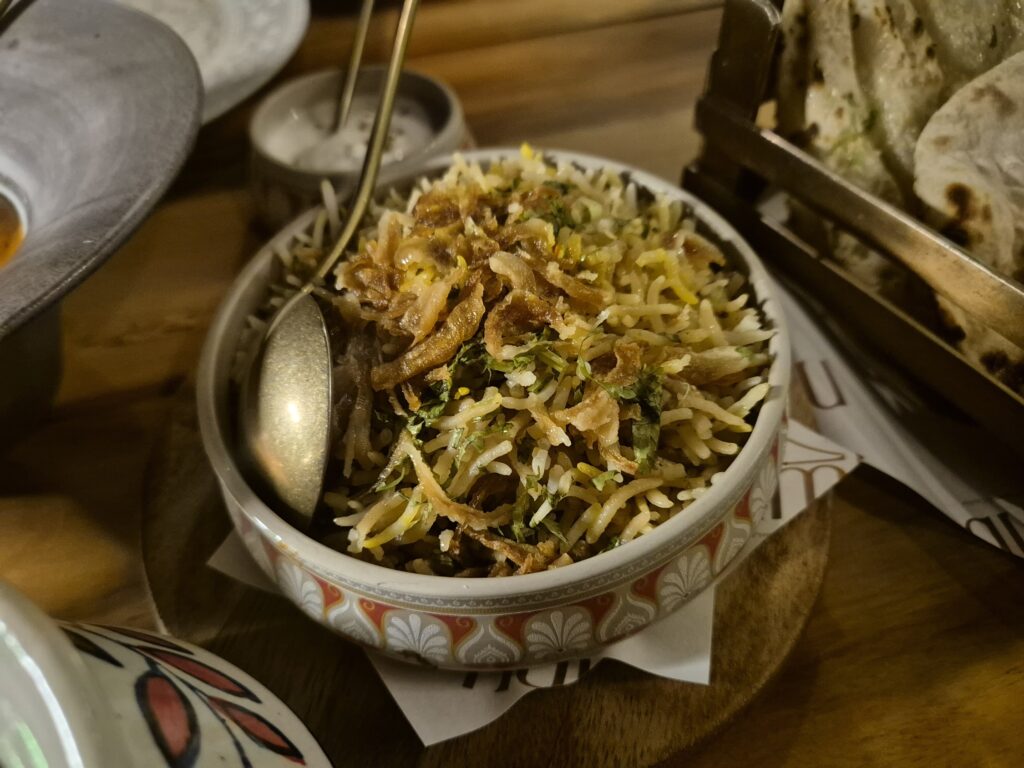
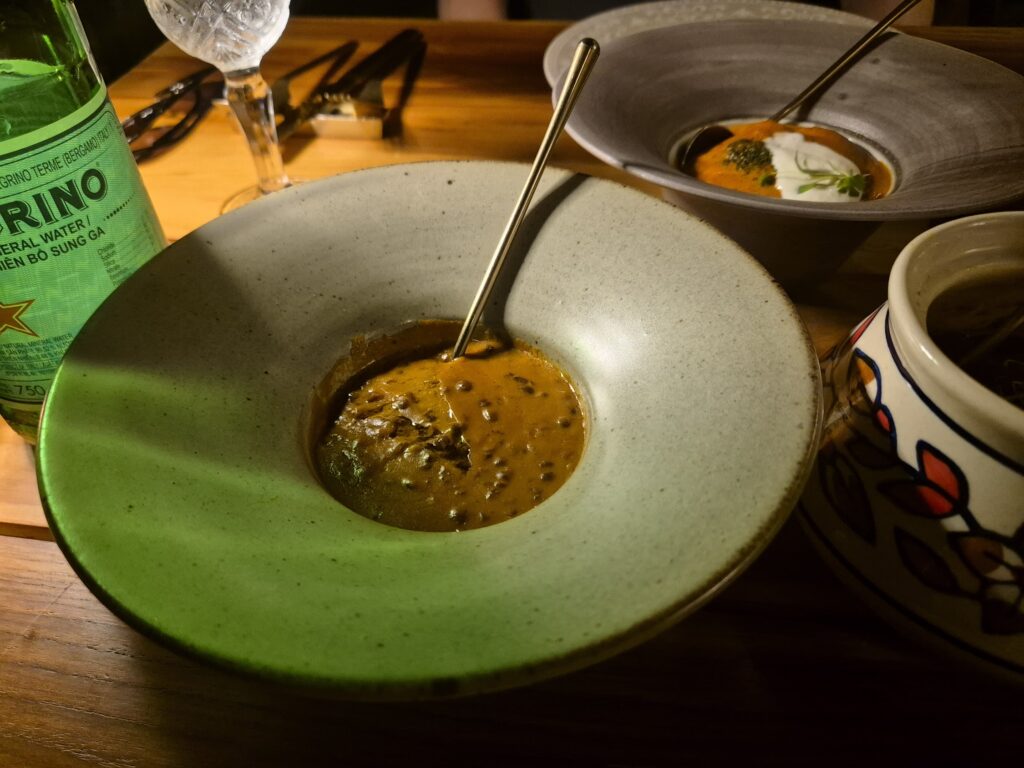
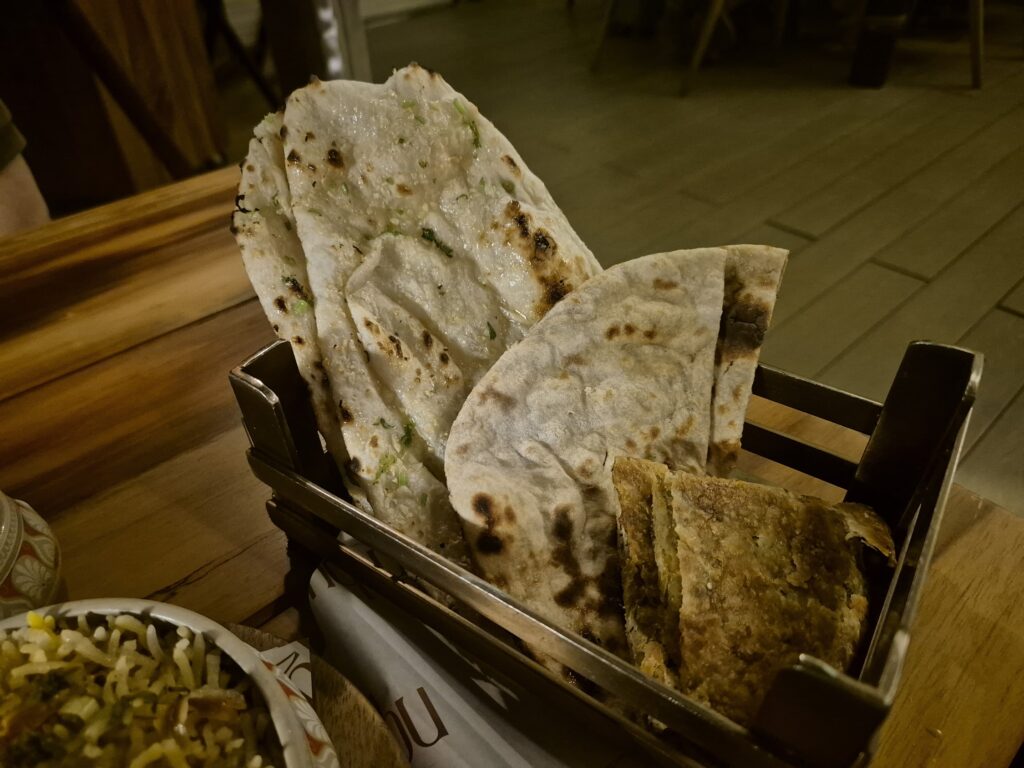
The main spread is generous, the bread basket alone worth a trip up the Patong hills and then an elevator ride up to the rooftop. A selection of grilled naan, chapati and paratha this handsome is crying out for some clinging sauces to dredge through, and just as you think that, slow-cooked overnight urad dal enriched with cream and Amul butter, and a Delhi butter chicken are ceremoniously lowered onto the table.
They like a trio here at Tambu, and dessert is dark chocolate paan, malai tres leches (thought it said ‘testicles’ in the fading evening light) and masala chai choux. A lovely, light conclusion, though in truth the main course had finished us off. Would have loved to approach these with an empty stomach for a more faithful appraisal of the kitchen’s pastry work. Next time, next time…
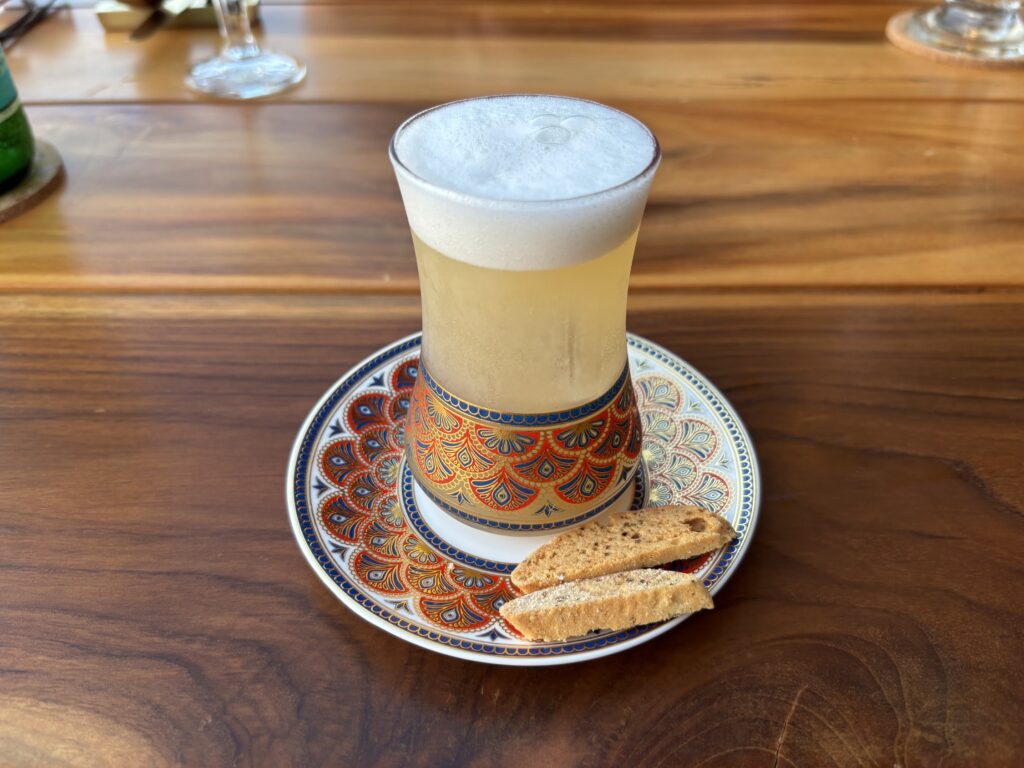
Do go for the Chai Milk Punch, a surprisingly stiff cocktail served in an attractive Meenakari glass alongside homemade biscuits. That said, a Kingfisher beer is a pleasing companion throughout.
This is a more serious restaurant than a Patong hotel Indian might initially denote, and it’s fair to say that Tambu could comfortably hold its own against the acclaimed Indian restaurants of Bangkok, for a fraction of the capital’s prices. You wouldn’t get these views in the Big Mango either…
Open for dinner only during the week, and for lunch and dinner at the weekend.
Ideal for sunset steaks and Andaman Sea views from on high…
Sizzle shares the Avista Hideaway rooftop with Tambu but operates in an entirely different register. Where Tambu is tented and tasting-menu, Sizzle is more open to the whims of the elements and diner, its à la carte offering built around a brick charcoal grill and a live lobster tank. It shared a spot with Tambu on the same page of 2026’s Michelin Guide too, which is a hugely impressive one-two punch of hotel dining, and a credit to the Avista Hideaway for the thought clearly invested in their food operations.
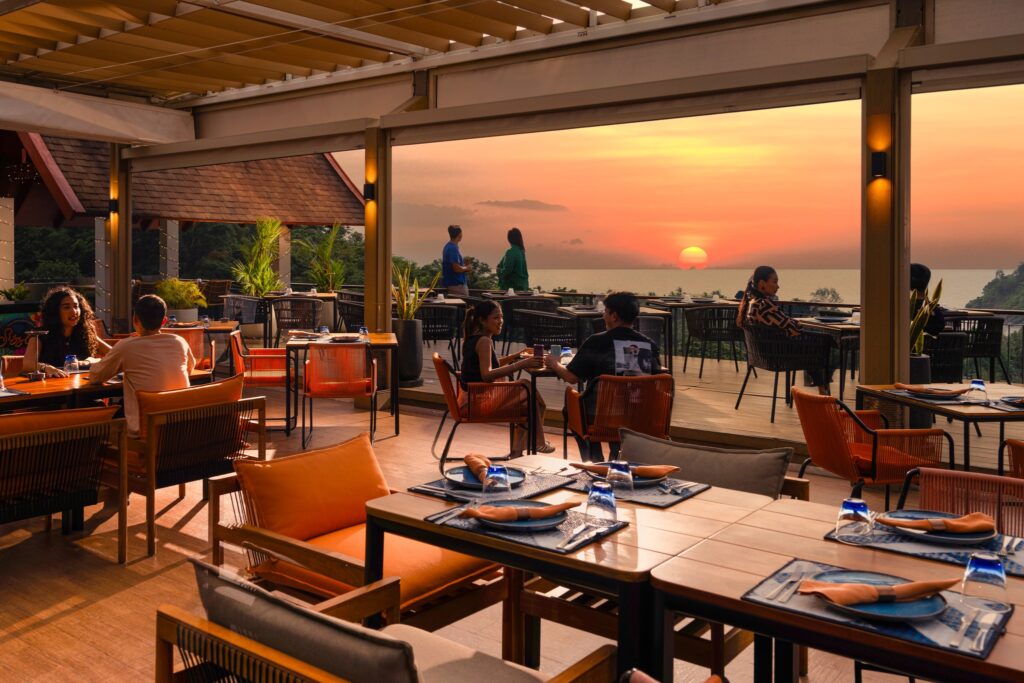
In case you skimmed over the Tambu bit to get here, we’ll repeat: the views here will have you staying far longer than planned. The panorama over the Andaman is uninterrupted and enormous, the dining room entirely open-sided, no walls, and the sea breeze renders air conditioning irrelevant. A fire show once the sun has set draws your gaze away briefly, which has the happy side effect of giving your steak the time it needs to rest.
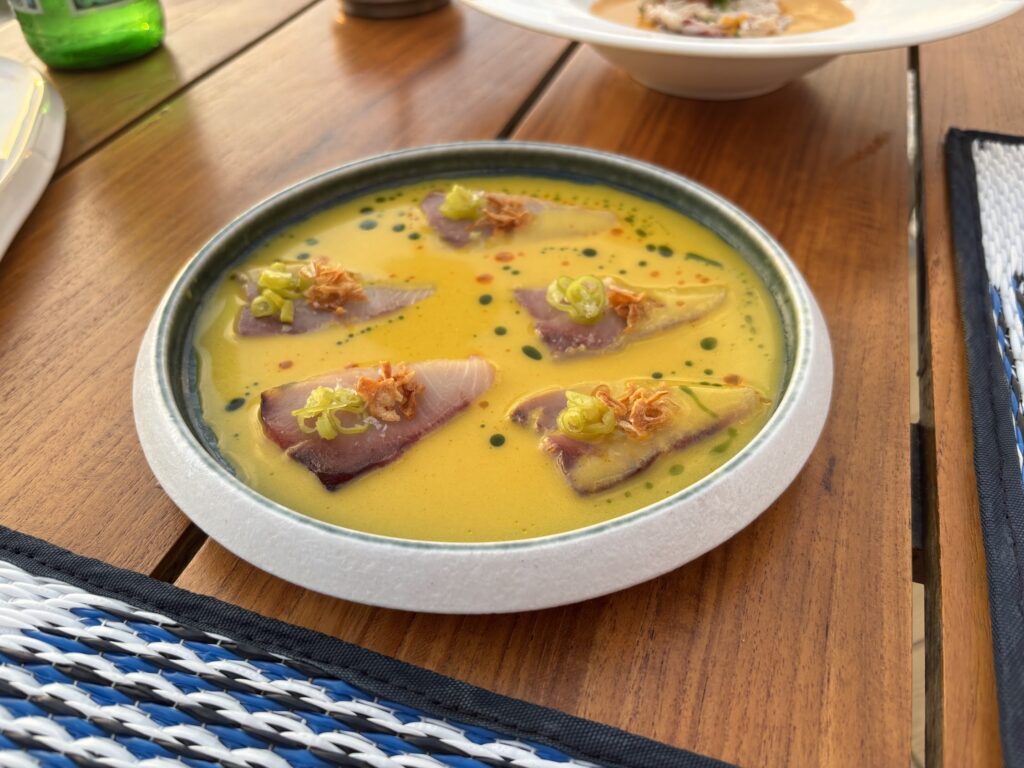
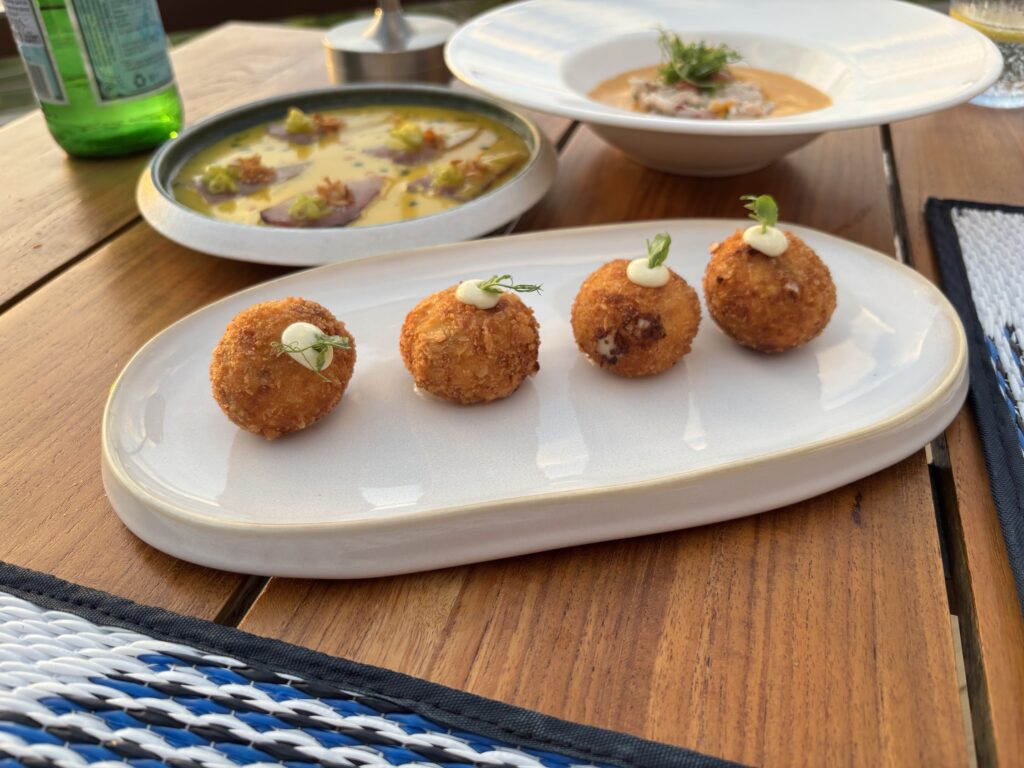
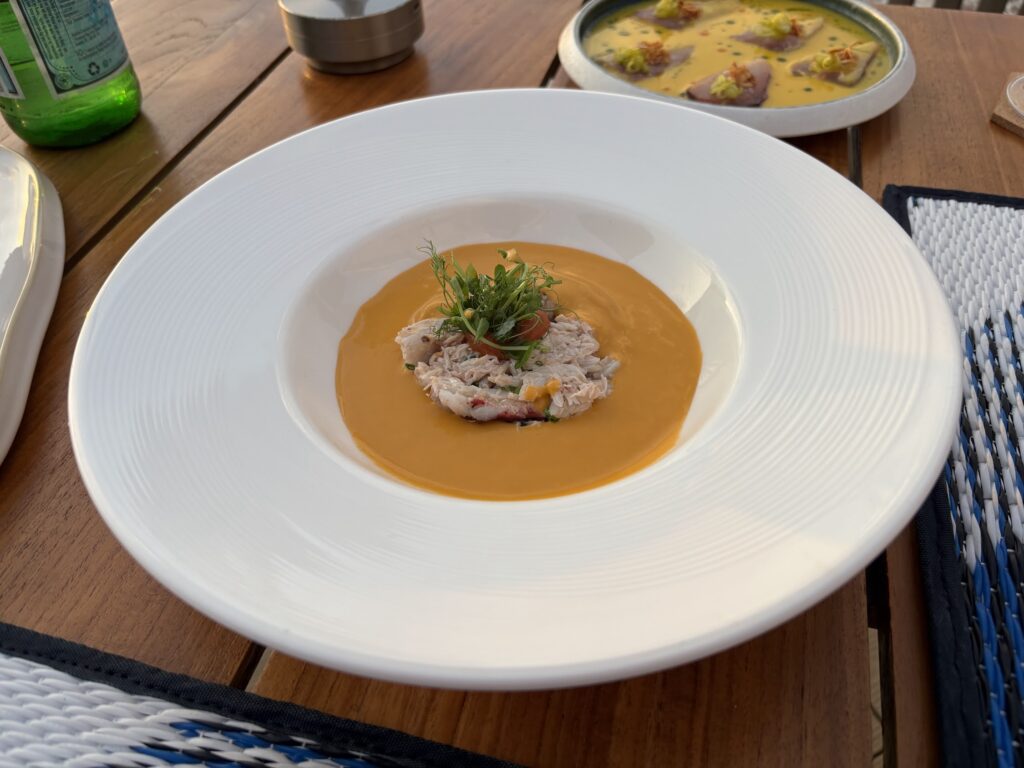
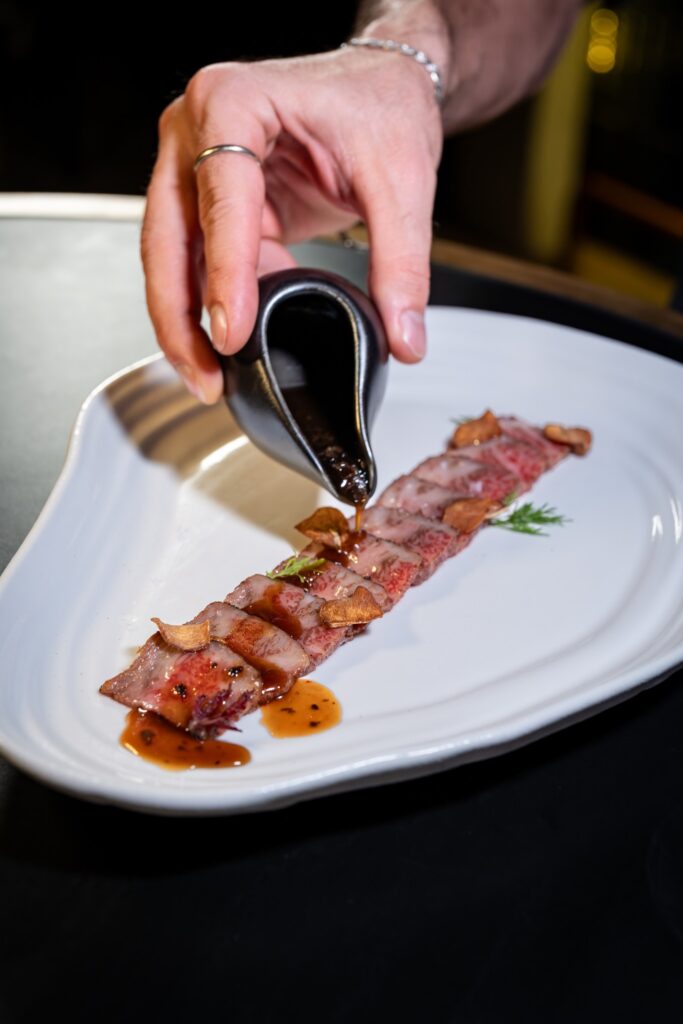
Chef Alvaro de la Puerta, from Almería in Andalusia, brings over a decade of experience across kitchens in Spain, the UK and the Cayman Islands to this esteemed vantage point. His Spanish instincts are all over the earlier courses: Iberico croquetas with 24-month ham and aioli, a crab salad built on a pert tomato gazpacho and tomato gel, a hamachi ceviche with tiger’s milk and crispy corn, and whole grilled dayboat fish finished with slivers of fried garlic and an olive oil and vinegar emulsion.
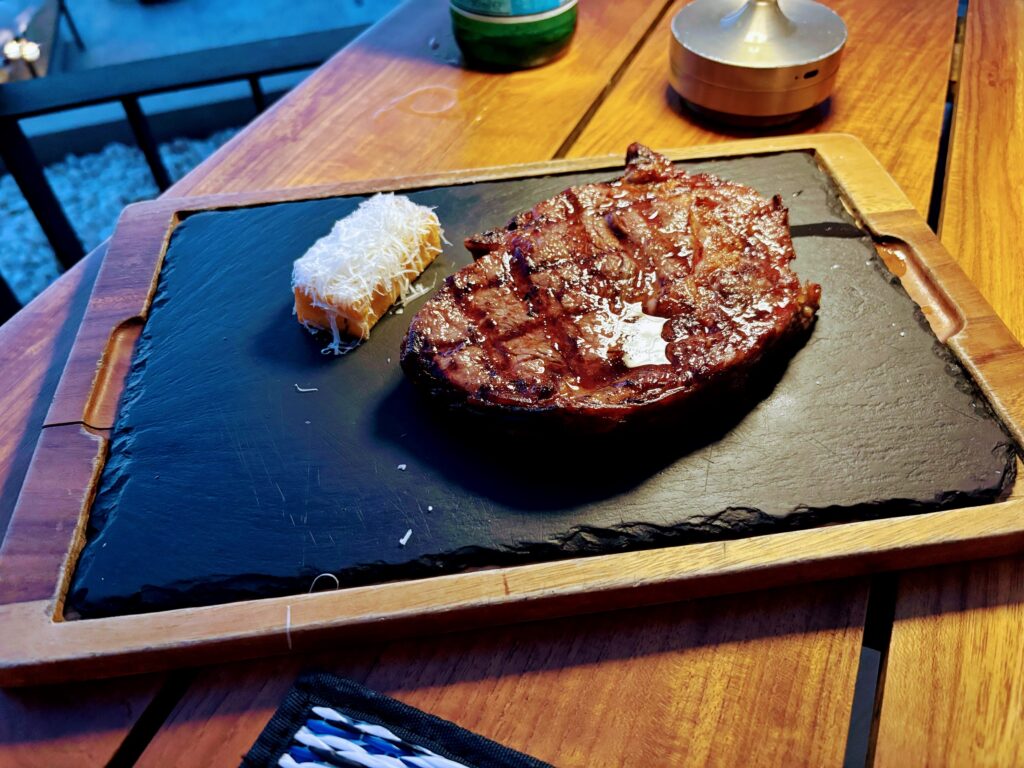
The Australian Black Angus ribeye that follows is unadorned in a way that takes confidence: a puck of garlic butter, a rectangle of deep-fried polenta, and nothing else. The aging is serious, pushing into that funky, almost blue-cheese depth, and it’s beautifully cooked. Sauces are available (gorgonzola, bearnaise, bordelaise, a Japanese BBQ glaze) but the beef is good enough to go without.
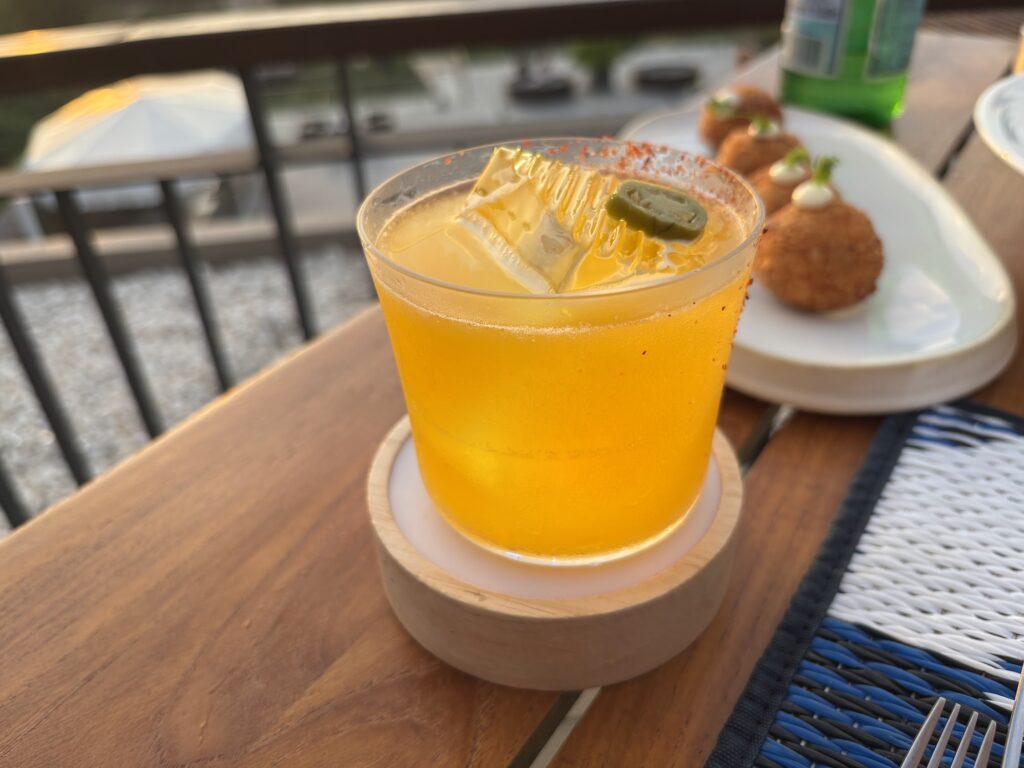
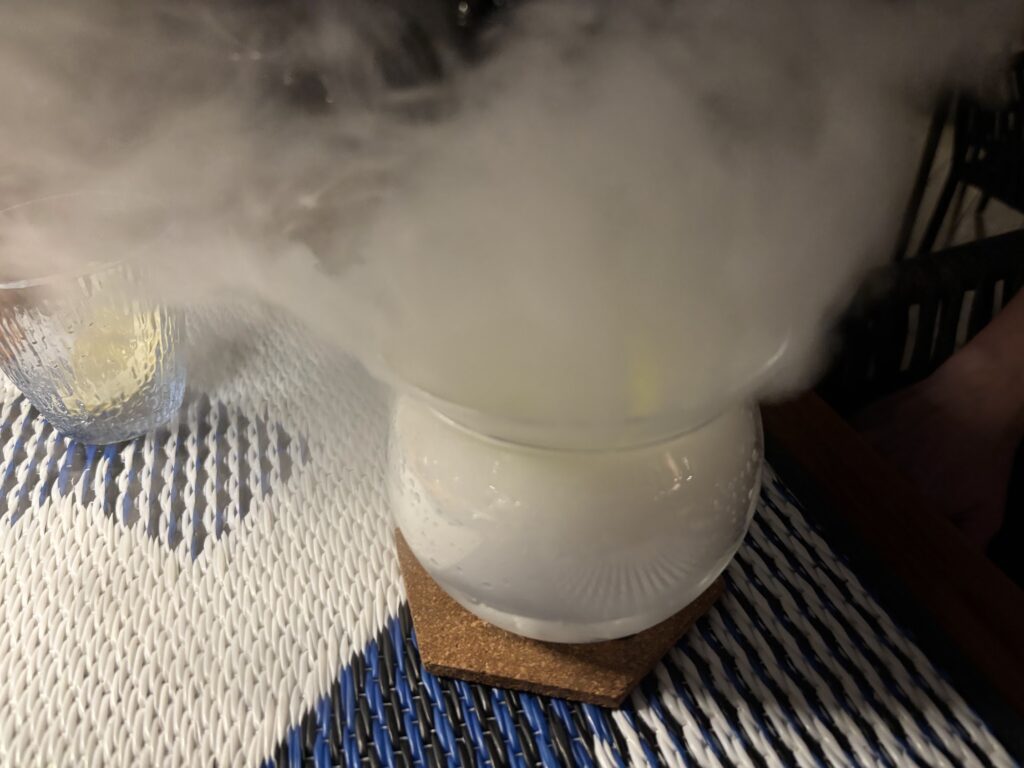
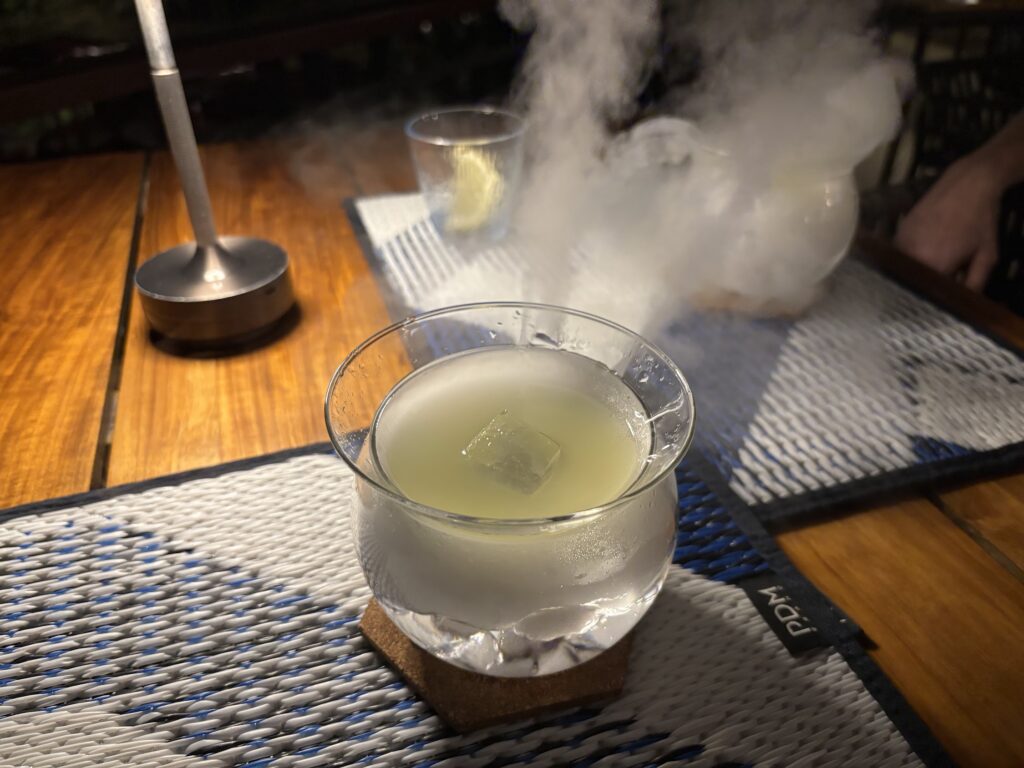
The cocktails belong at sunset. The Sunset Passion, fresh passionfruit with vodka and lime, and the Oaxaca Picante, tequila, mezcal, jalapeño and passionfruit with genuine heat, are both excellent. Dessert was not on our agenda until Simona, the restaurant’s wonderful host who sets the tone for the whole evening, insisted. A basque cheesecake, a tiramisu assembled tableside, and a limoncello over dry ice close off an evening that’s now cascaded into the early hours with us barely noticing.
Starters from THB 350 (around £8), steaks from THB 2,200 (around £50), and the tomahawk at THB 6,000 (around £130) for two to three. Open for dinner only, daily.
Ideal for American-style BBQ across the road from Patong Beach…
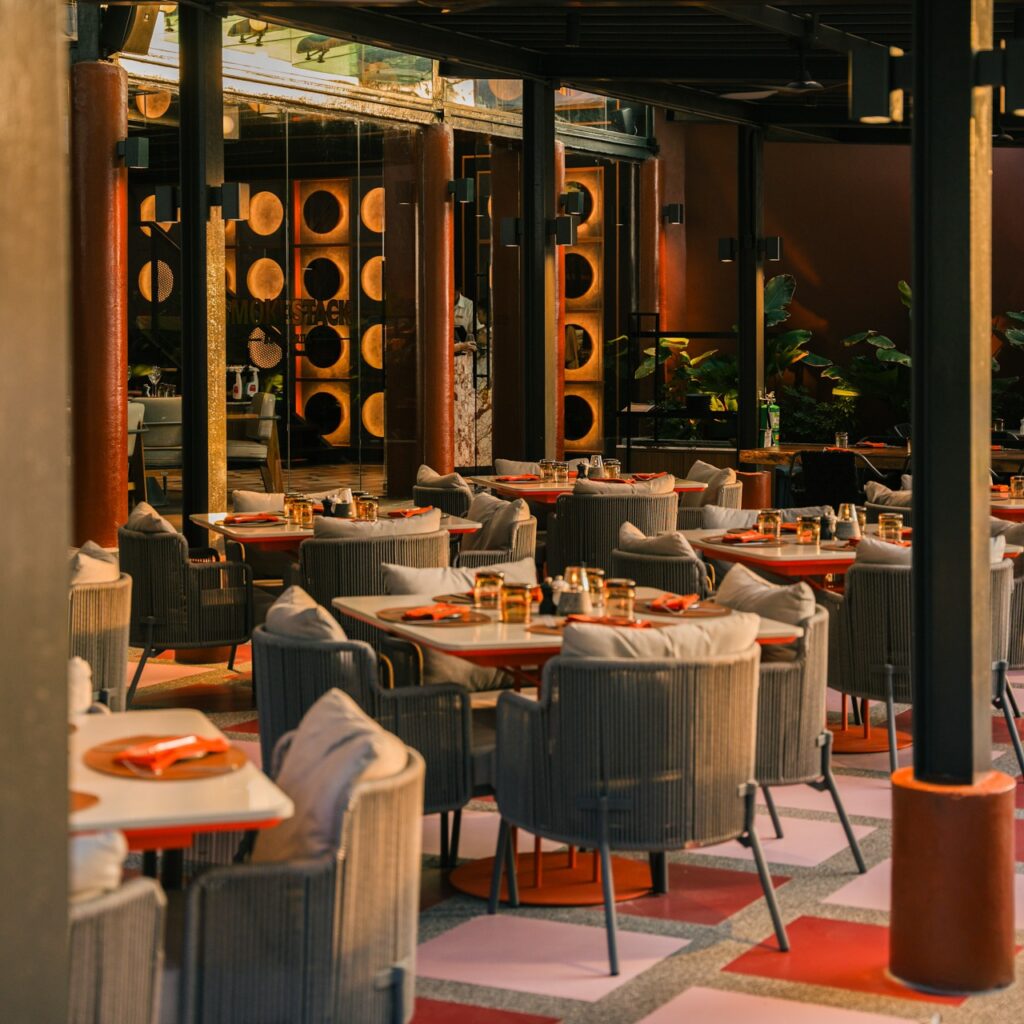
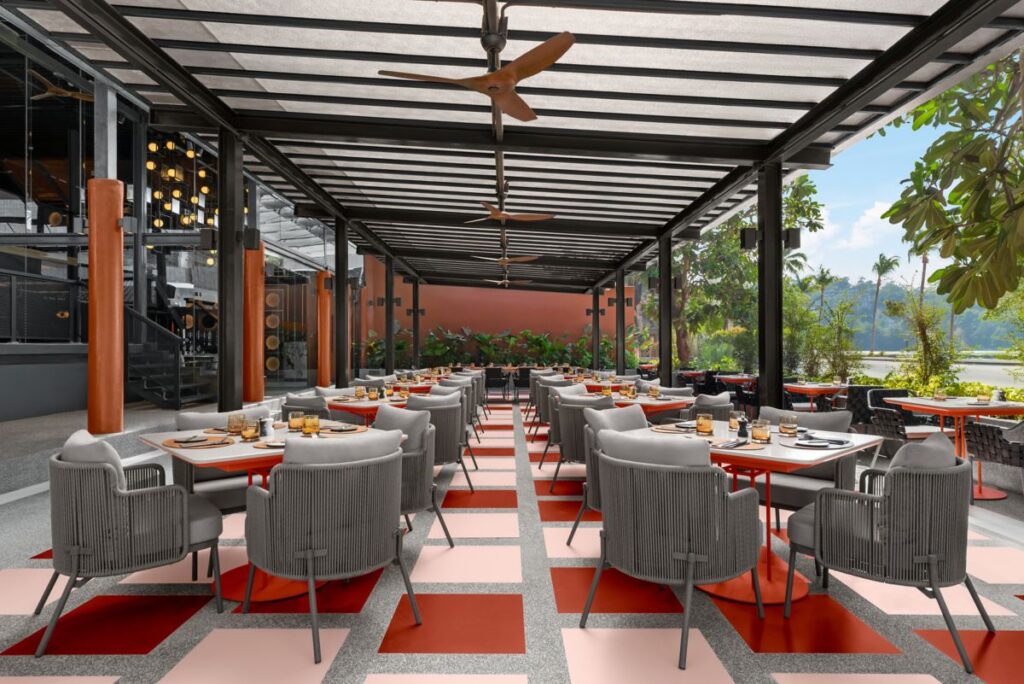
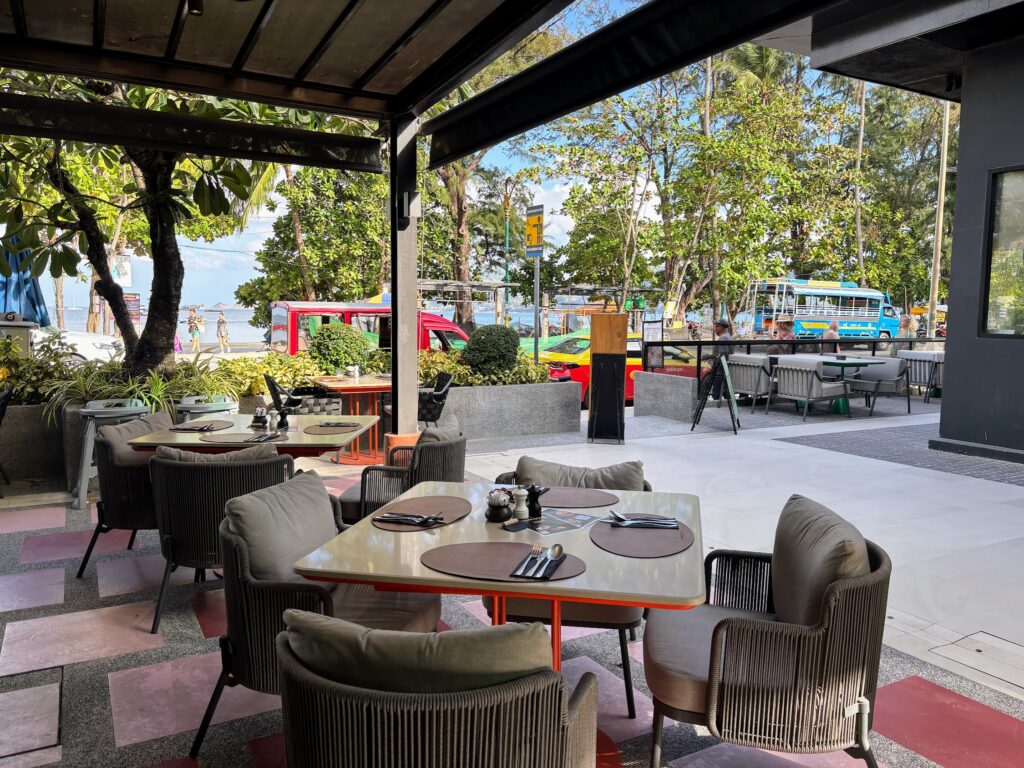
In this part of Patong, you’ll notice green dispensaries everywhere. But a badly judged blunt isn’t the only thing being smoked here. At Smokestack, part of the Courtyard by Marriott directly across from Patong Beach, chef Christopher Tuthill billows an even denser fog over handsome terrace seating.
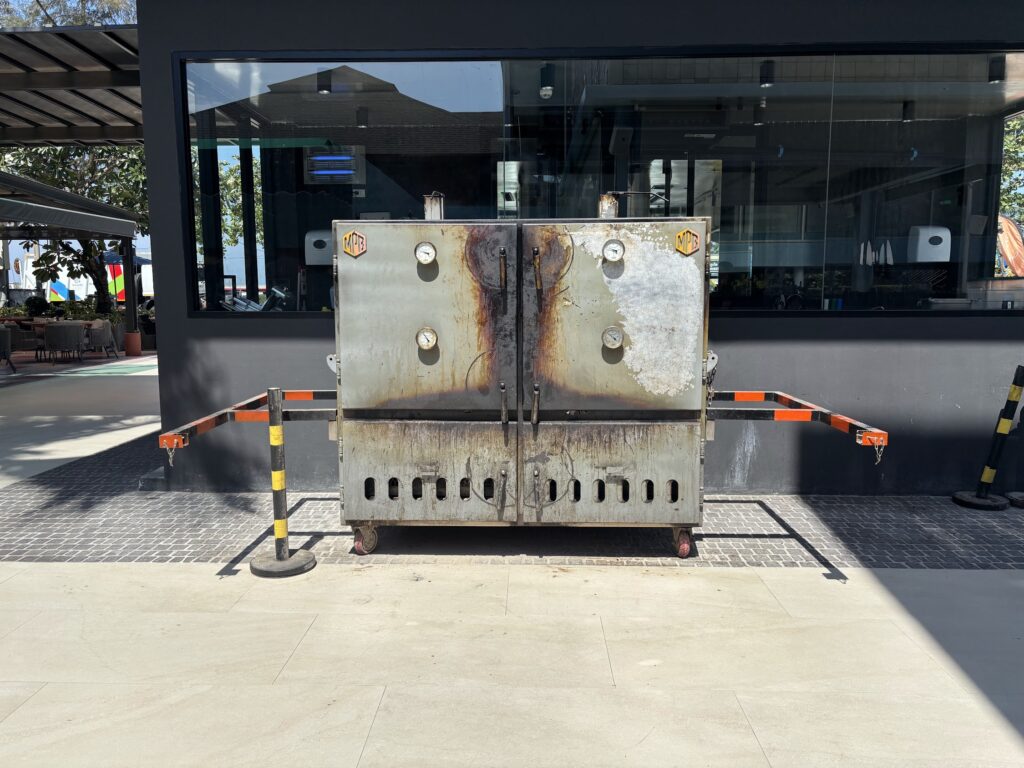
This is a man who knows what he’s doing. A California Culinary Academy graduate who spent years training between San Francisco and Hong Kong, and has built the kind of American smokehouse that takes its format seriously: fruit wood smokers, house rubs, low-and-slow cooking measured in days rather than hours. A massive, element-beaten smoker sits outside the semi-open kitchen, and the haze of hickory carries out towards the beach. It’s not unusual to see heads turn on Thaweewong Road, noses leading their owners to the dining room.
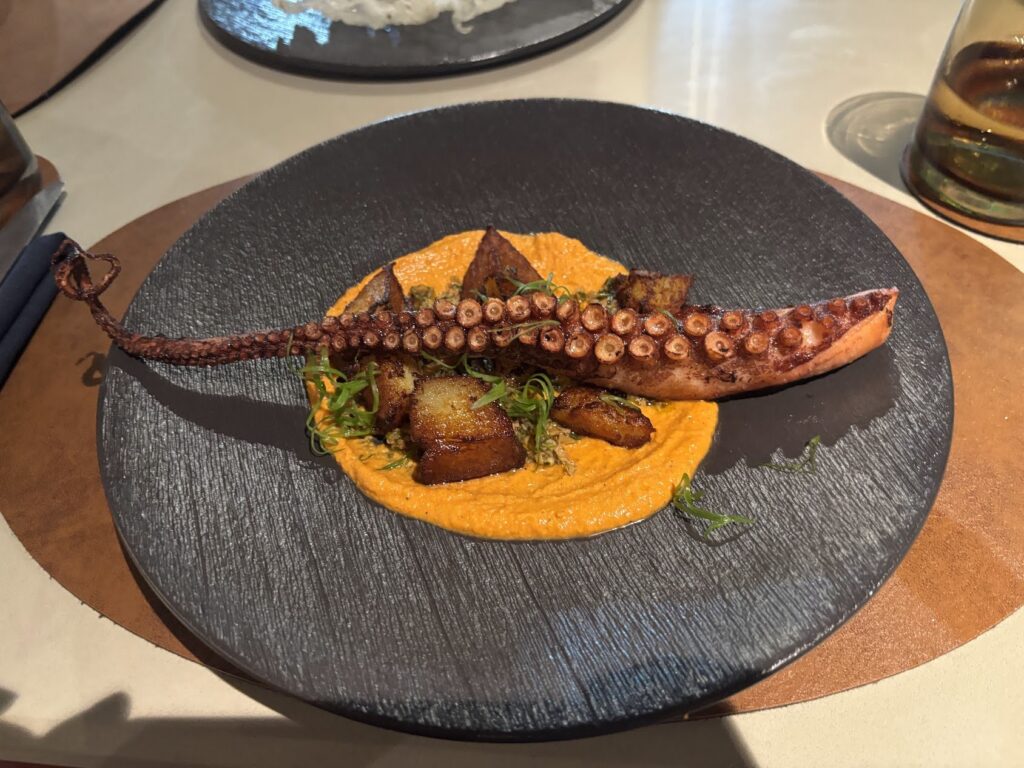
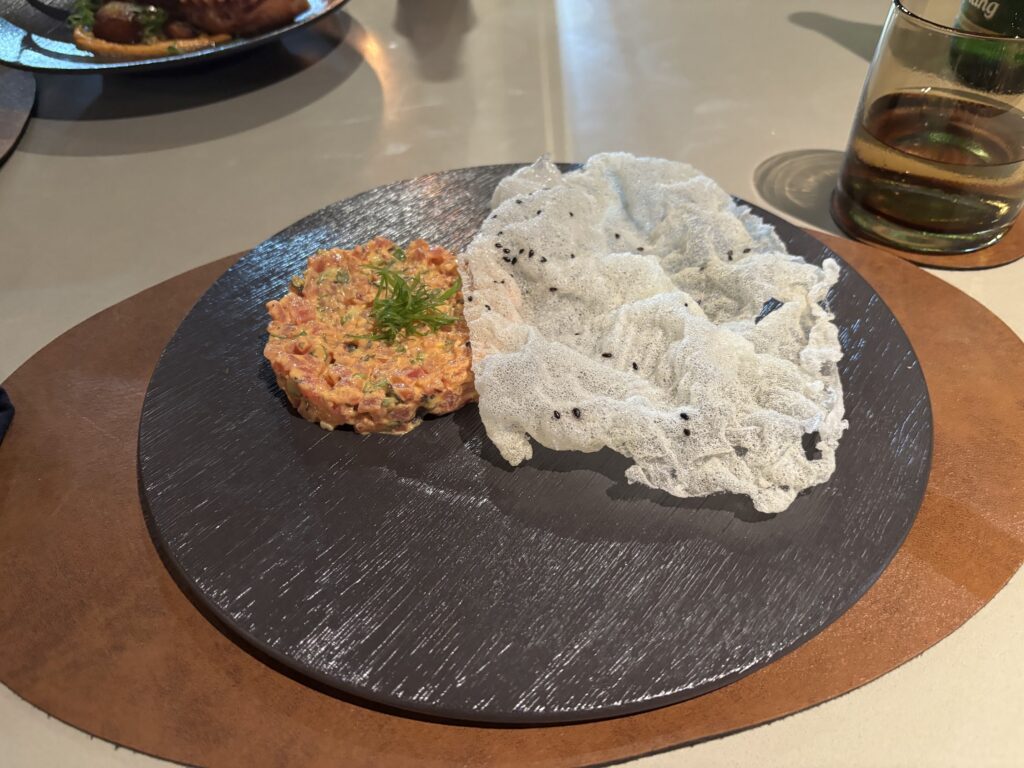
Before your beef brisket arrives, a tuna tartare with sriracha mayo and rice crackers is sharper and more delicate than the smoker outside would have you believe. A grilled octopus with crispy potatoes and chorizo does a good job of teleporting you to somewhere on the Med. More Marbs than Monte Carlo, perhaps, but nonetheless…
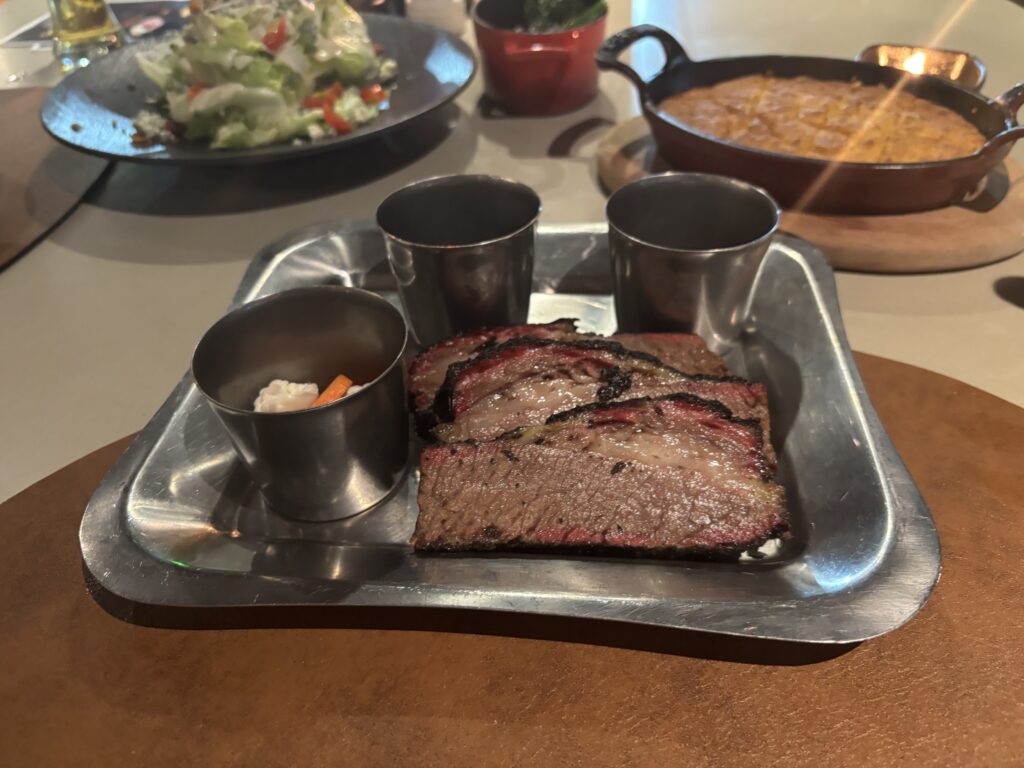
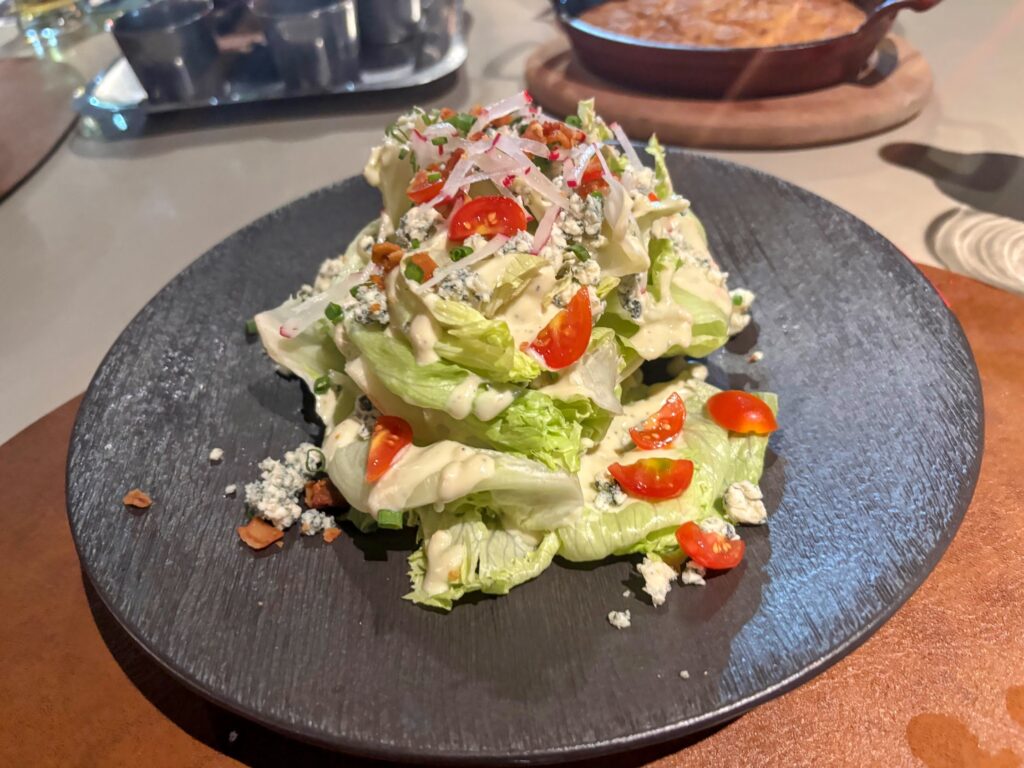
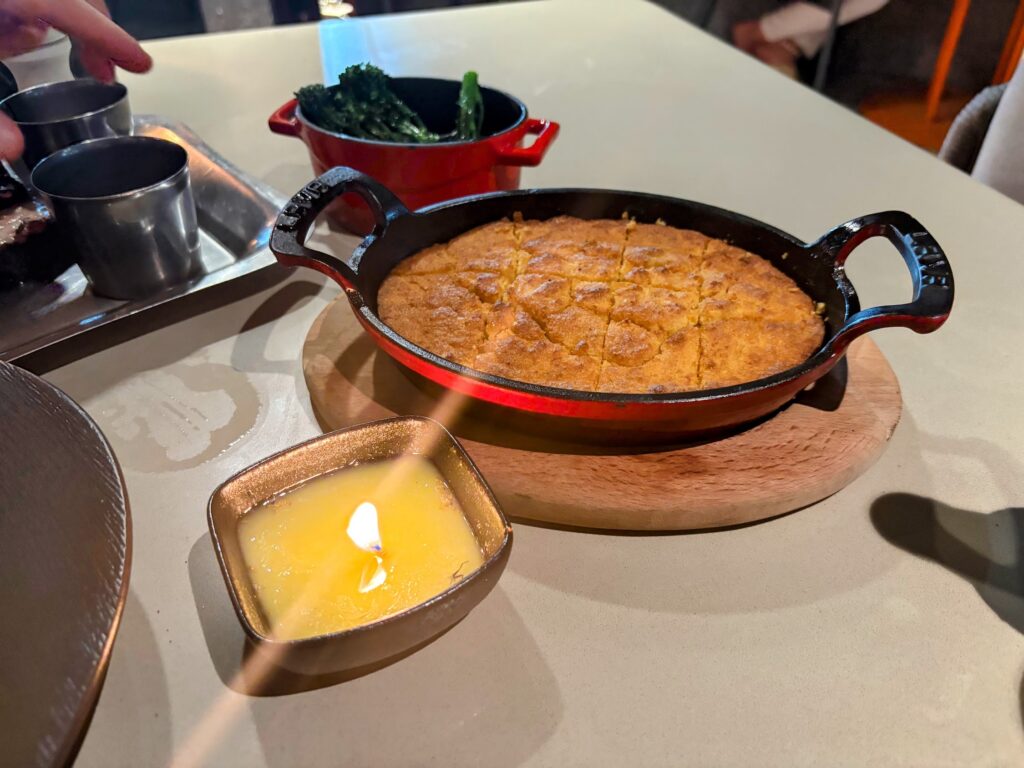
Let’s allow the brisket room to rest for even longer. The cornbread with its beef tallow candle, spread as it melts, costs almost nothing and should be ordered without hesitation. A wedge salad with blue cheese dressing is there to cut through the richness when you need it.
It’s time. The 240-day grain-fed Angus brisket at THB 740 (around £16) is the headliner: deeply smoky, dark and yielding, served with house pickles and a choice of sauces including a Carolina-style vinegar and the house golden BBQ, which has a pleasingly creeping heat. The menu goes wider than straight barbecue too: charred Andaman seafood, whole grilled snapper with romesco, and a 1.4kg wagyu tomahawk for sharing if you’re feeling extravagant. A Saturday night all-you-can-eat BBQ buffet pulls a crowd, too.
The wine list is thoughtfully put together, with a Banfi Chianti Classico and an Alvaro Palacios Rioja among the reds, and decent by-the-glass pours from around THB 295 (around £6.50). The whole thing is cracking value.
Ideal for Royal Thai cuisine on a cliff, with a wine cellar to match…
Just about every resort reception desk on Phuket’s west coast will suggest Baan Rim Pa when you ask for Thai food recommendations, which says a couple of things. One, that there is an overarching assumption that Royal Thai food is the most pleasing to the tourist palate. And two, that Baan Rim Pa does deliver, even if its incredible views are its chief appeal.
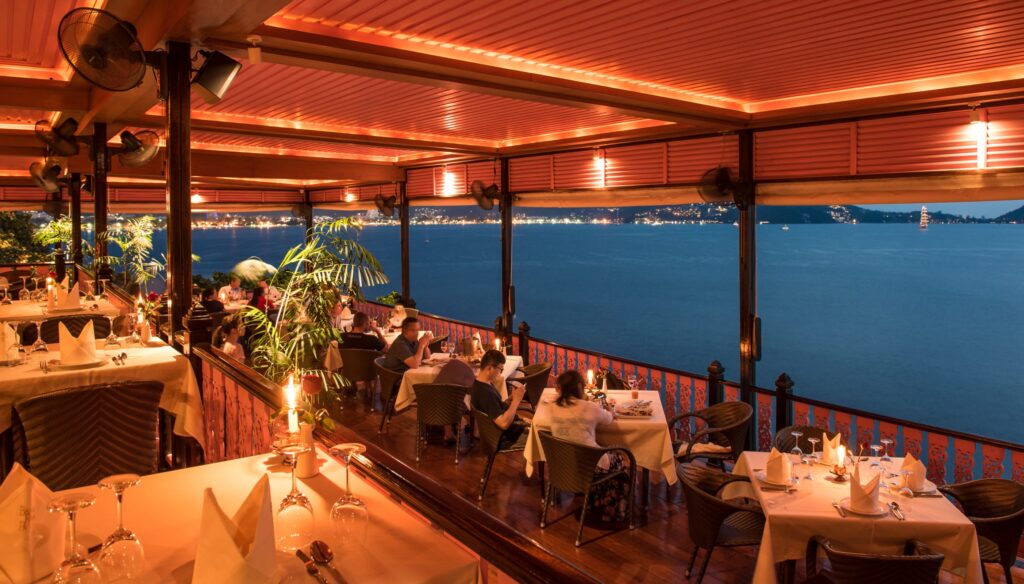
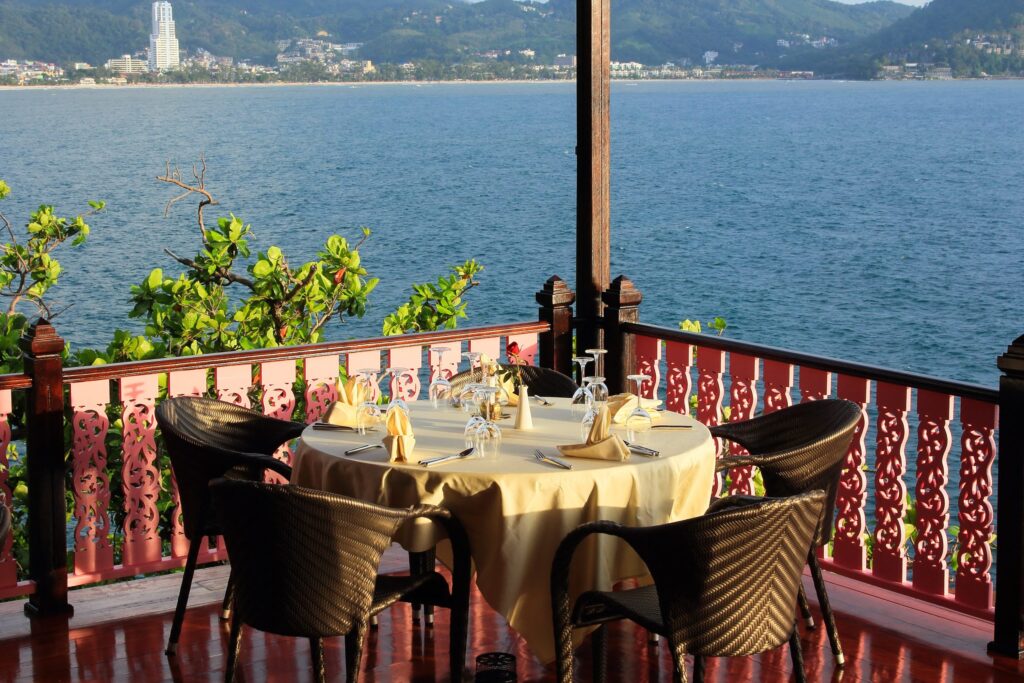
The name means ‘house by the cliff’, and that about says it. Except that it’s a restaurant, not a house, but anyway. This house/restaurant sits on the rocks at Kalim, just north of Patong Beach, with waves crashing below and panoramic views across to the bay. Founded by the late restaurateur Tom McNamara, who converted his own clifftop house into a restaurant (ah, that explains it), it has been serving Royal Thai cuisine for over 30 years, making it one of the longest-standing fine dining restaurants on the island. The original Patong location started as a 32-seat operation and grew to 200; when the restaurant consolidated to its Kalim site, the craftsman who built the original polished wood bar was brought back to recreate it in the new building. Nice touch.
The interior is old school in the best sense: a two-and-a-half-storey teak house with Thai silk, white tablecloths, napkins folded into elaborate sculptures, and a grand Steinway where a pianist plays jazz, blues and Broadway standards nightly. The menu is enormous, as a Royal Thai court’s table should be.
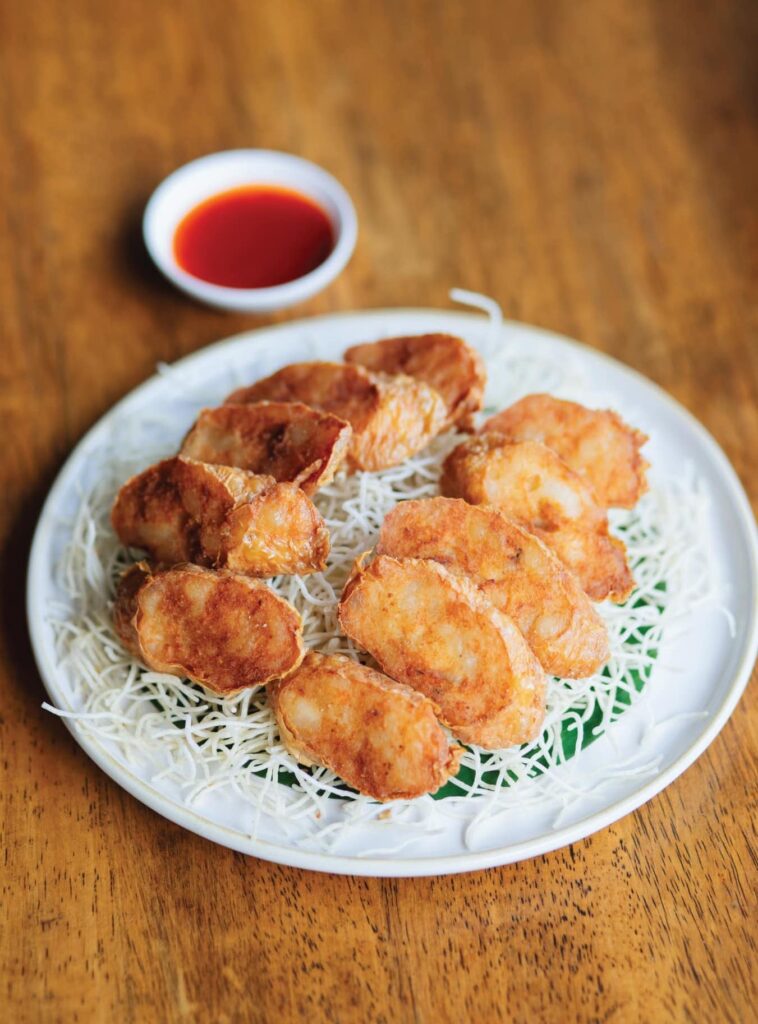
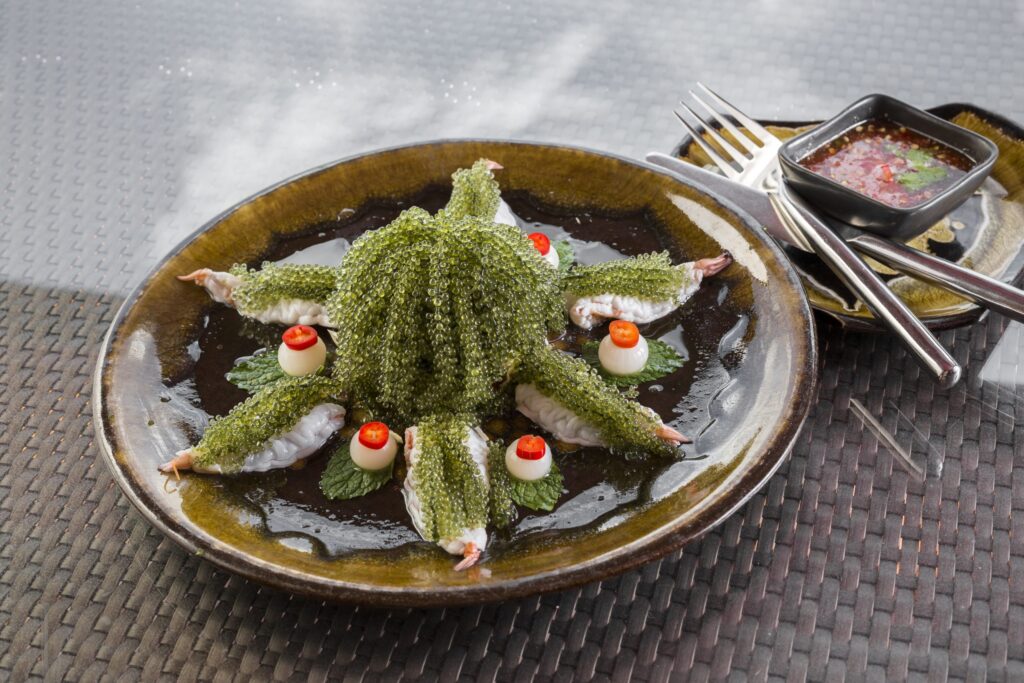
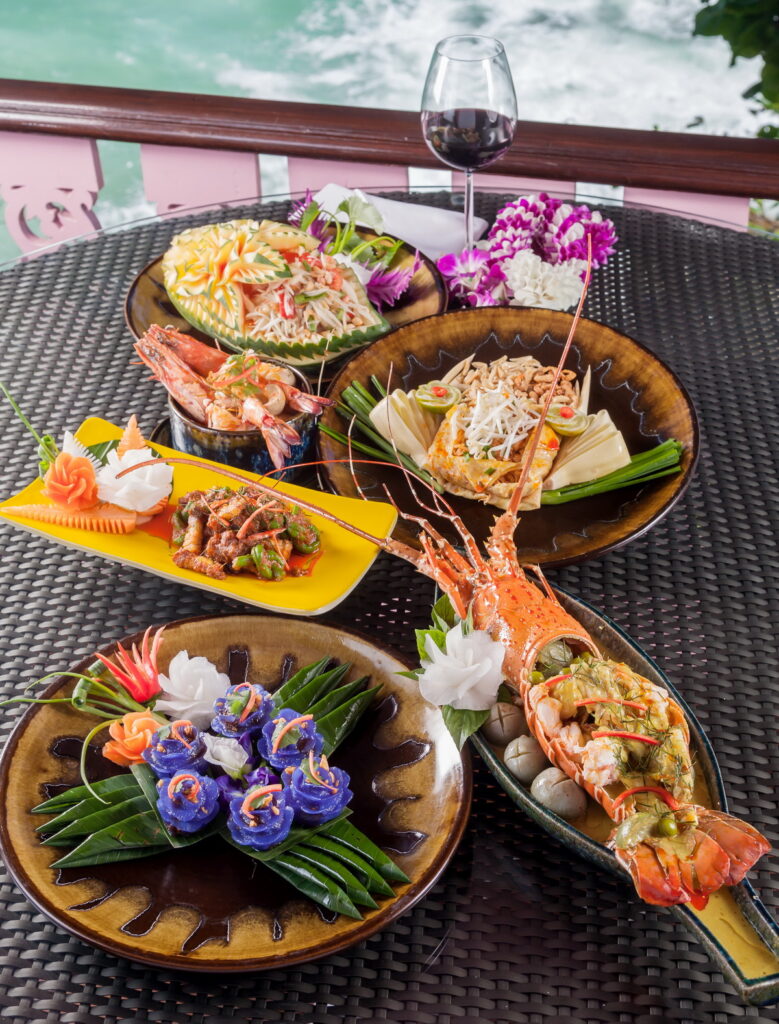
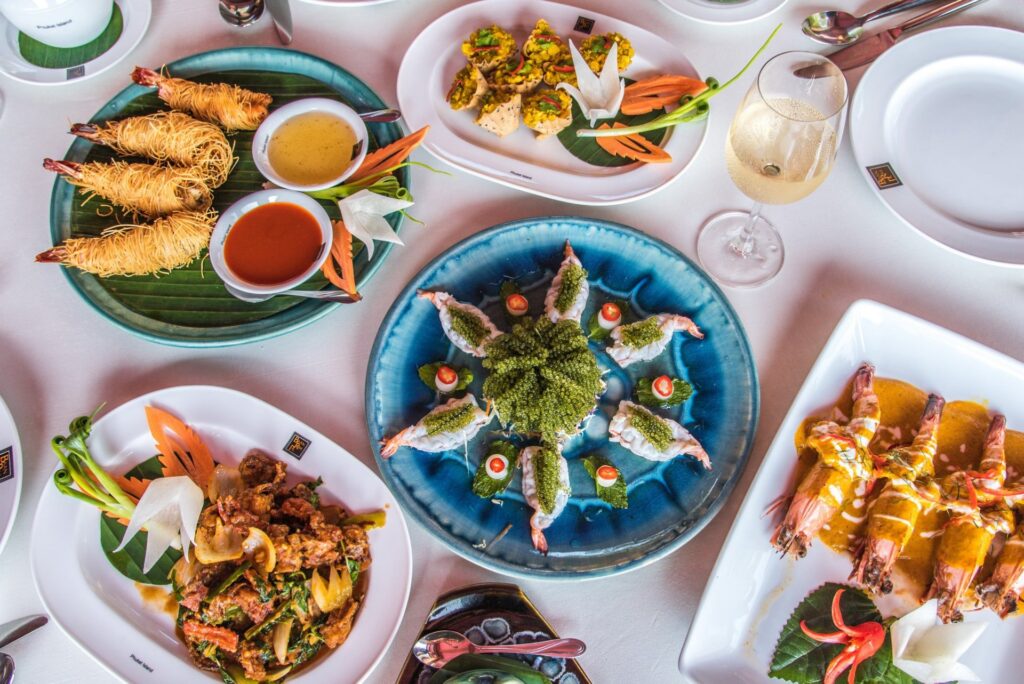
Bird-shaped chormuang dumplings filled with crabmeat and chicken, architectural prawn sashimi hidden under sea grapes, noodle-wrapped tiger prawns with chilli sauce and local honey, steamed whole snapper with spicy lime and garlic sauce: these are dishes that were once reserved for the Grand Palace, and the kitchen treats them with corresponding care. Carrots are carved all over the shop, but the prices are gentler than the intricate work with the paring knife suggests: most dishes fall between THB 345 and 500, which isn’t half bad really.
Executive chef Khun Wan, originally from Chaiyaphum in Isaan, joined as a kitchen hand in 1991 and trained under celebrated chef Charlie Amaatyakul from the esteemed Mandarin Oriental in Bangkok. He has worked his way through every level of the kitchen since.
The wine cellar has held Wine Spectator’s Best of Award of Excellence every year since 2002, a distinction that requires at least 350 selections with breadth across regions and depth of top producers. For a Thai restaurant on a Phuket clifftop, this is a considerable achievement.
Do we even need to say you should book for sunset? Open daily from noon to 11pm.
Ideal for award-winning Sardinian-Italian fine dining on the Kalim clifftop strip…
The accolades say it all. Michelin Plate. Wine Spectator Best of Award of Excellence. Iron Chef Thailand. Asia-Pacific’s Top Chef at the NOW Travel Asia Awards 2024. An acclaimed follow-up in Bangkok.
Acqua, the Phuket original, has been the island’s benchmark Italian restaurant since Sardinian-born chef Alessandro Frau opened it in 2009, and sixteen years on, the awards keep coming. But Frau didn’t open Acqua to collect trophies. Before hitting 30, he was already executive chef at the Sheraton Grande Laguna, overseeing 130 chefs across 12 outlets – a management role, not a cooking job. Acqua was his way back to the stove and to his homeland.
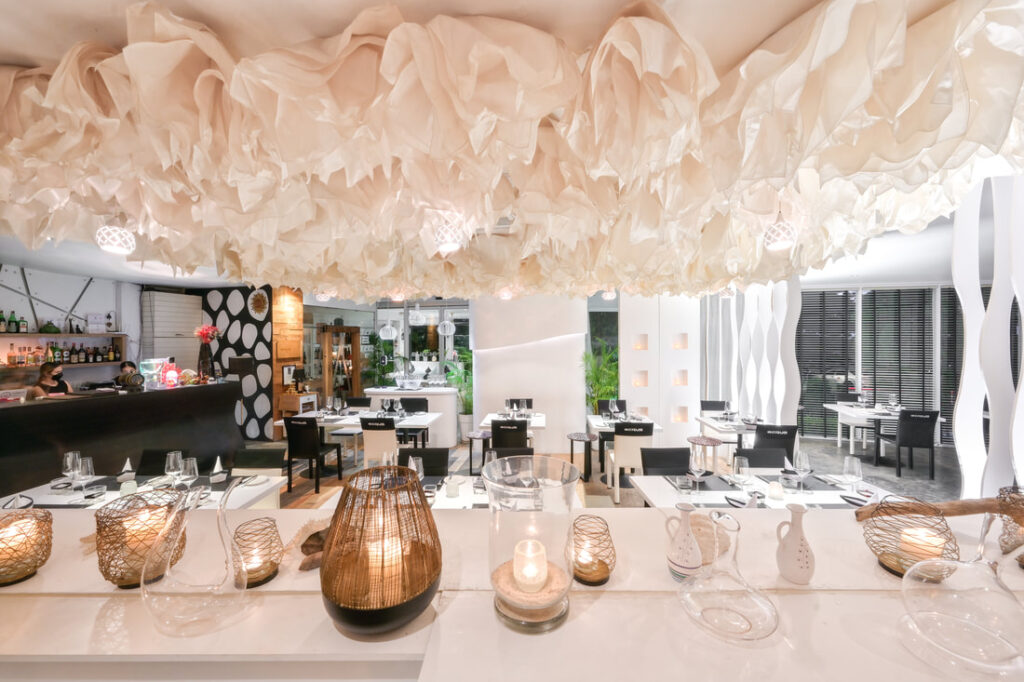
The restaurant sits a few minutes north of Patong on the same clifftop stretch as Baan Rim Pa and lauded L’Arôme by the Sea. The interior is Frau’s own design: black and white, clean lines, with a ceiling installation of what looks like hundreds of sheets of scrunched paper or parchment with lights glowing through it. It lends the room a theatrical, almost sculptural quality.
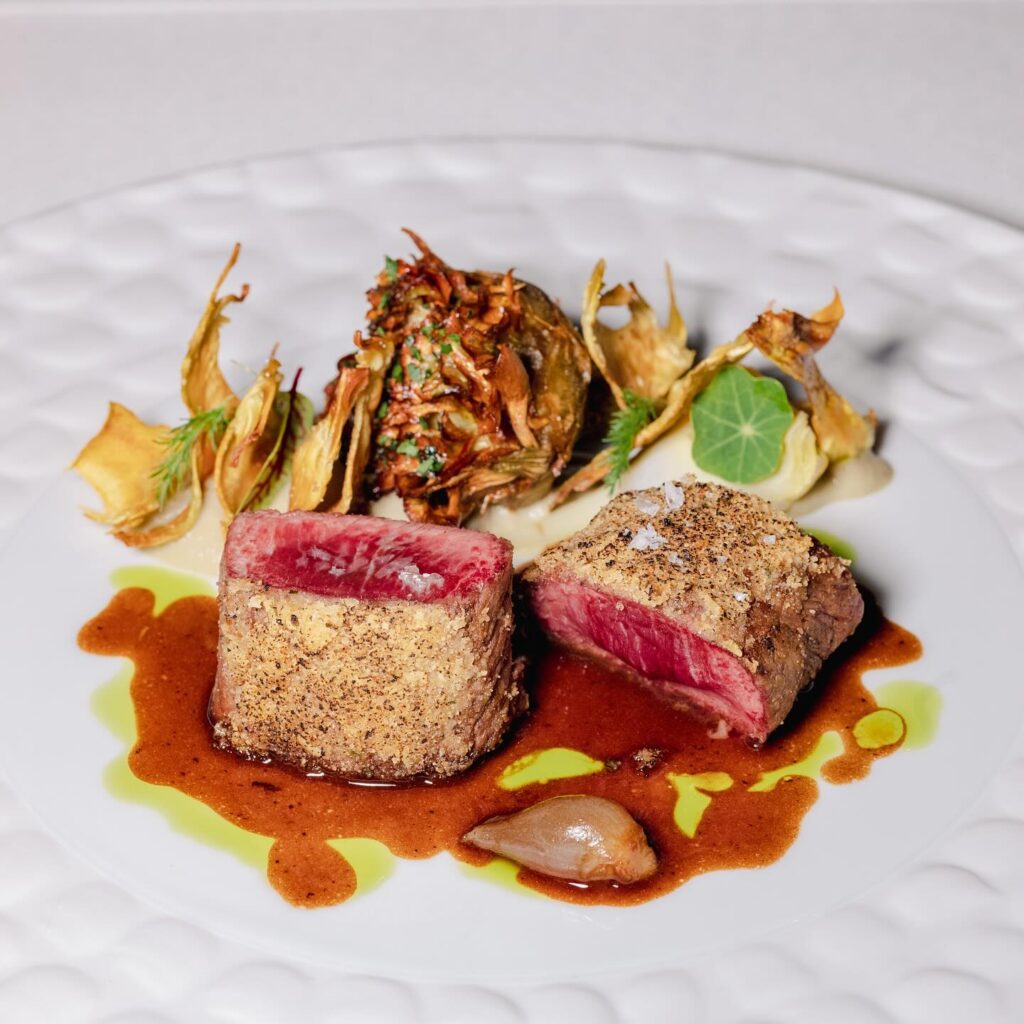
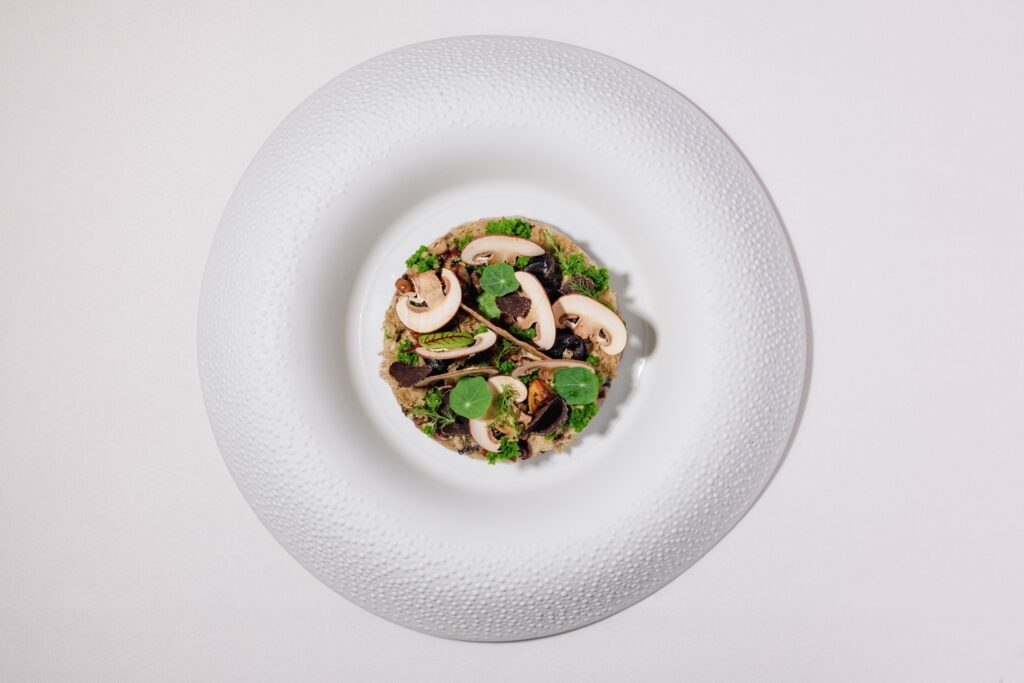
The cooking is rooted in Sardinia but sourced globally and restlessly: Sicilian red prawns from Mazara del Vallo served raw with Sardinian sea urchin and Siberian caviar, wild mushroom risotto, burrata-stuffed tortelli with wagyu beef cheek ragout braised for 72 hours and finished with 25-year aged balsamico. A sweat forms on your brow in anticipation of the bill when you read that roll call of ingredients, but this is a special occasion sort of place, so come prepared to submit.
A degustation menu at THB 4,300 (around £95) with optional wine pairing is the fullest expression of the kitchen, but the à la carte covers serious ground too, from wood-fired pizza with a 72-hour proved dough through to lobster à la Rossini with pan-fried foie gras and truffle bisque.
Front-of-house Joy has been there for years and is widely considered one of the best in Phuket. She’ll guide you through the enormous wine list, which is deeply, proudly Italian, with a strong Sardinian section (Argiolas Turriga, Capichera, Agricola Punica Barrua) alongside Sassicaia, Ornellaia and Tignanello, and by-the-glass pours via Coravin for those not committing to a full bottle.
Khao Suan Kwang is a district in Khon Kaen famous for its grilled chicken, and gai yang restaurants across Thailand carry the name as a mark of pedigree.
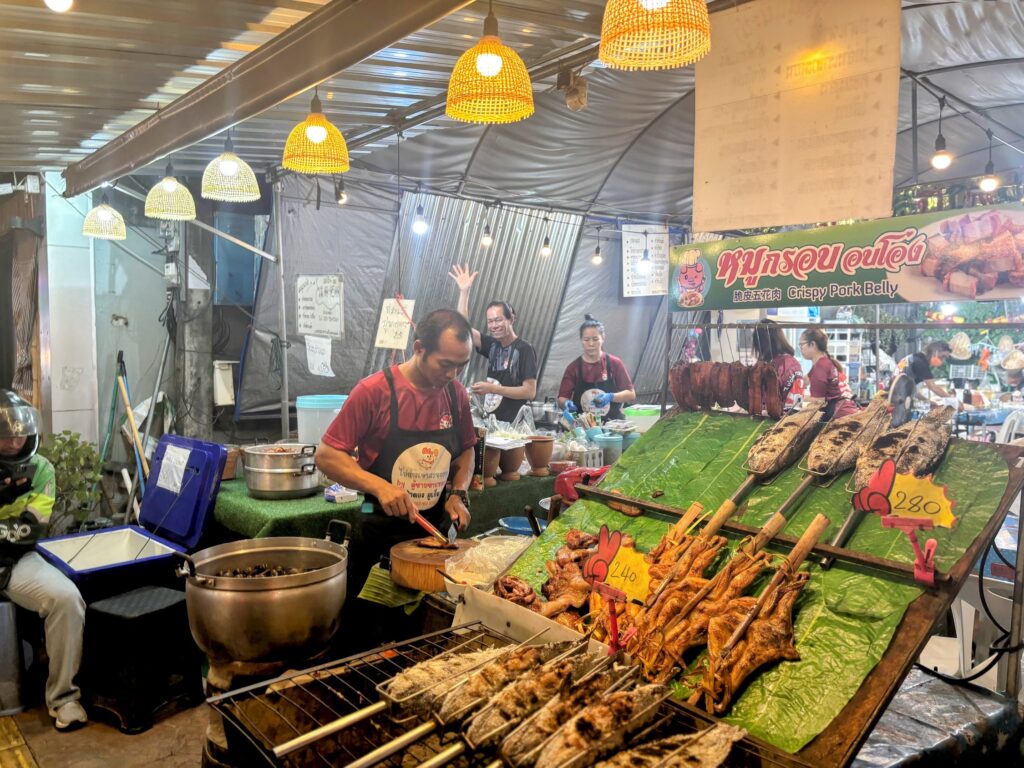
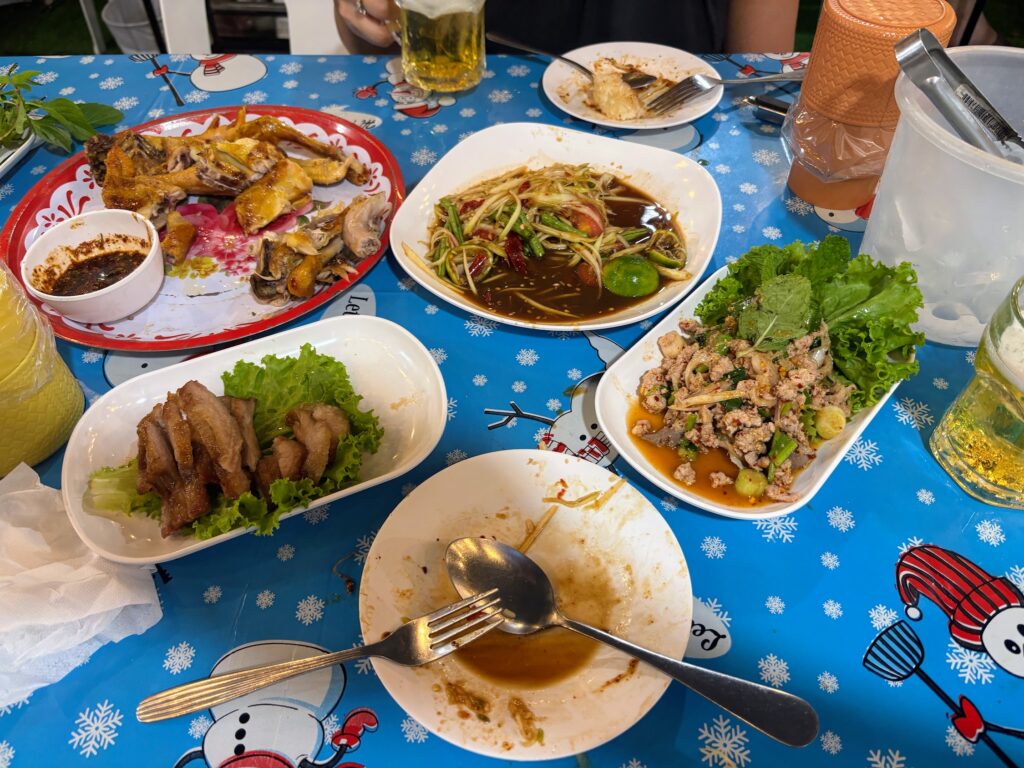
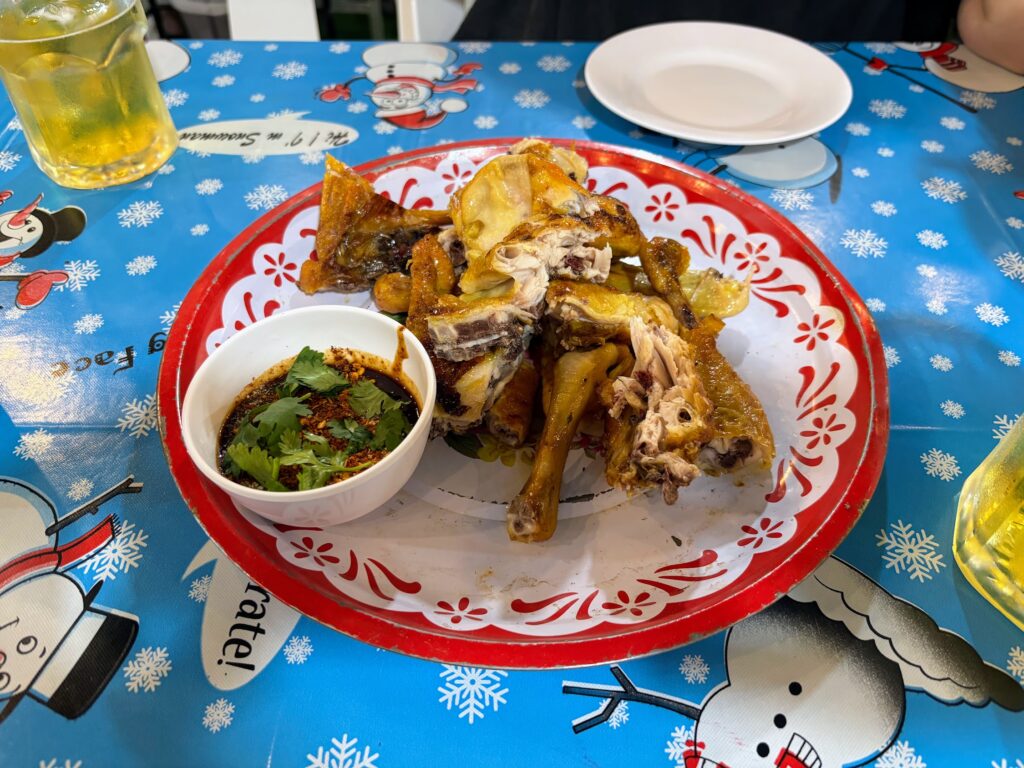
Back in Patong, and the full signage at this Phra Metta Road joint reads ไก่ย่างเขาสวนกวาง by ผู้ชายขายหอย — ‘Khao Suan Kwang grilled chicken by the shellfish guy’. It’s a typically idiosyncratic Isaan restaurant name that – alongside the cartoon snowman-adorned blue plastic tablecloths, metronomic ‘pok pok pok’ and molam soundtrack – actually tells you everything you need to know.
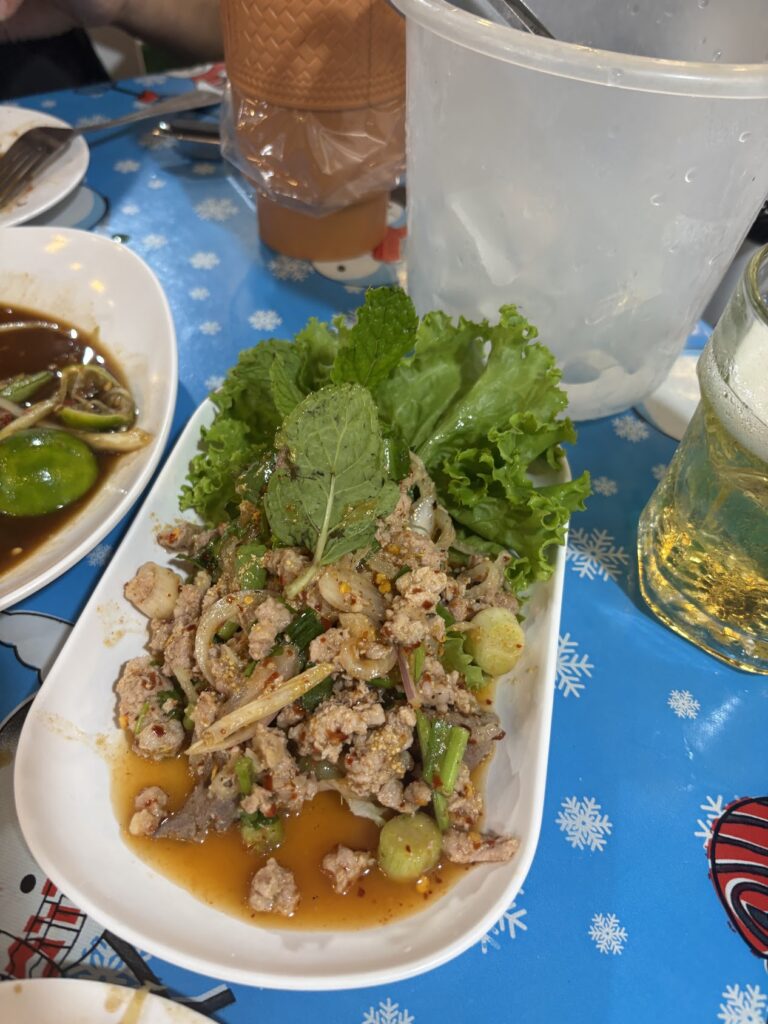
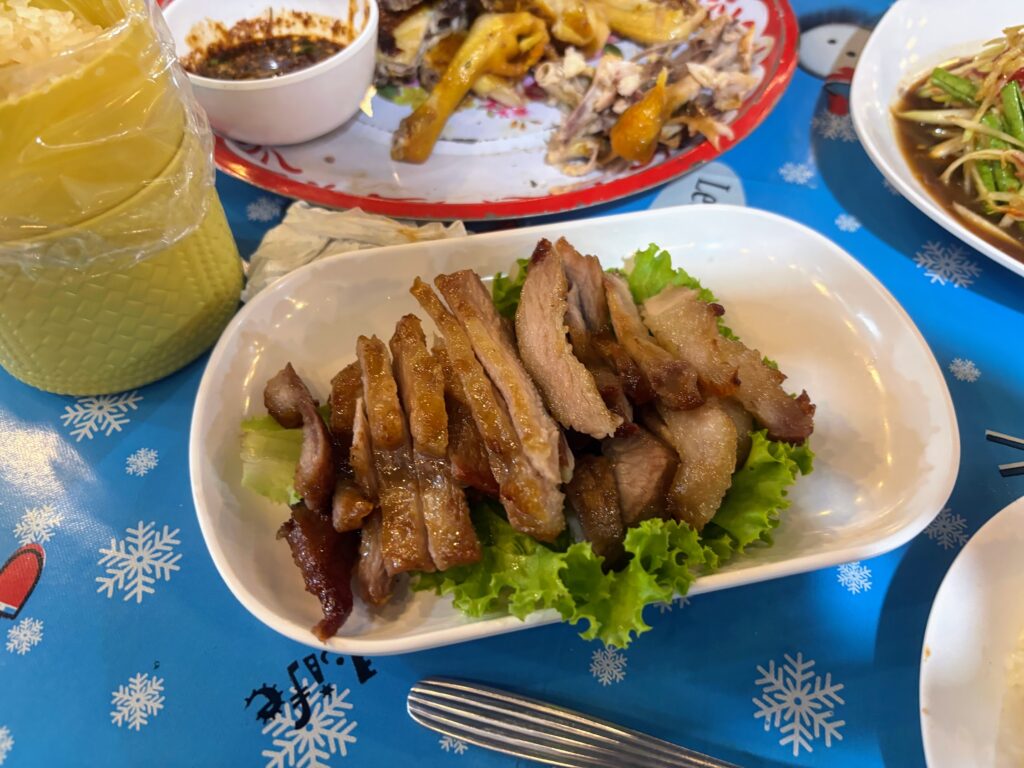
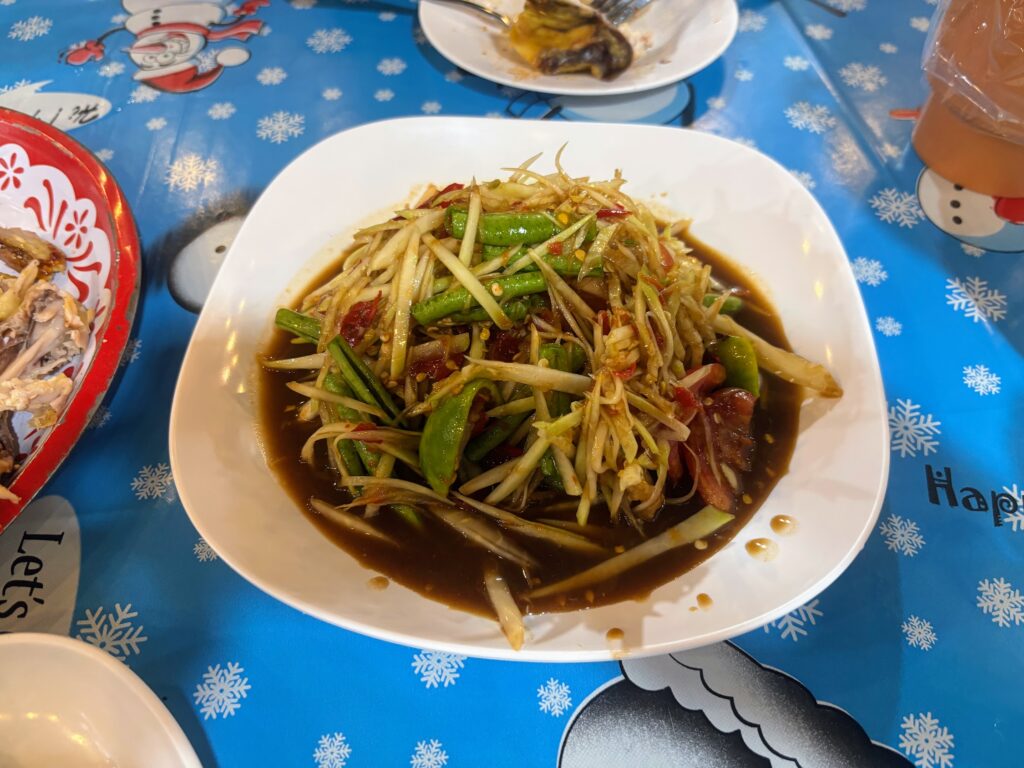
Though, even after eating here loads of times, we’re still not confident who the shellfish guy is. Or, indeed, if the shellfish is good here. Best to stick to the Isaan classics, we think – as everyone else is. Out front, whole tilapia turn over charcoal in their salt crusts alongside the flavoursome, though a touch gnarly, gai yang. Inside, the laap is juicy, the som tam pla raa is fiery, and the beers are cold. Whether Khon Kaen or Patong, it’s just the ticket.
Ideal for an Isaan chilli hit and a certain amount of sass…
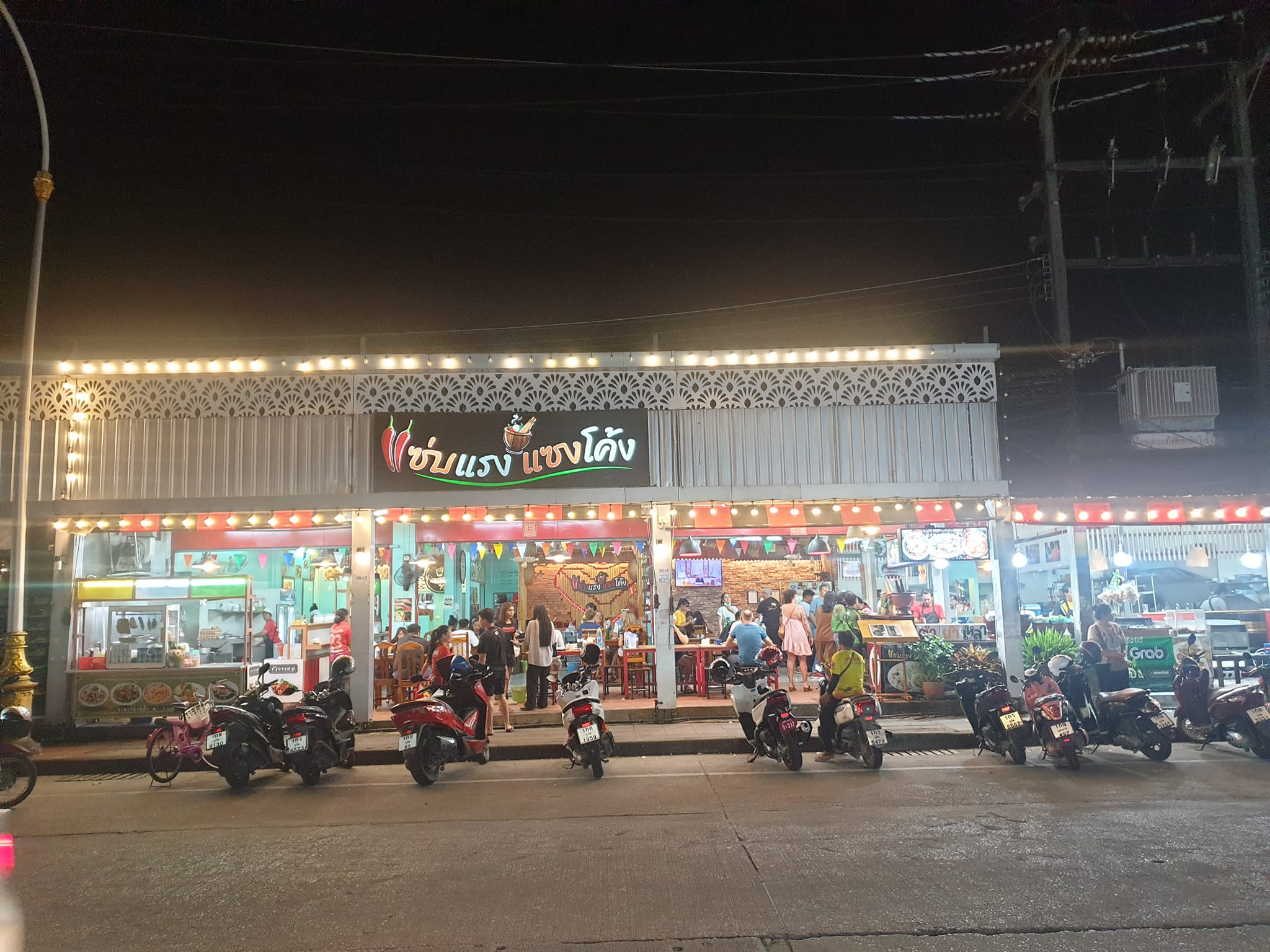
Hey, speaking of idiosyncratic Isaan restaurant names, how’s this one for size? ‘แซ่บแรง แซงโค้ง‘
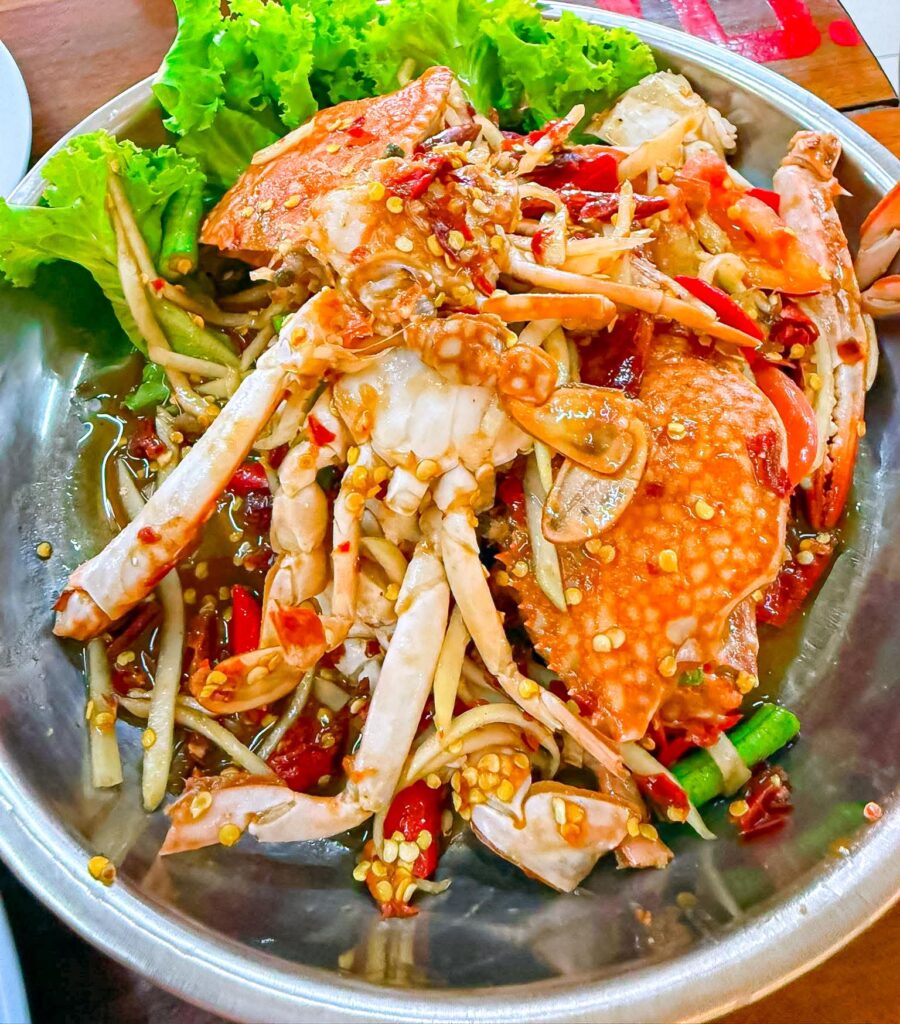
‘Saeb raeng’ means intensely spicy; ‘saeng khong’ means overtaking on a bend, which, if you have driven Phuket’s hill roads, you’ll know is something of a national sport. Put them together and you get something close to ‘so fiercely spicy it overtakes you on a corner’, which is one hell of an image. Though we’d caution against driving at all after a plate of the tam taeng kwaa (pounded cucumber salad) here; it’s head-spinningly assertive.
Ideal for a three-curry lunch for the price of an Evian back home…
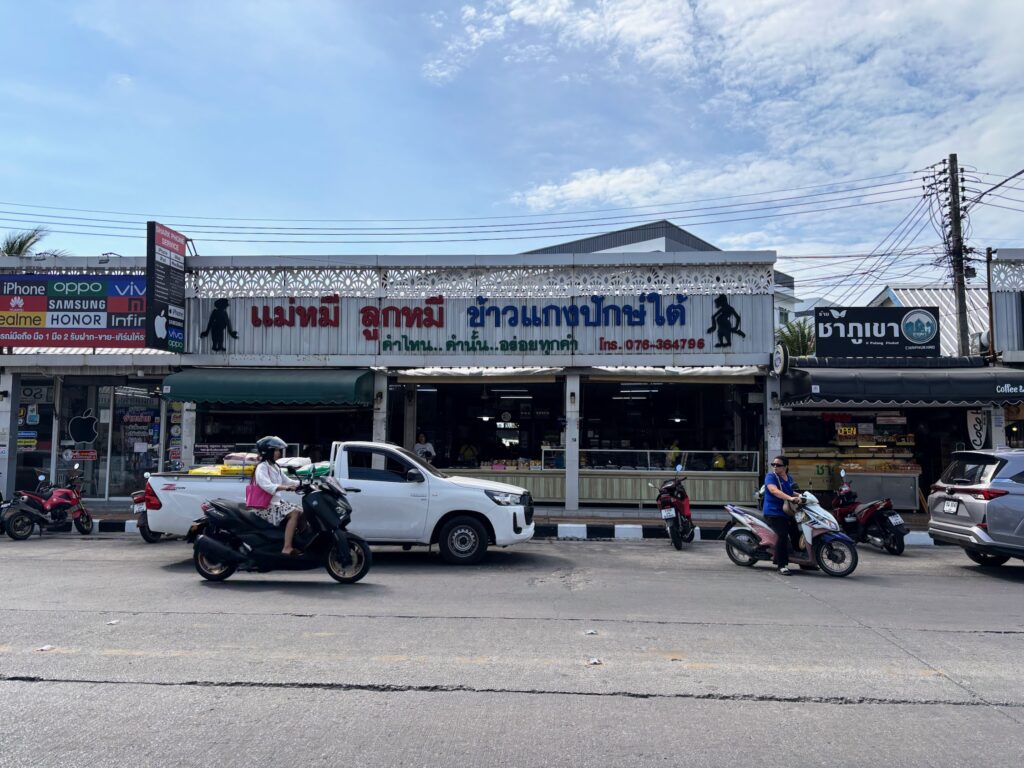
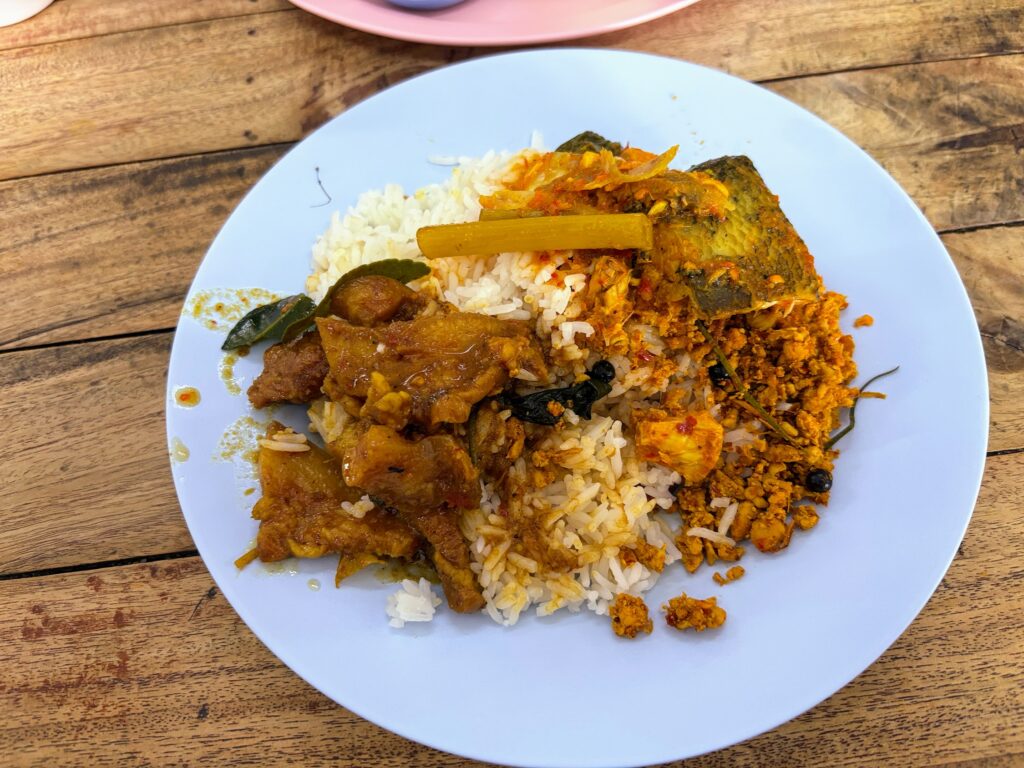
Another budget baller on Phra Metta is Mae Mee (แม่หมี ลูกหมี ข้าวแกงปักษ์ใต้). The format here is raan khao kaeng: pre-made curries in trays behind a counter, served over rice. The clientele is primarily office and construction workers, drawn by satisfying, homestyle curries here; a brusque khua kling (dry toasted pork mince curry) is the pick of the bunch.
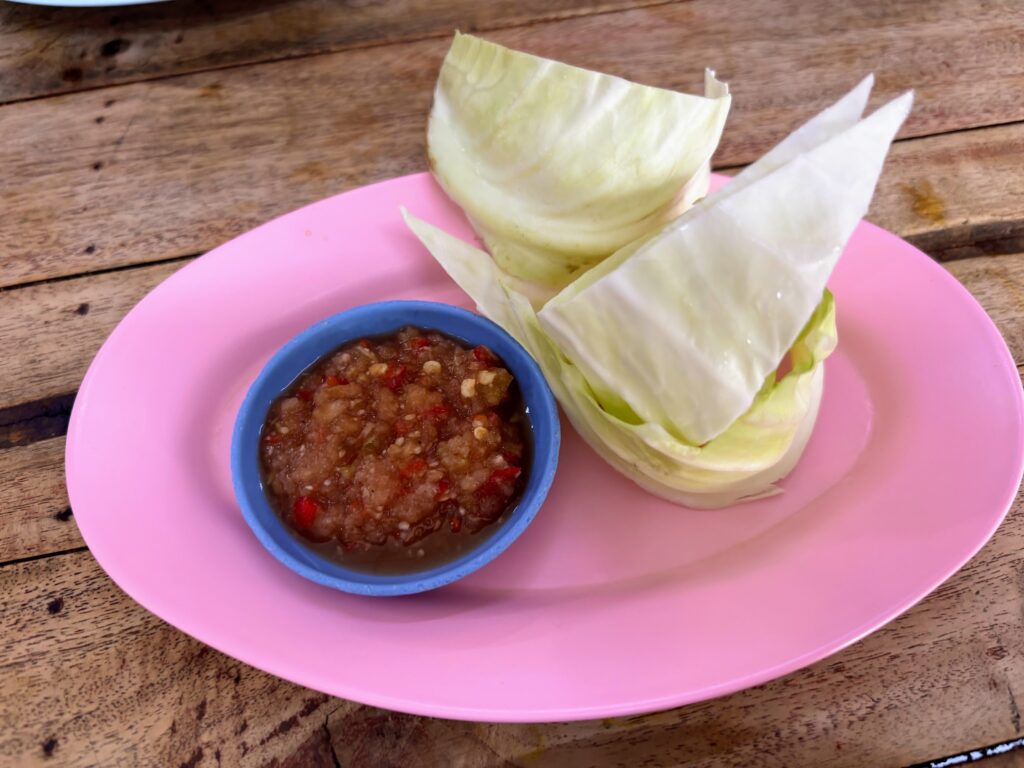
It’s extraordinary value, with three curries over rice costing just 65 baht (£1.50). There’s even complimentary nahm chub and fresh vegetables for scooping, both self-service, and free water, too. Superb stuff.
Ideal for a hotel Thai restaurant worth leaving the pool for…
Chang Thai is a new addition to the Phuket Marriott Merlin Beach. It was born out of a straightforward gap: guests kept asking for good Thai food, and the resort, like most on the island, didn’t have a dedicated restaurant offering it with wine and full table service.
Hotel manager Khun Aof, a genuine food enthusiast, created the concept, and chef Green, whose passion for the stories behind each dish is infectious and frequently funny, brought it to life with dishes that deserve attention beyond the hotel’s guests.
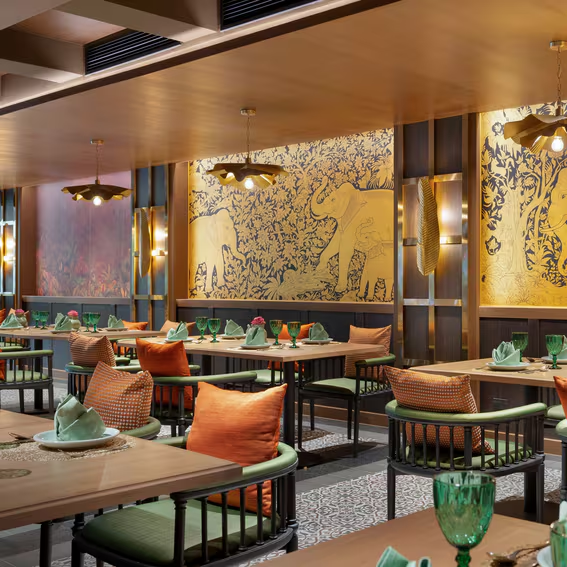
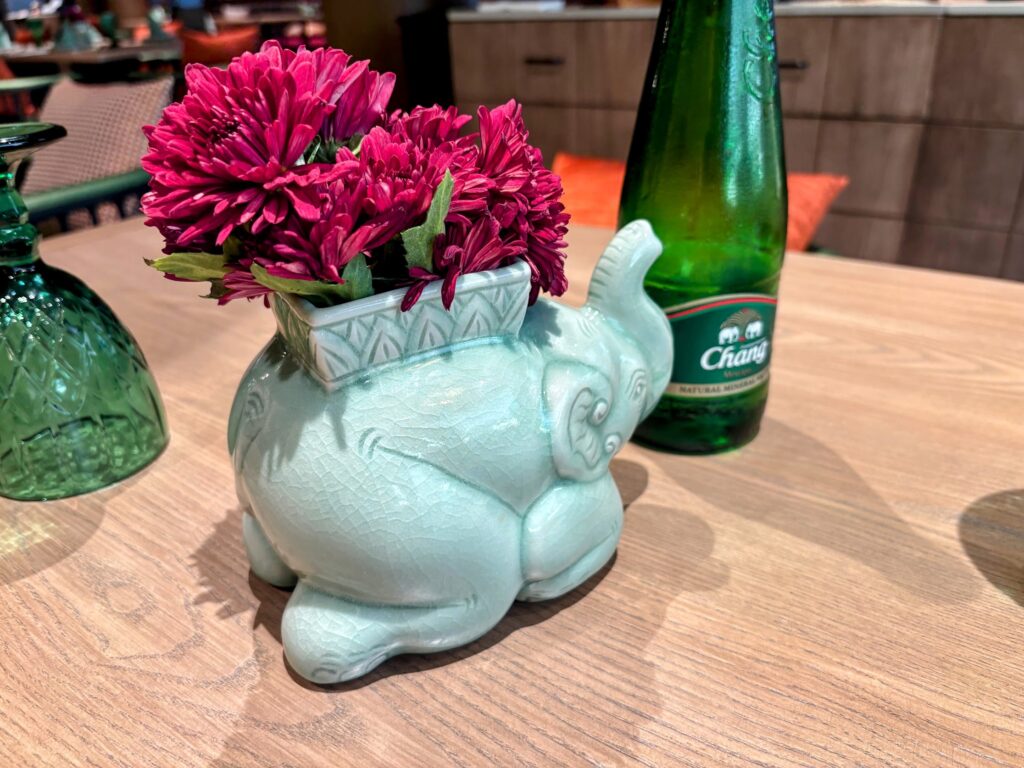
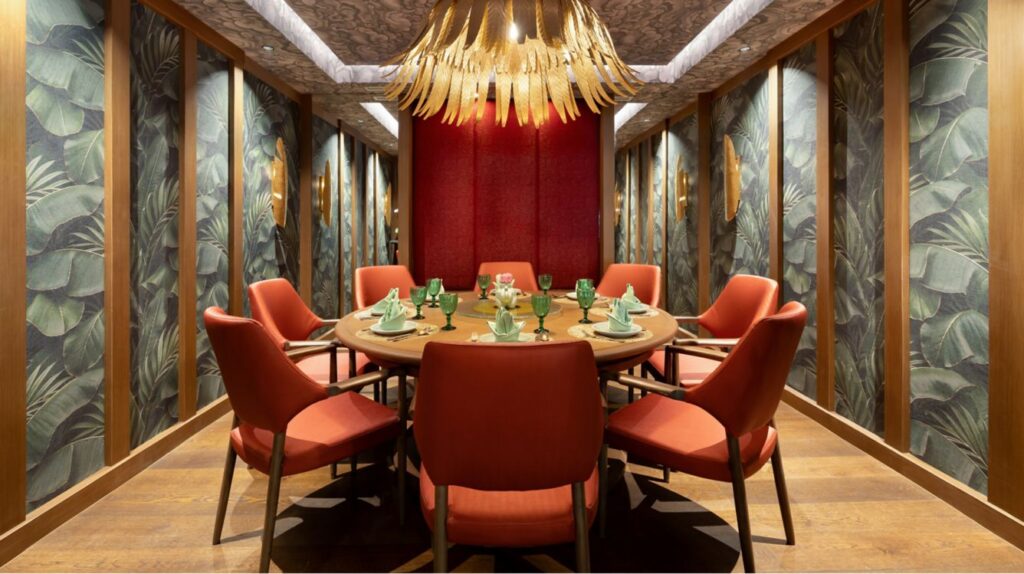
The room is beautiful. Elephant motifs run through the decor, Thai silks dress the space, and the crockery is thoughtfully chosen. It’s unmistakably Thai without tipping into theme restaurant territory. Cooking classes run during the day in the same room (perfect for eavesdropping on recipes), and there’s a smaller lunch menu for those staying at the resort.
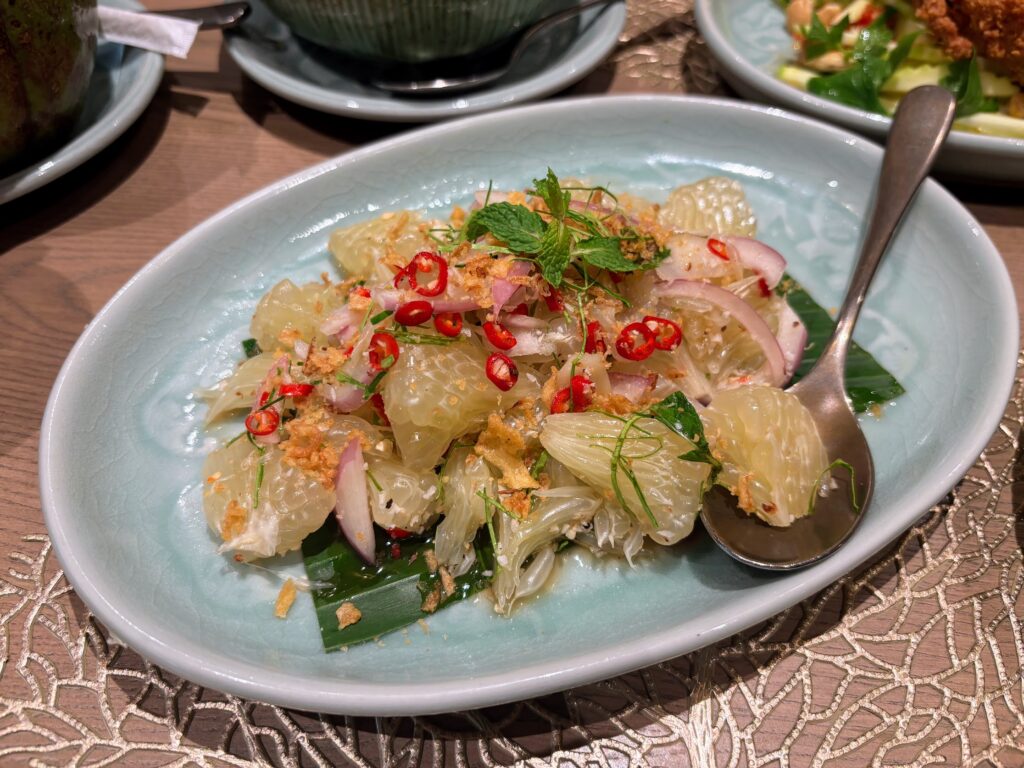
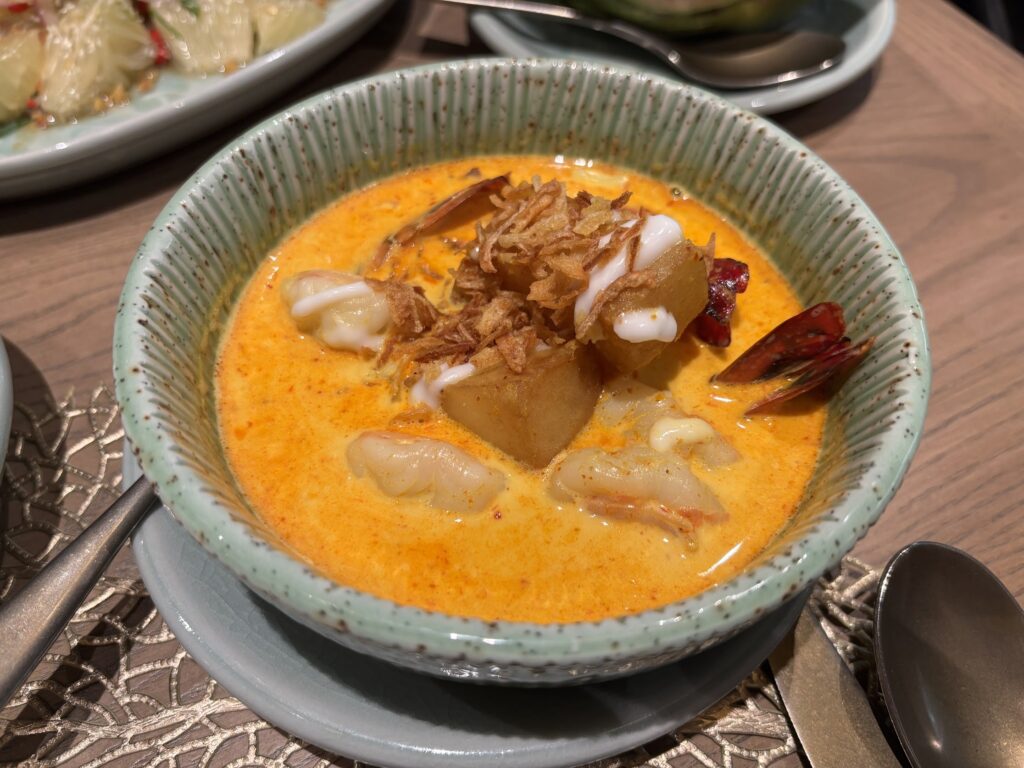
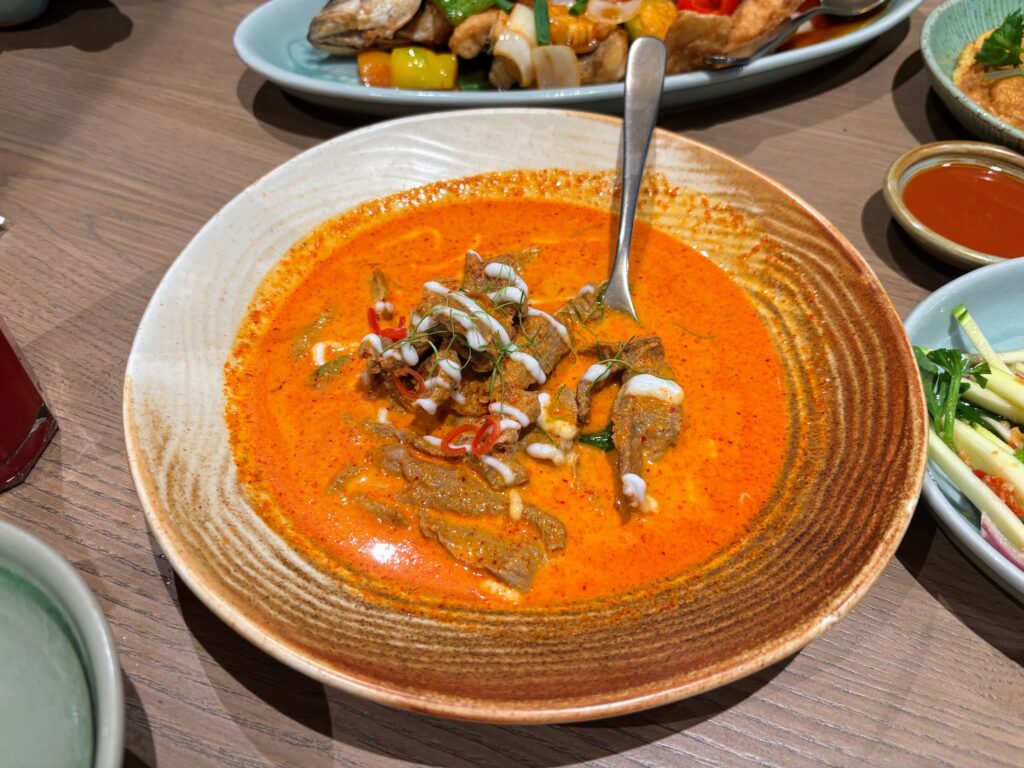
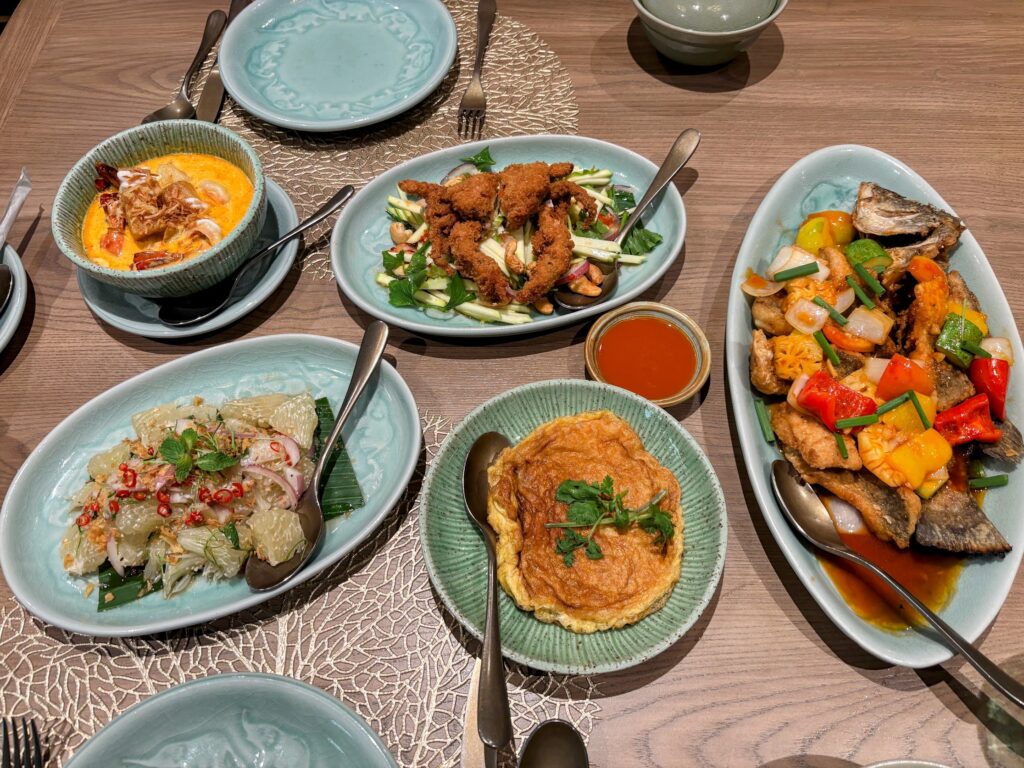
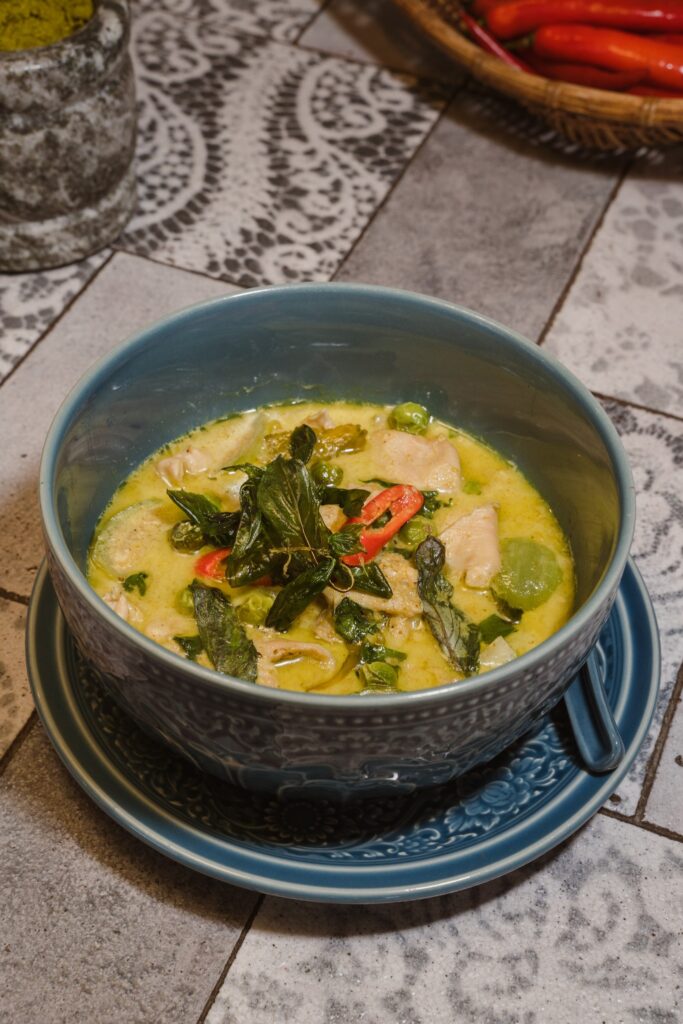
The pomelo salad was bright and clean, and a soft shell crab with green mango had the requisite crunch and punchy heat. A gaeng garee of prawns and a deep-fried seabass under a sweet and sour sauce sharpened by Phuket pineapple followed, though it was the panang of beef, thick and fragrant, that kept pulling us back across the table. Chef Green insisted we order a Thai omelette to balance the table. We thought he meant putting it under a wobbly leg. Of course he didn’t, but it did the job he intended, cutting through the richness of the curries alongside.
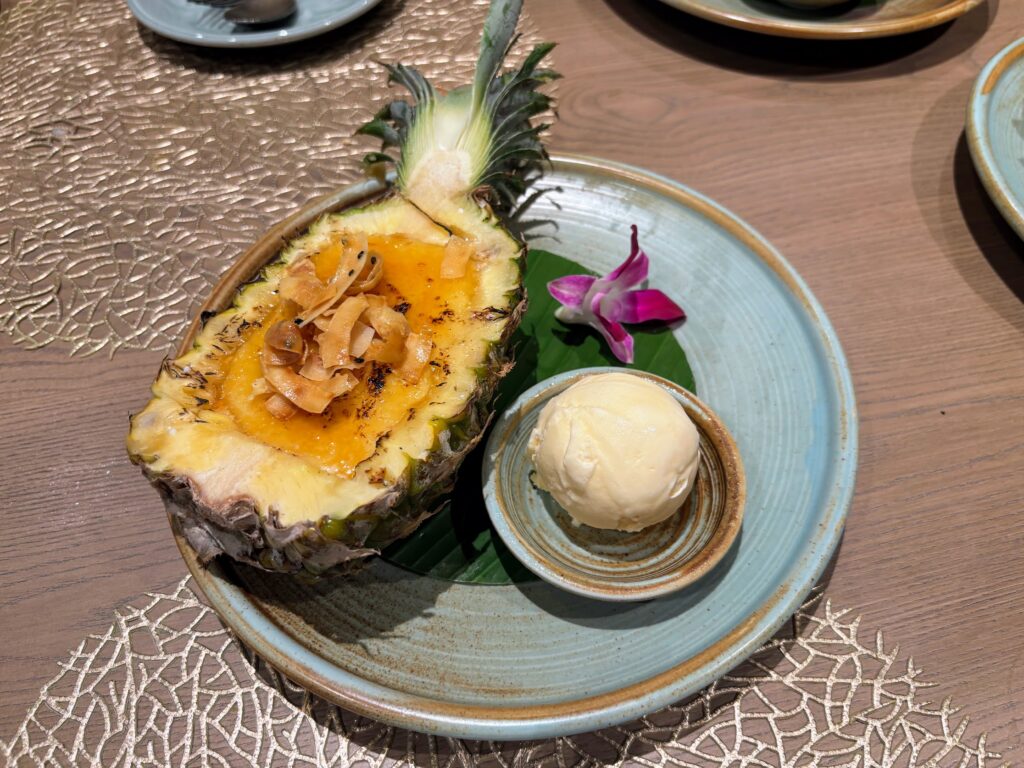
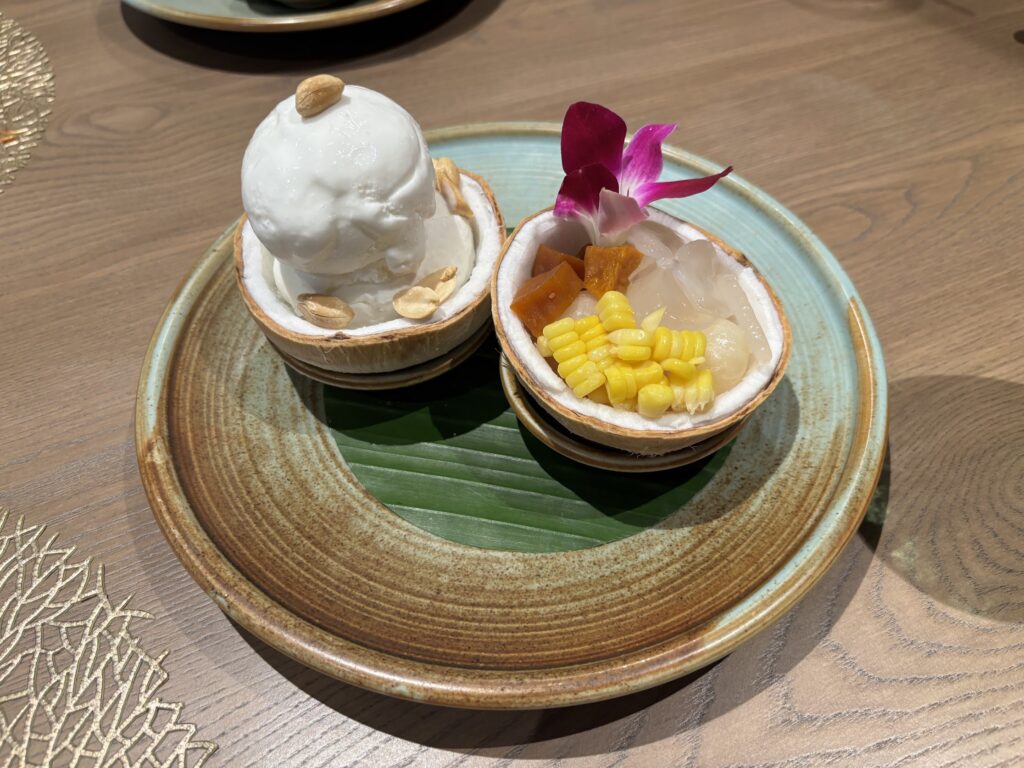
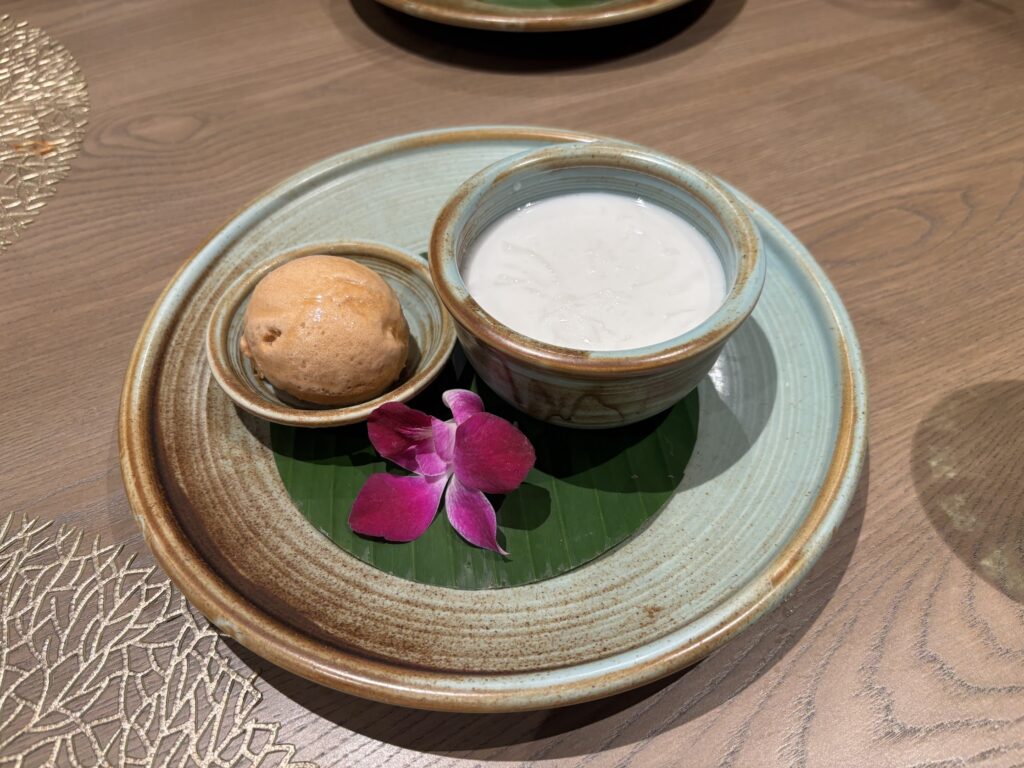
Dessert is where the kitchen pulls away. A Phuket pineapple crème brûlée with dried coconut and honey, bua loy with Thai tea ice cream, and a coconut ice cream loaded with sweetcorn and lychee were all genuinely excellent, and better than anything the savoury courses had prepared us for.
All in all, Chang Thai presents a refreshing alternative to much of the high-end hotel Thai fare in Patong; the ingredients sing with freshness, and the seasoning is on point. Someone in the kitchen clearly cares here.
Ideal for a sustainably-sourced Thai dinner that feels nothing like a resort restaurant…
Ta Khai (meaning ‘fishing net’) is the signature Thai restaurant at Rosewood Phuket, a couple of kilometres south of central Patong. It feels like a different world entirely: timber pavilions lit by wicker lanterns, wooden decking with plump cushions, the lights of Kamala visible across Patong Bay. You feel you can breathe a little easier here.
Chef Nun and chef Yai, a married couple with 30 years of experience in southern Thai cooking, are in the kitchen, and it’s one that takes its sustainability very seriously. Ta Khai’s Partners in Provenance programme names every supplier on the menu: white pigs from Sampran Farm, chicken and duck from Klong Phai Farm, organic eggs from Koh Yao Noi, pink pomelo from Mae Tao Farm, salt from Samut Sakhon.
Live fish and shrimp come from the on-site pond, supplied by Eco Aquaculture through what is claimed to be Asia’s only closed-loop aquaculture system, with fish-free feed and no hormones or chemicals. You choose your fish from the pond and it arrives steamed with lime and chilli or grilled over banana leaf with native herbs and tamarind sauce. Commendable, indeed, but with the big blue just over there, it feels a little strange.
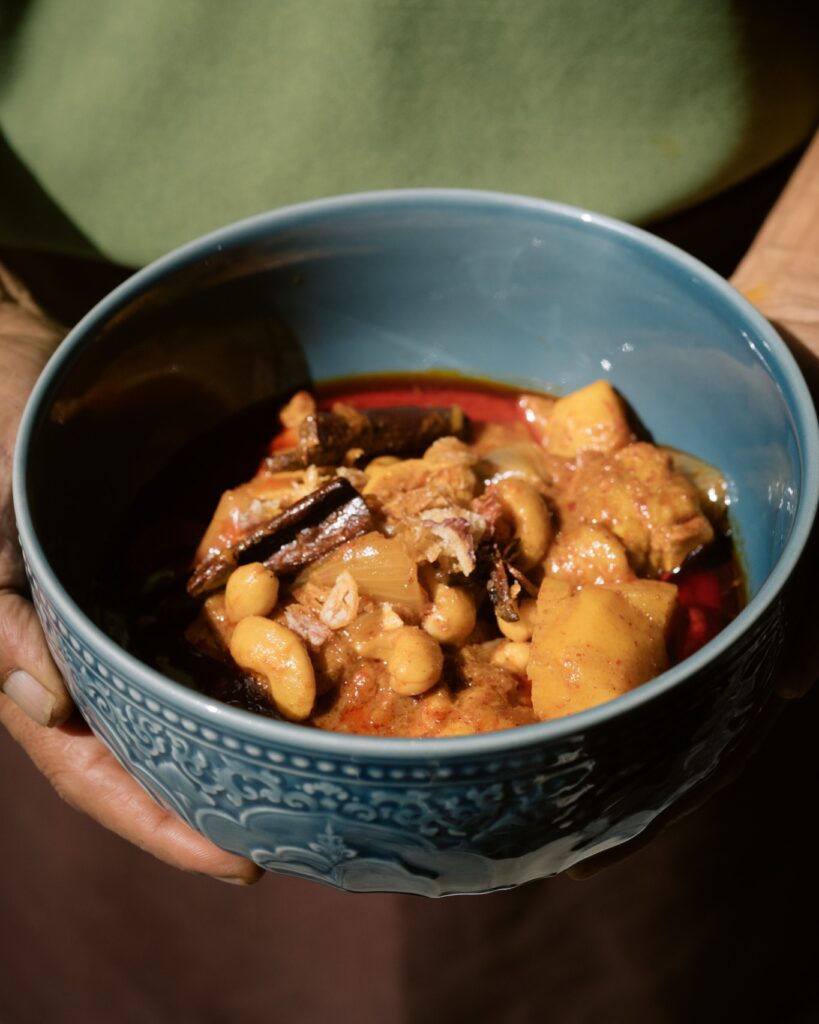
It’s not something we care to dwell on. The Ta Khai Experience set menu at THB 1,850 per person (around £40) is the way in: pomelo salad with prawns, peanuts and dried coconut, chicken fried in pandanus leaves, fresh Phuket spring rolls, a spicy grouper soup with young tamarind leaves, steamed seabass, beef cheek massaman, moo hong (soy-braised pork with black pepper and garlic), stir-fried native melinjo leaves, and a Phuket pineapple sorbet with chilli and salt sprinkles. It’s one hell of a spread.
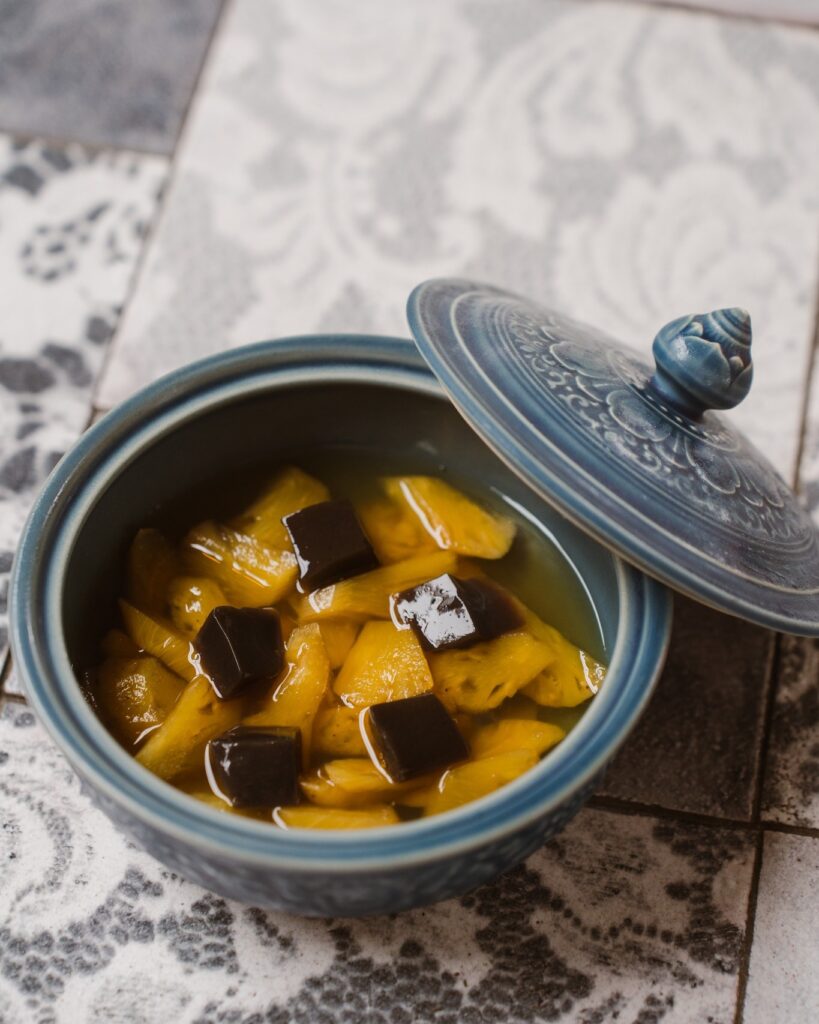
There is also an Explorers Menu of simpler dishes (satay, fried rice, pad see ew) for those wanting something less committed, though it undersells the kitchen considerably. Another dish that celebrates the island’s pineapple is Subparod Chuam. It’s slow braised in brown sugar until its natural sweetness deepens into a warm, caramel note. Silken cubes of grass jelly provide a cooling contrast. It’s mighty good and a refreshing end to your meal.
Ideal for cheap, cheerful Thai food that Patong can’t get enough of…
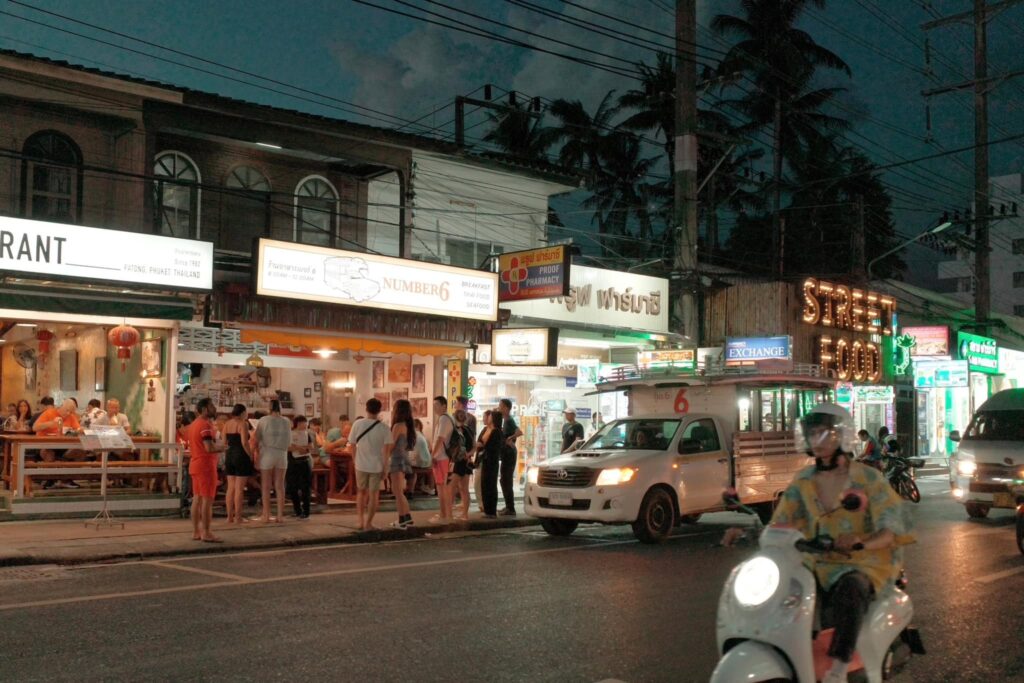
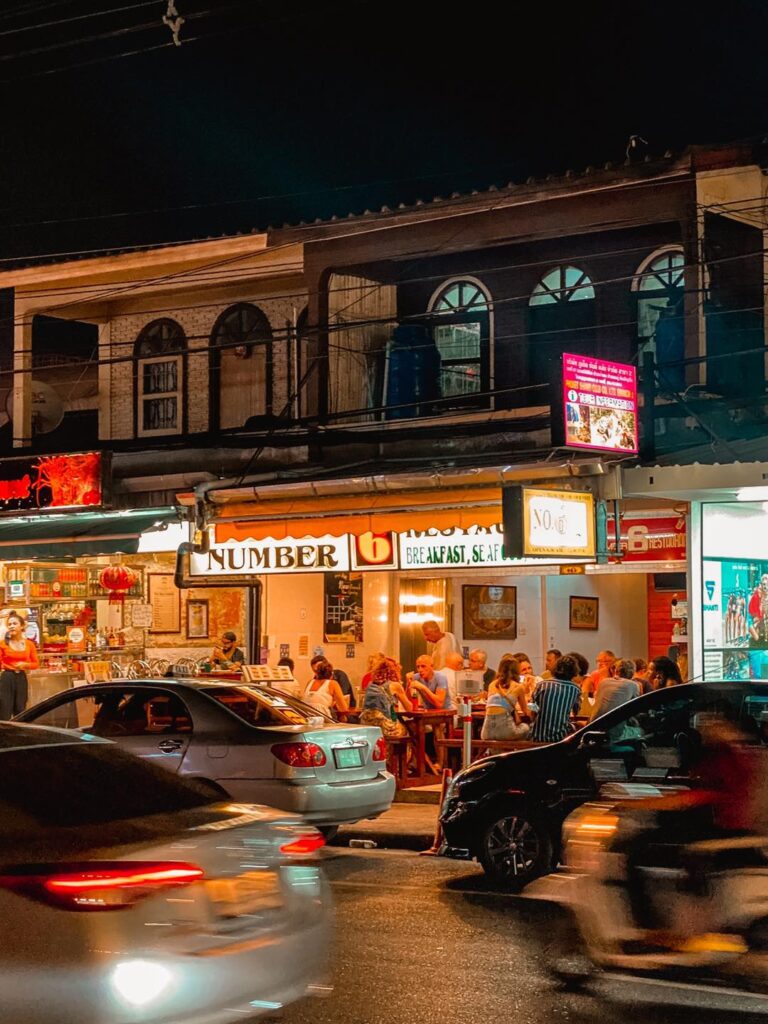
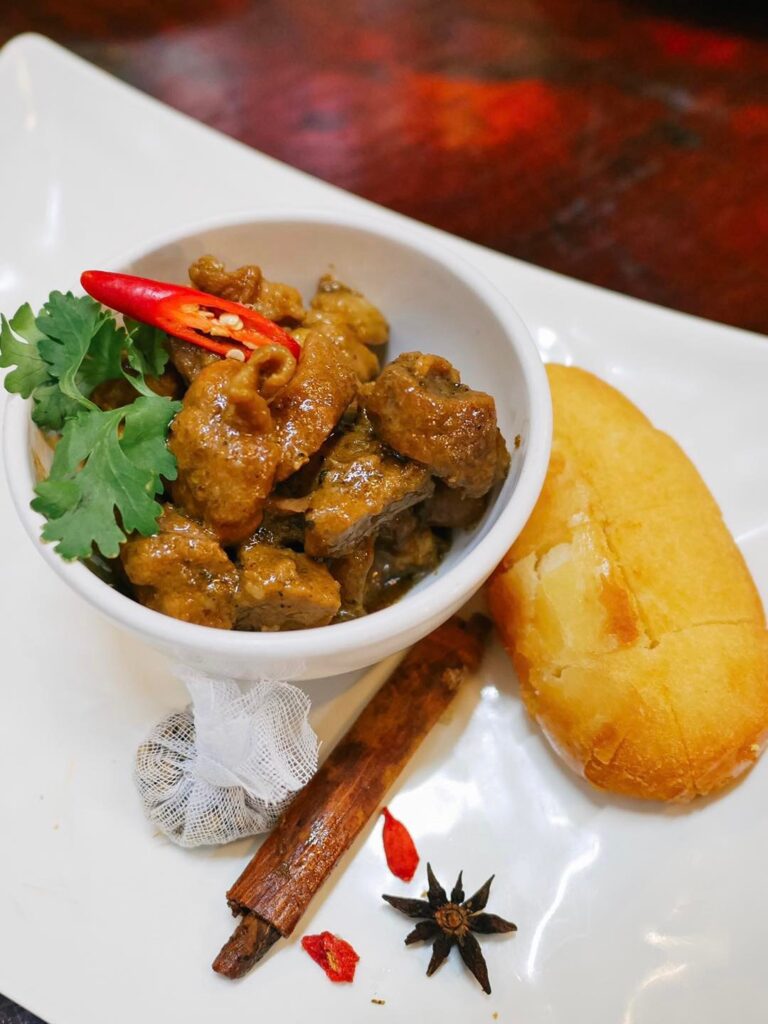
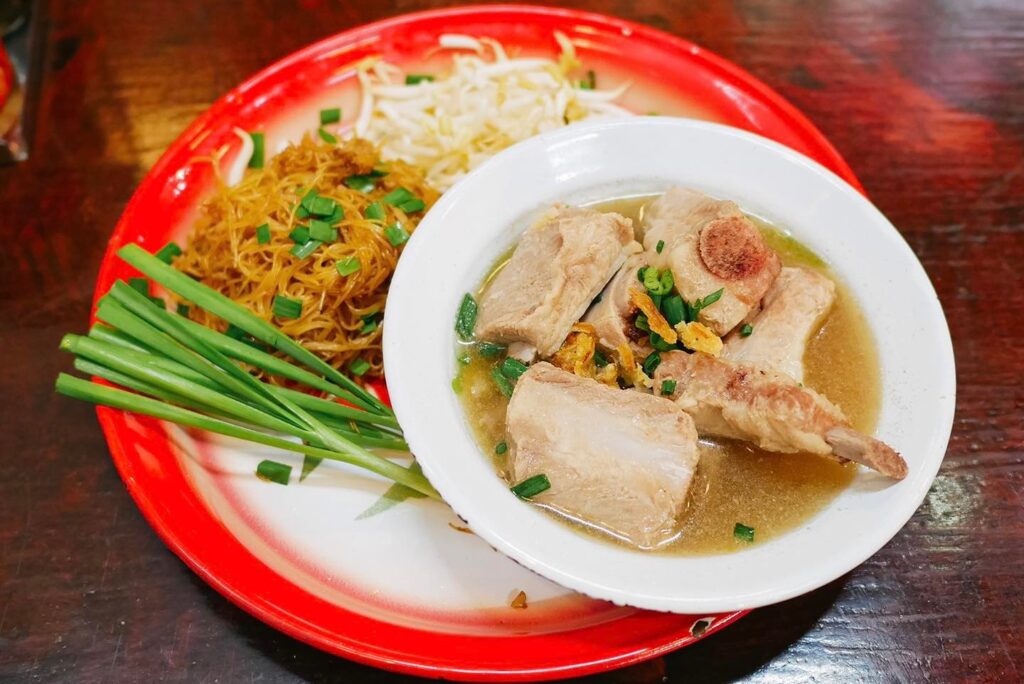
No 6 has been doing its thing on Rat-U-Thit Road for four decades now, and the queue outside it every evening has become as much a part of the Patong landscape as the tailors and the tuk-tuk drivers. It is not the best Thai food in town, Kaab Gluay and the backstreet Isaan joints have it beat, but it is cheap, the portions are enormous, and the pad Thai, yellow noodles and pineapple fried rice have kept tourists and a fair share of locals happy since 1985. That’s got to count for something.
Images via No 6 Restaurant
The restaurant is cramped and loud, and you will share a table with strangers. If the queue is too much, a free shuttle takes you to the second branch, No 6 Up The Hill, which has the same menu and prices but with a panoramic view over Patong and a touch more elbow room. That’s one way to deal with the overflow!
The post appeared on the communal noticeboard sometime on Thursday. A bearded dragon – answering, apparently, to Gordon Gecko – had gone missing somewhere in the upper floors. The reward was $10,000. The photograph showed a small, prehistoric-looking creature regarding the camera with indifference. It was shared on Instagram and by the weekend, the post had accumulated more comments than anything the property’s marketing team had managed all month.
This, we came to understand, is what HOMA is all about: a place where people lose their pet lizards and their neighbours care. Where chess nights are advertised in the lobby alongside football screenings in the cinema upstairs and Muay Thai classes in the boxing gym. Where half the residents have been here for months and have opinions about what constitutes the best pad grapao on the island (it’s the one at Chuan Chim, silly), and the other half arrived last weekend with a carry-on and a laptop, and already know half the staff by their nickname.
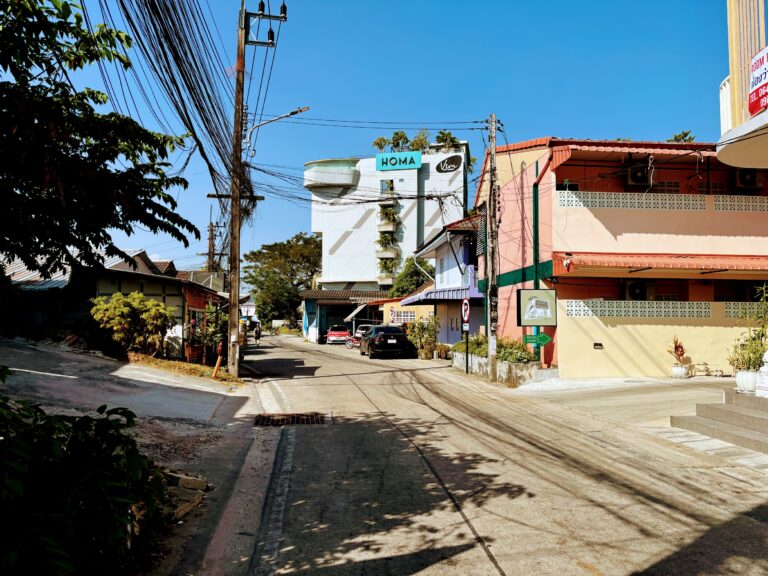
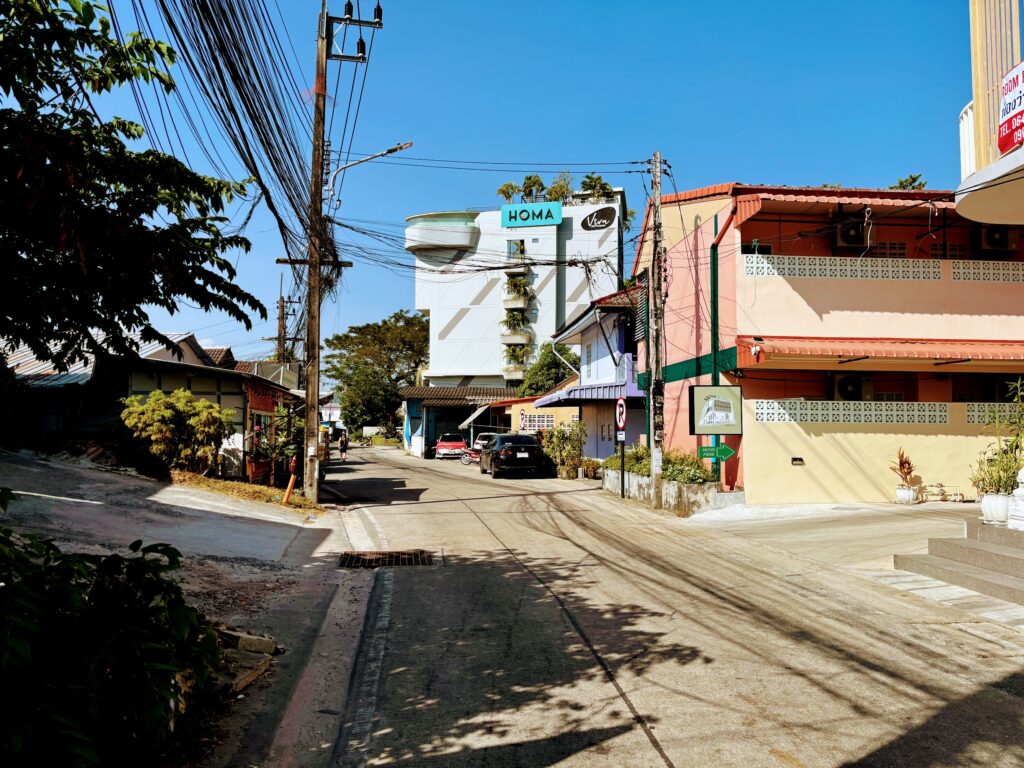
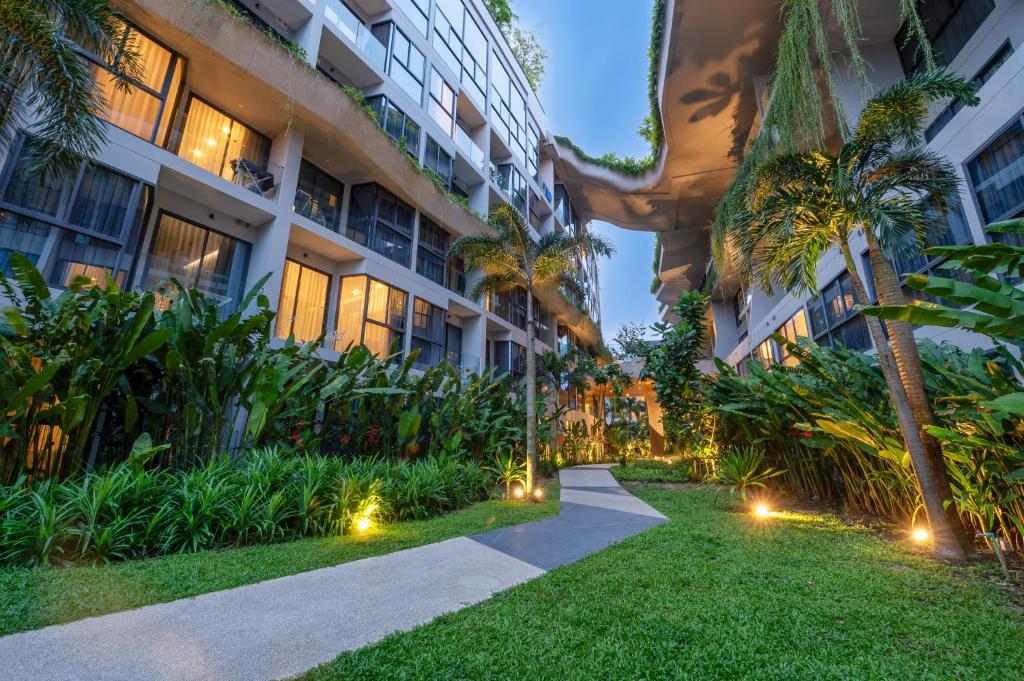
A vast co-living complex set back from Soi Samkong down a cul-de-sac, HOMA is part hotel, part serviced apartment block, part neighbourhood, occupying a stretch of Phuket that most visitors never reach. It offers something the majority of accommodation on the island doesn’t: the feeling of living – rather than just staying – somewhere.
The Location
HOMA sits in a residential neighbourhood in Phuket’s Ratsada district, a far cry from the beachfront resort strips that define much of the island. That’s the point of the place, the local setting designed to foster a less transient feel, though guests accustomed to seaside, sand-between-your-toes convenience may find the location takes some adjusting to.
From here, it’s about ten minutes by Grab to Phuket Old Town, that short distance having its advantages, as it’s far enough to insulate you from the crowds during high season when the Sino-Portuguese streets fill up fast and things get a little hectic. The nearest stretch of coast is Pa Lai, but like most of Phuket’s southern beaches it’s shingle and muddy seabed, not somewhere you’d lay down a towel. Patong, the nearest proper swimming beach, is around 20 to 25 minutes by car. For what it’s worth, most people who know Phuket well will tell you the Old Town is the real highlight of the island anyway, and HOMA puts you right on its doorstep.
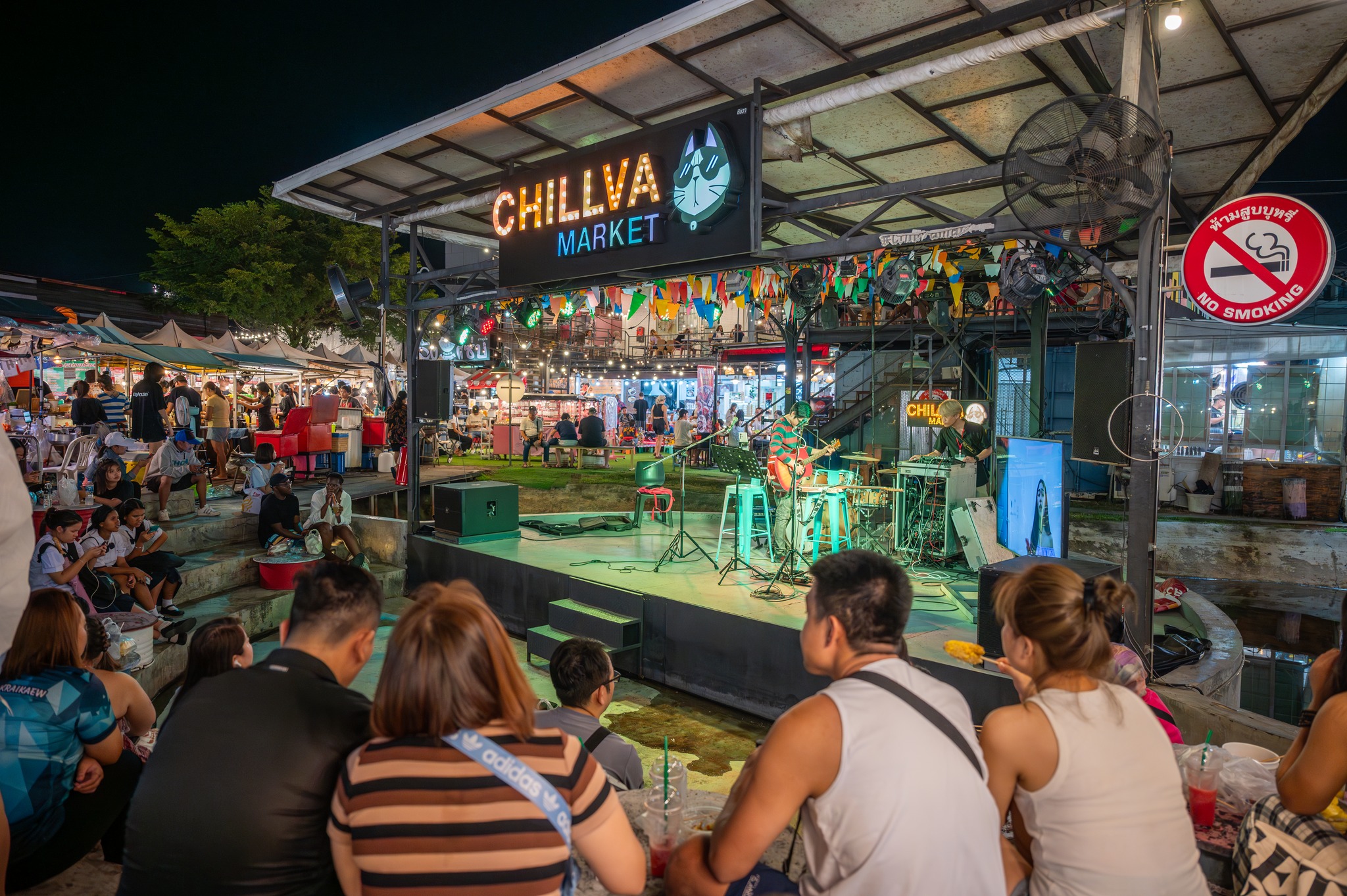
Along HOMA’s soi, everything you could plausibly need is within reach: motorbike rental, a tourist office for island trips, and local eateries like La Casa Azul for serviceable Mexican and newly opened Kin Khao for uncompromisingly delicious Southern Thai, all right outside. Chillva Market is a short walk away, a reliable spot for local food, trinket shopping and Hotel California being covered every other song. Phuket’s shiniest shopping mall Central Festival is ten minutes on foot, home to a Big C for everyday essentials.
The Vibe & Style
With (I’m going back to…) 505 serviced apartments spread across an interconnected network of buildings, HOMA is a mammoth operation. Around half its residents are long-term renters; the other half are travellers passing through for anything from a long weekend to a month-long relocation. In less carefully run properties, that mix can tip into something anonymous and soulless. Or, worse, can cause a just palpable tension. Here, it does neither. The interplay between people who have put down roots, those passing through, and people who are suddenly toying with the former gives HOMA its particular texture.
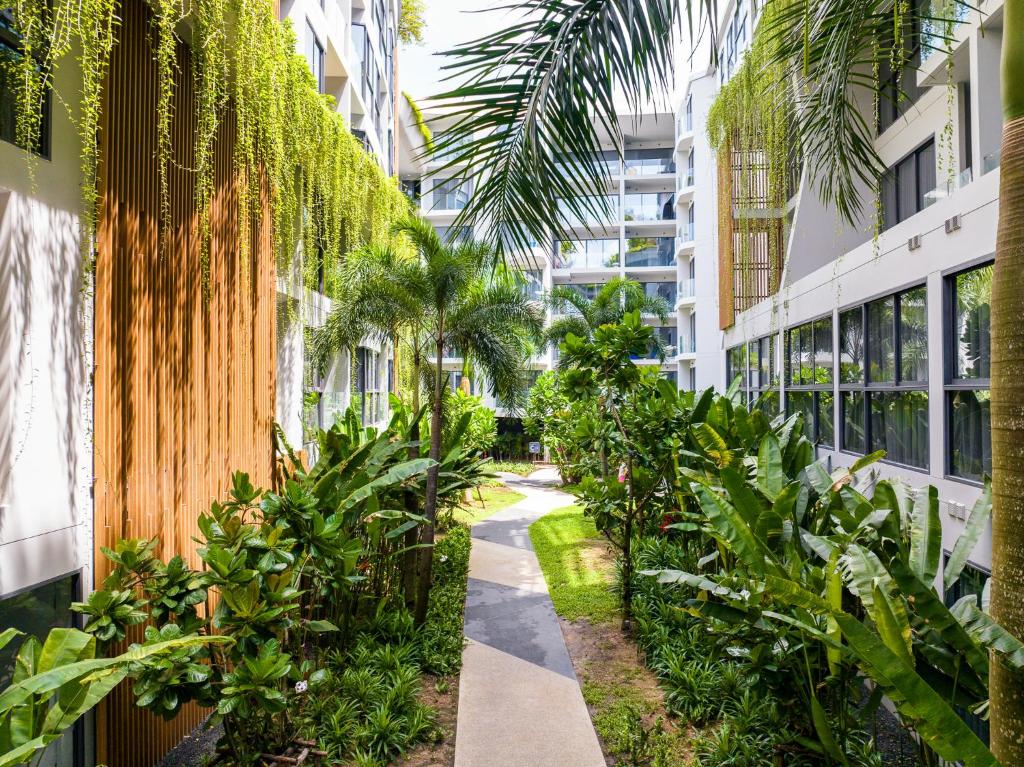
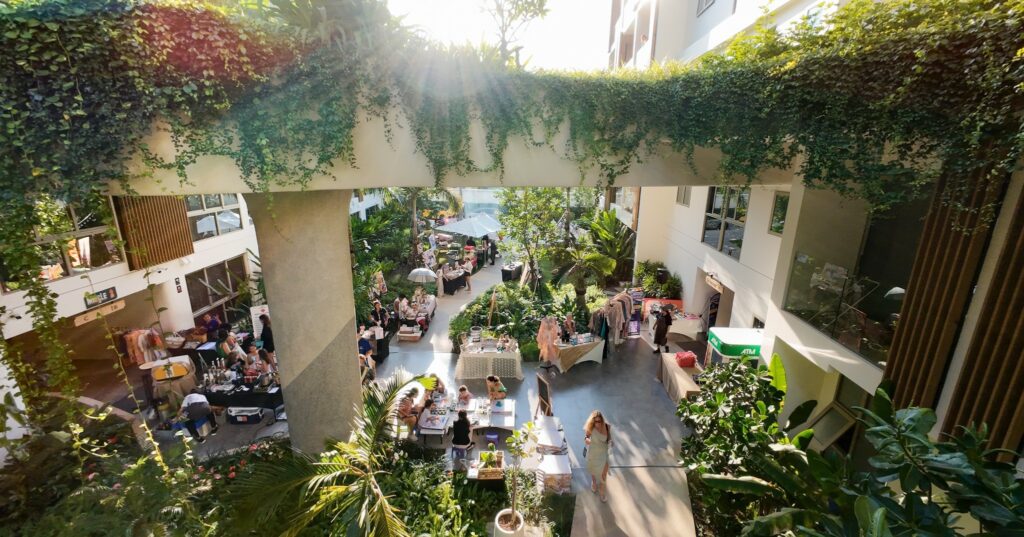
The communal areas are generous in scale and softened by biophilic design – curves, soft concrete, hanging plants trailing from balconies – which stops the complex from feeling as imposing as its size suggests. There’s a constant low-level hum of activity threading through them, and the staff play no small part in that. Skilled at navigating the competing demands of short-stay guests and long-term residents, they keep the whole operation running with the warmth Thailand is so well known for.
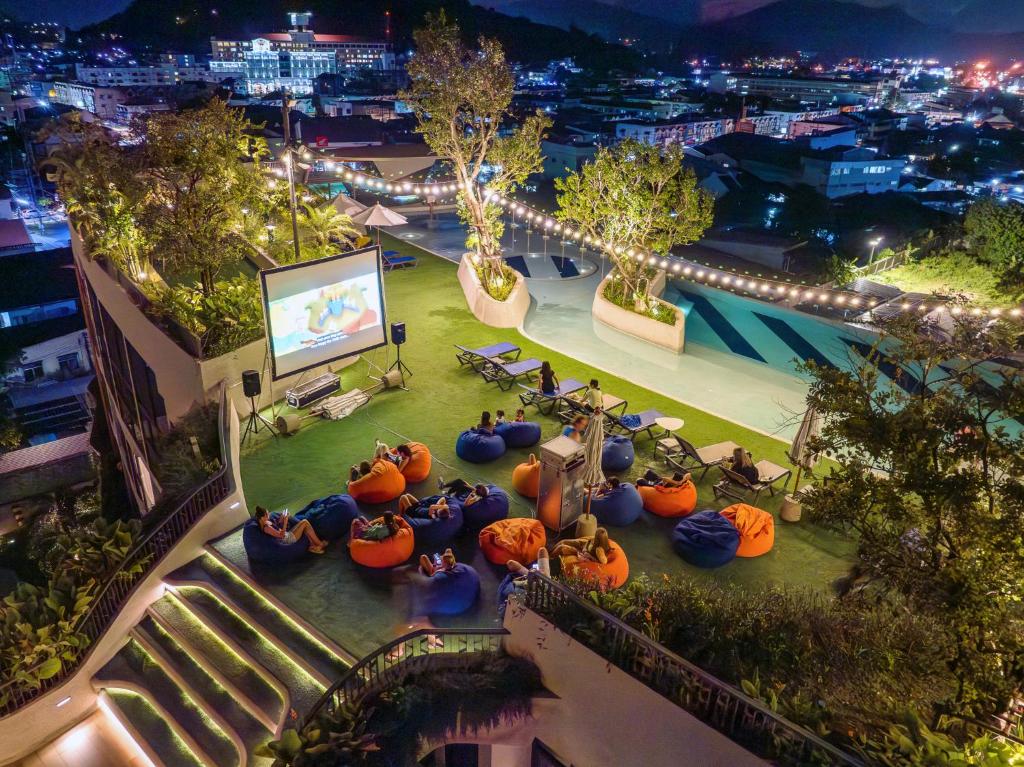
There is something faintly utopian about HOMA’s vision of community – or dystopian, depending on your disposition. Either way, it’s carefully cultivated rather than incidental. Cinema nights, games and quizzes, aperitivo evenings with live DJs, and a Christmas market featuring local businesses at the end of the year all give guests and residents opportunities to connect. Wellness runs through the block too – group Muay Thai classes, sunset yoga, personal trainers available at all hours – alongside a programme of local partnerships: healthcare benefits at Bangkok Hospital, ten per cent off day passes at the RENEW Sauna & Ice Bath Club (a half hour’s drive away), and a revolving roster of tie-ins keeps things ticking.
Right, you know that feeling when you won’t switch from Spotify to Apple Music because all your playlists are on Spotify and it feels like too much hassle to move them across? This is how you might feel living here. There’s a sense you might get institutionalised, with everything catered for quite so comprehensively, making it impossible to leave. For many, this is a massive bonus.
And there are many. But the only real inkling of just how many guests are staying here comes at checkout, when the lobby fills with an astonishing number of bags. That it remains unruffled is a testament to how well the whole operation is managed.
Pets are allowed, which as mentioned, occasionally produces its own drama that belongs to a neighbourhood, not a hotel corridor. Worth knowing if you’re travelling with animals: the policy covers dogs and cats only, up to two per room at 535 baht per pet per night, and they’re not permitted in the rooftop areas. Seems fair.
Rooms
HOMA offers five thoughtfully designed room types, from all-in-one studios at one end to three-bedroom family units at the other, with one-bedroom flats, signature duplexes and two-bedroom suites in between.
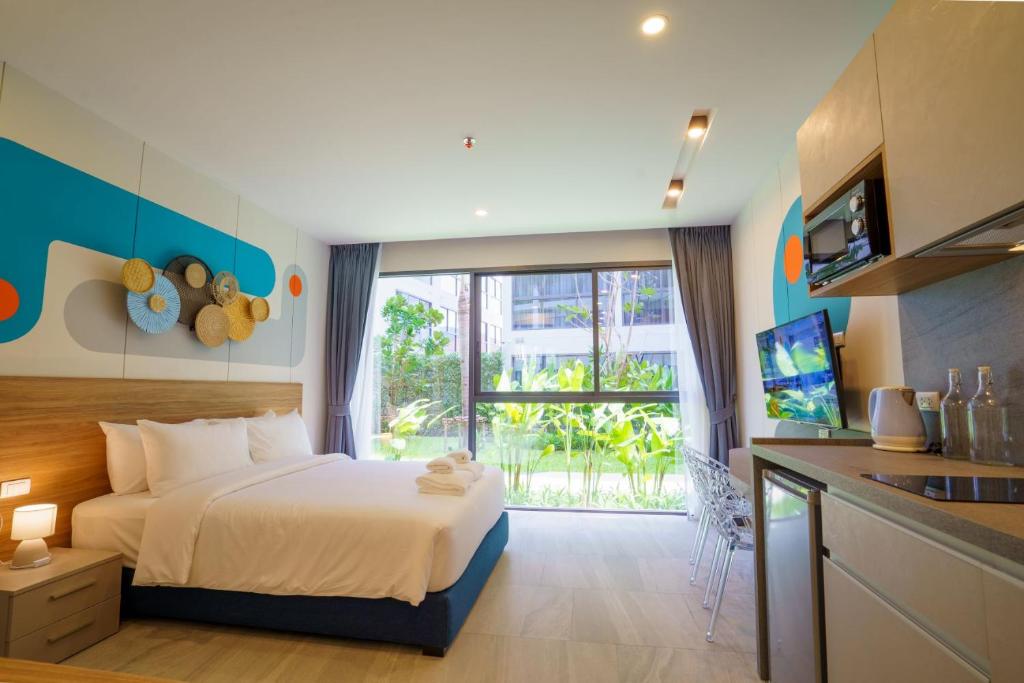
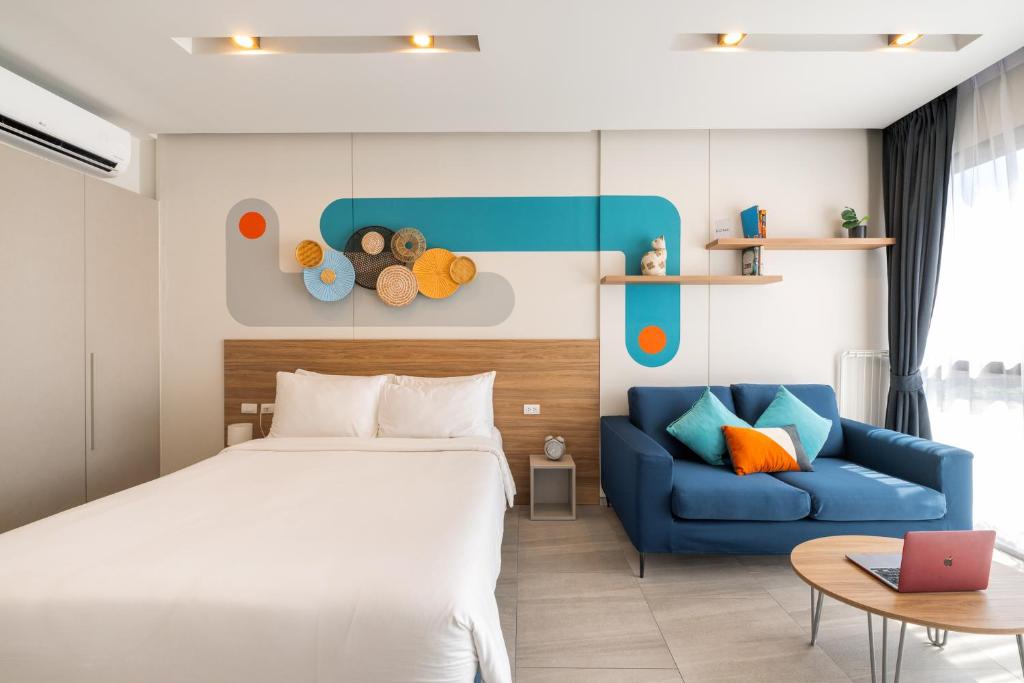
Studios are the signature offering and the most popular choice. They’re decent in size, bright, and fitted with kitchenettes complete with hobs, microwaves, and a fridge large enough for actual living rather than just minibar overflow. The aesthetic has a certain halls-of-residence exuberance: bold primary-coloured wall graphics, wicker wall art, acrylic furniture. Cheerful rather than chic, but designed with longer stays in mind.
One practical note: bring washing-up liquid if you plan to cook, as the kitchen is otherwise fully equipped. That said, short-stay ‘hotel’ guests get daily housekeeping, linen changes and a straighten-up. Long-term residents are on a weekly schedule.
Blackout curtains make the rooms blissfully dark at night. There’s ample shelving, two chairs for co-working, 42-inch smart TVs, and a wicker laundry basket in place of the usual plastic bag – the kind of small touches that suggest someone thought carefully about what staying here for a month would feel like. Complimentary filtered water stations sit beside the lifts on every floor, with glass bottles provided for refilling, removing that unseemly, sweaty trek out to the nearest 7/11 for single-use water every. damn. evening.
Communication runs through the HOMA app and WhatsApp rather than an in-room telephone, which suits such a clockwork-run property.
Facilities
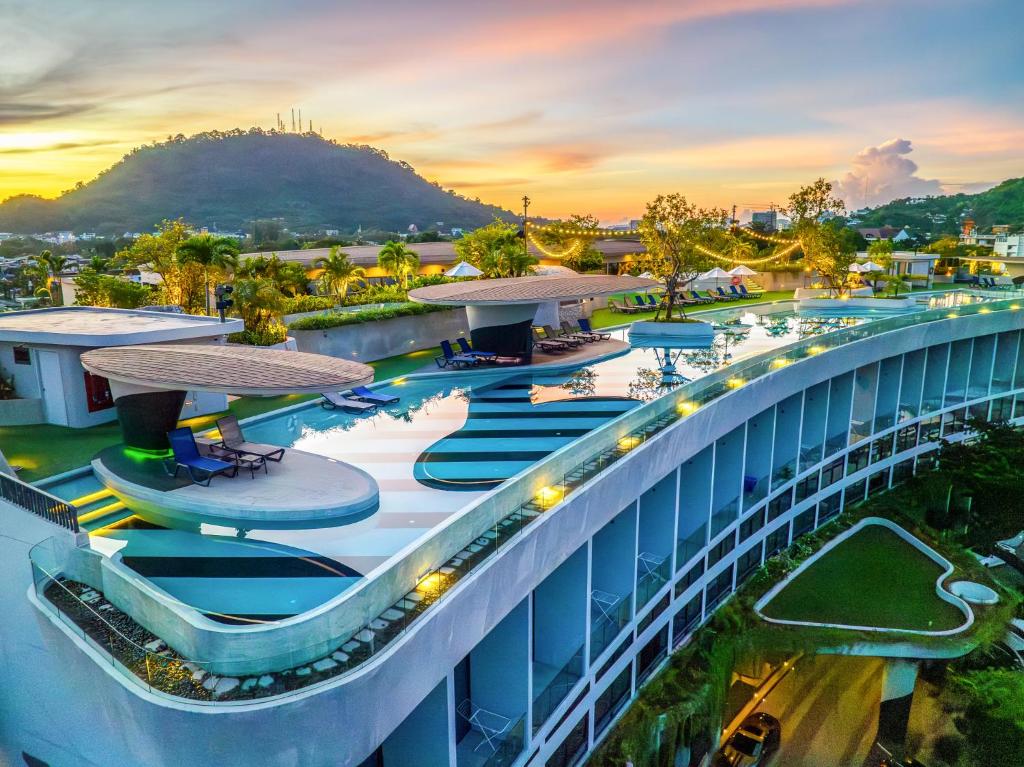
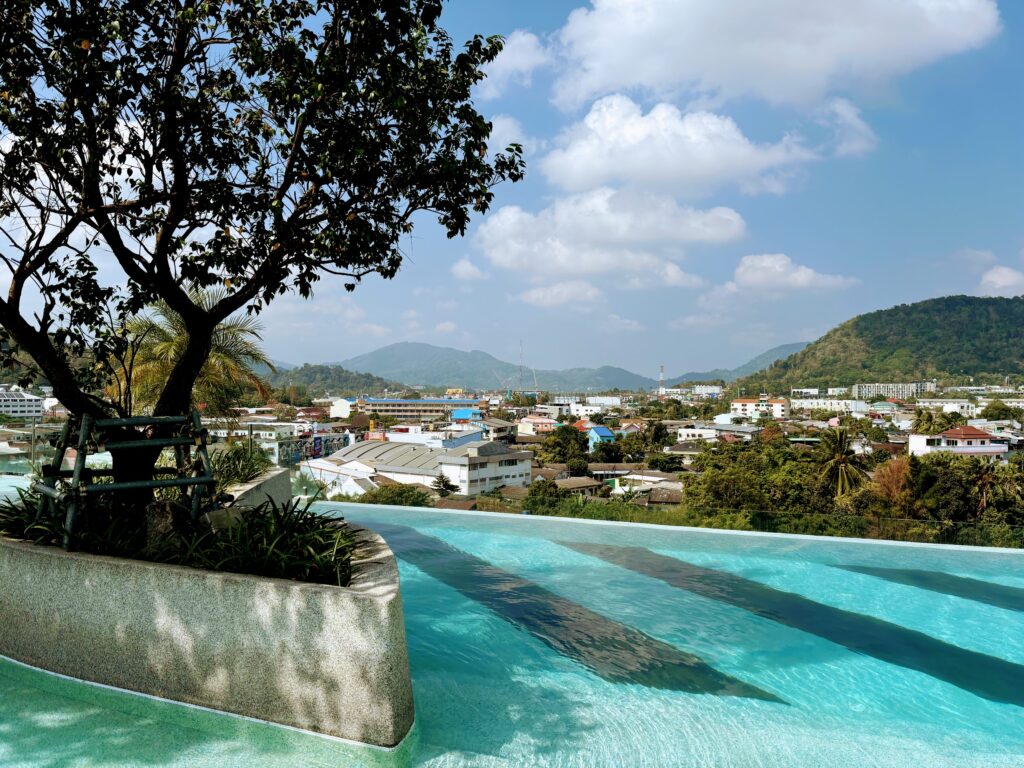
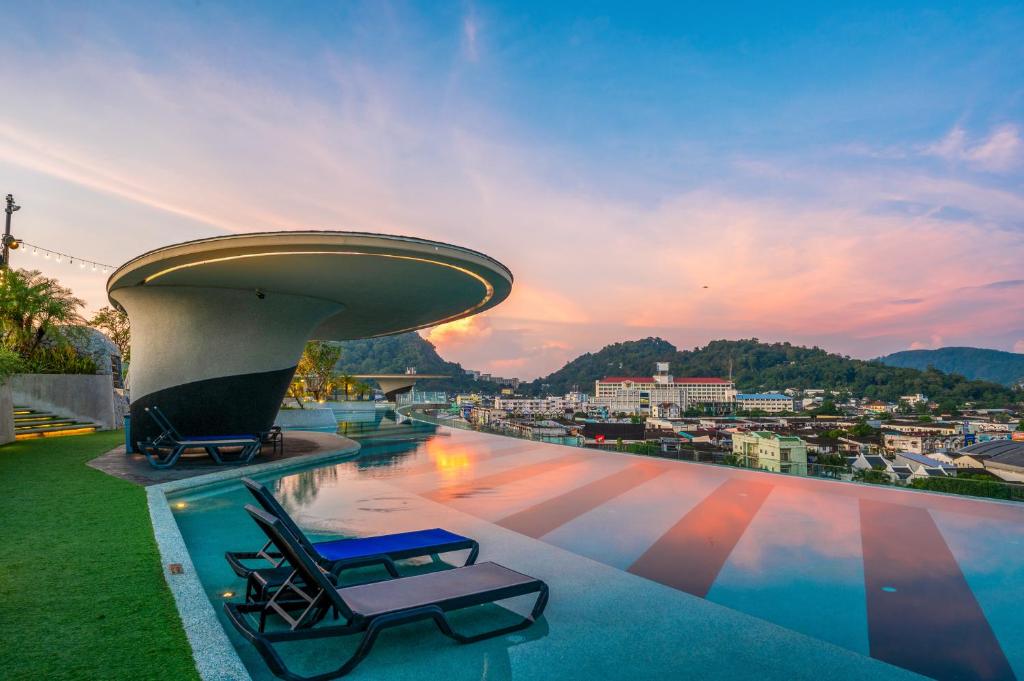
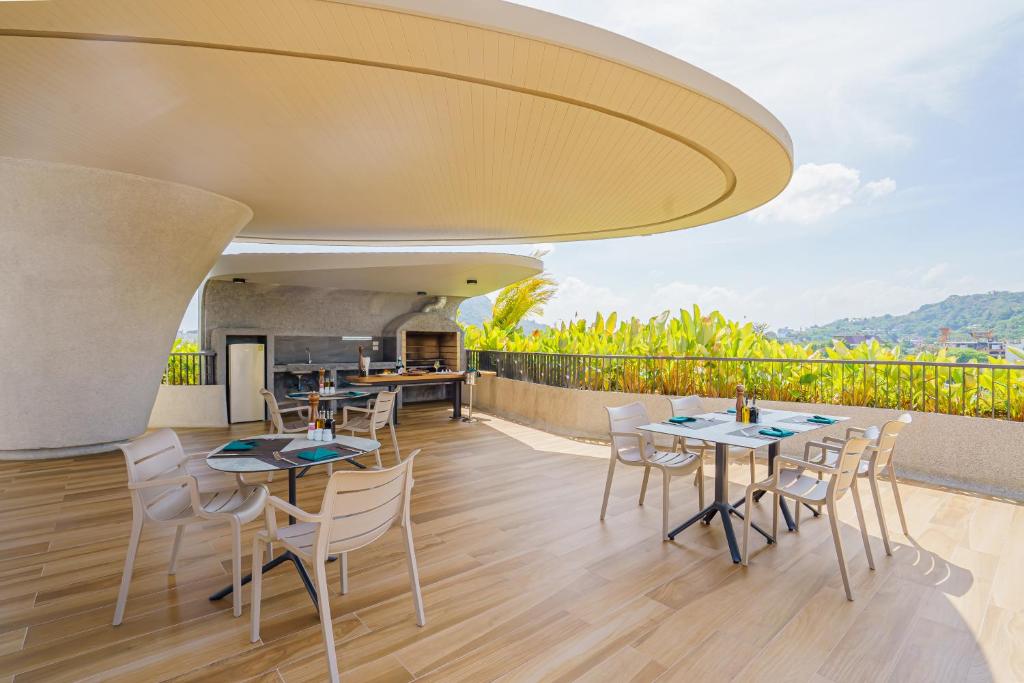
The rooftop is where HOMA makes its most emphatic statement. An 80-metre pool – reportedly the longest rooftop pool on the island, with a 50-metre Olympic-length lap section for anyone who takes their swimming seriously – runs the length of the seventh floor, flanked by panoramic views of Phuket’s green hills.
The neat design gives the pool an unexpected sense of privacy for such a communal space. At either end, circular decks jut out over the water, each topped with a dramatic disc-shaped canopy that wouldn’t look out of place in a design museum. Part UFO, part sculpture, they feel like their own little islands. A handful of sun loungers sit directly in the shallows for those who want to be in the water without committing to a swim. Behind, more loungers line the artificial turf, parasols and palms giving some shade.
A poolside bar serves drinks throughout the day, and it’s especially good for a late afternoon dip, when the light drops behind the mountains. At sunset, it’s a genuinely special place to be.
Beyond the pool, the facilities are comprehensive: a modern, well-equipped gym (7am to 10pm) with free weekly classes in yoga, Thai boxing, pilates and aqua gym; a games room with a pool table, PS5 and foosball; a cinema that also shows the footy; and a kids’ playroom. There’s also a Grab driver drop-off point for food delivery.
The in-house laundry service deserves a mention: 100 baht per kilogram, charged by weight rather than by item, returned by 11.30am the following day, which is crucially before standard check-out. Same-day turnaround is available for 80 baht more per kilo. That’s serious value when you consider the whole ‘500 baht to get your boxers washed two days later’ in some of the five star resorts down the road.
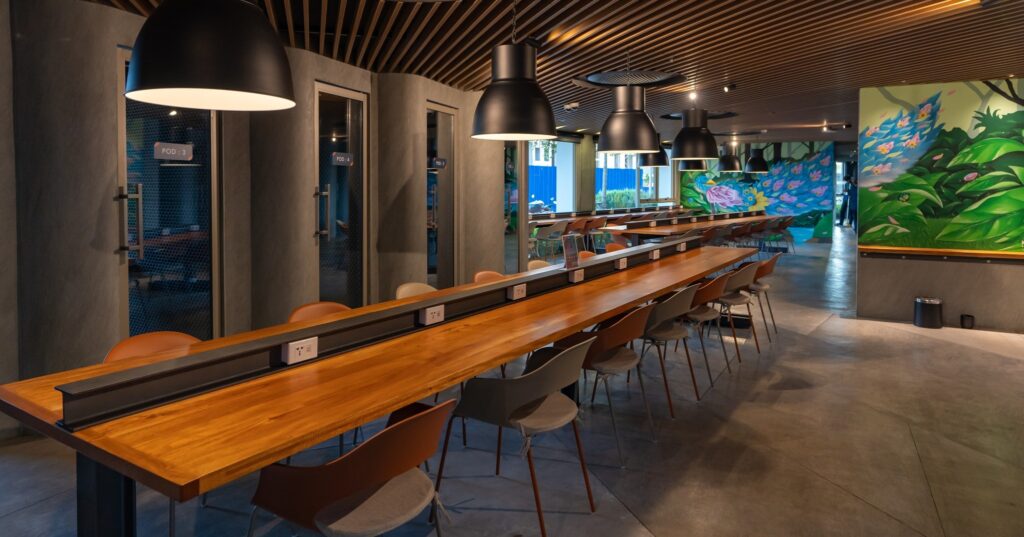
Unsurprisingly for a place of its posture, HOMA is geared up for digital nomads. Free WiFi runs across three separate networks – co-working spaces, public areas, and in-room – and the co-working space itself has soundproofed individual booths and meeting rooms, open round the clock. It’s worth knowing that the membership, which includes access to the pool, gym, co-working space and events, is also open to non-guests, which is useful if you have colleagues based elsewhere on the island.
What’s less obvious, but worth flagging, is the care that’s gone into the building itself. HOMA holds both LEED Silver and EDGE Advanced certification – making it the first purpose-built residential rental complex in Thailand to do so. In practice, that means solar panels covering 15-20% of the property’s electricity needs, rainwater harvesting, grey water recycling, and energy and water efficiency ratings significantly above the Thai national average. For a property at this price point, it’s an unusual commitment.
Food & Drink
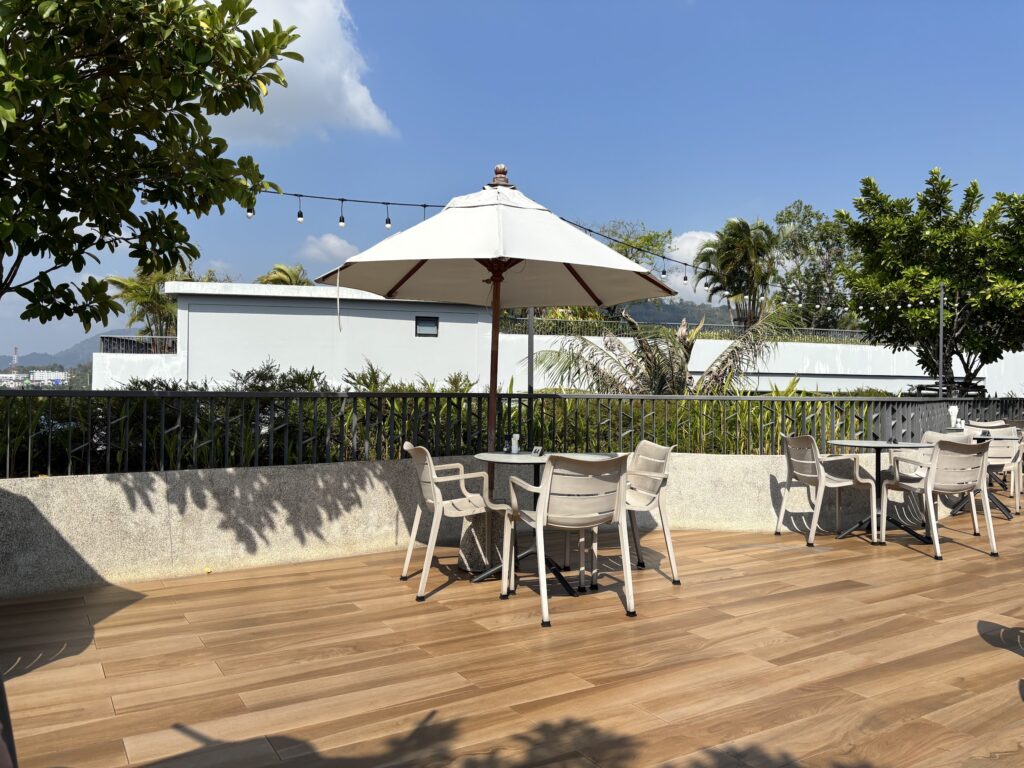
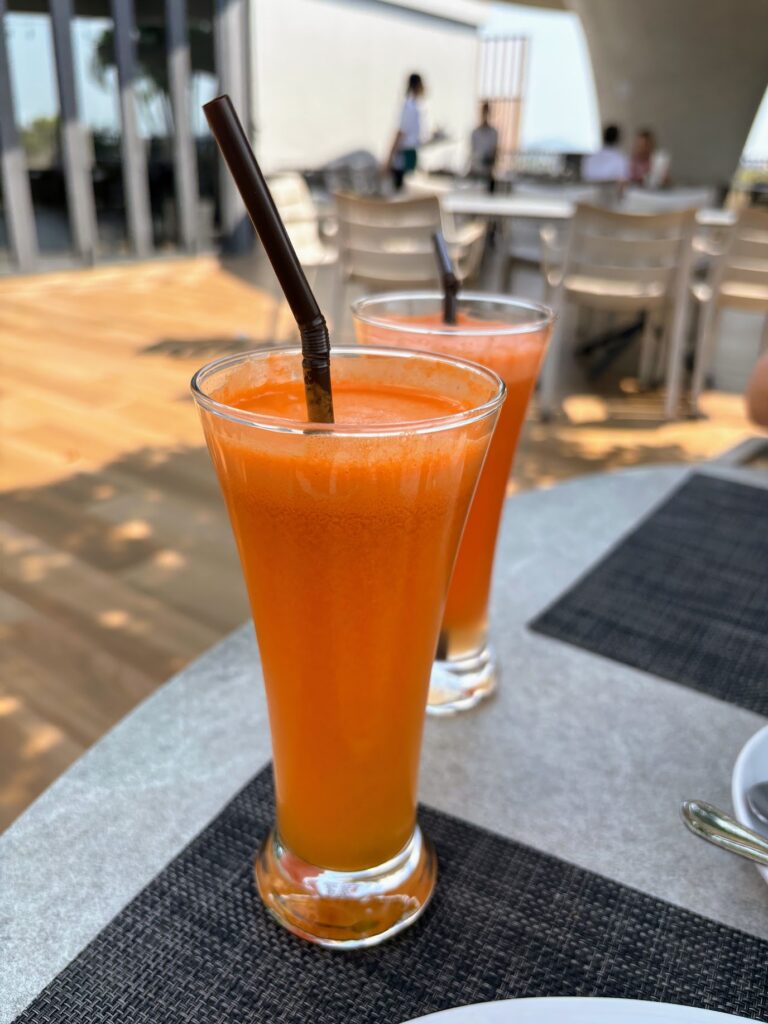
On the same floor as the pool, HOMA has an Italian restaurant VIVA, with a large outdoor terrace alongside the dining room proper, making it an excellent spot for a sundowner with views over the hills. The drinks list covers cocktails and wine, fresh juices and smoothies, and a happy hour runs in the early afternoon (worth checking current times on arrival).
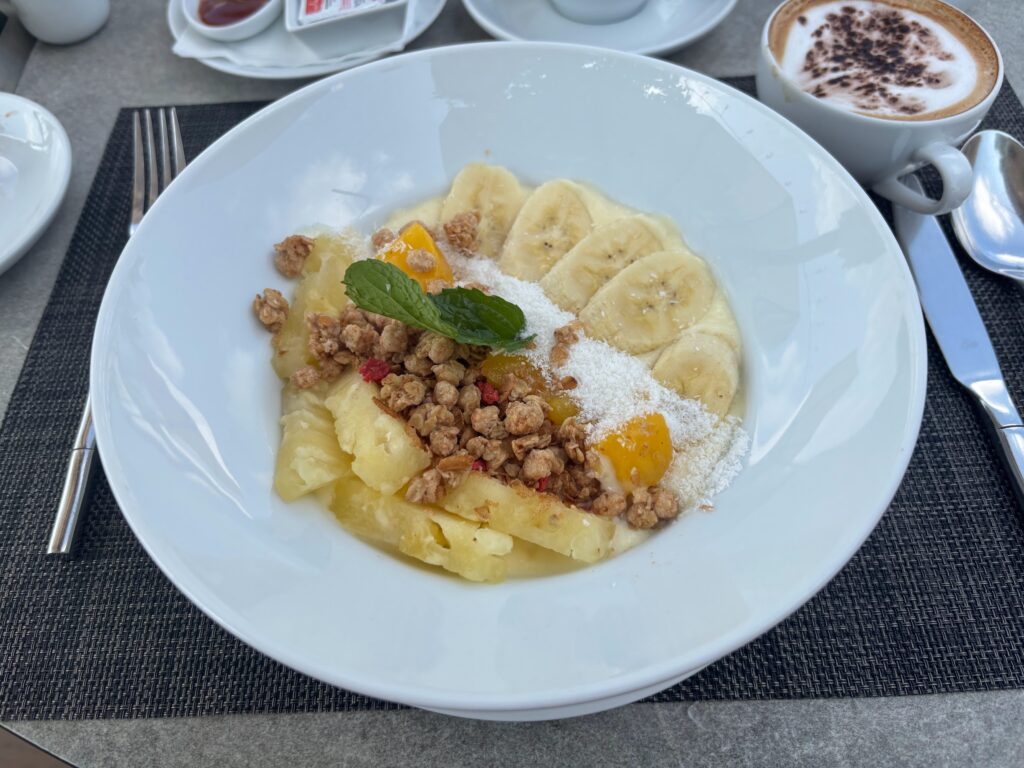
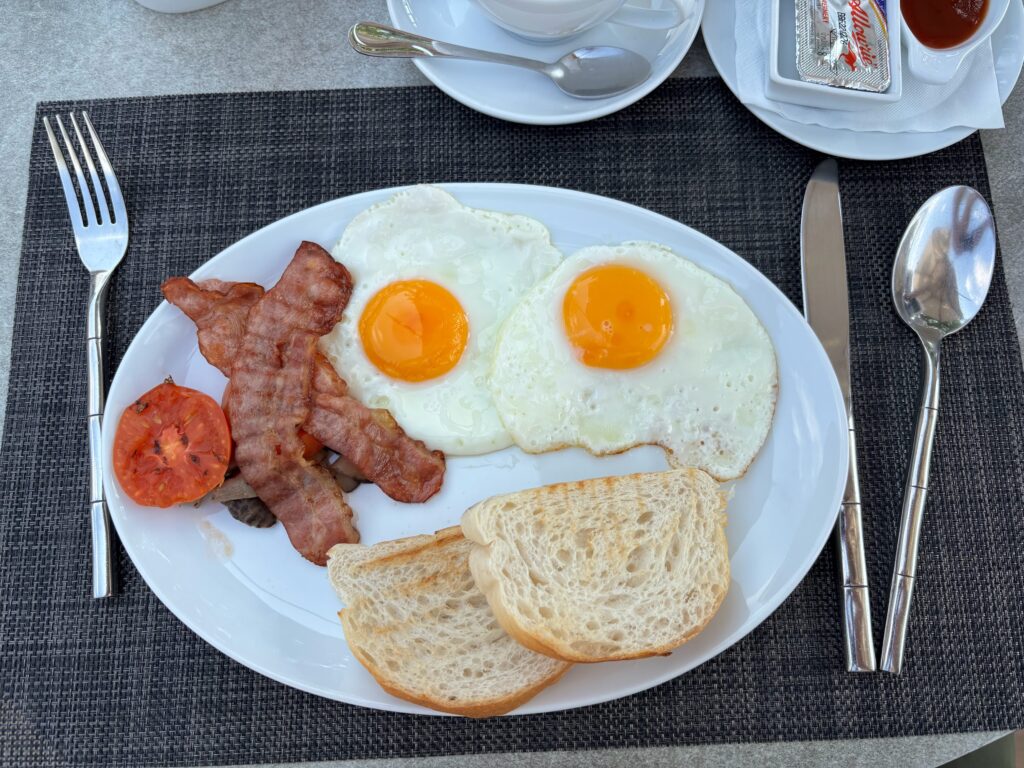
Serving from breakfast through to late dinner daily (7am-11pm), it’s particularly good in the mornings, where things are light, bright and airy. For breakfast, choose between a set or à la carte menu with both Asian and western choices. We had a gorgeous passion fruit yoghurt with granola, coconut flakes and local fruit. A simple plate of eggs with bacon was a job well done, too.
Later in the day, serviceable wood-fired pizza is the headline act, though the menu spans pasta, Thai dishes, grilled meats and salads. Live music on Friday evenings adds to the atmosphere. Do note that VIVA operates independently from HOMA. Breakfast isn’t included, and food can’t be charged to your room.
Ideal For…
With stellar facilities, genuine warmth and a residential flexibility that standard hotels don’t offer, HOMA fills a gap for digital nomads, relocating workers, families wanting space without resort-level prices, or any traveller who finds conventional hotels too transactional. Whether you’re coming for a long weekend, a week’s holiday or a month-long relocation, it suits.
Digital nomads & remote workers. The co-working spaces and soundproofed booths are properly set up, not an afterthought, and three-network WiFi with 24-hour access means you’re not working around the hotel’s schedule.
Long-stay travellers. Kitchenettes with hobs, daily housekeeping, laundry by weight, and the HOMA app setup are all oriented towards people staying weeks or months, not just a night. It feels like having a flat with hotel-grade upkeep.
Families wanting space. Two- and three-bedroom apartments, a kids’ playroom, a pet-friendly policy, and resort-level facilities without resort-level prices. There’s room to spread out and no pressure to keep things contained.
Budget-conscious travellers who don’t want to compromise on facilities. 800 baht/night is very competitive for an 80-metre rooftop pool, gym, cinema, and the overall level of comfort.
People relocating to or trialling life in Phuket. The community element, the monthly events calendar, the mix of short and long-term residents. It feels residential rather than transient.
It’s perhaps less suited to anyone looking for a traditional resort experience with beachfront access and full-service hospitality. There’s no concierge arranging your day trips, no turndown service, no lobby bar scene. If you want someone else to think about everything, this isn’t that.
Why Stay?
The lost pet lizard sounds like a minor detail. It isn’t. That noticeboard moment – neighbours mobilising over a lost lizard, strangers becoming something closer to a community – is precisely what HOMA Phuket Town is built around. The idea that how many of us live now – mobile, untethered, screen-adjacent, perpetually between places – doesn’t have to mean living alone in a room.
Today’s travellers are increasingly demanding spaces not just to rest and relax, but to work, too, and nowhere is that appetite more pronounced than Phuket, where a large and growing community of transient workers, remote professionals and long-term nomads has created real demand for accommodation that goes beyond the standard hotel room. HOMA was built precisely for this moment and offers one of the smartest ways to stay on the island.
Rooms start from around 1,500 baht per night (£35) for short stays, with flexible long-term rates available from one month upwards. The best price is guaranteed when booking directly through the HOMA website.
HOMA also has properties in Cherngtalay, Chalong and Si Racha.
Meta’s advertising platform has changed considerably over the past few years. What was once a manual, time-intensive process of building audiences, testing creative elements and adjusting placements has now been transformed by Meta Advantage+, a suite of AI tools built directly into Ads Manager.
For in-house teams managing campaigns, Advantage+ is a great way to improve performance without increasing the workload. And for business owners outsourcing the work, the potential benefits are even greater. The good news is that you don’t need to be a data scientist to benefit, but you do need time, patience, and expertise. Here’s what you need to know.
What Is Meta’s In-Built AI?
The tools are part of Meta Advantage, a portfolio of AI-powered features built directly into Meta’s Ads Manager. The suite covers three core areas: campaign automation, creative optimisation, and audience targeting.
Meta reports that nearly all of its advertisers are already using at least one AI-driven product within the Advantage portfolio. Advantage+ Shopping Campaigns automate the entire setup process, from audience selection through to ad placement, testing up to 150 creative combinations at once to find what converts. Advantage+ Creative adjusts individual ad assets, like images, copy, and formats, for each person who sees them, serving the version most likely to prompt a response. Advantage+ Audience uses machine learning to find the people most likely to take action, going beyond manually defined segments to surface higher-quality prospects.
The shift represents something more fundamental than incremental automation. Where Facebook advertising once rewarded granular control of audiences, placements, and bidding strategies, the platform now rewards advertisers who can brief the system well and then step back. The skill set has changed accordingly. Strong campaign managers today spend less time tinkering inside Ads Manager and more time on creative strategy, measurement frameworks, and the kind of upstream thinking that used to be the preserve of brand teams.
It is also part of a much broader industry shift. According to the IAB’s State of Data 2025 report, AI has moved from a niche optimisation tool to a foundational layer across the digital advertising lifecycle, with around 30% of agencies, brands, and publishers having already fully integrated AI across their campaigns and half of the rest expecting to follow suit by the end of 2026.
In short, Meta Advantage takes the guesswork out of the most time-consuming aspects of campaign management, freeing your team to focus on strategy.
Understanding the tools is one thing. Getting them to perform consistently is another. There are a few principles that separate strong results from wasted budgets, and a specialist Facebook advertising agency will recognise most of them.
Feed the algorithm well. Meta’s AI learns from what you give it. Upload a range of creative assets rather than relying on one or two variations, ideally a minimum of five to ten assets across different formats, including short-form video between six and fifteen seconds, static images with varied backgrounds, and at least three to four distinct copy angles. The more the system has to test, the faster it finds what works. Thin creative input is one of the most common and most avoidable reasons Meta campaigns fail to gain traction.
Be clear on your objective from the start. Advantage+ campaigns are built around goals: purchases, leads, and app installs. Choosing the right objective matters enormously because the AI optimises toward whatever you tell it to prioritise. Misaligned objectives are one of the most common reasons campaigns underdeliver, and the damage compounds. The system spends days, sometimes weeks, learning the wrong signal, and a mid-flight objective change resets that learning phase entirely. Getting it right at setup saves both budget and patience.
Give the algorithm room to learn. Meta’s machine learning models typically need around fifty optimisation events per ad set per week to exit the learning phase and stabilise. Cutting campaigns at the first sign of underperformance, or layering on too many manual exclusions, starves the system of the data it needs to make confident decisions. Patience in the first two weeks tends to pay dividends in the months that follow.
Automation handles delivery and optimisation, but strategy still belongs to the people running the account. Keep human judgment at the forefront. AI cannot replicate brand voice, creative instinct or the kind of strategic thinking that decides which audience to pursue and why. Reviewing performance signals, refreshing creative assets regularly and monitoring for audience fatigue are areas where experience still makes a tangible difference.
The AI is powerful, but it works best when guided. Recent IAB research found that more than 70% of marketers have encountered an AI-related incident in their advertising efforts, from off-brand outputs to hallucinated creative, which underlines why human oversight remains non-negotiable.
The performance data from Meta suggests that ad campaigns using its generative AI features delivered an 11% higher click-through rate and a 7.6% higher conversion rate than campaigns that did not use them.
At a larger scale, the results are equally compelling. Farfetch, the global luxury fashion platform, achieved a 30% reduction in comparable cost of sales through Advantage+ Shopping Campaigns. Meanwhile, a test run by media agency Zenith UK delivered a 30% uplift in incremental conversions and a 50% increase in new customers compared to business-as-usual campaigns.
It is worth noting the asymmetry these numbers reveal. The advertisers seeing the largest gains are rarely those simply switching automation on. They are the ones pairing the AI with disciplined creative pipelines, clean conversion tracking, and a willingness to test at sufficient scale. The technology is the floor, not the ceiling.
These results reflect what happens when the AI has enough data, creative variety and clear objectives to do its job well.
Is Meta Advantage Right For Your Business?
If you are running paid social campaigns on Facebook or Instagram and have not yet used Meta’s Advantage+ tools, you could be missing out. For in-house teams, the suite offers a way to scale results without increasing headcount. For business owners, it provides a more accessible entry point into effective paid social, provided you have the right foundations.
These tools can make or break your campaigns, depending on when and how you use them. That said, the tools reward those who take the time to get to know them. Creative strategy, objective setting, data quality and ongoing oversight require genuine expertise to get the best outcomes, which is why many businesses find that working with a team who already knows the suite well is the fastest route to results that actually move the needle.
The Bottom Line
Meta Advantage+ is no longer a fringe option for advertisers willing to experiment; it is increasingly the default way the platform expects campaigns to be run.
The advertisers getting the most out of it are not the ones handing everything over to the algorithm and walking away, nor the ones fighting it with manual workarounds. They are the ones treating it as a capable but demanding collaborator: feeding it strong creative, setting clear objectives, giving it room to learn, and applying human judgment where it counts.
Get those foundations right and the AI delivers, slotting neatly into a wider pay-per-click marketing approach. Get them wrong and no amount of automation will save the campaign.
Planning for the future is something that people have to do at every stage of life. Research published in 2021 revealed that 7 and a half million over-55s plan to modify their homes for later life care and wellbeing needs. For some, however, the idea of waiting until you’re 55 for your attention to turn towards later life and retirement feels somewhat fraught.
Indeed, that research suggested that 20% estimate future-proofers would need in excess of £10,000 to complete the appropriate home modifications to support themselves in later life. The average spend is upwards of £7,600 – representing a significant investment for over-55s and retirees. A case of closing the barn door after the horse has bolted, perhaps?
If you’re renovating your home already, it makes sense to think about the modifications your home may need to support you in later life. Planning ahead and looking at home adaptations while you’re in your younger years can create a more suitable living space, with new technologies opening up new opportunities for comfortable, convenient living, all of which can also help prevent falls and the risk of serious injury.
Should you be looking ahead and concerned about preventing falls when you get there, here are 8 home modifications that may help you in later life.
Smart Lighting & Motion Sensors
One of the most crucial modifications you can make to your home is the installation of smart lighting and motion sensors. Falls often occur when attempting to navigate dimly lit spaces or fumbling for light switches in the dark. Modern smart home systems can be programmed to automatically activate lights when movement is detected, ensuring walkways and staircases are always properly illuminated.
These systems can be configured to provide gentle, non-glaring illumination during night-time hours, making those inevitable trips to the loo significantly safer. What’s more, many smart lighting solutions can be controlled via smartphone or voice commands, eliminating the need to reach for switches altogether. Beyond the practical benefits, smart lighting can also help reduce energy costs by ensuring lights aren’t left on unnecessarily.
Wider Doorways & Corridors
Whilst it might seem a touch drastic whilst you’re still sprightly, widening doorways and corridors is a fundamental modification for future-proofing your home. The standard UK doorway width of 762mm can prove challenging for those using mobility aids or wheelchairs, and having to negotiate tight corners in narrow hallways can be equally problematic.
The recommended width for wheelchair-accessible doorways is at least 900mm, though many opt for 1000mm to provide ample clearance. Whilst this modification requires significant work, incorporating it into planned renovations can be more cost-effective than tackling it as a standalone project later in life. Plus, wider doorways and corridors create an open, flowing feel to your home’s layout – a design feature that’s increasingly sought after in modern properties.
A Stairlift
To consider the concept of ‘Aging in Place’ and making your home more livable for your golden years, it’s essential that domestic mobility is your first consideration.
According to that research from all the way back there in the introduction, nearly 50% expect to install a stair lift to support their mobility at home. Stairs are perhaps the most significant hurdle for people when it comes to staying in their home through later life, unless you live in a bungalow, that is.
However, stairlifts aren’t all that aesthetically pleasing; they are a cumbersome and pretty ugly home adaption. Instead, consider installing a domestic lift. Not only will one help you remain independent in your home later on in life, but they can also look modern, sleek and stylish.
That said, becoming reliant on a stairlift before they’re completely necessary might actually cause joints to degenerate faster. Exercise a little caution here, we think.
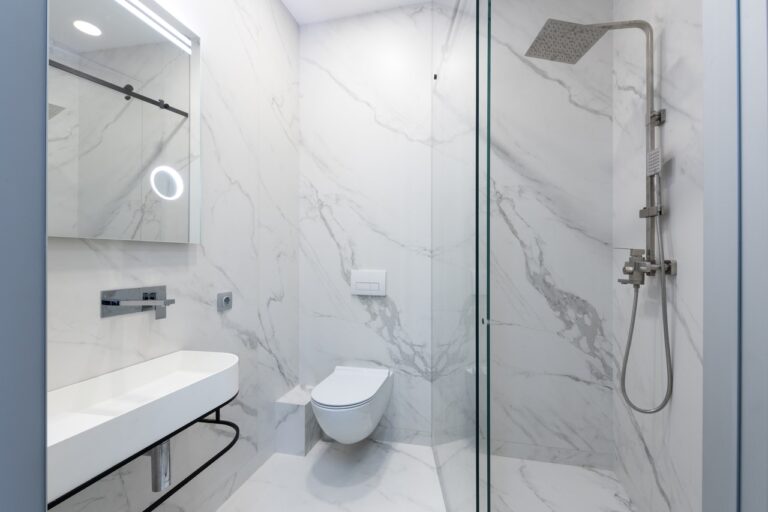
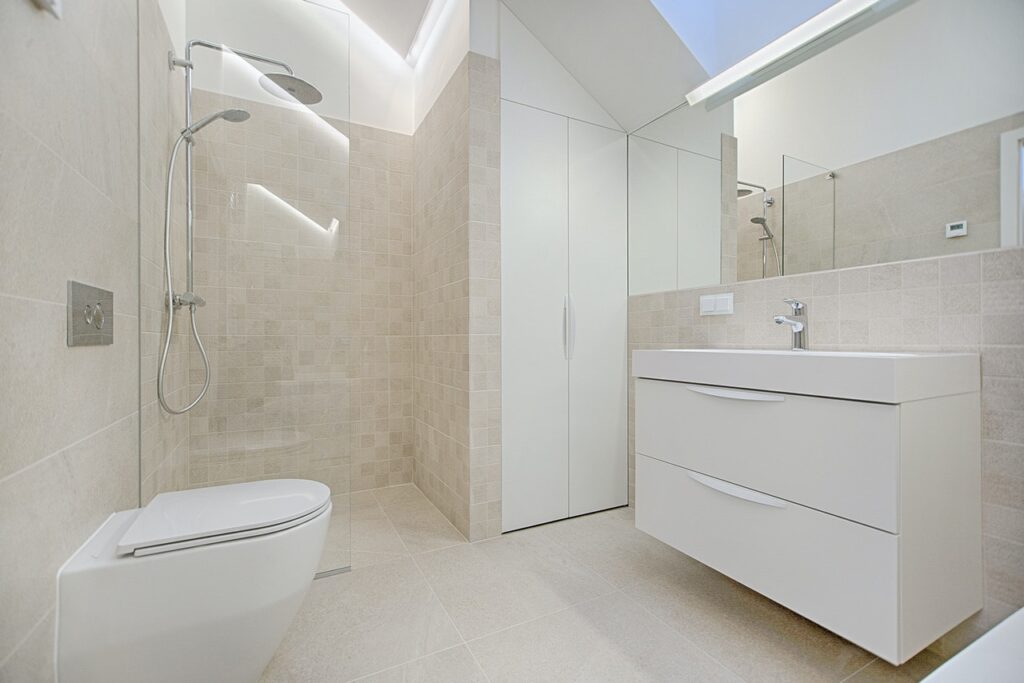
The second most common home modification that just over 40% of respondents expect to undertake is a bathroom conversion. This typically includes the removal of a bath and creation of a wetroom to allow for more comfortable and safe showering, as opposed to bathing. Baths tend to be difficult to enter, presenting slip hazards. Walk in tubs or wetrooms provide greater accessibility, with easy access walk in showers meaning that entry and exit doesn’t require a spot of amateur gymnastics to achieve.
You’ll be pleased to hear that with their spa-like looks, wetrooms are becoming increasingly popular here in the UK and can add value to your home. Moreover, there are far fewer surfaces in a wet room, which makes the job of cleaning it a lot easier.
Many home adaptations concern small adjustments to the height of certain everyday items around the home, and one of the most important are those of plugs and switches.
In the average UK home, light switches tend to be too high for those in wheelchairs and plugs tend to be too low for easy access for elderly residents. According to the Approved Document Part M overview from LABC, sockets and switches in UK new builds should be at a minimum of 450mm and a maximum of 1200mm from floor level, with sockets at the lower end of that spectrum and switches at the higher end.
Many elderly residents who have chosen to age in place opt for both their sockets and switches to be at a height of around 750mm from floor level, as this is considered more accessible.
Install A Downstairs Toilet
Accessibility where the toilet is concerned should also be a priority when considering home modifications and property futureproofing. As such, installing a downstairs toilet is a wise move, not only for accessibility but also as such an addition can significantly raise the value of your home.
Should wheelchair accessibility be a consideration, raising the height of any toilets in your home is important, too. A standard toilet is 430mm high whilst a standard wheelchair sits at 480mm; the required shifting of body weight to negotiate this difference can be tough for some with mobility issues; instead, building regulations experts TopBc recommends having the toilet at the same height as the wheelchair for easier access.
Ramp Installation
Almost 30% also expect to install a ramp to their property. This may be internal or external, providing easier access and movement in and around the home, as well as creating an access route for wheelchair users. Whether this is a permanent feature or one which can be added and removed when necessary is up to the homeowner. Handrails will further enhance accessibility.
Rethink Your Flooring
Flooring is one of those modifications that’s easy to overlook until a slip happens, by which point it’s often too late. Many of the most common surfaces in British homes – polished wood, glossy tiles, high-pile carpet – present hazards as mobility changes with age. Hard, slick floors offer little grip, while thick carpets can catch the feet of those using walking aids and cause trips.
The sweet spot is a slip-resistant surface that’s firm underfoot but kind on joints. Low-pile carpet, cushioned vinyl and rubber-backed flooring are all worth considering, particularly in kitchens, hallways and bathrooms where moisture and movement combine.
Transitions between rooms deserve attention too; threshold strips that sit proud of the floor are a classic trip hazard, and flush transitions are far safer for anyone using a wheelchair, walker or cane. If you’re already pulling up floors as part of a wider renovation, it’s the cheapest possible moment to factor accessibility into your choice of replacement.
South London’s district of Bermondsey, with its expansive, extensive history dating back to the Domesday Book, has long been an essential part of London lore and landscape. Originally known for its monasteries, the area gradually transformed with the arrival of the leather industry in the 17th century, becoming a major manufacturing centre during the Industrial Revolution.
As the years have passed, Bermondsey has continued to evolve, embracing its industrial heritage while simultaneously adapting to modern times – indeed, many of the area’s most forward thinking restaurants and bars are now housed in former warehouses.
And it’s with one foot in the past and another in the present that today we’re exploring its defining artery, Bermondsey Street, which seems to have carved out a niche all of its own in this little spot south of the river, its outdoor seating and upright drinking spilling onto its cobbled streets and evoking something altogether more continental than its SE1 postcode might suggest.
Running from the southern end of Tower Bridge Road to Grange Road, this lively thoroughfare boasts some of London’s most cherished culinary institutions; whether it’s tapas or tapenade you’re after, Bermondsey Street has got you covered.
So, put on your best dress, bring your appetite, and meet us out on the street; here are the best restaurants on Bermondsey Street.
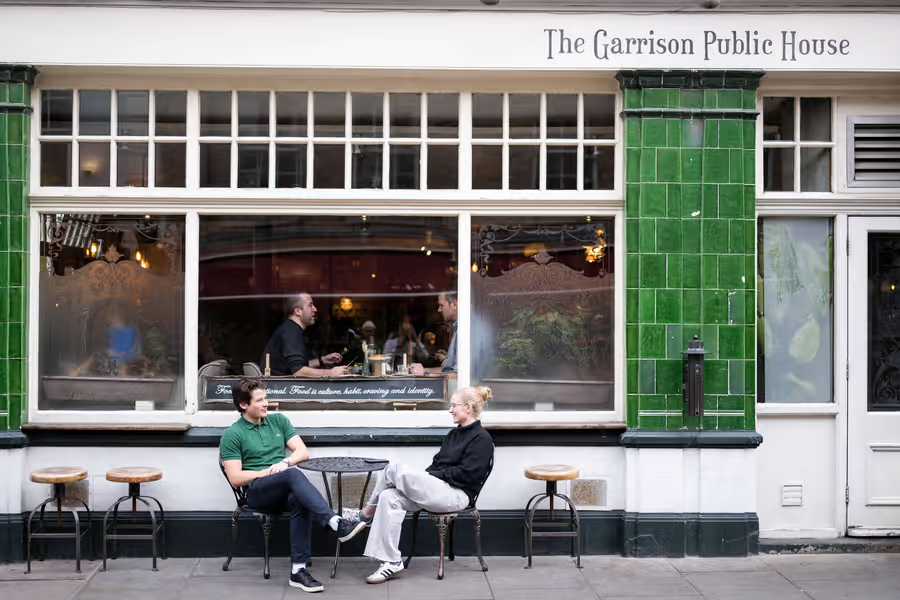
The Garrison
Ideal for inclusive, confidently-cooked pub dining…
With its old-school ambience and good-natured service, the Garrison has become a beloved Bermondsey institution since opening two decades ago.
Sitting on the corner of Bermondsey Street and White Ground and coaxing passersby in with a most insistent of come hithers, the gastropub has seemingly grown up with the surrounding area. As this stretch of southeast London has slowly gentrified – for better or for worse – the Garrison has been there, as welcoming to the increasingly yuppy population as it is its beloved regulars.
The Garrison’s latest chapter began in early 2025, when the pub appointed Natalie Coleman as its new head chef. Coleman – MasterChef winner in 2013, AA Rosette holder, and Best Chef at the 2022 Great British Pub Awards – brings serious pedigree to the award-winning gastropub, and her arrival has injected fresh energy into a menu already defined by pared back, proudly unrefined, ingredient-led modern European food.
Under Coleman’s guidance, the restaurant continues to flourish, offering a clean and contemporary farm-to-table approach to its dishes, with no-nonsense, utterly delicious cooking the order of the day.
Daily delivery of fish caught the night before, whether that’s black bass from Brixham, seabass from Perranporth or brill caught off the Cornish coast, is treated thoughtfully here; whole beasts arrive adorned with simple but superlative buttersauces; the house sourdough perfectly poised for dredging and mopping.
As any pub still devoted to serving the community should, the Garrison does a mean Sunday roast, too, with all the bells, whistles, flourishes and fancy that you’d expect from a Michelin-rated place. The middle white pork belly, crackling crisped separately and plenty of it, is the must-order, if you ask the locals (us).
Pair any and all of the above with a pint of unfiltered lager from nearby Battersea Brewery, and you’ve got yourself one of London’s most laid back afternoons.
It could quite convincingly be argued that the celebrated Spanish chef José Pizarro rules the restaurant roost in SE1, with not one, not two, but three celebrated restaurants in Bermondsey, and a certain level of ubiquity on lists such as this.
But in this case, familiarity certainly doesn’t breed contempt, with Bermondsey locals and diners coming from further afoot ensuring that Pizarro, José, and the newest addition, the all-day dining spot Lolo, are buzzing every night of the week.
José Pizarro’s passion for Spanish gastronomy has led him on an international journey to share his culinary expertise with the world. Born in Extremadura, Pizarro honed his culinary skills in kitchens across Europe before opening his first restaurant, Bermondsey’s José, in London.
Its (and his) increasing popularity quickly gave rise to Pizarro, located just a stone’s throw from the former. With an unwavering commitment to Spanish culinary traditions, Pizarro showcases the richness and diversity of Spain’s food culture at his (sur)namesake restaurant.
Though just a 200 metre stretch of sidestreet separates the two restaurants, there is actually a fair amount of discrepancy in the food and vibe offered within each. Pizarro sets itself apart by highlighting the essence of broadly southern Spanish cuisine through innovative dishes made from fresh, locally-sourced ingredients that are perhaps a little more elaborate – and larger – than the more traditional tapas plates served up to road.
There’s also a keen focus on seafood here, with the pulpo a la Gallega (Galician-style octopus), served in a reduction of the red-wine braising liquor that it’s been bathed in, a particular highlight. For the carnivores, the menu’s centrepiece is the suckling lamb, a simultaneously wobbly and crisp piece that’s been slow cooked over charcoal, its corners blistered and burnished from that familiar dripping of fat and licking of flames. A yoghurt aioli helps temper the sweet fattiness of this young cut.
An essential part of dining at Pizarro is exploring the exquisite, eclectic all-Spanish wine selection. The restaurant’s extensive wine list features traditional Spanish favourites like Rioja and Cava, as well as lesser-known wines such as Almansa and Picapoll, the latter of which pairing particularly well with that suckling lamb from just a paragraph prior.
Indeed, if you’re keen to sit a while and savour that wine, alongside some larger sharing dishes, then Pizarro is perhaps a better bet than its siblings, with banquettes and booths catering to larger groups looking to take a load off. Should you be looking for a truly traditional tapas bar experience, though, then it’s to José you should head…
Ideal perhaps the most traditional tapas experience in London…
José, an elegant yet welcoming tapas bar, wouldn’t feel at all out of place down a side street of Seville or Valencia, with its open-door, standing room only vibe causing an inviting din from midday until close. Located in a former Victorian building, José’s interior reflects the aesthetic charm of southern Spain, with its exposed brick walls, wooden floors, and an open kitchen. Yep, it’s all kitchen clatter and dining room chatter here…
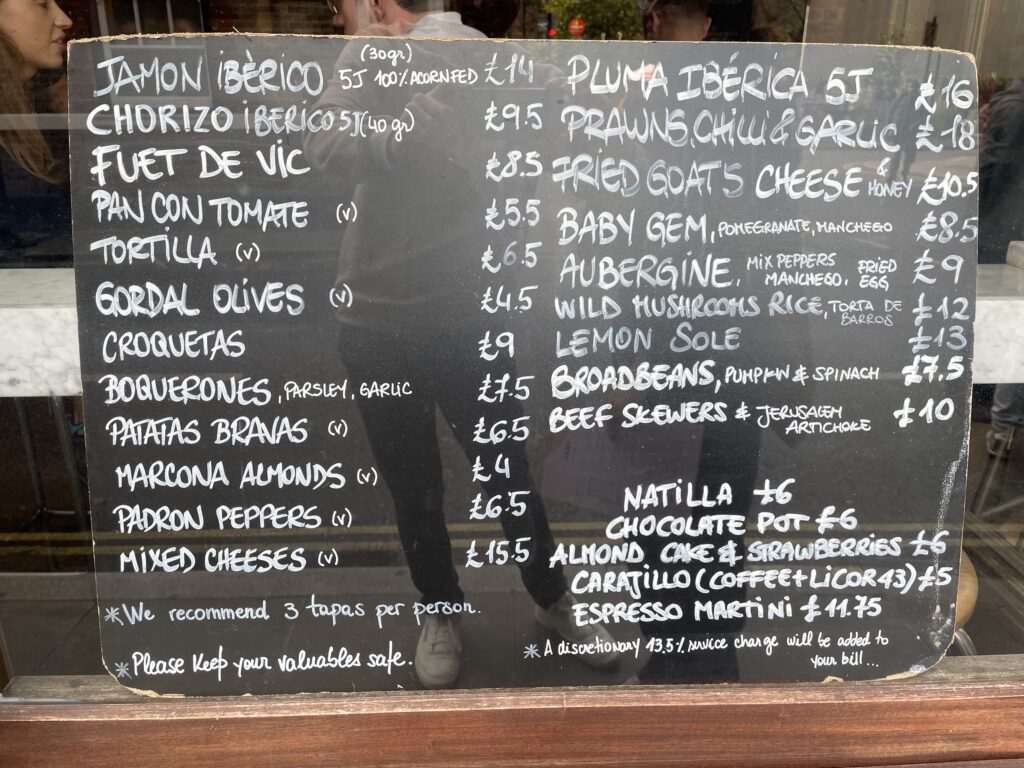
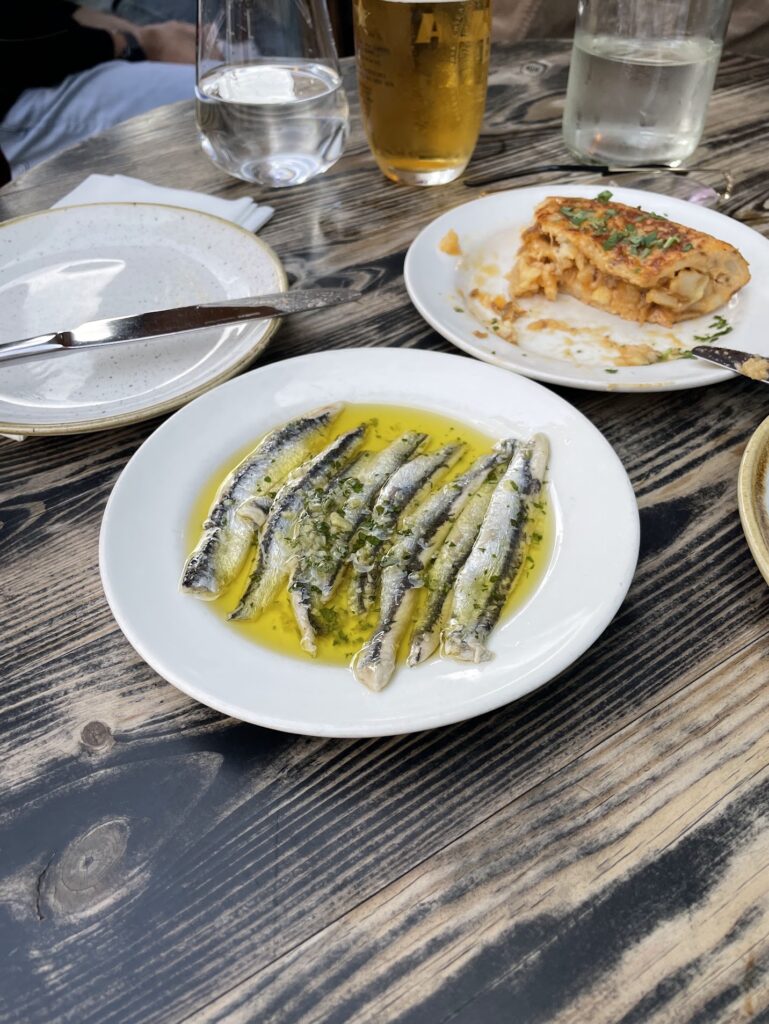
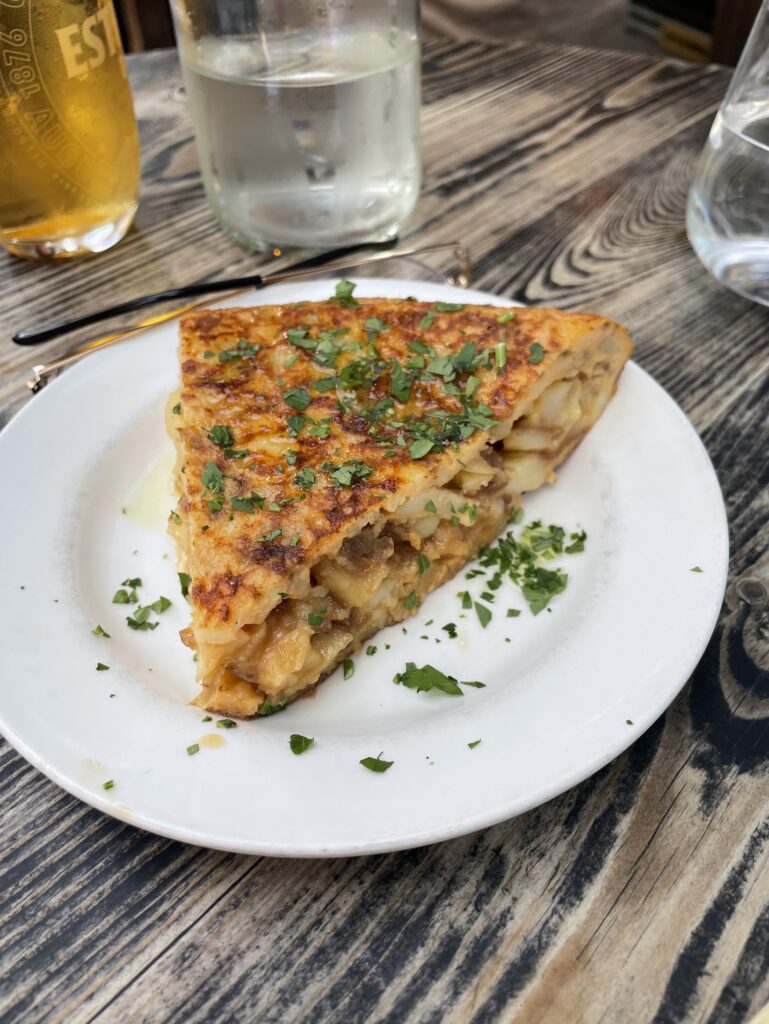
The chalkboard menu features an array of seasonal and locally-sourced ingredients presented in the most traditional of styles – expect faultless versions of patatas bravas, oozing, onion-heavy tortilla, piquant boquerones, blistered padron peppers, chorizo in sherry, and the restaurant’s exemplary daily changing croquettes. It’s all there, and it’s all bang on the money…
…No wonder, then, that José is one of Bermondsey Street’s most beloved restaurants.
Pizarro’s status as one of London’s most important Spanish chefs was further cemented in 2024, when he was awarded the Cross of the Order of Isabella the Catholic – Spain’s equivalent of a knighthood, and an honour no other Spanish chef has ever received.
Ideal for when you fancy a classic French dining experience…
As this Bermondsey neighbourhood has evolved into something that feels as close to ‘continental’ as we’ll get on these gloomy shores, with its alfresco dining and drinking scene, so too have its restaurants, with a whole host of tapas bars, pasta restaurants and French bistros opening in recent years to keep in step with the changing atmosphere.
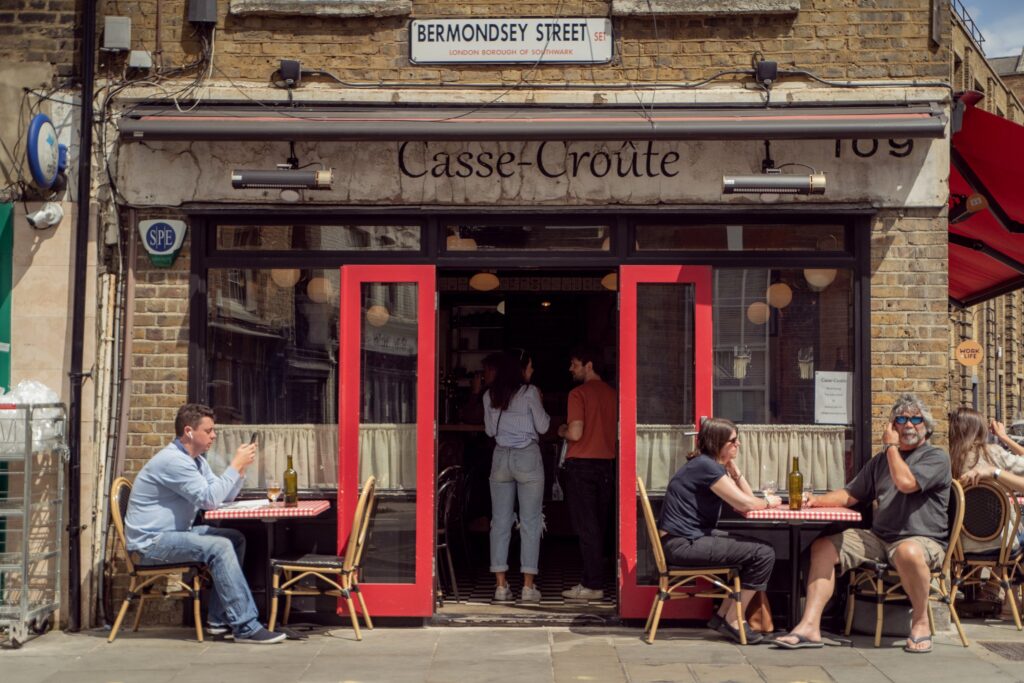
It should come as no surprise, then, that the charming, unassuming bistro Casse-Croûte is flourishing on Bermondsey Street. Now celebrating its second decade here, the allure is arguably in its consistency; though the menu regularly changes, the food is reliably, resolutely hearty and fresh. A fine balancing act, indeed…
The masterminds behind this culinary gem are three French friends – chef Hervé Durochat and front-of-house duo, Alexandre Bonnefoy and Sylvain Soulard. The trio brings with them extensive experience in the hospitality and culinary industries, having honed their skills in both London and their native France.
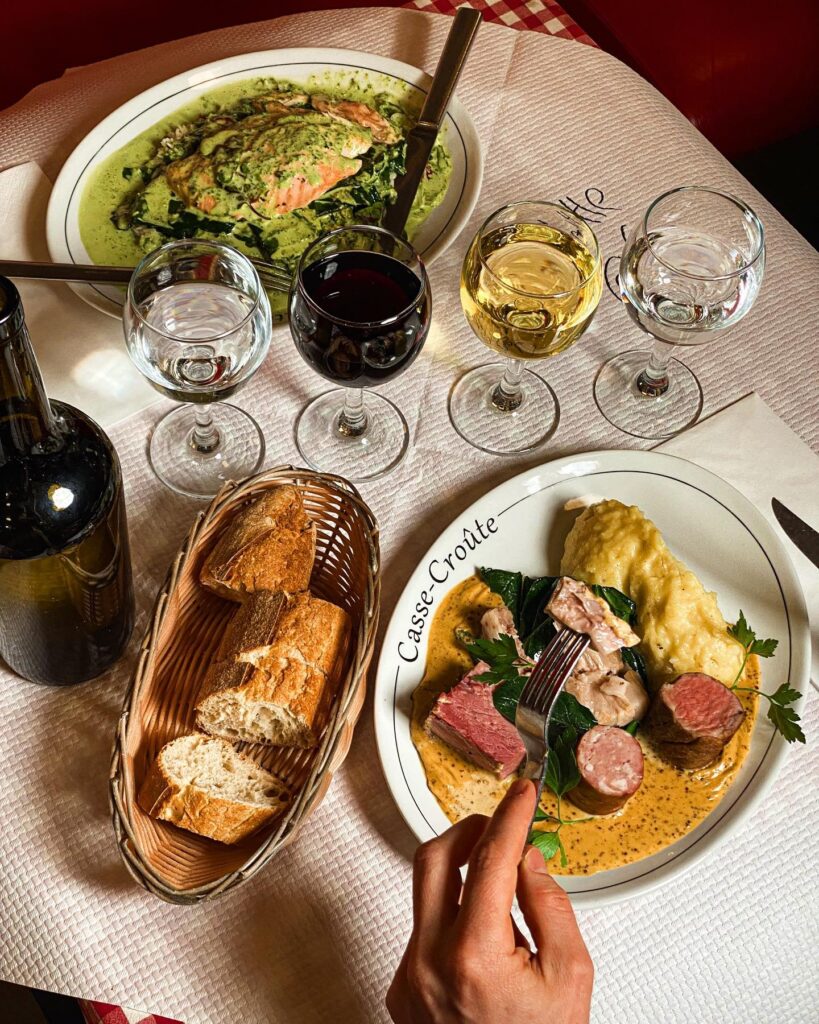
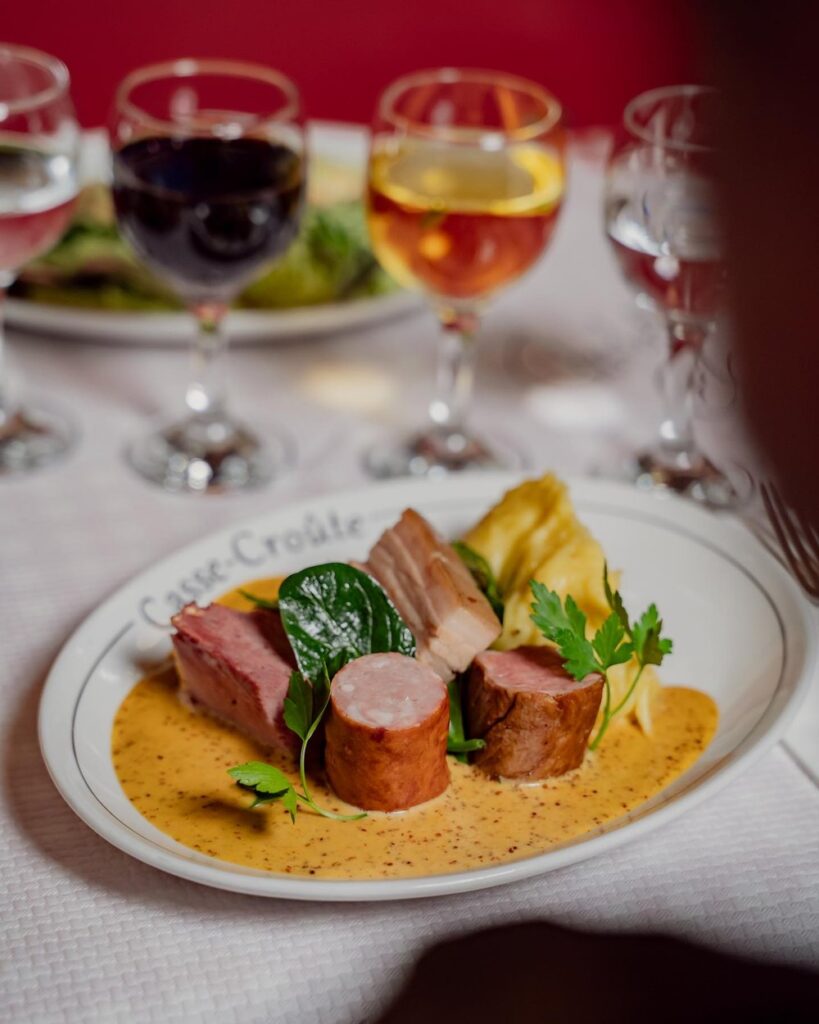
Focusing on traditional French cuisine, Chef Durochat and his dedicated team prepare daily menus that draw inspiration from rural, hearty classics alongside lighter, ‘metropolitan’ dishes. The compact menu ensures that each dish is crafted with the utmost care and quality ingredients, often procured from local producers.
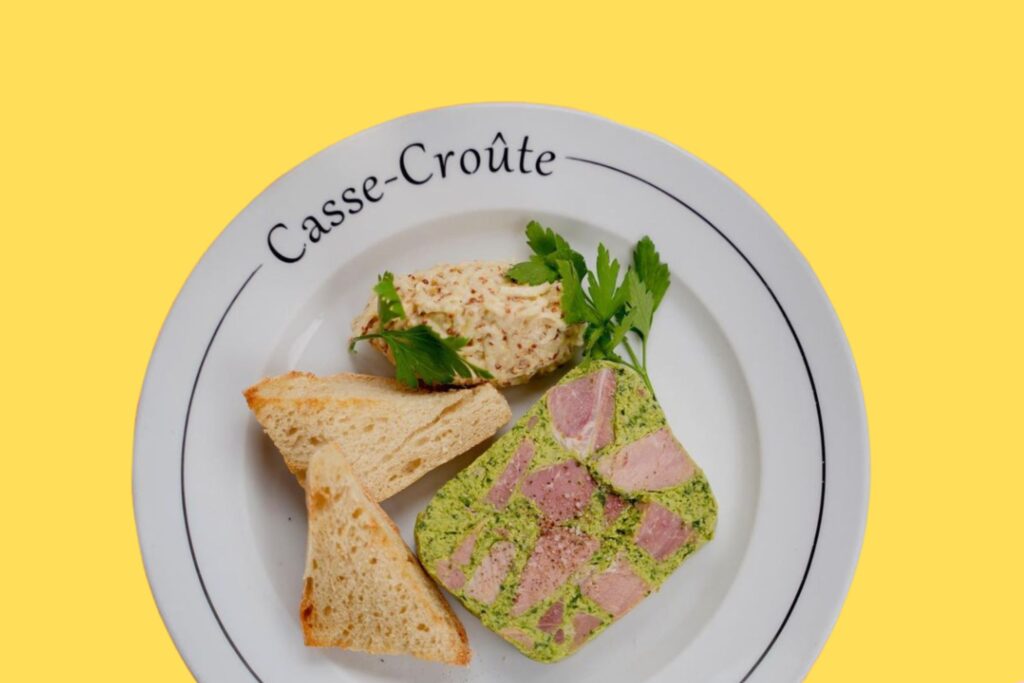
On the tight chalkboard menu in an even tighter dining room, expect homemade boudin noir using rare breed British pork alongside fish soup, the swimmers sourced from Billingsgate, the soup bolstered via a very pokey rouille. Yep, this is proud French fare from a team who know how to do the classics with precision and respect.
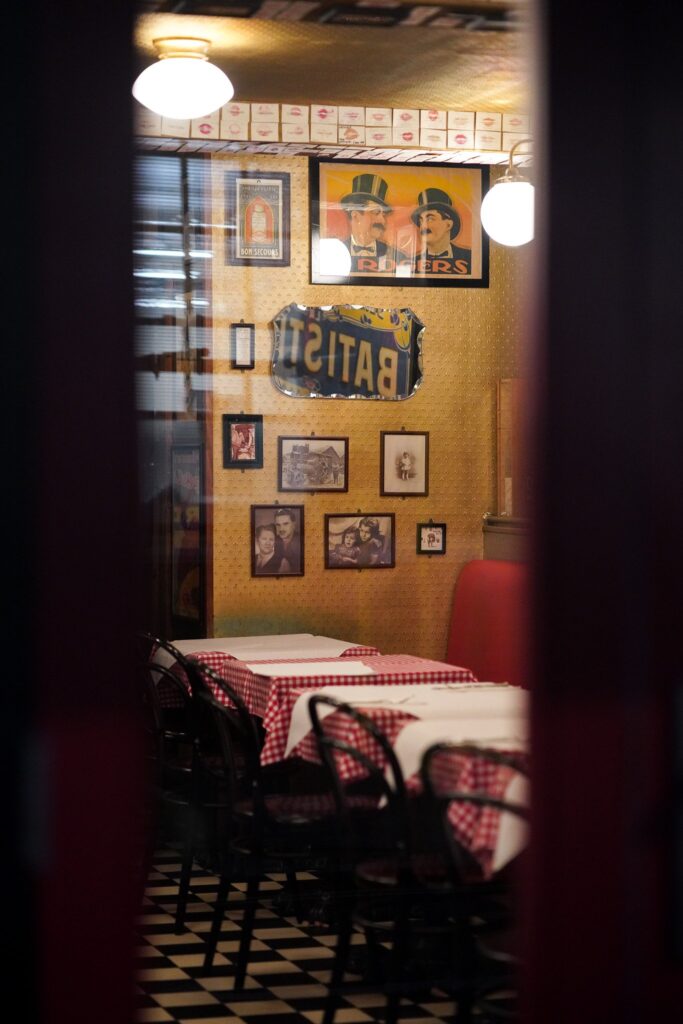
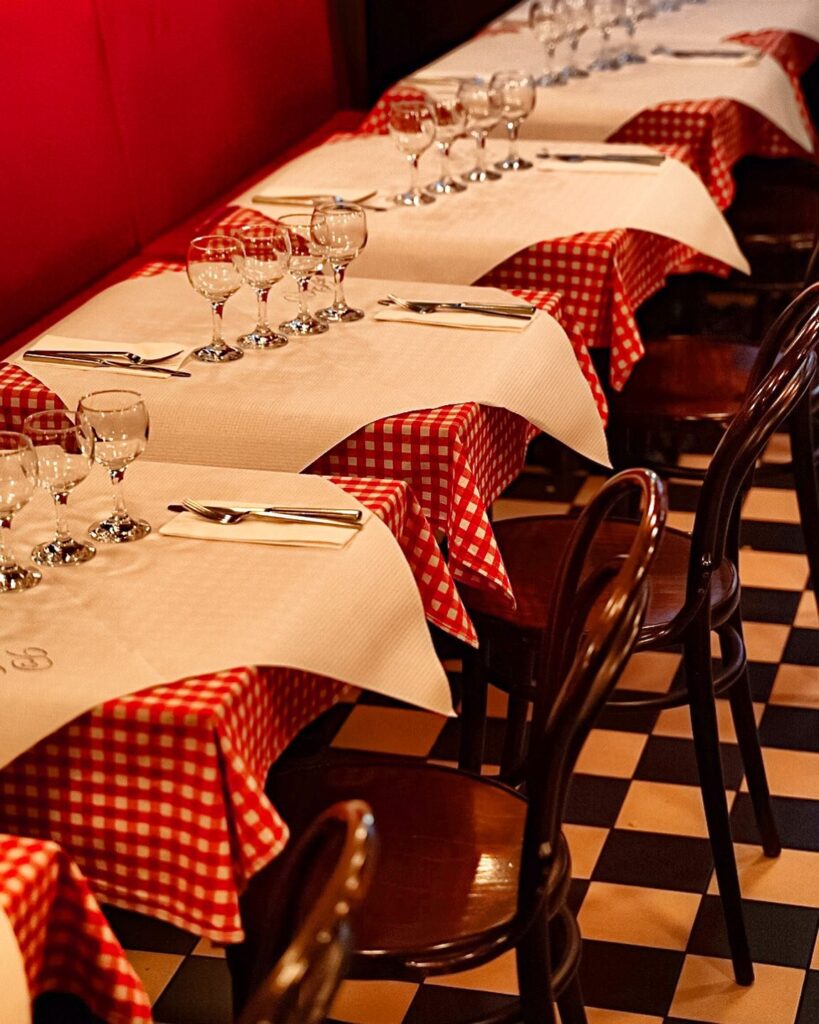
In that compact 20-seater dining room, it’s all iconic red-and-white chequered tablecloths, while the walls are adorned with vintage posters, photographs, and shelves housing a treasure trove of wines. Fairy lights and a small terrace with tables for al fresco dining provide the perfect ambiance for a warm summer evening, accompanied by a glass of fine wine and the soothing melodies of classic French chansons.
And speaking of wine, Casse-Croûte boasts a thoughtfully curated wine list, showcasing vibrant selections from various French regions.
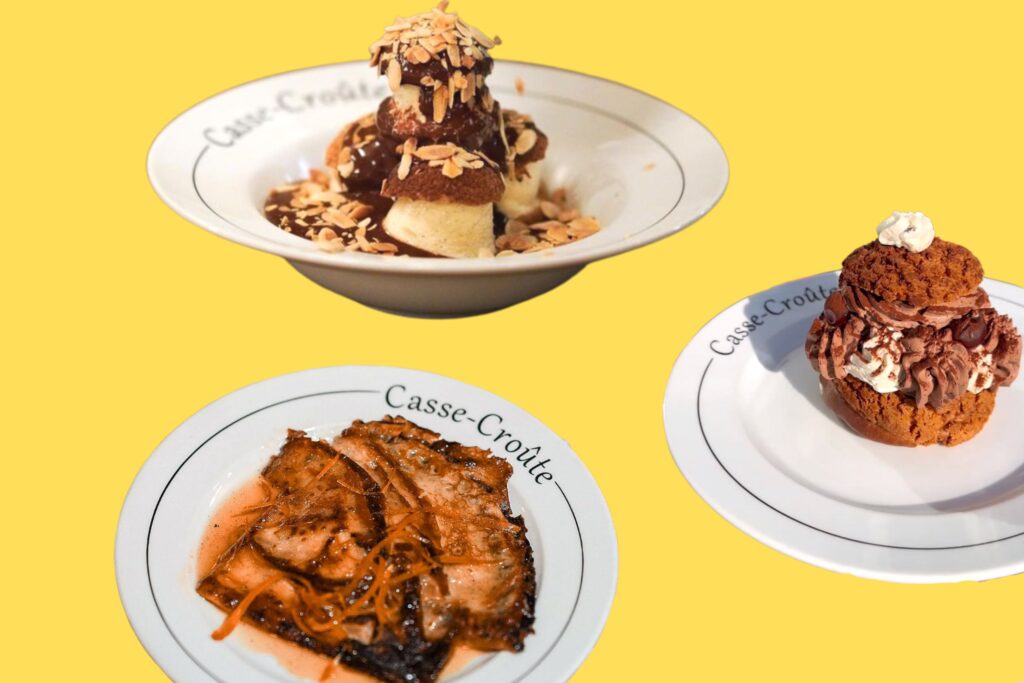
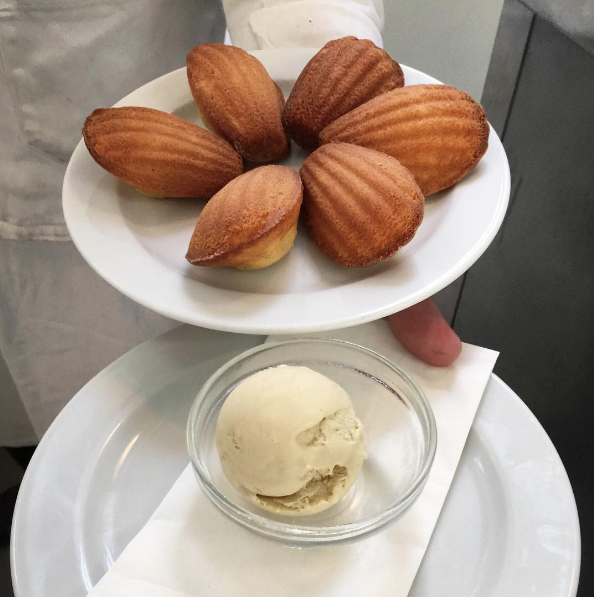
The pastry work at this restaurant is on point, too, just as you’d expect from a restaurant that might as well be flying the Tricolore outfront. The skilfully constructed chou chou forêt noir is a must-order, but even better is a particularly brooding chocolate mousse, served with a trio of freshly baked madeleines. When it’s on the menu, profiteroles coated in chocolate sauce and sprinkled with almond flakes are a beautiful thing, too. Expect to leave Casse-Croûte a couple of kilos heavier, sure, but also several hedons happier.
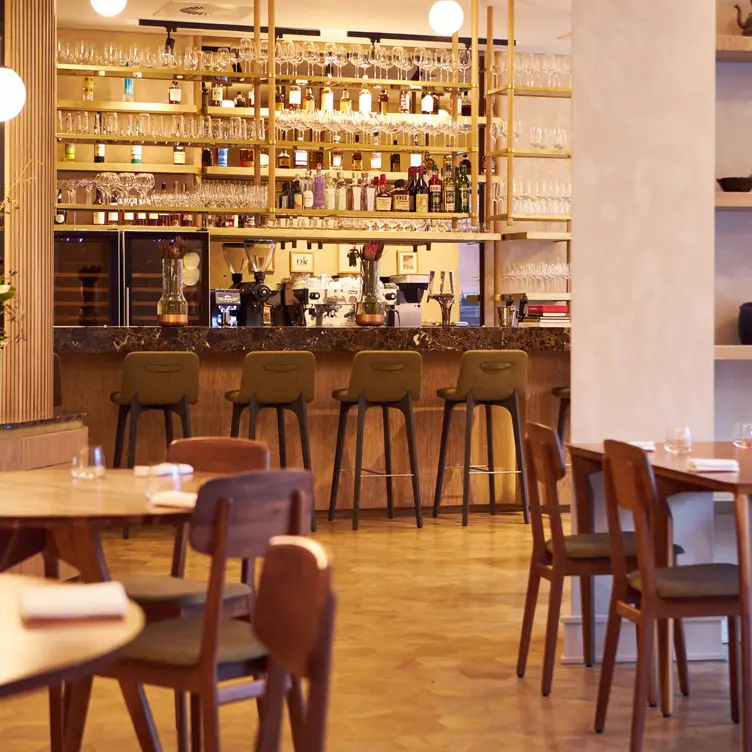
Just at the point where Abbey Street becomes Bermondsey Street, you’ll find Flour & Grape, an understated Italian pastificio who have understood the assignment and deliver on its finer details with aplomb.
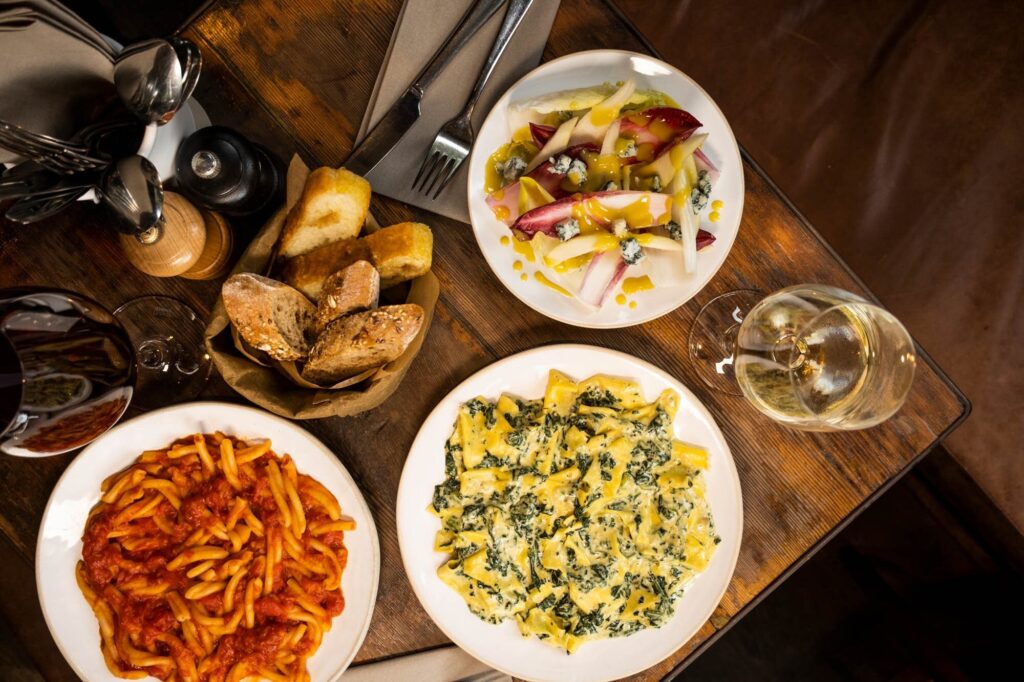
A Bermondsey Street fixture since 2017, the vibe here is freshly made pasta and wines poured by the glass – a place where you can drop by for the swiftest of snacks and sips, or one you can sink into for a longer stint, if you’ve got nowhere to be.
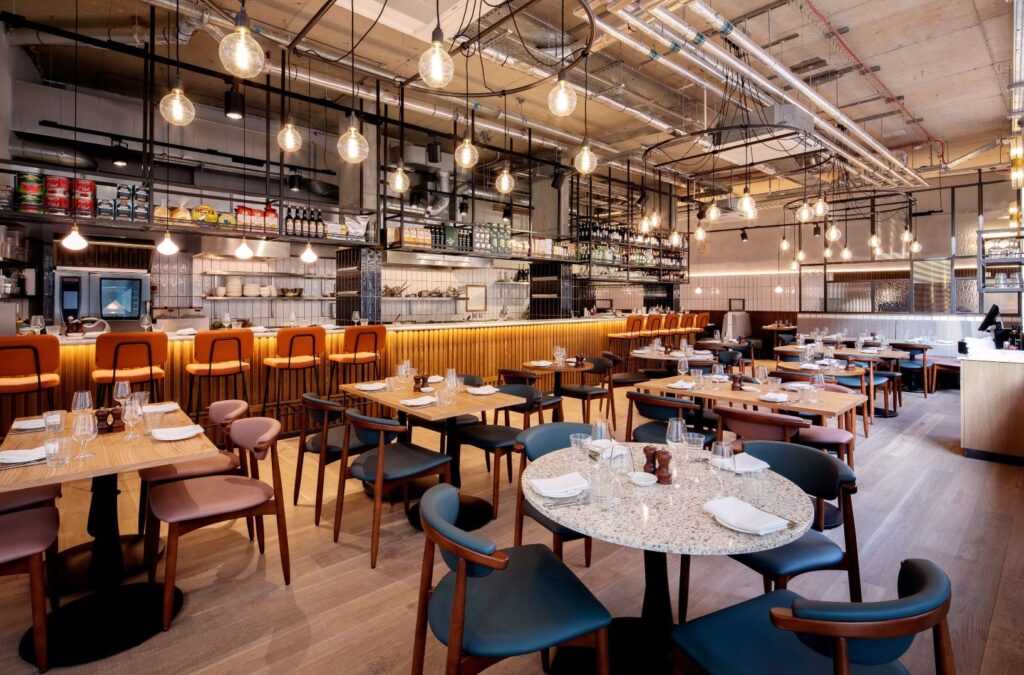
Should you fall into the former camp, take up a stool at the marble-topped bar, which offers a fantastic vantage point for those who wish to witness the pasta-making process first hand. If you’ve come here to take your time, there’s an additional dining space upstairs, which showcases the building’s exposed brickwork and high ceilings, imbued with an air of historic charm. Seating options include comfortable leather banquettes as well as intimate tables for two, ideal for a romantic dinner.
At the helm is founder and owner Nick Crispini, a hospitality heavyweight with a passion for celebrating Italian produce – wine included – in a modern London setting. Crispini’s dedication to upholding authentic recipes and techniques is mirrored by Head Chef Roberto Mercandino, who brings his rich Neapolitan heritage and culinary prowess to the kitchen. It’s a match made in heaven.
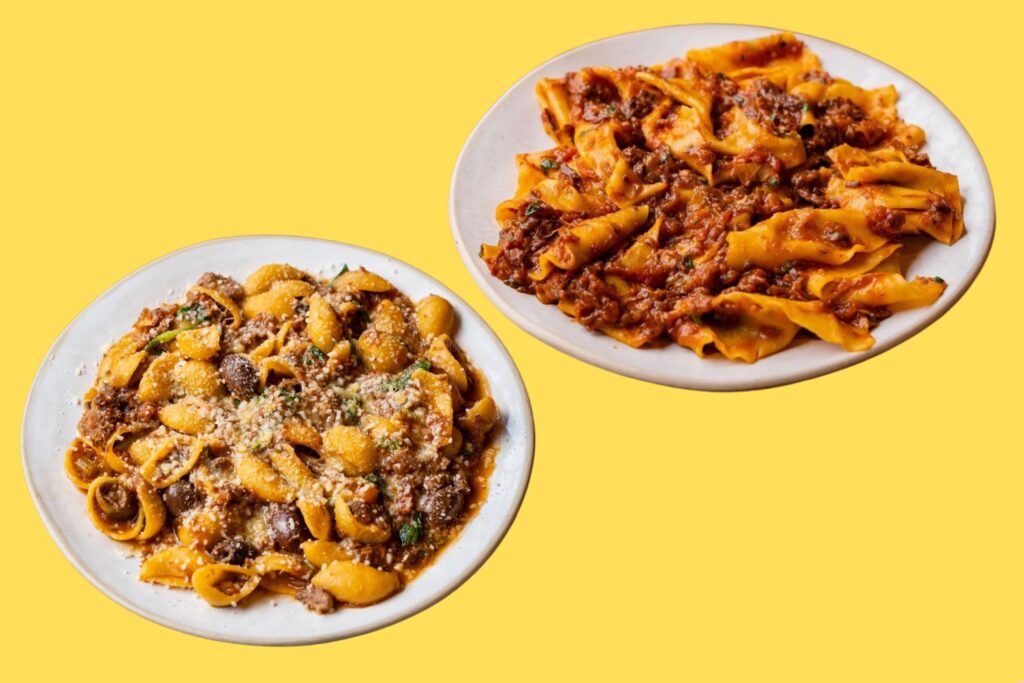
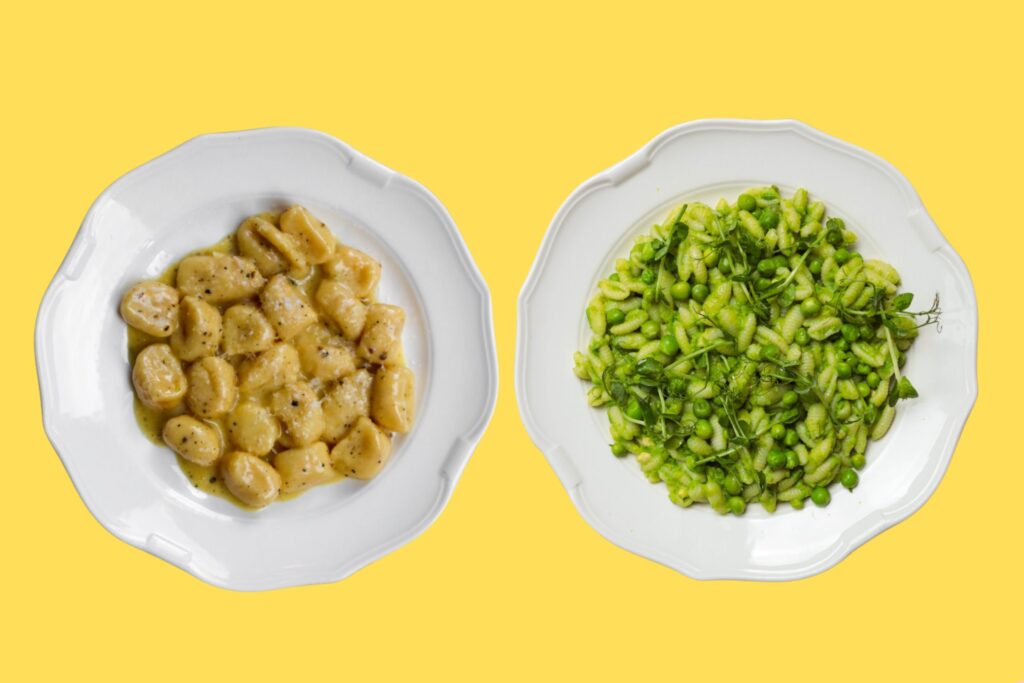
Flour & Grape’s mainstay is, without question, its range of freshly crafted pasta dishes. Each one is prepared onsite daily with inspiring combinations of classic sauces, seasonal ingredients, and a contemporary twist. From the indulgent yet delicate crab taglierini to the hearty sausage and fennel pappardelle, there’s a dish to satisfy every pasta lover’s cravings.
But the food at Flour & Grape is not limited to pasta. Gourmet antipasti offerings such as beef carpaccio and burrata with fresh heritage tomatoes provide an irresistible start to any meal. Desserts continue the theme; order the the creamy Amalfi lemon and ricotta cheesecake or the satisfyingly rich chocolate and espresso budino, either of which will undoubtedly end your meal on a sweet high note.
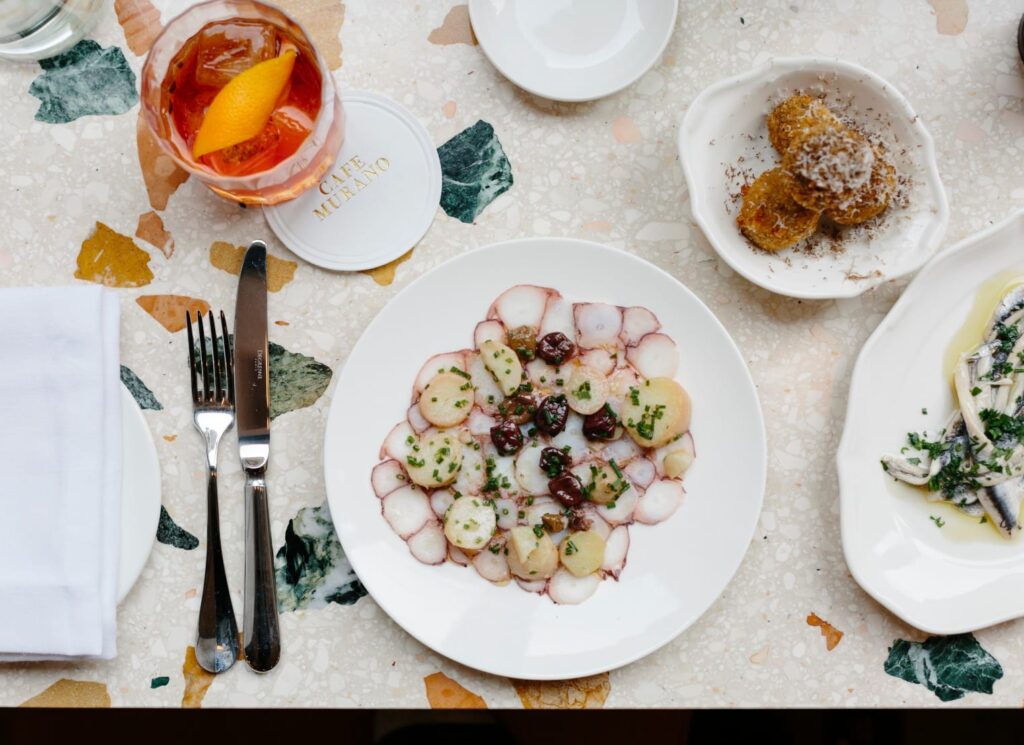
Cafe Murano is the brainchild of chef Angela Hartnett, whose restaurant Murano in Mayfair is the proud holder of a Michelin star. Here, it’s a more laid back and leisurely affair, with more manageable prices to match.
That’s not to say the quality of ingredients or cooking are compromised here. No, at Cafe Murano, you’ll find plates of power and precision which celebrate British produce via an Italian home cooking sensibility, whether that’s in the superb cacio e pepe gnocchi with a silky, peppery coating, or the superlative seafood risotto, properly portioned and generously appointed with clams, mussels and cuttlefish. It’s a briny delight.
Larger plates keep things simple to great effect; the light and breezy hake with summer minestrone and pesto is especially good. For something a little more gutsy, Sunday lunches at Murano are a hearty affair. Think hunking plates of roast beef from with a side of horseradish cream, plenty of fluffy yet crispy roast potatoes and a pouring of rich gravy.
Don’t leave without satisfying that sweet tooth; Cafe Murano’s desserts are bright and seasonal affairs. Ours is a vanilla panna cotta with strawberries, if you’re asking.
Ideal for smart, seasonaldishes from one of London’s most beloved wine bars…
Okay, it’s starting to feel a little restrictive, unwieldy even, to stay within the parameters of a single thoroughfare when a couple of London’s very best restaurants are just a minute’s walk off Bermondsey Street. So, allow us a little poetic licence for these final two…
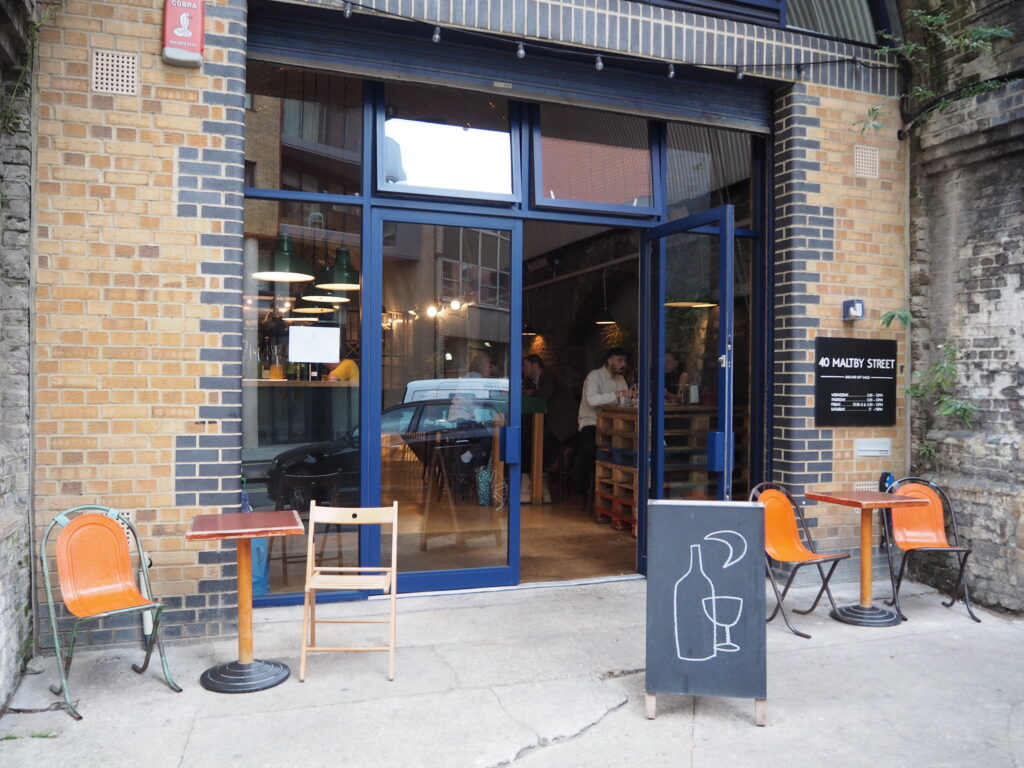
Nestled between London Bridge and Bermondsey stations, 40 Maltby Street is a gem that many in the know call their favourite London restaurant. To be fair, it’s actually kind of hard to call 40 Maltby Street a restaurant – it’s a wine importer and bar first and foremost, with a kind of spare tunnel of a dining room tacked onto its kitchen, built into the railway arches it calls home.
The wine bottles that line the walls form the backbone of visual intrigue here, shaking ominously every time a train rumbles above. Not that any of this distracts from things; here, it simply allows the focus to fall firmly on the ever-changing, seasonally-appropriate chalkboard menu of around 12 dishes.
Though it’s rendered in a scrawl almost illegible, what a menu it is, with the kitchen thriving under the culinary direction of head chef Steve Williams, who is celebrated for his judicious use of British produce. Williams creates dishes that are both simple and spectacular, boasting a refined touch recognisable from his time leading the Harwood Arms kitchen when it became the first pub in London to win a Michelin star.
The tarts here are, quite simply, must-orders, with elegant pastry work and seasonally appropriate, expertly judged fillings leading to some truly masterful creations. A recent (well, last year’s) quiche-adjacent asparagus and bacon tart, with a salsa verde-dressed watercress salad on the side, was wonderful, the egg custard set just right – not too firm, certainly not too runny – and its piquant salad sparring partner the perfect foil to the tart’s richer, saltier tones.
Even better, slices of roast beef that are warmed gently so the yellow, sweet fat is melting but the rest remains blushing, are served with fried Jersey Royals and a properly piquant horseradish number. Yep, this is a glorious expression of late spring produce, and with that tart clocking in at £11 and the beef at £26, you’ve got yourself a damn good, light meal for two for under £40.
Though matching wine with asparagus can be a tricky ask, the Potron Miney Pari Trouillas Rosé, which is currently being poured by the glass, pairs beautifully with the tart, its fresh acidity just the right foil for the asparagus’ more vegetal notes. So, pour one up and luxuriate in some sunshine, both on the plate and just outside 40 Maltby Street’s flung-open doors.
Open for dinner from Wednesday to Saturday and for lunch Thursday to Saturday, 40 Maltby Street does not accept reservations, ensuring a spontaneous and vibrant atmosphere reflective of the bustling market area it resides in.
Ideal for Michelin-starred plates of pedigree and precision…
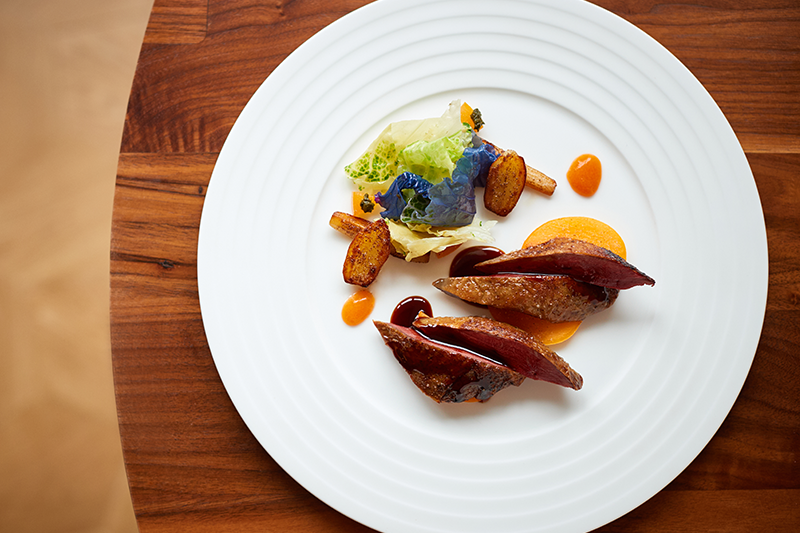
A short stroll from London Bridge, Trivet offers a sophisticated dining experience that has earned it two Michelin stars since opening in 2019. And as of the 2026 Michelin Guide, the accolades keep coming – Labombe, the restaurant’s Monday night wine bar concept, has been awarded its own Michelin star, making the Trivet operation one of the most decorated in the capital. It’s arguably the best starred experience in London Bridge, which should come as no surprise when you consider the pedigree behind the operation.
Founded by chef Jonny Lake and sommelier Isa Bal, both alumni of the legendary Fat Duck, Trivet opened its doors in October 2019 and has somehow managed to both earn accolades and keep things relaxed and refined, without an unseemly hype machine forever circling, reeling and story-ing.
The restaurant’s design, crafted by Umay Çeviker, helps emphasise this elegant understatement, blending natural wood textures with Mediterranean, Japanese and Nordic influences. The menu at Trivet continues this theme, and is a testament to Lake’s and Bal’s extensive experience, featuring dishes that are both highly inventive and strangely comforting, with premium ingredients treated with the most delicate of touches.
A little less delicate, admittedly, are the a la carte prices – expect to pay in the low forties for starters and anywhere from the late fifties to the mid-sixties for a main course, but boy will you get clarity of flavour from your investment. If you’re simultaneously baulking at those prices and salivating at the idea of pristine ingredients not getting fucked with, then fear not; Trivet also offers a ‘Lunch at Trivet’ situation where things feel eminently more reasonable.
Running from Tuesday to Saturday, from midday to 2pm, you’ll find the same star-quality cooking, but with dishes a little lighter and prices accordingly lower. The lunch menu is a brilliant way into the Trivet experience without the full a la carte commitment.
Notably, the wine list at Trivet is uniquely arranged in chronological order based on the earliest mentions of wines in literature, showcasing a deep respect for historical richness and gastronomic storytelling. And with our own gastronomic storytelling in danger of getting a little chronologically confusing, we’re returning to the food menu for dessert, which has got to be Trivet’s iconic baked potato mille feuille, which is layered with an intoxicating saké and white chocolate mousse. Christ, it’s good, and we’d appreciate being left alone with it now. Byyyeeeee.
It’s only natural that most people want to stay in the house that they’ve built, nurtured and loved well into their retirement and beyond. But as our bodies, brains and needs change, so do the demands we put on our properties.
Often, our homes need updating to meet those changing needs, but this presents something of a conundrum as we age; do we update now, and allow superfluous elements into the home prematurely? Or, do we wait until the necessity for a stairlift, solar light or riser-recliner chair arrives, at which point the willpower to install one may no longer be there?
Today, we’re taking this conundrum into the bathroom, to sit with it a while and contemplate renovations you can make now that will help you live more comfortably as you age. Fortunately, you don’t need to compromise on style or functionality when it comes to future-proofing your bathroom; here are some key ways to do just that.
Install A Walk-In-Shower Or A Wet Room
Wet rooms aren’t just popular with the elderly. In fact, they are becoming a coveted asset to any bathroom, offering a spa-like showering space and an easy-to-clean floor, all in one. As Living reports, “Wet rooms are becoming increasingly popular in the UK, and with their spa-like looks they’re also a great way to add value to your home.’’
Wet rooms are essentially shower spaces that have no shower tray to step over and are at the same level as the bathroom floor. As such they allow accessibility for wheelchairs, and bars or rails can easily be installed to provide stability for those less stable on their feet. Just be sure you install some slip-resistant flooring, wood panelling or mats, as they can get seriously slippery without.
If a full wet room conversion feels like too big a commitment, a quadrant shower tray from specialists like Heat and Plumb offers a smart middle ground; their curved, space-saving design fits neatly into a corner, freeing up floor space while still providing a low-profile step-in that’s far more manageable than a traditional high-sided tray.
Underfloor Heating
We know installing underfloor heating is a messy job. However, this article is about future-proofing; do it now, and you’ll reap the benefits later in life. Scratch that, you’ll reap the benefits shortly, too.
Indeed, being able to enjoy the luxury of a warm bathroom floor during the cold winter is a real luxury, making cold winter mornings much easier to deal with, and the feeling under bare feet is one of reassurance and comfort, every single time. For those in their later years, such simple comforts can be especially important, when joints and limbs tend to suffer from the cold more.
The beauty of underfloor heating is in the fact that you don’t have to give over valuable wall space to radiators, saving space for a seat and grab bars should you need to add them later on in life. Should you be wondering how much underfloor heating costs, you’ll be happy to hear that it won’t break the bank. The average cost of the parts and installation comes in at around the £1000 mark and there are plenty of styles to choose from.
In the spirit of future-proofing, you’ll likely want a non-slip surface for your bathroom floor and for that, porcelain is the best. Moreover, it’s best to look for tiles with an R13 rating, which is the highest of the slip resistance scores for anti-slip floor tiles.
If underfloor heating isn’t plausible, central heating radiators specifically designed for bathrooms with safety features like low surface temperatures and sleek profiles are a wise alternative.
Non-Slip Tiles
Indeed, when it comes to future-proofing your bathroom, perhaps the most crucial step is literally under your feet. Non-slip tiles are the unsung heroes of a safe and secure bathroom environment; the foundation upon which all other bathroom safety features are built.
Imagine stepping into your bathroom on a chilly morning. The last thing you want is to slip on a wet tile. Non-slip tiles are designed to provide that extra grip, ensuring your bathroom remains a haven of relaxation, not a hazard zone.
Non-slip tiles aren’t just about safety. They’re also about style. Today’s market offers a plethora of designs, colours, and textures to choose from. Whether you’re a fan of the minimalist aesthetic or prefer a more traditional look, there’s a non-slip tile that matches your taste.
Incredibly durable, too, they’re designed to withstand high levels of moisture and heavy foot traffic, making them a cost-effective solution for those looking to future-proof their bathrooms.
So, how do you choose the right non-slip tiles for your bathroom? Look for tiles with a high slip-resistance rating. These tiles have a slightly rough surface that provides traction even when wet. Also, consider the size of the tiles. Smaller tiles mean more grout lines, which can provide additional slip resistance.
For something less investment-heavy, a decent bath mat does the trick.
A Walk-In Tub
Here at IDEAL, we love a bath. You know, those long, languid ones that take you somewhere else entirely. Those ones are often bolstered by a book and a bottle (a glass, sorry, we mean a glass), and last until your fingertips are wrinkled and your face flushed. But we digress…
It’s a simple pleasure that sadly seems to get less accessible as we age, since it becomes more difficult to get in and out of the bath. As such, when renovating your bathroom, consider installing a walk-in style tub.
Basins
For further bathroom accessibility additions, consider a wall-mounted basin. Not only do they look stylish, but they also allow for a stool to be placed underneath it, which you can use to clean your teeth, apply makeup and even shave while seated.
You don’t need to stick to a boring white one either; a wall-mounted basin with an intricate, even ornamental design can really lift the aesthetic value of the space. To make one a proper focal point, and a piece of art in the process, consider installing a ceramic, tiled version, seen across Greece, Turkey, and the Middle East, as well as East Asia. Just gorgeous, and timeless, too – talk about future-proofing!
A Thermostatic Shower
We’ve all been in the shower when suddenly, there’s a drop in water and it either becomes freezing cold or scalding hot. By adding a thermostatic shower mixer to better control the temperature in your shower, you can be assured that those horrific sudden scalds of heat or bracing cold changes when someone else in the house turns on a tap are a thing of the past.
Why will this help you in the future? Thermostatic mixer showers are ideal for the elderly as they prevent sudden changes in temperature, which means a safer, more secure shower. Which is the least we can offer our more elderly selves, don’t you think?
When it comes to future-proofing your bathroom, storage is often overlooked. Yet, as we age, the ability to reach high shelves or bend down to retrieve items from low cupboards can become increasingly difficult. Consider installing pull-out drawers and shelves at waist height, eliminating the need to stretch or stoop. Wall-mounted cabinets with sliding doors require less space to operate than traditional swing doors, making them ideal for wheelchair users or those with limited mobility.
The beauty of implementing these storage solutions now is that they’re not only practical for later life but also incredibly convenient at any age. Soft-close drawers, touch-release mechanisms and strategically placed handles all contribute to a bathroom that’s both stylish and accessible. Look for moisture-resistant materials like treated wood or high-quality laminate that will stand the test of time, ensuring your investment remains functional and attractive for decades to come.
Proper Lighting Design
Lighting isn’t merely an aesthetic consideration when future-proofing your bathroom; it’s a crucial safety feature. As our eyesight naturally deteriorates with age, adequate lighting becomes increasingly important. Consider a layered lighting approach that combines ambient, task and accent lighting to eliminate shadows and dark spots where accidents might occur.
Motion-sensor lights are particularly useful for night-time visits to the loo, automatically illuminating your path without requiring you to fumble for switches in the dark. Meanwhile, illuminated mirrors can provide focused light for tasks like shaving or applying makeup, reducing eye strain.
For maximum accessibility, position switches at a comfortable height and consider opting for rocker or touch switches rather than traditional toggle versions, which can be challenging for those with limited dexterity. LED options not only provide superior brightness but are energy-efficient and long-lasting—meaning fewer bulb changes in years to come, a practical consideration for when climbing stepladders becomes less appealing.Retry
The Bottom Line
Designing your bathroom now, while thinking about what’s to come, makes good financial sense. But more than that, it grants a little peace of mind about your golden years being as comfortable and contented as possible.
Spare a thought for those who celebrate a birthday in January. With the country collectively unpickling their livers, giving their bank balances a much needed rest, and pledging to go meat free for the month, the appetite for celebration tends to be somewhat suppressed during the new year’s first month.
Should you be keen to breathe new life into your birthday and give it a different twist this year, or you’re simply curious about customs from across the world, then you’ve got to the right place; from flowers to flour, here are some unique ways birthdays are celebrated in different cultures around the world.
Canada: Grease The Nose
In Canada, the birthday boy or girl is pinned to the ground and their nose is smeared with butter or grease, all in the name of making them too slippery for bad luck to take hold in the coming year.
Another Canadian tradition is that a wrapped coin is hidden among the layers of the birthday cake. If you find the coin, you get to go first in all of the party games!
How to say Happy Birthday: Happy Birthday or Bonne Fête
Ghana: The Outdooring Ceremony
While Ghanaians celebrate birthdays throughout life, one of the most significant birthday celebrations is a baby’s first – known as the ‘Outdooring’ ceremony. Traditionally held on the eighth day after birth, this ceremony marks the baby’s first time being brought outside and officially presented to the community and elements of nature like the sun and rain.
During modern birthday celebrations, Ghanaians often engage in the tradition of ‘spraying’ – where guests shower the birthday celebrant with money while they dance. The amount isn’t as important as the gesture itself, which symbolises wishes for prosperity. Another unique aspect is the breaking of a kola nut and sharing it among guests – a practice that represents unity and blessings.
How to say Happy Birthday: Afihyia Pa (in Twi, one of Ghana’s major languages)
Russia: Pull The Ear
In Russia, a wonderfully childish tradition exists where you get to pull the birthday person’s ears as many times as their age, plus one for luck. This is often accompanied by the saying “grow up; don’t be noodles”, which is an encouragement to mature into a tall and strong adult. This pulling ear tradition is also popular in Brazil.
Beyond the ear-pulling, gift-giving carries its own quiet etiquette. Flowers are a near-universal birthday offering across the country, though the bouquet itself matters: always an odd number of stems, since even-numbered arrangements are reserved for funerals. It’s a detail worth knowing if you’re arranging a Russian flower delivery from overseas, where the wrong count can land very differently than intended.
Interestingly, 40th birthdays tend not to be celebrated in Russia. This is because, in the Eastern Orthodox Christian tradition, it’s believed that the 40th day after death is your soul’s judgment day. On this day, a memorial service for the departed is traditionally held. Therefore, it’s considered bad luck to celebrate your 40th in Russia, and the year’s birthday celebrations are usually skipped.
How to say Happy Birthday: с днем рождения (or, ‘s dnem rozhdeniya‘)
Australia: Eating Fairy Bread
This iconic sweet treat, consisting of soft white bread spread with butter and sprinkled with hundreds and thousands, has graced Australian birthday party tables for decades. However, as Mashed writes, “you do not have to be young to enjoy this food fit for Tinker Bell.’’ In fact, an Australian birthday party is the perfect excuse to indulge in some treats usually deemed only fit for kids!
In Australia, your 21st birthday is considered the ‘big one’, and will often be celebrated with a huge barbeque party and an extravagant gift that symbolises a transition into adulthood, such as a car, from mum and dad. Incidentally, in South Africa, your 21st is also considered your most important birthday, with parents giving their child a symbolic key as a gift on this date.
How to say Happy Birthday: Happy Birthday Mate
Sweden: Birthdays In Bed
Next up, Swedish birthday traditions dictate that birthday boy/girl is woken up, no matter how old they are, and serenaded with ‘Ja må du leva’ while they’re in bed. It’s also custom to open birthday presents in bed, too!
When it comes to birthday cakes, the Princesstårta (Princess Cake) is by far the most popular confectionary to enjoy on birthdays in Sweden. This cake was named in honour of the three princesses, Margaretha (from Sweden), Martha (from Norway), and Astrid (Queen of the Belgians), and is a layered cake of sponge, pastry cream, raspberry jam and whipped cream. The cake is covered by a layer of green marzipan, giving it a smooth, rounded top, and a truly distinctive appearance.
How to say Happy Birthday: Grattis På Födelsedagen
Iran: The Sabzi Polo Tradition
In Iran, birthdays are celebrated with a special dish called Sabzi Polo ba Mahi – a fragrant rice dish made with fresh herbs and served with fish. The herbs used typically include parsley, dill, chives, and coriander, creating layers of green throughout the white rice. This dish is considered particularly auspicious because green represents life and renewal in Iranian culture.
Another unique aspect of Iranian birthday celebrations is the ritual of burning wild rue (esfand). Seeds are thrown on hot coals, creating a fragrant smoke that’s believed to ward off the evil eye and ensure good fortune for the coming year. The crackling sound of the seeds popping is said to drive away negative energy.
How to say Happy Birthday: تولدت مبارک (or, Tavalodat Mobarak)
Mexico: Cake Face
After singing a special birthday song called ‘mañanitas’ (or little mornings) in Mexico, guests shove the face of the birthday boy or girl in the cake for good luck. The tradition, known as the ‘La Mordida’, happens since it’s considered good luck for the birthday boy or girl to take the first bite of their cake without using utensils. Thus, a helping hand is offered! In fact, you’ll find this tradition popular across South America, too.
Las Mañanitas is a traditional Mexican birthday song sung in Mexico. It’s usually sung as an early morning serenade to wake up the birthday boy or girl.
When it comes to gift-giving, flowers are always a good choice in Mexico, coming second only to tequila in the present buying popularity pyramid. However, be sure not to give Marigolds. Often called “flowers of the dead”, Cempasuchil, or Flor de Muerto, are strongly associated with the Day of the Dead celebrations.
Dahlias are Mexico’s official flower. When given as a gift, they are a symbol of a commitment. As such, they are often used in floral arrangements at weddings and given at anniversaries. Avoid giving purple flowers as they are reserved for funerals. On the other hand, white flowers are seen as being uplifting.
How to say Happy Birthday: Feliz Cumpleaños
Oleg Baliuk via Canva
Jamaica: Throwing Flour
From flowers to flour…
In Jamaica, the birthday boy/girl celebrates their special day by having flour thrown in their face by ‘well-wishers’. Often, they will be anointed with water first to ensure that the flour truly adheres to the celebrant’s face.
This flouring tradition also happens in Germany, but only on your 16th birthday! On your 18th birthday in the country, the flour is replaced by an egg. Hey, they could almost make a cake out of you…
How to say Happy Birthday: Happy Birthday, or Happy Earthstrong in Iyaric, the Rastafari language
China: Slurping Noodles
All across East Asia, noodles represent longevity and a long, prosperous life. It’s believed that the longer the slurp, the longer your life will be, and because of this, it’s important not to cut the noodles with your chopsticks or spoon as you’re eating them.
In fact, in China, whenever it’s a family member’s birthday (even if your aunt, for instance, lives on the other side of the world), the whole brood eats noodles to confer a long life on the celebrant.
Every culture has superstitions around gift-giving and China is no exception. While fruit baskets are always a good thing to give here, be sure not to include a pear – the Chinese word for ‘pears’ sounds the same as the word for leaving or ‘parting’ and as such, is considered bad luck.
Gifting flowers for a loved one’s birthday in China can also get a little complex. Red flowers tend to denote a fortunate, prosperous future, and are the safest bet. Steer clear of white flowers entirely, as well as yellow chrysanthemums, both of which are reserved for funerals.
Anyway, speaking of noodles…
How to say Happy Birthday: 生日快乐 (or, ‘shēngrì kuàilè’)
Leung Cho Pan via Canva
Nepal: The Rice & Colour Blessing
In Nepal, birthdays begin with a special blessing ceremony where parents apply a colorful tika (a paste made from rice, yogurt, and bright colors) to their child’s forehead. The birthday celebrant also receives colorful threads to tie around their wrist, known as ‘doro’, which are believed to bring protection and good fortune. Before the modern tradition of cakes, Nepali birthdays were marked by eating kwati, a soup made of nine different beans, representing abundance and prosperity.
Another beautiful Nepali birthday tradition involves the birthday person receiving fresh flowers and durva grass (considered sacred) as blessings from elders. These natural elements symbolise growth, strength, and longevity – much like the long-running roots of the durva grass itself.
How to say Happy Birthday: जन्मदिनको शुभकामना (or, Janmadina ko Subhakamana)
Netherlands: Circle Celebrations
Here’s one that will have your head spinning: birthday celebrations in the Netherlands take on a distinctly circular nature, both literally and figuratively! Dutch birthday parties often involve guests arranging their chairs in a circle in the living room. But that’s not all – calendar congratulations are also a unique Dutch tradition. Not only do guests congratulate the birthday person, but they also congratulate all of the birthday person’s family members present at the party, creating a continuous circle of well-wishes.
The Dutch are also famous for their love of hagelslag (chocolate sprinkles) on bread, and on birthdays, this simple treat is elevated to party status with special fruit-flavored varieties and elaborate decorative patterns. Unlike fairy bread in Australia, this isn’t just for kids – adults indulge just as enthusiastically!
How to say Happy Birthday: Gefeliciteerd met je verjaardag
South Korea: A Bowl Of Seaweed Soup
Originally a postpartum food for mothers, in South Korea seaweed soup is given to new mums to replenish the nutrients in the body after going through the tiring process of labour. As such, the tradition of eating seaweed soup by Koreans on their birthday stems from that simple way of honouring the mothers who brought them into the world.
So how do you make it? As Korea.net explains “The preparation of this soup is simple, with just dehydrated seaweed, soy sauce, garlic, sesame oil, salt and water needed as ingredients. Throwing in meat or seafood adds protein but beef is the meat of choice, though coastal areas add mussels or white fish. Even with these variations, the seaweed remains the star of the dish.’’ Sounds downright delicious to us!
How to say Happy Birthday: 생일 축하합니다 (or, saeng-il chu-ka-ham-ni-da; a polite and respectful way to say it)
Stick around in South Korea a little longer with us, in the capital Seoul, eating the city for all it’s worth.
Marylebone has always been an odd contradiction. It sits right in the middle of London, a few minutes’ walk from the roar of Oxford Street and the waxing and waning queues at Madame Tussauds, yet it behaves as though none of that exists.
Marylebone has pushed the village branding hard in recent years – and against all odds in a glossy central London postcode, it actually sticks. There is a Sunday farmers’ market where regulars turn up with their St John totes and their detailed opinions about sourdough, a bookshop that people travel across the country to visit, and a pub where the piano singalongs have been ringing out for decades. Walk ten minutes in any direction from Marylebone High Street and you hit a major London landmark, but the High Street itself has a rhythm that belongs to a much smaller place.
No wonder it has many a famous son and daughter; Byron, Elizabeth Barrett Browning, the Beatles, Jimi Hendrix and Virginia Woolf have all called Marylebone home, along with literature’s most famous detective at a certain address on Baker Street. But the neighbourhood wears its pedigree lightly: the free art collection at the Wallace Collection rivals anything on the South Bank, the best coffee costs the same as it does anywhere else in London, and the markets have a pleasing cut and thrust.
So, what to do with a weekend here? This is a start; our guide to 48 hours in Marylebone.
Day 1: High Art, High Street & High Flavour
Morning: The Wallace Collection, Daunt Books & Marylebone High Street
Start at the Wallace Collection on Manchester Square, and start early. The museum opens at 10am and the first hour, before the crowds find it, belongs to you.
This is one of London’s great free museums, housed in Hertford House, a grand Georgian townhouse that still feels more like a private home than a public gallery. The collection was assembled across the eighteenth and nineteenth centuries by the Marquesses of Hertford and bequeathed to the nation by Lady Wallace in 1897, and it has remained in these rooms ever since, paintings hung salon-style against silk-covered walls, porcelain and furniture arranged as though someone might return to sit among them at any moment.
Titian, Rembrandt, Velazquez and Hals share wall space with a world-class armoury and some of the finest decorative arts in Europe, while Fragonard’s The Swing and Frans Hals’ The Laughing Cavalier (neither laughing nor a cavalier, but never mind) are both here. Through 2026, the museum is also hosting Winston Churchill: The Painter, a major retrospective running from May to November. There’s a £20 admission charge for this one.
From Manchester Square, walk south to Marylebone High Street and turn right. The High Street is the neighbourhood’s spine, and even at this hour it is worth a slow wander past the Conran Shop, the Ginger Pig butchers and Rococo Chocolates. Halfway along, stop at Daunt Books at number 83, the original branch, opened by James Daunt in 1990 in a building that has been a bookshop since 1912 and is thought to be the first purpose-built bookshop in the world. The rear gallery, with its long oak balconies, graceful skylights and stained-glass window, is one of the most beautiful rooms in London, and the system of arranging books by country rather than genre means you could lose an hour here without trying. Or, indeed, trying to find what the hell you’re looking for…
Take whatever you’ve bought and walk south to Marylebone Lane, where Paul Rothe & Son at number 35 has been feeding the neighbourhood since 1900. The sandwiches are the main event – made to order behind a counter piled with fillings, from egg mayo with anchovies to pastrami with Swiss cheese and gherkin – but at this hour, to keep you going until lunch, a sausage roll or a slice of gala pie with a cup of their scotch broth is the move. It is open weekdays from 8.30am and Saturdays from 11.30am.
Now you’re not starving, before lunch it’s worth a short detour down to Chiltern Street, a quieter, slightly more curated version of the High Street a block to the west, to stop at Shreeji Newsagents at number 6. On Chiltern Street since 1982, Shreeji has long since outgrown its description as a newsagent: redesigned by Gabriel Chipperfield in 2020, it now bills itself as London’s first culture concept store, with a reading room, a café, and a magazine selection that runs to over 500 titles spanning art, architecture, fashion and food. The Times once called it one of the coolest newsagents in the city, which is probably understating it. Pick up something to read over lunch and keep walking south.
Lunch: The Golden Hind
You must be hungry again after all that fussing over what to read. The Golden Hind on Marylebone Lane has been frying fish (not the same fish, but you get the picture) since 1914. It is a tiny, tiled chippie with formica tables and zero interest in reinvention, and that’s what makes is so special; the fish is fresh and the batter crisp, the chips are just the right shade of marigold yellow, and you can bring your own wine from the off-licence next door. It is exactly the sort of place that shouldn’t still exist in a neighbourhood this polished, and yet here it is. And, indeed, here you are.
Contrary to all this bluster, you can actually book online.
Afternoon: Baker Street, Blue Plaques & the Golden Eagle
After lunch, head north to Baker Street and the Sherlock Holmes Museum at 221B, a four-storey Georgian townhouse recreated in meticulous detail from Conan Doyle’s descriptions, right down to Holmes’ chemistry set and Watson’s writing desk. It is a tourist attraction, and there will be a queue, but it is also a genuinely charming piece of Victorian immersion that takes around 45 minutes to walk through (adults £16, tickets from the gift shop next door). If you are visiting between May and June 2026, the Regent’s Park Open Air Theatre, a ten-minute walk north, is staging a world premiere of Sherlock Holmes by Joel Horwood, so you could make a double bill of the detective across an afternoon and evening.
Back out and blinking into the sunlight, Marylebone is one of the best neighbourhoods in London for spotting blue plaques, and an afternoon spent wandering the back streets with your eyes up will turn up plenty. John Lennon’s is at 34 Montagu Square, a short walk west of Baker Street, where he lived with Yoko Ono in 1968 and where the Two Virgins cover photograph was taken. Wilkie Collins, author of The Moonstone and The Woman in White, is commemorated at 65 Gloucester Place, one block further west, while Elizabeth Garrett Anderson, the first woman to qualify as a doctor in Britain, is at 20 Upper Berkeley Street. Charles Babbage, the father of computing, lived for over forty years at 1 Dorset Street – his plaque, for reasons nobody seems entirely sure about, is green.
Head back east and south through the pretty Paddington Street Gardens towards Marylebone Lane, which curves and narrows in a way that feels almost medieval. This is where you will find the Golden Eagle, a tiny pub that is worth a pint at any hour, and if you happen to be around on a Tuesday, Thursday or Friday evening, Tony ‘Fingers’ Pearson leads the piano singalongs from 8.30pm, as he has done since 1988. A little further along the lane, St John Marylebone (where you will eat tomorrow) has its ground-floor bar open for a glass of wine and a few things on toast, which is a civilised way to bridge the gap before dinner.
Evening: AngloThai & Drinks at The Parlour
Hopefully you ignored our foolhardy advice to fill up on bread just there, because dinner tonight is at AngloThai, the Michelin-starred Thai restaurant on Seymour Place that earned its star just three months after opening in late 2024.
Chef John Chantarasak, half-Thai and half-British, trained at Le Cordon Bleu in Bangkok and worked at Nahm under David Thompson before years of acclaimed pop-ups and supper clubs with his wife Desiree, who runs front of house and curates a wine list with a strong Central European focus, particularly Austria, because the acidity of cooler-climate wines is exactly what Thai food demands.
The cooking is tasting menu only, at £65 for lunch and £125 for dinner, built entirely around British ingredients standing in for Thai imports, from Suffolk-grown holy casil to seabuckthorn berries replacing tamarind and sunflower seeds in place of peanuts. AngloThai manages its own reservations through its website, and the popular evening slots fill up fast, so plan accordingly. The lunch tasting menu is easier to get and, frankly, a steal.
Anglo ThaiThe Parlour
After dinner, walk the few minutes to The Parlour at The Zetter on Seymour Street for a nightcap. The crimson-walled cocktail bar is gorgeous, all grandfather clocks, bound books and deep sofas, and in the colder months a fireplace that makes you want to cancel every plan you have ever made. The house cocktails, like the Apiary built around Woodford Reserve bourbon and black bee honey, are the kind where one drink becomes three without anyone meaning it to. If you are staying here, which you should be, you can roll upstairs to bed afterwards
Day 2: Parkland, Nose-to-Tail & Chamber Music
Morning: Regent’s Park & Primrose Hill
Regent’s Park is a ten-minute walk from most parts of Marylebone, and on a clear morning there is no better way to start a day in London. Enter from the south via Park Square East and you are in 395 acres of green space designed by John Nash for the Prince Regent in the early nineteenth century, with formal gardens, a boating lake, London Zoo along its northern edge, and Queen Mary’s Gardens at its centre, home to around 12,000 roses in summer. For the more ambitious, the walk up to Primrose Hill and back is around four miles and rewards you with one of the better views of the London skyline from 63 metres above sea level.
Walk back for lunch at St John on Marylebone Lane, Fergus Henderson and Trevor Gulliver’s Marylebone outpost of their nose-to-tail empire, which opened in 2022 as a wine-led, all-day space with an open-plan dining room downstairs and a more casual walk-in section upstairs. The blackboard menu changes daily, though certain dishes recur like old friends: deep-fried Welsh rarebit, bone marrow and parsley salad, Eccles cake and Lancashire cheese. The wine list is all French, much of it under the restaurant’s own label, and Henderson’s food has always had a wonderful knack of making the unfamiliar feel inevitable. A glass of house red and the rarebit for under £25 is one of the better quick lunches in this part of town.
Afternoon: Wigmore Hall
A five-minute walk brings you to Wigmore Hall on Wigmore Street, one of the finest chamber music venues in the world. Built in 1901 as a recital hall for the German piano company Bechstein, seized as enemy property in the First World War and sold at auction, the hall seats just 552 and has acoustics that musicians routinely describe as perfect. The art nouveau cupola above the stage, designed by Gerald Moira, depicts the Soul of Music and is as striking now as it was when the hall first opened.
Check the programme before your visit, as there are over 400 concerts a year and many tickets are priced under £18, including the Sunday morning coffee concerts that have been running since 1979. This is a building that has hosted Prokofiev, Britten, Segovia and, pre-fame, a young David Bowie, and catching even a lunchtime recital here is worth rearranging your afternoon for.
Evening: Fischer’s & The Marlborough
For your final evening, if you want to go all out, Kol on Seymour Street is Santiago Lastra’s Michelin-starred Mexican restaurant, one of the few London restaurants on the World’s 50 Best list, with a tasting menu at £145.
But there are other ways to eat extremely well around here without the ceremony. Fischer’s on Marylebone High Street is a Viennese brasserie that feels like it has been here for a century, all tiled walls, gold-framed portraits and the kind of room where almost anything could plausibly happen. The Wiener schnitzel (£33.75, or add the Holstein garnish of anchovy, capers and egg for a few quid more) is flat, crisp and enormous, and the Franz Joseph Kaiserschmarrn, chopped fluffy pancake with cherry compote, is the way to finish. A schnitzel, a side, a glass of Gruner Veltliner and dessert will leave you comfortably full and somewhere around £55 to £60 a head.
Alternatively, consider the excellent Lurra on Seymour Place, who specialise in Basque charcoal-grilled steaks, whole turbot and txakoli wines. Or, for something more laid back, Hoppers on Wigmore Street does some of the best Sri Lankan food in London.
After dinner, a ten-minute walk south brings you to The Marlborough on North Audley Street, just over the border into Mayfair. First licensed in 1758 and reopened in late 2025 by Carl McCluskey of big pizza hype fame with backing from the team behind The Devonshire (Oisin Rogers, Charlie Carroll, Ashley Palmer-Watts), this is a pub done very well indeed: hand-built mahogany fittings, Victorian detailing, two handpumps for cask ale and a Guinness installation modelled on The Devonshire’s, which is widely regarded as one of the best pints of stout in London.
Downstairs, Crisp serves the same New York-style thin-crust pizza that built a cult following and a permanent queue at McCluskey’s original Hammersmith pub, now in a 52-cover basement with its own terrace. If you have skipped Fischer’s and want to eat here instead, that is a perfectly defensible decision. Eight pies on the menu, all one-person, all excellent, and a nutella calzone to finish if the evening is heading that way. The pub takes no reservations and has no dress code, so just turn up and find a spot. Be prepared to wait.
If you want to continue the night beyond that, the superlative cocktail bar Kwant is a short walk away in Mayfair and stays open late.
Where To Stay
Probably our favourite of all the Marylebone hotels is The Zetter, a 24-room Georgian townhouse on Seymour Street where designer Russell Sage spent three years sourcing 10,000 objects to fill the building, taking his cue from Sir John Soane’s Museum. The rooms are dense with antiques, dark leather and oriental rugs, and the Lear’s Loft suite occupies the entire top floor with a claw-footed bath on the roof terrace.
Downstairs, The Parlour is a beautifully curated cocktail bar and all-day dining room that, come winter when the fire is roaring, is one of the best rooms in London. The Cornish crab crumpet and the fish finger sandwich are both worth ordering.
The Bottom Line
Marylebone is the part of central London that behaves like it has nothing to prove, which is precisely why it is worth two days of your time. It is walkable, unhurried and genuinely varied, moving from world-class museums to backstreet pubs to a 110-year-old chippie without ever breaking stride. Marylebone’s food scene alone would justify a weekend, but what makes the neighbourhood special is that eating well here never feels like the main event – it is just what happens between everything else.
Picture this: Your pop-up restaurant is buzzing. The tables are full, Instagram is lighting up with photos of your signature dishes, and food critics (or, at least, a slew of vloggers) are taking notice. But here’s the million-dollar question: Can you transform this temporary triumph into a lasting success story that investors want to be part of? If you can’t, this is all a fumbled crumb on the story of your life, rather than a perfectly proven loaf rising in the oven…
The harsh reality is that even the most innovative pop-ups often struggle to make the leap from hot ticket to serious investment opportunity. While your grandmother’s secret recipe might have customers lining up around the block, investors are looking beyond the plate. They’re searching for pop-ups that combine culinary creativity with business savvy—operations that can scale from one-off sensation to sustainable success.
We’ve analysed dozens of pop-up-to-permanent success stories and chatted to investors who’ve backed them. The pattern is clear: The winners aren’t just serving great food -they’re building sophisticated operations disguised as simple restaurants. Whether you’re testing waters in a borrowed kitchen or running a six-month residency, these are the 7 critical elements that turn investor heads and open wallets.
Show Numbers That Actually Matter
We had to start with the boring bit, but money talks. First-week sales are exciting, but they don’t tell the full story. Smart pop-ups track metrics that actually matter: customer retention rate, average spend per head, peak vs off-peak performance, and social media engagement that translates to bookings, not just likes. These are the numbers that make investors’ eyes light up.
But it’s not just about collecting data – it’s about using it. Are you tracking which dishes get reordered most often? Do you know your busiest days and times down to the hour? How about your average table turnover time? These insights help you optimise everything from staffing levels to menu engineering.
The most successful pop-ups use data to predict trends before they happen. If you can show investors how you’ve adjusted your business based on real customer behaviour, you’re speaking their language.
Your Space Should Tell A Story
Walk into any successful pop-up and you’ll feel it immediately – that perfect match between concept and space. It’s not just about cramming in as many tables as possible – it’s about the innate feel of the room, a fine balance between spaciousness and bustle, intimacy and energy.
Working with experienced hospitality interior design firms, you can create a space that flows naturally, adapts to service needs, and makes everyone feel like they’re part of something special.
The secret lies in understanding how diners move through your space. The best pop-ups create natural pathways that guide guests from entrance to table to bar without awkward bottlenecks. Think about sightlines too – can your guests see the kitchen action? Is there a focal point that draws the eye? These details matter to investors because they show you understand how space impacts both operations and atmosphere.
Your furniture choices speak volumes about your brand. From the height of your bar stools to the finish on your tables, every detail contributes to the story. But remember – comfort drives revenue. Uncomfortable guests don’t linger for that extra dessert or cocktail.
Design A Menu That Makes Money
Let’s talk about the elephant in the room – your stunning signature dish might be losing you money. Each plate needs to earn its place on your menu through smart costing, efficient prep, and price points that your target market will actually pay. It’s about finding that sweet spot between culinary ambition and commercial sense.
Menu psychology matters too. Consider your menu layout – where do eyes naturally fall on the page? Are your high-margin dishes positioned prominently? Smart pop-ups use menu design to guide ordering behaviour subtly. They also understand the power of limited choice – a carefully curated menu often outperforms a sprawling one.
Consider your prep times too. Can your kitchen handle a full house ordering your most complex dishes simultaneously? The best menus balance showstoppers with quick-fire crowd-pleasers.
Build A Dream Team
In the pop-up world, your team needs to be doubly impressive. They’re not just serving food – they’re selling your vision. When everyone from your head chef to your commis to your part-time server can naturally explain your concept and make genuine connections with guests, investors notice.
Training is crucial, but culture is key. How do you maintain team energy when service is slow? What systems do you have for sharing feedback and ideas? The strongest pop-ups create environments where staff feel invested in the concept’s success.
Think about roles differently too. Could your bartender double as a social media manager (whilst you respect their agreed hours and roles, of course)? Could your servers help with prep during quiet periods (again, whilst ensuring this doesn’t amount to a blurring of defined, contracted responsibilities)?
All that dispensed with, versatility and a sense of nimble fluidity impresses investors.
Create Systems That Scale
Here’s the brutal truth – if your pop-up only works because you’re there every second of every service, and everyone is frazzled trying to deliver the quality and consistency you aspire to, investors will walk away. You need robust systems that anyone can follow, from opening checks to closing procedures. Think of it as writing the manual for your future empire.
Documentation is your friend here. Every process, from how to plate each dish to how to handle complaints, should be recorded. But keep it practical – the best systems are the ones people actually use.
Consider technology too. The right point-of-sale system, inventory management tools, and reservation platforms can make scaling much smoother. Just make sure they talk to each other.
Marketing Beyond The Buzz
Instagram buzz is great, but sustainable success needs more. What’s your plan for quiet Tuesdays? How are you building a loyal customer base? The most successful pop-ups combine social media savvy with old-school hospitality values to create genuine word-of-mouth excitement.
Email marketing remains incredibly powerful in hospitality. Are you collecting customer data? How are you using it to drive repeat visits? Smart pop-ups create targeted campaigns based on dining habits and preferences.
Local partnerships can be game-changers too. Think about complementary businesses in your area – could you create mutual value through collaborations?
Partner With The Right Suppliers
Your suppliers aren’t just vendors – they’re your growth partners. When you work with established, esteemed names, you’re showing investors you understand the importance of reliability and scalability. The right suppliers don’t just deliver goods; they deliver peace of mind.
Build relationships with multiple suppliers for crucial ingredients – this redundancy impresses investors. And don’t forget to negotiate terms that can scale with you. The best suppliers will want to grow alongside your business.
Remember, investors aren’t just backing your food – they’re backing a food business. Show them you’ve thought beyond the pop-up phase, and you’ll find they’re much more willing to come along for the ride.
Know Your Numbers For The Long Game
Tracking daily covers is one thing; modelling a three-year financial runway is quite another. Investors want to see that you’ve thought about unit economics beyond the pop-up phase: what does a permanent site actually cost to open, what’s your realistic break-even timeline, and how does your margin structure hold up when rent, rates and full-time salaries enter the picture?
The founders who secure backing arrive with a clear view of how much capital they need, what it buys, and when investors might reasonably expect a return. That means understanding the difference between fit-out costs and working capital, knowing your projected food and labour cost percentages, and being honest about the months where cashflow will be tight. Vague optimism gets politely declined; specific, stress-tested projections get second meetings.
It also pays to think about funding structure before you’re sitting across from someone with a chequebook. Are you offering equity, debt, or a revenue-share arrangement? If you’re going the equity route, it’s worth looking into the Seed Enterprise Investment Scheme, which offers tax relief to investors backing early-stage UK companies and can materially sweeten the deal when you’re trying to close a round. Pop-ups that move into permanent sites successfully have almost always done this thinking well in advance, treating the temporary run as a proof of concept rather than an end in itself.
The Bottom Line
Most importantly, let your passion show through in everything you do. Yes, investors care about numbers and systems, but they also invest in people who combine ambition with smart business sense. Get these elements right, and you’ll be well on your way to turning your pop-up dream into a permanent reality.
Here’s a terminally online debate that shows no signs of abating; what is the best type of pint known to a person?
Is it the post-work Madri in the closest pub to the office, straight after shutting up shop for Christmas? Is it the lukewarm, halftime Creamflow, triumphantly chugged from a plastic pint when your team is winning? Or, is it the first Brothers cider in the Wednesday morning sunshine at Glastonbury, your tent safely erected and your spirits soaring?
Whilst all of those are plainly spectacular, for us it’s the 7am airport lounge beer as you wait for your flight – pre-holiday, of course. It’s one that feels crisper and colder than any other, chugged with wanton abandon and a tangible sense of possibility. Magic.
What perhaps isn’t so magic is the accompanying airport lounge meal, which promises only indigestion and a rather dehydrated, flatulent flight.
But not anymore. In recent years, the standard of airport food feels like it’s improved immeasurably, with some genuinely decent feeds to be found in the UK’s bigger airports.
Today, we’re kicking back in the country’s busiest. Whilst you could rely on luxury airport transfers getting you to the gate just in time for check-in, there’s something rather relaxing about giving yourself a bit of time at Heathrow, to savour that first pint and a slap-up meal in style before your onward flight. We think we’ll do just that; care to join us?
With all this in mind, here’s our guide on where to eat in London Heathrow.
Gordon Ramsay Plane Food – Terminal 5 (in departures, after security)
Recently named the UK’s busiest airport terminal by some distance, Heathrow’s Terminal 5 is home to one of the airport’s longest-standing dining destinations. Gordon Ramsay’s Plane Food first opened here back in 2008, and in December 2025 it was relaunched as Plane Food Market, a vibrant, market-style concept that brings together several brands from the Ramsay empire under one roof.
The format is a far cry from the original sit-down restaurant. There’s a Lucky Cat counter serving Asian-inspired dishes like ramen, nigiri, spicy tuna rolls and bonito fried duck leg bao; a Street Burger stand doing smash burgers; a Street Pizza section turning out sourdough pies; a Gordon Ramsay Fish & Chips for the classic golden cod and chips; and Hotter Than Hell Wings for those who fancy testing their capsaicin tolerance before a long-haul flight. Plane Food classics remain on the menu too, including the Full English Breakfast, butter chicken curry and the so-called Idiot Sandwich, stuffed with braised short rib, melted cheddar and confit mushrooms.
It’s designed to work for everyone, whether you’ve got ten minutes before boarding or a couple of hours to kill. There’s a lively bar serving cocktails, a grab-and-go counter, and plenty of seating for those who’d rather settle in.
Open from 5am, it covers breakfast through to evening service, and won a 2024 OpenTable Diners’ Choice award in its previous incarnation. For sheer range of options in a single space, it’s hard to beat at Heathrow.
Big Smoke Taphouse & Kitchen – Terminal 2 (in departures, after security)
If you’re after genuine craft beer (and a load of subsequent toilet breaks) with your pre-flight feed, Big Smoke’s Terminal 2 outpost brings a slice of Surrey brewing excellence to the airport. The Surbiton-based brewery has created something that feels distinctly un-airport-like (as long as you’re staring forlornly into your pint glass), despite the ever-present departure boards looming overhead.
The main event here is their range of craft beers, brewed just down the road at their Esher brewery. Their Cold Spark lager and Electric Eye Pale Ale are reliable companions to that ‘holiday’s officially started’ moment, whilst their rotating guest taps keep things interesting for regular travellers. They’ve even managed to squeeze in some traditional cask ales – a rarity in airport bars where kegs usually reign supreme.
Image via bigsmoke-taphousekitchen.co.uk
The food menu sticks to what works: hearty beer-friendly fare. The burgers are a cut above standard airport offerings, made with dry-aged beef and served with crispy, golden chips (none of that anaemic airport fries business). Their chicken wings, glazed in house-made beer BBQ sauce, have earned a reputation among Terminal 2 regulars as the ideal pre-flight sharing plate – though sharing is entirely optional, we won’t judge.
For breakfast, they serve up a generous full English that comes with their own beer-braised beans, and their eggs Benedict makes a convincing case for starting the day with brunch even at 6am. Because let’s face it – time becomes rather meaningless once you’re airside, doesn’t it?
Spuntino – Terminal 3(in departures, after security)
Over in Terminal 3, the satellite version of the acclaimed but now sadly closed Soho institution Spuntino (which means snack in Italian) is getting flyers well and truly lubricated with their fine selection of bourbon and a crackling, transportive blues soundtrack.
True to form for a place conceived by the already hugely missed Russel Norman, the snacks are where it’s at here – the stuffed, deep-fried olives would feel like a treat anywhere in London, whilst the chips with chicken salt and aioli are as more-ish as that old joke about heroin.
That said, Spuntino’s most iconic dish is undeniably the truffle egg toast, where fontina & gruyère cheese meet a poached egg and a good dousing of truffle oil. Their crab mac and cheese is a comforting dish to delve into, too, and larger plates further hone in on the idea of Italian/American comfort food, with thin crust sourdough pizzas, spaghetti and meatballs, and house hamburgers all several notches above what you’d usually find at an airport.
Look out for the restaurant’s original mural by famed Soho artist Neal Fox, which adds to the place’s eclectic charm, and don’t forget to end on a Spuntino donut, freshly fried and paired indulgently with a blueberry sundae.
Sure, they might need to wheel you out of Spuntino and take you to the boarding gate in one of those beeping electric cart thingys, but you’ll feel pretty satisfied and smug as you cruise through Heathrow, semi-comatose.
La Belle Époque at the Sofitel Hotel, Terminal 5 (landside, connectedto Heathrow via covered walkway)
For those with a penchant for French cuisine and a desire for a proper sitdown meal away from the check-in queues and boarding gate chaos, La Belle Époque at the Sofitel London Heathrow offers the airport’s most outwardly sophisticated dining experience.
As Heathrow’s only restaurant with serious designs on fine dining (not many airport restaurants boast 2 AA Rosettes, that’s for sure), La Belle is a unique proposition. There’s certainly nowhere else at Heathrow could you feast on a smoked duck liver parfait with grilled brioche, or on a thick portion of expertly roasted Cornish hake, served with pommes puree and a red wine ‘Matelote’ reduction. And for that, La Belle Époque has to be applauded.
The dim lights and royal purple hues, alongside impeccable service and that precisely-cooked food, make it an excellent choice for a business meeting, or for a farewell meal with someone special before your flights. Cheers!
Fortnum & Mason Bar – Terminal 5 (in departures, after security)
For a quintessentially British experience (enthusiastically drinking in an airport), the Fortnum & Mason Bar in Terminal 5 is the place to be.
Known for their luxury picnic hampers, Fortnum & Mason have brought their grazing expertise indoors, and to Heathrow, offering a selection of teas, wines, and light bites at their central bar. You’ll find a range of elegant finger foods here, from smoked salmon to Welsh rarebit and beyond, making it the perfect spot for a relaxing drink before you board and a meal that won’t weigh too heavy around the plane seatbelt.
Caviar House & Prunier Seafood Bar – Multiple Terminals (departures, after security)
If you have a penchant for (risking it all by having pre-flight) seafood, the Caviar House & Prunier Seafood Bar is something of a Heathrow haven.
Located airside in four of the airport’s terminals (Terminal 1 is missing out, hey?), this ubiquitous stand specialises in Prunier caviar and Balik smoked salmon. The menu also features a variety of seafood options, including oysters and seafood platters, all paired with a selection of fine wines and champagnes. It’s the ideal spot for luxurious pre-flight indulgence in less than luxurious surrounds.
Shan Shui, Terminal 2 (departures, after security)
Few people enjoy flying after a massive roast dinner or something similarly substantial. And those that do, you certainly don’t want to be sitting next to…
For a feed that will liven you up rather than put you down pre-flight, Shan Shui in Heathrow Terminal 2 is probably your best bet. The all-halal menu at this Old Shanghai-inspired eatery features a continent-spanning roll call of spirited pan-Asian dishes, including Cantonese roast duck rice, chicken satay, beef rendang, and even a cheeky katsu sando. You can even enjoy a dim sum lunch if you so desire, with three pieces of har gau or vegetarian teochew clocking in at just £7.50.
Sure, this perhaps isn’t the spread for you if you’re flying to Beijing, Penang or Phuket, but if you’ve spent the last week eating fry-ups and steak and ale pies, the serviceable, spicy food at Shan Shui will be a welcome change.
The Bottom Line
Who said airport food had to be boring? The restaurants at London Heathrow may not be winning a star anytime soon, but as an accompaniment to that first glorious holiday pint, the options for a decent meal have vastly improved in recent years. Cheers!
As recently as 2017, Eater declared that an up-to-then omnipresent New York influence on London’s dining scene was ‘waning’.
But after a slew of recent NYC-inspired openings and a hype train picking up more pace than Amtrak’s flagship Acela, it’s transpired that the opposite is in fact true: New York is very much the Big Apple of our eye right now. Where food is concerned, at least…
Though it might suddenly feel as though London is heaving with New York-inspired restaurants, this is a bond that’s been cherished long before everyone started saying ‘red sauce’ and quoting the Sopranos whenever they fancied some spaghetti and meatballs.
You’ll be glad to hear, then, that if you’re up for New York-inspired food in London in 2026, you haven’t come in at the end. The best is not over. This is a love affair still very much alive. Here are the best New York style restaurants in London.
Grasso, Soho
Ideal for a warm Italian-American welcome and plates that are even more generous…
“You, Uh… Gonna Eat That?”
Italian-American cuisine is having a moment right now and Grasso – after a somewhat shaky start, admittedly – is where the stuff truly shines in Soho. A family-owned restaurant, the folk on the door are a big-hearted bunch, and make you feel like you’re friends coming home from a holiday every time you career into the restaurant a little unsteady off a few jars on Dean Street. For us – that’s been a lot of times lately.
The menu is reassuringly short, letting you be fully present with your expertly poured Soho Manhattan and the fine company you’re keeping, rather than having to endure the unseemly business of reading a menu for more than a few cursory glances.
Once a couple of those Manhattans have been dispensed with, order the endlessly stretchy mozzarella sticks with nduja and honey – they belong on every table. As do the meatballs which, made to a third-generation family recipe, have become one of Soho’s most cherished dishes – the neighbourhood’s denizens may well revolt if they’re ever taken off the menu. The chicken parm here is truly great, too; generously portioned and faithfully executed.
A plate of silky smooth penne alla vodka, a cornerstone of the Italian-American red-sauce repertoire, is a serious dish and is as comforting as it is elegant. If anyone ever tells you that this dish is kitsch, they are wrong. It’s a stone cold classic, though certainly shouldn’t be eaten stone cold, we should add; this guy congeals something rotten when it’s cooled down.
That vodka sauce rears its beautiful head again as part of the lobster linguine, which is a real showstopper with claws included for cracking and gnawing. You’d hope so too for £39 a plate. Flanking the pastas and the parm are a commendable lineup of American pizzas, though we’d suggest pies aren’t perhaps Grasso’s strongest suit. Not to worry.
Desserts are made every day by the owner’s mother, and it would be rude not to leave without sampling at least one. If there’s a cheesecake on the menu, that should be your order. Phew; you might have to wheel us out of here, you know…
Ideal for a classy, confident ode to 1970s New York glamour…
Wheel us to Dover Street, if you don’t mind, and to The Dover, another recently (relatively speaking, we know) opened, hugely hyped ode to American-Italian food in London. This time, a distinctive touch of 1970’s glamour and sophistication is brought to the starched white table.
Very outwardly channeling a time when people still made a kinda stuffy sartorial effort for a night out, The Dover aims to challenge the notion that there isn’t a future for old-fashioned fine dining. It largely succeeds in that aim.
At the helm is Martin Kuczmarski, former Soho House head honcho. He told the Standard that an iconic Seventies scene of Sophia Loren eating meatballs with Al Pacino in Brooklyn was the inspiration for the restaurant. And so The Dover harks back to New York classic restaurants that provided the mise en scene for such stuff, all dark wood, flickering candles, pressed linen tablecloths and chess board flooring.
The food is as you’d expect to find in New York-style Italian restaurants and on the pages of Cucina con Amore. It’s not fancy, just delicious. If the white tablecloths aren’t splattered with red sauce from your spaghetti meatballs (or the blood of your enemies as Don’t Stop Believin’ plays) by the end, then you haven’t done things right.
Whilst the restaurant is currently (still?!) one of the hottest tickets in town and the best in the state far as I’m concerned, you can usually nab a seat at the bar if you haven’t made a reservation. Just watch out for the fella in the Members Only jacket.
Kuczmarski has been busy building on its success. In late 2025, he opened two siblings in quick succession: Martino’s, an all-day Italian trattoria on Sloane Square, and Dover Street Counter, a few doors down from The Dover itself. The Counter is a more playful, late-night affair inspired by 1950s Los Angeles counter dining, with disco fries, buttermilk fried chicken and margaritas on the menu, all set to a 90s R&B soundtrack and open until 1am at weekends. If The Dover is your smart first date, the Counter is your third.
Every time we find ourselves hungry in Marylebone, we find ourselves at Alley Cats Pizza. And every time we find ourselves in Alley Cats Pizza, we just can’t help but burst into that Dean Martin song. And with this pizza pie, it’s definitely amore.
Alleycats is one of the new-wave of New York / New Haven pizzerias that have hit London in the last couple of years, and, with good reason, it’s also perhaps the most popular. So popular, in fact, that the original Marylebone site has since spawned siblings on the King’s Road in Chelsea, on Westbourne Grove in Notting Hill, and most recently on Portobello Road, where a new ‘slice hatch’ on the ground floor serves enormous 18-inch slices to go. That’s four locations in a little over two years; not bad for a walk-in-only pizza joint.
It’s easy to see why; if you picked up an Alley Cats Pizzeria and plonked it down in the middle of New York, it would fit right in, seamlessly so; all wipe-clean gingham table cloths, exposed brick walls and Rega tomato tins holding your cutlery. The pizzas wouldn’t be out of place either, and would stand up to an Arturo’s (surely an inspiration here) or a Lucali’s quite capably.
Pizza geeks will be pleased to hear that the 72 hour proven dough is supremely digestible; slow-fermented and made with Canadian wheat and a thirty-year-old starter, these cats are operating on another level to many other doughs in the city. The resulting chewy yet crisp crust is made for dipping in Alleycat’s homemade scotch bonnet sauce.
The menu is short and concise; there isn’t much more on it than a handful of thoughtfully conceived pies. The pepperoni pizza with jalapenos and hot honey is everything you could want from a New York style pizza – smoky and tangy with those all important curled cups of spicy sausage. Sure, bright orange grease might drip down your chin with every bite, but you’ll be having the time of your life while you ruin your shirt.
If you’re in the mood for something without sauce (who ARE you?), then try the carbonara pizza. Either way, you’ll want to start with some candied bacon and some meatballs, just to settle in. On the other side of the meal, the Alley Cats vanilla soft serve makes for the ideal finish.
The restaurant is open everyday from midday to 11pm daily, and takes bookings. Should securing a table be tough, check out our thoughts on where to eat the best New York style pizza in London. We’ve got all your back-up needs covered in there.
Locations: Marylebone (the original) as well as locations in Chelsea (King’s Road), Westbourne Grove, Portobello Road
Papo’s Bagels, Dalston
Ideal for London’s best NYC-style bagels…
London’s bagel scene is small when compared New York’s, but it’s seriously good all the same. Of course, you could head to Brick Lane to get some mighty fine bagels, but it’s worth making the trip to Papo’s Bagels in Dalston if you’re after the very best gear.
This NYC-style takeaway bagel joint only started during the pandemic, when two homesick New Yorkers started baking and experimenting with bagels at home. The results were – and still are – bloody marvellous.
Chewy, golden and glossy, Papo’s brings true NYC bagels to London. The classic cream cheese and smoked salmon, topped with onions and capers, is the signature here, and for good reason; it’s generously (but not overly) proportioned, and the oak smoked salmon is prepared exclusively for Pap’s Bagels by the Isle of Bute Smokehouse.
Thankfully, they don’t operate a puritanical ‘no toasting’ policy here (New York bagels aren’t meant to be), as the tuna melt topped with popping pink pickled onions is always a good choice. Even better, the simple scallion schmear is a winner, letting those perfectly proved bagels do the talking. Whatever you order, bring home a bag of Papo’s famous bagel chips – crispy, crunchy, and salty – and you’ll be thanking your foresight long into an admittedly thirsty evening.
If you didn’t possess that kind of forward planning, you’ll be happy to hear that they deliver all over London, too.
Ideal for oysters, Guinness and slinky, swanky jazz…
A really good American restaurant near the American embassy; a simple stroke of genius, make no mistake. But Darby’s is so more than just a strategic location. Irish chef-owner Robin Gill’s father played the trumpet, living in and touring New York in the 50’s and 60’s, and this Manhattan-chic restaurant is in part an ode to those glitzy bars his father used to entertain in.
The restaurant combines the best of those American and Irish influences, sourcing the finest produce from across the UK and delivering it via an all-round classy and satisfying experience.
You’ll find us sitting at the central NYC-inspired oyster bar, slurping back freshly shucked oysters with a pint of Guinness in hand. Here, oyster happy hours (Tuesday to Friday, from 5pm to 7pm, and Saturdays from 3pm to 6pm and again from 9pm to 11pm) start at just £2 a slurp, and are an excellent way to kick off your evening here.
Once their briny liquid is bubbling up and out of you ‘till you can’t take no more (ew), sashay over to your table and order the Aberdeen Angus sirloin. Served on the bone with a side of gem lettuce that’s been positively doused in Caesar dressing and topped with pangrattato, it’s heaven. A shout out (you may well be shouting – it gets noisy in here) also to their beef shin and bone marrow pie – a true signature that’s been on the Darby’s menu since day dot and is one of our favourite dishes in London during the cold, comfort-food months.
In keeping with the whole Americana thing, there’s an onsite bakery, too, serving bagels until 3pm – a lifeline to those working at the nearby American embassy in need of a fix, no doubt.
Classy, delicious and fast when it needs to be, the atmosphere, food and service at Darby’s is pretty much flawless. We love this place.
Ideal for London’s, scratch that, the world’s best burger…
London is home to many great burgers. If we had to choose just one to spend the rest of our lives with, though, it would be Bleecker – it’s about as good as a burger can get.
We’re not the only ones who think so. These patties have developed a cult following across London in recent years, with a whole host of publications naming it as the city’s best. Most recently, the Bleecker Cheeseburger was named No. 2 on the World’s 25 Best Burgers list and the best in the UK, with judges praising the “outstanding quality of the meat” and calling it “probably the best burger patty we have tried in the last 12 months.” That kind of recognition, from a list that’s increasingly getting shared around, is serious stuff.
So how did London come to get this fine specimen of a burger? We have Zan Kaufman to thank for that. After trying the “best burger” she’d ever eaten at Zaitzeff in New York (now sadly closed), she decided to set up a food stall that paid homage to this bun and beef experience. A bricks n’ mortar restaurant shortly followed, and fast forward to today, Bleecker is flipping patties in seven locations across London.
The quality of those patties (always go for the double) really does come through. The beef comes from rare breed, grass-fed cattle from small farms in the UK, and it’s a meaty, flavourful affair. The rest of the thing is pleasingly prosaic – a yielding but supportive bun, plastic American cheese, and a simple house sauce (a mix of ketchup, mayo, mustard, pickles and secret spices) is all this one needs to send it on its way. When all these elements combine, it’s pure poetry.
Order a side of the beautifully piquant ‘angry’ fries, and a vanilla milkshake, because that’s what they do in the States, the latter of which is made with real deal Nielsen Massey vanilla, and you’ve got yourself one of London’s finest all-American meals.
The whole Bleecker Burger experience is indeed simple – just burger, fries and a shake. But just like Zaitzeff was the best burger Kaufman ate in New York, her Bleecker burger will likely be the best you eat in London. Or, if the judges are to be believed, just about anywhere else in the world.
In the mid 19th century, steakhouses arrived in New York City. Back then, they were men-only restaurants where gluttonous acts were on the menu – think pitchers of beer, plenty of manly chanting, and round upon round of meat, all to be eaten with the hands. When women got the vote, things changed and no longer were New York’s steakhouses just a place for men. At some point, cutlery was introduced too…
Today, from Midtown to Williamsburg, steakhouses are everywhere. It’s undeniably the city’s archetypal dining experience, which makes the UK’s very own Hawksmoor conquering New York all the more impressive.
Sure, Hawksmoor is great, but it’s proudly British, and we’re here for the best New York style restaurants in London today. To that end, and if you’re after that luxurious steak dining experience, head to CUT at 45 Park Lane. This Wolfgang Puck-led (Austrian, we know, but something of an honorary New York resident) establishment ticks all the boxes of a classic steak house – low lighting, dark wooden panels and booths…you know, steak. It also holds 10th position in the World’s 101 Best Steak Restaurants, as if we needed another list like it.
Anyway, CUT’s menu reads as close to a classic New York steakhouse as one possibly could in London, offering lobster rolls, oysters and, of course, prime cuts of steak. The New York sirloin (also known as the New York strip), with its inherently rich marbling, is one of the most tender cuts on the menu, boasting an intense flavour that’s often sacrificed in favour of superior texture in American steakhouses. To get both here is a double-win.
If you’re wondering, the origin of this particular cut’s moniker is indeed thanks to those aforementioned New York restaurants that popularised the cut. It was a restaurant called Delmonico’s in New York City, founded in 1827, that first offered the New York strip steak as its signature dish. Whatever cut you choose, CUT at 45 Park Lane is a standout choice for a special all-American/Austrian steak night out in London. Oh, and their martinis are killer, too.
Ideal for an unpretentious, affordable steak dining experience…
We all know that a steak dinner brings with it a certain premium price tag, and is usually reserved for special occasions. But what if you’re after a midweek steak that won’t break the bank? Enter Flat Iron, cherished London heroes who believe in the democratisation of steak, with the chief billing being that they offer ‘great steak for everyone’. Though we’re commies at heart, we believe in great steak too…
Confusingly, perhaps, this place has nothing to do with the Flatiron building in New York, but rather, the name is to do with a cut of steak – both of which resemble an old-fashioned metal flat iron. Kinda. If you’re wondering, they do use old-fashioned flat irons as weights for cooking their steaks, too, branding both their steaks and re-emphasising the brand. Nice touch guys.
Anyway, back to the cut. The flat iron is a well marbled thing, with a robust beefiness and, when cooked just right, as they do here, remarkably juicy and tender. If you’re in London looking for a medium rare steak, a side of creamed spinach and a glass of red (just like in New York) then you can’t do much better than Flat Iron. Oh, and the bit you’ve been waiting for; the signature steak is just £15.
In New York, brunch is a religion. They’ve perfected the concept of it. Its essential features and the city’s best purveyors are keenly debated over, erm, brunch. It brings people together and it divides them. Yep, brunch is a serious business in the business capital of the world.
Of course, this frivolous portmanteau and proud New York tradition traverses the world, from the city’s takes on dim sum and tacos to its waffles, pancakes and everything in between.
Unsurprisingly, brunch has also found a home in the Big Smoke. But where to eat a gold-standard version? Some may suggest Balthazar in Covent Garden for brunch if you’re in a New York State of mind. Mimicking the original French brasserie in Manhattan, we’ve found it a little hit and miss.
Instead, if you’re looking for a true American-style brunch that not only promises but also delivers on a menu of classic transatlantic favourites, then head to the Double Standard in Kings Cross, whose ‘Another Bloody Brunch’ menu nods to the brand’s New York roots.
Every Sunday from midday to 4pm you can enjoy classic brunch dishes like buttermilk chicken waffles topped with crispy bacon and maple syrup, eggs benedict and eggs royale. They even serve short rib mac ‘n’ cheese and baby back ribs for the carnivores/gluttons in the squad.
On the sweeter side of the menu, there are waffles with your choice of toppings and Knickerbocker glory – a dessert which is believed to have originated in New York in the early 1900s, named after The Knickerbocker Hotel in Manhattan. There’s us thinking the name meant something vaguely saucy…
Okay, we admit from the off that this one isn’t a New York-inspired restaurant, per se. In fact, the website makes a point that it was born in the Netherlands, nurtured in California and made in the UK.
But we have many a fond memory of being in the Big Apple eating pancakes at Clinton Street Baking Company & Restaurant, a New York institution known for its pancakes whose brunch pulls in massive queues each and every week.
At Clinton Street, they griddle between 200 and 300 orders a day and the top seller is their blueberry pancakes. We’ve done the hard work and eaten our weight in pancakes in London to find something similar. Our research led us to the ‘American’ option from Where The Pancakes Are in, confusingly, London Bridge’s Flat Iron Square. It was meant to be…
With this order, you get a stack of three buttermilk pancakes topped with bacon, blueberries and real-deal maple syrup. While not the same as Clinton Street Bakery – the blueberries are served on the side rather than in the batter – this is everything you could want from an American pancake stack, fluffy and indulgent in all the right crevices.
If you’re a New Yorker (or Londoner) craving a comforting stack of fluffy pancakes at any time of day, even after dark, here’s your new go-to place. You can thank us later.
Pastrami sarnies, Matzo Ball soup, big ol’ pickles… Jewish deli food and New York go hand in hand. Have you even been to New York if you haven’t had a Bagel with lox and cream cheese at Russ & Daughters? Or, a Pastrami on rye at Katz’s Deli?
Our go-to place for a New York Style deli experience was Monty’s Delicatessen. Beloved by many, it was renowned for it’s reubens and Jewish comfort food. Unfortunately, it shut its doors at the tail end of 2021, leaving many with a bagel-sized hole in their heart.
Since then, many have posited (and we agree) that Panzer’s is the closest thing in London to a gourmet New York Jewish deli. This institution has been selling salt beef sandwiches, chicken soup with matzo balls, and bagels with schmear for the good part of eighty years, and over that time they’ve somewhat perfected their craft.
Don’t stop there. Wander down the deli’s aisles and you’ll find American store cupboard staples like jiffy corn muffin mix and goldfish crackers (no goldfish were harmed in the making of these crackers, etc…).
For many, the New York dining scene is synonymous with Chinese food. It’s been part of the Big Píngguǒ’s diverse cultural fabric since forever and an integral one at that.
Sadly, back across the pond in London, you won’t find the Americanised General Tso’s chicken; a beloved dish that originated in New York.
However, we have found some pretty darn special soup dumplings here. While they aren’t the same as those iconic soup dumplings at Joe’s Shanghai, you can have something similar(ish) at RedFarm, an offshoot of New York’s cult dim sum joint that set up shop in Covent Garden back in 2017. Dim sum master chef Joe Ng and Brooklyn-born Ed Schoenfeld are the brains behind the restaurant, and their London opening is the first venture outside Manhattan.
RedFarm is known for its contemporary, playful approach to dim sum, exemplified by the bulging, bulbous xiao long bao, which are served with a straw.
Images via @redfarmldn
Your old school dim sum place this ain’t – there are more intriguing anomalies on the menu and in the delivery. See also the multi-coloured Pac Man shrimp dumplings, each decorated with sesame seed eyes, and the pastrami egg roll (whose meat was once supplied by aforementioned Monty’s Deli). This isn’t simply gimmicky food for the craic – both are delicious.
Speaking of gimmicky deliciousness, it’s impossible to order only one round of their cheeseburger spring rolls, which have – unsurprisingly – the comforting familiarity of a cheeseburger and the crunchiness of a spring roll. What’s not to love?
‘Goodge Street’. There’s something faintly obscene-sounding about the word that we can’t quite put our finger on – not that we’d want to put our finger on it – but what’s even more obscene here, on this strip connecting Fitzrovia and Marylebone, are the options for a damn fine feed.
From Portuguese comfort food given the fine dining treatment to Peruvian plates full of verve and vitality, there’s something to satisfy just about `anyone in this part of town. If your pockets are sufficiently bulging, that is; this part of town gets pretty pricey. With that in mind, here’s where to eat near Goodge Street.
The Ninth, Charlotte Street
Ideal for laid-back, Michelin-starred, Mediterranean-inspired plates of breezy perfection…
There can’t be many more likeable London restaurants than The Ninth, whose Michelin star doesn’t get in the way of a laid back, generous dining experience that leaves you satisfied, satiated and not too skint, either.
Here, chef Jun Tanaka’s Mediterranean-inspired cooking is pleasingly unfussy, with dishes designed for sharing built around one or two expertly-sourced central characters. Don’t miss the crisp artichoke, its leaves all splayed out and pickable, and served with a verdant, pungent three-cornered leek aioli for dipping. Better still is the striking, oddly-photogenic turbot head, which arrives sitting on a rusty langoustine bisque that’s got proper, briny depth from a long roasting of the shells and heads. Roll up your sleeves, turn your spoon on its head, and burrow and furrow with the handle at all the delicious, gelatinous best bits of the fish. Gorgeous.
End, as just about everyone does here, with Tanaka’s signature pain perdu with tonka bean ice cream. A hefty block of custard-soaked brioche is fried in foaming butter until almost over-caramelised, its middle gooey and its edges crisp. It’s served with an ice cream so smooth it’s clearly had several rounds in the pacojet, the two plate-fellows both rich and indulgent but somehow light enough that the massive portion is gone in seconds. It’s got to be one of London’s most iconic sweet treats, and one we’ve wolfed down more times than we’re happy admitting (seven, if you’re asking).
This one needn’t be too damaging to your bank balance, either. The set lunch menu at the Ninth, running from Monday to Saturday and costing just £43 for three courses, is one of the best priced Michelin-starred meals in the capital. With several wines available by the glass for under a tenner (the Alvarinho, at £10 a glass, pairs beautifully with the turbot head from two paragraphs previous), you really can’t go wrong.
And new for 2026, executive chef Filippo Alessandri has launched the Single Ingredient Series, a succession of tasting menus that place one seasonal star front and centre. First up is asparagus (23rd April–21st May), with dishes like glazed Portwood asparagus with house ricotta, Iberico pork pluma with grilled Wye Valley purple asparagus and wild garlic, and even a dessert involving poached white asparagus in Champagne with green apple sorbet. Tomatoes take over from 15th June to 11th July, then shellfish from 15th September to 10th October. Each menu is £98, with an optional £70 wine pairing.
Ideal for sophisticated French bistro classics in a refined, intimate setting…
This small bistro deluxe in the heart of Fitzrovia delivers what every food-obsessed Londoner these days openly craves: unapologetic French cuisine with all the trimmings, minus the stuffiness. Since opening in August 2023, 64 Goodge Street has been knocking the fluff off berets across town, culminating in a well-deserved Michelin star in February last year.
In a dining room that feels like it’s been here forever (though it was once a humble travel agents), the Woodhead Restaurant Group (Portland, Quality Chop…) has created yet another hit. There’s no bar or waiting area – just a gloriously quiet, music-free space where British Racing Green walls and polished wood set the scene for refined, sometimes rarefied indulgence.
Head chef Stuart Andrew, who’s been with the group since Portland’s launch, executes “French cooking from an outsider’s perspective” with aplomb. The kitchen sends out sauces with that kind of reduced, lip-smacking quality that they do so well across the pond. There are also snail, bacon and garlic ‘bon bons’ that reimagine escargot as aristocratic Scotch eggs; Kintyre smoked salmon with housemade blinis (something seen all too rarely these days); and a lobster vol-au-vent with sauce américaine that’s more generous with the crustacean than the pastry or price (at lunch, three courses are £59) deserves.
For dessert, the Crêpes Suzette with brandy and vanilla ice cream is positively hedonistic in its booze content, and just glorious. The Paris-Brest, meanwhile, is more textbook perfection.
Wine lovers will feel right at home with a thoughtfully curated list that begins with a handy explainer of their approach. From assiduously sourced house pours (starting at a palatable £8 a glass) to special bottles from the world’s best winemakers, there’s something for every budget. Burgundy, naturally, gets star billing, with entire pages devoted to the region’s beguiling bottles.
Yet another confirmation that French fine dining is back, baby. Just, in this case, the chefs are British.
Ideal for some of the finest regional Indian plates in London…
When you step into Pahli Hill’s warm wood, leather clad space just a moment from the throngs of Oxford Street, it’s only natural to breathe a sigh of relief. There’s a transportative quality to proceedings at this modern Indian restaurant, whether it’s in the tastefully done colourscape or the aroma of dried spices toasting in the kitchen that have wafted invitingly into the dining room.
Based around Bombay’s sociable ‘building societies’, there’s certainly a conviviality in the air, and on the plate there’s much to lift your mood further. We’re big fans of the set lunch menu, served from midday until 2:45pm, Tuesdays to Fridays, and seemingly designed to give weary shoppers a much needed blast of respite and rejuvenation. For just £32, you get yourself a three courses which is, really, so much more than that; each ‘course’ is a spread of complementary bites and bigger dishes.
The papadi chaat to start feels like a meal in itself, a riot of spicy, sweet and sour notes, and contrasting textures and temperatures. Each bite offers something different, from pomegranate seed pops of sharpness to herbal piquancy brought by coriander chutney, all anchored by soothing chickpeas and the papdi (crisp shards of wafer) itself. No wonder this dish earned head chef and owner Avinash Shashidhara a place at the 2023 Great British Menu banquet.
Follow this with a canteen-style thali of chicken, fish or vegetables with all the trimmings, and a spiced vanilla rice pudding, and sit and contemplate for a while if you do truly want to return to another Uniqlo this afternoon.
Ideal for Spanish-Italian hybrid tapas in a smartly informal setting with a great sherry list…
The forefather of a pioneering group famous for its hybrid Spanish and Italian tapas, this smartly informal Fitzrovia favourite seamlessly combines two culinary cultures under one roof. The buzziest vibe is undoubtedly in the bustling low-lit bar rather than the basement dining room, where the atmosphere can swing from void-like when empty to merely noisy when full.
Food-wise, there’s plenty to enjoy, especially if you stick to the classics. The blistered padrón peppers deliver that sunny booze food that works all year round, while the cylindrical croquetas of jamón, leek and manchego (£9) is the Iberian peninsula’s food in microcosm. At £8.50 each, the Salt Yard signature of goats cheese stuffed tempura battered courgette flowers deliver exquisite mouthfeel, with a pleasing, lingering base note of florality from a drizzle of blossom honey. This one’s a classic for a reason.
Under Head Chef Panajot Prifti, the dishes range from the intricate to the beautifully simple, constantly evolving whilst staying close to their roots. The charcuterie is impressively curated, the pistachio salami a winner, the San Daniele prosciutto lifted higher when drizzled with walnut oil – an inspired touch.
Open daily from noon until 11pm and a short walk from both Goodge Street and Oxford Circus, Salt Yard has weathered two decades in the capital’s brutal restaurant scene. While newer Iberian behemoths like Barrafina, Sabor and José may have raised the tapas bar, this Fitzrovia stalwart still offers a reliable slice of Spanish-Italian sunshine, especially when you’re armed with a glass of cold sherry.
Ideal for sushi, sashimi and robatayaki, served in a high-end setting…
For contemporary Japanese cuisine that sits somewhere between the bling of Dubai’s sushi restaurants and the raucousness of Tokyo’s backstreet izakayas joints, ROKA is the place to head if hunger strikes when you’re on Oxford Street and you’re willing to part with a pretty penny.
Specialising in robatayaki (charcoal-grilled) dishes and featuring a central robata grill, ROKA Charlotte Street has been open since 2004, with three subsequent branches following in the two decades since.
Still, it’s to the mothership (incidentally the closest to Oxford Circus of the four outposts) that we head for premium Japanese and British ingredients grilled with precision, so the smoke and char complements rather than overpowers.
You wouldn’t, after all, want to fork out £100 on a portion of tokujou wagyu only for it to arrive decimated by the flame. Fear not; this one hits the table barked but blushing, glazed with a piquant wasabi ponzu and finished with whispers of finely sliced spring onion. The black cod, marinated in yuzu before getting kissed by the coals, is even better, with a properly caramelised crust given way to flakes of pearlescent flesh.
The chefs here don’t spend all their time wrestling with errant bricks of bincho-tan, however. There’s also an extensive menu of sushi and sashimi, and a tasting menu that combines the raw menu with the grilled. Yours for £105 per person.
Though ROKA doesn’t feature in London’s Michelin Guide, it does boast 3 AA Rosettes, considered to be roughly equivalent to a star.
Ideal for colourful, contemporary Peruvian plates…
After a major refurb, Lima Fitzrovia has returned as a refreshed and revitalised version of its former Michelin-starred self. In celebration of its 10th birthday in 2022, the pioneering Peruvian restaurant recently welcomed its second decade with a new menu of bold, contemporary takes on Peru’s culinary culture and Lima’s modern influences.
Now led by newly-appointed head chef Diego Recarte, the menu masterfully blends Peruvian ingredients and cooking traditions with elements of Japanese (Nikkei) and Chinese (Chifa) cuisine.
The results are truly delightful, exemplified in dishes like the tuna Nikkei tartare whose shisho tempura brings added texture, and the grilled secreto Iberico resting atop purple potatoes, its run-off of juices softening those sometimes stubborn tubers into something rich and giving.
There’s also a vibrancy to the main room that was perhaps lacking in Lima’s previous incarnation, with an uncluttered sense of space and harmony now defining the dining here. The multicoloured woven lampshades flown in from Lima (the city) and the expansive skylight just add to that sense of air and elevation. For a country so famed for its altitudes, this feels an apt touch.
Ideal for contemporary Portuguese cooking with a focus on the Iberian Atlantic coast…
The site at 30 Charlotte Street has been Portuguese for a while now. Previously Lisboeta, Nuno Mendes’s much-loved homage to Lisbon, it reopened in September 2025 as Luso under the same ownership (MJMK, who also have Kol, Casa do Frango and AngloThai) but with a different chef and a noticeably different mood.
Where Lisboeta could feel like a special occasion, Luso pitches itself somewhere more relaxed. The ground floor bar has gone, replaced by extra tables on a new limestone floor, and the cooking leans less on one chef’s personal vision and more on a broader sweep of Portuguese regional food. The name itself, from Lusitania, the Roman word for what became Portugal, signals that wider scope.
In the kitchen, head chef Kimberly Hernandez (ex-Luca, ex-Dosa) works with consultant Leo Carreira, whose CV takes in the Basque Country’s Mugaritz and London’s The Sea, The Sea. Between them, the menu covers a lot of coastline. Clams à Bulhão Pato, steamed with garlic, coriander and lemon, are a fixture. Salt-baked wild sea bass, brought to the table whole and cracked open in front of you, is the kind of dish that makes neighbouring tables pay attention, not only because of the theatre of the sound of that cracking, but because of the enveloping aroma of the steam that billows out.
There’s oven-roasted suckling pig with that vaunted Bairrada-style crackling, and at lunch, pregos (steak sliders with brown butter, Savora mustard and garlic) are available until they sell out.
The wine list is almost entirely Portuguese and goes deep on lesser-known regions. The oddest and most talked-about bottles come from Herdade do Cebolal in the Alentejo, where the wine is aged in lobster cages on the seabed. It sounds like a gimmick; by all accounts, the salinity comes through in the glass.
Upstairs, the first-floor dining room in its Georgian townhouse setting is the prettier of the two spaces, its walls hung with black-and-white ethnographic photographs of the Portuguese coast by Artur Pastor. Downstairs is busier, noisier, and arguably more fun.
Luso is closed on Sundays. Monday is dinner only, from 5:30pm. Tuesday to Saturday, they serve lunch from noon and dinner from 5:30pm.
Ideal for upmarket Modern British fare, served insophisticated surrounds…
Housed within the London EDITION Hotel, Berners Tavern isn’t – as the name suggests – really a pub at all, but rather, an opulent dining room that’s all high ceilings, twinkling chandeliers and booths designed for striking deals in.
Another Central London spot that falls under the watchful eye of restaurateur Jason Atherton and headed up by experienced chef Andrei Poptelecan, the all-day a la carte menu at Berners Tavern showcases contemporary British cuisine via some of the best ingredients you’ll find in Albion.
So, that’s Orkney scallop, served raw in crudo form and allowed to do all the talking, Cumbrian Herdwick lamb that’s braised for 8 hours until it collapses under a mere click of the fingers, and the restaurant’s pride and joy, its selection of steaks sourced from Scotland’s revered Buccleuch Estate and char-grilled in a specialist Mibrasa oven and served with skin-on fries.
The winelist at Berners is a hefty, 40-odd page tome or largely Italian and French wines, though you’ll find some intrigue in the lower reaches; the Macedonian 2018 Ktima Ligas is particularly special, and at £95 a bottle (as opposed to its bottle shop price of around £45), it’s also an eminently reasonable mark-up – 100% is relatively unheard of in Central London.
When the sun is shining, the temperature clement and the country’s mood buoyant, there’s nothing better than taking your dog for a saunter. You answer every ‘how old is she?’ with unbridled enthusiasm, you relish those tangles with the other canines (and their owners), and you even take a weird sort of pleasure in the warm, freshly laid feeling of picking up their poop.
But sometimes, even with longer days and lighter evenings on your side, the whole thing starts to feel like a chore. The same route, the same sniffing spots, the same tug-of-war at the gate. If the magic has faded and you’re needing a little push, then read on; here are 7 tips for falling back in love with dog walking, IDEAL for the disillusioned dog walker.
It’s A Shared Experience
Don’t think of it as you, the human, taking them, the dog, for a walk. As The Conversation points out, dogs are sentient beings with their own personalities, and we need to listen to and negotiate with them about how the walk is experienced. The walk is a shared experience, after all.
As such, try adapting the timing, length and location of your walks depending on what your dog seems to enjoy most. Don’t do this thing out of a sense of obligation or duty; rather, relish in this shared time together.
Just as your dog needs the exercise, so too remember that this is a healthy activity for you, too. According to Harvard Health, dog owners walk an average of 20 more minutes a day and take about 2,700 additional steps compared with people who don’t have a dog at home. So, embrace the chance that dog walking brings for you to get your step count up and get some fresh air in your lungs.
Be The Dog
Paws for thought and put yourself in your dog’s shoes for a moment. Not that they wear shoes, but anyway.
Your dog is stuck at home for most of the day, doing nothing (sound familiar?) and those walkies are one of the only times they get out there, socialise with other dogs and enjoy themselves.
It’s not only a time to relieve themselves, but a time to stretch those four legs and be mentally stimulated. It’s the one time of day they get to go out and explore. As such, let your dog sniff and investigate, don’t rush their bathroom breaks or temper their curiosity. Your dog deserves some ‘me time’ away from the domestic space; so let them run wild and savour those moments of tranquillity for yourself, too.
Get Your Dog Trained
Sure, it’s vital that you give your dog some space and freedom on your walks, but if those strolls are consistently leaving you both annoyed and frustrated, and you’re consistently coming home with an aching shoulder from pulling and a sore throat from calling for your dog, then an intervention might be required.
At this stage, you might want to consider dog training classes. Speak to an appropriate dog trainer about issues of your pup pulling on the lead and hesitating at every tree, lamp post and shrub on your walk (if that’s what they do, of course) and any of your concerns about their development.
The trainer will have professional, certified tips and tricks to recommend to make the whole thing more manageable; and that’s why you’re here, right?
Just like a baby needs ‘stuff’, so does a dog. First things first, finding the right collar and leash combo to suit both you and your dog is essential. You can also opt to use a dog harness instead of, or in addition to, a collar. A harness can give you better control, especially if your dog pulls on the leash a lot or squirms out of a collar easily.
Beyond the lead, think about what else might make your walks more comfortable for both of you. A portable water bowl is a must in warmer months, and a decent treat pouch keeps rewards close at hand for reinforcing good behaviour on the go. For short-haired and elderly dogs, a lightweight fleece jacket is still worth having for those chillier mornings. This is a case of one-size-certainly-doesn’t-fit-all, here.
In case your dog isn’t able to walk on its own, due to age or medical conditions, there are options to help get around more easily. Dog strollers and prams are a practical investment, not only because they give your dog that sense of freedom and stimulation it so craves, but also because all their accessories can be easily stored.
Keep An Eye On Their Joints
If your dog’s enthusiasm for walkies has dropped off noticeably, or they seem stiff after a longer outing, it’s worth considering whether there might be something physical going on. Arthritis is surprisingly common in dogs of all ages, not just older ones, and the signs can be subtle: reluctance to jump, slowing down on hills, or simply not wanting to go as far as they used to.
You can assess your dog’s joint health in minutes with a quick online check, and if something doesn’t feel right, a trip to the vet can make a real difference. Addressing joint issues early means more comfortable walks for them and more enjoyable ones for you.
Switch Up Your Route
One of the quickest ways to reignite your enthusiasm is to stop walking the same loop every day. Your dog will thank you for it, too; new smells, new terrain and new dogs to greet are all hugely stimulating for them.
Try heading to a different park, exploring a footpath you’ve driven past a hundred times, or even just reversing your usual route. If you’re stuck for ideas, the Ordnance Survey has a wealth of mapped walking routes across the UK, many of which are dog-friendly.
Find A Walking Buddy
Other than your dog, we mean. Pairing up with another dog walker allows both pets to wander around, sniff, and explore, while you can enjoy the company of a fellow human. There are dog walking groups out there that you can join to make your daily outing more social, or, consider setting one up yourself.
Having someone to chat with transforms even the most uninspiring Tuesday afternoon lap of the local rec ground into something you might actually look forward to.
The Bottom Line
The benefits of dog walking for you and your furry, four-legged companion are huge, from increasing your bond with each other all the way to giving your physical health a boost. That said, even with the best weather and the best intentions, it can sometimes be hard to find the motivation to get out there together every day.
We hope the tips above give you the push you need to lace up, clip on, and get going. We’ll see you out there.
They say that the kitchen is the heart of the home, but when that heart is so compact that its arteries are getting clogged, then it’s safe to say that the most important room in the house won’t be functioning to its full potential.
A small kitchen can leave homeowners frustrated as it feels cramped and cluttered, making it difficult to cook and entertain guests. However, with some smart design tricks and organisation tips, including using lighter colours and clever storage solutions, you can make your small kitchen look and feel more spacious.
Before you settle on the most suitable kitchen design for your small space you will want to consider elements such as functionality, layout, storage, aesthetics, budget, and lighting.
Make the most out of the space you have by keeping designs practical and efficient, with essential features that match your cooking needs. Ensure the space is adequate to keep your small kitchen organised, while lighting will also play a crucial role in making the space feel brighter and more spacious.
Whatever design you opt for, you will want it to reflect your own personal style as well as complement the rest of your home. Be sure to consider your budget and look for affordable solutions, such as ready-to-assemble cabinets and cost-effective materials.
Anyway, enough bluster; the walls are closing in. Here are some fantastic tips for making your small kitchen look bigger…
Use A Light Colour Scheme For Small Kitchens
Choose small kitchen cabinet colours and wall paints that are light, such as white, pale neutrals, or pastels. These colours will all help to make a kitchen look bigger as they reflect lighter and create an open, airy feel. Dark colours can absorb light, overwhelming your kitchen space and making it feel smaller.
Maximise Natural Light
Create the illusion of space by allowing as much natural light as possible to enter your kitchen by installing larger windows or skylights. If installing large windows would mean you lack privacy, use window vinyl to distort the view without impacting the light .
Install Open Shelves
Replace upper cabinets with open shelves to make your kitchen feel more spacious. Open shelves also allow you to display your favourite dishes and accessories, adding a personal touch to the space. Consider using matching containers or baskets to keep things organised and visually appealing.
Use Glass Cabinet Doors
If you need upper cabinets, or don’t like the idea of open shelving, use glass doors to make your kitchen appear larger. Glass reflects light and adds depth to your space. You can also consider using frosted or tinted glass for a more unique look.
Use Reflective Surfaces
Mirrors, a glossy backsplash, and stainless-steel appliances reflect light, making your kitchen look brighter and more spacious. If you have some free wall space, consider adding a mirror on one wall to create a visual illusion of more space. If you have a dark kitchen and you want to make it brighter to open up the room, reflective surfaces are a great tool.
Choose The Right Kitchen Wall Tiles
The kitchen wall tiles you choose can have a surprising impact on how spacious your kitchen feels. Larger format tiles work well in smaller kitchens because fewer grout lines create a cleaner, more continuous surface that tricks the eye into seeing more space.
Stick to lighter shades and consider tiles with a slight gloss or sheen to bounce light around the room. If you’re set on patterned tiles, keep things subtle and consistent rather than busy, as bold patterns can make a compact kitchen feel chaotic.
Remove Clutter
Keep your countertops clean and clutter-free. Use vertical storage solutions, such as magnetic knife strips and pegboards, to save counter space. Installing a kitchen island can also help to maximise the availability of storage to you.
Choose compact and multi-functional appliances that can be stored easily when not in use to help free up counter space and make your kitchen look less cluttered. Consider appliances such as a combination microwave and oven or a compact dishwasher.
When it comes to how to display kitchen appliances, many of these items can be built into the kitchen units now which also keeps everything neater and more uniform.
Create A Focal Point
Add a focal point, such as a colourful backsplash or a piece of artwork, to draw the eye away from the small space. This creates a visually interesting element and takes attention away from the size of the kitchen.
Opt For A Minimalist Design
Simplify the design of your small kitchen by avoiding unnecessary decorative elements and sticking to clean lines and simple shapes. Using minimalist designs, such as a monochromatic colour scheme, can help to create a brighter, more open space.
What Should You Avoid When Trying To Make A Small Kitchen Bigger?
When trying to make a small kitchen look bigger, there are certain things you should avoid to prevent the space from feeling cramped or cluttered, these include:
Dark colours – keep clear of darker colours on your walls or cabinets, as they absorb light and make the space feel smaller.
Too much clutter –avoid overcrowding your kitchen with too many accessories, appliances, or decorative items, as they can make the space feel cluttered and cramped.
Bulky furniture –bulky furniture, such as oversized kitchen islands or tables, can take up too much space and make the kitchen feel smaller.
Lack of storage – insufficient storage solutions can overwhelm small spaces, avoid cluttered worktops and consider creative storage solutions.
Poor lighting – using inadequate lighting can make the space feel dark and confined. Consider installing bright and energy-efficient lighting, such as LED lights, to make your small kitchen look brighter and more spacious.
The Bottom Line
By implementing these design tricks and organisation tips, you can relieve your frustrations of having a small kitchen by making the room feel more spacious. Remember to use light colours, maximise natural light, install open shelves, or glass cabinet doors, use reflective surfaces, remove clutter, use smaller, more ergonomically-friendly kitchen appliances, and create a focal point to make your small kitchen look bigger.
And with that, we can’t wait to be invited over for your next dinner party!