Spring is well and truly here, and with it comes that familiar wardrobe dilemma. The sun makes an appearance, temperatures creep up, and you’re tempted to ditch the layers entirely – only for a sharp breeze to remind you that we’re not quite in summer territory yet.
The trick, as ever, is to invest in pieces that work across those unpredictable days, covering you (literally) whether the forecast delivers warmth or yet another grey afternoon. With that in mind, here are our 9 IDEAL fashion must haves for spring.
A Light Jacket
Gone are the days when your only options were a heavy winter coat or a flimsy summer layer. This spring, the light jacket is doing more than bridging a gap; it’s earning its place as the centrepiece of an outfit.
Cropped, boxy silhouettes are leading the charge right now, with denim jackets, short trenches and utility styles all leaning into that slightly relaxed, modern shape that pairs so well with mid- and high-rise bottoms. A soft woven duster remains a reliable option for those temperamental days we know all too well, but if you want to tap into what’s feeling most current this season, look for something cropped that sits just above the hip. It creates a clean, balanced proportion that flatters without overthinking things.
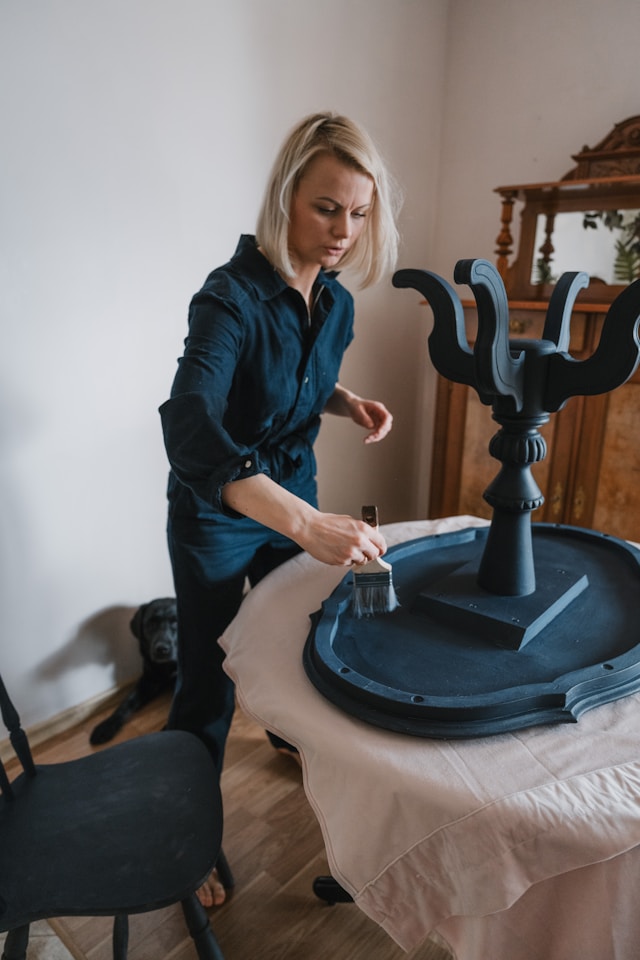
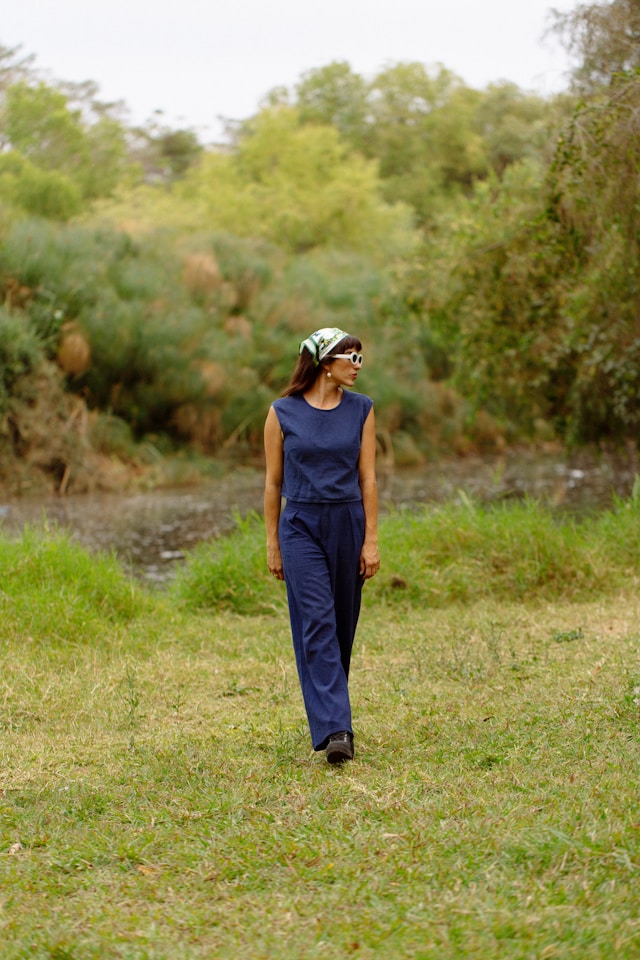
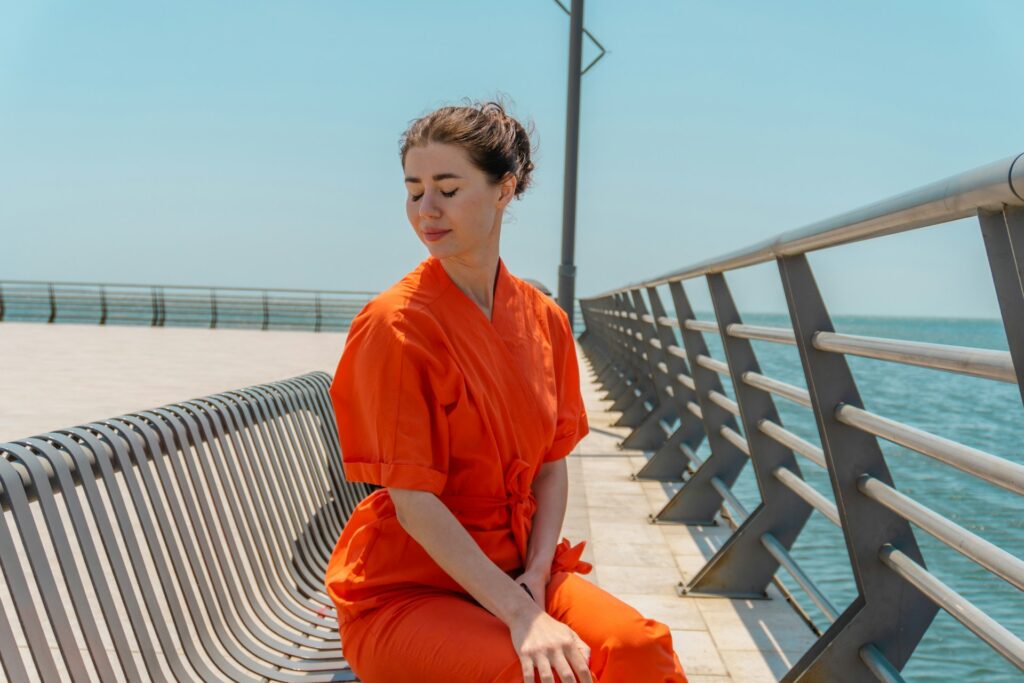
Rock A Jumpsuit
The jumpsuit continues to hold its ground as a spring staple, and with good reason; it’s one of the few pieces that manages to look put-together with minimal effort while keeping you warm from neck to ankle.
Denim remains a strong option here, particularly given the wider denim-on-denim trend that’s been building across the season. But tailored, wide-leg styles in block colours are also making a strong case for themselves this year, offering something a little more polished for days when you want to step things up. Throw on one of those cropped jackets and you’re covered for whatever the weather decides to do. Layer a skinny scarf at the neck for an unexpectedly chic finishing touch.
Ditsy Floral Dress
You really can’t beat a floral dress to mark the shift in seasons. A long-sleeved midi looks great with boots and a chunky oversized jumper for those cooler mornings, giving you that layered, slightly undone look that never really goes out of style.
This spring, though, it’s worth paying attention to how you accessorise; oversized retro sunglasses are everywhere right now, and they pair brilliantly with a floral print to give the whole thing a slightly ’70s feel. Swap your crossbody for one of this season’s elegant shoulder bags, too, which complement the femininity of a floral midi without competing with it. When spring gives way to summer, let the dress do the talking on its own with bare arms and strappy sandals.
It’s A Wrap
A wrap dress has always been one of those pieces that does the work for you: flattering, easy to style, and effortlessly polished without looking like you’ve tried too hard. For spring, sleeves are always a sensible move, and the beauty of the wrap silhouette is how well it responds to layering. Pair with tights and a cardigan on cooler days, or wear it solo with woven flats when the temperature allows.
They certainly had their moment in the sun last summer, but this season, the wrap dress feels especially relevant in bold, saturated colours. Cobalt blue, rich violet and buttery yellow have all been prominent on the spring runways, and a wrap dress in any of those shades makes a strong statement without needing much else around it.
The Case For Lighter Denim
Cream and white jeans are earning their place as the spring denim of choice — and for good reason. Lighter tones reflect the season’s shift in mood, pairing effortlessly with the bold, saturated colours dominating the rails right now while keeping things feeling fresh and unforced. Wide-leg and barrel silhouettes are the shapes to go for, both offering that slightly relaxed, modern proportion that flatters without overthinking. When the temperature drops, a straight-leg style in the same pale palette keeps things versatile without losing that easy, seasonal feeling.
The Oversized Shirt
The oversized shirt is one of the standout pieces of spring/summer 2026 — masculine in cut, refined in execution, and yes, perfectly acceptable to steal from your boyfriend’s wardrobe. He’ll never see it again, and frankly, it’ll look better on you anyway.
What makes it so appealing is how many different directions you can take it. Wear it as a dress, belted at the waist and paired with knee-high boots, for one of the more effortlessly chic looks of the season. Layer it unbuttoned over a fitted white tee and tailored trousers for something that feels simultaneously relaxed and polished. Or throw it open over a t-shirt and cream wide-leg jeans for a casual afternoon, then swap in bold footwear and cinch the belt tighter when evening rolls around.
Crisp cotton and structured poplin are the fabrics to look for — stiff enough to hold their shape, light enough to carry you through spring without overheating.
The Modern Cardigan
Long since freed from any fusty associations, the cardigan has become a genuine style piece in its own right. An edge-to-edge maxi length or a drop-shoulder style are this season’s shapes to look for, and the current mood favours softer, more feminine knit textures; think ribbed, pointelle, or a fine crochet.
Collared cardigans are having a particular moment in 2026 — the addition of a neat collar lifts the whole piece, giving it a more considered, almost preppy edge that works just as well over a slip dress as it does with straight-leg jeans. Also worth seeking out are 3D knits embellished with raised flowers, fruit and botanical details, which have moved from niche knitwear into mainstream fashion with some speed this season. They bring texture and personality in equal measure, and pair brilliantly with simple, pared-back basics that let the knit do the talking.
Pair with jeans for a clean spring look, or layer over a slip dress for something with a bit more personality. A cardigan paired with a matching knitted co-ord is one of the more polished combinations doing the rounds this season, bridging the gap between relaxed and put-together in a way that feels very 2026.
Bold Colour
If there’s one overarching theme defining spring 2026, it’s the return of confident, saturated colour. After several seasons of muted palettes and pared-back neutrals, the mood has shifted decisively. Cobalt blue, rich violet, turquoise and punchy primaries are everywhere, from the runways to the street style circuit.
The freshest way to wear them is through unexpected pairings that shouldn’t work but somehow do: bubblegum pink with chestnut, sage green with butter yellow, red with ballet pink. If committing to a full colour-block outfit feels like a stretch, start with a single piece in a bold shade – a dusty blue leather jacket or a cobalt knit, for instance – and let it do the talking against your existing neutrals.
The Leather Jacket
No spring wardrobe rundown for 2026 would be complete without acknowledging the leather jacket’s current dominance. It’s always been a trans-seasonal staple, but this year it’s taken on a new energy, with designers offering fresh colourways that move well beyond the classic black biker. Olive green, burgundy, chocolate brown and tan are all in the mix, each bringing a slightly different character to the piece.
A cropped, neatly cut leather jacket works beautifully over a floral dress or with high-waisted jeans, while a padded bomber style offers something a little more relaxed. If you’re going to invest in one outerwear piece this spring, this might be the one.We realise we’ve forgotten to mention footwear. Not to worry; check out our guide to the IDEAL shoes to keep a spring in your step this season. And with that, we’ll see you on the catwalk!
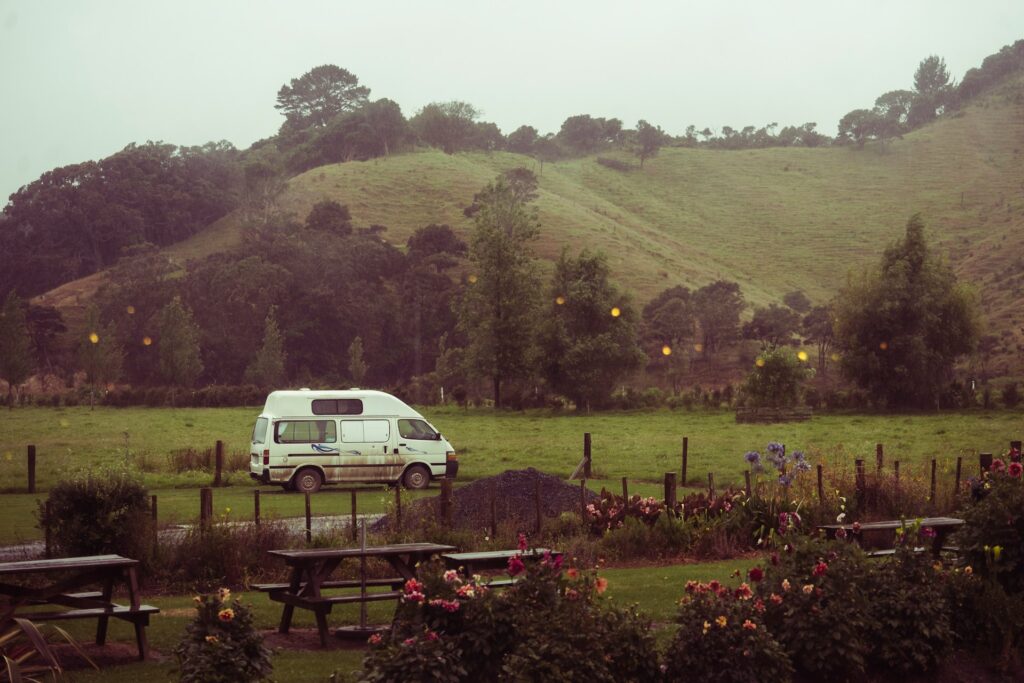
Hey, it’s no coincidence that RV stands for ‘relaxing vacation’ just as much as a recreational vehicle, right? Because a holiday in one can be a peaceful, pleasant one.
If the current state of the airline industry with all the chaos and cancellations has got you rethinking your holiday abroad this year, then a road trip might actually be the ideal concept for your next getaway.
Indeed, whilst there are no doubt some incredible places in this world to visit, some of the most amazing holiday destinations are actually much closer than you might have imagined. The UK isn’t short on its fair share of local wonders to explore on your next holiday. From the Lake District to the beaches of Cornwall, there are plenty of destinations to choose from that are well within driving distance.
While planning a campervan holiday may be better than flying abroad, it arguably requires even more careful planning. Here’s how to go about it; our 7 IDEAL tips for your first road trip.
Plan A Trip For Beginners
Sorry for diving straight in, but we’re going to assume that you’ve already been shown how to fill the water tank and empty the dirty water tank in the RV. You should have been taught how to fill the gas tank and maintain the batteries, too. You have been shown that, right?
But there are likely a few elements of a campervan/RV trip you might not be familiar with. The guys over at 365 Camper Hire, a hire provider based in Fleet, Hampshire, tell us, it’s essential you park in campgrounds with water and electricity instead of boondocking. Choose routes that are easy to navigate and don’t have steep inclines; you don’t want to be getting to grips with driving an RV on the most challenging roads.
Pick a destination that’s less than a three-hour drive, so that you don’t get tired or bored on a long stretch of road; this is a holiday, after all. Skip the popular destinations on your first trip, because you don’t want to fight to park in the only available campsite. Instead, enjoy the freedom of the road, first and foremost.
Plan On Cooking
One of the best tips for your campervan trip is to make the most of the cooking, al fresco and on the move. Too many people blow their budget eating out for every meal when really, there’s a lot of joy to be found in cooking for yourself on such a holiday. Barbecues under the stars, with family and friends…what could be better? Not only is this one of life’s simplest pleasures, but it’s also a great money saver when on the road, too.
The British weather has a habit of changing its mind, sometimes several times in a single afternoon. Even if you’re heading out in the height of summer, make sure you’ve got waterproofs, layers and a decent pair of walking shoes stashed in the van.
A sunny morning can turn into a soggy afternoon without much warning, and there’s nothing worse than being caught out on a clifftop walk in flip flops and a t-shirt. Being prepared for all conditions means you can keep enjoying yourself whatever the sky throws at you.
Get Your Entertainment Sorted
Here’s thing thing no one tells you; campervan life has periods where things really slow down. There will be downtime on a road trip, and that’s no bad thing. But a rainy evening in a campervan with nothing to do can test anyone’s patience, especially if kids are involved.
Load up on card games, books, a portable speaker and a few downloaded films or podcasts before you set off. If you’re travelling with little ones, having a stash of activities ready to go can be the difference between a memorable evening and a mutiny. And don’t underestimate the simple pleasure of sitting outside with a drink and some decent music as the sun goes down; sometimes that’s the whole point.
Make Time For Regular Stops
Many new campervan and RV owners expect to drive pedal to the metal from point A to point B without taking the time to really savour the vistas (and have a little pit stop, too). In reality, you need to plan regular stops. Indeed, it’s wise to plan on stopping every two to three hours, at a minimum, at a location that has both gas and bathrooms.
This allows you to top up the petrol, pick up supplies that you didn’t initially realise you lacked, and spend a penny or two, if necessary. Though we acknowledge our previous tip, if you really don’t want to cook, these pit stops allow you the chance to get a snack or lunch. If you have children, try to plan at least one or two stops a day where the kids can run around.
Take Your Time
It’s crucial you take your time when you’re on your first RV trip. Don’t create a tight schedule; everything takes longer than you think on the road. Indeed, don’t box yourself into a tight timetable; create a driving schedule with lots of leeway so that you aren’t trying to drive an ambitious number of miles each day to reach the next booked campsite. If you arrive sooner than expected, you have more time to unpack at the campsite and enjoy the sights.
A good rule of thumb is 300 miles or 3 PM. That means you won’t drive more than 300 miles or around 5 hours per day, and you should plan things so that you arrive by 3 PM at the destination. That sense of unbridled freedom depends on it.
Practice, Practice, Practice
Because it makes perfect, right? So, before your trip, practice levelling the RV before you’re at a campsite. Practice (tired of the P word, yet?) hooking up fresh water and emptying black water tanks before your family’s ability to use the bathroom depends upon it. Learn how to turn on the generator and manage power consumption before you turn on the AC and blow the breaker.
Consider creating checklists on daily routines related to your campervan. That way, you’ll always empty the black water tank and secure your belongings before leaving the campground and do so correctly.
Sprawling over a sometimes sparse section of East London, Stratford (or ‘Stratford City’, as they’re attempting to rebrand it) has transformed remarkably over the past decade. Once overshadowed by the pull of neighbouring boroughs, the area has undergone a significant metamorphosis of late, emerging as a location increasingly convinced by its own culinary conviction and cultural identity, with events including the much lauded ABBA Voyage and West Ham’s run to the UEFA Europa Conference League win both happening here.
The catalyst for Stratford’s change was undeniably the 2012 Olympics. The games not only presented London on a global stage, but also breathed new life into Stratford in particular. The Olympic legacy left an indelible mark on the district, sparking a dynamic period of investment, construction, and development.
Post-Olympics, Stratford City is now proud to have Westfield Stratford, one of Europe’s largest shopping and leisure destinations, and the Queen Elizabeth Olympic Park, a clutch of world-class sporting venues that includes West Ham’s London Stadium, right in its backyard. And, in 2022, the groundbreaking ABBA Voyage opened here, and is still going strong as 2026 cranks into life. All of this has led to Stratford train station being named the 7th busiest in London, a sign of its growing influence as an area.
As a pleasing byproduct of this rising footfall, the area’s restaurant scene has begun getting noticed, with shiny new openings and old Stratford stalwarts both receiving increased attention.
Whether you’re here to retread scenes from Top Boy, blow some Bubbles, go on a virtual voyage with ABBA, or just do a little shopping in Westfield, you’ll no doubt be looking for a decent feed in this corner of London.
We’re here to help with that; here are the best restaurants in Stratford, and our thoughts on where to eat before ABBA voyage.
Mr Ribs Restaurant
Ideal for generous portions of Brazilian home cooking…
Back on ground level and onwards to a more humble – but no less delicious – eating experience…
At Mr Ribs, just a short walk from Stratford Underground Station and standing proud long before the Olympics came to town, the proposition is straightforward; nourishing, generous portions of Brazilian home cooking with an emphasis on the country’s cherished meat dishes – the restaurant is attached to a butchers of the same name next door.
Visit at lunch, as the more popular dishes here, such as the carne de panela and bife acebolado, sell out fast. We’re especially enamoured with the feijoada – Brazil’s beloved stew of black beans and various pork bits – here, the smoked sausage supercharging the thing with umami, the namesake pork ribs as giving and generous as the restaurant itself.
Before you satiate yourself with that stew and your appetite is done until dinner, don’t miss out on a couple of the fried-to-order coxinha. These little croquette-like numbers are filled with an enthusiastically seasoned mixture of chicken and stretchy, sticky cheese, and pair perfectly with a guava juice. Delicious.
Finish it all with a smooth, but bracing Bica, the Brazilian version of espresso – Mr Ribs’ version is excellent – and you’re good to go.
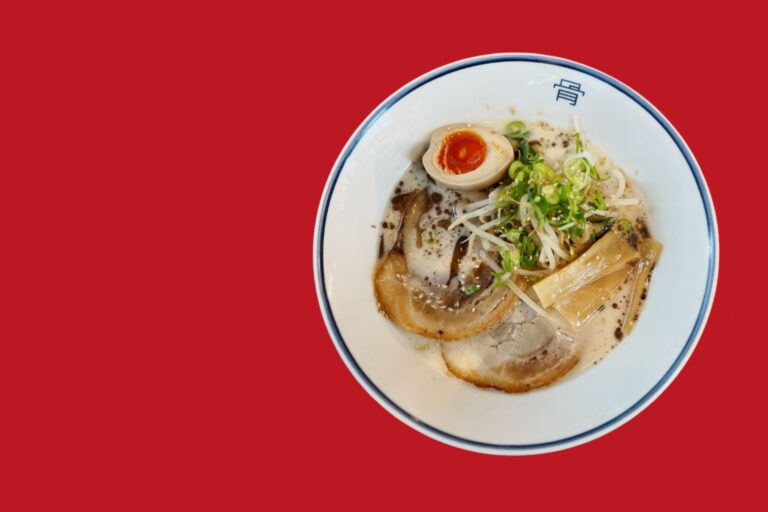
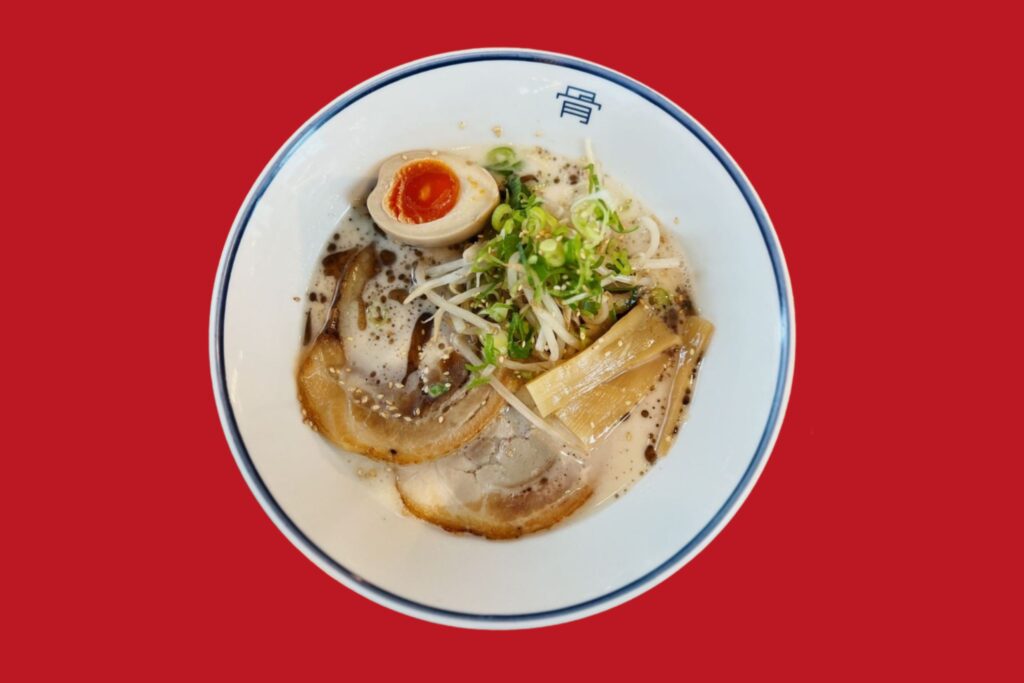
Tonkotsu has become one of the UK’s most ubiquitous Japanese restaurant brands in recent years, with more than a dozen outposts of the premier ramen slingers now operating in London alone, with more in Birmingham and Brighton for good measure.
The Stratford branch, which opened its doors in the newly developed International Quarter at the end of July 2018, is the largest site of the Tonkotsu chain to date.
Conveniently located just outside Westfield Stratford (and the closest restaurant on our list to ABBA Voyage, incidentally), if you’re braving the enormous shopping centre then a bowl of ramen here is the perfect precursor – after wolfing one down you’ll be in enough of a groaning fog to largely ignore the crowds.
Though the word ‘tonkotsu’ translates to ‘pig bone’ in Japanese – and the milky rich broth is without doubt the headlining act – you don’t have to pray purely at the altar of porcine to enjoy a meal here. The katsu curries, gyoza, and pickles are fantastic, too, for those seeking a lighter meal.
That ramen, though; it’s one that promises sensory overload, of properly lip-smacking umami flavour, alkaline noodles with just the right bite, fatty slices of pork belly, jammy eggs… the works. Add a ‘shot’ of scotch bonnet paste if you really want to feel something.
A word on those noodles. Handmade every day (the restaurant’s strapline reads “If you don’t make your own noodles, you’re just a soup shop”), and boiled for a precise 32 seconds, they’re meticulously formed, holding up confidently to the dialled-up-to-eleven broth. It’s the only way it should be.
Keep an eye out for the restaurant’s guest chef collaborations, usually released to celebrate Tonkotsu’s birthday in the capital. Recent highlights have included chef John Chantarasak’s ramen/khao soi mash-up, Kricket’s Southern Indian-inspired bowl and Jose Pizzaro’s Iberico pork ramen with piquillo peppers, served with a shot of sherry.
A slice of Mediterranean refinement in Stratford Cross…
Named after the Greek goddess of hearth and home, HERA (we’re not stuck on caps lock; that’s just how it’s rather shoutily stylised) opened in November 2024 in the space between Westfield and the Queen Elizabeth Olympic Park.
In a prime spot in Stratford Cross’s new cultural quarter, where the V&A East Museum will eventually be its neighbour, the restaurant occupies a dramatic double-height space where winter sunlight streams through floor-to-ceiling windows. Evenings see the room transformed by the glow of surrounding towers and the shimmer of copper and gold details against deep aubergine walls – it reminds you that you’re in an area with designs on a weird kind of gaudy glamour, and also that you’ll probably eat some aubergine during your meal, which is useful.
The menu is divided into logical, prosaic sections – ‘Garden’, ‘Farm’, and ‘Sea’ – that somewhat bely the gentle complexity of these refined takes on Greek standards. Standout dishes include a delicate seabass carpaccio dressed with yuzu and dill oil, and a vegetarian moussaka that layers a marmite-rich mushroom ragu with flamboyantly risen graviera cheese bechamel (it’s all in the addition of egg yolk, we’re told). And if you’re looking to bridge the gap between your mains and dessert in some style, then go for the feta saganaki, which arrives cloaked in delicate kataifi pastry and doused in a house lemon honey that’s got floral notes of (we think) lavender running through it – a dish that exemplifies the kitchen’s approach of refining traditional recipes without losing their essential character.
A carefully curated wine list champions Greek varieties, while the cocktail menu plays with global flavours – the Helen of Spice adds mango and agave to a spicy margarita base, and Dates in Crete reworks an old fashioned with banana and coffee notes. For those heading to ABBA Voyage, the £55 set menu offers good value and a comprehensive taste of the kitchen’s range all within a curt and concise timeframe. Right now, it features a smoky melitzano salata, grilled octopus with fava beans, and much more besides.
Located in the heart of the burgeoning/bland East Village, Santi has been serving up self-proclaimed simplicity since the summer of 2016, when the Olympian focus had long left London in search of sunnier climes, but the folk of Stratford still needed a decent feed.
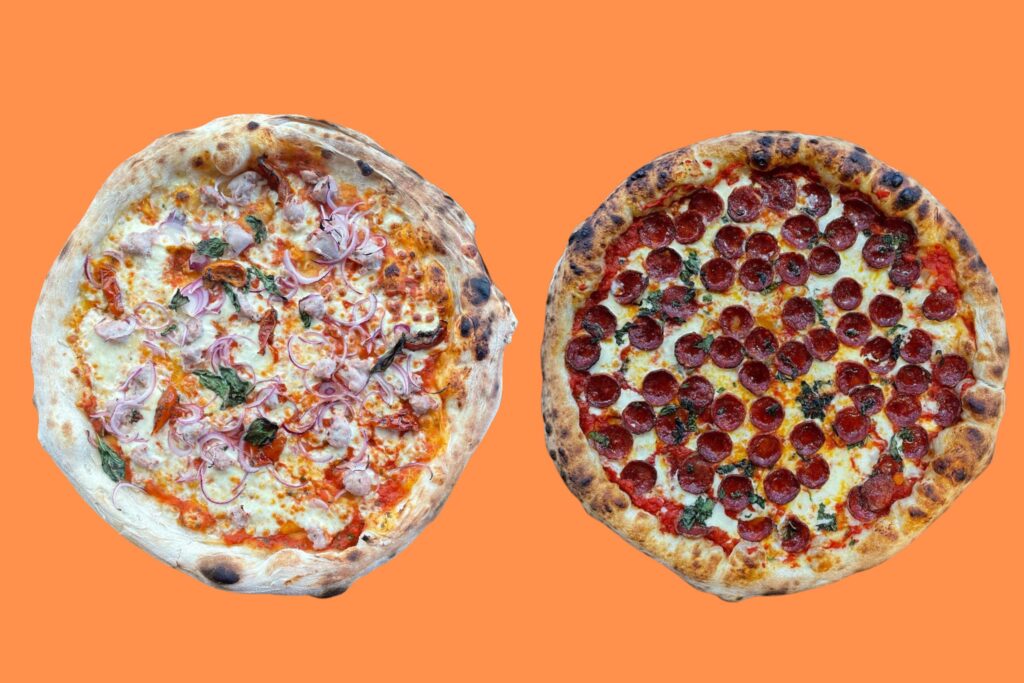
Another gaff just a short hop from Westfield Shopping Centre, Stratford Station and other central sites, Santi fills the brief for a swift, serviceable bite before the football or ABBA Voyage, with the central pizza oven churning out capable Neapolitan-adjacent pizza and calzone quickly and efficiently.
Whilst these aren’t quite the best pizzas in London, Santi is the ideal Stratford pit stop if your show is starting soon.
Ideal for some of the best Sichuan hotpot in the city…
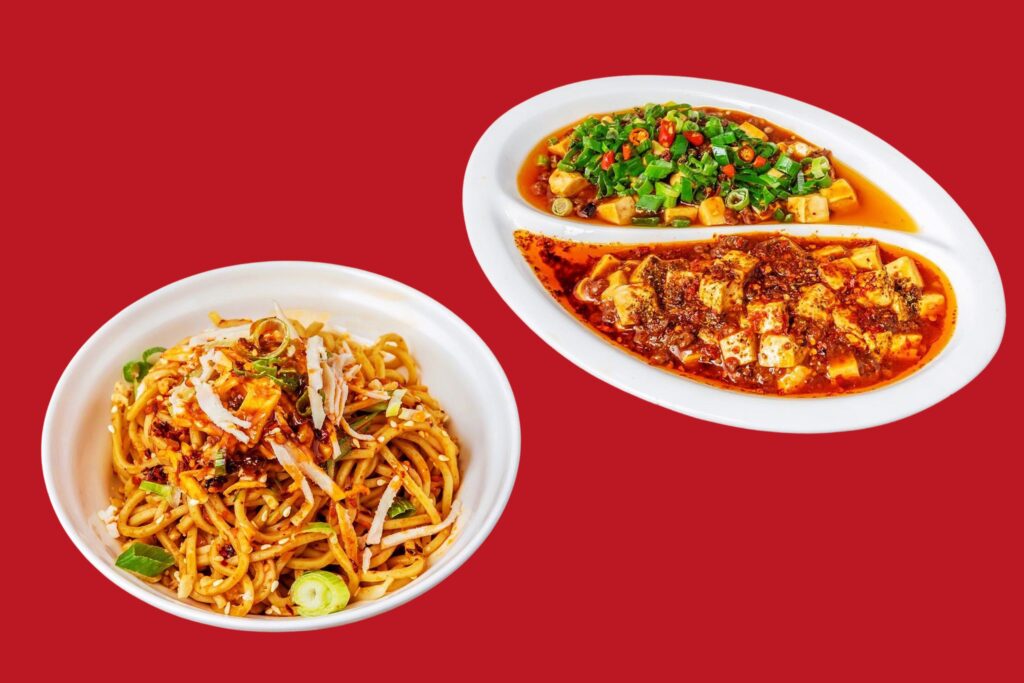
London’s love affair with the numbing complexity of Sichuan food shows no signs of abating, and Stratford’s Sichuan Grand, part of the strangely scant-feeling Gerry Raffles Square and sitting opposite the Theatre Royal Stratford East, is one of East London’s most enjoyable purveyors of the good stuff.
In a vast, grandiose dining room defined by carved wooden screens and lighting that’s reminiscent of when the first sun peeks through the curtains at the afters, the name of the game here is bubbling, chilli oil slicked hotpot.
It arrives with accompanying solo induction, already spitting out white-shirt endangering broth and far, far too hot to slurp hastily (a burnt tongue tells the tale). Exercise patience and restraint, if you can, and you’ll be resoundingly rewarded.
Go for the tripe, its honeycomb-crevices clinging on to the increasingly rich and assertive broth and delivering a chewiness that rewards perseverance. Slide in a few slabs of silken tofu as the bubbling mellows, another nourishing, sauce-soaking vehicle that is pretty much obligatory in a Sichuan hotpot.
As the broth condenses, we love to plunge in a bitesize piece of the restaurant’s prawn mash – essentially the filling for a prawn toast. Only needing a moment submerged in the chilli-forward soup, it’s bouncy and supple within seconds, and an absolute treat. A pot of jasmine tea is all you need to send this one on its way.
For a delightful breakfast or brunch in this part of town, Stratford’s Sawmill Café, on West Ham Lane, is the place to go. This quaint café prides itself on freshly baked bread, homemade pastries, and locally sourced ingredients. The eggs Benedict with smoked salmon is a must-try, as is their selection of artisanal sourdough bread.
A winner of the Time Out Love London award five years in a row, there are plenty of gluten free options here to enjoy in or take away. If you’re doing the latter, then Stratford Park is just a minute’s walk away and ideal for a picnic. The freshly squeezed juices here are not to be missed!
We end, somewhat resignedly, inside Westfield Shopping Centre and in the massive mall’s World Food Court. In our humble opinion, the best place to eat here is Rhythm Kitchen, whose traditional jerk dishes, curry goat, and a variety of sides never fail to hit the spot.
Run by the self-styled ‘Jerkfather’, the quarter jerk chicken served over rice and peas and fried plantain is a snip at £12.50, the chuck blistered and burnished in all the right places, its piquant marinade having caught the flames and caramelised just right.
If you’re in a hurry, the jerk chicken and roti wrap is a hugely popular lunch time order – the house rum punch an almost-mandatory chaser. Cheers!
Though firmly ensconced on disparate sides of the globe, the food of Thailand and Mexico share more than a fair amount of similitude. Both sitting in the cradle of the Coffee Bean Belt, Thailand’s 19th parallel north circle of latitude is shared with Southern Mexico, with the two countries also enjoying a kindred vivacity on the plate.
Coriander, lime and, of course, chilli all feature conspicuously, with both cultures cherishing the shared communion of a family meal over rice, tortillas and the rest.
It shouldn’t come as much of a shock, then, to learn that Bangkok boasts some fantastic Mexican restaurants, with a spate of acclaimed recent openings only raising the stakes higher.
Well, we’ve done all the hard work, enduring dizzy heights and eating delicious bites (and a fair few duds) to bring you this; our guide to the best Mexican restaurants in Bangkok.
Ojo, Silom
Ideal for fine Mexican dining at 1000 feet…
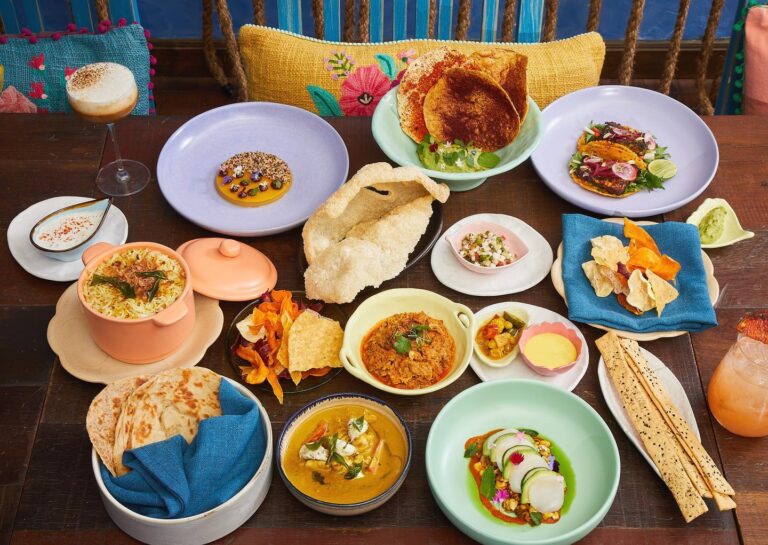
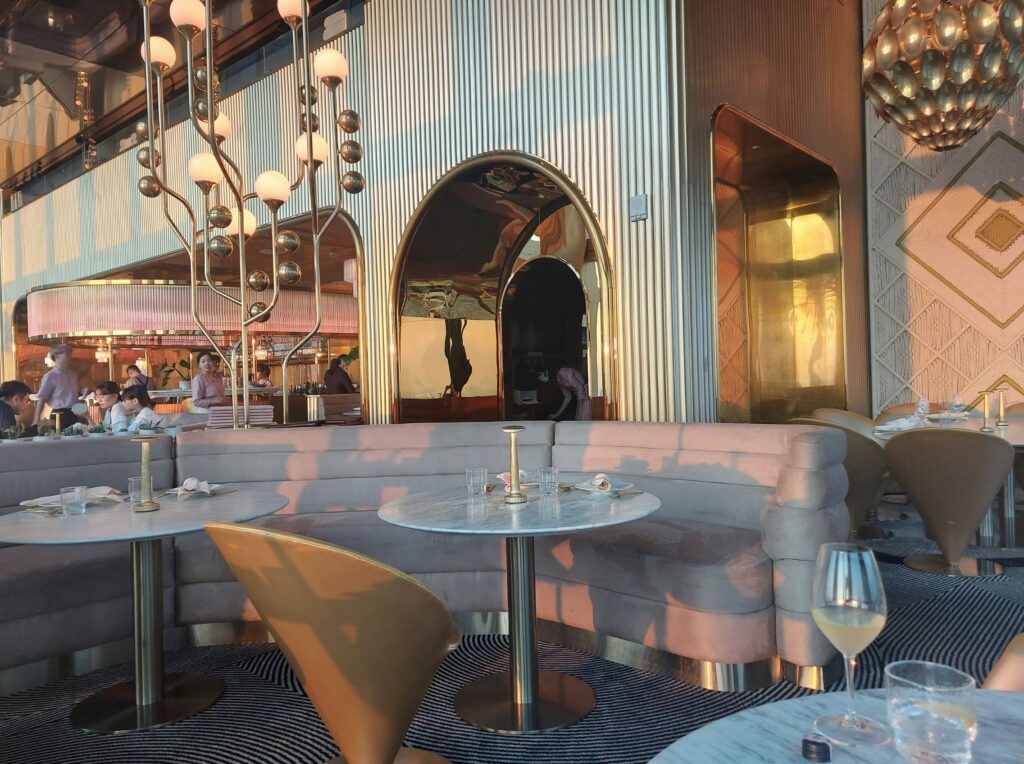
Standing proud on the 76th floor of Bangkok’s tallest building the King Power Mahanakhon, and seemingly having even loftier ambitions than its 300 metre-high position, Ojo is one of Bangkok’s most exciting dining rooms, and that’s saying something.
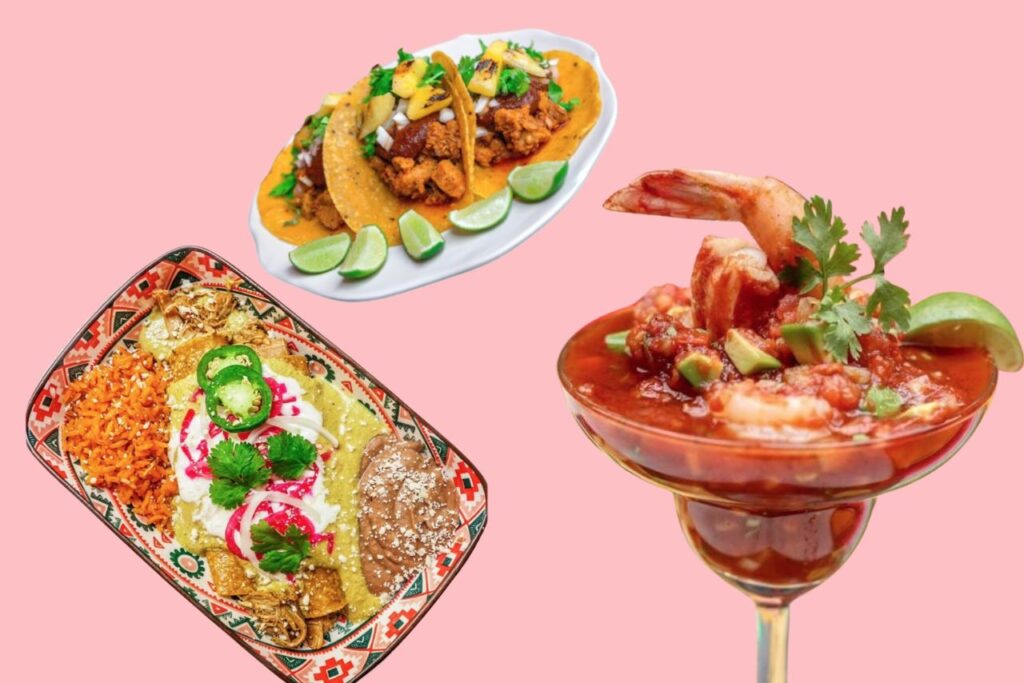
Fear not. At ground level, in downtown Bangkok just off Phloen Chit BTS station, is a much more humble, affordable affair that very much does feel like a welcoming neighbourhood Mexican restaurant, doing all the good things right; enter La Monita Taqueria.
The story of La Monita began in 2009, when husband and wife duo Billy Bautista and Kasama ‘Oh’ Laopanich surveyed the Bangkok restaurant landscape and found the Mexican food options somewhat lacking. The restaurant’s hefty, hearty Mexican comfort food, with the odd nod to chef Bautista’s Californian roots, quickly gained a legion of followers, with the 75 seat taqueria regularly packed.
12 years on, and La Monita now has three restaurants across the city; the original at Mahatun Plaza in Ploenchit, alongside La Monita Taco Truck on the ground floor of Siam Paragon, and the newest addition, La Monita Mexican Urban Cantina at EmQuartier, the latter boasting fantastic views of Bangkok from its 7th floor vantage point. Though there are differences in the food on offer between each branch, the one consistent is the quality, with customisable tacos and burritos, and a massive range of different salsas and fillings.
The headlining act at La Monita’s original branch – with items served in street-food recollective plastic trays – has got to be the super quesadilla, which sees a whopping 12-inch flour tortilla filled with cheese, beans, two types of salsa, guacamole, sour cream and your choice of protein. Ours? It has to be – and always is – the New Zealand rib eye, cooked pink and served sliced. Heaven.
Finish with the house horchata, so rich, sweet and moreish that it basically serves as a liquid dessert, and step back out into the Bangkok heat happy and satiated.
Ideal for real deal Mexican food in the heart of Silom…
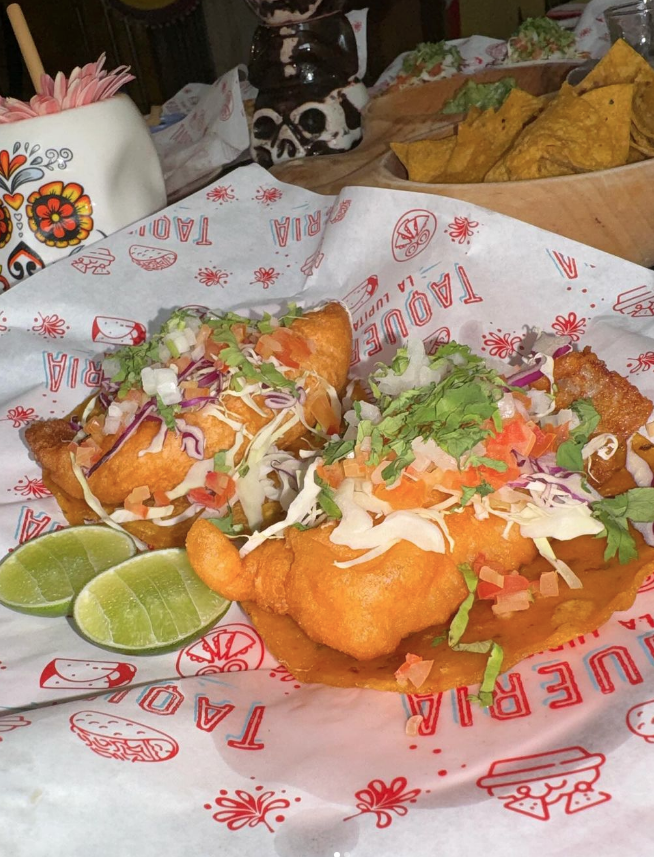
Images via @lalupitabkk
Mexican chef Alberto Garcia has carved out a little slice of his homeland in Silom since La Lupita’s opening in 2018, with many professing the restaurant to be one of the only true ‘real deal’ Mexican joints in Bangkok.
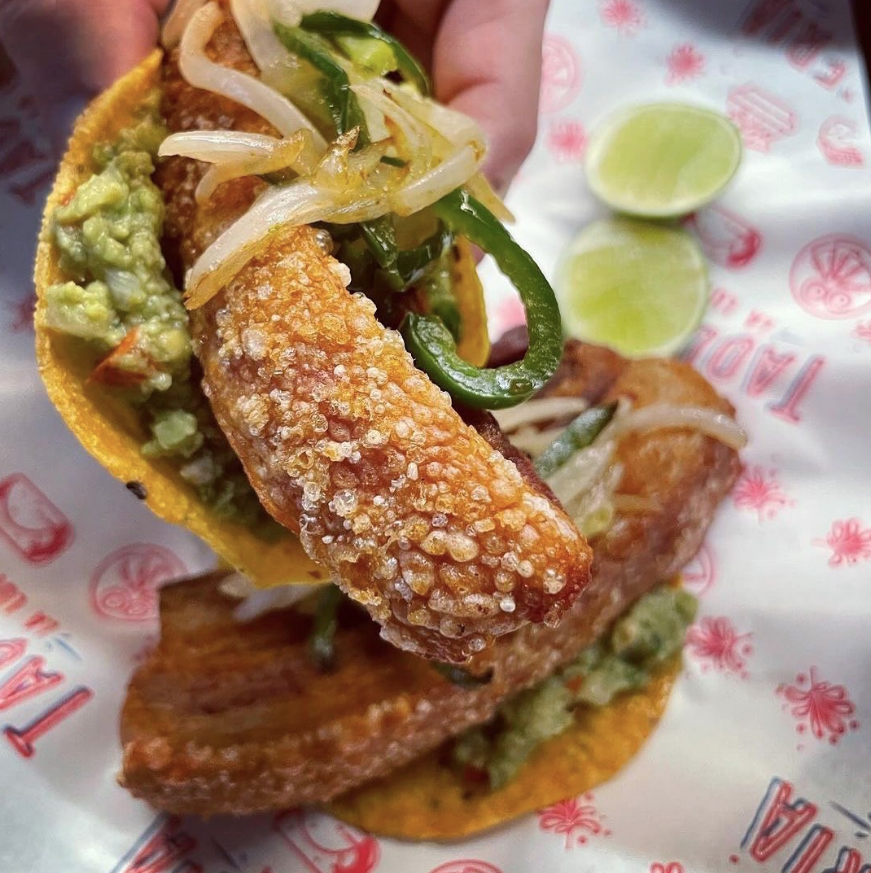
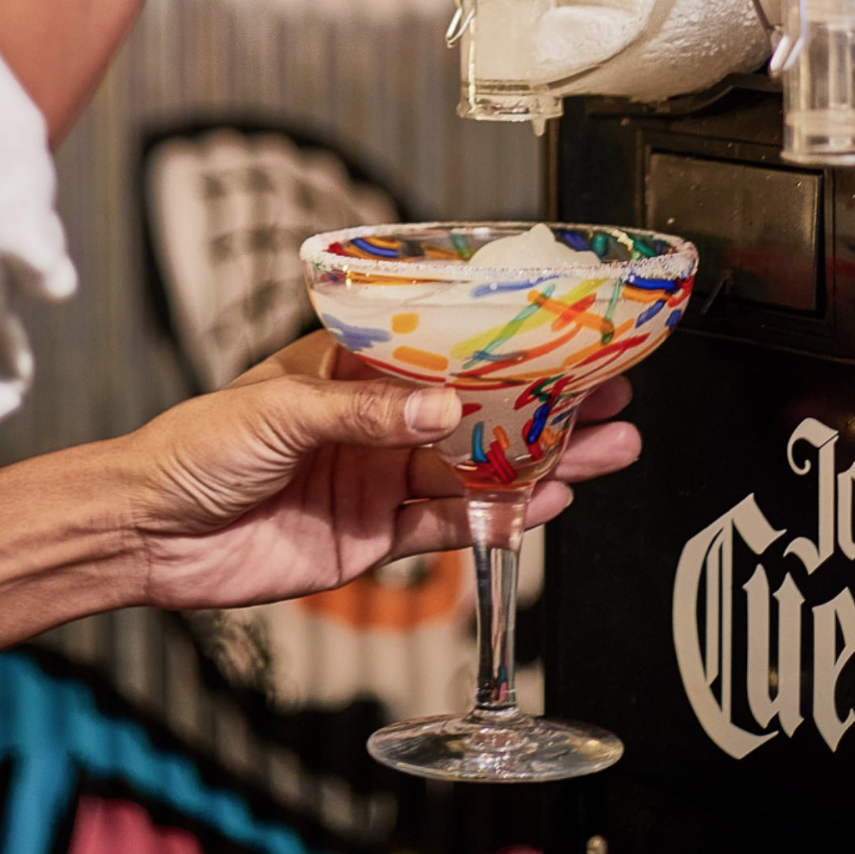
With a happy hour running until 9pm daily, and some seriously good frozen margaritas sloshing about in the lively, sprawling space, it’s no wonder the restaurant is a hit, and that’s before you factor in everyone’s favourite dish here, the pork belly tacos, which are genuinely some of the best tacos in Bangkok. Blessed with three chunks of moo grob-grade crispy pork on each and every freshly pressed, guac-smeared tortilla, these tacos are then heaped with thinly sliced green pepper for a little verdancy. A squeeze of lime is all you need to send them on their way – magic.
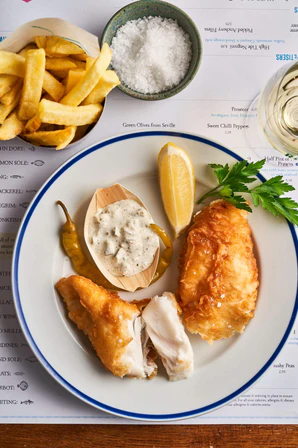
The Baja fish tacos are almost as good, with pieces of deeply golden, deeply-fried fish that wouldn’t look out of place in your local London chippy dressed simply with fresh pico de gallo and shredded cabbage. It really is all you need.
Keep an eye out, too, for La Lupita’s monthly ‘Four Hands Dinner’ collaborations, which sees chefs across the city dropping in to Si Lom Road for one night only. Booking is highly recommended for these; we can’t wait!
Now, did we mention those frozen margaritas? We’ve had a few and fear we’re getting forgetful…
Ideal for an enlightening, effervescent Mexican omakase experience…
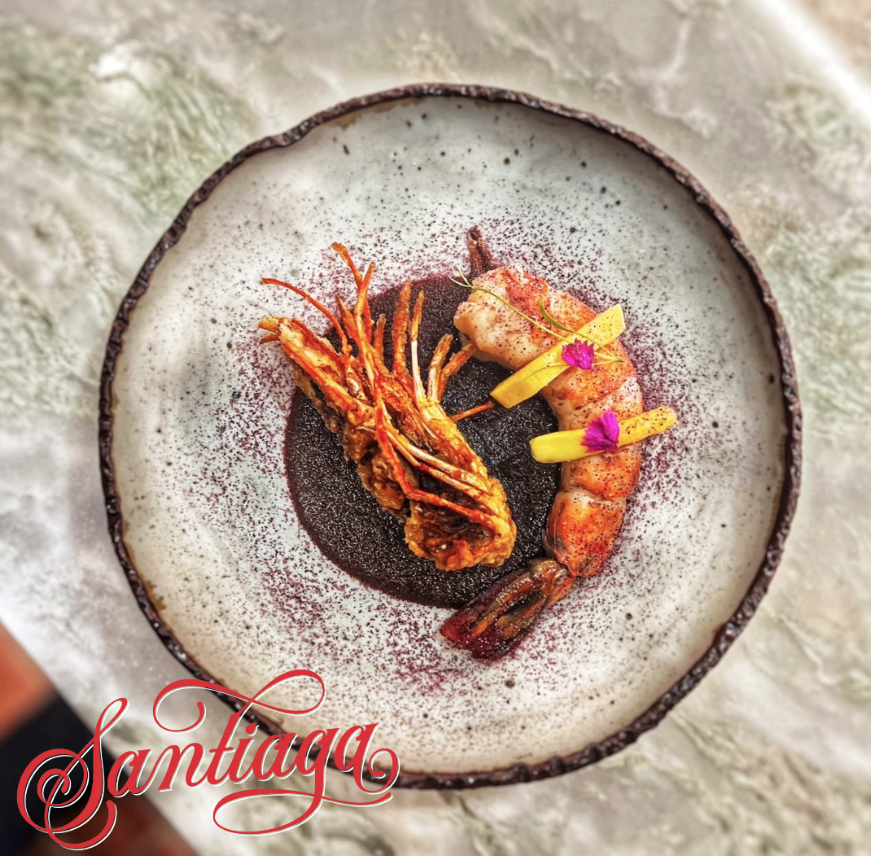
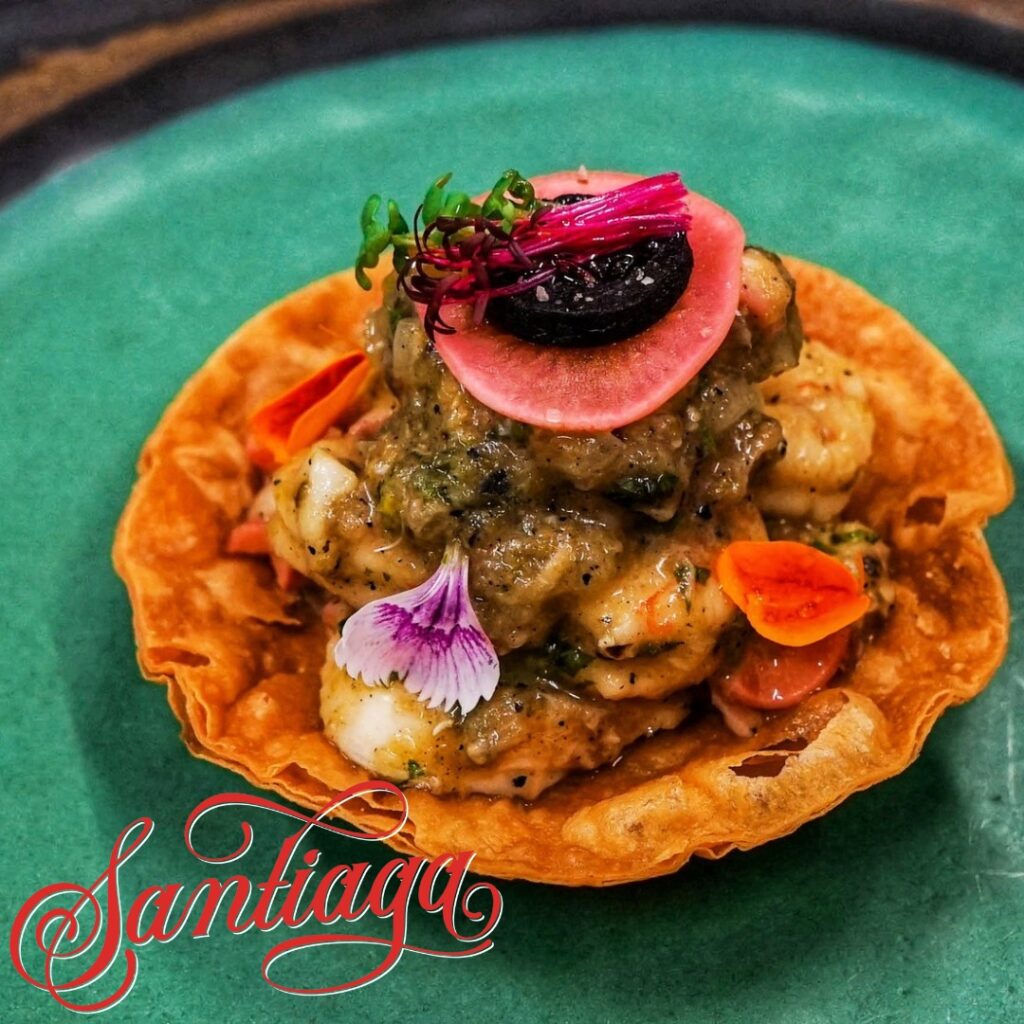
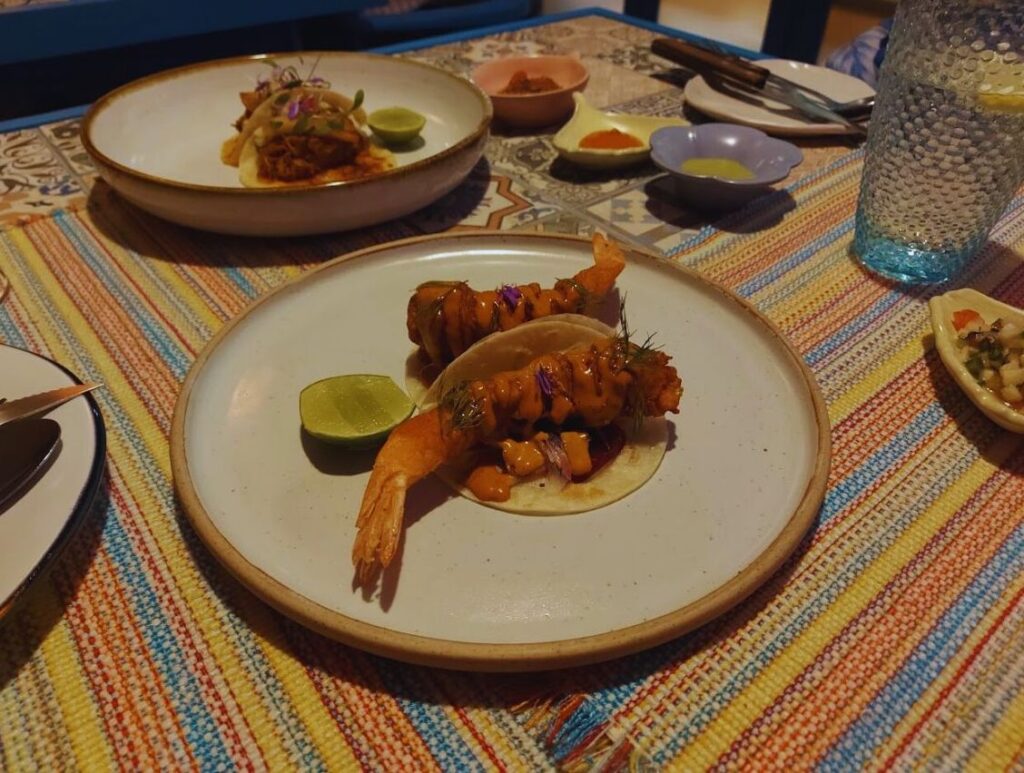
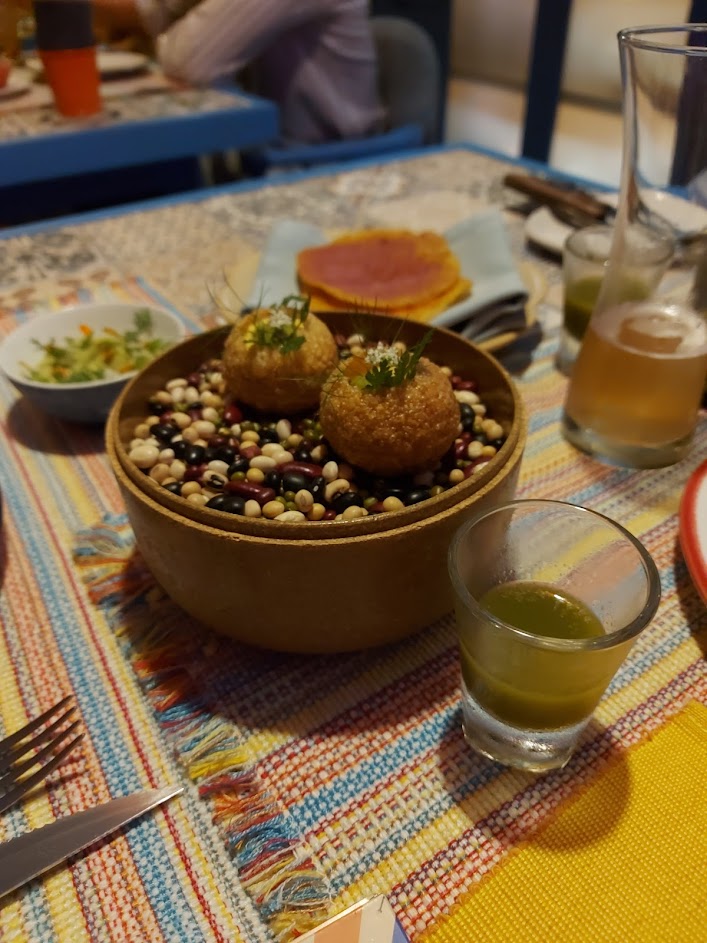
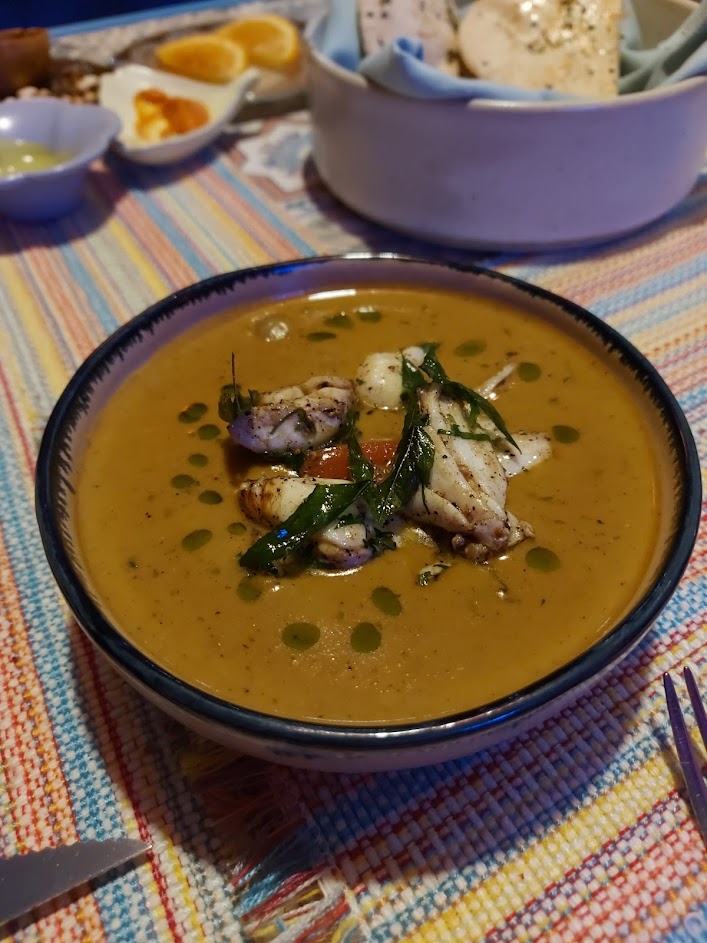
From the same team behind La Monita (as well as popular Texan eatery Billy’s Smokehouse, which the restaurant sits above) comes Santiaga, a whole different proposition to the easy, breezy vibes of their Bangkok taquerias, and one of the city’s most exciting openings of recent years.
Open since April 2022, Santiaga positions itself as ‘Mexican omakase’, with a largely tasting menu – a ‘’Mexican 101’’, in their words – format served to reverent diners seated around a counter, the open kitchen serving as the chefs’ lectern.
Though this may all sound a little fussy and formal for a cuisine so well suited to convivial vibes, chef Billy’s effervescence pulls off that fine balancing act between the educational and the exuberant with aplomb.
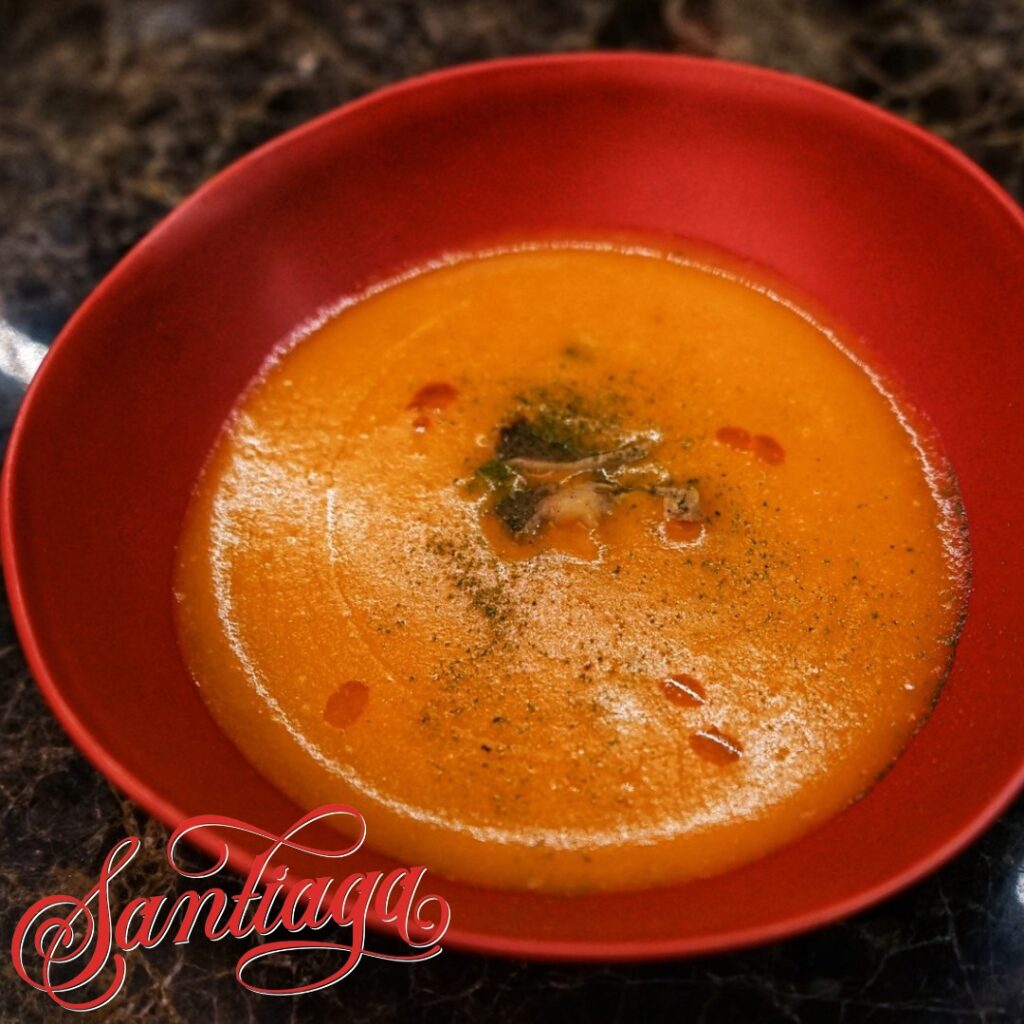
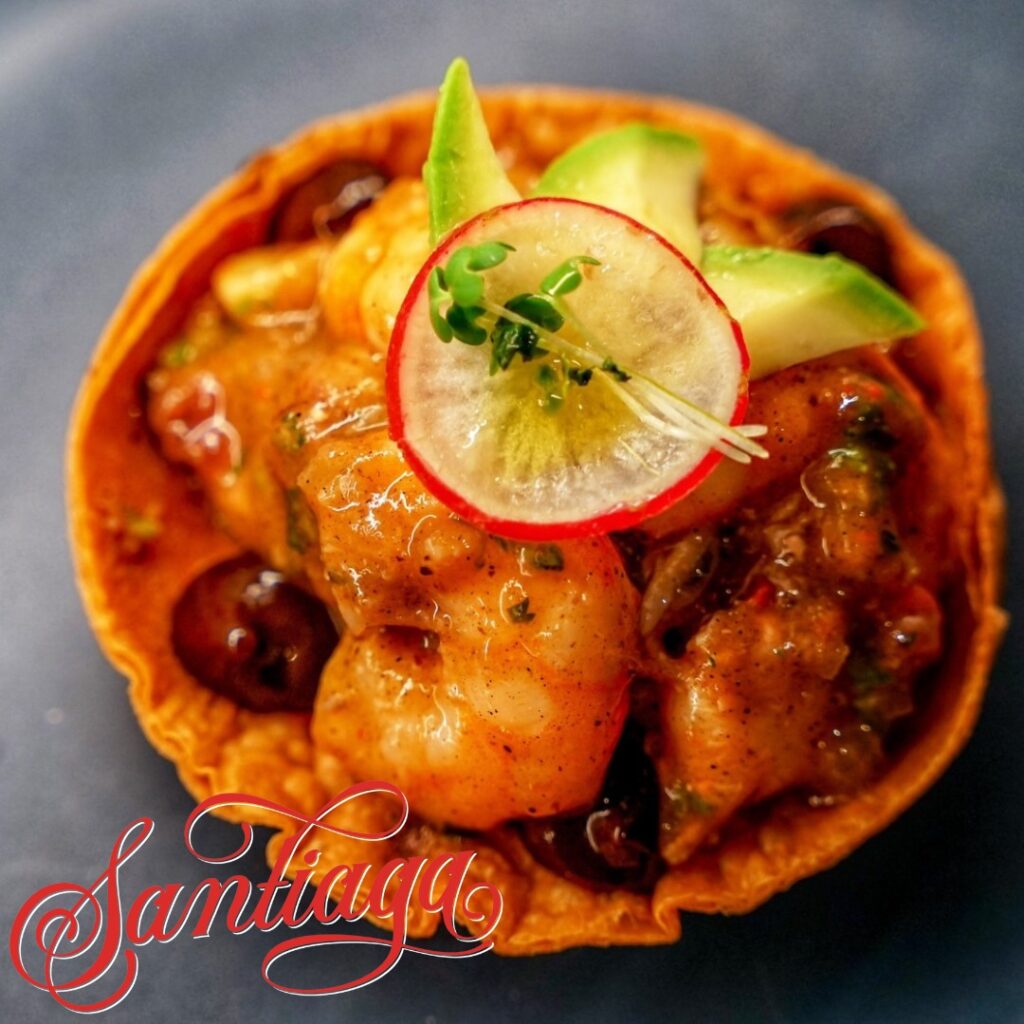
Over an 11-or-so course tasting menu (clocking in just north of 2’500 baht) that sprawls over several hours and culminates in a trio of delectable tacos, guests are introduced to the refined, complex side of Mexican cuisine, with the highlight a 40-ingredient mole – grandma’s recipe – that dances on the palate with such elegant steps that the perfectly roast chicken it’s served alongside barely gets a moment under the mirror ball.
As with any great Mexican restaurant – whether streetside taqueria or fine dining culinary mecca – the quality of the food lives and dies by the standard of their tortillas, and Santiaga takes theirs very seriously indeed. Made from scratch on site, freshly pressed and cooked on Bangkok’s only clay comal, they are superb.
With an extensive range of premium tequila and mezcal, this is certainly a special occasion kind of place, but one where you leave feeling both nourished and enlightened.
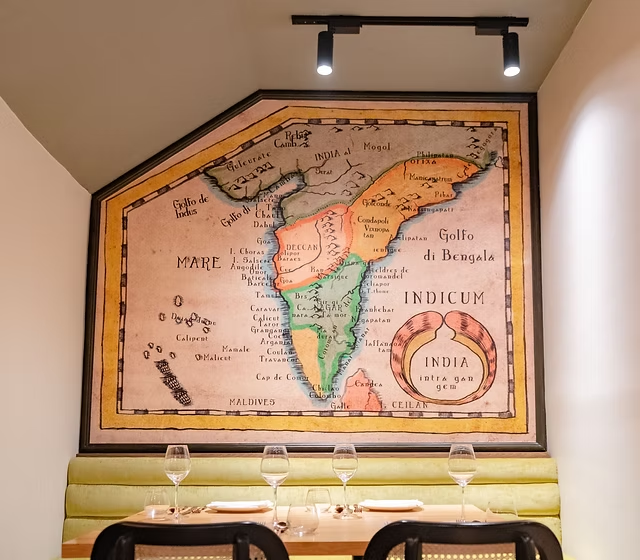
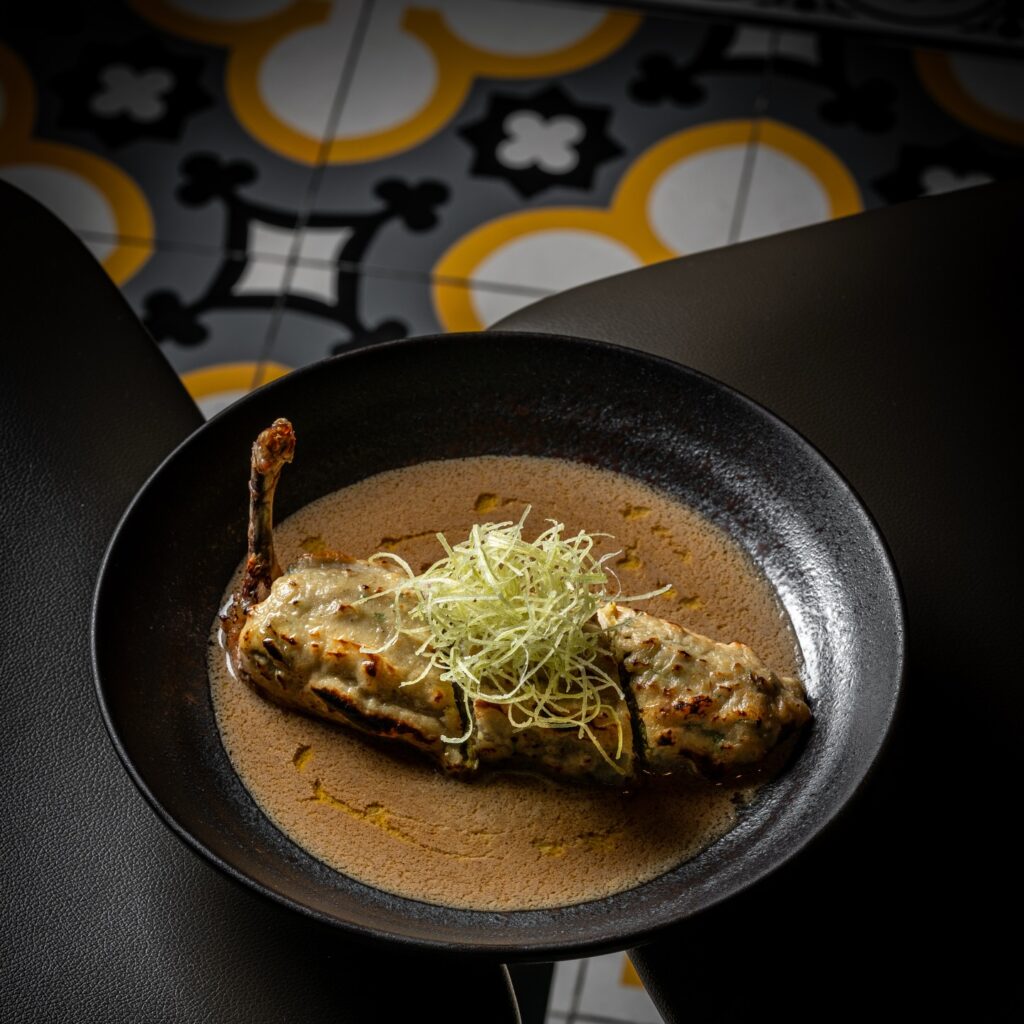
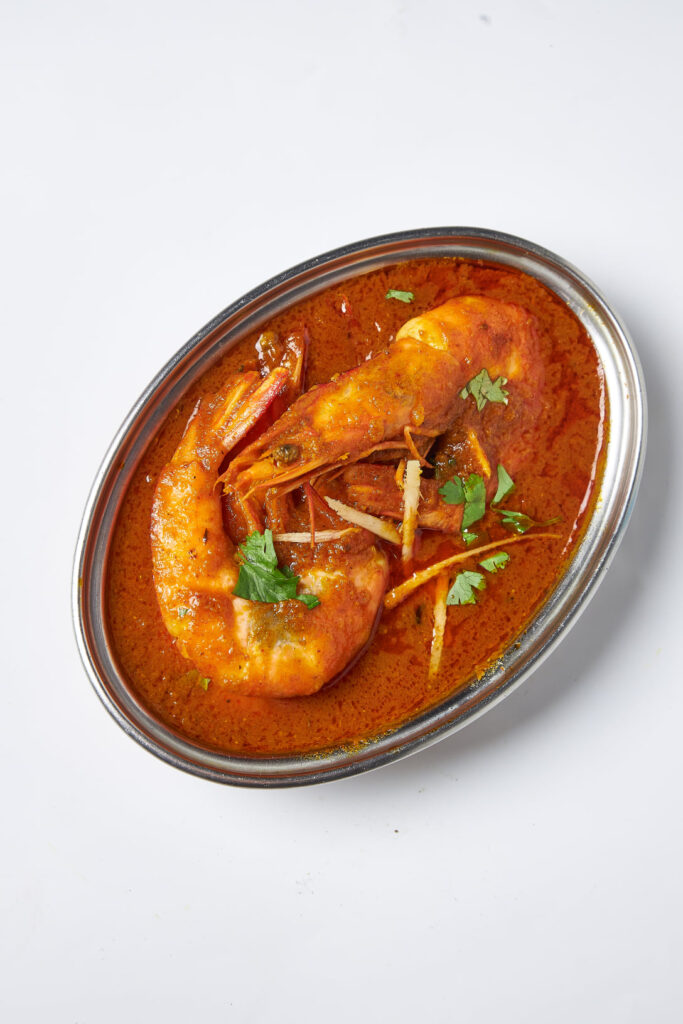
Well, at Ms. Maria and Mr. Singh’s, chef Anand tells the culinary story of a ‘’love affair between a Mexican hometown girl and an Indian city boy’’ via a perfectly poised marriage of Mexican-Indian cuisine. Expect the chef’s famous crab curry, but this time paired with goan poee bread for pulling through the complex sauce. Or, keema paneer quesadillas, rich and heady with the flavour of mutton and roasted spices, and served before pork vindaloo tacos with pineapple salsa, a beautifully balanced affair.
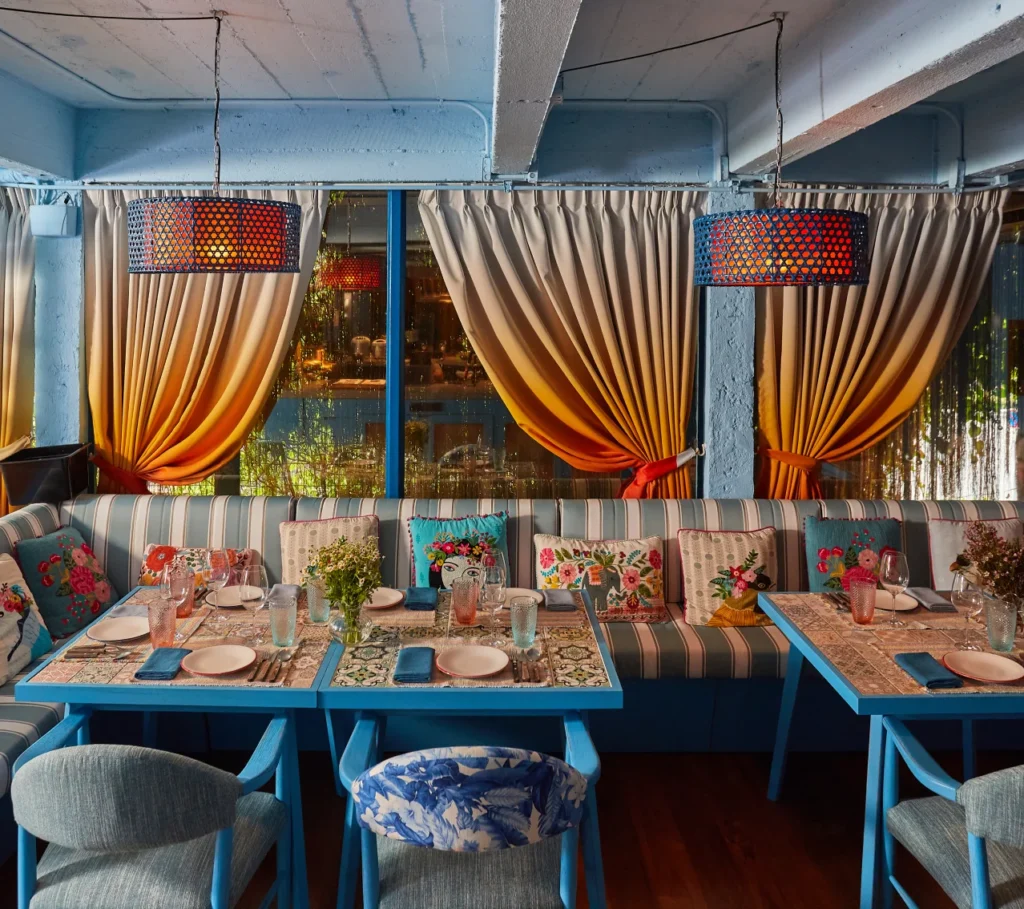
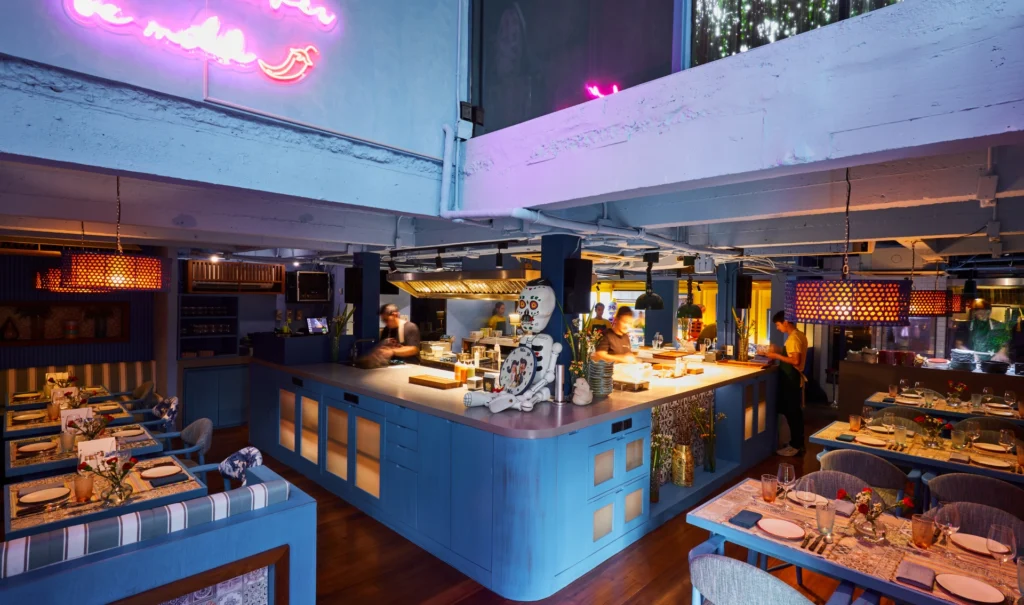
All of these dishes are available on the current tasting menu (a snip at 4000 baht for two) being served in a new location on the second floor of Gaggan Anand’s eponymous restaurant on Soi Sukhumvit 31. The vibe here is relaxed and playful, the vibrant decor channelling both Oaxaca and Jodhpur to vivid effect.
Riffing on that theme, as you enter the restaurant a flashing neon sign declares that ‘’love should never be mild’’. The food here more than lives up to that proclamation, and we couldn’t be happier that chef Anand continues to express himself in such a frisky, frivolous way.
Address: 68/2 Soi Sukhumvit 31, Khlong Tan Nuea, Watthana, Bangkok 10110, Thailand
Ideal for innovative Mexican dining with a local twist…
No, Delia Smith has not joined the hordes of celebrity chefs trying to make their name in the big city. Instead, Delia is steered by the steady hand of chef Gaby Espinosa, formerly head chef at Ms. Maria and Mr. Singh from just above.
Sitting pretty (real pretty) in the ground floor of Baan Trok, a century-old heritage building just north of Chinatown, Delia is making serious waves in the city’s burgeoning Mexican dining scene, offering a carefully considered approach to Mexican cuisine that manages to honour tradition whilst embracing local ingredients and the odd modern technique, too.
The beating heart of the restaurant is its comal, a traditional cast-iron griddle that sends forth a steady stream of perfectly pressed tortillas. These form the foundation for some truly memorable dishes, including a sublimely simple quesadilla that lets the quality of its ingredients sing, and an inspired taco al pastor that swaps the traditional pork shoulder for charcoal-grilled jowl, its richness cut through with chunks of fresh pineapple, its appearance lurid and enticing through axiote seeds.
The drinks programme shows similar attention to detail, with house variations on Mexican classics sitting alongside more experimental offerings. The margarita de la casa, elevated with a whisper of smoked coconut, is a particular triumph.
Set behind floor-to-ceiling windows that flood the sleek dining room with natural light, Delia manages to balance refinement with playfulness – much like its menu. With both à la carte and brunch options available, plus a carefully curated selection of mezcal, this newcomer is a welcome addition to Bangkok’s flourishing Mexican dining scene.
Speaking of Anand, the former Gaggan chef Eduard González, a Mexican-native, now mans the plancha at the Sukhumvit taco truck Cholos. We’re pleased to report it’s bloody great.
Channelling LA’s food truck culture, the menu here is as compact as the kitchen from which it’s served, with a tight list of heavy-hitting, heavy-sitting streetfood classics wooing the downtown crowd every Wednesday to Sunday lunchtime and evening.
The Baja fish tacos, simply adorned with shredded purple cabbage and pico de gallo, taste as good as they do on the opposing side of the North Pacific, whilst the baby corn elote, grilled then dressed with crema fresca, eats beautifully.
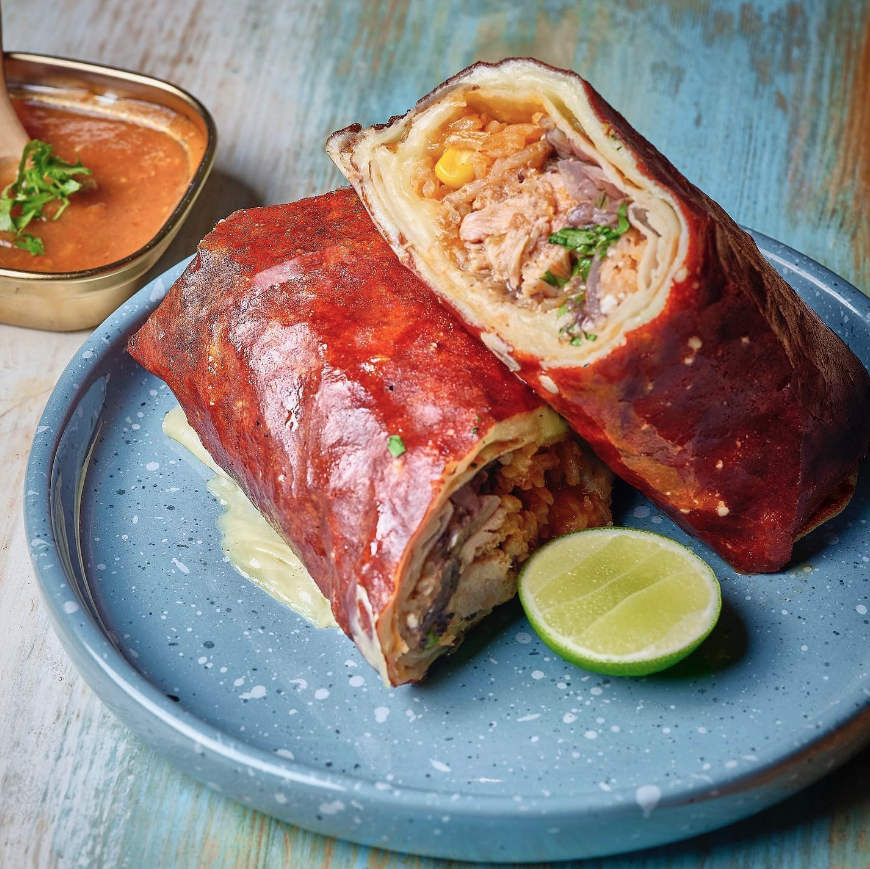
With the vibe as ‘authentic’ as you’ll get so far from home, with happy diners spilled out across the truck’s adjoining parking lot, sleeves rolled up and shirts splattered with salsa, this is certainly one of the best places to eat Mexican food in Bangkok. The crispy burrito cheese wrap washed down with a frozen margarita is a must.
It could be said that Charley Brown’s set the standard for quality Tex Mex in the city, with the restaurant serving the good stuff since 1992.
Quite possibly Thailand’s oldest Mexican restaurant and now in its third incarnation on Sukhumvit Soi 19, the premise is still very much the same as when they started some three decades ago; the warmest of welcomes, super-sized plates of the type of fortifying comfort food found in the US’ southern central states, and punchy margaritas (mine’s a passion fruit) to send you on your way unsteadily.
Our favourite thing to order here, however, is something we’ve not encountered on other Mexican menus. The Berenjena Maria, which calls to mind a parmigiana melanzane with added oomph – sees slices of aubergine layered with goat’s cheese and a red chilli sauce, before being topped with breadcrumbs and baked until it’s a cakey, oozy unit. One for dusting off the hangover, this.
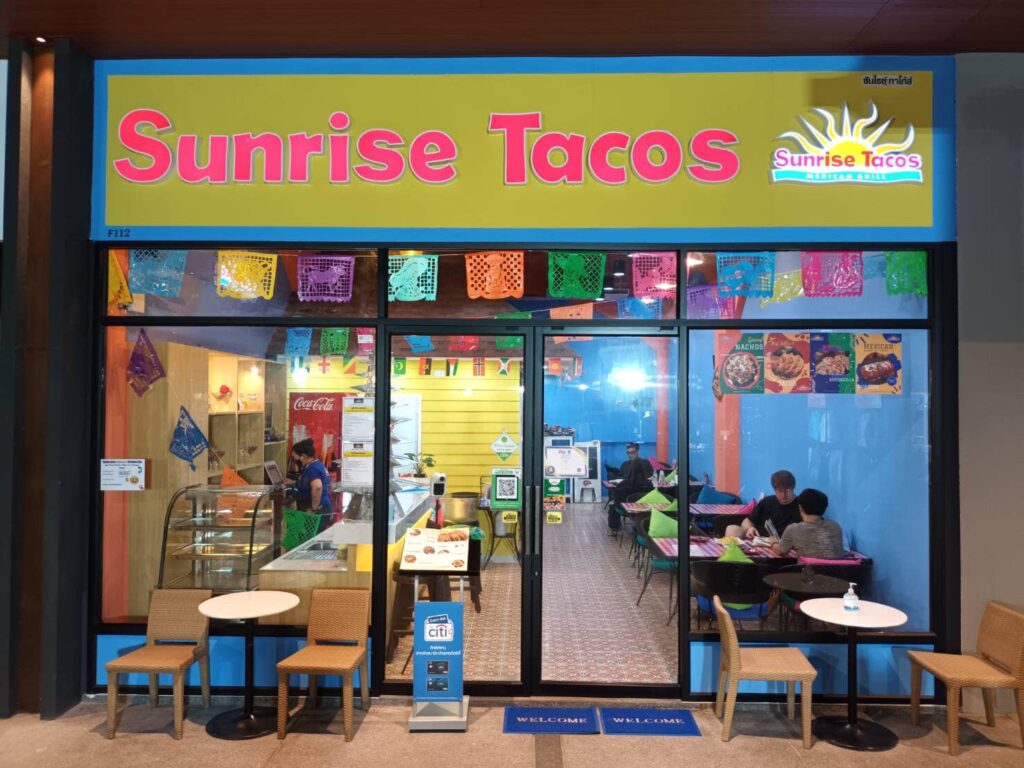
Sunrise Tacos’ original branch will always have a regrettable association with sleaze, owing to its position at the entry point to Patpong, one of Bangkok’s red light districts, but the impossible-to-miss restaurant certainly fills a certain hole if you alight in Silom after sinking a few Singha in the sun.
Keep things simple here with Sunrise’s bottomless chips and salsa (available in mild, medium or hot). Follow that with the restaurant’s flautas, here filled with chicken and cheese, fried, then draped in the Mexican tricolour (represented by enchilada chilli sauce, sour cream, and blended guacamole) and you can’t go far wrong.
Though it’s certainly not scaling the dizzy heights of Ojo or the measured elegance of Santiaga, Sunrise has a chaotic charm, and with a litre pitcher of eminently drinkable margarita clocking in at under 545 baht here, the appeal is clear.
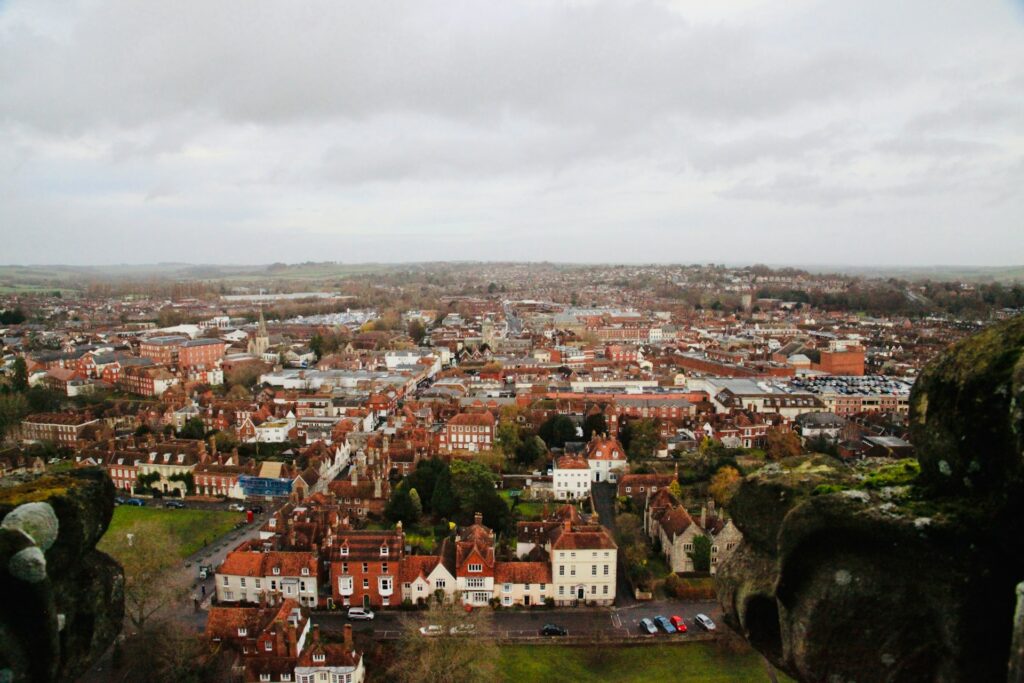
Let’s put this on the page and in writing before we begin; Salisbury feels like a contradictory sort of place. Boasting a cultural might pretty much unrivalled for a city of its size anywhere in the UK, it’s also a place that’s a little, well, lowkey. Its culinary capital follows suit, with plenty of pleasant places to dine, sure, but not many that will truly rock your socks off.
This city may boast one of the most magnificent cathedrals in the world, be within a massively heavy stone’s throw from Stonehenge, and house one of just four copies of the Magna Carta, but weirdly, you’re not going to find any Michelin-starred restaurants or one-to-watch young chefs here.
What Salisbury lacks in high-profile dining, however, it more than makes up for with its charming, locally-loved restaurants and cafes, some that offer a genuine taste of the region and others that take inspiration from the other side of the world.
From historic inns to contemporary cafes, the city’s dining scene is a reflection of its heritage. With that in mind, here’s our guide on where to eat in Salisbury, and the best restaurants in the city.
Rai d’Or
Ideal for pints and Panang curry in a historic pub…
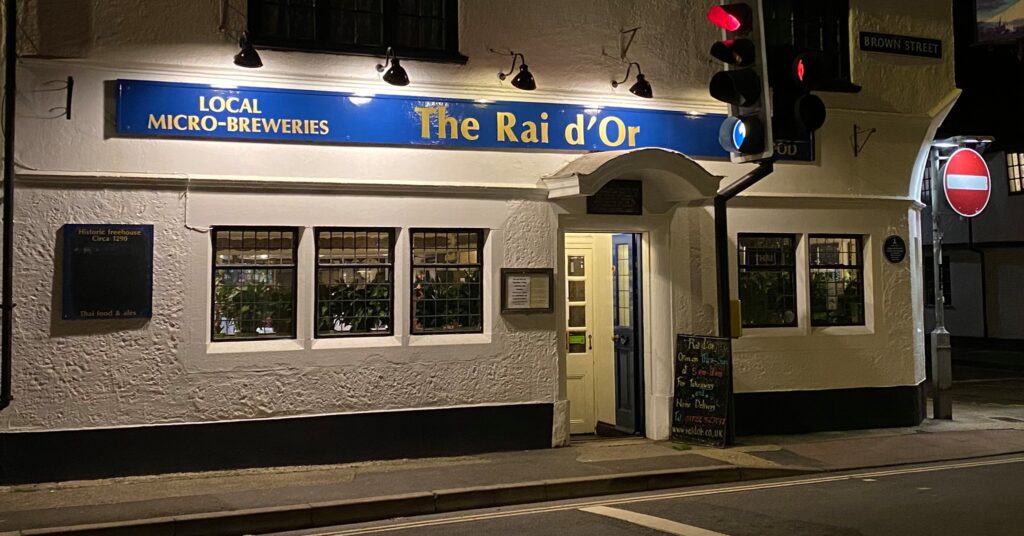
A local favourite if ever there was one, Rai d’Or wears its inherent contrasts proudly, offering a unique blend of delicious, uncompromising Thai cuisine and a traditional British pub atmosphere – frothy flagons of ale and all – housed in a 14th-century beamed building that exudes historical charm.
Now in their third decade on Brown Street, and with a Thai team at the stoves and the amiable host Simon out front, it’s a match made in heaven. Or, at least, in Siam…
Pleasingly for a city centre operation, The Rai D’Or continues to operate as a pub, and you’re more than welcome at the bar if all you’re after is a pint. There’s a great selection of real ales here, featuring a rotating lineup of top-quality brews from local breweries, which has earned the place high praise and recognition from CAMRA via inclusion in its Good Beer Guide annually since 2004. That real ale pairs particularly well with the coconut curries here; the Panang curry of chicken is particularly well-judged.
Ideal for sophisticated farm-to-table dining in a restored country inn…
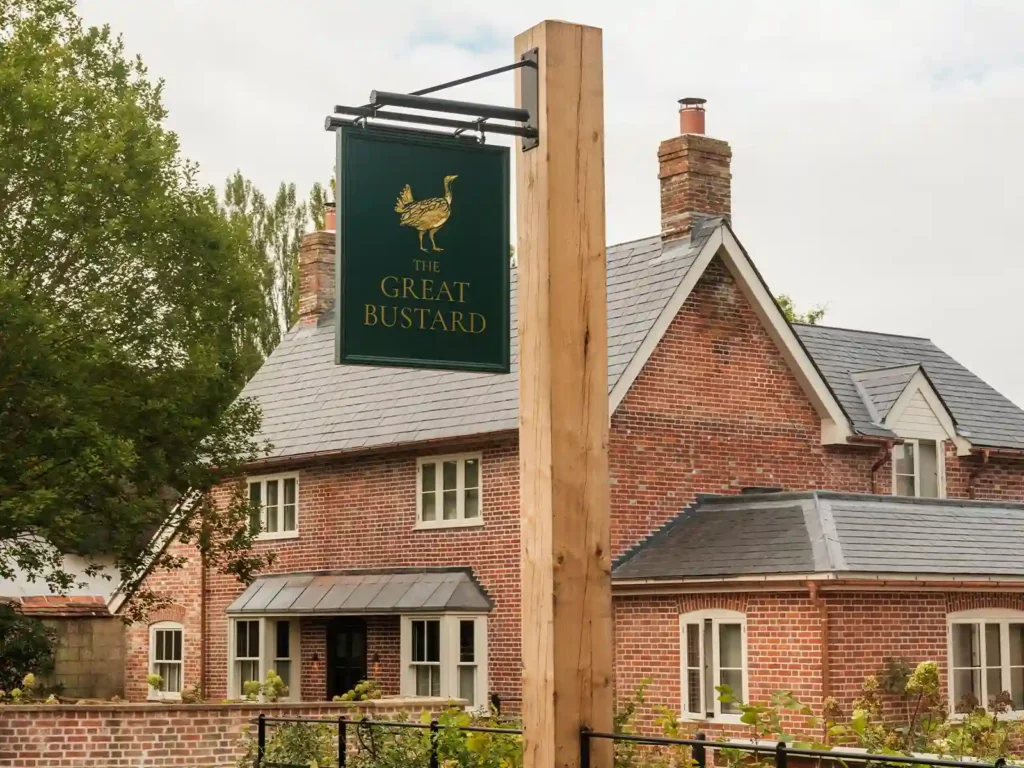
Just five miles north of Salisbury (and a really pleasant bike ride, too, if that’s your thing), The Great Bustard has somewhat flown under the radar since its opening in October of 2024. Sure, it’s already been awarded 2 AA Rosettes. A coveted spot in the Good Food Guide has been secured. And yes, it’s already received a glowing review in The Times…
…Okay, The Great Bustard definitely hasn’t flown under the radar; we just wanted to use a laboured pun. In actuality, it’s no surprise this place has hit the ground running, its credentials impeccable and its premise precisely delivered – head chef Jordan Taylor cut his teeth at Restaurant Gordon Ramsay and the two-Michelin-starred Moor Hall in Lancashire, and there’s a keen connection to the surrounding estate and its produce. The menu, accordingly, writes itself.
Taylors menu celebrates both the surrounding Great Durnford Estate and the finest West Country producers with real technical flourish. A visually stunning terrine of estate game – layered with breast of pigeon, pheasant and partridge – demonstrates the kitchen’s ambition perfectly, while the loin of estate hare wrapped in cabbage with celeriac fondant shows Taylor’s deft touch with local, notoriously tricky-to-cook ingredients.
The dining room, housed in a contemporary wood-clad extension, matches the food’s sophistication. Floor-to-ceiling windows flood the space with natural light and look out onto a heated terrace and gardens, while a striking picture window into the kitchen, framed by fine wines and gleaming stemware, hints at the serious gastronomic intent. Two elegant rows of black leather banquette seating divide the room, adding a touch of city sophistication to this rural retreat.
But it’s not all refined dining – there’s a dedicated, laid back pub menu too, featuring precise but not ‘cheffy’ takes on classics like beer-battered fish and chips and a seriously good estate venison burger with charcoal mayo. The bar area, with its beamed ceiling, inglenook fireplace and wingback chairs, is exactly where you want to be with the Sunday papers and a pint of house Great Bustard lager, a complex, malty little number that’ll have you contemplating a second before you’re halfway through your first. And true to proper pub form, the Sunday roast is killer – Great Durnford lamb or Springbottom Farm beef, served with all the trimmings including massive Yorkshire puddings and spiced creamed kale.
Service, under the watchful eye of general manager Matheus Sanches (formerly of the Harbour Hotels group), strikes that perfect balance between polish and warmth. The wine list deserves special mention, featuring an impressive selection by the glass and some seriously special bottles from the Great Durnford Manor’s own cellar.
With its formula of technically accomplished cooking, warm hospitality and that irresistible combination of pub cosiness and restaurant finesse, The Great Bustard is a more than welcome addition to Salisbury’s dining scene, confirmed by its inclusion in the 2026 edition of the Michelin Guide.
Book ahead for the restaurant, especially for Sunday lunch, though the pub operates a walk-in only policy.
Ideal for light, seasonal lunches surrounded by art and sculpture…
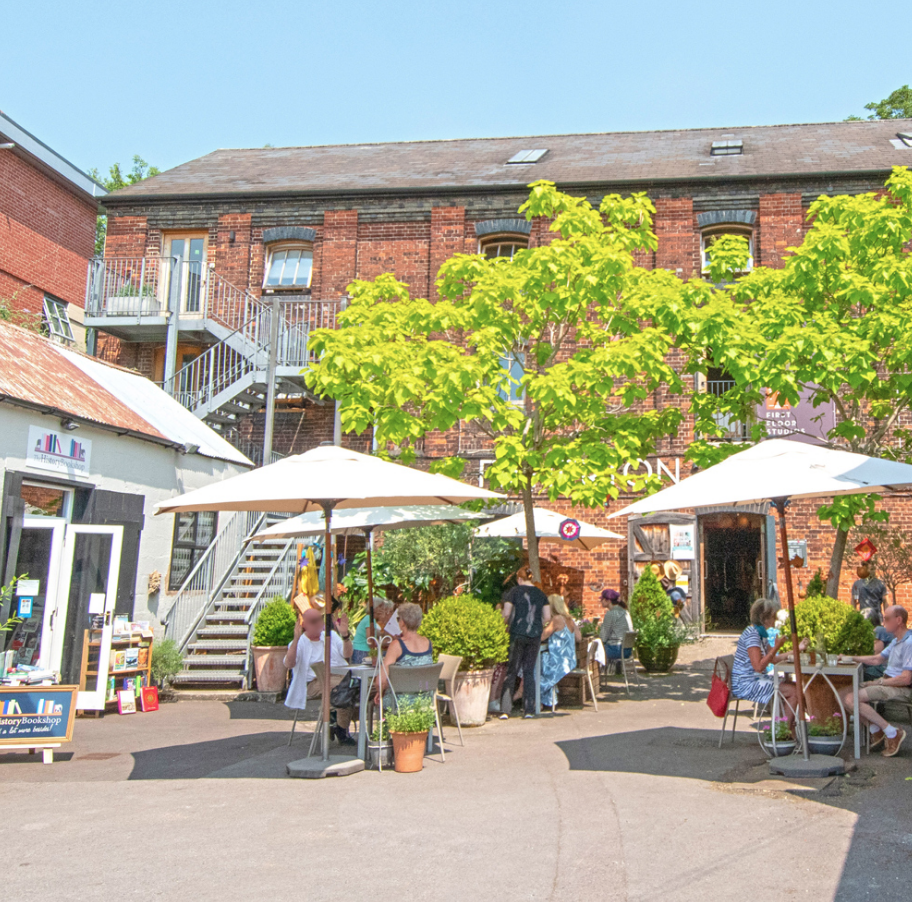
Fisherton Mill is more than just a place to graze; it’s something of a cultural hub that combines a gallery, studios, and a café under one roof.
Located in a beautifully restored Victorian grain mill just off Fisherton Street and a handy five minute stroll to Salisbury station, the café offers a delightful menu of homemade dishes with just a little flair, from hearty brunches to light lunches and an enticing cake display.
The emphasis here is on fresh, locally sourced ingredients, with a menu that changes seasonally to reflect the best of what’s available from Wiltshire. It’s an ethos that has earned Fisherton Mill runner-up in the OFM Awards Best Value Eats category back in 2022, as well as a Local Gem mention in 2024’s Good Food Guide.
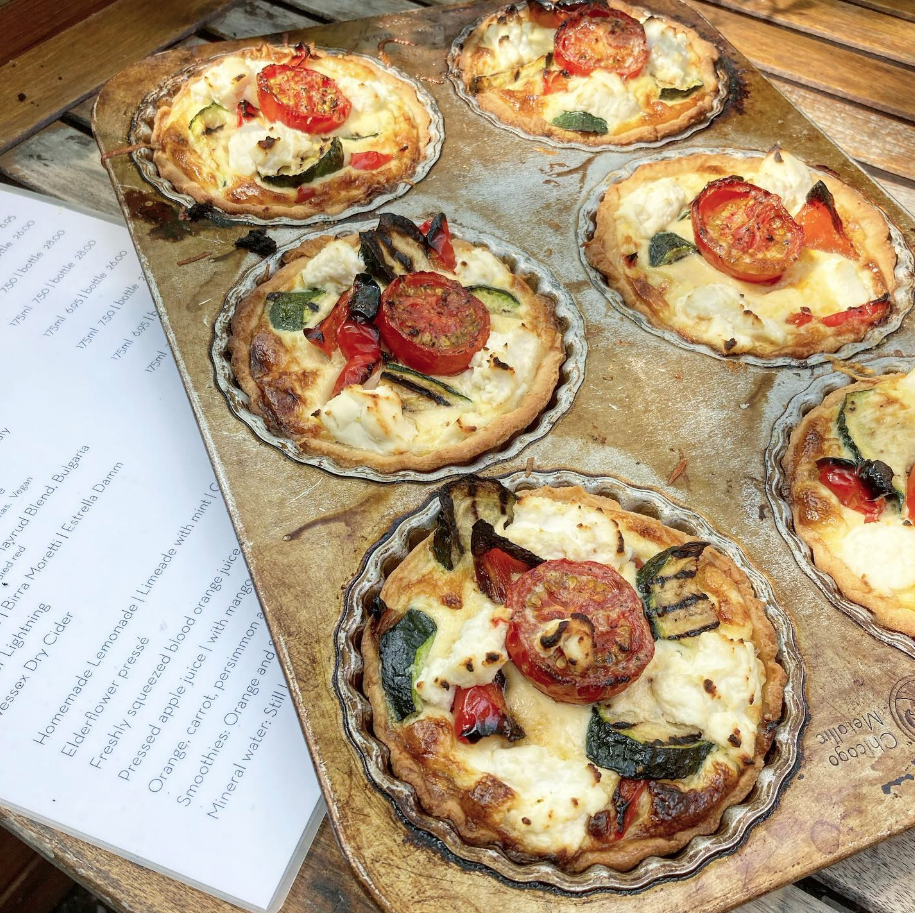
So, that’s freshly made tortelloni stuffed with pesto and dressed with fresh peas, artichoke and pecorino, or green olive focaccia (again, made on site) with grilled courgettes, heritage tomatoes and roasted red peppers. It’s wholesome, lovely stuff, and just what you want to eat for lunch in Salisbury before exploring its sites.
The setting is equally impressive, and after enjoying a meal or coffee here, visitors can explore the gallery and studios, which showcase the work of local artists and makers.
Please be aware that Fisherton Mill isn’t open for dinner, shutting up shop at 5pm daily. It’s also closed on Sundays.
Ideal for an old school boozer and a globetrotting menu…
The Compasses Inn, located in the picturesque village of Chicksgrove 12 miles west out of Salisbury, is a quintessential English country pub with a reputation for excellent food and a warm, welcoming atmosphere. What more could you want?
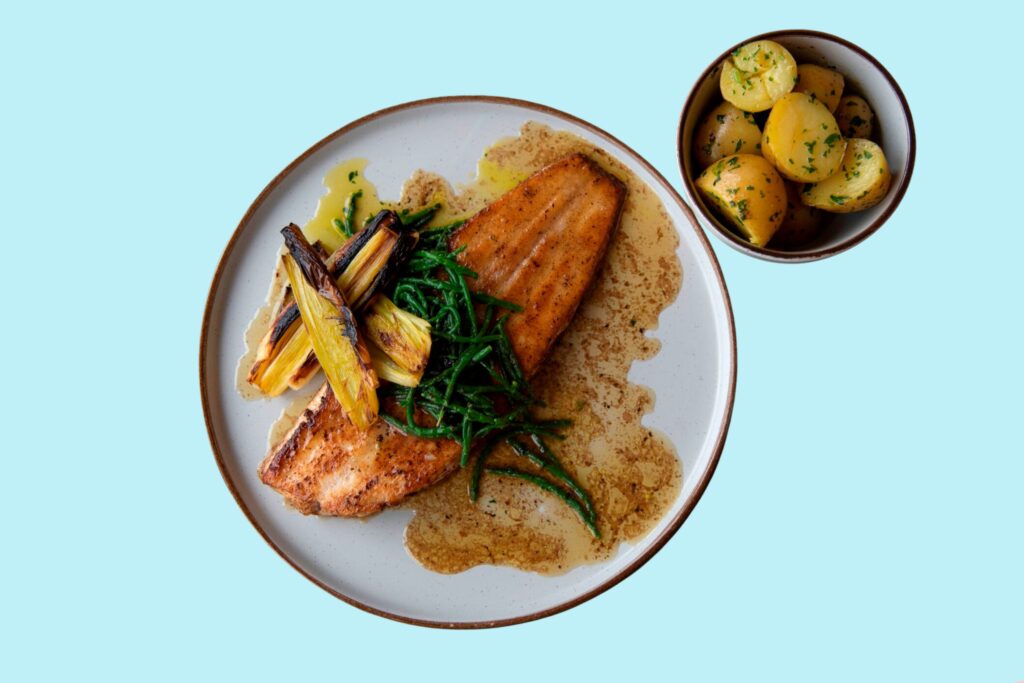
The menu is a celebration of global gastropub cuisine, with a focus on locally sourced, seasonal ingredients. Though there’s Balinese croquettes with Vietnamese slaw, and lamb stifado with tzatziki, we’ve found the most joy in the more prosaic corners of the Inn’s menu. A recent dish of roast whole plaice with brown butter and capers was particularly good, as is the gold-standard fish pie, with burnished mash lid and pleasingly generous chunks of fish (mustn’t. say. swimming) beneath it.
Image via @thecompassesImage via @thecompasses
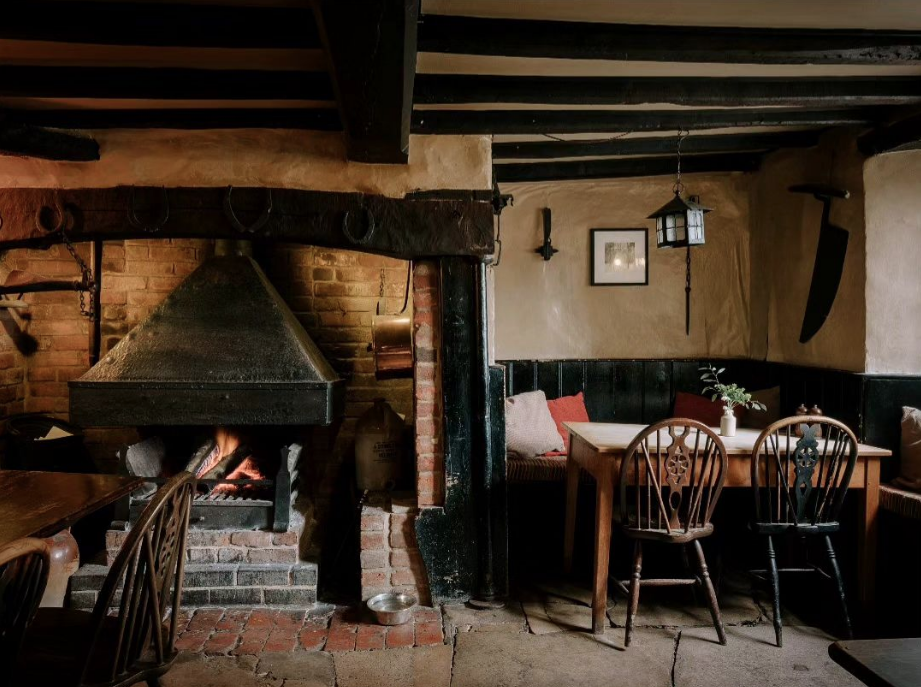
The inn itself is steeped in history, with parts of the building dating back to the 14th century. Inside, you’ll find a cosy interior with open fires, wooden beams, and a relaxed vibe to the service. End with the chocolate mousse – dark and decadent – and settle in for a pint or two afterwards. You better make the journey count, after all.
The Jade is a family-run Chinese restaurant that has been a staple of Salisbury’s dining scene for over three decades (despite a 2016 announcement of closure that ended up being, thankfully, temporary).
Known for its extensive menu of traditional Chinese dishes, The Jade offers everything from dim sum and Peking duck to a pleasingly vast variety of vegetarian options. The fried-to-order pineapple fritters have been a dessert staple here for as long as its been open, and still hit the spot.
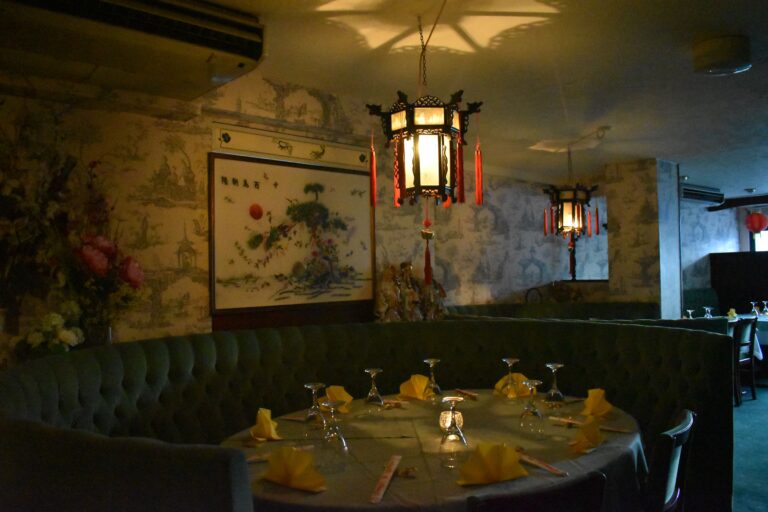
The restaurant itself is elegant yet unpretentious, with banquettes rendered in – you guessed it – jade green, and a dining room that’s defined by the gentle hum of conversation (and the odd clatter of woks when the kitchen door swings open), rather than a raucous, unruly din.
Only open for dinner, Monday to Saturday, and closed entirely on Sundays.
Ideal for contemporary Indian dining, square plates, swooshes and all…
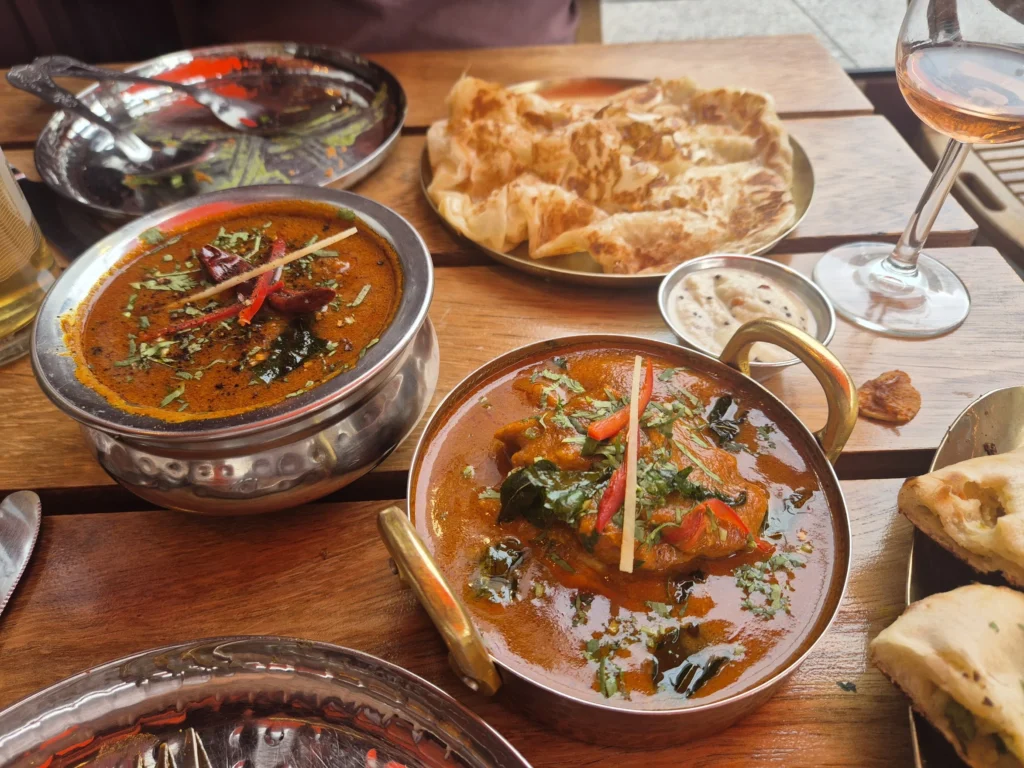
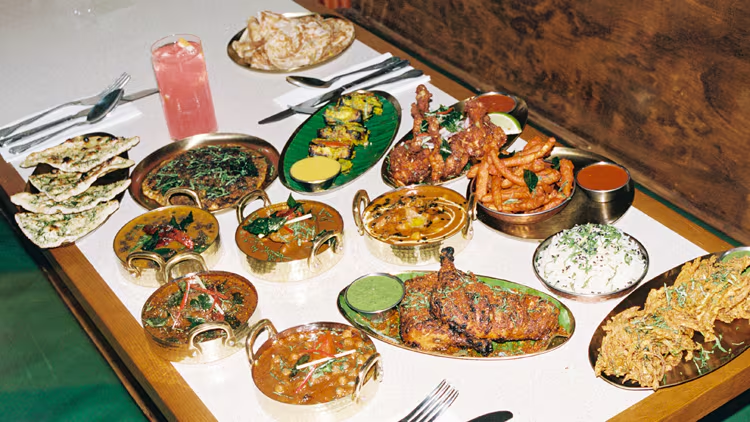
Anokaa is a contemporary Indian restaurant that brings a welcome contemporary twist to traditional Indian cuisine whilst still keeping the flavours punchy and complex. The menu is a fusion of classic Indian dishes and innovative creations, all prepared with fresh, high-quality ingredients. Signature dishes include the rump of Welsh lamb with cashew nut, coriander and tomato, which hits the table as pretty as a picture, its square plate decorated with all manner of 90s style dots, dabs and swipes. Boy do those dots, dabs and swipes taste alive, though.
Salisbury’s only city centre restaurant ever to be recognised in the Michelin Guide (2017), Anokaa might feel a little dated now when held up against contemporary Indian dining in the UK’s bigger cities, but the food here is carefully seasoned and creatively presented. Sometimes, that’s just what you want from a special occasion kind of meal.
Ideal for South Wiltshire’s best dining experience…
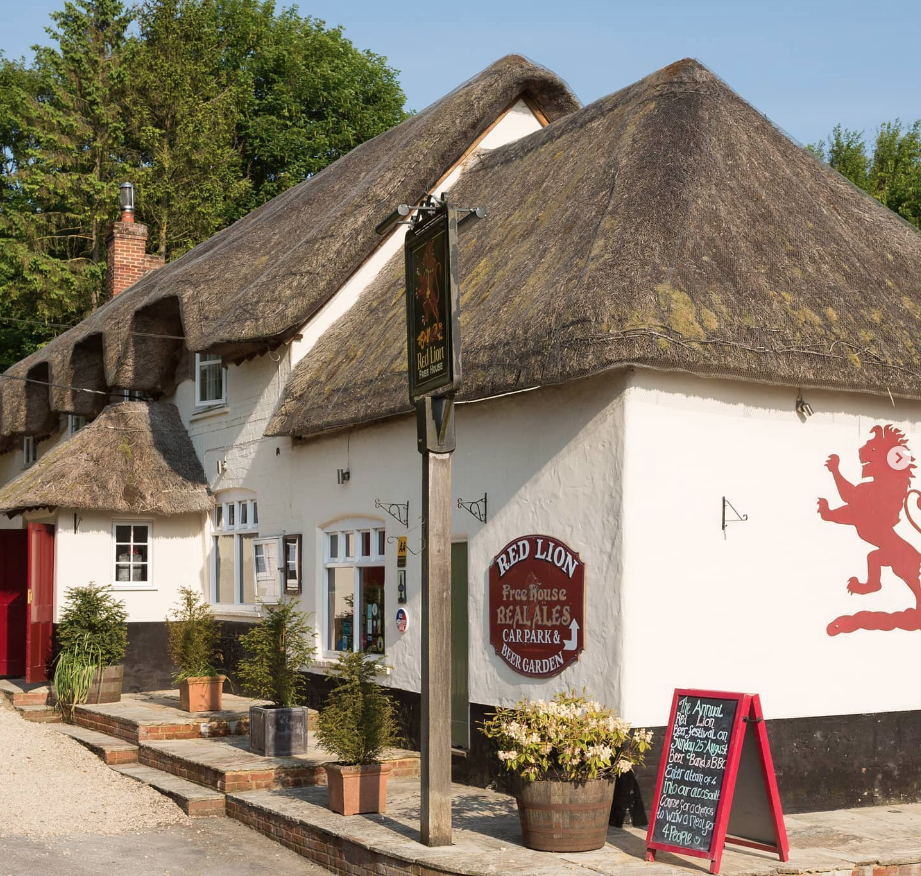
A half hour’s drive north of Salisbury in the charming village of East Chisenbury, The Red Lion Freehouse is a Michelin-recognised pub (previously starred, but for some inexplicable reason recently ‘demoted’) that offers the best dining experience in the local area, hands down and by some distance.
The menu is – as any self-respecting gastropub should be – a celebration of British cuisine, with a focus on locally sourced, seasonal ingredients that’s earned plaudits from The Spectator (“as good as pub food gets”) and the AA Rosette Restaurant guide (“astonishing cuisine”) among others.
We’re very much with them; in a refreshingly unfussy dining room, we recently enjoyed a £75 a head, five course tasting menu that was perfectly paced, celebrating summer’s bounty with precision. Bookended by a gorgeous chilled gazpacho of locally grown tomatoes and a cleansing strawberry sorbet, the Red Lion Freehouse is a class act.
It also boasts a beautiful garden, perfect for al fresco dining in the warmer months. With its combination of excellent food, charming setting, and top-notch service, it’s no wonder this pub has earned such high acclaim.
If you do choose to visit the pub from Salisbury, Stonehenge is on the way (or on the drive back), standing tall around halfway between the two. Sounds like the perfect day out to us!
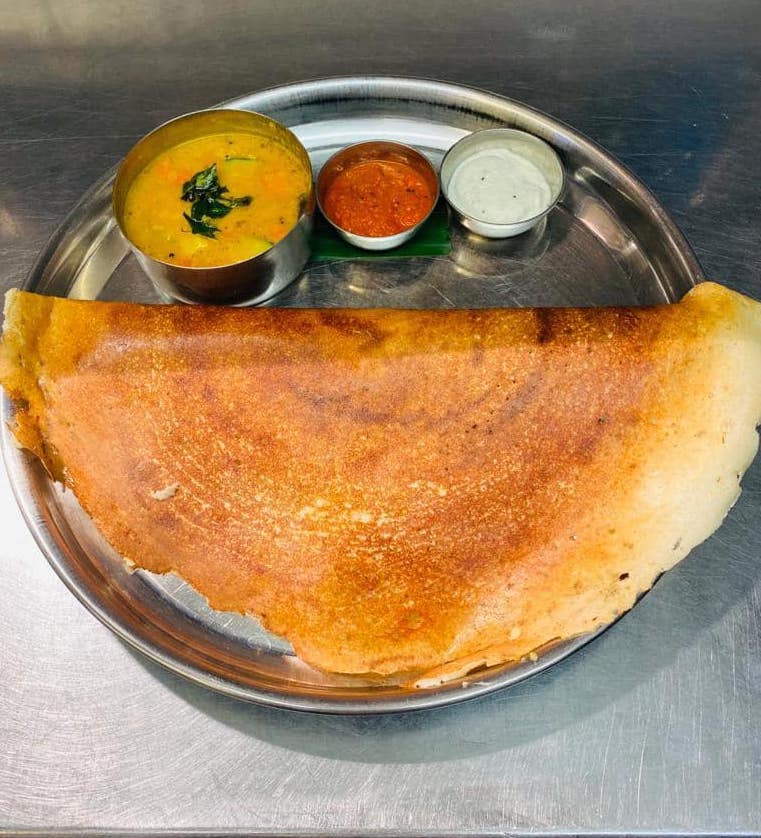
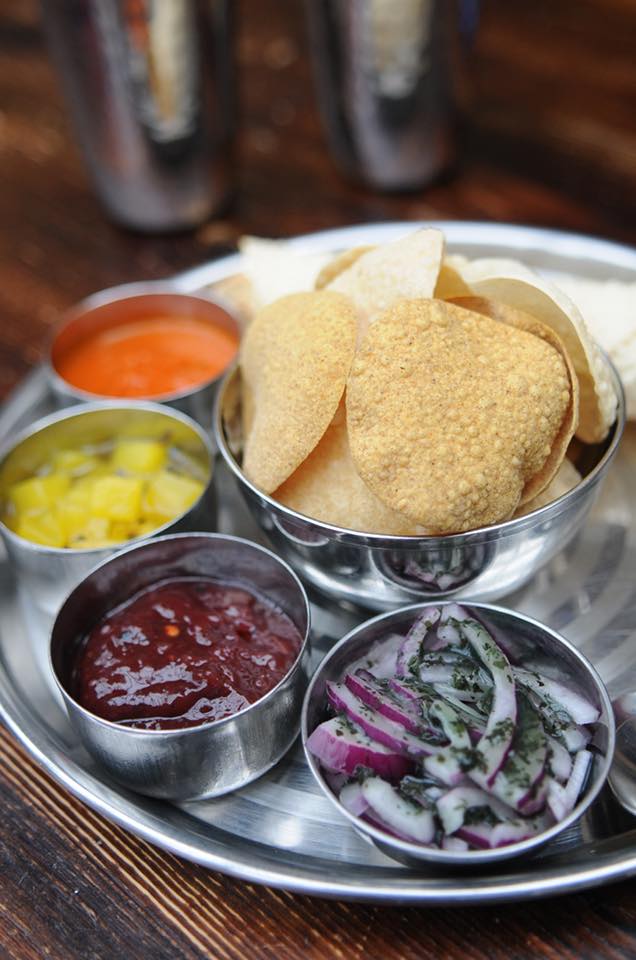
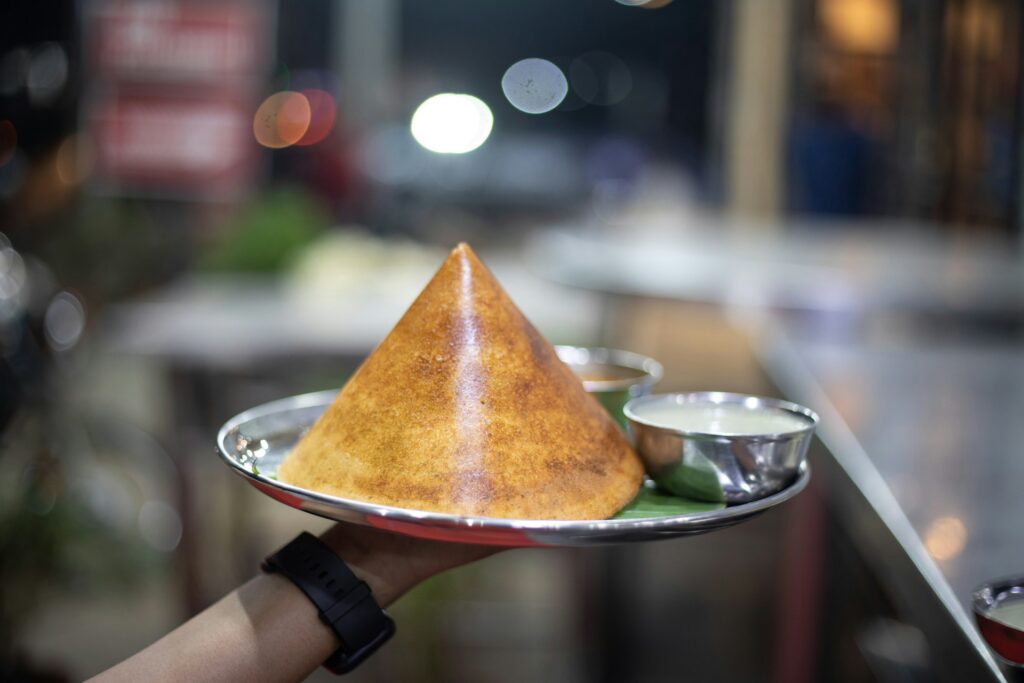
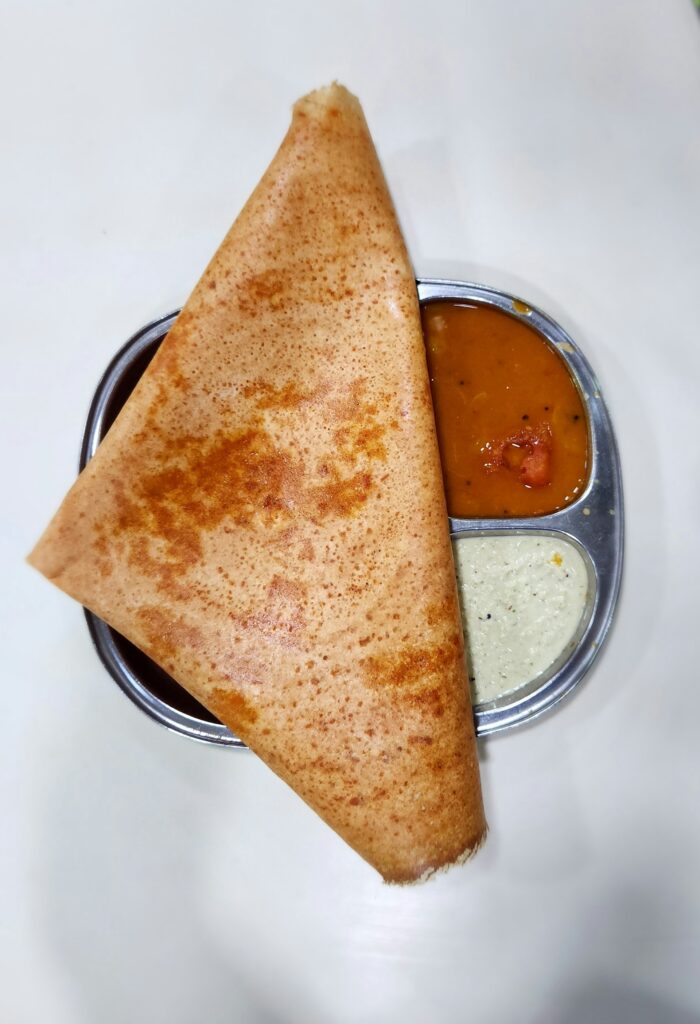
Back in Salisbury centre, and to Cafe Diwali, a vividly rendered restaurant just seconds from the magnificent cathedral. The menu is inspired by the diverse flavours of Indian street food and snacks, leaning on the lighter side of the country’s culinary canon with signatures like the always-invigorating samosa chaat, its yoghurt, mint chutney and tamarind dressing just the livener a tired palate needs. Even better are the dosa plates, crisp and airy, and served with three pots of chutney – sambar, coconut and tomato – for dipping and dredging. Lovely stuff.
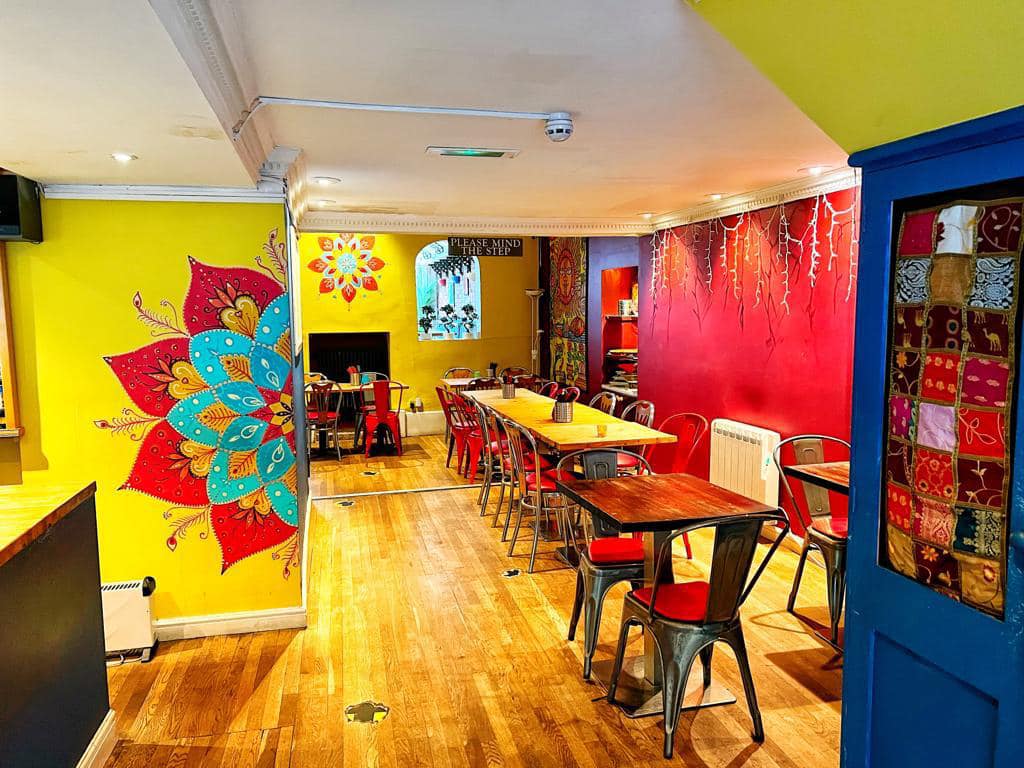
In fact, the whole place has a lightness of touch, from the sunflower yellow walls and natural light streaming through the conservatory out back and into the dining room, all the way to the dexterous service. We’ve said the word ‘light’ enough now…
Though the ‘cafe’ in the name might lead you to think this is a soft drink, tea and coffee only operation, Cafe Diwali do serve beer.
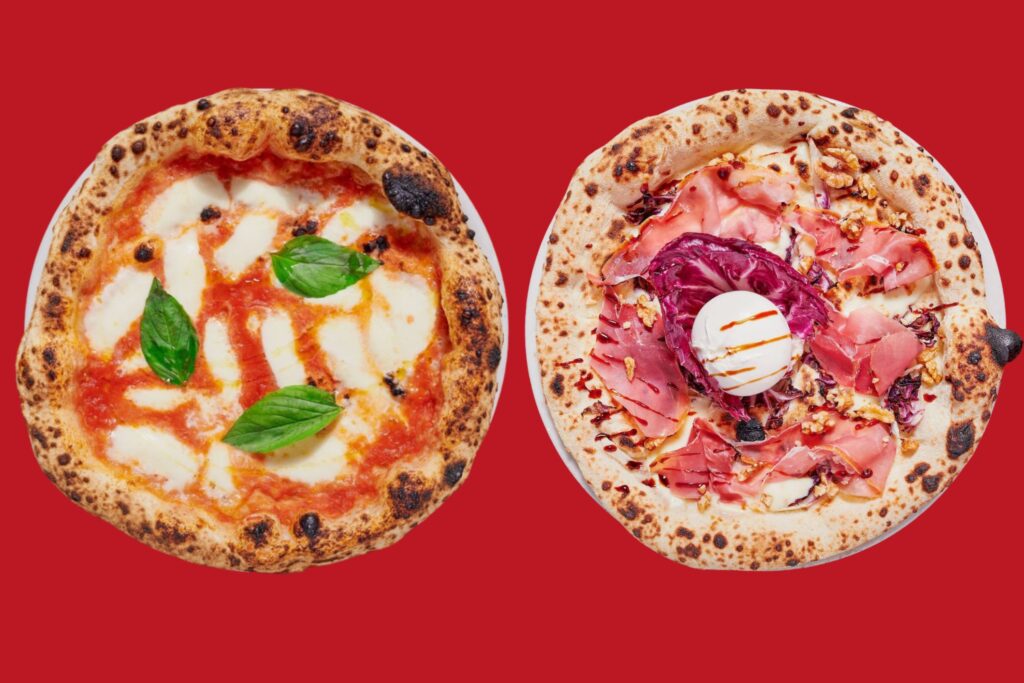
Nole Pizza is Salisbury’s most popular pizzeria, and one that prides itself on serving proudly inauthentic Neapolitan-style pizzas, its several outposts across the city and surrounding area testament to the group’s success.
With seating overlooking Salisbury’s bustling market square, Nole On The Square is our favourite iteration. Here the dough is made fresh daily and cooked in a traditional wood-fired oven, resulting in a perfectly crispy crust with a soft, chewy centre – just as it should be.
Images via @nolepizza
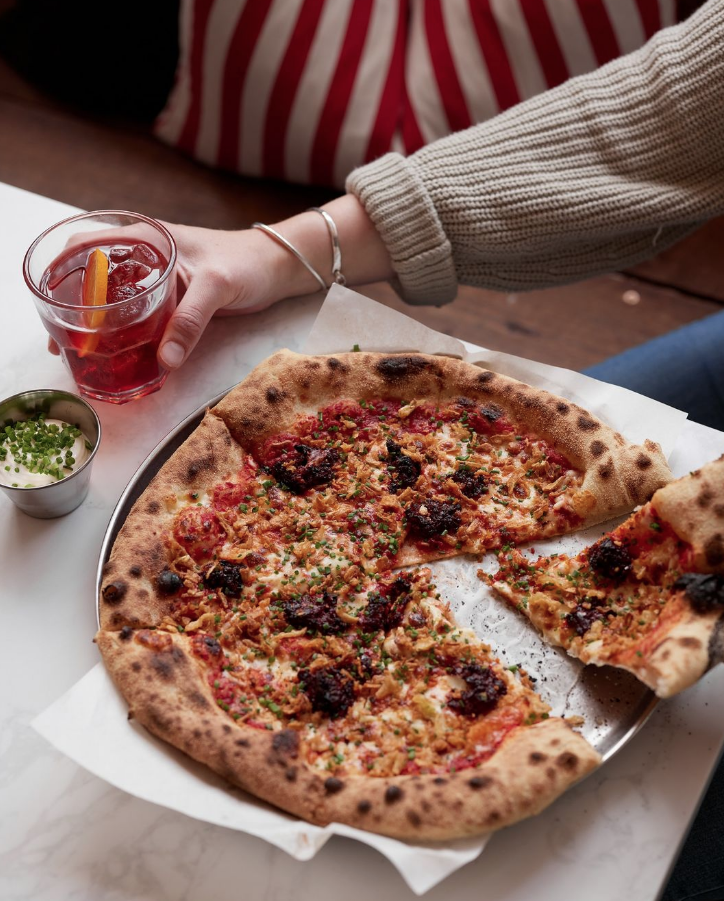
We’re very much into some of more leftfield creations here; the pepper pork, potato, blue cheese and pesto is just as punchy as it sounds. Damn delicious it is, too. For those preferring something a little more traditional, the anchovy and artichoke number is a lovely marriage of the sweet and the salty.
Sure, the pizza prices are at the more premium end here, with the two just mentioned clocking in at £15 and £14 respectively, but this is quite comfortably the best pizza you’ll find in Salisbury, and worth those extra few coins. The craft lager, from the restaurant group’s own Rude Giant brewery, is great too.
We end at Tinga, a Mexican bar and taqueria that aims to bring the flavours of Mexico to Salisbury city centre, and delivers on that promise with a pleasing range of tacos, burritos and quesadillas.
The signature dish is the eponymous tinga tacos, which sees chicken breast poached until tender before being shredded and bathed in a rich, gently spicy chilli and tomato sauce. £6.75 will get you three of these, which is an absolute steal, quite frankly. Equally good are the agave cauliflower tacos, which sit on guacamole and are dressed with a smoky adobo dressing. A couple of spicy, pokey margaritas seal the deal.
It was once a commonly held belief that if you lived in Zone 2 or further spiralling outwards, you’d be mad to travel into Central London on the weekend. Like many, our sentiment towards Zone 1 during our downtime has somewhat changed lately. Working from home has made the chaos and carnage of ‘Central’ seem suddenly appealing, and we’re increasingly keen to leave our neighbourhoods on the weekends in search of some bustle.
Because home isn’t always where the heart is, and if you’re looking for the latter part of your weekend to be spent dining out on what is traditionally the homeliest meal, then it’s worth making the journey central for some of the best roast dinners in London. Here you’ll find some marvellous meat-centric restaurants and Michelin-starred chefs serving up proper roasts with proper gravy and crispy spuds that weren’t cooked several hours prior.
With all that in mind, here’s our roundup of the best Sunday Roasts in and around Soho.
Temper Soho
Ideal for a smoky, BBQ roast in a lowlit spot with cool vibes…
You probably know Temper as a barbecue joint with something of a cult following. Its Soho outpost on Broadwick Street is known specifically for its Mexican influenced menu, where taco dishes rub shoulders with prime cuts of steak. However, come Sundays its vast basement space gets filled up with punters looking for a long, languid lunch of the roast variety.
On this sacred day of rest, the attention of the open-fire-pit kitchen changes to the roasting and the smoking of meats traditionally associated with British Sunday Lunch. Here, joints have been burnished with flames and full-on snogged by smoke. Seeing the chefs lovingly nurturing that meat makes it feel like you’re being served an extravagant roast by your favourite grandmother – should that grandmother be a dexterous, agile young chef, of course.
Anyway, as you watch the rather comforting tableau unfold in front of you, pass the time with some Mexican inspired snacks that the restaurant is so famous for. A lamb taco (£14) or a goat’s cheese version (£10) will tide you over nicely. If you’re nursing a hangover that those licking flames only seem to exacerbate, then a round of Temper’s Mini Marys – three for £12 – will sort you out while you wait.
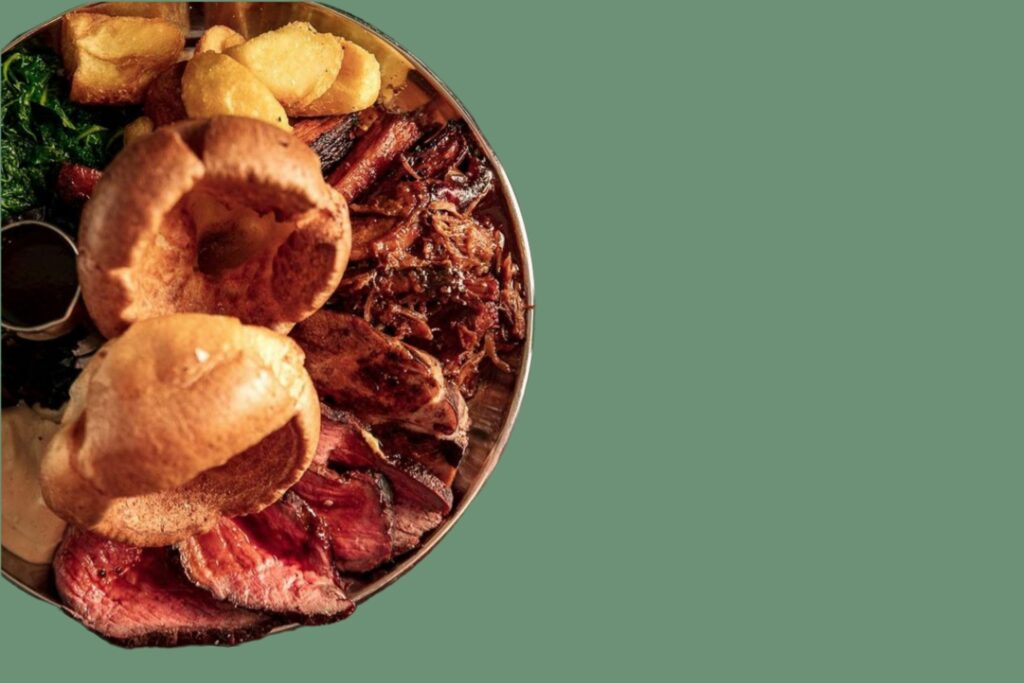
On to those roasts. We write the plural form quite deliberately, and if you’re one to get ‘meat envy’ from another person’s roast choice, then this is the ideal place for you. Come with a friend and order the ‘Three Beast Feast’ for £37.50 per person, where you get aged beef, roasted pork and smoked lamb shoulder to share. Yep, you don’t have to choose!
For the more selfish members of the squad (and the solo Soho diners, it should be said), you can, of course, have your own roast at £28.50 a head and choose from roast aged beef with horseradish cream, roasted Mount Grace pork loin with smoked apple sauce, smoked Yorkshire chicken with chimichurri, or smoked and pulled lamb shoulder with mint sauce. Sides include beef fat roast potatoes and Yorkshire puddings at an agreeable £1.50 that could possibly be the biggest in London – and bigger is always better in the case of these batter-based beauties.
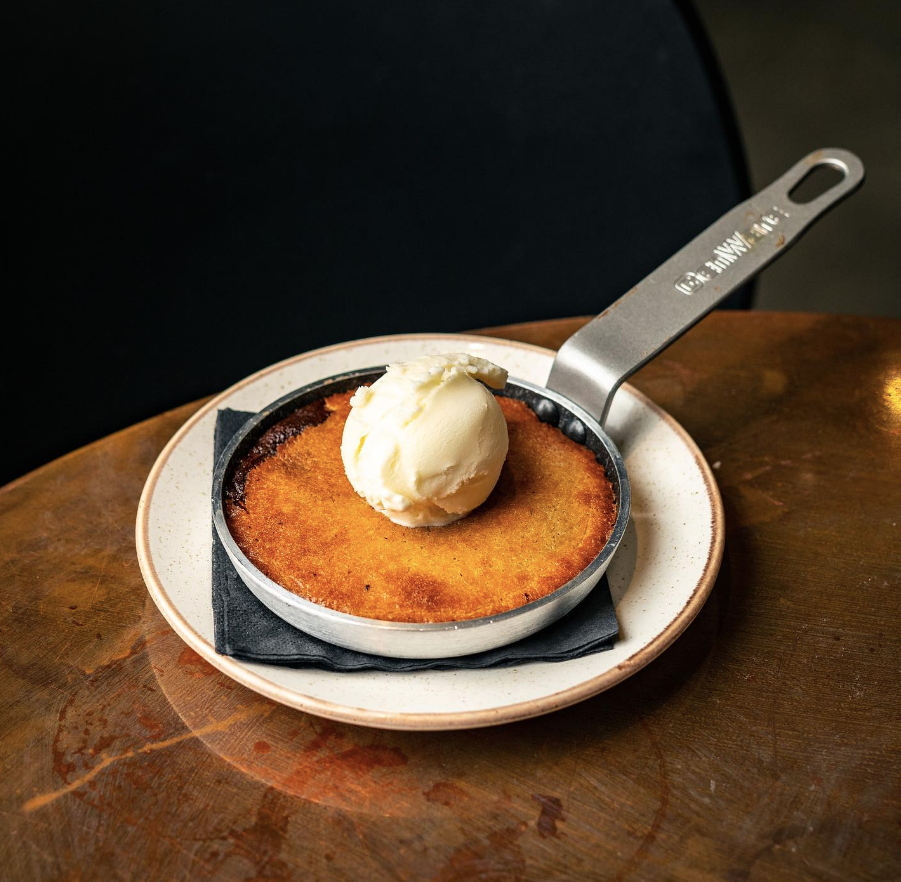
And to finish things off, it’s got to be a sticky toffee cookie (£8) with a fior di latte ice cream. We know what you’re thinking; don’t fuck with the classics. But once you’ve tried these gooey deep-dish cookies, baked in Temper’s wood-fired ovens and steeped in toffee sauce, you might just be proclaiming that rules were meant to be broken…
P.S The best place to pull up a pew is under one of the skylights. We speak from illuminated experience.
Ideal for when you want the best roast beef in town…
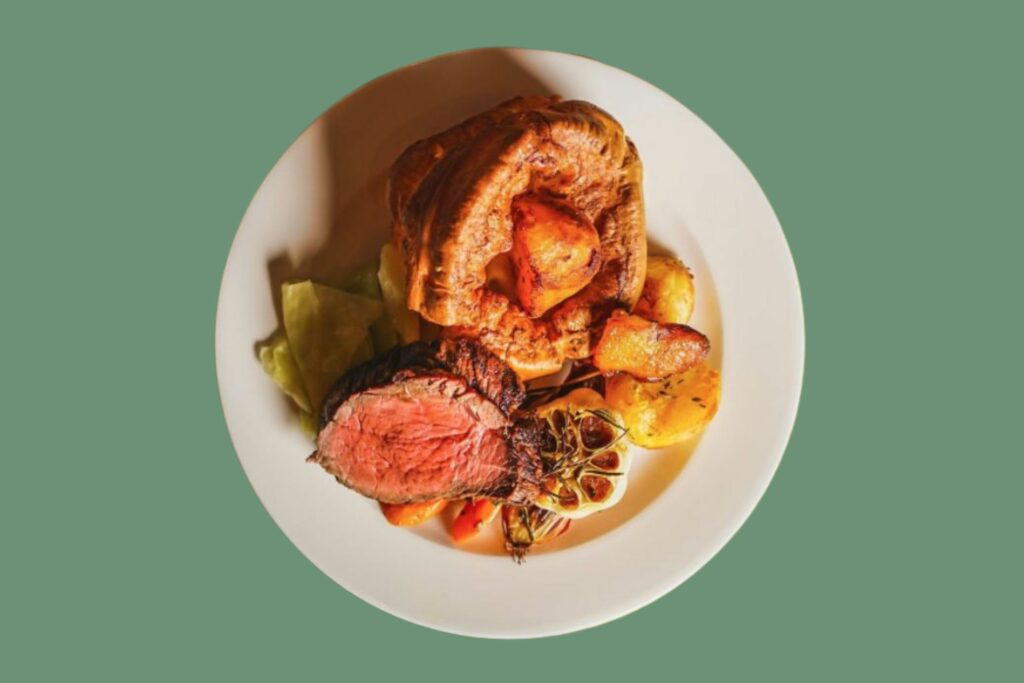
This London institution is known for serving some of the best beef in the country. And beef is what you’ll get served for Sunday lunch here — Hawksmoor is a steak restaurant, after all. Choose from a slow roast rump or from their blackboard cuts for sharing. From the latter, go for the Chateaubriand with all the trimmings, because it’s still the weekend and you’re at work tomorrow.
You may or may not know that, back in the day when ovens weren’t invented, joints of meat were traditionally roasted on a spit over an open fire. Doing things in an old fashioned way doesn’t necessarily mean better, but when it comes to roasting meat, it probably does. So to achieve the same flavour, Hawksmoor starts the roasting process on real charcoal and then finishes their roasting joints in the oven. The result is a slightly smoky roast with a gorgeous crust. Heaven.
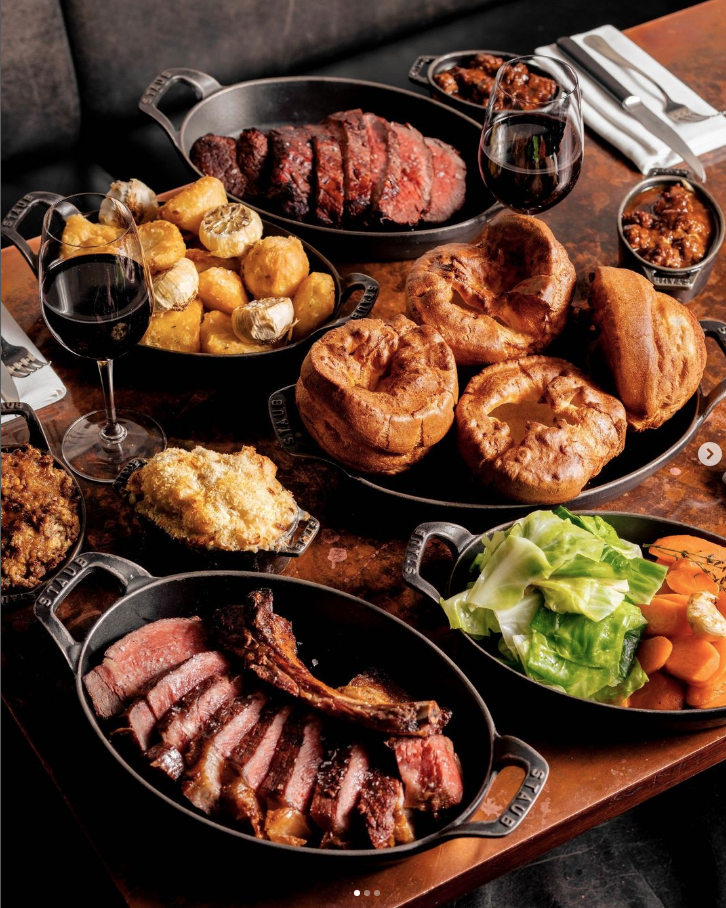
You’re not a beast, of course, and you know that it’s as much about the trimmings and the sides where Sunday Roasts are concerned. In a restaurant famed for their enduring attention to detail, Hawksmoor has given a lot of thought to this side of the menu. Here, the supporting cast includes roast potatoes (of the beef dripping variety, naturally) and a giant garlic bulb which has been roasted down to a mellow paste to satisfyingly squeeze on top of, well, whatever you want. Carrots, seasonal greens, and an unctuous bone marrow gravy seal the deal.
If the deal was still up in the air like a South American wonderkid on transfer deadline day waiting for their work permit, then perhaps the Yorkies here will convince you? The size of a baby’s head and as light as you like, they’re gravity-defying, life-affirming things.
Go big before going home (on a stretcher) with extras of celeriac mash and sausage gravy and raise the white serviette of surrender before agreeing with pals that you deserve an Uber home.
Ideal for a celebratory lunch of the refined but unpretentious variety…
Sunday lunch is Tom Kerridge’s favourite meal to cook and eat. So much so, in fact, that he’s even got a TV series on the subject. So it should come as no surprise that the Sunday roasts at his Bar and Grill are pretty darn spectacular.
He’s a chef known for his flavoursome yet unpretentious food, and that ethos is delivered with aplomb in the dining room of the Corinthia Hotel. This isn’t a roast you’d get at your mums – like his ‘elevated’ pub grub, it’s a beautifully refined affair.
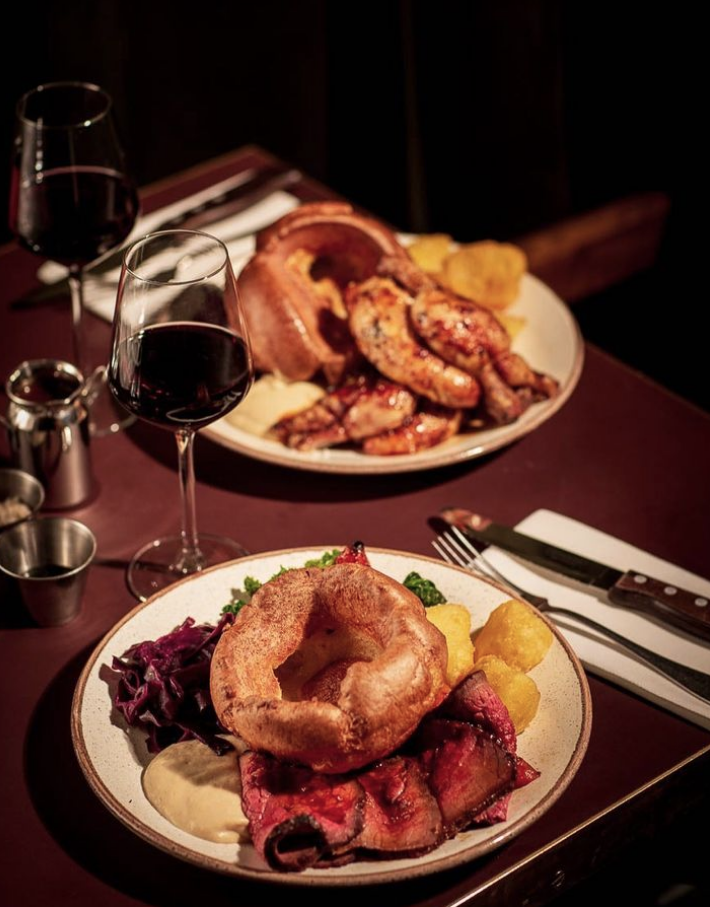
The menu changes seasonally but always showcases prime British ingredients with Kerridge’s signature flair. On a recent visit, roast ribeye of beef arrived with a stuffed Yorkshire pudding, roast potatoes, red cabbage and horseradish cream. Devon white chicken was given a spring lift with white asparagus, amalfi lemon and sauce vin jaune, while a hefty Barnsley lamb chop came simply with sauce reform.
There’s fish, too – pan roasted monkfish on the bone with sea vegetables and green peppercorn sauce – and a vegetarian squash tart with pumpkin seed pesto, girolles and maitake tempura for the meat-free contingent. Mains hover around the £42 to £52 mark, which for cooking of this calibre in a five-star hotel feels about right.
Whichever way you want to play it, get ready for the stuffed Yorkshire pudding – it’s a triumph of engineering and perhaps the meatiest, most umami-laden thing on the whole menu. Which, in the hands of Kerridge and co., is really saying something!
Ideal for cosy Sundays vibes below Soho street level…
Another Soho basement, another day that turns into night…
This particular basement, it should be said, is just about as ‘Soho’ as they come – the restaurant is housed in a former brothel and they’re not shy about shouting loud and proud about its insalubrious past. Indeed, there must be a ‘meat market’ joke in here somewhere, but we’re not about to make it…
Fortunately, in the dining room it’s more laid back, with decor that quietly whispers “we serve good meat” in a wood panel, low lighting and green leather booth seating kind-of-way. Of course, they do serve good meat here – some of the juiciest and most succulent in the capital, in fact.
Start with their rather unique take on a Bloody Mary (yep, we realise we already had one at Temper, but we’re not always hungover, honest), here dubbed a Beefy Mary and made even more restorative than normal with the addition of a nourishing beef jus and a whisper of smoke.
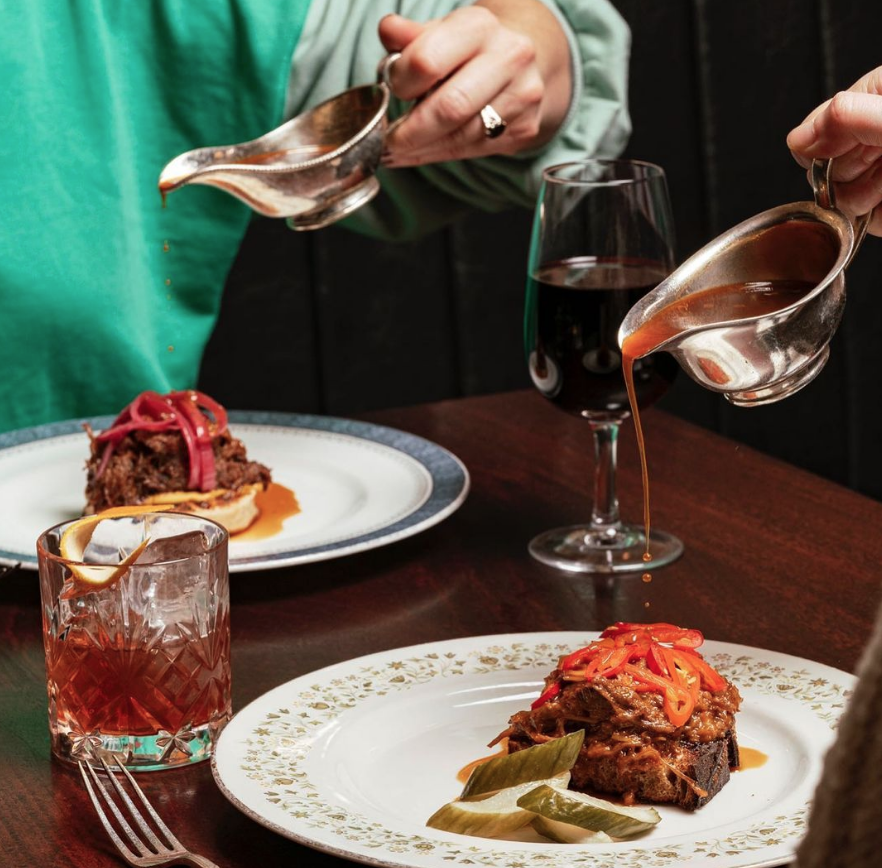
Even though you’re here for the roast, the pig’s head on toast is a wonderful way to kick things off; delicious slow roasted, soft and yielding meat that’s been shredded and spun through with its sensual braising liquor is served on sourdough with chilli and a jug of gravy to help get things going. Pickled onion brings sweet relief from all that richness.
Sensual? We didn’t say that out loud, did we?
Smoked beef ribs with a winter slaw are equally as tempting. Rather than being faced with something macabre, the ribs have been cooked low and slow until giving and gutsy, and – like the pig’s head – served with a boat of gluggable gravy to pour over. It’s an indulgent, soul-nourishing spectacle that your cardiologist may disapprove of, but your therapist would certainly encourage.
When it comes to the main event, whole joints are roasted over open coals. Similarly to Temper’s three beast feast, they offer an ‘all-in option’, which is a mix of roast beef, lamb and pork with all the trimmings, clocking in at just £28 a head. Since Sundays are made for sharing, this one really is a no-brainer. Your wallet will thank you, too.
For veggies, the barbecued cauliflower chop roast is as enticing as the meats, with the whole damn thing roasted over open coals until charred and caramelised in every crevice. Order a bubbling cauldron of cauliflower four cheese (Montgomery cheddar, ogleshield, stilton and parmesan, if you’re wondering) topped with panko breadcrumbs, and you’ve got yourself a beautiful, beige feast.
Try to save room for pudding – and do be aware that Blacklock’s Sunday Roasts get booked up months in advance, so secure yourself a table and wait in eager anticipation of one of the best roast dinners in Soho.
For a refined take on a Sunday roast, it’s to the Dean Street Townhouse you must head.
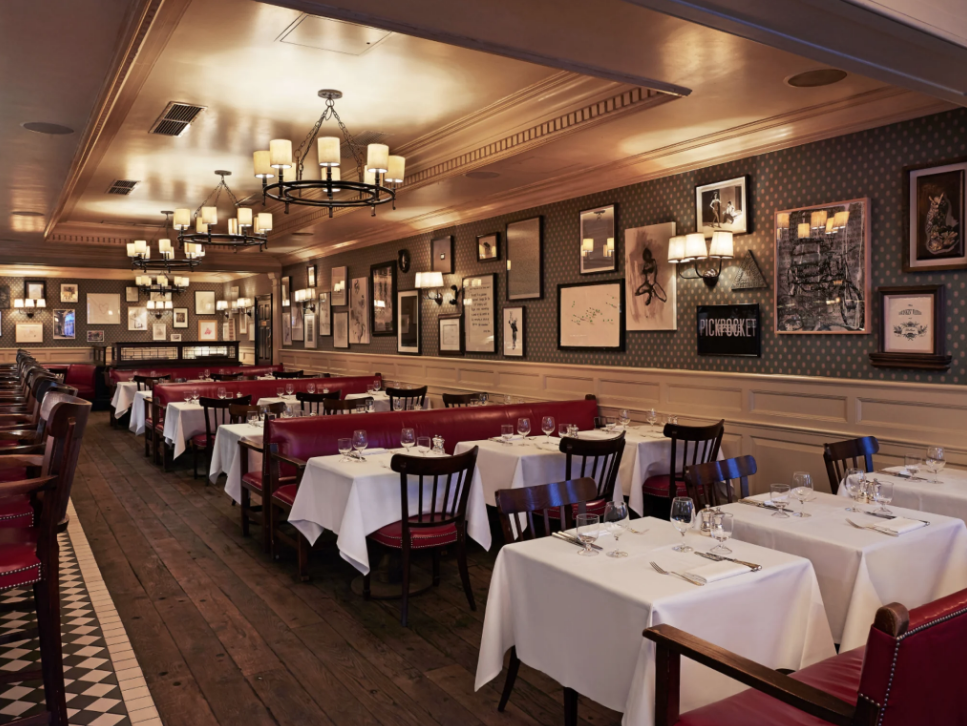
Offering a Sunday menu and served from 12-5pm, the vibe inside is seemingly designed to make you feel all fancy; all starch white-table cloths, chequered black and white flooring and red leather banquette seats. Book a booth with friends and make a proper occasion of dining on Dean Street.
Here, it’s a perhaps more predictable roll call than some of the other entries on our list (this is a Soho House with a broad, basic spectrum to feed), but that’s sometimes what you want from your roast, right? Not sometimes; most of the time…
Black Angus sirloin is, of course, served with a billowing Yorkshire pud. The rare breed pork belly comes with apple sauce, and, currently, the Norfolk chicken arrives with the welcome addition of bread sauce and stuffing, because, well, why should you only have bread sauce on Christmas day? All roasts come with Yorkshire pudding, roast potatoes, seasonal vegetables and a leek and Westcombe gratin.
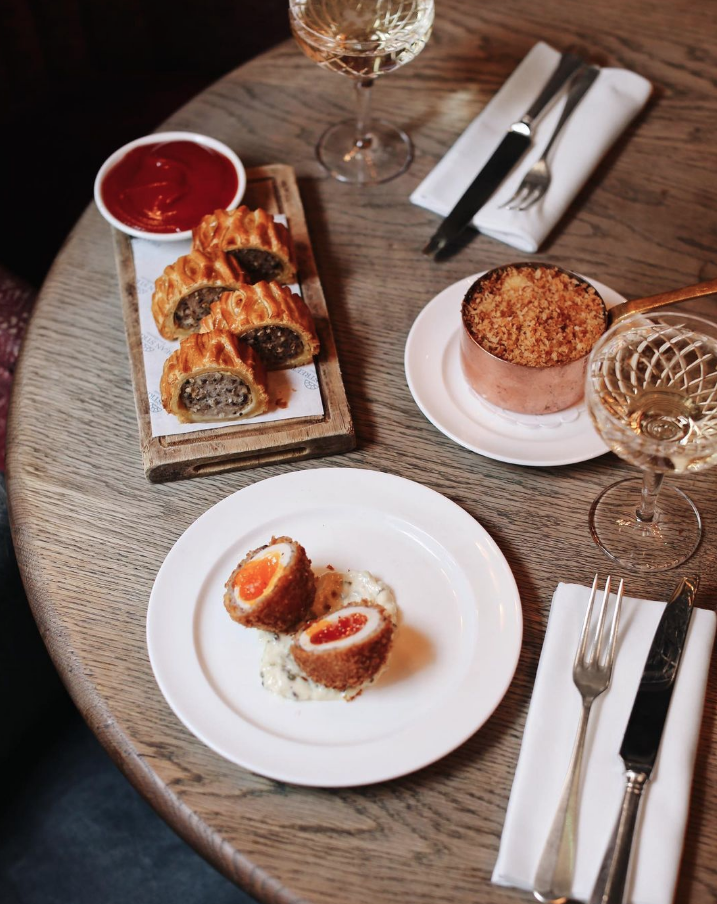
If you’re visiting from out of town and want to try some upmarket versions of British classics while you nurse a drink and consider the other cloying Soho House clientele, then the sausage roll here is darn good. Be warned; service can be a little slow, so while you wait for your mains to appear, admire the beautiful room and discuss the contemporary works of art on the walls which come from the likes of Tracey Emin.
Like many restaurants, the Dean Street Townhouse, by law, has had to put a calorie count next to its roasts. At all costs, ignore these little numbers chastising you for your greed. It’s Sunday, and it’s time to stuff your face.
Do we even need to introduce the Devonshire? If you’ve ever scrolled through Instagram, read the Food section of basically any Saturday or Sunday supplement, or simply felt a little hungry in the heart of Soho, then you’ve probably heard of this all-conquering new boozer.
But for those who haven’t; the Devonshire is the work of hospitality dream trio Oisin Rogers, Charlie Carroll and Ashley Palmer-Watts, all of whom bring their experience to this gastropub with big and bold ambitions to be the best in the business.
Sure, you might have to avoid a braying TopJaw clutching a totally superfluous microphone and pretending to like Guinness outside. And yes, you might have to sit so close to the central woodfired grill that you leave with no eyebrows. But we do have to rather begrudgingly admit that the Devonshire is good. Very good.
Images via @devonshiresoho
And on no day of the week is their confidence and technical prowess more keenly realised than on Sundays, at lunchtime, when all of the team’s honed hospitality and precise, generous meat cookery is shown off to its full potential. Sunday funday, indeed.
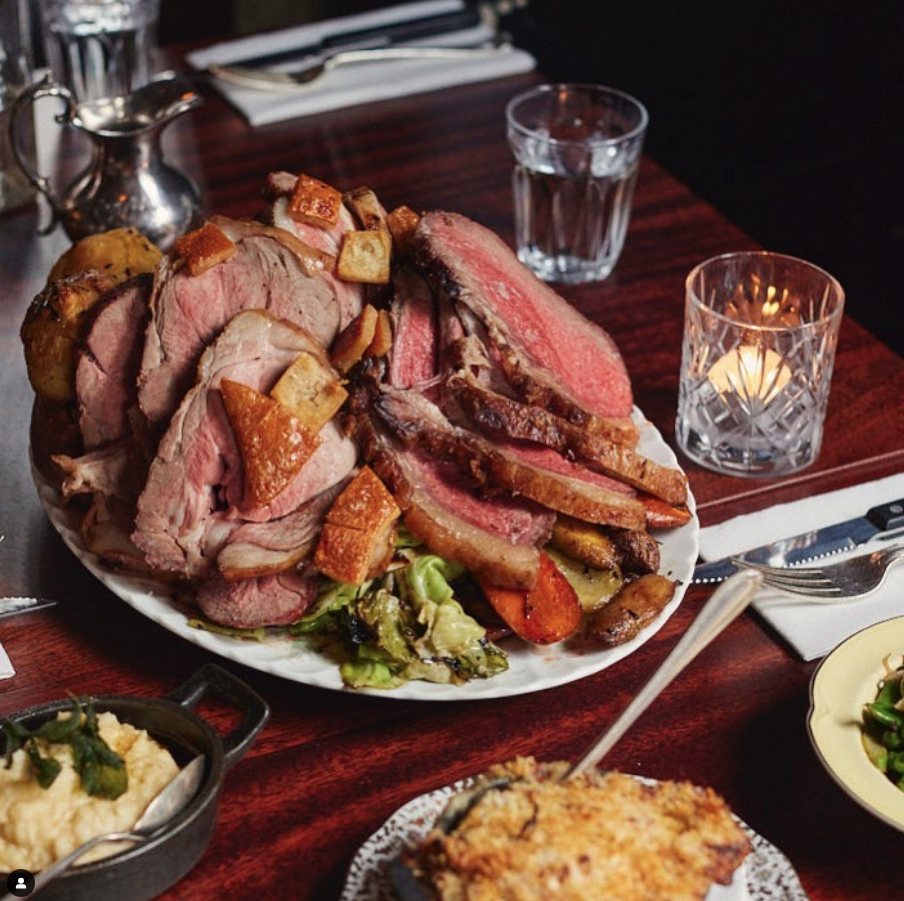
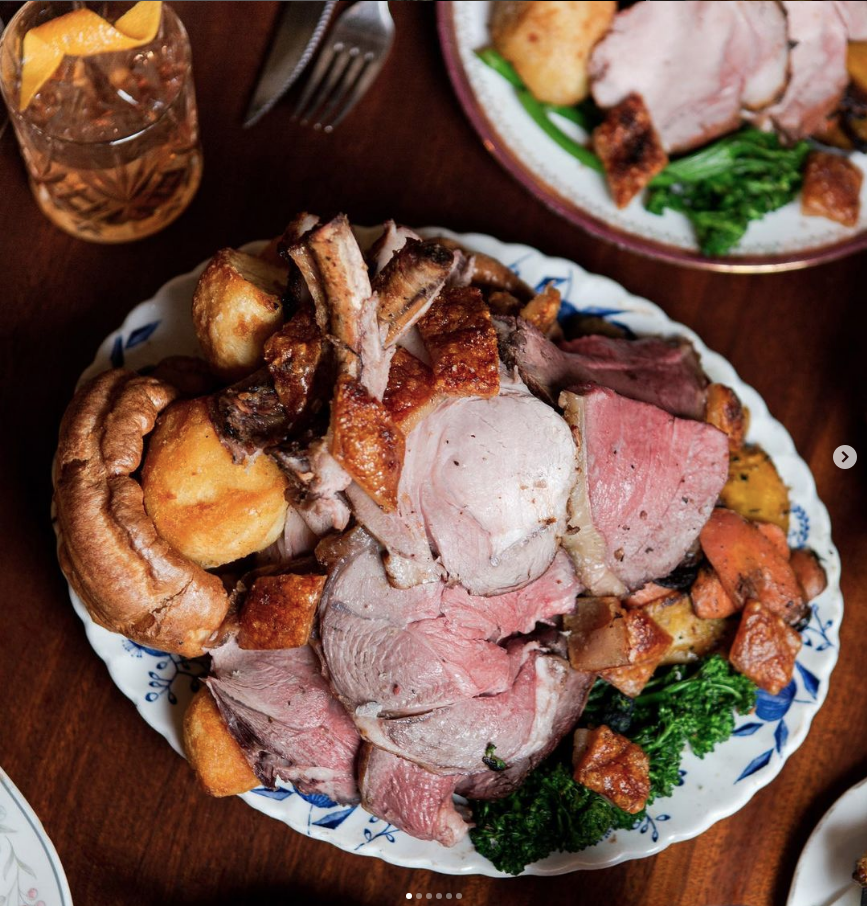
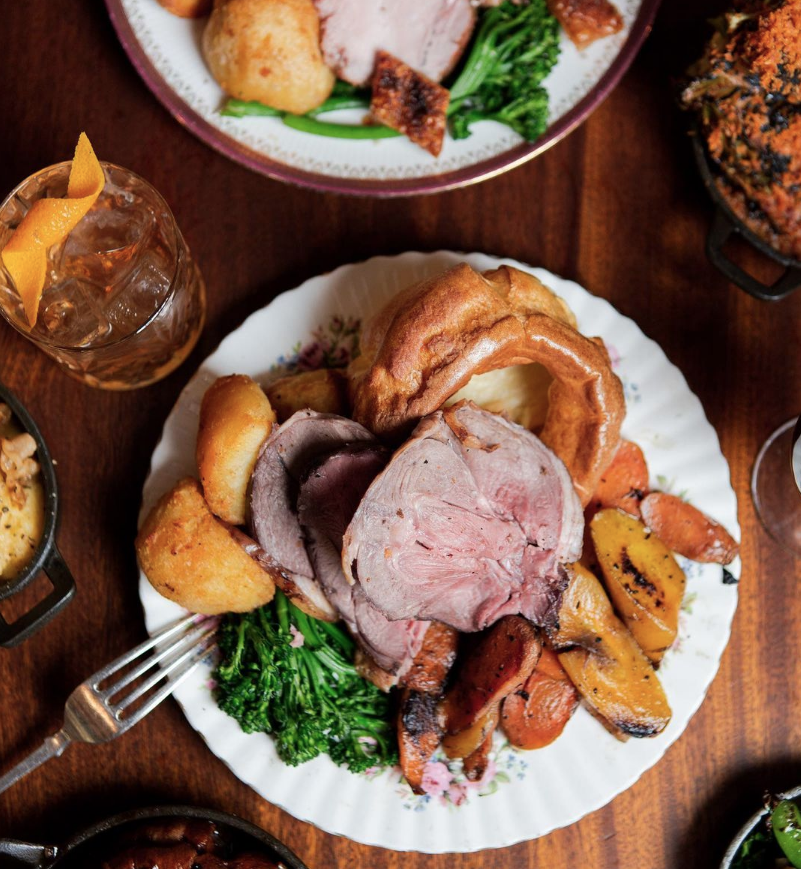
It’s from the Devonshire’s dedicated butchery room, which boasts space for 4000 steaks, that the magic happens. Nope, there’s no mixed grill here. Neither is there the tough decision of whether to go for chicken, lamb, pork or beef (beef, it’s always beef), with only the latter served in roast rib form with all the usual sides and aplomb. That rib comes in a single, thick slice, wall-to-wall blushing pink, with silver service for the roasties and Yorkshire puddings. Re-ups of the gravy boat are available on request. What more could you want?
For £29.50 a head, this is certainly at the premium end of the pricing for a Sunday roast in Soho (or pretty much anywhere in London, for that matter), but it’s well worth it. Finishing things off with the signature bread and butter pudding is a no brainer.
Do note: bookings are released at 10:30am on Thursdays, three weeks in advance. Set your alarm – slots vanish within minutes.
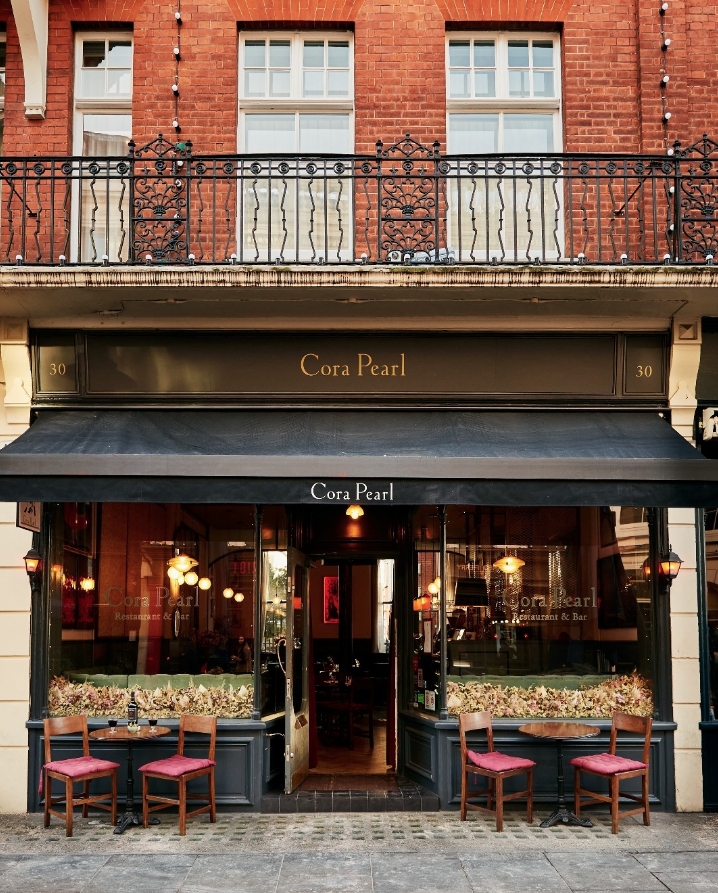
Cora Pearl is the younger sibling to perennially popular Kitty Fishers, the Mayfair bistro known for its confident British cooking and celebrity clientele, equally.
Like Kitty Fisher’s, not only is Cora Pearl named after an infamous courtesan, but it also places a focus on unfussy British fare, and unfussy is definitely a prerequisite of a Sunday roast, we’d venture.
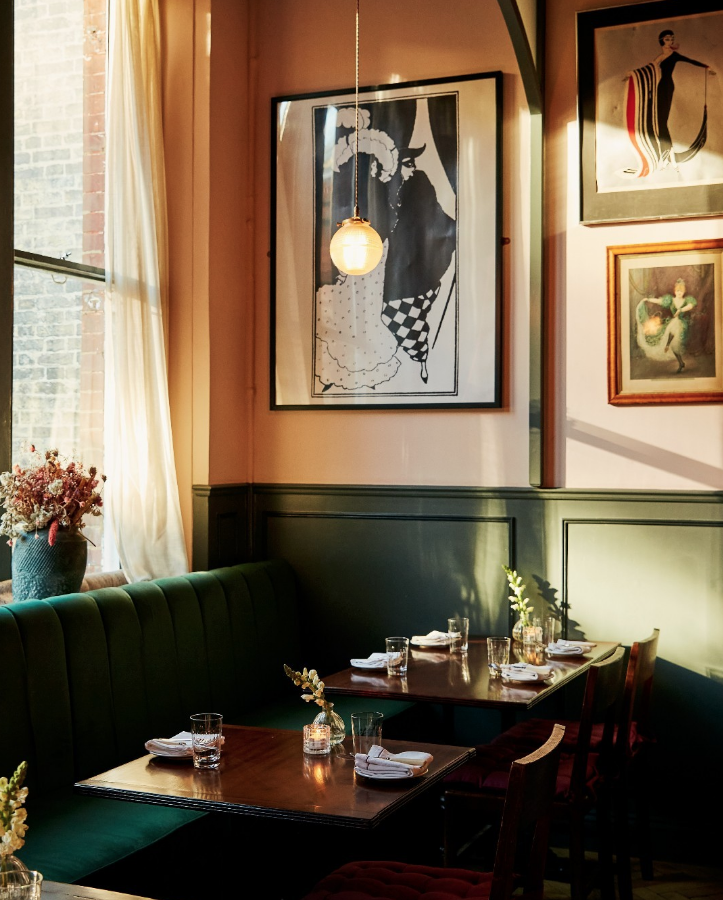
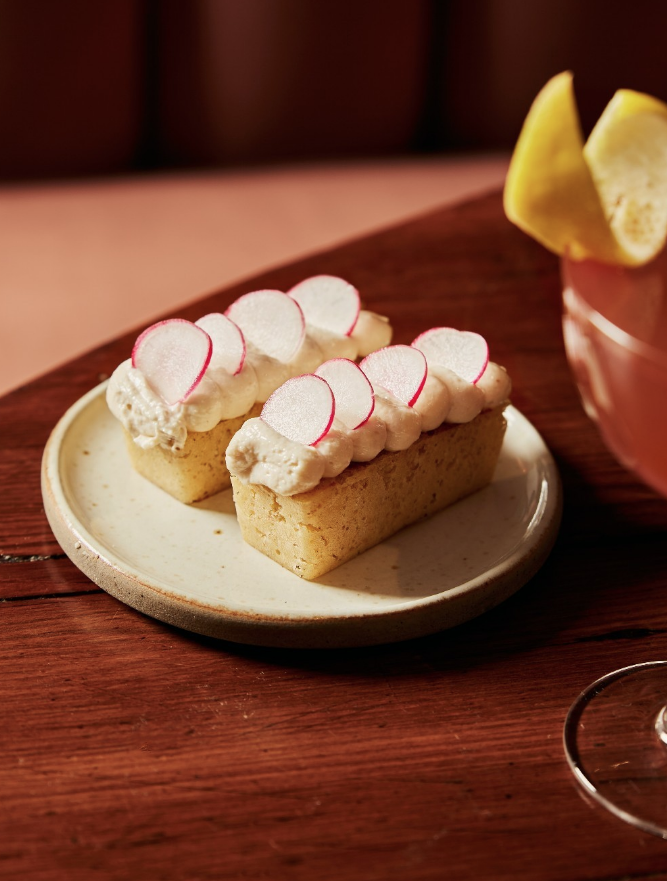
It’s all very gorgeous inside, and mellow jazz music plays in the background, making you want to linger a while after your meal. Or, of course, linger a little before the headlining course, with some whipped cod’s roe on caraway wafers or a coronation chicken toastie.
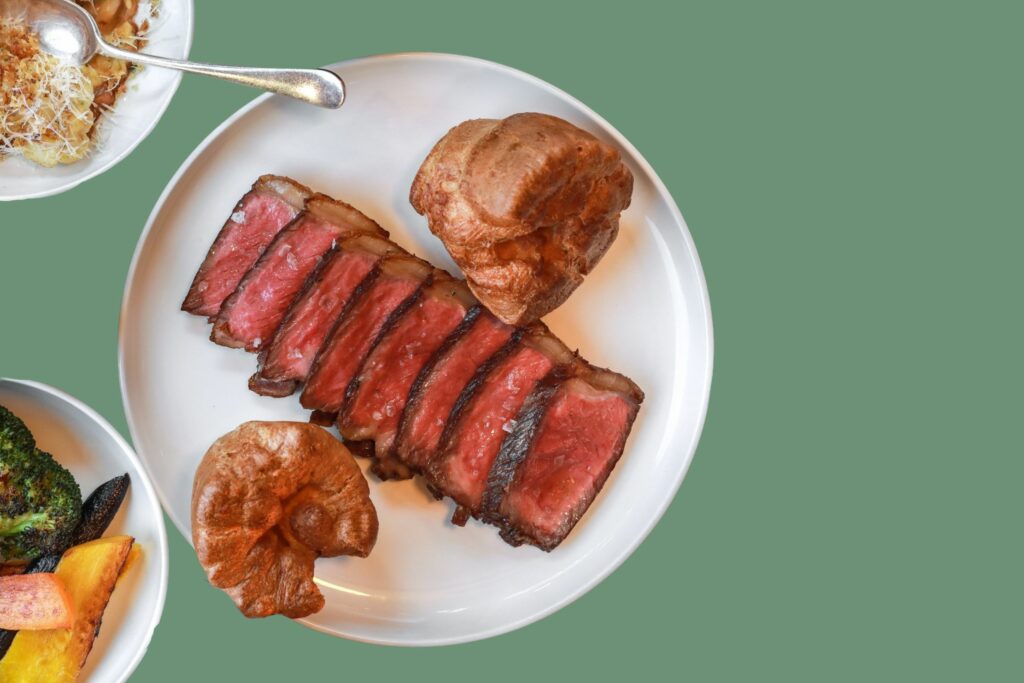
When it comes to the roast, it’s everything that you could want; generous, expertly cooked and darn delicious. They serve a roast sirloin of Highland beef here which is crowned as the king of roasting joints for good reason – served with horseradish cream and all the trimmings, each slice is a showstopper.
The roast organic chicken is equally as tasty and comes perked up with cranberry sauce – a winning combination. You get a choice of fish at Cora Pearl, too. Currently they’re serving up a roast sea trout with fennel and nduja that certainly looks the part. Roast pork belly with mustard mayo rounds out the options.
Either way, finish with the milk and cookies or a rice pudding brûlée, and leave deliciously satisfied.
The only problem when eating in Soho is that it’s dangerously close to some of the best cocktail bars in the city – better get the recipe for those beef jus Bloody Mary’s for tomorrow!
There’s an old Yorkshire saying: “Hear all, see all, say nowt; eat all, sup all, pay nowt”, and while Yorkshire folk may be famously careful with their money, the dining scene in York proves that some things are worth loosening the purse strings for.
Behind the medieval walls and Gothic spires, this historic city has quietly transformed into one of Britain’s most exciting food destinations, where talented chefs are writing new chapters in York’s two-thousand-year story through their menus.
The city’s culinary landscape stretches far beyond the traditional tearoom offerings that once defined it. Today, you’ll find everything from refined tasting menus showcasing Yorkshire’s exceptional produce to bustling wine bars, neighbourhood bistros pushing creative boundaries, and even AVPN-certified Neapolitan pizzerias.
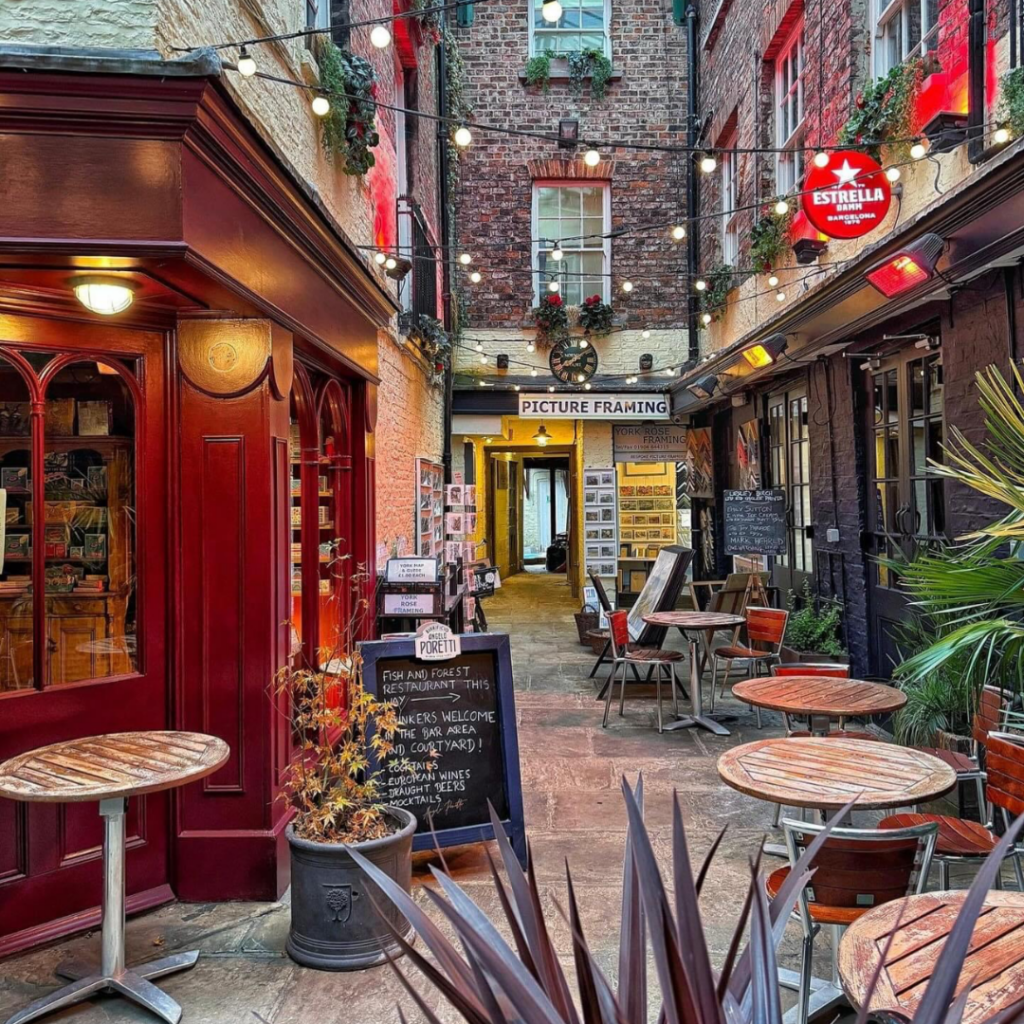
In the narrow Snickelways and along the cobbled streets, ancient timber-framed buildings now house restaurants that wouldn’t look out of place in London or Copenhagen. Yet there’s something distinctly Yorkshire about it all – a refreshing lack of pretence that keeps the focus squarely on what matters: the food.
But in a city where every alleyway seems to hide another promising restaurant, and where new openings appear as regularly as tourists at the Minster, the challenge isn’t finding somewhere good to eat – it’s choosing between them. We’re here to help with that; here are the best restaurants in York.
Roots
Ideal for farm-to-fork fine dining that doesn’t take itself too seriously…
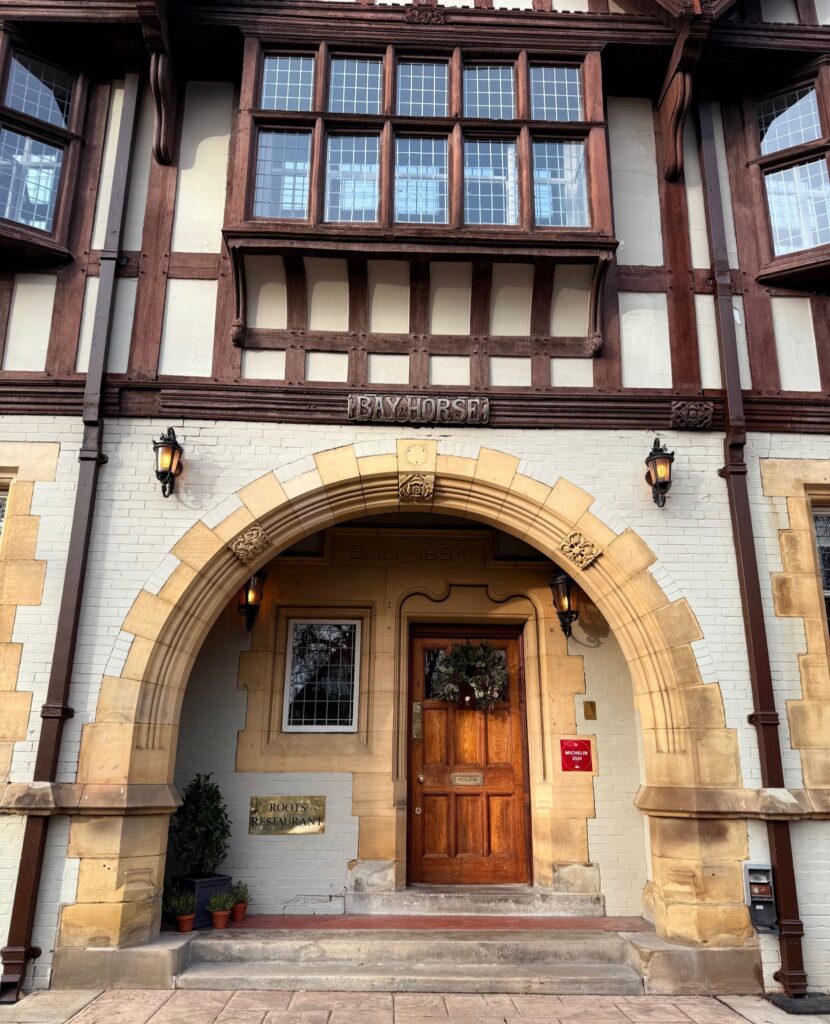
The second act of chef Tommy Banks, this Michelin-starred venture doesn’t just serve food – it serves a sense of time and place. Housed in a Victorian pub where patterned rugs soften wooden floors and natural light pours through tall windows, Roots presents the Banks family farm (over in Oldstead, where the mothership Black Swan sits) in edible form.
It all reads a bit pretentious when we write it down, but what a pleasure it is to eat this expression of Northern British seasonality. Head Chef Will Lockwood and team work with ingredients that tell stories: vegetables that spent months in the ground at Oldstead, wild foods foraged from hedgerows, preserves that capture seasons past and gluts enjoyed in jars and bottles.
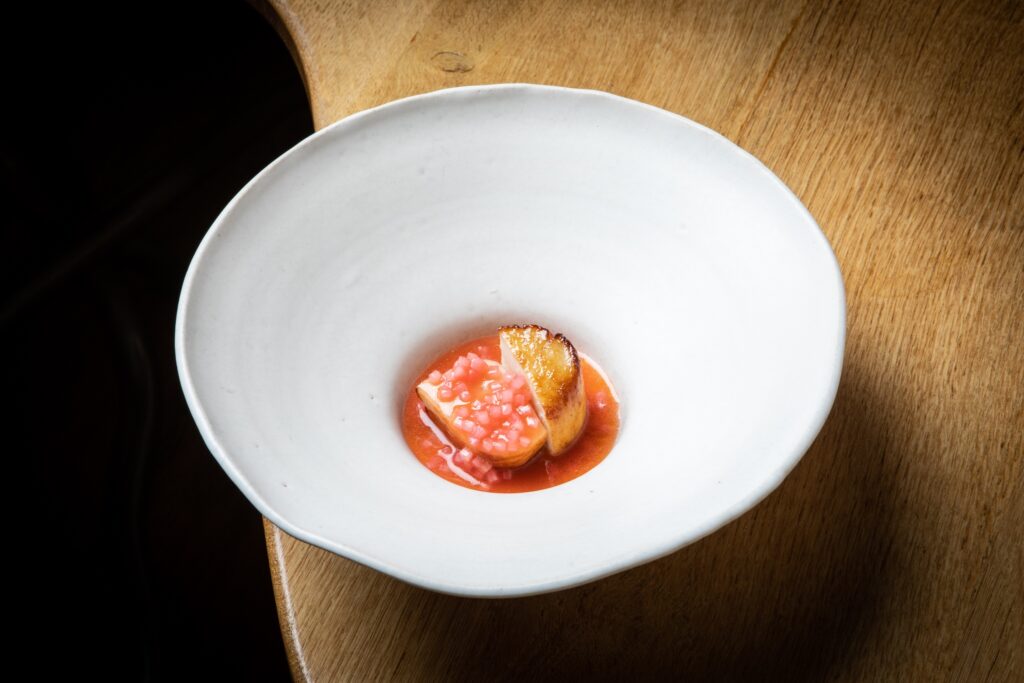
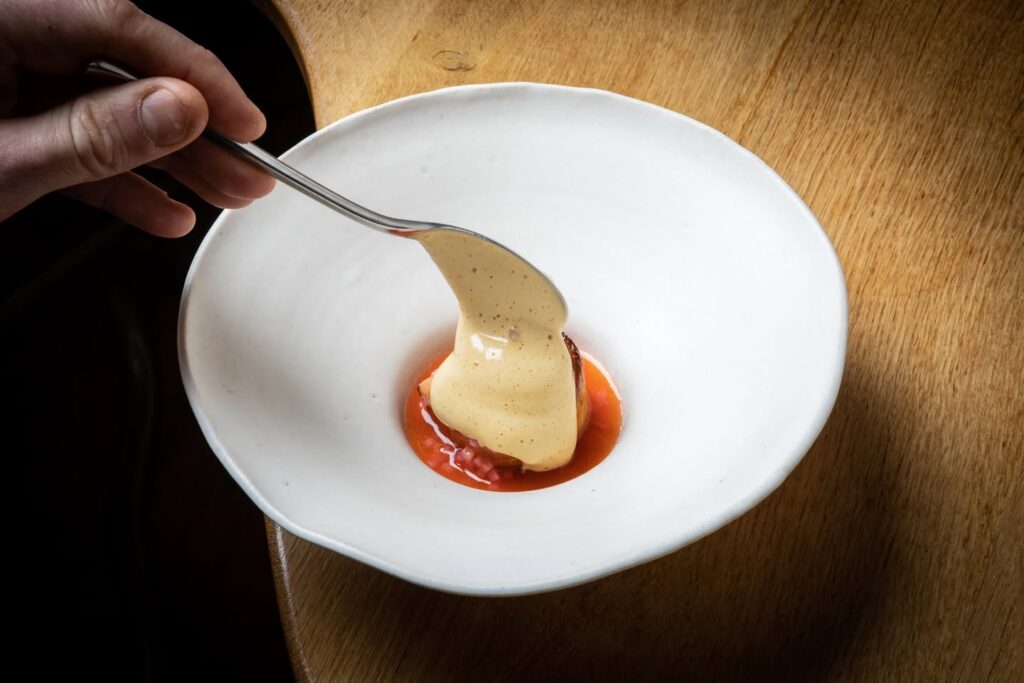
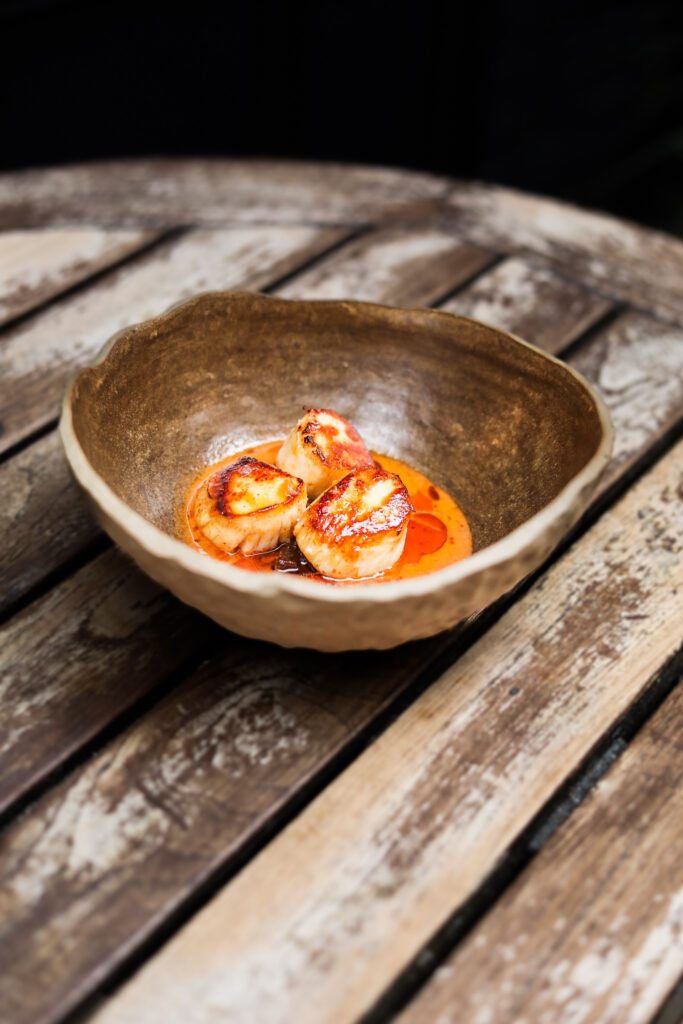
The Core Menu (£110) serves as your introduction to this philosophy, while the Signature Menu (£165) goes deeper and longer, both featuring ingredients that have been coaxed into new forms through months of preservation. A palm-sized scallop is served halved and anointed with brown butter sabayon. It sits on a tamari sauce made, not from soybeans but rather, fermented black squash.
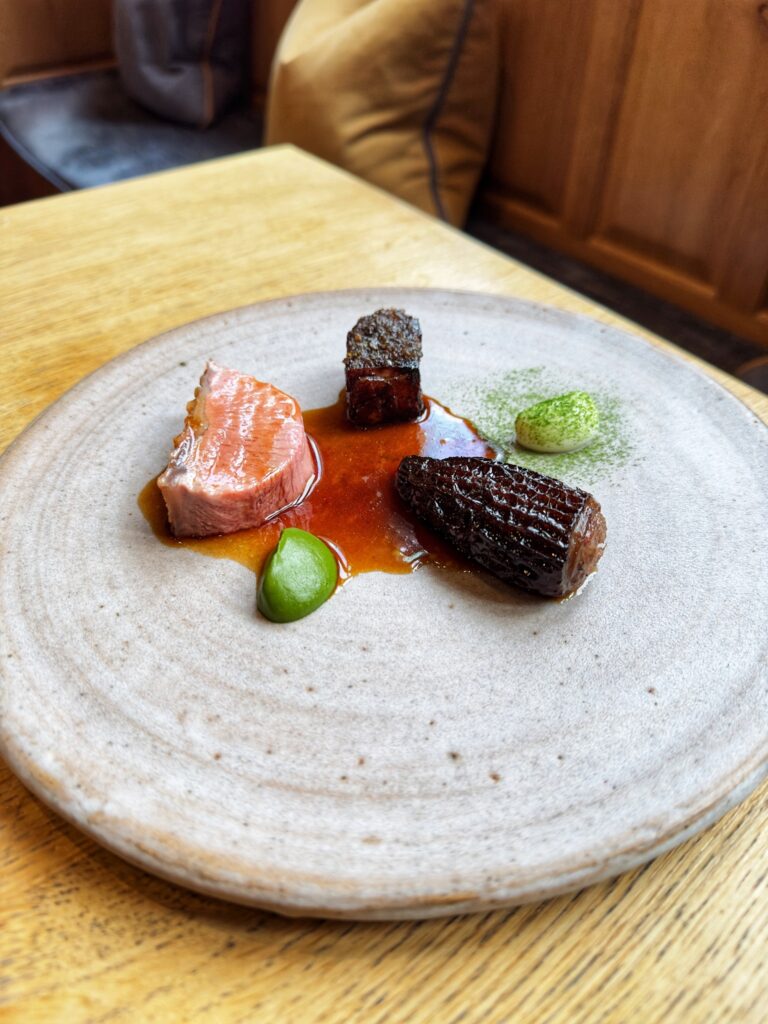
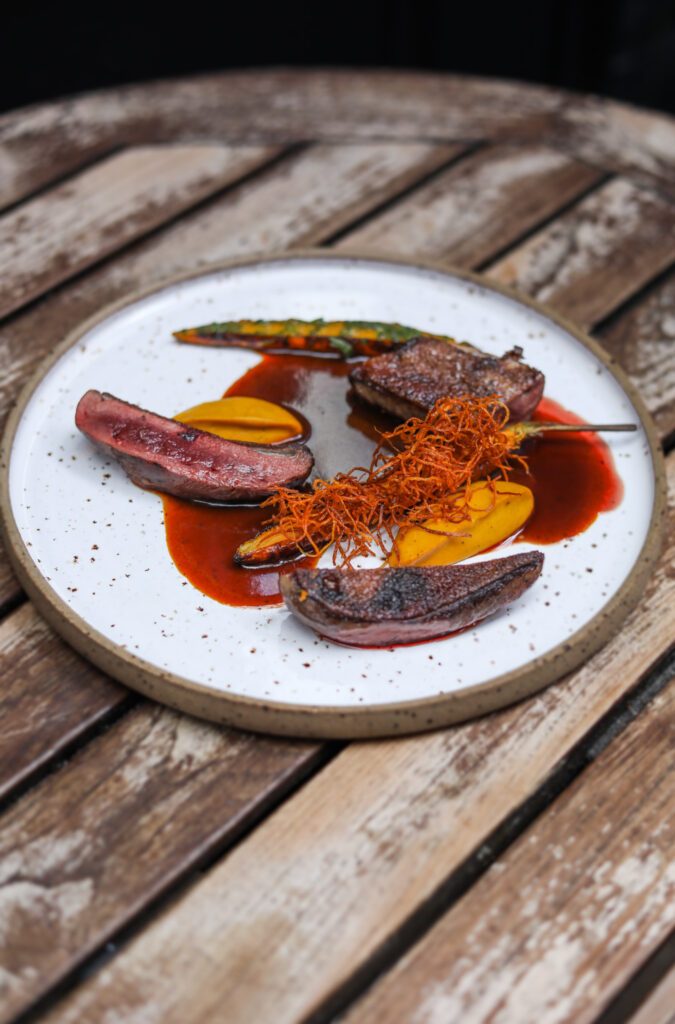
The headlining hogget is the star of the show, a study in whole-animal cookery, featuring both roasted saddle and belly. The saddle, bathed in garlic butter and thyme, shares the plate with its transformed belly counterpart – a testament to time and fire, braised and barbecued before being glazed with a compelling black garlic vinegar caramel. Morels, butter-roasted and cleverly stuffed with lamb faggot mix, bring an earthen depth alongside twin purees of sheep’s yogurt and green onions that have been kissed by fermented onion juice. The dish speaks to both tradition and innovation, crowned with a rich hogget sauce that makes the most of every part of the animal, from bones to trim, all enriched with herbs and lamb fat. Christ it’s good.
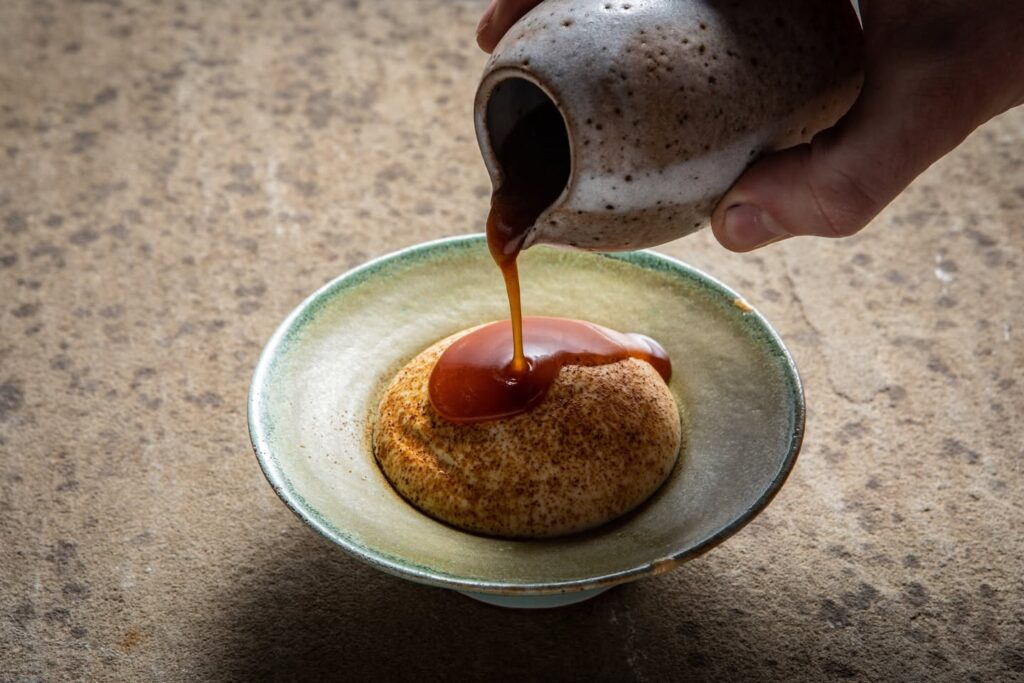
Desserts are particularly intriguing, a marriage of both savoury and sweet, and last year and this. A recent sweet course of roasted chicory root turned crumble and ice cream, was paired with Charlotte potato custard foam and sea salt caramel. It was as intoxicating as it sounds.
The drink pairings show similar thoughtfulness. The Experimental & Adventurous might pair your course with a Polish Solaris or South African Cabernet Franc, while Grand & Classic stays closer to fine dining traditions. The non-alcoholic Soft & Inventive pairings prove zero-proof can be just as compelling as their spirited counterparts. At Roots, it’s the most enjoyable drinks pairing we’ve had – nuanced and complex, drawing on the restaurant’s library of preserved ingredients.
The yacht rock soundtrack reminds you that even Michelin-starred food doesn’t require hushed tones. Was that Steely Dan we heard meandering across the dining room? We like this place even more…
The kitchen hums Wednesday through Saturday, with dinner service nightly and lunch adding another layer of possibility on Fridays and Saturdays. Getting a table here requires the same patience needed for their slow-food philosophy – but like their aged beef and preserved vegetables, good things come to those who wait.
Ideal for sustainable seafood that tastes like it was caught just moments ago…
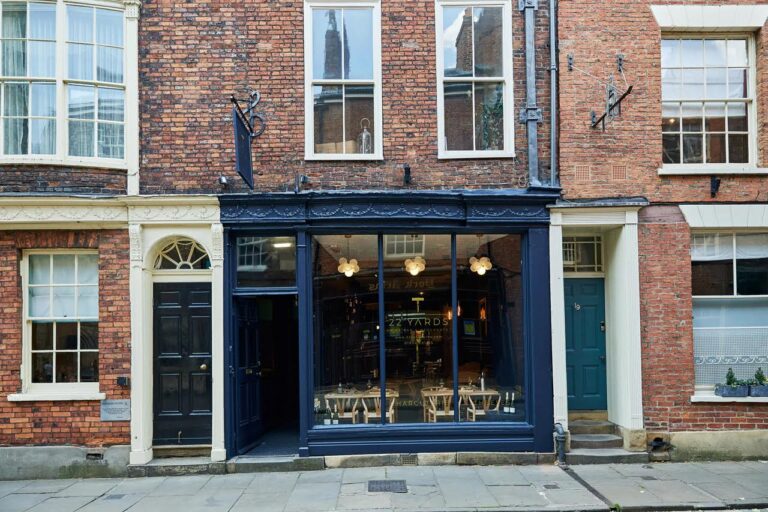
It takes confidence to open a sitdown seafood restaurant 40 miles inland. After nomadic stints at Spark: York and the Gillygate pub, chef Stephen Andrews has found Grape Lane’s brick and timber the perfect backdrop for his ambitious vision. The Michelin Guide’s nod for sustainable gastronomy suggests that geography is no barrier to exceptional fish cookery. And let’s be honest; 40 miles isn’t really that far. We just needed something to say…
The weekly-changing chalkboard menu isn’t just practical – it’s a manifesto for the freedom of flexibility. One week might bring rich pulled mallard ragu with a tangy Yorkshire relish, the next could feature bream kissed by a Japanese Konro grill, accompanied by pickled mussels and samphire. Classical technique meets contemporary thinking, sure, but it’s in the latter where the kitchen really shines – witness their pan fried king scallops, with XO sauce made from dehydrated scallop roe, which packed an umami wallop and is the best thing we’ve eaten here by some margin.
While seafood and game lead the menu, vegetable dishes receive equal attention, proving that the restaurant’s sustainability chops extend beyond just fish. Earthy and humble, a recent carrot dish saw this root vegetable used in multiple ways, from smoky purée to crunch offcut crips, all centred around a perfectly roasted carrot, and crunchy crisps made from the offcuts. It was paired with mallard breast, vibrant carrot top salsa verde, and a rich mallard jus gras – a plate that was as delicious as it was sustainable, and the most carrot-y dish you’ll ever taste, even with a load of blushing wild duck on the plate.
They nail the sweet stuff, too. To finish, you might find a rich chocolate delice served with coffee cream, white chocolate mousse, and a crunchy salted almond brittle – layers of texture and flavour in every bite.
Front of house manager Yohan Barthelemy brings genuine enthusiasm rather than rehearsed service, matching dishes to wines from a list that prizes character over predictability. This is the type of bistro every neighbourhood should have.
Wednesday through Saturday service (noon to 9pm). Friday and Saturday evenings require forward planning. With a reputation as one of the best restaurants in York, tables here are increasingly coveted.
Ideal for creative small plates that will surprise and delight…
Watching Neil Bentinck’s kitchen at work feels like witnessing culinary jazz – precise yet improvisational, technical yet soulful. Skosh really is something.
The recent expansion of this Grade II listed space beyond Micklegate Bar has added a proper bar, private dining room, and more counter seats, but hasn’t diluted the electric atmosphere that made the original so magnetic. The Michelin Guide clearly agrees – Skosh was awarded a Bib Gourmand in the 2026 selection, recognition that what Bentinck delivers here is not just exciting but seriously good value, too.
The name Skosh – Japanese for ‘a small amount’ – understates what’s happening here. Each plate may be small, but the ideas are expansive. Take their hen’s egg – a £4.50 masterpiece where Dale End cheddar, PX sherry and mushroom create something that lingers on diners’ palates all evening, such is the hit of umami at its core.
The kitchen moves effortlessly between culinary cultures without breaking stride: Whitby crab finds itself on tostadas brightened with clementine, while luscious, wobbly pork belly transforms into a vindaloo that would make both Yorkshire and Indian grandmothers proud. Their apple crumble soft serve – a playful collision of salted caramel and blackcurrant – proves that kitchens of real poise and focus can still have a sense of fun.
The staff navigate the menu’s global wanderings with the confidence of seasoned travellers (or, you know, experienced hospitality workers), helping you plot a course through both dishes and a wine list that favours character over convention.
Grab a counter seat to watch the kitchen’s choreography, or settle into the dining room for a more languid experience. They serve Wednesday through Saturday, both lunch and dinner, with Sunday lunch added to the rotation too. Even with the expansion, reservations remain as sought-after as summer sunshine in Yorkshire, and booking a week or two ahead is pretty much essential.
Ideal for North African flavours that will transport you straight to the Yorkshire souks…
What began as Tarik Abdeladim’s market stall in 2015 has grown into something that defies easy categorisation. Still, we’ll do our best…
Behind the warm yellow walls on Grape Lane, traditional North African and Levantine dishes aren’t just reproduced – they’re reimagined through a Yorkshire lens that proves authenticity and evolution aren’t mutually exclusive.
The kitchen’s dedication reveals itself in quiet details: lemons preserved in-house, merguez sausages made daily (served with minty cacik and urfa pepper flakes, and keenly priced at £9), local ingredients transformed through ancient techniques.
The Algerian cassoulet is the headliner, and exemplifies this approach – giant butter beans and house-made merguez create a foundation for Thirkleby duck leg confit, while urfa-spiced whipped feta adds unexpected depth. Whilst £26 is a premium price in this part of town (or rather, in this part of the UK), it’s a massive, bottomless piece of work – Northern portions, indeed.
This commitment to locality runs deep – meat from the Yorkshire Dales, halloumi from Huddersfield, even their house beer comes from Brew York. Whether it’s dry-aged local lamb rump singing with ras el hanout and celeriac, or baked hake, landed off the coast in Whitby, finding harmony with coconut dahl, each dish reflects both its origins and its current home. The wine list travels further, sure, but still has a keen sense of place, featuring Lebanese bottles alongside European classics.
For those seeking Los Moros’ roots, their original street food stall still trades in Shambles Market, serving some of York’s most compelling lunch options. Open Tuesday through Saturday (12-2pm lunch, from 6pm dinner – earlier on Fridays). The restaurant’s popularity makes booking ahead wise.
Ideal for special occasion dining that’s stood the test of time…
Some restaurants survive for thirty-five years. Melton’s, open since 1990, has done something rarer – it’s evolved. In this intimate Scarcroft Road space, Michael and Lucy Hjort created more than just a restaurant; they arguably laid the foundations for York’s current dining renaissance. Now, with Head Chef Calvin Miller at the helm after more than 14 years alongside Michael, Melton’s proves that longevity and a forward-thinking mentality aren’t mutually exclusive. A third AA Rosette, awarded in September 2025, feels entirely deserved – this kitchen is operating at a level that belies the restaurant’s understated, neighbourhood feel.
The kitchen marries classical technique with contemporary vision. A cep and kombu custard arrives with barbecued maitake and beer vinegar, honouring the fundamentals of classical cookery whilst introducing more global elements. Even familiar dishes reveal new depths – halibut gains complexity from a truffle and hazelnut crust, while a recent, hugely satisfying blackberry and meadowsweet dessert shows a kitchen willing to play with de rigueur ingredients without detriment to pure pleasure.
Lucy’s presence in the dining room turns first-time visitors into regulars through genuine warmth rather than rehearsed hospitality. Her wine list (all personally chosen) deserves particular attention – not just for its depth, but for markups that suggest they’d rather you explore than play it safe. There’s even a wine from Yorkshire in there – a white from Lauren Vines in Driffield, priced at an eminently reasonable £26.60.
Choose between the Short Menu (£85 for three courses) or the Tasting Menu (£98 for six courses), both equally accomplished. The dining room itself, with its distinctive murals and considered lighting, feels both special and comfortable – much like the restaurant as a whole. Tuesday through Saturday service (dinner only Tuesdays, lunch and dinner otherwise) still draws crowds after three and a half decades.
Ideal for special occasion dining in spectacular settings…
Andrew Pern has mastered the art of creating restaurants that feel inevitable – as if they’ve always been part of Yorkshire’s fabric. His Star Inn The City – sibling to the Michelin-starred Star Inn 20 miles north in Harome – transforms a former engine house into all-day riverside dining that makes you wonder how the building was ever used for anything else.
The Star Inn’s terrace captures that rare alchemy of setting and sustenance. Inside, red velvet banquettes and white tablecloths create an atmosphere that welcomes both special occasions and impromptu, booze-fuelled lunches.
The kitchen celebrates Yorkshire with honest confidence – a baked Tunworth arrives generous with salted hazelnuts and onion chutney, while the Sunday roast sirloin (£27) delivers everything you hope for, including duck fat roasties that could start arguments over who gets the last one in lesser establishments. A proudly Yorkshire establishment of course delivers on a particularly proud Yorkshire pudding; this one is fucking massive!
Or, go in a different direction with their eight-hour braised ox cheek with winter truffle potato purée, which shows similar dedication to getting the basics exactly right whilst sprinkling a little stardust (or simply grating a shed load of truffle) along the way.
The wine list spans from accessible to ambitious (yes, that Ornellaia 2008 really is £815), while the cocktail programme adds theatrical touches – their smoked Old Fashioned arrives wreathed in woodchip smoke and tasting of it, too. You can, of course, just have a pint – the Star Inn The City is one of the only Pilsner Urquell Tankovna tank beer sites in the North of England.
Open from 11am weekdays (9:30am weekends), it’s equally suited to morning coffee or midnight digestifs. The dress code stays relaxed, but the cooking never lets up.
Ideal for authentic Neapolitan pizza that makes you forget you’re in Yorkshire…
Pizza certifications might seem like bureaucratic overkill, but the AVPN (Association Verace Pizza Napoletana) badge that Cresci earned isn’t just paperwork – it’s proof of Armando Imparato and Berardo Caggiano’s obsession with getting things right – nothing more, nothing less. Since 2020, their Piccadilly restaurant has been quietly showing York that Neapolitan pizza is both science and poetry.
The bare bones space tells you everything about their priorities: wooden tables, walls lined with Italian products, and an open kitchen where the wood-fired oven commands attention like a theatre’s main stage. Each pizza base emerges with that distinctive Neapolitan character – a crust that’s both chewy and tender, soft centre maintaining its integrity. Their Margherita (judiciously priced at £9.50) demonstrates why simplicity requires perfection: San Marzano DOP tomatoes, fior di latte mozzarella, basil, and olive oil, each element given space to be heard. The Calabrese (a little more at £13, but still not that much) adds ‘nduja and sautéed red onions without losing that essential balance.
Even the starters show this attention to detail – their frittatina di pasta comes in both classic and cacio e pepe variations, while the Sicilian cannolo filled with goat’s ricotta and 70% Callebaut chocolate makes a compelling argument for saving room for something sweet.
Open daily from noon until 10pm without reservations – though the queue at peak times suggests that sometimes the best things are worth waiting for.
Ideal for relaxed evenings where the wine list is as compelling as the food…
Cricket and fine dining rarely intersect, but 22 Yards – named for both a cricket pitch’s length and their dining room’s dimensions – proves that unexpected combinations often yield the most interesting results. Housed in a Georgian building facing York Minster, it’s created something increasingly omnipresent down in that there London but less so up north: a wine bar that takes its food as seriously as its cellar.
The menu walks a delicate line between sophistication and comfort. Orkney scallops with brown butter and truffle showcase the kind of technical precision that premium ingredients demand, while their slow-braised ox cheek with pecorino and herb polenta satisfies more base, carnal cravings.
The kitchen shows particular flair with game – their venison goulash with sauerkraut and crispy onions is a winner – a bowl you can get truly lost in until your partner actively becomes concerned. But it’s their charcuterie and cheese programme that truly puts the 22 flag in the ground. The 22 Yards Deli Board (£32) reads like a roll call of Yorkshire’s finest artisans: Wildman’s cured meats, Courtyard Dairy cheeses, house-made focaccia… Gorgeous stuff.
Their wine programme – over 150 bottles for retail and 70+ by the glass – reflects the same thoughtful curation as the food. The sommeliers bring knowledge without pretence, whether you’re exploring house wines priced in their mid-twenties or serious Burgundies that reach triple digits. Their pre-theatre offer (deli board and two glasses of English sparkling for £48) might be York’s smartest value supper.
Open from noon (5pm Mondays and Tuesdays), though weekend evenings require advance planning – word has spread.
Ideal for brunch that’s worth getting out of bed for…
Some spaces defy easy categorisation. In a neo-Victorian building on Micklegate, Partisan blends café, gallery, and restaurant into something uniquely York. Owner Florencia Clifford, who refined her approach as a cook in Buddhist retreats, brings mindful attention to everything from their North Yorkshire farm’s herbs to the curated artwork on the walls.
The globally-influenced menu peaks at brunch. Huevos Vaqueros reimagines eggs in chipotle-spiced tomato sauce with black beans, while Persian Eggs marry slow scrambling with Medjoul dates and almond dukkha. Their Full English comes in three thoughtful variations (all £16), each built around house-made smokey beans and M+K herb sausages. The signature dish, though, is the scallop and bacon bun, which has earned (deserved) legendary status in York.
There’s a counter of delicious bakes, too, including ever-present sweet and savoury scones that change change daily according to the seasons. Elsewhere on the counter, you’ll find inventive bakes like crème brûlèe apple and cardamom cruffins, and sticky baklava buns. It’s all very nourishing indeed, if not for the waistline then definitely for the soul.
Beyond perfectly executed Monmouth coffee, their drink selection shows similar care – from creative spritzes to single-origin hot chocolates featuring bars from Venezuela to Madagascar (£3.50). The recent addition of their evening concept Brancusi suggests an operation still evolving.
Open daily 9am to 3pm, the consistent queue of locals and visitors suggests they’ve found a winning formula. Every piece of art and furniture tells its own story – and yes, it’s all for sale.
Ideal for imaginative British cooking that celebrates Yorkshire’s larder…
Some homecomings take the scenic route. After 15 years of refining their modern British cuisine in Sydney, Adam and Lovaine chose York’s Old Coach House on Peasholme Green to continue their story. The result is a restaurant that combines technical precision with the kind of warm hospitality that can’t be taught.
Their kitchen menu (from £85) reveals ambition tempered by experience. Venison tartare finds unexpected but totally right companions in smoked eel cream and beetroot, while a mushroom dumpling with garlic purée and confit carrot shows similar imagination anchored in an understanding of what works together.
But it’s their cheese trolley – a tradition carried from their Sydney days – that’s become legendary. Working with Yorkshire’s Andy Swinscoe, each morning begins with a debate about perfect ripeness and ideal combinations, turning cheese service into performance art. Or, if you’re after something sweeter, the ‘A Little Bit of Yorkshire’ dessert, featuring local strawberries and Yorkshire Tea marshmallows, captures the kitchen’s ethos: serious cooking that remembers to smile.
The wine list (200+ bins) mirrors this attention to detail, ranging from accessible to esoteric. Their Little Arras bakery nearby suggests an operation unwilling to compromise – the sourdough alone justifies the detour.
Open Wednesday through Saturday for lunch and dinner, with their kitchen menu showing the team at their most expressive.
Forget everything you think you know about suburban dining. Or, indeed, dining in Surbiton…
Still often dismissed as nothing but a sleepy commuter town, Surbiton actually lays claim to one of South London’s most exciting food scenes. This former Victorian railway residential neighbourhood, just 16 minutes from Waterloo, now boasts a dining scene that could rival most across London’s outer neighbourhoods, with an admirable independent spirit that keeps things interesting.
The epicentre is Maple Road, where ambitious young chefs and family-run restaurants sit side by side, but the entire area pulses with a palpable culinary energy. From a two-rosette French restaurant that Gordon Ramsay once featured on his show to a brand-new Turkish spot that’s turned a tired pub into Surbiton’s hottest opening, here are the best restaurants in Surbiton.
The French Table
Ideal for impressing food-obsessed Francophiles who think nothing good happens south of the river…
Eric and Sarah Guignard have been quietly going about their business of running one of London’s best French restaurants from this sage-green fronted building on Maple Road since 2001.
While central London spots chase trends and Instagram likes and Tod mentions, Eric sticks to what he knows: technically on-point French cooking that makes you remember why the folk who always bang on about classical technique aren’t just toeing the line.
The Lunch Prix Fixe Menu is a steal at £35 for three courses, available Tuesday to Friday. A recent menu featured red onion tarte tatin with whipped goat cheese, pork belly and cheek with white coco beans and green beans casserole, and poached conference pear with chocolate sauce and Chantilly – each course paired with a tailored wine recommendation. It’s textbook stuff: seasonal produce, classical technique, zero fuss.
For those seeking the full experience, the Dinner Tasting Menu (£80 per person, £130 with matching wines) runs to five courses and is where Eric and his team really stretch their legs. The March 2026 menu opened with citrus cured Loch Duart salmon with fennel escabèche and blood orange before building through new season white asparagus with coppa di Parma and cured egg yolk to a main of venison loin roasted in smoked tea butter with sticky red cabbage, caramelised pear and sauce grand veneur. Wine pairings run from English sparkling (Balfour Winery, Kent) through to Muscat de Beaumes de Venise, and the whole thing demonstrates Eric’s ability to layer complex flavours without overwhelming the palate.
The dining room spans two floors painted in calming pastels, tables spaced far enough apart that you can actually have a conversation. Service maintains professional standards while remaining relaxed enough to not lead to a dining room of hush and whisper, and they genuinely seem pleased when you ask what’s in a dish.
Ideal for spice enthusiasts looking for delicate complexity…
Nand Kishor Semwal doesn’t do tikka masala or korma. Instead, at Koyal, the former head chef at Andy Hayler-starred Dastaan, Michelin-starred Trishna and two-starred Gymkhana has brought his considerable talents to this unassuming spot on Brighton Road, where he’s using Himalayan wild mustard and perilla seeds in ways that will rewire your understanding of Indian cuisine.
The menu is an intriguing blend of faithfully rendered regional Indian cooking and the occasional fine dining flourish. The hara pyaaz, aloo and palak ke bhajiye arrive as delicate fritters that shatter at first bite, releasing clouds of steam scented with herbs you can’t quite place. That’s the perilla seed chutney working its magic. The pani puri, decent value at £7, involves multiple layers of flavour that unfold as you eat, with tangy kiwi and pineapple water adding unexpected brightness where usually the richness of tamarind would anchor the whole thing.
Semwal’s Michelin-starred background shows in technically accomplished dishes like the wild boar with toddy vinegar and Goan spices, whilst the muntjac dum biryani layers basmati rice with tender deer meat, saffron and fried onions in the traditional style, the gamey notes tempered by undulating waves of heady dried spice.
Perhaps it’s those bits coming off the binchotan coal grill that produce the truly standout dishes; the wild tiger prawns with kasundi, black pepper and garlic (£7.50 each) are a case in point.
Pair it all with a couple of drinks from the cocktail list, which features bangers like a Saffron Gimlet with gin and saffron cordial, or the Old Monk By The Fire – a dessert cocktail made with 7-year Indian rum, masala tea and almonds. The wine list includes interesting Indian selections from Sula Vineyards alongside European choices.
The dining room seats 130 but never feels cavernous, decked out in colours that stop just short of garish. Service runs on the unobtrusive side, letting the food take centre stage. A meal here runs around £75 per person, which reflects the pedigree and the fact that every dish tastes multicoloured, psychedelic even.
The main man Andy Hayler, who had once eaten at every three-Michelin-star restaurant in the world, reviewed Koyal earlier this month and concluded that no restaurant in London is currently serving better Indian food. And having once read every Andy Hayler review in the world, we can confirm that he’s pretty darn discerning when it comes to Indian food in the capital.
Ideal for Italian that balances ambition with affordability…
The Italian Taste offers something that sits somewhere between your local red-sauce joint and those sterile places where they charge £35 for cacio e pepe, more Siena than Shoreditch, perhaps. Family-run since it opened, this Victoria Road stalwart delivers exactly what you want from a neighbourhood Italian: generous portions, fair prices, and pasta that tastes like someone’s nonna actually made it rather than an English fella made it with both eyes on the bottom line rather than the mantecare pan.
The menu spans all the classics you’d hope for, from daily-changing zuppa del giorno to an indulgent antipasto misto that could easily feed two. The gamberoni Vesuvio sees fat tiger prawns swimming in garlicky tomato sauce that begs to be mopped up with their excellent bread, whilst the linguini marinara heaves with clams, mussels, and prawns in a sauce that tastes distinctly of the sea without being overwhelmingly fishy.
Good, solid technique shows in dishes like the spaghetti carbonara and the risotto alla pescatora, which showcases quality seafood in a creamy rice base.
The recent addition of a secret garden changes the game completely. What was once a decent local Italian now offers al fresco dining that’s genuinely charming, complete with Mediterranean atmosphere. Inside, the Mediterranean blue walls and checked tablecloths telegraph exactly what kind of place this is: no minimalist pretensions, just a trattoria where families celebrate birthdays and couples share bottles of Montepulciano on date night.
The Italian wine list sticks to familiar territory but does it well – Sangiovese del Rubicone at a decent £25.50, Nero d’Avola from Sicily (£30.90), and a decent Chianti Classico (£37.50) that pairs beautifully with their heartier meat dishes. House wines by the glass start at £6.90, making this accessible enough for midweek visits.
Owner Alida works the room most nights, remembering regulars’ usual orders and making newcomers feel like they’ve been coming for years. Book ahead for the garden, especially on warm evenings when half of Surbiton has the same idea.
Ideal for Sushi purists who want their fish glistening and their rice at body temperature…
Sushi Hero is a tiny Ewell Road spot that does things the way it should be made: to order, with fish that was swimming recently enough to still glisten beautifully.
The room barely fits 20 people, which means booking ahead unless you fancy eating California rolls in your car, in a miserable scene that might have you reaching for the hose. Get back inside the room, where recent renovations have smartened things up without losing the intimate feel. This is still very much a neighbourhood spot, just one that happens to serve genuinely excellent sushi.
The Hero Special Roll changes depending on what’s best that day – their signature prawn tempura creation with avocado, cucumber and tobiko that showcases why they’ve built such a following. For those seeking more, the salmon and tuna tartares arrive beautifully dressed with avocado and mooli, whilst the torched salmon belly with ponzu demonstrates a gesture that predates the Nobu version by several years.
The Special Hero Bento offers exceptional value for those wanting to try everything – sushi, sashimi, yakitori, edamame, tempura and gyoza all on one tray for £23. For the less adventurous, the chicken katsu curry gets raves, the sauce made from scratch rather than dumped from a jar.
While the name suggests sushi-only territory, the menu extends well beyond raw fish. The soft shell crab arrives perfectly crispy, the chicken yakitori shows pleasing char marks from the grill, and the prawn tempura delivers the kind of light, crispy batter that makes you wonder why so many places get it wrong.
The sake selection runs from hot nihonshu served traditional-style to premium cold junmai with its rich, full-bodied character. Individual rolls run £6-8, poke bowls £12-15, making this affordable enough for a midweek treat rather than special occasion only.
Ideal for lazy Saturday sessions that turn into impromptu dinners…
Gordon Bennett’s doesn’t do reservations. Turn up, grab a table if you can, order some small plates and see where the afternoon takes you. This Maple Road spot nails the neighbourhood bar formula: good drinks, unfussy food, and an atmosphere that encourages you to order just one more round.
The weekend brunch game here is strong – the farmers market brunch is their premium take on the full English, loaded with poached eggs, Cumberland sausages, smoked back bacon, roast tomato, hash browns, portobello mushroom, black pudding and beans. For those wanting something lighter, there’s eggs royale with Scottish smoked salmon or the simple pleasure of scrambled eggs on seeded granary toast. Coffee comes from Coffee Bay, Surbiton’s favourite roastery, served in bottomless mugs for those planning extended, jittery sessions.
Come evening, the tapas menu kicks in with small plates designed for sharing and grazing. The warmed garlic and rosemary flatbread arrives with hummus, fresh green olives and mushroom pâté – essentially their trilogy of dips that might fill you up before you get much further. The grilled buttermilk chicken thigh and chorizo skewers have achieved minor legendary status locally, whilst the medium rare bavette steak bulgogi offers something more substantial for those who’ve worked up an appetite.
The padron peppers arrive properly blistered and salted, the salt and pepper calamari comes with just enough heat from fresh chilli, and the aromatic spare ribs provide the kind of messy eating that makes perfect sense with a pint in hand. For those wanting something more filling, the British beef burger (£16.95, or £9.50 during early bird Tuesday-Thursday) comes with mature cheddar and skin-on chips.
The room feels like someone’s particularly stylish living room, complete with mismatched furniture that somehow works and a fireplace that gets actual use in winter. Outside, pavement tables under the trees provide prime people-watching territory. Behind the bar, they take cocktails seriously without being precious about it – the espresso martini and bloody mary both hit the spot.
The no-bookings policy means weekends can get rammed, but that’s part of the charm. This is Surbiton’s front room, where neighbours become friends over shared plates and third rounds.
When Gokhan and Ugur transformed the tired Wags N Tales pub into Renas in November 2024, they didn’t just open another Turkish restaurant. They created Surbiton’s first proper dinner-and-dancing destination, complete with colour-changing ceiling lights and DJs after 10pm. The name means ‘rebirth’ in Turkish, and walking into the maroon and poker-green interior with its crystal chandeliers, you understand why. This is what happens when someone decides suburban dining doesn’t have to mean suburban ambitions, and creates a properly kitschy place in the process.
The menu walks the line between traditional Turkish and modern European with surprising confidence. Their lamb shish gets compared to fillet steak, and deservedly so. Each piece arrives charred outside but blushing within, served with Turkish bread for mopping up the juices. Weekend Turkish breakfasts (£15.90) pack the table with menemen, sucuk, honey, kaymak and enough other bits to keep you going until dinner. The Renas Shaksuka Feast adds fried aubergines and grilled halloumi to the traditional egg dish, because why not?
By day it’s family-friendly, but come evening the place transforms. The cocktail list runs to 30 options, including the Turkish Night and Lokum Turkish Delight that taste exactly as kitsch as they sound (in the best way). At £20-30 for mains it’s pricier than your average kebab shop, but this isn’t your average anything. It’s full-on, hectic, boisterous and bawdy, but, most importantly, it’s utterly delicious.
Ideal for a breakfast that makes you cancel your lunch plans…
The French Tarte sits next door to its four-legged sibling, but don’t mistake it for The French Table’s poor relation. This blue-fronted bakery and café stands on its own merits, starting with pastries that former Ritz pastry chef Michel Rissons crafts each morning.
Weekends the place heaves with Surbiton families loading up on pain au chocolat and flat whites made with locally roasted beans. Secure a table and order the croque monsieur: Gruyère melting into quality ham between slices of their own bread, béchamel sauce gilding the lily in the best possible way. Follow it with an almond croissant if you’re of a particularly gluttonous persuasion, as it delivers flaky pastry wrapped around marzipan-sweet filling that makes you understand why the French take breakfast so seriously.
Such breakfasts can quickly turn into long, languid lunches, with the restaurant closing at 4pm and the lunch menu an enticing rundown of French bright and breezy classics like quiche and another round of that croque monsieur.
The afternoon tea (weekends only, book ahead) presents a French spin on the British classic, with savoury elements that have been given real care in their construction rather than just filling space before the sweet stuff.
The community feels as warming as the coffee, regulars greeting each other over shared tables when space gets tight. Lovely stuff, and we’ll probably stay here a little while…
On the bustling streets of Bangkok, under the lines of the BTS and down the city’s many sois, where the aroma of fish sauce and spice usually dominates, there lies a burgeoning burger scene that’s flipping the script on traditional Thai fare.
Because we all get a hankering for a burger once in a while, even when dining in one of the world’s greatest food cities. And for when that hankering hits, we’ve got you covered; here are the best burgers in Bangkok.
Street Burger Sukhumvit 48, Sukhumvit
We begin our list of Bangok’s best burgers in seemingly insignificant surroundings; on the steps of a 7/11, on Sukhumvit 48. It’s here that you’ll find one man and his hotplate, serving up a simple smashburger that is simply known as ‘the street burger’ to the legions of fans making the pilgrimage just past Phra Khanong for a bite.
Officalled dubbed the ‘beef cheese bun’ by the chef here, one Nattanon ‘Pump’ Sukkamnerd, the burger’s prosaic description is both faithful to its no frills nature and belying of the deliciousness within.
The crisp, crumbly beef patties come gloriously unadorned in nothing more than a little mayo and a slice of American cheese, with the pillowy brioche bun holding things together ‘till the last bite. It – and every one that preceded it – reveals a truly satisfying burger.
And the best part? A double here is just ฿135 – around £3. The perfect excuse to order another, we think…
From humble beginnings cooking burgers for friends in his apartment, chef Taiki Rattanapong has wrought chaos on the Bangkok burger scene with his meticulously crafted creations, putting all other burgers calling themselves ‘gourmet’ to some considerable shame in recent years.
Now situated in an intimate eight-seater counter on the third floor of a nondescript building near Thong Lor (look for a little illustration of the chef’s head on a glass door – it’s all you’ve got to go on), Homeburg offers what can only be described as a fast-food omakase experience. And one that culminates in one of the more extraordinary burgers we’ve ever eaten…
The attention to detail here is commendable – from the precise 33-second timer for toasting the garlic bread palate cleanser to the ultrasonic-treated chips fries that achieve the perfect craggy but crisp texture. The OG burger, the headlining act following a supporting cast that includes tacos and jerk wings, is officially dubbed ‘Prototype #1’, but it’s as fully realised as you could possibly hope for.
A masterclass in balance and harmony; a perfectly cooked patty, a Japanese milk bun, finely chopped pickled jalapeño paste, dashi cheese, crispy bacon and a proprietary ‘Homeburg sauce’…we realise we’re just listing ingredients but it feels wrong to ruin the full surprise here. To hammer home the point about precision, though, only eight diners are served per sitting – though following a full kitchen overhaul in early 2025, there are now two sittings a night, at 5pm and 8pm.
At around ฿3,000 (£70) for the set menu, it’s certainly not cheap, but then neither is perfection. Be warned – reservations are made exclusively via Instagram and must be paid for in advance. You’ll want to arrive exactly on time; after all, when a chef times his toasted bread to the second, tardiness simply won’t do.
From the streets of Sukhumvit to the shopping malls of Silom, all in search of another of Bangkok’s best burgers; this time at Bun, Meat And Cheese, the more causal, ‘accessible’ version of chef Rattanpong’s OG burger that we just got a little flustered over…
We note too the similarity in name to Pump’s burger from several paragraphs previous, but this burger is a little different to that street rendition. Here, the bun is toasted and crisp, its structural integrity essential to contain a filling that verges on the sloppy.
Not in an unpleasant way, we should add. Quite the opposite, in fact; the patty is juicy as-you-like, full of the umami-rich flavours of dry aged beef that are tempered by a sweeter-than-sometimes bun. The accompanying cheese has been melted in such a way as to almost completely envelope the patty, before a slice of American cheese is added. Tomatoes and lettuce bring further moisture, making this one feel light but indulgent. Oh, it’s good, and there are crinkle cut chips for a little side of nostalgia, too.
Part of the slick Commons shopping complex, there’s a little outdoor space with step-seating here; a nice spot to recline as you take down your burger.
Tucked down a long and winding soi adjacent to office blocks and apartment buildings in Ari, Barney’s Burger Joint is the sort of place you’d walk straight past if it weren’t for the smell of beef fat hitting hot griddles. Since 2017, this unassuming spot has been serving some of the city’s best American-style burgers to a devoted lunchtime crowd of office workers, as is the way in Ari. And long may it continue.
The menu is refreshingly minimal – burgers, grilled cheese sandwiches, and that’s about it. You can choose between regular or smashed patties, though given Bangkok’s recent obsession with the latter, it seems a shame not to lean into what they do best. The American Trucker – available in single, double, or triple configurations – comes with smoked bacon, double cheese, and their house sauce. At ฿210 for a single smashed patty or ฿290 for a double, it’s competitively priced for what you’re getting.
The smashed patties arrive with crisp, caramelised edges that somewhat justify the hype of the technique worthwhile – thin enough to develop a crust but still with a little juice in the centre, which is quite a tough balancing act, to be fair. The bacon here is the full-sheet crispy kind, and the American cheese has been melted to the point where it practically fuses with the beef.
On the sides, dirty fries (฿195) come loaded with chopped patty, cheese sauce, and jalapeños – a plate you’ll need to share unless you’re feeling particularly ambitious. The tater tots with west coast mustard dip make for a less confrontational option.
There’s a second branch now on Sukhumvit Soi 23, though the original Ari location – with its courtyard seating and country music soundtrack – has that certain appeal that comes from eating burgers in a car park alongside office workers doing exactly the same thing.
Though there has been a proliferation – and, in some cases, subsequent retraction – of weed shops across Bangkok in recent years, the vibe hasn’t fortunately extended to crack yet.
Nope, the Crackhouse in question here is actually a poorly conceived pun that reveals itself to be a genuinely delicious egg-focused restaurant, if you can just get past the name.
Here (in the same complex as The Bun Meat and Cheese above) an all-day breakfast menu features The Big Crack – a monstrous marvel replete with dry-aged Angus beef, cheddar, smoked bacon, caramelised onion and a fried egg, all sandwiched between a warm brioche bun. Whilst it’s perhaps not quite as irresistible as crack – or so we’re told – it’s certainly pretty moreish.
Next we’re heading to the Pullman G Hotel’s restaurant 25 Degrees Bangkok, a spot that’s got the city’s nightowls – of which there are many – and early birds – of which there are perhaps fewer – covered with its 24-hour service. This Californian import doesn’t just serve up a mean burger; it lets you play chef/mad scientist/tedious experimentalist with its extensive list of toppings to craft your bespoke bun masterpiece.
The Number One is their pièce de résistance, a towering, teetering, tottering creation adorned with caramelised onions, gorgonzola, and a slathering of Thousand Island dressing. Or, for a Thai twist, the pork laap burger is an interesting idea that doesn’t quite deliver, to be honest. Either way, be prepared to share – these patties are not for the faint-hearted!
Some might say making the perfect burger isn’t easy, and Tom Tabruyn would probably agree with that assessment. After more than 1,000 attempts at perfecting his potato bun recipe alone, this Belgian burger enthusiast has finally settled on something he’d be proud to serve at Easy Burger.
The concept is refreshingly straightforward – easy, you might say: keep costs reasonable and quality sky-high. The Easy Burger patties are crafted from organic, locally sourced beef that’s dry-aged for 28 days, before being smashed to crispy-edged perfection on the griddle. The Bacon Blue (฿215) is their piece de resistance, featuring maple bacon jam, homemade ranch dressing, pickles, and a generous helping of gorgonzola that makes each bite a bracing, umami-packed explosion.
Though there’s a bricks and mortar operation close to Phrom Phong station (just after Soi Sawatdi), the On Nut branch, opposite Cheap Charlie’s Bar on Sukhumvit Soi 50, is our favourite. With its cold beers and relaxed vibe away from any main roads, it’s a particularly pleasant spot to while away an evening.
Next up is Arno’s Burgers, a success story with a legion of (at last count) 12 branches across Bangkok and beyond. Or, at least, in Chiang Mai and Pattaya…
Conceived by master butcher Arnaud Carré, their Traditional Burger is a testament to simplicity done right – a juicy patty hugged by a fluffy, floury house-made bun, with a choice of sharp American or tangy blue cheese.
For all the carnivores out there (a safe assumption if you’ve made it this far), Arno’s isn’t just a burger joint; there’s a whole host of other prime cuts of beef served here. Cooked over open flame, this is a great place to satisfy your steak cravings.
Served out of a shack with a few alfresco benches opposite making up the dining room, Paper Butter and the Burger may appear unassuming from the outside, but their burgers certainly pack a punch, flavour wise. This one’s a globetrotting affair, from Hawaii and Mexico via a quick detour in Chiang Mai. Hey, there’s even fish and chips if the mood takes you.
Playing to the home crowd somewhat, the Chiang Mai Spicy Burger is the highlight for us here; a minced pork patty with satisfying fat distribution reveals a pleasing spiciness from red curry paste, and plenty of intrigue from finely chopped jungle herbs. It’s essentially a sai ua in burger form, just one that’s been topped with some properly plasticky cheese for good measure!
Housed in a series of retro-modern, ketchup-and-mustard hued diners across the city, Smizzle has carved out its own niche in Bangkok’s increasingly competitive smash burger scene. From its original home in Bambini Villa to its newest outposts at the EmQuartier, this burgeria specialises in the art of the smash – that perfect technique that creates a crust that would make Maillard himself proud.
Images via @smizzleburger
Their signature Oklahoma burger (฿270) is a symphony of caramelised allium, featuring double smashed patties (crafted from 300-day grain-fed Charolais beef, no less) buried under a blanket of grilled onions and double cheese. For the more adventurous, the Crusty Blondy (฿290) offers an intergalactic twist with its disc of crispy-fried cheese adding a pleasingly alien texture to proceedings. ‘Pleasingly alien’. Does that sound…good?!
Anyway, the attention to detail extends beyond the beef – even the buns are given the royal treatment, with the bottom getting a careful sear for that crucial structural integrity. And if you’re feeling particularly decadent, their loaded truffle fries make for a rather unecessary side order.
Billy’s Smokehouse is challenging the ‘bigger is better’ burger philosophy with its Billy’s Burger, and, sick of getting lockjaw from absurdly stacked burgers, we’re very much here for it.
At Billy’s, it’s all about the crust – that golden brown, caramelised joy that comes from a perfect griddle sear. With two thin, well-crusted patties and simple yet effective toppings, this burger is a masterclass in balance and flavour.
If you’re the kind of person who likes a burger as an amuse bouche (can we be friends?), then why not head upstairs next, to the team’s highly-regarded Mexican chef’s table restaurant, Santiaga?
For those who appreciate the finer details, Chef Bar is a must-visit. Their Tassie Angus Burger is some feat of engineering, featuring in-house ground Aussie beef and homemade ketchup, all lovingly assembled on a crusty tomato butter bun. Rife with umami (too-mami?), Chef Bar offers a gourmet experience in a cosy 15-seater setting, a welcome respite from the more insalubrious surrounds of Sukhumvit Soi 23.
No burger roundup would be complete without a nod to Daniel Thaiger, the food truck pioneer that arguably sparked Bangkok’s burger renaissance. Their Mr. Steve burger is a thing of legend – a buttery, greasy delight that’s earned its place in the city’s culinary folklore. Track down their iconic red truck and sink your teeth into a piece of Bangkok burger history, which was one of the first properly delicious burgers in the city.
Right now, you’ll find a more permanent branch of Daniel Thaiger in Bang Kapi. Named the Burger Hub, it sits in the shadow of several of Bangkok’s major hospitals, which could be useful for getting your clogged arteries seen to following your burger binge.
In Silom’s Bloqyard, you’ll find No Drama Burger. Housed inside a black container not much larger than a freestanding ATM, these guys are knocking out arguably Bangkok’s best smash burger.
Perhaps that’s why it’s called No Drama; as these patties are so comprehensively caramelised that there’s no danger of a bathroom drama from the ol’ “I like my burger pink” nonsense. Or, more likely, it’s just an always-welcome dose of jai yen yen.
Either way, this is a burger that takes the Maillard reaction to its natural conclusion. That is, double-pattied, double-plastic cheesed, and dressed in pickles and a piquant, pokey hot sauce. A second act of lubrication, the signature No Drama sauce, seals the deal.
We think it’s safe to say that Northcote Road occupies something of a unique position, both in geographical terms and in the minds of the average Londonder.
Sprawling from Battersea to Balham but certainly not Clapham, it’s a buzzy, populated street that’s pedestrianised and almost continental on the weekend, with action, activity and al fresco dining all taking place along the strip.
Yet, it also feels strangely superficial; every other shop could be a JoJo Maman Bébé, and for a road of such obvious affluence, at first glance the dining options are a little predictable; all mid-level chains and Gail’s bakeries.
But scratch the surface just a little harder, and amongst those ever-presents are a handful of fantastic food purveyors, producers and restaurants doing some truly great grub. If you’re wondering where to eat on Northcote Road, Clapham Junction, then here are the best restaurants.
Porchetta & Grill
Ideal for a porchetta sandwich that will transport you to the Italian countryside in one bite…
Yep, we realise just 7 or so words ago we said ‘restaurants’, but the first place to eat on our list isn’t actually one of those. Instead, it’s a compact, black trailer, parked outside Joe & Juice and serving some of the best porchetta in the city.
Here, the proposition is simple; unctuous Umbrian porchetta with crisp crackling, served either in a semolina dusted ciabatta or over polenta and vegetables. Rustic Roman sausages, heady with fennel seed and white pepper can also be supplemented; now that’s a sarnie worth heading south of the river for. Come to think of it, we’d swim the river for one of these.
Image via Porchetta Grill Facebook Page
With the main ingredient expertly prepared by Giovanni Morinello, an Italian butcher with 30 years of experience, you’ll be in very safe hands here.
Just back from the Northcote Road and a five minute walk from Porchetta and Grill, you’ll find the edge of sprawling Wandsworth Common; the perfect place to tuck in to your sandwich in peace. You can thank us later!
Ideal for a warm and welcoming Italian restaurant…
From here on in you’ll start to notice a theme, that the majority of the best places to eat on Northcote Road are Italian. And that’s no bad thing when you’ve got a neighbourhood resident as good as Osteria Antica Bologna, a warm and welcoming Italian which has been in the same spot for over three decades and does all of the simple, rustic things just right. It’s a place where Italians come to feel Italian in London.
So, that’s freshly made pasta, ragus that taste like they’ve been bubbling since the restaurant opened, risotto that’s genuinely cooked to order (please allow for 20 minutes) and, if you’re feeling particularly ravenous, a Bistecca alla Fiorentina, that famous chargrilled T-bone steak beloved of the food aficionados of Tuscany.
With affordable wine by the glass and a convivial atmosphere every night of the week (except Mondays, when it’s closed), it’s no wonder that Osteria Antica Bologna is such a hit with the locals.
Ideal for classic Thai curries and regional specialties…
So far, it might feel like Northcote Road is London’s very own Little Italy (though, officially, this is an area in the south west corner of Clerkenwell), and sure, the dominance of Italian restaurants here is stark. But there’s also capable Thai food being cooked on Northcote Road that’s well worth your time if you’re not in the mood for more pizza.
Rosa’s Thai has outposts all over London – yep, we did say Northcote Road is dominated by chains – with the restaurant gaining popularity for its affordable, properly punchy Thai dishes with origins from across The Kingdom. The Clapham branch has found a home on Northcote Road, and it provides welcome respite from the dough-based offerings that define the rest of the strip.
Go for the stir-fry dishes, as Rosa has real woks and burners out back and that all-important ‘hei’ can be sensed on the plate and palate. The chilli and basil stir fry is a very satisfying one plate wonder, akin to Bangkok’s beloved pad gra pao, but using Thai basil instead of the holy stuff. Regardless, it does the job.
As their website boasts, over 1.6 million Pad Thais have been served by the restaurant group. We’re a little embarrassed to admit just how many of that number were us.
After that brief, spicy respite, we’re going for another Italian, this time at Buona Sera which has been serving the good people of Clapham for over a quarter of a decade.
Meaning ‘good evening’, this is actually a spot best enjoyed in the late afternoon sun, as the restaurant has plenty of outdoor seating (even on a weekday) and a sunny disposition to match it.
These guys have been in the same spot for nearly 40 years, and have finely honed their simple yet satisfying offering. With a sprawling menu of capable pasta plates, as well as some simple starters perfect for picking as you watch the world go by, Buona (autocorrect attempted to change that to ‘buoyant’, which would be rather fitting) Sera is a lovely place to while away a few hours.
Ideal for massive quarter slices of sourdough pizza with sturdy puffed crusts…
Breadstall is a mobile unit that sits just a few strides down the street from Porchetta & Grill, but the proposition here is slightly different; nominally it’s a pizza joint, but there are other edible treats to be found here, too.
The quarter slices of sourdough pizza are Breadstall’s biggest seller – sturdy puffed crusts making them ideal for eating on the move. But we’re just as keen on the freshly baked focaccia and ciabatta, generously filled and tasty as you like. The fried chicken with rocket and mayo is our go-to, if you’re asking.
That’s not to say the pizzas aren’t fantastic, and the success of this Northcote Road original has since spawned a second site in Soho – of which Jay Rayner wrote behind a paywall, “you may have your favourite, this is now mine”.
With Breadstall also delivering, Londoners can now get a slice of this little corner of South London straight to their door.
For a no fuss, no frills fish and chips restaurant, Seafare Fish Bar is one of Northcote Road’s true gems. Though the bulk of the business is the takeaway trade, Seafare has a cute patio outfront which is ideal for basking in the sun if the weather’s right.
Back inside and into the vats of bubbling rapeseed oil (which the restaurant recycles into biofuel), all the fish here is sourced daily from Billingsgate Market, with a choice of cod, haddock, plaice, rock, squid and scampi pleasing the pesci crowd, with a light, delicate batter.
Sides are reassuringly traditional, with the wally a real whopper and the gravy thick and proper. Chips tread that most welcome line between crisp and soggy that all chippy connoisseurs are well versed in, and the mushy peas actually taste of peas rather than vinegar.
And that’s all you can ask for from your local chippy, right?
Ideal for South Indian feasting that’s a different proposition to your old-school curry house…
Tamila brings something genuinely different to Northcote Road’s dining landscape. From the team behind Islington hits The Tamil Prince and The Tamil Crown, this is their first outpost south of the river, and it’s a more casual affair than its gastropub siblings up north.
Perhaps with a slice of the Dishoom morning market in their crosshairs, there’s a keen focus on South Indian breakfast and brunch here – the masala dosa arrives as a crisp, golden scroll accompanied by coconut chutney and sambar that puts most of the road’s brunch offerings to shame. The medhu vadai (savory lentil ‘doughnuts’) are worth crossing postcodes for, striking that perfect balance between crisp exterior and fluffy middle.
Come evening, the kitchen shows its real muscle. The Thanjavur chicken curry is worth ordering for the sauce alone – complex, aromatic, and crying out to be mopped up with their exceptional rotis, while the Chettinad lamb curry brings that lovely, undulating chilli heat without sacrificing on nuance or deliciousness.
The drinks list is equally considered, featuring Indian-spiced takes on classic cocktails alongside their own Tamila lager, which is a drinkable, pleasant enough drop.
It’s been just a year on the strip, but Tamila has already been added to the MICHELIN Guide, with inspectors praising its “knockout Thanjavur chicken curry” and “mightily appealing prices” – and the brand has expanded further with sites in King’s Cross just-opened Soho. But there’s a buzz about this Northcote Road original that suggests it’ll remain a neighbourhood fixture for years to come. We’re certainly not complaining.
Okay, we accept this is neither a restaurant nor quite on Northcote Road (the A205 separates the two), but we’re not going to let a little pedantry get in the way of what is arguably London’s greatest sausage roll.
Yep, at Slice Street Bakery on St. John’s Road, you’ll find one of the most generously proportioned, beautifully seasoned, properly fatty portions of minced pork based nirvana that we’ve ever had the pleasure of sinking our teeth into, all gorgeous mouthfeel and salty deliciousness. And whilst £4 might seem like a hefty price tag, this is a real piece of work, weighing as much as a newborn baby and, in many ways, even cuter.
Slice Street also do excellent sandwiches – the fried chicken with a kind of buffalo sauce dressing is particularly lovely – and Roman pizza slices for those looking for a lunch spread to make any colleagues or family members jealous. Great stuff, indeed.
We had to finish with something sweet and Italian, in keeping with the road’s preferred cuisine. At the award winning Oddono’s Gelati, the gelato is at its best when it celebrates a singular ingredient, ramping up the characteristic flavour of that ingredient to dizzy new heights.
In fact, Oddono’s pistachio gelato is regularly acknowledged as one of the best single scoops in the city, with Time Out London saying back in 2010 that ‘’the pistachio is some of the best you’ll ever taste’’. That same pistachio also received two gold stars at the 2009 Great Taste Awards. After several balmy evenings spent strolling the strip in the company of the fabulous flavour, we have to agree.
The Isle of Wight is, in many ways, the quintessential British holiday destination; warm but windy, refined and rustic, often gaudy yet occasionally glamorous, it encapsulates the Great British summer getaway rather succinctly.
While the island is most well-known for its sandy beaches, charming seafront promenades and piers – and as once more infamously described as a ‘’psychedelic concentration camp’’ – its culinary scene has never been more exciting or diverse.
Long gone are the days of a weekend of pickled cockles and rollmops for breakfast, lunch and dinner (although that sounds rather fabulous, we can’t deny). In their place, a veritable feast of great eating options, from traditional fish and chips to fine dining. With that in mind, and with knife and fork in hand, here are the best restaurants on the Isle Of Wight.
Aquitania, Seaview
The Seaview Hotel has a proud past, having stood in this gorgeous spot just yards from the island’s north coast for decades. Its gastronomic history is equally as noble, with the hotel host to several award-winning restaurants over the years.
The current restaurant here, Aquitania, is perhaps the most applauded, with a Michelin plate and 2 AA rosettes awarded to the seasonally changing celebration of the Garden Isle’s finest produce.
There’s a keen focus on seafood here, naturally, with head chef Mark Wyatt straddling classical French and Modern British cooking sensibilities (you can see Pointe de barfleur on a clear day here, after all) in dishes like crisp-skinned sea bream with a voluptuous hollandaise sauce. At £34 for two courses or £39 for three, it’s not half bad value, either.
For something a little more laid back, the adjacent Pump Bar & Bistro’s hearty pub fare is just the ticket, too. Don’t miss out on the indulgent crab over fries, which come fully loaded and given extra heft from chorizo. Perfect with a cold, crisp glass of pinot Grigio and a side order of sea breeze!
The True Food Kitchen at Castlehaven Beach Café, Castlehaven
While The True Food Kitchen in Ventnor has long drawn diners to its copper-clad, mango wood-furnished dining room, it’s the restaurant’s summer outpost at Castlehaven that truly captures the imagination. Here, in what must be the Isle of Wight’s most southerly dining spot, a former caravan site kiosk has been transformed into something rather remarkable.
The setting alone deserves its own review – a cluster of 1960s static homes dotted across a grassy enclave, all facing out towards the Channel’s glittering expanse. St Catherine’s Lighthouse stands sentinel nearby, while dolphins and seals occasionally break the horizon (truly – we’re not just saying that). The microclimate here means that when the rest of the island shivers, Castlehaven often basks in inexplicable warmth.
Award-winning chef Adam Fendyke (formerly of acclaimed local favourite Tramezzini, which sadly closed in 2020 to become the Ventnor True Food Kitchen) has crafted a menu that feels perfectly attuned to this maritime setting. His poke bowls have become something of a local legend, particularly the yuzu and ginger smoked salmon version, its sushi rice base mingling with crisp edamame and tropical fruit salsa. The bao buns arrive pillow-soft, collapsing around their fillings of pulled pork and tart pickled apple. Even something as seemingly straightforward as a pretzel bun becomes a quietly accomplished affair – try the one topped with creamy avocado and umami-rich miso aioli, finished with locally foraged seaweed. On a caravan park, with these pan-Asian flavours, strangely enough it just makes sense.
The journey here is part of the experience. Forget attempting the narrow, unpaved road – the walk down from St Catherine’s Road is the way to do it. The coastal path winds past weathered chalky cliffs, offering increasingly spectacular views until you spot the old red telephone box that marks your arrival. And yes, there’s a cocktail bar waiting at the bottom.
The True Food Kitchen at Castlehaven is open from May to September only, subject to weather conditions.The Ventnor original is open year round.
Overlooking Ventnor beach from its elevated perch, The Hambrough has long been one of the Isle of Wight’s most celebrated addresses for food. A Michelin Guide entry and 2 AA Rosettes still adorn the wall, and the views from the first floor dining room remain as staggering as ever.
It’s worth noting, though, that The Hambrough’s offering has shifted since its fine dining heyday. The restaurant is not currently serving lunch or dinner, instead operating as a 5 AA Gold Star boutique hotel with a focus on what it does best in the mornings. And those mornings are worth getting up for: the breakfast here has won the AA Breakfast Award for several years running, and a broader brunch menu (served Wednesday to Saturday, 10:30am to 2:30pm) covers everything from a properly assembled full English and oak-smoked kippers to buttermilk pancakes with bacon and maple syrup.
The lounge bar, open daily from 10:30am, is where those sea views really earn their keep. It’s a fine spot for an afternoon tea (Wednesday to Saturday, booking required) or simply a cocktail as the light changes over the bay. On warmer days, the hotel’s secret garden offers a sheltered spot for cream teas and grazing platters, and there’s a private garden room available for small celebrations.
For those planning a longer stay, The Hambrough also manages several self-catering properties nearby, including the impressive Villa Lavinia, which sleeps up to ten with its own cliff-top garden.
Overlooking Yarmouth’s twinkling marina, The Terrace is a contemporary European restaurant that opened bravely in the sparse, turbulent summer of 2020.
We’re so glad it did. With a focus on seasonality and local provenance, The Terrace offers an eclectic menu that includes everything from traditional fish and chips and a seasonally changing cottage pie to more innovative dishes, with the most interesting stuff (in our humble opinion) found in the ‘starters and snacks’ section of the menu. The spicy squid beignets are superb, the lobster arancini with tomato fondue even better.
Of course, the requisite sea view is all present and correct here… What’s not to love?
You can also access the Terrace via speedboat from Lymington on the mainland, all yours for £150 per four guests, as arranged by the restaurant itself. With Terrace rooms available, too, why not make a night of it?
Not all of the Isle of Wight restaurant action goes down at the coast though. Indeed, around a ten minute drive inland, and sitting pretty in the picturesque village of Newchurch, The Garlic Farm has earned its place as one of the island’s most cherished culinary destinations.
What began as a humble garlic-growing venture back in 1972, when Granny Norah of the Boswell family planted the first garlic crop in her kitchen garden, has now transformed into a multi-discipline venue. Amazingly, the Garlic Farm is now the UK’s largest garlic growing operation.
The Boswells, with Colin and Jenny at the helm, and their children – Oliver, Natasha, Hugo, Josephine, and Alexa—along with nine grandchildren, have created something very special here, cultivating a culture of exploration and innovation all based around garlic, an ingredient famously associated with the Isle of Wight due to its optimal growing conditions characterised by ample sunlight and balanced, chalky soil.
At the heart of this verdant farm lies The Garlic Farm Restaurant, an award-winning establishment renowned for its gourmet dishes that celebrate the unique flavours of garlic.
It’s a very special place to unwind, even if you’re a vampire. From the restaurant’s patio, patrons can enjoy sweeping views across the verdant valley, often spotting the local wildlife, including peacocks, guinea fowls, and even red squirrels darting about.
The restaurant’s menu boasts a range of culinary delights, often incorporating the farm’s very own reared Highland beef and, of course, their garlic. It’s on the small plates menu where much of the intrigue lies, with the toasted garlic flatbread, topped with garlicky red pepper and smoked garlic balsamic, a real treat. If you’re not a fan of garlic, the restaurant menu does denote ‘garlickiness’ via clove icons. The Isle of Wight gin cured gravlax is the only dish on both the main and small plates menu to feature no garlic whatsoever, and somewhat suffers as a result, to be honest.
Once your meal’s done, the shop adjacent to the restaurant is a treasure trove of garlicky delights such as smoked garlic, black garlic, and garlic chutneys. During your visit, don’t miss out on trying the famed garlic ice cream or garlic beer—novel treats that reflect the farm’s innovative spirit. Phew; better pack some mints, hey?
The Garlic Farm is also an educational playground, featuring a heritage centre and farm walks where visitors can learn about the myriad potential health benefits and varieties of garlic. In the height of summer, the farm’s team, which grows to nearly 100 employees, hosts open days with activities ranging from falconry displays to ‘make your own garlic bread’ sessions, enhancing the visitor experience with hands-on learning and fun.
Please do be aware that the whole operation, including the restaurant, is open from 9am to 5pm, though they do occasionally host a dinner service. Keep an eye out for that!
Keep an eye out, too, for the annual Isle of Wight Garlic Festival, which is this year held on the farm on the 15th and 16th of August.
Located in the heart of the old seaside village of Shanklin, Pendleton’s is a rustic, cosy gem of a place that feels so in keeping with its surroundings. Owner Stephen works the floor with generous aplomb, the spirits flow almost as merrily, and the menu has a straightforward, unfussy charm.
It’s an inclusive affair, too, with a commendable leaning towards vegetarian plates, the verdant pea, pesto and spinach lasagna a particular springtime highlight on our last visit. It is, of course, served with a green salad. Of course, the fish here is sympathetically treated, too, a local seabass, crisp, salty, and served over Mediterranean vegetables, was wonderful, too.
Lovely stuff, and it’s little surprise that Pendleton’s is such a cherished neighbourhood restaurant.
Please note that Pendleton’s is a seasonal restaurant, and is closed for winter.
The pride of the western village of Freshwater, The Red Lion is a gastropub that prides itself on its low-key atmosphere and commitment to quality food, drink and community. It’s a winning recipe that’s made the pub one of the island’s most beloved meeting points.
The menu features a range of classic pub fare, as well as more adventurous dishes that showcase the best of the Isle of Wight’s produce. Sure, you’ll find an esoteric (admittedly excellent) Ploughman’s spread on the lunch menu, which uses focaccia, Isle of Wight blue cheese and superb house pickles. But delve a little deeper and there’s intrigue to be found, whether that’s in the lamb ragu and chestnut tart served as an accompaniment to a blushing loin, or in the light and breezy chickpea and sweet potato tortellini.
With a fine selection of local cask ales at the bar and a shiny Michelin Plate on the wall, there aren’t many better places on the island to settle into for an afternoon that gently turns into an evening of merriment. Cheers!
Located in Colwell Bay, The Hut is a sea-level beachside bistro that offers a relaxed dining experience with stunning views of the water. Hear it lap…
The menu at The Hut is just what you want from somewhere so exquisitely poised, its mise-en-scene a knowing nod to the incomparable surroundings. So, that’s whole fish cooked with restraint, shellfish served with drubbings of garlic butter, and the odd inventive touch for those who like a little flair with their fish (see the tandoori spice marinated, whole roasted sea bream that’s paired with a rich chana masala).
A side of the restaurant’s consummate zucchini fritti is pretty much obligatory. And no, we didn’t intend that to sound like a little song. Finish with the Hut’s close-to-iconic Tiramisu Martini, and you might be left singing this place’s praises though.
Please note that The Hut is a seasonal restaurant, and is closed for winter.
For something laid back and lunch friendly, No64 Ryde is the spot for good coffee and homemade cakes on the island. Welcoming (no, actively encouraging) of doggy diners, No64 is a great place to bring the furry members of the family, too.
Though the Full English is always tempting (and the version here eminently satisfying), we’re particularly enamoured with the omelettes and frittatas on offer, a recent sausage and chard creation hitting all the right spots.
Finish (or start – jam or cream…who cares?) with a homemade scone or two, and barrel out of the cafe well set-up for the day ahead.
Overlooking Sandown Bay, The Bandstand is a small restaurant that retains the former bandstand’s architectural features while offering panoramic views of the coastline through large glass windows. Though we’ve covered quite a few spectacular views already on this list, we think The Bandstand takes the crown.
Lovingly restored to its former glory (a restoration that earned the restaurant the IOW Conservation Award 2016), whether you’re grabbing a cup of coffee, a light lunch, or leisurely dinner, The Bandstand provides a unique dining experience with an extensive list of seasonally varied dishes and breathtaking views of the coastline. Yep, even the most fickle members of the squad will find something to like here.
Next up is the Smoking Lobster in Cowes. Reflecting the Isle of Wight’s penchant for low-key, unpretentious restaurants, the Smoking Lobster is a local favourite, especially after the success of its original outpost in Ventnor.
Voted Best Restaurant on the Isle of Wight for 2022, the restaurant offers a unique dining experience divided into three areas: the central dining room with a marble bar and oversized windows, the secluded Japanese room, and the spacious corridor overlooking the grill and kitchen. Their lobster tempura and ginger-baked sea bass come particularly recommended.
Looking for the best restaurants in Dartmouth? You’ve come to the right place to find them. No, not Dartmouth, silly, but IDEAL Magazine…
Sure, Dartmouth’s got the kind of aesthetic that makes amateur photographers look like they know what they’re doing – all tumbling technicolor houses, bobbing boats and that magnificent river slicing through the heart of town. But there’s another reason this historic naval port draws visitors back time and again: the food’s seriously good.
From long-established stalwarts doing the simple things right to exciting newcomers turning those simple things on their head, the dining scene in Dartmouth spans everything from star-aspiring tasting menus to natural wine bars, with plenty of stellar seafood in between.
The result? A town where you can eat exceptionally well, whether you’re after a blow-out feast with wine to match, or simply the finest fish and chips eaten straight from the paper while dodging surprisingly athletic seagulls.
Here’s our guide on where to eat in this delicious corner of Devon: the best restaurants in Dartmouth.
The Seahorse, South Embankment
Ideal for sublime seafood cooked over fire with an Italian soul…
If you’re looking for proof that simple things done perfectly are often the most impressive, spend an evening at The Seahorse. Since 2008, this waterfront gem has been showing Dartmouth how to cook fish with both precision and soul, and nowadays, it’s very much keeping it in the family – with Ben Tonks (yes, that’s the son of seafood ambassador Mitch) heading up the kitchen.
The dining room feels like you’ve stumbled into a particularly lovely corner of coastal Italy – all warm woods, leather banquettes, and vintage menus on the walls. An open kitchen lets you watch as the day’s catch meets the flames of the charcoal grill, while the hospitality, overseen by General Manager Bronte Story, makes you want to linger all afternoon. Oh, how we’ve lingered…
Putting basically every other seafood restaurant in the country’s claims of maximum freshness to shame, the fish at the Seahorse is delivered twice daily from Brixham just a few miles down the coast, and the menu changes accordingly.
Recent highlights include charcoal roasted Torbay scallops with garlic and white port that demonstrate exactly why this place has been in the National Restaurant Awards top 100 for over a decade – simplicity, reverence of the key ingredient, and just a little knowing flair. Their regularly changing fisherman’s soup, rust-coloured and redolent, is so good it makes you forget about your white shirt and dive right in.
For the full experience, keep an eye on the specials board for their whole fish cooked, of course, on the bone; it’s the highlight of any meal here. A recent John Dory roasted over fire and dressed in garlic and Cava vinegar (at £42 per person for two, several notes cheaper than those served in London) shows exactly why The Seahorse has maintained its reputation as one of Devon’s finest restaurants. Just so good.
Regardless of how you play things order-wise, start with a Seahorse martini at Joe’s Bar next door – this intimate drinking den feels like it’s been transported straight from a backstreet in Venice – then settle in for some seriously good cooking. If you’re watching the pennies, their Menu del Giorno (available at lunch until 2:45pm) offers three courses of the same precision cooking for £35. A recent offering included stracciatella with roasted delica pumpkin to start, followed by ray wing with artichokes and datterini tomatoes, finishing with vanilla affogato – a steal at this level.
The wine list deserves special mention, roaming from accessible house wines to serious Italian and French heavyweights. Their house Tonnix wines, a collaboration between Mitch Tonks and Mark Hix, are decent value at £48 a bottle.
Speaking of seafood, the restaurant’s connection with Italy goes beyond just culinary influence – they’re officially twinned with Al Gatto Nero in Burano, sharing a philosophical approach to cooking fish that emphasises simplicity and respect for ingredients.
Ideal for small plates that effortlessly blend French finesse with Italian soul…
In a town that’s rightfully obsessed with seafood, Andria carves out its own compelling niche. Awarded a Bib Gourmand in the Michelin Guide in 2022 and retaining it in the most recent 2026 drop (that coveted award for ‘good quality, good value cooking’), this modern bistro is where head chef Luca Berardino’s fascinating culinary heritage – born in Paris, raised on Italian home cooking, trained in the UK – comes together on the plate.
The dining room, with its laid back, bare boards bistro vibes, sets the scene for what’s to come: cooking that’s both precise and a touch playful. The menu revolves around small plates that demand (well, the waiter demands) to be shared – they suggest three per person, but you might want to order more once you see what’s emerging from the kitchen. Brixham crab (just can’t get enough of this stuff ‘when in Devon’) paired with apple, lemon and ginger shows a keen understanding of points-of-difference making a dish, while the hand-dived Dartmouth scallops with roe satay, cucumber and daikon demonstrates the kitchen’s ability to think globally while sourcing locally. It’s a fine balance, indeed.
Even seemingly simple dishes arrive with a twist – their stir-fried sprouts come alive with aleppo chilli, whipped tahini and that ubiquitous miso caramel, while wild mushrooms are bathed in umami via 26-month aged parmesan and a golden, bursting egg yolk. The Black Angus fillet (a bargain at £19) arrives with alongisde a beef fat hash brown that has us resenting every roast potato we’ve ever eaten. This is top, top cooking, and in a town where plain seafood dishes rule supreme, a few flourishes and a bit of gentle innovation are so welcome.
For the full experience, book the Chef’s Table upstairs in their purpose-built kitchen dining room. Here, Berardino cooks exclusively for up to 8 guests (10 for private events) around a communal table, with dishes emerging from a wood-fired BBQ. The tasting menu (£90, with optional wine flight at £55) might feature anything from those scallops and roe satay to Hereford fillet with chasseur sauce, ending with a rich vanilla gelato topped with zabaglione espuma. Ooft.
The wine list, curated by local expert Jon-Paul Passmore, roams from accessible house wines to some serious bottles, with an impressive selection of natural wines for those interested in something different. Cocktails are uniformly excellent, and all priced at £12 – start with their Salcombe Citron and see where the evening takes you.
Ideal for classic dining with harbour views to remember…
There’s something rather charming about Taylor’s, even if that charm occasionally veers into the realm of provincial hotel restaurant. After 25 years on the quay, Peter and Pauline’s restaurant knows exactly what it is – a comfortable, reliable spot where the stunning views of the Dart compete for attention with some occasionally ambitious interior design choices.
The dining room is… a lot. Grey damask wallpaper, plush upholstered chairs that wouldn’t look out of place in a regional wedding venue, and enough mirrors and chandeliers to make a cruise ship blush. But those windows. Oh, those windows. Arched and elegant, they frame a view that’s pure Dartmouth – bobbing boats, the historic waterfront, and if you’re lucky, the Britannia Royal Naval College’s magnificent training ship creating the kind of backdrop that seasons everything with an extra sense of sparkle.
The menu plays the classics with confidence. A starter of crab Thermidor with garlic toast (£17.50) demonstrates why some dishes never go out of style, while their treatment of Dartmoor ribeye, served with a cream and green peppercorn sauce, shows respect for Devon’s pantry. The cooking is precise rather than pioneering, with Peter and his team focusing on essential flavours and combinations that have stood the test of time.
The wine list is similarly well-judged, ranging from accessible house wines (their Australian Chardonnay at £32.25 does the job nicely) to more serious bottles for those pushing the boat out – the Puligny Montrachet (£90) feels appropriate for special occasions. Service strikes that pleasant balance between attentive and relaxed that comes from years of experience. Might as well as just settle in and enjoy that view.
Ideal for breakfasts that make early rising worthwhile (and a slice of Dartmouth life)…
Ignore the truly terrible name. Because if there’s a more cheerful way to start your day in Dartmouth, we haven’t found it. Housed in a characterful townhouse on Lower Street, Café Alf Resco (or just ‘Alf’s’ to the locals) has mastered that rare art of being both a tourist favourite and a place where the local community love to congregate. The interiors are pure Devon charm – all wooden beams, cosy nooks, and red cushions housed under a large awning for semi-outdoor dining.
The legendary Alf’s Breakfast puts most Full English offerings to shame, featuring special-recipe sausages that’ll make you forget about supermarket versions forever. The eggs Benedict arrives with perfectly poached eggs on toasted muffins and a hollandaise sauce that achieves that elusive balance between rich and bright. Both meals are just £12. For something lighter, their house-made granola has developed something of a cult following, while the Portuguese custard tarts, baked fresh each morning are worth setting an alarm for. Yours for £4 a pop.
The commitment to local sourcing shows in every detail – bread and pastries come from Dartmouth bakers, the orange juice is squeezed fresh before your eyes, and their house-blend coffee is roasted just down the road. The heaters crank into gear on chillier mornings to create something cosy and convivial, while weekend sessions feature local musicians playing jazz, blues, or flamenco – ‘Eat to the Beats’, as they charmingly put it.
For lunch, the kitchen turns out hearty filled baguettes and toasties (from £7.50), alongside seasonal specials that might include West Country chargrilled steaks or burgers. There’s even a full bar serving Dartmouth Gin, Devon Red Cider, and local ales from Salcombe Brewery – though maybe save those for after noon, eh?
Ideal for picnic provisions that elevate any impromptu feast…
A hit among locals and visitors in the know, Smith Street Deli is the kind of place that makes you rethink your carefully laid lunch plans the moment you step inside. This charming delicatessen serves up carefully curated provisions that can transform a simple picnic into something rather special.
The sandwich selection sets a high bar – think fresh Brixham crab with lemon mayo on sourdough (£8.50), or rare roast beef with punchy horseradish that’ll clear your sinuses (£7.50). The deli counter is a treasure trove of locally sourced charcuterie, artisanal cheeses, and preserves that tell the story of Devon’s impressive food scene. Their coffee, from a local roaster, is good quality too, while their salted caramel brownies have achieved near-legendary status among Dartmouth’s sweet-toothed contingent. What’s not to love?
Ideal for when you need to be humble and sit down to something other than seafood…
Running strong in the heart of Dartmouth, Kendricks is where to head when you need a break from the town’s marine-focused menus. This family-run spot near the quay, with Hannah leading the front of house and Tom commanding the kitchen, has mastered the art of satisfying those comfort food cravings. It’s actually one of two venues – there’s a sister restaurant in nearby Stoke Fleming – but the Dartmouth original remains the mothership for those seeking global comfort food done properly.
Their house burger is a masterful affair – a handmade 6oz Devon steak patty topped with streaky bacon and Emmental cheese, served with homemade coleslaw and fries that justify the climb back up Dartmouth’s hills. The West Country pork ribs emerge from the kitchen tender and sticky after a slow cook in their house marinade, with a half rack at £17.50 or a whole at £29 for the particularly peckish.
The menu roams globally while keeping its feet firmly planted in Devon’s pantry – their steaks (from £26 for an 8oz rump) come from local herds and arrive with mushrooms and confit tomatoes, while the pulled beef chilli shows the kitchen’s knack for the kind of slow-cooking that fills a kitchen with a soothing sense of domesticity. The sizzling chicken fajitas arrive at the table with proper theatre and all the trimmings, and there’s a veggie version too if that’s more your thing.
Early birds should look to their Tuesday to Thursday deal (5:30-6:30pm), where £26 gets you two courses of the same hearty cooking. The bar program holds its own too – think local heroes like Bays Devon Cove and Dartmoor ales alongside a thoughtfully curated wine list. Their cocktails provide the perfect excuse for an aperitif – the Negroni hits all the right bitter-sweet notes, and is priced at under a tenner. A rare find in this economy, we think…
Ideal for waterfront fish and chips when you want to keep it simple…
Part of Mitch Tonks’ seafood empire, Rockfish has embraced the simple pleasure of fish and chips without any nods to ‘refinement’ or ‘elevation’, which is just what we need to hear sometimes. Perched on South Embankment with views that’ll have you planning a permanent move to Devon, this is where tradition meets sustainability with impressive results.
The kitchen’s connection to Brixham runs deep – their own boat, Rockfisher, along with the rest of the local fleet, ensures the fish is about as fresh as you can get without catching it yourself. The daily menu changes based on the morning’s catch, with your server marking each available species directly on your tablecloth – a nice touch that lets you track your way through Devon’s marine bounty. Or, at the least, a flourish of truly fantastic marketing.
Their fish and chips set a high standard, and are priced at something of a premium accordingly – prime Brixham hake (£20.95) or line-caught Icelandic haddock (£23.95) comes in a crisp, light batter, accompanied by unlimited chips cut from their own dedicated potato crop. It’s not all deep fried; the kitchen shows its range with dishes like chargrilled sea bream with Greek island salad, too.
For the full experience, start with Portland pearl oysters (£9.95 for three) or their excellent salt and pepper Brixham ‘calamari’, then work your way up to the fritto misto – a mixed fry that shows exactly why Tonks has built such a reputation in these parts. There’s even a selection of tinned seafood available, which has been caught, processed and boxed by the Tonks team.
The wine list is well-considered, ranging from a crisp Folle Blanche (£5.50 for a 175ml glass) to serious bottles like Pouilly Fuissé (£56). There’s local beer too, naturally. The outdoor terrace, when the weather plays nice, offers the kind of setting that makes even a simple glass of Prosecco feel like a special occasion.
A final note: Dartmouth gets seriously busy in summer, so book ahead for anywhere you’ve got your heart set on. And if you’re visiting during the Dartmouth Food Festival in October, prepare for the town to buzz with foodie events, tastings, and demonstrations. It’s worth braving the crowds for – just pack your stretchy trousers.
Spring has sprung, and while the weather is certainly taking its sweet time to get properly warmed up, blue skies and sunny afternoons are on the horizon, make no mistake!
Finally, we can start to consider turning off your home’s heating, flinging open the windows and letting fresh air flow into our homes. And with it, can you feel a fresh, optimistic outlook in the air?
It’s time to draw the heavy curtains, banish the Winter blinds, and let some sunshine in. If you’re looking to lighten things up in tune with the new season, then here are 8 ways to dress your windows this spring.
Layered Window Dressing
One of the simplest ways to give your windows a spring refresh is to layer different treatments together. Pair a sheer voile or lightweight linen with a heavier curtain that can be pulled back during the day, letting you switch between full sunlight and a softer, filtered glow as the mood takes you. This approach works particularly well with tall or wide windows, where a single treatment can look a bit sparse.
Layering also gives you more flexibility with colour and texture. A neutral blind paired with patterned curtains, or a Roman shade topped with a simple pelmet, lets you ring the changes seasonally without replacing everything. Come autumn, swap the lightweight layer for something heavier and you’ve got a completely different feel without starting from scratch.
Bamboo Blinds & Lots Of Plants
With summer holidays prohibitively expensive (and summer, of course, still so far away!), we’re going for a tropical window dressing to bring home fond memories of holidays far flung.
If you want to introduce the essence of Bali and other tropical countries to your window, then start with plants. The serenity that the green, tropical foliage brings to your home can be soothing and rejuvenating in equal measure, especially in the relative drab of Britain.
While it’s hard to replicate lush tropical landscapes, filled with gorgeous green foliage and a vast array of brightly coloured flowers, rest assured that there are some vibrant indoor tropical plants that can flourish indoors here; Birds of Paradise, Orange Phalaenopsis Orchids, Ginger Lilies and Arum Lilies are just some of our favourites.
When it comes to window coverings, bamboo blinds are the only way to go. Moreover if you have a seriously sunny room, such blinds are ideal, giving you privacy while still letting in some of that much needed sunlight. Plus, they are one of the more affordable blind options out there.
Alternatively, you could go with some interior wooden shutters or dress your window with sheer voile curtains, just like the ones that blow in the breeze when you’re on holiday and create a whimsical feeling while doing so.
Spanish Shutters
Or, why not welcome Spain into your home this spring? Shutters are a mainstay of Spanish interior design and bring a warm, welcoming vibe even in reticent ol’ Blighty.
Actually, that reticence might chime with Spanish shutters, after all. According to El Pais via Lonely Planet, “the principal reason (shutters are so popular in Spain) is that while Spaniards are friendly and open, they are protective of their private lives and don’t wish their neighbours to haveaccess to what goes on in their homes”.
Should you be looking to fuse supreme privacy with a stylish touch this spring, Spanish shutters could be for you.
If you’re keen to consider your privacy further, then interior shutters could be a prudent move. These are great for anyone who lives in an area with views which are just too good to obscure. Internal shutters can easily be adjusted for privacy, light or shade, and are perfect for creating a minimalist look for the home.
Springtime Fabrics & Flowers
Alternatively, linen makes great, lightweight drapes and blinds for spring time, offering enough shade to keep the house cool on warmer days while also lapping up all that beautiful natural light during the day.
Or, consider Roman or cascade blinds, which are perfect for framing the window while also bringing in the sun, and can be decorated with floral prints. At night, they can be brought down to add privacy and keep the house feeling cosy.
Outside, if you have window sills, you can fill these with beautiful window sill planters of springtime flowers to add a light, fragrant and seasonal feel to the house.
New Windows
If your house isn’t particularly light, and you’d love to open the space up for the future, why not get new windows entirely? Casement windows are the perfect way to add a spacious feel to the home while also opening up the room for a lighter and brighter environment. If you’re short on space and light, consider introducing skylights.
For those looking to maintain or add period charm to a property, sash windows offer timeless elegance while providing excellent ventilation options. These traditional windows slide vertically, allowing you to control airflow precisely by opening them from the top, bottom, or both simultaneously. Modern sash window designs combine this classic aesthetic with improved insulation and security features.
If your property is in a protected zone, it’s worth checking with your local planning authority before making changes; conservation area windows typically need to match the original style and materials, but there are now high-performance options that meet heritage requirements without sacrificing energy efficiency.
Installing new windows isn’t as time-consuming or expensive as you might first think. Many window replacement projects can be completed within a day or two, causing minimal disruption to your household. With advances in manufacturing and installation techniques, the process has become more streamlined and affordable. Additionally, many window companies offer financing options to spread the cost over time, making this home improvement more accessible.
The benefits extend beyond aesthetics, too. New energy-efficient windows can significantly reduce your heating and cooling costs throughout the year. Double or triple glazing provides better insulation, while low-emissivity (Low-E) glass coatings help keep heat in during winter and reflect solar heat during summer. This investment not only transforms the look and feel of your space but can also add considerable value to your property when it comes time to sell.
Eco-Friendly Window Treatments
Sustainability is increasingly important in home design, and your windows offer a perfect opportunity to make environmentally conscious choices. Consider wooden blinds sourced from sustainable forests, which provide natural texture and warmth while being renewable resources. Hemp and organic cotton curtains are excellent eco-friendly fabric options that come in various weights and styles.
For energy efficiency, cellular (honeycomb) shades are worth considering – their unique design traps air in distinct pockets, creating excellent insulation that keeps rooms cooler in summer and warmer in winter, potentially reducing your energy consumption. Cork blinds offer another sustainable option with natural insulating properties and a distinctive textural element.
Upcycled options can add character while reducing waste; vintage scarves or fabrics can be repurposed into unique curtain panels, while reclaimed shutters can be restored for a rustic touch. Many manufacturers now also offer window treatments made from recycled materials, including polyester from plastic bottles transformed into sophisticated blinds and shades.
A Window Seat
If you’re lucky enough to have a bay window, then build in some seating to it. If not, installing a small chair with the best view in the house offers a spring sunspot, where you can bask in any sunlight streaming through the windows and enjoy the fresh breeze, too. Bridging the gap between the inside and out by having somewhere to chill directly next to the window can be the perfect way to feel ‘at one’ with the outdoors when the actual temperatures outside demand you stay inside!
These sunny nooks can serve multiple purposes beyond simply providing a place to relax. With careful design, window seats can incorporate valuable storage space underneath—perfect for stashing extra blankets, books, or seasonal items. Make your window seat inviting with plush cushions and throw pillows in spring-inspired colours or patterns that complement your room’s décor. For an extra touch of comfort, add a small side table for your morning coffee or evening tea, creating the ideal reading corner or meditation space.
Smart Window Solutions
Bring your window treatments into the digital age with smart technology that offers convenience, energy efficiency, and enhanced home security. Motorised blinds and curtains can be programmed to open and close at specific times, helping to regulate your home’s temperature naturally by capturing warmth when needed and blocking heat during the hottest parts of the day.
Many smart systems can be controlled via smartphone apps or integrated with home assistants like Alexa or Google Home, allowing you to adjust your window coverings with simple voice commands or remotely when you’re away from home. Some advanced systems even include sensors that automatically adjust your blinds based on the room’s temperature or sunlight levels.
For those concerned about privacy, smart window films offer an innovative solution – these can transition from transparent to opaque with the touch of a button, eliminating the need for additional curtains or blinds in some settings. They’re particularly useful for bathroom windows or street-facing rooms where you want to balance natural light with privacy.
While the initial investment may be higher than traditional window treatments, smart solutions can pay dividends in energy savings and added convenience, making them an increasingly popular choice for modern homes.
The Bottom Line
There are plenty of ways to update your home for the spring, but by starting with the windows, you can bring in as much of the season into the house as possible. And whilst we realise it’s a long way off, if you love to play the long game then check out our article on ways to dress your windows in winter for more interior design inspiration!
As a concept, the workcation promised more than it delivered for much of its early life. For a while after the pandemic it meant little more than taking your laptop somewhere warm and discovering, mid-presentation, that the WiFi couldn’t handle a video call. The legal footing was vague, the accommodation options amounted to Airbnb roulette, and most people came home more tired than when they left.
That era is over. More than 50 countries now offer dedicated remote work or digital nomad visas. Broadband in most major cities can sustain a full day of calls without flinching. And serviced accommodation has expanded to fill the gap between a hotel room with no desk and a rental flat with no guarantees. The International Workplace Group’s 2025 Work from Anywhere Barometer found that six in ten hybrid workers extended a holiday to work remotely that year, while 87% said the flexibility to choose where they worked improved their productivity.
For most UK workers considering two to four weeks abroad, the practical barriers are lower than you’d expect. Every destination below can be visited visa-free for at least 90 days, and we’ve included the details that actually matter: time zones, visa-free allowances, and honest assessments of the trade-offs.
Tokyo, Japan
Tokyo topped the IWG’s 2025 global workcation rankings with a score of 91 out of 120: broadband speeds among the world’s fastest, a rail network that treats a two-minute delay as a crisis, and one of the lowest crime rates of any major city on earth.
What earns it the top spot, though, is the depth of the city when you have time to move slowly through it. The secondhand bookshops of Jinbocho. The backstreet izakayas of Koenji. Morning walks through Yanaka before the tourists wake up. Mountains, hot spring towns and the coast are all within 90 minutes by train. UK nationals can stay visa-free for 90 days on arrival, with the option to extend to six months at a regional immigration office.
Japan’s digital nomad visa (launched April 2024) exists for longer stays, but it’s aimed at high earners: six months maximum, a minimum annual income of ¥10 million (roughly £49,000), and no renewal without first leaving for six months.
The trade-off is the time zone. GMT+9 means your 2pm London meeting falls at 11pm. If your work is largely asynchronous, this barely registers. If you spend your days on calls, it’s a dealbreaker.
Lisbon, Portugal
Lisbon’s trump card is the clock. It sits on GMT (GMT+1 in summer), which means UK working hours translate without any adjustment at all. You finish at 5:30 and the city is still warm, still light, and dinner doesn’t start for another three hours.
But such prosaic concerns as ‘the clock’ aren’t why you’re here. The city’s food punches well above its price point, the city is compact enough to learn on foot within days, and the flight from London takes under three hours. A serviced apartment in a residential neighbourhood like Príncipe Real or Santos costs less than you’d pay in Paris or Amsterdam, and puts you somewhere you can build a daily rhythm: a regular morning café, a local market, the same walk to clear your head after lunch. UK nationals can stay for 90 days under Schengen rules.
For longer stays, Portugal’s D8 digital nomad visa offers up to a year (renewable to five), with an income threshold of around €3,480 per month.
Barcelona, Spain
Barcelona is the European workcation that practically organises itself. Easyjet and Ryanair fly direct from Bristol, London and Manchester in about two hours, often for less than you’d spend on a week of commuter rail tickets. The time zone (GMT+1, or GMT+2 in summer) needs no adjustment, and the broadband across the city is strong.
The Eixample district works particularly well as a base: a predictable grid, cafés on every corner, and the beach reachable by metro in under 20 minutes. UK nationals can stay for 90 days under Schengen rules, and Spain’s digital nomad visa (launched 2023) covers longer stays with a minimum income of around €28,000 per year.
Barcelona has tightened its short-term rental regulations significantly, with plans to phase out tourist apartment licences by 2028, which is where serviced accommodation by Situ becomes the more reliable route.
Topping the IWG workcation rankings in 2024 before Tokyo displaced it, for pure value Budapest is still the standout in Europe. A good restaurant meal with wine costs what you’d pay for a mediocre sandwich in central London, and a serviced apartment in the 5th or 7th district gives you a city-centre base for a fraction of Western European rates.
The architecture is extraordinary, the restaurant scene has sharpened enormously over the past decade, and the thermal bath culture gives you something to look forward to at the end of a working day that no gym membership can replicate. The time zone (GMT+1, or GMT+2 in summer) aligns with UK hours.
Hungary doesn’t offer a digital nomad visa, but UK nationals can stay for 90 days under Schengen rules. Spring and early autumn are the sweet spots: warm enough to sit outside, cool enough to breathe, think and, erm, work.
Seoul, South Korea
The South Korean capital Seoul ranked fourth globally in the IWG’s 2025 barometer, and a lot of that comes down to the internet. Speeds here are routinely among the world’s fastest, the kind where you forget that connection quality is something you normally worry about.
The city’s study café culture is a genuine asset for remote workers: purpose-built spaces designed around concentration, with fast WiFi, power at every seat, and a prevailing hush that would shame most London libraries. The food is exceptional across every price point, and Bukhansan National Park borders the city itself.
UK nationals can visit visa-free for up to 90 days (British passport holders are currently exempt from the K-ETA requirement through December 2026, though you’ll need a free e-arrival card before landing). South Korea’s F-1-D Workation Visa (launched January 2024) covers stays of up to two years, but the income bar is steep at roughly ₩88 million per year (around $66,000). The time zone (GMT+9) carries the same caveat as Tokyo.
Valletta, Malta
Small enough to learn in a day, the size of Valletta is a strength where workcations are concerned. You’re not spending your non-working hours figuring out the city; you’re living in it from the start. Malta is English-speaking, the broadband holds up, and the time zone (GMT+1, or GMT+2 in summer) mirrors UK hours.
The island’s scale means you can take a lunchtime call with London, close the laptop at five, and be swimming in the Mediterranean twenty minutes later. UK nationals can stay for 90 days under Schengen rules. Malta’s Nomad Residence Permit covers longer stays for remote workers with a minimum monthly income of €2,700.
The time zone advantage in Cape Town doesn’t get enough attention: GMT+2, which during British Summer Time means you’re only one hour ahead. You can work a full London day and still have light for the mountain, the coast or the Winelands.
The cost of living is favourable against the pound, and the food and wine culture is serious, the kind of city where a Tuesday evening dinner can turn into one of the best meals you’ve eaten all year. Load shedding was a real deterrent in 2023 and much of 2024, but South Africa went through most of 2025 without significant outages.Accommodation in the City Bowl, Sea Point and De Waterkant tends to come properly set up for working stays. UK nationals can stay for up to 90 days visa-free. Go between November and March and you trade a British winter for reliable 25-degree days.
Rome, Italy
Rome needs no introduction, which is precisely why it works for a workcation. The case for spending time there has been made by roughly 2,700 years of history. But what’s changed is the infrastructure for working there; fibre broadband has reached most central neighbourhoods, and high-speed rail puts Florence and Naples within 90 minutes.
Italy’s digital nomad visa (in force from April 2024) offers one-year residency for remote workers, renewable, with a baseline income threshold of around €25,000-28,000 per year. For a shorter stay, the Schengen 90-day allowance covers it.
The time zone (GMT+1, or GMT+2 in summer) is near-identical to London. And serviced accommodation in residential neighbourhoods like Trastevere, Prati and Testaccio gives you a base that feels like living in the city rather than visiting it, which, after several millenia of receiving guests, is the version of Rome most people never see.
Every destination here can be reached visa-free for at least 90 days, and most sit within two hours of UK time. Where the trip succeeds or fails is usually in the accommodation. A furnished apartment with a tested desk, reliable WiFi and a kitchen will always beat booking blind. Get that sorted and the rest tends to follow.
Bangkok’s emergence as a destination for high-end Indian dining may feel like a recent phenomenon, a product of the Michelin Guide’s arrival in Thailand in 2018 and the constellation of starred restaurants that followed. But the city has been among the world’s best for Indian food for decades. Indian merchants settled here as far back as the Sukhothai and Ayutthaya periods, and Pahurat, Bangkok’s Little India, has had a thriving food scene of its own ever since. The Indian community in Thailand today numbers well over 200,000, and the culinary crossover between the two traditions is obvious.
What changed was ambition. When Gaggan Anand opened his first restaurant in 2010 and began serving progressive Indian food to a city that already understood its flavour grammar, something shifted. By 2015 he was topping Asia’s 50 Best Restaurants, a position he held for four consecutive years. The original Gaggan closed in 2019, but the ground it broke attracted a generation of Indian chefs who saw Bangkok not as a compromise but as an opportunity: proximity to source ingredients, a dining public with a built-in literacy for the spice palette, and a fine-dining infrastructure that rewards risk.
Gaa, INDDEE, and Haoma each now hold Michelin stars. Gaggan’s own revived flagship (also starred) returned to number one on Asia’s 50 Best in 2025, though whether it can be classified as ‘Indian’ cuisine is another discussion. Regardless, the result is a city where a starred tasting menu and a seven-table Punjabi canteen open since 1963 sit within a few kilometres of each other, and both are worth crossing town for. With all that in mind, here are the best places for Indian food in Bangkok.
Gaa
Ideal for playful Indian fine dining that’s delicate, light and precise….
Gaa opened in 2017 directly opposite Gaggan, then the top-ranked restaurant in Asia, on Langsuan Road. Chef Garima Arora had served there as sous, and had spent three years at Noma in Copenhagen before that. A Michelin star followed within a year, making her the first Indian woman to receive one. The restaurant has since moved to a 60-year-old Thai wooden house on Sukhumvit Soi 53, where it picked up a second in the 2024 Guide. The place you walk into now bears little resemblance to the one that earned the initial recognition.
Saag & Homemade ButterCrayfish, Fish Floss & Rasam, Lamb TartareCrayfish, Fish Floss & Rasam, Lamb Tartare
You now dine in the Garden Room on the ground floor, where gold chain-mail curtains enclose each table in a private cocoon lit in warm amber. From outside the veil you can see the diners within; from inside, the rest of the room disappears. It is a strange, beautiful piece of design, somewhere between a spaceship and a temple, and it sets the tone for a meal that trades in controlled surprise.
Around ten courses of ‘India in many bites’ map the country’s culinary tradition through seasonal Thai produce, and the cooking is defined above all by clarity. Temperatures shift with real intent: warming aloo chaat heavy with dried spice giving way to a frozen pomegranate anar bhel, and the summer curry, one of the kitchen’s longest-running signatures, arrives ice-cold in a spider crab shell with green apple granita and sticky black rice. The finale, a beef kebab that sits alongside Surin rice, is given heat via Arora’s bespoke ‘Thai garam masala’ in jus form, that’s actually more reminiscent of a peppercorn sauce than anything recognisably ‘Indian’.
There is a deliberateness to all of it that reframes some assumptions about Indian fine dining: this is food built on delicacy and precision, not heat and fat. The wine cellar holds over 2,000 bottles from more than 300 labels, and the non-alcoholic pairing is colour-matched to the wine flight glass by glass, so that nobody at the table feels like an afterthought. At just north of THB 6000 a head (around £140), the tasting menu sits at the affordable end of the city’s two-star bracket, and you leave light but fulfilled – just the ticket on a balmy Bangkok evening, we think.
Ideal for coastal Indian you won’t find anywhere else in Bangkok…
Most Indian restaurants in Bangkok gravitate north, towards the tandoors and slow-cooked curries of the Mughal tradition. Jhol comes from a different direction entirely. Chef Hari Nayak was born in Udupi, a small coastal town in Karnataka, and his menu maps the regions around Konkan and Malabar on the west coast and Chettinad, Pondicherry, and the Bay of Bengal on the east. When Jhol opened in early 2020, it launched without any of the dishes that have come to define Indian restaurants globally: no dal makhani, no tikka masala. Naans and kulchas were replaced with coastal breads like appams, kallappams, and neer dosa. There is no butter chicken by design.
It is a deliberate bet that diners in Bangkok are keen for Indian food beyond the greatest hits, and it has paid off; Jhol buzzes every night, in a room that’s pitched somewhere between a smart neighbourhood bistro and a restaurant with ambition, all warm bungalow interiors, sepia Indian portraits and the gentle glow of a semi-open kitchen.
The Kundapura ghee roast, cooked with masala from the Konkan coast, has become a signature, available with chicken on the a la carte and with crab on the tasting menu – the latter stuffed into a crab shell, topped with idli batter and steamed, a clever inversion of the more familiar neer dosa pairing. A Coorgi pandhi curry brings slow-cooked pork belly with kanchampuli vinegar and soft pathri rice breads, served with a gotukola salad made from leaves known in Thailand as bai bua bok, a small crossover that feels entirely at home here.
The chicken Pandhra Rassa, a Kolhapuri classic built on coconut milk, ground cashew and poppy seeds, here is done sous vide, the breast stuffed with minced chicken and topped with crispy fried leeks. That range across India’s coastline and interior, west to east, north to south, is the point; three dishes from three traditions hundreds of kilometres apart, all on the same menu, none compromised. Most a la carte dishes sit comfortably around the 500-baht mark, making Jhol one of the more accessible places on this list.
The cocktails lean heavily on Indian and Thai spirits. The monsoon negroni, made with Hapusa gin and kokum-infused Campari, is worth ordering for the kokum alone: a tart, fruity sourness from India’s Western Ghats that cuts through Campari’s bitterness in a way that we suddenly realise orange just can’t muster.
Ideal for keema quesadillas, natural wine and a boisterous atmosphere…
Gaggan Anand’s casual restaurant sits on the second floor directly above his main venue on Soi 31, built around a fictional love story between an Indian man and a Mexican woman. The room is painted in vivid oranges and blues, the music is loud, and the whole thing feels more like a lively supper club than a sit-down meal. You can eat at the central horseshoe bar overlooking the open kitchen if you want to watch the two head chefs, Hernán Crispín Villalva and Roshan Kumar, work the line.
The pairing of Indian and Mexican cooking makes more sense than it sounds on paper. Both lean heavily on dried chillies, layered spice, and slow-cooked meat, and the kitchen exploits that overlap with obvious enjoyment: pork vindaloo tacos with pulled pork, melted mozzarella, charred pineapple, and fresh chillies; papdi chaat with Gaggan’s signature spherified yoghurt (a trick he leaves like fingerprints across every restaurant he touches); keema quesadilla with spiced lamb curry and melted cheese (brilliant, the best dish on the menu).
The crab curry, swimming in coconut milk rich enough to justify the 820 baht price tag, is the dish most tables seem to order and the one you should too. A tasting menu for two at 6,000 baht is the way to go if you want the full story, from ceviches and tostadas through to churros with toasted sticky rice ice cream.
Papdi Chaat Crab curry
The wine list is enormous for a restaurant of this size and leans almost entirely towards low-intervention and natural producers from Italy, France, Austria, Georgia and beyond, with a dedicated skin-contact section and sake by the glass. At a place this fun, that level of thought on the drinks is a welcome surprise. A word of warning: this is one noisy restaurant. You’ll want to wear your hearing aid. Or, perhaps not actually…
Ideal for a ten-course journey through India’s regions, paired by Bangkok’s most awarded sommelier…
INDDEE occupies the building that once housed the original Gaggan, a fact that adds weight to arriving here. The century-old house off Langsuan Road has been reworked across two floors in eggshell tones with marble, antique copper and Indian walnut wood. Two open kitchens at ground level divide into hot and cold sections, opening onto glasshouse dining rooms where the brigade works in full view.
Chef Sachin Poojary, formerly chef de cuisine at Wasabi by Morimoto at the prestigious Taj Mahal Palace in Mumbai, leads the team, having opened the restaurant in 2023 and earned a Michelin star within six months. It now has two.
The tasting menu runs to around ten courses, each built around a specific region or moment in Indian culinary history. The opening course, Parsi Love Affair, draws on akuri, the traditional Parsi scrambled egg dish from Gujarat, reimagined here as a silky egg chawanmushi crowned with Oscietra caviar and served in a ceramic egg. It sets the tone immediately: playful, technically precise, and rooted in a culinary tradition that may surprise those who haven’t read Pushpesh Pant’s India: The Cookbook front to back.
Later, a carabinero finished tableside represents Goa: a Recheado glaze built on chilli, aromatic spices and vinegar meets a coconut gribiche lifted with tamarind and jackfruit, two recipes from the same coast defined by different souring agents. The prawn is smoked over charcoal and finished in the marinade, and an ambotik – a sour, spicy Goan curry – arrives in a glass to frame the sequence. You move between the three elements in a prescribed order, and the interplay between fruit acidity and vinegar shifts with each pass. We’re loath to call it educational; that would do a disservice to how fun it is to dine here, but we certainly left having felt we’d learnt something.
The 10-destination tasting menu is THB 5,500, with a vegetarian version at THB 4,900 (making INDDEE the most expensive restaurant on our list, and worth it, too). Sommelier Jay Bottorff, the first Thai recipient of the Michelin Sommelier Award, oversees a wine list that has won multiple Star Wine List awards including the Grand Prix for Asia in 2025. With dishes this intricate and bold, his by-the-glass selection is worth leaning on.
Ideal for a sustainable, starred Indian fine dining, and a wine list that beat every big name on earth…
Haoma holds both a Michelin star and a Michelin Green Star for sustainable gastronomy, the only Indian restaurant in the world with that combination. Chef Deepanker Khosla, who goes by DK, runs an urban farm on site and a separate plot of land south of Bangkok, and the kitchen’s relationship with what grows there defines the menu rather than decorating its edges. The distance each ingredient has travelled is printed beside every dish: 58km for the lamb, 790km for the tear drop peas, and everything in between, highlighting a real due diligence on food miles, even if a whopping 790km isn’t necessarily something to boast about.
Only rogan joshing – it’s an admirable commitment to traceability, and it doesn’t stop there. Rainwater is harvested for the building’s water needs and the drinks list is built in part from the kitchen’s surplus fruits and vegetables.
Back in the room, and the restaurant occupies DK’s former home on Sukhumvit Soi 31, a wooden house wrapped in a greenhouse, its interior dim and lush, with strings of lights between seedlings and floor-to-ceiling windows. The food is what DK describes as neo-Indian: historic and pre-colonial recipes reimagined through modern technique, plated with a near-Nordic minimalism that belies how grounded the flavours are in the subcontinent. Of course, all of this is a little tiresome if the food doesn’t deliver. It does.
The tasting menus start at THB 4,500 for seven courses and THB 5,500 for ten, with meat, seafood and vegetarian options. Though it would feel natural to go veggie with all the green credentials on show, we’ve always chosen the seafood option here, which is Haoma’s strongest suit in our view. A wild caught fish arrives in a laughably aromatic Alleppey curry with peanut thecha; the lobster course comes with pulissery (a tangy Keralan yoghurt and coconut curry), and is made opulent with caviar and ghee roast bao. The honey rasmalai with saffron and pistachio ice cream is a lovely, heady way to finish.
The wine list, overseen by Vishvas Sidana, won the Star Wine List Grand Prix for best in the world in 2024, beating lists ten times its size with fewer than 200 labels. For a neo-Indian restaurant on a residential soi in Bangkok, that is some going. Sidana favours small, biodynamic producers and has a knack for matching them to food this spiced and complex.
Ideal for a build-your-own negroni trolley and a whole tandoor lamb leg that’ll linger for weeks…
There is a certain type of restaurant that loves to tell you where its tandoor was imported from, how many degrees it reaches, and how long it took to install. Charcoal skips the origin story and lets the oven do the talking. The concept puts fun ahead of fine dining, applying Mughlai and Old Delhi cooking to the fifth floor of Fraser Suites on Sukhumvit Soi 11.
The lighting is low enough that you may wish you’d brought a torch, but that fits: copper-clad clay ovens glow behind glass in the open kitchen, a spice library lines one wall, artwork nods to Mumbai’s tiffin dubbawallahs, and colonial punkah ceiling fans turn overhead. The smell of coals and charring meat fills the room. It is more theatre than most Indian restaurants in Bangkok attempt, but here it works.
The kebab section is where the kitchen does its best work. Lamb seekh, chicken malai, and various tikkas arrive with the kind of char and smoke that a conventional oven cannot replicate, and a whole slow-braised leg of lamb finished in the tandoor is the sort of dish you order for the table and remember for weeks (mainly because the smell of smoke will linger on your clothes for just as long).
But the non-tandoor cooking holds up too: the dal charcoal, urad lentils slow-cooked overnight to a deep, buttery richness, has earned a following of its own, and the vegetables get as much care as the meat, with a malai broccoli and a gobhi musallam that would satisfy anyone not eating from the grill.
The cocktail list deserves more than a passing mention. A build-your-own negroni trolley lets you choose your base spirit, vermouth and bitter from a list that includes paan and cardamom gin, curry sweet vermouth, and charcoal spiced Campari. Every signature drink draws on Indian ingredients, from kokum to fenugreek to mace, and at 370 baht they are a steal in a town whose baseline cocktail price is rising faster than its skyline.
That same attention to the full experience carries through to the Sunday brunch, all-you-can-eat from the tandoor with free-flow Prosecco at 2,290 baht, which has made Charcoal a Sukhumvit fixture for weekend entertaining, and to the paan stall at the exit, a nod to Mumbai’s street corners, where fresh betel leaf wraps are rolled to close the meal: aromatic, then sweet, then almost menthol, like a lovely little After Eight. If you haven’t tried one before, this is the place.
Ideal for crispy dosas, soft idli and a Madras filter coffee on Sukhumvit Soi 13…
Every restaurant on this list so far has filtered Indian food through a chef’s lens, whether fine dining or casual. Sri Ganesha is the corrective: a family-run, purely vegetarian South Indian restaurant tucked inside the Sukhumvit Suites building on Soi 13, run by Mr Senthil and his wife with chefs from Tamil Nadu. The room is fluorescent-lit, the plates are stainless steel, and a television in the corner keeps the staff company between orders.
The dosas are the draw. Rava masala arrives flamboyantly large and shatteringly crisp, spread with a thin layer of chutney and stuffed with spiced potato, accompanied by fiery sambar and a coconut chutney. A ghee paper roast, glossy and lace-thin, is the kind of thing you’d eat twice in one sitting if your pride would allow it. The idli are steamed to a cloud-like softness and the dal vada – deep-fried lentil fritters – hit the table golden and crisp with a soft, spiced centre.
We realise we’re just breathlessly listing stuff now, but Sri Ganesha has that effect on us. Indeed, if Jhol introduced us to coastal Indian cooking through a fine-dining lens, Sri Ganesha is the no-frills OG: the food that generations of South Indians grew up eating, served with zero pretension and total conviction.
Finish with a Madras filter coffee, served in a steel tumbler with a small metal bowl so you can pour the frothy liquid back and forth to cool it – a ritual in itself, and one of the more satisfying ways to end a meal in this city. Individual dishes run from around 60 to 100 baht, and a thali with assorted subji, soup, bread, rice and dessert comes in at under 200.
The place has been running for over two decades, it opens daily from 9am to 9pm, and the lunchtime crowd of Indian expats and Sukhumvit locals speaks of the quality of the place with some conviction. A short walk from BTS Asok or Nana.
Ideal for seven tables, no menu, and chicken makhani made by the same family since 1963…
Bangkok’s oldest Indian restaurant opened in Pahurat in 1963, started by Om Prakash, who had left Sialkot near Lahore during Partition and eventually settled in Bangkok’s Indian quarter. His son Somkid still runs the place today, and his mother has reportedly continued supervising the kitchen well into her later years, checking ingredient freshness with the attention of someone who built the restaurant’s reputation from scratch. We bet Somkid loves that…
The room holds seven tables, the lighting is harsh, a television in the corner plays Indian dramas, and the place takes some finding, down an alley off Chakphet Road. But Pahurat regulars, Indian expats, and clued-in visitors have kept it full for decades. This is grandmother-style Punjabi cooking: plenty of ghee, real spice depth and the intricacy of an old hand that some of Bangkok’s shinier Indian restaurants can only dream of, and chicken makhani with garlic naan cooked with the kind of care that reminds you why north Indian food became beloved the world over. Dishes are keenly priced from around 180 to 250 baht. Cash only. Halal-certified.
The Pahurat original is the one to visit, though the brand has since expanded to Siam Paragon, Emporium, and EmQuartier, which tells you something about how good the cooking is.
Ideal for a 20-baht roti and palak paneer eaten on a plastic stool beside a canal…
A hundred metres or so from Royal India, down a different unmarked soi off the same road, Tony’s is harder to find and more worth the effort. A handful of white plastic tables straddle the pavement beside a canal. The kitchen operates from one side of the soi and the seating from the other. A ceiling fan, fairy lights, and a television tuned to Indian soap operas provide the atmosphere. The occasional passing motorbike adds to it.
The highlight is the roti: hand-rolled on the spot, flash-scorched over a high flame, arriving piping hot and faintly dusted with flour. Paired with a chicken masala cooked to falling-apart tenderness in a tomato sauce fragrant with jeera and coriander, and finished with a cup of masala chai, this is street-food Indian with nothing between you and the cooking. It’s fucking glorious.
Vegetarians are well served here too, just as it should be. The palak paneer draws particular praise from regulars. It’s us, we are those regulars; the palak paneer is sensational. A plain roti is 20 baht, a chicken masala 120. For two people eating well with chai, you’ll struggle to spend more than 500 baht. Recent improvements to the canal walkway alongside the restaurant have made the setting better than it has been in years.
Bangkok’s Indian restaurants now span a range wider than almost any other city outside the subcontinent itself. Gaa and INDDEE each hold two Michelin stars, placing them among the finest Indian restaurants anywhere in the world.
At the other end, Royal India has been feeding Pahurat for over sixty years on seven tables and a cash-only policy. The tasting menus are worth the investment. But so is the chicken masala at Tony’s, eaten on a plastic stool beside a Bangkok canal, with only a fan and Yeh Rishta Kya Kehlata Hai for company.
We’re not far from Bangkok’s Chinatown, so let’s head there next, in search of dinner. Care to join us?