Home Blog

Hotel Review: Sinae, Phuket

You know the footage. The couple in linen, hand in hand, walking through a frame of palm fronds towards an infinity pool that catches the late sun. Fingers laced, a glance exchanged, a slow-motion dive. A barefoot sprint along the sand, giggling like schoolchildren who’ve broken out of assembly. The mood-music edits that every luxury hotel now commissions have flattened into a single visual language, and the gap between what they promise and what the holiday delivers is, by now, a running joke among anyone who’s watched enough of them.

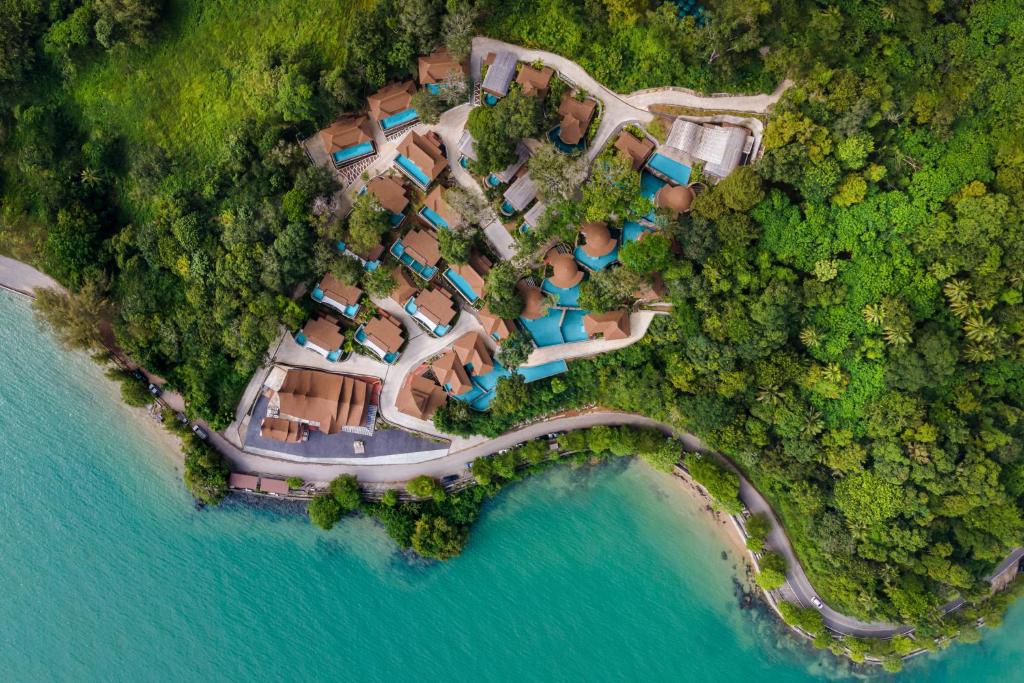
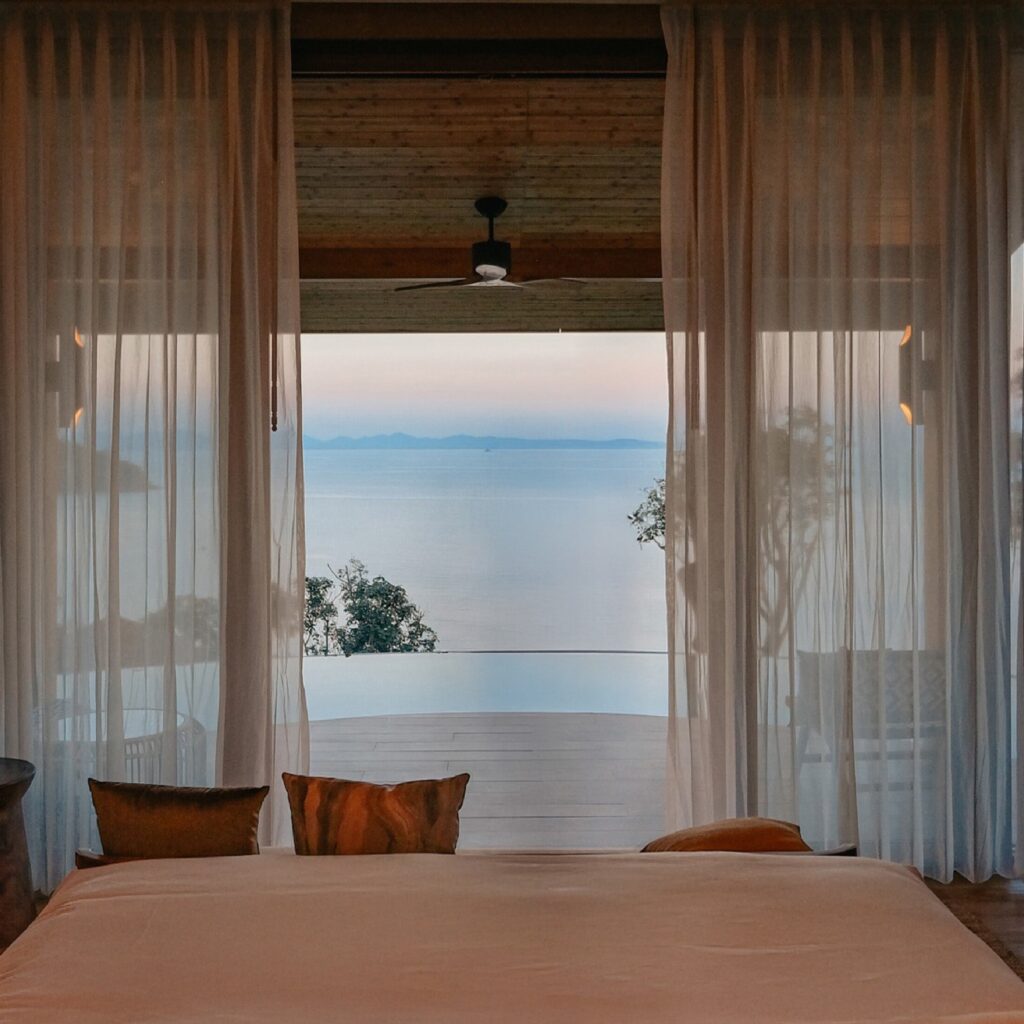
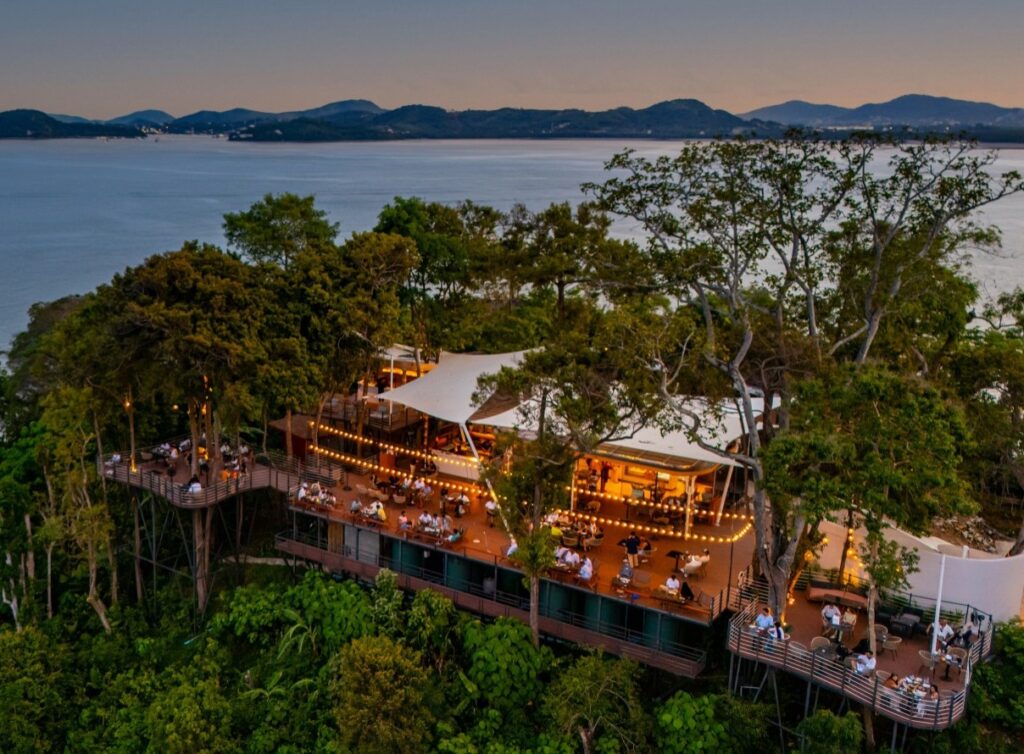
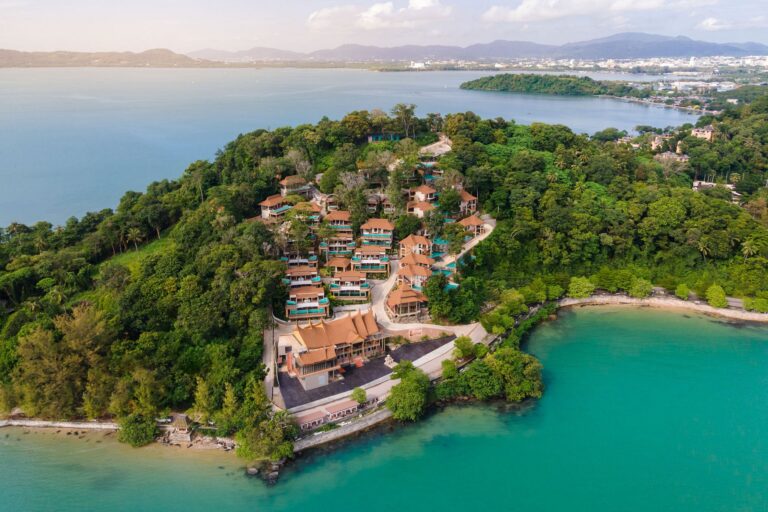
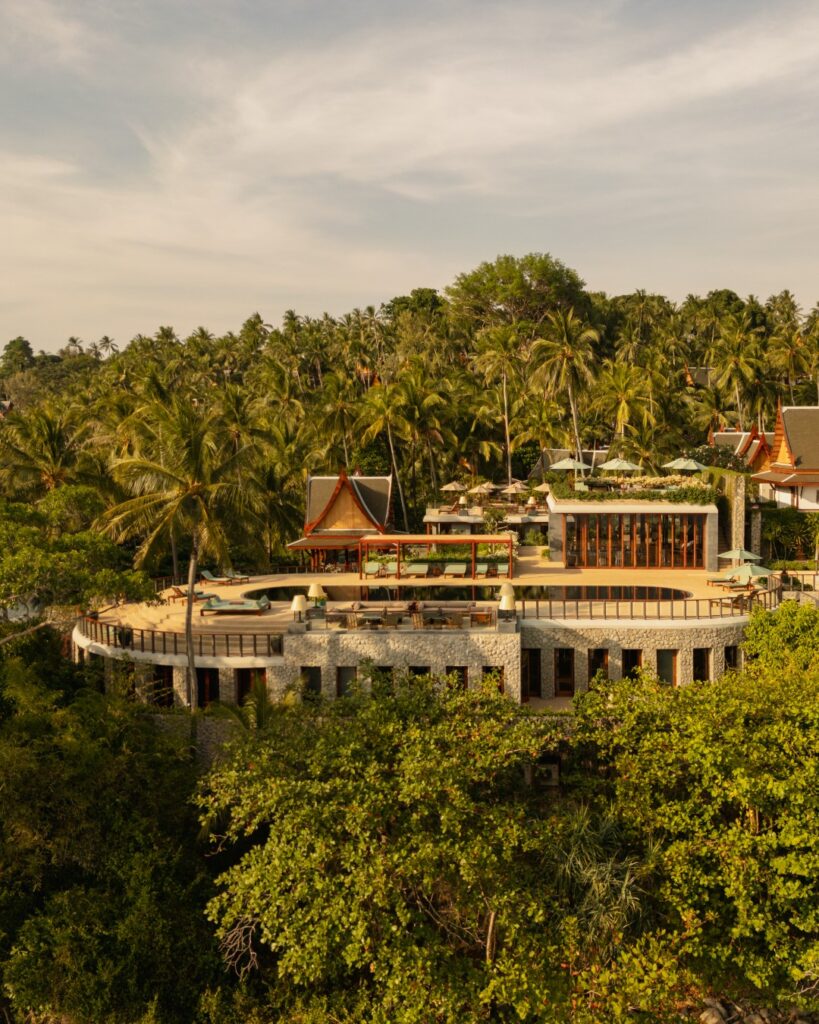
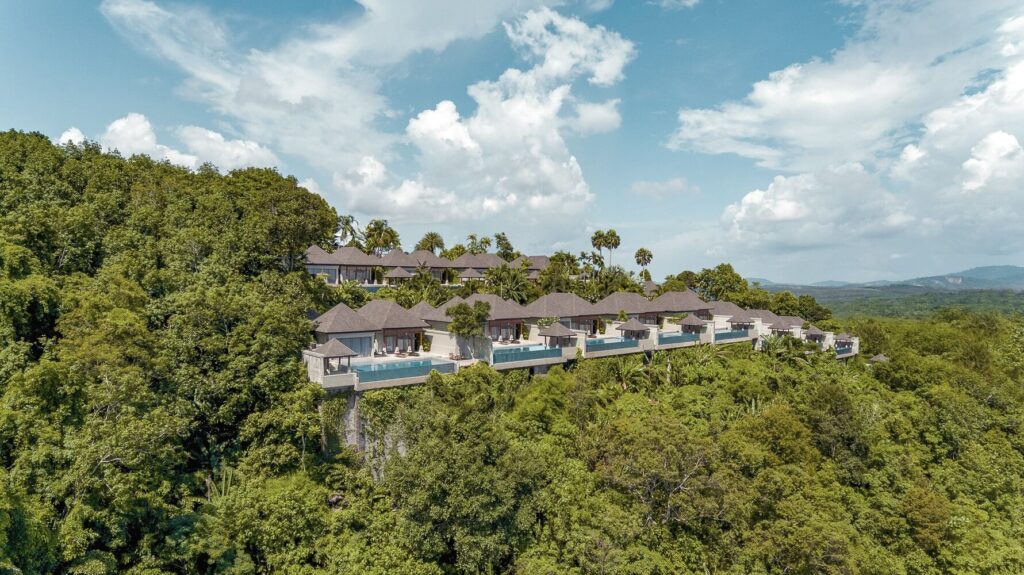
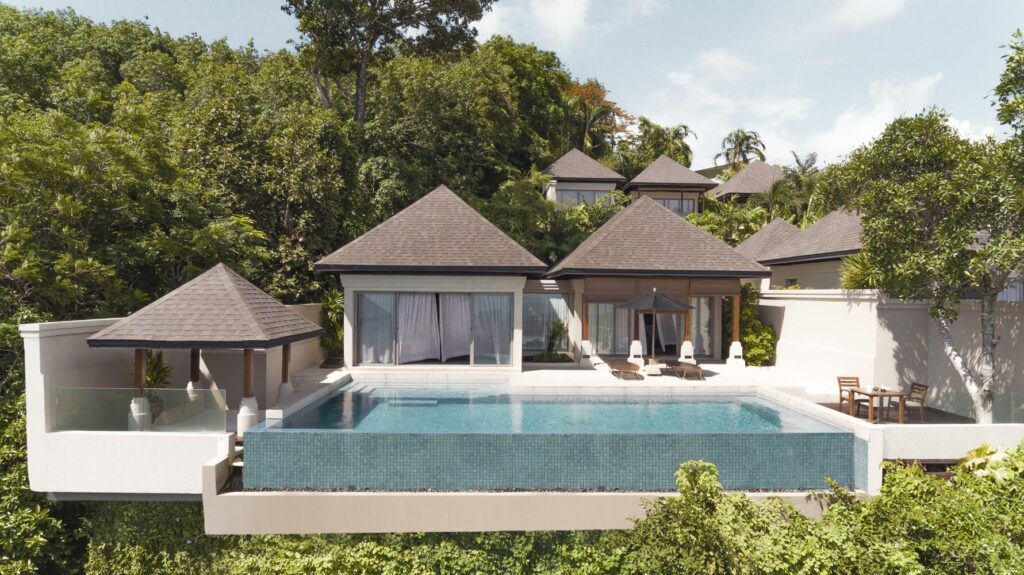
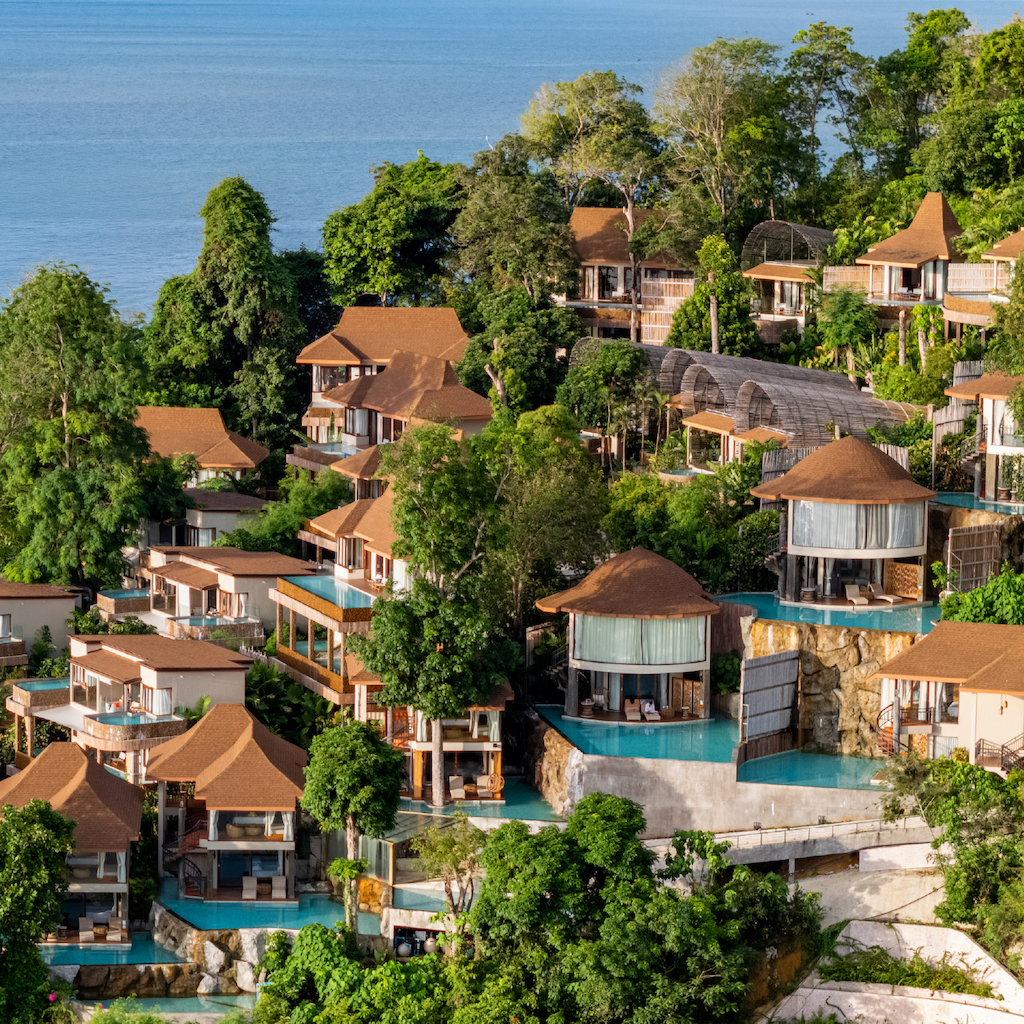
Sinae, a 64-villa retreat on a Koh Sirey hilltop off Phuket’s east coast, has the reels. It also, more unusually, has the goods. The ocean panorama in the videos is the one you actually see from the bed. The private pool in the reels is the one in your own villa, since almost every room here has one. The seclusion is real enough that, over three nights, we crossed paths with perhaps four other guests. None of this should be surprising at the price point, and yet it routinely is, which says less about Sinae than about the industry it sits within. The marketing department, for once, hasn’t had to overpromise. The cascading hillside has done the work for them.

The Location

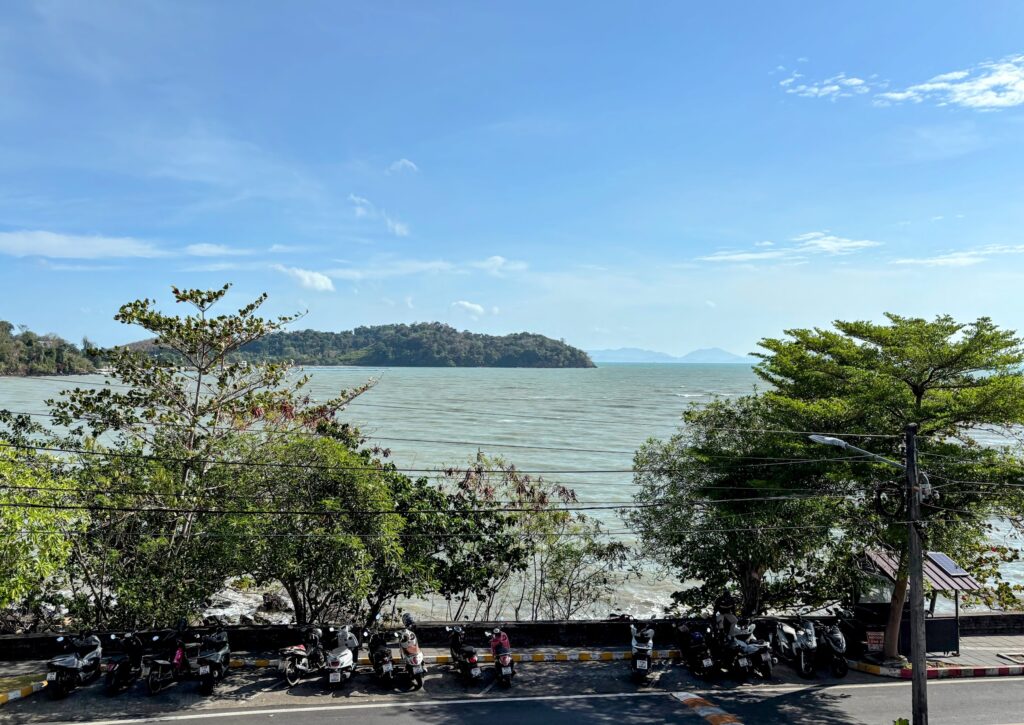
There’s nothing much within walking distance of the hotel itself. A handful of seafood shacks sit along the coast. Nearby, the TikTok famous PTT petrol station on Koh Sirey has become an unlikely tourist landmark for its panoramic sea views (people do photograph petrol stations now, apparently). But Sinae isn’t positioned for walkable convenience. It’s positioned for the view, the privacy and the feeling that you’ve left the rest of the island behind.

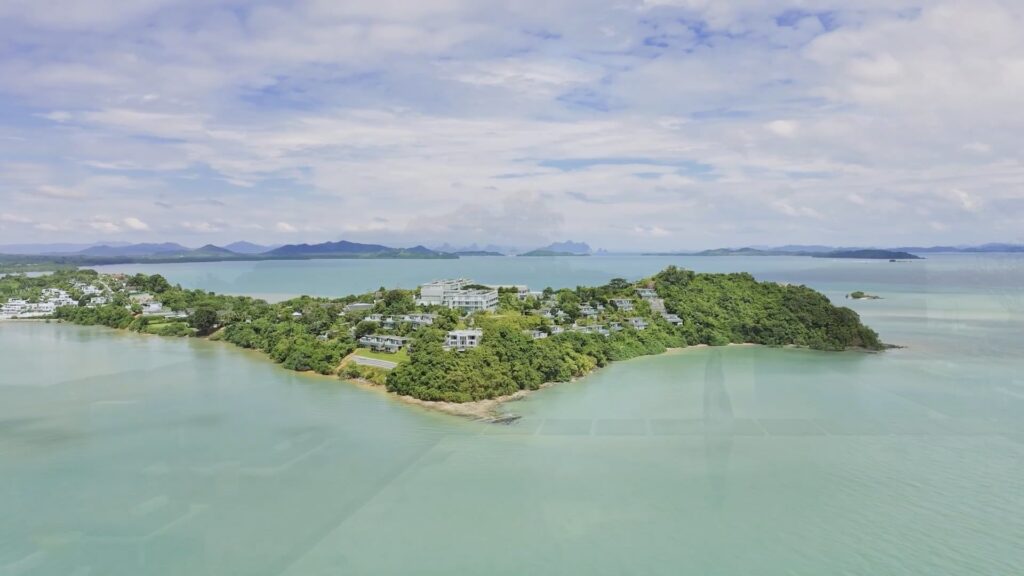
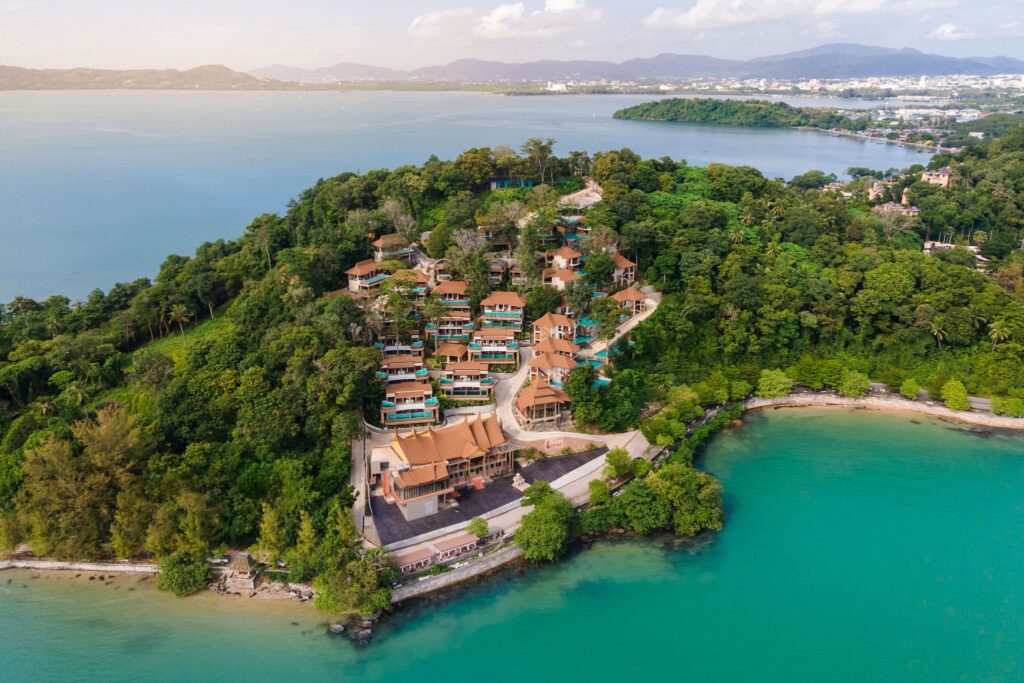
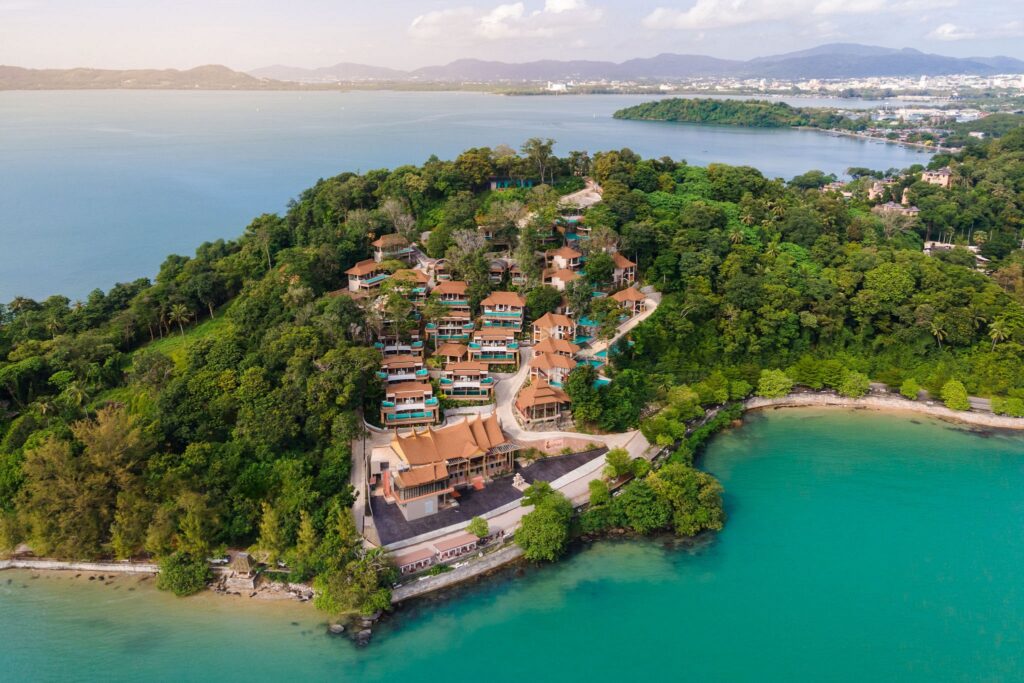
Koh Sirey is one of Phuket’s closest-kept cards. A small island just east of Phuket Old Town, connected to the mainland by a bridge so short you’d miss it if you blinked (or, indeed, nodded off for a moment in your Grab), it occupies a curious position: technically separate, practically attached, and atmospherically distinct from the beaches that define most visitors’ experience of the island. The landscape that greets you is all green hills, mangrove forest and thick tropical canopy, and the humidity drops a notch as soon as you’re under it.
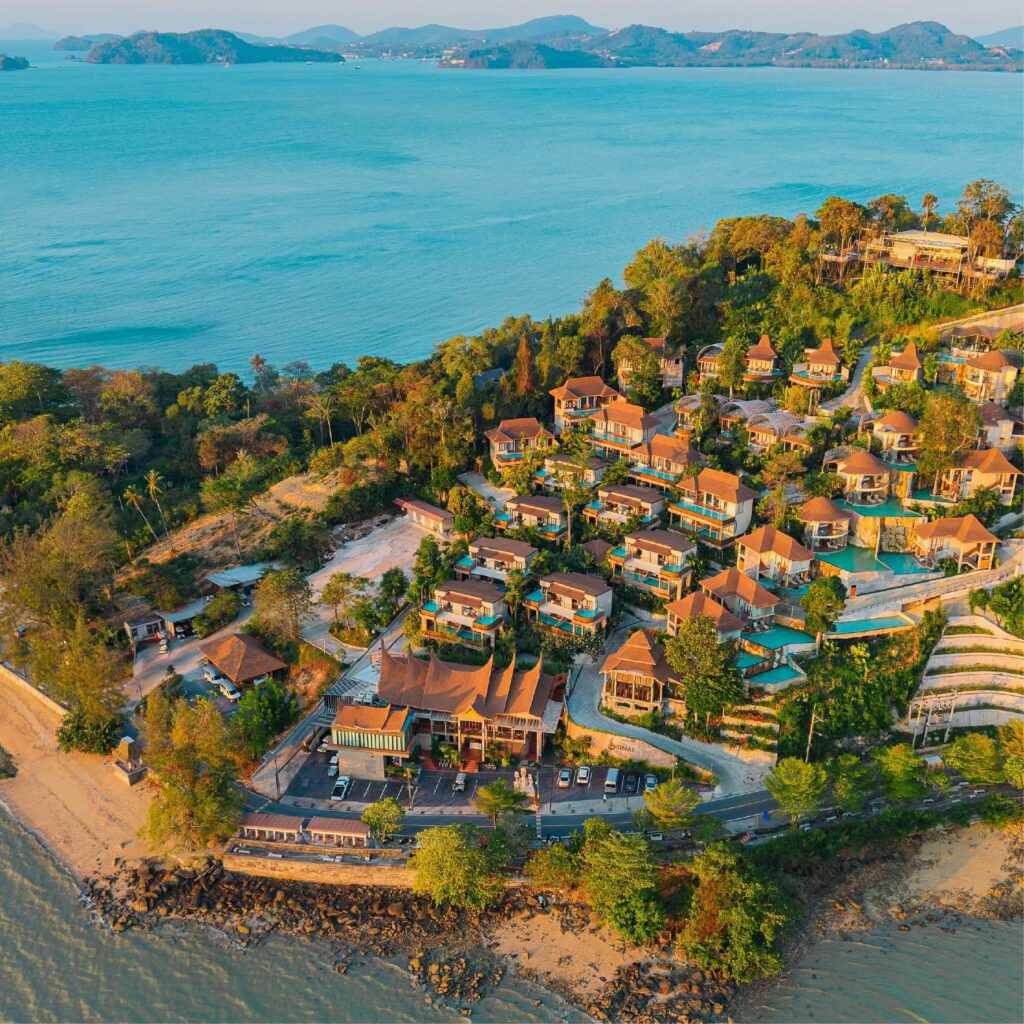
You cross the bridge, past the spot where monkeys congregate in the evenings, and climb through a landscape of rubber plantations, modest local homes and the odd stray dog with zero agenda. Down near the water sits Koh Sirey’s Urak Lawoi community, one of Phuket’s oldest sea gypsy settlements, whose ancestors were among the first inhabitants of the Andaman coast. Twice a year, during the Loy Rua festival, they launch elaborately decorated boats out to sea carrying offerings. It’s a reminder that this part of Phuket has a story considerably older than the one told by those damn reels from a few paragraphs previous.

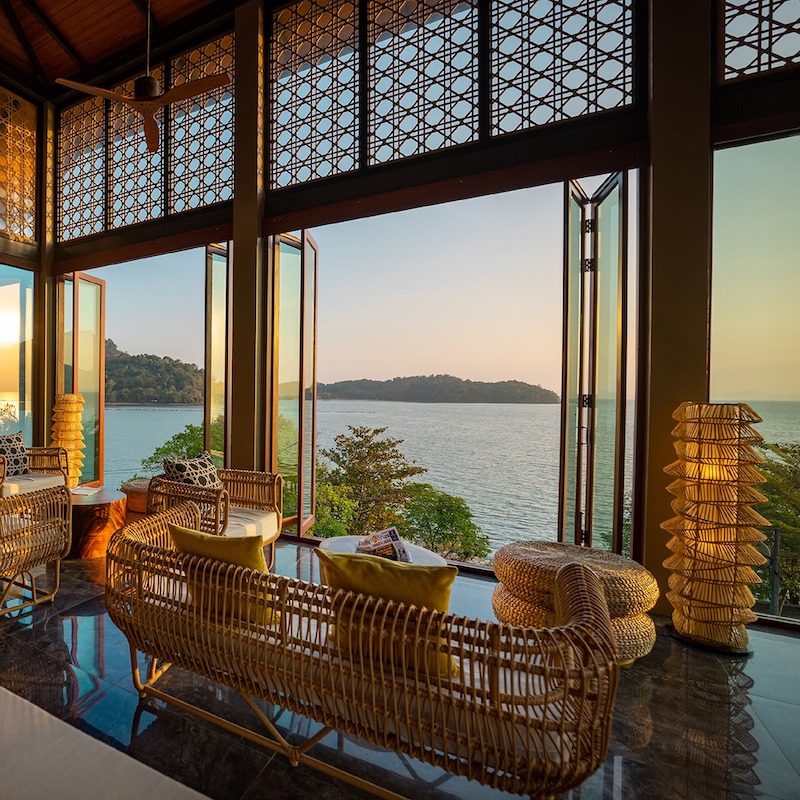
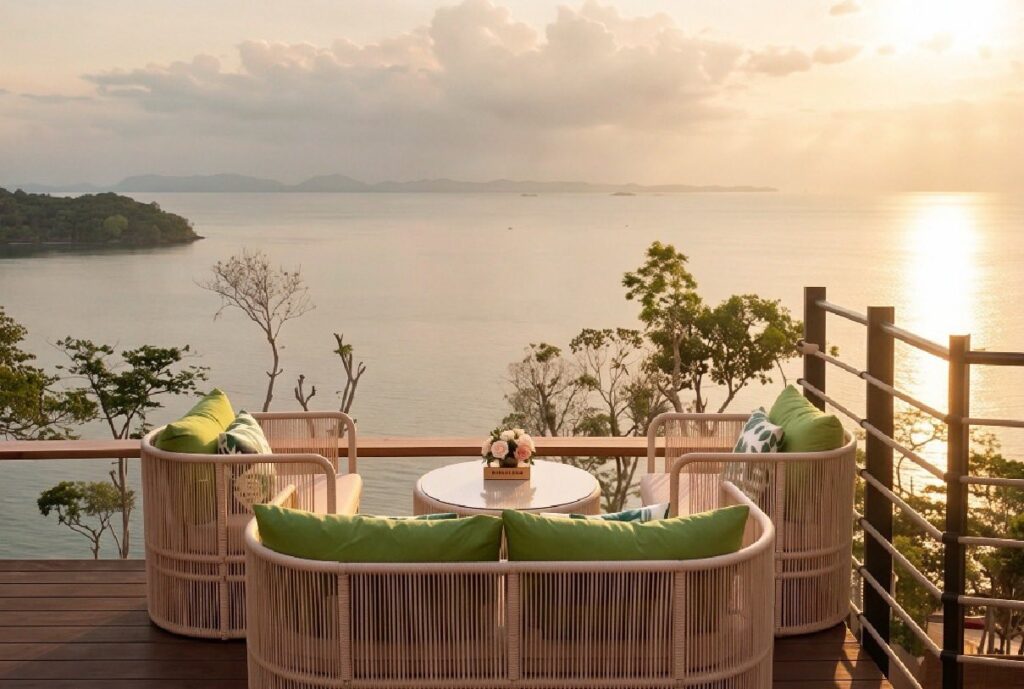
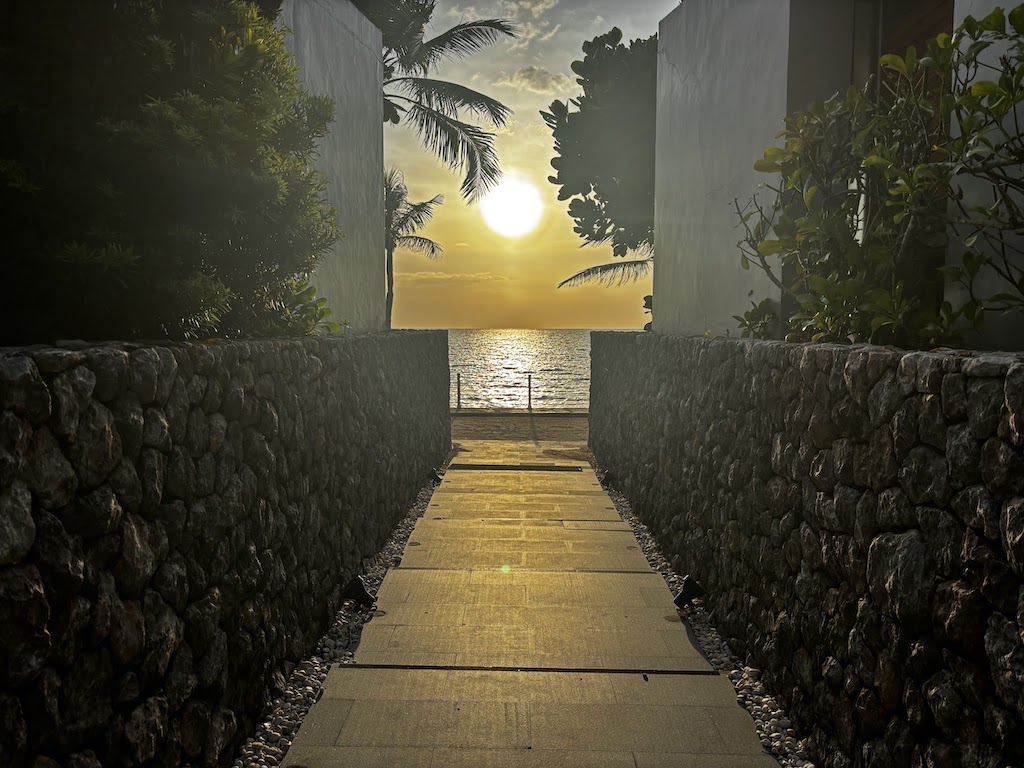
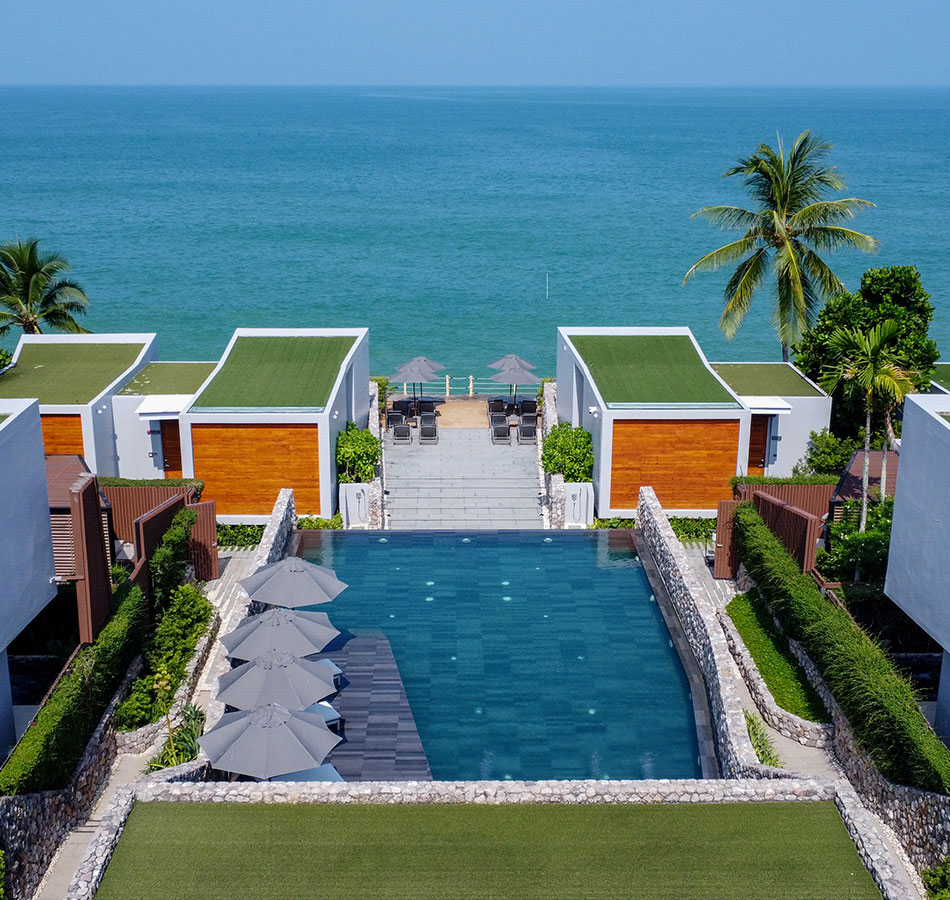
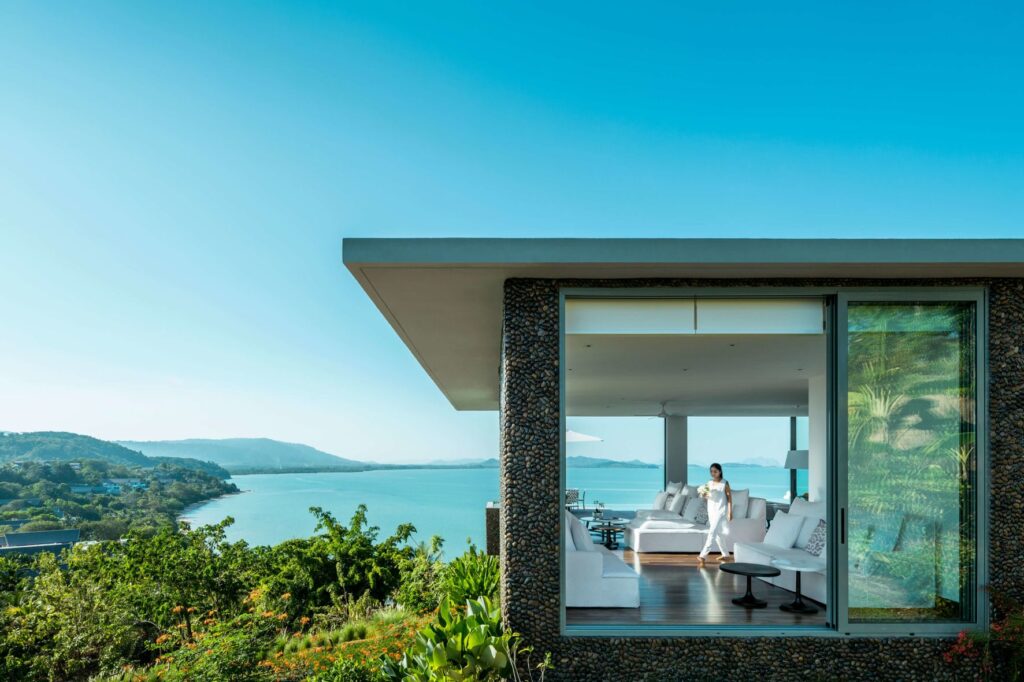
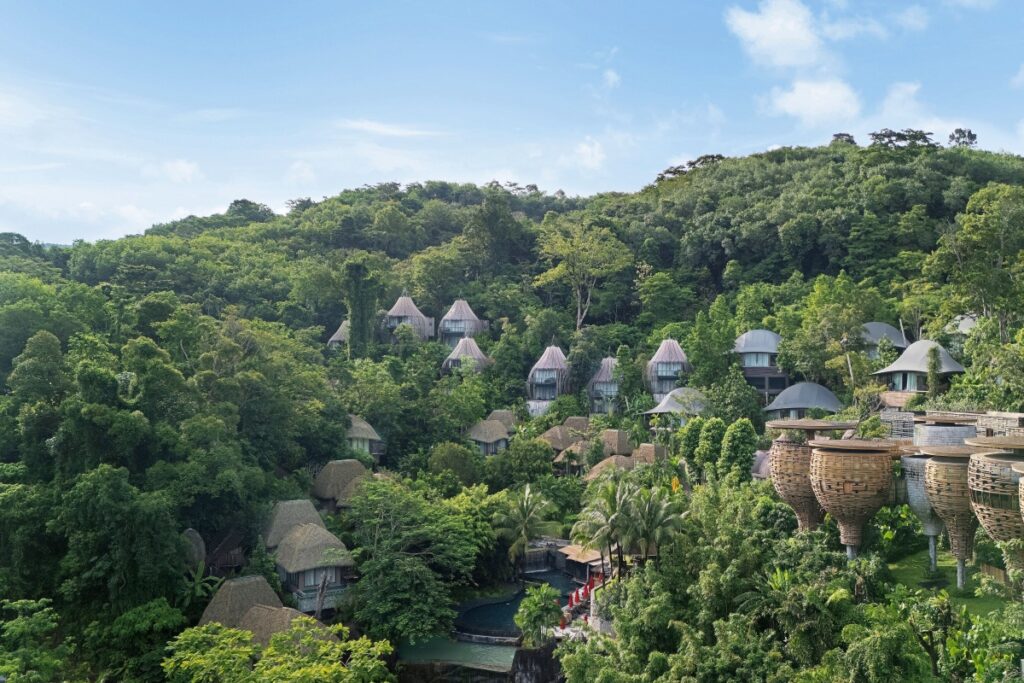
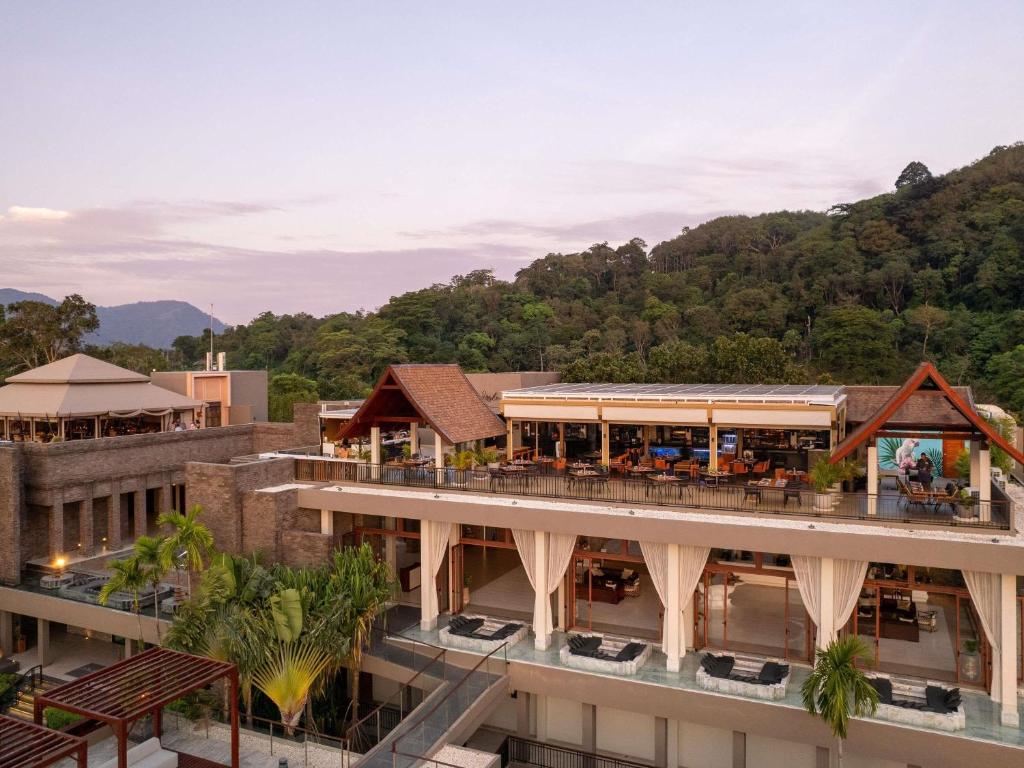
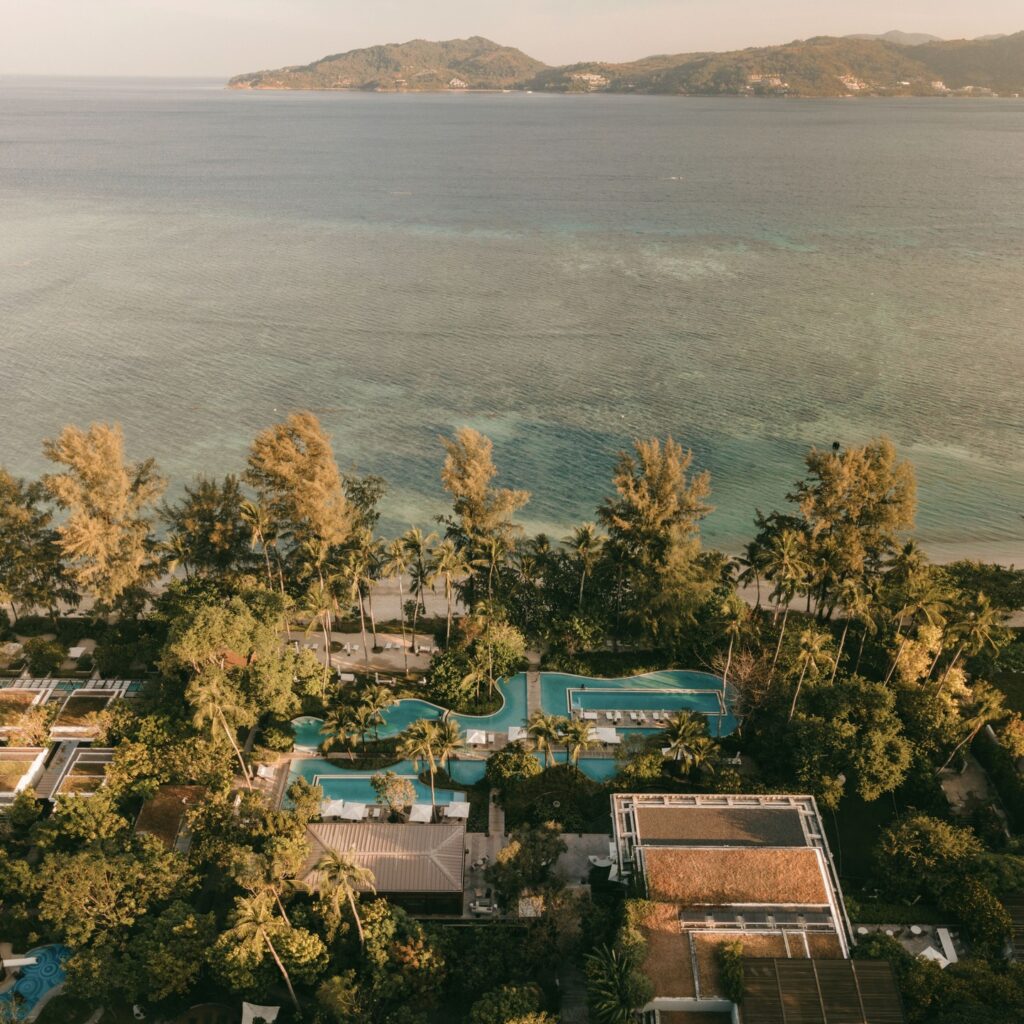
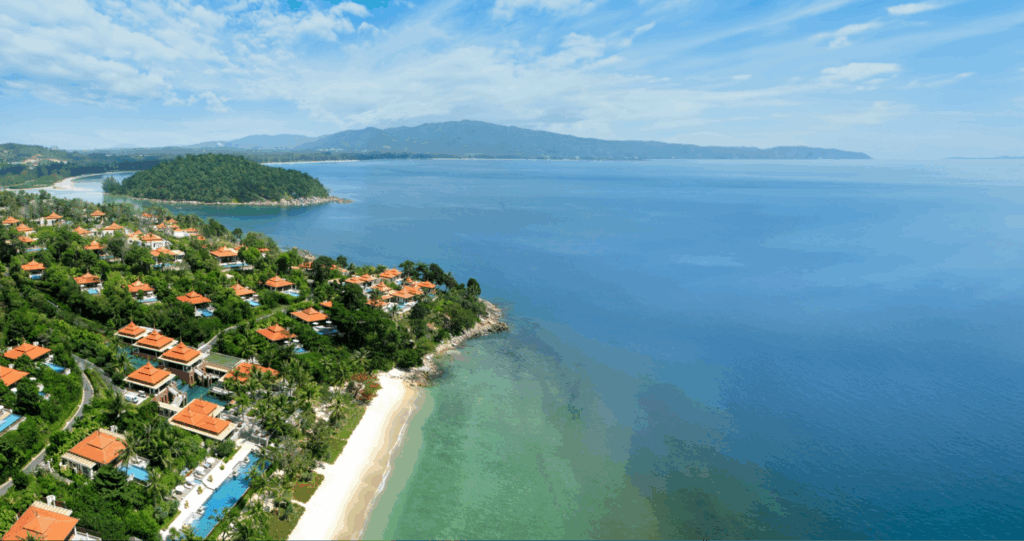
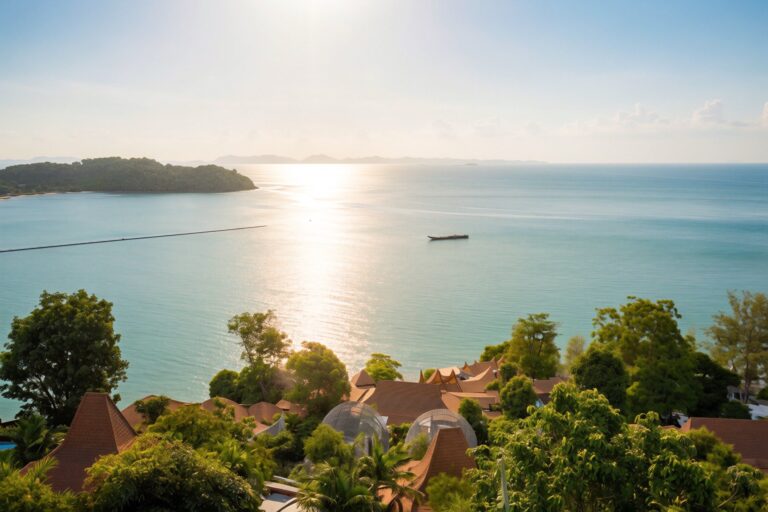
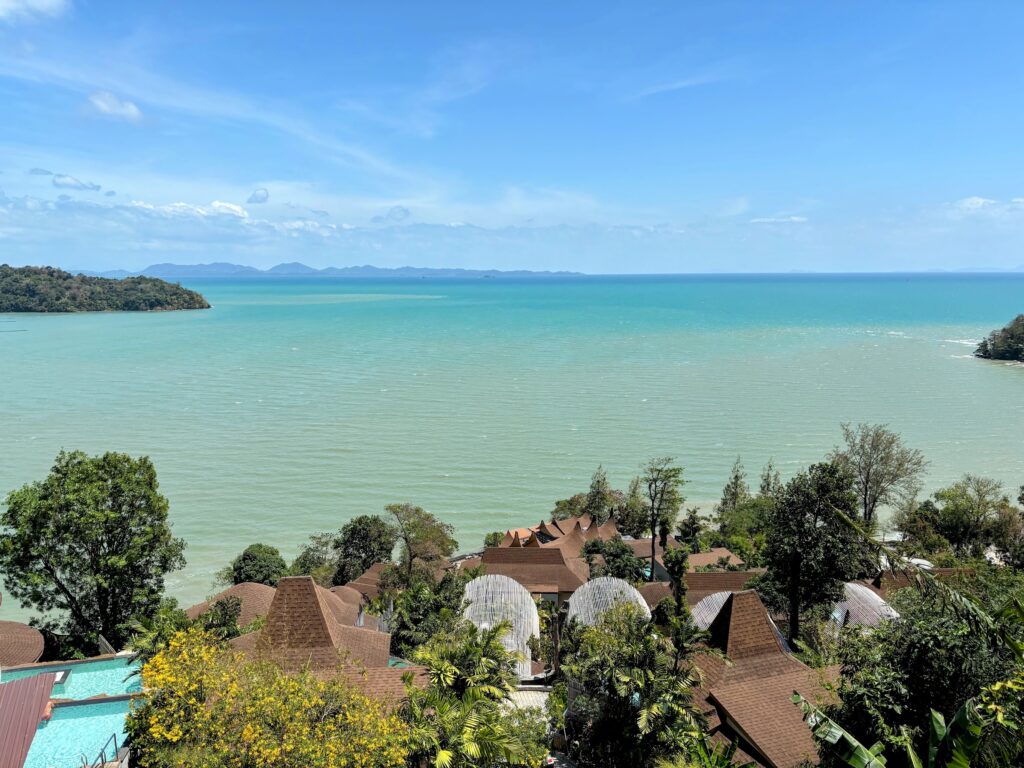
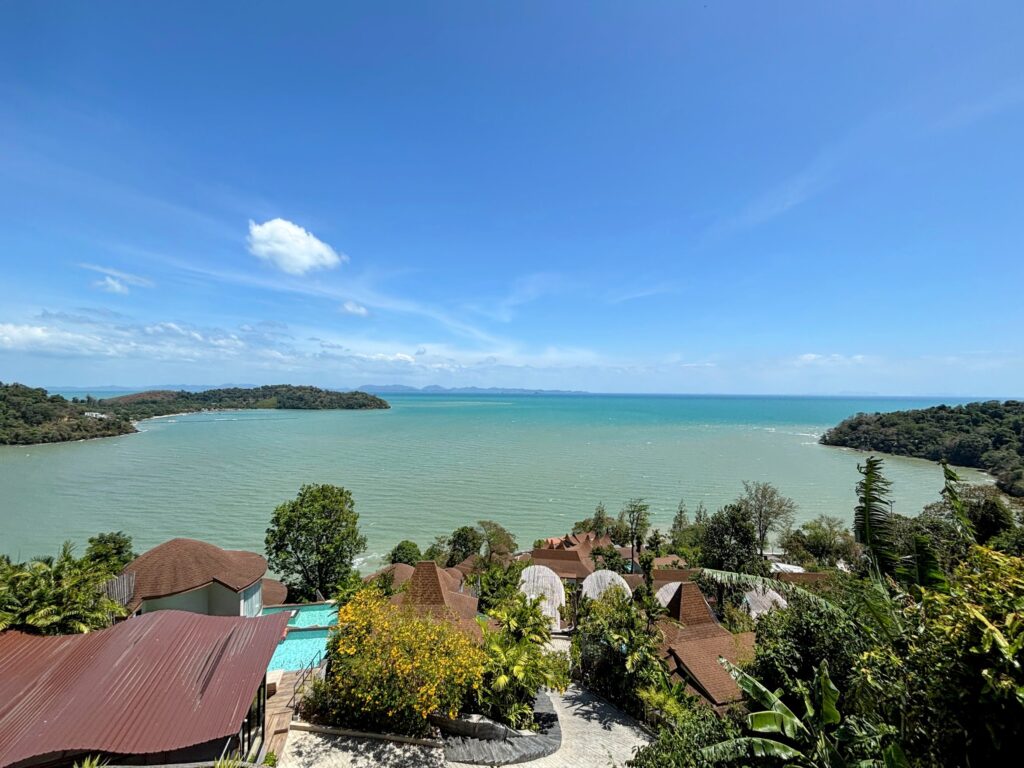
Sinae sits at the top of the island’s hill, and the views from up here are something else, easily one of Phuket’s most magnificent ocean panoramas. On a clear day, you can see across Sirey Bay to the limestone karsts of Phang Nga, with Koh Yao Yai and even the distant outline of Koh Phi Phi on the horizon. Mountains behind, sea ahead, that rare feeling of being surrounded by both. And not another hotel in the frame. Finding an uninterrupted view of sea and mountains simultaneously is becoming harder by the year. Sinae has one, and it knows it.
Phuket Old Town is around ten minutes by car, which is close enough to make an evening out feel effortless and far enough to insulate you from it. Decompress at Sinae during the day, then take a taxi into the Old Town for dinner. Royd on Dibuk Road is excellent for contemporary Southern Thai, while a few doors down, Raya does the traditional version from a century-old Sino-Portuguese mansion. For something else entirely, Marni on Montri Road turns out wood-fired Neapolitan pizza that has placed in Asia-Pacific’s top 50 four years running. On a Sunday, you can wander the Thalang Road Walking Street Market afterwards. It’s a smart arrangement: the seclusion of a hillside retreat with the dining scene of Phuket’s cultural capital a short ride away.

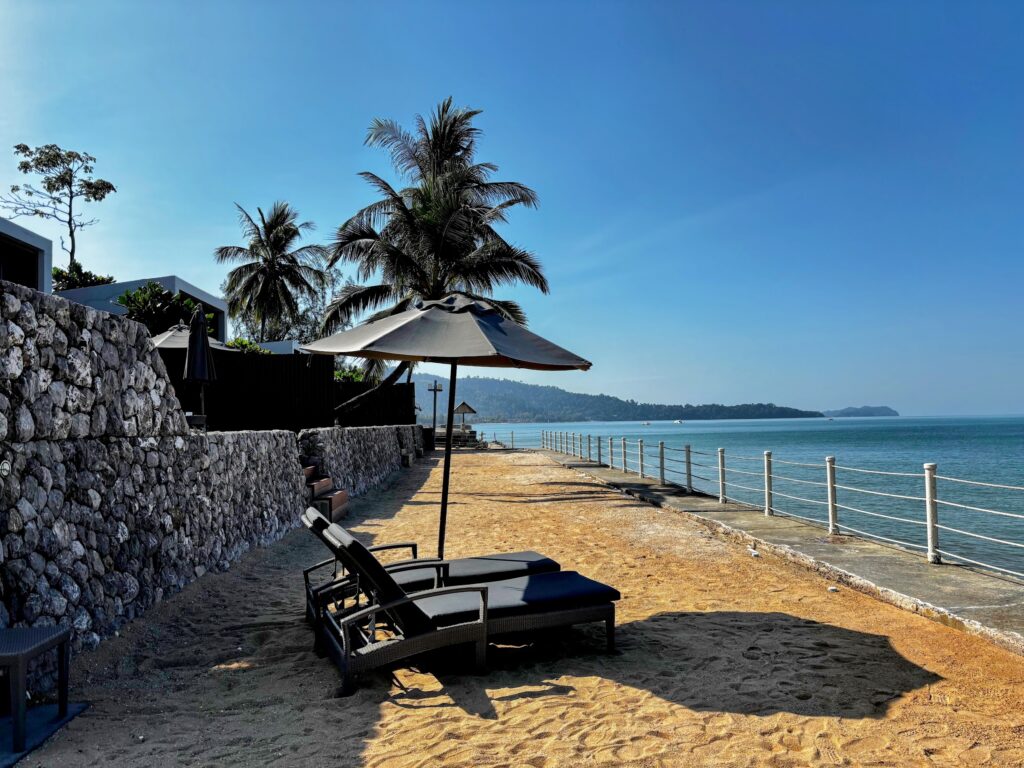
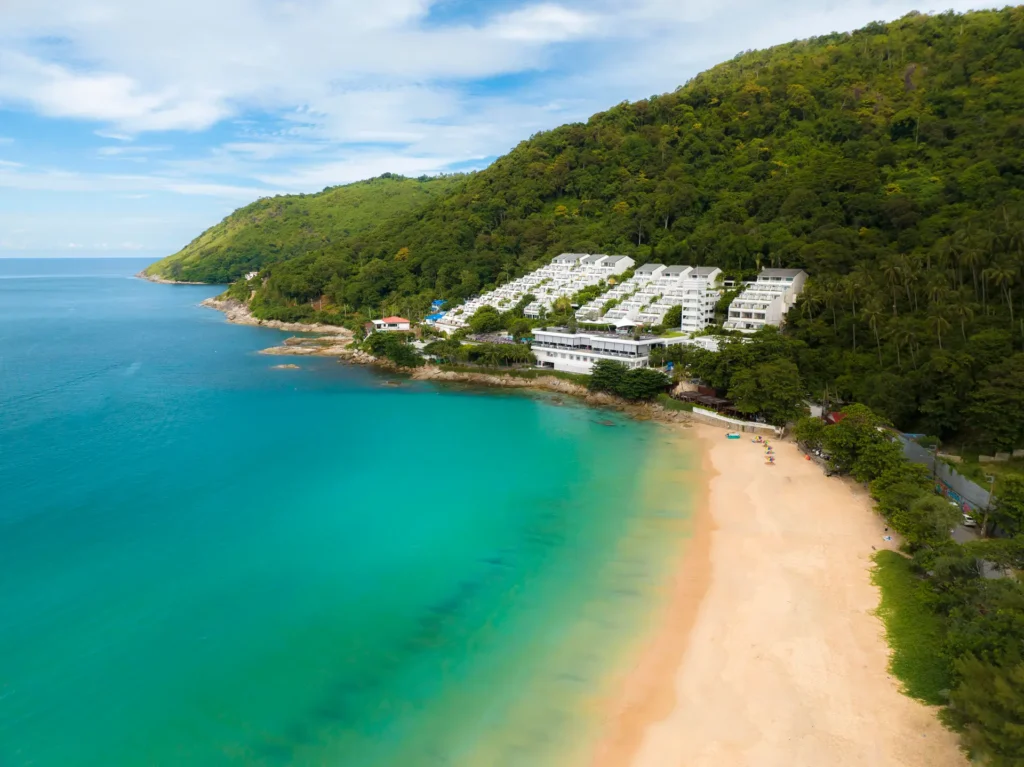
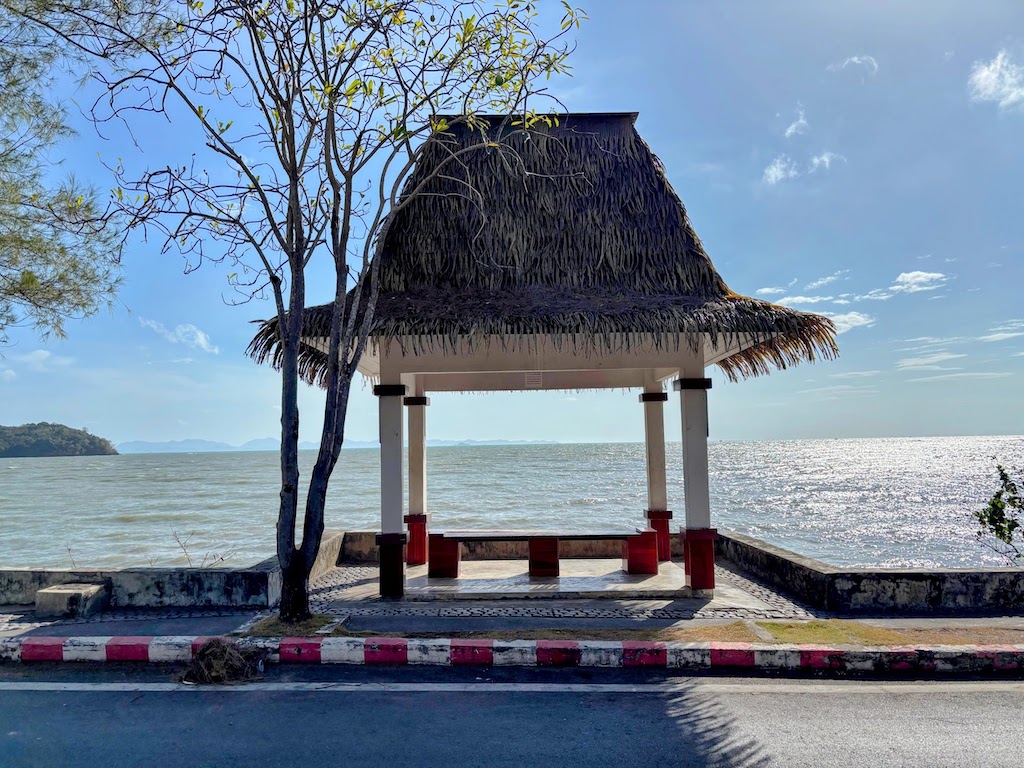
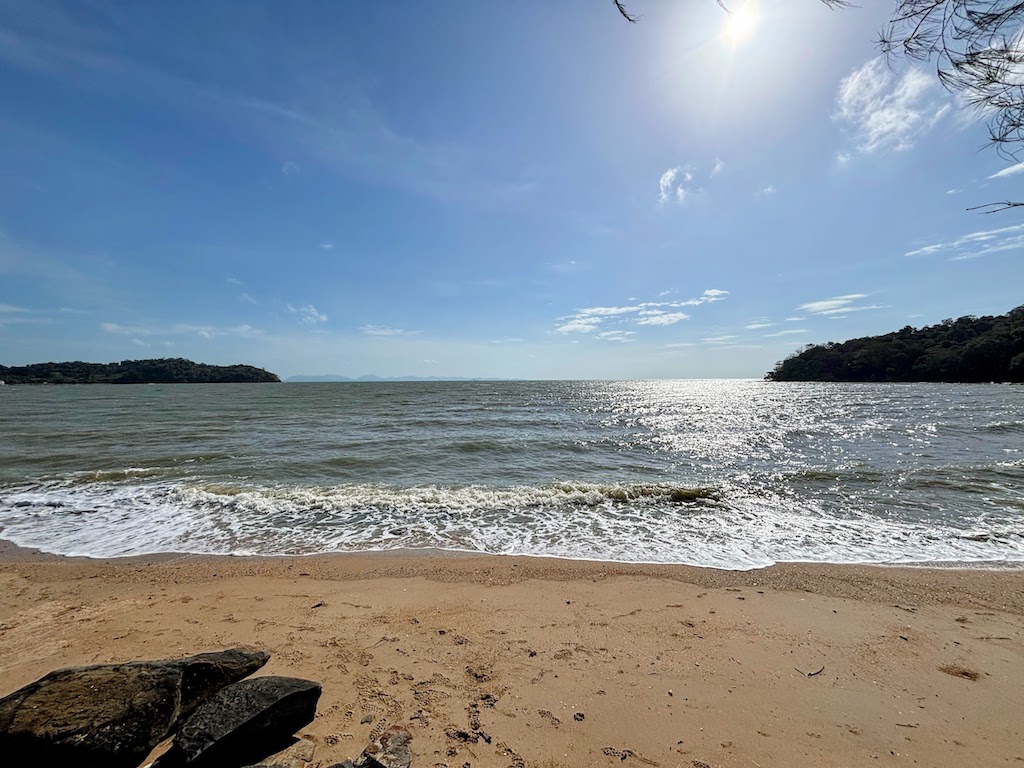
Back at base, and the choppy waters on this side of the island mean swimming off the coast is limited. Every cloud; those same conditions bring a welcome breeze that takes the edge off the afternoon heat. Down at the bottom of the hill, the bay has a narrow strip of sand and a few thatched-roof salas along the seawall, one with a tsunami warning sign posted to it. At low tide the water pulls way out, exposing mudflats where locals wade around collecting shellfish. It’s not a beach day destination, but it gives the location a sense of place that a manicured resort strip never could. Trade-offs go both ways.
Character & Style

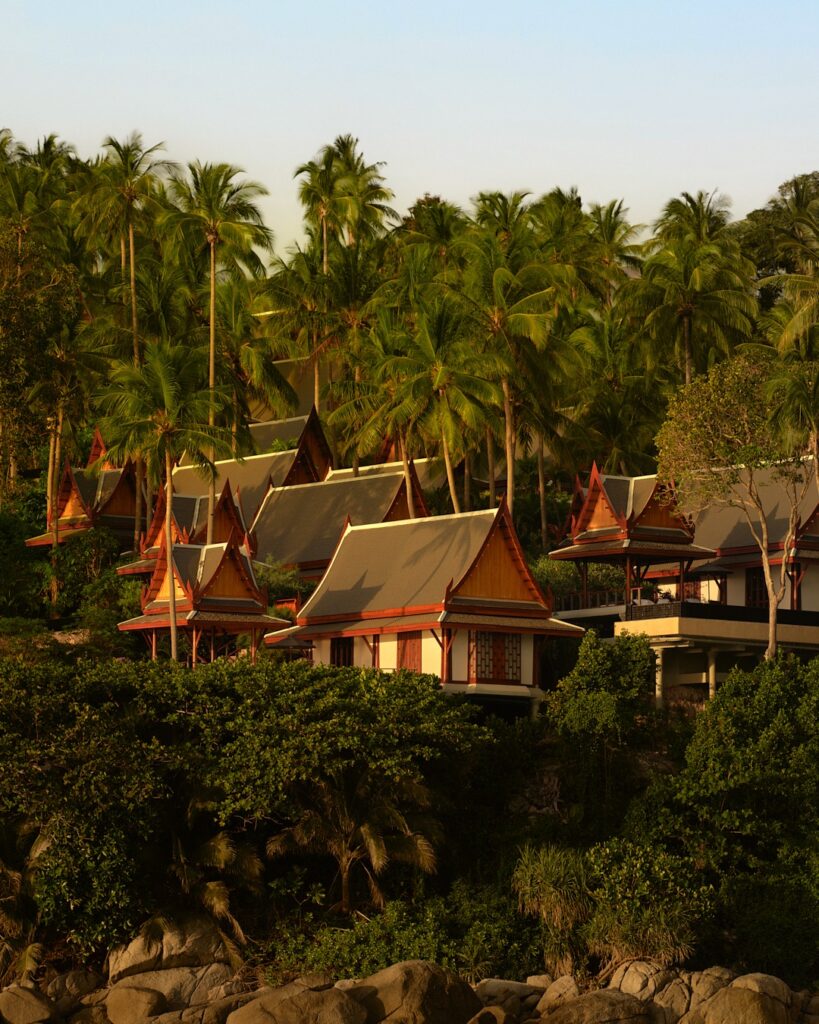
Sinae’s design is a modern reading of coastal Thai vernacular, drawing on the fishing villages that have dotted Koh Sirey for generations.

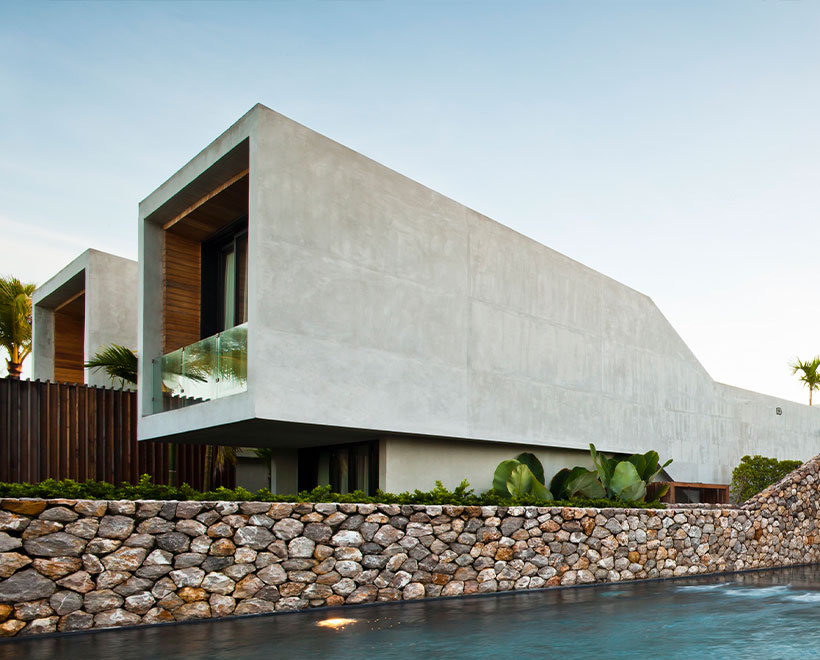
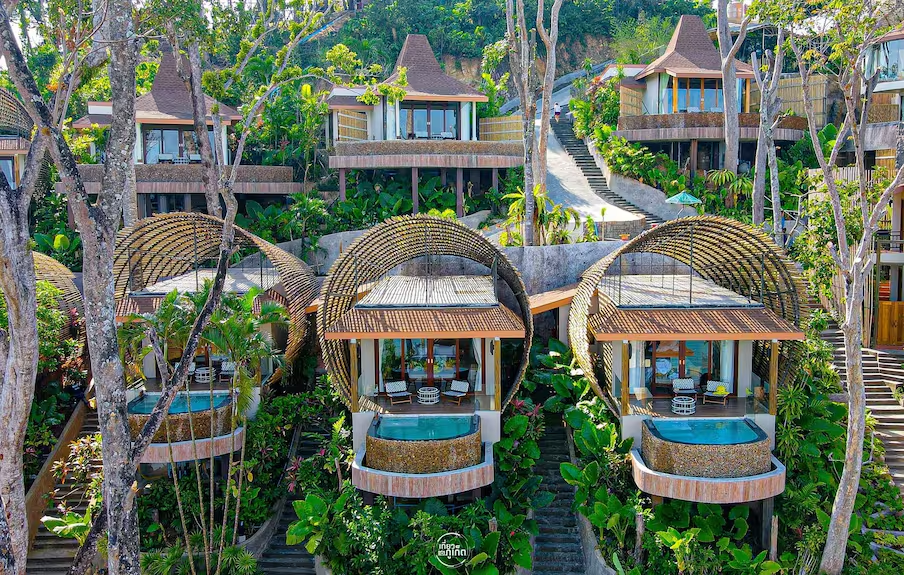
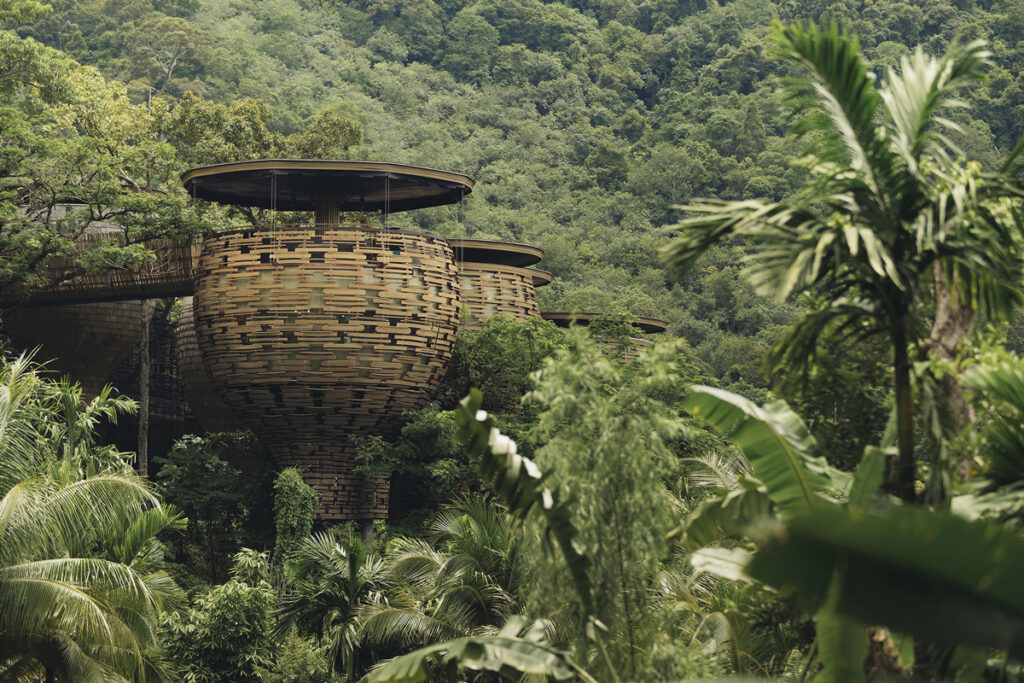
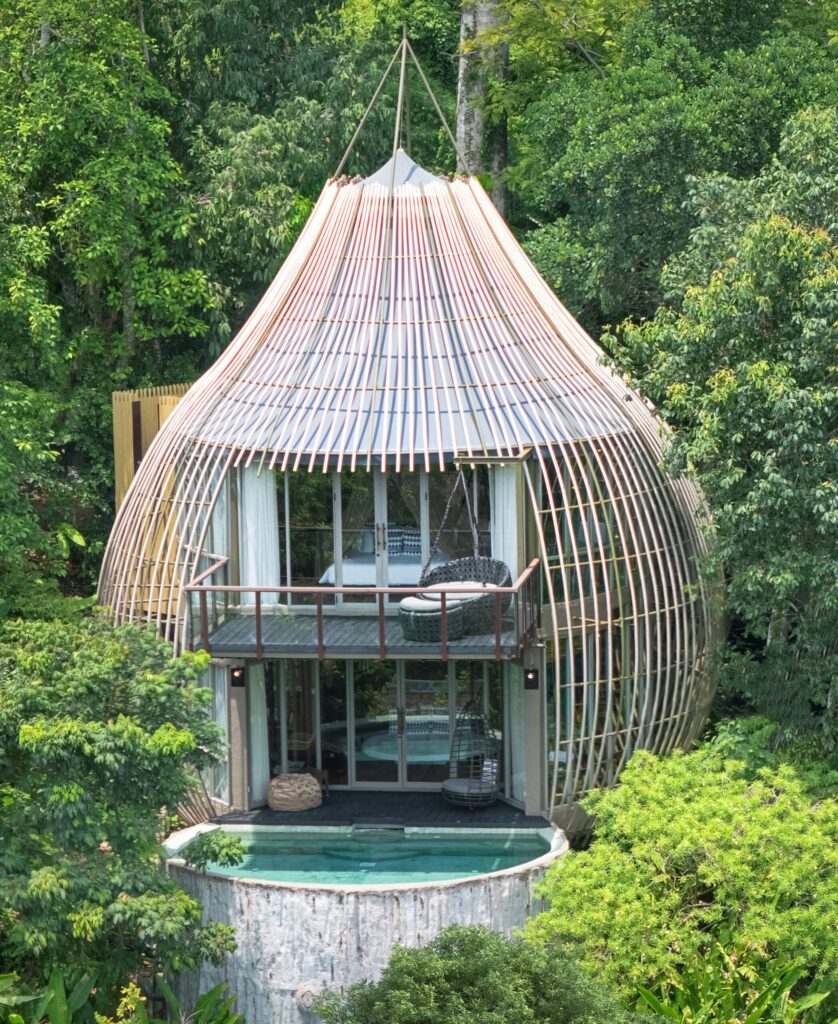
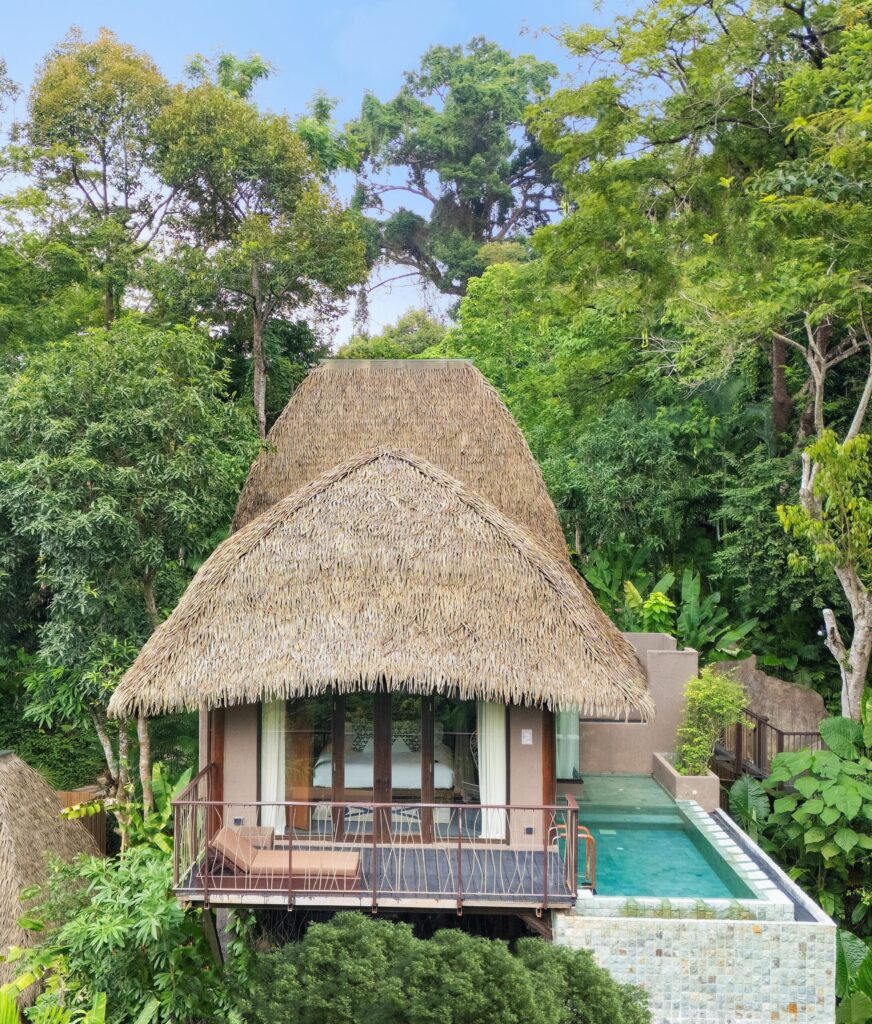
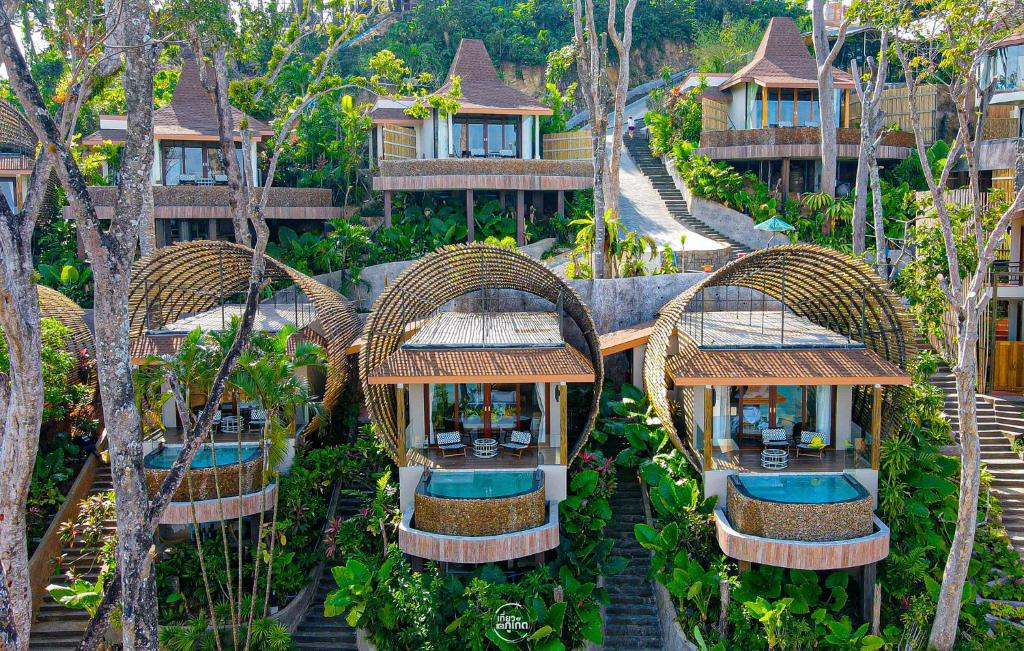
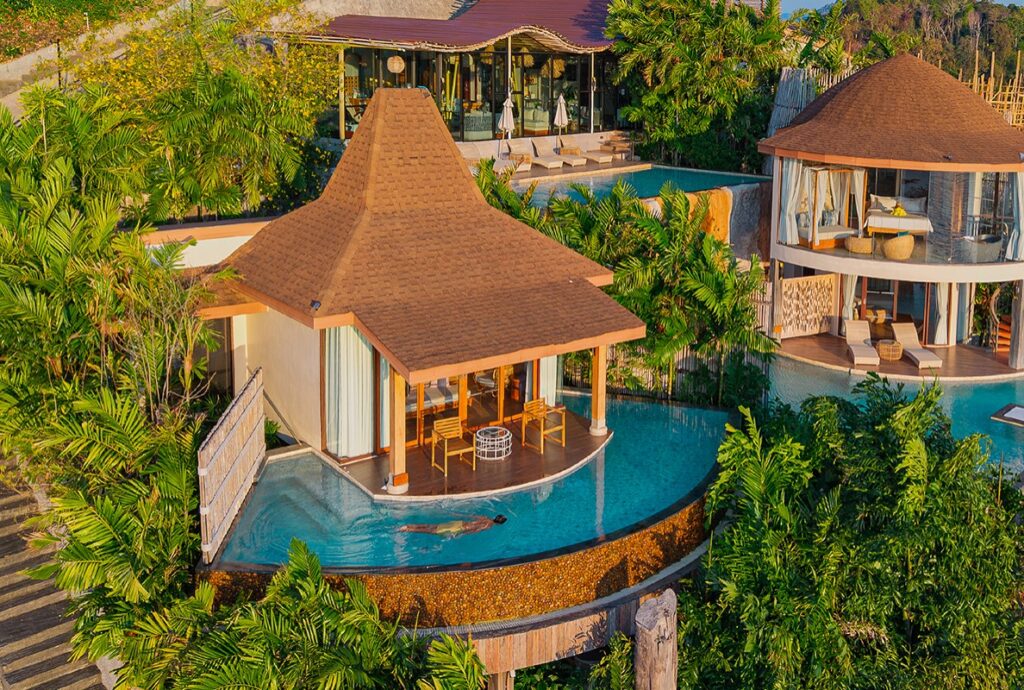
The Sea Sai villas, with their curved, ribbed rooflines, look like lobster pots nestled into the hillside, a nod to the traditional Thai fish-trap designs that inspired them. Elsewhere, the Sky Pool Villas take their cues from local boathouses, their dark timber frames resembling the upturned hulls of fishing boats. Lying in bed with the sound of the wind and the sea rising up the hillside, you could almost believe you were on a vessel. A very comfortable, very stationary vessel with an excellent minibar, but still…
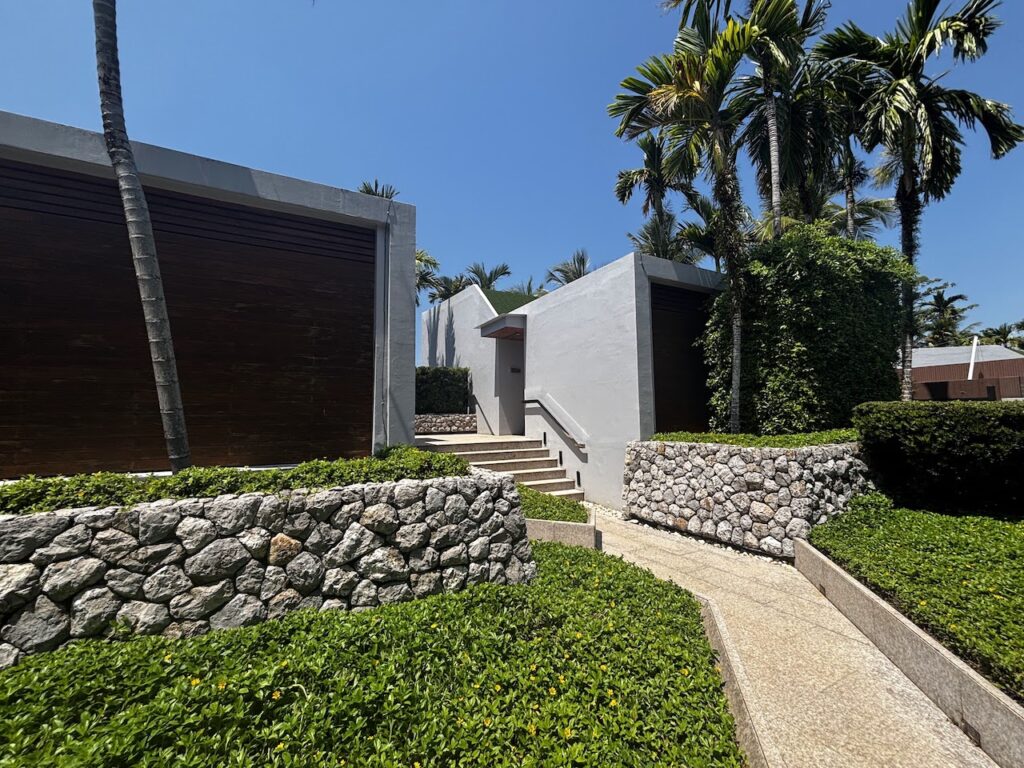
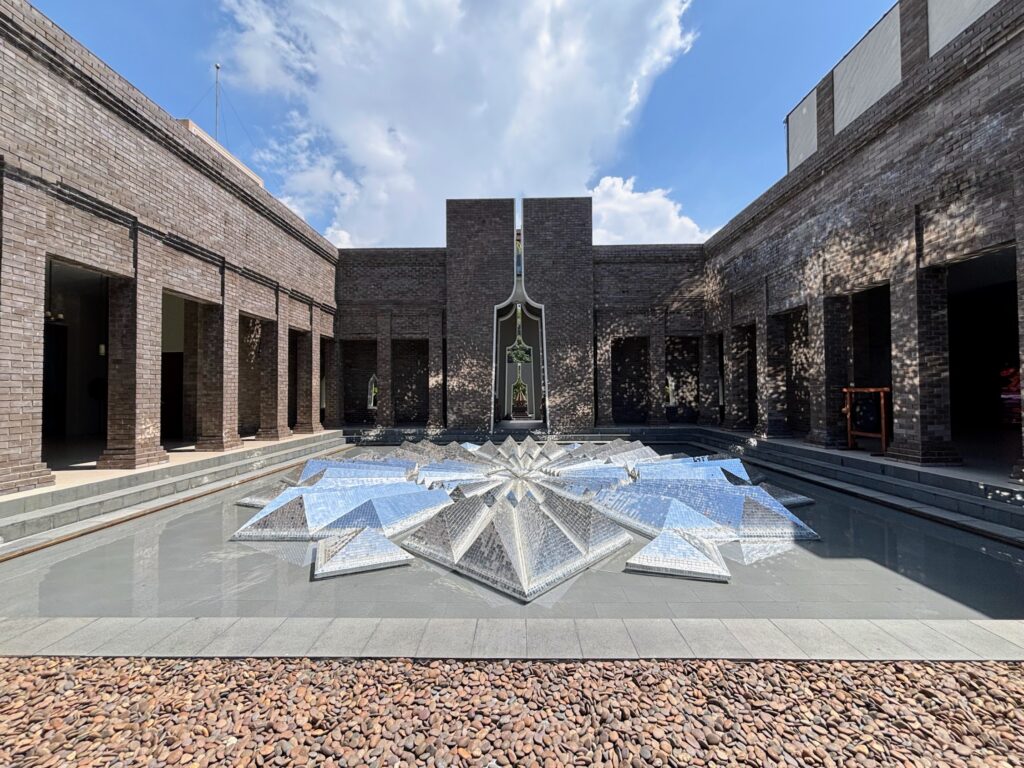
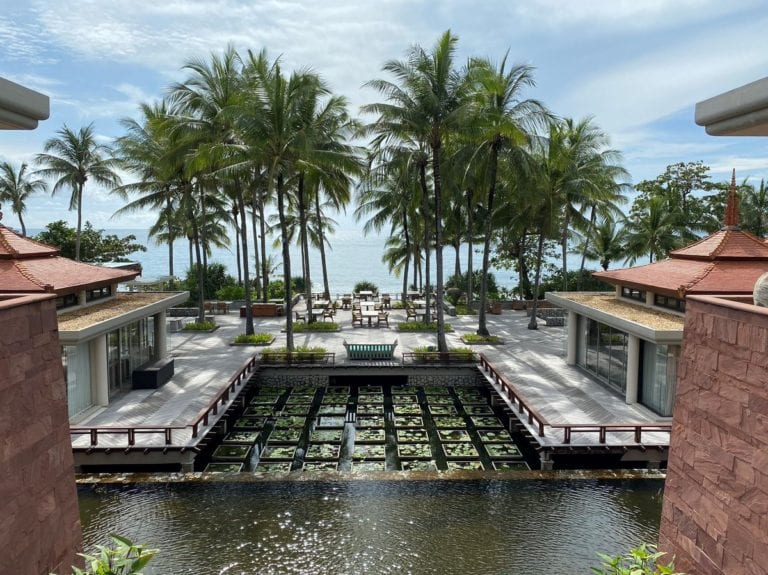
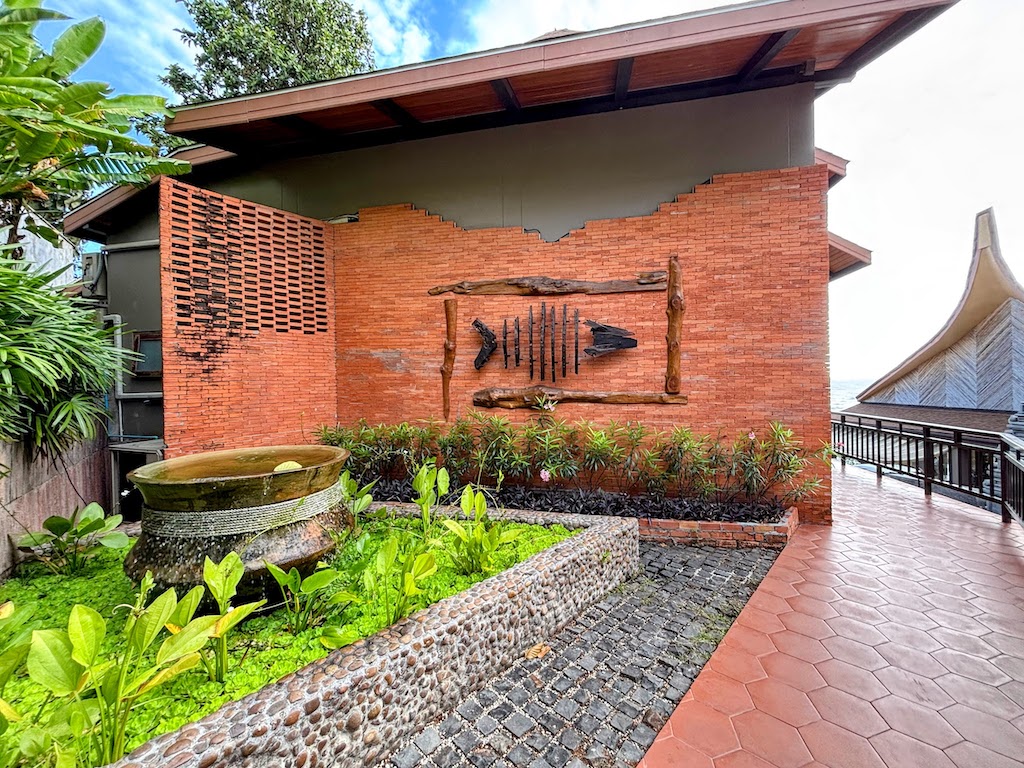
The material palette reinforces the sense of rootedness. Exposed terracotta brickwork, left deliberately unrendered, runs through the public spaces and entrance areas, its warm, weathered tones carrying an echo of Ayutthaya-period construction, where centuries of tropical rain have long since stripped the stucco from the old capital’s temples and forts to reveal the brick beneath. It’s a ruin-aesthetic rather than a reproduction, and it gives the place a weight and seriousness that most Phuket resorts, with their bleached timber and whitewashed concrete, simply don’t have.
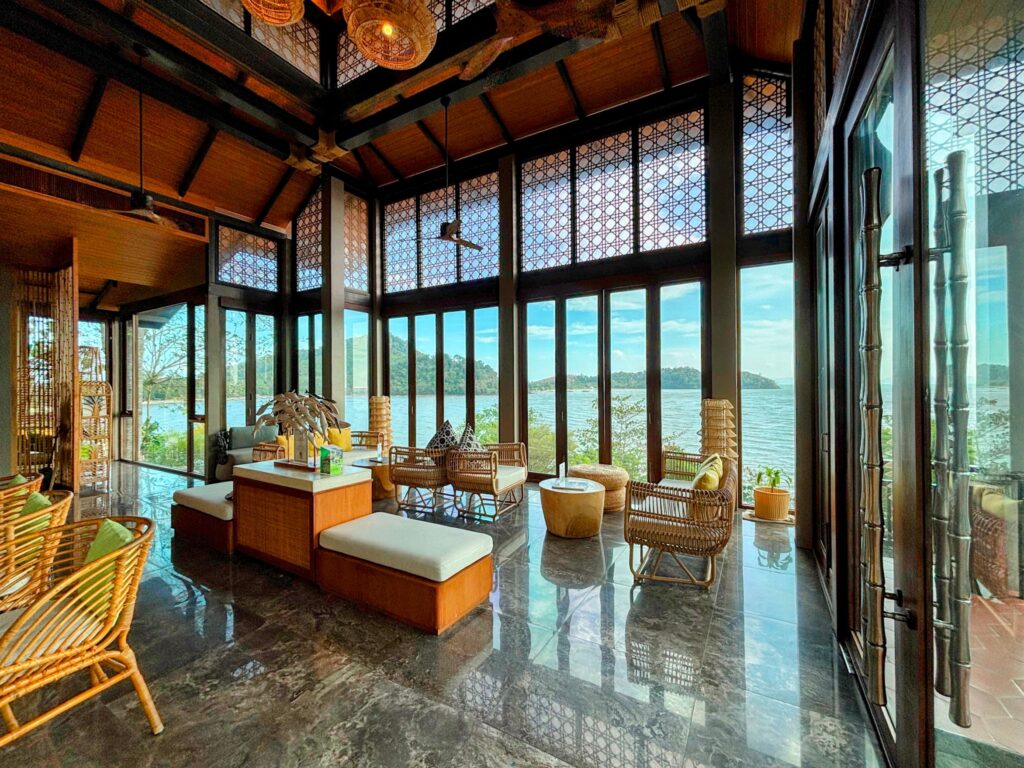
Lattice screens punctuate the brickwork, filtering light in patterns that recall the ventilation grilles of Phuket Old Town’s Sino-Portuguese shophouses, and the connection feels deliberate: Sinae sits ten minutes from those same streets, and the architectural conversation between the two is one of the more thoughtful things about the property.

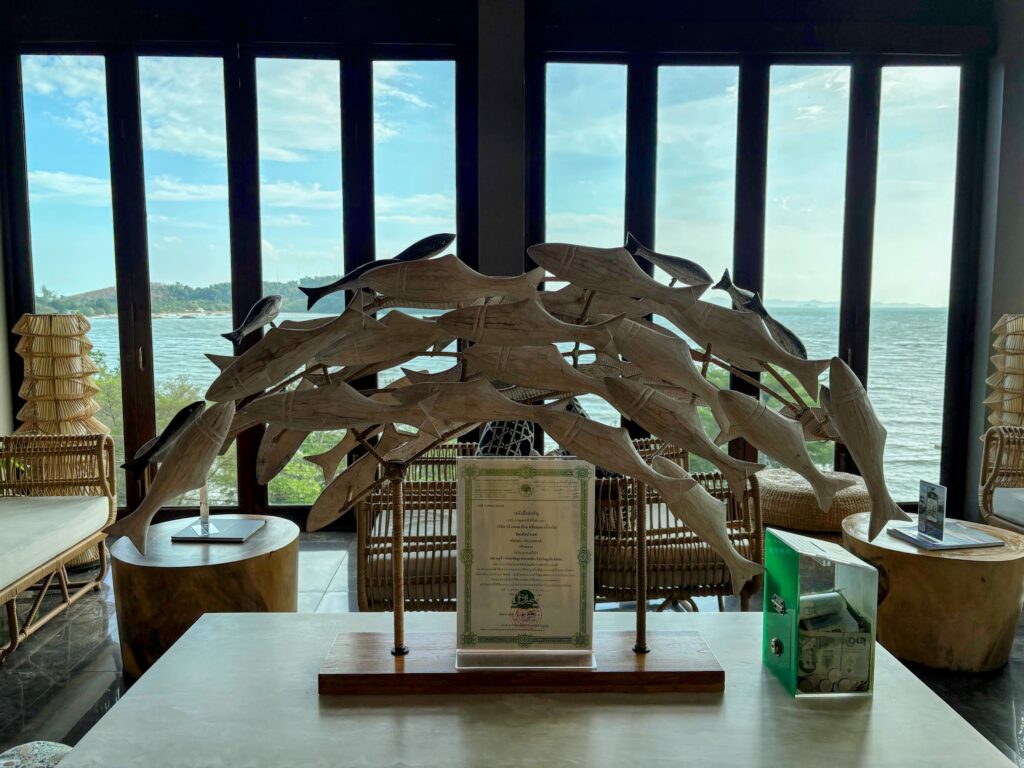
Outside the lobby, a fish skeleton assembled from driftwood and reclaimed timber is mounted against the brick, the bleached, salt-weathered grain suggesting old boat wood given a second life. Inside, a carved wooden shoal arcs across the reception desk, the figures mid-leap as though clearing a wave.

The latter is placed alongside Sinae’s Green Hotel certification and a small donation box, but it doesn’t feel preachy or performative. The hotel runs four beach clean-ups a month, restores mangrove forests along the coast, and grows its own herbs and vegetables on site using compost from the kitchen. There’s a twice-monthly alms-giving ceremony for monks, too. It all feeds into the broader feel of the place: a resort that takes its setting seriously, and respects its role within it.
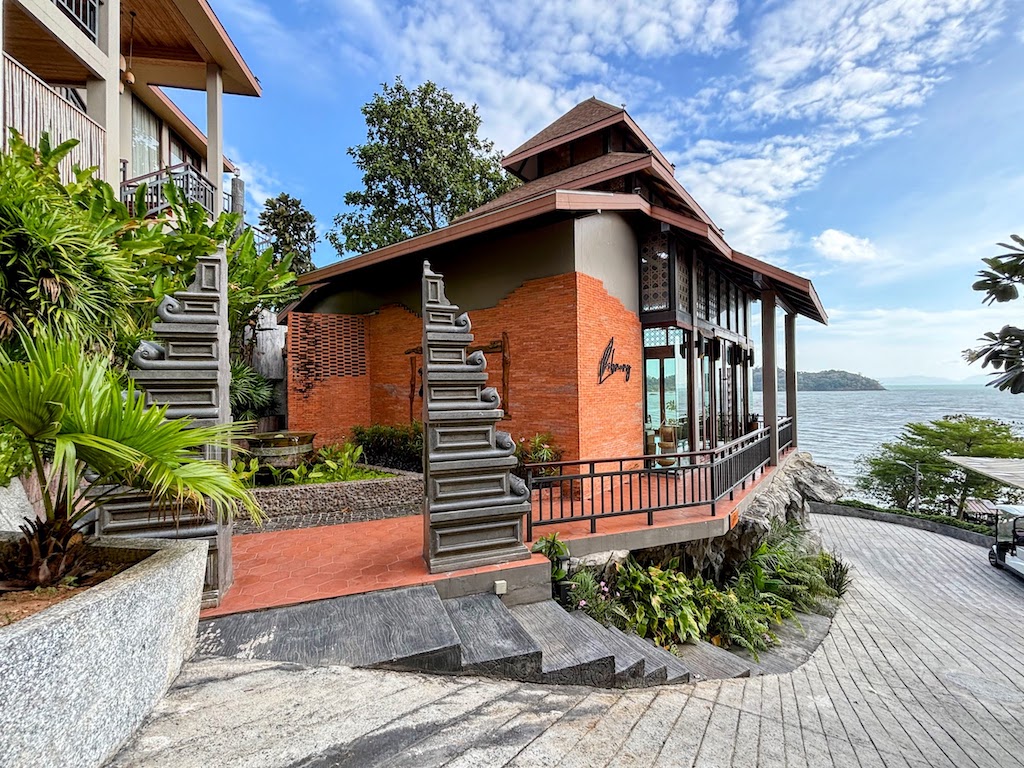
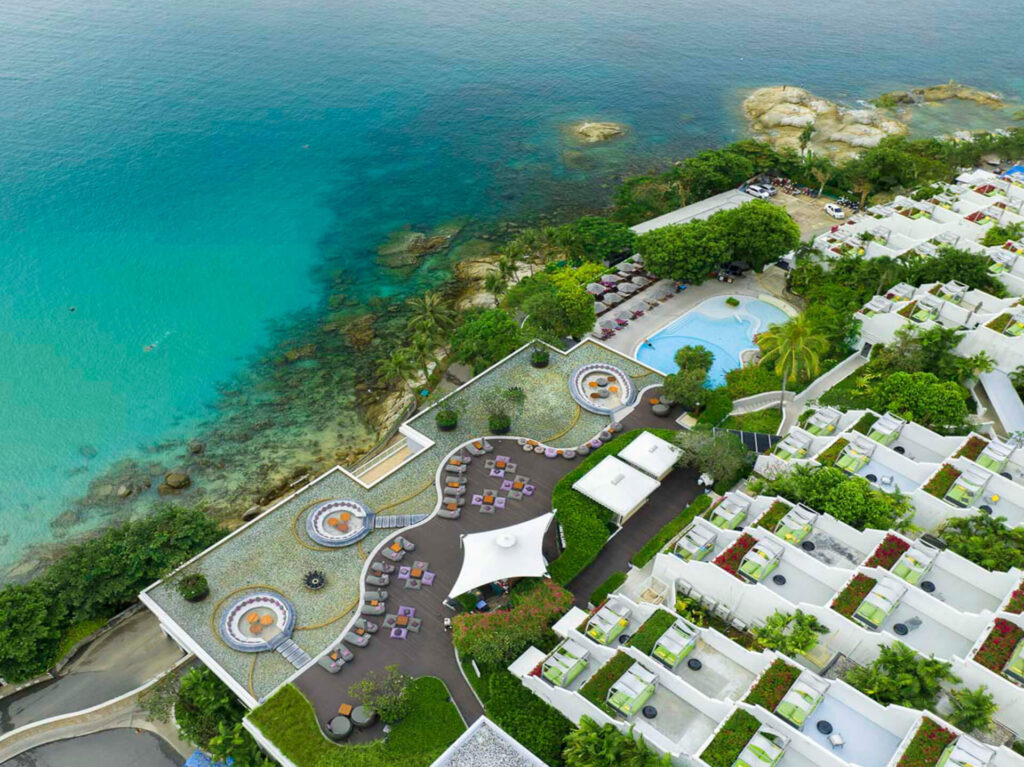
The hotel itself is built into a steep hillside, which gives the whole place a terraced, vertical quality and your calves a personality they didn’t previously have. Buggies shuttle between levels with commendable frequency, the drivers unfailingly cheerful despite the gradient, though guests determined to get their steps in can take the stairs. A full circuit on foot is a genuine workout, but the payoff is the occasional surprise view around a corner that makes the effort worthwhile.

We were met at the base of the hill and driven up, then escorted into one of the most beautiful hotel lobbies I’ve encountered, the kind of room you briefly consider swapping careers to work from.
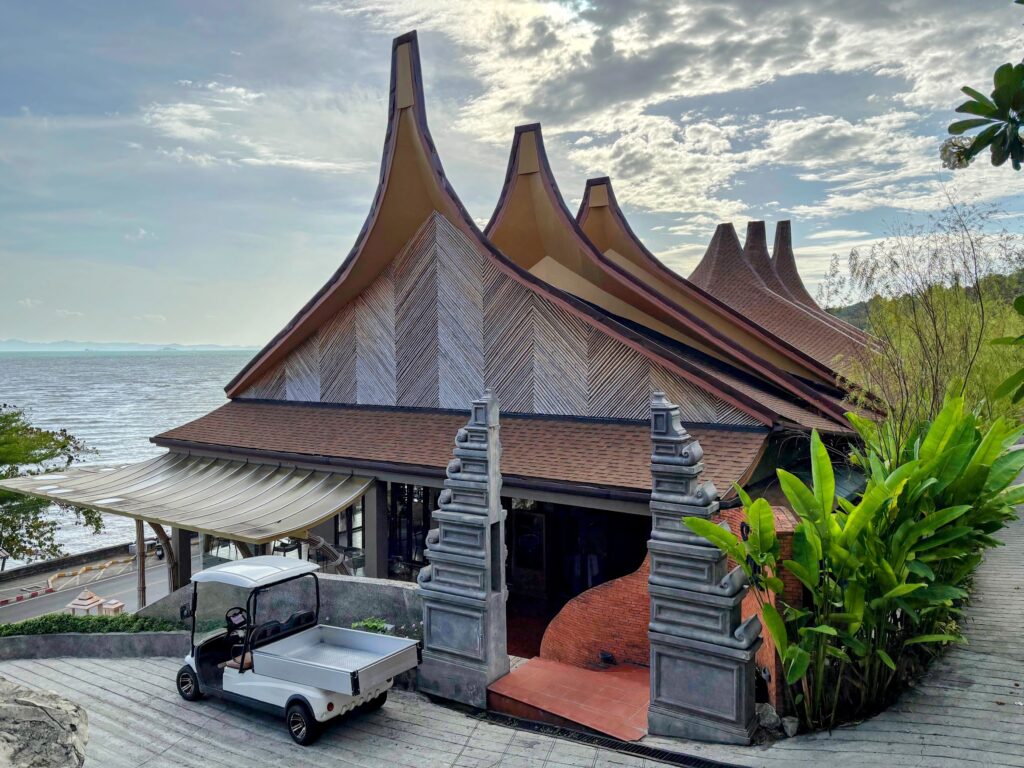
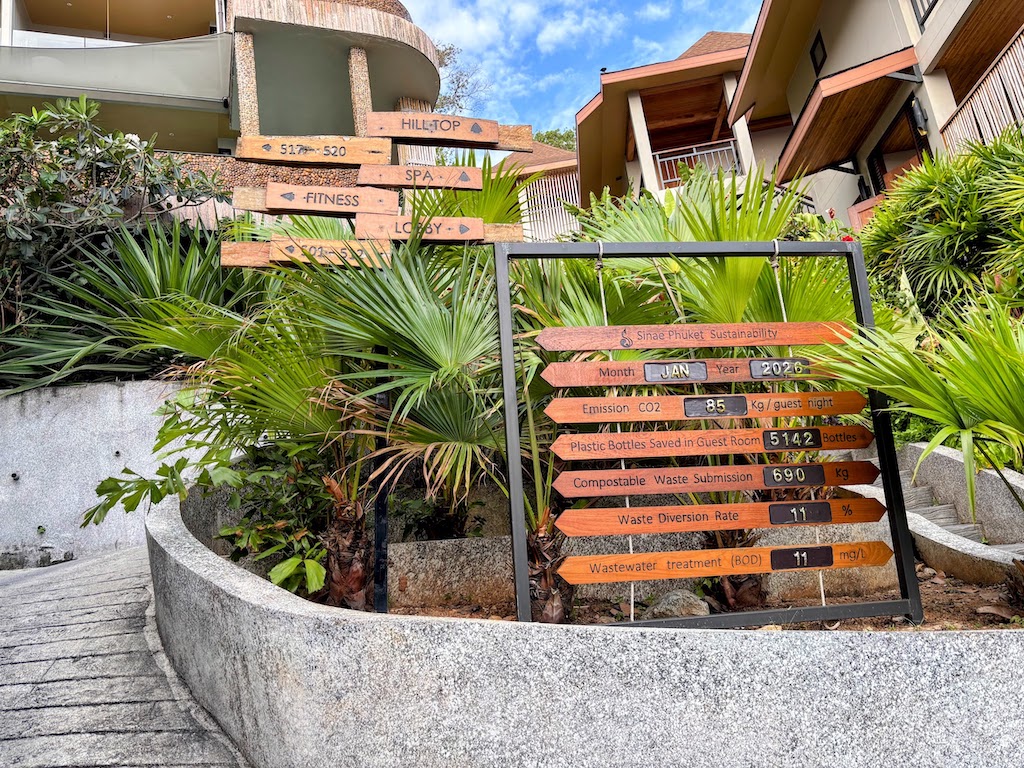
Staff encouraged us to download the Sinae app, which handles everything from buggy requests to room service orders and spa bookings, and it works well enough that you never feel the need for a reception desk again. Unfortunate, I suppose, as we’d like any excuse to come back to this room.

With just 64 villas, Sinae is small enough to feel personal but large enough to ensure you rarely cross paths with other guests. The atmosphere is private without being precious, which is a balancing act that’s surprisingly hard to pull off at five-star level.

Rooms

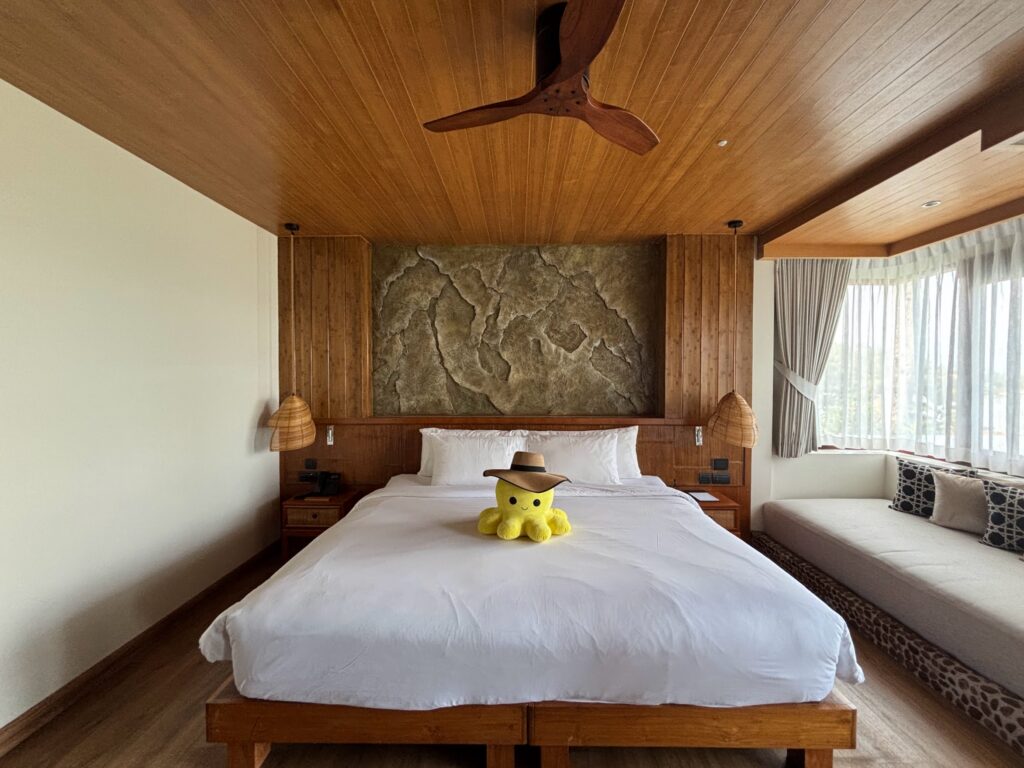
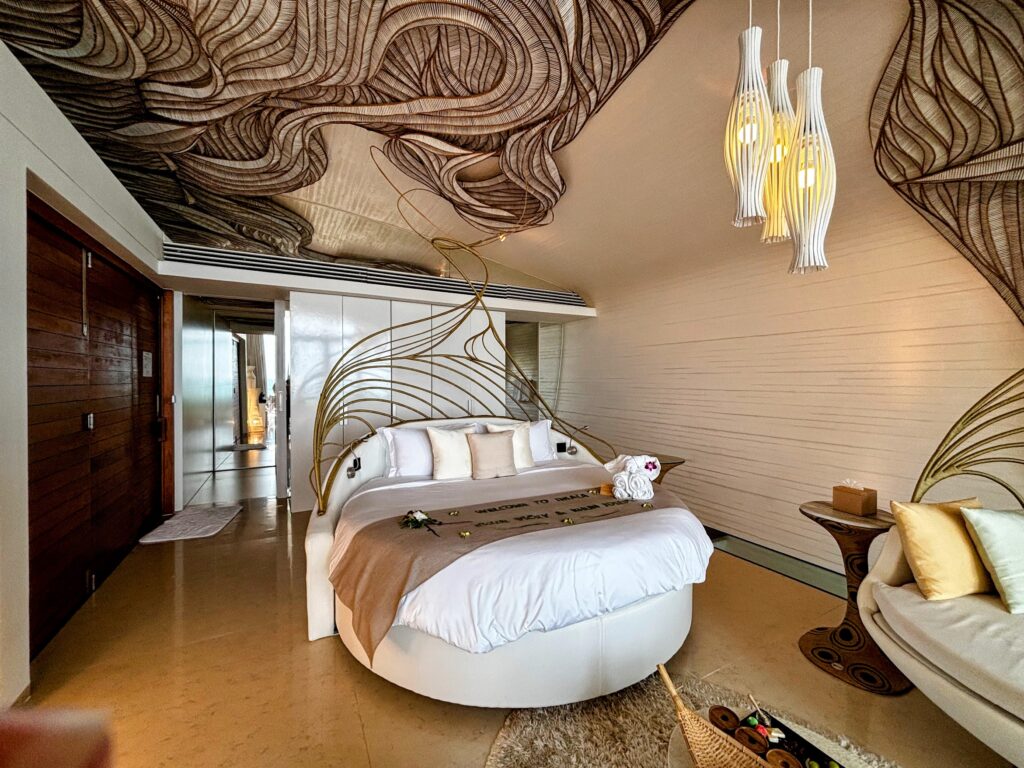
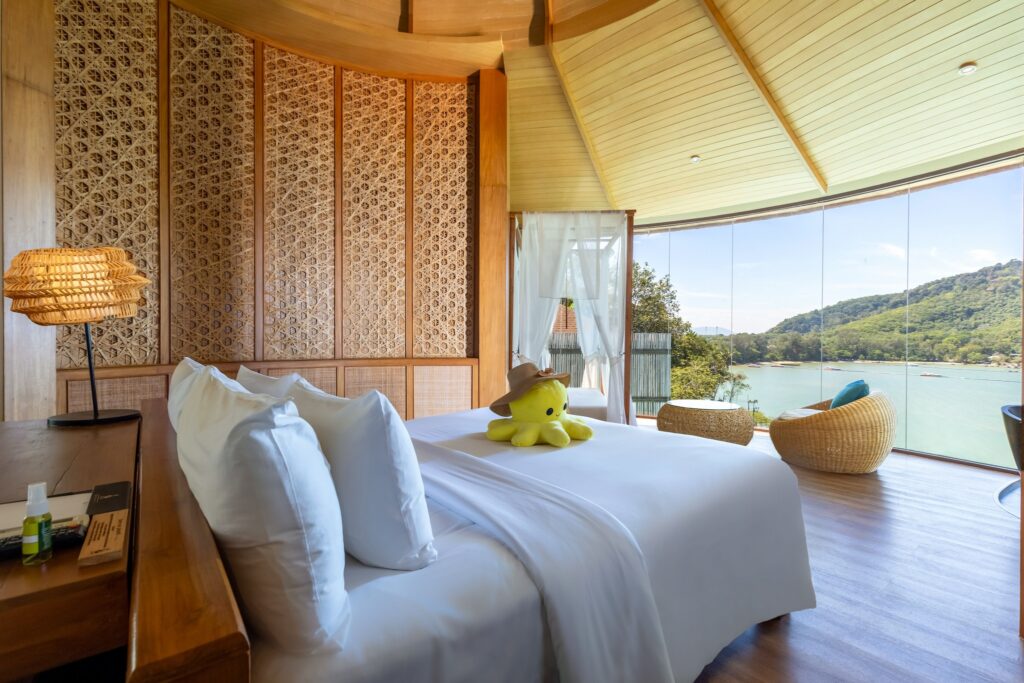
An octopus with a sunhat awaited us in the room, on top of a bed of stratospheric thread count, which was either a charming cuddly toy or a veiled warning about the tentacular grip this place has on its guests. It set the mood: it’s the kind of place you come to let your hair down and get horizontal.

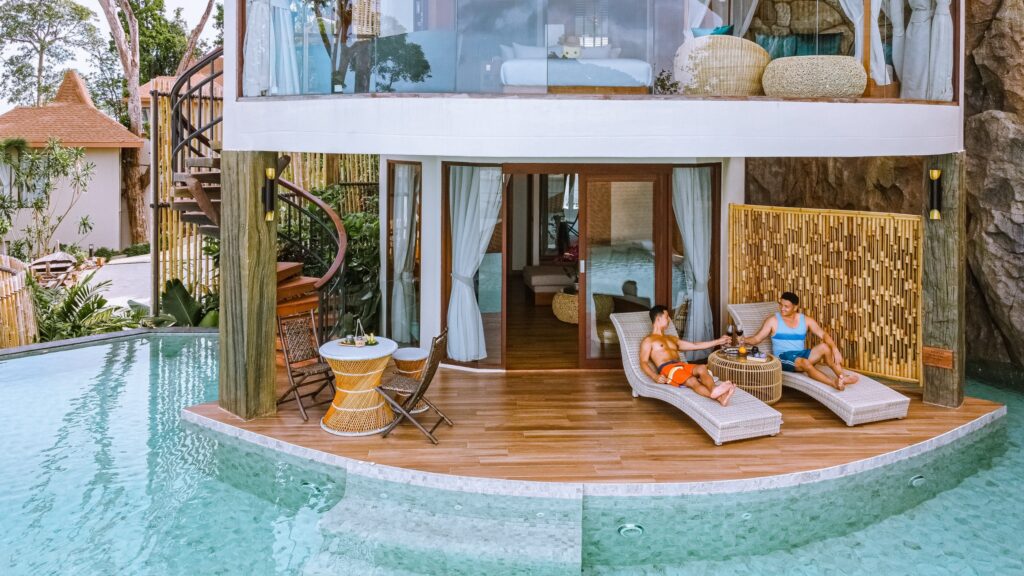
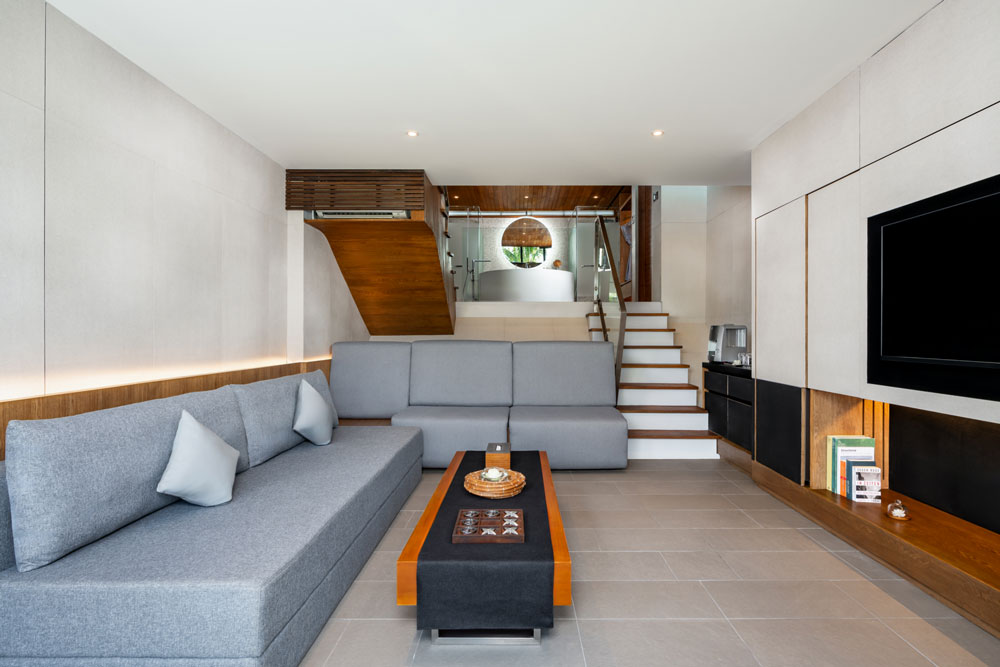
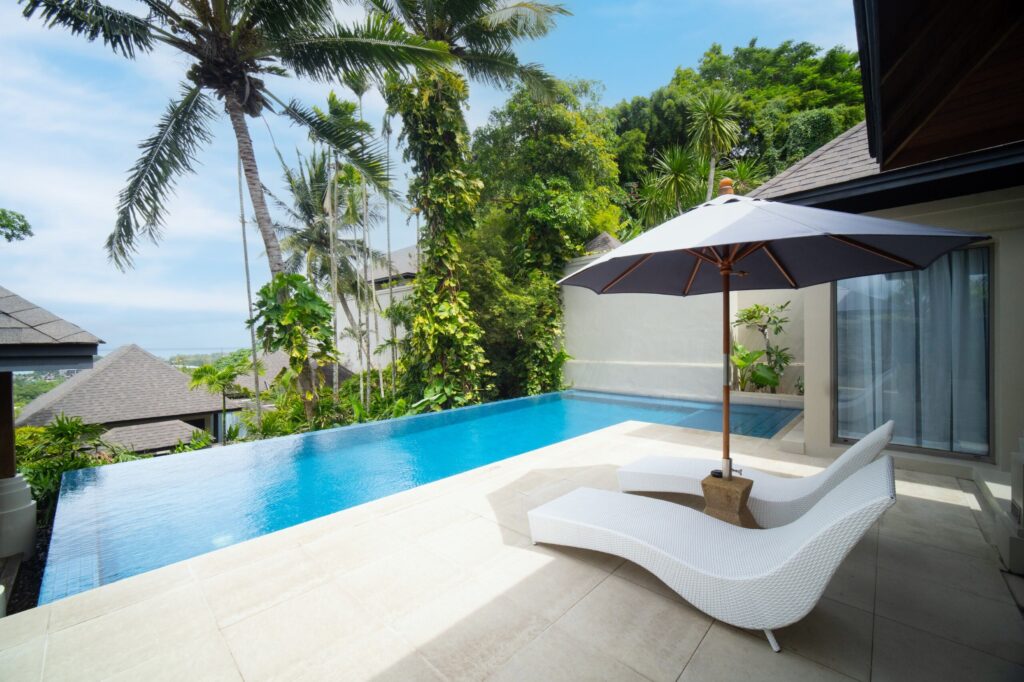
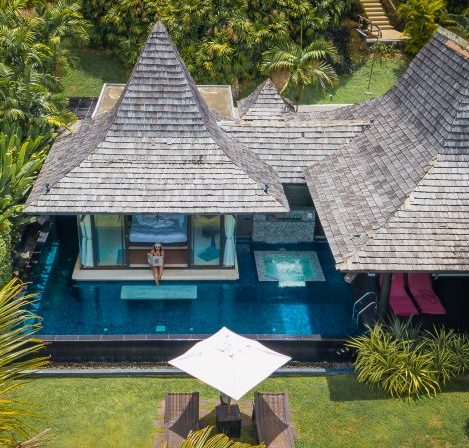
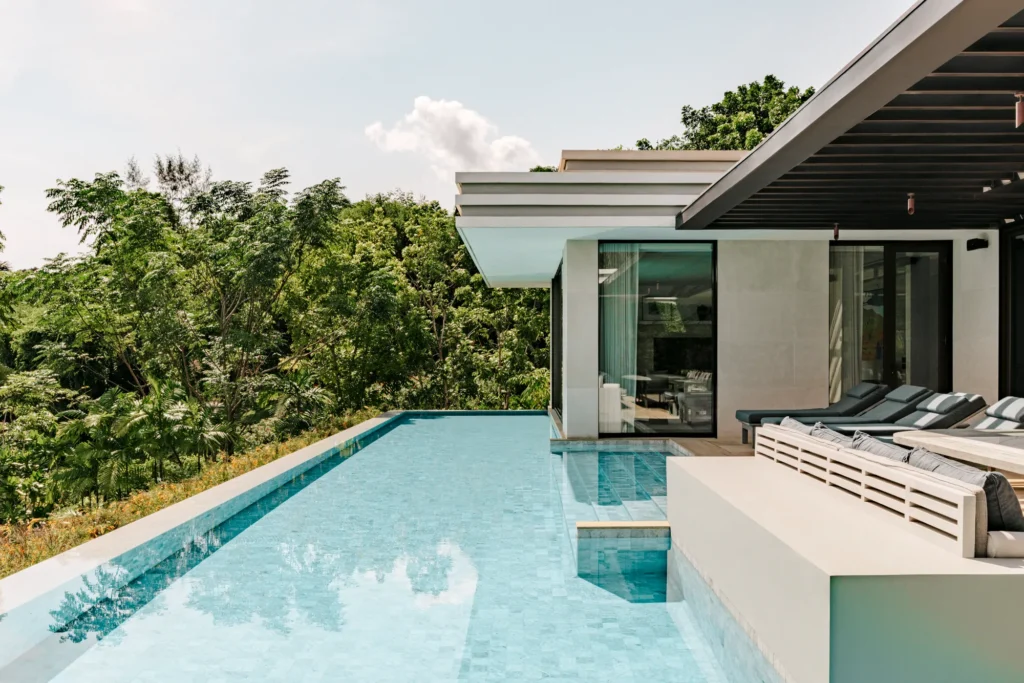
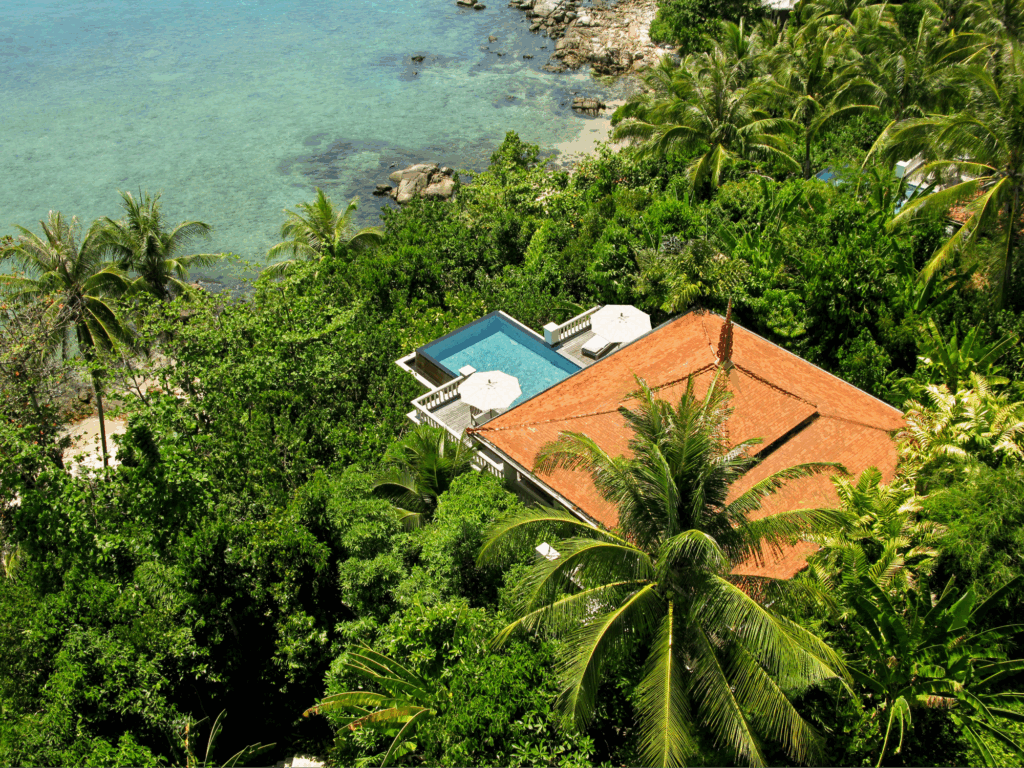
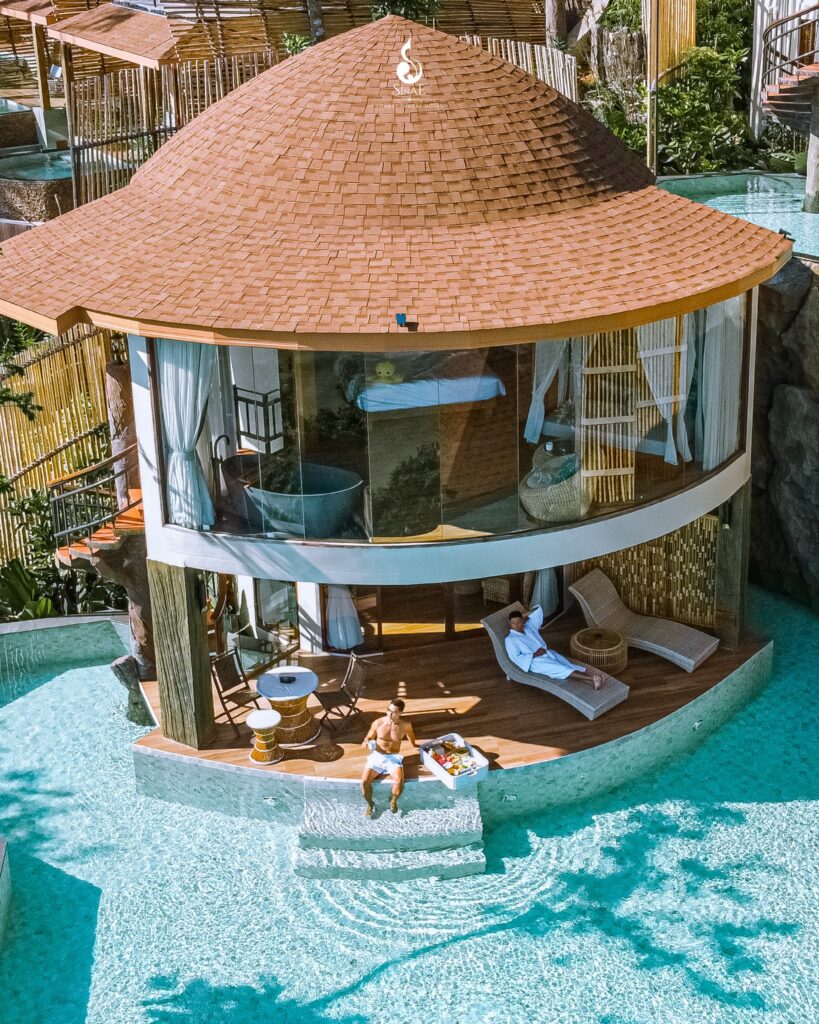
Every villa at Sinae comes with a private pool and an ocean view, which eliminates the usual hotel anxiety of wondering whether you’ve been assigned the one room that faces the car park. Eight categories span the range, from entry-level Studio Pool Villas through the fish-trap-inspired Sea Sai and the Premier Pool Suite with its crescent-shaped infinity pool, up to the Sky Pool Villa and the two-storey Family Pool Villa at the top end. In every sense of the word.
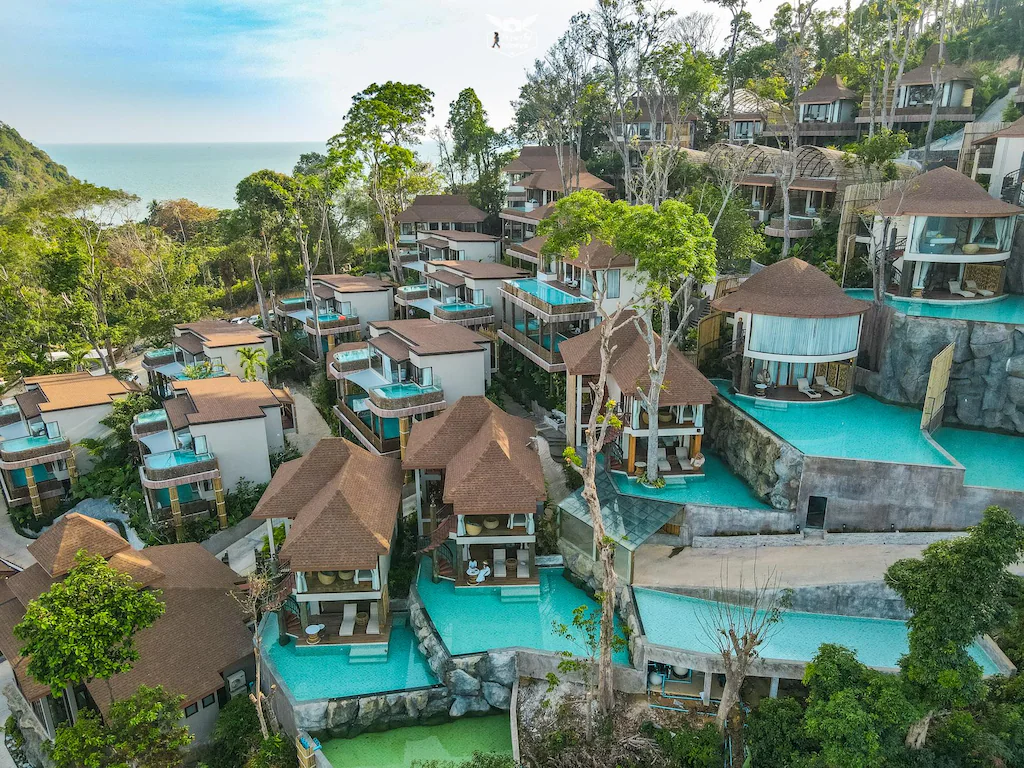
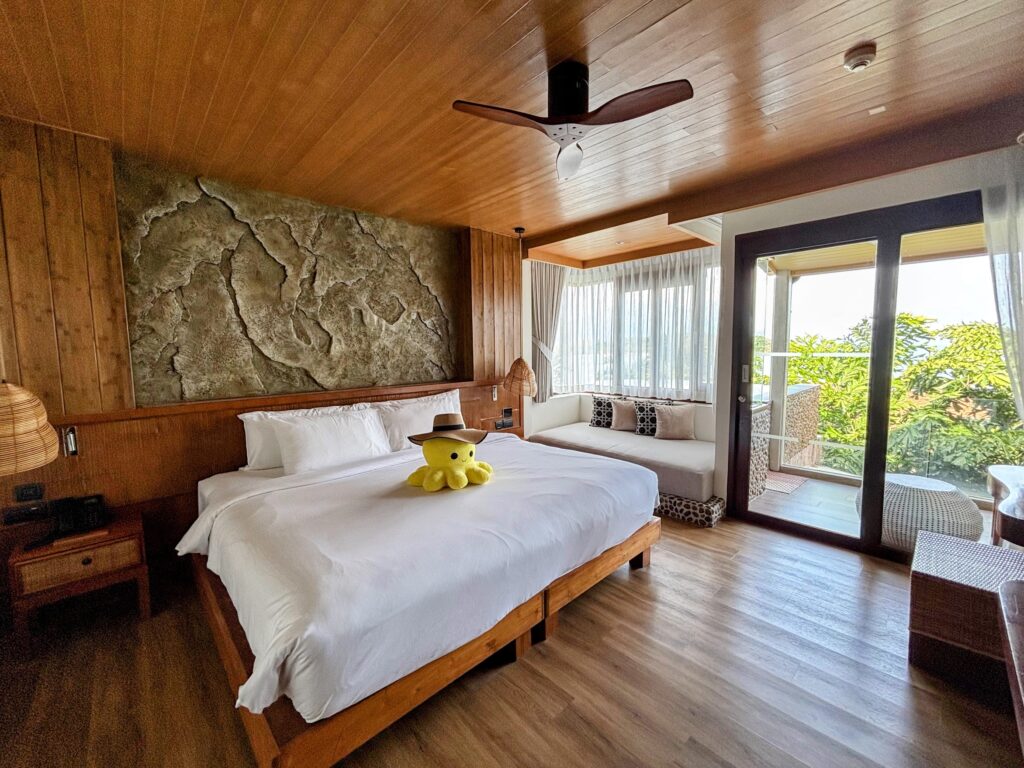
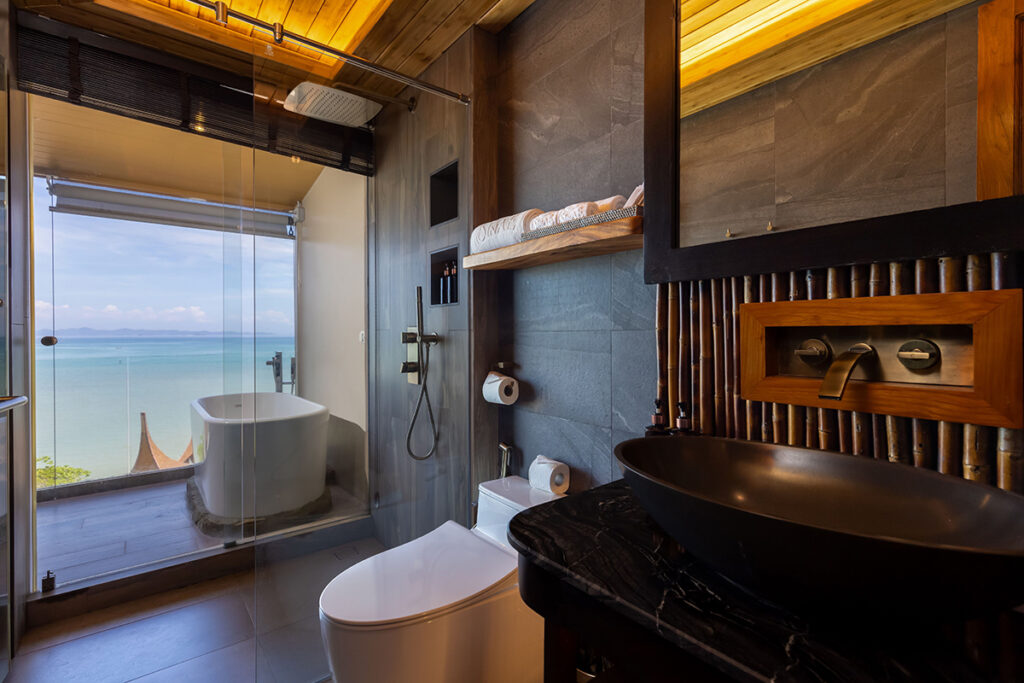
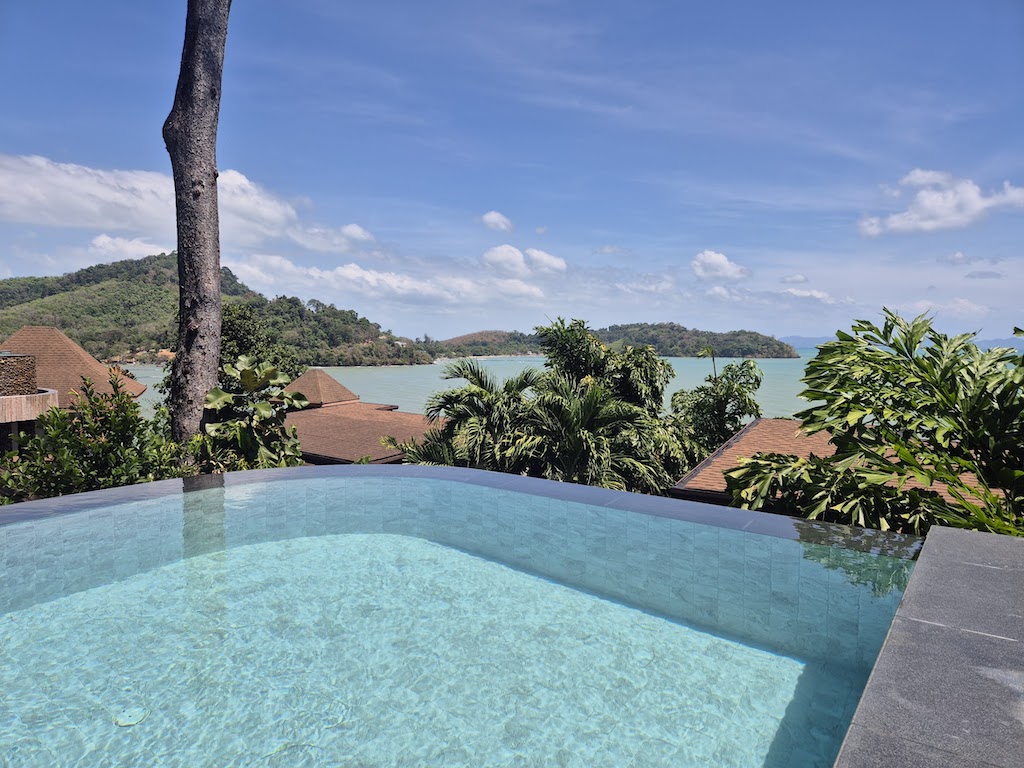
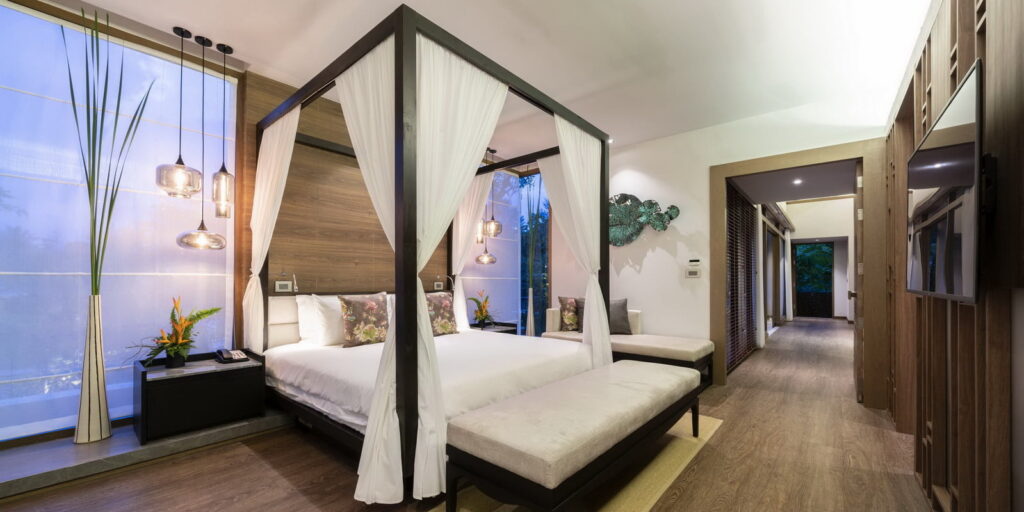
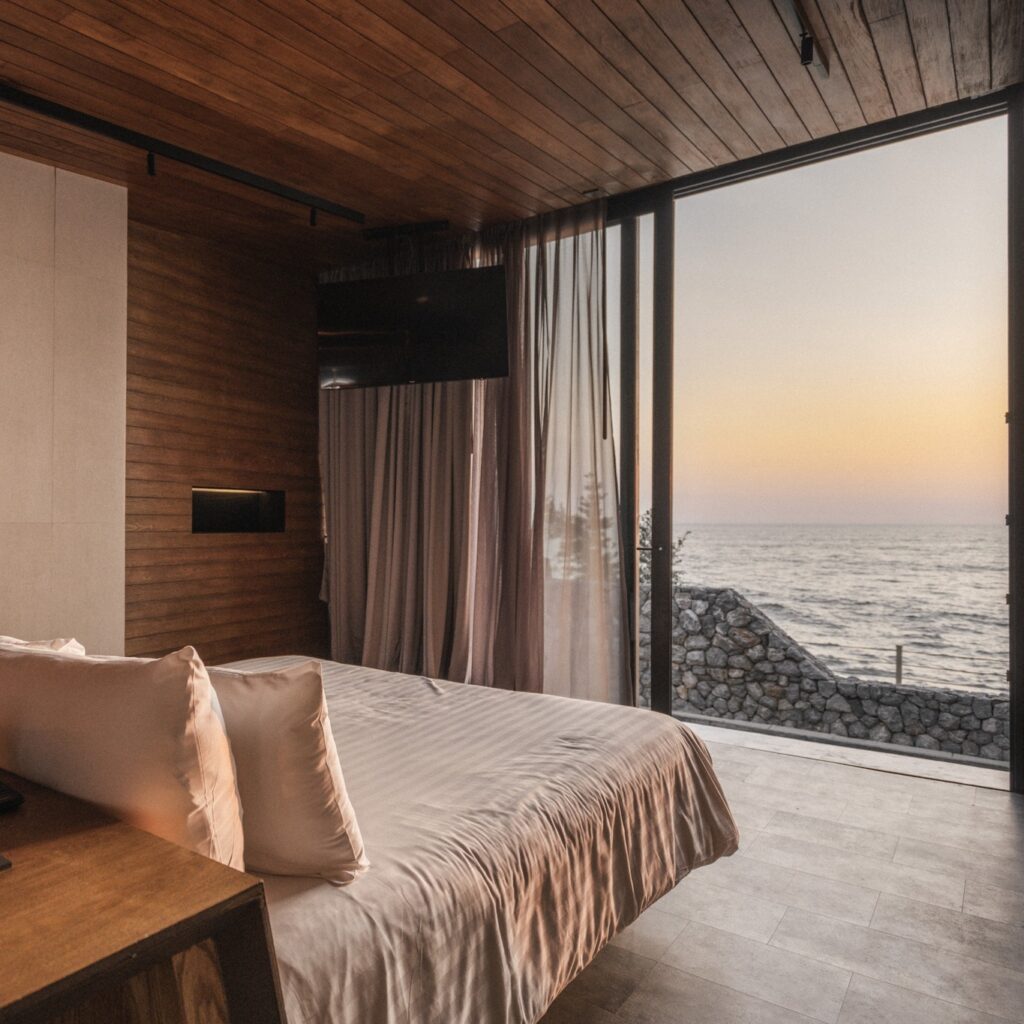
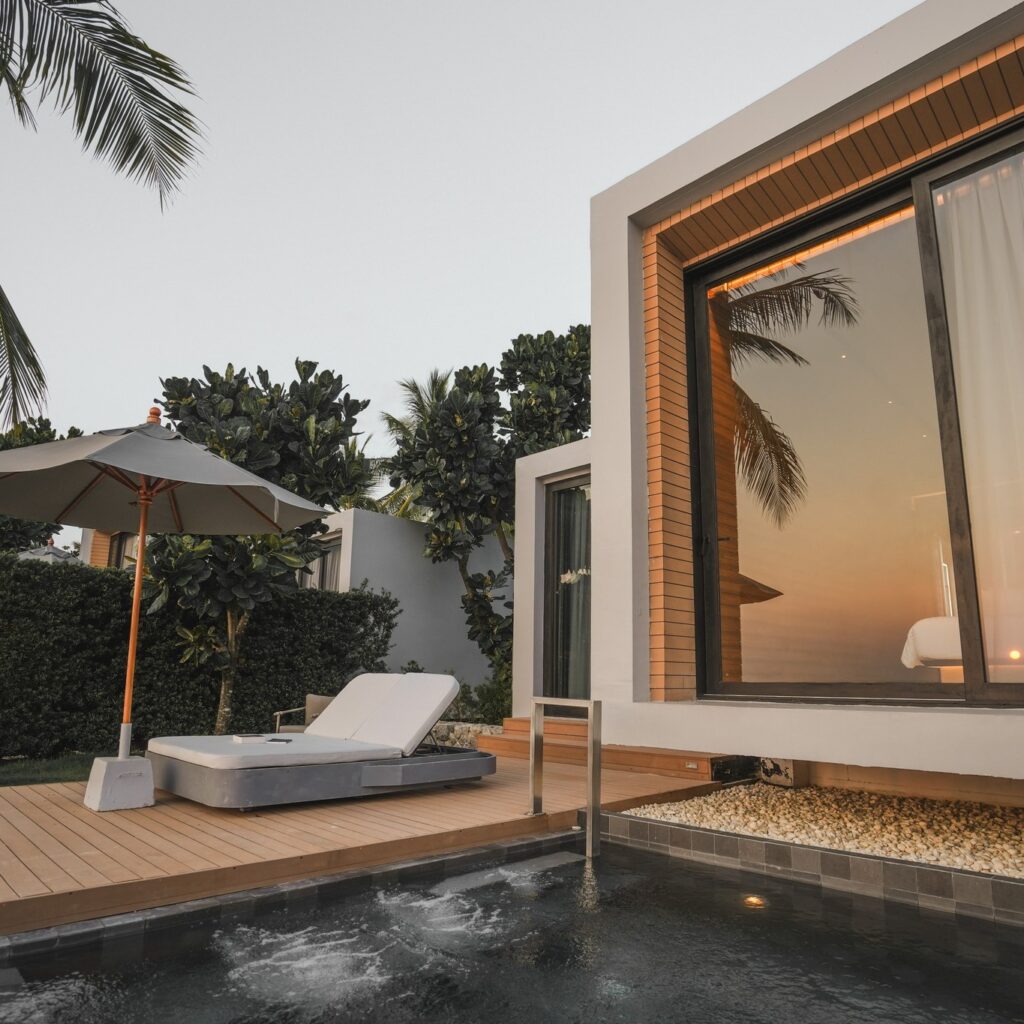
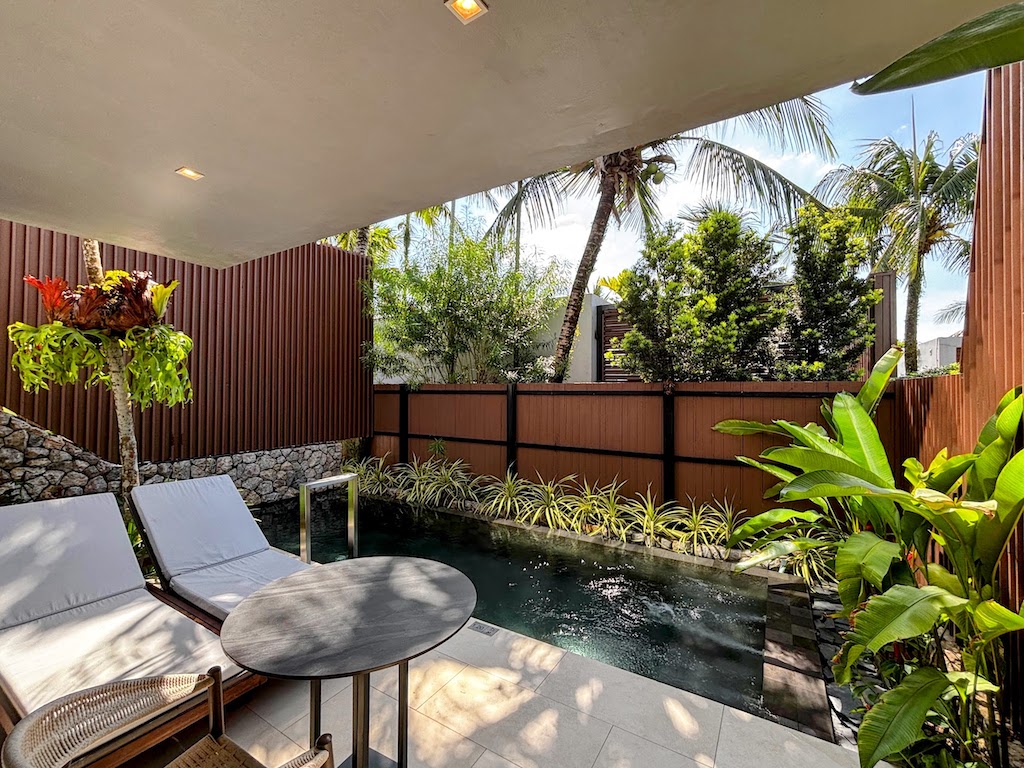
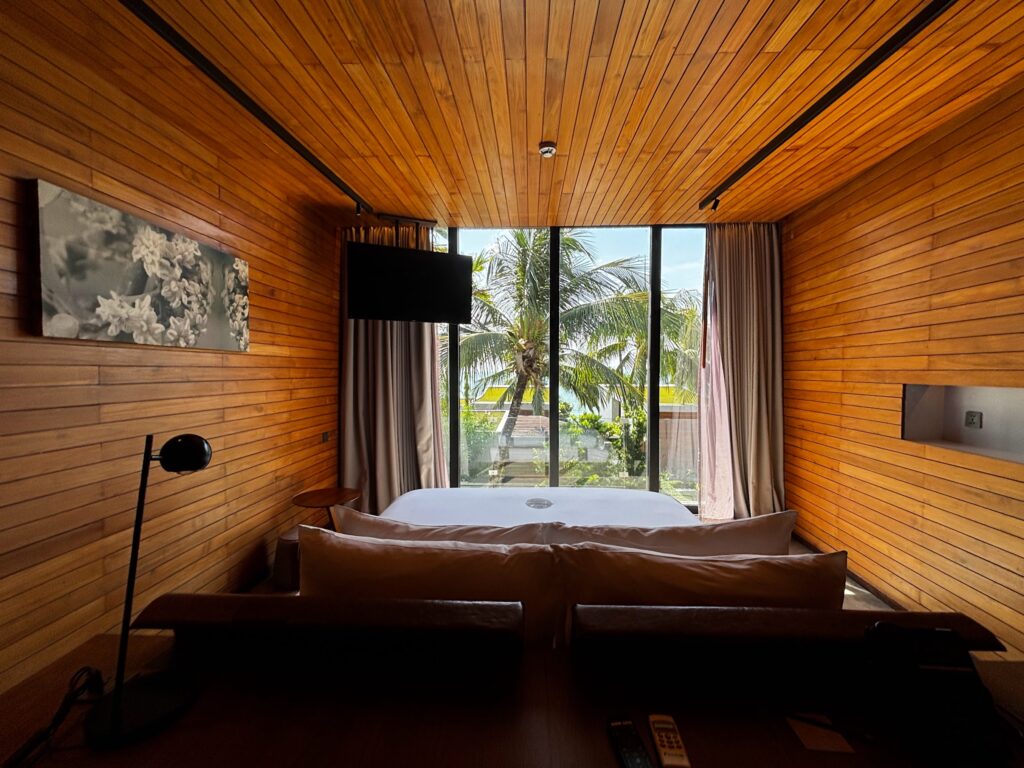
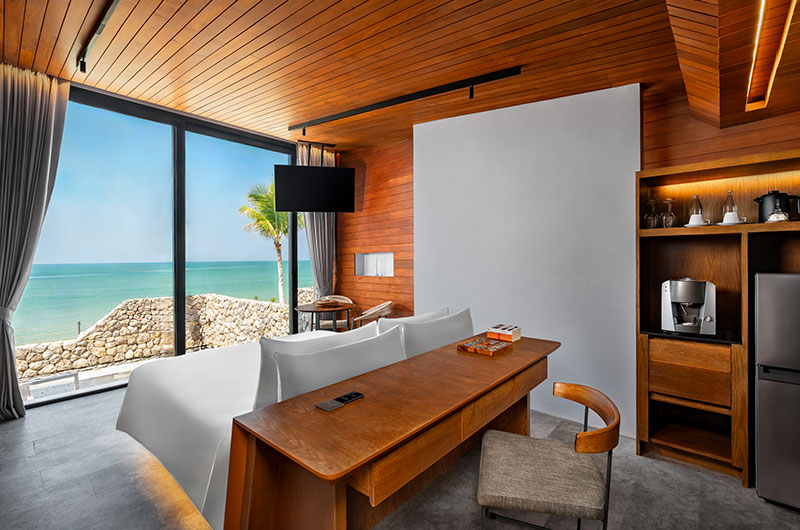
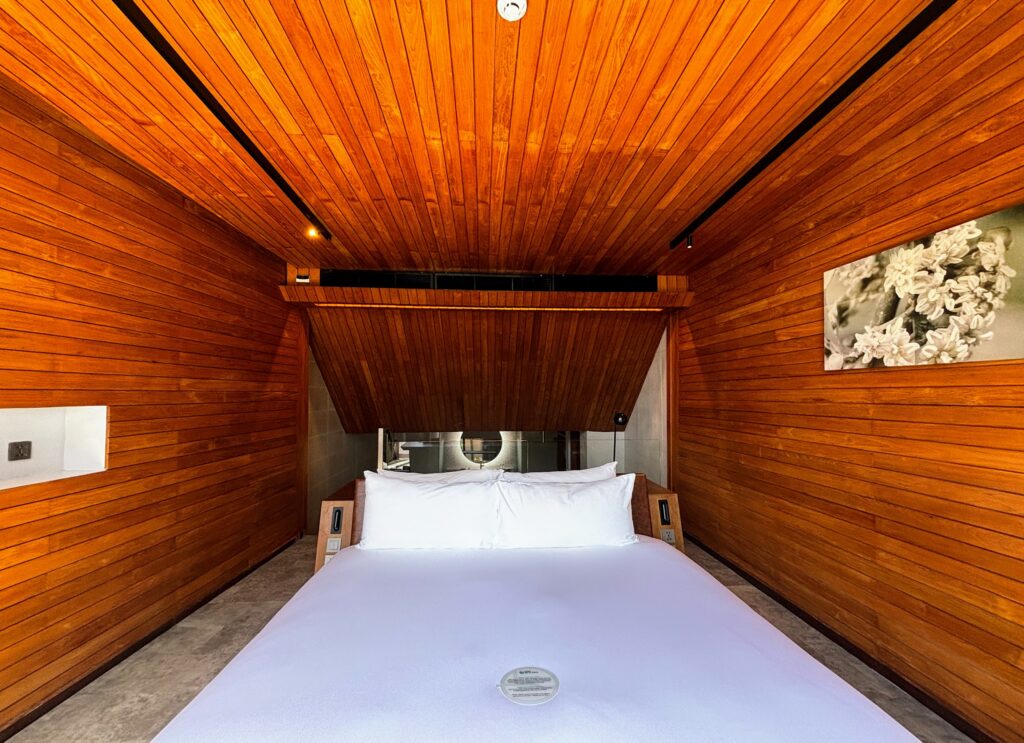
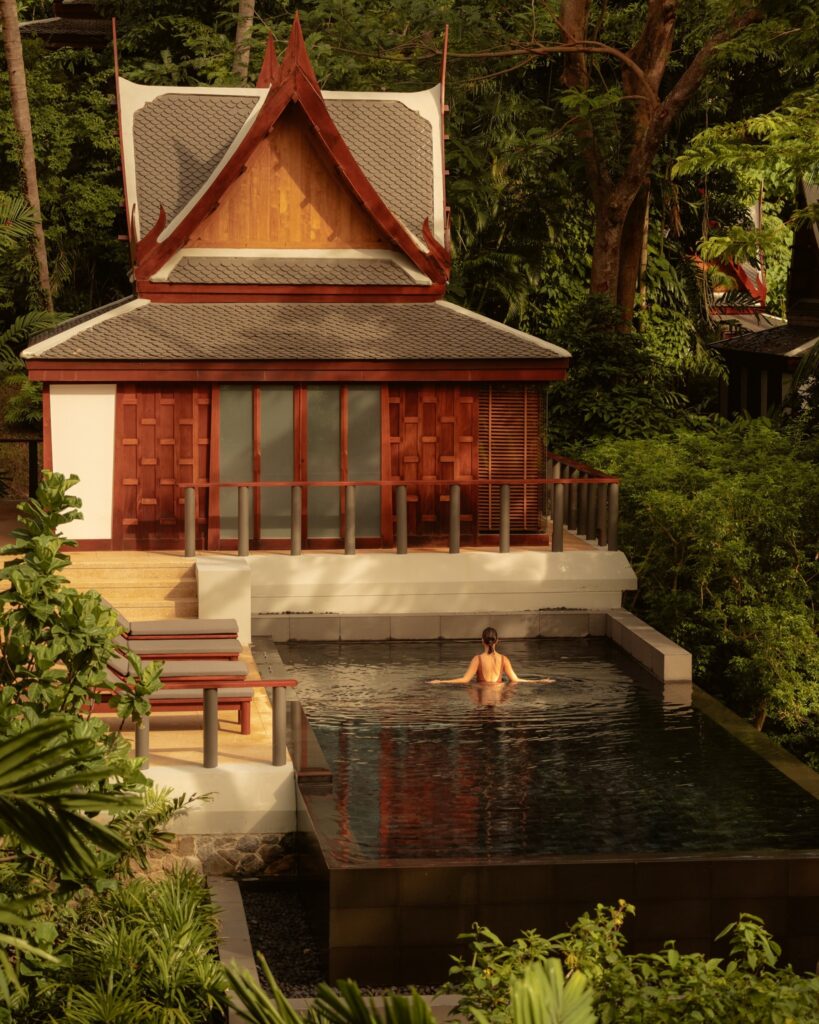
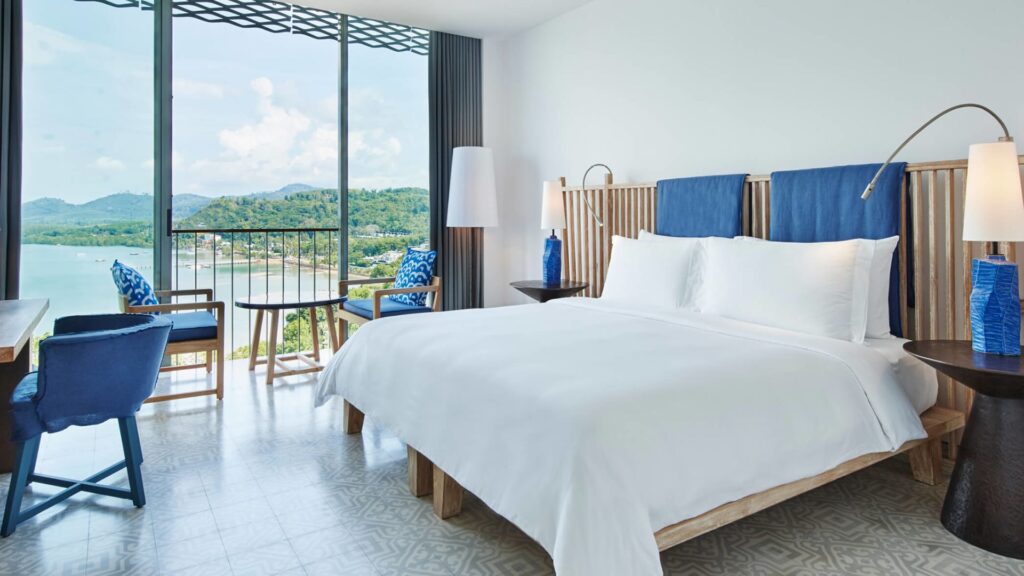
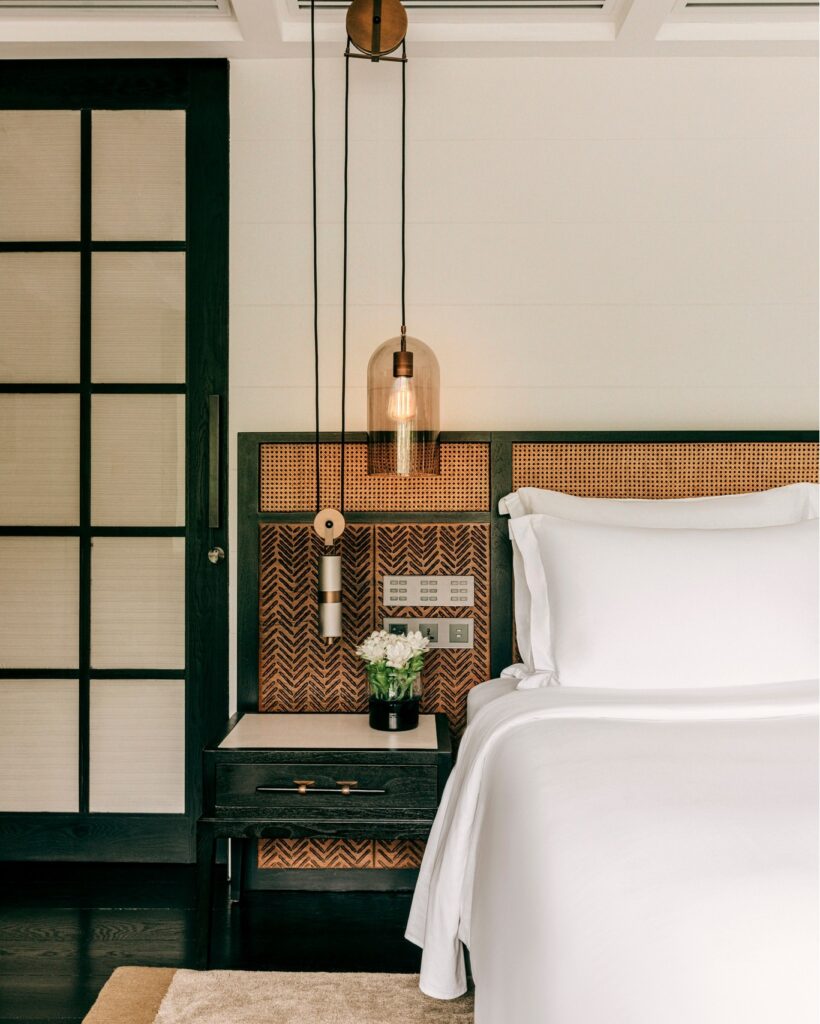
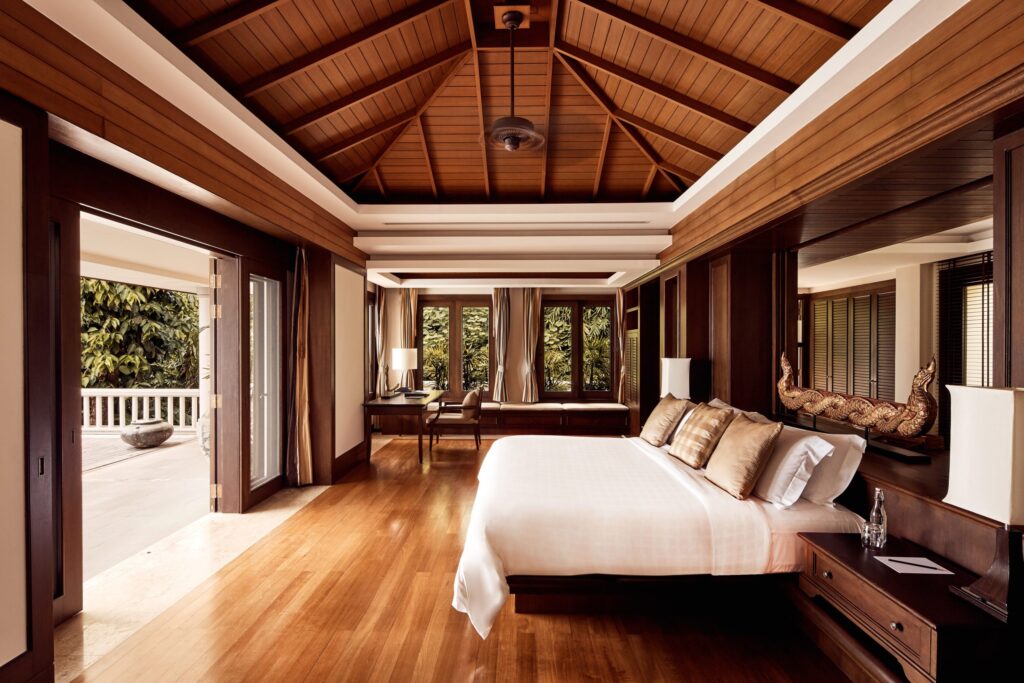
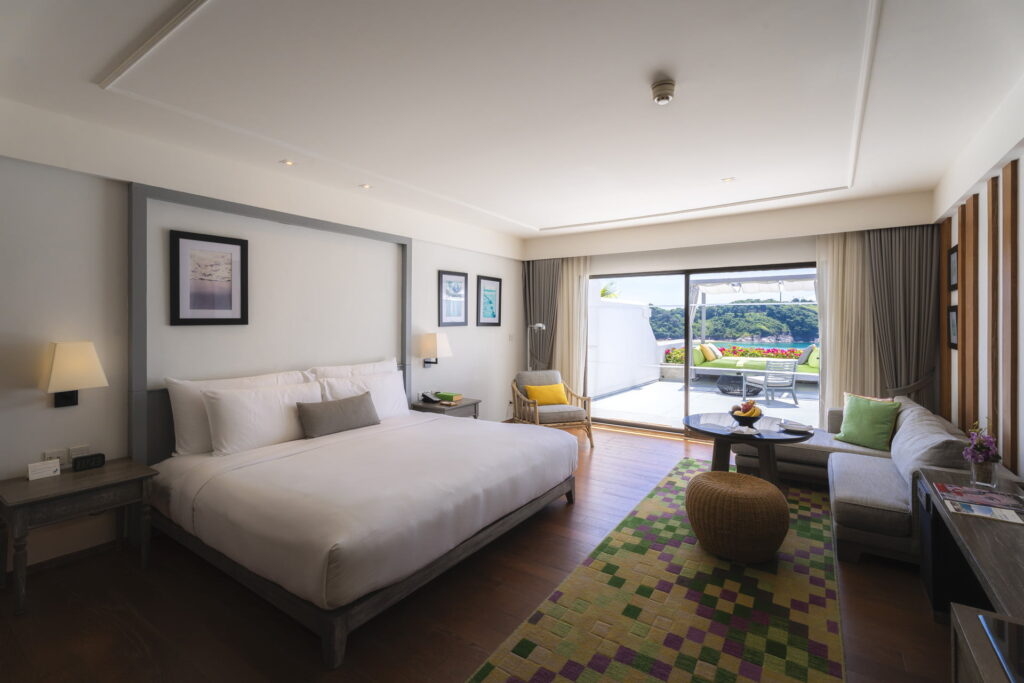
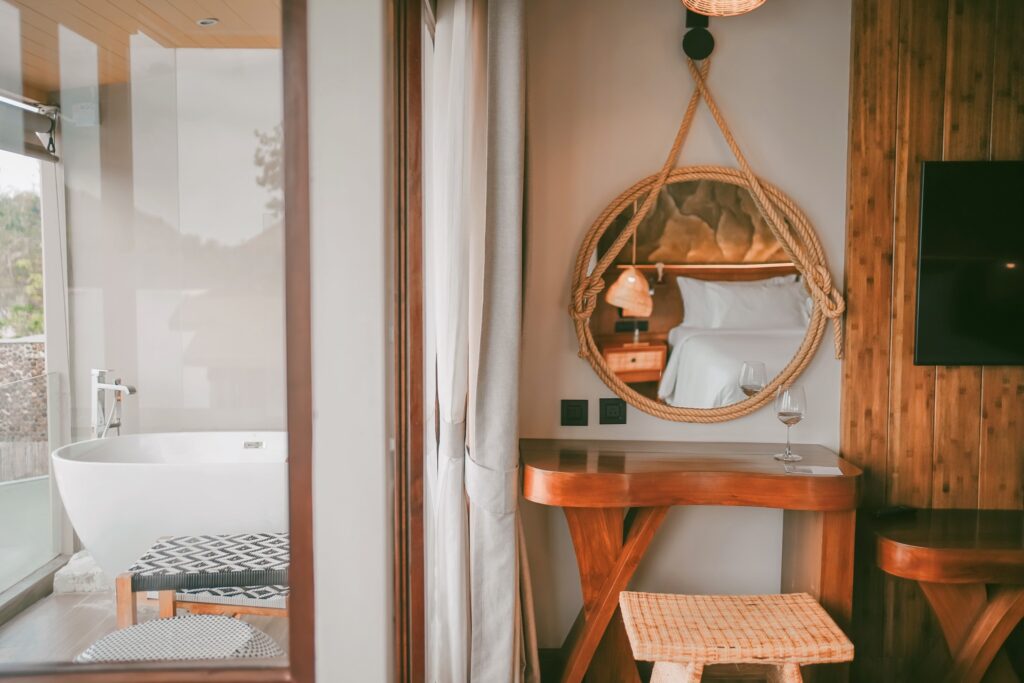
We stayed in a Studio Ocean Pool Villa, and the proportions were generous. The room is dressed in teak and stone, with a backlit feature wall behind the bed that looks impressive when lit at night. Floor-to-ceiling glass slides open to the terrace, and from the bed you’re looking straight at the Andaman Sea. The private plunge pool isn’t enormous, but it’s perfectly proportioned for a morning dip and the kind of aimless afternoon lounging that constitutes the core activity here. Views from the pool are superb. We told ourselves we’d leave the villa and explore by lunchtime. We did not leave the villa by lunchtime.
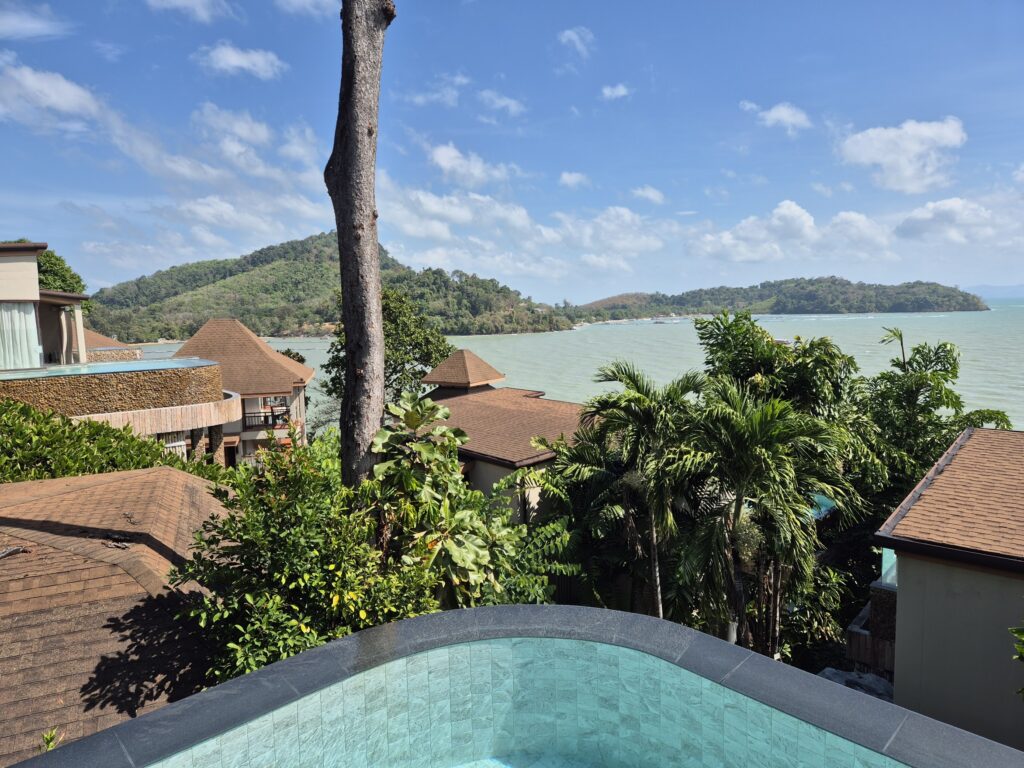
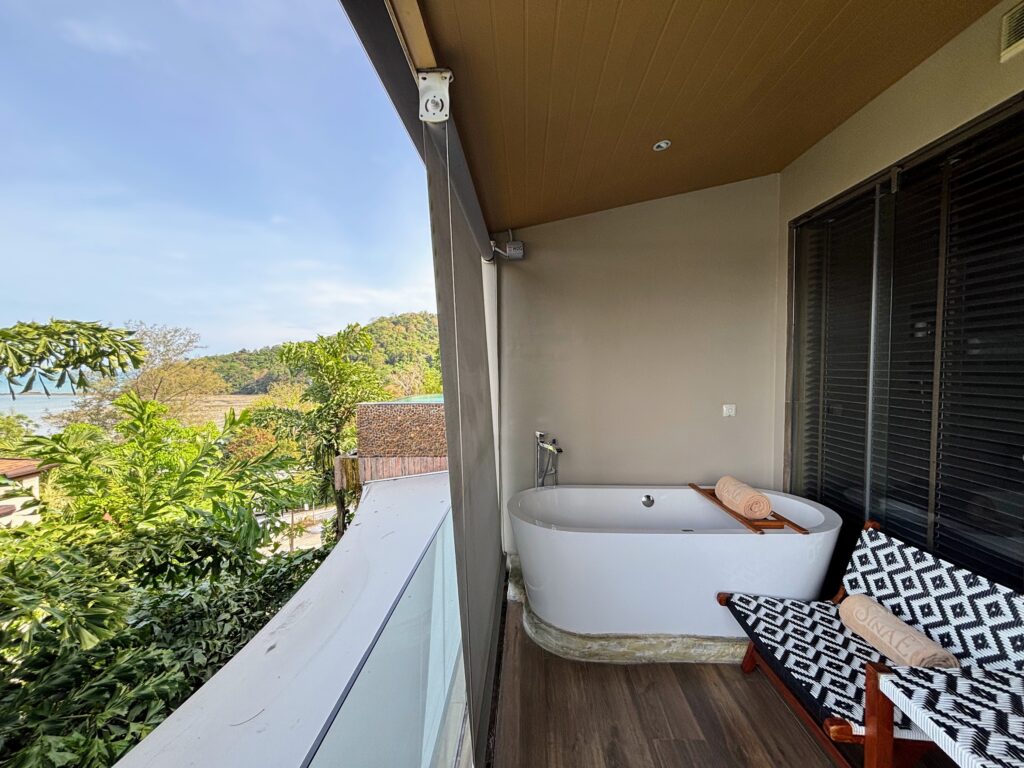
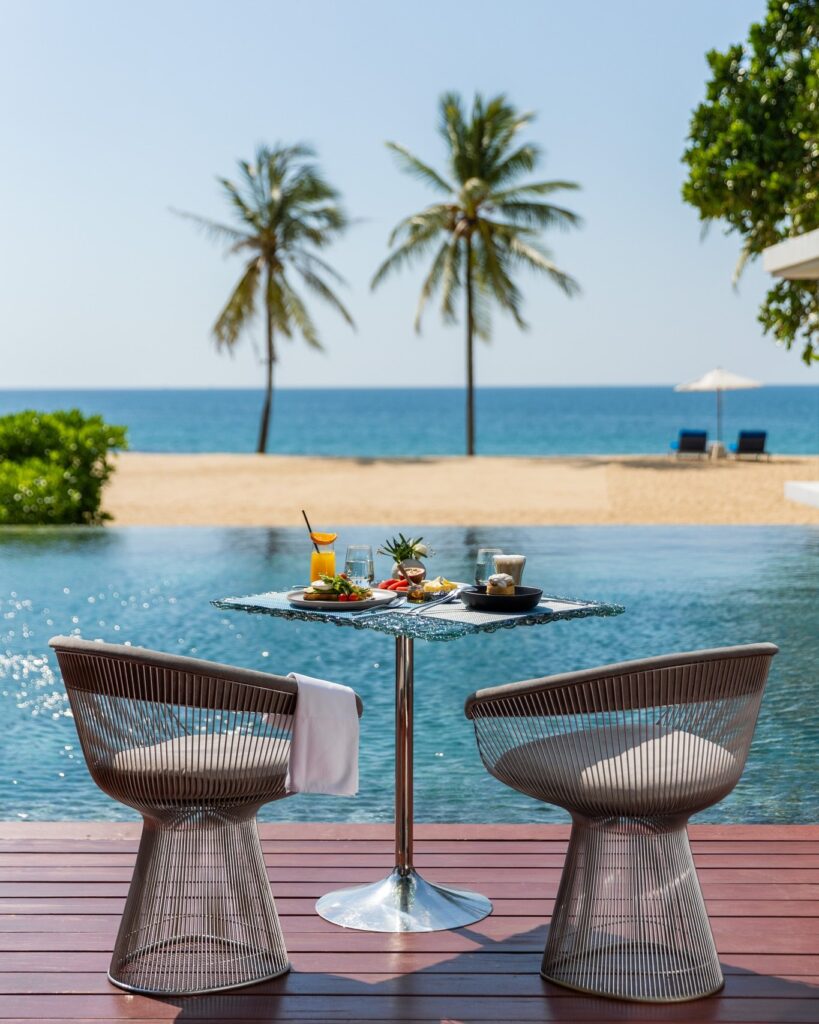
It’s easy to see why honeymooners gravitate to Sinae. The combination of a private pool, an uninterrupted sea view from the bed, and no reason whatsoever to leave the room creates the kind of cocoon that couples are after. Book the Premium honeymoon package and you get a floating breakfast delivered to your villa pool, flower bed decorations, a honeymoon cake, and a romantic bath drawn as part of an enhanced spa session.
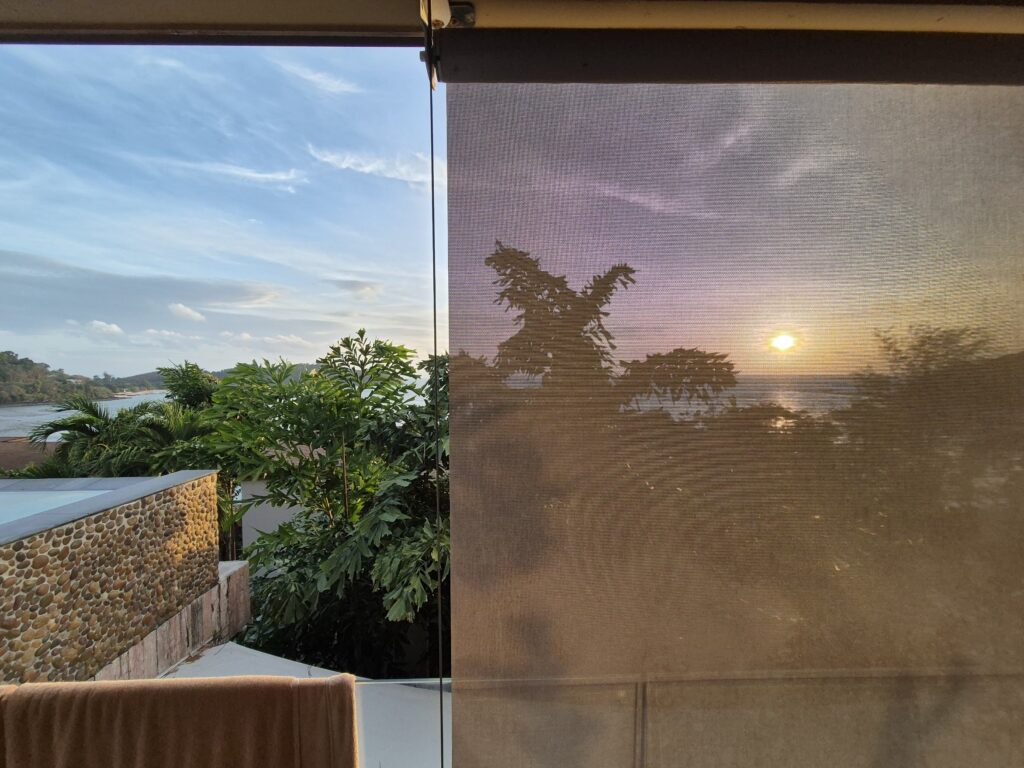
Complimentary soft drinks are stocked in the minibar, a thoughtful touch at this price point. The room is well equipped for longer stays, with a pillow menu, a decent workspace, and a smart TV. Blackout options are effective.

Do be aware that some villa categories, particularly the lower-positioned ones, can have their sea views partially interrupted by neighbouring rooftops. If an unobstructed vista matters to you, it’s worth specifying when booking. The higher-sited villas and the Sky Pool Villa category deliver the full panoramic experience.

And whatever you do, don’t leave your shoes outside your room, even for a minute. Monkeys will take them. We learnt the hard way.
Facilities & Spa

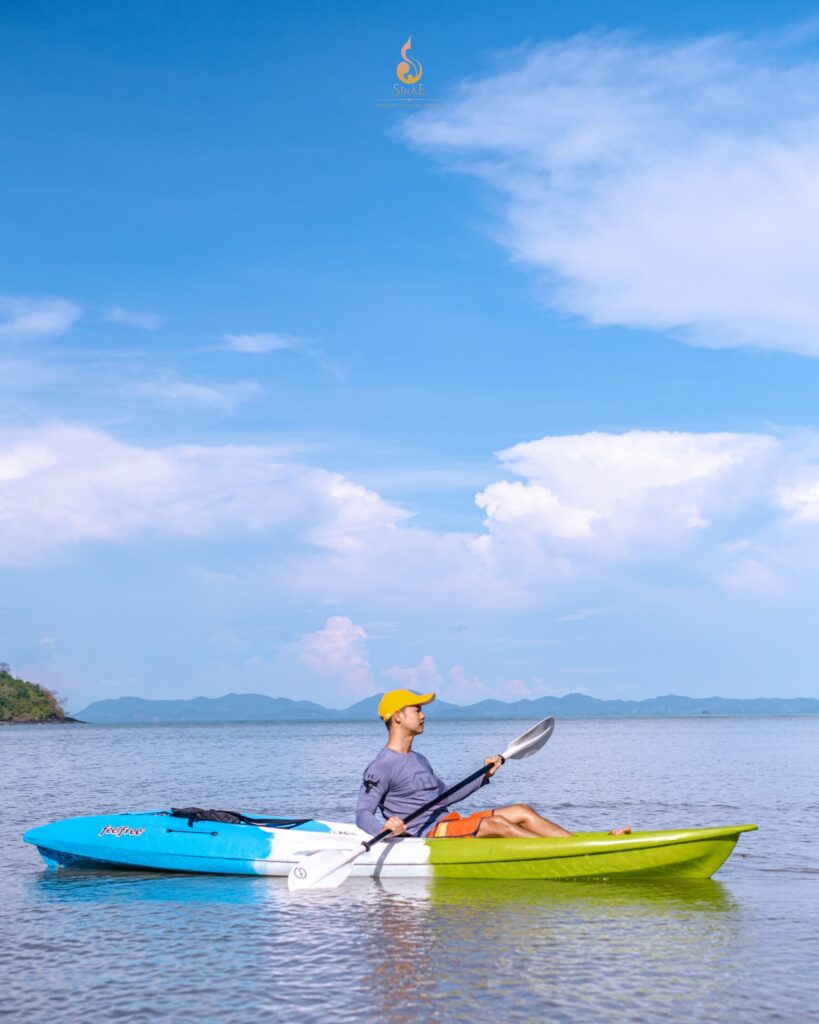
There’s enough here to feel you’re not stuck on the hillside. Paddleboards, kayaks and bicycles are on hand (free, too), and each offers a different way into the rhythms of Koh Sirey. The kayaking along Sirey Bay is best tackled early, before the heat sets in; the east-facing water is sheltered from the Andaman swell, so you can paddle in relative calm past mangrove-fringed shoreline and longtail fishing boats heading out for the morning catch, with the green outline of Koh Yao Yai visible across the strait. It’s wonderfully grounding.
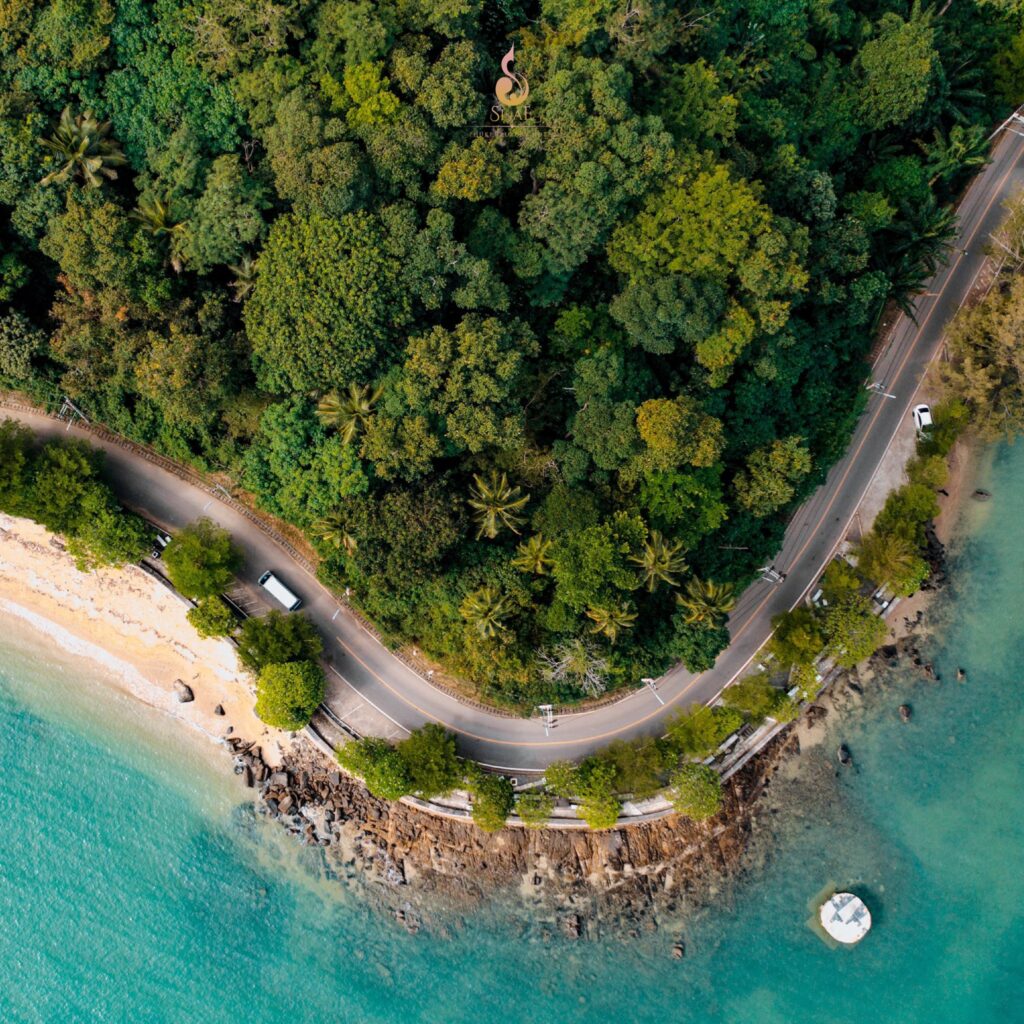
On the bike, the ride takes you along winding coastal roads next to calm waters, through rubber plantations and coconut groves where the tropical canopy of the Ratsada jungle cools the air around you. You pass the Chao Ley sea gypsy village at Laem Tukkae, its harbour crowded with painted fishing boats, and climb up to Wat Koh Sirey, where a golden reclining Buddha and a replica of Myanmar’s Kyaiktiyo Pagoda sit on a hilltop with views back over Ratsada Harbour. Long-tailed macaques hang around the mangroves near the bridge, and the whole circuit is short enough (Koh Sirey covers just 20 sq km) that you can be back for a late breakfast without having broken too much of a sweat.

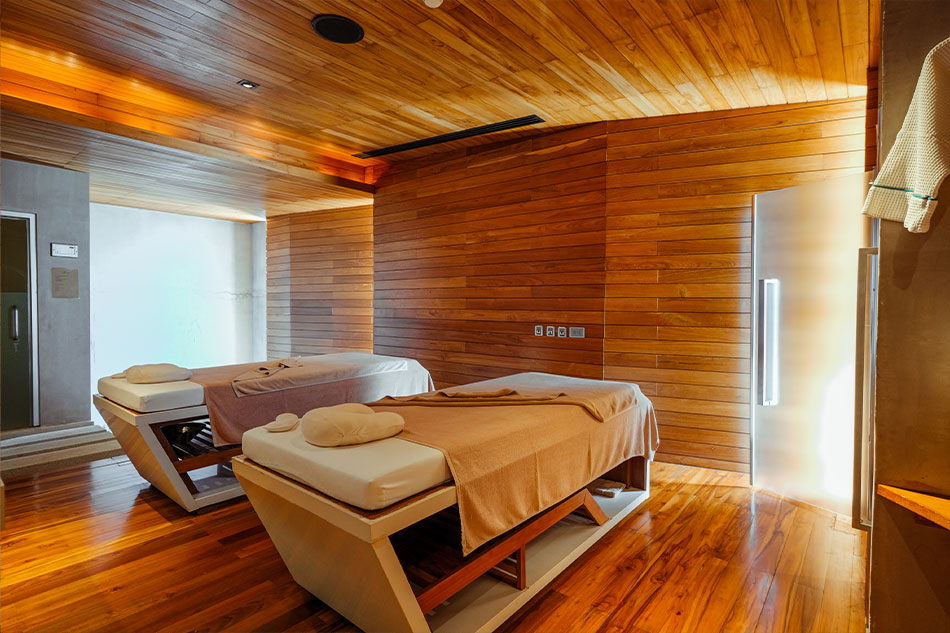
The Sindh Spa, named after the Sanskrit word for river, sits near the top of the hill and offers traditional Thai massage, aromatherapy, facials and couples’ treatments. Private treatment rooms look out over the sea, and the whole thing is run with an unhurried professionalism that never tips into the transactional. A welcome drink before and a tea of your choice afterwards bookend each session. We had an aromatherapy massage that was good enough to make the return journey down the hill feel like floating.

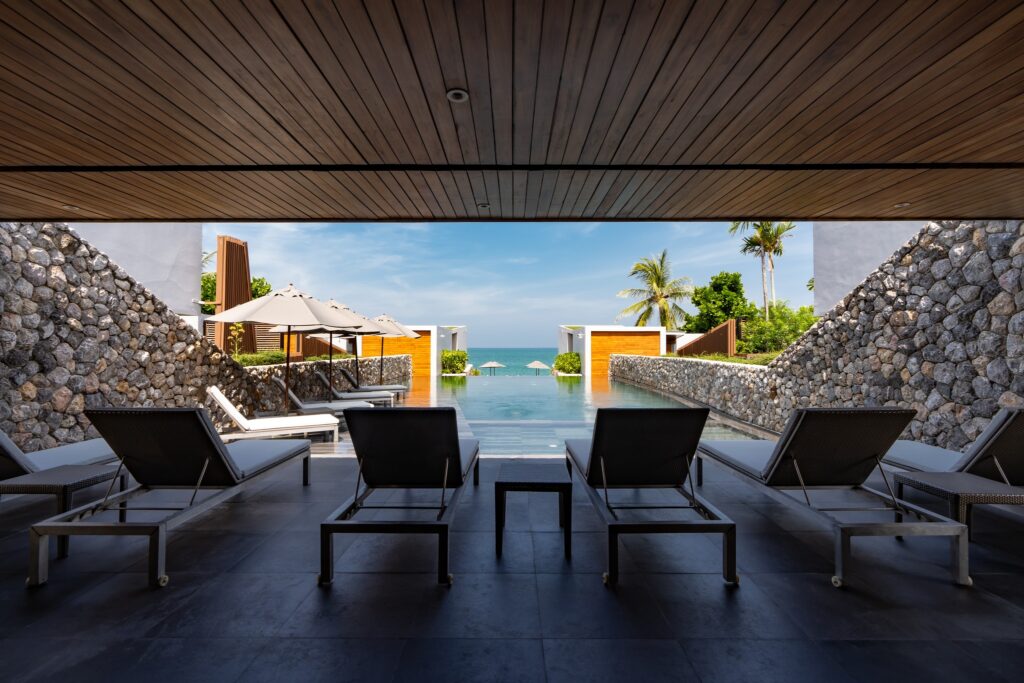
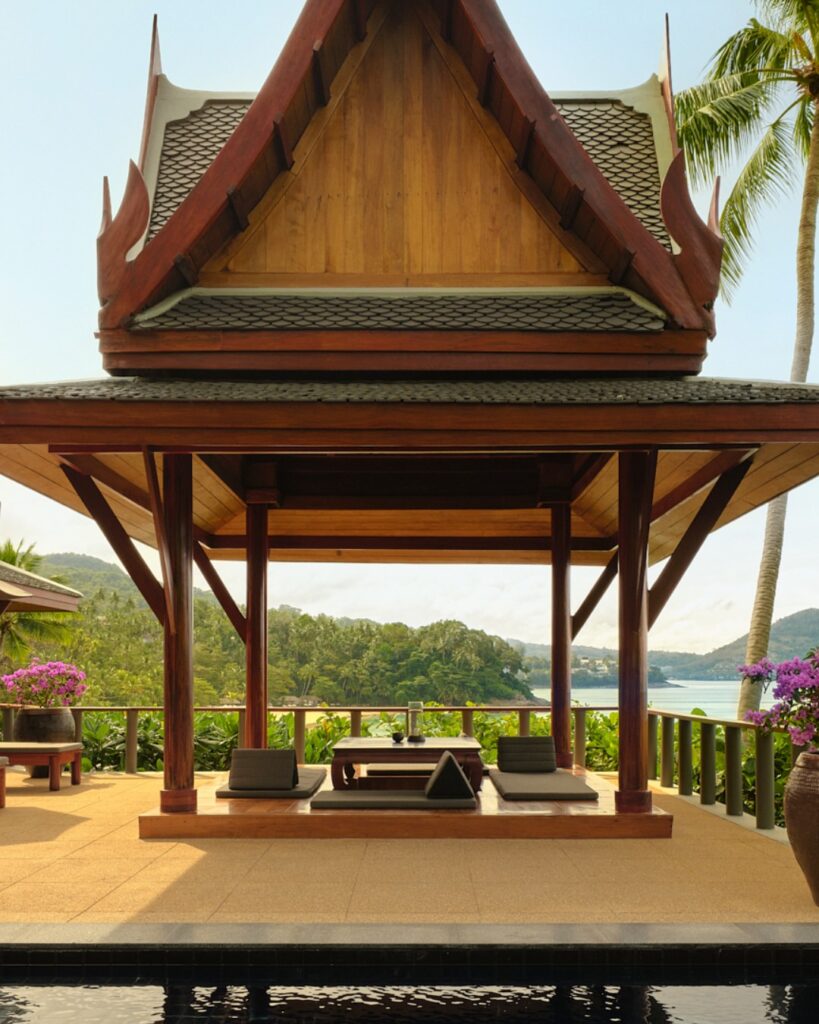
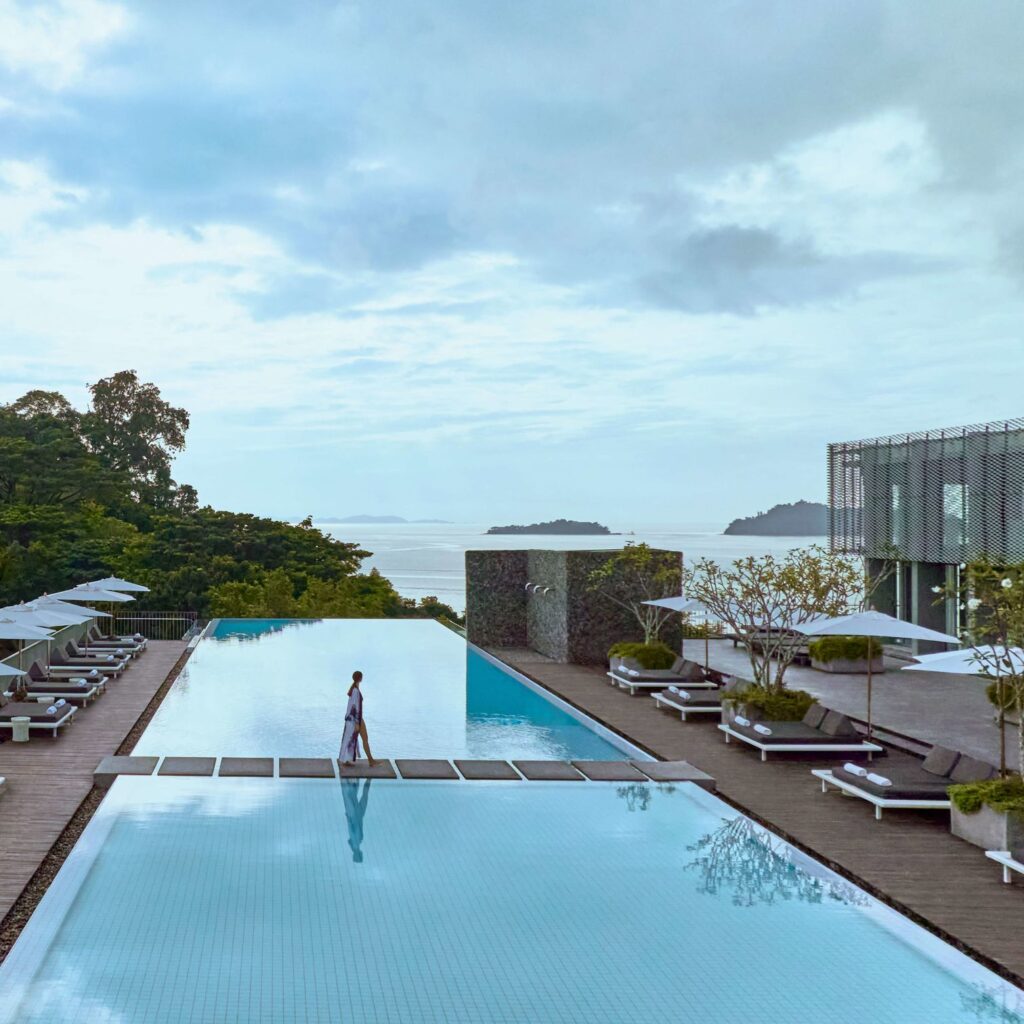
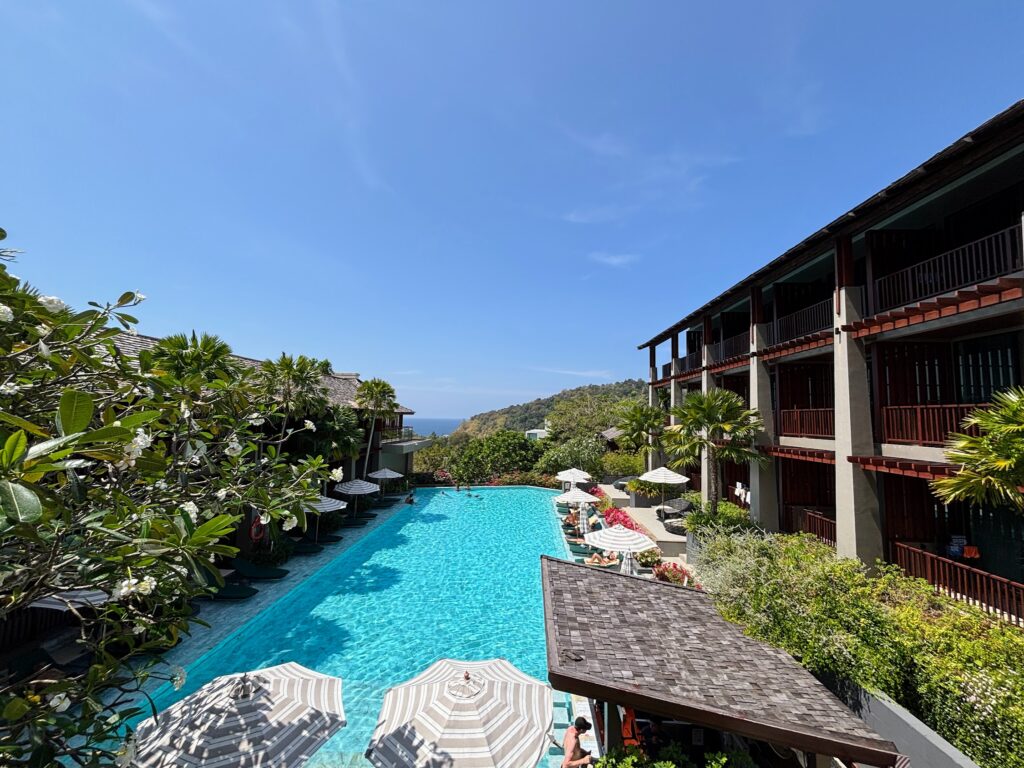
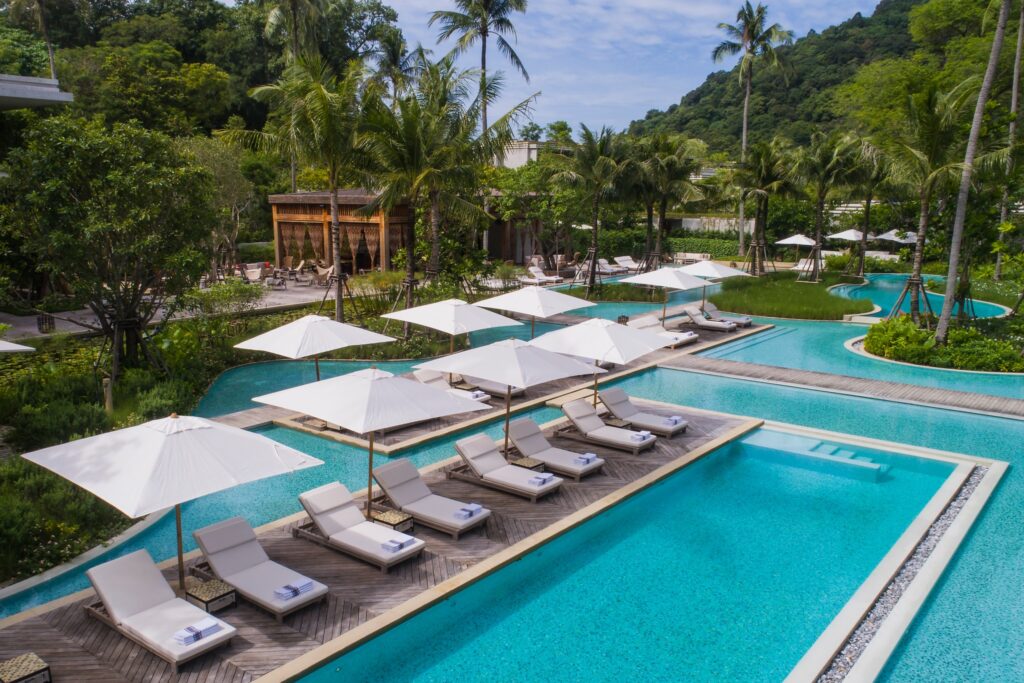
The shared swimming pool sits on a lower terrace with views out over Sirey Bay, and while it’s not enormous, the setting more than compensates. It’s a good-looking spot, with handwoven sunbeds lining the deck and a clubhouse nearby for drinks and snacks. Since almost every villa comes with its own private pool, you may not find yourself up here often, but it’s a pleasant place to settle if you want a change of scene or a larger stretch of water.

A gym with modern equipment handles the fitness brief, and a daily manager’s reception gives guests a chance to mingle should they wish, though the general atmosphere at Sinae tilts towards seclusion rather than socialising.
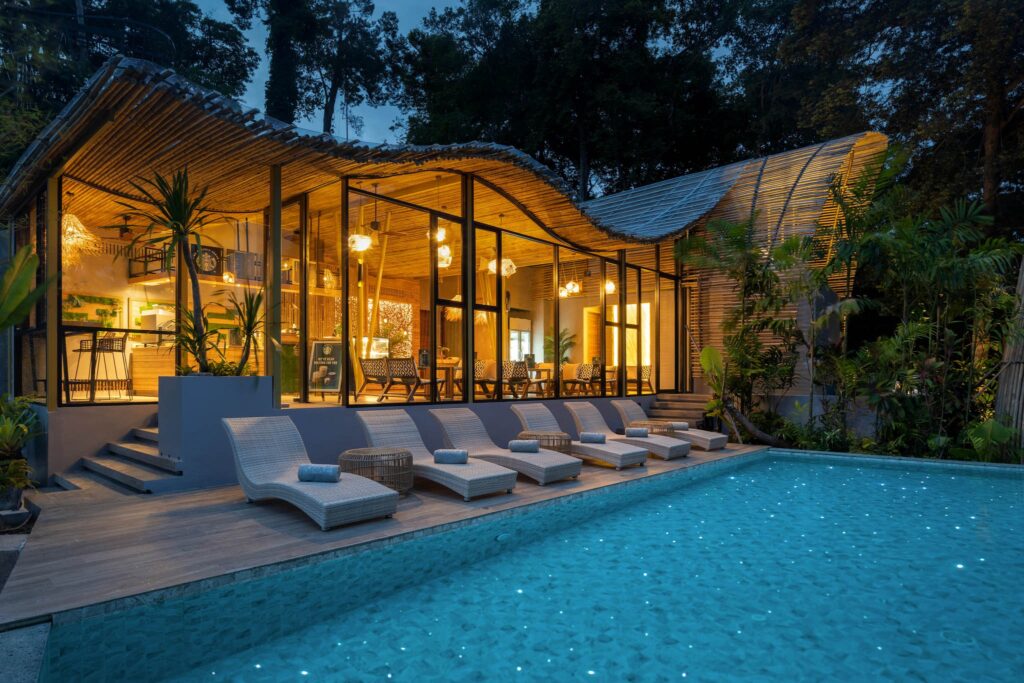
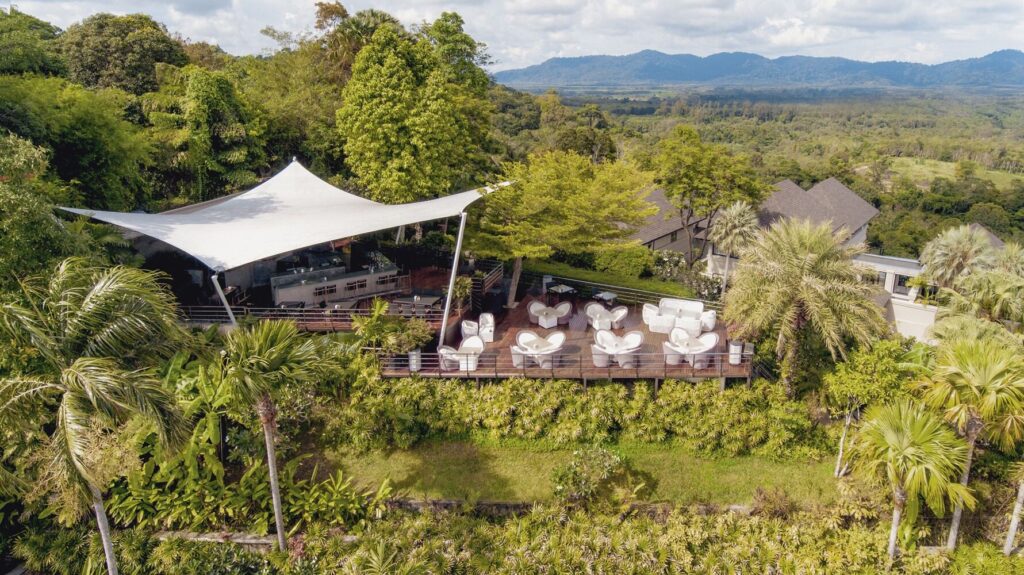
Then there’s the Hilltop Cafe, and getting to it is an experience in itself. The buggy climbs steeply through the treeline to the summit of Koh Sirey, the ascent having something of a roller coaster about it, before you arrive at what might be the most spectacularly positioned cafe on the island. The descent is equally heart-thumping. Our driver took the hairpin bends with the casual confidence of someone who does this forty times a day. We gripped the handrail with the casual confidence of someone who does not.

Recently refreshed, it’s far more than the Starbucks outpost the name might suggest. The full international menu, overseen by Chef Bee, does curry, pizzas and everything in between, and there are freshly baked pastries for those brunching with a view. There’s also a dedicated bar mixing cocktails and mocktails alongside the coffee. You can come for a light bite or settle in for a full meal – really, you’re here for those views first and foremost.

Non-guests can visit for a 500 baht voucher redeemable against food and drink, though hotel guests have a reserved area and complimentary buggy access. The views from up here are vast, and on a clear evening you can watch the sun set over Phang Nga Bay with a beer or a cocktail in hand. You might spot a monkey in the trees, too, which is either a bonus or an occupational hazard depending on what you’re eating.

Food & Drink

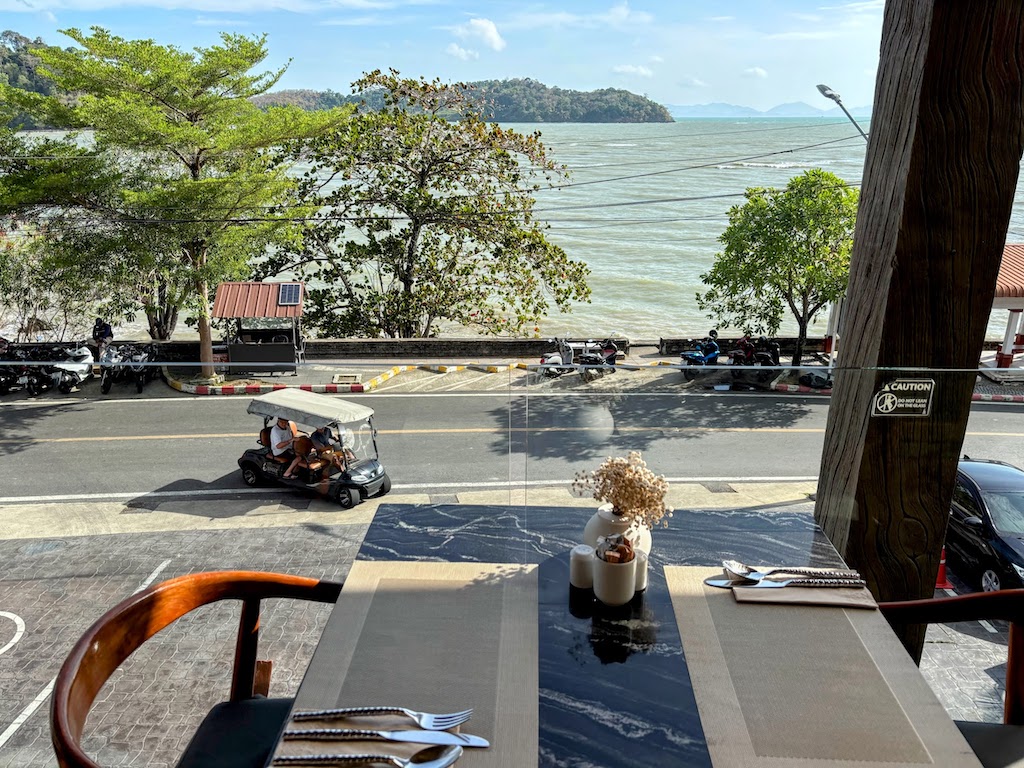
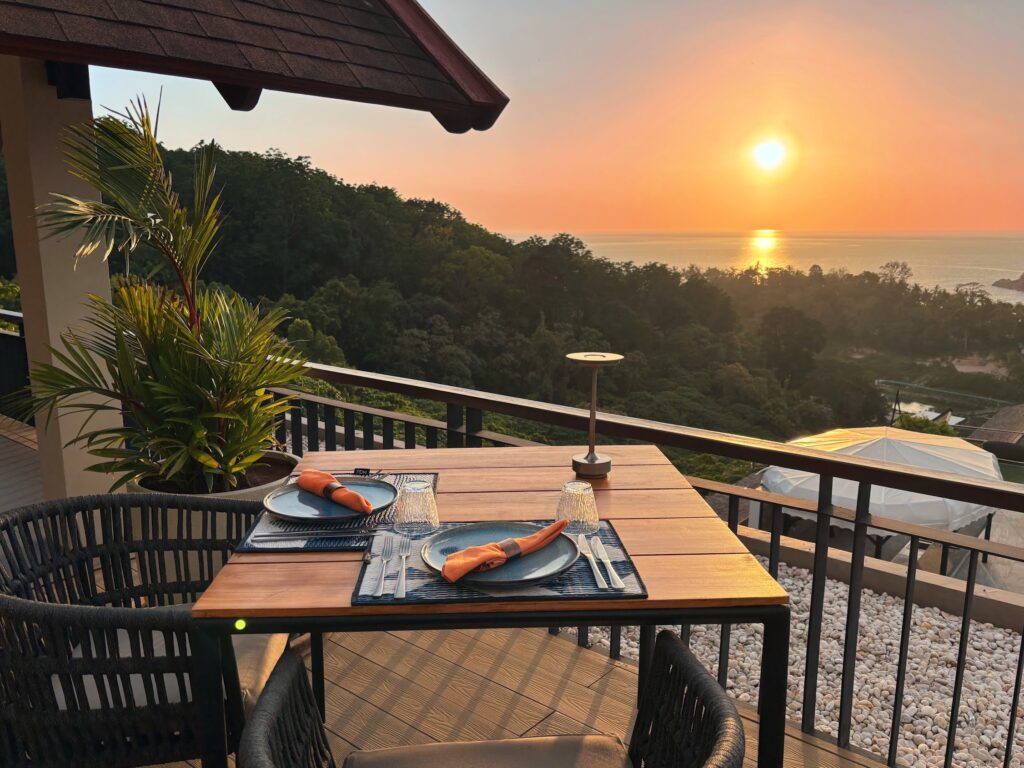
SAI Bistro & Bar is Sinae’s main restaurant, positioned at the base of the property with an open terrace overlooking the bay.

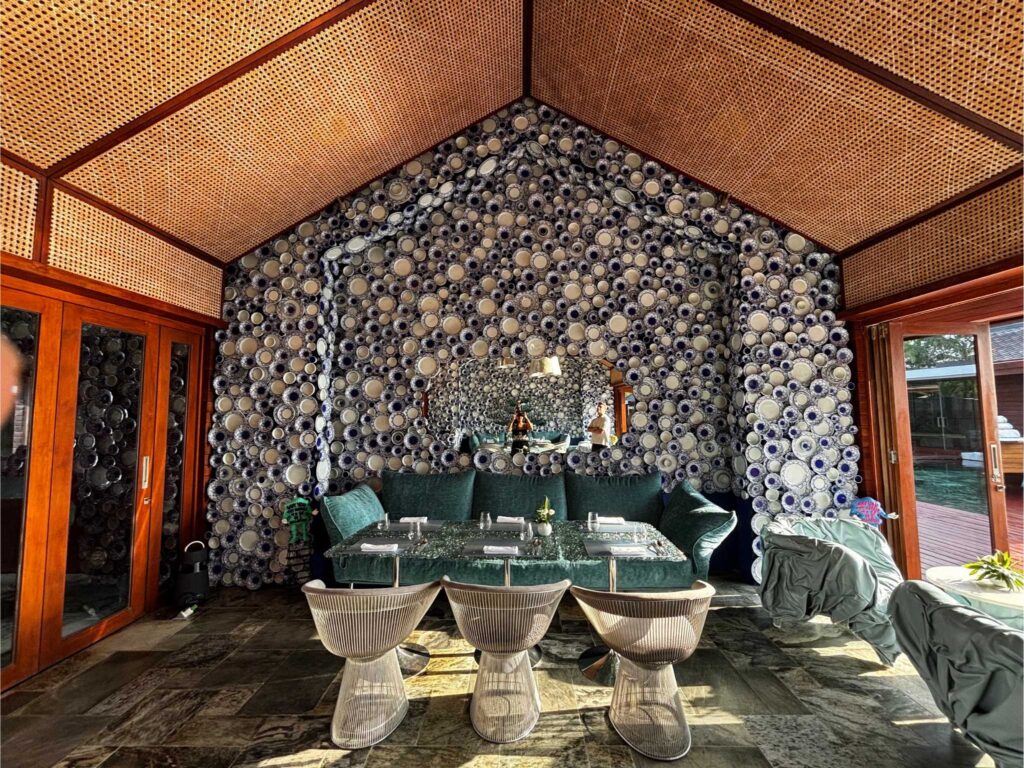
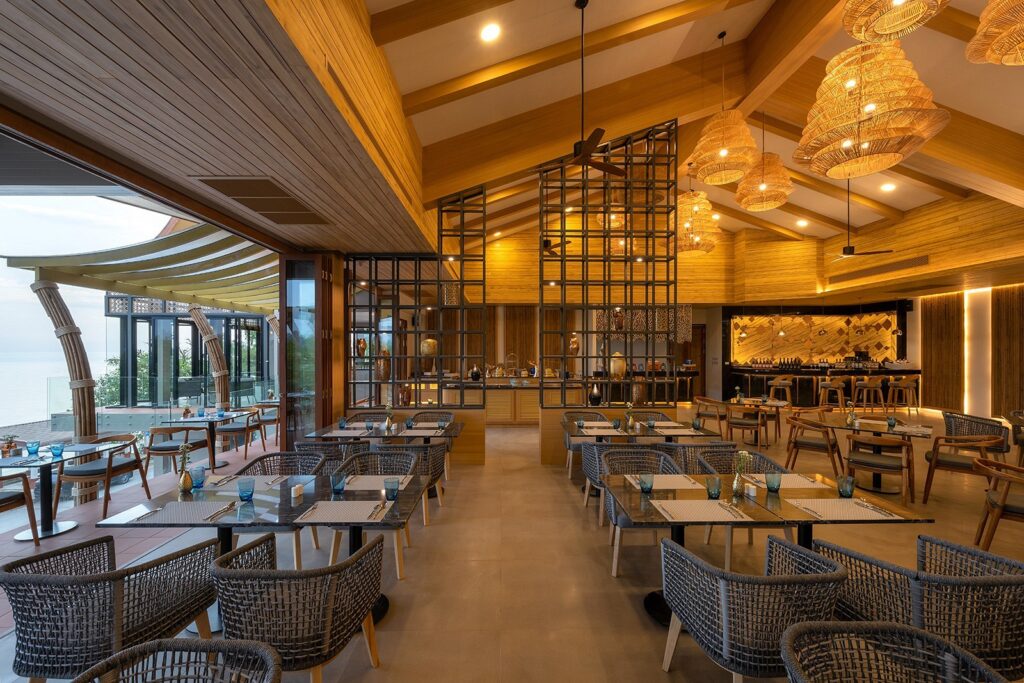
Inside, the design takes its cues from the longtail boats that have worked these waters for centuries, those narrow, painted vessels you see pulled up on every beach from Rawai to Railay. It’s a gorgeous room, with high ceilings, warm wooden finishes, and enough space between tables that the whole thing feels open and laid back, the execution restrained enough to evoke a fisherman’s village without overdoing the reference.
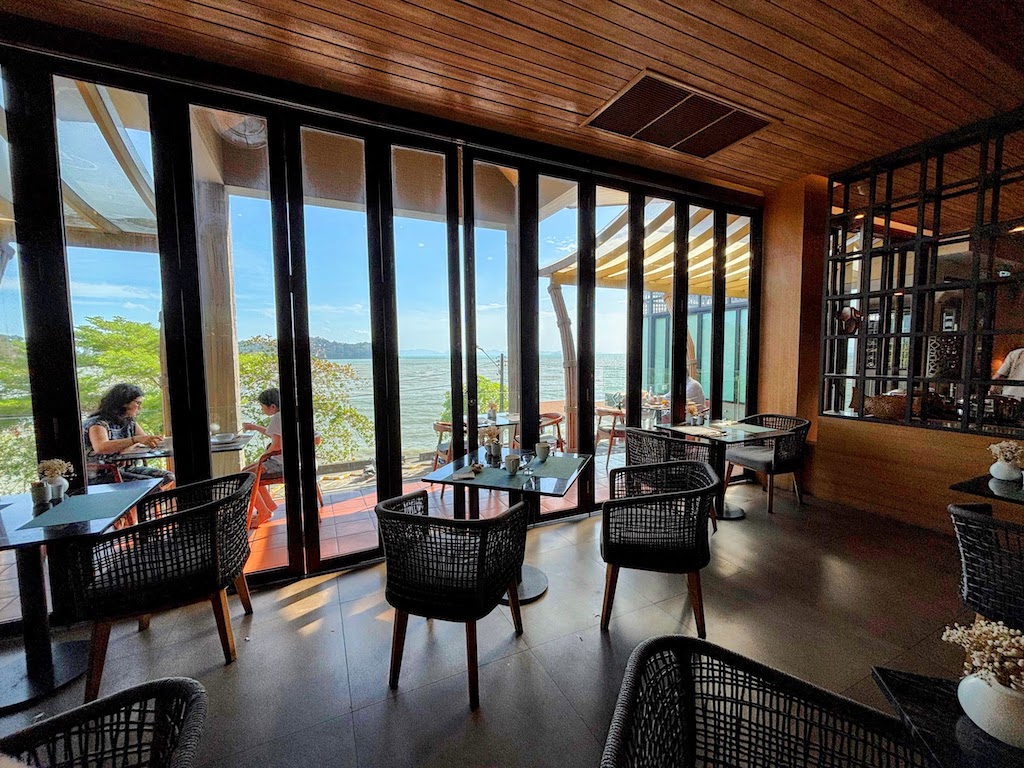
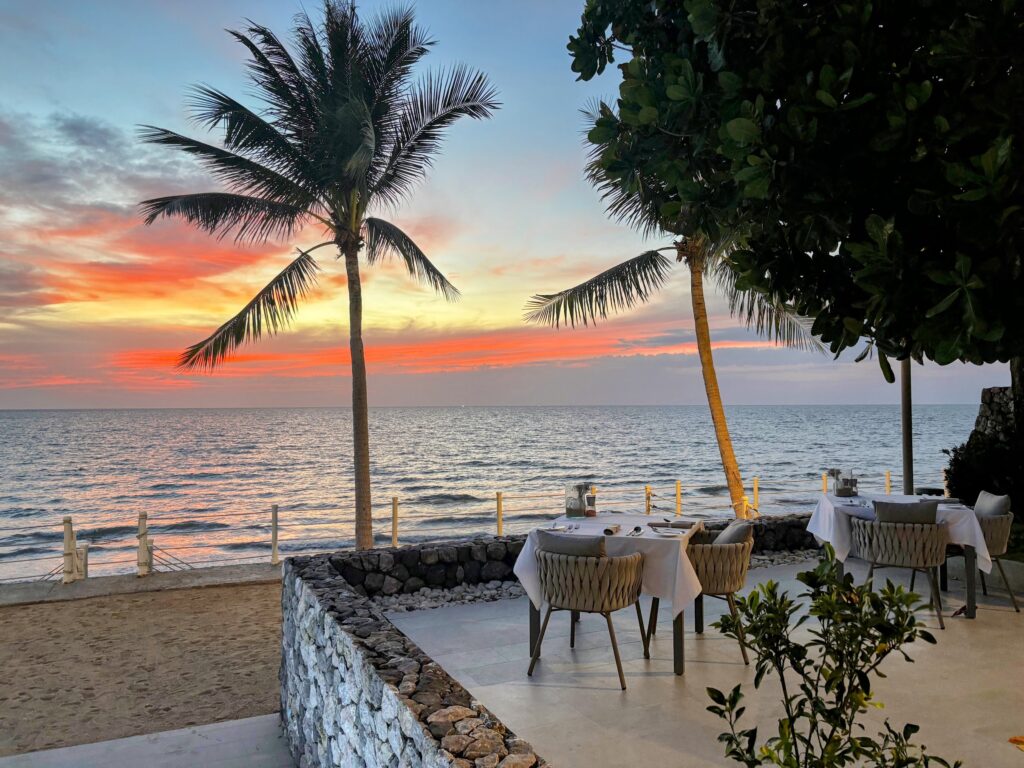
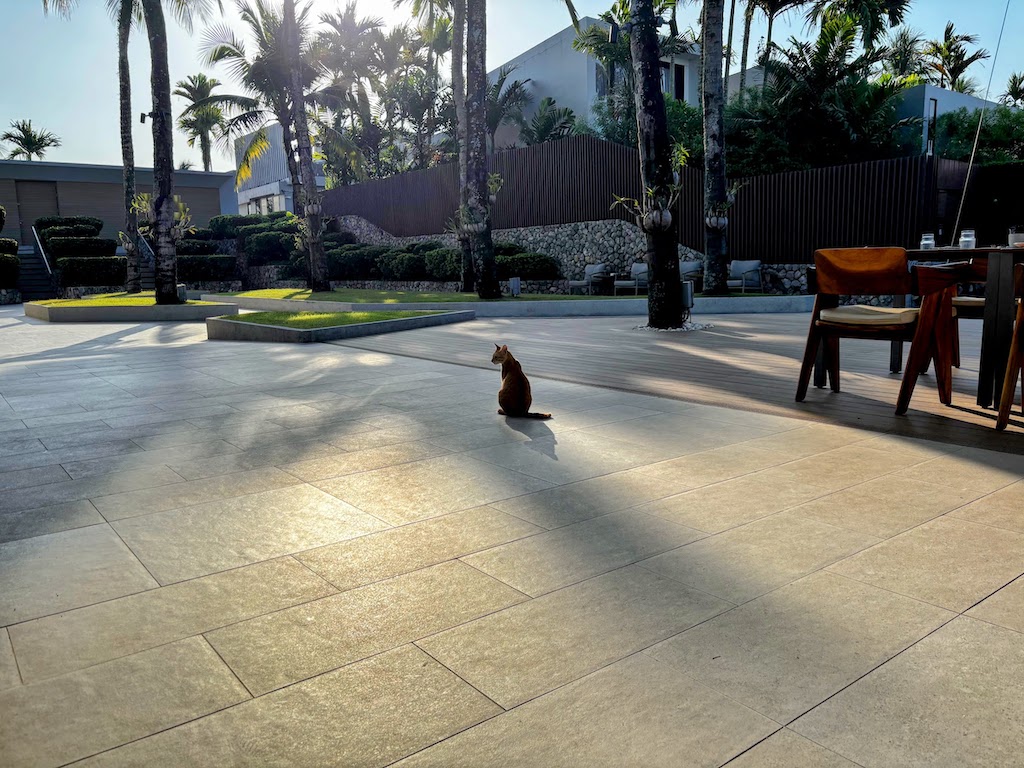
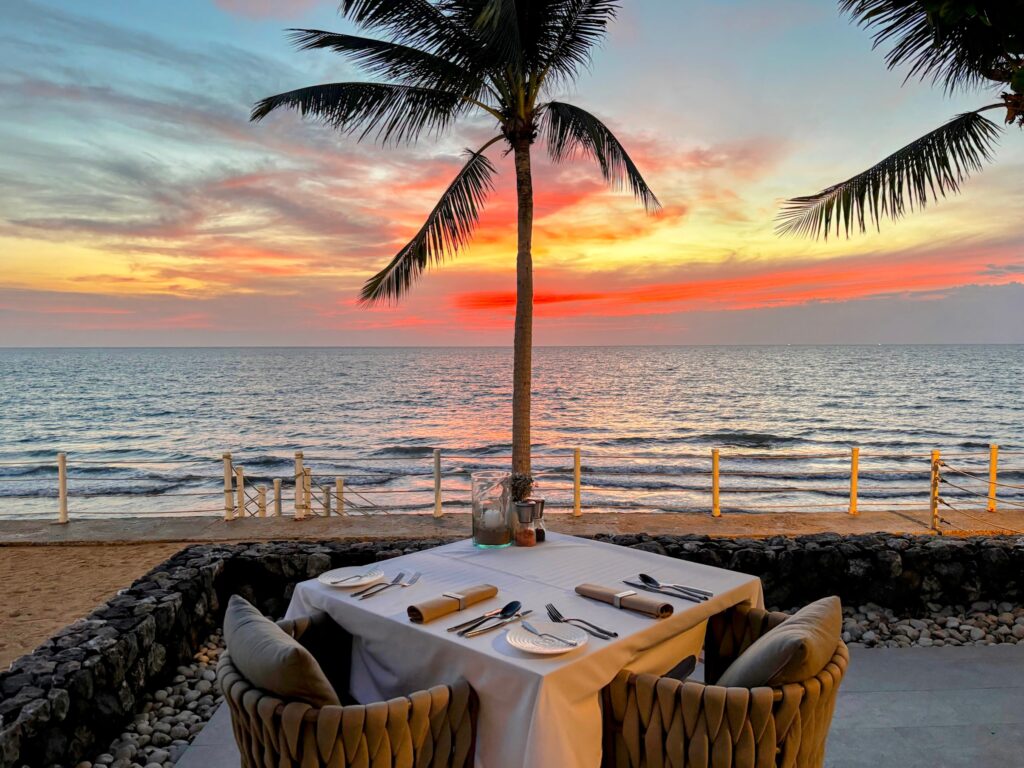
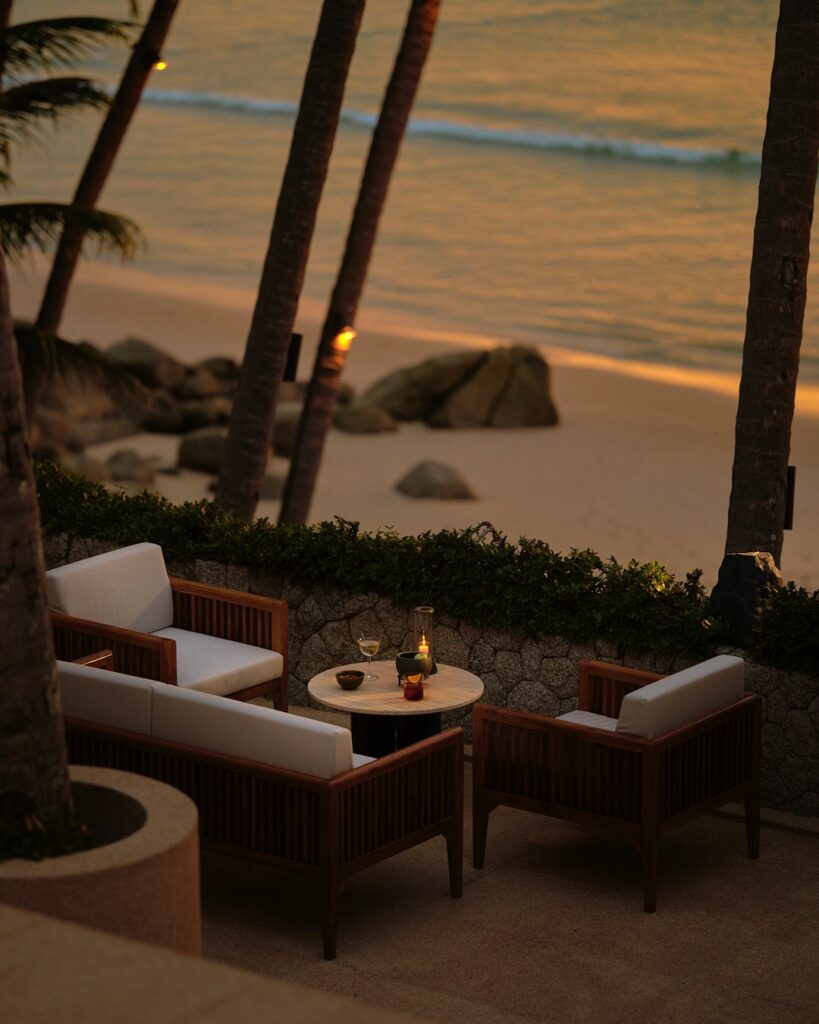
A word of warning: the air conditioning inside runs cold enough that you’ll want a cardigan or a light layer, particularly in the evenings. The smarter move is to sit out on the terrace, where low lighting and the sound of the sea below make for a romantic dinner, with mosquito coils doing their work beneath the tables. A resident cat, unbothered by service or sunset, holds court on one of the terrace chairs as though the table were booked in its name.
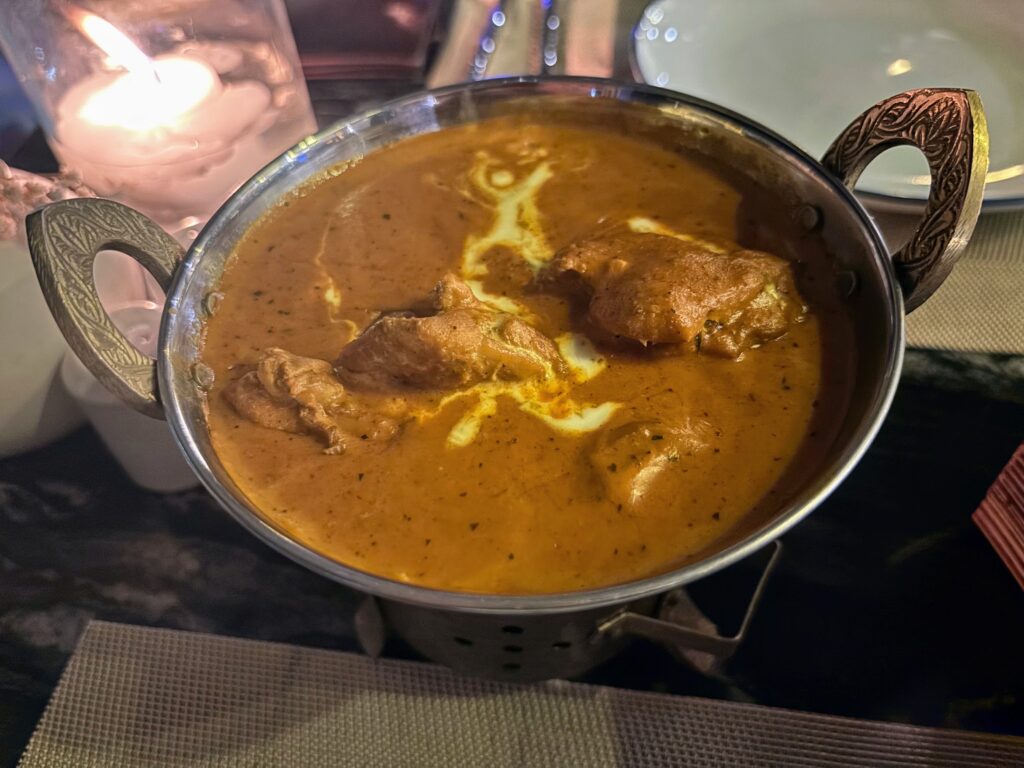
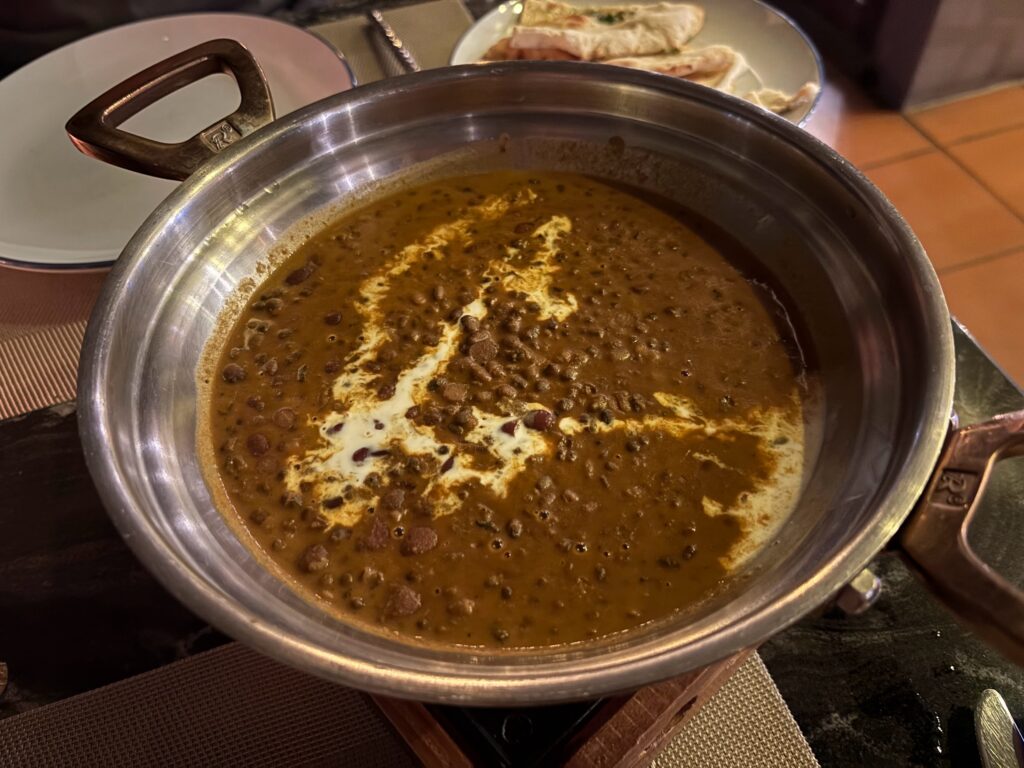
But it’s SAI’s Indian menu that deserves the loudest billing. We had a butter chicken, deliciously sweet and tangy, and generously portioned, and a dahl makhani, slow-cooked with that deep, smoky sweetness that only comes from hours of patience with black lentils and cream. We mopped away at both with warm roti, and they were great, the kind of food that had us returning to the same section of the menu the following evening without a shred of guilt. We ordered the butter chicken again on night three. The waiter didn’t even blink.

Both the Thai and Indian sides of the menu are reassuringly short, a handful of choice dishes rather than the sprawling, fifteen-page laminated affair that usually signals a kitchen trying to do too much.

The Thai side leans into the Southern Thai and Phuket Peranakan flavours that define the island’s culinary identity, rather than defaulting to the pad thai and green curry greatest hits that most hotel kitchens fall back on. The muek tom nam dum, a Phuket-style squid ink soup with shrimp paste, shallots, garlic and lemongrass, is a good example of how specific the cooking gets here, and the gaeng som is excellent too, puckering, refreshing and bracingly hot. The best approach is to order a few dishes and share, and if you’re unsure on the balance, ask your server to guide you. They know the menu well and they’ll steer you right. If you’re looking for a one-dish wonder, the pad mee Hokkien is a solid call, although for a really great version it’s worth dipping into the Old Town and having it at Mee Ton Poe.

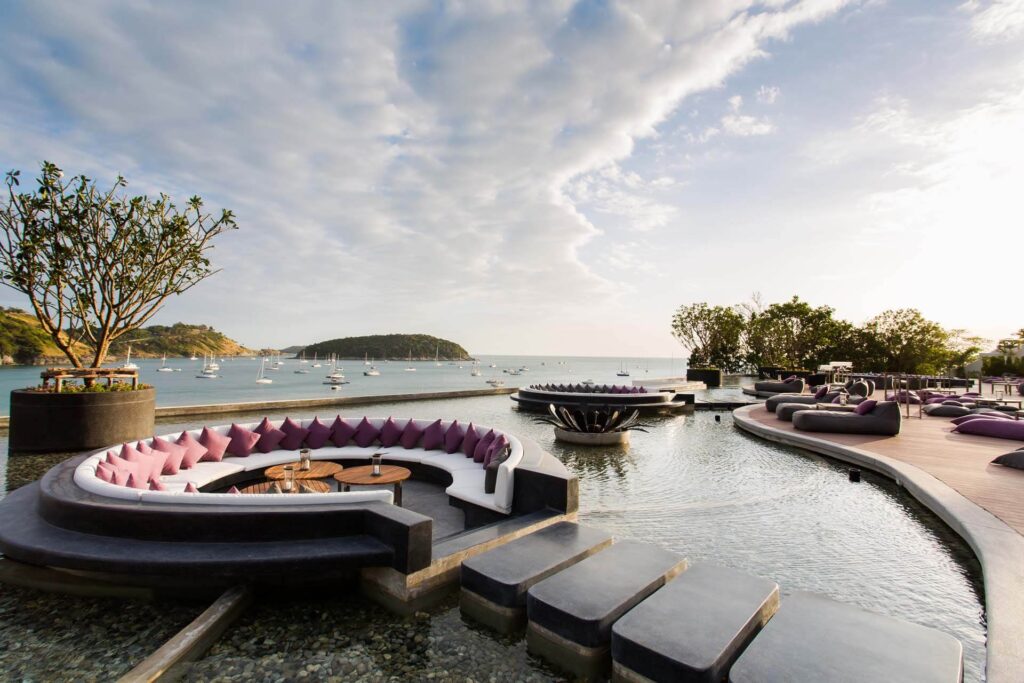
For cocktails with a view, SAI Lounge & Wine sits alongside the main restaurant, offering drinks and snacks in a more intimate setting that looks out over the ocean. It’s a good spot for a pre-dinner drink or a late-evening glass of something without the formality of a full sit-down meal. The Hilltop Cafe is the better spot for a sundowner, though. The combination of a cold Singha over ice and that view is a formidable one.

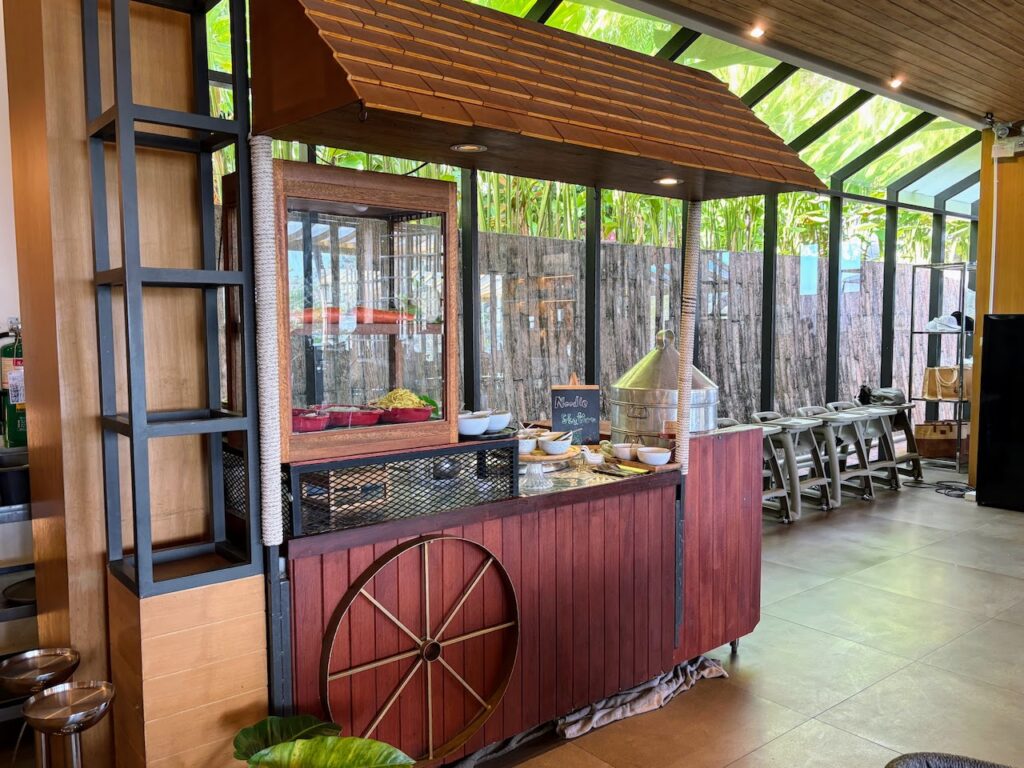
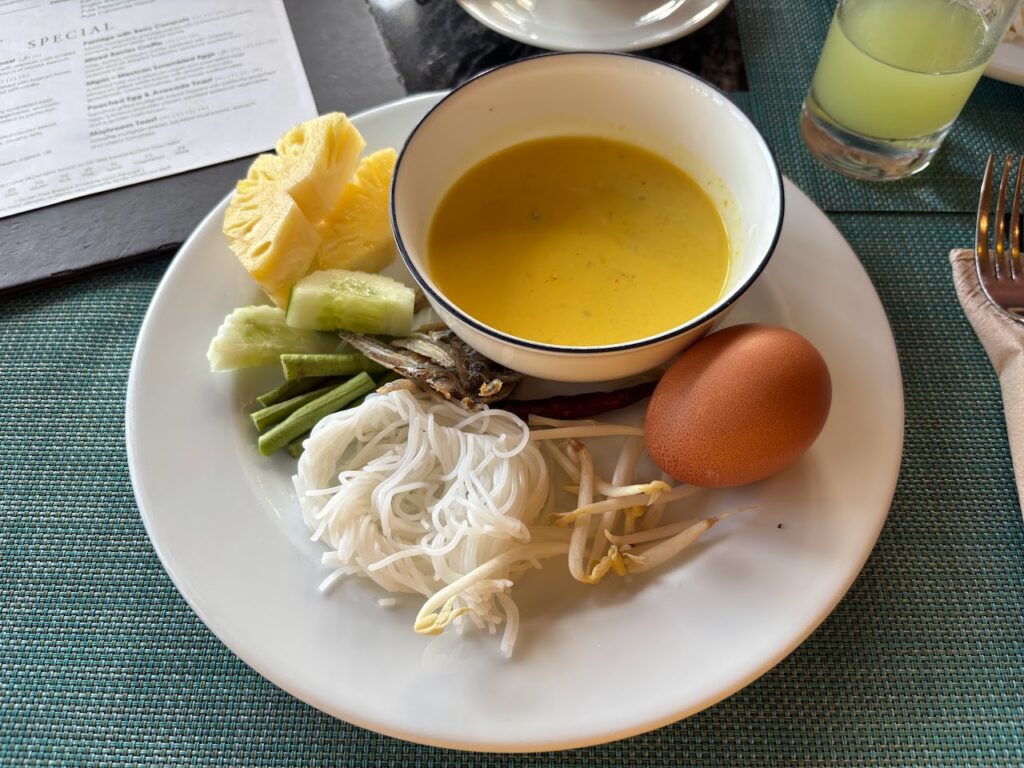
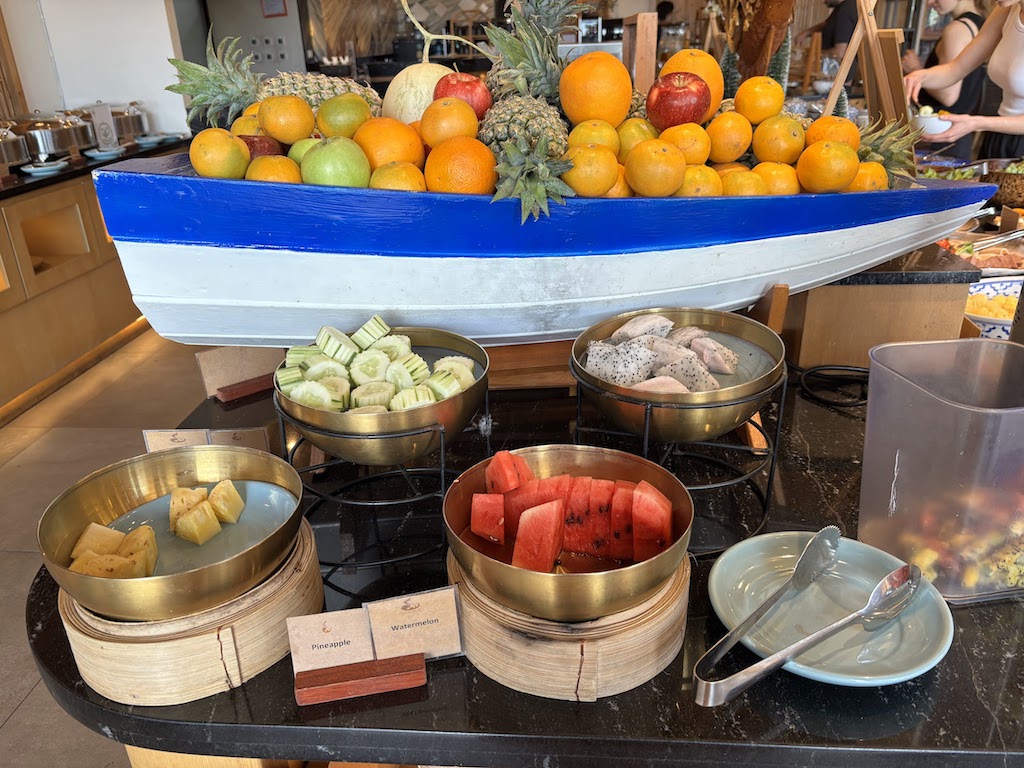
Breakfast is served at SAI Bistro, and it’s a good spread. We had an excellent kanom jeen, the fermented rice noodles served with Southern Thai curry sauces that constitute one of the great breakfasts of this part of the world. There’s a generous buffet alongside, covering both Thai and Western ground, with eggs cooked to order and smoothies you can assemble yourself. The specials menu goes beyond the usual hotel breakfast territory, too, with migas, avocado on toast with beetroot hummus and feta, and a red velvet French toast that leans fully into brunch mode.
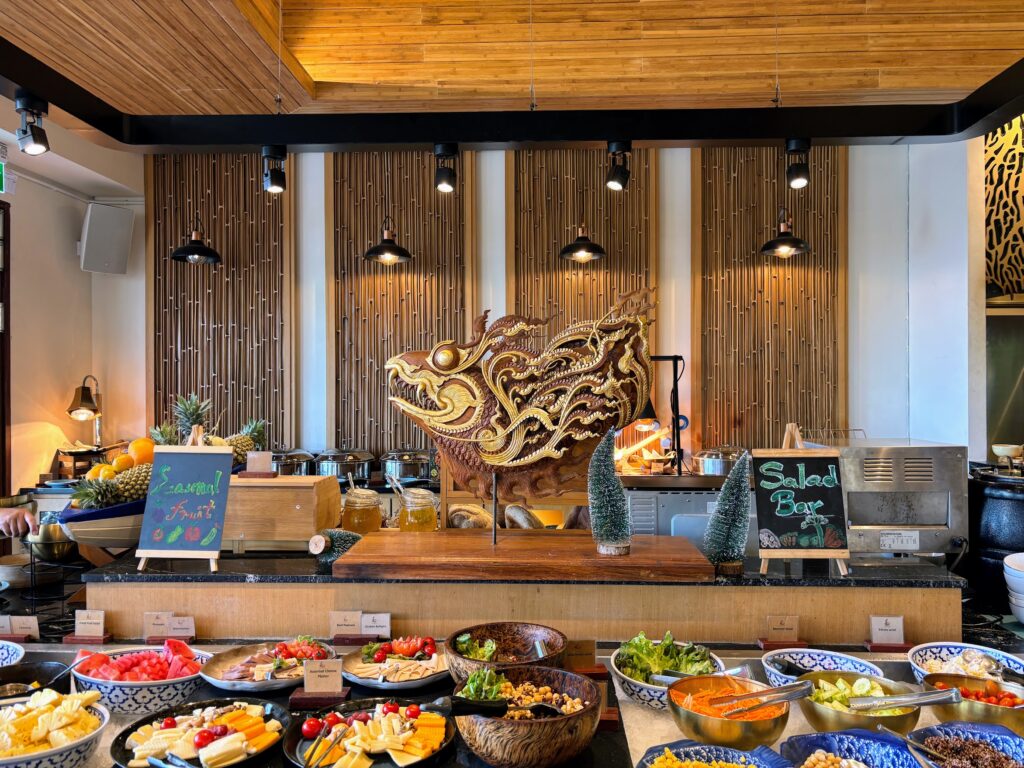
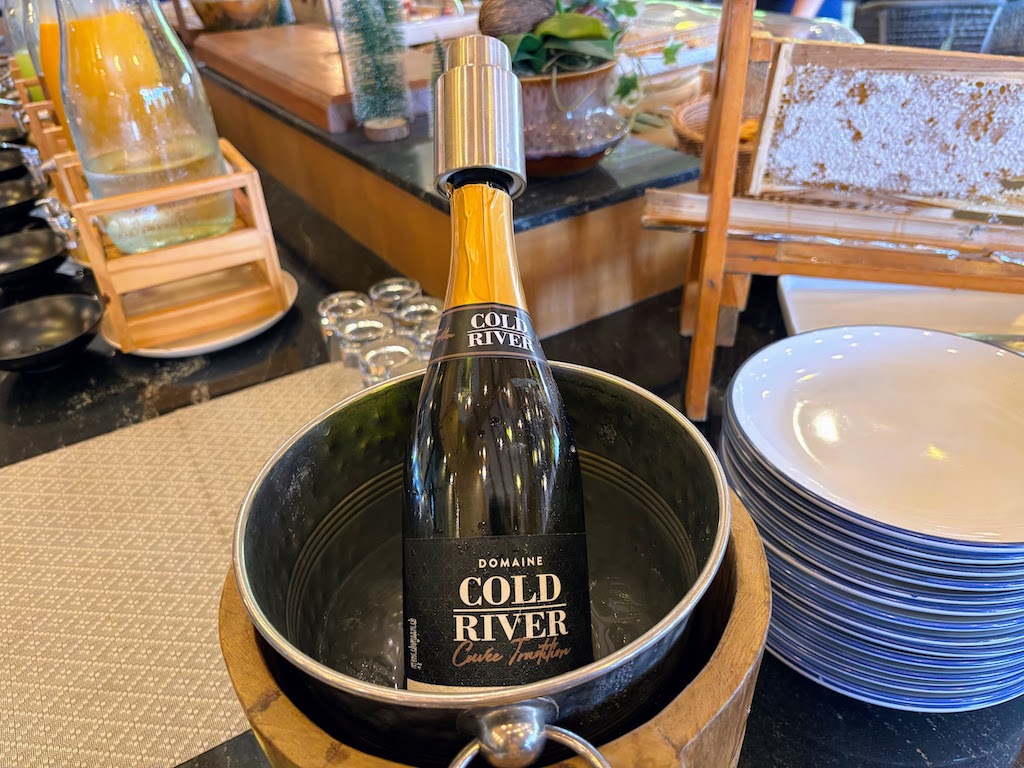
The breakfast buffet offers champagne, because it is a fancy, refined kind of place. Nobody questions champagne at nine in the morning if it arrives in a flute and the hotel has five stars. Crack open a lager, though, and you’d be getting concerned looks from the next table. It’s strange how we act on holiday.

Room service runs round the clock and can be ordered through the app, which is useful when the prospect of getting dressed to walk to the restaurant feels like too much commitment after a long afternoon by the pool.
Ideal For…

Couples and honeymooners, emphatically. Sinae offers three tiers of honeymoon package, each available as an add-on with a minimum three-night stay.

Big celebrations, too. The seclusion of some villas means it’s the right place to spend your birthday in your birthday suit.

Old Town foodies using the hotel as a base. Sinae’s proximity to Phuket Old Town makes it a fine perch from which to explore one of the most concentrated Michelin-listed food scenes in the country, then retreat to your hilltop pool when the heat becomes too much.

Travellers who want Phuket without the Phuket. Koh Sirey feels like a different island. If you’ve done the west coast beaches and want something more residential, more private, more removed from the strip, this delivers.

It’s less suited to those who need a beach on their doorstep, or families with young children who might find the steep terrain and grown-up atmosphere a mismatch, though Family Pool Villas do exist for those who need the space.
Why Stay?

This is a place that is worth the splurge. Sinae Phuket does something increasingly difficult on an island where development has outpaced discretion in many corners: it gives you the sea, the sky and the hills without putting another building in the frame. The private pool villas are thoughtfully designed, the setting on Koh Sirey’s hilltop is genuinely special, and the proximity to Phuket Old Town means you’re never far from the island’s best eating, even if the hotel itself feels a long way from everything.

Come for the view, stay for the seclusion, and bring someone you’re fond of. The octopus on the bed is waiting.

Rooms start from around 8,500 baht (£198) per night in low season, rising to around 24,000 baht (£560) at peak. Rates include breakfast.

Address: 888, Ratsada, Mueang Phuket District, Phuket 83000, Thailand

Website: sinaephuket.com
The Best Luxury Hotels In Khao Lak, Thailand

Most visitors to the Andaman coast fly into Phuket and head south, feeling the tension rising as the traffic thickens and the development closes in. That’s no way to start a holiday. Fortunately, there is another way…

That way is north and over the Sarasin, an hour up the mainland coast of Phang Nga Province through a landscape that gets progressively lower, greener and less interested in selling you anything. That way is Khao Lak.

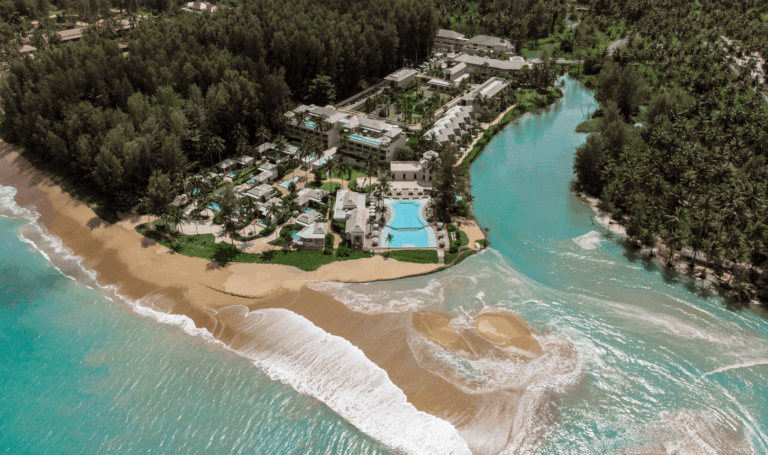
Khao Lak isn’t an island, and it’s less a single destination than a twenty-kilometre stretch of beachfront. The small town of Bang Niang sits at its centre, with named beaches fanning out in either direction (Khao Lak Beach and Nang Thong to the south, Khuk Khak, Pakarang Cape and Bang Sak to the north) and the jungle of Khao Lak–Lam Ru National Park backing the lot. No high-rises; by local convention nothing is built above the tree canopy. No shopping malls, no equivalent of Bangla Road, no theme parks. Just beach, jungle and a pace of life that Phuket long since left behind.

That’s not to say it’s totally sleepy. Bang Niang Market draws crowds on its open evenings, and Chai Hat Bang Niang road has a handful of bars, western restaurants, a Starbucks and a 7-Eleven to keep things ticking over. The overall register is low-key, and those expecting nightlife might be disappointed. But nobody comes here for the night-life.

There is a gravity to Khao Lak, too, that the laid-back surface doesn’t immediately reveal. This stretch of coastline was the worst-hit area in Thailand during the 2004 Boxing Day tsunami. A police boat still sits inland at Bang Niang as a memorial, dragged there by the wave and left where it stopped. Almost every hotel along this coast is, in some sense, a rebuild, and almost every long-serving member of staff has a story attached. It’s not something the hotels dwell on, but it’s there, and it shapes the way hospitality is practised here in ways that are hard to put into words.

Beyond the coastline itself, Khao Lak is the gateway to the Similan Islands, a protected marine park ranked among the world’s top dive sites. The Surin Islands sit further north. Khao Sok National Park’s rainforest and Cheow Lan Lake are an hour inland, and Phang Nga Bay’s limestone karsts a short boat ride south. The ideal window for all of it is November to April, when the seas are calmest (February is the driest month statistically, March often the local sweet spot) and the Similans are open. May to October is green season, with lower rates, reduced services at some of the smaller properties and the marine parks closed.

Where you base yourself matters. We’ve stayed in all six of the hotels below across multiple visits, alongside others that didn’t make the cut. What links the ones that did is a particular Khao Lak sensibility: rooted in the area rather than parachuted onto it, built around the landscape instead of over it, and each with a clear idea of what and who it’s for that goes beyond just putting beds near a beach.

Anyway, with all that in mind, here are the best luxury hotels in Khao Lak.

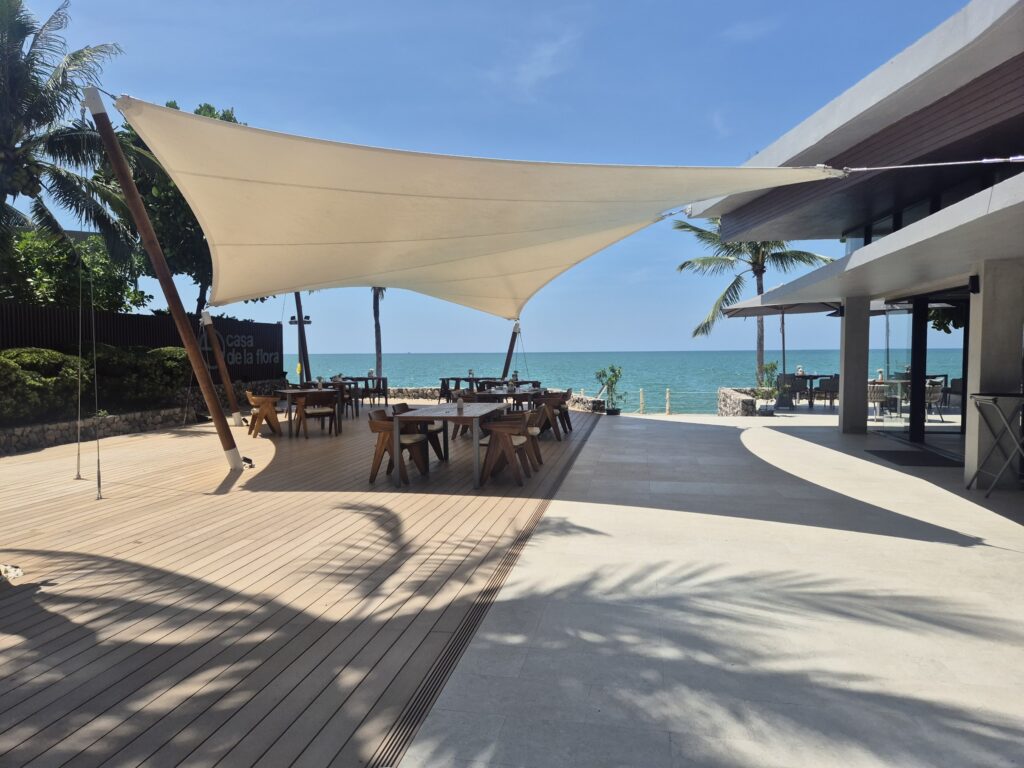
Casa De La Flora

Ideal for design-hotel devotees, sunset chasers, and those who want a different kind of beach holiday…

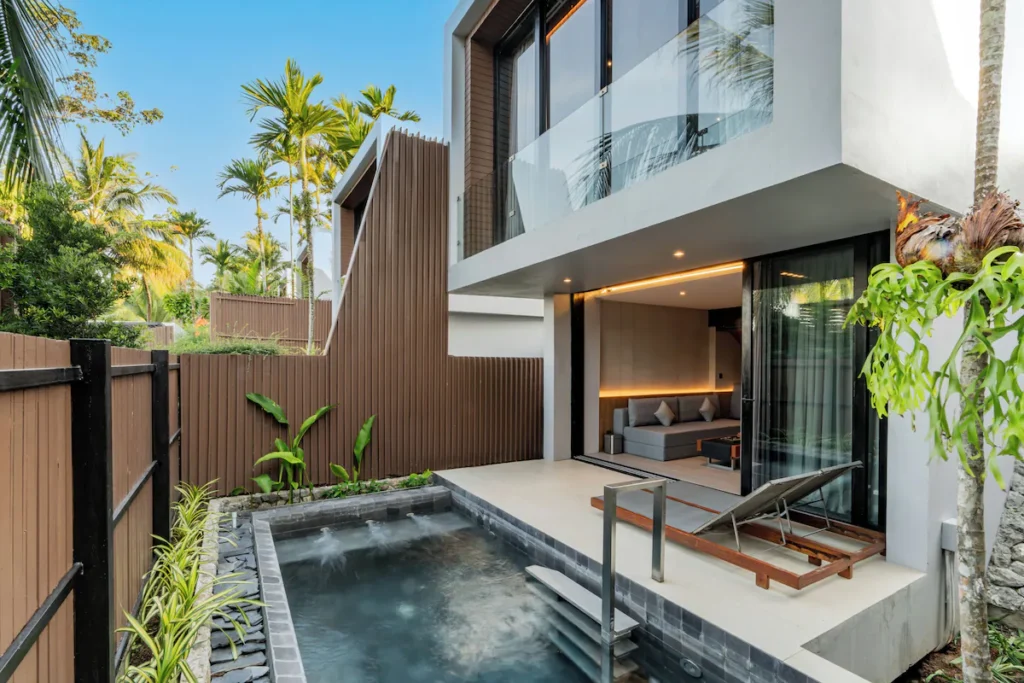
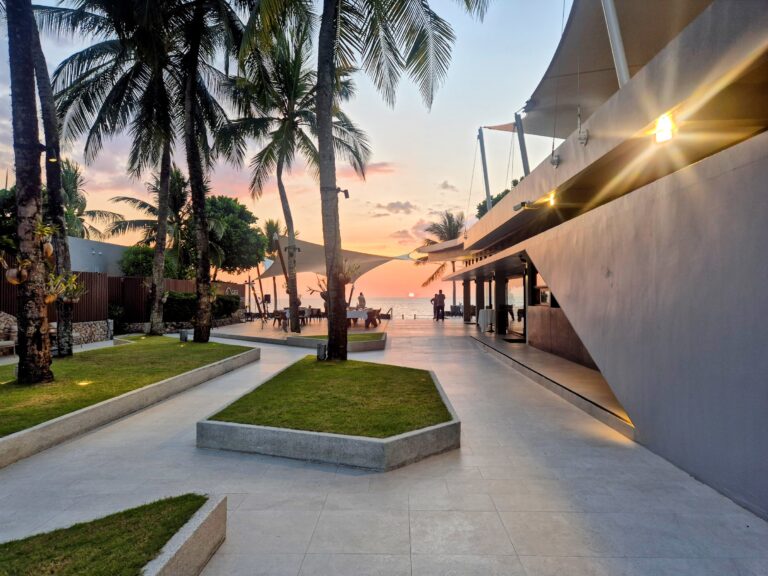
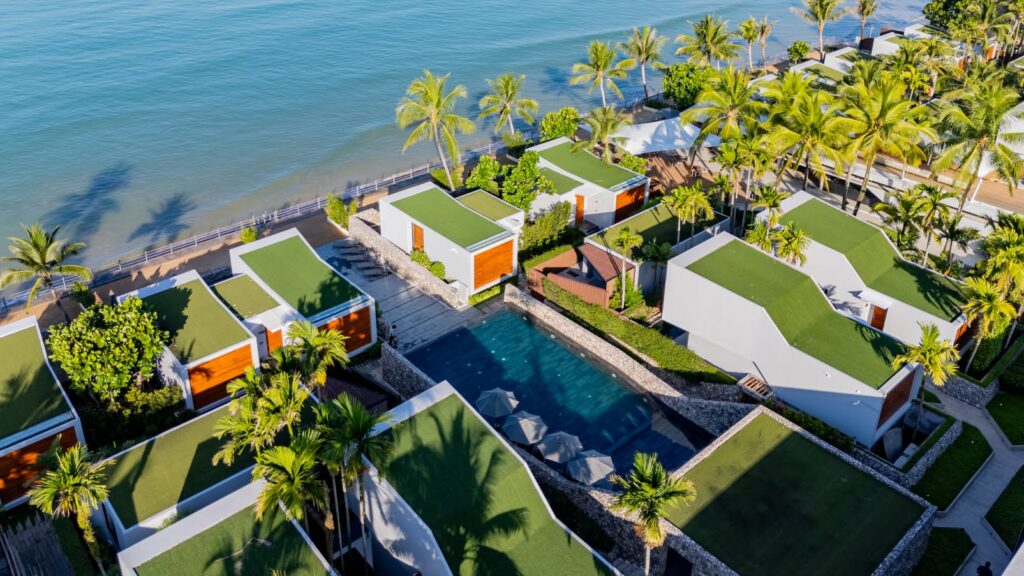
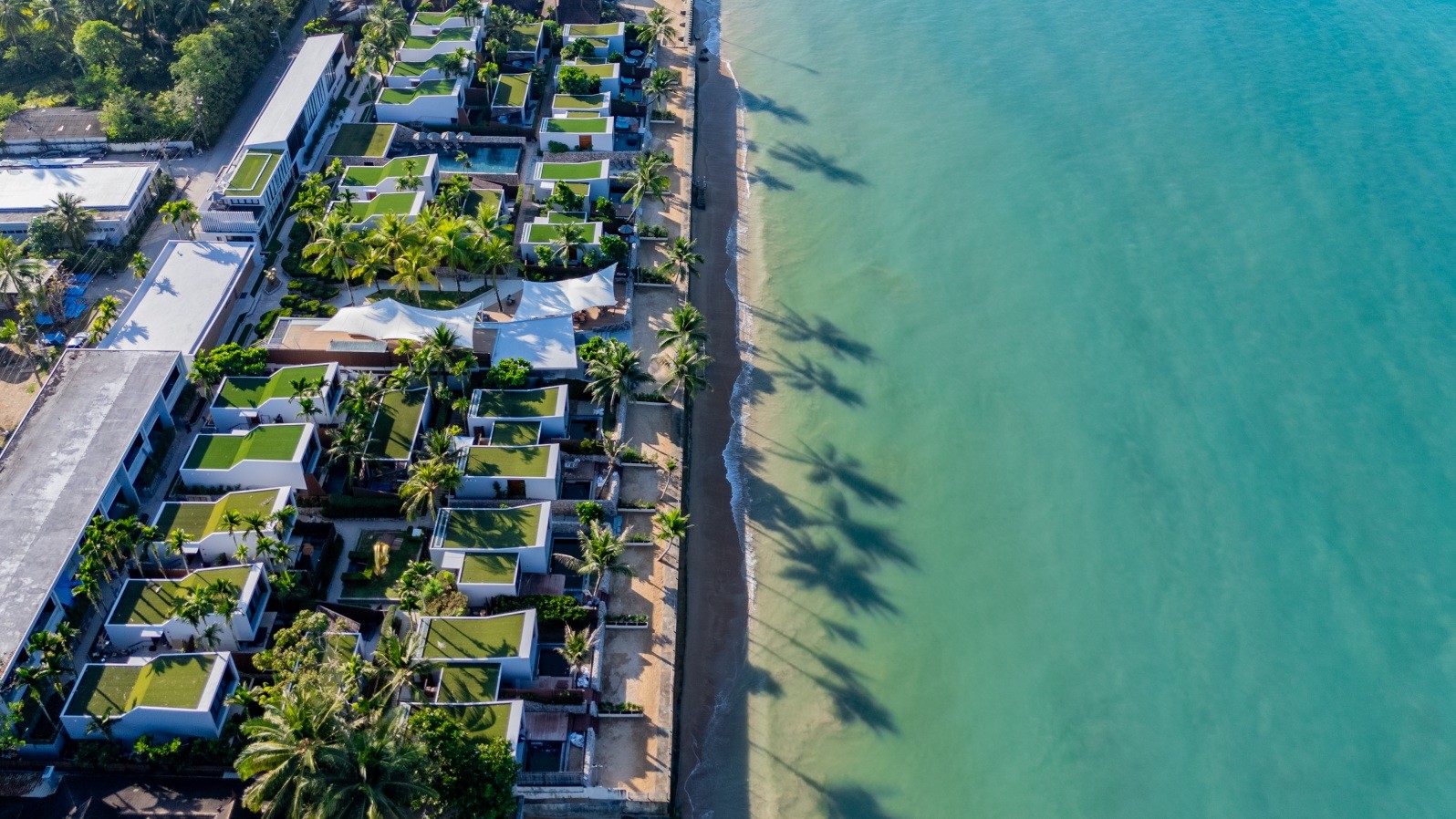
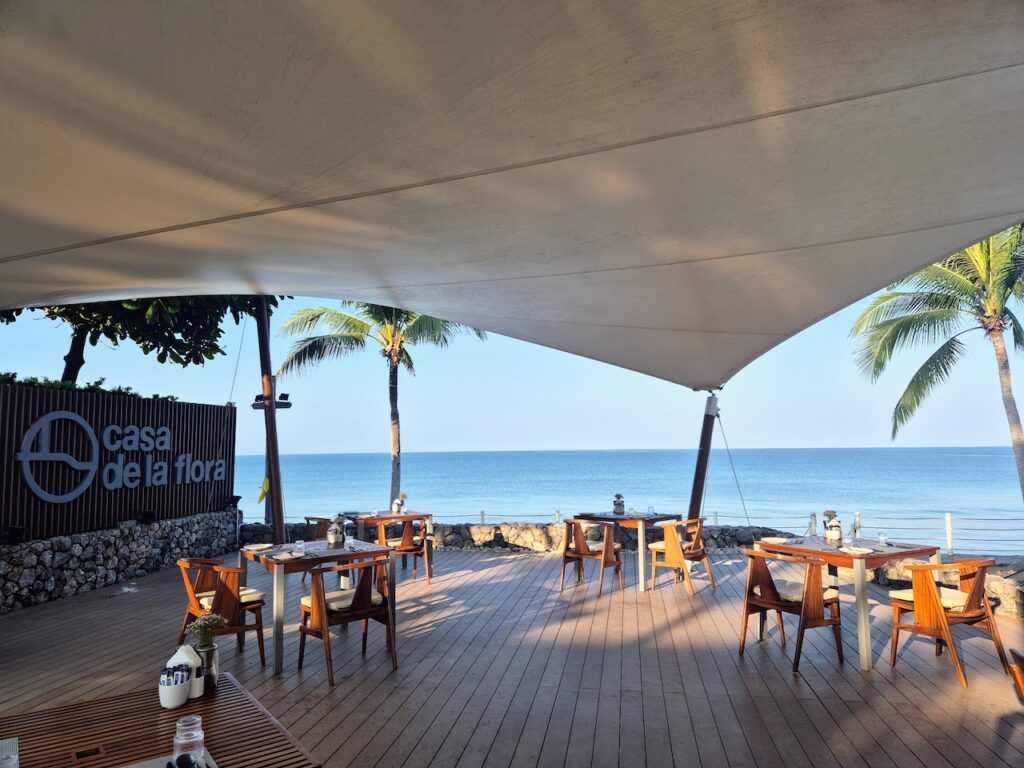
You don’t come to Casa de la Flora for the beach – though the beach is right there. You come because the 34 villas, slate-grey cubes arranged in a deliberately geometric sequence from the road down to the sand, look like nothing else on the Andaman coast. This is the kind of hotel architects love.

The design is by Bangkok studio Vaslab Architecture with landscape practice T.R.O.P., who soften the geometry with green roofs and tropical planting, and the conviction of it holds whether you’re in a Studio Pool Villa or the two-bedroom Beachfront Grand with uninterrupted ocean views. Every villa has its own pool, the scale changes depending on your vantage point, but the overarching idea doesn’t. When the resort closed in 2023 it was Vaslab who came back to refresh the interiors and reconfigure eight units into a new duplex format, and the property reopened in March 2024 looking sharper for it. Which is saying something; it looked bloody sharp before.

Khao Lak is unhurried at the best of times, and this corner of it even more so – the kind of place where you lose track of the day and find you don’t much mind. Casa de la Flora leans into that entirely. It’s private, slow-paced, and feels removed from the world in a way that fewer and fewer places manage.

You needn’t leave if your feet – or willpower – fail you. On-site dining centres on La Aranya restaurant, which has the most exquisite sunset views and precise Southern Thai food to match. The onsite Spa La Casa offers plenty of treatments, but if you’re after something more comprehensive, the La Flora Group’s La Vita Sana wellness space is the largest in the region. It’s a five minute shuttle up the road, which is free and doesn’t rely on a timetable, of course.

Casa de la Flora is a member of Design Hotels and part of the family-owned La Flora Group, which also operates La Vela Khao Lak, La Flora Khao Lak and La Solaya next door, the last of which also appears in this guide.

You can read our full review of Casa de la Flora Khao Lak here.

Prices for the entry-level Studio Pool Villa start from around 8,000 baht (£185) per night in low season, rising to roughly 16,000 baht (£370) at peak. Rates include breakfast.

Address: Khuk Khak, 67 213, Takua Pa District, Phang Nga 82220, Thailand  

Website: casadelaflora.com

The Sarojin

Ideal for honeymooners, privacy seekers, and keen swimmers…

The Sarojin is a property Khao Lak regulars return to, and the one most consistently recommended by travel professionals working the Andaman coast. The reason has less to do with any single headline feature than with the accumulation of small things done well across 56 residences. 

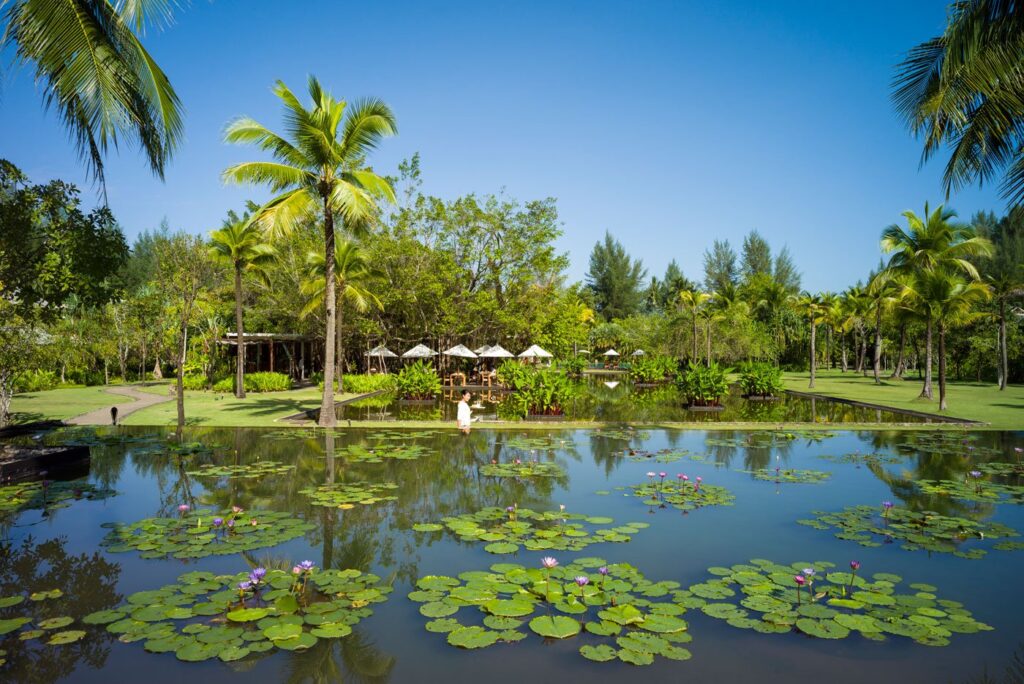
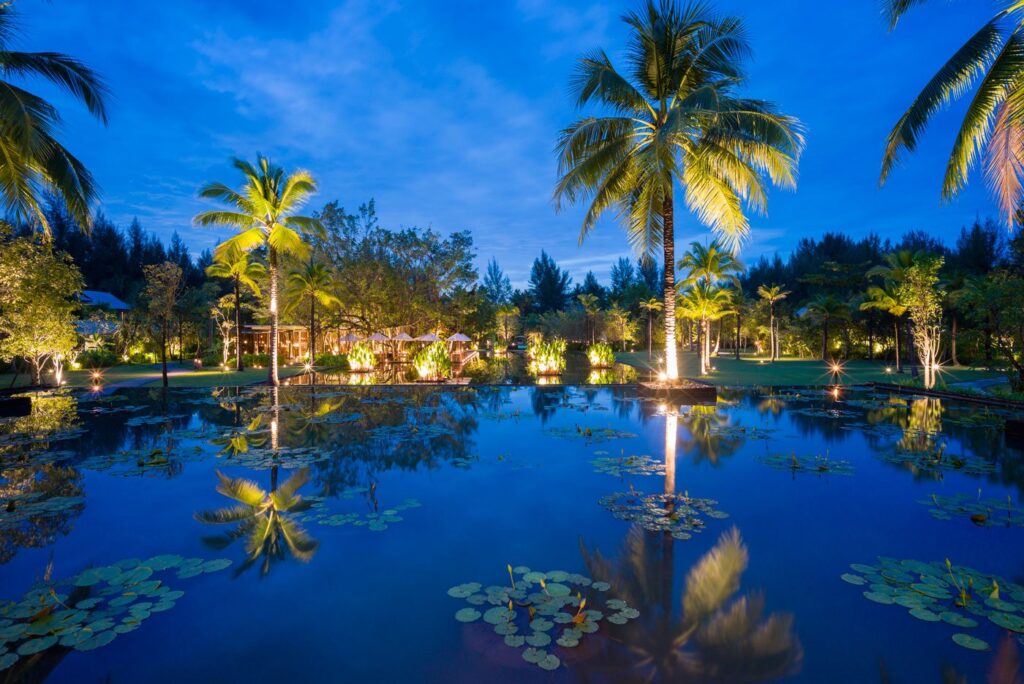
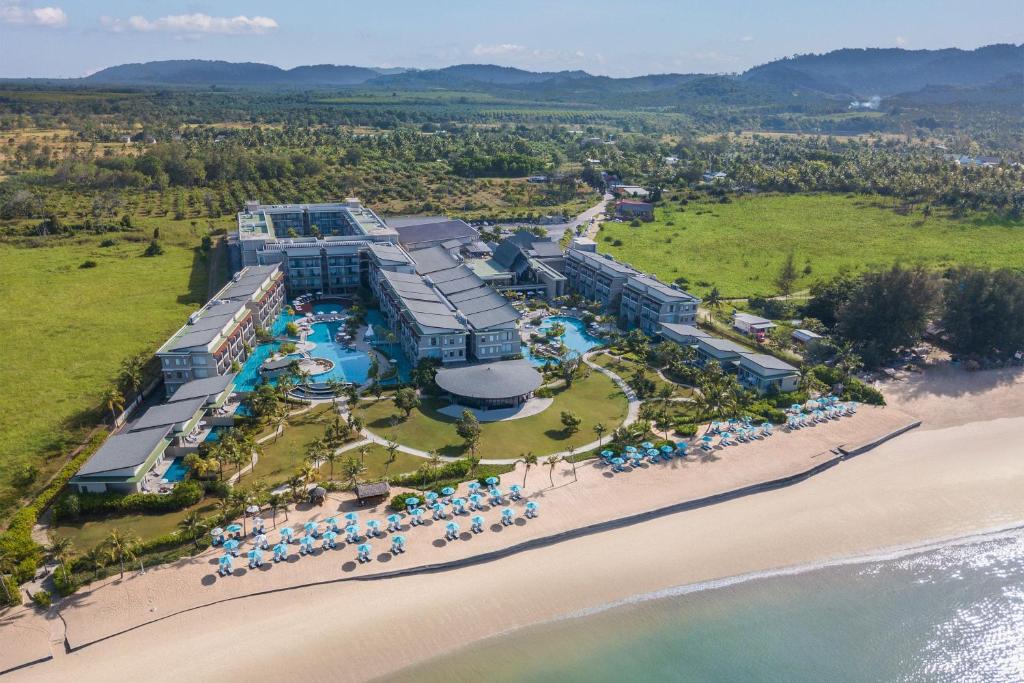
The resort is set through ten acres of tropical gardens on the protected hook of Pakarang Cape, which shelters an eleven-kilometre stretch of beach that stays swimmable year-round, at a time when much of the Khao Lak coast doesn’t. The garden landscaping conceals the buildings so completely that you can’t see any of the rooms from the entrance; you reach yours by crossing a small stream and walking through a garden terrace. The efforts at maintaining privacy – skip breakfast and you might not see another guest during your stay here – are commendable.

The accommodation spans four categories from Garden Residences through to Jacuzzi Pool Suites, but the sense of seclusion is consistent across all of them; you don’t need to upgrade to feel like you’ve got the place to yourself.

When you do surface, Ficus serves contemporary Mediterranean cooking under the canopy of an ancient ficus tree beside a lotus pond, while Edge takes on the Thai side from a beachside pavilion, and a wine cellar of several hundred bottles backs up both. Private dining can be arranged on demand in settings that range from a candlelit jungle waterfall to a sandbar accessible only by longtail. The signature move, though, is the all-day à la carte breakfast served until 6pm (yep, breakfast at 5:59pm is an option) with a glass of sparkling wine. It sounds gimmicky on the page and substantially changes how you spend a Sarojin day in practice.

The property makes fine use of its prime location. The Lady Sarojin, the resort’s own boat, heads out to the Similans through high season, and an ‘Imagineer’ concierge designs bespoke days around whatever guests happen to mention in passing. To cap it all off, the spa sits on raised timber platforms over a small estuary at the back of the gardens, with the mangroves for company instead of the usual muzak and a marble corridor. Makes a change.

The resort holds 2 Michelin Keys, and it’s an adults-only property (well, no children under ten).

Prices for the entry-level Garden Residence start from around 7,500 baht (£165) per night in low season, rising to roughly 25,500 baht (£565) at peak. Rates include breakfast.

Address: 60, Khuekkhak, Takua Pa District, Phang Nga 82220, Thailand  

Website: sarojin.com

Hotel Gahn

Ideal for Peranakan history buffs, budget-conscious travellers, and anyone who believes the best luxury is at the table…

Hotel Gahn is the only property on this list that isn’t on the beach, but who wants grains of sand in your bedsheets and under your fingernails when you’ve got design this elegant and immersive?

A twenty-room boutique property set back from Bang Niang Beach, the hotel is built entirely around the Baba-Nyonya culture that emerged when Chinese immigrants settled the Andaman coast and married into local Thai families.

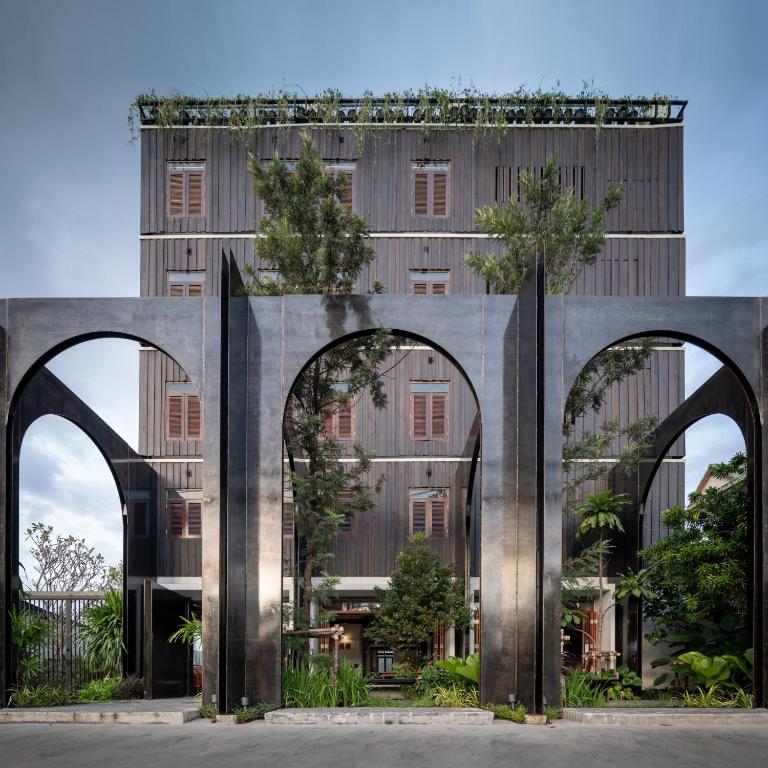
Gahn means time in Thai, and the design by Phuket practice Studio Locomotive takes that lineage seriously: a steel gateway modelled on the five-foot way of traditional Straits shophouses, Chinese canopy beds, hand-painted ceramic wash basins, Peranakan porcelain lining the shelves, and the owner’s mother’s vintage collectibles displayed in glass cabinets in the lobby. Stepping inside feels like passing through a time portal – the Baba-Nyonya world of a century ago made vivid and immersive, though mercifully with air conditioning and other modern conveniences. The building won the Design Anthology Award for Hospitality Spaces in 2021, and it feels less like a hotel than a family home that happens to have rooms available.

If you plan your travels around restaurant reservations, then this is a hotel for you. The chief reason to book, though, is Juumpo, the on-site restaurant named after the owner’s grandfather, who cooked on Chinese trading junks plying the route between southern China and the Andaman coast. The menu draws on his recipes and the broader Baba-Peranakan culinary tradition, a fusion of Chinese cooking methods with the aromatics of the Malay peninsula and southern Thailand that you won’t find replicated at the beachfront resorts down the road. Juumpo holds a Michelin Guide listing, and neighbouring hotels’ guests regularly make the trip inland to eat here. No surprise, then, that breakfast is also a real treat at Hotel Gahn; the Thai sweet selection, in particular, is vast and irresistible. 

Hotel Gahn is walking distance to Bang Niang Market and the Tsunami Memorial police boat, with the local boxing stadium right next door. Factor in room rates that start well below anything else on this list and a restaurant that would justify a visit even if you were sleeping somewhere else, and you have Khao Lak’s strongest argument for choosing food and design over a beachfront postcode.

You can read our full review of Hotel Gahn Khao Lak here.

Prices for the entry-level Superior Room start from around 1,250 baht (£25) per night in low season, rising to roughly 3,000 baht (£70) at peak. Rates include breakfast.

Address: 27, 76 Phet Kasem Rd, Khuekkhak, Takua Pa District, Phang Nga 82220, Thailand

Website: hotelgahn.com

Le Méridien Khao Lak Resort & Spa

ldeal for families who like to spread out, twitchers and the all-inclusive sceptic…

If the rest of this list favours comparatively compact and detail-led, Le Méridien Khao Lak represents the other end of the argument: scale. Le Méridien is a major Marriott-operated resort on Bang Sak Beach at the northern end of the coastline, well clear of the busier southern stretches, with rooms and suites across ten categories, three pool areas and a dining and facilities offering deep enough that you could eat somewhere different every night for a week without repeating a meal or running out of things to do. Yes, we realise that’s a sprawling sentence but this is one sprawling property.

Whether that sounds like paradise or a gilded cage depends on what you’re after, but for families with children of mixed ages and competing requirements, it solves problems that smaller properties simply can’t. And when everything’s so tastefully done and so comprehensively accommodating, that scale stops feeling like a compromise and more like an opportunity.

Dining keeps pace with the footprint. Le Méridien boasts an all-day restaurant, a beachfront seafood grill, a wood-fired pizzeria, a lobby lounge with craft cocktails, house-made gelato and a couple of bars to fill in the gaps, and the consistency across that many simultaneous kitchens is impressive. And then there’s the beach bar: sand between your toes, waves crashing a few metres away, and piña coladas made with expertise – not the watered-down, syrup-heavy resort standard you’ve been let down by before, but the real thing. An evening here justifies the flight. Almost. Flying here for a piña colada would be mental, to be fair.

Beyond the food, the grounds and the national park on the doorstep make this one of the better places in the region for twitchers, so bring your binoculars. There’s a Kids’ Club with guided birdwatching sessions and an art studio open to all guests where instructors run acrylic painting classes at a pace that suits you, for a small canvas fee.

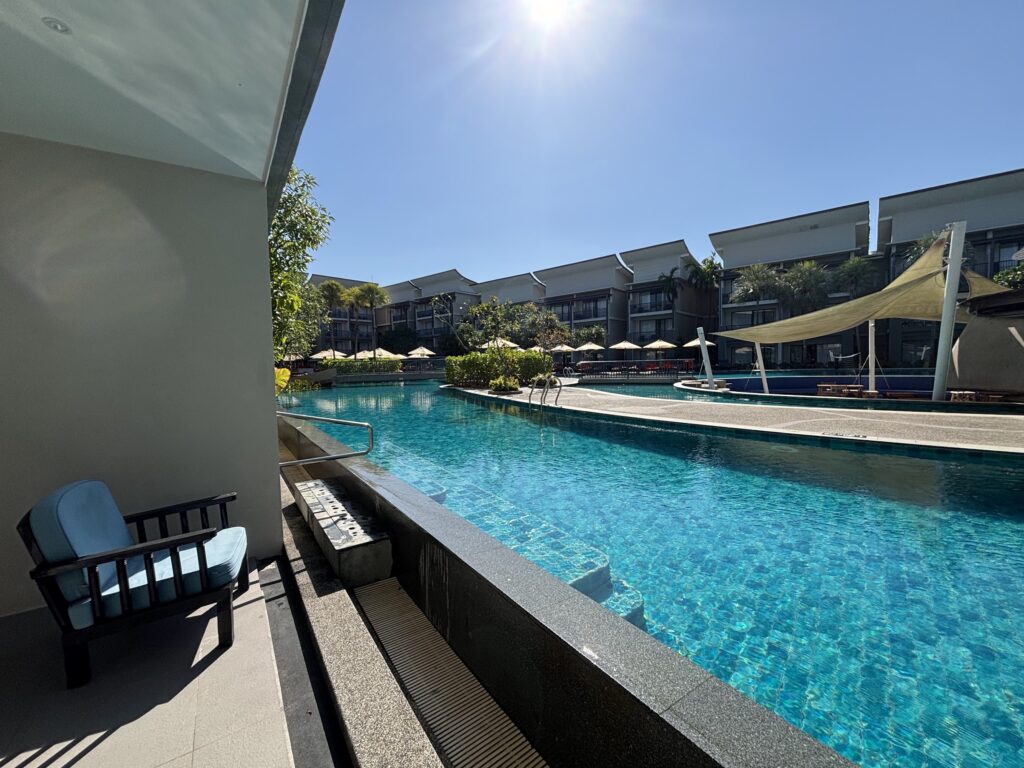
The pool access rooms are among the most spacious on offer, starting from 43 sqm. Stepping from your private terrace straight into the water sets the tone for the kind of holiday where you’re not in any particular hurry to be anywhere. Don’t overlook the pizzeria’s room delivery either, which arrives in a proper takeaway box. There are worse ways to spend an afternoon than dipping in and out of the pool with a freshly made pizza for company.

A couple of practical flags: the drive from Phuket airport is close to 100 kilometres, around ninety minutes, so you’re committing to the seclusion. But with everything catered for, and the beach right there as your back garden, you won’t find that any issue. It’s also one of those properties that makes you reconsider any snobbery you might have harboured about all-inclusive holidays. Book it that way. You’ll understand why when you’re on your third piña colada and haven’t thought about your wallet once.

You can read our full review of Le Méridien Khao Lak Resort & Spa here.

Prices for the entry-level Studio start from around 2,750 baht (£55) per night in low season, rising to roughly 11,500 baht (£230) at peak. Rates include breakfast.

Address: 31 Moo 7 Bangmoung, Takuapa District, Khao Lak, Takua Pa District, Phang Nga 82190, Thailand

Website: marriott.com

La Solaya Khao Lak

For sun-seekers after a prime position on one of Khao Lak’s finest stretches of coast, sunset snap accumulators, and those who like their resort brand new…

Sun-drenched days, walking barefoot on the beach, and long languorous afternoons gazing out at the Andaman Sea – La Solaya may be the newest property on this list by some distance, but it already feels like one of the coast’s most effortlessly beautiful addresses.

The staff and service have the ease of somewhere that’s been open for years. The La Flora Group acquired the former Mukdara Beach Villa & Spa Resort in May 2025, closed it for eight months and reopened it in January 2026 as a fifteen-acre beachfront resort on Bang Niang Beach, right next door to the group’s existing La Flora Khao Lak and around the corner from Casa de la Flora, which also appears in this guide. That family connection between the three properties matters in practice, because wellness offerings, dining credits and certain facilities are shared across them.

The rebuild tells you a lot about who La Solaya is for. The previous beachfront pool villas were removed to expand the sunbathing and lounging area. The space below the lobby has been converted into an indoor games and snack zone for teens. The kids’ pool has new floating play features. Accommodation now covers five categories from Deluxe Rooms through to Pool Villas, and the overall orientation is family-friendly without being exclusively so. Couples won’t feel like they’ve wandered into someone else’s holiday, and the villas themselves, all done in Thai vernacular, are gorgeous, with morning light angled onto the bed and the Andaman rolling you to sleep at night.

Dining is a tighter setup than at some neighbours, with SolMare Beachfront Restaurant handling Thai and international food on the sand and SolBar covering cocktails and light bites by the pool. The pure, panoramic views of the Andaman from the terrace seating of both operations are pretty much unrivalled, and it’s certainly tempting to bounce between the two like a pinball, a drink here, a snack there, and repeat until it’s time to totter to bed. We wouldn’t judge you; people in glass villas, and all that.

Wellness splits between Spa Floranica and the La Vita Sana offering also available at sister property Casa de la Flora, which includes structured three-day courses for jet lag, sleep and recovery. As a new-build with everything still gleaming, La Solaya has the advantage of nothing being tired yet, without the usual disadvantage of staff still finding their feet. In fact, everything is already calm, clean and serene. 

You can read our full review of La Solaya Khao Lak here.

Prices for the entry-level Deluxe Room start from around 2,700 baht (£60) per night in low season, rising to roughly 12,800 baht (£284) at peak. Rates include breakfast.

Address: 67/179, Takua Pa District, Phang Nga 82220, Thailand

Website: lasolayakhaolak.com

Devasom Khao Lak Beach Resort & Villas

Ideal for food-led travellers, history nerds & couples bored of identikit Andaman resorts…

Devasom opened on Khuk Khak Beach in December 2018. It’s the second property in the group, after Devasom Hua Hin, and the entire place is built around a single historical conceit: the ancient Takola Kingdom, the name for the wider Takua Pa area during the sixth and seventh centuries, when it operated as a major Southeast Asian spice trading port.

The name itself draws on the Sanskrit Deva (angels) and Ashram (residence), and the design references that period throughout, with some of the buildings incorporating salvaged architectural elements that are several centuries old. It could have tipped into theme-park nostalgia, but the commitment to sourcing and detail keeps it firmly on the right side of elegant.

The setting helps. The 69-key resort sits across three hectares with a natural freshwater lagoon on one side and the beach on the other, and at high tide guests can kayak through the lagoon and out to the open sea. Every room has a sea view, and the lagoon-and-beach geography gives even the entry-level Seaside Grand Deluxe rooms a sense of openness that belies their category, while two signature Sky Villa penthouses with private pools sit at the top of the resort for those after something grander.

Dining is perhaps the centrepiece, and the reason many guests choose Devasom over better-known neighbours. TAKOLA, the on-site Thai restaurant, held a Bib Gourmand in the Michelin Guide Thailand from 2021 to 2024 (and still, to our mind, delivers the goods), with a kitchen that works with ingredients grown on site or supplied from a neighbouring village, and seafood from Andaman fishermen who’ve worked these waters for generations. The eight-course Takola Journey tasting menu draws on Southern Thai traditions specific to the Takua Pa area and is one of the more compelling fine-dining propositions on the coast. 

The Michelin-recognised Devasom Beach Grill & Bar tackles the Mediterranean side of things from a beachside pavilion, with a heavy-hitting wine list to keep the oenophiles happy. The resort has hosted several notable guest-chef residencies lately, including the legend Chudaree ‘Tam’ Debhakam of Baan Tepa, Thailand’s first female two-Michelin-star chef.

Beyond the food, Devasom keeps a surprisingly full cultural calendar for its size: a well-appointed spa, multi-day digital detoxes, the annual ‘Sol Festival’, an Artist in Residence programme, a ceramic studio (KALA TERRA) and a long-running scholarship for local Phang Nga children. It’s a place that treats the area it sits in as something worth engaging with rather than screening out, and that instinct colours everything from the menu to the architecture. It’s fast becoming one of our favourite places to stay in Khao Lak.

Prices for the entry-level Seaside Grand Deluxe start from around 5,500 baht (£120) per night in low season, rising to roughly 21,700 baht (£480) at peak. Rates include breakfast.

Address: 79 Moo 3 Khuk Khak Beach, Takuapa, Phang Nga, Phang Nga 82220, Thailand

Website: devasom.com/khaolak

Hotel Review: Casa De La Flora, Khao Lak, Thailand

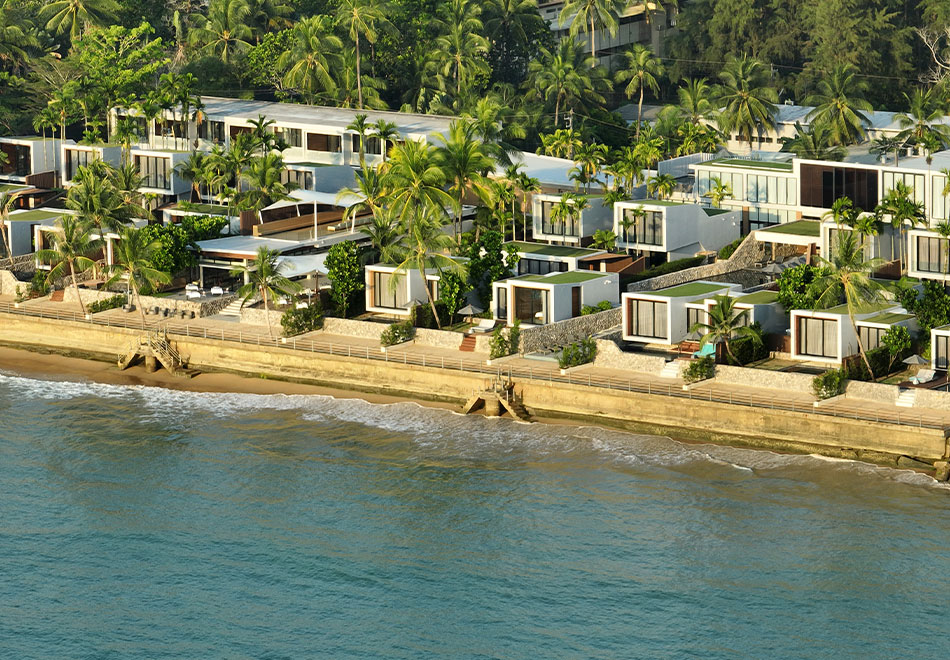
On a coast lined with teak and tropical timber, someone decided to build in concrete. Thirty-four grey cube villas, poured and angular, facing the Andaman Sea from a sleepy stretch of Bang Niang beach in Khao Lak. It should feel wrong. It doesn’t.

Casa De La Flora arrived in this corner of Khao Lak in 2011 with a proposition that remains unusual in Southeast Asian hospitality: that a great resort hotel needn’t look anything like the place it’s in. That philosophy runs counter to everything I thought I knew (and liked) about resort hotels, but you know what they say about the exception that proves the rule?

The grounds are spare, the sightlines deliberate, the atmosphere closer to a Mediterranean art residency than a tropical resort. More Le Corbusier than Cherngtalay, arguably. And yet, perhaps because of all this, perhaps despite it, it is one of the most calming places in Phang Nga, an already damn calm place, it should be said.

In a coastline – a country – of lookalike resorts, Casa De La Flora is the original.

Location

Khao Lak sits roughly an hour and a half north of Phuket airport, in Phang Nga province, a pleasingly uncrowded part of Thailand untroubled by Phuket proper’s brimming crowds. It’s far enough from the famous island not to act as spillover either, leaving this strip refreshingly calm and its seafood shacks and beer corners refreshingly priced. Aaahhh…

Go on, breathe out. Exhale. Slacken your pace and horizontalise your gait. Thais who live in Phuket come here to escape Phuket, which says plenty about its pace, its prices and its priorities. Visitors to this coast of Southern Thailand looking to follow (swim)suit will find that unhurried posture hugely appealing.

Although it feels secluded, Casa De La Flora sits right in the centre of Khao Lak, just along a quiet stretch of Bang Niang beach where building height restrictions keep the skyline low and the pace even slower than the main strip. The area has a drowsy charm about it. A smattering of resorts and beach restaurants share the road, but it never feels crowded. Clientele range from young backpackers with frangipani flowers tucked behind their ears to German retirees settling in for the season. There’s a soundtrack of contented groaning, of people finally settling into the rhythm of their holiday and politely asking their partner what day it is for the fifth time that Monday. Or, was it Wednesday?

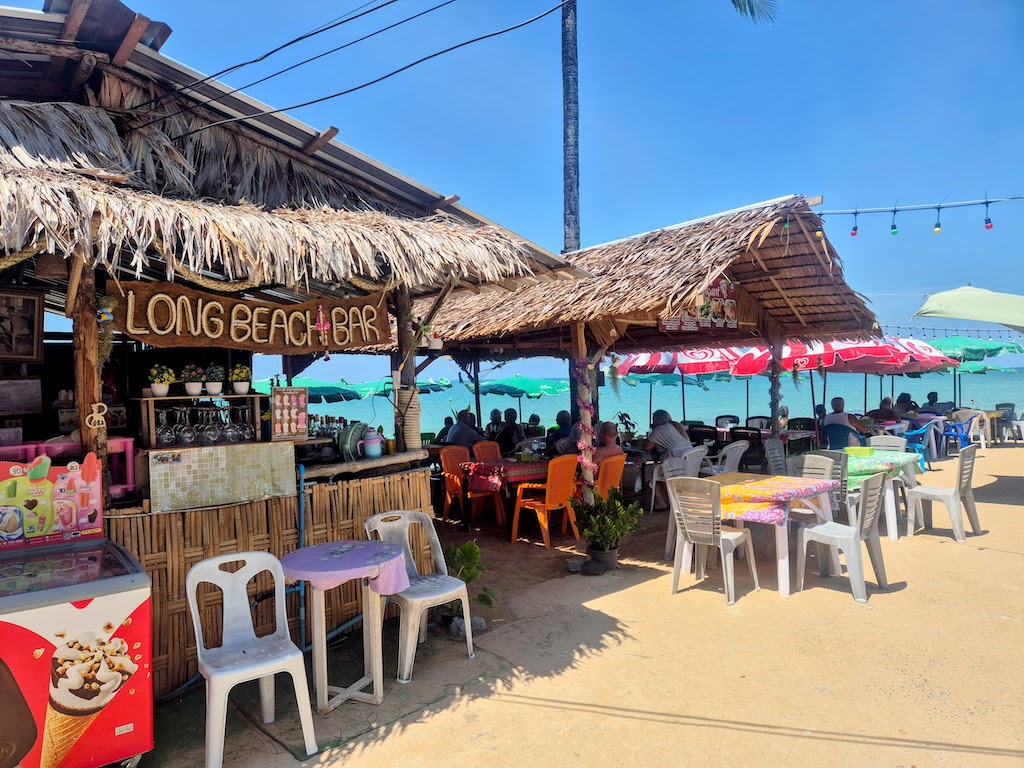
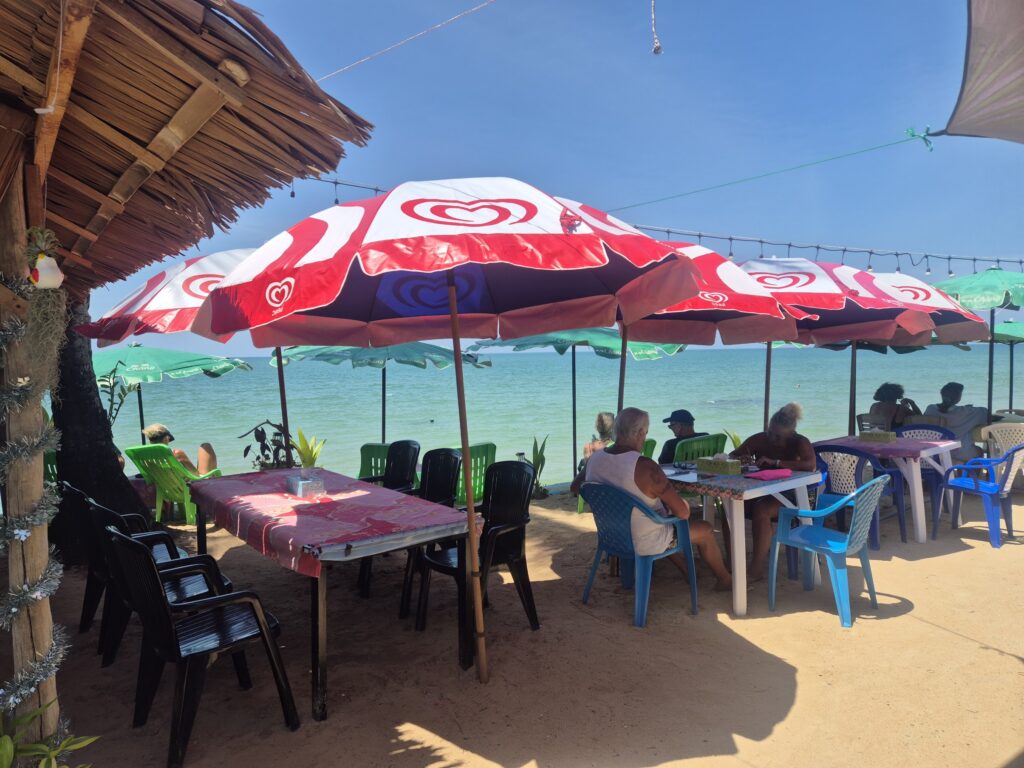
The road outside has the texture of a beach town that hasn’t tried too hard to appeal to anyone in particular: a massage place or two, a few open-sided restaurants, the odd bar (pool table in use, of course) sending the strains of Do-Ther-Tum (Doo Doo Doo), Thailand’s unofficial reggae anthem, across the tarmac. Where the road drops off into the sea, Long Beach Bar and Restaurant offers plenty of shade and a low-key beach atmosphere: bamboo bar, plastic chairs. It’s a fine perch above the water to soak up the bohemian vibes and rub shoulders with some beer-swigging tourists. And, indeed, swig your own.

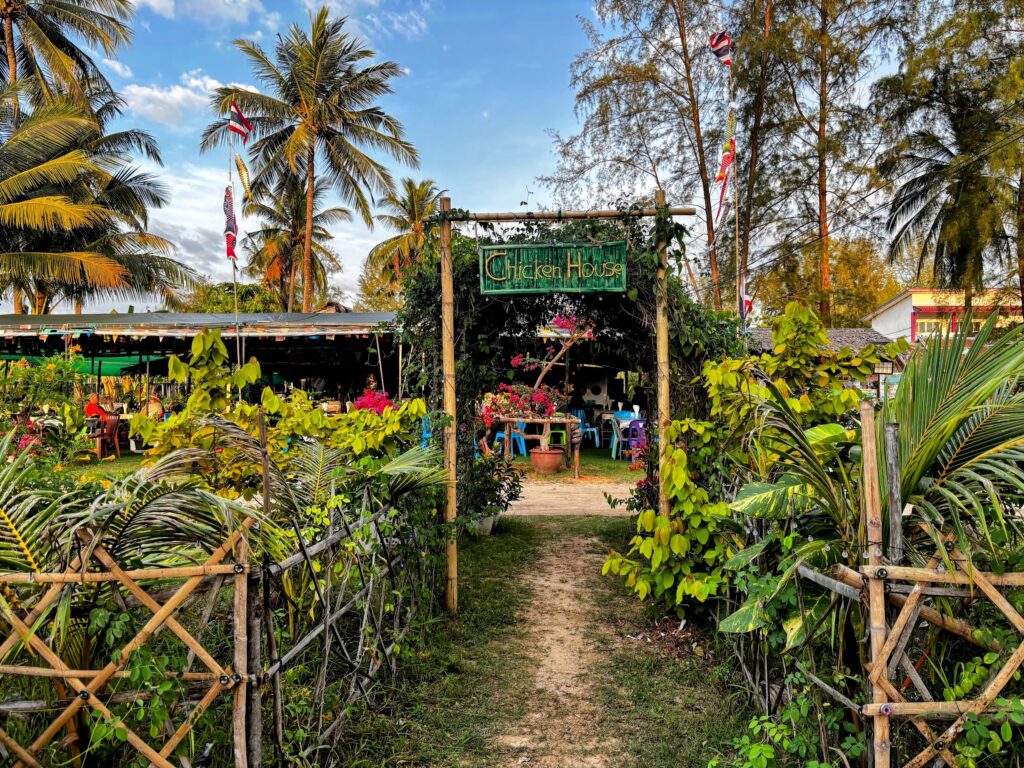
Nearby, Chicken House has a scrappy allure: mismatched chairs sprawled across a lawn that is curiously half astroturf and half real grass, a rudimentary effort at some bunting; just the sort of spot, basically, to kick back with a Singha over ice and a plate of perfectly adequate pad grapao. Stick to the Thai side of the menu here to avoid any surprises (a meal of nuggets and strangely sweet garlic bread feels almost perverse at this juncture).

A few places along the road offer bargain price laundry services for as little as 80 baht per kilo (Thuptong Guest House does the job perfectly). In the other direction, where Bang Niang Beach Road meets the main Khao Lak strip, Roilay serves some of the best Southern Thai food in the area.

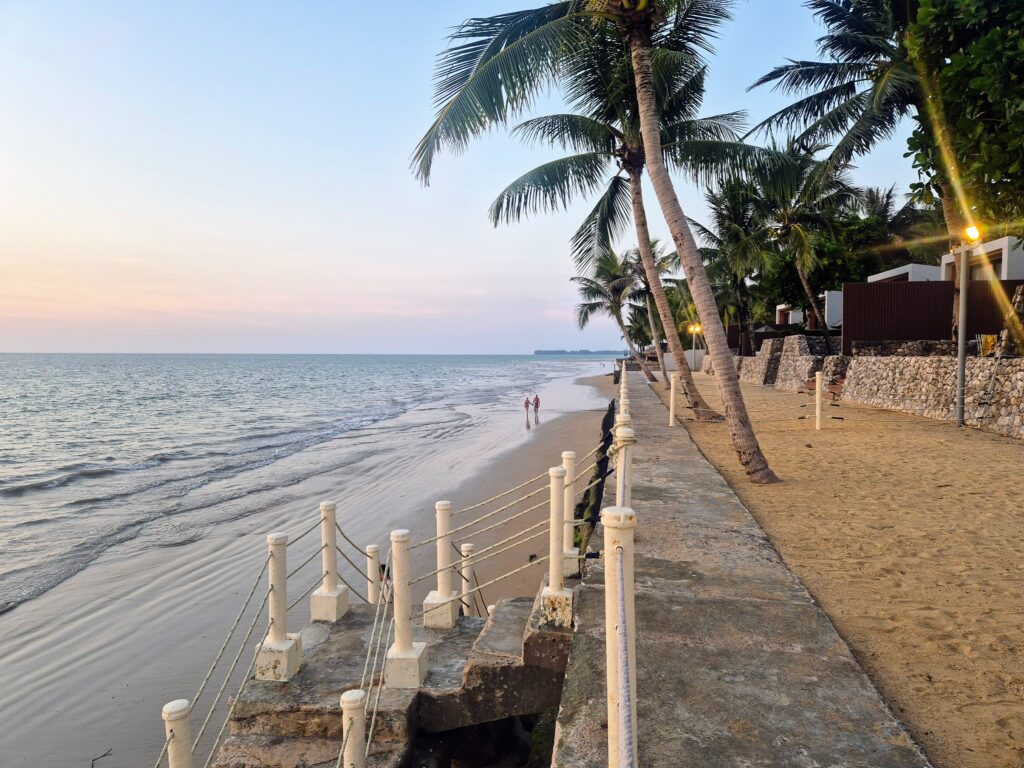
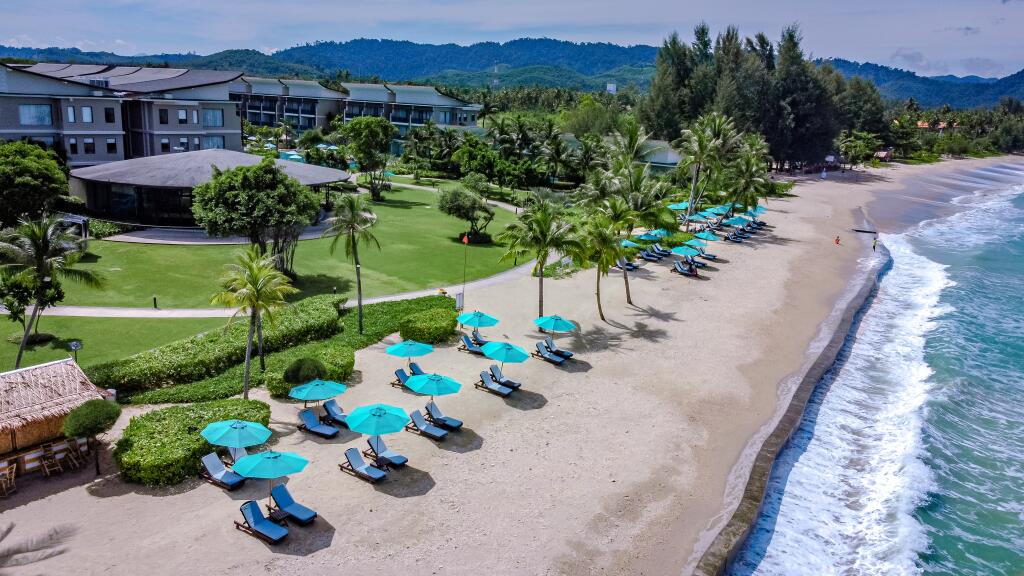
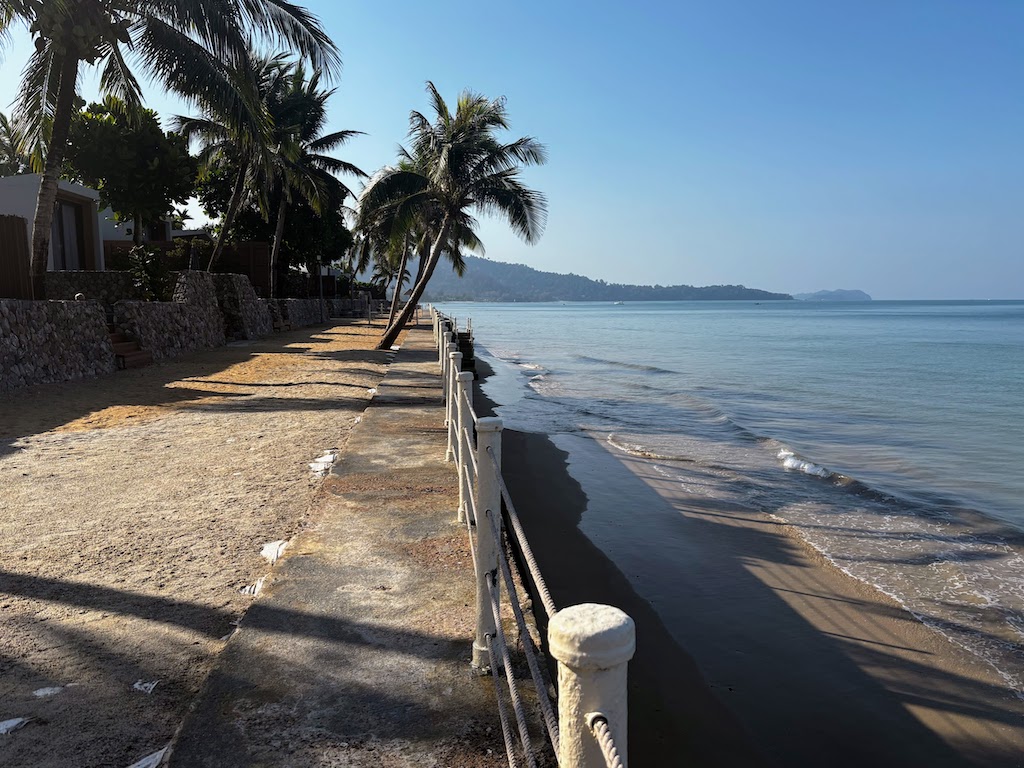
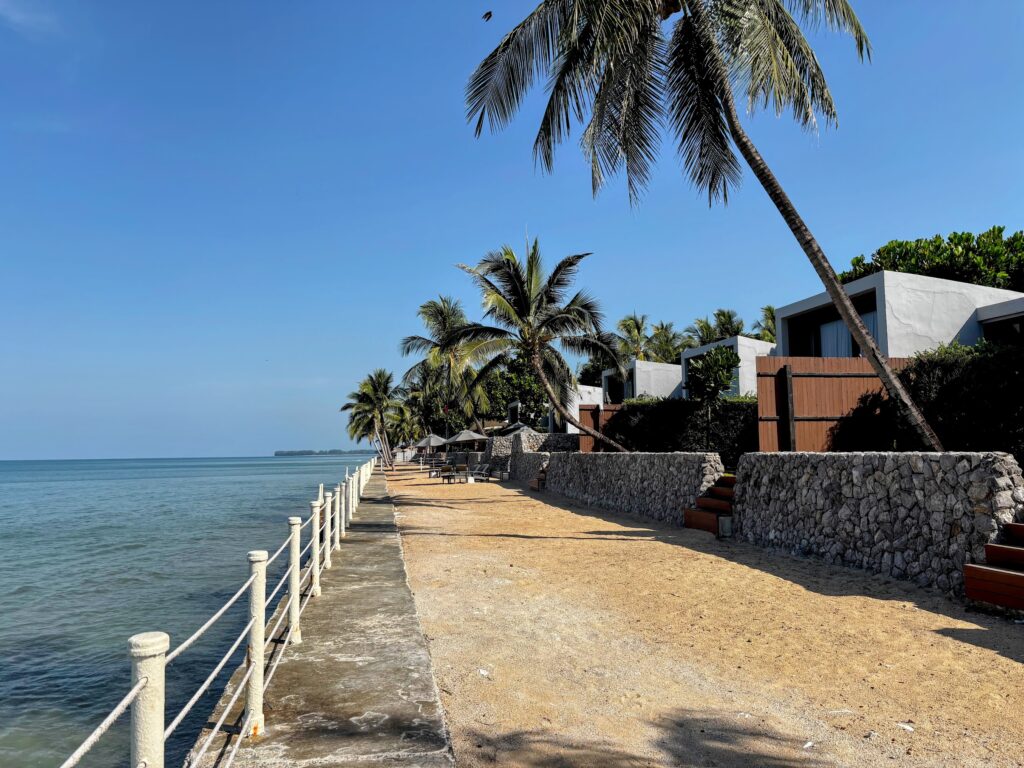
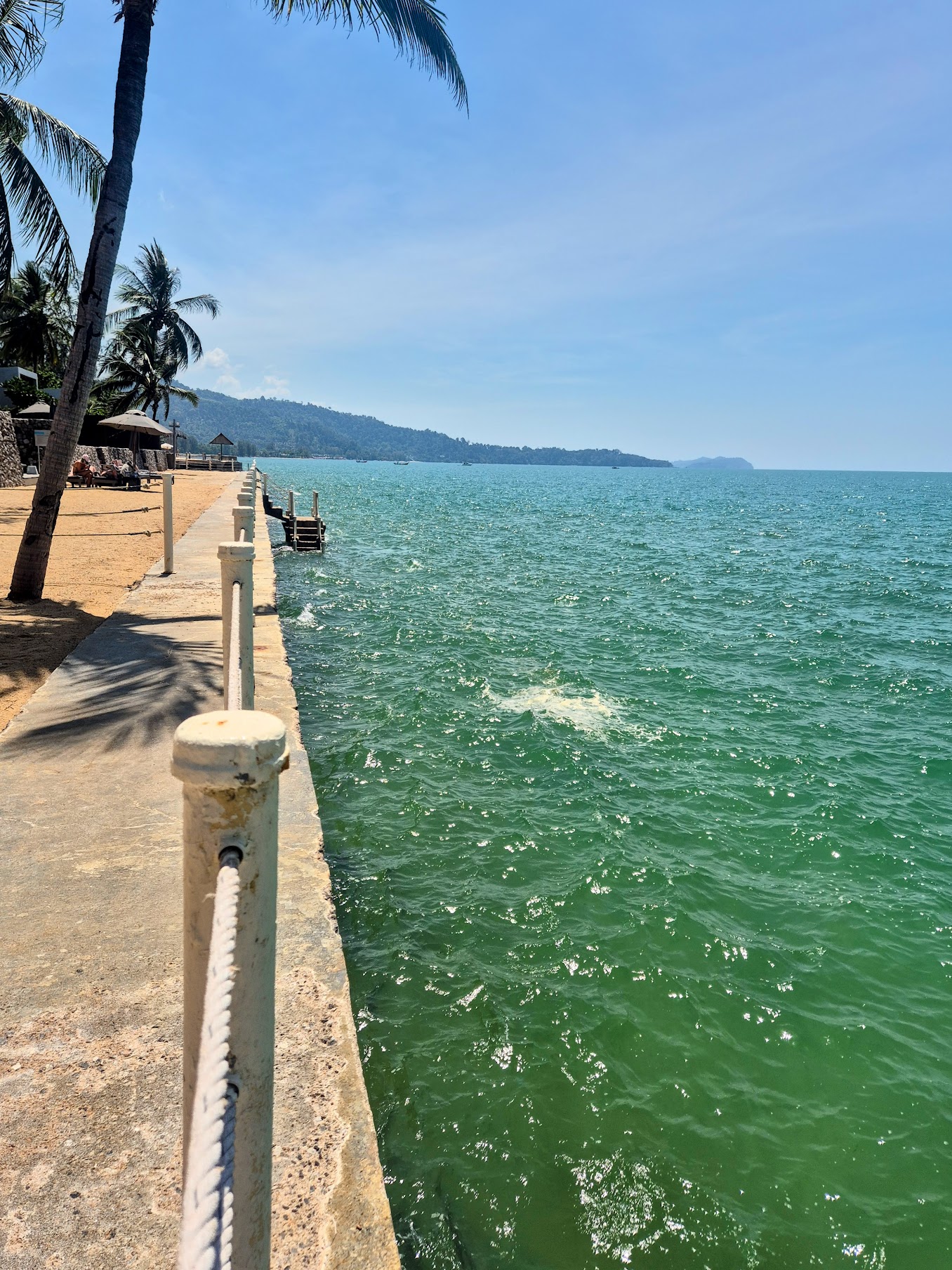
There is blissfully little to distract you here, and the part of Bang Niang beach the hotel overlooks is very quiet indeed. If you love to swim, this is one of the best hotels on this part of coast for actually getting into the water and splashing about. A set of steps from the hotel leads directly into the ocean, and from the resort ledge you can watch shiny fish flitting beneath the waves below, tempting you to join them. At high tide the water comes right up to the sea wall, waves crashing against it with some force and the beach disappearing entirely beneath the surface. Do check the flags before you go in; things can get rough.

At low tide, which typically occurs in the morning and again in the evening, a more fully-formed beach appears, easily accessible for long walks and largely yours thanks to the low tourist numbers on this particular corner of Khao Lak. There is no manicured shoreline in front of the property as such. When the beach does emerge, it isn’t really a sunbathing spot; it’s a place to swim, walk, and savour a rare sense of seclusion. On a clear afternoon, with the Andaman reaching west towards nothing, that feels like more than enough.

If you do find yourself beach-hungry, options are close by. Just up the road past Long Beach Bar, the edge of Bang Niang beach is lined with sunbeds and umbrellas: it’s lively but crowded. For something calmer, a 15-minute taxi ride brings you to Coconut Beach, with its fine pale sand, large palms, and crystal-clear water that turns a gorgeous turquoise in good weather.

A little further afield, White Sand Beach does exactly what it says on the tin. You can also book a trip with the hotel to Similan Islands and visit Donald Duck Bay, named the world’s 10th best beach earlier this year (do we really need a 50 Best for everything?!). You must prebook your tour as they need to register your visit with the National Park in advance. The islands are open from October 15th to May 15th.

Somehow, the concrete-heavy design of Casa De La Flora doesn’t feel in conflict with its more rough-and-ready surrounds. The contrast, in fact, is part of the appeal.

Character & Style

The first question on arrival is which scent you’d like in your room. Lemongrass, then. Do you have a preference for pillows? A two-stack, bottom layer firm, top layer cloud, if you’re asking. It is, in its small way, a declaration of intent.

Casa De La Flora is low-key and intimate – contemplative, even – trading on a hospitality that doesn’t try to compete with your attention. The lobby is all clean lines and a gently curated feel: concrete and teak wood with interesting, sculpture-garden angles, framed by a long window showing the Khao Lak countryside in the distance.

The villas are slate-grey concrete cubes that might, at a lazy glance, be mistaken for bunkers. It would be an understandable comparison – the reflexive insult that most small, square concrete buildings have had to endure at some point in their lives – but an unfair one. These are feats of design and poise, not a futile hedge against nuclear armageddon.

There are also duplex suites reached by a beautiful spiral staircase from the lobby level, their elevation offering a purer vantage point of sea and sand. The bedroom sits on the upper floor, the living space and private pool below, and from the king-size bed the sunset is yours without having to stand up for it.

Since Casa De La Flora opened, stark concrete has crept back into vogue in high-end hospitality, with acclaimed properties like Pompey in Portland, Jamaica, Hotel Terrestre in Mexico’s Puerto Escondido, and Sou Fujimoto’s Shiroiya Hotel in Maebashi, Japan, all reimagining brutalism in their own way. The word, for what it’s worth, takes its name from the French béton brut, meaning raw concrete, and has nothing to do with being brutal, though it’s been fighting that battle since the 1950s.

Casa De La Flora has been likened to a Le Corbusier edifice, and there’s something to that. His Cité Radieuse in Marseille, now a UNESCO World Heritage Site and a symbol of sun-drenched Mediterranean modernism, proved that concrete and sunshine could work in harmony rather than clumsy contradiction. Something of that spirit is present here: clean lines, cast concrete, an austere elegance offset by foliage, graceful in its contrast to the Andaman Sea.

The hotel has operated around the concept of ‘Arising Flora’ since it opened, a design philosophy that shapes the layout of the property. The idea, conceived by Bangkok architects VaSLab, is straightforward: each villa is designed to mimic a plant emerging from the ground, its walls angled and roof tilted as if reaching toward the light, and those same angles were deliberately calculated to maximise sea views from every room. Nothing is serendipitous here.

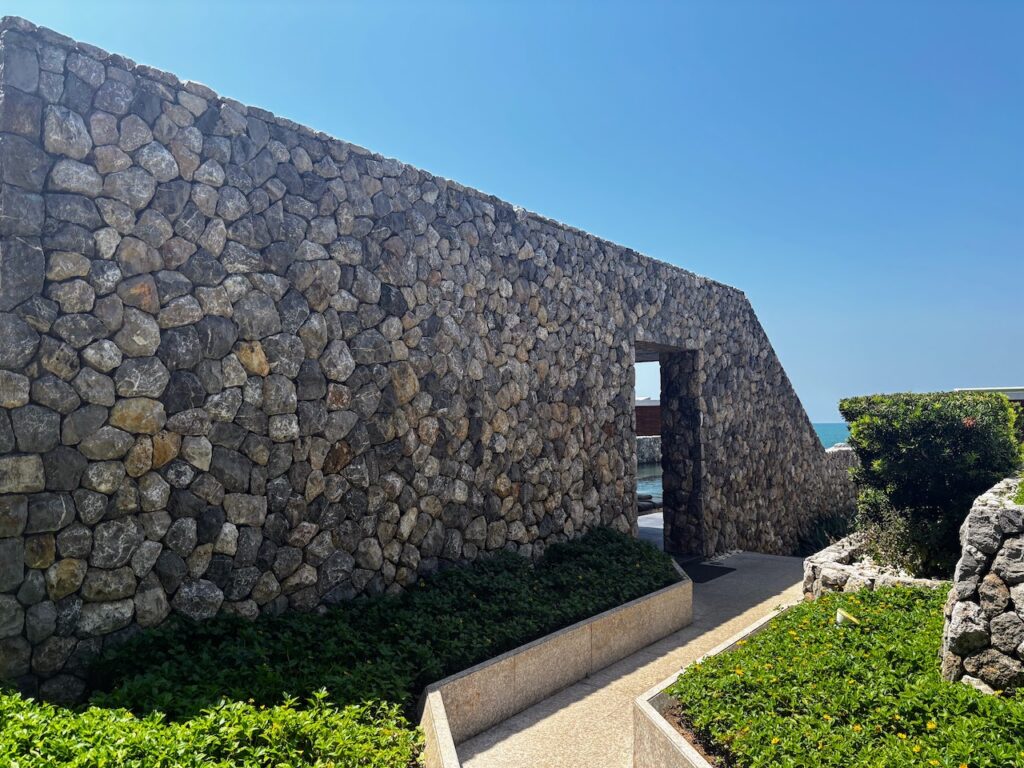
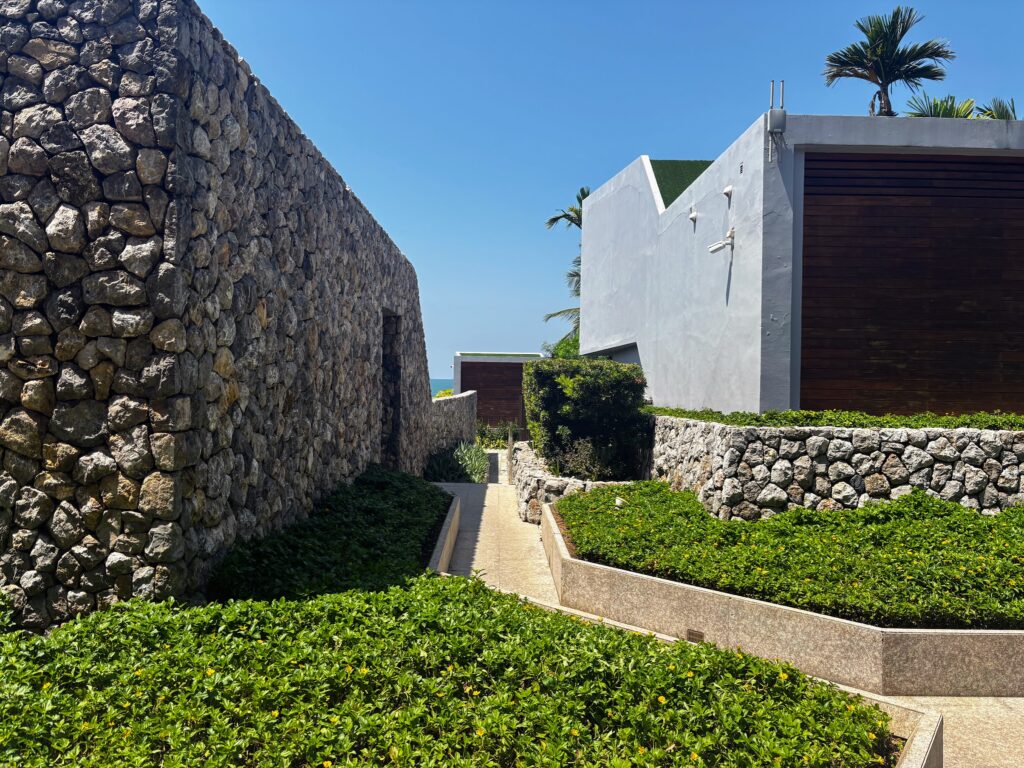
The paths and landscaping carry that logic further still, designed by Bangkok firm TROP to read as the roots, stems and branches to the villas’ blooms. The boulder-stone walls are thick, irregular, geological, reading less like construction than excavation.

Lanes and paths frame sightlines towards the water so that light and air move freely around each villa. The ocean view is still the hero, of course, particularly from the restaurant and the beachfront villas, and the strictly uninterrupted sightline, no developments, no superyachts on the horizon, is no accident.

Yes, that does sound like design spiel. But Casa De La Flora is a Design Hotel, capitalised, accredited, the real thing, and unlike many properties that slap the word ‘design’ on their website and leave it at that, the concept here is legible from the moment you arrive.

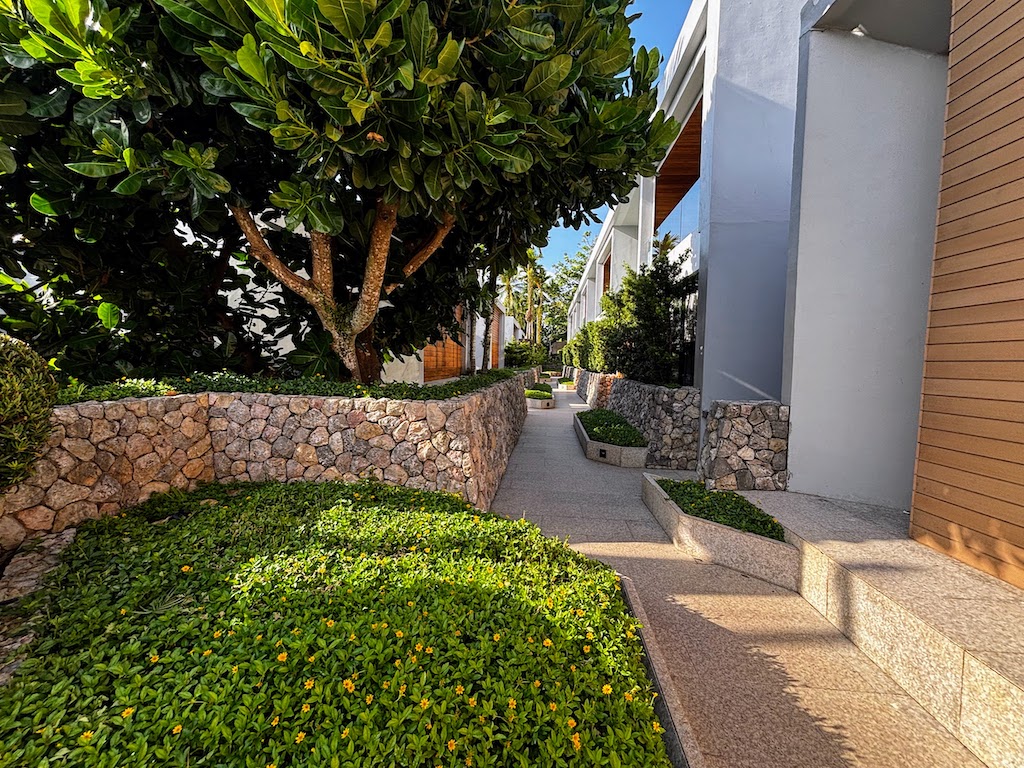
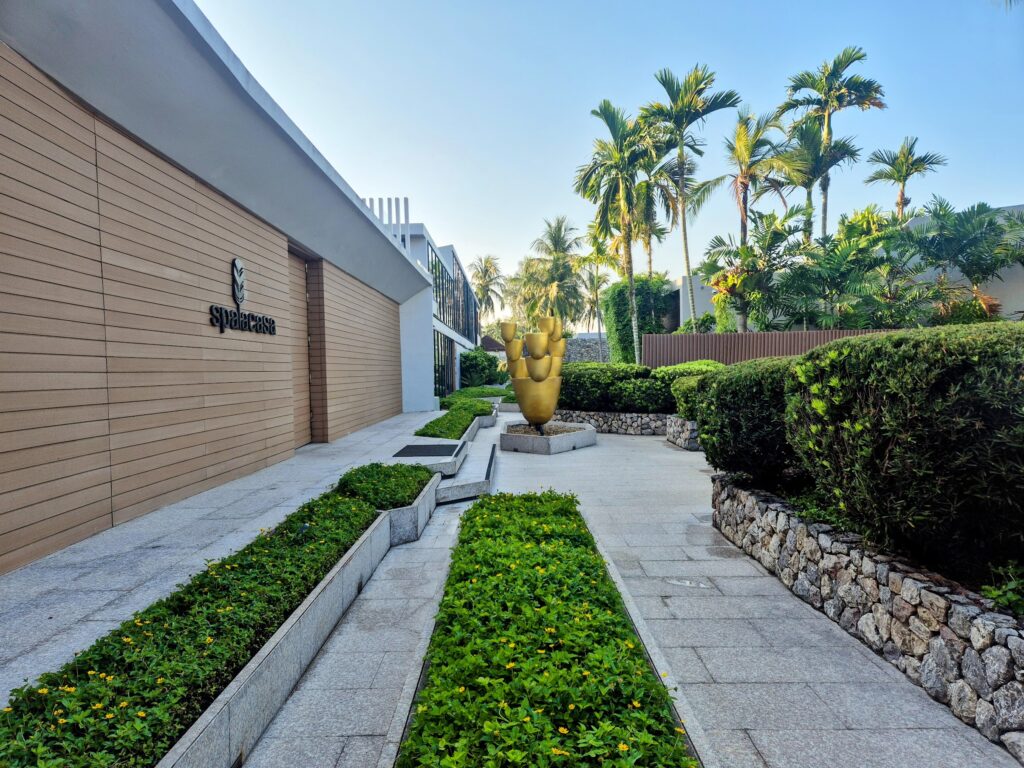
Although the name might suggest otherwise, there isn’t a riot of colour here. The planting is deliberate rather than exuberant, but there’s plenty of it: low angular flower beds of Wedelia, a small, bright yellow daisy-like flower, and topiary softening the clean modernist lines. Mature plumeria cast occasional dappled shade along the pathways, while tall palms provide privacy and shade from a climate that demands both. Orchids planted in coconut shells are fixed to the coconut palms here and there, a small, charming detail that’s easy to miss.

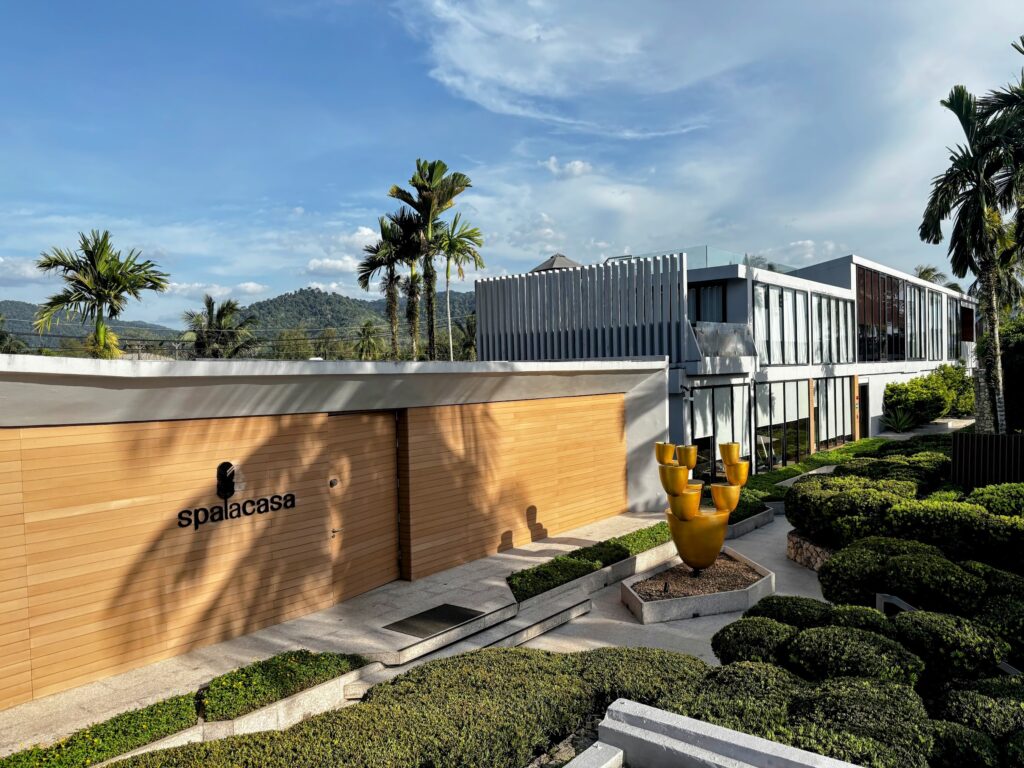
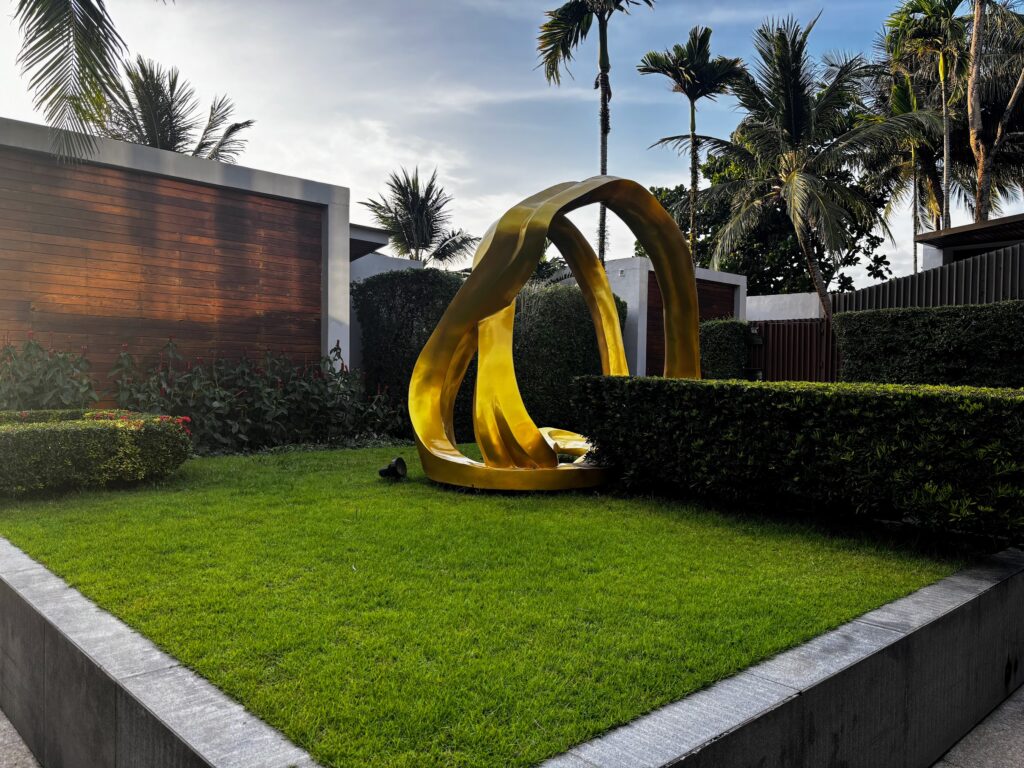
Gold sculptures by Bangkok designer Anon Pairot – their sweeping curves drawn from the forms of stems, petals and pollen – are dotted around the property. Commissioned specifically for Casa De La Flora, they were designed to soften the angular lines of the architecture, tying the resort back to the floral concept that gives it its name. Pairot’s studio was responsible for much of the custom furniture too, and the sculptures feel like a natural extension of that vision: bold enough to catch the eye, but never at odds with the surrounding landscape.

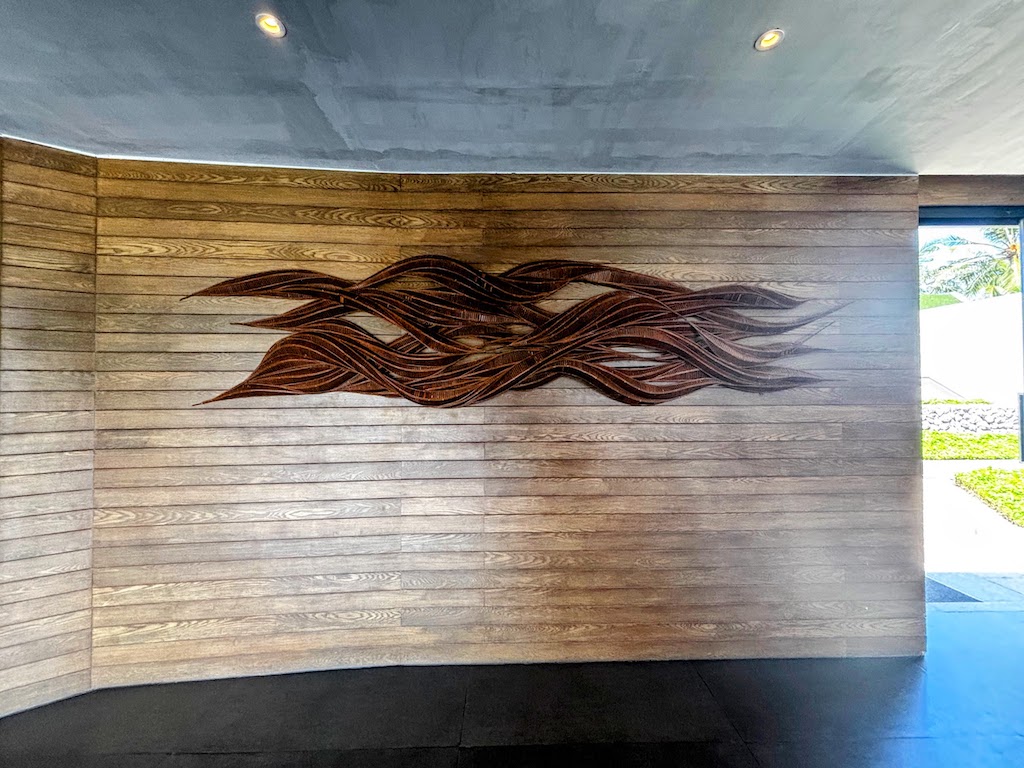
Elsewhere, works by the Thai artist Korakot Aromdee, who also contributed to Iniala Beach House up the coast, appear throughout the grounds. His intricate bamboo sculptures are natural and soft, their whimsical forms a little light relief from the geometric architecture around them. The swirling shapes, somewhere between crashing waves and airborne clouds, are inspired by the natural environment of his coastal hometown in Phetchaburi, and made using a traditional kite-making binding technique he learned from his grandfather.

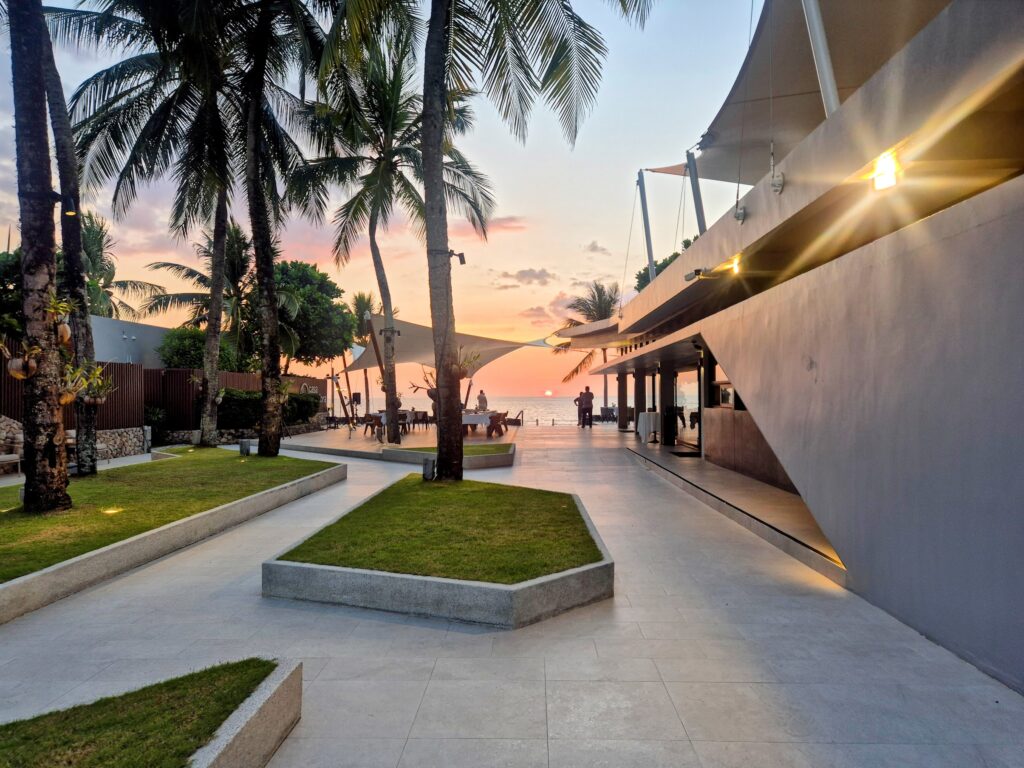
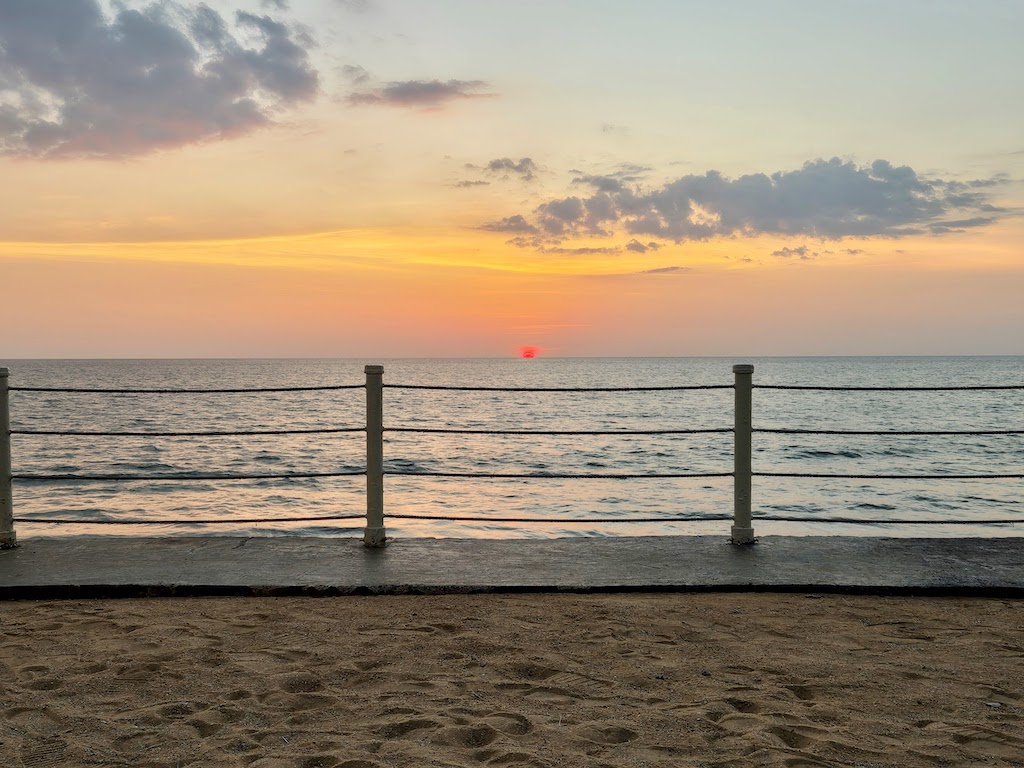
This strip of Khao Lak is all about the sunsets. They’re an event and give the hotel its rhythm. From the front of the resort and from the restaurant, you get an unobstructed view, and guests gather each evening to watch the horizon turn spectacular shades of pink and lilac as the light drops behind the Andaman. A small colony of cats and kittens roams the grounds, adding unexpectedly to the Mediterranean feel of the place. They stop to admire the sunsets, too.

Rooms

The 34 pool villas and suites span six categories, with beachfront villas sitting closest to the water’s edge. Each one is vast, with floor-to-ceiling windows that frame the sea so completely you’ll find yourself lingering at them, taking in the view long after you’d intended to move on, and pondering the good fortune in your life that got you to this point.

Some hotel rooms are just for sleeping in, rolling out of bed and bidding it adieu until nighttime. This one is for spending time in. We stayed in a Duplex Grand Pool Villa, set further back from the shoreline and split over three floors. Our chosen fragrance of lemongrass scented the air on arrival; the other option was lavender, but when in Thailand and all that. Hey, if Casa De La Flora opens up in Provence, we’ll know what to do.

Inside, it’s larger than most folks’ apartments. Teak wood abounds and there is a natural cohesion between indoor and out. Despite the soaring windows, the interiors remain pleasingly dark if you let them, making the villas an ideal retreat from the midday heat.

All accommodation comes with a private terrace, plunge pool and surrounding planting, lending each villa a sense of calm. Those plunge pools earn their keep when the afternoon sun is at its fiercest, but they come into their own after dark, too. There’s a real indulgence to a solitary splash before bed, nightcap in hand, the resort having gone still around you and only the sound of the sea for company. That, and 33 other villas splashing about, too.

Beds are enormous, and you’ll have chosen your pillow type at check-in, a touch designed not only to grant you the most perfect, personalised sleep, but also to give you the impression of a place going above and beyond. Even if all the pillow types ended up secretly being the same, it sets a tone. We also learnt that anti-snore pillows exist, the sort of revelation that does more for a marriage than most couples’ getaways.

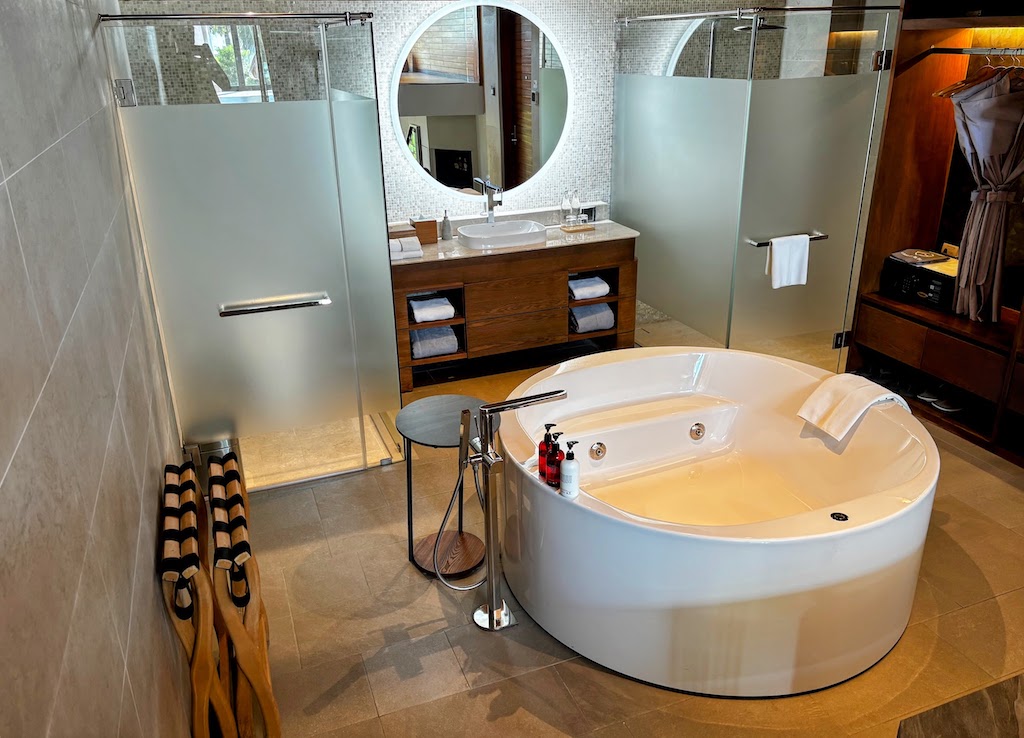
Taking a bath in a hot climate can feel faintly absurd, but the deep soaking tub here makes a compelling case for the ritual. With a jacuzzi function built in, there’s every reason to make full use of it. Run it deep, run it long, and let the salt and sun rinse away. Bathrooms are stocked with THANN amenities, the homegrown Thai apothecary brand whose botanical scents bring a touch of Thailand to the experience. A welcome reminder, mid-soak, of exactly where in the world you’ve washed up.

The minibar is complimentary in every villa – beer included – and replenished daily. Few holiday pleasures rival the simple joy of padding to the fridge and grabbing a cold one, entirely guilt-free. And then, in our case, returning wrinkly to a now tepid bath to drink it. Not the bathwater, the beer…

These rooms are too lovely not to take advantage of room service, and there is an art to ordering it. The wise know you can’t go wrong with the club sandwich or the caesar salad; both travel particularly well, and they’ve held their place on room service menus across the world for generations for a reason. We tested both as the hallmarks of any hotel catering to an international clientele, and the kitchen passed with ease. That said, Thai food often improves at room temperature, most curries especially, so a good portion of the Thai menu travels just as well. The kitchen has a notably delicate touch, with everything balanced carefully between sweetness and tartness, and nothing phoned in except the order itself.

The hotel also runs rainwater harvesting and has an app through which you can order free water to your room, make maintenance requests, and generally avoid having to put shoes on for anything.

Facilities

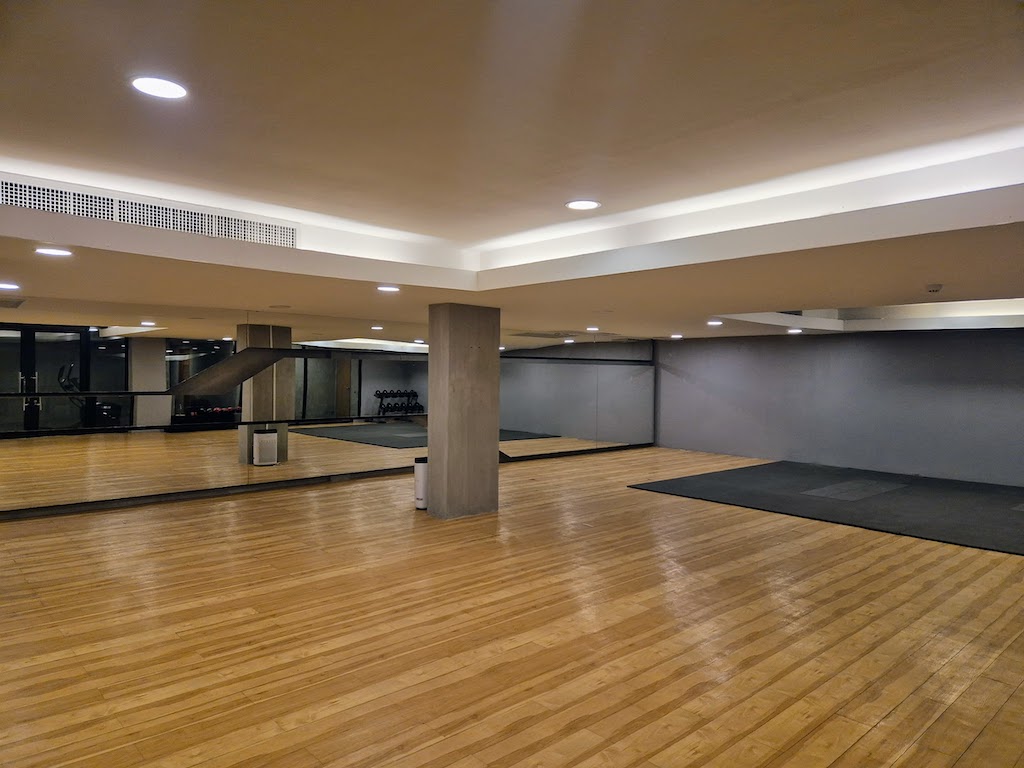
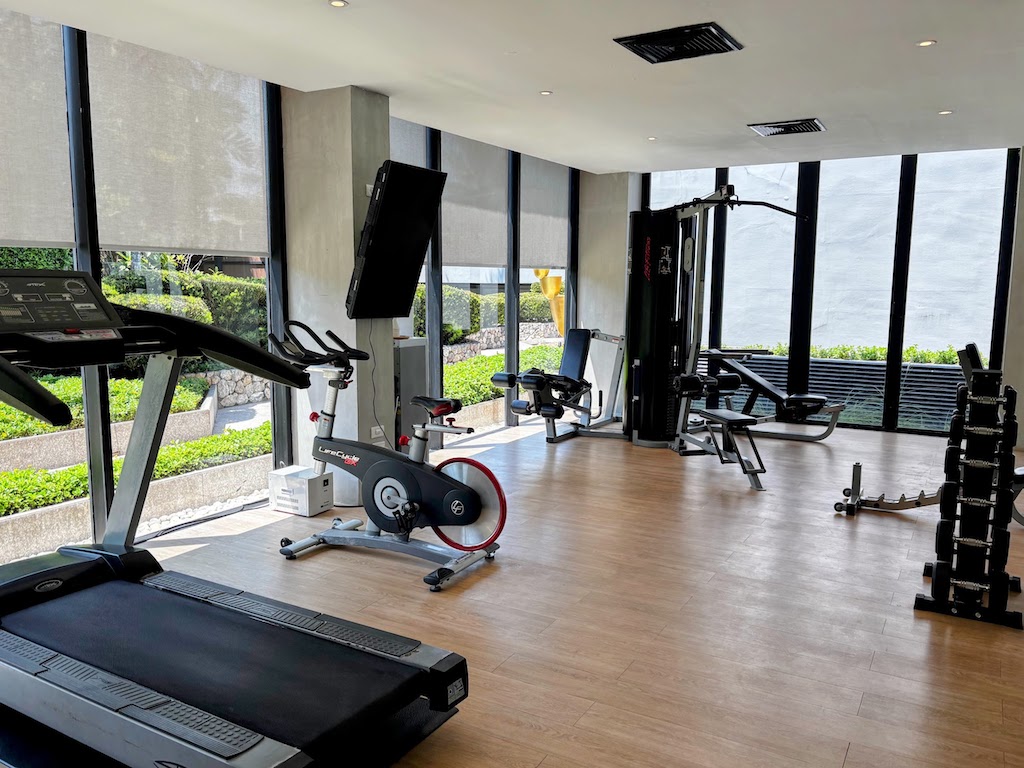
There’s a small, serviceable gym. A cooler, larger activity room downstairs houses weights and yoga mats – useful if the upper gym is busy, or if you simply need space to stretch. The front of the resort, however, is a gorgeous spot for early morning sun salutations before the rest of the hotel has woken up, with the tropical greenery and early light making it a considerably more appealing place to move your body than any air-conditioned box.

The hotel also offers an activity programme, with occasional aqua yoga sessions in the main pool a highlight, and there’s a dedicated wellness centre, La Vita Sana, a short drive away for those wanting something more structured. Changing rooms are downstairs and there are oil burners scented with pandan and towels provided throughout. A bench in there would be useful for getting changed, though; the ol’ hopping dance to avoid wet socks feels a bit silly in a five-star, but first world problems and all that.

Spa La Casa is rooted in local ingredients and time-honoured Thai traditions. The standout is the Casa Touch, a signature massage that brings together classic Thai technique, aromatic oils and a warm compress made from tin mining stone, which retains heat well and is naturally mineral-rich. It gets deep into tired muscles, using a mix of acupressure, elbow pressure and gentle stretching to leave you feeling thoroughly unknotted, your worst pretzel tendencies straightened out until the next stressful incident. Let’s just say it won’t be here.

Beyond that, the menu covers plenty of ground: aromatherapy, deep tissue, a coconut oil massage and a Thai fusion treatment that draws on both eastern and western methods. Body scrubs use ingredients like coconut, coffee and local herbal powders, and there is a white clay wrap blended with turmeric, honey and lemon.

The main pool is beautiful enough to tempt guests away from their own private plunge pools. From the water, the horizon unfolds in an extraordinary sweep of sea and sky, and the pool’s chemical-free, ozone-purified water mirrors the colour of the sea so closely that it feels like a continuation of the ocean. Without the sting of harsh chemicals, there is a softness to it that feels natural, like swimming in a calm, sheltered cove.

Sleek sun loungers flank either side, and for those without a beachfront villa, there is no need to feel short-changed: plenty of loungers sit just beyond the pool, right up against the sea, offering the same unhurried, open-air vibe. Both the pool and the restaurant make the most of the view: spend your days lounging by the former and your evenings at the latter, and feel quite smug about doing so.

Food & Drink

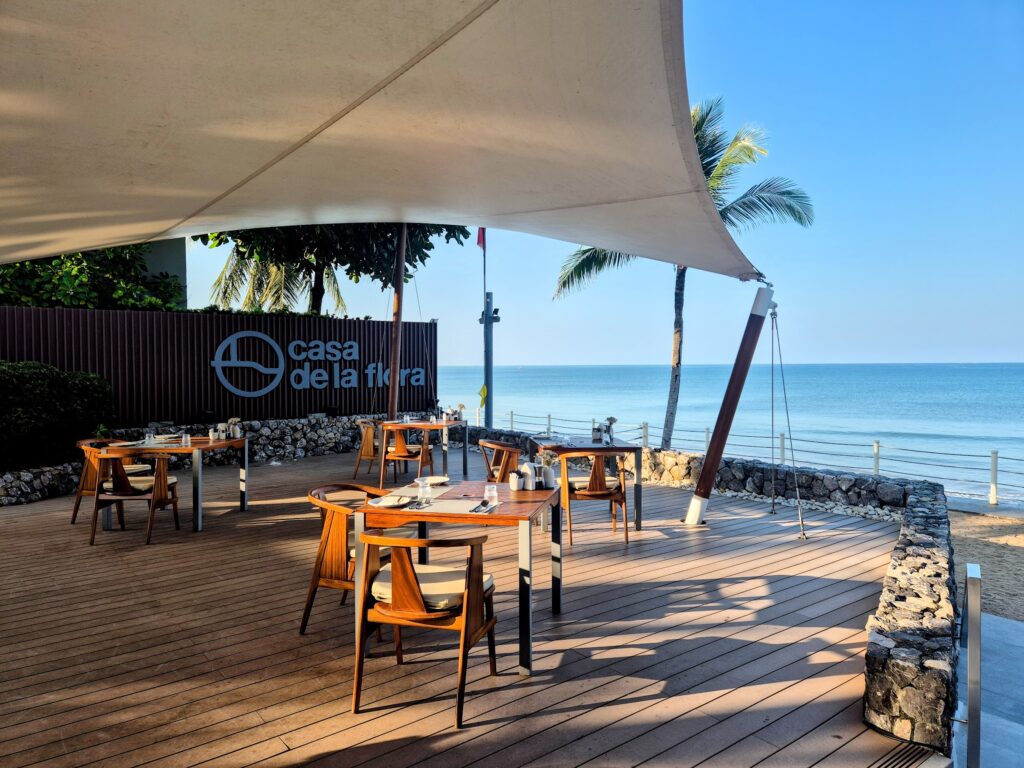
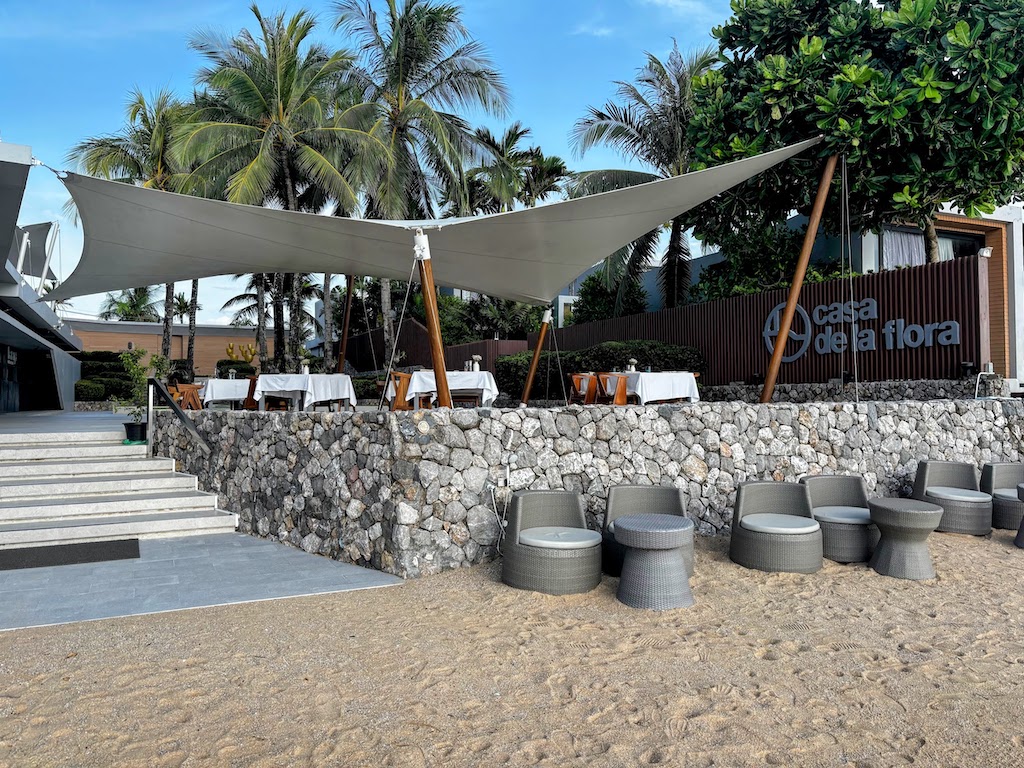
La Aranya sits right at the water’s edge, open to the breeze and the last light of the day, serving Thai food alongside international dishes. Hotel restaurants rarely justify the markup; La Aranya justifies the stay. It’s top notch.

There aren’t many better things than a long, leisurely hotel breakfast. Breakfast here is served à la carte until 2pm – a radical policy that we think more hotels should adopt.

No buffet, no chaotic steam trays: everything arrives cooked to order, and with lunch starting at midday, the kitchen turns ingredients over constantly. It shows in the freshness of the food.

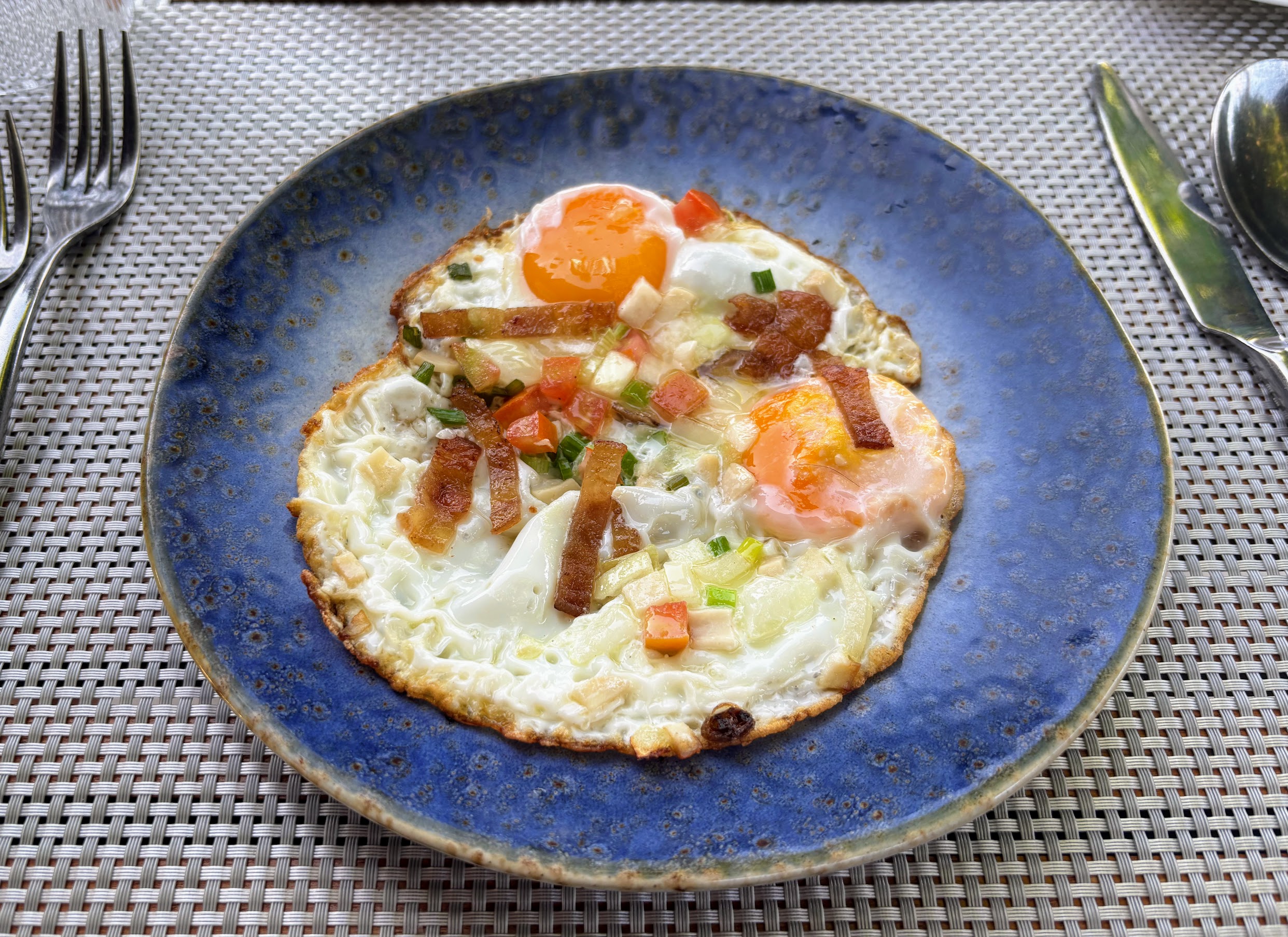
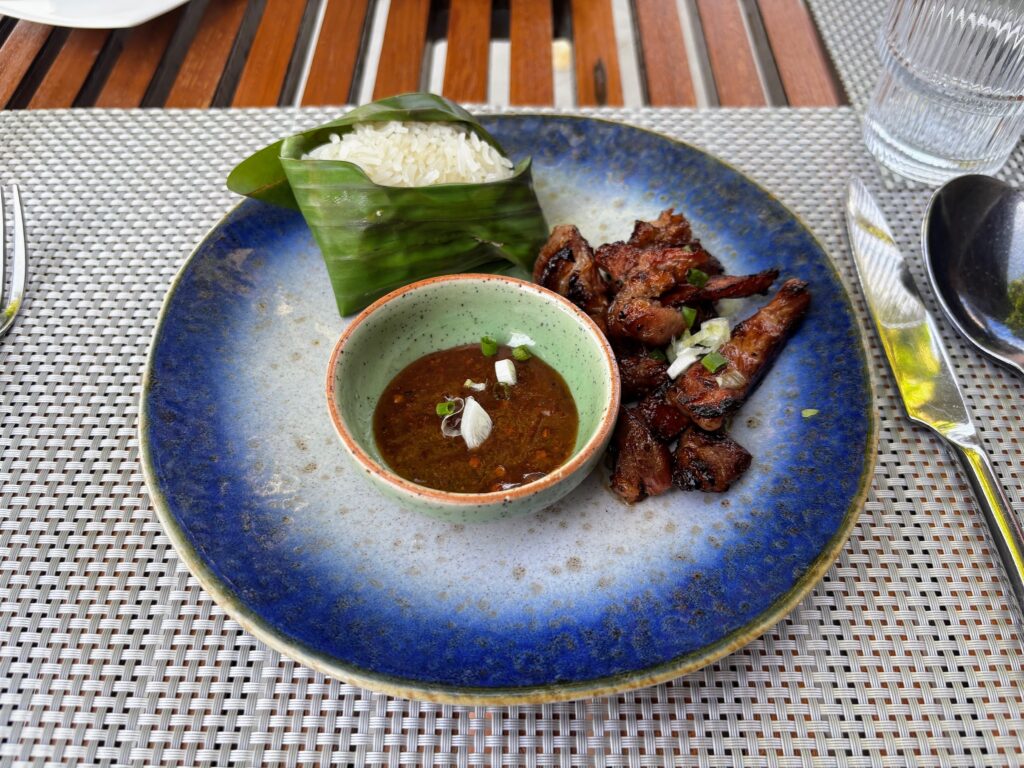
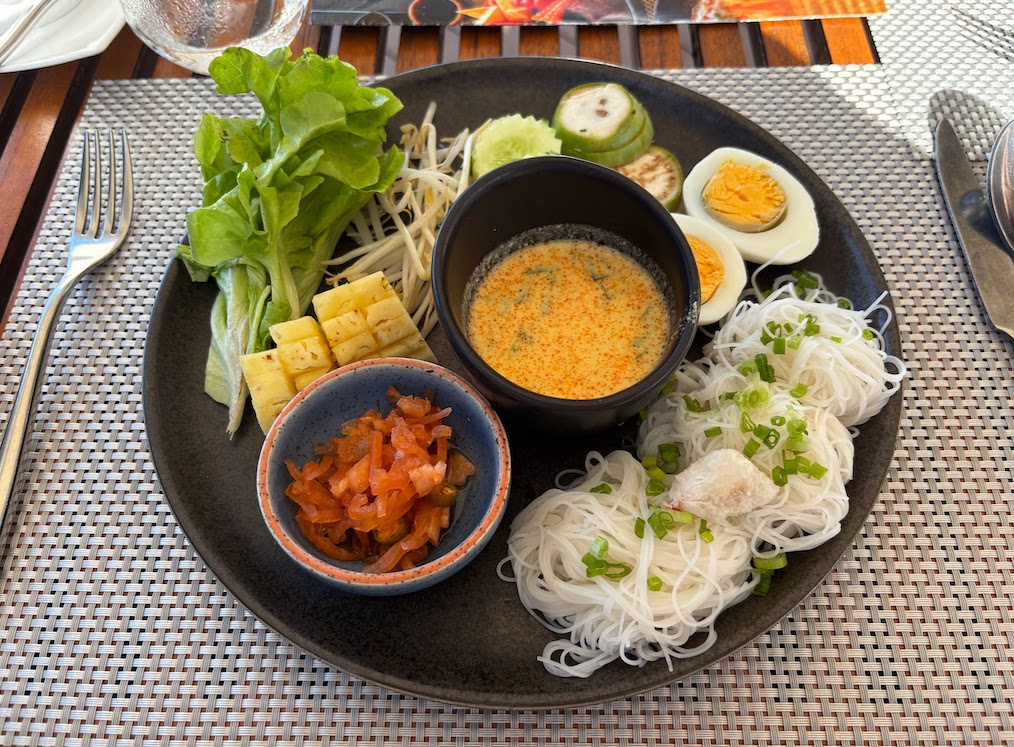
A waiter does the rounds with a basket of bread and pastries; there’s a good cheese and charcuterie selection alongside eggs and flamboyantly fluffy pancakes, but the Thai options are the real draw. The BBQ pork with sticky rice is not to be missed, nor is the kanom jeen – rice noodles in a southern Thai fish curry sauce that’s as typical a Phuket breakfast as it gets, and a good place to start for anyone unfamiliar with the cuisine. The unagi bowl, roasted eel over Japanese rice with shrimp roe and miso soup, is another highlight. Dishes are small so you can try more than one, just like at a buffet, but without any of the buffet’s logistical horrors.

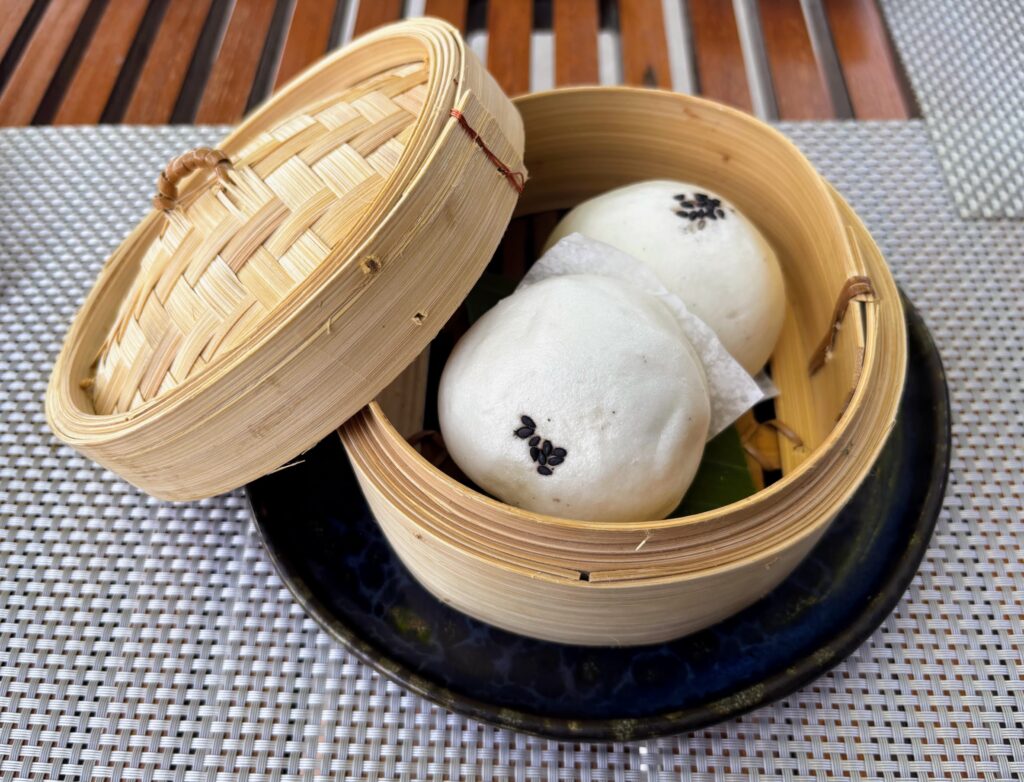
The daily specials are worth your attention: on our visit, the khao mun gai tod was delicious, and the crispy pork belly with Chinese dipping sauce was another option that looked good going by. A pan-seared foie gras with a blueberry reduction was less appealing at 9am, though some mad bastard next to us ordered two plates of it. Before you’re done, ask about the steamed sesame, chocolate and custard buns, which are sourced from a well-regarded tea shop in nearby Takua Pa.

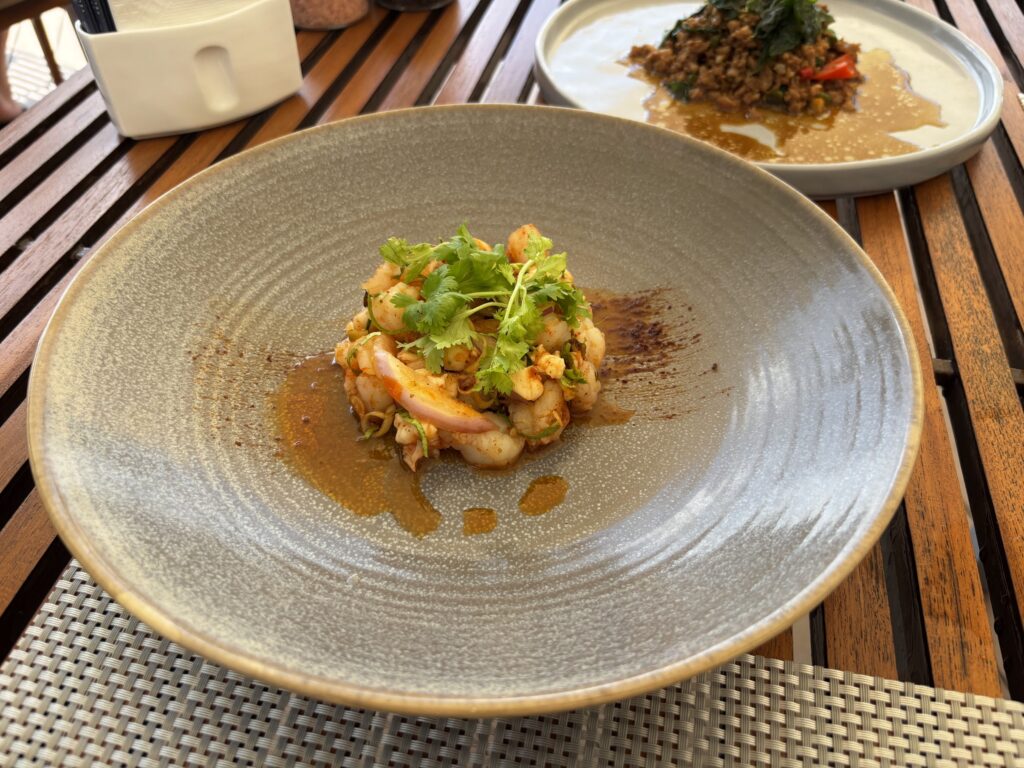
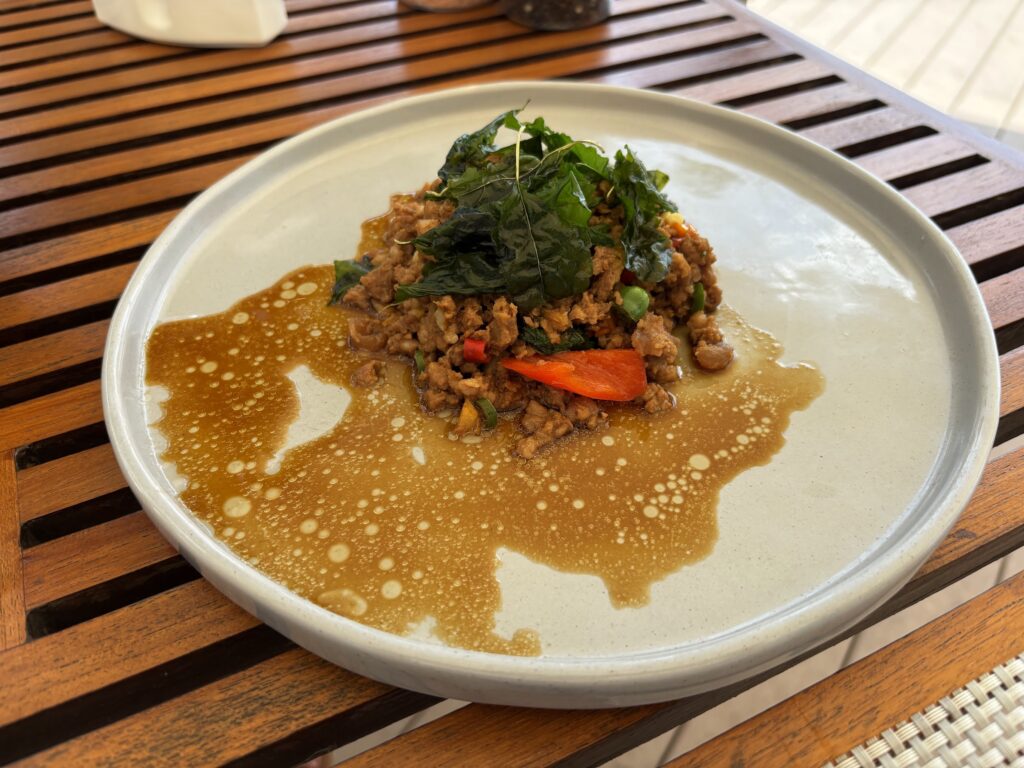
Lunch runs from midday, with a focus on fresh, organic ingredients that carries through into the evening. We had a mango salad and a pad krapow. Both beautifully presented and seasoned vigorously.

The register shifts to something more romantic in the evening. White tablecloths appear and the place settles into an intimate pace, bathed in amber light, the sunset doing its thing beyond the tables.

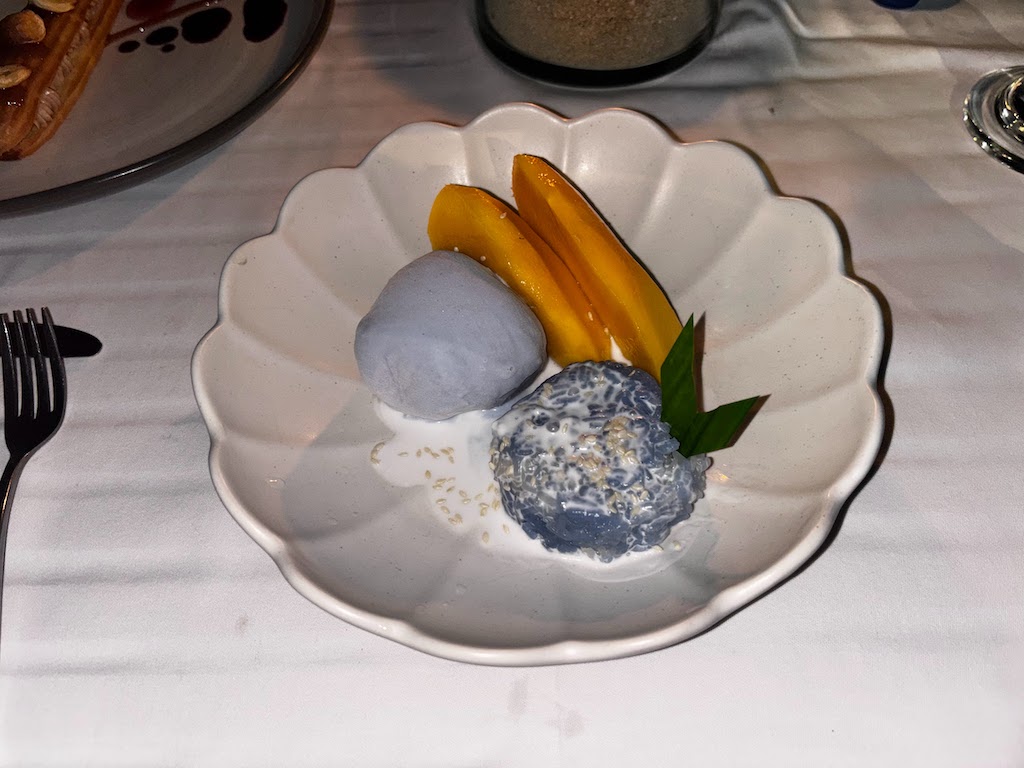
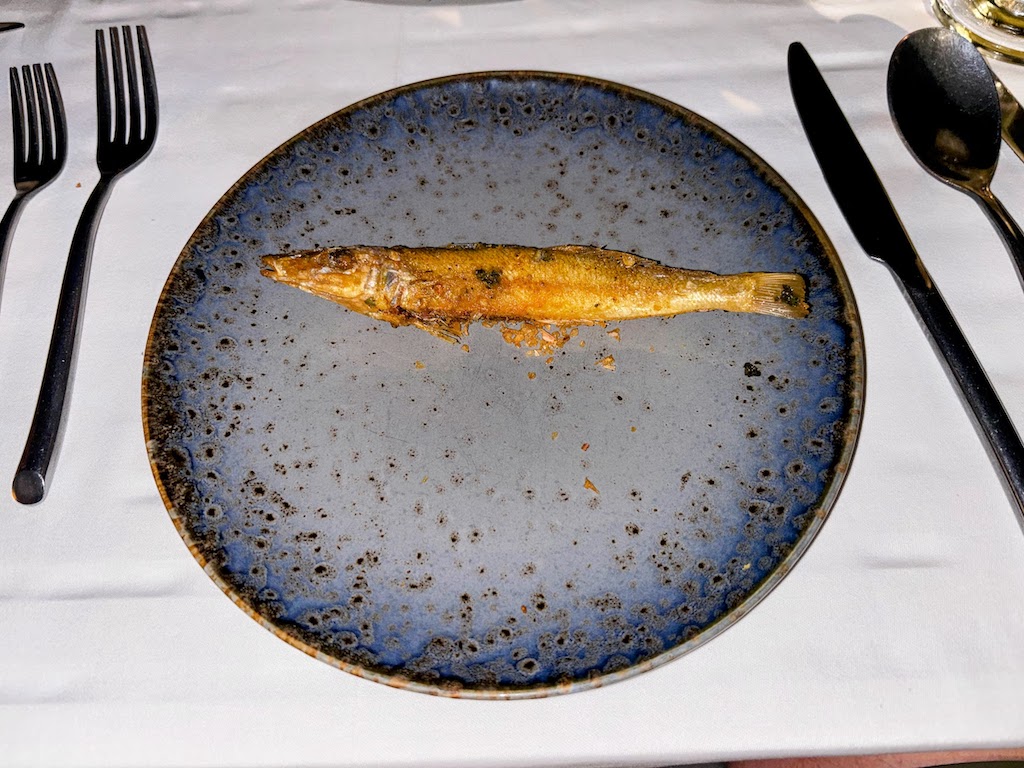
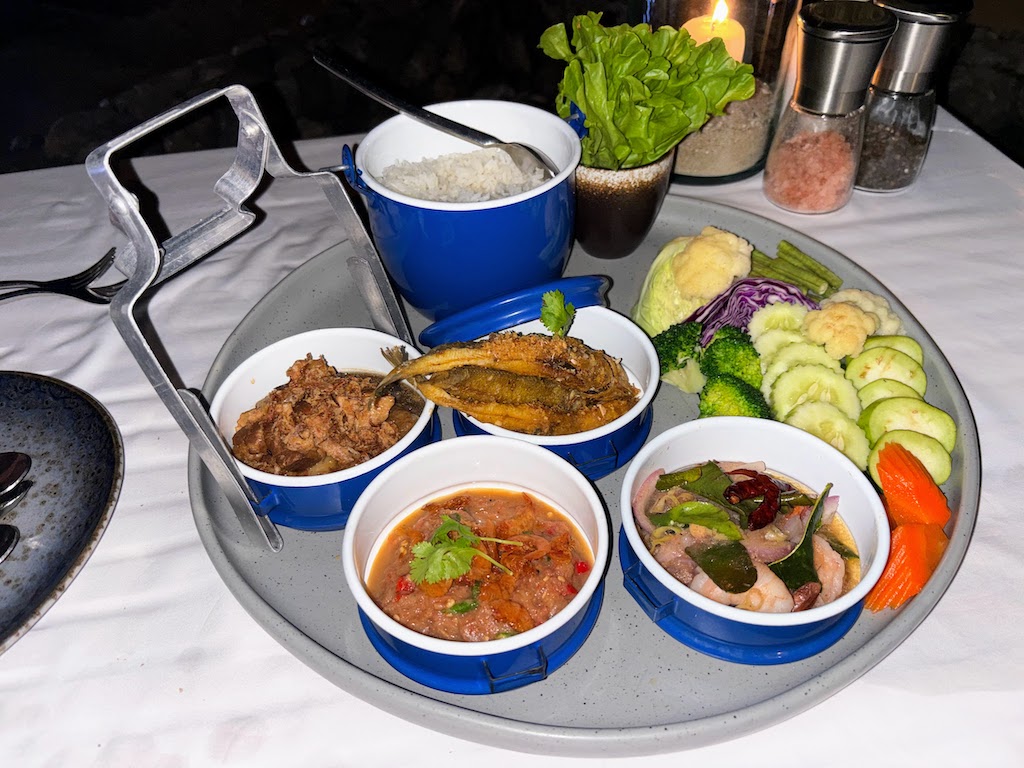
We noted earlier that the design of the hotel could be anywhere in the world. The dinner menu says otherwise. The Southern Thai set menus arrive in tiffin boxes, an approachable way to explore the local cuisine and understand what goes with what. Southern Thai food demands balance, and ordering à la carte risks a table that’s all sour or all sweet. The tiffin format does the balancing for you, and it works. We had nam prik goong sieb, a gloriously assertive relish, alongside crispy pla sai tod kanim, moo hong, the local favourite of slow-braised pork belly, and goong phad kapi. Conclude with a mango sticky rice, as is customary.

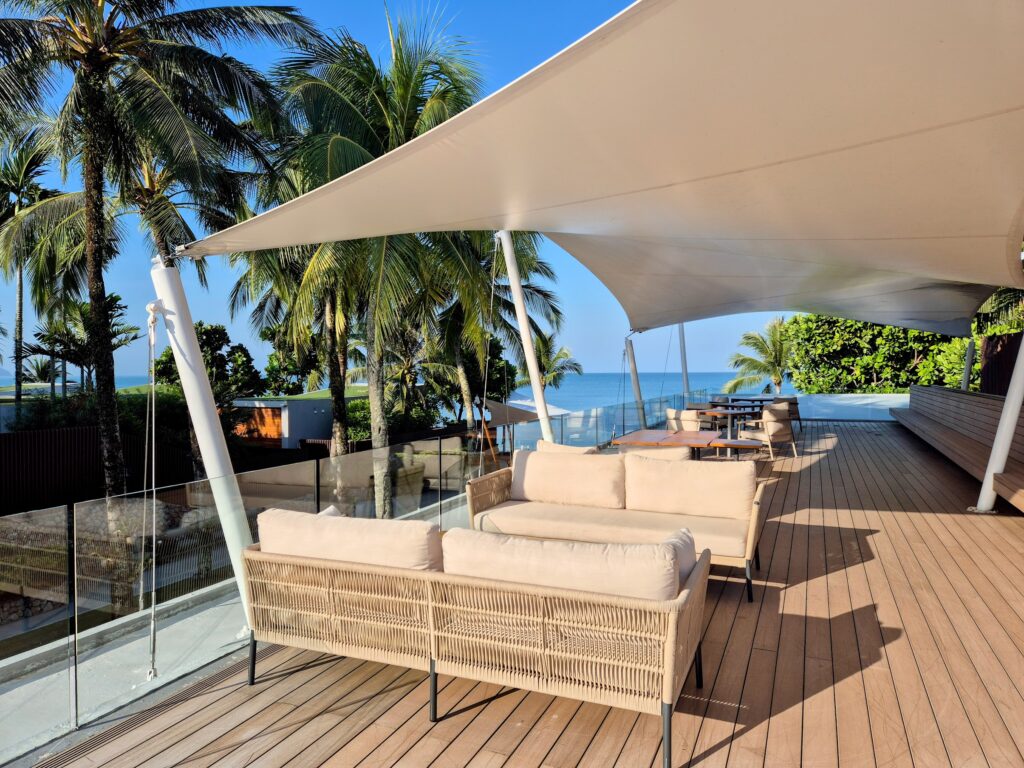
There are plenty of tub chairs in front of the restaurant where you can have an evening drink. Above, a rooftop lounge offers panoramic views of the ocean. The hotel calls it the check-in lounge, and if you arrive early while waiting for your room, there are few better places to be.

Ideal For…

Casa De La Flora is concrete, contemplative, and obsessive about the finer details. It suits those who notice them.

Couples after design-led seclusion. Private plunge pools, a complimentary minibar, and candlelit dinners at La Aranya make this one of the most romantic stays on the Andaman coast. It’s a grown-up resort without ever announcing itself as one.

Those who notice the details. The VaSLab architecture, TROP landscaping, Anon Pairot’s gold sculptures and Korakot Aromdee’s bamboo installations reward repeat looking. This is a place where the angles are deliberate and the sightlines are earned.

Keen diners who don’t want to leave the grounds. La Aranya’s à la carte breakfast runs until 2pm, the Southern Thai tiffin-box set menus at dinner are a masterclass in balance, and the steamed buns from Takua Pa are worth the trip alone.

A base for Phang Nga province. The Similan Islands departure pier is nearby, Takua Pa Old Town and its Sunday Walking Street a short drive north, and Khao Lak-Lam Ru National Park borders the resort area. The hotel offers special rates for Thailand residents, which makes return trips easier to justify.

It’s perhaps less suited to families with young children, despite the hotel welcoming them. The atmosphere is slow-paced and peaceful, the pools aren’t built for splashing, and the beach requires a degree of tidal awareness that toddlers are unlikely to respect.

Why Stay?

At Casa De La Flora you could easily spend an entire week drifting between your villa, the pool and the restaurant, and many guests do, returning year after year. It is easy to cement a connection to the hotel (pun intended).

If you lived in Thailand, this is the kind of place you would make a point of returning to for a couple of nights as part of a glorious weekend away, at least once a year. The design is confident enough to hold your attention across multiple stays, the restaurant good enough to anchor each day around mealtimes, and the setting quiet enough that the Andaman, rather than any programme of activities, sets the pace. Heaven, then.

Villas at Casa De La Flora start from around 8,000 THB (approximately £185) per night in low season, rising to around 16,000 THB (£370) in high. Rates include breakfast.

Address: Khuk Khak, 67 213, Takua Pa District, Phang Nga 82220, Thailand

Website: casadelaflora.com

Where To Eat The Best Bánh Mì In London

Last updated May 2026

Is the bánh mì the finest sandwich in the world

Though we wouldn’t want to make too definitive a proclamation (torta ahogada, we haven’t forgotten you!), it’s certainly almost always voted as one of the best

In 2022, the bánh mì was even added to Merriam-Webster’s Dictionary, pointing to its increasingly assured status in the conversation of the world’s great sarnies. “Dictionaries reflect how mainstream and how popular foods are,” Andrea Nguyen, author of The Banh Mi Handbook, told NBC. We couldn’t agree more.

A by-product of French colonialism, this Vietnamese sandwich is a cultural collision turned culinary world champ. But what makes the bánh mì so good? To quote Felicity Cloake; “The perfect sandwich has to have a contrast of textures and flavours”, and this is exactly what the finest of bánh mì achieves.

Its charm, we think, lies in the unique baguette used; a crisp and crunchy exterior, all without being toasted, forms the husk, with a soft crumb in the middle and plenty of space left for filling. It’s that crunch that makes a bánh mì pop!​

Then there’s the acidity of the pickled carrots and daikon, and the richness of pâté and mayo, the spring of the sausage, the fatty mouthfeel of the pork, all balanced out against the crunch of those pickles and rounded off with some fresh herbs. The result, as Andrea Nguyen puts it, is “a party in your mouth!”

From Hoxton to Hackney, Clapton and Clapham, London has no shortage of great Vietnamese eateries serving bánh mì to the masses. Here, we explore some of the best…

Keu, Soho, City, Shoreditch, Borough

Here at IDEAL we never get tired of bánh mì. Just like some people have a ham and cheese sandwich every day for lunch, day in, day out, we could enjoy this Vietnamese classic.

Variety doesn’t really matter that much to us when it comes to a bánh mì; just give it to us the way Auntie prefers. However, if variety did matter, then we would head to Keu, who have not one, not two, not three, but thirteen bánh mì options available.

Starting out in Shoreditch and now spread across four different locations in the capital, Keu’s popularity isn’t up for debate. A sister restaurant of Vietnamese stalwart Cay Tre, their stellar bánh mì making operation sees them serving some of the most exciting bánh mì outside of Vietnam, from the classic fillings of pate and pickles to the less traditional like their slow braised mackerel in caramelised fish sauce, all the way to their kimchi-filled bánh mì that comes with honey glazed pork.

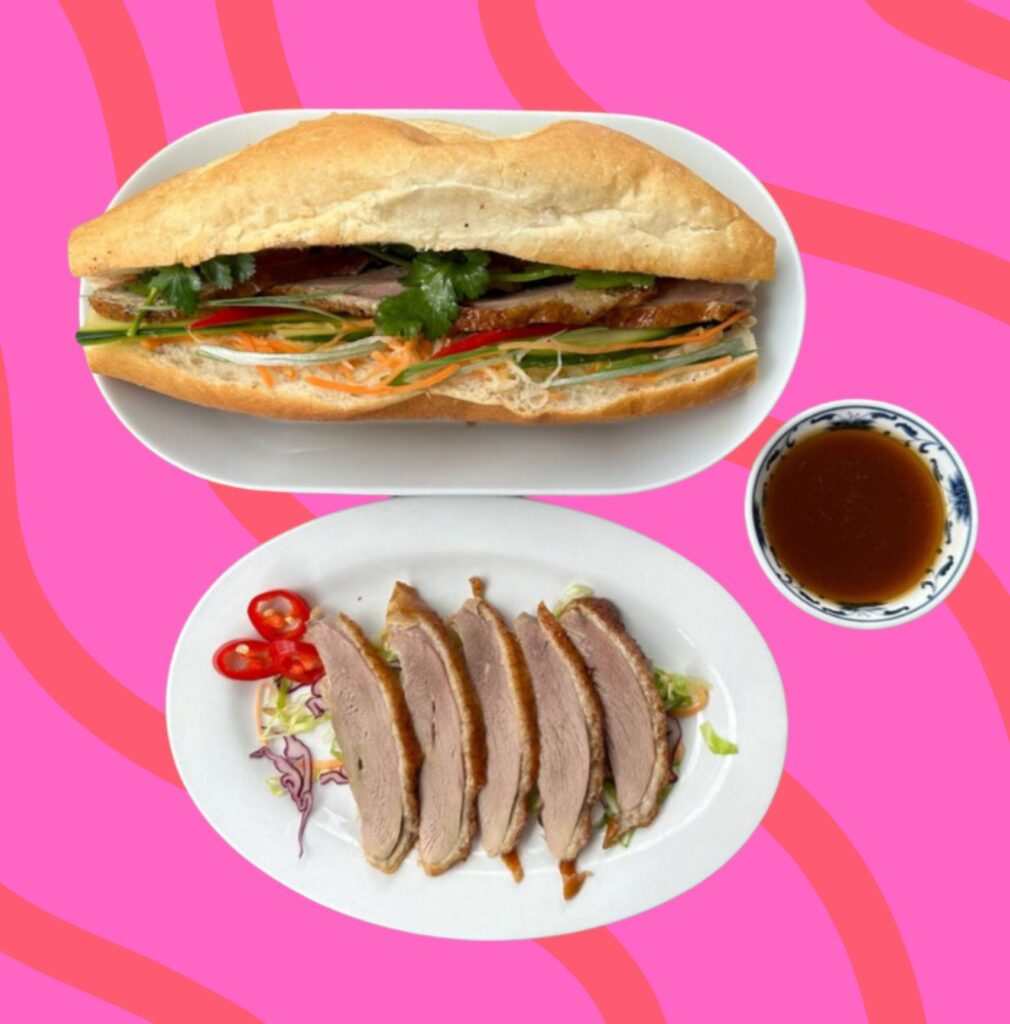
If you’re partial to a hoisin duck wrap for lunch from Pret or Mark’s & Spencer, then come here for the Cantonese roast duck bánh mì, which features a familiar, sticky hoisin sauce –  it’s just a million bread rolls better than those wraps you find on the high street. We’re also fans of their Hoi An deluxe bánh mì – the special Hoi An sauce which is made of pork gravy, five spice, butter and fermented chilies is something else. 

Website: banhmikeu.co.uk

Address: Soho, City, Shoreditch & Borough 

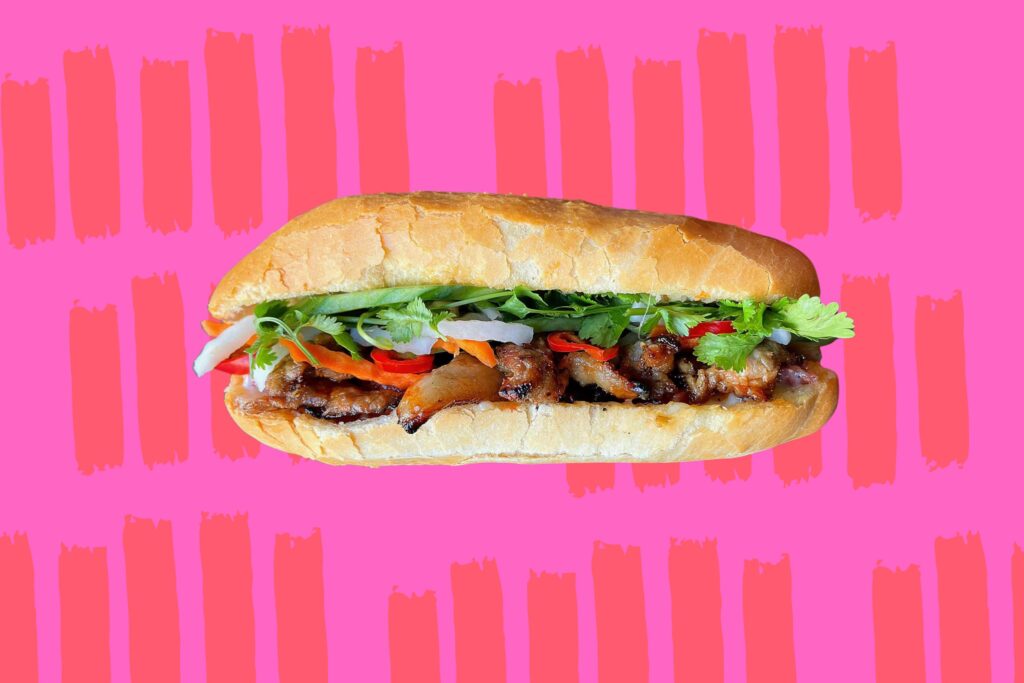
A selection of Bahn Mi from Keu (images via Keu Facebook Page)

Viet Caphe, Clapham

A bacon sarnie and a cup of Joe. A cappuccino and a cannoli fried in pork lard. A surprisingly delicious instant coffee dry rub for a loin of pork…

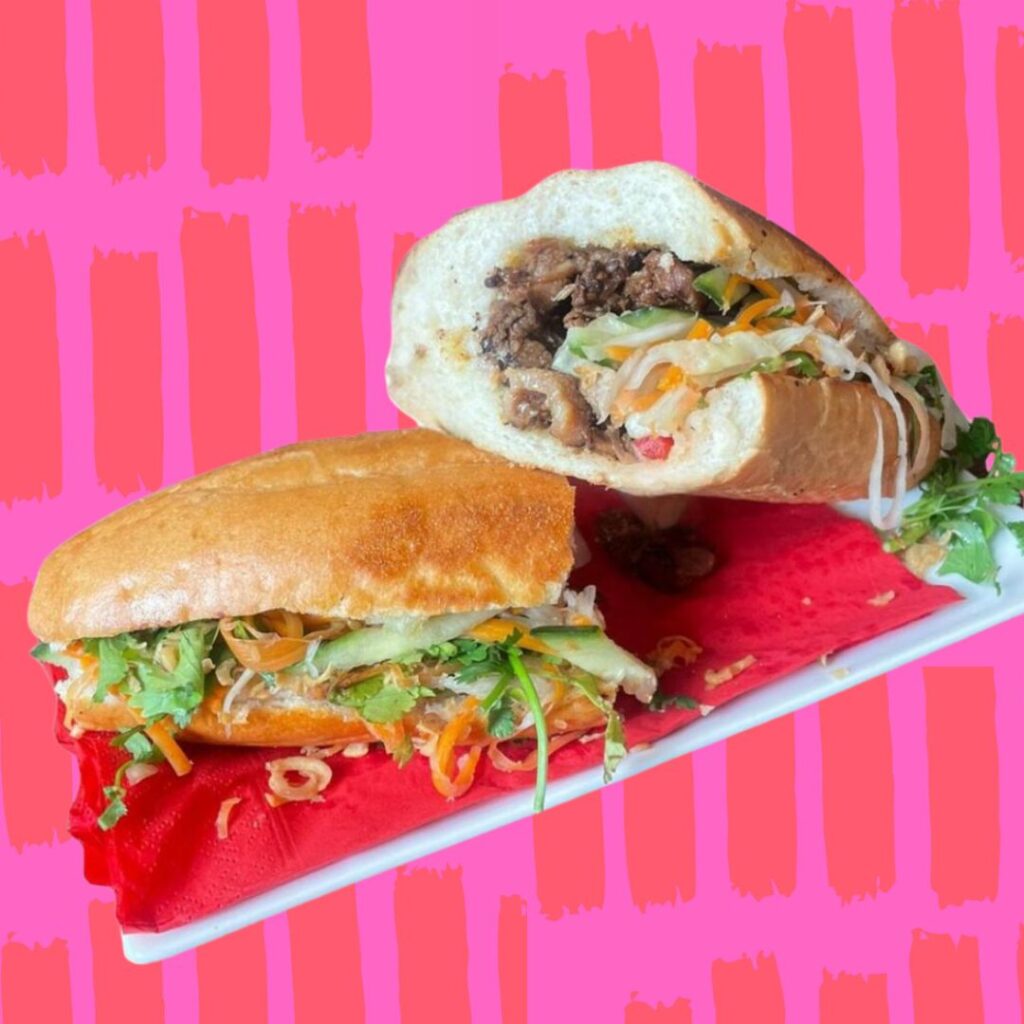
…Yep, coffee and pork is a match made in heaven, and so it is at Viet Caphe, just a five minute walk from Clapham Junction. A relative newcomer on our list, this place is already dishing up some of London’s best banh mi, with bread that’s just the right level of hollowed-out, a crust that crackles but doesn’t cut the roof of your mouth, and fillings that straddle fat and piquancy as only the very best banh mi can pull off.

It’s an inviting rundown of banh mi classics, primarily focused on the porkier side of things (though owner Kim assured us that the Caphe is slowly rolling out a few vegetarian and vegan options, too), with the crispy roast pork an absolute winner, all silky, unctuous mouthfeel punctuated by the usual house pickles and (here, not house) hot sauce.

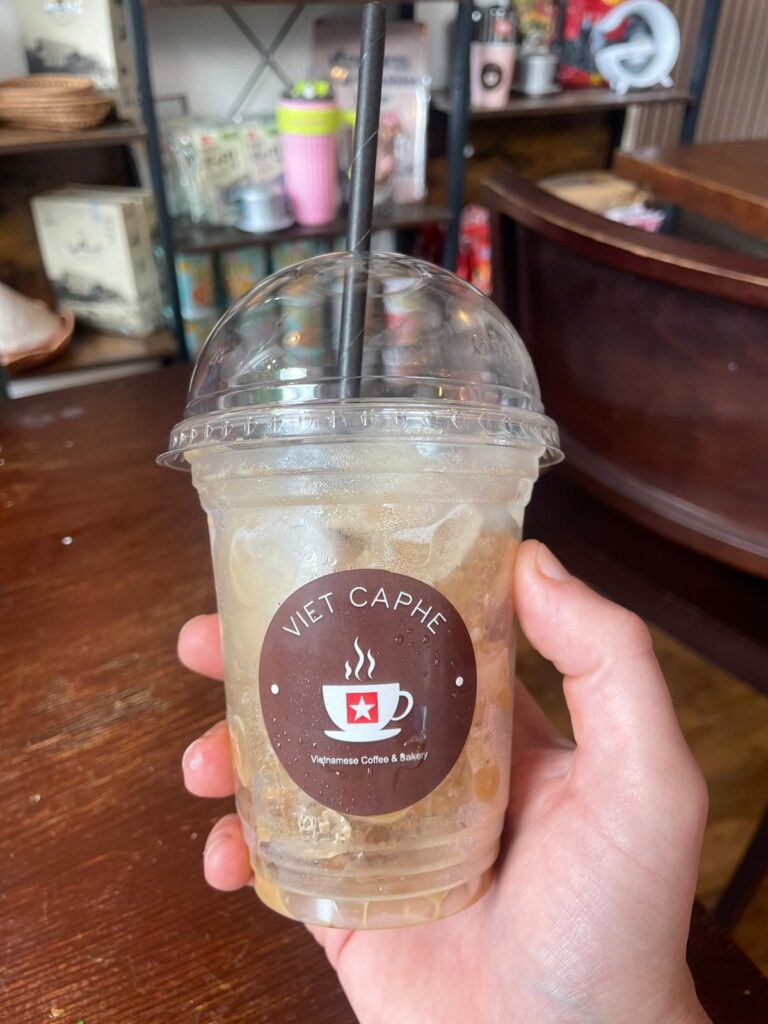
Pair it with a cup of on-the-money Vietnamese iced coffee with plenty of condensed milk (you can order by percentages of sweetness), and luxuriate in one of Battersea’s finest lunches.


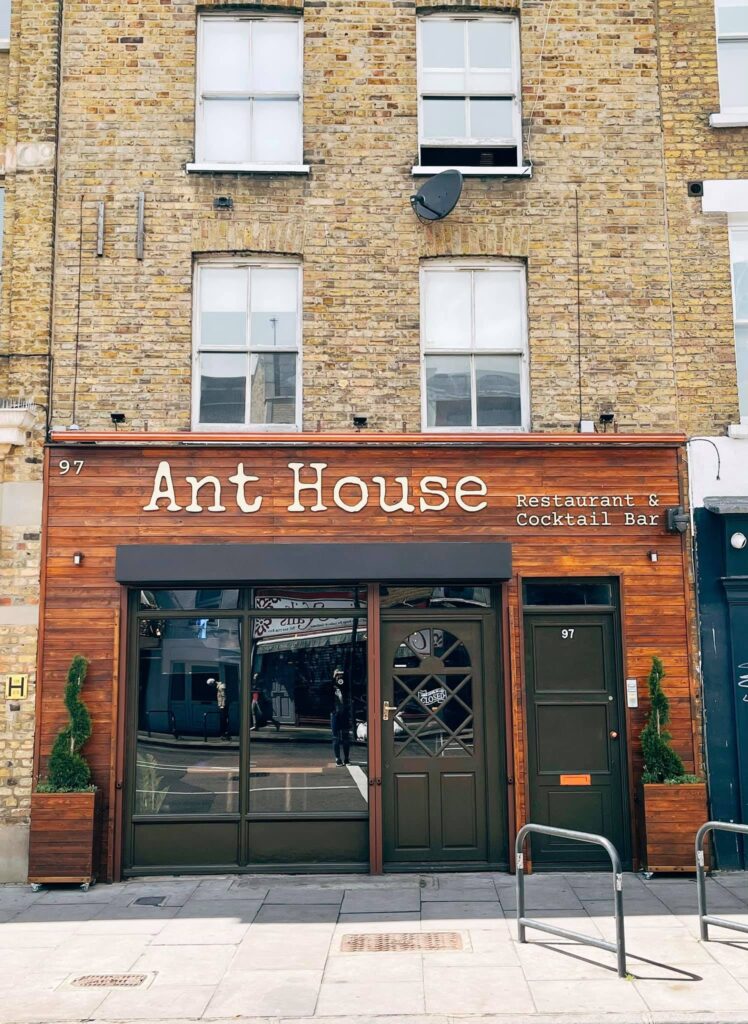
Ant House, Shoreditch

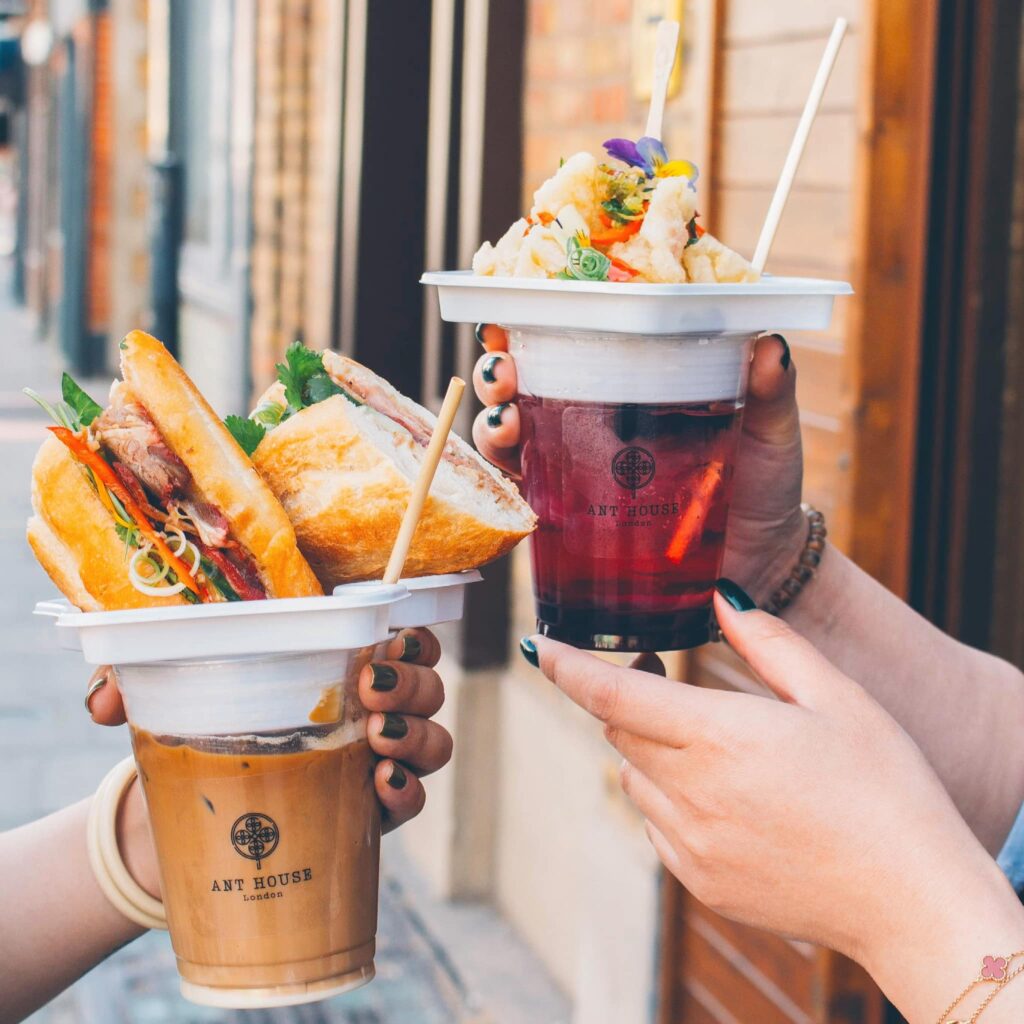
A good bánh mì baguette should have a light, crispy crust and airy texture, and this is exactly what you get at Ant House. As you bite into that crispy crust, a shower of crumbs falls into your lap, its smattering seemingly playing a little tune heralding the taste sensation to come. We’re thinking about making an ASMR video about this bánh mì – it’s that evocative!

Opened in 2021, Ant House is a relative newcomer to Kingsland Road’s Pho Mile, and this younger, hipper Vietnamese restaurant has a whole section of their menu devoted to bánh mì’s, offering five different types.  

You can’t go wrong with ‘The Ant House Classic Banh Mi’, which is pork heavy, just as one should be; think char siu pork, mortadella sausage, sliced pork belly, ham hock, chicken liver pate, and pork floss. It’s a meat lover’s dream, make no mistake. 

If you’re new to bánh mì, then you’re probably wondering how all these different cold cuts work together without the whole thing getting really heavy – they just do, and somehow, it doesn’t. A word of warning, though; it’s impossible not to end up with spicy sriracha on your trousers when you bite into this fully loaded classic. Exercise caution if you’re devouring one of these guys on your lunch break.

For the vegetarians and vegans in the banh-gang, the Ant House serves up an equally delicious meat-free ‘Banh Mi Chay’, which is filled with tofu, mushroom with a caramelised onion and garlic filling. One of the greatest things about tofu is its texture, and here it really shines with the ideal balance of crisp outer skin and a soft, wobbly interior. Yum.

Come to the Ant House for its lunch combo of bánh mì and lemon ice tea, and then stay for a delicious bowl of pho, followed by cocktails. You know you want to!

Address: 97 Kingsland Rd, London E2 8AG

Website: ant.house

BBQ pork Bahn Mi (image via Ant House’s Facebook Page)

Banh Mi Aha!, Holborn, Soho, Farringdon, City

Next up, we think it’s fair to say that Banh Mi Aha! nails the Vietnamese sandwich with its perfect proportion of vegetables to meat, and bread to filling ratio done just right.

We’re fans of the bo la lot inspired bánh mì here – the beef spicy, peppery and utterly moreish. Biting into one of these guys takes us right back to Saigon’s Co Giang street – home to a string of bo la lot restaurants – perched on a plastic stool tucking into a plate of these wraps. We’re equally enamoured with their heo quay bánh mì, which sees fatty chunks of crispy, crackled pork drizzled with hoisin sauce. Ngon!

Banh Mi Aha! have expanded since we first featured them, with branches now open in Soho, Farringdon and the City alongside the original Holborn location. The quality hasn’t dipped with the growth; if anything, the queues at Lamb’s Conduit Street speak for themselves.

Address: 39 Lamb’s Conduit St, London WC1N 3NG

Website: banhmiaha.co.uk

Read: Where to eat the best street food in Ho Chi Minh City


Lai Rai, Peckham

The newest addition to our list comes courtesy of Lai Rai, the Vietnamese restaurant that opened on Rye Lane in summer 2025 from the Bánh Bánh family and the Vinaxoa snack collective.

Bánh mì is the daytime business here, served between noon and 3pm Wednesday to Sunday, and the kitchen takes the bread seriously; baguettes are baked in-house and brought out with a choice of glaze – plain, spicy or, intriguingly, golden syrup – before being filled with cucumber, pickle, spring onion, coriander, fresh chilli and sauce.

There are three to choose from, all priced at £12. The thịt kho is the one that does the heavy work; braised pork belly with a yolk sauce that adds richness without tipping into the territory of those heavier, mayo-soaked numbers, plus tangy pickled mustard greens that cut through the fat with a sharper, more bracing acidity than the usual carrot-and-daikon combo. The mustard greens are a clever switch, a more Southern Vietnamese touch that gives the whole thing real character.

The gà nướng pairs roast chicken thigh with a pork and chicken liver pâté and house-made sriracha, which is a properly grown-up combination; the pâté brings a deep, slightly funky richness that elevates the chicken from being merely the safe option. For the veggies, the chả chay is a seitan and mushroom cold-cut affair with tofu whip and miso kho quẹt, and is one of the more thoughtful vegan bánh mì in the city; the miso adds a savoury depth that vegan iterations sometimes lack.

Wash it down with one of Lai Rai’s serious Vietnamese coffees; the cà phê lai, which cuts coffee with jasmine tea for a self-described ‘double buzz’, is the in-house favourite, while the cà phê phở, a daring concoction of coffee, pho spice and sparkling water, is the one you’ll be talking about later. A lovely way to spend a Saturday lunchtime in SE15.

Address181 Rye Ln, London SE15 4TP

Websitelairai.london


Viet Cafe, Camberwell

The pho at Viet Cafe is one of Camberwell’s best hangover cures – though it’s only available on Saturdays until it sells out, which is pretty fast. However, the bánh mì is not to be sniffed at either. 

Infact, Viet Cafe is first and foremost known to most as a sandwich joint; alongside the blackboard of bánh mì sandwiches and Vietnamese dishes, it also sells ‘Western’ fillings. Obviously, it’s the former we’re here to talk about today. 

Sitting alongside the usual suspects filled with Vietnamese cold cuts you’ll find some more unusual twists on the traditional bánh mì sandwich. The grilled chicken satay baguette here offers a fantastic fusion of South East Asian flavours while the bánh mì filled with grilled, lime-marinated tiger prawns brings a satisfying textural bounce and zesty, zingy alternative to the usual fatty pork options.

A word of warning, the Viet Cafe is a very popular lunch time destination, especially with the staff from King’s College Hospital, and with the bánh mì here filled fresh to order, just as it should be, you may well be waiting a while to get your fix.

Address: 75 Denmark Hill, London SE5 8RS

Website: vietcafecamberwell.com


Image © galitskaya via from Getty Images via Canva

An’s Oriental Supermarket, Holloway

London has a spectacular range of Southeast Asian supermarkets thanks to the rich and diverse communities from the region who have settled in the capital. Perhaps our favourite place to shop in all of the city is at An’s Oriental Supermarket on Holloway Road, which not only sells groceries but is also a foodie hotspot for takeout items like pho, steamed buns and, of course, bánh mì.

It’s a classic version, with a crisp exterior, and a centre that feels almost hollowed out before being filled with peppery pate, pig’s head terrine, pickles, coriander and spicy sauce. There’s even a little sweet Chinese sausage thrown in for good measure; a nice touch.

Address: 599 Holloway Rd, Archway, London N19 4DJ 

Website: An’s Oriental Supermarket – Asian Grocery Store (business.site) 


Hai Café, Clapton

The wonderful thing about a bánh mì is that you can eat them at any time of day, equally at home as a ‘grab & go’ lunch as they are for dinner or as a late night snack. Perhaps the most satisfying iteration, however, is for a leisurely brekkie alongside a cafe nau da.

You can only enjoy your banh mi for dinner at Hai Café, which occupies a small spot in Clapton with only a handful of tables and even tighter opening hours (just 6 to 10pm, Thursday to Saturday). Just like the shoe-box sized cafe itself, the menu is a compact affair, with everything on it made & marinated in-house from scratch, whether that’s the grilled red pork, punchy pate, or piquant pickles. 

The specials board, based on whatever Mama Hai feels like making for that week, is where it’s at, and if the cafe is doing Hai’s famous lemongrass chicken, then order it. Filled with slices of fragrant, juicy lemongrass chicken, it’s a light and bright affair. 

Interestingly, all their bánh mì’s are served with crushed black sesame seeds; not necessarily a purist touch, but one which offers a rich and nutty element and, in our eyes, only elevates the taste of the bread, making you sit up and think.

Address: 120b Lower Clapton Rd, Lower Clapton, London E5 0QR, United Kingdom

Website: hai-cafe.com


Banh Mi Hoi-An, Hackney

You’ve probably heard that, according to Anthony Bourdain, the world’s best bánh mì is in Hoi An, over at Bánh Mì Phượng. We’ve eaten at this particular baguette-slinger over in Central Vietnam, and it’s certainly a fully-fledged affair, absolutely stuffed with cold cuts, sauces and several sauces. 

For a similarly stacked sarnie, we’re finishing our tour of London’s best bánh mì in Hackney, at Bánh Mì Hội-An. It’s a particularly fine pate here, rasping and loosely knitted, with a rust-coloured tinge that suggests a more gentle cooking on the liver than the usual hard steaming a Vietnamese pate goes through. That, or a little red food colouring has been added, as is popular in Hanoi, Ho Chi Minh City and beyond.

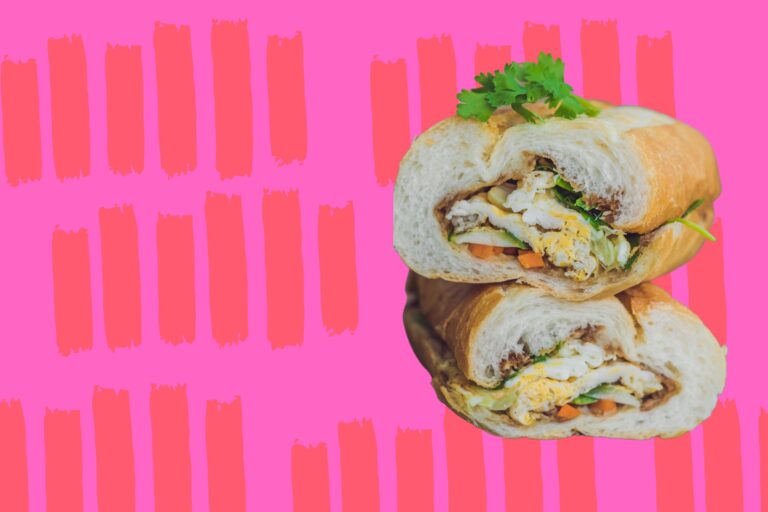
For brekky, we’re big fans of the bánh mì trứng here, which sees a medium-set, rolled omelette replace the length and breadth of pork cold cuts. Should you be in this thing for reasons of taste not dietary decisions, you might want to request that they keep the pate present. 

Address: 242 Graham Rd, London E8 1BP, United Kingdom

Website: Banh Mi Hoi-An Vietnamese Street Food in London | London | Facebook

And with that, we’re taking a virtual trip to Vietnam next, for a foodie tour of the capital Hanoi. Care to join us?

8 Ways To Keep Your Home Cool This Summer

Us Brits are an odd bunch. We long for sun for the majority of the year, which is spent in gloom and despair, but as soon as it’s T-shirt weather, we’re moaning that it’s too hot.

The current heatwave gripping the UK has rather changed that flippant perception, don’t you think? With record breaking temperatures this week predicted to cause carnage across the country and concern about the growing climate catastrophe, we’re suddenly realising that the UK simply isn’t well-equipped for extreme weather.

Aside from the melting railway tracks, this is perhaps most keenly felt in our homes, which are neither very good at keeping heat in or out. If you’re looking to make sure yours is hospitable the next time the mercury is tested, then here are 8 ways to keep your home cool this summer.

Improve Energy Efficiency

To keep your home cool, you first need to keep the hot air out. Whilst it’s more common to associate triple-glazed windows, improved insulation and sealing the cracks around windows and doors with keeping the warm air in during winter, these changes can also help keep your home cooler in summer.

Not only do these home improvements keep the sun out during a heatwave, but they’ll also reduce your property’s carbon footprint, which feels pretty pressing right about now. Check out our guide to some simple hacks to make your home more energy efficient here.

Windows & Window Coverings

Speaking of windows, and while it may be tempting to open them as wide as they can go when it’s hot outside, this isn’t actually advisable if you’re trying to keep temperatures down. If the temperature outside your home is warmer than inside, opening the windows will only let hot air in, making your home an even more uncomfortable environment to spend time in. 

If you have south-facing windows, in particular, it’s important to block any direct sunlight that tries to shine its way through during the day. We’re not saying cultivate a crack den energy and spend your days in the dark – natural light is a wonderful thing, of course – but it’s wise to keep your windows shut and curtains or blinds firmly drawn unless you want to end up sleeping in a sauna by the time it reaches the end of the day!

Direct sunlight that’s left to stream into a room might look gorgeous, sure, but it can hugely increase the temperature and even cause your home’s furnishings to fade in colour. If you’re keen on managing the amount of light you let in with precision, then made to measure window shutters are a wise investment.

If there is a slight breeze in the air on a hot day and opening a window seems like a good option, try to make sure windows are open at opposite ends of the house so the air can circulate through your home and cause a nice cooling draft. 

Finally, open your windows before you go to bed to make the most of the natural drop in temperature at night time. 

Skylights & Ventilation

If you’ve got a flat-roofed kitchen extension – and given the number built in the UK over the last decade, there’s half a chance you have – you’re probably familiar with the greenhouse effect it produces in summer. All that roof space soaking up direct sun, nowhere for the heat to go, and suddenly the room you extended to enjoy is the one you’re avoiding.

A ventilating skylight can change the indoor climate of that kind of space dramatically. Hot air rises, and a skylight that opens at the highest point of a room gives it somewhere to go, creating a natural chimney effect that draws cooler air up from below and pushes the warm stuff out. It’s passive, silent, and unlike a fan or portable AC unit, costs nothing to run once it’s in.

The key word is ventilating. A fixed pane will give you light but won’t do anything for airflow or temperature control. If you’re considering the investment, buy flat roof skylights from a reputable supplier and make sure the model you’re choosing actually opens. Paired with the cross-ventilation trick mentioned above — windows open at opposite ends of the house — a well-placed rooflight can meaningfully improve how your home handles heat without adding to your energy bills.

Fan Out

If an AC unit is a little out of your price range for the time being, then keep cool with a fan. A ceiling fan is, of course, functional, moving air around the room and making things less stuffy, as well as offering a cooling breeze on warmer nights. But it also brings tropical chic to a room in both its appearance and sound. What’s more, if you’re struggling to sleep in summer, the hypnotic groove can help lull you off into slumber. Many ceiling fans also double up as lights.

Electric fans come in all sorts of shapes these days; consider a desk/table fan which are designed for personal cooling and are ideal for sitting atop a desk or table top. Pedestal fans, which sit on an adjustable stand are great for circulating air throughout the room. Or, tower fans are perfect for small rooms as they have tall narrow bodies.

Moreover, they typically have more features than other types of fans and do a better job of cooling down the entire room. They do, however, have a higher price tag to match.

Image by Ross Helen Via Canva

Breathable Bedding

There’s nothing worse than getting into bed and immediately feeling sticky and stressed about getting to sleep in the heat. While a fan can definitely help, you don’t want to become reliant on one being switched on all night as this can cause coughs to occur and will ramp up your electricity bills, too.

Getting some summer bedding can be a huge help and stop you from dreading bedtime and the restless slog before eventual, snatched sleep. Think cotton, linen and other similar breathable fabrics that are naturally drier and cooler on the skin. A high-thread-count might look good but when it comes to getting in bed when it’s hot, but you want a low-thread count and your fabric to be as thin as possible for cook, comfortable sleep. 

Summer Cooking

When it comes to cooking in the summer months, the types of meals you eat can have an effect on the temperature of your home and cause the environment to heat up for a number of hours if you’re slow roasting or doing lots of stovetop cooking.

To avoid overheating, adapt your cooking for the summer months and opt for lighter meals that don’t involve using the oven. Instead of the usual Sunday roast, why not put the effort into a delicious summer barbecue or even a fresh salad? The lighter meals will have you feeling lighter on your feet, too.

Insulation

Wall and loft insulation is most commonly associated with keeping our homes warm during the winter and preventing hot air from escaping, but actually, it plays a key role during hot summers too.

Insulation can help to keep the hot air out and allow you to cool your house down as much as is possible. Sometimes during particularly warm spells during the Great British Summer, we realise our homes aren’t as well equipped as we’d like to deal with the heat. Insulation is one way of mitigating this.

Lighting & Appliances

You might not realise it, but your electrical appliances and the lighting around your home can give off a significant amount of heat. Try to only use lights when necessary and always turn them off when you’re out of the house or in the garden to save energy but also reduce the amount of heat energy produced. On top of this, be aware of which appliances are switched on. Even charging your phone overnight can cause the temperature in your room to increase making it worth keeping your electrical usage in mind. 

The Bottom Line

The UK’s housing stock was built to keep warmth in, not out, and every heatwave makes that more obvious. The good news is that most of the fixes here are straightforward, affordable, and don’t require ripping your home apart.

A few smart changes to how you manage airflow, light and insulation can make a real difference to how comfortable your home feels when the temperature climbs, and given the direction things are heading, that’s an investment worth making sooner rather than later.

Where To Eat Near Tottenham Court Road: The Best Restaurants

Last updated May 2026

With a shiny new stop on the Elizabeth Line cementing its status as a TFL headlining act, Tottenham Court Road is now the eminent focal point for those wanting easy access to Soho, Covent Garden and Fitzrovia.

But heavy is the head that wears the crown. Peckish passengers, starving shoppers and hungry day-trippers (yep, alliteration has failed us there) might just find that Tottenham Court Road station is a victim of its own success in terms of decent options of where to eat nearby. 

Instead, leave the station blinking into the light, and you’ll be met with a string of Burger Kings, itsus, Le Pain Quotidiens and LEONs. At least if you’re after a big bag of American Candy with a side of tax fraud, you’ll be more than adequately served.

That’s not to say there aren’t fantastic places to eat within a rock’s throw of Tottenham Court Road Station; you just have to know where to look. We’ve done that looking for you; here’s where to eat near Tottenham Court Road and the best restaurants near its station.

Akoko, Berners Street

Ideal for trying one of London’s most exciting, thought-provoking tasting menus…

Just a stone’s throw away from Tottenham Court Road Station, Akoko offers a full tasting menu that showcases some of the very best of West African cuisine in the capital. This Michelin-starred restaurant is the result of years of hard work by founder Aji Akokomi and, more recently, executive chef Mutaro Balde, who have poured their hearts into creating a dining experience that honours tradition while pushing the boundaries of culinary creativity. 

Akokomi has said that his aim in the city is to “change the perception of African food as we know it”, and it feels like Akoko is going from strength to strength, shedding its early, inevitable comparisons to Ikoyi and growing into a stellar culinary force in its own right (with a tasting menu a third of the price!). 

The dining room itself is one of the most tasteful, calming places you’ll ever have the pleasure of spending a couple of hours in, all mahogany and terracotta shades, and gorgeous ceramics inspired by acclaimed Nigerian potter Ladi Kwali that you’d be shit scared of chipping if you didn’t feel so soothed by the space. 

Art by contemporary Nigerian artist Niyi Olagunju hangs on the wall, and there’s a pleasingly reverberant buzz for a place of this calibre, the enveloping smell of smoke greeting you at the door before the suave service shows you to your seat. Once installed, you might be tempted to skip the wine (the ‘cheapest’ bottle here tops £60) and instead order a cocktail or two.

At Akoko, the ethos is all about blending innovation with live fire cooking, umami, and a broad range of spices. The chefs expertly craft a diverse range of dishes using the freshest seasonal British ingredients paired with African spices, resulting in a culturally resonant and distinctly exceptional dining experience. 

Nestled in one of those gorgeous bowls, the moi moi with mackerel and a sweet, spicy vatapá is extraordinary, the moi moi itself as smooth as silk but with that all-important bounce, the usual stew here a vibrant orange puree, rich with coconut milk and boasting real depth via ground peanuts and cashews. It’s magic, possessing almost laughable depth and more layers than a metamorphic rock. That’s just one course of a ten-strong tasting menu that will set you back £130 – not appaling value in this part of town. 

There’s also a shorter lunch menu, for £65, which builds to a crescendo of braised, pressed short rib, and, of course, a smokey, sublime jollof rice. Whichever way you play it, end with Akoko’s take on the Old Fashioned, here flavoured with plantain and feeling so right under the dimmed lights of the dining room, and reflect on a thoughtful and ultimately delicious evening at one of London’s hottest new restaurants.

Address: 21 Berners St, London W1T 3LP

Website: akoko.co.uk


Chishuru, Great Titchfield Street

Ideal for a taste of refined yet traditional Modern African cuisine in Central London…

There really is one restaurant that stands out as, not only one of the best places to eat near Tottenham Court Road, but arguably our favourite restaurant opening of recent times in London; chef Joké Bakare’s Chishuru.

Open for just three years in its current guise, Chishuru has already won a Michelin-star for its modern take on West African cuisine, making Bakare the first black female chef in the UK to earn this prestigious accolade. It’s richly, royally deserved, and testament to a menu of complex, creative, deeply satisfying dishes.

The name ‘Chishuru’ itself means “the hush that descends when you’re enjoying a meal”, and whilst the compact dining room here certainly isn’t suspended in silent reverence, there’s an agreeably laid back vibe to proceedings, with service attentive but not overbearing, all of which helps focus fall on Bakare’s extraordinary cooking. 

Assertive but perfectly balanced spicing – not only from chilli but a whole host of peppers, some rasping, some floral – is the narrative thread that ties the whole thing together. Starting with rice and coconut balls stuffed with a heady tangle of braised mutton and lightened with a taut green chilli sauce, and ending with a final savoury dish of grilled mutton cutlet with uziza seed sauce, there’s an almost poetic circular nature to the menu, that uziza seed sauce something of a callback to the uziza leaves that have graced a perfectly poised pepper soup from earlier in the meal. The everpresent ‘side plate’ of jollof rice, grilled plantain and house pickles help things feel even more cohesive.

There’s no danger of going off-piste in your ordering, mind. Chishuru is a set menu only affair, a journey through Igbo, Hausa, and Yoruba cuisines priced at £105 for dinner, and £55 for lunch. That, my friends, would be a bargain anywhere in the capital, but for somewhere so central, it represents a serious steal, and kept commendably the same price for the best part of a year now, all in the face or rising inflation.

There was also a wine pairing available for £68 (again, decent value in this part of town) the last time we ate here, which is a smart move, as these dishes boast a complexity that requires careful complementing. A pre-theatre menu is now also available Monday to Thursday between 5:30pm and 6pm, offering a slightly condensed version of the dinner menu for £65 per person, for those heading on to a show. Or, you know, for those just looking for a fine dinner deal. You don’t actually have to be heading on to a show, do you?

Arguably our favourite restaurant in London, Chishuru is the place to eat near Tottenham Court Road. Do remember to book in advance – getting a primetime table is becoming increasingly difficult. Not that we’re complaining; there’s nowhere more deserving.

Address: 3 Great Titchfield St., London W1W 8AX

Website: chishuru.com


Carousel, Charlotte Street

Ideal for an ever-changing line-up of the best and brightest chefs from across the globe…

If you’ve already eaten the length and breadth of Tottenham Court Road and are feeling somewhat uninspired, then perhaps the ever rotating cast of chefs and cuisines at Carousel will have you returning to dine in Central London again?

A unique dining concept on the eastern outskirts of Marylebone, Carousel is part restaurant, part creative hub. Each week, from Tuesday to Saturday, a new guest chef takes over the kitchen, with the restaurant introducing some of the brightest young talents from across the world to the hungry punters of Charlotte Street. Over 350 chefs from more than 50 countries have cooked here and counting.

The lineup is, as ever, typically strong. Barcelona seafood specialist Batea is in residence as we write (12th–16th May), with chef Manu Núñez (Besta, Ekstedt, Gastrologik) bringing his upended marisqueria format to Charlotte Street. The Barcelona original has a cult following of locals who book weeks ahead, fusing Catalan and Galician traditions in dishes that have made it one of the most talked about openings in the city in recent years.

A jubilant return then for Guatemalan chef Pablo Díaz from 19th to 23rd May, the Mercado 24 chef and Latin America’s 50 Best regular bringing produce-driven cooking back to Carousel. Sea bream tiradito cut with green chilli and ginger, roast duck with green chipilín curry, all to be spooned greedily into heirloom corn tortillas. Cutlery is optional. Napkins are essential.

Closing out the month from 26th to 30th May, Hong Kong’s Choi Ming Fai makes his Carousel debut with a menu of precision and elegance, taking in dishes like king crab with steamed egg, osmanthus and wood ear mushroom, and grilled lobster with Shaoxing wine and celtuce. Fai’s CV reads like a roll call of the best of the modern London-meets-Asia scene, with stints at Hide, Roganic, Aulis and Mora behind him.

Into June, South African chef Vusi Ndlovu brings his Cape Town restaurant EDGE to Charlotte Street from 2nd to 6th June, with a menu that draws on the full breadth of the African pantry. Expect dishes like smoked suya-spiced carrot with iru yoghurt and peanut-chilli XO, and torched mackerel with jollof consommé and tomato fondue.

Then from 9th to 13th June, Berlin-based Rezma Rahman arrives with Roti Mami, her globe-trotting pop-up inspired by the flavours of Bengal. A Sylheti-inspired menu of flaky rotis, slow-cooked curries and street food classics that draw on the stories and movement of the South Asian diaspora.

There’s also now a permanent restaurant at the Charlotte Street address; Cometa, a contemporary Mexican seafood spot from Carousel co-founders Ed and Ollie Templeton, opened in February 2026 in the former wine bar space. British day-boat fish and seafood get the Mexican treatment here, with ceviches, aguachiles and sharing plates like lobster with chintextle and smoked butter sauce. It’s already received a sterling review from Jay Rayner in the FT.

In addition to the main dining area, Carousel also hosts art exhibitions, workshops, and live performances, making it a true cultural destination. For those wishing to try as wide a variety of cuisines and chef’s styles as possible, Carousel is a great option, but book fast, as these residencies tend to sell out quickly.

Address: 19-23 Charlotte St., London W1T 1RL

Website: carousel-london.com


The Barbary Next Door/The Barbary, Neal’s Yard

Ideal for intoxicating Berber-style flavours…

Where To Eat Near Covent Garden: The Barbary

A little more of a walk than the other entries on our list (a whopping 10 minutes!), but well worth the trek, tucked away in Neal’s Yard you’ll find one of London’s prettiest and most colourful streets. You’ll also find one of London’s most fabulous brunches.

At The Barbary Next Door, a cosy, candlelit spot (yep, even in the daytime) with just ten seats, a nourishing, soulful North African breakfast is served from 10:30am from Thursdays through Sundays, perfectly setting you up for a day of shopping and strolling.

The four cheese bourekas, brown egg, tomato and zhug is a thing of nourishing, piquant beauty, but if you’re after something lighter, the restaurant’s berries with tahini, greek yoghurt and date molasses is as velvety and satisfying as it comes. 

Its raucous elder sibling The Barbary, which is just next door (duh) is a wonderful spot for lunch or dinner, too, boasting intoxicating Berber-style flavours, all served up around horseshoe-style seating. Expect a shot of two of their Lebanese style Arak to be offered, often on the house.

Boasting intoxicating Berber-style flavours in an atmosphere that, quite frankly, is easy to get carried away in, the Arak flows almost as freely as the house hummus, here enlivened with a piquant tatbila source, all scorched green chilli, garlic and lemon juice. Grab a sesame and nigella seed glazed flatbread and dredge on through.

From the larger plates section of the menu, titled a-la-esh (‘on the fire’), you’ll find dishes from ‘land’, ‘sea’, and ‘earth’, the bulk of which fall in the latter camp. The jaffa-style cauliflower is a real highlight, arriving as charred golden florets positively bathing in a garlic and lemon sauce. 

Try to resist ordering the smoked octopus labneh alongside it – three words that jump out from any menu, that’s for sure. Here, a buxom tentacle that’s been kissed by the grill hits the counter curled around a tumble of chickpeas and herbs, their bed a particularly perky, bright white labneh (the strained yoghurt that rarely isn’t part of the Levantine table). A class dish, this one.

All of this is served up around horseshoe-style seating with plenty of on-the-house shots being poured for patrons, whether long loyal or uninitiated. Those who haven’t been before are certain to return, we think.

A second branch in Notting Hil is equally as compelling.

Address: 16A Neal’s Yard, London WC2H 9DP

Websitethebarbarynextdoor.co.uk


Cafe Deco, Store Street

Ideal for deceptively simple, seasonal European cooking that changes weekly…

Just a brief hop, skip and a stroll from Tottenham Court Road Station lands you on Store Street, where Anna Tobias and the 40 Maltby Street crew have been doing their deceptively simple thing since late 2020. What started as a lockdown takeaway deli operation has grown into one of Bloomsbury’s most reliably satisfying restaurants, though you’d never know it from the unassuming frontage. That humble vibe is all part of the charm, of course.

The space itself is actually pretty large once you’re inside. There’s counter dining up front, tables scattered across the first floor’s pretty tiles, a smaller dining room at the back, and more seats downstairs by the kitchen. On sunny days, the small terrace out front fills up fast (real fast; there’s just four always-unsteady tables) with people who’ve figured out that this is one of the best spots in the area for a long, lazy lunch.

Tobias, who cut her teeth at Rochelle Canteen and the River Cafe, brings a similar sensibility here. She just has a knack for making simple-sounding dishes sing. The menu changes every week to keep pace with the seasons, and while descriptions might read straightforward – prosaic, even – on paper, what arrives at your table tastes essential somehow. Snacks like a glossy egg mayonnaise with a lovely cross of salted anchovy draped over the top set the tone. Even more austere, a collection of random cubes of Parmigiano Reggiano might feel a little odd to kick-off, but there’s a hell of a lot of the stuff for £7, and with a crisp glass of Léo Dirringer’s Grain de Sable Riesling, you’ll find gloriously effortless pairing.

The larger plates follow suit; straightforward in composition, big on satisfying flavour. Fish – often poached to perfection – might come bathed in a pitch-perfect sauce vierge, meat dishes arrive pink and judiciously seasoned, and accompanying vegetables are cooked with care and attention, retaining a bite when they need to, but also being braised until collapsing when that’s what the dish demands. Because we’re all a little tired of al dente everything, aren’t we?

Back to that wine list. It’s one that has a similar breadth to the OG on Maltby Street and the same sole focus on non-intervention wines, with bottles starting at £39. The team here know their stuff and will steer you toward something interesting without any of the usual wine bar pretension.

Bookings at Cafe Deco are for two-hour slots, which feels about right for the pace of service here. It’s not rushed, but it’s not languorous either. Staff know what they’re doing without making a song and dance about it, and there’s a relaxed confidence to the whole operation that makes you want to settle in and order another bottle. You know what? We might do just that…

Address: 43 Store St, London WC1E 7DB

Website: cafe-deco.co.uk


Din Tai Fung, Centrepoint

Ideal for world-conquering Taiwanese soup dumplings in London’s most iconic brutalist building…

Din Tai Fung at London’s iconic Centre Point building is, in the all-conquering restaurant group’s own words, “a world first”. Though the formula here is pretty much the same as the other 169 outposts globally, we think they’re referring to the cocktail bar that’s connected to the restaurant. Here, you can settle into powder pink banquet seating, order a signature cocktail (you’ve a choice of three, a ‘din’, a ‘tai’ or a ‘fung’), and admire the views of a bustling Tottenham Court Road below. Or, in another world first for the company, they might be referencing the presence of private dining rooms in the restaurant.

Either way, we’re not here for the vibes; we’re here for the xiao long bao soup dumplings. At Din Tai Fung Centrepoint, they are as meticulously prepared as ever, the standard 18 folds intact and tangible, the piping hot soup spilling out of the dumplings and burning the mouths of those not yet conversant in the essential step of first piercing their wrappers and catching the soup in a loitering, lingering spoon. You only get burned once…

…Push on through the pain, as this isn’t only about the signature pork xiao long bao; the prawn and pork shao mai dumplings are arguably even better – fatty, bouncy and pert in all the right places. End with a salted egg yolk custard lava bun, burn your mouth again on its dusty, salty-sweet goodness, and seek solace in a soothing bubble tea. The caramel milk one is particularly good.

Address: Unit R04, Centre Point, 11 St Giles Square, London WC2H 8AP

Website: dintaifung-uk.com


Noble Rot Soho, Greek Street

Ideal for unfussy dishes of seasonal British fare and arguably the best wine list in the country…

If you’re looking for where to eat near Tottenham Court Road, then you’ll find one of it just a three minute walk from the station.

A proper ‘restaurant’ follow-up to the fantastic Noble Rot wine bar on Lamb’s Conduit Street, where its older sibling was focused on small plates to complement big drops, Noble Rot Soho is a proudly three course affair, with a superb set lunch menu costing just £24. You won’t find better value anywhere in Central London.

Of course, you can veer off-piste and into the a la carte menu proper if you don’t want to be confined to the set menu. Start with the pork, rabbit and prune terrine – as good as it sounds – and follow with the restaurant’s sharing roast chicken with morels and vin jaune, which has already earnt iconic status with London’s culinary cognoscenti, and serves three generously for £90. 

Combine those hearty, satisfying dishes with arguably the best wine list in the country, and Noble Rot Soho is without doubt one of the best restaurants close to Tottenham Court Road station.

Address: 2 Greek St, London W1D 4NB

Website: noblerot.co.uk


Arcade Food Hall, New Oxford Street

Ideal for a veritable feast of global cuisines under one roof…

Speaking of trying as much as you can manage all under one roof, it’s been pretty impossible to miss the buzz surrounding the JKS-backed Arcade Food Hall since its opening in April of 2022.

Housed in the Centre Point building on New Oxford Street, and just a few second’s stroll from Tottenham Court Road station, Arcade Food Hall offers a veritable feast of global cuisines, with 8 restaurant concepts currently operating here, and a fully-fledged Southern Thai joint on the mezzanine above the communal dining area.

That Southern Thai restaurant is Plaza Khao Gaeng is superb, doing some of the most faithfully composed, fiery food from The Kingdom anywhere in London. Though much has been written about the fearsome chilli levels on display here, it’s the vivacity of the ingredients that really shine through. The coconut cream in the massaman and chicken curries tastes freshly pressed (a labour intensive process that’s rare to find in the capital), the sour curry sparkles with garcinia fruit as opposed to just lime and tamarind, the khua kling’s green peppercorns bring rasping heat alongside the undulating presence of various fresh and dried chillies. It’s magic. Our only complaint? More elbow room on the tables, please!

Speaking of finding room, if you’ve somehow managed to save stomach space for seconds, then on the floor below there’s sushi, smash burgers, shawarma and more.

Heads up for May & June 2026 visits: the Tottenham Court Road original is closed for refurbishment from Monday 4th May, with a planned reopening in June. In the meantime, Luke Farrell’s third Plaza Khao Gaeng opens on 5th May at 6 Bedford Street in Covent Garden, putting the grill front and centre with dishes from Thailand’s deep south. Plaza’s Borough Yards outpost, beneath the Stoney Street arches, is also up and running.

Address: 103-105 New Oxford St, London WC1A 1DB

Website: arcadefoodhall.com


Laksamania, Newman Street

Ideal for traditional Malaysian eats…

Post-office diners beware; no starched white shirt is safe from the enthusiastic slurping of soup and noodle that Laksamania encourages. Or rather, that Laksamania demands

Offering one of the best value quick meals in Central London, there’s a decent selection of laksa here, none of which top the £20 mark and all of which are a generous size for a pit-stop and a re-fuel near Tottenham Court Road.

Here, the soup is simmered for 8 hours or so, resulting in a decent level of complexity difficult to find in this part of London (though, a little further afield, both Normah’s and Bugis Street Brasserie do an arguably superior version).

Our go-to order? The Melaka curry laksa, which in the Nyonya tradition delivers a hot and sour one-two punch, the former asserted by the addition of sambal. A carefully positioned napkin (or bring-your-own bib) is pretty much essential, here.

There are other things than Laksa on the menu. Think generously portioned plates of wonton char siu lo mein and sticks of satay that come with a deep and earthy peanut sauce.

Address: 92 Newman St, London W1T 3EZ

Website: Laksamania.co.uk


Lima, Rathbone Place

Ideal for exciting Peruvian plates of colour and precision…

If you’re wondering where to eat close to Tottenham Court Road Station, then a simple five minute stroll will deposit you on Rathbone Place and at Lima, a restaurant doing punchy Peruvian plates without too much fuss or frippery. 

Check out our full review of Lima here.

Address: 31 Rathbone Pl, London W1T 1JH

Website: limalondon.com


Flat Iron, Denmark Street

Ideal for when steak and chips is on the night’s agenda…

You’d be hard pressed to find a decent steak for under £30 in the centre of London. Which is what makes Flat Iron (a two minute walk from Tottenham Court Road Station) all the more remarkable; a properly good product, slowly reared and generously marbled, cooked to perfection, for just £15.

Yep, you read that right; £15. You’d pay similar for a smoothie along Oxford Street. Interestingly, when we first published this piece back in 2022, the steak was £14. It’s only gone up by a quid in four years, which is an impressive commitment to the mission here.

It’s the simplicity of the proposition here that’s so appealing; there’s only one steak (though there are a couple of specials) on the menu – ‘The Flat Iron’ – alongside chips, green salad, and a selection of sauces. There’s no danger of getting gripped by the paradox of choice, which in the hustle and bustle of Central London, is very welcome indeed.

And get this; a bottle of rustic but drinkable Italian Rosso is £25. You could say that their motto ‘’great steak for everyone’’ might even sell Flat Iron short! 

Address: 9 Denmark St, London WC2H 8LS

Website: flatironsteak.co.uk


The Ninth, Charlotte Street

Ideal for relaxed Michelin-starred Mediterranean-influenced dining…

Michelin-starred dining doesn’t come more laid-back than at The Ninth, just a few minutes’ walk from Tottenham Court Road. That’s not to say the Mediterranean-inspired plates aren’t worthy of a star; chef Jun Tanaka’s cooking is as poised and precise as you like, with the restaurant’s rabbit lasagna earning cult status soon after opening in 2016.

If it’s on, order it, as the chefs at The Ninth have a wicked way with pasta. If not, anything from that section of the menu is guaranteed to wow you. Save room for the restaurant’s signature pain perdu, and you’re going to leave satisfied. You’ll also be grateful that Tottenham Court Road Station is on hand to whisk you home.

New for 2026 is the restaurant’s Single Ingredient Series, a run of tasting menus that each zero in on one seasonal ingredient across every course. The series opens with asparagus (23rd April–21st May), featuring dishes like glazed Portwood asparagus with fermented white asparagus and house ricotta, and Iberico pork pluma with grilled Wye Valley purple asparagus and wild garlic. There’s even asparagus in the dessert: poached white asparagus in Le Black Réserve Champagne with green apple sorbet. Imagine the smell of spring in the toilet after this one!

Tomatoes follow from 15th June to 11th July, then shellfish rounds things out from 15th September to 10th October, with caramelised scallops alongside Delica pumpkin risotto and a cataplana of clams, squid, Huelva prawns and monkfish among the highlights. The tasting menus are priced at £98 per person, with an optional wine pairing for £70.

Address: 22 Charlotte St., London W1T 2NB

Website: theninthlondon.com


Roka, Charlotte Street

Ideal for for contemporary Japanese cuisine that seems to fuse Dubai and Tokyo…

Roka is the place to head if hunger strikes when you’re on Tottenham Court Road and you’re willing to part with a pretty penny. 

Specialising in robatayaki (charcoal-grilled) dishes and featuring a central robata grill, Roka Charlotte Street has been open since 2004, with three subsequent branches following in the two decades since.

Still, it’s to the mothership (incidentally the closest to Tottenham Court Road of the four outposts) that we head for premium Japanese and British ingredients grilled with precision, so the smoke and char complements rather than overpowers.

You wouldn’t, after all, want to fork out £100 on a portion of tokujou wagyu only for it to arrive decimated by the flame. Fear not; this one hits the table barked but blushing, glazed with a piquant wasabi ponzu and finished with whispers of finely sliced spring onion. The black cod, marinated in yuzu before getting kissed by the coals, is even better, with a properly caramelised crust given way to flakes of pearlescent flesh. 

The chefs here don’t spend all their time wrestling with errant bricks of bincho-tan, however. There’s also an extensive menu of sushi and sashimi, and a tasting menu that combines the raw menu with the grilled. Yours for £88 per person.

Though Roka doesn’t feature in London’s Michelin Guide, it does boast 3 AA Rosettes, considered to be roughly equivalent to a star.

Address:37 Charlotte St., London W1T 1RR

Website: rokarestaurant.com


Paradise Soho, Rupert Street

Ideal for a contemporary take on the food of Sri Lanka…

Sure, we could veer off Tottenham Court Road in search of Sri Lankan food and find ourselves within a few short, erm, hops of Hoppers. Here, we’d be confident of a fine feed indeed.

But in our view, Central London’s best spot for gorgeously spiced, contemporary takes on the food of Sri Lanka is within the brutalist confines of Paradise Soho. Since opening in 2019, Paradise has been quietly doing its own thing, known for its gorgeously spiced contemporary takes on classic dishes and self-proclaimed fiery accent.

Following a major refurbishment in the spring of 2024, Paradise has evolved into something even more ambitious – a refined, contemporary interpretation of Sinhalese cuisine that feels both deeply rooted in tradition yet boldly innovative.

Set within brutalist-inspired interiors that pay homage to celebrated Sri Lankan architect Geoffrey Bawa, the restaurant now offers a carefully orchestrated seven-course menu (£59) that showcases both Sri Lankan and British produce. Diners can choose between three different menu paths: Land + Sea, Sea + Veg, or Veg + Plant, each offering a distinct journey through modern Sri Lankan flavours, seen through (as is de riguer right now in London) something of a British lens.

The experience begins with a vibrant lacto-fermented Kentish raspberry rasam brightened with lime leaf oil, before moving on to their now-signature hand-chopped raw mutton roll tartare – a clever deconstruction of the classic short eat (and once signature dish here). Seafood features prominently in two of the menu options, with standout dishes including seared hand-dived Orkney scallop served with a native lobster and riesling kiri-hodi, preserved wild garlic oil, and coconut kiri-bath. It’s all bloody gorgeous, quite frankly.

The drinks offering has been updated too, with Head Bartender Anna Krawiec collaborating with the team behind Three Sheets London. The cocktail list leans heavily on Ceylon arrack – try their take on the Negroni, expertly balanced with thuna-paha spices and Little Blanc vermouth. The natural wine list, curated by GM Nick Hann, focuses on sustainable and organic producers, with particularly strong selections from the Loire Valley and Austria.

Paradise’s new format runs Tuesday through Saturday for dinner, with a single Saturday lunch service. While the £59 price point for the tasting menu (with optional £42 wine pairing) represents a step up from its previous incarnation, the level of cooking, innovation and premium ingredients more than justifies the cost. This is modern Sri Lankan cuisine pushing into exciting new territory.

Address: 61 Rupert St, London W1D 7PW

Website: paradisesoho.com


Koya Soho, Frith Street

Ideal for a nourishing bowl of udon noodles…

We end, conversely, with perhaps our favourite place to eat breakfast in the whole of London, and certainly the best breakfast close to Tottenham Court Road; at Koya.

Opening at 10am, seven days a week, the restaurant specialises in udon noodle and rice dishes, with austere menu descriptions belying the masterful preparation and technique involved in these nourishing dishes. This is soul food, make no mistake, and ideal for kicking off a day’s shopping along Oxford Street. 

The must-order for breakfast? It’s got to be Koya’s version of kedgeree, which is simply divine. Or, how about the divinely simple kama tama; udon noodles with egg, soy sauce and spring onion? That will set you up for whatever the day brings.

Address: 50 Frith St, London W1D 4SQ

Website: koya.co.uk

The Best Luxury Resorts In Phuket, Thailand

There are, conservatively, several hundred properties on Phuket that would describe themselves as luxury. Or, indeed, ‘luxurious’, if they were awarding themselves five stars for grammar too. 

The infinity pool, the straw-hatted beach bar, the international buffet breakfast where the shumai is taken as seriously as the scrambled eggs, the spa offering treatments with vaguely Sanskrit names; these things are now the baseline, and they no longer constitute distinction. All of which raises the obvious question: how on earth do you actually choose where to stay in Phuket?

The honest answer is that the properties worth flying for are the ones that haven’t built themselves from the same template. The ones with a meaningful, even poignant design vision, a dining proposition good enough to eat in for, not just fall back on, or a cohesive architectural concept that endures through the whole property. But most importantly, a sense of place rooted in the actual cultural fabric of the island rather than a sanitised version of it. Because more than anything, you want to feel the soul of where you’re staying, not check-in and lose your pin-drop till departure. 

We’ve stayed in all twelve of the properties below across multiple visits over the years, and across the wider island we’ve slept in many, many more that didn’t make this list. Most fell short for the same reason: a kind of pan-Asian luxury aesthetic that could be transplanted to Langkawi or the Seychelles without anyone noticing. The twelve here, by contrast, all have something genuine and unique going for them, something we’ve come back to repeatedly and recommended onwards. They’re not ranked, and they’re not exhaustive, but they are each meaningfully different from one another, and each fabulous in their own way.

With all that in mind, here are the best luxury resorts in Phuket.

Iniala Beach House (Phang Nga)

Ideal for design obsessives who take their dinner just as seriously…

Iniala Beach House isn’t really a hotel, per se; it’s a collection of separate design commissions that you happen to be allowed to sleep in. The property comprises ten standalone accommodations on Natai Beach (a 25-minute drive north of Phuket airport, over the Sarasin Bridge into Phang Nga province), and across them, eleven international designers were each given a space and told, more or less, to do whatever they wanted with it. 

The results are opulent and psychedelic. The Boudoir Suite is theatrical, lacquered, almost Victorian; the Carpenter’s, sculptural and hand-finished; Villa Bianca, the three-bedroom showpiece, contains a private waterfall feature and two soaking tubs and feels like something out of a very expensive children’s book. The Siamese Suite encourages you to sleep in the cradle of come-hither bamboo curls. Yes, it’s nuts, and no two spaces look alike, which is the inverse of how almost every other luxury property on the planet is operated.

If the design is maximalist, the food earns its reputation by entirely different means: focused, singular, and built around one exceptional kitchen. Aulis Phuket, the 15-seat chef’s table from one-of-our-own Simon Rogan, opened in December 2023 in the resort gardens and earned a Michelin star in November 2024, less than a year in, becoming the first and only star ever awarded in Phang Nga province. It uses the same hyper-local idiom as Rogan’s three-starred L’Enclume in Cumbria, which means a tasting menu drawn from ingredients that are either grown on-site or sourced from a tightly defined radius. A meal here is both thought-provoking and cohesive, which is a surprisingly difficult act to balance. Aulis does it gracefully.

And then there’s Natai itself; a long, casuarina-fringed strip of pale, powdery sand with almost none of the commercial development that defines Phuket’s west coast. It registers, even in 2026, even in Phuket, as somewhere the rest of the world has yet to find. There’s no village within walking distance for an evening drink and no morning market round the corner, but for most guests booking Iniala, that absence is of course the appeal. 

Iniala holds both a Michelin Key for the property and a Michelin star for Aulis, a combination almost no hotel of this size can claim. 

You can read our full review of Iniala Beach House here.

Suites at Iniala Beach House start from around 30,000 baht (£700) per night in low season, rising to roughly 43,000 baht (£1,000) at peak. Two-night minimum stay. Villas are priced on request.

Address: Iniala Beach House, Khok Kloi, Amphoe Takua Thung, Phang Nga 82140, Thailand  

Website: iniala.com

Amanpuri (Cherngtalay)

Ideal for purists who want the original, not an imitation…

Most of the luxury beach resorts you’ve ever stayed in are, whether they’d admit it or not, descended from this one. When Adrian Zecha and the late American architect Ed Tuttle opened Amanpuri on Pansea Beach on the 1st of January 1988 as the first ever Aman, they more or less invented the modern tropical resort: low-pitched roofs inspired by Ayutthaya temple compounds, raised walkways through coconut groves, and the deliberate dissolution of any hard edge between built structure and surrounding landscape. There was no Aman Bali yet, no imitations across the Maldives. This was the source code, and almost four decades on, it’s also still the best version.

The site is a former coconut plantation occupying its own headland on the northern end of Pansea Beach. Across 40 pavilions and 44 villas (one to nine bedrooms, with private pools and personal chefs in the larger configurations), every accommodation faces the same central black-tiled pool, which is perhaps the single most replicated image in luxury hotel design.

Where Iniala might attract celebs and reality TV shows, Amanpuri is where the upper echelons go to not be recognised. The small fleet of yachts available for day charters around Phang Nga Bay and Phi Phi is the kind of thing few competitors can match, ridiculing the notion of shared minibuses and group tours that other hotels might put on in favour of something much more private. The Aman Spa is so well regarded that people book treatments here without ever checking into a room, which is about the only concession to the outside world Amanpuri makes.

The whole property closes for full maintenance every June, which is part of why it still looks immaculate decades after opening, and it remains the only hotel on Phuket to hold the maximum three Michelin Keys. No surprise, then, that Amanpuri isn’t cheap. There are properties on the island that match its design and exceed its food, but what you’re paying for is the original; the building inside which the entire genre was invented. Whether that matters to you is a personal calculation.

Pavilions at Amanpuri start from around 60,000 baht (£1,400) per night in low season, rising to roughly 90,000 baht (£2,100) at peak. Two-night minimum stay. Villas begin at roughly 150,000 baht (£3,500) and climb from there.

Address: 118, 1 ถนน ศรีสุนทร, Choeng Thale, Thalang District, Phuket 83110, Thailand

Website: aman.com/resorts/amanpuri

The Pavilions Phuket (Cherngtalay)

Ideal for hilltop hermits…

Most Phuket resorts are designed around the assumption that you want to be as near to the beach as is geographically possible, with every single step to the shore mitigated against via buggies, shortcuts or simply fake sand. The Pavilions Phuket is built around the assumption that you might not. 

Set on the terraced hillside above Layan Beach in Cherngtalay, the property is configured so that everything you would conceivably want during a stay is delivered to you, or accessible without leaving the resort, somewhere within the gates. The hilltop villas come with private cable-driven funiculars to ferry you up the steep paths to your front door, while a complimentary scheduled shuttle runs down to Layan Beach and the nearby Laguna shopping area for the times you do want to leave. Which, it turns out, are few and far between. 

The accommodation ranges from family-friendly suites to substantial multi-bedroom pool villas, and the villa pools in the upper-tier categories measure 14 by 4 metres, large enough to actually lap, which is rare.

The confidence of the dining options reinforces the logic of staying put. Alto, the flagship Italian fine-dining room, shares its name and kitchen lineage with Alto Rome, where the Pavilions group also runs two-Michelin-starred Acquolina – suddenly it’s not so surprising that the Italian here is significantly better than the average resort version. The 360 Bar serves cocktails and sushi from the rooftop with sweeping, dramatic views of the sea. And then you remember that villa guests get complimentary afternoon tea and free-flow cocktails from 4pm at Alto, and that you can have a chef come to your terrace and cook a barbecue while you sit with a drink, and that shuttle to Layan starts to feel real redundant.

You can read our full review of The Pavilions Phuket here.

Tropical View Suites at The Pavilions Phuket start from around 4,080 baht (£95) per night in low season, rising to roughly 9,000 baht (£210) at peak. Pool Villas from around 12,750 baht (£300) in low season, rising to roughly 25,000 baht (£580) at peak.

Address: 31 1, Choeng Thale, Thalang District, Phuket 83110, Thailand

Website: pavilionshotels.com

Read: The best Italian restaurants in Phuket

COMO Point Yamu (Cape Yamu)

Ideal for guests who’d trade sand for a better view of the karsts…

COMO Point Yamu commits to a counterintuitive idea: a beach island resort that’s deliberately not a beach resort. The property occupies the very tip of Cape Yamu on Phuket’s east coast, where the cape itself is rocky rather than sandy, and the view across the water isn’t open Andaman swell but the calmer waters of Phang Nga Bay, with the limestone karsts of Hong, Naka and the wider archipelago rising in the middle distance.

The interior design, by Italian Paola Navone, leans heavily into Phuket’s Peranakan Sino-Thai heritage with aquamarine tiles, burnt-orange accents inspired by Buddhist robes and white walls calibrated to catch the soft bay light, but it’s the orientation that makes the real impression, a view that threads through everything here. The gym faces the karsts. The COMO Shambhala yoga pavilion faces the karsts. The pool faces the karsts. Even the treadmill has a better view than most hotel balconies on the island. 

It’s a property designed so that wherever you are, whatever you’re doing, the bay is the backdrop and horizon, and that includes Nahmyaa, the Southern Thai restaurant, which goes deep into regional cooking most visitors to the island never encounter: wok-fried fern tips in coconut milk, squid bathed in its dark ink until it makes you sticky-lipped, and a southern red curry of cobia fish which could have been caught by the longtails bobbing below your window, with shrubby basil foraged from the cape.

The trade-off, and there’s no avoiding it, is the lack of a beach immediately outside the property; the resort gets around this with COMO Beach Club on Naka Yai Island, a complimentary boat ride away, with day beds, saltwater pool and treatment rooms reserved for hotel guests. Some guests find the daily boat trip across to a private island the best part of staying here, while others would prefer to step from villa to sand. Worth knowing before you book.

Bay Rooms at COMO Point Yamu start from around 5,000 baht (£115) per night in low season, rising to roughly 12,000 baht (£275) at peak.

Address: 225 Pakhlok, Thalang District, Phuket 83110, Thailand  

Website: comohotels.com

The Vijitt Resort Phuket (Rawai)

Ideal for slow travellers wanting a coast that still feels lived in…

Rawai is the part of Phuket that first-time visitors rarely reach, which is precisely its appeal. The Vijitt is the area’s standout property. The site is 18 acres of sloping lawns and mature coconut palms on Friendship Beach, with a 250-metre stretch of east-facing sand and views across Chalong Bay to the limestone islets of Lon and Coral. The property has been here long enough that the original landscaping has matured into something genuinely impressive, with rubber trees, fruit trees and coconut palms that have had decades to grow into a canopy that newer resorts can only render in CGI.

The accommodation is entirely standalone villas, 92 of them, each with high-pitched roofs, teak interiors and floor-to-ceiling windows that open onto private gardens, with nothing taller than the treeline disrupting the grounded feel of the property. The whole place has the character of somewhere that has settled into its surroundings rather than been imposed on them, which is rarer than it should be on Phuket. It’s all low slung, slow-paced, and laid back; the destination for those wanting to be so ensconced in their surroundings that they turn into a palm tree, with only the sea breeze to remind them which way is forward.

Friendship Beach is tidal, so swimming windows depend on the tide rather than the conditions, but that’s part of why Rawai feels less commercial than the west-coast strips. Anyway, it’s damn good for a wander.

Luxury of course means different things to different people. But is there anything more luxurious than eating a Phuket lobster plucked fresh from the sea? We think not. Two kilometres down the road, the working fishing village at Rawai proper is home to a strip of no-frills seafood restaurants trading on the local catch done simply, and done brilliantly. For us Mook Manee is the pick of the bunch and the best place on the island for Phuket lobster.

Go further. Promthep Cape is fifteen minutes south and one of the great sunset spots on the island, and the working fishing community along the southern coast gives the area an authenticity the more polished resort strips have largely sacrificed. For some, that is the ultimate luxury.

Deluxe Villas at The Vijitt start from around 5,500 baht (£130) per night in low season, rising to roughly 8,500 baht (£200) at peak.

Address: 16 Moo 2, A, Wiset Rd, Rawai, Muang, Phuket 83130, Thailand

Website: vijittresort.com

Sinae Phuket (Koh Siray)

Ideal for Old Town explorers who’d like a bay-view base…

You might have noticed a pattern forming. We certainly have as we’ve been writing this. That is, that several of our picks so far sit above, beside or across the water from the beach rather than directly on it, and that’s not a coincidence. The properties on Phuket with the most character tend to be the ones that have traded direct sand access for something harder to find: a hilltop, a headland, a view not interrupted. The beachfront itself, particularly on the west coast, has long been claimed by the resorts with the biggest marketing budgets rather than the most interesting ideas, but that’s freed up room elsewhere.

Sinae is perhaps the purest expression of that principle. Plenty of hotels claim a fishing-village aesthetic; Sinae has the unusual distinction of actually being next to one. The property sits on Koh Siray, the small island connected to Phuket’s east coast by road, fifteen minutes from Phuket Old Town and entirely outside the orbit of the island’s beach-strip development. The Urak Lawoi sea gypsy community lives along the bay below, and the entire architectural language of the resort is a direct response to it, with pitched timber roofs, bamboo, natural stone, and an earth-and-cream palette that recedes into the green of the hillside pleasingly. 

As any great hotel lobby should, Sinae’s sets the tone: a small, wooden-framed space with a genuinely breathtaking view across Phang Nga Bay that hits you before the welcome drink does. On check-in, we were warned not to leave shoes outside the villa door. The monkeys come down from the hillside and steal them, apparently. The monitor lizards, we were told, are harmless but best not fed when you pass them on the path. It might just be a script to emphasise that you’re not in Patong any more, but it worked on us.

The property, which follows the curves of the shoreline, is all-villa, 64 of them, each with its own private infinity pool. Though clearly five-star in spec, they feel almost humble, and I say that as a massive compliment; part of the geography and topography of the surrounding jungle rather than an eyesore, the rooms themselves appointed with dark, deep wood and a sense of all-encompassing calm. The Sinae Residence next door, a more recent addition, accommodates larger families and groups in three- to five-bedroom villas.

Sai Bistro & Bar, the main restaurant, has an unexpectedly strong Indian menu alongside the Thai, and the Hilltop Café at the property’s highest point has a widescreen view across Phang Nga Bay’s limestone islands that you return to even when not in the market for a coffee.

Siray Bay itself isn’t really a swimming beach; the water is sheltered and the sand is limited, and that’s the property’s main caveat. But the revelation, over multiple stays on the island, is that sacrificing your place on the sand is a net positive. For guests prioritising bay views, design grounded in actual local culture, and proximity to Phuket Old Town’s restaurant scene, it’s not an issue. 

You can read our full review of Sinae here.

Studio Pool Villas at Sinae start from around 7,000 baht (£165) per night in low season, rising to roughly 14,000 baht (£325) at peak.

Address: 888, Ratsada, Mueang Phuket District, Phuket 83000, Thailand

Website: sinaephuket.com
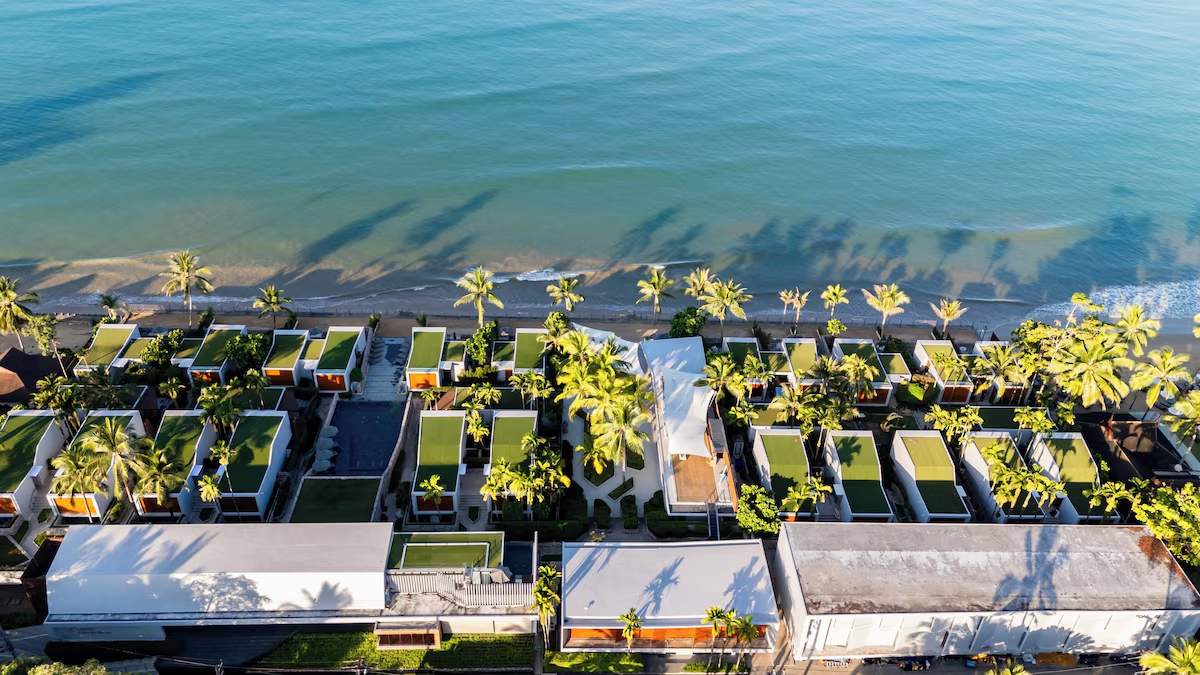
Read: Where to stay in Phuket Old Town

Keemala (Kamala)

Ideal for honeymooners after the most distinctive design on the island…

Of all the properties on this list, Keemala is the hardest to explain to someone who hasn’t seen it, but we’ll do out best. 

The 38 villas above Kamala on Phuket’s affluent northwest coast are organised around the design narratives of four invented Thai clans (the earth-bound Pa-Ta-Pea, the wandering Khon-Jorn, the sky-dwelling We-Ha and the nest-building Rung-Nok), and each clan has its own villa typology designed to express its mythology. 

Still with us? The Bird’s Nest Pool Villas, woven cocoons of timber suspended at canopy height, are the resort’s signature image and the reason most first-timers book, while the Tree Pool Houses sit on stilts amongst the canopy, the Tent Pool Villas borrow nomadic motifs, and the Clay Pool Cottages channel the Pa-Ta-Pea farming clan with rough-rendered walls and earth tones at ground level. Every villa has its own private pool, with raised jungle walkways connecting everything. It is, on paper, an idea that should collapse under the weight of its own whimsy.

That it doesn’t is largely down to who built it. Keemala is a fourth-generation Phuketian family project, the Somnams, whose roots on the island reach deep enough into the earth that the mythology they’ve invented feels like an extension of local culture rather than a costume draped over it. The architects redrew blueprints and redesigned buildings to accommodate existing trees instead of felling them, and in several villas the trunks sprout straight through the pool platforms. There are rescued water buffalo on site, a mushroom hut, a hydroponic garden and an orchard supplying the kitchen at Mala Restaurant. You start to wonder if the head shop down the road has signed a partnership deal with the breakfast chefs, quite honestly. But the fantasy has foundations, which is why you buy into it rather than seeing through it.

The wellness side of things has genuine substance too. The Mala Spa offers Tok Sen treatments, in which a wooden hammer is tapped along the body’s energy channels, a centuries-old northern Thai technique that most resort spas wouldn’t touch with a, erm, hammer, alongside a meditation cave and yoga pavilions set amongst the ancient trees. The resort also runs a strict anti-animal-exploitation policy, actively steering guests away from elephant trekking and tiger shows and towards the Phuket Elephant Sanctuary.

Kamala Beach is a complimentary shuttle ride away, and yes, there’s no sand at your door. But the Somnams built Keemala with the explicit intention of proving a Phuket resort could thrive without it, and they were right.

Clay Pool Cottages at Keemala start from around 15,000 baht (£350) per night in low season, rising to roughly 28,000 baht (£650) at peak.

Address: 10 88 Nakasud Rd Kamala, Kathu District, Phuket 83150, Thailand

Website: keemala.com

Twinpalms Tented Camp Phuket (Cherngtalay)

Ideal for grown-ups who like the idea of camping but not the reality of it…

A luxury safari camp on a Thai beach would feel like a gimmick if the people behind it had half-arsed the execution. But Carl Langenskiöld’s Twinpalms group, which has been on Phuket for over two decades, have gone all in. Their Tented Camp launched in December 2024 among the tropical gardens and sands of Bang Tao Beach in Cherngtalay, and it’s the most distinctive new arrival on the island in years.

The adults-only camp comprises 29 luxury tents on raised wooden decks, with 24 lagoon tents in one- and two-bedroom configurations set among tropical gardens, and five beachfront tents arrayed directly on the sands of Bang Tao itself. The tents are substantial, fully air-conditioned with sumptuous king beds, freestanding bathtubs and indoor-outdoor showers, and the design language commits to a rough-luxe aesthetic of worn leather, dark wood, rattan and soft linen, rather than the polished minimalism that dominates the rest of the island’s luxury market. It feels, for once, like somewhere you could spend a week without checking your phone. Actually, we’d go further; it’s a place where you can imagine writing your first novel in one continuous flow of increasingly experimental prose. With a fountain pen, we should add.

The wider Twinpalms group’s beach club operations, Catch Beach Club and The Lazy Coconut, are walking distance along Bang Tao for guests who want a livelier daytime scene. The whole thing is calibrated for couples wanting a few nights of design-forward escape rather than a fortnight’s beach holiday, and for that brief, nothing else on the island gets close right now.

And all without a roll mat or sleeping bag in sight.

You can read our full review of Twinpalms Tented Camp here.

Lagoon Tents at Twinpalms Tented Camp start from around 12,000 baht (£275) per night in low season, rising to roughly 20,000 baht (£460) at peak.

Address: 202 88, Choeng Thale, Thalang District, Phuket 83110, Thailand

Website: twinpalmshotelsresorts.com/tented-camp-phuket

Avista Hideaway Phuket Patong (Tri Trang)

Ideal for food-led travellers who came for the rooftop…

Avista Hideaway is a Patong resort for people who don’t really need to be in Patong. The property occupies its own pocket of jungle high above the town; the road climbs steeply through dense forest as you arrive, depositing you far enough up the hillside that the remnants of last night’s neon-spiked bucket on Bangla finally abate. The views of the Andaman lazily pandiculating help commit the recent past to distant memory.

The rooms lean into soothing dark blues and rich local woods, with the upper-tier suites and villas half-buried in tropical planting and fitted with private plunge pools. There are three larger central pools dotted across the property’s hills too, one of which is adults-only. But the real reason to book is on the rooftop.

Tambu and Sizzle, both Michelin-Guide listed and sitting side by side at the resort’s precipice, are right up there in the ol’ ‘best restaurants in Phuket’ discussion. Tambu serves progressive Indian charcoal cuisine inspired by the tented kitchens (hmm, suddenly getting an idea for a partnership with one of the other hotels on this list) of the Mughal emperors, with Iron Chef Thailand winner Saurabh Sachdeva at the helm. Sizzle, under chef Alvaro de la Puerta, leans into Spanish-influenced open-fire cooking. Both make a strong argument for staying on the rooftop with a sundowner and not leaving for the rest of the evening. 

When you do dust yourself down and decide to face the outside world, Freedom Beach (recently #27 on the World’s 50 Best Beaches list) is a 700-metre jungle hike away, but worth the climb for the big reveal when you part the flora. A complimentary shuttle into Patong proper is there for anyone wanting to dip into the chaos and retreat afterwards.

You can read our full review of Avista Hideaway Phuket Patong here.

Deluxe Rooms at Avista Hideaway start from around 3,950 baht (£92) per night in low season, rising to roughly 8,770 baht (£204) at peak.

Address: 39/9 Muen-Ngern Rd, Pa Tong, Kathu District, Phuket 83150, Thailand

Website: mgallery.accor.com/en/hotels/A245

Read: The best restaurants in Patong

Rosewood Phuket (Emerald Bay)

Ideal for wellness travellers who still want a swimmable beach…

The wellness offering at most luxury resorts tends to read as polite afterthought, an additional revenue line bolted on rather than built in. At Rosewood Phuket, it’s the headline act. 

Asaya, Rosewood’s integrated wellness concept, made its global debut at this property when it opened in 2017, and the brand chose Phuket as the launchpad deliberately. Asaya has since rolled out to Rosewood Hong Kong, London, São Paulo and more, and will launch in Seoul in 2027. But this is where it started, and it still feels like the most fully realised version.

The Asaya Spa occupies its own grounds within the resort, and at its centre guests can hand-select herbs from the on-site garden to be blended into their treatments on the spot. The menu goes well beyond the usual hot-stone-and-aromatherapy offering: Watsu, Chi Nei Tsang, Phaoya fire healing and sound baths, all practices rooted in traditions that mainstream spas tend to water down or skip entirely. Here, it feels as natural as the sun rising to the east and disappearing off to the west.

The site itself is 43 acres of gated jungle along 600 metres of Emerald Bay’s beachfront in southwestern Phuket, appreciably more secluded than its proximity to Patong would suggest. BAR Studio’s architecture cascades down the hillside in a series of pavilions, houses and villas, each oriented to the water, and unlike several properties on this list, the sand is right there at the bottom. After all that talk of hilltops and headlands and shuttle buses, it’s nice to report that you can walk from your villa to the Andaman in flip-flops, to be fair.

Dry yourself off, it’s time for dinner. Ta Khai, the Southern Thai restaurant here, is the real deal. The kitchen is headed by local chef couple Khun Nun and Khun Yai, cooking southern dishes (massaman with beef cheek, moo hong braised in soy and black pepper, steamed seabass with lime and chilli) from ingredients sourced almost entirely from partnered farms across the region. Pink pomelo from Mae Tao, rice from Raitong Organic, fish from local aquaculture; all adding up to something that tastes fresh, alive and very much of its place. It’s the rare resort restaurant where the sustainability claims go beyond the laminated card on your bedside table or the encouragement to chuck your towels on the floor.

Garden Pool Pavilions at Rosewood Phuket start from around 25,000 baht (£580) per night in low season, rising to roughly 42,000 baht (£975) at peak.

Address: 88/28, 30-33, 88 Muen-Ngern Rd, Pa Tong, Kathu District, 83150, Thailand

Website: rosewoodhotels.com/en/phuket

Trisara (Cherngtalay)

Ideal for gastronomes wanting a villa to retreat to between Michelin-starred meals…

Trisara is a 39-villa property on a protected nature preserve on Phuket’s northwestern coast, owned and operated by Thai family outfit Montara Hospitality Group. It has been here long enough that the service has a fluency to it that newer properties are still working towards, and will never quite reach. Each villa is set into terraced gardens above a private bay, with a private infinity pool and a gated entrance. There are no hotel corridors, no shared walls; there’s not even a lobby in any conventional sense. The 48-metre saltwater pool along the resort’s private beach exists mostly for guests who fancy a change of scenery from their own terrace. Now that’s luxury. 

The food, though, is what separates Trisara from properties that can match it on villas and views. PRU was the first restaurant on Phuket to receive a Michelin star, has held it since 2019, and remains one of the most committed expressions of farm-to-table cooking in Southeast Asia. The name stands for Plant, Raise, Understand, and Dutch chef Jimmy Ophorst’s tasting menus draw almost entirely from PRU Jampa, an organic farm that Montara operates in central Phuket. The carrots are cooked in the soil they were grown in, the butter is made in-house from milk sourced in Krabi, and the signature duck is brined, dry-aged for five days, then slow-roasted over a fire fuelled by charcoal from the farm’s own woods. Even by the standards of restaurants that talk earnestly about provenance, this is unusually thorough.

The same farm also supplies JAMPA, Montara’s Michelin Green Star restaurant at nearby Tri Vananda, where chef Rick Dingen does zero-waste, live-fire cooking in a more relaxed register. Between them, PRU and Jampa hold a Michelin star and two Green Stars from one farm, which is a concentration of credentials that no other resort group on the island comes close to.

Thai Library, the resort’s southern Thai restaurant (also Michelin-recognised), is a little looser but delivers a similar conviction on sourcing: stir-fried Phang Nga crab with yellow chilli, dry-aged duck with red yeast rice, and tiger prawn grilled with Pattani salt and bitter bean. After PRU’s tweezered precision, it’s a useful corrective.

Trisara doesn’t announce itself the way some of Phuket’s newer properties do. It just keeps being very good at what it’s been doing for twenty years, and that confidence is hard to fake. The same could be said for its impeccable restaurants. Though relatively new additions, they have the same assured swagger. Christ, it feels safe in here.

Ocean View Pool Villas at Trisara start from around 29,000 baht (£680) per night in low season, rising to roughly 55,000 baht (£1,280) at peak. Residences are priced on request.

Address: 60 Cherngtalay 1 Srisoonthorn Road Tambon Choeng Thale, Thalang District, Phuket 83110, Thailand  

Website: trisara.com

The Nai Harn (Nai Harn Beach)

Ideal for traditionalists who still want their feet in the sand…

Before Amanpuri, before any of them, there was this. The Nai Harn opened in 1986 as the Royal Phuket Yacht Club, designed by Mom Tri Devakul, the Thai aristocrat, architect and artist who trained at Harvard’s Graduate School of Design and went on to shape more of Phuket’s built landscape than anyone else on the island. He designed Club Med Kata, Le Méridien Phuket, The Boathouse and his own Villa Royale. A year after the hotel opened, he lent it to the organisers of the inaugural King’s Cup Regatta and designed the trophy himself. Queen Sirikit, Prince Albert of Monaco and Rudolf Nureyev were among the names on the register.

The property changed hands and names over the decades (Le Royal Méridien Phuket Yacht Club was one of them) before reopening under independent ownership as The Nai Harn in 2016. A refurbishment brought interiors up to date, but the bones of Mom Tri’s white-on-white Mediterranean architecture still climb the hillside above the bay, and all of the 130 rooms still face the ocean, exactly as he drew them. 

Even the drinks have a pedigree here. Rock Salt, the beachfront restaurant, has a rosé selection curated by James Suckling, one of the most influential wine critics in the world, and a cocktail list put together by Salim Khoury, formerly of The Savoy. Promthep Cape is five minutes south and the Rawai seafood market is around the corner, so you’re embedded in southern Phuket in a way that the northwestern resorts can’t offer.

It is the only resort with direct frontage onto Nai Harn Beach, one of the cleanest stretches of sand on the island. Sure, the whole place reads as more Santorini than Andaman at golden hour, which is unusual on Phuket, but if it’s escapism you’re after, you won’t do much better. It is also Phuket’s only member of Leading Hotels of the World, the invitation-only consortium that independently inspects its properties against several hundred service criteria, which tells you something about the standard the place holds itself to.

Forty years on, it still feels like it knows exactly what it’s doing.

Deluxe Ocean View Rooms at The Nai Harn start from around 5,800 baht (£135) per night in low season, rising to roughly 14,000 baht (£325) at peak.

Address: 23/3 Moo1, Vises Road, Rawai, Muang District, Muang, Phuket 83100, Thailand

Website: thenaiharn.com

7 Of The Most Popular (& Spectacular!) Arctic Cruise Itineraries

The Arctic, a realm of pristine beauty and untouched wilderness, is a dream destination for many intrepid travellers. Its icy landscapes, teeming with unique wildlife and steeped in rich history, offer an unparalleled polar adventure

If you’re considering embarking on an Arctic cruise, you’re in for a chilly, expansive treat. Here, wrapped up all warm and cosy, we’re checking out 7 of the most popular Arctic cruise itineraries. Care to join us?

Understanding Arctic Cruising Seasons

The Arctic, with its harsh climate and secluded position, necessitates a brief cruising season, generally spanning from May to September. This limited window of opportunity adds a sense of urgency and exclusivity to the Arctic adventure.

The peak of the Arctic cruising season falls between June and August, coinciding with the region’s summer months. During this period, travelers can expect milder temperatures, ranging from 3 to 12 degrees Celsius, and almost continuous daylight, providing ample opportunities for exploration and wildlife watching. This is when the Arctic is teeming with life; seabirds are nesting, marine mammals are active, and the tundra blooms with wildflowers.

May and early June mark the beginning of the season, offering a chance to witness the transformation as the ice and snow start to melt, revealing the landscapes beneath. September, on the other hand, sees the end of the season, with the onset of autumn colors and the opportunity to spot migratory birds as they begin their journey south.

Understanding the nuances of the Arctic cruising seasons and aligning your travel plans accordingly ensures a richer, more fulfilling experience, capturing the essence of this remarkable destination at its best.


Svalbard, Norway

Svalbard, a Norwegian archipelago located in the Arctic Ocean, is a top choice for many Arctic explorers, with a growing number of luxury Arctic cruises making the region more accessible than ever. This itinerary typically starts and ends in Longyearbyen, the world’s northernmost town. You’ll have the chance to witness the majestic polar bears, walruses, and reindeer in their natural habitat. The midnight sun, a natural phenomenon where the sun doesn’t set for months, adds a magical touch to this Arctic adventure.

This journey typically lasts between 8 to 14 days. The nearest airport is Svalbard Airport, Longyear, located in Longyearbyen. Besides the enchanting wildlife, you’ll also have the opportunity to explore the remnants of the whaling industry and the fascinating Global Seed Vault.


Greenland’s West Coast

Greenland, the world’s largest island, offers a unique blend of Inuit culture, dramatic landscapes, and diverse wildlife. Cruises along the west coast of Greenland often start from Kangerlussuaq, sailing through the stunning Disko Bay, and ending in Nuuk, the capital. Along the way, you’ll encounter gigantic icebergs, humpback whales, and traditional Inuit villages.

A cruise along Greenland’s west coast usually spans 10 to 15 days. The starting point, Kangerlussuaq, is accessible via Kangerlussuaq Airport. This itinerary offers a chance to witness the Northern Lights, explore the UNESCO-listed Ilulissat Icefjord, and learn about Greenland’s Viking history.

Kangerlussuaq

The Northwest Passage

The Northwest Passage, once a treacherous route sought by early explorers, is now a popular Arctic cruise itinerary. This voyage typically starts in Kangerlussuaq, Greenland, and ends in Nome, Alaska. It’s a journey through history, wildlife, and breathtaking landscapes. You’ll traverse the Canadian Arctic Archipelago, visit remote Inuit communities, and possibly spot the elusive narwhal.

This epic journey typically takes around 17 to 20 days. The nearest airport to the starting point is Kangerlussuaq Airport in Greenland. Highlights include the historic Beechey Island, the wildlife-rich Prince of Wales Strait, and the culturally rich Gjoa Haven.


The Norwegian Fjords & The North Cape

A cruise along Norway’s coastline offers a different Arctic experience. You’ll sail through the stunning Norwegian fjords, visit charming coastal towns, and reach the North Cape, the northernmost point of mainland Europe. This itinerary combines natural beauty, wildlife encounters, and a taste of Scandinavian culture.

A Norwegian fjords cruise typically spans 7 to 10 days. The nearest airport is Bergen Airport, Flesland, if your cruise starts from Bergen. Highlights include the UNESCO-listed Geirangerfjord, the charming Lofoten Islands, and the Sami culture in Honningsvåg.


Iceland Circumnavigation

An Iceland Circumnavigation cruise offers a comprehensive exploration of this stunning island nation. Starting and ending in Reykjavik, the itinerary takes you around the entire country, allowing you to experience its diverse landscapes. From the dramatic fjords of the Westfjords region to the puffin colonies of the Eastfjords, and from the geothermal wonders of the North to the black sand beaches of the South, Iceland is a treasure trove of natural beauty. Plus, you’ll have the chance to soak in the rich Viking history and vibrant Icelandic culture.

An Iceland Circumnavigation cruise usually takes around 10 days. The nearest airport is Keflavik International Airport, located near Reykjavik. You’ll have the opportunity to visit the geothermal Mývatn region, the bird cliffs of Látrabjarg, and the charming Westman Islands.

Read: The Best Things to See & Do on Iceland’s Snæfellsnes Peninsula

Reykjavik
Látrabjarg

Spitsbergen & The East Greenland Coast

This itinerary combines the best of Svalbard and Greenland, offering an in-depth Arctic experience. Starting in Longyearbyen, you’ll explore the wildlife-rich Spitsbergen before crossing the Greenland Sea to the remote and rugged East Greenland coast. Here, you’ll encounter towering icebergs, ancient Thule sites, and possibly the Northern Lights. The cruise typically ends in Reykjavik, Iceland, providing a fitting conclusion to an epic Arctic adventure.

This comprehensive Arctic journey typically lasts between 13 to 15 days. The nearest airport is Svalbard Airport, Longyear. Highlights include the wildlife haven of Spitsbergen, the remote Scoresby Sund in East Greenland, and the chance to witness the Northern Lights.

Sleeping Alaskan huskies in Spitsbergen
Scoresby Sund, Greenland

Baffin Island & The High Canadian Arctic

For those seeking a truly remote Arctic experience, a cruise to Baffin Island and the High Canadian Arctic is a must. Starting from Iqaluit, the capital of Nunavut, this itinerary takes you deep into the heart of the Canadian Arctic. You’ll explore the stunning fjords of Baffin Island, visit traditional Inuit communities, and witness the spectacular wildlife, including polar bears, narwhals, and perhaps even the elusive bowhead whale. The cruise typically ends in Resolute, a small Inuit hamlet and one of the northernmost communities in Canada.

This remote Arctic experience usually spans 12 to 14 days. The nearest airport is Iqaluit Airport in Nunavut, Canada. You’ll have the chance to visit the historic Thule sites, the stunning Auyuittuq National Park, and the wildlife-rich Lancaster Sound.

Baffin Island, Canada
Auyuittuq National Park.

The Bottom Line

Embarking on an Arctic cruise is a journey like no other. It’s an opportunity to disconnect from the hustle and bustle of everyday life and connect with nature in its purest form. Whether you’re a wildlife enthusiast, a history buff, or simply an adventurer at heart, the Arctic has something for everyone. So, pack your bags, bring your sense of wonder, and get ready for an unforgettable Arctic adventure.

Remember, the Arctic is a fragile environment. As travellers, it’s our responsibility to respect and protect it. Always choose eco-friendly cruises, follow the guidelines, and leave no trace behind. 

And if you’re still not cold enough, then next up we’re heading to Antarctica. You’re more than welcome to hide in our suitcase…

7 Essential Things To Check Before Buying A Countryside Cottage

A weekend viewing in spring sells almost any cottage. The wisteria’s out, the lane looks like something off a National Trust biscuit tin, and the flagstone kitchen smells faintly of woodsmoke. Then you move in during a wet February and discover the oil tank’s three-quarters empty, the septic tank hasn’t been emptied since 2019, and the listed status you found charming now applies to the kitchen window you wanted to replace.

This isn’t to put you off. Country cottages, when they work, are wonderful. But they often come with quirks that don’t show up in the cheerful Rightmove listing, and the seven checks below come up again and again in conveyancing reports and surveyor write-ups. Some will apply to every cottage. Others only to the more out-of-the-way ones. Either way, running through them before you exchange will save you a lot of grief once the keys are in your hand.

How The Heating Actually Works

A meaningful minority of cottages, particularly older ones or those further from larger villages, aren’t on the gas grid. If yours isn’t, that usually means oil, LPG, or an air-source heat pump, and each comes with its own running costs and quirks. Oil is still the most common of the three, and you’ll want to check the tank’s age, capacity, and bund (the secondary containment around it).

Domestic oil tank installations are governed by OFTEC standards and Building Regulations, with single-skin tanks no longer suitable in many situations (within 10 metres of a watercourse, 50 metres of a borehole, or where a spill could reach drains). A leaking single-skin tank can cost five figures to remediate.

Ask the seller for the last three delivery receipts. That tells you what a real winter costs to heat the place, not what the agent guesses. A poorly insulated 18th-century cottage with solid stone walls can easily burn through 2,500 litres a year, which at current prices is a meaningful line item rather than a rounding error.

If the cottage runs on an Aga or Rayburn, find out whether it’s the heat source for hot water and radiators too. Some owners switch them off in summer and rely on an immersion heater, which is fine, but you’ll want to budget for servicing, which typically runs £200 to £500 a year. They’re glorious things to cook on. They’re less glorious things to find out, in October, that you don’t know how to relight.

Read: How to bring cottagecore charm to your city home

Why The Property Likely Needs A Specialist Insurance Quote

Country cottages rarely fit the tidy boxes mainstream insurers use. Solid stone walls, timber-framed construction, listed building status, flat-roof extensions, and outbuildings used for storage all push a property into non-standard territory. If the cottage has been underpinned at any point, or sits in a flood-risk postcode, mainstream comparison sites will often refuse to quote at all, which is a fun thing to discover three days before completion.

According to the team at Intelligent Insurance, one of the biggest pitfalls for cottage buyers is underinsuring against the rebuild cost, which is rarely the same as the market value. For older cottages built with reclaimed stone or lime mortar, the rebuild figure can be considerably higher, since you’re not just paying for materials but for craftspeople who know how to work with them.

The reinstatement valuation in your surveyor’s RICS report is the number your buildings cover should match, not the price you paid. Specialist insurers are also more likely to recognise non-standard features like thatch, listed status or unusual outbuildings as part of the policy rather than reasons to decline cover.

What’s Going On With The Drains

Most cottages are on mains drainage, but a significant minority aren’t, particularly older properties and those in smaller hamlets. If yours falls into that group, you’re dealing with a septic tank, cesspit, or a small private treatment plant. Since the 2020 General Binding Rules came in, septic tanks that discharge directly to a watercourse have been illegal in England, and the responsibility for upgrading falls on the current owner before sale. Your solicitor should ask for evidence of compliance, but it’s worth raising directly during the viewing rather than leaving it to surface later.

Ask three things: when was it last emptied, where does it discharge to, and is there a maintenance log. A modern treatment plant needs annual servicing and emptying every one to three years depending on use. Replacing a failed system can cost £4,000 to £10,000 once you factor in groundworks and connection, which is the kind of unexpected expense that tends to sour the romance of cottage life rather quickly.

Damp, Ventilation & The Smell Test

Old cottages and damp are old friends. Solid stone walls don’t have cavities to keep moisture out, lime mortar needs to breathe, and decades of well-meaning previous owners slathering on modern cement renders or plastic paints have trapped moisture in walls that were never designed to be sealed up. The result is rising damp, penetrating damp, condensation, or some combination of all three.

A good Level 3 RICS survey will pick up the major issues, but use your nose at the viewing too. Musty smells in cupboards, salt blooms on internal walls, blistered paint behind sofas, and black mould around window reveals are all worth flagging. Ask about the ventilation, particularly in the kitchen and bathrooms. Cottages were built to breathe; modern double glazing and extractor fans can change the equation in ways that take a few winters to reveal themselves.

If the property has had chemical damp-proofing injections, treat that as a question to investigate rather than a reassurance. The treatment is sometimes the cause of the problem rather than the cure, especially in older buildings where breathable lime-based solutions would have been more appropriate.

Boundaries & Land Registry Surprises

Older properties are notorious for boundary disputes. Fences drift over decades, neighbours park or plant on land they don’t quite own, and garden extensions quietly absorb strips of adjoining plots. 

The Land Registry title plan gives you the general boundary, but it’s not precise to the centimetre, and older rural plots sometimes have features on the ground that don’t match the filed plan at all.

Ask your solicitor to check for any rights of way, easements, or access rights registered against the title. Footpaths running through gardens or across driveways are more common than you’d think, and they’re very difficult to reroute once established. If the cottage comes with land, confirm where the maintenance obligations sit. Hedgerow upkeep, ditch clearance, and fencing between your property and any neighbouring agricultural land can all fall to the buyer, and the costs add up if several hundred metres of stock fencing need replacing.

Access, Broadband & Mobile Signal

If the cottage is on a private road or shared driveway, find out where the maintenance obligations sit. Disputes over potholes and resurfacing are surprisingly common, surprisingly heated, and surprisingly expensive to litigate, and they tend to surface six months in rather than during the viewing.

Then there’s connectivity, which matters more than ever if you’ll be working from home. Check the actual line speed at the postcode using Ofcom’s broadband and mobile checker, not just whether full fibre is available in the area. Test all four mobile networks inside the cottage during the viewing too, since thick stone walls can knock signal out completely even in well-served villages. If the cottage is more isolated, ask whether the area has frequent power outages and whether there’s a wood-burner or solid-fuel backup for heat.

Renovation Reality Check

Most cottages need work. The question is whether you’ve priced it honestly. Repointing solid stone walls with lime mortar runs around £60 to £100 per square metre. A new oil boiler with installation is £3,500 to £5,500, and rewiring a three-bedroom house typically lands between £4,450 and £8,000, before any redecoration. Solid stone walls, lath-and-plaster ceilings and awkward access tend to push you toward the upper end of those ranges rather than the lower.

If the property is listed, every external change needs listed building consent, and many internal ones do too. Listed building consent applications should be determined within eight weeks, but factor in time for pre-application advice, preparing a heritage statement and, if needed, revisions to your plans. For more complex projects, the full process from initial discussions to approved consent can take several months. The local conservation officer is generally the most important relationship you’ll cultivate in the first year of ownership, so it’s worth starting on the right foot.

The Bottom Line

A cottage purchase rarely goes wrong because of the obvious stuff. It goes wrong because someone assumed the boiler was newer than it was, didn’t realise the access drive was unadopted, or didn’t budget for a non-standard insurance premium. Spend a weekend on these seven checks before you exchange and you’ll have a much clearer picture of what you’re actually buying, beyond the wisteria.

And once you’ve moved in? The wisteria really is glorious.

Spring Florals & Summer Citrus: How To Match Your Perfume To The Season

There’s a reason your favourite winter fragrance suddenly feels wrong in April. It isn’t your nose playing tricks. Heat, humidity and cold each behave differently on skin, lifting some notes and flattening others, which is why perfumers think in seasons even when marketing departments don’t.

Wearing scent well through the year is less about owning twelve different bottles and more about understanding which note families do what, and when. The approach is straightforward: work out which family of notes suits the season you’re dressing for, then find a fragrance within that family that suits you. Once that logic is in place, building a rotation becomes much simpler, and a lot less expensive than the trial and error approach most people default to. 

With all that in mind, here’s a season by season breakdown, with the perfumery logic behind each shift and a handful of fragrances worth seeking out if you want to test the theory on your own skin.

Spring: Green Notes, Fresh Florals & Citrus Top Notes

Spring is the season perfumers tend to build around transparency. After months of resinous, ambered fragrances doing the work in cold weather, skin and nose alike want something that breathes. The note families that come into their own here are fresh florals, green notes such as galbanum and violet leaf, and the lighter end of the citrus spectrum, particularly bergamot and neroli.

The reason these work in spring is partly chemical. Warmer air and modestly raised skin temperature lift volatile top notes faster, so fragrances that felt thin in February suddenly read as bright and three dimensional in April. A fresh spring floral scent built around dewy rose, transparent jasmine or orange blossom will project differently in mild weather, holding its character without becoming cloying.

Chloé Eau de Parfum is the easiest entry point here, an airy rose led modern classic that has held up well since launch. Diptyque Do Son takes the tuberose route with more restraint than the note usually receives, while Hermès Un Jardin Sur Le Nil offers a green, slightly aquatic take on the season for anyone who wants to sidestep the more obvious floral register entirely.

The mistake people make in spring is reaching for something too sweet too soon. Gourmand notes, vanilla heavy bases and dense white florals can tip into overwhelming once temperatures climb above the high teens, which means a fragrance that feels balanced in March may need rotating out by late May.

Summer: Citrus, Aquatic & Aromatic Herbs

Summer is when fragrance choice becomes genuinely technical. High heat accelerates evaporation, which means light fragrances disappear faster while heavy ones can turn sour on the skin. The note families that survive this best are citrus, aquatic notes built around calone or similar molecules, aromatic herbs such as basil, mint, lavender and rosemary, and the lighter woody notes including vetiver and cedar.

Citrus is the obvious starting point, though there is more nuance here than the supermarket aftershave aisle suggests. A well constructed citrus fragrance uses bergamot, lemon, grapefruit or yuzu over a base that gives the top notes somewhere to land, often a soft musk or a dry vetiver. Acqua di Parma Colonia remains the textbook reference for this style. Atelier Cologne Pomélo Paradis pushes the grapefruit angle harder. For something more contemporary, Maison Margiela Replica Under The Lemon Trees layers citrus over green leaves and petitgrain in a way that lasts longer than most colognes manage.

Aquatic fragrances divide opinion, but the better examples have moved well beyond the marine clichés of the late nineties. Issey Miyake L’Eau d’Issey and Davidoff Cool Water are the genre defining choices, while Escentric Molecules Molecule 02 takes the minimalist route, building almost entirely around a single ambroxan note that reads as clean, skin-like and faintly salty.

The summer rule worth remembering is that projection should come from quality rather than concentration. A well made eau de toilette will outperform a poorly composed eau de parfum in heat, every time.

Read: 7 of the best scented candles for a sweet smelling summer

Autumn: Amber, Spice & Soft Woods

Autumn is where fragrance gets interesting again, though the season’s signature scents are admittedly well-known. As temperatures drop, skin holds onto scent for longer, which means denser compositions start to make sense once more. The note families to look for are amber accords, soft spices including cardamom, pink pepper and cinnamon, dried fruits, tobacco, and the warmer woods such as sandalwood and benzoin.

This is the season where niche perfumery really earns its premium. Le Labo Santal 33 became ubiquitous for a reason, its smoky, leathery sandalwood reading as both warm and austere at the same time. Tom Ford Tobacco Vanille leans richer, with a dried fruit and spiced honey character that suits cooler evenings. For something less commercially familiar, Frédéric Malle Musc Ravageur balances amber, cinnamon and a dense musk in a way that feels enveloping without becoming heavy.

Rose appears again in autumn, but it’s handled very differently to spring’s sweet, fragrant version. Where spring rose tends to be green and transparent, autumn rose works best when paired with oud, spice or leather. Byredo Rose Of No Man’s Land is a useful reference point, balancing pink pepper and rose with a soft papery base that flatters cooler weather.

The transition from summer to autumn is where most people get their timing wrong, reaching for heavy ambers too early. Mid October is generally the point where denser compositions stop feeling premature, though anyone living somewhere with a mild autumn may want to wait until November.

Winter: Oud, Resins, Leather & Gourmand

Winter is when fragrance can carry weight without apology. Cold air slows evaporation and skin chemistry holds onto base notes for longer, which means the heavy resinous and gourmand compositions that would feel suffocating in July finally have room to breathe. The note families that come into their own are oud, frankincense, myrrh, leather, vanilla, coffee, chocolate, and the heavier white florals when used as part of a denser composition.

Oud is the obvious winter signature, though quality varies wildly. Maison Francis Kurkdjian Oud Satin Mood handles it with the most finesse at the accessible end of luxury perfumery, layering rose and violet over a smooth, slightly sweet oud. For something more smoky, Penhaligon’s Halfeti uses oud as part of a much broader composition involving leather, dark florals and dried fruits.

Gourmand fragrances also peak in winter. Mugler Angel remains the reference point for the patchouli and praline style, while Kilian Angels’ Share takes the cognac and vanilla route, and Tom Ford Lost Cherry pushes the fruit and almond character to its limit. These are fragrances that work because cold weather gives them somewhere to go, projecting confidently without becoming cloying.

The winter mistake is over application. Heavy compositions in cold environments project further than their wearers tend to realise, particularly indoors. Two sprays of a well made oud will fill a room in a way that six sprays of a summer cologne never will.

The Bottom Line

Thinking seasonally about fragrance is less about following rules and more about understanding why some scents work and others do not at any given time of year. The most practical way in is to identify which season your current rotation handles worst, work out which note family that season actually wants, and start there. Build outwards from the weakest point rather than the strongest, and within a year you will have a genuinely useful perfume collection instead of a bathroom cabinet full of half empty alternatives.

Why Do So Many Restaurants Fail Within A Year Of Opening?

The restaurant industry is notoriously challenging, with a high rate of failure for new establishments. In fact, it’s regularly reported that more than half fail in the first 12 months; a sobering reality that has been in the news with every growing ferocity recently.

But what are the underlying causes of these failures? Here we explore just some of the more common reasons that contribute to the short lifespan of many new restaurants.

Some Key Reasons Why A Restaurant Might Fail In Its First 12 Months

Insufficient Market Research

One of the primary reasons restaurants fail is due to inadequate market research. Many restaurateurs jump into the business driven by passion but neglect to analyse whether there is a demand for their concept in the chosen location. Understanding the local market, the competition, and the target demographic is crucial. Without this knowledge, even the most passionate and skilled chefs and managers can find themselves struggling to attract customers.

Read: 4 IDEAL market research methods for food businesses

Lack of a Unique Selling Proposition (USP)

In a market saturated with dining options, a new restaurant must stand out. A unique selling proposition is what differentiates a restaurant from its competitors. Whether it’s a unique menu, a distinctive dining experience, or exceptional service, a USP is vital.

The details matter here more than many new operators realise; everything from tableware and lighting to background music for restaurants and staff uniforms contributes to the overall identity a venue projects. Restaurants that fail within the first year often lack a clear USP, leaving potential customers with no compelling reason to choose them over established venues.

Poor Financial Management

Cash flow is the lifeblood of any business, and restaurants are no exception. Many new restaurants underestimate the capital required to sustain the business until it becomes profitable. Unexpected costs, such as emergency repairs, can also be a death knell for a cash-strapped establishment. Moreover, poor management of expenses, such as food waste, labour costs, and inefficient operations, can quickly lead to financial ruin.

This is where powerful restaurant management software can help businesses unify their daily operations into a single ecosystem. Modern solutions integrate point-of-sale systems, inventory tracking, cost analysis, and financial reporting, giving restaurateurs real-time visibility into their cash flow and helping them identify potential issues before they become critical problems.

Read: Demystifying business insurance for start-ups in the UK

Inadequate Experience & Leadership

Running a restaurant requires a specific set of skills and experience. Many new restaurateurs are chefs or individuals with a passion for food but may lack the necessary business acumen. Leadership is also critical; a strong leader can motivate staff, manage operations efficiently, and make tough decisions when necessary. Without this expertise and leadership, restaurants often struggle to navigate the complexities of the industry.

Compromised Quality Or Inconsistency

Consistency is key in the restaurant business. Customers expect the same level of quality every time they visit. New restaurants sometimes make the mistake of starting strong but then allowing standards to slip as they become more comfortable or as they start cutting costs. This can lead to a loss of repeat business, which is essential for a restaurant’s survival.

Neglecting Marketing & Customer Engagement

In the digital age, marketing and customer engagement are more important than ever. New restaurants need to establish a strong online presence, engage with customers through social media, and encourage reviews and word-of-mouth recommendations. Many restaurants fail because they either neglect these areas or execute them poorly, missing out on the opportunity to build a loyal customer base.

Check out this guide on marketing materials for restaurants, such as flyers, bespoke menus, and more, for some useful info on helping you develop a strong brand online and beyond.

Failure To Adapt

The restaurant industry is dynamic, with constantly evolving consumer trends and preferences. Successful restaurants are those that can adapt to these changes. This could mean tweaking the menu, embracing new technologies, or refreshing the decor. Restaurants that fail within the first year often do so because they are too rigid and unable to pivot in response to feedback or market trends.

Location, Location, Location

A restaurant’s location can make or break its success. Factors such as visibility, accessibility, parking, and local demographics play a significant role. A poor location can limit footfall and deter potential customers, making it difficult for even the best restaurants to survive.

Plain Old Bad Luck

Sometimes, despite meticulous planning, a strong concept, and a dedicated team, restaurants fail for reasons that can only be chalked up to plain old bad luck. The capricious nature of fate can play a significant role in the success or failure of a new restaurant. Here a few examples…

Unforeseen Events

Unpredictable events such as road construction blocking access, a sudden change in local regulations, or even adverse weather conditions can severely impact a restaurant’s operations. For instance, a new restaurant might open its doors just as a major road development starts, diverting potential traffic for months. Similarly, a harsh winter can deter diners from venturing out, hitting a restaurant’s bottom line hard.

Public Health Crises

The recent global pandemic has taught us that public health crises can have devastating effects on the hospitality industry. A new restaurant might open shortly before an outbreak of illness, leading to mandatory closures or a drop in public confidence, through no fault of the owners.

Supply Chain Disruptions

Supply chain issues can also strike unexpectedly, leading to shortages of key ingredients. This can force restaurants to alter their menus or serve subpar dishes, disappointing customers and damaging reputations.

Personal Circumstances

Sometimes, the bad luck is personal. A key member of the team might fall ill or have to leave unexpectedly due to personal issues, leaving the restaurant struggling to fill the gap. The loss of a head chef or a manager can be particularly destabilising for a fledgling restaurant.

The Luck Of The Draw

Finally, there’s the simple, inexplicable bad luck that can befall any business. A new, well-reviewed restaurant might just happen to open at the same time as several others, splitting the potential market. Or a viral social media post could unjustly tarnish the reputation of a restaurant just as it’s trying to establish itself.

Mitigating Misfortune

While it’s impossible to plan for every eventuality, successful restaurateurs learn to be resilient and resourceful. They have contingency plans, maintain a healthy cash reserve, and are quick to respond to and recover from setbacks, all while serving the best food they can. They understand that while bad luck can play a part in the failure of a restaurant, good management, adaptability, and perseverance can often help to weather the storm.

The Bottom Line

The restaurant industry is fraught with challenges, and the statistics can be daunting. However, understanding the common pitfalls can help aspiring restaurateurs navigate the treacherous waters of the business.

By conducting thorough market research, developing a strong USP, managing finances wisely, gaining the necessary experience, maintaining quality, engaging in effective marketing, adapting to change, and choosing the right location, new restaurants can increase their chances of success and longevity.

For those brave souls who venture into the restaurant industry, it’s not just about surviving the first year; it’s about laying the groundwork for a sustainable and thriving business that will delight customers for years to come.

7 Ideal Tips For Creating A Free Home Gym With Items You Already Own

Gym memberships in the UK now average just over £25 a month at low-cost chains alone, according to Leisure DB’s 2025 State of the UK Fitness Industry Report, with mid-market memberships sitting closer to £50 and London prices regularly pushing past £75. That’s before you factor in the petrol, the parking, the protein shake at the counter, and the small psychic cost of changing in a room that smells of Lynx Africa.

Little wonder, then, that the home workout has gone from lockdown necessity to genuine lifestyle shift, with Sport England’s latest Active Lives survey showing record numbers of UK adults now meeting weekly activity guidelines, much of it done outside traditional gyms.

The best part? You don’t need to spend a single penny to build a genuinely effective home gym. A surprising amount of resistance, cardio and mobility work can be done entirely with stuff already kicking around your house. Fitness experts have long noted that you can do nearly a full workout with just a wall, and with a bit of imagination and a willingness to lunge across your living room, you’ll be hitting every major muscle group without setting foot in a Pure Gym. With that in mind, here are 7 IDEAL tips for creating a free home gym with items you already own.

Sort The Floor First

Before you do anything else, think about what’s under your feet. A workout on a hardwood floor in your slippers is asking for a turned ankle, and your downstairs neighbours will quickly tire of the burpees. The good news is that most homes already contain everything you need; a thick rug folded in half works brilliantly for floor-based stretching and core work, while an old yoga mat (most households seem to have one gathering dust behind the wardrobe) gives you enough grip for planks and press-ups.

If you do decide to spend on a single thing as part of your home setup, make it protection for your floor. Even pure bodyweight work, jumping jacks, burpees, mountain climbers, press-ups, takes a quiet but cumulative toll on floorboards, carpet underlay and the patience of anyone living beneath you. A set of decent gym floor mats absorbs the impact, dampens the noise, and protects the one thing in your home you genuinely can’t replace cheaply. Floor damage is the cost that outlasts the workout, so it’s worth heading off early.

Chair Squats, Dips & Step-Ups

A solid dining chair is one of the most versatile pieces of fitness kit you’ll never have to buy. For squats, sit on the seat with a straight back and arms extended in front of you, then slowly rise to standing before lowering yourself back down, hovering just above the seat at the bottom of each rep. For tricep dips, face away from the chair, place your palms on the edge of the seat with fingers pointing forwards, and lower your body until your elbows reach a 90-degree bend.

A sturdy chair (or the bottom step of your stairs, if your dining furniture is more for show) also makes an excellent platform for step-ups, which are unassuming but one of the most efficient lower-body exercises going. Just make sure the chair isn’t going to slide; a non-slip mat or a wedge against the wall sorts that.

Grocery Cupboard Weights

The dumbbell aisle of any sports shop is a study in marketing. A pair of 5kg neoprene-coated weights costs around £40, and yet most kitchens contain heavier loads sitting on the shelves for free. A standard 5kg bag of rice or potatoes is exactly that. A two-litre bottle of water weighs 2kg, a four-pinter of milk roughly 2.3kg, and a large bag of cat litter or compost can easily hit 10kg or more.

For meaningful resistance, think bigger. A full backpack loaded with hardback books quickly reaches 10–15kg, comfortably enough to challenge most home lifters during goblet squats, rows, deadlifts and overhead presses. Two filled five-litre water bottles, one in each hand, give you 10kg of suitcase-carry loading for farmer’s walks down the hallway. If you need to go heavier still, a sturdy laundry bag filled with books or sand becomes a serviceable sandbag for cleans, carries and shouldered squats. Sure, your home gym might look a little chaotic, and your partner will be confused when they go to cook your favourite dinner only to find the ingredients are gone, but that’s the rub and them’s the brakes.

Lighter loads still have their place. The 1–2kg range, two tins of chopped tomatoes, a small water bottle, suits high-rep isolation work for shoulders and arms; lateral raises, front raises and bicep curls all benefit from going lighter and slower than ego suggests. The trick is matching the weight to the movement, keeping the load balanced, and making sure whatever you’re gripping won’t slip mid-rep. None of it needs to leave your account.

Stair Cardio & Plyometrics

If you’ve got stairs, you’ve got a cardio machine, and one that costs precisely nothing to run. Research highlighted by Harvard Health found that people who climb more than five flights of stairs daily, around 50 steps, were roughly 20% less likely to experience a heart-related problem or stroke, based on data from nearly 460,000 adults. You can dial the intensity up by skipping every other step, taking them two at a time, or adding a weighted backpack for resistance.

For something more explosive, the bottom step works beautifully for plyometric box jumps, alternating quick step-ups (think mountain climbers, but vertical), or simply sprinting in place at the foot of the stairs and tagging the third step on every count. It’s brutal, it’s free, and you can do it while the kettle boils.

Towel Roller & Resistance

Foam rollers have become a fixture of the modern wellness routine, and they do genuinely help with stretching, post-workout mobility and releasing tight fascia. Rather than spending £25 on what is essentially a tube of dense foam, roll a thick bath towel tightly around a rolling pin and secure it with two elastic bands. It’ll do the same job for your IT band, your upper back, and your calves, with the bonus that you can unroll it and dry yourself with it afterwards.

A long towel doubles as a free resistance band, too. Loop it around your feet for seated rows, hold it taut overhead for shoulder mobility, or use it as a sliding disc on a hardwood floor for hamstring curls and pike push-ups. Old tights or a long scarf work similarly, and there’s a quiet satisfaction in repurposing things you’d otherwise have donated to the charity shop.

Backpack Loading

Of all the no-cost training methods, weighted backpack work (sometimes called rucking by people who take it very seriously) might be the most underrated. Load a sturdy rucksack with hardback books, bags of rice, or filled water bottles, tighten the straps so it sits flush against your back, and you’ve effectively built yourself a weight vest for the cost of nothing at all.

Wear it during squats, lunges, press-ups or step-ups to add resistance, or take it for a brisk walk and turn an ordinary stroll into a meaningful conditioning session. According to the Cleveland Clinic, rucking burns up to three times more calories than walking without a weighted pack, putting it on par with jogging, and weighted walking has also been linked to improved bone density and reduced risk of osteoporosis as you age.

Habit Stacking With Television

The final tip is more behavioural than equipment-based, but it’s the one most likely to actually keep you moving, and it requires nothing beyond the telly you already own. The principle is simple; attach a small dose of exercise to something you already do without thinking, in this case watching television.

Pick a show, pick a trigger, and pick a movement. Every time the Bake Off theme plays, do 20 squats. Every time someone on Succession says something cruel, drop and do 10 press-ups (you’ll be ripped by the end of the season). Every ad break in the football, plank for 60 seconds. The point isn’t to replace structured training but to break up the long sedentary stretches that Harvard researchers have linked to a 40–60% greater risk of heart failure and cardiovascular death, even among people who otherwise meet activity guidelines.

The Bottom Line

A full-functioning home gym doesn’t require a spare room, a deadlift platform or a subscription to anything. It requires a bit of floor space, a willingness to look slightly daft in front of your own furniture, and the recognition that consistency beats kit, every single time. Spend the gym membership you’ve just saved on something that actually brings you joy. A really good coffee machine, perhaps.

The Best Restaurants In Peckham

Last updated May 2026

Arguably South London’s most famous neighbourhood – and one which gave us Giggs, Only Fools & Horses, Isla Bevan, Rio Ferdinand, John Boyega and so many more – on any given day Peckham’s streets are a hive of activity; a cornucopia of cultures and cuisines, as African-Caribbean grills and bakeries mix with minimalist coffee houses and ‘Modern European’ bistros to give the high street an unmistakably eclectic vibe.

It’s a vibe that’s been seeing seismic change recently, for better or for worse. Amidst this backdrop of change, Peckham’s restaurant scene has burgeoned, offering a diverse array of dining options that cater to both new and old residents, with the area’s more established food purveyors adapting to shifting times with admirable nimbleness.

For many, the culinary landscape of Peckham thrives when managing to reflect the area’s multicultural heritage and evolving identity. Join us as we explore the restaurants, both new and old, that make Peckham’s dining scene truly one-of-a-kind. Here are the best restaurants in Peckham.

Lai Rai

A striped funfair awning marks the spot at Rye Lane where Lai Rai took over the old Issa Vibe site in June 2025. In just under a year, this fun, frivolous, serious Vietnamese snacking and drinking spot has made a major impact, earning a Michelin Bib Gourmand at the first time of asking but, more importantly, commanding queues on the nights when it matters.

It’s the fourth opening from the Bánh Bánh group, the second-generation Vietnamese siblings who’ve been feeding Peckham, Brixton and Fleet Street for the best part of a decade, though here they’ve stepped back and handed creative reins to a younger team. Blair Nguyen and Ivy Vo of Vinaxoa, the South London snack collective that cut its teeth catering raves and warehouse parties, lead the kitchen and the front-of-house energy respectively, and things are decidedly less phở-forward.

The space itself is set across two floors of buttery yellow tiling, scarlet stools, red neon and a James Turrell-referencing halo light upstairs that washes the communal tables in warm crimson. That retro-Saigon interior comes from house of baby, the spatial design studio run by Joseph Losper and Tomio Shota; visual artist AP Nguyen, formerly general manager at Bánh Bánh, ties the whole thing together. The name lai rai translates as ‘little by little’, which somewhat captures the gentle, drawn-out rhythm of the place rather more elegantly than we just have.

By day (noon to 3pm, Wednesday to Sunday) it’s all about the bánh mì and Vietnamese coffee. The baguettes are baked in-house, glazed plain, spicy or with golden syrup, then loaded with cucumber, pickle, spring onion, coriander and fresh chilli. Best of them is the thịt kho, pork belly braised until fudgy, yolk sauce (mayo, basically) and fizzing pickled mustard greens (£12). The chả chay, a vegan number of seitan and mushroom cold-cut with tofu whip and miso kho quẹt, makes a strong case for itself, too, and is also £12.

Coffee here is of the rocket fuel variety, with smooth notes of butter, chocolate and hazelnut – Ferrero Rocher, essentially. Try the cà phê lai, which cuts coffee with jasmine tea for what the team endearingly call a ‘double buzz’, or the cà phê phở, a glorious mix of coffee, pho spice and sparkling water.

The bigger evening menu, from 6pm Tuesday to Friday, is where Blair Nguyen’s cooking really opens up. The chạo cốm, prawn lollies wrapped in fragrant young rice on sugarcane stems, are the natural starting point. From there, you might find yourself ordering the đậu hũ lắc me cay, crisp cubes of tofu tossed with tamarind, roasted chilli jam and spring onion oil, or gỏi tai heo đu đủ, a green papaya salad with braised pig ear, pineapple and Viet herbs. The bò tái chanh – beef tartare with lemongrass, crushed peanut and salted egg yolk – is the small plates standout. Highlights from the larger plates include vẹm cốt dừa (mussels in a coconut broth with lemongrass and Vietnamese hot mint) and a grilled bavette steak with oyster sauce, white pepper and herb butter that nods to the French influence on the country’s food.

For dessert, there’s a rotating cast of community and friends; cult SE London ice cream maker Clingy Wrap has been making appearances with flavours like Laughing Cow cheese, sweetcorn, fish sauce and caramel. It’s a glorious interplay of sweet and salty, and well worth saving room on your dessert shelf for.

The Vietnamese-accented cocktails are ace, too. The Phở Please blends whisky with pho-infused rice wine and house syrup; the Cà Phê Martini does what it says on the tin. There’s Saigon Special beer for those wanting to commit fully to the bia hơi spirit that informs the whole project – meeting friends for fuss-free snacks and cold beer, the kind of low-stakes hang that Vietnam does so well and London so rarely manages. Have yours over ice, as it should be.

Address: 181 Rye Ln, London SE15 4TP

Website: lairai.london


Levan

Just a minute’s walk from Peckham Rye Station, Levan, a contemporary European bistro, takes its name from the legendary DJ Larry Levan, and pays homage to the spirit of inclusivity and creativity that he embodied. 

Chef Rani Raimondi, formerly of Planque and the Clove Club, leads the kitchen team in crafting seasonal sharing plates that showcase the best of modern European cooking, inspired by Paris’ ‘bistronomy’ movement, which aims to fuse fine dining with a more casual atmosphere and eclectic wine lists.

Start with the now iconic Comté fries with saffron aioli; a decadent twist on the classic French chip blanketed under whispers of delicate grated cheese, showcasing Raimondi’s ability to elevate humble ingredients to new heights. Follow that with a couple of sharing plates; the bavette steak (cooked blushing) with heritage tomatoes and scotch bonnet that’s currently on the weekly changing Chef’s Menu is a knockout. And anytime there’s pork chop on that menu – arriving a pleasing pink – don’t miss out on it!

That said, it’s the restaurant’s fantastic wine list that takes centre stage, with a firm focus falling on low-intervention, bio-dynamic wines from small producers across Europe, reflecting the restaurant’s commitment to sustainability and quality.

Accordingly, one of the most notable achievements for Levan has been winning the Special Jury Prize in The Buyer’s 2022 Star Wine List of the Year UK. This prestigious award highlights the restaurant’s dedication to championing wines from the Jura region in France (the owners here nearly called the restaurant ‘Jura’ in its honour), an area often underrepresented and challenging to source.

Levan’s wine list features an impressive range of producers and styles from this region, showcasing a refreshing, unique, and distinctive personality that sets it apart from other neighbourhood restaurants in Peckham.

Address: 12-16 Blenheim Grove, London SE15 4QL, UK

Website: levanlondon.co.uk


JB’s Soulfood 

If you’re stepping off the train seeking the sweet, spicy smell of jerk chicken on the grill, then don’t look for smoke signals as soon as you alight. Instead, head north out of Peckham Rye Station and up Rye Lane, making for JB’s Soulfood, arguably the best known jerk in the area (except, perhaps, Gregg Wallace).  

Serving the good folk of Peckham High Street since 2014, Bill and Jennifer, the much-loved dynamic duo behind the South London institution, have transformed a compact unit into a bustling hub of authentic Caribbean cuisine and community. Bill, a former welder, convinced Jennifer to bring her culinary skills to the forefront, and together they created a soul food haven.

Though you can squeeze in around one of the restaurant’s clutch of sparsely appointed wooden tables, owing to its size JB’s is better suited to takeaway, and that’s fine by us; there’s nothing better than pitching up on the pavement outside and getting acquainted with the signature drum-smoked jerk chicken, which is also one of the area’s best value meals, clocking in at under a tenner when served over rice. A plastic cup of JB’s Guinness punch will send you merrily on your way…

… But not before you pick up a side of silky macaroni cheese and, because you’re here, you’re hungry and it’s delicious, some heavily, headily-spiced curry goat.

Lunchtime deals and student specials run every lunchtime from Monday to Friday.

Address: 27A Peckham High St, London SE15 5EB, United Kingdom

Website: JB’s Soulfood Ltd | London | Facebook


Hausu

Right next to Peckham Rye station at 11a Station Way (in the former Coal Rooms space), Hausu brings together food and music in a way that captures the creative energy of SE15.

Founded by siblings Tom and Holly Middleton-Joseph, alongside their business partner Christian Williams, Hausu takes its name from a trippy Japanese horror film from the ’70s. Fortunately, it’s not all shocking psychedelic shades and murderous household appliances. Instead, the space offers a relaxed, mid-century feel with green banquettes, herringbone floors, and warm lighting that gives the panelled walls a soft glow. Set and setting, indeed…

Holly, who previously worked at The Camberwell Arms and The Waterman Arms (both on our rundown of London’s best gastropubs, incidentally), runs the kitchen here. Her menu is a globetrotting affair, with dishes like scallop and prawn toast – a dish with truly gorgeous mouthfeel, coming covered in black sesame seeds and served with a quite spicy dipping sauce. To truly get a measure of the place, don’t miss the humble, restorative ‘Dad’s Broth’ (£4.50) either, a chicken soup packed with herbaceous flavours that offers a glimpse into the Joseph family’s food heritage. Interestingly, Joseph’s cooking has been recognised beyond Peckham, too; she was named one of the National Restaurant Awards’ Rising Stars for 2026

For something on decidedly the other side of the substantial scale, try the sirloin steak (£47 for 450g). It comes with a beef sauce and a pert condiment made from confit lemon zest, salted red chillies, and crispy garlic. Be warned – these steaks are big boys, served on the bone, and can take a while to hit the table. Best order an extra starter while you wait.

Music is central to Hausu’s identity. Tom selects tracks that play through a vintage sound system, creating a soundtrack that envelopes but doesn’t overwhelm the dining experience. On Fridays, local DJs take over, and the team believes strongly that music and food together create something special. 

A place this vibey needs carefully made drinks, and the Gibson Martini (£11) is a knockout (quite literally after three or four), combining Absolut Vodka, Dolin Blanc, and juice from Hausu’s house pickles. 

Open Tuesday to Friday from 6pm and Saturdays from noon (closed Sunday and Monday), Hausu works for both quick drinks and proper meals. Its location practically inside the station makes it perfect for a pre-train cocktail or a night out in Peckham.

Speaking of cocktails, in March the trio expanded upstairs, opening Upstairs at Hausu as a late-night cocktail bar above the restaurant. Designed by artist Eva Gold and inspired by David Lynch’s Red Room from Twin Peaks, the room is shrouded in red drapery and dim lighting, with cocktails like the salted Iberico tomato Martini and a blood-orange Sidecar with fig foam pouring to a soundtrack of South London DJs. As Holly puts it, “if you know, you know” – well worth seeking out after dinner downstairs.

Address: 11a Station Wy, London SE15 4RX

Website: hausulondon.co.uk


Bar Levan

Christ we loved Larry’s, the New York-inspired bistro that used to sling the finest meatball subs known to man from this spot, the same one that Bar Levan now occupies.

So, like a stepkid who needed convincing about their mum’s new partner, we went into Bar Levan more than a little apprehensive, having already decided we missed Larry’s chilled out vibes and latke too much to welcome its replacement into our lives. 

We were wrong. Opened in the Autumn of 2023 by Mark Gurney and Matt Bushnell as a replacement for Larry’s, the minds behind neighbouring Levan from a few paragraphs earlier have brought another slice of Parisian chic to Peckham with Bar Levan. Inspired by the vibrant natural wine bars of Paris, such as Septime La Cave and Aux Deux Amis, Bar Levan offers an intimate vibe seemingly at odds with the bustle of the Blenheim Grove thoroughfare beyond its doors. 

Just a stone’s throw from Peckham Rye Overground, Bar Levan is a 42-cover space that features high-top table, as well as street-level seating for those warmer days. The bar’s vintage sound system and rare vinyl collection, curated by owner Mark Gurney (something of the nominative determinism here, being a house DJ?), provide a dulcet backdrop to your dining and drinking experience. Every Friday, local DJs spin tunes, and once a month, the bar hosts the cult music and wine tasting event, Strictly Bangers.

Bar Levan’s wine list, curated by Gurney, is a treasure trove for natural wine enthusiasts. The ever-evolving selection features an extensive range of natural wines from across Europe, including lesser-known regions like Slovakia, The Czech Republic, and Hungary, alongside more familiar territories such as Austria, Italy, and France. Wines are available by the glass, carafe, or bottle, with unique ‘one-offs’ making regular appearances. Lovely, inclusive stuff.

The menu features playful sharing plates rooted in informal European bistro classics, blending retro and refined cooking styles. Start with small bites like miso devilled egg with nori and togarashi, or a more prosaic but no less delicious Ortiz anchovies in olive oil. Pair both with an even more straightforward baguette and butter, the latter properly salty and all the better for it.

Move on to Bar Levan’s excellent Croque Monsieur with pickles, a stacked, indulgent affair that continues Larry’s legacy of doing truly killer sandwiches. Even better are ‘mussels on crisps’, which are just that. Need we say more?

Bar Levan is open Monday from 5pm to 11pm, Tuesday to Thursday from 5pm to midnight, Friday from 5pm to 1am and Saturday from 3pm to 1am. Closed Sunday. The bar takes reservations but also welcomes walk-ins.

Address: Unit 5, 12-16 Blenheim Grove, London SE15 4QL

Website: barlevan.co.uk


Beef Suya at Tiwa ‘n’ Tiwa, Peckham

A joyful weekend spent eating through Eater London’s recommendations on where to eat in Peckham (for pleasure, not business) ended in the conclusion that the beef suya at Tiwa ’n’ Tiwa is one of the most moreish plates of food in all of the city. It’s also one of the spiciest.

As Jonathan Nunn (editor of the superb food newsletter Vittles) writes, the easiest way to find Tiwa ‘n’ Tiwa is to head to the huge, glass fronted Burger King on Peckham High Street, turn around, and ‘’look for the smoke’’. 

Follow your nose, and you’ll find barbecued beef suya that’s been rolled in the effervescent Nigerian suya spice blend yaji, usually made from several different strains of dried chilli alongside onion, garlic and ginger powders, white and black pepper and several other heady ground spices. 

The chilli-hit here is of the rasping variety, teasing and taunting the back of the palate rather than the tip of the tongue, as fresh chilli seems to. Its analeptic quality invigorates, and despite the hot fluster it puts us in, it’s impossible not to order another plate.

Owner Aetoye Seyi has been running this Peckham institution since 2013, and now has additional sites in Plumstead and Tottenham – though the original on Peckham High Street remains the spiritual home.

Address: 34A Peckham High St, London SE15 5DP, United Kingdom


Artusi

Artusi, named after the famous Italian gastronome Pellegrino Artusi, is the Italian neighbourhood restaurant every borough dreams of; it’s no frills in every sense of the word, and all the better for it. 

A chalkboard menu details the ever-changing offerings of the day; always expect two or three freshly made pasta dishes (on one of our many, many visits a wild garlic spaghetti with a ricotta salata was bloody lovely), a strong vegetable showing and a couple of meat and fish dishes. The cod, pancetta and braised coco beans currently on the menu is a salty delight.

Though simplicity and respect for ingredients lies at the heart of the operation, everything is executed with confidence and care – what we would expect from a former Clove Club chef, Jack Beer.

Whisper it, but the Sunday set menu deal, from 12pm to 4pm, is probably the best of its kind in the city – you can enjoy 3 courses for just 29 quid. Yes, 29. For more of a blowout, the £40 per person sharing menu for eight or more people, housed in the airy lower floor right next to the kitchen, is another great deal.

The restaurant boasts an all-Italian wine list, with a focus on small producers and natural wines, as is the way in a modern London neighbourhood restaurant. The 2020 Ciello Baglio Antico Catarratto – an orange wine bursting with vivacity and freshness – is a steal at £8 a glass.

Whilst Artusi isn’t quite so close to Peckham Rye Station as the other entries on our list, sitting a ten minute walk away on Bellenden Road, it’s certainly worth stretching your legs for.

And if you’re in ‘Central’, there is now a second branch of Artusi in Soho. There’s also a sister restaurant, Marcella, over in Deptford, both worth a visit if you can’t make the trip to Bellenden Road.

Address: 161 Bellenden Rd, London SE15 4DH, United Kingdom

Website: artusi.co.uk


Guacamoles

Inside the recently renovated Rye Lane Indoor Market at 48 Rye Lane sits Guacamoles. Hmm, perhaps sits isn’t quite the right phrase – it stands proud. Look for orange dahlias painted on white beams, Mexican flags, and a sombrero perched on top of a small blackboard menu and you’ll know you’ve arrived.

This colourful taco spot is run by Manolo de la Torre – known as ‘Taco Manny’ to some – and his wife Gabriella. What started as a pop-up in late 2023 has quickly become a beloved fixture in Peckham, serving really damn good tacos at surprisingly reasonable prices.

Manny’s background adds depth to his cooking. Originally from Veracruz on Mexico’s east coast, he comes from a family of food vendors – his grandfather built a business selling burritos to factory workers. After coming to the UK and noticing the lack of affordable Mexican options, Manny decided to fill that gap. “This is fast food; it shouldn’t be expensive,” he says. “With one kilogram of masa, I can make 90 tortillas”, he told FT Globetrotter.

Mission statement dispensed with, unsurprisingly the menu centres on corn tortillas made fresh daily by hand. The birria tacos feature slow-cooked beef with a complex spice blend that gives them remarkable depth. Even more impressive is the lengua (beef tongue) taco, where the meat becomes wonderfully tender after slow-braising.

The al pastor uses pork belly that’s been braised and fried rather than the traditional spit-roasting method. The mix of achiote, orange, and vinegar creates a flavor that’s complex and satisfying. Every order includes freshly made guacamole and three different salsas, plus lime wedges.

Save room for Manny’s tres leches cake – a light sponge soaked in evaporated milk following a family recipe passed down through generations. It’s delicate yet indulgent. The Jamaica Aguas Frescas (hibiscus tea) makes a perfect accompaniment – sweet and refreshing with a pleasant tartness.

While you can take your food to go, it’s worth eating in the market’s food court. The area directly in front of Guacamoles has colorful papel picado decorations and a lively atmosphere that enhances the experience.

Budget-conscious visitors should come on Tuesdays when tacos are just £3 each. As for Manny’s claim that these are “the best tacos in London” – well, they’re certainly contenders.

Address: Rye Lane Indoor Market, 48 Rye Ln, London SE15 5BY

Instagram: @guacamolespeckham


M. Manze

M. Manze, a renowned pie and mash shop, has been serving Londoners with its delicious traditional British meals since 1902. The history of this iconic establishment is deeply rooted in the culinary culture of London, particularly in the eastern docklands area where it first gained popularity during the Victorian era. Pie and mash, originally a working-class food, was designed to be easily transportable and protected from the dirt and grime of historic London by its pastry crust.

The legacy of M. Manze began with Michele Manze, an Italian immigrant who opened his first pie and mash shop on Southwark’s Union Street in 1844. His business was inspired by the travelling piemen who sold their pies throughout London. Over the years, the Manze family expanded their business, opening several shops across the city. Today, the fourth generation of the Manze family, Emma Harrington, her father Rick Poole, and her husband Tom Harrington, continue to run the family-owned business.

Image via Manzes Facebook

Located at 105 Peckham High Street just a 5 minute walk north of the station, M. Manze’s Peckham shop is the second oldest surviving branch after the Tower Bridge shop. It first opened its doors in 1927 and has since become a beloved institution in the community. However, the shop faced a significant challenge in 1985 when it was burnt down during the riots in the area.

A long legal battle ensued, and unfortunately, Lionel Manze, Michele’s son who took over the business after his father’s death in 1932, did not live long enough to see the outcome. Despite these hardships, M. Manze persevered and continues to thrive in Peckham.

The signature dish of M. Manze is, of course, their famous pie and mash. The pie consists of a minced-beef filling, which historically contained leftover scraps of meat and vegetables, baked in a pastry crust. It is served with mashed potatoes and a thin green parsley sauce called liquor, which, despite its name, contains no alcohol. This hearty meal has been a staple of London’s culinary scene for generations and remains a favourite among locals and visitors alike.

M. Manze is not only known for its delicious pie and mash but also for its warm and welcoming atmosphere. The staff at the Peckham shop are friendly and greet customers with a smile, making it a go-to place for those seeking a taste of traditional London grub. In addition to their signature dish, M. Manze also offers other handcrafted traditional English dishes, such as stewed eels, which are available for delivery throughout the UK.

Read: The best restaurants in London Bridge and Borough

Address: 105 Peckham High St, London SE15 5RS, United Kingdom

Website: manze.co.uk


Ganapati

Ganapati is a South Indian gem tucked away just off Bellenden Road, offering a taste of Kerala cuisine as imagined by head chef and owner Claire Fisher, who has spent years perfecting her recipes, resulting in dishes that transport diners straight to the sun-soaked shores of Southern India.

Open since 2004, long before Peckham shapeshifted into its current form, the restaurant’s inception can be traced back to Claire Fisher’s life-changing trip to India in 1992. Enamoured by the rich flavours and vibrant culture, Claire embarked on a journey to master the art of South Indian cooking, which eventually led her to Holly Grove, and Ganapati.

The Thali here, a traditional Indian platter with a selection of curry, rice, raita, mung bean salad, pickles and poppadoms, offers a true taste of Kerala’s diverse culinary landscape, and is just fantastic. It’s a bargain, too, at £12.50 for the full spread, and is one of the best budget lunches in the immediate area. Come get it while it’s hot!

Address: 38 Holly Grove, London SE15 5DF, United Kingdom

Website: ganapatirestaurant.com
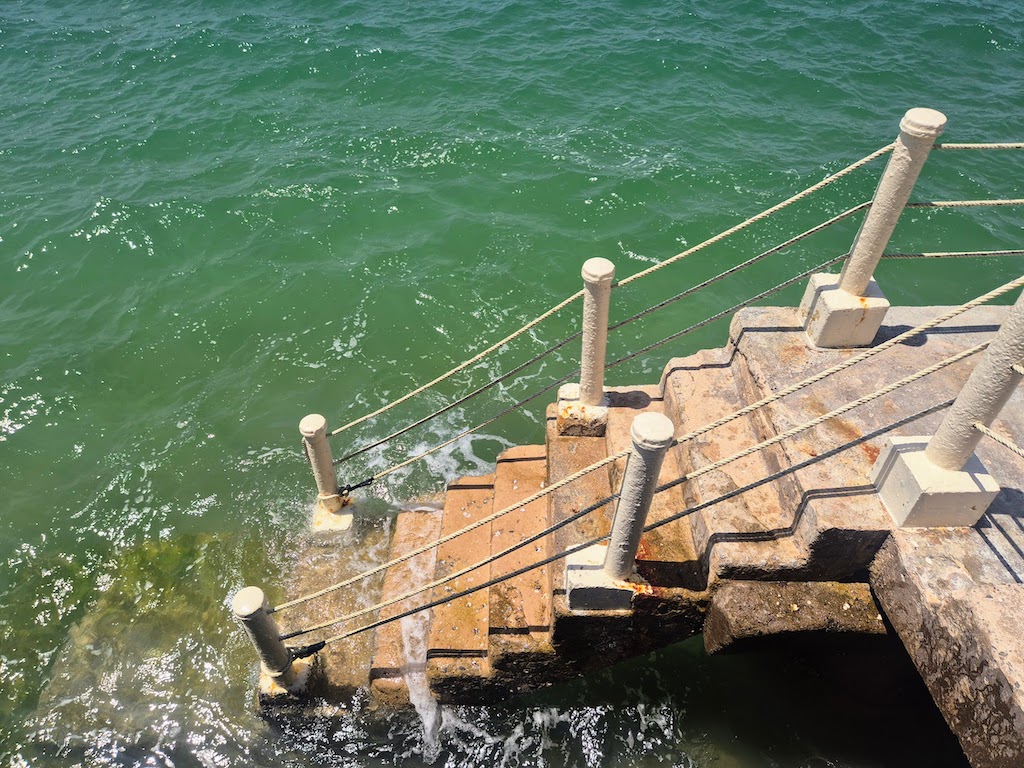

Peckham Bazaar

National newspaper recognition has not dented the idiosyncrasies of this great ‘pan-Balkan’ Peckham institution, where head chef and owner John Gionleka, originally from Albania, brings his wealth of experience and passion for regional cuisine to create dishes that are both comforting and innovative.. 

With its celebration of the South Eastern Mediterranean, it’s no surprise that fish is done superbly here, with a grilled octopus, white taramasalata (none of that neon-pink stuff here), and caper dressing a standout dish on our last visit, showcasing the chef’s skill in combining bold flavours and textures. It’s intriguing, exciting and both familiar and thrilling, which is pretty much all you want from a meal out.

The wine list here is a celebration of sometimes lesser-known grape varieties from the Balkans and Eastern Europe, and features unique and diverse options, ranging from the Simcic Opoka Ribolla, an orange wine from Slovenia, to Greek reds and other regional favourites. Spirit enthusiasts can indulge in a Peckham Negroni with Otto’s vermouth from Athens, which is excellent. Throw in a glass or two, and you’ve got yourself one of the best meals in Peckham.

Address: 119 Consort Rd, London SE15 3RU, United Kingdom

Website: peckhambazaar.com
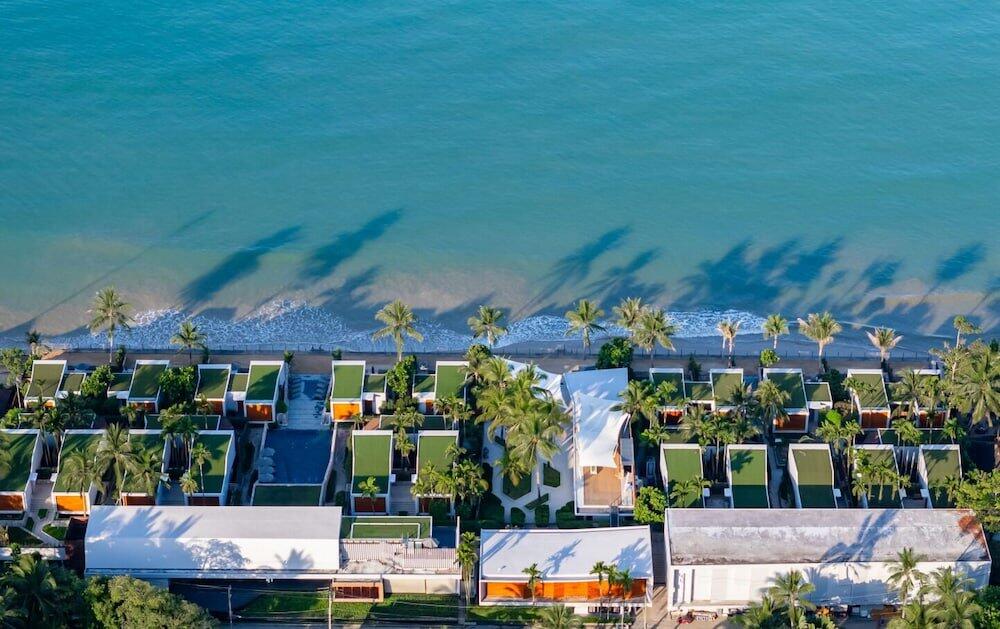

The Begging Bowl

Located on Peckham’s premier foodie strip Bellenden Road, the Begging Bowl uses Thai street food to form gorgeous small plates of zest and fire. The building is beautiful and airy, adding to the buzz this place generates even on a weeknight.

Chef-owner Jane Alty has trained in some of the best kitchens in London. Originally from New Zealand, Jane has lived in London for two decades, working alongside the city’s best chefs in top-name restaurants such as Bibendum, Galvin at Windows, Racine and, most influentially, the Michelin-starred Bangkok restaurant Nahm.

On the menu, dishes boast real clarity and punch, with excellent sourcing evident in the precision of flavour. Don’t miss out on deep fried whole sea bass, served under a tangle of shredded green mango and doused in a perky tamarind dressing. The jasmine rice, so fragrant and nourishing, is limitless. A real treat, and one of London’s best Thai restaurants, for sure.

Address: 168 Bellenden Rd, London SE15 4BW, United Kingdom

Website: thebeggingbowl.co.uk


Mr. Bao

Mr. Bao has been delighting South Londoners with its famous fluffy buns and other Taiwanese staples since 2016. 

Frank Yeung, the owner of Mr. Bao, is no stranger to Peckham’s restaurant scene, as he co-owns Miss Tapas on Choumert Road and has previously run a small chain of Mexican restaurants called Poncho 8 with his friend Nick Birkett, who is co-owner here. The duo fell in love with baos during their trips to New York and Asia, which inspired them to bring these instagrammable bites back to Peckham. We’re so glad they did.

The star of the show at Mr. Bao is undoubtedly one of its signature dishes, the Bao Diddley, a fried chicken bao given a real kick of flavour by kimchi and wasabi mayo. The tapioca flour used here is the masterstroke, making their chicken extra crispy, the fermented bean curd nestled within the buns packing an umami punch. It’s pretty much the definition of ‘crowd-pleaser’. For the vegetarians in the gang, the teriyaki shiitake mushroom bao is just as satisfying.

If you have a penchant for dessert, then their squidgy, sweet, salty and savoury miso cookie sandwich will make you smile – think two freshly baked chocolate chip cookies sandwiched together with miso caramel and marshmallow fluff. We’re grinning just thinking about it.

The restaurant also boasts an enjoyable selection of drinks, including their house Daddy Bao Yuzu Pale Ale, Mr. Bao Plum Wine Negroni, and a keen roll call of sake. Aahhhh.

And with that, we’re in need of a well-earned lie down…

Address: 293-295 Rye Ln, London SE15 4UA, United Kingdom

Website: mrbao.co.uk

Eating Near The O2: The Best Restaurants In Greenwich

Last updated May 2026

Who remembers the Millenium Dome? 

Those of a certain vintage may well recall the white elephant on the Thames. A hulking reminder of the unfulfilled promises and empty excesses of champagne socialism. The flimsy structure catching Daniel Craig’s fall but failing to capture the public’s attention. An inexplicable diamond heist…

…But to many, this spiky silhouette on the Greenwich skyline is better remembered as being the scene of some of London’s biggest gigs over the past decade or so, with everyone from Bey to BubléBieber and Burna gracing its stage. And those are just the B’s…

Though much maligned (and bloody freezing inside!), The O2 has become arguably the city’s main focus for major world tours, high-octane sporting events and more, playing a pivotal role in the regeneration of the Greenwich Peninsula along the way.

With close to 3 million tickets sold by The O2 annually, you’d think the options for eating in the vicinity would be as vast as they are delicious. The former is certainly true; there are close to 50 restaurants and food vendors onsite. The latter, however, is a little harder to say with conviction. 

In all honesty, if you’re looking for a truly fantastic feed before heading to The O2 Arena, you might be better off first pitching up in Deptford or Peckham, where there are plenty of great meals to be had. Simply take the 188 bus from Deptford, or catch the overground to Canada Water before taking the Jubilee line to the venue from Peckham – neither should take much longer than half an hour. 

But that’s not why you’re here, right? You’re here to find a great restaurant within a big yellow pillar’s throw of The O2 Arena. We’re here to help with that; here’s our guide on where to eat near The O2 Arena, Greenwich.

The Best Food At The Actual O2 Arena

For those in a hurry…

Marugame Udon, The O2

Ideal for a bargain bowl of noodles served swiftly…

The dining options at The O2 Arena may be vast, but they’re not desperately exciting – you’ve got your Nando’s, your Pizza Express, your Las Iguanas, and, well, that’s about it.

Arguably the best option for a nourishing, desperately decisive bite here is Marugame Udon. Specialising in Sanuki udon, a type of udon noodle from the Kagawa prefecture in Japan that’s famous for its firm, chewy texture and its simple adornments, this is a no-fuss bowl of goodness that will see you right before the show if you’re tight on time.

The chicken katsu udon is arguably the star of the show at Marugame, a best-selling dish that combines breadcrumbed, deep-fried chicken breast with a rich curry sauce and those chewy noodz. Costing £9.95, it’s a relative steal, too, though not as cheap as a bowl of the BK or kake noodles, both in a fish dashi broth at disparate ends of the rich to light spectrum, and both clocking in at just £4.95. That’s some seriously impressive value.

Marugame Udon has over 1000 stores worldwide, with 8 in London alone, so you’re guaranteed consistency and efficiency here, which is ideal if you can hear the band limbering up on stage.

AddressUnit 2.03 Entertainment Avenue, The O2, Greenwich, SE10 0DX

Websitemarugame.co.uk


Gaucho at The O2, The O2

Ideal for the only sophisticated-ish sit-down dinner in the O2…

One of around 20 of the Gaucho brand nationwide, this Argentinian-inspired steakhouse is perhaps the best (the only?) option for a fairly sophisticated sit-down meal within the grounds of The O2 Arena. 

Spread over three floors, it’s an expansive spectacle that’s billed as ‘the finest steak restaurant in Greenwich’. Think big, guys. 

To be fair, they’re probably right; the thoroughly marbled, hefty ancho rib eye, served blushing but not too rare, is a fine piece of beef indeed. Pair it with some chargrilled veg adorned with a well-made Caesar dressing, and you’ve got yourself a complete meal. Hold the sauce – the chimichurri is seasoned with caustic intent and brings nothing to the party. 

If you’ve got time before the show starts, finish things off with the vibratingly sweet salted dulce de leche cheesecake, which hits the right spot if you’re in the mood for a certain sort of sugar rush.

Update For Summer 2026: Gaucho’s new Flavours of Summer set menu is now running, with three courses for £35, available Sunday to Wednesday from 5:30pm. The set lunch remains strong value for this part of town at two courses for £17.95 or three for £19.95, available Monday to Friday between 12pm and 4pm, and there’s a pre-theatre option going at the same prices. Finally, on O2 show dates, cocktails are available at reduced prices, which is worth knowing if you’re watching the pennies before splashing out on merch.

AddressPeninsula Square, London SE10 0DX

Websitegauchorestaurants.com
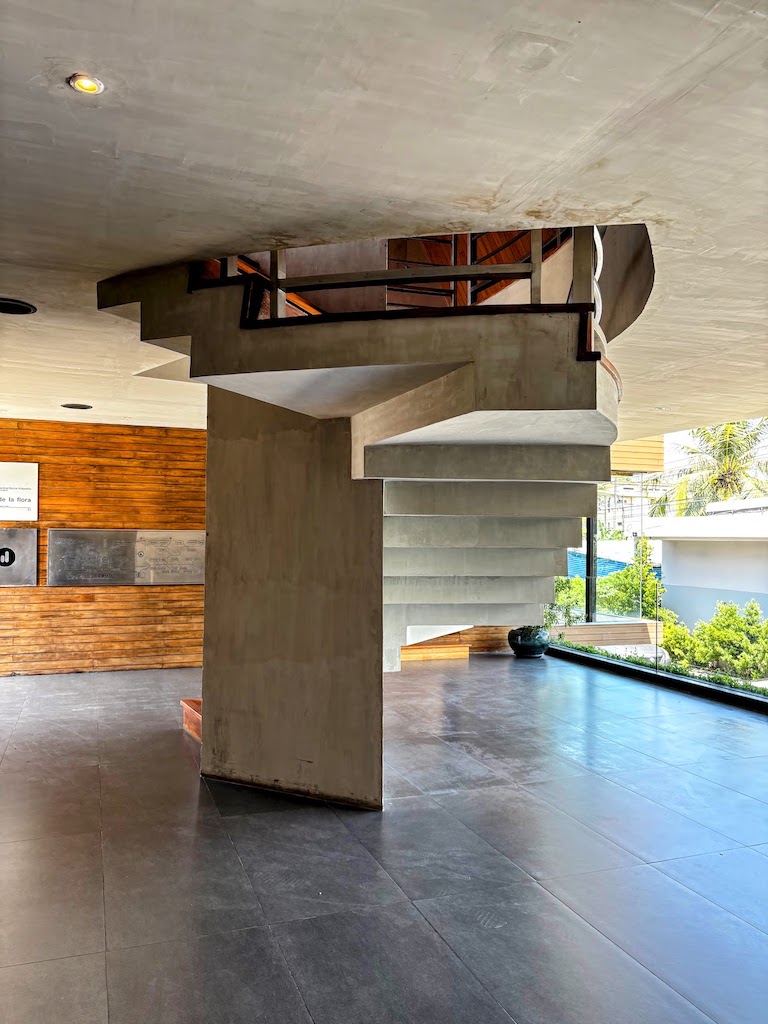

Five Guys, The O2

Ideal for familiar fast food when you’re in danger of missing the first song…

Listen; we don’t make the rules. When time is of the essence and you need a quick, satisfying, salty meal, Five Guys still does a job. Sure, you’ll need one of those silly 2 pint cups of beer to rehydrate afterwards, but that’s half the fun isn’t it?

AddressThe O2 Entertainment Centre, London SE10 0DX

Websiterestaurants.fiveguys.co.uk


The Best Restaurants In Greenwich 

Venture a little further afield and into Greenwich proper, and you’ll find your world of options for dinner expands greatly.

A short walk or even shorter bus ride from The O2…
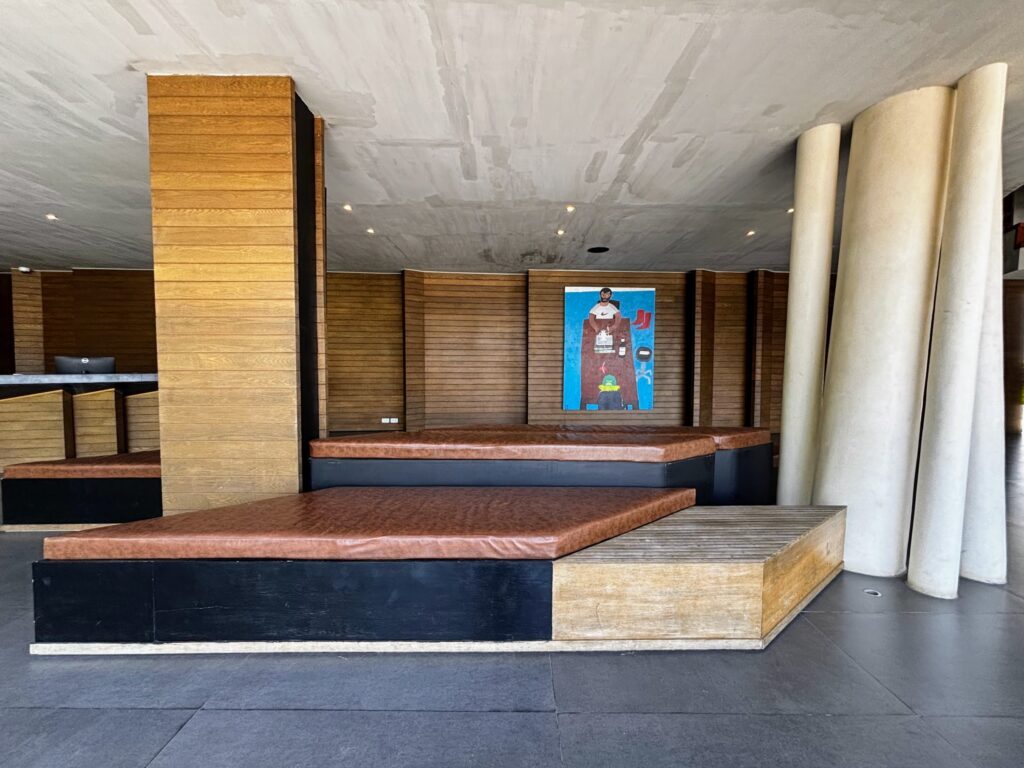
Wandercrust Pizza at The Pelton Arms

Ideal for Greenwich’s best pizza by some distance…

Though Crisp Pizza seems to have annexed all of London’s pizza-in-a-pub hype recently, Wandercrust Pizza’s residency at the Pelton Arms in Greenwich is still worthy of a little slice of the action. 

Long proved, wood-fired, Neapolitan-adjacent pizzas are the name of the game here, which arrived splayed over brown paper, all irregularly shaped, inflated and leopard-crusted, and glistening with a drizzle of good olive oil. 

The provola e pepe is the connoisseur’s choice, the smoked pasta filata bringing just the right amount of intrigue whilst letting the carefully sourced San Marzanos and the pizza’s oven pronounced breath shine. Freshly cracked black pepper seals the deal. This is a seriously good pizza, make no mistake, and quite possibly South East London’s best.

Pizzas start being slung at 6pm weekdays and from 1pm at the weekends, giving you plenty of time for a meal before the show – that’s if you give the support act a swerve, of course.
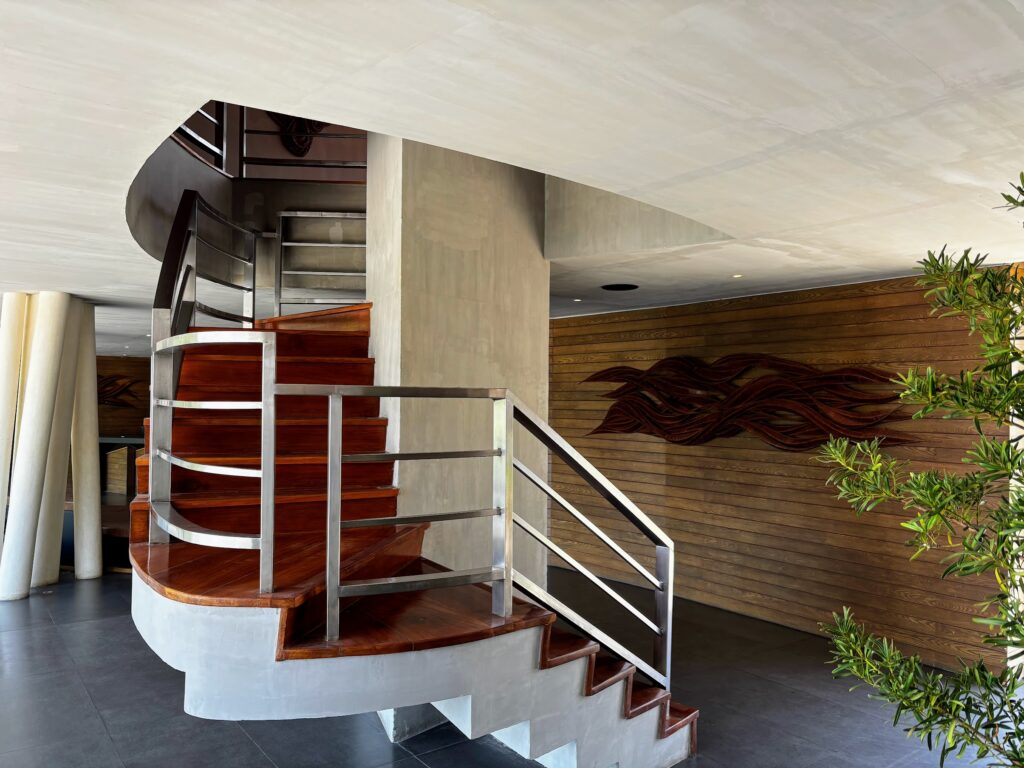
And on Mondays, it’s buy one pizza and get another free. Who can argue with that?

AddressThe Pelton Arms, 23-25 Pelton Rd, London SE10 9PQ

Websitewandercrust.com
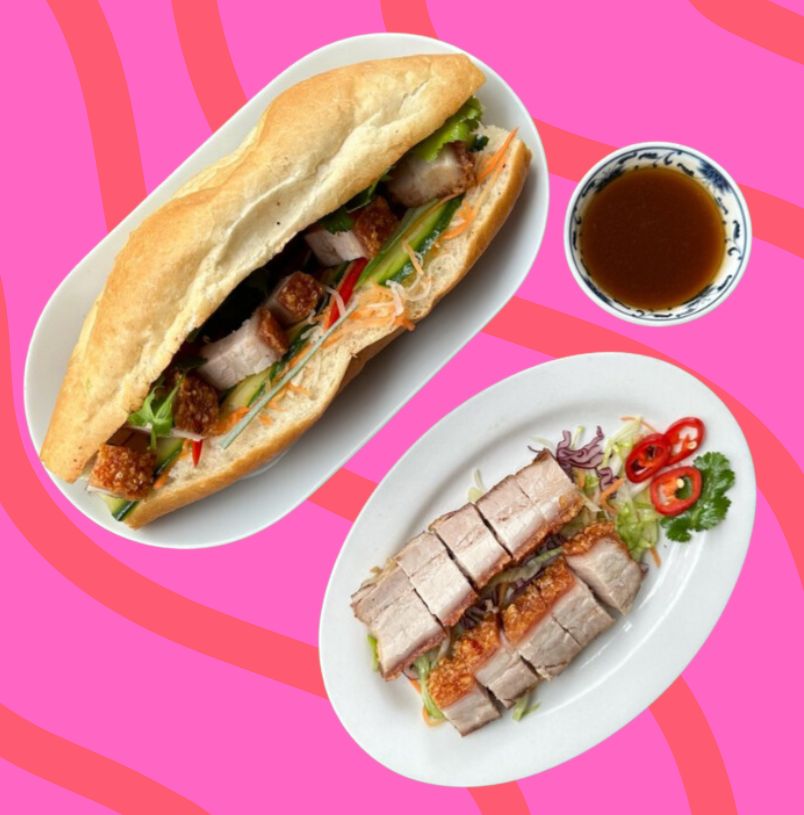

The Pilot Inn

Ideal for decent pub grub just a short stroll from the O2…

Just a 10 minute stroll from The O2, The Pilot is one of the oldest pubs in the area, oozing charm and history despite its takeover by Fuller’s a decade ago. 

Sure, it may be a centrally-run, generally-managed affair, but the food at The Pilot is genuinely decent. We’re partial to their ham hock and Cornish cider terrine, whilst the seared trout with braised lentils and crispy capers feels like it’s been cooked to order rather than warmed through in a bag. High praise indeed.

It’s also one of the closest places for a proper pint close to the venue. This is something you might want to savour pre-show, as the pints inside The O2 are flat as fuck. In summer, pitch up at some of the wooden bench seating in the courtyard opposite the pub and have a few – it’s a pleasant spot.

The Pilot’s Sunday roasts are particularly renowned (vague promises of provenance appear, such as ‘South Coast pork’, ‘Yorkshire’ puddings…), making it the perfect place for a long and leisurely afternoon meal before a Sunday night show. If you’ve got seated tickets, that is…

Address68 River Way, London SE10 0BE

Websitepilotgreenwich.co.uk


K Kitchen

Ideal for a messy, spicy takeaway…

Though K Kitchen – a Korean joint that does a mean fried chicken – is takeaway only, it’s only a couple of minute’s walk from the attractive East Greenwich Pleasaunce Park

Glazed in your choice of three house sauces (or simply ‘savoury, without sauce’), here boneless thigh fillets are double battered and double fried for maximum crunch. Though the plum and garlic certainly hits the spot, we’re all about the sweet chilli sauce glaze here, which boasts that sharp piquancy of the finest Korean fried chicken. 

Order a tub of 5 thighs for an eminently reasonable £8.95 and head for that park for the ultimate pre-show, alfresco feast. Bring extra napkins – this one gets messy!

Read: Where to eat the best fried chicken in London

Address9 Woolwich Rd, London SE10 0RA

Websitekitchenonline.co.uk


Goddards at Greenwich

Ideal for a quintessential pie and mash experience…

Standing proud since 1890 in the heart of Greenwich, and a mere hop, skip, and a jump (or, more sensibly, a 15 minute bus ride on the 188) from The O2 Arena, Goddards at Greenwich offers a quintessentially traditional pie and mash experience. 

The pies are hand-made with flaky pastry (also available gluten-free), the fillings are generous with just the right level of sauce-saturation, and the liquor is just as bracing as God intended it. Delicious.

And for the sweet-toothed, the dessert menu features another British staple – steamed puddings smothered in syrup. Whether you’re a local or a visitor, a meal at Goddards at Greenwich is an authentic taste of London’s culinary heritage that should not be missed.

Address22 King William Walk, London SE10 9HU

Websitegoddardsatgreenwich.co.uk


Alhaji SUYA

Ideal for an endorphin-stoking chilli rush…

This Greenwich outpost of the popular Peckham institution started life as a hole in the wall in the car park of Smyths Toys Superstores, but has since moved to a proper shopfront on Woolwich Road with a few seats. It still operates primarily as a takeaway, serving some of the best northern Nigerian food in the capital.

Just look for the lines of Uber Eats drivers, as Alhaji does a roaring trade in delivery to the hungry punters of South East London and beyond. The suya has a pronounced hum of smoke and a bark that’s achieved through a process of double-grilling, and the chilli heat manages to be both assertive and nuanced.

Kilishi – a robust dried beef number similar to jerky – is also sold here by the 60g for £5.95. You’d be foolish not to add a 5 gram baggy of extra yaji spice to your order, too. Sneak a Minigrip of the stuff, rusty red and thrumming with heat, into The O2 in your sock for a chilli-inspired endorphin-rush mid-gig. Ah, that’s the stuff.

Open daily from 10am until 10pm, and 11:30pm on Fridays and Saturdays.

Address: 24 Woolwich Rd, London SE10 0JU

Websitealhajuisuya.com
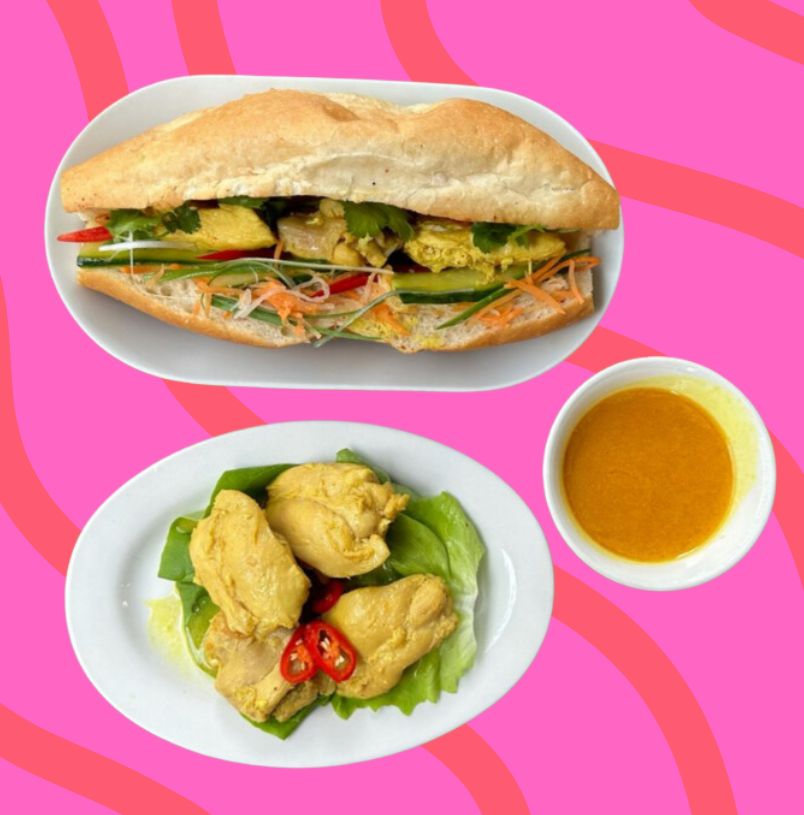

Heap’s Sausages

Ideal for a pre-gig banger…

Martin Heap has been making sausages for longer than most London restaurants have existed. He started Simply Sausages at Smithfield Market in 1991, where queues formed around the block for his 24 varieties of banger – the same recipes that now fill Sainsbury’s Taste the Difference range. His Greenwich café and deli, run with partner Vincenzo Carbonara (can’t help thinking he’s missing a trick being confined to the sausage game), is where you’ll find the originals: handmade on-site, visible through the glass at the back of the shop.

The flagship No.1 sausage – 88% pork with nutmeg, mace and a whisper of white pepper – hasn’t changed since Heap first perfected it. But the menu runs broader than that: sausage and mash with onion gravy, the Lethal Lucifer hot dog for those who like heat, lamb merguez with tzatziki, and a Big Heap’s Bap that stacks sausages, bacon and egg into something approaching structural engineering. There’s a small heated courtyard out back, local wines and Fourpure beers, and a deli counter selling cheeses, charcuterie and store cupboard bits if you want to take something home.

A word of warning: this is a daytime operation only, closing at 4pm daily, so it’s lunch before a matinee rather than dinner before an evening show. It’s also a good 45-minute walk to The O2 from here, so allow time or hop on the Thames Clipper from Greenwich Pier to North Greenwich, but it’s well worth the detour if you like your sausages made by someone who’s been at it for over three decades. Who doesn’t, quite honestly?

Open Monday to Friday 7:30am to 4pm, whilst on Saturdays and Sundays things start a little later, at 8am and 9am, respectively.

Address: 8 Nevada Street, Greenwich, London, SE10 9JL

Website: heapssausages.com
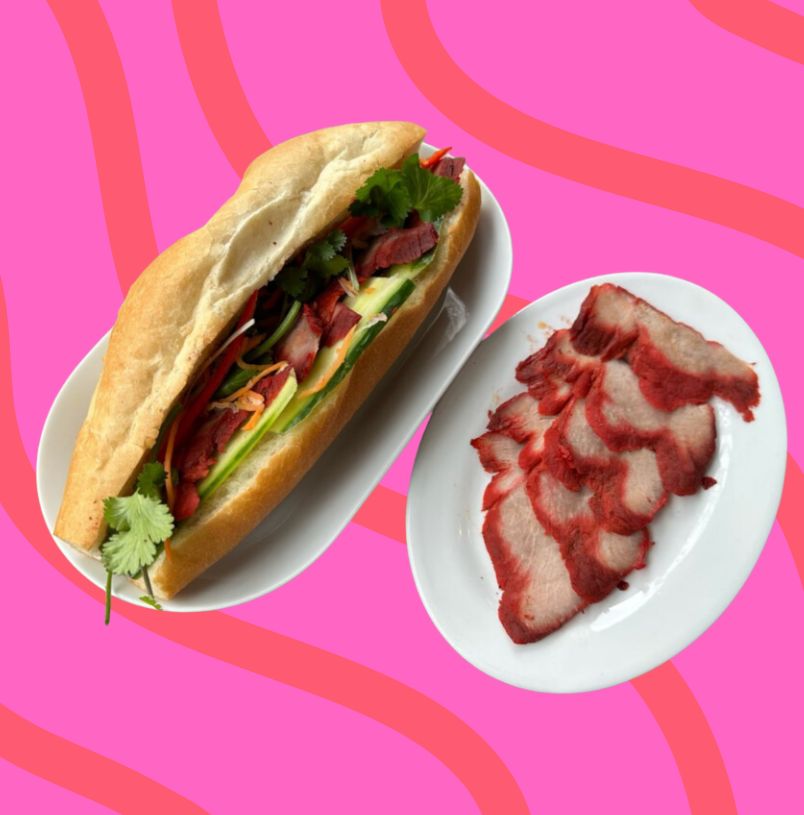

Greenwich Market

Ideal for a fickle squad who need plenty of choice…

A bit further afield but worth the journey, Greenwich Market is a treasure trove of street food stalls serving cuisines from around the world. From Thai curries to Italian arancini, the world’s your oyster here (they do those, too). It’s a great place to explore if you have a few hours to spare before your event at The O2.
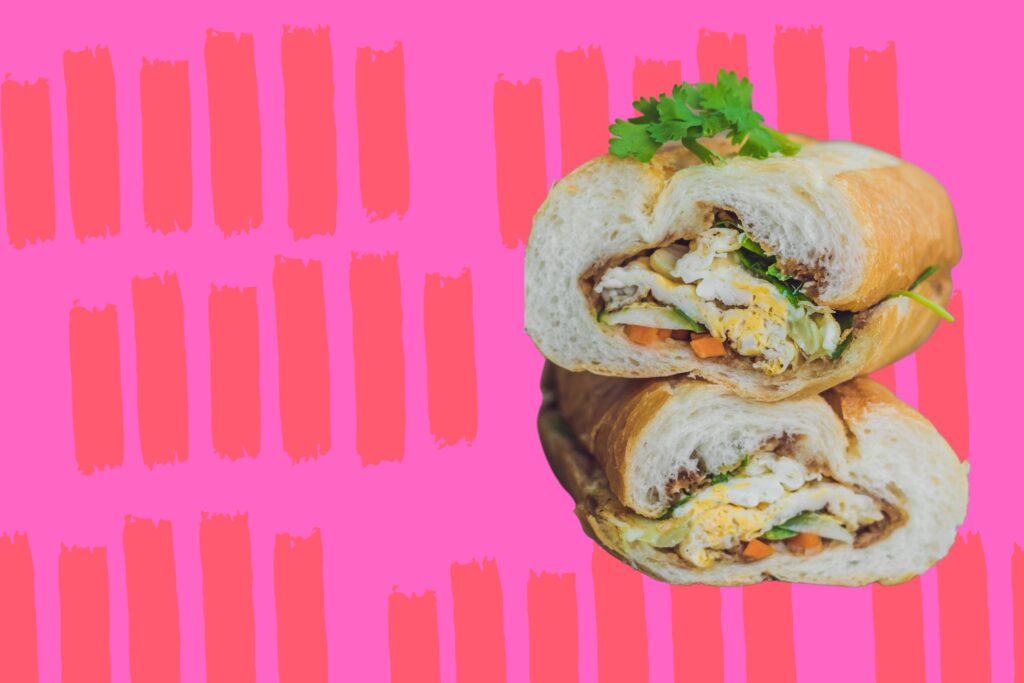

Among our favourite stalls here are the prosaically named but poetically seasoned Ethiopian Vegetarian Food, whose Yetsom Beyaynetu platter (well, polystyrene box in this case) is superb. Just down the way, another Ethiopian joint, Addis Taste, does a damn fine lentil sambusa (a samosa of sorts). 

Photo by Michael Elliott

For dessert, it’s got to be Doreen’s Jamaican Homemade Rum Cake, the name of the stall and the indulgently soaked sweet treat that is the headlining act. We have to admit gorging on so many of these in a single sitting once that we genuinely felt pissed…

Do be aware that the market closes at 5:30pm, with many stalls winding down earlier than that, so make sure you’re planning on an early dinner/late lunch if you’re eating here before heading to the venue. Don’t worry about that yawning gap between finishing eating and your gig beginning; the walk from Greenwich Market from the O2 can be an incredibly pretty one, and takes around an hour. Simply head for the Cutty Sark from the market, and follow the curve of the Thames north. Beautiful.

Address5B Greenwich Market, London SE10 9HZ

Websitegreenwichmarket.london


Mountain View

Ideal for superb value Nepalese food…

Don’t be fooled by the starched white table clothes in Greenwich’s premier Nepalese restaurant, Mountain View; the vibe here is laid back and unpretentious, and the food fresh and invigorating. 

Start with the fulsome, subtly spiced lamb momos, steamed and pleasingly gelatinous. Served alongside is a nuanced tomato achar, spicy and smokey but in a measured way. It’s an excellent way to kick things off here. Or anywhere, for that matter. It’s also laughably good value at just £6.25 for a plateful.

From the larger dishes, the murgh tikka lababdar is a rich and soothing affair, its generous finishing of cream and butter smoothing out the rougher edges of smoked chilli. Smooth out your own rough edges with a pint of Cobra – on tap here – and it’s show time.

Address160 Trafalgar Rd, London SE10 9TZ

Websitemountainviewgreenwich.co.uk

Read9 local dishes to try on your holiday to Nepal


Bianco43

Ideal for Neapolitan-style pizza opposite Cutty Sark station…

Step out of Cutty Sark DLR Station and you’ll see the glowing pull of Bianco43 pretty much straight away, the warm, flickering smoulder from the pizza oven an enticement if ever there was one.

From that oven, it’s Neapolitan-style pizzas all the way, the Napulé a particularly salty, satisfying business. Tuesday is Pizza Night at Bianco43, with any pizza on the menu for £10.90. Worth knowing if your show falls midweek.

There’s also a short selection of homemade pasta dishes. Keep it light with spinach and ricotta tortelloni or go to town on the lasagna, before walking it all off, riverside. The O2 is less than hour away on foot, and it’s a pleasant walk.

Address43 Greenwich Church St, London SE10 9BL

Websitebianco43.co.uk


Just across the Thames in Canary Wharf, you’ll find a broader selection of restaurants to dine in before you head to the O2. Check out our guide on the best restaurants in Canary Wharf before you make that call.

The Best Restaurants In Tooting

Last updated May 2026

Known affectionately for decades as London’s curry corridor, in the past few years Tooting has evolved into one of the capital’s most exciting food destinations, all while keeping its South Asian culinary heritage firmly at its heart. 

This South London neighbourhood – famously crowned one of the world’s coolest by Lonely Planet – now draws food pilgrims from across the capital with its intoxicating mix of 30-year-old Pakistani institutions, Aussie brunches and cutting-edge Filipino BBQ joints.

The transformation hasn’t erased Tooting’s culinary soul just yet. While gentrification threatens to push property prices further skyward, the area’s significant South Asian population ensures incredible curries remain the beating heart of this evolving food scene. From £20 Sri Lankan feasts to award-winning tasting menus, these are the essential dining experiences that make Tooting unmissable. Here are the best restaurants in Tooting.

Apollo Banana Leaf

Ideal for Sri Lankan feasting on a budget…

This Sri Lankan institution occupies what can only be described as a community centre crossed with a particularly exuberant wedding reception. And how damn good does that sound? Technicolour mountain murals compete with disco lights for your attention, while the BYOB policy (no corkage) keeps the atmosphere properly convivial and costs wonderfully minimal.

The food here is serious business, despite the party-ready surroundings. Their mutton kothu roti – that glorious mess of chopped flatbread stir-fried with spiced lamb – arrives as a steaming heap of carby, meaty joy that’ll have you questioning why you ever bothered spending twenty notes on that pappardelle and ragu ten minutes up the road. The crab masala comes in a heady sauce thrumming with brown crab meat, the white meat still in the claws and requiring both commitment and plenty of napkins, while those crispy mutton rolls at £1.79 each make perfect sense as a starter, a side, or honestly, a snack for the journey home. Or, you know, all three…

Don’t stop there. The £11.29 king prawn curry delivers maximum flavour for minimal outlay, though be warned: when they mark something with a single chilli icon, they mean it’s hot. This is heat that builds and builds, the kind that has you reaching for another Kingfisher while swearing you’ll order mild next time. You won’t.

And in a final commitment to obscene value – in this city, in this economy – there’s a set lunch from Fridays to Sundays, and a set dinner Sunday to Thursday for just £8.99 and £9.99 respectively. Getting change for a tenner, that includes four huge dishes, including dosa and biryani. These guys want to feed you, and there’s no point trying to resist it.

Website: apollobananaleaf.com

Address: 190 Tooting High Street, SW17 0SF


Lahore Karahi

Ideal for legendary Pakistani curries in a no-nonsense setting…

This family-run corner restaurant has been part of Tooting’s fabric since John Major was Prime Minister, and they’ve spent those decades perfecting their craft. Forget what you might have read elsewhere – the real draw here is the nihari. This overnight-cooked beef stew arrives rich and deeply spiced, the meat almost disappearing into the sauce, it’s broken down so thoroughly. It’s the sort of dish that was traditionally eaten by Mughal nobility after morning prayers, now democratised for South London at £13.95.

The dining room is simple but attractive – think bright strip lighting and tightly packed tables in clean lines. Downstairs, it’s a canteen-like and upstairs it looks a bit like a Premier Inn on steroids. But this is a restaurant, not a showroom, and when your mixed grill delivers meat that’s been charred, burnished and rendered gnarly by the tandoor, aesthetics become irrelevant. 

Their beef chapli kebabs are another must order on a menu full of them – these Pashtun-style patties come studded with coriander seeds and crushed chillies, the kind of thing that’s hard to find done properly outside Pakistan or Afghanistan. At Lahore Karahi, it’s just a queue to get at them, rather than a flight.

The fact they’re open from 10am for traditional Pakistani breakfast (halva, chana and puri) shows they’re serious about feeding the community, not chasing trends. BYOB keeps things affordable at £2 per person corkage, though don’t plan on lingering over your bottle – tables turn fast here, with a queue often forming by 7pm on weekends. That’s all part of the Lahore Karahi experience.

Update For Summer 2026: Lahore Karahi has expanded its reach with delivery and collection kitchens in Croydon, Peckham and Camden – though the original Tooting site remains the place to eat in.

Website: lahorekarahi.co.uk

Address: 1 Tooting High Street, SW17 0SN


Turo Turo

Ideal for modern Filipino cooking that respects its roots…

After years of successful pop-ups, former Gordon Ramsay chef Rex De Guzman finally opened this permanent Filipino spot in November 2024, and Tooting’s dining scene is all the better for it. The pork sisig has become their calling card – it arrives on a cast iron plate hot enough to continue cooking at the table, creating the kind of theatre that would have everyone in the room looking over enviously, had they not already ordered it, too. It’s a riot of crispy pork, onions and chillies that gets even more appealing as it sizzles away in front of you.

The name means ‘point point’ in Tagalog, referring to how Filipinos traditionally order from street stalls by pointing at what they want. But while the name nods to street food culture, the execution here aims to show off De Guzman’s fine dining background. The chicken inasal – marinated for 24 hours before hitting the grill – is a gorgeous mix of blistered surface and brined tenderness within – its vinegar-based sawsawan sauce provides the perfect acidic counterpoint to cut through the richness. Both these hero dishes clock in at £12, which is pretty wild for the quality, quite frankly. 

Ginger and bagoong (Filipino shrimp paste) marinated chicken wings are absurdly satisfying, only needing a cheek of lime to see them on their way, whilst their soy and garlic glazed charred aubergine has become something of a signature, the aubergine fudgy and giving, the glaze packing plenty of umami punch.

The rum-heavy cocktails feel appropriately tropical without descending into tiki bar cliché. All in all, Turo Turo has fast become one of Tooting’s best places to eat, and we can’t wait to go back and get across the grilled skewers in more depth and detail.

Weekend brunch (Sat and Sun, 10:30am-2:30pm) and the communal Boodle Fight experience have since become part of the offer, along with regular karaoke and open mic nights – Turo Turo is now as much bar and live music venue as restaurant.

Website: turoturo.co.uk

Address: 102 Tooting High Street, SW17 0RR


Daddy Bao

Ideal for Taiwanese soul food with a side of family history…

Frank Yeung named this place for his father, and that family connection runs through everything from the recipes to the service at Daddy Bao. The shiitake mushroom baos have become a thing of local legend among London’s vegetarians – salty-sweet and pleasingly bouncy. They arrive in an intimate space decorated with dark wood, red lanterns and jade accents that creates the right mood for date night without trying too hard.

The slow-braised pork belly bao remains the bestseller for good reason. The meat comes lacquered in a hoisin-style glaze. It’s then topped with crushed peanuts and fresh herbs that add texture and brightness to each bite. But it’s worth venturing beyond the baos – the three cups chicken showcases the Taiwanese talent for balance, aromatic with Thai basil and hitting that sweet-savoury-boozy sweet spot that defines the dish when done with precision.

The weekend bottomless brunch is big news in Tooting, though the small size means booking ahead is essential unless you fancy joining a queue that snakes all the way into Balham. August 2024 saw them expand downstairs with Good Measure, an underground cocktail bar open Thursday through Saturday that serves Taiwanese-inspired drinks. The ambition shows they’re not content to rest on their bao laurels – this is a restaurant that keeps pushing.

Website: daddybao.co.uk 

Address: 113 Mitcham Road, SW17 9PE


Smoke & Salt

Ideal for discovering what happens when fine dining meets market dining…

You’ll find Smoke & Salt on a residential drag of Tooting High Street, where a string of restaurants, barbers, cafes and grocers begins to thin out, and terraced housing takes their place. The location might seem unlikely for a restaurant that’s got recognition from both the Good Food Guide and Michelin Guide 2026, but chef Aaron Webster makes it work. 

The Culture menu is the full experience at £80pp (wine pairing £65), a multi-course run through chef Aaron Webster’s smoking, curing and preserving techniques. The Craft menu offers a pared-back glimpse of the same kitchen at £48pp (wine pairing £42), available until 6.30pm. Dishes shift with the seasons, but the current spring menu gives you a sense of the kitchen’s range: a delicate consommé with langoustine oil, pretzels with smoked butter, a beef fat donut filled with beef ragout, striploin suya with yaji and rhubarb. It’s the kind of cooking that wouldn’t look out of place in restaurants charging twice the price.

This is cooking that takes calculated risks without forgetting the basic rule of restaurants: make it taste good. The wine list follows suit, leaning into natural wines and less obvious choices – think Austrian orange wine, chilled South African pinotage, or organic Spanish xarel-lo rather than the usual suspects. With glasses starting at £7, you can afford to be adventurous.

Website: smokeandsalt.com

Address: 115 Tooting High St, London SW17 0SY


Namak Mandi

Ideal for Pashtun cooking that demands your full attention…

This cash-only Pashtun restaurant operates at a frequency that borders on controlled chaos. The downstairs dining room is 50% counter, 100% kinetic energy – staff squeeze past tables balancing enormous Afghan naans on hooks, flames shoot from karahis, and the air hangs thick with smoke from the grill. Walking past at dinner time, you’ll see the queue forming outside, people pointing at the takeaway menu whilst simultaneously counting cash.

The chapli kebabs are essential – deep-fried beef patties studded with coriander seeds and crushed chillies that arrive with enough structural integrity to be almost aerodynamic, but so juicy and perfectly spiced that resistance is futile. Order two, not one. Order three in fact. The lamb karahi comes straight from a still-smouldering wok (the vessel is the karahi), its tomato-based sauce hitting sweet tangs and ginger notes that feel light and luxurious. The naans are genuinely absurd in scale – pillowcase-sized flatbreads that need their own custom stands.

But the real theatre happens upstairs. Pre-order the lamb sajji at least two days in advance, and you’ll be ushered into private dining rooms where shoes come off, cushions line the floor and there’s the thick patina of lamb fat across all surfaces. The whole lamb – roughly 15kg – arrives in a trough atop a mountain of kabuli pulao, pink and tender throughout. It’s best attacked with hands, and mess is not just accepted but encouraged.

Namak Mandi isn’t licensed and doesn’t allow BYOB, but when you’re wrestling with a small animal in a curtained room, alcohol feels beside the point – you’ve got enough on your plate.

Website: namakmandi.co.uk

Address: 25 Upper Tooting Rd, Tooting Bec, London SW17 7TS


Vijaya Krishna

Ideal for Keralan spicing that hits the spot…

Three decades in the same spot might make some restaurants complacent, but this Keralan specialist recently emerged from a refurbishment looking fresh while keeping the cooking that made its reputation consistent. The new look features cream walls, soft lighting and classical Indo-European portraits of Indian musicians – a contemporary setting that matches the sophistication of what has always come out of the kitchen.

The masala dosas here are genuinely comedic in scale, arriving like giant golden scrolls that could double as sleeping bags, stuffed with perfectly spiced potato filling. But size isn’t everything – it’s the execution that counts. The dosa itself shatters at first bite before giving way to a slight sour chew, and the sambar and chutneys provide the traditional accompaniments done right. 

The kitchen’s real skill shows in dishes like the lamb madras, which has a heat that builds gradually, undulates further, all while maintaining complex spicing that reveals itself as the chilli heat subsides. 

That said, as a Keralan restaurant, their specialities really shine in dishes like the fish molee or Kerala parotta. Their vegetable avial might sound humble on paper – mixed vegetables with coconut and curry leaves – but it achieves a satisfying kind of harmony. Just when you think you’ve had too much sweetness, aromatic notes roll into town. Once it’s all starting to feel a bit too heady, spice and sweetness takes over once again. It’s incredibly skilful seasoning. 

Unlike many Tooting spots, they’re fully licensed, with a wine list that sensibly focuses on bottles with enough structure to stand up to the spicing. There are beers too, of course.

Website: vijayakrishna.co.uk

Address: 114 Mitcham Road, SW17 9NG


Juliet’s Quality Foods

Ideal for Australian-style brunch that earns its queues…

From the team behind Balham’s absurdly popular Milk, Juliet’s has achieved the kind of devoted following that has weekend warriors setting alarms to beat the queues. The pistachio slice with yuzu icing has many adoring fans but it’s not the only highlight from a menu where every dish reads like someone’s hungover fever dream of breakfast excess but somehow works brilliantly.

The menu goes big on brunch creativity – think fermented chilli butter çilbir, shrimp patty buns, and that famous espresso hollandaise on their ‘Young Betty’ variations, which are essentially delicious creative bits over sourdough toast. Sure, every plate looks ready for its Instagram close-up, but more importantly, the food tastes as good as it looks.

The fit-out screams Melbourne-meets-South London: exposed brick, retro 70s bubble lettering, and a sun-trap garden that becomes a small war zone for tables come Saturday morning. The weekend queues snake down Mitcham Road like they’re giving away free houses, but people wait because they know it’s worth losing half a morning for.

Prices reflect the ambition – expect to pay £15-20 for most mains – but in a world of soggy full Englishes and sad smashed avocado, Juliet’s is proof that brunch can be worth getting excited about. Just don’t expect to walk straight in at 11am on a Saturday.

Website: juliets.cafe

Address: 110 Mitcham Road, SW17 9NG


Dub Pan

Ideal for faithful yard cooking with a sound system soundtrack…

This husband-and-wife operation in Tooting’s Broadway Market brings yard shop vibes to SW17, complete with steel drums out front where jerk chicken meets its smoky destiny. The interior goes all-in on the Caribbean theme – reggae posters, bright colours, sound system on point – but this isn’t some sanitised chain version of island culture. This is the real deal, run by people who know the difference between authentic jerk seasoning and the stuff that comes in a bottle from Saino’s.

The jerk chicken justifies the hype, arriving properly charred after its 24-hour marinade bath. This is jerk with the requisite layers – sweet from the scotch bonnets, aromatic from the allspice, with heat that builds slowly then stays with you. The curry goat is equally accomplished, the meat tender enough to fall off the bone but still having a pleasing structural integrity, swimming in a sauce that suggests someone’s grandmother is in the kitchen passing down secrets. Even the shrimp rundown – prawns cooked in coconut milk until they’re sweet and tender – shows what happens when simple dishes get proper respect.

Weekend bottomless brunches have become the stuff of Tooting legend, largely thanks to their ‘Iron Strong’ rum punch that lives up to its name. £29.50 gets you 90 minutes of bottomless rum punch plus a meal box or main dish, available Friday to Sunday at the Tooting site. Just don’t wear white – between the jerk sauce and the curry, this is food that demands full commitment. And maybe a few extra napkins!

Update For Summer 2026: Dub Pan has expanded beyond Tooting, with sites now in Boxpark Shoreditch, Boxpark Croydon and a Dub Burger spin-off at Mercato Metropolitano. Reassuringly, the original Broadway Market shack remains the heart of the operation.

Website: dubpan.com

Address: 29 Tooting High Street, Broadway Market, SW17 0RJ

So close we’re not actually sure where the border changes the name, we’re checking out the best restaurants in Balham next. Care to join us?