Home Blog Page 219

HOW TO CARE FOR YOUR SOFA: 5 SIMPLE TIPS FROM THE EXPERTS AT MADE.COM

Our sofas have gone through a lot lately. They’ve been there for us on our darkest days. Since all day Netflix binges have replaced days out, and our sofas have taken the place of our ergonomic office seating, an inevitable wear and tear of our favourite chair has followed.

Whether you have a trusty older sofa in need of some love or you’re plotting a purchase in the February sales, we’ve teamed up with the furniture experts at Made.com to share these 5 simple tips on how to care for your sofa.

PROTECT YOUR SOFAS FROM FADING

A lot of fabrics, including leathers, are affected by sunlight and heat, so to avoid fading and damage from these sources, we recommend keeping your sofa away from direct light and heat sources – this includes radiators. 

While all fabrics will naturally fade over time, positioning your upholstered and leather chairs and sofas away from direct sunlight will help to minimise changes in appearance, keeping the material’s vibrancy for longer.

It should go without saying, but keep your sofa away from naked flames and cigarettes, too. Naked bodies, on the other hand, are fine.

PLUMP UP YOUR CUSHIONS

Over time, cushions will lose volume, and with increased and extended use, the speed of this loss is only increased. If you have noticed a ‘you’ shaped groove in your sofa cushions lately, then it’s time to take action. 

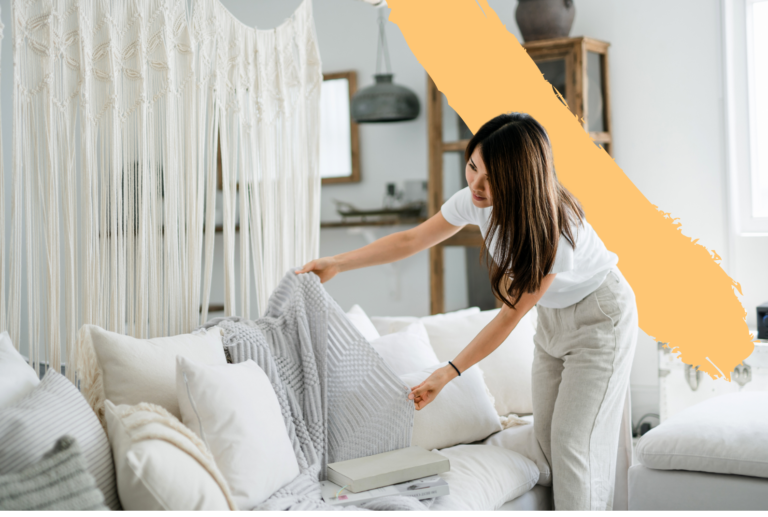
Keep your cushions at their best for longer by plumping firmly from the outside edges after use. If your cushions aren’t fixed, it’s also a good idea to turn and rotate them to avoid uneven wear. Aim to do this once a week to keep cushions looking fuller.

BLOT SPILLS

Accidents are bound to happen, you are only human after all and we’ve all been drinking a little more wine on our sofas recently. That said, it’s vital that you attend to any spillages immediately to avoid causing permanent damage to your sofa’s surface. 

Soak up liquids with a dry cloth by blotting; never rub in the liquids as this is more likely to cause matting or deepen any stains if the spilt liquid is coloured. Once the worst of the spill is absorbed, use a hairdryer to avoid water marks, being careful not to place it too close to your sofa as this could burn the fabric – a distance of 30cm is recommended.

If you’ve spilled something that might leave a serious stain, such as red wine, there are some upholstery specific stain removers that can be purchased. However, ensure that you do your research as to whether they are suitable for your particular sofa’s material. If unsure, it’s best to ask a professional for help.

CLEANING YOUR SOFA

Fabric sofa: You should vacuum your sofa regularly to avoid dust building up – this can, over time, cause marks to develop on the fabric that can’t be reversed. If your sofa is in need of a deeper clean, seek out a local professional rather than trying to clean it yourself.

Velvet sofa: Turn the cushions regularly, and gently brush or vacuum (with an upholstery attachment or cloth-covered regular nozzle) weekly. 

If your velvet pile starts to have a crushed appearance, brush the furniture with a clothes brush to fluff the pile back up. Because of the way it’s woven, velvet pile will naturally crush over time, but doing this will delay the process.

Whenever there is a spill on your velvet sofa, follow the same steps – blotting and drying with a hair dryer but following the process with the use of a clothes brush to prevent matting. More serious stains and spills will require a professional, though.

Leather sofa: Leather sofas are great for families with children or pets because of how much easier they are to clean (the sofas, not the children and pets!). It’s simple; spills can be wiped with a damp cloth and then dried with a towel. To keep your leather looking its best, we recommend you clean it regularly with a leather cleaner, too.

KEEP ON TOP OF PET HAIR

Pet hair has that magical ability to stick to everything and anything, especially fabrics like velvet. To keep rogue pet hair to a minimum, it’s good practice to vacuum your sofa regularly, including in the gaps where pet hair may gather.

A top tip: For those more stubborn hairs that refuse to be sucked up, deploy a window squeegee to gather the hair. Use the squeegee in a downwards scraping motion, as this will gather the hairs into neat piles which can then be removed by hand or with the vacuum cleaner.

If you don’t have tonnes of time to commit to laboriously vacuuming your sofa regularly, then simply invest in a stylish yet affordable throw or pet mat that you can train your pet to sit on, keeping the rest of the seat fuzz free.

IDEAL COLOURS TO PAINT YOUR HOME TO INSPIRE CREATIVITY AND WELLNESS

Each month, search data shows that over 20,000 of us are looking for more information on the topics of “wellness” or “well-being”. And that figure keeps growing year on year, with Google Trends showing a whopping 147% increase in searches for “well-being” in the past five years, and a 114% increase in searches for “wellness.”

So, how do we get our wellness fix when we’re stuck at home? One way is to create a space that’s filled with positive vibes – using simple decor tips and tricks. According to a survey by YouGov, 15% of people have made a resolution to spruce up their home decor in 2021. After the amount of time we’ve spent at home last year, it’s easy to understand why there’s been a spike in DIY projects and home makeovers.

With this in mind, and with the help from the team at Lick Home, here are the IDEAL colours to paint your home to inspire creativity and wellness.

ADD HARMONY TO YOUR HOME WITH GREENS AND BLUES

When it comes to designing a space that promotes wellness, nature is a crucial element which should be incorporated into the design process at every turn. If you’re missing your outdoor time like so many of us, welcome some of that natural feel-good factor into your homes by bringing in those blues and greens.

Green 03: Dark Faded Green Paint 

Known as the colour of harmony and balance, green will bring that feeling of peace into any space of your home. It’s also the colour of nature, and as we’re spending more time indoors right now, adding a few splashes (or licks) of green to your home helps by bringing a bit of the outdoors in.

Lick’s colour experts recommend adding green to your kitchen. Having a green kitchen may subconsciously inspire you to eat more healthily. You could also try green for your home office/whichever room where you choose to park yourself in with your laptop for the day. Green is a restful colour for your eyes, so it’s a good choice for when you need a break from staring at Slack messages.

Blue 07: Dark Inky Blue Paint (with a touch of green) 

This moody and mysterious blue is another colour whose presence can help you feel closer to nature. Just like a crisp blue sky can instantly add positive vibes to your day, bringing in some of those cool and calming blues to your home can have the same effect.

With blue, the lighter you go, the more soothing your space will be. Darker blues are more stimulating, so choose to paint those in home office areas for a little mental boost. Pair dark blue walls in an office with bright accents such as Yellow 02 or Orange 02 for best results.

PAINT WITH BRIGHTER COLOURS FOR AN INSTANT INJECTION OF GOOD VIBES

The guys at cloudpainters tell us that “although painting your home with peppy colours may feel a little scary at first, it really does help to brighten up your mood along with your physical space”. Here are some of the brighter Lick paint colours that their specialists recommend for some indoor cheer:

Pink 03: Muted Bubble Gum Pink 

We love this colour; it’s quite, comforting and oh so pretty. Unassuming and nurturing, it also brings some seriously feel good energy with it – the type that says ”everything will be ok”. Whilst not actually as bubblegum as the name suggests, this millennial shade can make any space feel creative with a stroke of carefree thrown in for good measure.

Orange 02: Mid orange with a Touch of Brown

Orange is a stimulating colour that has a vibrant look and ‘feel’. The addition of orange into a room brings new life and a sense of joy. It’s another great choice for your home office space, helping to keep you energised as you hop from one Zoom meeting to the next. However, if a space is too orange and on the brighter end of the spectrum, then you might feel like you’ve just walked into a room designed by Sainsbury’s marketing team; approach such shades with caution.

This orange is earthy, rich, warm and wholesome. Reminiscent of a terracotta pot, the brown tones bring down the energy levels, making it more feel all the more sophisticated. Moreover, this Terracotta orange reminds us of the popular Mediterranean interior design style, evoking a relaxing sensibility which is good for the mind and soul.

Yellow 02: Warm Yellow with Reddish Undertones

Just looking at this colour makes us feel like we’re basking in the sun in summertime. An uplifting and mood-boosting colour, Lick recommend using the sunny Yellow 02 to add small pops of pep around your home. For instance, you could paint your favourite chair yellow, or even just the legs of your kitchen table.

LICK’S TOP TIPS

  1. It’s important to remember that you never see colour in isolation, e.g. it’s never just a grey wall. It’s a grey wall with a plant and some cushions. Its surroundings is how it influences the way we feel. It’s the combination of colours that inspire positivity and wellness in a home, rather than just the one colour.”
  2. Work with multiple paint colours to find combinations that can work together to impact your mood in a positive way. For instance, add in green with your plants and place them against a wall painted in the soft and nurturing Pink 01. This way, you’re getting the positive benefits of both those colours, creating a more inspiring space that you’re okay with being temporarily locked down in.

THE BOTTOM LINE

We’re big believers in the power of colour psychology and the impact that the shades we surround ourselves with can have on our mood and emotions. As we’re in the midst of our third lockdown, let’s take a look at how to use colour to transform our home into a space that will inspire wellness and positivity to get us through and make us a little bit happier on a day-to-day basis.

4 WAYS TO STAY CONNECTED & KEEP A SENSE OF COMMUNITY ONLINE DURING LOCKDOWN

Ideal for all those seeking connection during trying times.

COVID-19’s spread across the UK and the globe continues, and the future looks uncertain for so many. With another period of lockdown likely to continue long into 2021, many are rightly concerned about the impact this trying time is having on the collective mental health and wellbeing of the country. But self isolation needn’t mean feeling isolated and alone.

This dire situation calls on everyone to unite and connect with each other to make everyone feel that this is not a battle that we have lost but one that we’re going to fight till the very end.

Today is Time To Talk Day 2021, and with that in mind, here are 4 ways to stay connected and keep a sense of community during lockdown, IDEAL for all those seeking connection during trying times.

WRITE THAT LETTER, MAKE THAT CALL

Once upon a time, a phone call from a loved one was a welcome thing. Now, it only seems to spell incoming bad news. Whatsapp or Facebook messenger is the realm of bantz and light heartedness, right? But that depersonalised approach to contact isn’t what we all need during this difficult time. 

Social isolation can intensify loneliness and that feeling of detachment, so make sure you’re keeping connected with friends and family. Now might be a good time to change that habit of the last few years and call, Facetime or Skype loved ones; the added intimacy of hearing a familiar voice or seeing a familiar face can be reassuring.

Amid news about death and devastation, a conversation with a familiar and loving face will be a welcome respite. You don’t want to be inundated with bad news all day. Maybe that person has wonderful news to share that you can enjoy together.  Celebrating small wins can be a favourable prospect that you can indulge in. 

And whilst we wouldn’t want to ramp up the associations with being in prison, self isolation presents the opportunity to write that letter you’ve always wanted to, the closeness of the handwritten word offering comfort and connection. And if you’re reading this, Mum and Dad, I love you!

STICK TO THE FACTS BUT DON’T BE AFRAID TO SWITCH OFF

The new normal of rolling 24 news coverage and somehow even more constant Twitter commentary can represent the antithesis of its intended effect. It can leave you feel disorientated, overloaded and actually rather ill-informed.

Make sure you get your information from trustworthy sources, and regularly, sure, but perhaps not quite as obsessively as those urges are imploring you to. Though their response thus far has been, shall we say, erratic, the Government’s daily announcements on COVID-19 and their frequently updated travel advice is still a valuable source of information.

But let’s face it; if you’re genuinely, devotedly self isolating, then you’re going to be stuck inside for some time, uninterrupted. Switching off that stream of anxiety inducing news isn’t going to do you any harm when you’re not leaving the house anyway. 

That said, a fully blown digital detox probably isn’t the best idea; it’s essential to keep connected in these trying times after all. Instead, be scrupulous about how and where you get your news, sticking to more tried and trusted channels and voices to separate the noise from what really matters.

HAVE YOUR VOICE HEARD

Just because you’re locked down doesn’t mean you’ve lost your voice. And if there’s something you’re worried isn’t being addressed by government in this fast moving time, the online activism website Change.org have recommended some great tips on doing something about it. From your computer, you can start a petition to have your voice heard on the crucial, ever changing issues of the day.

Be like NHS Doctor Jeremy who started a petition calling on more urgent supplies for our NHS, or contractor Terry who is calling for better sick pay rights for the self employed, or even Doctor Adrian’s campaign rallying the British public to show each other kindness, and make your voice heard. With enough discontented voices growing louder, the powers that be will have to start listening. 

HELP THOSE IN NEED

If you’re self isolating, then going outdoors to lend a helping hand to those in most desperate need, like the elderly, immune compromised, and homeless, isn’t really possible. But that doesn’t mean you should call a halt to your altruistic urges. Oh no. There’s still plenty you can do for your community from behind the screen.

Across the UK, The Trussell Trust charity supports 1’200 food banks, which are in dire need of donations as selfish buggers stockpile far more than they need, leaving the hungry very little to survive on. If you’re unable to donate food because you’re stuck at home, the charity receives online donations which help them do their invaluable work. Do your bit for those less fortunate.

You might also want to join groups that put the needs of the community front and centre like The Village People South London Community Pub Group. The group have several outreach projects focusing on enriching the community through art, job opportunities, and skills and knowledge enhancement, with much of this available to engage with online during times of crisis.

As you’re probably aware, the over 70s are the most at risk group from the virus. They are also society’s loneliest, and the current global crisis is in danger of isolating them further, as face to face visits will be reduced or stopped entirely. There are now 1’200 (there’s that number again) mutual aid groups set up across the country to support those self isolating.

If you have any elderly relatives, put them in touch with the assistance being provided within their community. It is also important to teach our elders about online security, alerting them to current web and phone scams that, cruelly, they are most likely to fall victim to.

On a different note, you can offer to help complete weekly online shops for those both unable to reach the shops and the digitally illiterate. 

And if you are able to get out there and lend a hand, check out our tips on volunteering ideas to help the elderly this Spring. Together, we can get through this.

FROM LED STRIPS TO NEON SIGNS: 5 FUN LIGHTING IDEAS TO BRIGHTEN UP YOUR HOME

‘’And God said, Let there be light: and there was light’’. 

If only things were that simple. But deploying decorative lighting in the modern home demands dexterity, an eye for detail, and, of course, dollars to make things light and bright without being overwhelming. On the flipside, in these dark times, a moody, gloomy room is the last thing anyone wants.

Fortunately, decorative lighting is adept at multitasking, acting as decoration in the room as well as providing light. If you’re to use it to its best, then read on. From LED strips to neon signs, here are 5 fun lighting ideas to brighten up your home.

LED STRIPS (OR TICK TOCK LIGHTS) 

TikTok trends are taking over the world. They are lighting up our homes, too, and not just from the glow of smartphone screens.

In fact, LED Lights are becoming increasingly known as TikTok Lights because of their prevalence and popularity on the app. According to Refinery29, if you look up “TikTok” on Amazon, you are instantly redirected to their LED light offering. Interesting stuff!

LED light strips are easy to add to your home. For easy installation, simply peel and stick them just about anywhere. Many come with sticky clips and screws for additional support in addition to the adhesive tape on the back, making them a versatile lighting choice to boot.

Before buying, look for the LED strips which are remote or app controlled and compatible with Alexa, Siri or Google Home so that you can have a fully voice controlled system via your WIFI. ‘Let there be light’, indeed.     

Some features to look for before buying LED strip lights:

  • Look for an all in one kit with remote control and power adapter so that you don’t have to spend extra effort and money on other accessories.
  • LED lights come in the full spectrum of the rainbow; there are RGB and RGBIC colour strips, as well as rainbow colour-changing LED lights or single warm white colours for a more subtle look.
  • If you want LED strips for outside the house or workplace, look for waterproof lights to ensure protection.
  • You should consider lighting options like downlighting or ceiling spotlights, too, both of which can be LED adjustable, to help bring out the most from your space.
  • Higher electricity consuming LED lights could create heat and limit the lifespan of product. 
  • If you’re after a home rave/disco affect, then music sync is an absolute must for LEDs; just plug and play. And speaking of raves…

NEON SIGNS 

Perhaps we were missing raves and clubs? Or maybe Brits were desperate to enjoy some colour into their lives, but neon lighting was a huge trend last year. 

It seems like it’s here to stay in it all its dayglo glory; according to livingetc.com “Pinterest reported an 800 per cent increase in searches for ‘neon room’ during the last year, and the trend shows no sign of slowing down”.

Once confined to late night bars and movie theatres, this trend adds a vibrant element of interest to any home. It can be charming, fun, quirky and most importantly, can add an element of frivolity to any room – and that’s something we all need right now, don’t you think?.

As interior designer Jenn Feldman tells House Beautiful “With neon lighting, you’re dealing with a medium that’s really alive and allows you to emotionally feel the presence of art in your room by physically turning it on and off”. We couldn’t have put it better ourselves. 

LAVA LAMPS 

Hippy-chic, groovy and oh-so-fun, lava lamps have ebbed and flowed with the movements of interior design fashion for decades now, with the lava lamp invented in 1963. How its erupted in popularity since. 

As the Independent reports, the inventor Edward Crave said of his creation ”[it] starts from nothing, grows possibly a little bit feminine, then a little bit masculine, then breaks up and has its children. It’s a sexy thing.” 

While that analogy is perhaps a little ‘of the times’, we do agree with his later comment; “If you buy my lamp you won’t need drugs”. Yep, these quirky lamps are more than an adequate replacement.

HIMALAYAN SALT LAMPS

These pink hued lamps are said to balance positive and negative ions, reduce airborne infection, promote sleep, trap allergens, and deal with mould and bacteria, too. While these health claims are to be taken with a pinch of, well, you know, we can’t deny that they look so comforting when placed in a room devoted to relaxation. 

True or not, the gorgeous glow of these pink ash orangery lamps will add a natural ambiance to any room, their soothing presence and warm glow a truly lovely backdrop to a chilled night at home. Moreover, we love the countless unique variations of the lamp, each individual and each perfectly suited to a single soul somewhere out there. How romantic! 

Read: Decorative lighting trends for 2022

LIGHT UP MIRROR BALLS 

Here at IDEAL, we absolutely love mirror balls. As Vice writes so eloquently “It’s hard to deny that the disco ball is our most treasured party symbol. Reflecting fractals of light from above the dancefloor and pulling our focus to the center of it, the mirrorball tells everyone: this is where the action is”. 

While we can’t party at the moment, we can have a light up disco ball, which catches the natural light so beautifully during the day and serves as an artificial prompt to party at night.

THE BOTTOM LINE

When it comes to lighting, there really are no set rules. Instead, it’s better to play around with different types of lighting and see how they transform the feel of the room, the illusion of space, and even the colour of the walls and furniture. Sounds like one fantastic trip….good luck!

FROM DECLUTTERING TO SELF-STORAGE: 4 WAYS TO MAKE MORE SPACE AT HOME DURING LOCKDOWN

It’s a chorus being sung from John O’ Groats to Land’s End, a refrain familiar in every household currently containing an office, school and home; ‘’this place is running out of space’’. Say it out loud so you know how it feels…

The demands of lockdown – of fitting so many disparate elements in to the domestic space – has led to tension. With the demands of the home office and homeschooling clashing with the normal running of the house, it can be hard to find peace in a place which used to bring so much comfort.  

The pandemic has inspired a cleanout of homes as people transform their interiors into gyms and homes offices. Reports reveal that the demand for self storage units has been on the rise during the UK’s three lockdowns, with many putting their belongings into storage to create more space. In fact, online searches increased by a fifth at the start of the UK’s first lockdown. We can only imagine that number has increased since.

Fear not, there are things you can do to give yourself room to breathe, think and perhaps even swing a cat once again. From decluttering to self-storage solutions, here are 4 ways to make more space at home during lockdown.

DECLUTTER 

A sense of peace and quiet is something we’re all after at the moment. However, it can be hard to keep peaceful and calm when you’re surrounded by clutter. 

The pandemic has demanded that we rethink the way we use and structure our homes, but it’s still important that you make space at home to relax and reflect. To create the most serene of scenes, simplify your home by decluttering . 

Take a note out of Marie Kondo’s book – if it doesn’t spark joy, it’s time to say goodbye. You’d be amazed at how much stuff you uncover which hasn’t been used for years and therefore, has brought no value to your life for some time. It could, however, bring value to others. 

Though we can’t take things to the charity shops right now, you can tap into the potential of clever storage solutions to both minimise clutter and keep hold of items you cherish. And for those items you’ve deemed surplus to requirements? It’s okay to bid them farewell, just this once.

For instance, you probably have several gadgets and electronic devices stored for many years in your cabinets. While you probably want them as remembrance items or spare parts for your new gadgets, we all know you’ll never use them again; we all have a graveyard of semi-functioning electronics, cables and plugs under our bed, don’t we?

Disposing of these gadgets properly is liberating, sure, and also important for doing minimal harm to the environment. For your worn-out and damaged gadgets, you can use a laptop & computer recycling company, prioritising one that promotes safe and legal electronics recycling and disposal services.

Choose one that uses environmentally friendly desktop and laptop recycling methods. Some recycling facilities simply destroy computers and throw away the parts – ask the right questions prior to dropping off your electronics. Moreover, choose one that implements data overwrite destruction to ensure no recovery of usable data. 

If you have heaps of clothes, bedsheets, and linens you no longer use, you can hold a garage sale, donate them, or repurpose them. You could make creative mats, pet blankets, or rags out of fabric items. You can show your creativity and resourcefulness, and save a little money, too. 

The same is true with toys, old Christmas decorations, and other items you’ve been storing for so many years. You can watch do-it-yourself tutorials online to make a new item from the old ones you have at home.

Finally, store anything you are keen to keep but aren’t currently using somewhere safe, be it in your loft or under the bed. If you have a garden, you could invest in some garden storage.

Speaking of storage…

TAKE ADVANTAGE OF SELF STORAGE 

Let’s pose a familiar problem; you’re working from home. You don’t have the space you so desperately need for a home office, but you do have a guest room filled with beautiful furniture that you’re keen to keep. 

Or perhaps it’s a dining room with a dining table set and gorgeous sideboard that’s currently not being used. You’d love to clear space in here for the kid’s home learning operation…

The solution? Self storage, of course.

Storage is ideal if you’re looking to make room in your home, but don’t want to part with your belongings. STORED, who offer storage in Brighton, tell us that “the price of storage facilities will vary depending on the location of the unit and that city centre will be more expensive than in suburban areas….The annual industry report from The Self Storage Association UK, states that the average price for self-storage last year was £23.11 per square foot per year”. 

Though that might sound like an investment, think of the price of storage as akin to renting out an office space; you’re paying for that extra room at home, and actually, when you put it like that, self-storage seems like a savvy temporary solution to your ever-changing domestic needs.

STORED also advise that you can choose between short term and long term storage. Most companies offer a discount for storing things for a longer amount of time; they themselves offer a 30% discount when you book one of their storage options for 6 months or more.

CONSIDER A SHOFICE (SHED OFFICE) 

Instead of making room in your home by decluttering and putting your belongings into self-storage, why not make some extra room by creating a ‘shofice’?  

As reported in the Guardian, “Research by Direct Line’s home insurance arm found that since lockdown began almost 1 million homeworkers have splashed out on a shed or similar outbuilding to use as an office or workspace and a further 1.1 million are planning to do so in the next 12 months’’.  

Of course, you’ll need a garden for this one, but it might be a smart investment to relocate your home office to the garden shed. Remember any furniture or equipment installed into the building, such as desks and shelving units, can be claimed back on tax relief. Food for thought, indeed.

CREATE MORE STORAGE SPACE IN ‘DEAD’ SPACES

Even in the tightest, most compact of rooms you should be able to eke out ample storage space within. There are nooks, crannies, shelves and spaces lurking in every home; you just have to know where to look. 

Store your things inside the bed, under the bed, inside a window seat, and even on newly installed higher shelving which climbs the walls. Beds with built-in storage are particularly useful here, as are Ottoman storage chests at the end of the bed; both provide an answer to those pesky storage conundrums posed by a small bedroom. 

If your budget allows, and you want to make the most of the space you have in a room rather than just the space in your current wardrobe, think about investing in a built in wardrobe, which can be tailored to suit your needs and the space limitations of your bedroom.

Finally, remember to look above the floor line for storage solutions; there’s so much dead space in the higher reaches of the room just waiting to be filled. In doing so you may not carve out enough space for a whole home office room, but you’ll certainly give yourself some room to think.

If you’re looking to streamline the rest of your home, too, then check out these 6 IDEAL storage solutions for your kitchen. Get ready to embrace the space!

6 LUXURY BATHROOM DECOR IDEAS

Ideal for those who cherish their time in the tub.

Some find serenity collapsing into fresh linen at the end of the day. Others seek comfort at the bottom of a bowl of butternut squash soup. But here at IDEAL, that feeling of peace is most pronounced in the bathroom, either when taking a long, languid soak in the tub or a leisurely ponder on the lav.

If your bathroom doesn’t give you that feeling of indulgence and relaxation at the end of a hard day, then it is time for a makeover. Not of you, silly – put that slap away. We’re talking about a renovation project for your bathroom to make it as modern, welcoming and indulgent as you deserve. With that in mind, here are 6 luxury bathroom decor ideas, IDEAL for those who cherish their time in the tub.

USE NATURAL STONES

The use of natural stone in the bathroom brings a feeling of calmness to the bathroom and a sense of connection with the outdoors, too. No wonder so many 5 star resorts and luxury hotel rooms use stone so expertly in their design, harnessing its elemental quality and reassuring feel. 

Apart from enhancing the decor and ambience of a bathroom, natural stones and minerals also have functional uses; marble and granite, in particular, are incredibly durable materials, and are stain resistant to boot. They’re also far less prone to becoming warped or misshapen due to water or heat than common countertop materials like porcelain and wood.

Aside from countertops, consider a natural stone bathtub, whose sturdiness feels so comforting to sink into. You can also consider changing up your typical porcelain sink for one made of polished natural stone. And if you’re keen to think further outside the water closet, then a stone bench near the shower or a stool with a polished mineral top adds a really classy touch. And that’s why you’re here, right?

READY FOR THE FLOOR

Flooring is a defining feature of any space, and in the bathroom, it can make or break the whole feel of the room. If done badly it can also make or break your back, as a poorly appointed floor can be a slip hazard and a half.

It is, therefore, advisable to choose the flooring first and then work your way upwards towards designing the rest of the area. 

Of course, bathroom flooring needs to be fully, reliably waterproof. The natural stone we previously mentioned is naturally water resistant, but kitting out your whole bathroom in the stuff is both prohibitively expensive and, frankly, overkill. What’s more, it gets seriously cold and slippery. Deploy marble and granite more subtly for best results.

Your best bet for a durable, low maintenance floor which can still look classy is linoleum, allowing you to focus on the finer details of the room without having to worry about falling flat on your face financially. Generally speaking, lino has a warranty range of around 40 years, far more than the lifespan of other similar floors. Moreover, the click-and-lock option of lino flooring snaps into place and makes for easy installation.

KEEP IT MINIMALIST 

Luxury needn’t mean cramming every corner of your bathroom with ‘stuff’ in the hope that something smart sticks. Quite the opposite, in fact. 

Aesthetically, an ‘out of sight, out of mind’ mantra is best repeated in the bathroom. Cluttered surfaces are totally detrimental to kicking back here. If you are to keep things clutter free and minimalist in the bathroom, in the name of eliminating distraction from your well earned soak, we can’t emphasise enough, then, the importance of storage. Be smart and conceal storage to hide unsightly cosmetics, and display only beautiful bottles and dispensers on some stylish open-plan shelving. A less is more approach definitely works in the bathroom.

You could also install recessed shelving and lighting into the existing structure of the wall, to minimise the necessity for building outwards, instead using the room’s foundations to make space for storage. Shower shelving in the form of shower walls is another smart storage solution which will give you the most bang for your buck in a more compact space.

FAUCETS & FIXINGS

If you want to introduce an element of luxury into your bathing space, then you can evoke opulence even in the smallest of details. In fact, nothing speaks of a subtle yet sophisticated design quite like new faucets of brushed nickel or polished chrome. Go further and replace your old drawer pulls with colourful ceramic knobs to give the whole bathroom a sleeker feel.

Check out our tips on 7 luxury alternatives to your traditional bathroom fixtures for more on getting the finer details right!

ADD SOME ART

Sure, the bathroom is primarily a functional space, but the cosmetic, aesthetic side needs to be considered, too. Just because you exfoliate and evacuate here shouldn’t mean that art and sculpture is completely overlooked. In fact, there’s no other space in the house when you sit quite so still and overlook a room with quite so much scrutiny as the bathroom. Something to catch the eye, then, and tickle your artistic sensibilities, is perfect.

It should go without saying that any art or sculpture should be restrained and subtle. Once again, it should be reiterated; less is more. Go for something soothing and abstract, and ensure it’s water resistant, too!

JAPANDI DESIGN

Japandi interior design – a symbiotic fusion of Japanese and Scandanavian aesthetics and sensibilities – has seen a huge increase in popularity in recent months. This approach is particularly well suited to the bathroom, channeling streamlined, functional elements with that eye for detail which both cultures so excel at.

If you’re keen to learn more, then run yourself a bath, take your phone to the tub, and check out these 6 ideas for creating your perfect Japandi bathroom.

RELOCATION: 5 HANDY TIPS FOR EXPATS MOVING TO LONDON

Ideal for those looking to relocate to the Big Smoke when it’s safe to do so.. 

London is home to one of the most multicultural populations in the world, and presents opportunities for personal and professional progression rarely found in the world’s other truly ‘global’ cities. Indeed, UCL reports that “Approximately 1/3 of Londoners were born abroad and over 200 languages are spoken in the capital”, and as such, if you’re looking to move to London from abroad, you’re bound to find a warm welcome somewhere in the capital. 

That said, there are a few essentials that are handy to know to make your settling into the city as smooth and seamless as possible. With that in mind, if you’re looking to relocate from abroad, here are 5 handy tips for expats moving to London, IDEAL for those looking to relocate to the Big Smoke when it’s safe to do so.

GET TO GRIPS WITH YOUR PAPERWORK

First things first, getting your visa sorted should, of course, be your number one priority. It’s all well and good familiarising yourself with the closest supermarkets or the borough with the best pubs, but if you’re not allowed to legally live in the country, you’re wasting your time.

Get someone else to do all the paperwork so you can concentrate on those more important things we just mentioned. Immigration lawyers can take care of the sometimes obstructive bureaucracy. They can also answer all your questions on requirements, eligibility stipulations, work permits and more. 

Be sure to have all your documents to hand, too. If you’re renting a flat or finding a job, you’ll need a whole host of letters – proof of address, bank accounts, evidence of your right to remain – so make sure you have everything translated into English and certified. Endeavour to carry both paper and digital copies of all your documents to make the whole process of settling as smoothly as possible.

FINDING SOMEWHERE TO LIVE

Though it can offer a decent level of peace of mind, choosing your accommodation (both the neighbourhood and actual premises you’ll be living in) prior to arriving in your new city is, frankly, an error.

Instead, it’s best to give a few neighbourhoods a ‘trial run’, as it were, to find which best suits your unique needs. Check out our guide to East London’s best areas here and some of the coolest neighbourhoods in the city here for a little more inspiration.

Once you’ve familiarised yourself with your favourite terrain in the city, then it’s time to find a roof. Finding a flat in London is no mean feat. Beware of shady landlords in London, and rent from a reputable agency rather than finding something on Gumtree from a private landlord. Your rights will be better protected should things go wrong.

Make a list of the best London property sites and sign up to updates. Trustworthy platforms include SpareRoom, RightMove, Zoopla and OpenRent. If you’re looking to live in a specific area, take a trip there and pop into a local estate agents in their bricks and mortar offices. They can show you properties that meet your requirements.

The most important tip when looking for somewhere to live in London is that places go fast. As such, you have to be available and in the city when the call comes. Anywhere of any real appeal tends to go – or goes up in price – on the same day it becomes available, with pesky estate agents exacerbating the problem by exaggerating (and often simply manufacturing) the need for urgency. 

To circumvent this issue, consider closing off a dedicated week in your calendar to flat hunting in which you rent an Airbnb or stay with a friend in London and get deep into the search without distraction.

Ideal tip: Parking in London is notoriously expensive and it’s often difficult to secure a spot at all. If you’re bringing your car from abroad, it’s sensible to secure accommodation that has either off-street parking, a drive, or guarantees parking permits, at the very least.

Whether you’re planning to relocate or sell a car overseas, look for an international car shipping provider near you. The four major players here are arguably Montway Auto Transport, Easy Auto Ship, Sherpa Auto Transport, AmeriFreight.

TUBE TRAVEL ESSENTIALS 

London wouldn’t be able to function without the tube. It’s the quickest and most useful method of transport in the capital. Yet, it’s also the most infuriating. Most meetings in the city begin with a complaint about the tube and the nightmare journey that just befell the traveller. 

Whether you’re London born’n’bred, a reluctant resident or the occasional visitor, there’s one piece of knowledge which we all share; that mastering the transport system grants you a key to the city. Not exhaustive by any means, but here are some of our favourite apps which help you get around: 

  • Citymapper – Live updates on the quickest public transport routes and tube times.
  • Busmapper – Live updates on bus timetables and delays.
  • Tube Map – Transport for London’s official route planning app.
  • Uber – Do we need to explain?
  • TFL Oyster & Contactless – Keep track of everything Oyster Card related on your phone; super useful when you’re in a rush. Which you always will be.

EATING OUT & IN

One of the greatest joys of living in London is that you can find food from anywhere in the world. Eating out in this city is one of the biggest perks of living here, and the diversity of deliciousness on offer makes the rat race seem almost worth it sometimes.

From Michelin Star restaurants to some of the best markets in the world, when it comes to food, the world is here. Want a traditional Turkish breakfast? No problem. Fancy some West African cuisine? Sure. Keen to sample the food of Bhutan? It’s here. 

While you can find a hugely diverse range of cuisines in the capital, if you’re looking to sample some proper ‘British’ gastronomy, some of the best British restaurants in the capital include Battersea Pie Station, St. John, The Harwood Arms and Poppies Fish’n’Chips. Do give the national cuisine a try, and don’t believe the scurrilous stereotypes about stodge! 

That said, eating in London can get expensive. Some handy insider tips for eating out for less in the capital, then… 

  • Look for BYOB restaurants. 
  • Keep up to date with Eater London, who really know their stuff and are good people, too.
  • Take advantage of the special pre-theatre menus offered by some restaurants in the West End. 
  • Keep your eye out for soft launches where restaurants test their menu and operations before opening. They often offer up to 50% off food. Soft launches are listed on hot-dinners.com and softlaunchlondon.com.  
  • Zone out, and head for the outskirts of London for some seriously good cheap eats.
  • Check out this extensive, beautifully crafted map of the Best Value Restaurants in London. It’s amazing.

SUPERMARKET & MARKET KNOW HOW

When it comes to eating in, it’s a good idea to get to grips with the different supermarket options out there.

The cheapest national supermarkets on the high street are Lidl, Aldi, Asda and the frozen food queen Iceland. Mid-market options include Tesco, Sainsbury’s and Morrisons. At the more expensive end of the market, you’ll find Waitrose, M&S Whole Foods and Ocado (online only). 

Zero Waste, plastic free bulk stores are also becoming popular throughout the capital with shoppers looking to minimise their environmental impact. However, while friendly on the environment, these low-impact stores aren’t so friendly on your wallet.

London is also home to corner shops aplenty, and these independent stores are a cornerstone of London life. Dotted around London’s many neighbourhoods, they offer basic foodstuffs and the odd bottle, too. 

If you’re on the hunt for esoteric ingredients and some real bargains, too, then the capital is also home to a diverse range of global supermarkets from Thai to Chinese, Mexican and beyond, all of which stock a variety of products you’re not likely to find in most mainstream supermarkets. If you’re looking for a specific ingredient from a certain country, you’re likely find it in London – just Google.

London is also famous for its many markets – from Brixton to Dalston, you’ll find them everywhere, and are particularly great for a variety of cheap, fresh fruit, vegetables, fish and meat. Saturdays in the cities see farmer’s markets popping up, too. And if you’re still hungry after all of that, well, you’re not looking hard enough. 

LONDON IS ALWAYS EXPENSIVE BUT AT TIMES FREE

London is one of the most expensive cities in the world to live in. Indeed, it’s estimated that a single person’s monthly costs (excluding rent) are around approximately £845.31.

Luckily, London has much to offer, and a lot of it is, remarkably, free. Museums, art galleries and many other educational attractions won’t cost you a penny to enter – amazing and largely unique for a capital city. There’s also beautiful, wildlife abundant parks for a stroll, historic streets to take in and exciting street art and performances to enjoy. Make the most of this side of London if you’re keen to save money whilst settling in!

Check out our guide on 7 IDEAL travel tips for getting around London and 5 tube survival tips only a Londoner knows for more!

*Right now (February 2021) there are a whole host of restrictions on travel, both into the UK from abroad and within its cities, including London. Do check the very latest Government rules and guidance on international travel before making your move*

5 ALTERNATIVES TO BRAIN TRAINING APPS WHICH COULD MAKE YOU FEEL SHARPER

The last decade has seen an astronomical rise in the popularity of brain training apps like Lumosity and Elevate, which are free to download and promise to make you sharper. Whilst there’s little doubt that playing such games regularly improves your ability at, well, playing those games, the jury is still out on whether they actually give cognitive function a boost.

In fact, experts suggest that sleep, socialising and exercise are far more effective tools in your arsenal if you’re looking to sharpen up your mind. But if you are keen to discover quick, fun ways to give your brain a workout, then fear not, there are still some great, scientifically backed activities out there which do the job; here are 5 alternatives to brain training apps which could make you feel sharper.

LEARN A LANGUAGE 

Incredible things happen inside the brain when you learn a second (or third, fourth, or fifth language). In a 2014 article in the Guardian, it was reported that ‘’learning a foreign language can increase the size of your brain’’, with genuine growth in grey matter volume seen in bilingual students.

Even more interestingly, Knowable magazine reports that these changes occur even in those using computer based e-Learning to study a language, with brain connectivity enhanced, white matter in the right hemisphere increased, and grey matter also bigger in volume. Wow!

So, if you’re looking for an interactive way to give your brain a workout on your smartphone, instead of those brain training apps we mentioned earlier, why not try a language learning app instead? Some of the most popular out there include Duolingo, Drops, Babbel and Memrise, which use advanced gamification technology to help learners acquire new vocabulary and basic grammatical structures whilst at the same time having fun.

Expand your vocabulary and your gray matter? Yes please. Or should we say, ‘’Да, пожалуйста’’?

PLAY VIDEO GAMES

Games such as Tetris or Space Invaders are loved by everyone, but they are also good for the development of various cognitive skills, such as perception, agility, and reasoning. In fact, the former has been credited with some truly surprising discoveries regarding mental health and cognitive function. 

In 2018, it was reported that Tetris could even help drug addicts resist cravings; ‘’The game engages both the brain’s visual and spatial systems — which are used while indulging in a craving fantasy — and keeps these parts of the brain distracted long enough to allow the cravings to subside’’. What’s more, the findings, published in an article in the Atlantic, reported that ‘’researchers have found evidence that playing Tetris may aid cognitive development’’.

In fact, the ‘game’ being played doesn’t have to be Tetris, specifically, but rather any game which is visually arresting and provides an element of challenge. Candy Crush, then? Food for thought, indeed…

CROSSWORDS & SUDOKU

Of course, you can give your brain a few laps of the metaphorical gym even if you aren’t using smartphones or computers. Crosswords and sudoku, in particular, have long been believed to improve memory and cognitive function. 

Though the evidence isn’t actually conclusive on how much they help the brain, it should be noted that the Fisher Center for Alzheimer’s Research Foundation encourages regular crossword puzzles as a means of protecting the brain, citing a study done by the University of California which found that ‘’the more often someone engaged in mentally stimulating activities, the less buildup of beta-amyloid they were likely to have in the brain’’. That beta-amyloid is a toxic protein which can build up in the brain and cause issues with memory. Fascinating stuff.

What’s more, a study in the Journal of Geriatric Psychiatry found that increased playing of sudoku (and also crosswords) led to better brain function in the over 50s. Pass us a pen, please.

CHESS

Speaking of an activity which doesn’t require you to stare into a screen to reap its benefits, experts of the brain and players of chess alike have been extolling the virtues of the famous board game for centuries, suggesting it is one of the very best natural ways to make you feel sharper out there.

Studies have consistently posited that routinely playing the world’s most famous board game improves memory, problem solving and even reading skills (in children), develops planning and foresight, and most comprehensively, has been said to significantly increase a player’s IQ after four months of playing.

Even if these studies are yet to be conclusive on chess’ ability to give the brain a workout, the game is fun and also incredibly sociable, should you choose to join a chess club to get your kicks. And you know what they say about being sociable? Yep, it’s amazing for the brain.

A BRAIN TRAINING CENTRE 

Finally, something a little different. Did you know that there are actual brain training centres, whose aim is to develop cognitive function in their students and clients, in a clinically proven way far beyond the reaches of those apps we keep mentioning? 

But how is this different to traditional teaching? Well, brain training centres, which have grown hugely in popularity in recent years, employ educational psychologists and neuroscientists alongside teachers in order to develop cognitive learning programs which use play, implicit learning, associative learning, habituation and sensitisation, emotional learning and experiential learning, with a particular focus placed of metacognitive strategies.

Such centres specialise in those living with learning difficulties, using both traditional neurofeedback methods combined with more modern metacognitive neurofeedback to help individual students work on their unique learning needs. Lovely stuff.

Recent scientific studies have revealed the link between stress and a reduced cognitive function. To feel sharper, one of the best things you can do is get your stress levels under control. Check out these 5 free stress relief strategies for more on how to do just that. 

*This article is not intended to replace medical advice, diagnosis or treatment given by a qualified health professional. Instead, this article only provides information, not advice. For any medical enquiries, always consult your GP first*

RECOGNISING & OVERCOMING SOCIAL ANXIETY: THE IDEAL GUIDE

Social anxiety disorder (sometimes referred to as social phobia) is defined by the NHS as a long-term and overwhelming fear of social situations, and is one which extends well beyond the familiar symptoms of shyness. According to the Mayo Clinic, ‘’in social anxiety disorder, fear and anxiety lead to avoidance that can disrupt your life’’.

Most common in the teenage years, but also present in both children and adults, it’s important to recognise and distinguish the signs and symptoms of social anxiety when compared with a more common lack of confidence in certain social situations. For many, social anxiety’s intensity assuages with time, but in cases where it doesn’t, there are some mechanisms you can employ to lessen its impact on your everyday life.

With all this in mind, here’s our IDEAL guide to recognising and overcoming social anxiety.

SHYNESS OR SOCIAL ANXIETY?

We all sometimes feel overwhelmed in social situations, particularly when the perceived power dynamics of an interaction are working at an imbalance or we’re speaking in front of a large group of people. But those who suffer from a more severe social anxiety will be anxious prior to a social situation, too, as well as during and after it.

It’s this ‘worst case scenario’ assumption before and overly analytical, negative conclusions after a social event which can point to something more serious. Should this sense of fear be affecting every day life, at work, with family and friends, or during study, then it could be more severe than the shyness we all suffer from time to time.

SOCIAL ANXIETY SYMPTOMS

Though it’s important to note that the experience may be different and unique from person to person, the NHS suggest that some key symptoms of social anxiety to look out for include: 

  • Avoidance of group activities, particularly with strangers
  • Worrying about the physical manifestation of embarrassment, such as sweating or blushing
  • Finding it tough to complete a task if others are watching
  • Avoiding eye contact
  • A fear of being judged or criticised that is so strong that the person avoids situations which might be challenging
  • Heart palpitations, trembling, feeling sick or diarrhoea before or during social situations 
  • Panic attacks

Though these symptoms can be hugely uncomfortable, it’s important to realise that social anxiety is common, and if you’re concerned, you should speak to your GP, who can refer you to a mental health specialist for a full diagnosis.

EVERYDAY COPING TECHNIQUES

Aside from seeking help from your GP and the subsequent support of mental health services, there are some everyday coping techniques you can employ to help lessen the intensity and burden of social anxiety. Whilst some may picture members of a crowded room naked, medical professionals recommend keeping a diary of your thoughts and feelings, and triggers for any cases of anxiety, to help you get a better picture of what particular occasions provoke specific reactions.

It might also be of benefit to social anxiety sufferers to learn some simple breathing exercises or even investigate meditation as a way to take a moment, breathe deeply and hopefully gain perspective and take stock of a situation.

TREATMENTS

Experts believe that Cognitive Behavioural Therapy is the best tool for dealing with social anxiety, as it examines how our thoughts and beliefs (however evidence-based or irrational) feed into our feelings. 

According to the good guys at Mind UK, ‘’CBT is based on the idea that the way we think about situations can affect the way we feel and behave. For example, if you interpret a situation negatively then you might experience negative emotions as a result, and those bad feelings might then lead you to behave in a certain way’’. 

No wonder it’s regarded as an effective tool in coping with social anxiety, then. Your GP will be able to refer you to a therapist who can guide you through keeping a CBT diary and training your thoughts to respond in a rational way to triggers. Alternatively, try this useful resource of 25 CBT techniques and worksheets if you’d like to explore the therapy from home.

And if you’re keen to explore a few more simple techniques you can use in your daily life to soothe the soul and calm the mind, then check out these 5 IDEAL wellbeing exercises to include in your everyday.

*This article is not intended to replace medical advice, diagnosis or treatment given by a qualified health professional. Instead, this article only provides information, not advice. For any medical enquiries, always consult your GP first*

5 IDEAL WAYS TO UP YOUR VALENTINE’S DAY GAME THIS YEAR

This year’s Valentine’s Day is going to look a lot different to normal, with the traditional date venues – and subsequently, that sense of the unfamiliar and exciting – currently closed for business. 

With spas, hotels, restaurants and bars all off limits, couples across the UK are going to need to get creative and curious if this year’s Valentine’s Day is going to be a romantic, racy affair. 

Fortunately, there are things you can do from home to make the day as special as ever. In fact, steering clear of the usual cliches of candlelit restaurant meals and a quick hotel room fumble in favour of something more inventive and experimental might just lead to fireworks. With that in mind, here are 5 IDEAL ways to up your Valentine’s Day game this year.

BRING THE RESTAURANT TO YOU 

There is something about eating in a fancy restaurant on Valentine’s Day that makes you feel like you’ve entered a competitive canoodling event with the tables next to you. The thought of all that PDA and a restaurant full of loved up couples would usually make us cringe. However, what we wouldn’t give to have the option of taking our lover out for a romantic meal this February 14th, after months spent indoors, at home, and without stimulation.

The next best thing you can do is to bring the restaurant to you. Fortunately, many of the finest restaurants up and down the country are putting together special boxes for V-day, perfect for welcoming that sense of occasion into the domestic setting. Give yourself a break from cooking and washing up, and enjoy the romance instead by ordering in. It’s been a while since you took a load off, don’t you think?

THINK WEEKEND STAYCATION AT HOME 

Since romantic weekends away are off, bring the hotel experience to you, instead. We hate to say; there’s some effort involved here, but the payoff is worth it. Start by getting all your chores, like laundry, cleaning the kitchen, hoovering and dusting surfaces, out of the way. A sink full of dirty dishes can be a romance killer, that’s for sure. 

Next, transform your bedroom for Valentine’s Day. Think a fresh new shade evocative of passion (that’s red, then) for your bedsheets, candles with an aroma which promotes sensuality, such as sage or cinnamon, and lighting which sets the mood just right. Finally, to really capture the hotel room experience at home, make sure you’re breaking the routine; no pyjamas, cocoa in bed or an episode of Question Time to put you to sleep. Save the room for romance on this very special day.

SEX TOYS FOR HIM & HER 

Speaking of which, if you’ve never included toys in your love-making, make this Valentine’s Day the time you start. Try experimenting with a surprise gift for your partner to really spice things up, and if you’re celebrating from a distance, then why not consider some camera-to-camera fun?

Better yet, if you and your partner can’t be physically (and physical) together this Valentine’s, worry not. Many sex toy brands have toys that can be controlled remotely via apps, enabling your partner to control pressure, speed and intensity of the toy.

So why not use this unique, one-of-a-kind Valentine’s Day as an excuse to get experimental?

VIRTUAL TANTRA CLASSES 

Tantric sex can be a way to reconnect with your partner and find a new passion for lovemaking if things have got a little stale lately. If you’re curious about the most popular positions and effective breathing techniques used in the practice, then why not take a virtual online class?  

Communication, understanding and practice are key, and since we’re all locked down right now, there are some great couple’s workshops and events currently being hosted virtually to instruct you on the amazing world of tantric sex. Get involved!

Read: 6 IDEAL ways to transform your bedroom this Valentine’s Day.

MAKE SOME COCKTAILS

Or, if you’re looking for something a little different, then there are also some fantastic cocktail making classes currently available online for those looking to end Dry January with a bang. 

So, why not see who’s the better mixologist between the two of you (with only you as the judge, admittedly) by hosting a cocktail making competition? A marvellous way to lubricate the fun of Valantine’s Day, there are events companies currently curating such evenings, complete with expert tasting notes and professional tips; Design My Night have detailed an extensive rundown of the best virtual cocktail making events available in the next few months; do check it out.

Or, if you’re keen to host the event yourself, then check out our guide on how to make the best Valentine’s day cocktails.

5 BENEFITS OF HAVING HARDWOOD FLOORING IN YOUR HOME

Carpets? Pah. Tiles? Not for us. Vinyl? Change the record…

We’re all about the solid wood flooring here, for the look, the feel, and even the sound. Oh, the sound; that honest, deep click-clack is reassuring and homely in equal measure.

But wood isn’t a popular flooring option purely for aesthetic reasons; hardwood flooring is also highly durable, easy to maintain and hygienic, too. A beautiful, wooden floor can lend just the right balance of lightness and warmth to your living room, and make it feel bright and open. Moreover, it can be used as a backdrop to show off colourful furniture or a carefully chosen rug.

Is there anything it can’t do? We’re about to find out; here are 5 benefits of having hardwood flooring in your home.

CHARACTER & COLOUR

The first and most evident of benefits is the appearance of hardwood floors. They are, quite simply, a beautiful feature to have in the home and can add a huge amount of character and depth to any interior. Whether you go for a dark smoked wood to make a bold and traditional statement or keep it light and airy with a natural or light coloured wood, hardwood floors add an element of luxury and timelessness to even the most monotone of properties. 

That said, you need to be discerning in your choice of colour; it needs to work on a practical and aesthetic level; as such, careful consideration regarding suitability is key. Whitewashed flooring and pale colours can lighten up a space and work for low traffic areas. However, they need frequent cleaning as every bit of dirt shows up, as does wear and tear over time. That click-clack we mentioned? It shows up fast on white wood. Moreover, if a room has lots of windows and natural light, white wooden flooring can be stark and, at times, uncomfortable to look at.

At the other end of the spectrum, dark wooden flooring can create a more intimate feel to a room and, as a backdrop, can be used to show off both light and bright furniture. Warm, honey-toned wood floors are a less dramatic choice than both pale and dark flooring, and this traditional choice is safer if your furniture tastes change in the future or if you want to sell your home. 

Should you suddenly need to pivot on the colour, then rather than having to fork out for an entire new floor, you can refinish your wood and stain it a different colour or texture. Alternatively, consider wood floor sanding and restoration, which transform worn and scuffed hardwood floors into fresh, soft and beautifully coloured wood that looks brand new. 

LOW MAINTENANCE

Aside from the clear aesthetic benefits of hardwood floors, there are also some practical reasons why it can make for a worthy investment and addition to your property. Sealed wood floors are incredibly easy to keep clean as you can simply sweep and lightly mop away any dirt without worrying about those wine, coffee and curry stains which seem to haunt every household’s carpet. What, you haven’t dropped curry on your carpet? You haven’t lived, mate.

What’s more, because wooden flooring is particularly easy to keep clean, it’s also a hygienic flooring option in comparison to carpets where dust and dirt, like pet hair or debris picked up outdoors, can easily get trapped in the fibres, eliminating the chance of potential odours developing over time if you have any pets or messy young children. If you or your household suffer from allergies, hardwood floors are also a great option as it will reduce the amount of dust particles trapped in your home which can be swept and mopped away. Hell, with hygiene this good, you could even eat that curry you dropped earlier off a wood floor!

HOME VALUE

On top of wood floors being easy to keep clean, they also add value to your property, according to the experts. Whether you are considering selling your property at some point in the future or not, it’s still great to know that your flooring is benefiting you long term. According to a 2013 survey made by the National Association of Realtors, a massive 54% of buyers would be willing to pay more for a home with wood flooring, with the respondents indicating that this type of flooring was particularly appealing to families.

DURABLE

Hardwood flooring is highly durable and can last for many years in a busy household without showing many signs of wear and tear, making it ideal and popular in high-traffic areas like the kitchen, living room, entryways and hallways. 

Unlike carpets or lino that will usually need ripping up and replacing after a few years, hardwood floors can be kept, professionally cleaned, sanded down and reoiled to have them looking brand new. You might even prefer the look of your wood floor once it’s started to show some signs of wear; where an old, dodgy carpet works to the detriment of a property, wooden flooring with a few marks can sometimes add character and soul to a property! 

Even if you’re not convinced by that slightly tenuous argument, you can simply have wood flooring refinished at a much smaller investment than having to replace the entire floor, as you would with carpets or lino.

VERSATILE

Finally, hardwood floors are hugely versatile. They can be finished to suit your individual taste, requirements and purpose, whether you want a raw, matt, or satin finish to your floor or a light white, darker brown or natural coloured stain. Their timeless quality isn’t going out of fashion anytime soon, and considering the material’s longevity, that’s good news all round!

Want more wood? Check out these 5 tips for choosing the best wooden furniture for your home.

6 WAYS TO HELP BOOST YOUR MENTAL WELLBEING VIA YOUR DIET

Though we’re well aware that the food we eat has a massive impact on our physical health, the importance of diet’s role in our mental health is sometimes less well documented.  

According to the Mind UK, ‘’evidence suggests that as well as affecting our physical health, what we eat may also affect the way we feel’’.

Therefore, if you’re keen to address any feelings of low mood holistically, or you simply want to optimise your mental performance throughout the day, it’s important to zero in on your diet to make sure that you’re providing your brain with all the nutrients it needs.

Of course, do bear in mind that a holistic approach to your mental health is best; this thing won’t be fixed through diet alone. If you’re feeling particularly low, rest assured that help is out there; even during these tough times, you can speak to someone remotely regarding your feelings.

But in terms of what you can do for yourself, at home, simply and easily, you diet plays a hugely role in your mood. With this in mind, here are 6 ways to boost your mental wellbeing via your diet.

GO FURTHER THAN FIVE A DAY

Though we realise we’re stating the obvious, we’re going to do so anyway; to have your body and mind feeling tip-top and working in harmony, it’s vital that you enjoy a balanced diet to supply your body with all the vitamins, minerals and fibre it needs. This starts with striving for that well-publicised, sometimes criticised 5-a-day, and preferably, going further.

In fact, it’s long been acknowledged by scientists and nutritionists that ‘5-a-day’ isn’t actually a sufficient amount of fruit and veg to truly reap the benefits they provide, but rather, it’s framed as such so it’s realistically achievable. 

In fact, we should be consuming at least seven portions of fresh fruit and vegetables a day. Doing so has been linked to a 42% lower risk of death from all causes. Experts also recommend that of the minimum 7 items, the majority should be vegetables.

Don’t let these numbers, ratios and calculations throw you off or discourage you from your healthy eating goals. Instead, a simple trick is to simply add an extra piece of fruit or vegetable to each mealtime. So, throw in some diced banana to your morning bran, some sliced tomatoes to your lunchtime sarnie and a handful of frozen spinach to your curry tonight. Done!

FOODS WHICH RELEASE ENERGY SLOWLY

Feeling low on energy and low on mood seem to go hand in hand, so if you want to regulate both, then experts recommend that you prioritise foods which release energy slowly throughout the day, rather than the jolting, jarring shot provided by caffeine, sugar et al.

Contrary to popular misconceptions, carbs, in moderation, are you friend. The NHS recommends basing meals around starchy carbohydrates such as potatoes, bread, rice or pasta, preferably in their wholegrain versions where possible, for that sustainable energy boost. A little daily dairy and a good amount of beans, pulses and oily fish also contribute to a diet which gives you the right energy levels to tackle your day in the right frame of mind. Nuts, which are high in fibre and protein, also release energy slowly and are a great, healthy snack when you’re feeling peckish.

FOODS THAT MIGHT HELP FIGHT STRESS & ANXIETY 

Speaking of nuts, some studies also suggest that certain nuts can help with stress and anxiety. Cashews, in particular, contain mood stabilising vitamins including B6, magnesium, and niacin.

A study found that depression scores in walnut consumers tend to be lower than the general population, too. Other foods have also been shown to have mood-boosting benefits, including beans, seeds and fish. On the other hand, foods that exacerbate low mood and anxiety include sugar, refined grains, alcohol and caffeine. 

Researchers have found that the Mediterranean diet has been associated with a significantly lower risk of developing depressive symptoms. Indeed, eating a ‘Mediterranean’ diet rich in different coloured fruits and vegetables will give you the best chance of getting the widest variety of antioxidant and anti-inflammatory phytonutrients your body needs. During the winter months, such a diet is particularly important, giving you vitamins you’d otherwise be getting from the shy, retiring sunlight of the season.

Speaking of sunlight, alongside that wholesome diet we mentioned, regular exercise and a strong support network, many have found that SAD Light Therapy has some uses as a complementary therapy option during the winter months.

The high fibre content of those diets we mentioned (provided by wholewheat pasta and wholegrain bread, and plenty of beans and pulses) is a great way to boost your microbiome, the trillions of microbes that live in your large intestine and which are so important for your health. Speaking of which…

THE POWER OF PROBIOTICS  

The power of probiotics has been given some serious air in the news recently. Indeed, just last week, the BBC aired a program named ‘The Truth About Improving Your Mental Health’, which offered some tangible ways in which we can look after our mental health, including shining a light on how our gut health has a huge impact on our mood. 

A study shown on the program revealed the role probiotics play in keeping the ‘second mind’ healthy, with participants who took probiotic supplements seeing a 50% improvement in their mood compared to a placebo group.

Some have even suggested that daily use of probiotics may improve cognitive function and boost mood; incredible!

Read: 6 IDEAL ways to improve your gut health

STAY HYDRATED

It’s incredible that something as simple and free flowing as water can have such a huge impact on our health, both physically and mentally. But staying hydrated can allow you to improve sleep quality, concentration and mood while also helping your body to work at its optimum. 

If you are someone who often forgets to stay hydrated, consider taking a water bottle or flask around with you at all times – this will help remind you to drink it throughout the day. Try to get into the habit of going to bed with a jug of water next to your bed, then as soon as you wake up, gulp down a couple of glasses of it. If you work in an office, always have a jug of water on your desk. 

Go the extra mile and download a drink tracking app that can allow you to set reminders to drink throughout the day.  Not only this, but you can also buy water bottles that have built-in water trackers that will allow you to keep an eye on how much water you are consuming. Knowledge is power, people! 

TRY A SLEEPY TEA 

It’s a very modern affliction; the commonly held belief that a fulfilling and healthy life is one lived at breakneck speed. This couldn’t be further from the truth, with countless studies linking poor sleep hygiene to low mood, and on the flip side, demonstrating a link between routine, quality sleep and improved wellbeing.

What’s more, regularly getting your 7 to 9 hours of quality sleep helps ensure your stress levels remain low. 

If you’re struggling to sleep, your diet might be playing a part. As well as steering clear of caffeine, sugar and alcohol in the run up to bedtime, you could also introduce a sleepy tea into your nighttime routine. Look out for ingredients like valerian root, chamomile, and lavender, all of which are said to have mildly drowsy-giving effects.

THE BOTTOM LINE 

Though we’re constantly reminded to prioritise self care and to talk openly about our feelings, how many of us can confidently say we’re doing just that? With some simple changes to our diet, we can go some way to boosting our wellbeing. 

And if you’re keen to consider this more, check out our article on 5 things you should be doing if you care about your wellbeing while you’re stuck at home.

*This article is not intended to replace medical advice, diagnosis or treatment given by a qualified mental health professional. Instead, this article only provides information, not advice. For any medical enquiries, always consult your GP first*

6 SLAM DUNKIN’ GIFT IDEAS FOR A BASKETBALL LOVER

Picking a gift is never easy. Unless you have magical powers to read minds (in which case, shouldn’t you be using those to help the world?) then you’ll know that getting the right gift for anyone can be tricky. 

Fortunately, when the intended recipient is a basketball obsessive, things get a little easier. Yep, whilst this thing isn’t perhaps as simple as a free throw, there is, thankfully, a bountiful choice of presents out there for the basketball lover in your life. For inspiration and ideas, read on for 6 slam dunkin’ gift ideas for a basketball lover. 

A BASKETBALL HOOP

Sinking a shot (we’re not talking about tequila here) is always a good feeling – that sudden rush of endorphins when you make it is one of life’s great highs. Why not give the basketball lover in your life the sound of that swish everyday with a wall mounted basketball goal, helping them to step up their B-Ball game and find that feeling daily? 

A basketball hoop will provide fun (and perhaps a growing proficiency) for years to come. Here’s a few of the most popular out there:

  • Adjustable Basketball hoops – ideal for children as you can raise it as they grow 
  • In-ground basketball hoops – ideal if they have a garden or driveway 
  • Portable basketball hoops  – ideal for taking this wherever they go 
  • Wall mounted basketball hoops – ideal for installing to indoor and outdoor walls

If you’re looking for a small token gift, then consider a mini basketball hoop – ideal for bedrooms and little ones not yet ready to take to the court proper. On the more intricate end of the spectrum, you can even find designer basketball hoops with a really cool, customised look, if you’re keen to take things further.

A TICKET & A TRIP 

Why can’t basketball players go on vacation? They aren’t allowed to travel. 

Why don’t basketball players like to leave their hometown? They hate traveling so much. 

Luckily (unless you’re buying for Micheal Jordan or LeBron James) we’re pretty sure that once travel is permitted again, your basketball-obsessed loved one will be keen to get out there and watch a game. What could be a better gift than a ticket to go and watch their favourite team?

Over 600 teams compete in the NBL (England’s National Basketball League) with courts all across the country. Though spectators aren’t currently permitted, once we’re allowed to come together to watch sport again, a ticket to a game would make an awesome gift.

A SHOUT OUT

The modern world has brought with it a very modern gift; virtual messages from celebrities, wishing the receiver happy birthday, good luck, congratulations and more from afar.

You can pay for personalised messages from pro basketball players, coaches or even sports broadcasters on sites like Cameo, whose mission is “to create the most personalised and authentic fan experiences in the world”. Should your loved one be a big fan of the basketball played across the pond, then Caemo has a roster of NBA players past and present, all ready to deliver personalised shoutouts.

How does it work? The price varies depending on which talent you choose – each set their own fee which can range from a tenner to a few hundred quid. The likes of Micheal Beasley or Tony Allen will set you back £750. A message from Harlem Globetrotters star Brianna Green costs £712,50 and one from the NBA Legend that is Dennis Rodman will cost £562.50.

AN AUTOGRAPH

Autographed basketball memorabilia is big business which can cost big bucks to boot. As the Chicago Tribune tells us “A Michael Jordan basketball is a highly prized, sought-after example of sports memorabilia, and worth about $1,400”.

Perhaps you’re not intending to be quite that generous, but rest assured that you can still find some excellent collectibles, souvenirs and keepsakes from the archives, online and affordable. The best place to look for autographed basketball memorabilia is eBay; bidding fingers at the ready!

A CHARITABLE DONATION

Try thinking outside the court in terms of gifts. Give the gift of good karma rather than an item only guaranteed to gather dust in the attic and donate to a basketball charity. 

Kind souls will love to receive a gift of a donation to a basketball or sporting charity. Here are a few we love:

  • The London Basketball Association 
  • Future Stars – London United Basketball Club
  • Ball for All

CLOTHES & ACCESSORIES 

The basketball jersey has got to be one the most instantly recognisable sports shirts in the world. The oversized, loose fit, the shape and size of it…it just screams a certain style and we love it. 

Get a replica shirt so your loved one can wear their team’s colours loud and proud. Whether it’s a team from across the pond liket the lauded L.A Lakers or Chicago Bulls, The Memphis Grizzlies or a team closer to home like the London Lions, Newcastle Eagles or the Surrey Scorchers is, of course, up to you. Just don’t make a mistake and buy a rival’s jersey…you won’t be forgiven in a hurry!

Why not go further and customise the jersey with your basketball-obsessed loved one’s name on the back? This is easily done in many of the high street sports stores, like Decathlon, Sports Direct or JD Sports.

Yep, when it comes to buying the ideal gift, the ball is in your court – whatever you choose, we’re sure it will be a slam dunk. 

And if you’re after some inspiration for things to write in your card, here’s a few more jokes for you:

  1. Why was the basketball court wet?
    Because all the players kept dribbling on it.
  2. Why’d the chicken cross the basketball court?
    He heard the ref was blowing fouls.
  3. Where is a basketball player’s favorite place to eat?
    Dunkin’ Donuts.
  4. Why did the fish refuse to play basketball?
    He was afraid of the net.
  5. Why are frogs so good at basketball?
    Because they always make jump shots.
  6. Why did the basketball player sit on the sideline and sketch pictures of chickens?
    He was learning how to draw fowls.
  7. What’s the difference between a dog and a basketball player?
    One drools, the other dribbles.

5 TIPS FOR CHOOSING THE BEST WOODEN FURNITURE FOR YOUR HOME


Whilst it’s true that wooden furniture certainly looks (and sounds) the part, it brings so much more to the home than simply aesthetics. Not only do such pieces offer warmth, cosiness, and an innate elegance — they also bring durability, integrity, and a quality that can’t be matched by other materials. Wooden furniture is also the most sustainable type of furniture you can buy…is there anything it can’t do?

In order to maximize the potential of your wooden furniture, you must first know what to look for when purchasing it. There are certain qualities to look out for and things to avoid which today, we’re going to discuss. We’ll also walk you through (with a satisfying click-clack soundtracking our every step) the types of wooden furniture available on the market, so you’re well informed and ready to shop. With that in mind, here are 5 tips for choosing the best wooden furniture for your home.

WOOD SPECIES 

When it comes to picking wooden furniture for your home, your first consideration will likely be the wood species. Generally speaking, hardwoods like oak and walnut are the best type of wood material for furniture, since they’re especially long-lasting and more resistant to scratches than other, softer types of wood. 

Lighter wood species – rattan peacock chairs or a bamboo dresser, for instance – can lighten up a space. Moreover, these tropical materials add texture and intrigue. Rattan pieces especially work with a vast range of design styles; from boho styled spaces to more modern rooms.

On the other end of the spectrum, dark wooden furniture (say, Chesterfield-style chairs) can create a more intimate feel to a room and, as a backdrop, can be used to show off certain other aspects of your decor.

Warm and honey-toned furniture represents a less dramatic choice than both pale and dark furniture and is perhaps easier to fit into a room seamlessly. Some wood species also have distinct, prominent grain patterns – these can appear straight or swirly, and come in a number of other patterns, too; deploy them wisely if you want a harmonious, homogeneous aesthetic. 

Some of the most common types of wooden flooring include:

Oak – Oak trees have a slow growth rate, making their wood extremely dense. For this reason, oak makes high quality, durable, and long-lasting furniture. It is also resistant to scratches and stains, as long as it is properly finished.

What’s more, it also comes in hues spanning from a pinkish-red to a beautiful light brown, so with oak, you have a wide variety of colours to choose from.

The experts at Only Oak Furniture tell us that oak furniture is a particularly popular choice with the buying public because it’s known for its character and has a very traditional, timeless look which works with many decor styles, from classic to modern. We couldn’t agree more.

Mahogany – Like oak, mahogany is another durable type of wood that can last for generations. However, due to its immense durability and fine grain, mahogany can be rather expensive. You get what you pay for, though; mahogany furniture is a fine investment, and can even be sold off in auctions years after your purchase.

Do be aware that some stores harvest mahogany unethically or even stain wood to make it look like mahogany. Check out these useful tips on how to identify real mahogany for more.

Pine – Looking for something that’s a bit cheaper but still durable? Then wooden furniture made of pine might be for you! Pine is incredibly lightweight, and perfect for families who might cause a fair amount of wear and tear over the years. Pine also has a rustic quality to it, making this type of furniture a particularly good fit for farmhouses – think long, rectangular and wooden tables, with enough room to accommodate seating a large family. Lastly, it also maintains its shape for the long term, as it can resist any type of swelling or shrinking.

Walnut – Walnuts aren’t just for the munchies; their wood can also be used for furniture that lasts for years! For wooden ornate furniture, walnut wood is your best bet as it carves extremely well. Also, like mahogany, walnut furniture is something you can invest in as it holds its shape (and therefore, its value) for years and requires high levels of craftsmanship.

DOES IT HAVE A GOOD FINISH? 

A question that’s especially important if you’re picking up antique or second-hand wooden furniture; does it have a good finish? A beautiful finish on wood furniture requires three steps, and when even one of these steps isn’t done properly, the quality of your furniture might be affected.

The first step is sanding. When selecting furniture, you must feel its surface to detect any element of roughness. You must also inspect if the stain looks cloudy or blotchy —  if it does, the wood hasn’t been sanded properly.

The second step for a good finish is the stain that’s been applied. Assess if the stain has been evenly applied — one side of the furniture must not look disproportionally darker than the other. Wood furniture can be stained to change the colour of the original wood, often taking on a darker look. That’s fine and normal, but you should still assess if the application has been even and consistent.

Lastly, you should inspect the overall finish. Do you see any bubbles, rough spots, or worse, finger marks? If you see none, then you can rest easy. Your furniture has a quality finish!

OVERALL CONSTRUCTION

The most important aspect of all, you should check if the craftsmanship or overall construction of your wooden furniture is of the utmost quality. 

Is your furniture only held together by staples and wood glue? That should be a massive warning sign, right there. If yes, then know that corners have been cut. And what’s more, staples rust easily. When looking for quality craftsmanship, ensure that all joints of the furniture are linked in such a way that is long-lasting and durable. 

Assessing the furniture’s sturdiness is also a great way to know if it is properly constructed, as sturdiness is one of the key indicators that your furniture will last longer. Tips made of rubber and/or vinyl must be fitted on the ends of the furniture’s legs to protect both itself and the floor, and the furniture must not show any signs of creaking or wobbling.

Finally, give the furniture a little tap with your knuckles; the sound should be rich and resonant, and not at all hollow.

MIXING WOOD FURNITURE & FLOORING 

If your home has wooden floors, then you need to carefully consider the type and colour of the wooden furniture that you’re choosing. Many people are hesitant when it comes to combining different woods in a single space, however, we think it’s the way forward. That sense of contrast and juxtaposition can work beautifully when done right.

That said, you should avoid matching the disparate woods too closely. Deploying several wooden pieces and pairing them with wooden flooring, all in the same room, can result in wooden sensory overload a jarring aesthetic. 

When it comes mixing wood tones, the design experts at MyDomain advise that “The goal in design when mixing anything from colors to styles is to create continuity — a design conversation or story, if you will. By paying attention to details such as undertones, finish, and wood grain, it becomes easier to mix and match confidently.’’

Wise words, indeed.

THE BOTTOM LINE

Wooden furniture is undeniably beautiful, evocative of strength and nature, and carrying an innate warmth and elegance. Its appeal for aesthetics definitely matches its durability and longevity, which makes the use of wood in furniture a household staple. 

However, before purchasing wooden furniture, there are things you must keep an eye on — indicators of quality which we’ve detailed above. By being scrupulous in your purchase, not only will your furniture be appealing to the eye, but will also last for generations to come, too.

5 TIPS FOR GETTING THE MOST FROM YOUR NEXT GLAMPING EXPERIENCE

Ideal for reconnecting with nature once lockdown is lifted.

The 19th century poet and playwright Robert Browning certainly had it right when he wrote…

“Oh, to be in England now that April’s there, And whoever wakes in England sees, some morning, unaware, That the lowest boughs and the brushwood sheaf round the elm-tree bole are in tiny leaf, While the chaffinch sings on the orchard bough in England – now!!” 

Admittedly, we’ve been inside and uninspired for so long, staring blankly at the walls awaiting further government instruction, that our thoughts are a little more prosaic. Regardless; we bloody miss the British countryside!

Though nothing is confirmed, it’s likely that late Spring and Summer will see us enjoying the Great British outdoors once again. And as soon as we’re able to, nothing sounds more liberating than a holiday spent outside, amongst nature, breathing in crisp, clean air and staring across a gorgeous vista rather than into our screens. 

Rather than wrestling with tent pegs, mallets and finding that you’re missing a couple of poles, how does a spot of glamping sound? All boxes have never been ticked quite so enthusiastically. That said, the world of glamping in the UK is surprisingly rich and diverse, with the term really an umbrella (pack one) for many types of luxury outdoor accommodation options. 

Some preparation and planning, then, is necessary if you’re going to have the best possible trip. With that in mind, here are 5 tips for getting the most from your next glamping experience, IDEAL for reconnecting with nature once lockdown is lifted.

DIFFERENT TYPES OF GLAMPING

Glamping gives you an utterly unique experience, and anyone who has ever gone glamping will attest to this. How we’re longing for that sense of freedom and space right now. We’re sure you’re the same.

There are various glamping breaks offered across the country, and this unique type of holiday can provide a surprising amount of variety – from a fully-catered group camping to romantic couple’s tents, all the way to elaborately-designed tipis and even full-on rustic bungalow retreats, and from remote glamping spots in the wilderness of Wales and the Scottish Highlands to coastal cabins by the sea, there’s something for everyone out there. You can even stay in a treehouse in rural Kent, set six feet above the ground, if you so wish! So many of us longed for a treehouse as a kid, and still as an adult, it feels like the ultimate escape.

What we’re trying to say is that glamping is diverse and varied in its scope, and rather than casting your net far and wide hoping to land a night spent under the stars, it’s more sensible to narrow down your search somewhat, in terms of your specific needs and wants from your trip.

Whether you’re after a pod, cabin, caravan, yurt, treehouse or trailer, rest assured that glamping will have you covered. 

EMBRACE DINING ALFRESCO 

With nearly everything taken care of for you in terms of the canvas over your head and the water flowing from the well-appointed, heated outdoor showers, glamping is an opportunity to really embrace the back-to-basics essence of outdoor cooking. 

Let’s face it, cooking and dining al fresco is one of life’s great pleasures, and just about every Brit is sick of the sight of their own dining table right now. Most glamping spots come with cooking facilities, which means you can rustle up more than instant noodles and a fry up. In many cases, that time spent cooking over fire and having a few warming whiskeys becomes the highlight of the trip! 

That said, a successful al fresco dining experience does require some planning. If your glamping spot doesn’t have a fridge, invest in a good cool box to store your frozen and refrigerated items. Freeze milk, orange juice and even sparkling water – they will act like an ice block in your cool box, keeping your other food items cool as it gradually defrosts. Freeze a tasty ragu or curry for a fuss-free meal on your first night, and consider a barbeque on the second; many of the best glamping spots boast an onsite farm shop selling locally sourced meats and locally grown veg; heaven! 

Some useful camping cooking hacks: 

  • Bring some foil – almost anything can be cooked on an open flame when wrapped up in tin foil.
  • Bring Wine in a box so you don’t have to worry about empty bottles.
  • A big umbrella is your friend – to hold over the BBQ in case it rains. 

AMP UP THE GLAMP

Glam up your glamping experience with some added home comforts. Let’s face it, you’re not here to ‘slum it’; it’s the peace and quiet, the fresh air, and the connection with nature that makes glamping so fantastic. So, don’t be afraid to bring a few items to make things feel more comfortable and, whisper it, even decadent.

You won’t be roughing it on the hard ground – a bed or mattress will be provided – but slipping between the sheets on your glamping trip should provoke a satisfied groan. Bring your own pillows or throws and a treasured blanket for extra comfort.  

Luxury glamping is all about ambience and the little touches can elevate outdoor living into something all the more luxurious. Consider bringing some strings of solar panelled fairy lights and lanterns for an ethereal glow, and pack some citronella smelling candles to create a serene atmosphere and also keep the bugs away. 

A portable radio or Bluetooth speaker is a welcome addition, too, providing a relaxing soundtrack to your trip. Just don’t blast out the 90s drum and bass too loudly; you may well have neighbours who are also seeking serenity, after all!

5 TIPS FOR GETTING THE MOST FROM YOUR NEXT GLAMPING EXPERIENCE

DON’T FORGET TO BE PREPARED

Do remember that glamping is still camping, just fancier. The biggest mistake people make when glamping is to assume that all of their needs will be completely catered for. 

In fact, nights spent sleeping al fresco in the British countryside can get surprisingly cold, even in summer, so packing plenty of layers is crucial. That blanket we recommended earlier may well come in handy, too! 

Just because you’ve exchanged a G for a C doesn’t mean you’re protected against the extremities of the weather, so in the day time, do remember to apply sunscreen and pack sunglasses, too. Finally, insect repellent is a must – those citronella candles can only do so much – unless you want your trip ruined by a breakout of bites and buzzing. Yep, we have mosquitos in the UK, believe it or not, amongst other pests. Best be prepared.

LEAVE YOUR SCREENS & WORRIES BEHIND

‘’Look for the bare necessities

The simple bare necessities

Forget about your worries and your strife

I mean the bare necessities

Old Mother Nature’s recipes

That brings the bare necessities of life’’

Hang on a minute; that Baloo might have been onto something. The nation’s screentime has soared during lockdown, and each day feels like we spend it on one screen, only to treat ourselves with a combination of other screens in the evening. Barely a moment passes when we’re simply being mindful and appreciative of the moment. 

When we’re finally permitted to travel locally and nationally again, do endeavour to make the most of your camping trip by leaving your screens behind (or at least, in the car) so you can give your eyes and mind a much-needed rest, and instead appreciate the glorious landscapes that the UK has to offer.

We’ll see you in the neighbouring yurt! Pssst, could we borrow some insect repellent?